My First Ride On Class 231 Trains – 22nd November 2023
I had several rides on Class 231 trains on a visit to Cardiff.
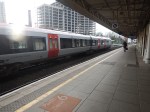
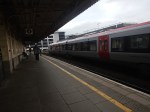
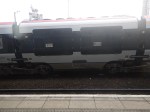
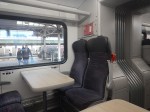
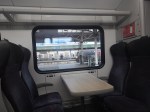
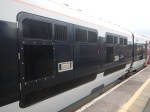
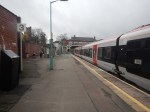
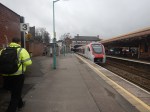
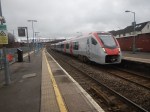
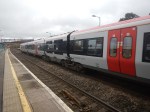
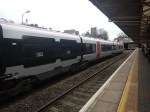
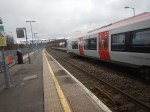
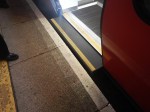
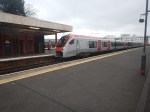
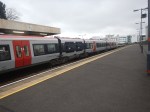
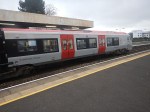
Note.
- The trans were running on the Rhymney Line.
- Like Greater Anglia’s Class 755 trains, they have pop-out steps and a PowerPack in the middle.
- The trains didn’t appear to be using their pantographs to run on electric, where it existed.
They were very similar to the Class 755 train.
Gatwick Airport – 23rd November 2023
I went to Gatwick Airport to see the new railway station.

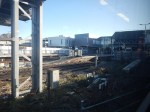
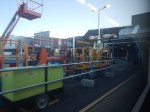
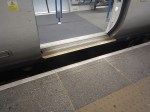
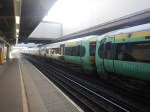
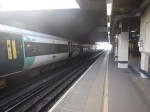
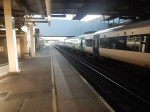
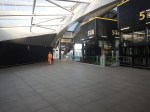
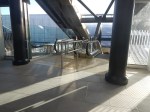
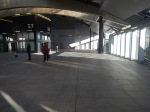
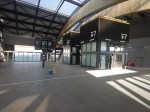
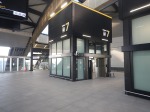
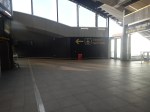
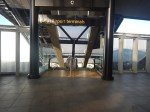
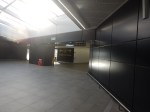



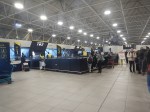

Note.
- As at Reading and Leeds stations, space has been created by building a wide concourse over the tracks.
- The experience certainly seemed better.
- Most platforms have up and down escalators and lifts.
- There were still a few things that needed to be finished.
But for me, as a man with a Freedom Pass and a Senior Railcard, the ticketing to Gatwick is still a pain.
- If I go to Heathrow or London City, I use my Freedom Pass to get to the Airport.
- If I go to Eurostar, I use my Freedom Pass to get to St. Pancras station.
- If I go to Stansted, I use my Freedom Pass to get to Liverpool Street station and buy a ticket for Stanstead Express.
If I go to Gatwick, Luton or Southend airports, I use my Freedom Pass to get to a station with a Booking Office and then buy an extension ticket from the Zone 6 boundary to the airport.
I believe there are three solutions.
Make It Possible To Link A Bank Card To A Freedom Pass
It should be possible to do something like the following.
- Touch in at Moorgate.
- Take the Elizabeth Line to Farringdon.
- Take Thames to Gatwick Airport.
- Check out at Gatwick Airport.
The credit card associated with the Freedom Pass would then be charged the fee for between the Zone 6 boundary and Gatwick Airport.
The credit card would be entered through the Freedom Pass web site.
On a related matter I believe that the Freedom Pass web site could be a nice little earner for Transport for London, by doing the following.
- Selling rail tickets on a best-priced basis. Savings are to be had by selling tickets for Freedom Pass holders from the Zone 6 boundary.
- Managing Railcards.
- Selling Transport for London merchandise.
Nobody would pay more than they do now, but Transport for London would pick up some commission from selling tickets.
Develop A Flexible App That Works With A Freedom Pass And Phone Payments
Similar to the first option, but the app charges accordingly.
Put Gatwick Airport In Zone 6
The management of Gatwick Airport might like to attract more travellers, so they would pay from the Zone 6 boundary for Freedom Farm users.
Conclusion
I would find the first two options acceptable, providing the charges were no more than now!
Cardiff To Reading In A Class 387 Train
Returning from my trip to Cardiff yesterday, it wasn’t the normal Class 80x train, but a pair of Class 387 trains.
The timings from real time trains, weren’t as bad as some would have expected.
- Cardiff Central – 16.54 – 16:56
- Newport – 17:07 – 17:11
- Bristol Parkway – 17:29 – 17:32
- Swindon – 17:53 – 17:58
- Reading – 18:20 – 18:26
Note.
- The first time is the scheduled time and the second time is the actual time of the Class 387 trains.
- The schedule covers the 109.2 miles in 84 minutes, which is an average speed of 78 mph.
- The Class 387 trains covered the 109.2 miles in 90 minutes, which is an average speed of 72.8 mph.
I also arrived in Reading with three or so minutes to catch the Elizabeth Line train.
Are More Elizabeth Line Services Needed To Reading?
In a couple of instances, I’ve waited at Reading for nearly half-an-hour for an Elizabeth Line train.
Currently.
- The two Elizabeth Line trains take 53 minutes between Reading and Paddington.
- The two Great Western Main Line trains, that serve Didcot Parkway take 37 minutes between Reading and Paddington.
- The Great Western Main Line train, that serve Newbury take 25 minutes between Reading and Paddington.
Perhaps four trains per hour (tph) on the Elizabeth Line would be more convenient?
But services wouldn’t be as fast.
Overground To London Bridge Under Consideration
The title of this post, is the same as that of a short article in the December 2023 Edition of Modern Railways.
This is the text of the article.
Transport for London is considering introducing London Overground services between Crystal Palace and London Bridge to help relieve overcrowding on the Sydenham corridor during the morning peak.
The move is one of two options outlined in a response to Lewisham’s Public Transport Liason Committee meeting on 4 October. The other is operating additional services on the existing route via the East London Line to Dalston Junction/Highbury & Islington. TfL acknowledges the London Bridge service would ‘represent a new routing for London Overground services that would necessitate significant changes to operational arrangements and driver testing’ and therefore further work is required ‘to establish the feasibility and business case for this change.’ There are no timescales for the implementation of either option.
The overcrowding follows the reduction by Govia Thameslink Railway of its Southern service to two trains per hour last September, when it replaced its East Croydon to London Bridge via Forest Hill stopping service with a Victoria to London Bridge via Forest Hill stopping service. In its response to the committee, GTR says the context to these changes is ‘the continued need to respond to the gap between our costs and revenues’, which it says is in the region of £15 million a year, with both demand and revenue having stabilised at around 80 % of pre-pandemic levels. It says its aim is to make ‘the most efficient use of the resources available to us,’ with the Victoria to London Bridge service designed to provide capacity for journeys to both stations’.
GTR says the current service has sufficient capacity and is lightly loaded outside peak times, and that while it will continue to keep passenger and feedback under review an increase from two to four trains per hour would require an increase in funding.
These are my thoughts.
Transport for London’s Long Term Plans
Plans exist to increase the frequency on various London Overground services and this graphic sums up what was planned a few years ago.
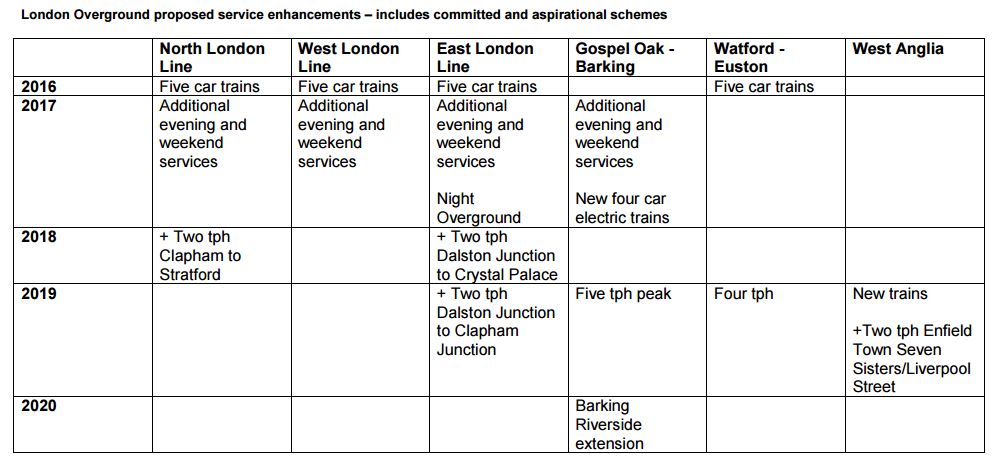
Note the extra two trains per hour (tph) between the following stations.
- Clapham Junction and Stratford
- Dalston Junction and Crystal Palace
- Dalston Junction and Clapham Junction
- Enfield Town and Liverpool St. via Seven Sisters
I think only Route 1 services have been increased.
I know signalling updates are holding up the extra trains on the East London Line, but are more trains needed to fully implement the extra services?
- Routes 2 and 3 services will need Class 378 trains because of the tunnel and these would be transferred from the North London Line.
- Route 4 would need Class 710 trains, as the service already uses them.
So there may be a need for more Class 710 trains.
This plan sees another two trains per hour (tph) running between Dalston Junction and Crystal Palace, which would help to reduce Lewisham’s overcrowding.
Would A London Bridge And Crystal Palace Service Be Easier To Implement?
It looks like the extra Dalston Junction and Crystal Palace services have been held up by two possible reasons.
- The required signalling update on the East London Line, that is needed to increase Crystal Palace and Clapham Junction services has not been performed.
- There are not a sufficient number of Class 378 trains to run the service through the Thames Tunnel. These will be released by running more Class 710 trains on the North London Line.
If two tph were to be run between London Bridge and Crystal Palace, this service would have these advantages.
- The train paths are available.
- The service would not be going through the Thames Tunnel, so the signalling upgrade would not be needed and the trains would not need to be able to evacuate passengers in the tunnel.
- The service could be run by any suitable third-rail trains.
- The service could be run by any length of train, that would fit all the platforms.
I believe the service could be run by eight-car trains to really get a hold on the current overcrowding.
How Many Trains Would Be Needed?
Looking at other services between London Bridge and Crystal Palace, I believe that the journey time would be about 24 minutes.
If the service were run efficiently, I suspect two trains would be needed to provide the required service of two tph.
An eight-car service would required four x four-car trains.
What Trains Could Be Used?
If the numbers are available, then third-rail versions of both London Overground’s Class 378 and Class 710 trains would be suitable.
But this would probably mean a number of Class 710 trains to be manufactured by Alstom. This would not be a short-term solution.
In Liverpool last week, I rode in a Class 319 train and these could be an interesting stop-gap.
- Several will soon be available as West Midlands Trains renews its fleet.
- They are already fitted with third-rail gear.
- They are 100 mph trains.
- Drivers seem to like them.
I believe they could fill in until more Class 710 trains were available.
Crystal Palace Station
This Open RailwayMap shows the platform layout at Crystal Palace station.
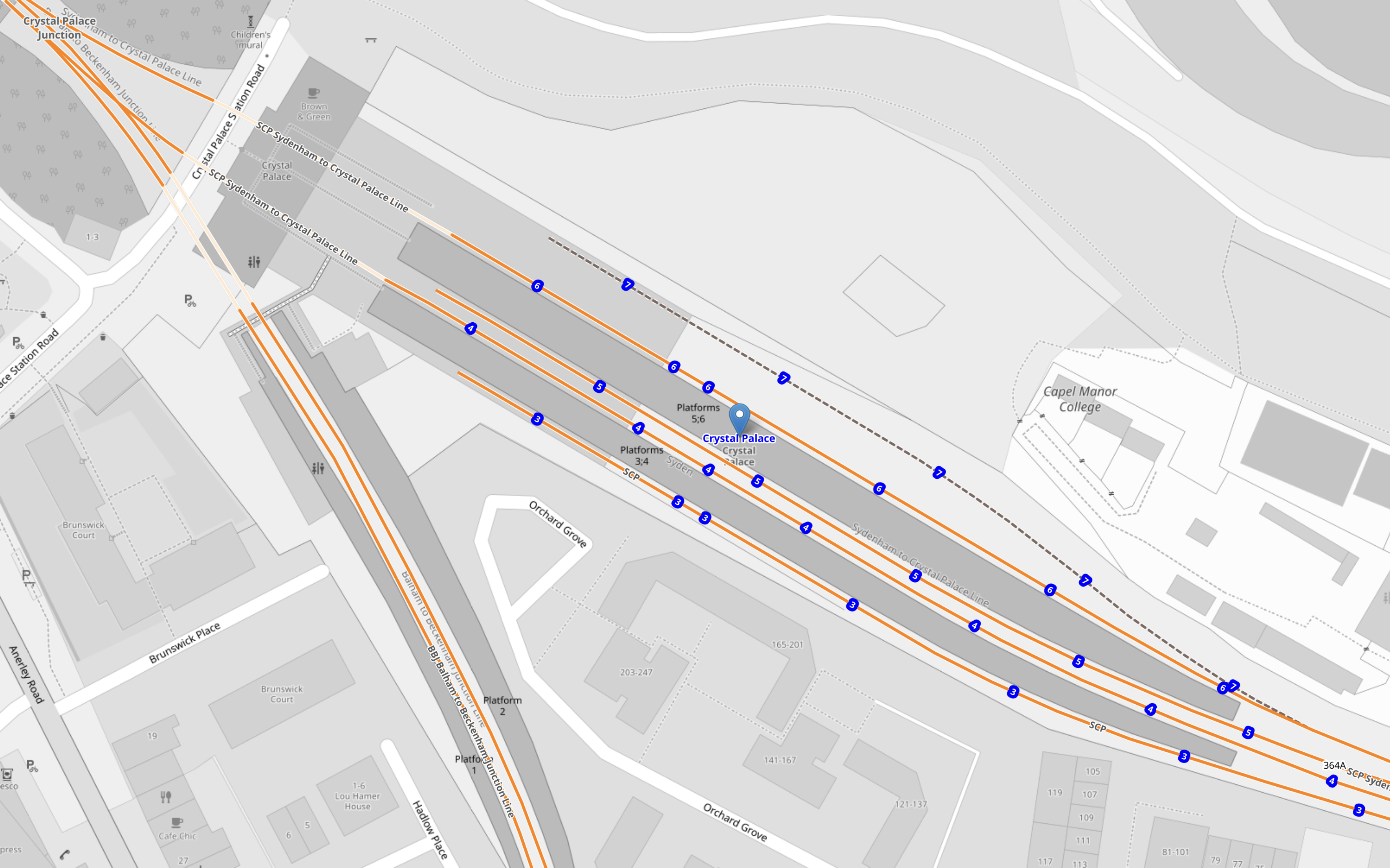
Note.
- Platforms 1 and 2 cross the South-West corner of the map and handle services like London Bridge and Beckenham Junction, London Bridge and London Victoria, and West Croydon services.
- Platform 3 is a little used bay platform, that can terminate trains from the East London Line or London Bridge.
- Platform 4 handles services between London Bridge and London Victoria.
- Platform 5 is a bay platform, that can terminate trains from the East London Line.
- Platform 6 handles services between London Victoria and London Bridge.
- Platform 7 is a disused bay platform.
These pictures show Crystal Palace station.
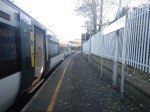
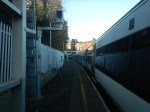
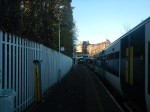
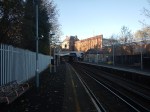
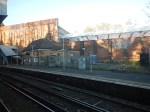
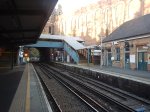
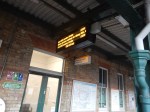
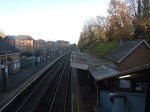
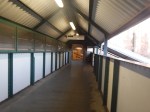
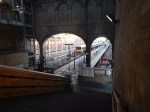
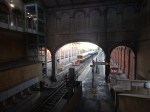
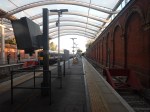
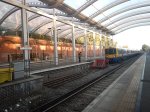
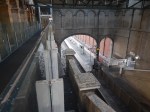
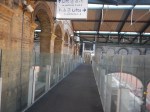

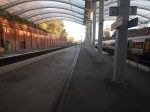
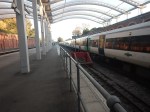

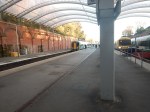
Crystal Palace station has an adequate number of platforms.
Conclusion
A service between London Bridge and Crystal Palace looks to be a sound plan.
Could Extra Passenger-Handling Capacity Be Added At St. Pancras International Station?
This article in Railway Gazette International, which is entitled Start-Up Announces Amsterdam To London And Paris High Speed Train Ambitions, has this opening paragraph.
A proposal to launch high speed train services from Amsterdam to London and from Groningen to Paris has been announced by Dutch start-up Heuro, while Virgin founder Sir Richard Branson is also reported to be looking at competing with Eurostar on cross-Channel routes.
This other paragraph also gives more details of Branson’s plans.
Heuro’s announcement comes after Spanish start-up Evolyn announced plans in October for a Paris – London service, while on November 11 British newspaper The Daily Telegraph reported that Sir Richard Branson and Phil Whittingham, former head of Virgin Trains and Avanti West Coast, were also drawing up plans to compete with Eurostar and had held discussions with infrastructure managers.
As in the past, German and Italian rail companies have expressed interest in running services to London, I don’t think it will be long before capacity at St. Pancras International will need to be increased.
There are six International platforms at St. Pancras International station and as it generally accepted that one well-managed platform can handle four trains per hour (tph), this means that the station has a theoretical limit of twenty-four tph.
Currently, services into St. Pancras International include.
- Up to 19 trains per day between London and Paris.
- Up to 10 trains per day between London and Brussels.
- One train per day between London and Amsterdam.
If we assume that trains can leave between 05:00 and 20:00, that is only about two trains per hour (tph).
There would appear to be plenty of space for the proposed 16 trains per day, that Heuro have said they will run.
My worry is will Customs and Immigration be able to handle all the extra passengers?
This Google Map shows King’s Cross and St. Pancras International stations.
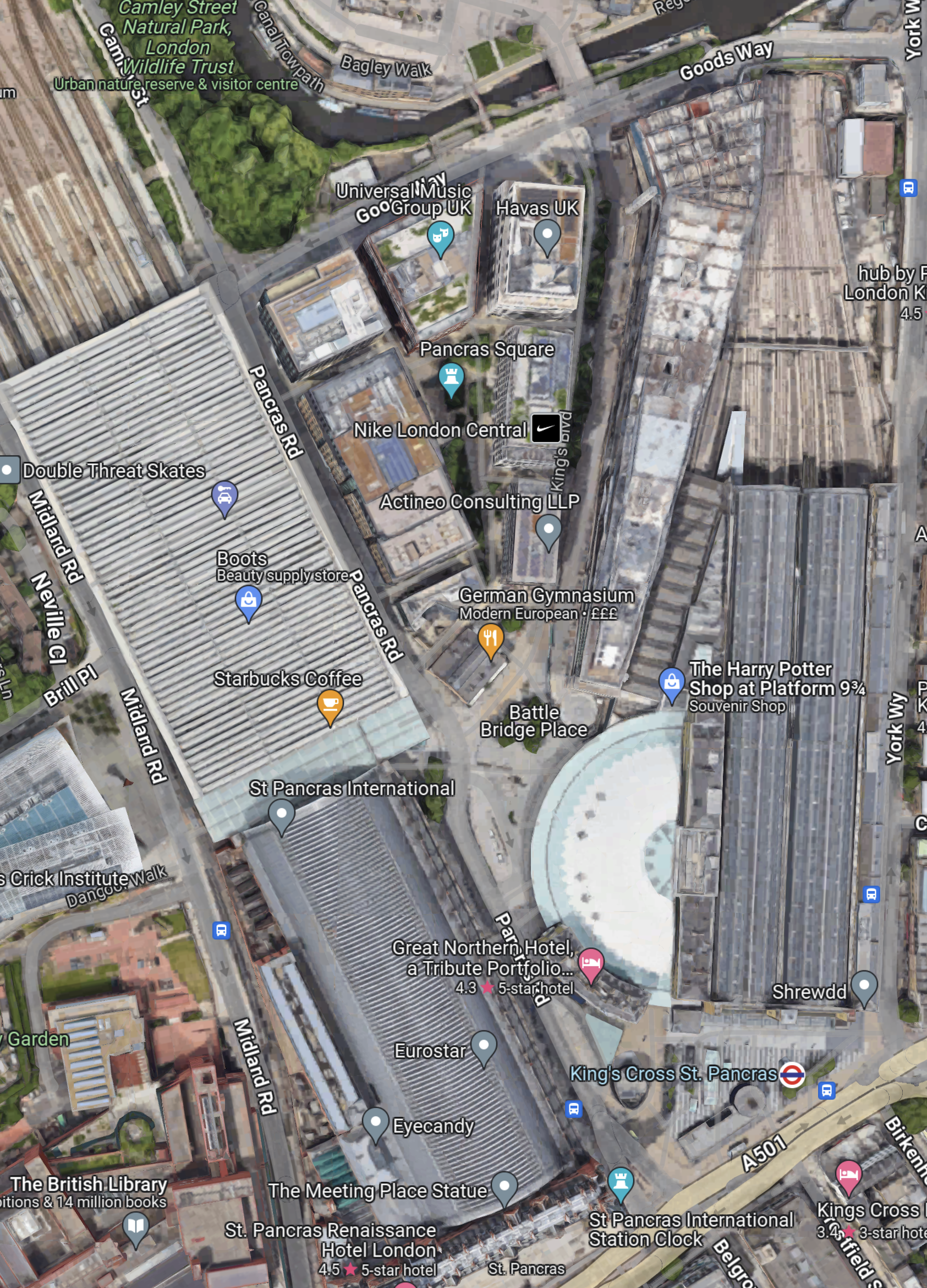
Note.
- St. Pancras International is the station on the left of the V.
- King’s Cross is the station on the right of the V.
- The new corrugated roof covers the Northern ends of the trains in the platforms at St. Pancras.
These pictures show the Northern end of the International and domestic HighSpeed platforms.

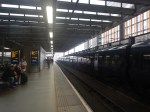
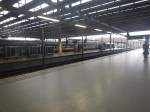
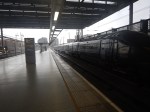



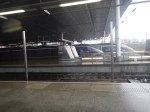
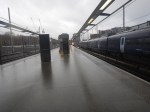
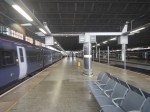
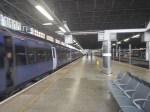
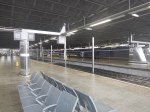
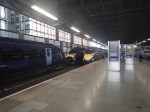



Note.
The pictures taken on the platforms were taken from the Southeastern HighSpeed platforms.
The Continental trains appear to be wholly in the dry either under the classic or the new roof.
The noses of the Continental trains appear to peek out from under the new roof by a few inches.
The air space above the platforms to the North of the new roof appears to be unobstructed.
This Google Map shows the Northern ends of the platforms at St. Pancras.
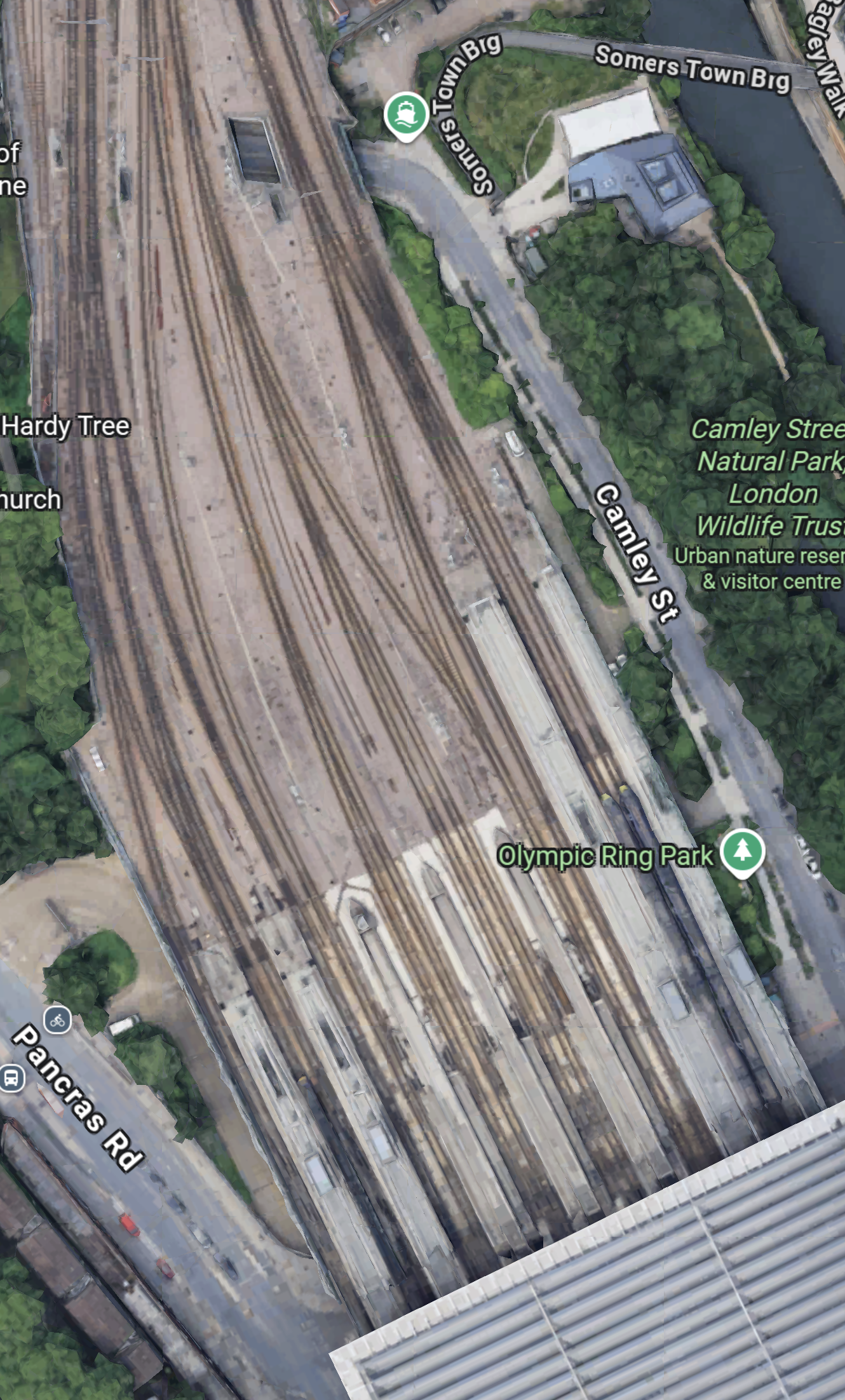
Note.
- The new roof is in the bottom-right of the picture.
- The platforms are numbered 1-13 from left to right.
- Platforms 1-4 are for East Midlands services, which are arranged in a 1-2-1 formation.
- Platforms 5-10 are for Continental services, which are arranged in a 1-2-2-1 formation.
- Platforms 11-13 are for Southeastern HighSpeed services, which are arranges in a 1-1-1 formation.
- Any trains in the station seem to be mainly under cover, although I think a couple of noses are just about visible.
- I am fairly certain, if more passenger-handling capacity were to be needed in the distant future, it could be built above the platforms.
I’ve never seen it said, but did the architects and structural engineers leave this space for future expansion of the station?
- The foundations could have even been designed to support a future vertical extension.
- But at least there is nothing of importance in the space above the exposed Northern ends of the station except a few pigeons.
- With two passenger-handling areas, one could be for departures and the other for arrivals.
- Escalators and lifts could give access to the three wide island platforms for Continental traffic.
Was this station designed to be expanded if required?
I also believe that that much of the work to add any new floors above the platforms could be carried out whilst train services were still running.
Alistair Lansley
According to his Wikipedia entry, the architect of the station was Alistair Lansley, who is not a well-known name or a celebrity architect, but an architect from British Rail’s Architect’s Department, who was also lead architect for Stratford and Ebbsfleet International stations.
So did he leave a space for the extension, that he knew from former experience would be needed?
Could A Mega-Station Be Built For The Channel Tunnel?
This article on Railway Gazette International, is entitled Start-Up Announces Amsterdam To London And Paris High Speed Train Ambitions.
It talks about how Dutch start-up; Heuro wants to run fifteen trains per day (tpg) between London and Amsterdam.
The article then has this paragraph, which details other operators, who are wanting to run services between London and the near Continent.
Heuro’s announcement comes after Spanish start-up Evolyn announced plans in October for a Paris – London service, while on November 11 British newspaper The Daily Telegraph reported that Sir Richard Branson and Phil Whittingham, former head of Virgin Trains and Avanti West Coast, were also drawing up plans to compete with Eurostar and had held discussions with infrastructure managers.
This leads me to the conclusion, that there will be a need for more capacity for trains and/or passengers at some time in the future.
- There are six International platforms at St. Panvcras International station, which can each probably handle four trains per hour (tph), so I suspect the station could handle 24 International tph.
- As a modern high speed train can carry over 500 passengers, that is 12000 passengers per hour.
- Visit St. Pancras station in the morning and it is often crammed with travellers coming from and going to Europe.
I suspect that the number of trains may not be a problem, but the number of passengers will.
We could always join Shengen, but then that would be an open door to all the would-be migrants to the UK.
This Google Map shows Stratford International station.
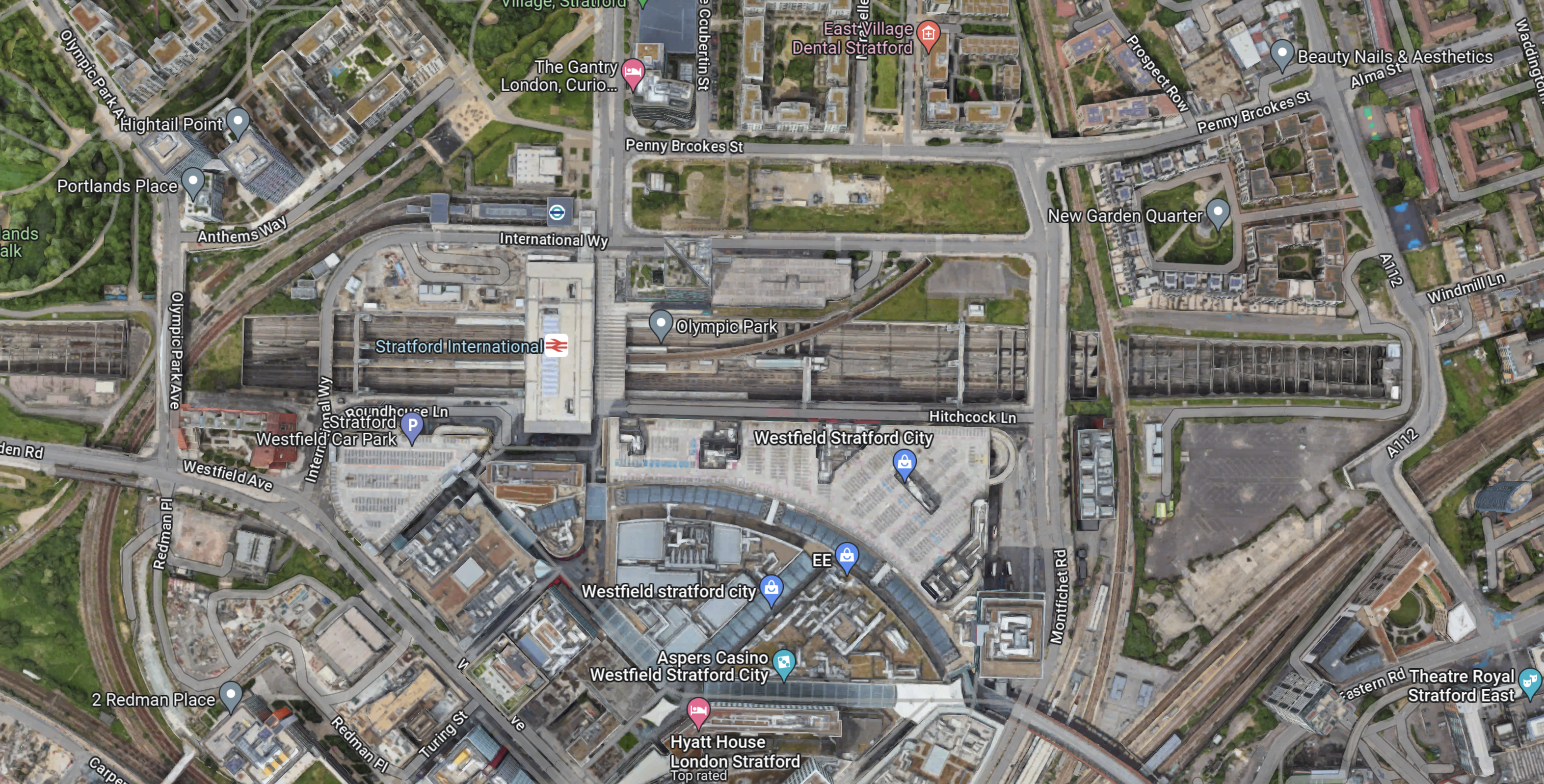
Stratford International station is in a soulless concrete cavern, that lies across the middle of the map.
In Platforms 1 And 4 At Stratford International Station, there are a lot of pictures of the station.
I think it would be extremely difficult to add extra platforms and passenger facilities to the station.
This Google Map shows Ebbsfleet International station.
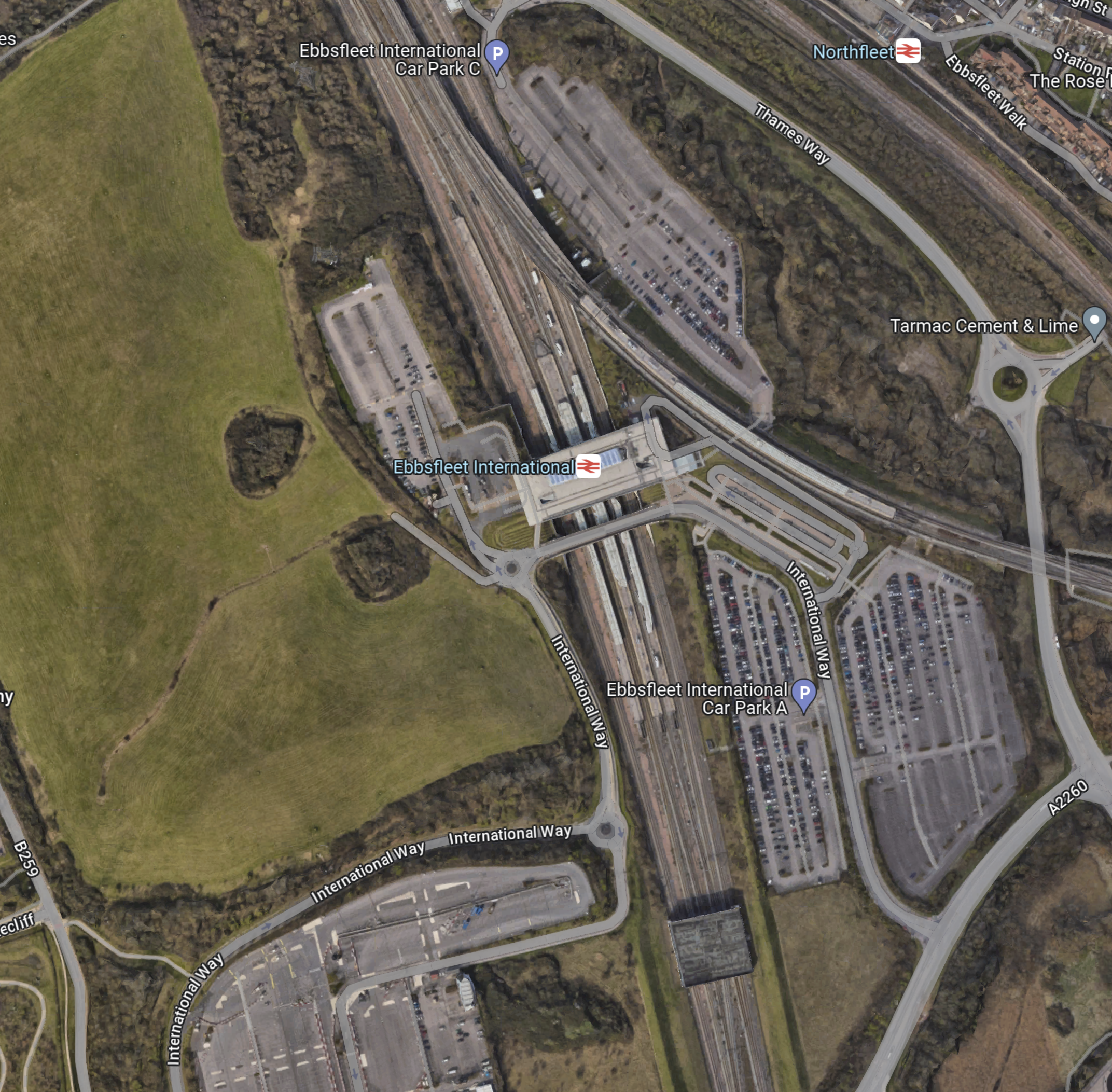
Note.
- Ebbsfleet International station, with its two International and four domestic platforms is in the middle of the map.
- The station is surrounded by car parks with a total of 5,000 spaces.
- Northfleet station is in the North-East corner of the map.
There is a lot of land, without any buildings on it.
These are my thoughts.
Enough Extra Bay Platforms To Handle The Additional Trains
There would appear to be space for perhaps two bay platforms to terminate trains.
But would passengers we happy being dumped outside Central London?
Would An Elizabeth Line Extension To Ebbsfleet Be Needed?
There are various plans to link the Elizabeth Line tp Ebbsfleet International.
In Elizabeth Line To Ebbsfleet Extension Could Cost £3.2 Billion, I showed this map from the Abbeywood2Ebbsfleet consultation.
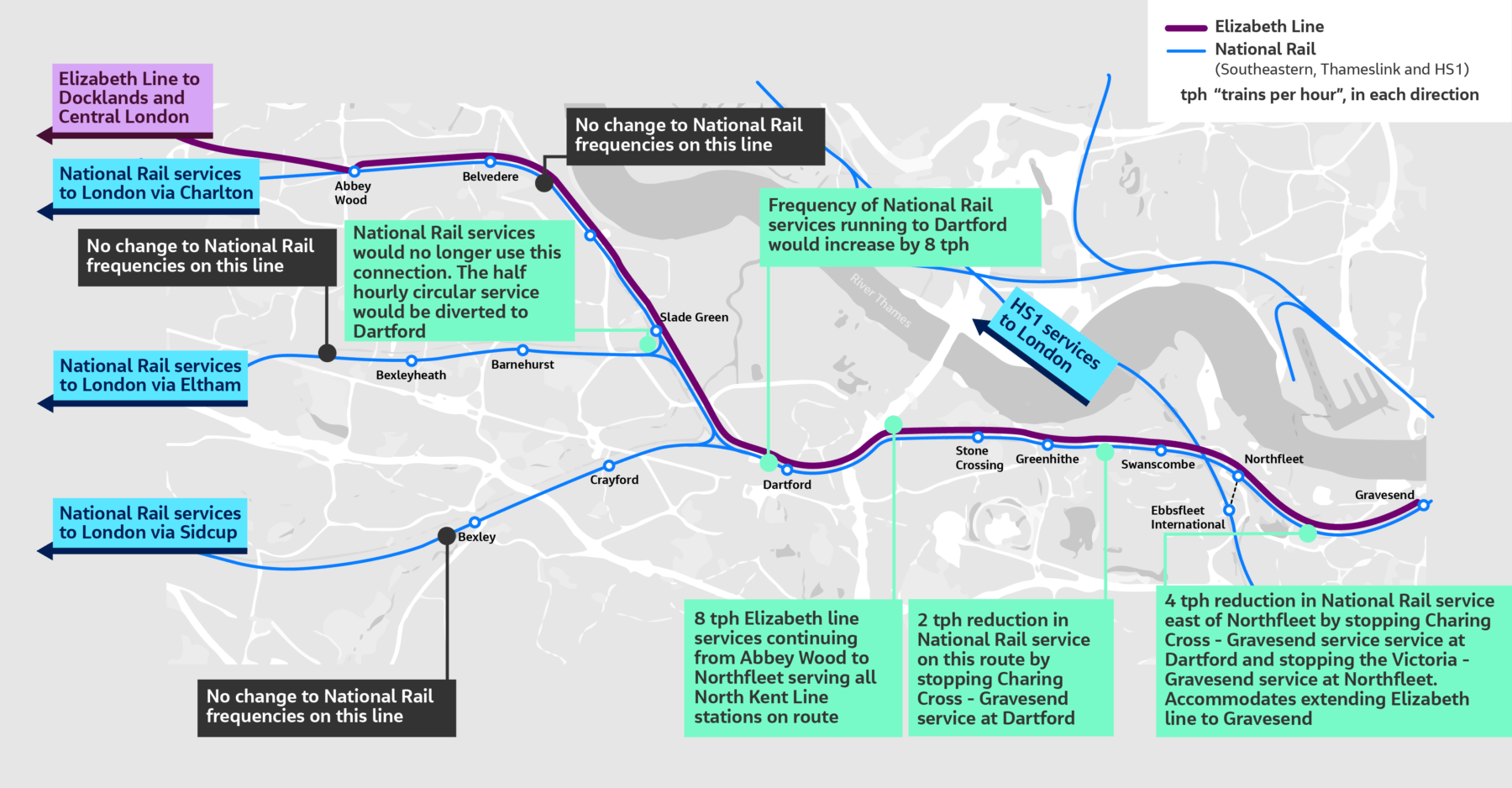
There doesn’t appear to be too much new infrastructure, except for a proper connection between Northfleet and Ebbsfleet stations. References on the Internet, say that the similar-sized Luton DART connection at Luton Airport, cost around £225 million.
The Elizabeth Line connects to the following.
- Bond Street
- Canary Wharf
- City of London
- Farringdon for Thameslink
- Heathrow Airport
- Old Oak Common for High Speed Two
- Liverpool Street station
- Oxford Street
- Paddington station
- Slough for Windsor
- Tottenham Court Road for the British Museum, Oxford Street, Soho, Theatreland and the Underground.
- West End of London
- Whitechapel for the Overground and Underground
For many people like me, the Elizabeth Line at Ebbsfleet will provide one of the quickest ways to get to and from European trains.
Ebbsfleet Has Space For A Bus Station
A bus station with comprehensive routes could be built at Ebbsfleet station, which I don’t think will be possible at St. Pancras.
It would also be possible to provide an easy route to Gatwick Airport along the M25.
Hotel Accommodation
This is surely necessary.
It would make an ideal base for tourists and business people, who wanted to visit several of the large cities connected to Ebbsfleet.
A Very Large Car Park
Consider.
- Heathrow Airport is looking at providing upwards of 50,000 car parking spaces.
- Some travellers are seriously allergic to public transport and will always use their car.
- Many travellers these days want to take a severely outside case with them, when they’re only having a weekend in Paris.
I feel that a mega-station for Europe will need upwards of 10,000 car parking spaces. All of them with vehicle-to-grid chargers.
A Very Large Storage Battery
According to this page on the E-on web site, the average size of the battery in an electric vehicle is 40 kWh.
If 5,000 car parking spaces were to be fitted with vehicle-to-grid charging (V2G), that would be 2 MWh of energy storage, that could be used by National Grid, to store surplus electricity.
Get V2G right and it could make a serious contribution to your parking costs.
Pictures Of Ebbsfleet Station
These are some pictures I took at Ebbsfleet station today.
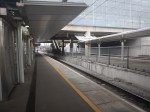


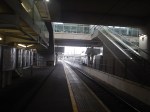







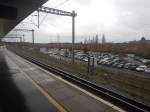
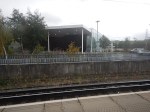
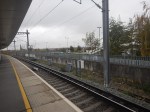

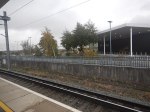
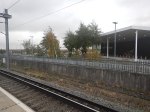
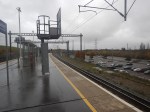
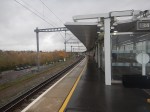
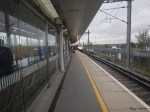
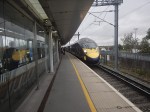
Note.
- The station is a fairly boring concrete, glass and steel construction.
- The SouthEastern HighSpeed services also go to St. Pancras, so they don’t offer any different connectivity towards the capital.
In addition, the SouthEastern HighSpeed Class 395 trains aren’t step-free at the platforms, as these pictures shows.
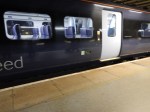
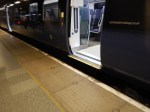
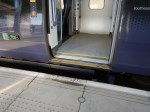
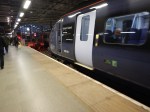
As I came back into St. Pancras International station, staff were struggling to load a wheelchair onto a train using a ramp.
Would A Two-Station Solution Increase Capacity?
High Speed Rail lines have high capacity trains and there are examples of more than one station at the end of a route.
- The London end of High Speed Two will have stations at Old Oak Common and Euston.
- The Manchester end of High Speed Two will have stations at Manchester Airport and Manchester Piccadilly.
- The Edinburgh end of the East Coast Main Line has stations at Waverley and Haymarket.
- The Amsterdam end of Eurostar and Thalys has stations at Rotterdam, Schipol Airport and Amsterdam.
A selection of stations gives choice and convenience for travellers.
Conclusion
I believe that selective development of Ebbsfleet International station could be used to take the pressure away from St. Pancras International station.
These developments could include.
- A comprehensive bus station
- Elizabeth Line to Northfleet
- Hotel Accommodation
- Lots Of Car Parking
Wisbech To March Rail Link Options Being Discussed
The title of this post, is the same as that of this article on the BBC.
This is the sub-heading.
Four options for a “rail” service between the Fenland towns of Wisbech and March are being considered by Network Rail.
These four options appear to be.
- Conventional rail
- Tram-train
- Light rail
- Very light rail
Note.
- I suspect all modes have their supporters.
- But only the first two options would be able to connect to Ely or Cambridge.
- The last two options would probably just be a shuttle to March.
I have looked at the route on OpenRailwayMap and there is no less than a dozen level crossings between March and Wisbech.
Even for very light rail, the engineering costs of these level crossings will be large.
Conclusion
I have a feeling that the costs of the engineering required for this scheme might kill it.
Europe’s Next High-Speed Train Operator
I was alerted to Heuro Train, by this article in Railway Gazette International, which has this opening paragraph.
A proposal to launch high speed train services from Amsterdam to London and from Groningen to Paris has been announced by Dutch start-up Heuro, while Virgin founder Sir Richard Branson is also reported to be looking at competing with Eurostar on cross-Channel routes.
The Heuro Train web site was easily found and the title of this post, was part of their mission statement on the home page.
I have read the web site and have a few initial thoughts.
Technology-Driven Excellence
This is their first sub heading and this is the text.
In a world where technology defines possibilities, Heuro develops the latest innovations into every aspect of our service. From advanced train systems to intuitive in-seat features that cater to your needs, our technology is the driving force behind a seamless, state-of-the-art travel experience.
We’ve all written things like that in the past.
Meeting The Human Need
This is their second sub heading and this is the text.
Heuro emerged from human desires, informed by analyses from Marveltest.
There’s been a 32% annual increase in online interest for train travel over five years. High-Speed Trains are 98% full at peak times. Over half of Europeans prefer train travel under 2 hours as a greener option. Introducing High-Speed Operators in train monopolies boosts demand by 45%.
They appear to have done their research and those are interesting figures.
Lightning Speed Connectivity
This is their third sub heading and this is the text.
In our digital age, both work and leisure have found a substantial home on the internet for urban humans. Whether sealing a business deal, streaming a favorite show, or connecting with loved ones, online interactions have become integral to our daily lives. At Heuro, we don’t just commit—we guarantee the best internet experience.
This is actually irrelevant these days, as there will be a high standard of Internet experience on all modes of transport in a few years, although some will get it earlier than others.
Planned Routes
This is their sixth sub heading and this is the text.
We will connect Amsterdam with Brussels, Paris, and London with intermediate stops at Schiphol Airport, Rotterdam Central, Antwerp Central & complimentary services to Groningen, Assen, Zwolle and Almere (continuing to Paris, 2 times per day)
This route map is shown.
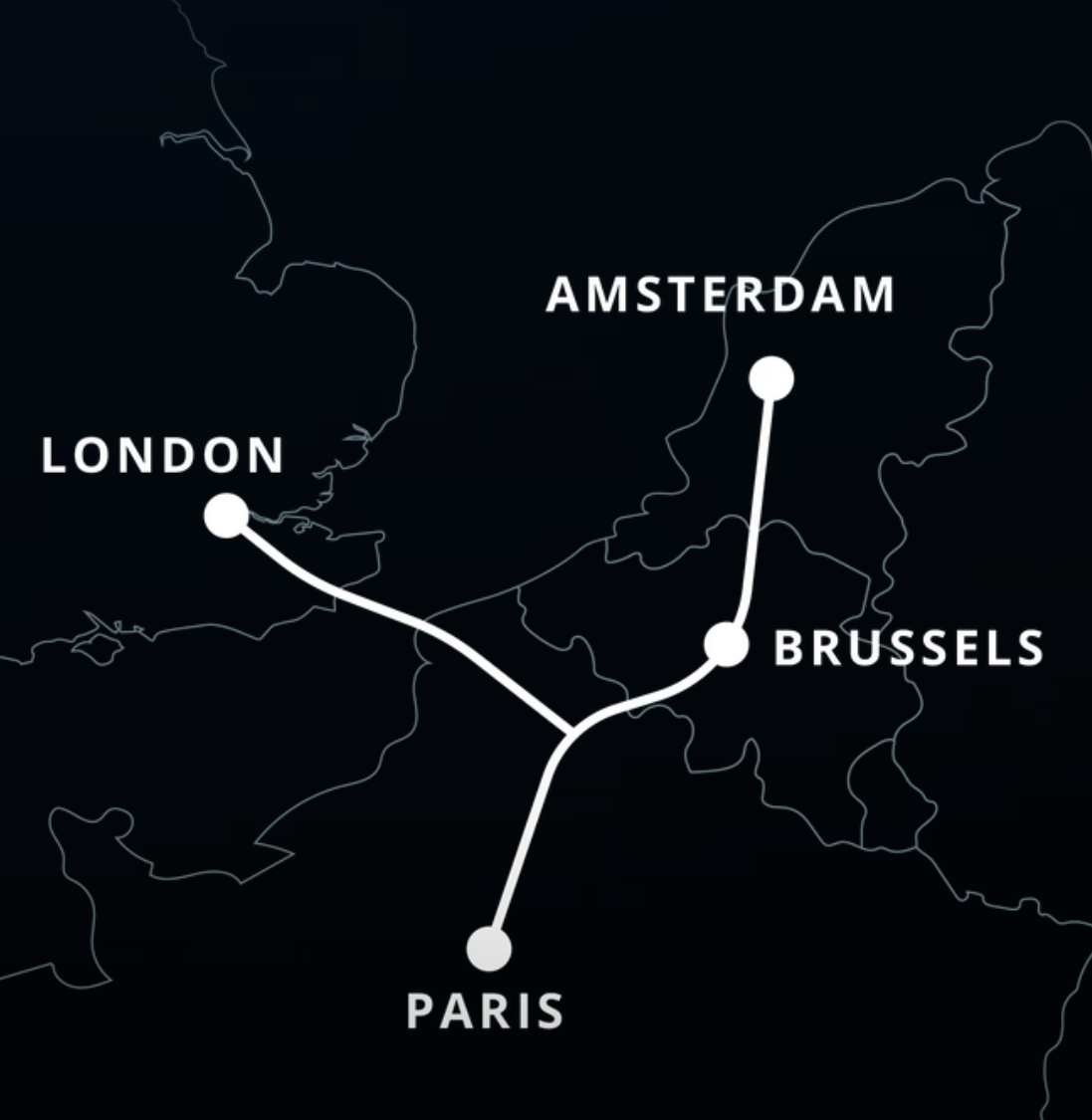
Note.
- It is not a large network.
- It makes a lot of use of the Dutch high speed line; HSL-Zuid, that runs between Amsterdam and the Belgian border.
- I suspect it has been designed to be extended.
The Railway Gazette Article has these two paragraphs, which give more information on services and Heuro’s thinking.
On November 15 Heuro told Railway Gazette International that it aims to launch in 2028, offering 16 Amsterdam – Paris and 15 Amsterdam – London trains each day with intermediate stops at Schiphol Airport, Rotterdam Centraal, Antwerpen Centraal and Brussels. Two of the Paris trains would run to and from Groningen via Assen, Zwolle and Almere.
The company said ‘every day, 55 planes fly from Amsterdam to London, while only four trains make this journey. Heuro intends to change that, aiming for more trains to depart from Amsterdam than flights’.
With other train companies wanting to serve London, will St. Pancras International be able to incorporate another fifteen trains per day from Amsterdam?
Web Site Language
Everything is in English! It also appears to be English English.
Les français ne seront pas amusés.
Extensions From London
Much of Central and Eastern England, and Eastern Scotland can be reached from St. Pancras International station, by a hundred metre walk to change platforms.
There is even a signed walking route between St. Pancras International and Euston stations, that isn’t the most arduous of walks.
The St. Pancras International and Euston stations connection could also be handled by a frequent electric shuttle bus.
Extensions From Amsterdam
Heuro are already indicating their intention to extend to Almere, Zwolle, Assen and Groningen.
I have taken that route and extended it via Leer, Oldenburg and Bremen to Hamburg.
Could this be in Heuro’s long term thinking?
Extensions From Paris
The French probably have ideas.
Conclusion
I like Heuro’s philosophy and starter kit.
Are LNER Going To Take On The Airlines?
Nine years ago, I wrote Edinburgh – Plane Or Train?, after a trip to Scotland, where I took easyJet up and came back in First Class by train.
- Both trips were about five hours door-to-door.
- The flight was about six quid more,
- But I got free food and drink on the train.
- Security on the plane was a pain.
- I had to take my passport for identification at Stansted.
I haven’t flown internally in Great Britain since, although, I have flown to Belfast.
For shorter flights the market is going towards rail, as these posts seem to suggest.
- 2.7M Tonnes Of Co2 Could Be Saved Per Year If UK Domestic Flights Went Electric
- Air Travellers To Be Hit By Carbon Charge On All Tickets
- Climate Change ‘May Curb Growth In UK Flying’
- France Bans Short-Haul Flights To Cut Carbon Emissions
- KLM Replaces Plane With High Speed Train
- Lumo Carbon Data Shows Its Trains Are 22 Times Greener Than Flying
- Next Time I’ll Go By Train
- Ryanair One Of Europe’s Top Polluters, EU Data Suggests
- Stop Taking Internal Flights And Go Green, Says Lib Dem Contender Davey
The climate seems to be turning against flying short-haul.
This is a paragraph, in this press release from LNER, which is entitled First Tri-Mode Long Distance Trains For The East Coast Main Line.
This new fleet of trains will keep LNER on track to reduce its emissions by 67 per cent by 2035 and be net zero by 2045. LNER has already reduced carbon emissions by 50 per cent compared with 2018/19. Per mile, LNER trains produce 15 times less carbon emissions than a domestic flight.
Are LNER building a number of climate-based sticks, with which to beat the airlines on the routes, where they compete?
These are my thoughts on the various routes, where LNER compete with airlines.
Newcastle
Newcastle is an interesting one.
- Newcastle station is in the city centre and is on the Tyne and Wear Metro.
- London King’s Cross is one of London’s major Underground hubs.
- There are lots of buses and local trains within walking distance of both stations.
- There are three trains every two hours and an additional eight trains per day (tpd) between the two London King’s Cross and Newcastle stations.
- Lumo also run five tpd on the route.
- There are generally no security delays at rail stations.
- London King’s Cross is laid out to maximise passenger flows. If it gets busy, everybody just walks out into King’s Cross Square.
- I’ve never had a problem at Newcastle station with overcrowding.
Perhaps, if you live near one of the airports, flying is more convenient.
LNER’s weapons against the airlines between London King’s Cross and Newcastle will be convenience and journey times.
Convenience is all about the location of the stations, their excellent local transport networks and good walking routes around the station.
Journey times will only get better, as the magic of digital in-cab signalling, allows the Azumas, the new CAF tri-mode long distance trains and the few remaining InterCity 225s to show what they were designed to do.
Dalton-on-Tees, where the first phase of the digitally signalling will end, is 39.8 miles South of Newcastle, so once the Newcastle train is passes Dalton-on-Tees on the East Coast Main Line, it will be a digital-signalled electrified railway all the way to Woolmer Green.
- Dalton-on-Tees is 39.8 miles South of Newcastle
- Woolmer Green is 244.8 miles South of Newcastle.
- Dalton-on-Tees and Woolmer Green is 205 miles.
- Newcastle and Dalton-on-Tees takes 37 minutes.
- Woolmer Green and King’s Cross takes 18 minutes
- Trains take typically an average three hours and nine minutes between London and Newcastle.
- A typical train time by LNER between Dalton-on-Tees and Woolmer Green is two hours and 14 minutes.
- This is an average speed of 91.8 mph between Dalton-on-Tees and Woolmer Green.
- Between London King’s Cross and Newcastle is fully-electrified.
I can build a table of timings and savings at various average speeds.
- 120 mph – 103 minutes – two hours and 38 minutes – 31 minutes
- 125 mph – 98 minutes – two hours and 33 minutes – 36 minutes
- 130 mph – 95 minutes – two hours and 30 minutes – 39 minutes
- 135 mph – 91 minutes – two hours and 26 minutes – 43 minutes
- 140 mph – 88 minutes – two hours and 23 minutes – 46 minutes
Note.
- The first field is the average speed between Dalton-on-Tees and Woolmer Green.
- The second field is the time between Dalton-on-Tees and Woolmer Green.
- The third field is the time between London and Newcastle.
- The fourth field is the saving over current timings.
- The London and Newcastle time is calculated by adding the times for the three sections together.
I have regularly timed trains at a very constant 125 mph, so with digital signalling, I suspect an average of 130 mph is possible.
This would mean, times of a few minutes under two hours and thirty minutes could be possible between London and Newcastle.
Edinburgh
Edinburgh builds on the improvements South of Newcastle.
Edinburgh station Waverley is a well-connected station.
- There are lots of buses, local trains and the Edinburgh Tram within walking distance of Edinburgh Waverley station.
- There are three trains every two hours and an additional seven tpd between the London King’s Cross and Edinburgh Waverley stations.
- Lumo also run five tpd on the route.
- Trains take typically an average four hours and thirty minutes between London and Edinburgh Waverley.
- Any savings because of the digital in-cab signalling between London and Newcastle can be applied to London and Edinburgh Waverley services.
As my calculations showed that averaging 130 mph between Dalton-on-Tees and Woolmer Green could save 39 minutes on journey times, I am fairly sure than a sub-four hour journey time will be possible between London and Edinburgh Waverley.
It should also be noted that that the power supply has been improved between Newcastle and Edinburgh Waverley.
- The distance between Newcastle and Edinburgh Waverley is 124.2 miles
- Newcastle and Edinburgh Waverley takes around one hour and 30 minutes.
- This is an average speed of 82.8 mph between Newcastle and Edinburgh Waverley.
- Between London King’s Cross and Edinburgh Waverley is fully-electrified.
As the record time for between London King’s Cross and Edinburgh Waverley was set by an InterCity225 train in 1993 at three hours and twenty-nine minutes, I suspect that with more digital signalling and some track improvements, that there are more journey time improvements to be squeezed out.
I certainly believe that a time of three hours and fifty minutes between London and Edinburgh Waverley will be regularly achieved. This is a journey time saving of around forty minutes.
Dundee
Dundee has an airport and a station on the East Coast Main Line.
Trains between London King’s Cross and Dundee take around five hours and 45 minutes.
LNER run three trains per day to and from London King’s Cross and one tpd to and from Leeds.
CrossCountry also run services.
Loganair has two flights per day to Heathrow.
Aberdeen
Aberdeen builds on the improvements South of Edinburgh.
The four direct tpd between London and Aberdeen take around seven hours and ten minutes.
This should come down to around six hours and thirty minutes with the journey time savings between London King’s Cross and Edinburgh Waverley.
Will this tempt travellers from the airlines?
Battery-Electric Trains To Dundee And Aberdeen
One thing that will help, is that Edinburgh and Aberdeen is to be partially electrified.
InPiling Work To Get Underway To Electrify Line To Fife, I included this Network Rail map of the electrification.
This map has been downloaded from the Network Rail web site.
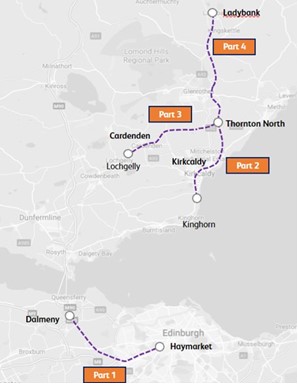
The electrification is split into four phases.
- Haymarket and Dalmeny – 25 km
- Kirkcaldy and Thornton North – 25 km.
- Lochgelly and Thornton North – 20 km.
- Thornton North and Ladybank – 34 km.
Note.
- The last three phases of electrification connect to Thornton North.
- The new rail link to Leven will also be electrified. and connected to Thornton North.
- The Forth Bridge is not to be electrified.
As Ladybank station is just 91.4 miles from Aberdeen, I suspect LNER will use Hitachi Intercity Battery Hybrid Trains to serve Aberdeen.
If these trains haven’t got the range, then I suspect LNER’s new CAF Tri-Mode Trains could handle the route.
Inverness
Inverness has a problem.
Zero-carbon trains will be unlikely to get to the city without full electrification of the Highland Main Line.
- Dunblane is the nearest electrified station to Inverness, but it is 146.2 miles away over a route with lots of steep climbs.
- I doubt that a battery-electric train could handle that route.
One solution would be for LNER to run the new CAF Tri-Mode Trains to Inverness using HVO or biodiesel.
Glasgow
Glasgow is the only other Scottish city with an airport and good rail connections to the South.
I am sure that Avanti West Coast will target airline passengers, if LNER prove it is a successful policy.
Other Factors
These are other factors, that will come into a traveller’s choice.
First Class
Some travellers like a bit more comfort and service.
Ability To Work
Some travellers like to work on a train.
You Don’t Get Tables On a Plane
I like to open a paper or magazine flat, which is difficult on a plane.
Views Tend To Be Better On a Train
Providing you get a window!
Parking Tends To Be Better At An Airport
But it may be more expensive!
Security Is Less Hassle On A Train
At the moment!
You Don’t Need To Prove Your Identity On A Train
Not in the UK! Yet!
Conclusion
It looks like LNER can offer the airlines to four of our major Northern cities serious zero-carbon competition.
Rail-Replacement Helicopter Service Takes Off
The title of this post, is the same as that of this article on Railway Gazette International.
These paragraphs give the story.
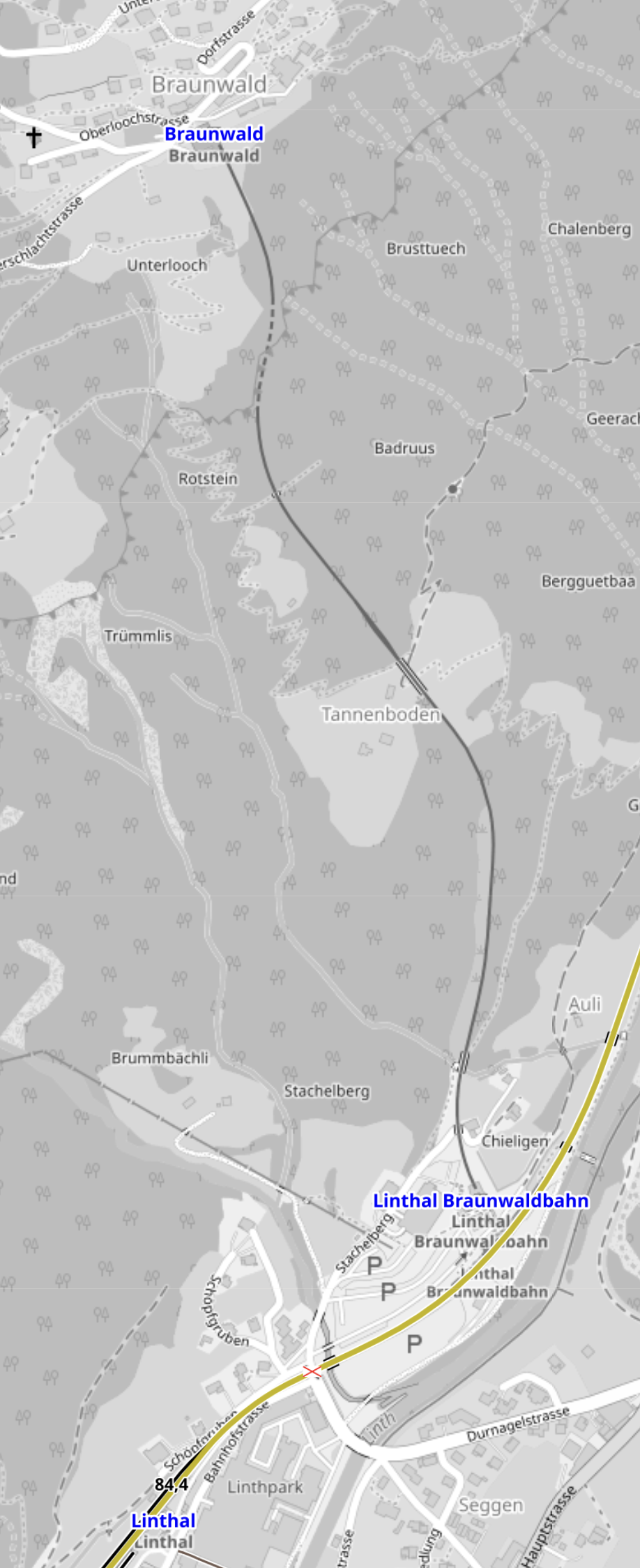
A rail-replacement helicopter service is being offered while the Braunwaldbahn funicular is closed for maintenance.
Services are suspended from November 6 to 17 on the 1 367 m long metre gauge funicular, which climbs 580 m to connect Linthal with the car-free village of Braunwald.
There are four seats available on each 2 min helicopter flight, with local residents, workers and students having priority over tourists.
The story has appeared in the Daily Express and there is this excellent and entertaining YouTube video.
This OpenRailwayMap shows the Braunwaldbahn funicular and its connection to the railway at Linthal.
It sounds like fun!
 The Anonymous Widower