Spotlight On The IVECO E-WAY H2: Less Weight, 15% More Passenger Capacity
The title of this post, is the same as that of this article on Sustainable Bus.
This is the sub-heading.
Up to seven time less batteries than a BEV bus (one module instead of 7), with 15% more passengers. These are the specifications mostly stressed by IVECO BUS when outlining the features of IVECO BUS E-WAY H2, presented at Busworld 2023 in Brussels. The bus model derives directly from the E-WAY BEV bus model
Note.
- The hydrogen fuel cell technology is from Hyundai.
- The bus is designed to be lighter in weight, which increases passenger capacity from 93 to 111 and gives an enhanced range.
- The driveline is from Accelera by Cummins, with a Siemens electric motor.
- IVECO provide the front axle and ZF the rear.
- Surprisingly, the bus is assembled from stainless steel panels, onto a steel floor.
It strikes me, that if the late great Colin Chapman had designed a bus, it would follow some of IVECO’s design.
Conclusion
This bus could set the standard for hydrogen-powered buses.
I particularly liked the saving in lithium compared to an electric bus.
Global Offshore Wind To Top 520 GW By 2040, Floating Wind To Play Major Role – Rystad Energy
The title of this post, is the same as that of this article on offshoreWIND.biz.
This is the sub-heading.
According to Rystad Energy, global offshore wind capacity will surpass 520 GW by 2040, with floating wind installations nearing 90 GW by that time
These are the first three paragraphs.
In 2023, the offshore wind sector saw a seven per cent increase in new capacity additions compared to the previous year, said Rystad Energy. This momentum is expected to accelerate this year, with new capacity additions expected to grow by nine per cent to over 11 GW by the end of the year.
By 2040, Europe is expected to account for more than 70 per cent of global floating wind installations. Although some project delays beyond 2030 are anticipated, there will likely be a strong push to accelerate deployment, according to Rystad Energy.
As a result, floating wind capacity is projected to approach 90 GW by 2040, led by the UK, France, and Portugal, with Asia (excluding mainland China) expected to account for 20 per cent of global installations.
Note, that Rystad Energy is an independent energy research and business intelligence company headquartered in Oslo, Norway.
Implications For Energy Storage
In Grid Powers Up With One Of Europe’s Biggest Battery Storage Sites, I talk about how the 2.9 GW Hornsea Three wind farm will have a connection to the grid, that incorporates a 300 MW/600 MWh battery.
With 520 GW of offshore wind to be installed by 2040, I suspect that energy storage companies and funds will do well.
If the 520 GW of offshore wind were fitted with batteries like the 2.9 GW Hornsea Three wind farm, there would be a need for around 60 GW of battery output, with a capacity of around 120 GWh.
I doubt, there would be enough lithium for all those batteries.
Some countries like Norway, the United States, Australia, France, Spain, Japan, India, China and others will be able to develop large pumped storage hydroelectricity systems, but others will have to rely on newer, developing technologies.
The UK will be well-placed with around 80 GWh of pumped storage hydroelectricity under development and several promising developing storage technologies.
Was I One Of The First To Have My Temperature Measured By A Thermometer Reading The Radiation From My Ear?
Last week, a doctor read my body temperature, by using an electronic thermometer, that read the temperature inside my ear.
But it wasn’t the first time!
That must have been in 1968 or 1969, when I was working at ICI in Runcorn.
ICI had a problem, in that they needed to read the temperature of chemical reaction vessels.
- Temperatures could be higher, than 1,000 °C.
- Some mixtures could be highly corrosive.
- Safety needed to be as high as possible.
My colleague; John Baxendale was assigned the problem.
John came up with a solution based on black bodies and their unique black body radiation.
These two paragraphs, from the Wikipedia entry for black body, explain the principle.
A black body or is an idealised physical body that absorbs all incident electromagnetic radiation, regardless of frequency or angle of incidence. The radiation emitted by a black body in thermal equilibrium with its environment is called black-body radiation. The name “black body” is given because it absorbs all colours of light. In contrast, a white body is one with a “rough surface that reflects all incident rays completely and uniformly in all directions.”
A black body in thermal equilibrium (that is, at a constant temperature) emits electromagnetic black-body radiation. The radiation is emitted according to Planck’s law, meaning that it has a spectrum that is determined by the temperature alone, not by the body’s shape or composition.
Note, that I have very mildly edited, what Wikipedia says, to the King’s English.
John had developed some clever electronics, that read the spectrum of the radiation and by decoding the spectrum, he was able to calculate the temperature.
Early on in the testing, John found that nearly all of us, have two black bodies on the side of our heads; our ears, so he could measure the temperature inside them.
City Airport May Help Others To Take Flight
The title of this post, is the same as that of this article on The Times.
This is the sub-heading.
The government’s decision to lift the cap on permitted passengers at London City airport is a compromise that could be a template for future growth
These are the first two paragraphs.
Planning decisions always upset someone. Still, credit to housing secretary Angela Rayner and the transport supremo Louise Haigh for annoying all sides with one of the first from the new Labour government: allowing London City airport to lift its cap on permitted passengers a year to nine million from the present 6.5 million.
Their verdict hacked off Newham council, which has long opposed the airport’s expansion, leaving it “deeply concerned” over the noise impact on local residents. It angered environmental campaigners, with Greenpeace saying it’d “undermine the UK’s climate leadership”. And it even “disappointed” the airport’s boss, Alison FitzGerald, who wanted an end to the 24-hour flight curfew from 12.30pm on Saturday but failed to get it pushed out to 6.30pm.
The government seem to have chosen a good compromise that has annoyed several parties.
The article goes on to argue, that we should make the best use of the thirty regional airports in the UK.
So shouldn’t the priority be to utilise regional capacity better, via airline and airport incentives if necessary, to minimise journey times to airports and spread the noise and air pollution around? Only then should ministers consider big new projects.
That seems very sensible to me.
Consider.
- Technology will bring us quieter and more environmentally-friendly aircraft, that will benefit those near the airport.
- Electric aircraft are closer to service entry than you think.
- Good public transport links to an airport, would surely cut car usage for both passengers and employees.
- Bus networks to many airports could be improved and made more attractive to passengers, by using modern electric or hydrogen buses. Even Gatwick is taking this route!
- Cranbrook station and Exeter Airport were supposed to have a bus link, but nothing has happened.
- Several airports are near main railway lines and it would be possible to build a station. It will be interesting to see how passenger traffic at the new Inverness station develops.
- East Midlands, Edinburgh, Glasgow, Leeds/Bradford and Liverpool Airports are larger regional airports, that are close, but not directly connected to the rail network.
- Carlisle and Exeter Airports don’t have the best of websites. Humberside sets a good standard.
- Doncaster Sheffield Airport has everything except a rail link and scheduled services.
Some of these improvements are not major and would surely be worthwhile, especially with a small amount of compromise.
Funding Awarded For Study On Hydrogen Storage Potential In The East Midlands
The title of this post, is the same as that of this article on the British Geological Survey.
This is the sub-heading.
A new study has been awarded funding to explore the underground hydrogen storage potential in the East Midlands.
These are the first three paragraphs.
East Midlands Storage (EMstor), a consortium led by Cadent and partnered with BGS, Star Energy Group, Net Zero Strategy and the University of Edinburgh, has been awarded discovery funding by Ofgem’s Strategic Innovation Fund to undertake a new study to evaluate geological storage potential in the East Midlands.
The EMstor study is the first of its kind in the region. It will undertake a feasibility assessment of the East Midlands’ geology to evaluate its potential to host storage technologies, allowing expansion of Cadent’s proposed 100 per cent hydrogen pipeline.
The East Midlands has numerous depleted oil reservoirs, which may have potential to store hydrogen. The study will characterise the potential geological reservoir to establish if it is suitable for hydrogen storage at scale in the local area.
The oilfields of the East Midlands Oil Province have their own Wikipedia entry, which gives full details of the dozens of small oil fields in the area.
- It may not be the world’s largest oil resource, but it certainly helped us during the Second World War.
- Experienced Texan oil-men were even imported, to help boost production.
- It used to be possible to spot the occasional lonely nodding donkey, as you passed through the area.
Surely, if some of the oilfields can be converted to hydrogen stores, this would be very useful.
London And Edinburgh By Lumo Using the Joint Line Diversion
This press release on the First Group web site is entitled FirstGroup Applies To Run Rochdale To London Rail Service With New British-Built Trains.
These are the first two paragraphs.
FirstGroup plc, the leading private sector transport operator, has submitted the first phase of an application for a new open access rail service between Rochdale and London to the Office of Rail and Road (ORR), restoring this direct link for the first time in almost a quarter of a century.
FirstGroup plans to expand its open access rail operations as part of its successful Lumo business, building on Lumo’s existing service which has transformed long-distance connectivity between London and Edinburgh and helped support a growth in passenger numbers for all operators on the East Coast Mainline. All of the trains on this new route will be electric and battery powered, and the service will be operated by brand new trains built in the UK.
Note.
- This service will be run under the Lumo brand.
- Battery-electric trains will be used.
- Stops will include Manchester Victoria, Eccles, Newton-le-Willows and Warrington Bank Quay.
- Only 15 km. of the route, between Miles Platting and Rochdale is not electrified.
Allowing for out and back trips between Platting and Rochdale, a sensible reserve and I suspect a battery-electric train with a range of 40-50 kilometres, would allow the train to be able to do a round trip to Rochdale from London Euston.
Hitachi have now published this page on their web site, which is entitled Intercity Battery Trains.
These are the first two paragraphs.
A quick and easy application of battery technology is to install it on existing or future Hitachi intercity trains. Hitachi Rail’s modular design means this can be done without the need to re-engineer or rebuild the train and return them to service as quickly as possible for passengers.
Replacing one diesel engine with just one battery reduces emissions by more than 20% and offers cost savings of 20-30%. Our intercity battery powered trains can cover 70km on non-electrified routes, operating at intercity speeds at the same or increased performance.
It would appear that Hitachi’s standard Intercity Battery Train will have a range of 70 km.
- A 70 km. range would be more than enough to handle Lumo’s Euston and Rochdale service.
- Lumo’s Class 803 trains don’t have a diesel generator to replace.
- One car does have a smaller battery for emergency hotel power, should the electrification fail.
As an Electrical Engineer, I wouldn’t be surprised to find out that the traction batteries of Hitachi’s standard Intercity Battery Train and the emergency batteries of Lumo’s Class 803 trains are of a similar design. The batteries could even be interchangeable, which would enable both Lumo’s routes to Scotland and Rochdale to use identical Class 803 trains.
Lumo’s Class 803 trains would have this specification.
- All-electric.
- Emergency battery to provide back-up hotel power.
- A range on battery of 70 km or 43 miles away from electrification.
The off-electrification range could be very useful in getting round incidents or overhead wiring problems.
An extended range of 70 km. would allow the following destinations to have all-electric services from London.
- Beverley #
- Bristol Temple Meads #
- Cheltenham #
- Chester
- Harrogate
- Huddersfield
- Hull
- Lincoln
- Middlesbrough
- Swansea #
Destinations marked with a hash (#), would need charging at the final destination.
A more detailed analysis will probably show other possible routes.
It looks to me, that Hitachi have got the specification of their Intercity Battery Train about right.
Bridging The Joint Line Diversion
This OpenRailwayMap shows the Great Northern and Great Eastern Joint Line (GNGE) or Joint Line.
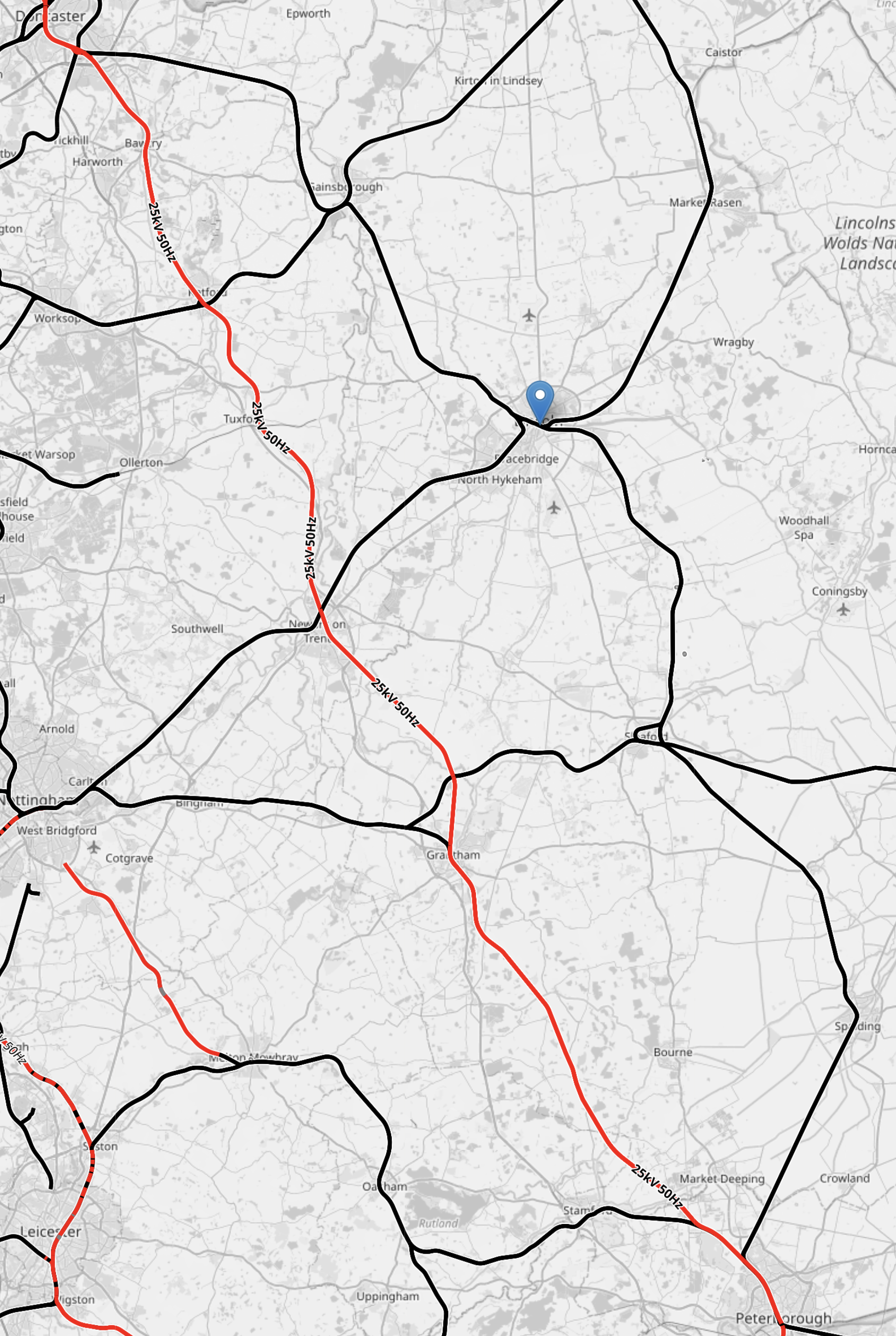
Note.
- Doncaster is in the North-West corner of the map.
- Peterborough is in the South-East corner of the map.
- The red line connecting them is the East Coast Main Line.
- Lincoln station is marked by the blue arrow.
Great Northern and Great Eastern Joint Line (GNGE) is described like this by its Wikipedia entry.
The Great Northern and Great Eastern Joint Railway, colloquially referred to as “the Joint Line” was a railway line connecting Doncaster and Lincoln with March and Huntingdon in the eastern counties of England. It was owned jointly by the Great Northern Railway (GNR) and the Great Eastern Railway (GER).
Over the last decades of the Twentieth Century, the Joint Line declined and British Rail did their worst to simplify the route.
But in the 2010s, Network Rail developed the route into a by-pass for the East Coast Main Line between Werrington and Black Carr junctions via Lincoln.
- Trains are routed via Spalding, Sleaford, Lincoln, Saxilby and Gainsborough.
- There is no electrification.
- The route can handle two freight trains per hour.
- The route can handle 9 ft. 6 in containers.
- There is a passenger service between Doncaster and Peterborough via Lincoln.
- Self-powered trains like InterCity125s, Class 800 trains and Class 802 trains can use their diesel power to use the diversion.
- All-electric trains, like LNER’s Class 801 trains and Lumo’s Class 803 trains have no self-power, so can’t use the diversion.
- Black Carr junction and Lincoln is 35 miles.
- Werrington junction and Lincoln is 51.7 miles.
The January 2024 Edition of Modern Railways says that the diversion is approximately 90 miles or 145 kilometers.
It would appear that there are two simple solutions.
- Electrify a section through Lincoln, so that Lincoln is within 70 kilometres of the electrification at both Werrington and Black Carr junctions.
- Fit bigger batteries to the trains.
A combination of both solutions might be possible.
Solar With Battery In Germany Now Cheaper Than Conventional Power
The title of this post, is the same as that of this article on Renewables Now.
These two paragraphs outline the article.
Ground-mounted solar PV and onshore wind energy are the most cost-effective technologies among all types of new power plants in Germany, with levelised cost of electricity (LCOE) ranging from EUR 41 (USD 44.75) to EUR 92 per MWh, according to a study by research institute Fraunhofer ISE.
The LCOE for new solar installations in combination with battery systems vary between EUR 60 and EUR 225 per MWh reflecting the high cost differences for battery and solar systems along with the different levels of solar radiation.
Note.
- The article states that these figures are lower than newly-built coal and gas-fired power plants.
- The Fraunhofer Institute for Solar Energy Systems ISE in Freiburg, Germany is the largest solar research institute in Europe.
The original Renewables Now article is well worth reading in full.
Conclusion
This paragraph concludes the Renewables Now article.
These calculations show that the large-scale projects currently underway in Germany, which combine ground-mounted PV systems, wind farms and stationary battery storage systems, are good investments,” says Christoph Kost, head of the Energy System Analysis Department at Fraunhofer ISE and lead author of the study.
As the climate for much of Northern Europe is not that different to Germany, I suspect we’ll be seeing large numbers of hybrid wind/solar/battery power plants created in the next few years.
Liverpool Street Station Gets Polka Dot Sculpture
The title of this post, is the same as that as this article on the BBC.
This is the sub-heading.
A huge artwork made up of silver polka dots has been unveiled outside Britain’s busiest railway station.
These are the first two paragraphs.
Infinite Accumulation is Japanese artist Yayoi Kusama’s first permanent public artwork in the UK and her largest permanent public sculpture.
Funded by British Land and the City of London Corporation, it is the final artwork commissioned and installed by the Crossrail Art Programme for the Elizabeth line.
I took these pictures today.
































Note.
- The area is getting to be a bit of a sculpture park, with other sculptures and plaques.
- All are protected by the City of London’s distinctive bollards. See The City Of London’s Soldiers for more pictures.
- The new sculpture, is probably worth nicking, with all that stainless steel.
- Liverpool Street station is a Grade Two Listed Building.
- I shall be adding extra pictures here. I shall be taking some at sunset.
I do like the new sculpture and the way it fits with the surrounding buildings.
‘Windiest Part Of The UK’ Could Power Nearly 500,000 Homes
The title of this post, is the same as that of this article on the BBC.
This is the sub-heading.
Power is flowing from the Shetland Isles to mainland Britain for the first time as the UK’s most productive onshore windfarm comes on stream.
These are the first two paragraphs.
SSE says its 103-turbine project, known as Viking, can generate 443 megawatts (MW) of electricity, enough to power nearly 500,000 homes.
Shetland is the windiest part of the UK, which means it will be rare for the blades, which reach a massive 155m at their tip, not to be spinning.
Note.
- SSE has built a 160-mile long undersea cable to carry the power from Viking to Noss Head, near Wick, on the Scottish mainland.
- The company said it has invested more than £1bn in the windfarm and cable projects.
- SSE plans to plough another £20bn into renewables by the end of the decade.
Companies don’t invest billions and banks don’t lend billions, unless they know they’ll get a return, so the finance for this billion pound project must be sound.
A simple calculation, shows why they do.
- According to Google, the electricity for the average house costs £1926.24 per year.
- 500,000 houses would spend £963,120,000 per year.
Google says this about the life of a wind farm.
The average operational lifespan of a wind turbine is 20–25 years, but some turbines can last up to 30 years.
If the wind farm lasts 25 years, then it will generate something like £24 billion over its lifetime.
It looks to me, that SSE have borrowed a billion and will get almost as much as that back every year.
SSE also have the experience to keep the turbines turning and the distribution network sending electricity to the Scottish mainland.
I have some further thoughts.
What Happens If Scotland Can Get Cheaper Electricity From Its Own Wind Farms?
Shetland’s turbines can be switched off, but that is effectively throwing away electricity that can be generated.
Any spare electricity can also be diverted to an electrolyser, so that the following is produced.
- Hydrogen for transport, rocket fuel for SaxaVord Spaceport and to decarbonise houses and businesses.
- Oxygen for rocket fuel for SaxaVord Spaceport and for fish farms.
Hydrogen may also be exported to those that need it.
Project Orion
Project Orion is Shetland’s master plan to bring all the energy in and around the Shetland Islands together.
This document on the APSE web site is entitled Future Hydrogen Production In Shetland.
This diagram from the report shows the flow of electricity and hydrogen around the islands, terminals and platforms.
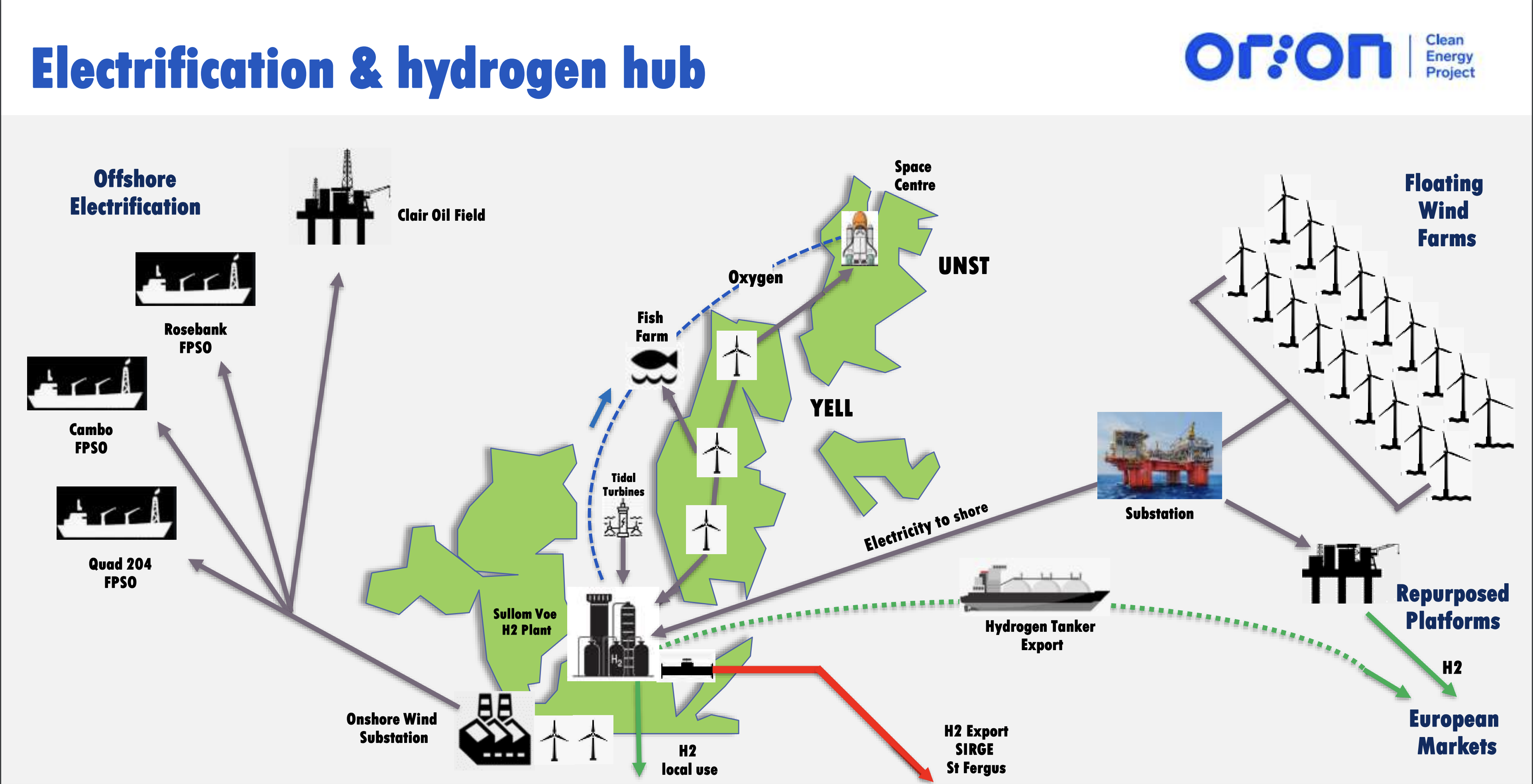
Note these points about what the Shetlanders call the Orion Project.
- Offshore installations are electrified.
- There are wind turbines on the islands
- Hydrogen is provided for local energy uses like transport and shipping.
- Oxygen is provided for the fish farms and a future space centre.
- There is tidal power between the islands.
- There are armadas of floating wind turbines to the East of the islands.
- Repurposed oil platforms are used to generate hydrogen.
- Hydrogen can be exported by pipeline to St. Fergus near Aberdeen, which is a distance of about 200 miles.
- Hydrogen can be exported by pipeline to Rotterdam, which is a distance of about 600 miles.
- Hydrogen can be exported by tanker to Rotterdam and other parts of Europe.
It looks a very comprehensive plan, which will turn the islands into a massive hydrogen producer.
Orion And AquaVentus
This video shows the structure of AquaVentus, which is the German North Sea network to collect hydrogen for H2ercules.
I clipped this map from the video.

Note.
- There is a link to Denmark.
- There appears to be a undeveloped link to Norway.
- There appears to be a link to Peterhead in Scotland.
- There appears to be a link to just North of the Humber in England.
- Just North of the Humber are the two massive gas storage sites of Aldbrough owned by SSE and Rough owned by Centrica.
- There appear to be small ships sailing up and down the East Coast of the UK. Are these small coastal tankers distributing the hydrogen to where it is needed?
In the last century, the oil industry, built a substantial oil and gas network in the North Sea. It appears now the Germans are leading the building of a substantial hydrogen network.
This map is only the start and I feel, there would be nothing to stop the connection of the Orion and AquaVentus networks.
SaxaVord Spaceport
SaxaVord Spaceport is now a reality, in that it licensed and tests are being undertaken.
‘World’s First’ O&M Campaign Using Heavy-Lift Cargo Drones Underway At Dutch Offshore Wind Farm
The title of this post, is the same as that of this article on offshoreWIND.biz.
This is the sub-heading.
Ørsted has deployed heavy-lift cargo drones (HLCDs) for maintenance work at the Borssele 1&2 offshore wind farm in the Netherlands. This is the first time heavy-lift cargo drones are being used in an operational campaign, according to the company which tested the concept in 2023 at its Hornsea One offshore wind farm in the UK.
These are the first two paragraphs.
At the 752 MW Dutch offshore wind farm that has been in operation since 2020, the 70-kilogram drones will transport cargo of up to 100 kilograms from a vessel to all 94 wind turbines. The campaign now underway at Borssele 1&2 is being performed to update some critical evacuation and safety equipment in each of the turbines.
A drone can complete a task that typically takes several hours in minutes, according to Ørsted.
Note.
- The article claims, a lot of time is saved.
- I suspect we’ll be seeing the use of drones for multiple deliveries, a lot more in the future.
I like the concept, where deliveries to a number of sites are made by drone, rather than in a traditional way perhaps by a ship or truck with a crane.
 The Anonymous Widower