Could Tennis Help The Symptoms Of Uncomplicated Pancolonic Diverticulitis?
When I used to play real tennis a very regularly, I didn’t seem to get the angry gut, I have now.
I asked Google AI, the question in the title of this post and received this answer.
Yes, playing tennis can help manage the symptoms of uncomplicated pancolonic diverticulitis as part of an active lifestyle, though it is best suited for the prevention of flare-ups rather than treatment during an active attack.
Regular, moderate-to-vigorous exercise like tennis has been shown to significantly reduce the risk of developing diverticulitis.
How Tennis Helps DiverticulitisReduces Risk of Attacks:
Studies show that vigorous activity, such as tennis, can reduce the risk of developing diverticulitis by up to 27%), as mentioned in research published in the Journal of Gastrointestinal and Liver Diseases.
Improves Bowel Function: Regular exercise helps keep bowels moving, which helps prevent constipation—a major contributing factor to diverticular pain.
Reduces Inflammation: Regular, moderate-intensity physical activity (which can include tennis) has an anti-inflammatory effect on the body.
Weight Management: Exercise helps manage weight, reducing obesity, which is a major risk factor for complicated diverticular disease.
My exercise levels have certainly dropped since I had the stroke and moved to London.
Could Horseriding Help The Symptoms Of Uncomplicated Pancolonic Diverticulitis?
When I used to ride horses a small amount, I didn’t seem to get the angry gut, I have now.
I asked Google AI, the question in the title of this post and received this answer.
While there is no direct scientific evidence regarding horseriding specifically, general physical activity and exercise are strongly recommended for managing and preventing the symptoms of uncomplicated diverticulitis.
Regular exercise helps to increase bowel motility (movement), which can help reduce the pressure within the colon that contributes to diverticular symptoms.
Here is how physical activity, including potentially activities like horseriding, can play a role in managing this condition:
Benefits of Regular Exercise on Diverticular Symptoms
Reduced Risk: Studies show that regular, vigorous activity can decrease the risk of developing diverticulitis.
Improved Digestion: Exercise encourages regular bowel movements, preventing the constipation that often exacerbates diverticular pain.
Weight Management: Maintaining a healthy weight reduces pressure on the colon, which is beneficial for managing diverticular disease.
Important Considerations for Horseriding
Gentle Movement vs. Jarring: While light-to-moderate, regular activity is beneficial, you should ensure that the activity does not cause sharp pain or excessive stress on the abdominal area, especially if you have had recent symptoms.
Individual Tolerance: The key is to engage in regular exercise that you enjoy and that your body tolerates well.
When to Avoid Exercise
If you are experiencing an acute flare-up of diverticulitis (fever, severe abdominal pain), you should avoid strenuous exercise, rest, and follow your doctor’s advice, which often involves a liquid or low-fiber diet.
Could Uncomplicated Pancolonic Diverticulitis Cause The Constant Pain In My Hip Joints?
It’s not chronic pain, but I must have had it for at least forty years.
So what does Google AI make of my question?
It gave me this answer.
Yes, it is possible for uncomplicated pancolonic diverticulitis (inflammation throughout the entire colon) to cause constant pain in your hip joints.
While diverticulitis is primarily a gastrointestinal issue, it can cause referred pain to the hips and legs or trigger systemic inflammation that affects joints.
Here is how your condition might be linked to your hip pain:
1. Referred Pain (Nerve Pathway Irritation)
The inflammation from a diverticulitis flare-up can irritate nearby nerves that connect to the hip, thigh, or groin area.
Location: While classic diverticulitis causes left-side abdominal pain, a severe or widespread (pancolonic) flare can cause “referred pain” in the lower back, hip, and thigh.
Constant nature: If the underlying inflammation remains active, this pain can feel constant rather than intermittent.
2. Systemic Inflammation and “Diverticulitis-Associated Arthritis”
Rarely, active diverticulitis can trigger a form of inflammatory arthritis, acting as an extra-intestinal manifestation of the disease.
Migrating Pain: This can cause joint pain and stiffness in larger joints, including the hips, knees, and ankles.
Connection: As the gut inflammation resolves with proper care (antibiotics/diet), the joint pain often improves.
3. Anatomical Proximity
The colon sits in close proximity to the musculoskeletal structures of the pelvis, including the iliopsoas muscles (hip flexors).Inflammation in the colon can cause swelling that affects these muscles, leading to pain in the hip region, particularly with movement.
That looks like a possibility to me!
But it needs more investigation.
Does The UK Need More Passenger Train Capacity Between London And Scotland?
I went from London Euston to Wigan North Western and Blackpool North stations on Wednesday.
Just after the Bank Holiday, the train to the North, which was going to Glasgow Central, seemed fairly busy, but I suspect that a few more souls could have been squeezed in.
Coming South in the early evening, there was a lot more space, but those that had gone to Scotland for the Bank Holiday weekend had probably returned.
At the moment, I am getting a lot of adverts like this, when I read The Times on-line.

It looks to me, that Avanti West Coast, are ecouraging travellers to use trains to travel to and from Glasgow.
How Many Anglo-Scottish Trains Are There?
- Avanti West Coast – 6 tpd – London Euston to Edinburgh Waverley via Birmingham New Street
- Avanti West Coast – 6 tpd – London Euston to Glasgow Central via Birmingham New Street
- Avanti West Coast – 1 tph – London Euston to Glasgow Central via Trent Valley
- CrossCountry – 1 tph – Plymouth to Edinburgh Waverley
- LNER – 2 tph – London King’s Cross to Edinburgh Waverley
- Lumo – 6 tpd – London King’s Cross to Edinburgh Waverley and Glasgow Queen Street
- Lumo – 4 tpd – London Euston to Stirling
- TransPennine Express – 1 tp2h – Manchester Airport to Glasgow Central
- TransPennine Express – 1 tp2h – Manchester Airport to Edinburgh Waverley
- TransPennine Express – 4 tpd – Liverpool Lime Street to Glasgow Central
Note.
- tpd is trains per day.
- tph is trains per hour.
- tp2h is trains per two hours.
- The two Avanti West Coast services via Birmingham New Street alternate.
- The Avanti West Coast London Euston to Glasgow Central via Trent Valley service runs 15 tpd.
- The two TransPennine Express services from Manchester Airport to Scotland alternate.
My initial estimate is that there are 5 x 15 tph +16 tpd or 91 tpd.
How Many Anglo-Scottish Trains Are There On HS2?
In the original design for HS2, this was the service pattern.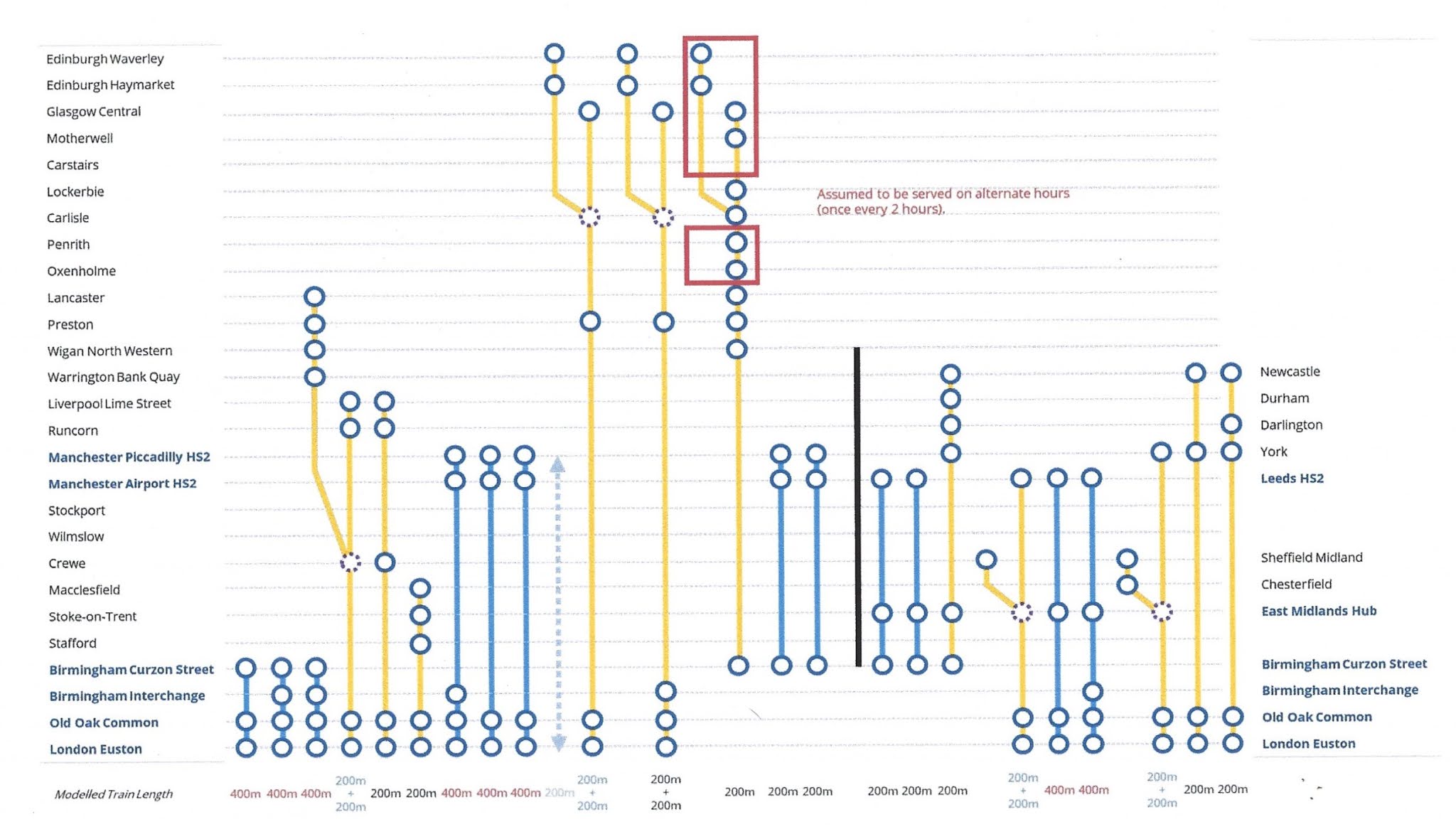
Note.
- Train 10 runs hourly between London and Scotland via Old Oak Common and Preston and splits at Carlisle with one train serving Edinburgh Waverley and the other Glasgow Central.
- Train 11 runs hourly between London and Scotland via Old Oak Common, Birmingham Interchange and Preston and splits at Carlisle with one train serving Edinburgh Waverley and the other Glasgow Central.
- Train 12 runs hourly between Birmingham Curzon Street and Scotland and serves Edinburgh Waverley and Glasgow Central alternatively.
It looks like HS2 contributes 5 tph between England and Scotland or 75 tpd.
But as HS2 is currently configured, these Anglo-Scottish trains will still run.
- CrossCountry – 1 tph – Plymouth to Edinburgh Waverley
- LNER – 2 tph – London King’s Cross to Edinburgh Waverley
- Lumo – 6 tpd – London King’s Cross to Edinburgh Waverley and Glasgow Queen Street
- Lumo – 4 tpd – London Euston to Stirling
- TransPennine Express – 1 tp2h – Manchester Airport to Glasgow Central
- TransPennine Express – 1 tp2h – Manchester Airport to Edinburgh Waverley
- TransPennine Express – 4 tpd – Liverpool Lime Street to Glasgow Central
If these trains continue to run my estimate is that there will be 4 x 15 tph +14 tpd or 74 tpd by classic routes.
This will mean 149 Anglo-Scottish tpd in total.
How Do You Get Between Leeds, Bradford, Sheffield and Hull, and Scotland?
If you look at the diagram, which shows the service pattern for HS2, note the following.
- HS2 does not provide a service between Leeds, York, Durham, Darlington and Newcastle, and Scotland.
- HS2 doesn’t connect to Bradford.
- HS2 doesn’t go past Leeds, but the current LNER services also serve Bradford Forster Square, Harrogate, Shipley and Skipton stations.
There is also no direct trains from the Leeds/Bradford area to Glasgow.
But Consider.
- The Settle and Carlisle Line runs between Skipton and Carlisle and used to host the Thames-Clyde Expresses that were run by the London Midland & Scottish Railway.
- The Wikipedia entry for the Thames-Clyde Express is an interesting read.
- Bradford Forster Square station was recently extended with two platforms , that can handle 10-car trains.
- Bradford Forster Square station has seven trains per day from London via Leeds.
- With a reverse at Bradford Forster Square station trains can call at Leeds, Bradford Forster Square and Skipton stations before taking the Settle and Carlisle Line to Carlisle.
- The Thames-Clyde Express used to take the Glasgow South Western Line to Glasgow Central calling at Dumfries and Kilmarnock.
- LNER’s Class 897 tri-mode trains will probably be able to handle the Settle and Carlisle and the Glasgow South Western Line, without using the diesel engines.
- East Midlands Railway’s Class 810 trains, when fitted with batteries, should probably be able to do the same.
There are a lot of possibilities of how the Settle and Carlisle Line can be used to increase zero-carbon connectivity between Glasgow and London.
The route wouldn’t be the fastest route, but it could be one of the most scenic.
Does Okehampton Interchange Have A Secondary Function To Be Used As A Backup To Cornwall Should Dawlish Be Destroyed Again?
I asked Google AI the question in the title of this post and received this answer.
The new Okehampton Interchange (opening summer 2026) acts as a local transport hub to increase capacity on the Dartmoor Line to Exeter, but it is not a direct backup to Dawlish.
While the Okehampton line via Tavistock is frequently considered as a strategic alternative to the vulnerable coastal route, the new Interchange itself is designed as a single-platform parkway station to serve the local community, not to act as a diversionary route for mainline trains to Cornwall.
Key Details on Okehampton Interchange & Strategic Role:
Purpose:
The £15m Interchange, located near the A30, is designed to relieve parking pressure at the existing Okehampton station and promote sustainable travel with a 200-space car park and bus connections.
Station Setup: It will have a single platform, making it incapable of handling the volume of diverted mainline trains.
Strategic Context: Following the 2014 Dawlish collapse, a northern route via Okehampton/Tavistock was identified as a potential resilient alternative.
However, implementing this would require hundreds of millions in investment to rebuild the track from Okehampton through to Tavistock, not just the new Interchange station.
The Dartmoor Line: The restored line between Okehampton and Exeter, which includes this new interchange, is primarily a local commuter route rather than a main line for Cornish traffic.
This Google Map shows the Okehampton by-pass.
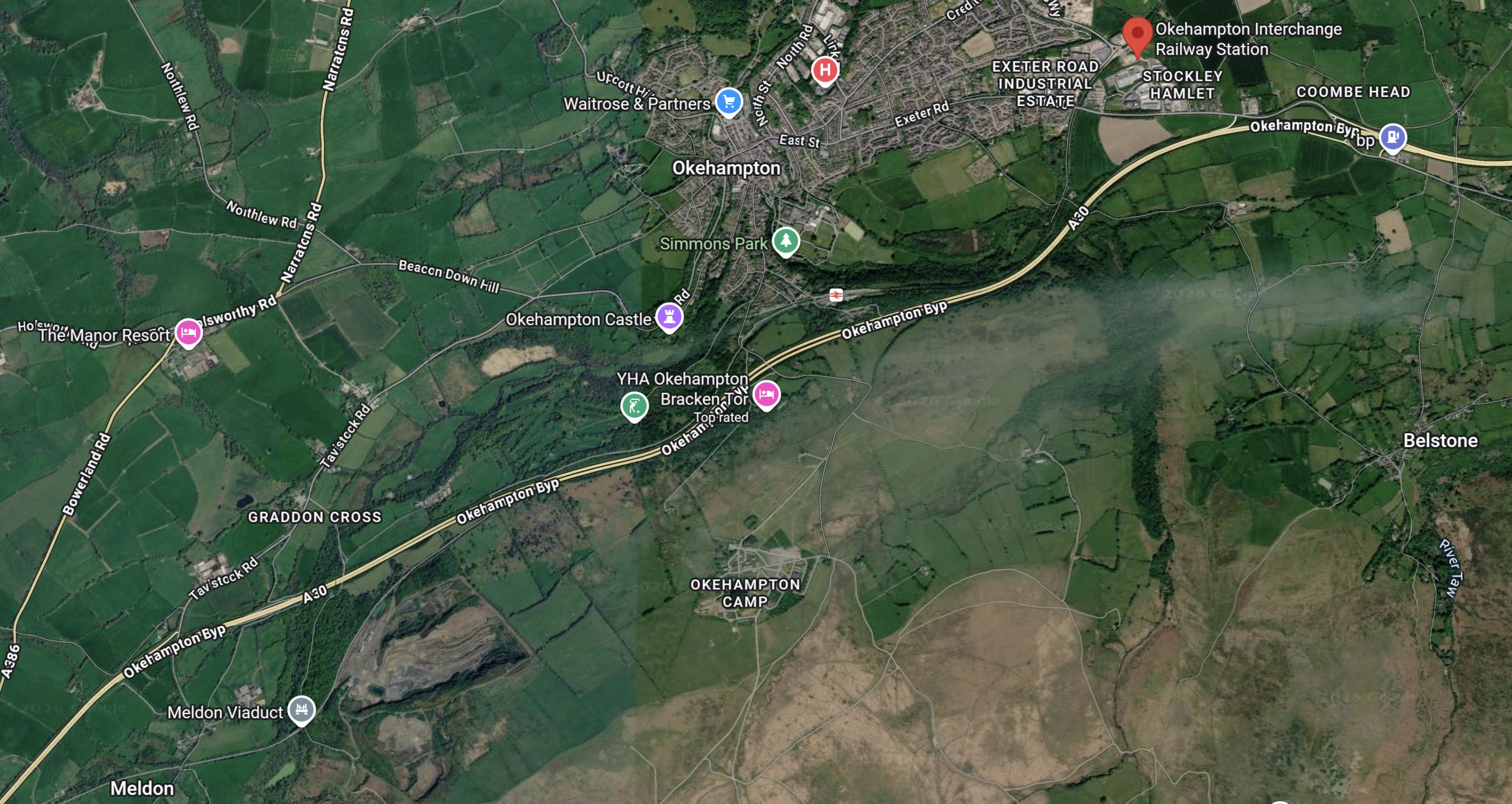
Note.
- Okehampton Interchange station is shown by the red arrow in North-East corner of the map.
- The town of Okehampton is to the West of the station.
- South of the town is the station symbol, which indicates Okehampton station.
Running across the map is the A30 road, which is described in its Wikipedia entry like this.
The A30 is a major road in England, running 284 miles (457 km) WSW from London to Land’s End.
This Google Map shows the A30 between Okehampton and Bodmin.
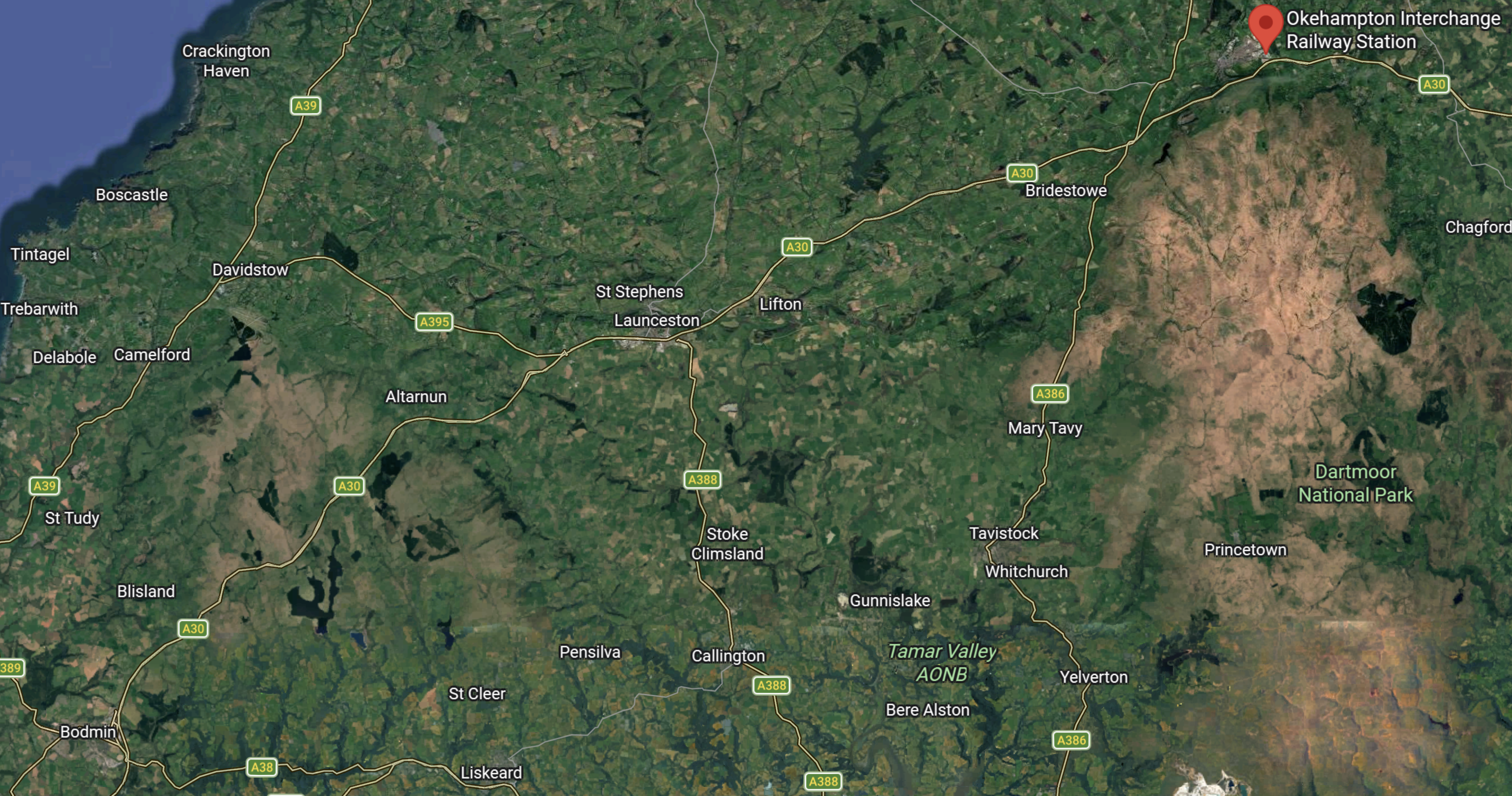
Note.
- Okehampton interchange station is in the North-East corner of the map.
- Bodmin with Bodmin Parkway station is in the South-West corner of the map.
- In the middle of the map is Launceston, which is on route of the A30.
Wikipedia says this about the road.
The A30 is dual carriageway through Devon and into Cornwall, bypassing Whiddon Down, Okehampton and Launceston.
I believe that if the railway was blocked again at Dawlish, it would be possible for passengers to be taken to Cornwall like this.
- Five-car Class 802 train to either of the Okehampton stations.
- Coach to Launceston and Bodmin Parkway.
- Class 802 trains to Penzance, which called at all stations.
That looks to me to be a practical alternative.
It should also be noted, that high-capacity, hydrogen-powered coaches, with a thousand-kilometer range will be coming into service soon and these will surely be ideal for a duty like this.
Do Coeliacs Have A Sweet Tooth?
I am certainly coeliac and often, when I have a coffee or a hot chocolate, when I’m travelling, I will ask if the cafe has a gluten-free cake to go with it.
Increasingly, I am getting disappointed. But then chains that speciallised in gluten-free like Carluccios and Leon have had a hard time lately and the rise of Greggs, Gails and Pret, who don’t do gl;uten-free doesn’t help.
Usually, whilst I watch, the BBC ten o’clock news, I will have a mug of decaffeinated tea, in which I will dunk, three M & S gluten-free ginger snaps.
After I was diagnosed as a coeliac, my late wife, once said she thought I would eat more biscuits and cakes.
So what does Google AI think, when I ask it the question in the title of this post?
This was the answer I received.
Yes, many people with coeliac disease have a sweet tooth, and it is a common experience to experience intensified sugar cravings after starting a gluten-free diet.
Here is why this happens and how it is managed:
Intensified Cravings: After eliminating gluten, some coeliacs experience strong cravings for sugar, ice cream, and chocolate.
This can occur because the body is suddenly deprived of high-carb foods, or due to underlying imbalances in gut bacteria.
Nutrient Absorption: In the early stages of a gluten-free diet, the body may be absorbing nutrients better for the first time, which can trigger intense hunger and cravings.
Hidden Sugar in GF Foods: Many processed gluten-free products—like biscuits and cakes—contain more sugar to improve taste and texture, which can satisfy, but also encourage, a sweet tooth.
Gut Health Factors: Some individuals suspect that sugar cravings are linked to candida (yeast) overgrowth, which is sometimes associated with coeliac disease.
I suspect with me sometimes, it can be, just because I’m hungry due to low availability of gluten-free snacks.
This week, when I went to Blackpool North, I changed trains at Wigan North Western station, where I bought a delicious lemon tart in the coffee stall.



Note.
- The delicious lemon tart came in the aluminium tray it was baked in. Could this be for protection, as the tart was still in one piece, after some time in my brief case.
- My pictures don’t do the tart justice.
- The coffee stall is on the Northbound platform.
- The toilets are under the Southbound platform, but are some of the cleanest, I’ve found on UK railways.
- Wigan North Western station is fully step-free.
- Wigan North Western station could be ready for High Speed Two trains.
Wigan North Western and Wigan Wallgate stations are only a short walk apart, so it is a well used interchange to get to Northern parts of Merseyside and Greater Manchester, from London and the South.
Will The Green Mayor In Hackney Affect The Value Of My House?
I asked Google AI the question in the title of this post and received this reply.
Based on the 2026 Hackney Green Party manifesto and local policy updates, a Green-led council in Hackney is likely to implement policies aimed at environmental sustainability, improved social housing, and stricter regulation of private property, which could have mixed effects on property values.
Here is how the Green Party’s approach in Hackney might impact your home value:
Potential Upward Pressures on Property ValueGreen Infrastructure Improvements:
The council is prioritizing increased green canopy cover (target of 30%) and the installation of electric vehicle charging points.
Increased green space and improved environmental quality can enhance the desirability of residential areas, often positively impacting house prices.
Energy Efficiency Upgrades: Continued investments in insulating homes and supporting heat pump installations could make older properties more attractive to buyers concerned about energy efficiency and lower utility bills.
“Alive and Flourishing” Strategy: Efforts to reactivate underused spaces could improve local amenities, making neighbourhoods more vibrant and potentially increasing demand.
Potential Downward or Stabilizing Pressures on ValueFocus on Social and Affordable Housing: A core priority is building 1,000 new council homes for social rent, along with a focus on “genuinely affordable” housing.
A shift away from high-end private luxury development towards affordable housing can reduce the rate of capital growth in the private market.
Rent Controls and Regulation: Green Party policy includes lobbying for local rent controls.
While this directly impacts buy-to-let investors, it can change the investment landscape and overall demand for investment properties in the borough.
Regulation of Empty Homes: The council plans to double Council Tax for properties left vacant for 12 months or more, and may use Compulsory Purchase Orders (CPOs) for long-term empty buildings.
Expansion of Selective Licensing: Proposals to expand landlord licensing schemes to cover more of the borough could increase costs for landlords, potentially causing some to exit the market.
Potential Tax and Regulatory Factors
Council Tax Increases: The budget for 2026/27 includes a standard 4.99% council tax increase.
Stricter Developer Obligations: Increased requirements for developers to contribute to community infrastructure could increase development costs, although the focus is often on increasing social value rather than solely high-end investment.
Conclusion
Hopefully Nothing Too Bad! But who knows?
Metro Rail Project ‘Best Service Since Steam Days’
The title of this post, is the same as that of this article on the BBC.
This is the sub-heading.
A £50m project to improve rail links to Newquay has been hailed as “the best service since the steam days”.
These three introductory paragraphs add detail to the story.
The Mid Cornwall Metro service will run direct hourly trains between Newquay and Par from 17 May after a 400m “passing loop” at Goss Moor and a second platform at Newquay have been installed.
Matt Barnes from Great Western Railway (GWR) said the route had not been developed since the age of steam trains and the improvements would be “a real step change” for Newquay’s residents and visitors.
Direct routes between Newquay and Falmouth are due to begin next year.
Note.
- Services start on May 17th.
- Click this link for the official web site.
I have great hopes that this rail service will be a big success.
Centrica Buys Severn Gas Power Station In South Wales
The title of this post, is the same as that of this article on The Times.
This is the sub-heading.
The owner of British Gas says the plant, acquired from the troubled Calon Energy for £370 million, will help secure supplies during the green transition
These three introductory paragraphs add more details to the story.
The owner of British Gas has acquired the troubled Severn gas power station in south Wales for £370 million after issuing a less than positive future profit guidance.
The combined-cycle gas turbine plant was owned by Calon Energy, which had gone into administration shortly after the start of the pandemic in 2020 when the power station was, for a while, mothballed.
Centrica said it acquired the plant to shore up its energy generation resources and secure electricity supplies during the UK’s green transition.
I think there a lot more to this story, than initially meets the eye.
The Location
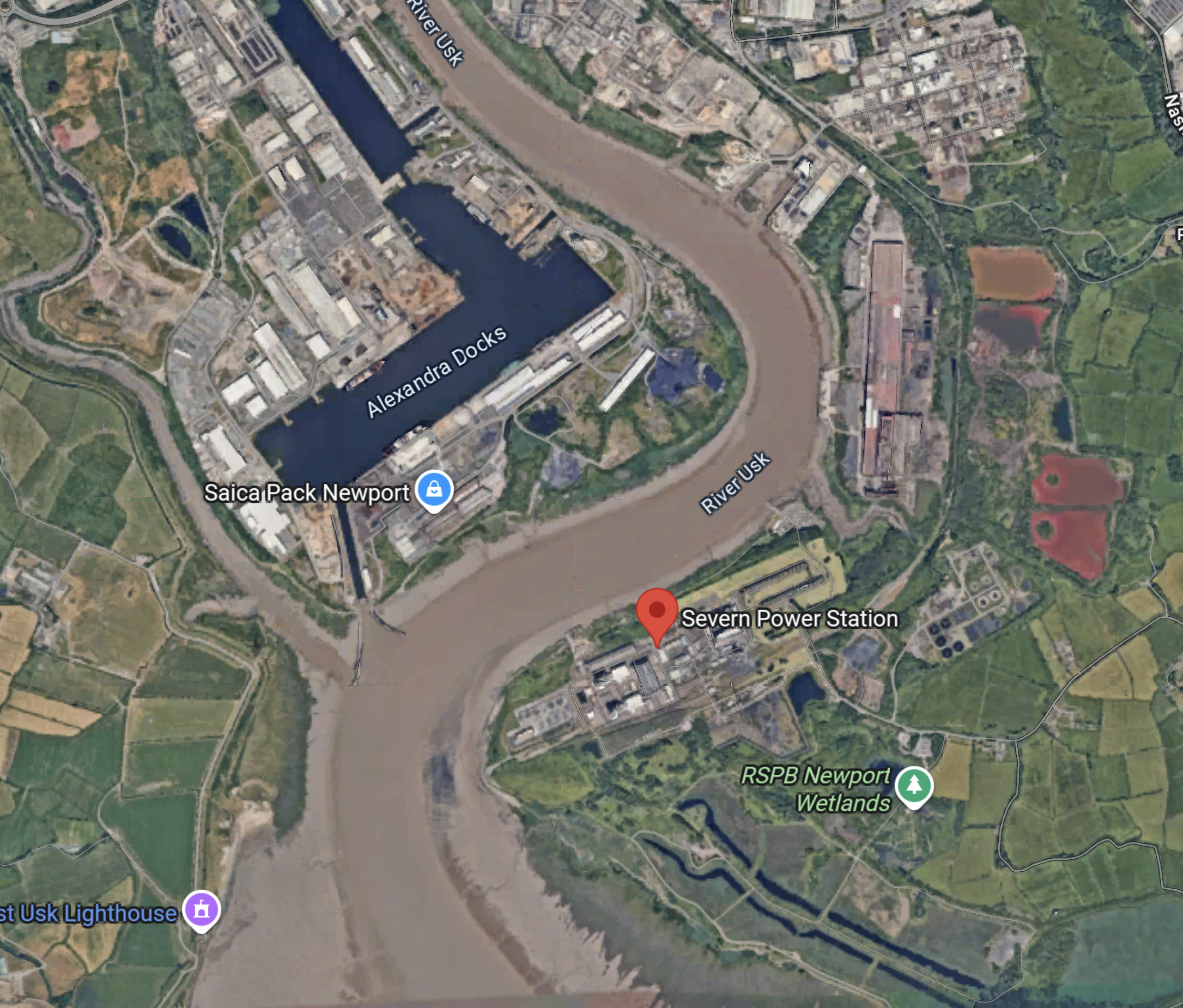
The Google Map shows the location of the Severn Power station on the River Usk, to the South of Newport in South Wales.
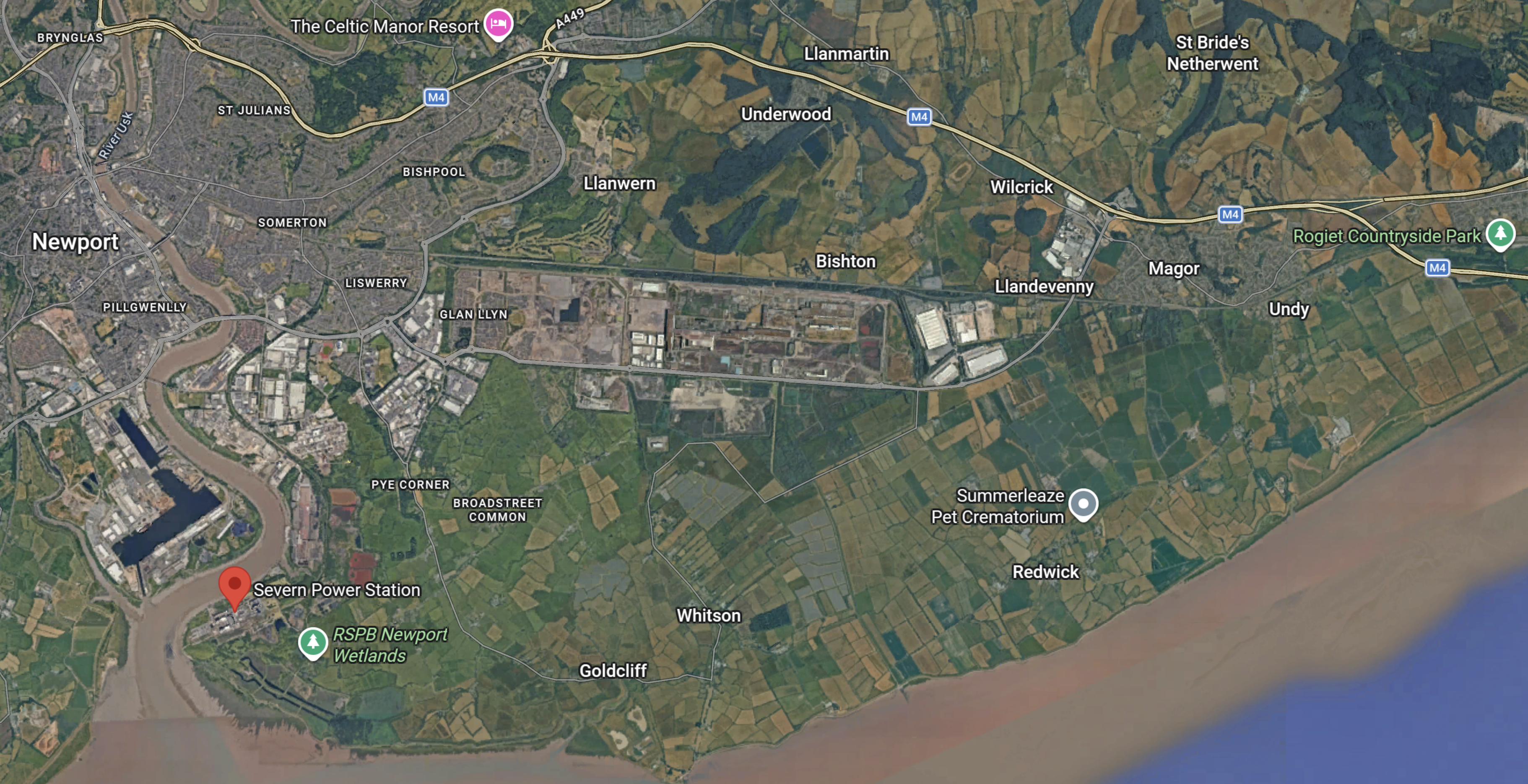
Note.
- Severn power station is indicated by the red arrow in the South-West of the map.
- The River Usk enters the sea to the West of the site.
- The RSPB Newport Wetlandsare South of the site.
- The long rectangle in the middle of the map is the former Llanwern steelworks, which is now a CAF train factory.
- Newport is also a major station on the main line between London Paddington and Cardiff.
This second Google Map shows the power station site at a larger scale.
I wouldn’t be surprised, that Centrica could fit other equipment on and around the power station site.
- Centrica and/or National Grid might want to put an interconnector across the Severn Estuary.
- There might be a need to connect to wind farms in the Severn Estuary.
- Centrica are building a bunkering facility for ships running on low carbon fuels at Grain LNG Terminal. Will they build one here?
- Centrica could build a HiiROC electrolyser to create hydrogen for difficult to decarbonise industries and bunkering ships.
The site has a lot of potential.
Gas-Fired Power Still Looks A Safe Bet For Centrica In The Renewables Era
I feel rather surprisingly, the title of this post, is the same as this article on the Guardian.
You’d think, that they would be critical of Centrica for keeping the gas power stations going.
But this is the sub-heading.
There will still be a need to have gas in the wings to keep the lights on, so the financials stack up on Severn plant purchase.
So why should Centrica buy a 832 MW closed cycle gas fired power station?
These posts describe, what Centrica have done at Brigg with another closed cycle gas fired power station.
- Construction Under Way To Double Power Station Capacity At Centrica’s Brigg Energy Park
- Hydrogen Milestone: UK’s First Hydrogen-to-Power Trial At Brigg Energy Park
Will Centrica be taking closed cycle gas fired power stations and making them more efficient to provide the back up to wind farms, when wind is having an off day?
I wouldn’t be surprised, if Centrica put a big battery on the two sites, as after all they are a godparent to Highview Power.
Are there any more closed cycle gas fired power stations, that they can acquire?
I asked, Google AI,”How many closed cycle gas fired power stations are there in the uk?” and received this answer.
As of early 2026, there are approximately 35 active combined cycle gas turbine (CCGT) power stations—often referred to as closed-cycle—in the UK.
These plants provide the bulk of the UK’s gas-fired capacity, totaling roughly 30-35 GW along with smaller, single-cycle (OCGT) plants which are used for backup.
Total Capacity: The total capacity of all gas-fired generation (CCGT and others) is approximately 35.7 GW.
Role in Power Mix: CCGTs are highly efficient and provide baseload power, while OCGT plants (about 14+ sites) are typically used for peak demand.
Key Locations: Major plants include Pembroke (RWE), Staythorpe (RWE), Didcot B (RWE), and Connah’s Quay (Uniper).
These plants remain the largest single source of electricity generation on the UK grid, though they are increasingly being paired with carbon capture proposals.
I think, that Engineer Baldrick is now working for Centrica and he has a cunning plan to use efficient CCGT power stations to back up the wind.
Consider.
- Severn power station is an 832 MW combined cycle power plant running on natural gas, which is located near Newport in South Wales.
- 4.5 GW of offshore wind is to be built near Port Talbot.
- Will some hydrogen generated by HiiROC be used to part-fire Severn power station and reduce its carbon footprint.
- South Wales can easily find space for a couple of Highview 300 MW/3.2 GWh CRYOBatteries.
- It would be useful to have a good-sized hydrogen store in South Wales.
That mix would surely provide enough reliable power for green steelmaking and a few data centres.

