Project To Develop 20+ MW Floating Offshore Wind Technology Kicks Off
This is the introductory paragraph.
UK Govt Awards Almost GBP 33m To Innovative Energy Storage Projects
The title of this post is the same as that of this article on Renewables Now.
This is the first paragraph.
The UK government has awarded GBP 32.9 million (USD 39.7m/EUR 38.3m) in funding to five innovative energy storage projects under the second phase of its Longer Duration Energy Storage competition.
These are the projects.
StorTera
StorTera has secured GBP 5.02 million to create a prototype demonstrator of its single liquid flow battery (SLIQ) technology.
The company’s main product is the SLIQ Flow Battery, for which it gives the headline of Reliable, Economical Energy For 20 Years.
This is a description of the technology.
The revolutionary StorTera SLIQ single liquid flow battery offers a low cost, high performance energy storage system made with durable components and supported by our flexible and adaptable inverter and control system. The StorTera SLIQ battery brings the following benefits/advantages:
- Low levelised cost of storage and capital cost
- Long lifetime of up to 20 years (min. 7,500 cycles)
- Long duration energy with the energy and power capacity easily and independently scalable
- Safe with no cooling requirements and high flash point materials
- Fully recyclable at the end of lifetime
This is said about costs – Using low cost materials and manufacturing techniques, we predict capital costs of approximately £120/kW and £75/kWh by 2022.
I feel there could be something about this technology, but we’ll only know, when the demonstrator is fully working.
Sunamp
Sunamp will get GBP 9.25 million to test its thermal storage system in 100 homes across the UK.
On their home page, Sunamp has a banner of World Leading Thermal Technologies, with this description underneath.
Sunamp designs and manufactures space-saving thermal storage that makes UK homes, buildings and vehicles more energy-efficient and sustainable, while reducing carbon emissions and optimising renewables.
They do appear to have sold something, which is always a useful thing to do.
This page on their web site, describes their Thermino Thermal Storage For Domestic Hot Water, where this is said.
Thousands of Sunamp thermal batteries are already in homes across the UK storing heat from low-carbon energy sources and releasing it for mains-pressure hot water when needed.
Our Thermino batteries replace traditional hot water cylinders – direct (for grid electricity and solar PV) or indirect (for boilers and heat pumps).
They are up to four times smaller than the equivalent hot water tank because they are filled with our energy-dense phase change material, Plentigrade. This means that heat pump systems can be installed where otherwise they wouldn’t fit, for example.
The key seems to be this substance called Plentigrade!
This page on their web site describes Plentigrade.
Under a heading of Storing Energy As Heat And Releasing It When, And Where, It’s Needed, this is said.
Sunamp thermal batteries are energy-saving thermal stores containing Plentigrade: our high-performance phase change materials (PCMs) that deliver heating or cooling reliably, safely and efficiently.
Plentigrade, with its perpetual phase changing ability, is at the core of our products.
Our breakthrough technology was created in collaboration with the University of Edinburgh, ranked among the top 20 universities in the world, and the UK’s national synchrotron particle accelerator, Diamond Light Source. To find out more about the chemistry behind Plentigrade, read our blog.
Note.
- This product almost looks to be too good to be true.
- But I’ve checked and it doesn’t seem to have appeared on Watchdog.
- It’s yet another breakthrough, that has used the Diamond Light Source.
- How many other developments would happen with a Diamond 2 in the North, as I wrote about in Blackpool Needs A Diamond?
I have a feeling, that my house needs one of Sunamp’s thermal batteries.
University of Sheffield
The article says this about a grant to the University of Sheffield.
The University of Sheffield has been awarded GBP 2.6 million to develop a prototype modular thermal energy storage system designed to provide optimised, flexible storage of heat within homes.
There are several thermal batteries around for houses.
RheEnergise
The article says this about a grant to RheEnergise.
With a GBP-8.24-million grant, RheEnergise Ltd will build a demonstrator of its High-Density Hydro pumped energy storage system near Plymouth. The technology uses a fluid denser than water to generate electricity from gentle slopes.
I wrote about this in Plan For £8.25m Plymouth Energy Plant To Generate Power From Cream-Like Fluid.
EDF UK R&D
The article says this about a grant to EDF UK R&D.
The government is also backing with GBP 7.73 million an initiative of EDF UK R&D and its partners, the University of Bristol, Urenco and the UK Atomic Energy Authority (UKAEA), to develop a hydrogen storage demonstrator using depleted uranium at UKAEA’s Culham Science Centre in Abingdon, Oxfordshire.
I wrote about this in Innovative Hydrogen Energy Storage Project Secures Over £7 million In Funding.
Conclusion
They are a mixed bunch of ideas from around the UK, that I think will produce at least two good winners.
Toyota To Build Hydrogen Fuel Cell Trucks In UK
The title of this post, is the same as that of this article on The Times.
These are the first two paragraphs.
The UK’s first mainstream commercial vehicle to be powered by hydrogen fuel cells will be built at the Toyota plant in Derbyshire, holding out the prospect that the Japanese group will choose Britain as its European manufacturing centre for the next-generation zero-emission technology.
Toyota will announce today that it has chosen Burnaston to produce six prototype hydrogen versions of its popular Hilux pick-up trucks.
It may be only a few vehicles initially, but if Toyota choose Burnaston, as their European manufacturing centre for the next-generation zero-emission technology, this could be large.
Honda’s NSX Factory Is Shifting To Plug-In Hydrogen CR-V Production
The title of this post, is the same as that, of this article on Road and Track.
Centrica And Ryze Agree To Develop Hydrogen Pathway
The title of this post, is the same as that of this press release from Centrica.
These are the first three paragraphs.
Centrica and Ryze Hydrogen are set to jointly build and operate hydrogen production facilities aimed at providing a reliable supply of hydrogen for industry and transportation.
Under the landmark agreement the firms will jointly develop hydrogen production projects on existing Centrica sites and work with third-parties to build production on their sites too.
A Memorandum of Understanding has been signed and will combine expertise in order to kickstart the development of the UK hydrogen economy, targeting the mobility, industrial and commercial markets.
There are also some other interesting statements in the press release.
- Centrica’s Head of Hydrogen, says that we should be bold in our thinking about hydrogen.
- The partnership will explore how the UK can work with international hydrogen production facilities.
- Jo Bamford, green entrepreneur and Executive Chairman of Ryze, believes that Centrica are very serious about hydrogen.
- Centrica and Ryse will convert some of the British Gas fleet to hydrogen.
I feel this could be a very significant deal for the decarbonisation of the UK.
Violence Against Women
The BBC is rightly having a campaign against domestic violence and violence against women in general.
It also appears to me, that women seem to get killed and attacked, a lot more than they did a couple of decades ago.
Is there too much violence against women in TV dramas, so men with small brains think it is acceptable? Surely, it is also wrong to have a TV drama called Killing Eve?
I have only watched a couple of TV dramas or films, in the last couple of years; Some Like It Hot and SAS Rogue Heroes.
Denny Bros Completes Solar Scheme At Bury St Edmunds Factory
The title of this post, is the same as that of this article on the East Anglian Daily Times.
This is the sub-title.
An energy-hungry manufacturer has completed a huge £0.5m solar array across its roofs – which on a good day can power the whole operation and more.
This Google Map from a few months ago, shows the incomplete array.
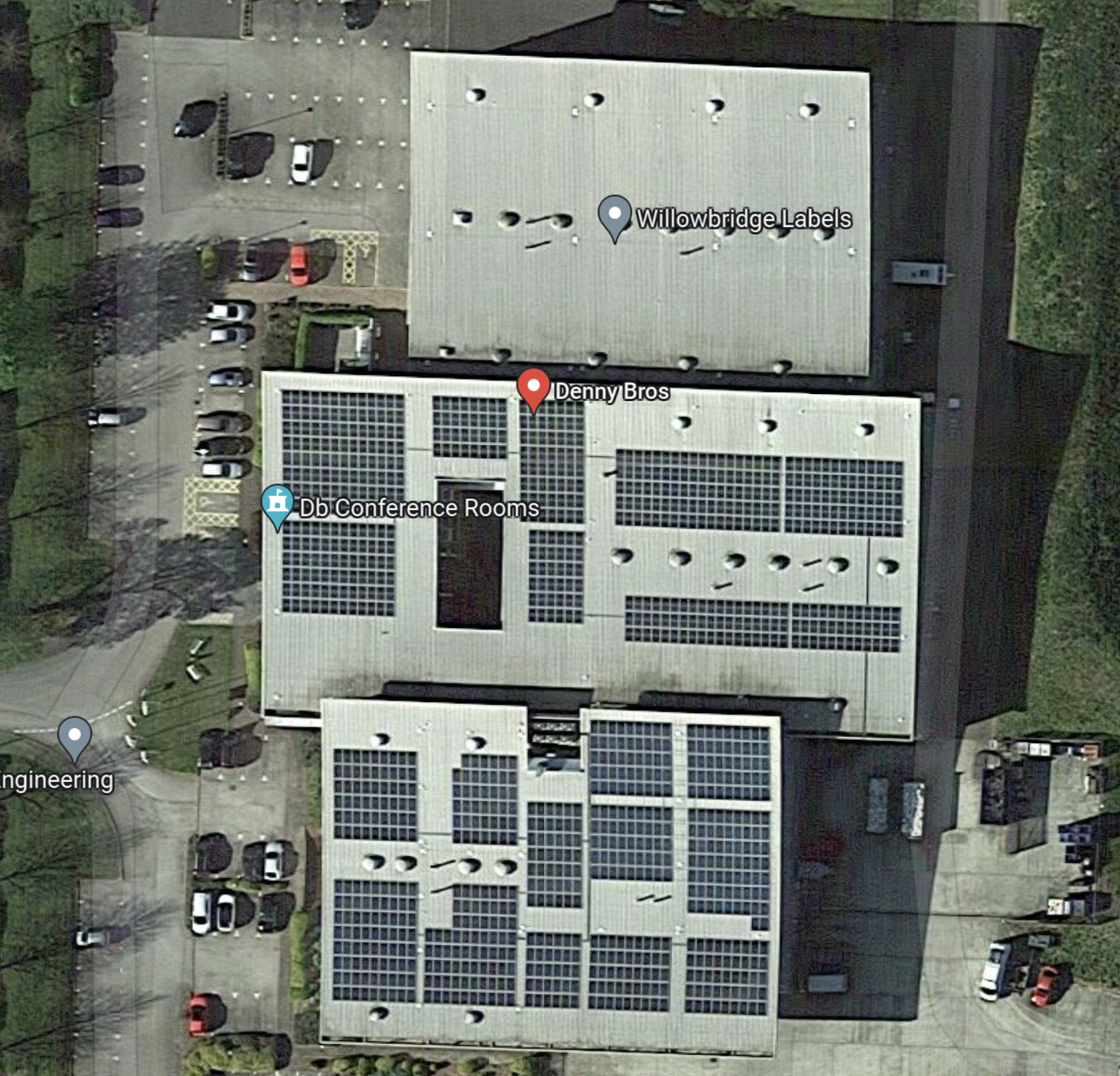
A more recent picture in the article, shows the top building with solar panels on the roof.
According to another report in the East Anglian Daily Times, the company turns over about eight millions.
As Denny Brothers appears to be a well-run company, that is partly employee-owned, the numbers must add up.
Incidentally, the article was displayed with two adverts; one for a solar panel company and the other for the well-known employee-owned company; John Lewis.
I suppose that’s the way the cookie rumbles!
I certainly don’t regret installing solar panels on my flat roof!
What About A Couple Of Wind Turbines?
I ask this question, as some MPs want to allow more onshore wind, providing the natives don’t mind.
I wrote about onshore wind in Chancellor Confirms England Onshore Wind Planning Reform and I think that in the right place they are acceptable.
I know the Government has changed since September, but if you look at the Google Map above, I suspect a couple of turbines could be squeezed in and they probably would be in Germany.
The Secret Of The TwinHub
I was reading about the TwinHub, which is a pair of wind turbines, that are to be mounted on a single float.
There is an explanatory video on the TwinHub home page. Just scroll the page down and you’ll find a full page video, that is rather beautiful and slightly hypnotic.
But note how it stops and starts in the wind and turns itself into a position, so that it is generating the maximum amount of wind.
So how does it do that?
It is not by clever computers and a whole host of actuators, but by good old-fashioned aerodynamics.
Above the video, there is a picture of the sea, with these words underneath.
This demonstration project will be located at the Wave Hub site, and will consist of two floating platforms anchored to the seabed. Each floating platform will host two turbines with inclined towers. The total installed capacity will be between 30 to 40 MW.
Two words are the key to the design – inclined towers.
The wind will apply a force to each turbine and because the towers are inclined, this will apply a force, that will turn the turbines so they are facing the wind. This will maximise the power generated.
The design is elegant, efficient and enchanting.
I can see the TwinHub becoming an unusual tourist attraction in Cornwall.
Passengers Of Reduced Mobility And The Elizabeth Line
I took these pictures at Whitechapel station and they show the preferred wheelchair entry point to the Class 345 train and the central car of the train, which has four wheelchair spaces.











Note.
- The well-signed wheelchair entrance to the train.
- Thw four wheelchair spaces are in the middle car of the train.
- There is no step into the train.
- The roundels also have directions to other lines and the way out.
The car also has longitudinal seating and lots of vertical grab rails.
I do find it strange that London is very much alone in the UK in using this seating design.
Ukraine Tender Would Pair Hydroelectric Plants With Large-Scale Battery Storage
The title of this post, is the same as that of this article on Energy Storage News.
This is a must-read article, as it outlines the damage that Russia is doing to Ukraine’s energy generation.
It also reports how the World Bank is trying to help.
 The Anonymous Widower