Will Our Gas Supplies Hold Up This Winter?
I am prompted to ask this question because of this article in The Times, which is entitled ‘Really High Gas Prices’ Loom For UK As Europe Faces Winter Rationing.
These are a few thoughts.
UK Gas-Fired Power Station Capacity
This entry in Wikipedia is entitled List Of Natural Gas Power Stations In The United Kingdom.
This statement summarises the capacity.
There are currently 32 active gas fired combined cycle power plants operating in the United Kingdom, which have a total generating capacity of 28.0 GW.
This section is entitled Decline Of Gas For Power In The United Kingdom, where this is said.
In 2016 gas fired power stations generated a total of 127 TWh of electricity. Generation has dropped to 119 TWh in 2017, 115 TWh in 2018, 114 TWh in 2019 and 95 TWh in 2020. The decline is largely due to the increase in renewable sources outweighing the decline of coal, and an overall reduction in demand.
Putting these pictures as a table and applying a simple numerical analysis technique gives the following.
- 2016 – 127 TWh
- 2017 – 119 TWh – Drop of 8TWh
- 2018 – 115 TWh – Drop of 4 TWh
- 2019 – 114 TWh – Drop of 1 TWh
- 2020 – 95 TWh – Drop of 19 TWh
In four years the amount of electricity generated each year by gas-fired power stations has dropped by an amazing 8 TWh on average per year.
Factors like the increase in renewables and an overall reduction in demand will still apply.
I wouldn’t be surprised to see a continuous reduction of electricity generated by gas of 8 TWh per year.
Figures like these could be possible.
- 2021 – 87 TWh
- 2022 – 79 TWh
- 2023 – 71 TWh
- 2024 – 63 TWh
- 2025 – 55 TWh
- 2026 – 47 TWh
- 2027 – 39 TWh
I have stopped these figures at 2027, as one major event should happen in that year, as Hinckley Point C is planned to switch on in June 2027, which will contribute 3.26 GW. or 28.5 TWh per year.
In Will We Run Out Of Power This Winter?, I also summarised the energy that will be produced by the various projects, that were signed off recently in the Contracts for Difference Allocation Round 4′, where I said this.
Summarising the figures for new capacity gives.
- 2022 – 3200 MW
- 2023 – 1500 MW
- 3024 – 2400 MW
- 2025 – 6576 MW
- 2026 – 1705 MW
- 2027 – 7061 GW
This totals to 22442 MW.
Note that a 1 GW power source would generate 8.76 TWh of electricity per year.
One problem we may have is too much electricity and as we are not blessed with much storage in the UK, where will be able to put it?
In a strange way, Vlad the Mad may solve the problem, by cutting off Europe’s gas.
Jackdaw Gas Field
This document on the Shell web site is the standard information sheet for the Jackdaw field development.
This is the short description of the development.
The Jackdaw field is an uHPHT reservoir that will be developed with a not permanently
attended WHP. Four wells will be drilled at the Jackdaw WHP. Produced fluids will be
exported via a subsea pipeline to the Shearwater platform where these will be processed
before onward export via the Fulmar Gas Line and the Forties Pipeline System.
The proposed development may be summarised as follows:
- Installation of a new WHP
- Drilling of four production wells
- Installation of a new approximately 31 km pipeline from the Jackdaw WHP to the Shearwater platform
- Processing and export of the Jackdaw hydrocarbons via the Shearwater host platform
First production expected between Q3 – Q4 2025.
Note.
- Production could start in just over three years.
- This gas will come ashore at the Bacton gas terminal in Norfolk.
- Bacton has two gas interconnectors to Europe; one to Belgium and one to The Netherlands, so is ideally connected to export gas to Europe.
Given the high gas prices, I am sure any company would pull out all the stops to shorten the project development time.
HyDeploy
I described HyDeploy, which is a project to blend up to 20 % of hydrogen into the distributed natural gas in HyDeploy.
In The Mathematics Of Blending Twenty Percent Of Hydrogen Into The UK Gas Grid, I worked how much electricity would be needed for HyDeploy’s target blending of hydrogen.
It was 8.2 GW, but!
- It would save a lot of carbon emissions.
- Boilers and other appliances wouldn’t have to be changed, although they would probably need a service.
- It would significantly cut the amount of natural gas we need.
- It might even be a product to export in its own right.
I certainly feel that HyDeploy is a significant project.
Gas Imports And Existing Fields
This entry in Wikipedia is entitled Energy in the United Kingdom.
In this section, which is entitled Natural Gas, this is said.
United Kingdom produced 60% of its consumed natural gas in 2010. In five years the United Kingdom moved from almost gas self-sufficient (see North Sea gas) to 40% gas import in 2010. Gas was almost 40% of total primary energy supply (TPES) and electricity more than 45% in 2010. Underground storage was about 5% of annual demand and more than 10% of net imports.
Gasfields include Amethyst gasfield, Armada gasfield, Easington Catchment Area, East Knapton, Everest gasfield and Rhum gasfield.
Consider.
- We know that the amount of gas used for generating electricity is reducing , due to the increase in renewables and an overall reduction in demand.
- The cost of both gas imports and exports are rising.
- In two years time the Jackdaw gas field should be producing gas.
Would it be sensible to squeeze as much gas out of the existing fields, as by the time they run out, renewables, an overall reduction in demand, the Jackdaw gasfield and other factors will mean that we will have enough gas and electricity for our needs.
The World Economic Forum Talk About Gravitricity
This article on the World Economic Forum is entitled How Gravity Batteries Will Help Us Switch To Renewable Energy.
The article is a must-read and Gravitricity must be very pleased with the contents and placement of the article.
As an investor in Gravitricity, through crowd-funding, I am certainly pleased.
Hydrogen Fuel Cells Could Get A Lot Cheaper With Newly Developed Iron Catalyst
The title of this post, is the same ass that of this article on Hydrogen Fuel News.
These are the first two paragraphs.
Scientists have been looking for an alternative to precious metals such as platinum for decades, in the hopes of bringing down the cost of hydrogen fuel cells.
An alternative to a platinum catalyst that costs considerably less will help to bring down the cost of hydrogen fuel cells and of using H2 as a carbon emission-free fuel. This would make it cheaper to both produce and use H2.
Researchers at the University of Buffalo, appear to be on the road to using iron as an affordable catalyst.
This paragraph describes he structure of the catalyst.
The researchers looked to iron because of its low cost and abundance. On its own, iron does not perform as well as platinum as a catalyst, particularly because it isn’t as durable in the face of highly corrosive and oxidative environments such as those within hydrogen fuel cells. The researchers bonded four nitrogen atoms to the iron in order to overcome that barrier, followed by embedding the material within a few graphene layers “with accurate atomic control of local geometric and chemical structures,” said Wu.
Gang Wu is leading the research.
In the early 1970s, I worked with one of ICI’s catalyst experts and he said, that improvements in this area will be large in the future.
Increasingly, I see his prediction being proved right, in the varied fields, where catalysts are used.
Network Rail Uses Tree Planting Initiative To Combat Graffiti Hotspot
The title of this post, is the same as that of this article on Rail Technology Magazine.
These two paragraphs introduce the article.
Network Rail has planted 35 trees, as part of its many sustainability initiatives, at a graffiti hotspot location in London with the hopes of acting as a vandalising deterrent whilst also improving the natural habitats within the area.
This action marks the first time that Network Rail have used ecological measures such as these to prevent graffiti and vandalism. The tree planting at the Bermondsey Dive Under – a junction where one set of rail lines tunnel under another – will not only create nicer visual stimulants for passengers and local residents but will also contribute to significant cleaning cost savings. It is estimated that the graffiti at the South-East London hotspot has cost taxpayers £150,000 in cleaning and rejuvenation works over the last 2 years.
I would expect that £150,000 buys a lot more than 35 trees.
These pictures show the trees from a train going Between East Croydon and London Bridge stations.




I also wonder whether those that are caught for painting the graffiti, should be sentenced to a community service order to plant new trees to stop the vandalism.
Rolls-Royce Secures Funding To Build Direct Air Capture Demonstrator
The title of this post, is the same as that of this press release from Rolls-Royce.
These are the two introductory paragraphs.
Rolls-Royce has secured £3m from the UK Government to build a demonstrator Direct Air Capture (DAC) system, which could play a vital role in keeping global temperature rises to below 1.5C by removing CO2 from the atmosphere.
The demonstrator funding comes from the Net Zero Innovation Portfolio (NZIP) through the Department for Business, Energy and Industrial Strategy (BEIS) and helps deliver on the UK Government’s 10 Point Plan for a Green Industrial Revolution. It follows initial Phase 1 funding of £250,000 awarded in 2021, that allowed Rolls-Royce to design the demonstrator in partnership with the Commonwealth Scientific and Industrial Research Organisation (CSIRO).
These two paragraphs, give a few clues to the technology.
Jess Poole, Direct Air Capture Lead for Rolls-Royce, said: “Every credible climate change model requires us to decarbonise today’s emissions, as well as removing CO2 already in the atmosphere via carbon negative technologies such as DAC. Our system combines our expertise in moving large quantities of air efficiently and integrating complex systems, which have been gained from designing world-leading jet engines, with novel DAC technology developed by CSIRO.
“Together the system works like a giant lung, sucking in air, absorbing the CO2, and releasing what is not wanted. We use a water-based liquid to wash around 50% of the CO2 from the captured air. Our technology is distinctive because very little water is used, and the liquid is recycled at low temperatures, making it energy efficient. Other technologies consume a lot of water and require substantial amounts of energy to generate heat for the separation of the CO2.
I was unaware of CSIRO, but that is not surprising, as they are Australian. They are introduced like this in their Wikipedia entry.
The Commonwealth Scientific and Industrial Research Organisation (CSIRO) is an Australian Government agency responsible for scientific research.
CSIRO works with leading organisations around the world. From its headquarters in Canberra, CSIRO maintains more than 50 sites across Australia and in France, Chile and the United States, employing about 5,500 people.
Their motto is “We imagine. We collaborate. We innovate.”
There’s certainly been several brilliant ideas and projects from the country in the last few years.
Is this another?
Another Problem With Carbon Dioxide
When I’m in an optimistic mood, I feel that scientists and engineers may develop so many ideas for the use of carbon dioxide, that we may need to burn natural gas in power stations, so we have the carbon dioxide for industrial or agricultural uses.
I know of one tomato grower, who uses a gas-powered combined heat and power boiler to heat his greenhouses. The carbon dioxide is fed to the tomatoes and any spare electricity is sold to the grid.
Direct Air Capture (DAC) systems might be needed to provide a carbon dioxide feedstock for some processes. Suppose in the tomato example, the grower is heating his greenhouses with an energy source, that doesn’t generate carbon dioxide, he might want to obtain his carbon dioxide from the air.
York And Church Fenton Electrification
This news item from Network Rail is entitled Yorkshire’s First New Electric Railway In 25 Years Set To Cut Carbon And Slash Journey Times.
This section summarised the work
Work began on the York to Church Fenton electrification scheme in October 2019, and to date has delivered:
- 17 kilometres of new, more reliable track, ready to run faster trains
- An innovative 65-metre-wide under-track crossing
- 270 new steel masts, which carry the overhead electric wires
When the new wires are energised, they will allow more environmentally friendly hybrid trains to run along this section at speeds of up to 125mph – that’s 30mph faster than they currently run.
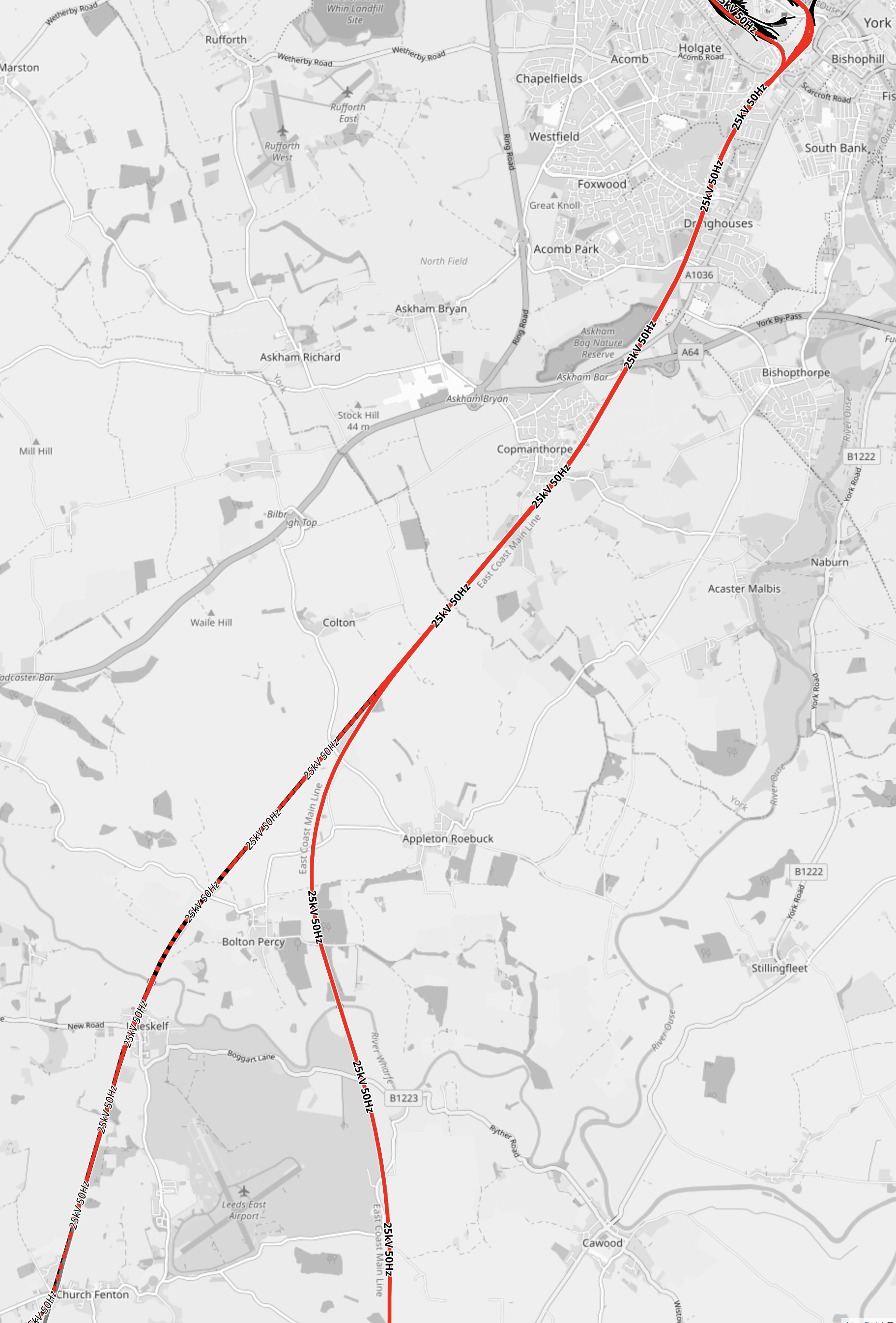
This OpenRailwayMap shows between York and Church Fenton.
Note.
red lines indicate 25 KVAC overhead electrification.
York is in the North-East corner of the map.
Church Fenton is in the South-West corner of the map.
The track marked in red going South is the Selby Diversion, which was built in 1983 to avoid the Selby coalfield. It joins the York and Church Fenton route at Colton Junction.
The Colton Junction and Church Fenton section is marked in red and black, indicating this section is being electrified.
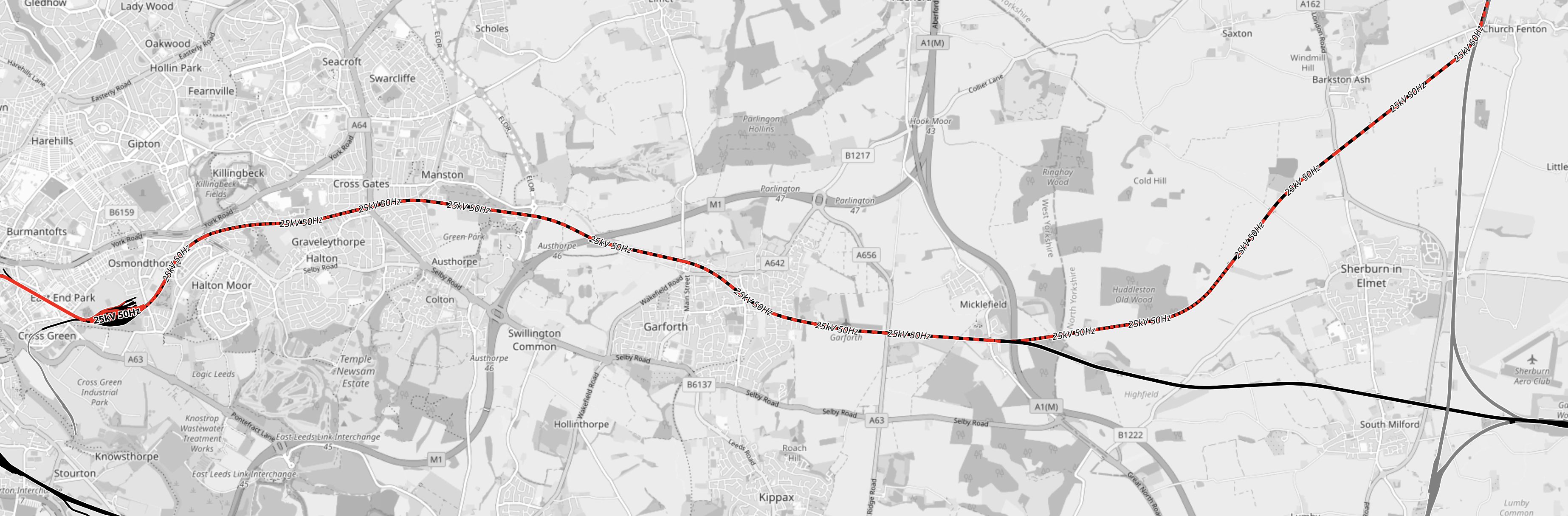
This second OpenRailwayMap shows between Church Fenton and Neville Hill TMD in the East of Leeds.
Note.
- Church Fenton is in the North-East corner of the map.
- Neville Hill TMD is the big black blob in the middle of the West edge of the map.
- The route marked in red and black will probably be the next to be electrified.
- Between Leeds and Neville Hill is electrified.
Electrification of Church Fenton and Neville Hill TMD means that the electrification between Leeds and York would be complete.
These services use this route between Leeds and York.
- TransPennine Express – 1 tph – Liverpool Lime Street and Newcastle
- TransPennine Express – 1 tph – Manchester Airport and Redcar Central
- CrossCountry – 1 tph – Plymouth and Edinburgh Waverley
In addition, the new electrified route will have other effects.
Electric trains will have direct electrified access to Neville Hill TMD from York.
Micklefield is only 42 miles from Hull and with charging at Hull, I suspect TransPennine’s Manchester Piccadilly and Hull service could go battery-electric.
Speed Limit To Be Lowered To 20mph In Wales
The title of this post, is the same as that of this article on the BBC.
These four paragraphs describe the policy.
Speed limits in built-up areas look set to be reduced from 30mph to 20mph in Wales from next year – a UK first that is controversial among some drivers.
Ministers say a 20mph speed limit will lower road collisions and traffic noise and encourage people to walk and cycle.
The slower limit has been divisive in areas where there have been trials with some motorists complaining of more congestion and journeys taking longer.
The proposed new law will be put before a Welsh Parliament vote on Tuesday.
I’m not sure that it will work.
I live in a 20 mph zone in Hackney.
But cars and motor bikes still speed through at up to 50 mph, as there is no visible enforcement.
Extending The Elizabeth Line – Improving The Route To Windsor & Eton Central Station
This post is now complete.
I took the Elizabeth Line to Slough station, for onward travel to Windsor & Eton Central station today and took these pictures along the route.

































Note.
- I joined the Elizabeth Line at Moorgate station and took a train all the way to Paddington station.
- As a Freedom Pass holder, I use the Elizabeth Line for nothing.
- I changed between the Central and Western sections of the Elizabeth Line at Paddington.
- I also bought my Slough and Windsor & Eton Central ticket at Paddington from a machine, for the princely sum of £2.10. It was with a Senior Railcard.
- There is a lot of building going on along the route.
- The diesel train on the Slough-Windsor & Eton Line was a three-car Class 165 train.
I have some thoughts on how to improve the train service to Windsor.
What Do I Mean By Improving?
I don’t mean direct trains, as that would be impossible for various reasons.
- Platform length at Windsor & Eton Central station would be a problem.
- Flat crossing across the fast lines would slow the expresses.
- To make the running efficient, a flyover would need to be built. The disruption of building it and the cost would be immense.
What is needed, is a system, which means that getting from Central Elizabeth Line stations to Windsor & Eton Central station is as easily as possible.
Windsor Is One Of Our Premier Tourism Destinations
I suspect that on passenger numbers; Bicester Village, Cambridge, Oxford and Windsor are the four most visited tourist sites by rail from London.
I don’t think it’s a good idea to provide some of the services to these destinations, with the exception of Cambridge, with British Rail-era diesel multiple units.
Could A Four-Car Train Be Run On the Slough-Windsor & Eton Line?
I took this picture of the Slough end of the three-car Class 165 train in Windsor & Eton Central station.

It does appear that say a four-car Class 387 train could be fitted into the platform, with perhaps some adjustment to the platform and the track.
Would The Train Be Electric Or Battery-Electric Powered?
Consider.
- The Slough-Windsor & Eton Line is only 2.5 miles long.
- It is single-track.
- Trains take six minutes to do the trip.
- Modern electric trains with better acceleration could probably do the trip in four minutes.
- A battery-electric train will need charging.
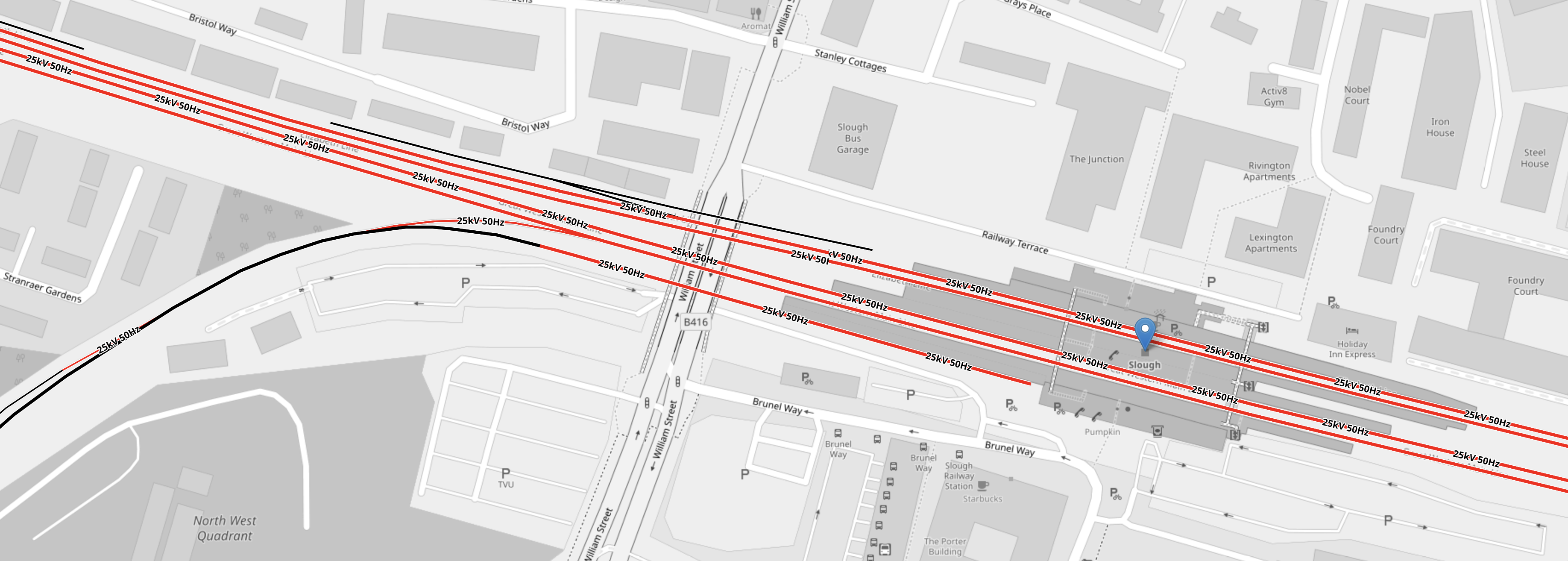
This OpenRailMap map shows the electrification at Slough station.
Note.
- 25 KVAC overhead electrification is shown in red.
- The Slough-Windsor & Eton Line leaves the map in the South-West corner of the map and runs into the electrified Bay Platform 1.
- The electrification in Platform 1 could be used to charge a battery-electric train.
- The Slough-Windsor & Eton Line appears to be partially electrified at the Slough end.
I wonder, if the simplest, most-affordable, least risky approach is to electrify the 2.5 miles with 25 KVAC overhead electrification, as it would allow a standard Class 387 train to work the route.
Operation Of The Shuttle
Currently, the Class 165 trains take six minutes between Slough and Windsor & Eton Central stations, which means that with turning the train at each end of the route, where the driver must walk seventy metres or so to change ends only a three trains per hour (tph) schedule is possible.
If I look at some of the station-to-station stops on the Elizabeth Line, I suspect that a well driven electric train could go between Slough and Windsor & Eton Central stations in perhaps four minutes. With a well-marshalled stop at either end of the route in perhaps two minutes, it could be possible to do a round trip in twelve minutes, which would allow a four tph service.
Capacity would go up from nine cars per hour to sixteen. or an over seventy percent increase in capacity.
There are several ways that, this shuttle could operate.
- As now, where the drivers have to be fit to change ends in the time.
- Two drivers are used with one in each cab.
- Drivers walk back on arrival at the terminal and then step-up into the next train. This is standard London Underground practice at stations like Brixton and Walthamstow Central.
- The train is fully-automated and the driver sits in either cab with an override, that allows him to take control, if say protestors or criminals get on the track.
As a Control Engineer, I certainly feel the fourth option is possible.
Intriguingly, I suspect the concept could be proved with two drivers in an existing three-car Class 165 train, to see if four tph are possible.
Ticketing
Ticketing is less of a problem now, than it was before March 28th 2022, as from that date Windsor & Eton Central station is now in the contactless area, so you could touch in with your bank card at any station in the London contactless area and touch out at that station.
It’s all explained on this page on the Great Western Railway web site.
I am a Freedom Pass holder, which gives me the ability to get free travel to and from anywhere on the Elizabeth line for free, so getting to and from Slough for nothing, is no problem, if I use the Elizabeth Line.
But I would need a ticket for the section between Slough and Windsor & Eton Central stations.
Before I got on the Elizabeth Line at Moorgate, I tried to buy an extension ticket between Slough and Windsor & Eton Central stations, from the ticket machines at Moorgate, but it was not possible, so in the end, I made a detour to the ticket office at Paddington and bought the ticket there. But when the Elizabeth Line is fully connected, there will have to be a rethink, as Freedom Pass holders from say Ilford would want a day out in Windsor.
Perhaps the Slough-Windsor & Eton Central line should become a fixed-fare line, where a bank card would be charged say a pound for each journey.
Note that I only paid £2.10 for a return ticket at Paddington with my Senior Railcard.
A Better Interchange At Slough
Currently, the Off Peak frequency of trains at Slough is as follows.
- Slough and Windsor & Eton Central – 3 tph
- Slough and Paddington – Elizabeth Line – 2 tph
- Slough and Paddington – Great Western Railway – 2 tph – Non-stop
- Slough and Paddington – Great Western Railway – 2 tph – Stopping
In TfL Confirms Details Of Reading Services, I wrote that the Elizabeth Line will have 4 tph to London in the Off Peak, with two extra services in the Peak.
This indicates to me, that the Slough and Windsor & Eton Central service needs four tph.
Global Electrolyzer Capacity To Reach 8.52GW By 2026
The title of this post, is the same as that of this article on Power Technology.
This is the first paragraph.
GlobalData’s latest report, ‘Hydrogen Electrolyzers Market Report Market Size, Share and Trends Analysis by Technology, Installed Capacity, Generation, Key Players and Forecast, 2021-2026’, reveals that the global electrolyzer capacity is estimated to grow to 8.52GW in 2026. Hydrogen is gaining prominence as a critical component of the energy transition, as significant policy support and government commitment to deep decarbonisation are spurring investments in hydrogen. By the end of 2021, seventeen governments released hydrogen strategies, with more than 20 governments publicly announcing that they are developing strategies, and numerous companies planning to tap business opportunities in hydrogen.
Hydrogen certainly appears to be coming.
In The Mathematics Of Blending Twenty Percent Of Hydrogen Into The UK Gas Grid, I calculated how much electricity would be needed to blend twenty percent of hydrogen into the UK gas grid.
To achieve this blending, which would reduce our carbon emissions by a large amount and still be compatible with existing boilers and appliances would 8.2 GW of electricity to generate the hydrogen.
The world needs to be developing more electrolysers for green hydrogen.
Will We Run Out Of Power This Winter?
Someone asked me if we will run out of power, if Vlad the Mad cuts all the gas to Western Europe.
This was my reply.
It appears that this year, 3.2 GW of new offshore wind farms could start producing electricity, followed by similar amounts in both 2023 and 2024.
One of those to come on stream about now is the 1.4 GW Hornsea 2 wind farm!
The follow-up 2.9 GW Hornsea 3, signed a contract last week for delivery in 2026/27.
Moray East in Scotland and Triton Knoll off Lincolnshire, are also scheduled to come on stream this year and they’re around 900 MW each.
As someone, who used to write project management software, I hope the companies building these fields have enough resources, in terms of people, boats, cranes and money. But as the companies are all the Shells of the wind industry, I would hope they have got their sums right.
What About The Contracts for Difference Awarded In Allocation Round 4?
We are currently fighting two wars at the moment.
- The main war in Ukraine, where we are giving that unfortunate country all the help we can.
- The secondary war in the UK against energy prices.
Would it help our cause in both wars, if we produced more energy?
- More renewable energy would reduce our dependence on imported gas.
- The gas saved could go to Europe.
- Europe would not be buying Vlad the Mad’s bloodstained gas.
- Replacing gas with solar and wind power might reduce energy prices.
If I put myself in the position of a struggling farmer with a contract for difference to build a solar farm on a poor field, I would want that farm to be earning money as soon as possible.
- Now that I have the contract can I start assembling that solar farm?
- Similar arguments can probably be used for onshore wind, which must be easier to assemble, than offshore wind.
- I don’t think that the hard-pressed energy suppliers would bother, if they received some quality cheap electricity earlier than they expected.
- Obviously, all the cables and the substations would need to be in place.
So I think that it is reasonable to assume, that energy might ramp up quicker than expected.
It could even be more front-loaded, if all the installers got a shift on.
Every little helps!
New Renewable Energy In 2023?
These wind farms are scheduled for commissioning in 2023.
- Neart Na Gaoithe – 450 MW
- Sofia Offshore Wind Farm – 1400 MW
- Seagreen Phase 1 – 1075 MW
We could see 2925 MW of offshore wind power commissioned in 2023.
New Renewable Energy In 2024?
These renewable energy sources are scheduled for commissioning in 2024.
- Dogger Bank A – 1200 MW
- Round 4 Solar – 125.7 MW
- Dogger Bank B – 1200 MW
- Dogger Bank C – 1200 MW
Note, where a windfarm is given a commissioning date of 2023/24 in Wikipedia , I will put it in 2024.
We could see 3726 MW of renewable energy commissioned in 2024.
New Renewable Energy In 2025?
These renewable energy sources are scheduled for commissioning in 2025.
- Moray West – 1200 MW
- Round 4 Solar – 1958 MW
- Round 4 Onshore Wind – 888 MW
- Round 4 Energy from Waste – 30 MW
- Vanguard Boreas Phase 1 – 1400 GW
We could see 6476 MW of renewable energy commissioned in 2025.
New Renewable Energy In 2026?
These renewable energy sources are scheduled for commissioning in 2026.
- East Anglia 1 North – 800 MW
- East Anglia 2 – 900 MW
- Round 4 Tidal Stream – 5.62 MW
We could see 1705 MW of renewable energy commissioned in 2026.
New Renewable Energy In 2027?
These renewable energy sources are scheduled for commissioning in 2027.
- Round 4 Tidal Stream – 35.2 MW
- Round 4 Floating Offshore Wind – 32 MW
- Round 4 Offshore Wind – 5594 MW
- Hornsea 3 Offshore Wind – 2852 MW
- Hinckley Point C Nuclear – 3,260 MW
We could see 13173 MW of renewable energy commissioned in 2027.
Too Much Electricity!
Summarising the figures for new capacity gives.
- 2022 – 3200 MW
- 2023 – 2925 MW
- 3024 – 3726 MW
- 2025 – 6476 MW
- 2026 – 1705 MW
- 2027 – 11773 MW
This totals to 28554 MW.
One problem we may have is too much electricity and as we are not blessed with much storage in the UK, where will be able to put it?
In a strange way, Vlad the Mad may solve the problem, by cutting off Europe’s gas.
We have a few interconnectors, where we can export the electricity to allow the Belgians, Dutch, French and the Germans to have a shower.
- BritNed – 1 GW – Isle of Grain and Rotterdam
- ElecLink – 1 GW – England and France through the Channel Tunnel.
- HVDC Cross-Channel – 2 GW – England and France
- IFA-2 – 1 GW – England and France
- Nemo Link – 1 GW – Richborough and Zeebrugge
- North Sea Link – 1.4 GW – Blyth and Norway
- Viking Link – 1.4 GW – Lincolnshire and Denmark
It looks like construction may be starting soon for another interconnector. NeuConnect will have a capacity of 1.4 GW between the Isle of Grain and Wilhelmshaven.
Conclusion
If I was the German Chancellor, I’d do everything in my power to accelerate the construction of NeuConnect!
 The Anonymous Widower