Coronavirus: Protein Treatment Trial ‘A Breakthrough’
The title of this post, is the same as that of this article on the BBC.
These are the first three paragraphs of the article.
The preliminary results of a clinical trial suggest a new treatment for Covid-19 reduces the number of patients needing intensive care, according to the UK company that developed it.
The treatment from Southampton-based biotech Synairgen uses a protein called interferon beta which the body produces when it gets a viral infection.
The protein is inhaled directly into the lungs of patients with coronavirus, using a nebuliser, in the hope that it will stimulate an immune response.
I first heard of Synairgen about five months ago, when I read about the company in the Sunday Times. It was only a few words, but it did say, that they were developing an inhaled beta interferon for use by Covid-19 patients or those with lung problems.
I should say, that I know about inhaled pharmaceuticals. Not because, I’ve ever used any, but because I funded the development of a very successful metered-dose inhaler for asthma drugs.
Two inventors; Stephen Dunne and Terry Weston came to me looking for finance to complete the development of an aerosol value, that instead of using CFCs or HCFCs as a propellant, used purified air. In fact it was pure nitrogen, but the average user of a deodorant or fly-spray doesn’t know that nitrogen is a constituent of air and thinks it’s posionous.
We formed a company called Dunne Miller Weston or DMW.
It was a technical success and the company’s MP; John Gummer, took details of the breakthrough to the conference that resulted in the Montreal Protocol.
The device and the associated patents were sold to Johnson & Johnson.
The two inventors had other ideas and one was for a metered dose inhaler for asthma drugs.
I remember that they were able to get a grant from Glaxo to prove the concept of the device.
Because, the full development would need more money, we now had a fourth partner; Mike.
I remember going with Mike to see Glaxo and we were unable to reach agreement on how Glaxo would contribute to the full development. They tended to give out these grants and I got the impression, that ours was one of the first to get a positive result and they didn’t know how to handle it.
But, it didn’t matter, as we were able to raise the funding from elsewhere and develop a successful device.
This was sold to Boehringer Ingelheim for a lot of money and all investors were very satisfied. Their product name is Respimat.
Glaxo carried on using an HCFC device.
I earned a reasonable about of money from my investment, but I also learned a lot about pharmaceuticals.
- At the time, New Zealand had the highest level of asthma inhaler use in the world.
- Pharmaceutical companies are very conservative.
- Doctors tend to give out inhalers like toys.
- Naked flames are a big cause of asthma.
But the most important knowledge I acquired was over a drink with an engineer in a pharmaceutical company, that the fine spray we obtained with our device would have lots of medical applications, including delivery of insulin for diabetics. We’d already had very good feedback, from test users in Germany.
Some other applications are stored in my brain. One could be a very big seller in the modern world!
So when I saw the report in The Sunday Times, I bought a few shares in Synairgen.
I have been well-rewarded today!
Beeching Reversal – Reopening Stratford-upon-Avon And Honeybourne-Worcester/Oxford (SWO) Railway Line
This is one of the Beeching Reversal projects that the Government and Network Rail are proposing to reverse some of the Beeching cuts.
I covered this route in RSC Urges GWR To Provide Stratford Improvements and came to these conclusions.
There are three ways to improve rail access to Stratford-upon-Avon.
-
- The relatively easy and quick, enhancement of the rail services in Warwickshire.
- Provide better one-change routes using Chiltern Railways.
- The more difficult re-connection of Stratford to the Cotswold Line at Honeybourne.
As the last project will take years to implement, I feel, it is important that services to Stratford from Birmingham, Coventry, Leamington Spa and the West Midlands are substantially increased.
I also believe that the responsibility of providing a local service between Leamigton Spa and Stratford should be given to West Midlands Trains.
The Case To Reconnect Stratford-on-Avon and Honeybourne Stations
In Where Is London Midland Going?, I wrote this section in July 2017.
The North Warwickshire Line
The North Warwickshire Line links Birmingham with Stratford-on-Avon and has an alternative name of the Shakespeare Line.
Plans exist to extend this line South to Honeybourne station on the Cotswold Line.
Under Possible Future Development in the Wikipedia entry for the Warwickshire Line, this is said.
The Shakespeare Line Promotion Group is promoting a scheme to reopen the 9 miles (14 km) of line south of Stratford to Honeybourne where it would link to the Cotswold Line. Called the “Avon Rail Link”, the scheme (supported as a freight diversionary route by DB Schenker) would make Stratford-upon-Avon station a through station once again with improved connections to the South, and would open up the possibility of direct services to Oxford and Worcester via Evesham. The scheme faces local opposition. However, there is a good business case for Stratford-Cotswolds link.
I think we’ll see something in the new franchise about developing this line, as there is a lot of potential for a train operator.
-
- Direct services between Stratford-on-Avon and Oxford, where there is a connection to Bicester Village. Tourists would love that!
- Connection of the housing development at Long Marston to Birmingham.
- Could Stratford-on-Avon or Honeybourne become the terminus of a service from Leamington, Coventry and Nuneaton?
It would also give DB Schenker, their freight diversion.
But we didn’t see anything in the new franchise and the project has turned up in the list of Beeching Reversal projects.
The Route Into Stratford-Upon-Avon
This Google Map shows Stratford-upon-Avon station.
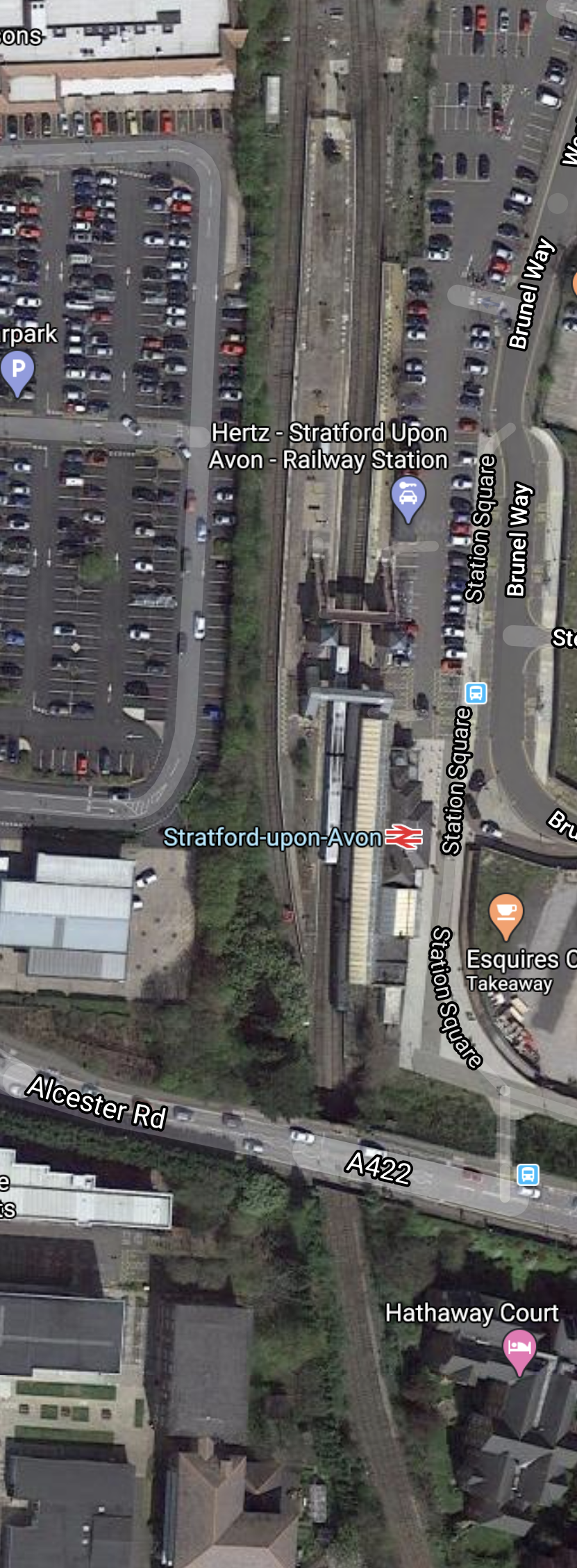
Note.
- The station is well-appointed with step-free access and three platforms.
- The bridge at the Southern end of the station to allow the railway to go South, appears to be intact.
This second Google Map shows the area of the town from the station to the racecourse.
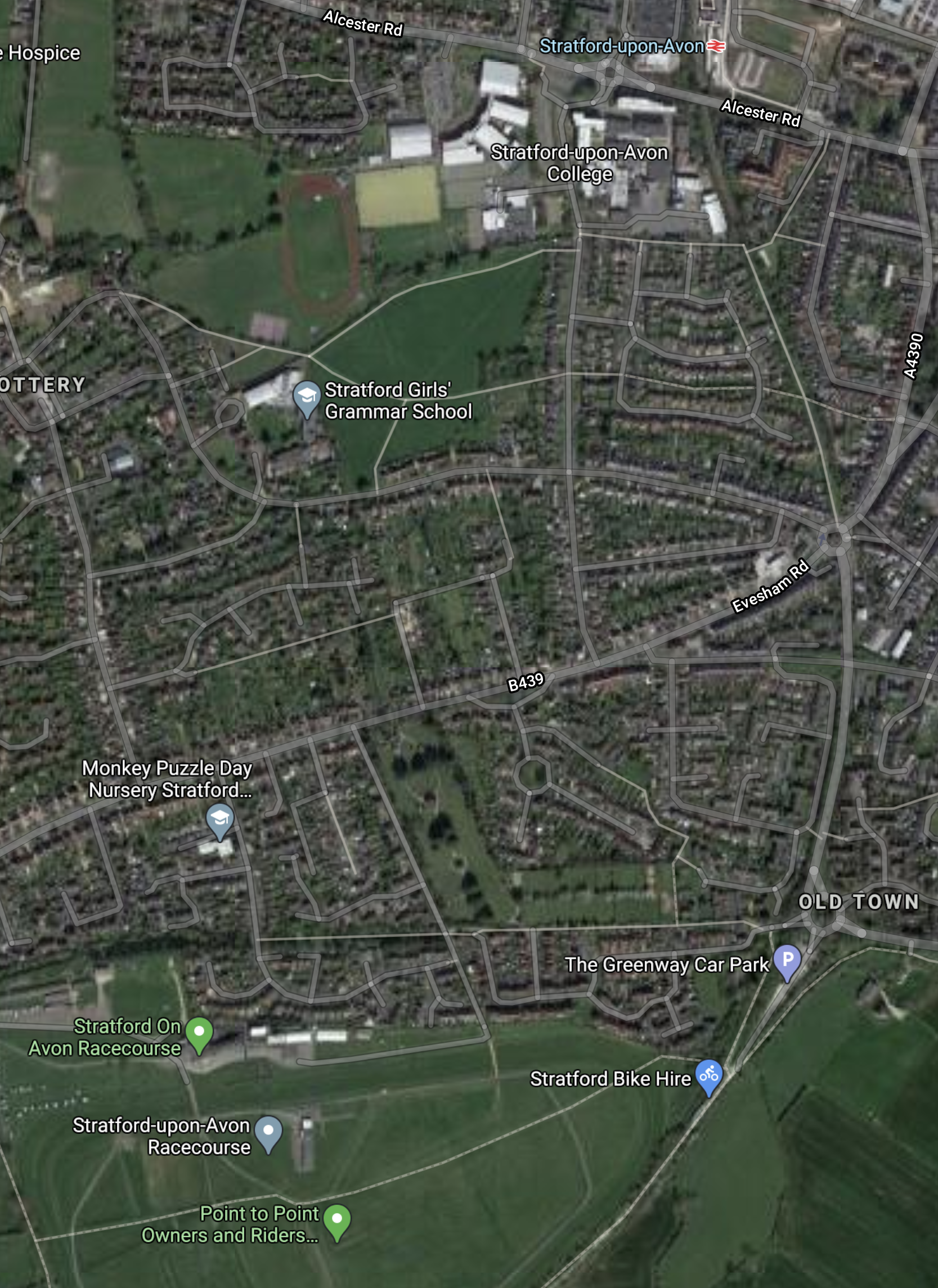
Note.
- Stratford-upon-Avon station at the top of the map.
- Stratford Racecourse at the bottom of the map.
The road curving between the station and the racecourse is the track of the former Stratford to Honeybourne railway.
My first reaction, when I saw this was that those, who want to rebuild this railway can’t be serious.
- Would you want one of DB Schenker’s noisy, smelly and polluting Class 66 locomotives running past your house?
- Would you want the line to be electrified, so they could use electric locomotives on this short stretch of railway? If so would DB Schenker be happy to change locomotives twice?
I have looked at new railways entering towns and cities all over the UK and Europe and feel there is only two possible solutions for Southern access to Stratford-upon-Avon station.
- A single-track passenger-only railway run by battery electric trains.
- A tunnel, which would probably be single-bore for cost reasons.
South of Stratford, the route is easier and it can be picked out on Google Maps until it reaches the Cotswold Line to the East of Honeybourne station.
This Google Map shows Honeybourne station and the junction.
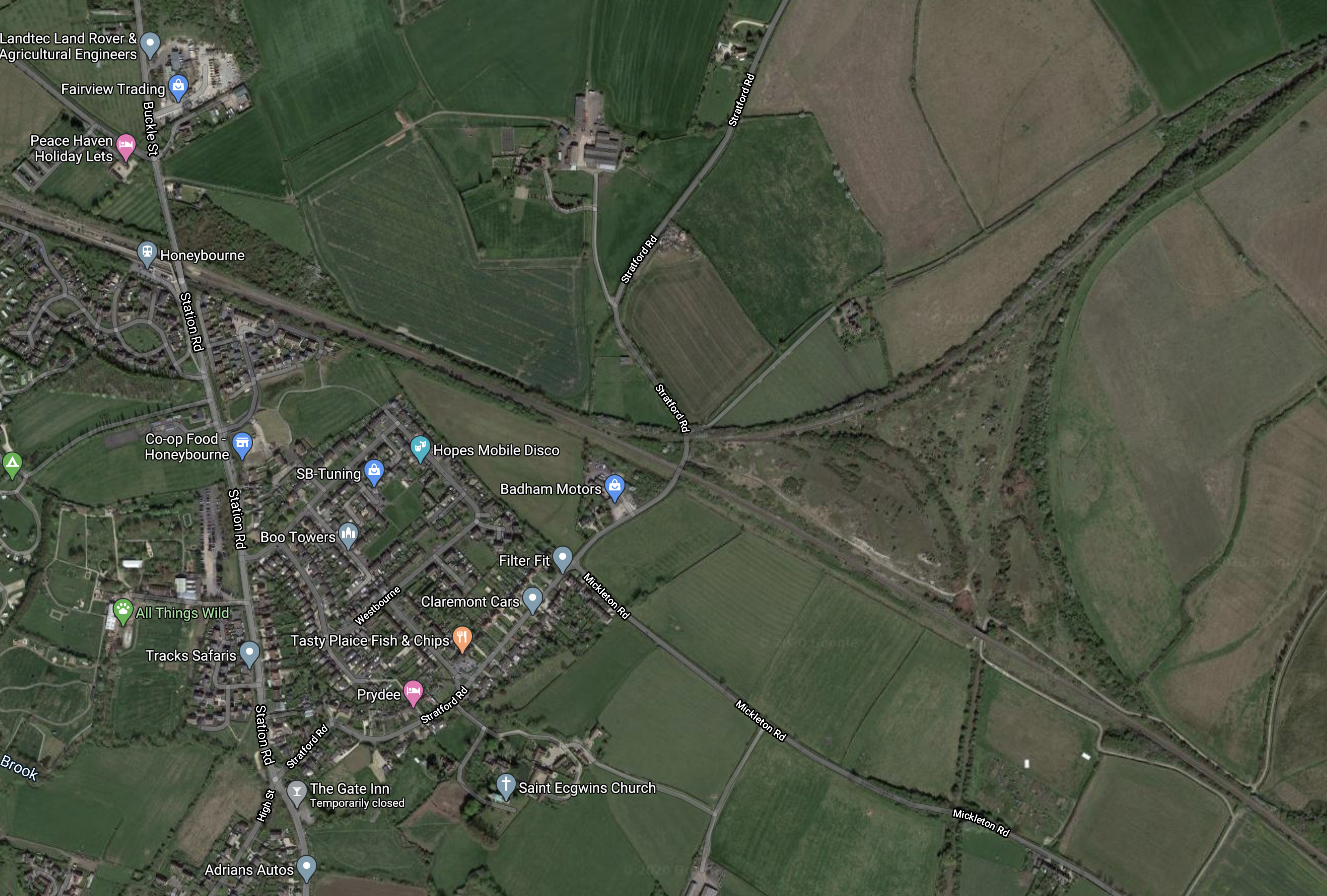
Note.
- The Cotswold Line running NW-SE across the map.
- The large triangular junction that connected the line to Stratford-upon-Avon station, which is to the North-East.
- Another track going South from the junction, can be picked out. This leads to the heritage Gloucestershire Warwickshire Railway at Broadway station, with onward connections to Cheltenham Racecourse.
Honeybourne station could be an important rail hub.
Honeybourne Station And Battery Electric Trains
Consider.
- Hereford and Honeybourne stations are 48 miles apart.
- Didcot East Junction, where trains switch to and from the Great Western Main Line electrification and Honeybourne stations are 48 miles apart.
- Trains to Hereford pass through Great Malvern, Worcestershire Parkway and Worcester Foregate Street.
- Stratford-up-on-Avon and Honeybourne stations would be less than thirty miles apart, if the two stations were to be reconnected by rail.
- Hitachi’s proposed battery electric trains will have a range of 56 miles on battery power.
If the means to charge battery electric trains were provided in the Honeybourne area, the following services could be run by battery electric trains.
- London Paddington and Worcestershire Parkway, Worcester Foregate Street, Great Malvern and Hereford.
- Honeybourne and Stratford-upon-Avon
The charging could be performed, by a ten minute stop at Honeybourne station or a section of electrified line centred on the station.
The two stations either side of Honeybourne are Evesham and Moreton-in-Marsh.
- They are fifteen miles apart.
- Trains take eighteen minutes between the stations.
- This would be enough time to charge the batteries.
- Trains could pan-up and pan-down in the two stations.
I believe modern low-visibility overhead electrification could be used.
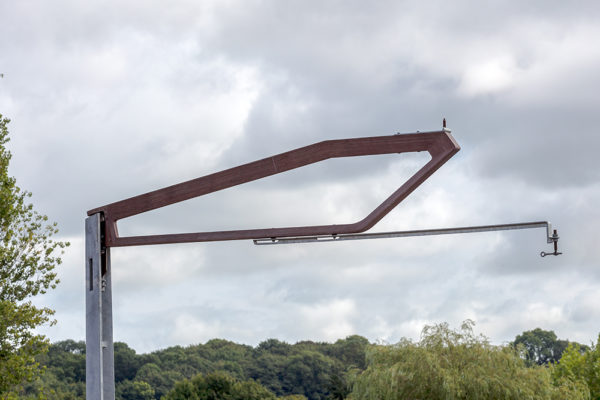
See Prototype Overhead Line Structure Revealed for more details on these gantries.
An Oxford And Stratford-upon-Avon Service
My estimates for the timings of the two sections of the route are as follows.
- Stratford-upon-Avon and Honeybourne – 20 minutes
- Honeybourne and Oxford – 46 minutes
Perhaps not the best for an efficient services, but I’m sure something could be arranged.
Conclusion
This will be a difficult project to get built.
If it is built, I suspect, it will be a passenger-only route using battery trains.
Gore Street Energy Welcomes Green Light For Larger Battery Projects In England And Wales
The title of this post, is the same as that of this article on Proactive Investors.
These are the introductory paragraphs..
Gore Street Energy Fund has welcomed legal changes to allow battery projects larger than 50MW in England and 350MW in Wales.
The new legislation removes energy storage, except pumped hydro, from the Nationally Significant Infrastructure Projects regime in England and Wales, said the fund.
This will allow larger projects to receive planning permission without government approval.
I can see why they are pleased, as it removes a level of bureaucracy.
I suspect companies like Highview Power will also be pleased as 50 MW is at the lower end of their battery range.
The Future Of West Midlands Trains’s Class 350 Trains
Currently, West Midlands Trains have four sub-fleets of Class 350 trains.
- Class 350/1 – 30 trains – Leased from Angel Trains
- Class 350/2 – 37 trains – Leased from Porterbrook
- Class 350/3 – 10 trains – Leased from Angel Trains
- Class 350/4 – 10 trains – Leased from Angel Trains
Note.
- All are 110 mph trains
- The trains are capable of being modified for 750 VDC third-rail electrification.
Under Future the Wikipedia entry for Class 350 trains says this.
West Midlands Trains announced that they would be replacing all 37 of their 350/2 units for Class 350/4 units cascaded from TransPennine Express and brand new Class 730 units which both can travel up to speeds of 110 mph.
In October 2018, Porterbrook announced it was considering converting its fleet of 350/2s to Battery electric multiple units for potential future cascades to non-electrified routes.
As West Midlands Trains have ordered 45 Class 730 trains for express services, it looks like they will be expanding services on the West Coast Main Line and around the West Midlands.
But it does appear that as many as thirty-seven trains will be returned to Porterbrook.
Class 350 Trains With Batteries
I believe that if fitted with batteries, these trains would meet or be very near to Hitachi’s specification, which is given in this infographic from Hitachi.

Note that 90 kilometres is 56 miles.
Could West Midlands Trains Run Any Services With Class 350 Trains With Batteries?
I think there are some possibilities
- Birmingham New Street and Shrewsbury – 30 miles without electrification between Shrewsbury and Wolverhampton – Charging facility needed at Shrewsbury.
- Birmingham New Street and Hereford via Worcester – 41 miles without electrification between Hereford and Bromsgrove – Charging facility needed at Hereford.
- Leamington Spa and Nuneaton via Coventry – 19 miles without electrification – Charging on existing electrification at Coventry and Nuneaton.
- The proposed direct Wolverhampton and Walsall service, that i wrote about in Green Light For Revived West Midlands Passenger Service.
There may also be some services added because of the development of the Midlands Rail Hub and extensions to London services,
Who Has Shown Interest In These Trains?
I can’t remember any reports in the media, about any train operator wanting to lease these trains; either without or with batteries.
Conclusion
It does all seem a bit strange to me.
- As a passenger, I see nothing wrong with these trains.
- They are less than twenty years old.
- They are 110 mph trains.
- They have 2+2 interiors, with lots of tables.
- They could be fitted with batteries if required.
But then, all of those things could be said about Greater Anglia’s Class 379 trains.
Our Sustainability Journey
The title of this post, is the same as that of this press release on the Rolls-Royce web site.
It is sub-titled.
Paul Stein’s Thoughts On Sustainability And Electrification
Paul Stein is Rolls-Royce’s Chief Technology Officer, so what he says is important.
This press release was the source of the information behind Distributed Propulsion ‘Maybe The Only Means’ For Small Electric Flight Progress, which I wrote about Rolls-Royce’s beer keg-sized 2.5 MW generator.
This is the third paragraph.
We’ve taken great steps at Rolls-Royce with our three-pillar sustainability approach of developing the gas turbine to even greater efficiency, supporting the introduction of Sustainable Aviation Fuel and creating new, disruptive technologies such as electrification.
These are definitely, the three pillars of wisdom, when it comes to sustainable aviation.
E-Fan X
This paragraph is Paul Stein’s view of the E-Fan X.
One of the great endeavours in the latter category has been our E-Fan X programme in partnership with Airbus. From our side, this has involved creating a hybrid-electric power generation system at a scale never previously seen in our industry, comprised of an embedded AE2100 gas turbine driving a 2.5MW generator and 3000V power electronics and an electric propulsion unit. What has been particularly encouraging has been the amount of industry interest and support for this programme, and I know everyone at Rolls-Royce and Airbus has been truly grateful for that.
He states that the E-Fan has now concluded, but a several valuable lessons have been learned.
2.5 MW Generator
He describes the generator like this.
Amongst the many great achievements from E-Fan X has been the generator – about the same size as a beer keg – but producing a staggering 2.5 MW. That’s enough power to supply 2,500 homes and fully represents the pioneering spirit on this project.
The press release discloses that the heart of this staggering generator is a Rolls-Royce AE2100 gas turbine, which powers the latest version of the legendary Lockheed Hercules; the C-130J Super Hercules.
Wikipedia gives this data for the AE2100D2 version of the engine.
- Length – three metres
- Diameter – 0.73 metres
- Weight – 783 kilograms
- Maximum Power Output – 3458 kW
- Fuel Consumption – 0.25/kW/h
It looks like in the E-Fan X application, the engine is not at full power.
Use With Aviation Biofuel
Aviation Biofuel is described like this in the first sentences of its Wikipedia entry.
Aviation biofuel is a biofuel used for aircraft. It is considered by some to be the primary means by which the aviation industry can reduce its carbon footprint. After a multi-year technical review from aircraft makers, engine manufacturers and oil companies, biofuels were approved for commercial use in July 2011.
But it doesn’t necessarily mean growing large amounts of crops and converting it to the fuel. Altalto, who are backed by British Airways, Shell, Oxford University and the British Government are building a plant at Immingham to convert household and industrial waste into aviation biofuel.
I would expect that Rolls-Royce have made sure that the generator will work with aviation biofuel.
A Memory Of Emergency Power Generation
About twenty-five years, there was a major power failure after a thunder storm, where I lived in Suffolk and C and myself went to bed in the dark. We awoke to full power in the morning, after a good night’s sleep with no disturbance.
Imagine my surprise, when I let the dogs out to find parked in the field in front of the house, a very large articulated truck.
I was greeted by an engineer, who asked if I minded, his generator in my field. I seem to remember my response was to offer him a cup of tea, which he refused, as he said he had everything he needed in the truck.
It turned out that the main sub-station for the area had received a direct lightning strike and had been destroyed. So to supply power to all the nearby villages, as my farm was at the end of the supply, it was the most convenient place to plug in a transportable gas-turbine generator. The generator was in the field for about ten days and the whole operation impressed me with its professionalism.
But with this new 2.5 MW generator from Rolls-Royce, there would only need to be a small 3.5 tonne four-wheeled truck, to include the generator, fuel and living quarters for the engineer
We have made a lot of progress in twenty-five years.
A Modern Railway Locomotive
The power of this new Class 68 diesel locomotive, that was built in Spain, by Swiss company Stadler is a very healthy 2,800 kW.
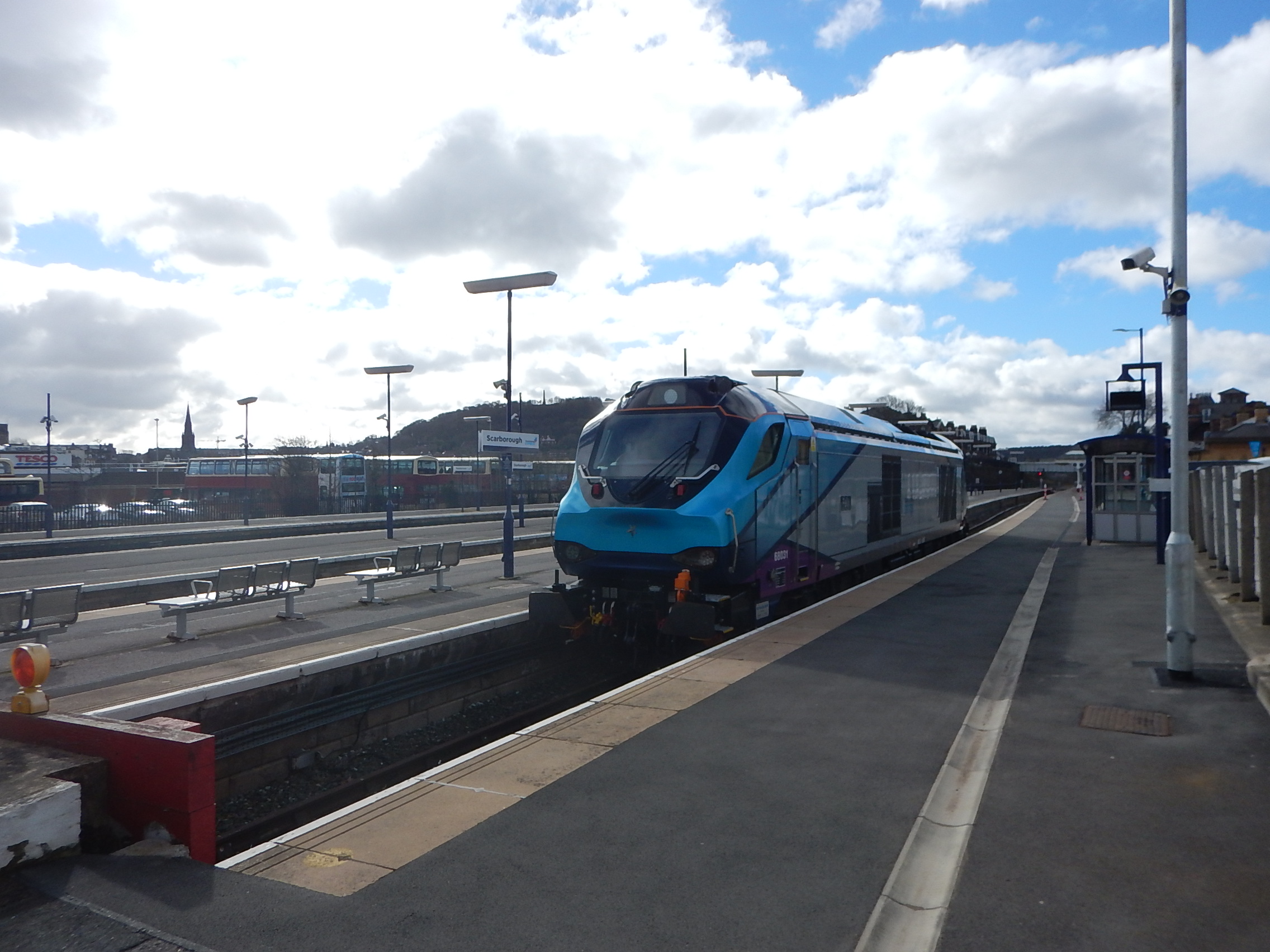
Consider these facts about a Class 68 locomotive.
- Thirty-four of these locomotives have been produced for the UK.
- They are powered by a Caterpillar C175-16 engine, which weighs thirteen tonnes.
- The transmission of these locomotives is electric, which means that the diesel engine drives a generator and the train is driven by electric traction motors.
- The locomotive is equally at home hauling intermodal freight trains and passenger trains for Chiltern Railways or TransPennine Express.
- According to Wikipedia, Class 68 locomotives comply with Stage III A of the European emission standards but not Stage III B. But that is much better than most of our noisy, smelly and polluting diesel locomotives.
Class 68 locomotives are members of the UKLight family of locomotives, which contains, these two other locomotives.
- Already in service is the Class 88 locomotive, which is a bi-mode locomotive, which is capable of running on electrification or the on-board 0.7 MW diesel engine.
- Under development is the Class 93 locomotive, which is a tri-mode 110 mph locomotive, which is capable of running on electrification, the on-board 0.7 MW diesel engine or battery power.
Stadler seem to be able to mix-and-match various power sources to provide versatile and highly-desirable locomotives.
I feel it would be feasible to design a railway locomotive with the following power sources.
- 25 KVAC overhead or 750 VDC third-rail electrification, providing up to perhaps the four MW of a Class 88 locomotive.
- A Rolls-Royce gas-turbine generator running on aviation biofuel, providing up to perhaps three MW.
- Batteries up to a weight of perhaps ten tonnes.
I am sure that it could handle many of the routes still run with diesel locomotives in the UK.
- It would handle all locomotive-hauled passenger services and would be electric-only in stations.
- It certainly solves the problem of hauling long intermodal freight trains between Felixstowe and the Midlands and the North.
- To handle the heaviest stone and aggregate trains, it might need a more powerful generator, but I’m sure Rolls-Royce would oblige.
In Thoughts On A Battery/Electric Replacement For A Class 66 Locomotive, I gave a list of routes, that would need to be handled by a battery electric locomotive.
- Didcot and Birmingham – Around two-and-a-half hours
- Didcot and Coventry – Just under two hours
- Felixstowe and Ipswich – Around an hour
- Haughley Junction and Peterborough – Around two hours
- Southampton and Reading – Around one-and-a-half hours
- Werrington Junction and Doncaster via Lincoln – Around two hours
- Werrington Junction and Nuneaton – Just under two hours
Will Rolls-Royce’s generator be able to supply 2.5 MW for up to four hours?
This would need two-and-a-half tonnes of aviation biofuel, which would be around 3,200 litres, which could be carried in the 5,000 litre tank of a Class 68 locomotive.
It certainly seems feasible to replace diesel locomotives with gas-turbine locomotives running on aviation biofuel, to reduce net carbon emissions and reduce noise and pollution.
But this is not just a UK problem and many countries, who rely on diesel-hauled rail freight, would look seriously at such a locomotive.
Underfloor Mounting In Passenger Trains
These pictures show the space underneath a Hitachi Class 800 train.
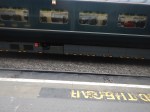
The red cap visible in some pictures is the filler for the oil or diesel for the MTU 12V 1600 R 80L diesel engine used to power the trains away from electrification.
This diesel engine has this specification.
- It produces 560 kW of power.
- It weighs around six tonnes.
- Its is about 4 x 2.5 x 1 metres in size.
The diesel engine produces about a fifth of the power as the gas-turbine generator, which is also smaller and very much lighter in weight.
It should also be noted, that a nine-car Class 800 train has five of these MTU diesel engines.
At a first glance, it would appear Hitachi could find one of Rolls-Royce’s gas-turbine generators very useful.
- It might even enable self-powered high speed trains to run on lines without electrification at speeds well in excess of 140 mph.
- I can certainly see, High Speed Two’s classic-compatible trains having one or possibly two of these generators, so they can extend services on lines without electrification.
We shouldn’t forget that one version of British Rail’s Advanced Passenger Train was to be gas-turbine powered.
A Class 43 Diesel Power-Car
Rolls-Royce would need a test-bed for a trial rail application of their 2.5 MW generator and there is probably no better trial vehicle, than one of the numerous Class 43 power-cars waiting to be scrapped. They could probably obtain a complete InterCity 125, if they wanted one for a realistic weight, test equipment and a second power-car for comparison and rescue.
But seriously, if we are going to remove diesel from UK railways by 2040, a solution needs to be found for the GWR Castles, ScotRail’s Inter7Citys and NetworkRail’s New Measurement Train.
One of the great advantages of these staggering (Rolls-Royce’s Chief Technology Officer’s word, not mine!) generators is that they are controlled by Full Authority Digital Engine Control or FADEC.
FADEC will give the pilots in a Hercules or other aircraft, all the precise control they need and I doubt Rolls-Royce will leave FADEC out of their gas turbine generator, as it would give the operator or driver extremely precise control.
A driver of a GWR Castle equipped with two gas-turbine power-cars, would be able to do the following.
- Adjust the power to the load and terrain, with much more accuracy, than at present.
- Shut the engines down and start them quickly, when passing through sensitive areas.
- Cut carbon-dioxide emissions, by simply using a minimum amount of fuel.
I would put a battery in the back of the Class 43, to provide hotel power for the passenger coaches.
Running current MTU engines in the Class 43s, on biodiesel is surely a possibility, but that not an elegant engineering solution. It also doesn’t cut carbon emissions.
As there are still over a hundred Class 43s in service, it could even be a substantial order.
It should also be noted, that more-efficient and less-polluting MTU engines were fitted in Class 43s from 2005, so as MTU is now part of Rolls-Royce, I suspect that Rolls-Royce have access to all the drawings and engineers notes, if not the engineers themselves
But it would be more about publicity for future sales around the world, with headlines like.
Iconic UK Diesel Passenger Trains To Receive Green Roll-Royce Jet Power!
COVID-19 has given Rolls-Royce’s aviation business a real hammering, so perhaps they can open up a new revenue stream by replacing the engines of diesel locomotives,
A Class 55 Locomotive
Why Not?
A Class 55 locomotive is diesel electric and there are thousands of diesel locomotives in the world, built to similar basic designs, that need a more-efficient and more environmentally-friendly replacement for a dirty, smelly, noisy and polluting diesel power-plant.
Marine Applications
The Wikipedia entry for the Cat C175, says this.
The Cat C175 is often used in locomotives and passenger-class ships.
I suspect there will be marine applications for the gas-turbine generator.
Conclusion
I’m very certain that Rolls-Royce’s pocket power station has a big future.
Who said that dynamite comes in small parcels?
Midlands Rail Hub
On the Midlands Connect web site, they have a page, which is entitled Midlands Rail Hub.
This is the introductory paragraph.
The Midlands Rail Hub – our flagship project – is the biggest upgrade of our rail network for a generation.
The page contains this helpful map.

There is also a table of journeys and the improvements to be made.
- Birmingham – Nottingham – +1 tph – 72 minutes – 59 minutes
- Birmingham – Leicester – +2 tph – 66 minutes – 42 minutes
- Birmingham – Hereford – +1 tph – 85 minutes – 65 minutes
- Bitmingham – Worcester – +1 tph – 40 minutes – 35 minutes
- Birmingham – Derby – +2 tph – 38 minutes – 38 minutes
- Coventry – Leicester – +2 tph – 57 minutes – 38 minutes
- Coventry – Nottingham -+2 tph – 99 minutes – 63 minutes
- Birmingham – Bristol – +1 tph – 85 minutes – 80 minutes
- Birmingham – Cardiff – +1 tph – 117 minutes – 112 minutes
- Birmingham – Kings Norton – +2 tph – 18 minutes – 14 minutes
Note that the data by each route is the increase in frequency in trains per hour (tph), the current journey time and the future journey time.
I’ll now look at each route in more detail.
Birmingham And Bristol
Consider.
- Birmingham New Street and Bristol Temple Meads stations are 90 miles apart.
- Current service is two tph, which is provided by CrossCountry and goes via Worcestershire Parkway, Cheltenham Spa and Bristol Parkway.
- There is to be an increase of one tph.
- Current journey time is 85 minutes
- Future journey time is 80 minutes
As CrossCrountry’s Birmingham and Bristol service goes through to Edinburgh, Glasgow or Manchester Piccadilly, would it not be convenient, if the service could use High Speed Two to the North of Birmingham?
Birmingham And Cardiff
Consider.
- Birmingham New Street and Cardiff Central stations are 108 miles apart.
- Current service is two tph, which is provided by CrossCountry and goes via Worcestershire Parkway, Cheltenham Spa. Gloucester and Newport.
- There is to be an increase of one tph.
- Current journey time is 85 minutes
- Future journey time is 80 minutes
As CrossCrountry’s Birmingham and Cardiff service goes through to Nottingham, would it not be convenient, if the service could use High Speed Two between Birmingham and Nottingham?
It would appear that both Bristol and Cardiff services could benefit from a High Speed Two connection.
This map from High Speed Two shows the line’s route through the Water Orton area.
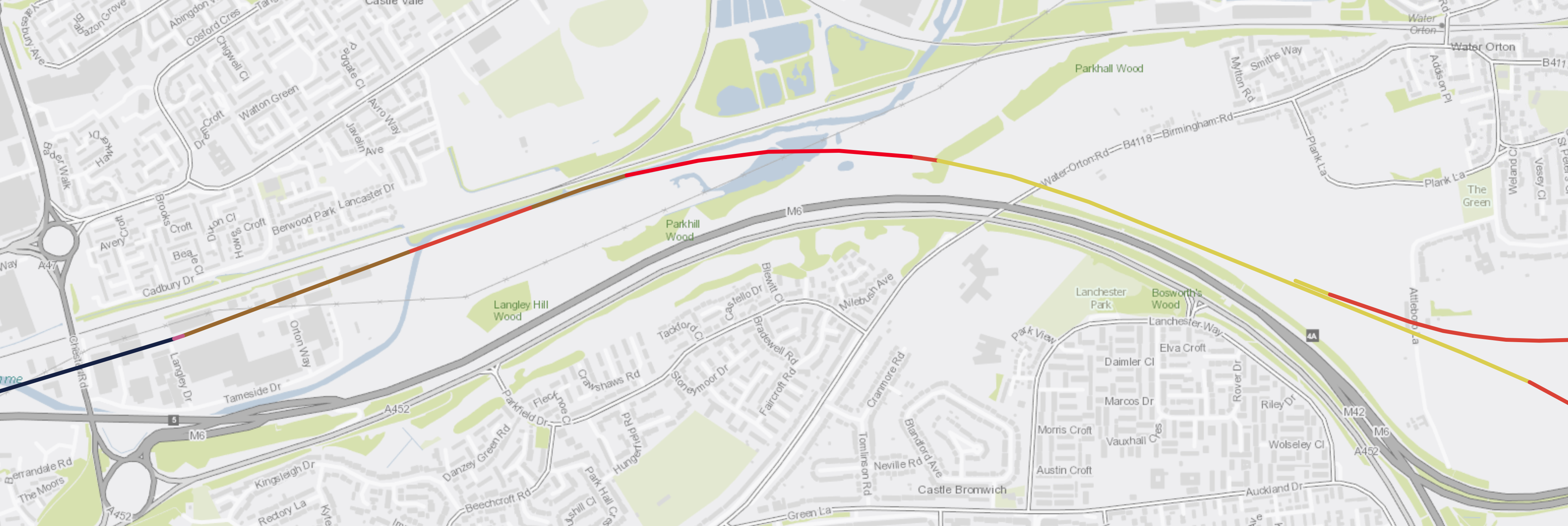
Note.
- High Speed Two is shown in various colours.
- High Speed Two splits at the Eastern edge of the map, with the Northern link going to Northern destinations and the Southern link going to Birmingham Interchange and London.
- Curving across the map beneath it, is the M6 motorway, with Spaghetti Junction off the map to the West.
- Water Orton station is in the North East corner of the map.
- The Birmingham and Peterborough Line, which connects Leicester and Birmingham New Street stations via Water Orton runs just tom the North of the route of High Speed Two shown on the map.
This Google Map shows the area.
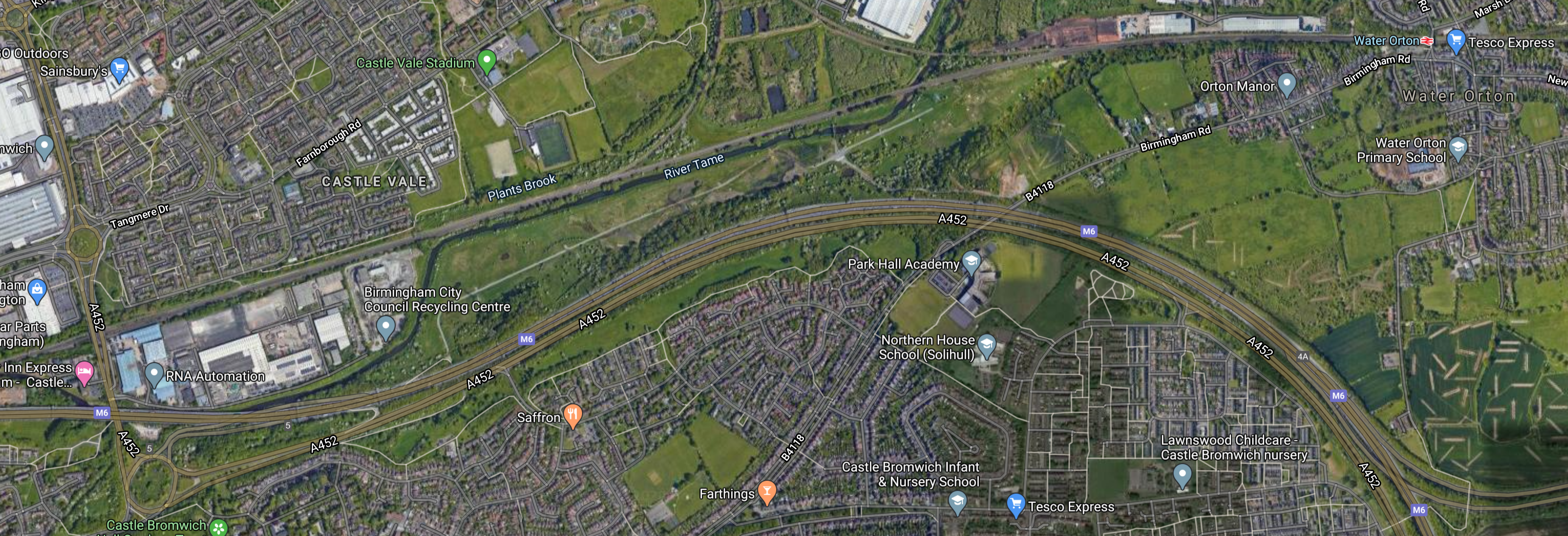
I wonder if it would be possible to provide links so that the following would be possible.
- Trains running East from New Street station could join High Speed Two to run to East Midlands Hub, Edinburgh, Glasgow, Leeds, Liverpool, Manchester, Newcastle, Sheffield and York.
- Trains from the North could run into New Street station and then continue to Bristol, Cardiff and Cheltenham.
The trains would have to be classic-compatible High Speed Two trains. These would fit into New Street station, as they are shorter than Class 390 trains and will have a aimilar height and width.
Time savings could be as follows.
- Bristol/Cardiff and Edinburgh – 110 minutes
- Bristol/Cardiff and Manchester Piccadilly- 50 minutes
- Bristol/Cardiff and Newcastle – 80 minutes
- Bristol/Cardiff and Nottingham – 45 minutes
All trains would be direct.
Birmingham And Derby
Consider.
- Birmingham New Street and Derby stations are 41 miles apart.
- Current service is two tph, which is provided by CrossCountry and goes via Wilnecote, Tamworth and Burton-on-Trent
- There is to be an increase of two tph.
- Current journey time is 38 minutes
- Future journey time is 38 minutes
- High Speed Two will run three tph between Birmingham Curzon Street and East Midlands Hub station in 20 minutes.
- Midlands Connect will run one tph between Birmingham Curzon Street and Nottingham Station in 30 minutes. See Classic-Compatible High Speed Two Trains At East Midlands Hub Station
Will passengers between Birmingham and Derby use High Speed Two services, which will be four tph or the current ones?
Birmingham And Hereford Via Worcester
Consider.
- Birmingham New Street and Hereford stations are 55 miles apart.
- Current service is one tph, which is provided by West Midlands Trains, and goes via Bromsgrove, Malvern Link and Great Malvern.
- There is to be an increase of one tph.
- Current journey time is 85 minutes
- Future journey time is 65 minutes
- The track between Bromsgrove and Birmingham is electrified.
- Hereford and Bromsgrove are 41 miles apart.
- Worcester and Bromsgrove are 13 miles apart.
With charging facilities at Worcester, this route would be an ideal one for battery electric trains.
Birmingham And Leicester
Consider.
- Birmingham New Street and Leicester stations are 40 miles apart.
- Current service is two tph, which is provided by CrossCountry and goes via Water Orton, Coleshill Parkway, Nuneaton, Hinckley and Narborough.
- There is to be an increase of two tph.
- Current journey time is 66 minutes
- Future journey time is 42 minutes
Birmingham – Nottingham
Consider.
- Birmingham New Street and Nottingham stations are 57 miles apart.
- Current service is two tph, which is provided by CrossCountry and goes via Tamworth, Burton-on-Trent and Derby.
- There is to be an increase of one tph.
- Current journey time is 72 minutes
- Future journey time is 59 minutes
- High Speed Two will run three tph between Birmingham Curzon Street and East Midlands Hub station in 20 minutes.
- Midlands Connect will run one tph between Birmingham Curzon Street and Nottingham Station in 30 minutes. See Classic-Compatible High Speed Two Trains At East Midlands Hub Station
Will passengers between Birmingham and Nottingham use High Speed Two services, which will be four tph or the current ones?
Coventry And Leicester
Consider.
- Coventry and Leicester are 28 miles apart.
- There is currently no direct train and a change is needed at Nuneaton
- There is to be an increase of two tph.
- Current journey time is 57 minutes
- Future journey time is 38 minutes
I suspect that a direct Coventry and Leicester service is being provided that does one of the following.
- Reverses in Nuneaton station.
- Takes a new flyover to cross the West Coast Main Line.
Would the Southern terminus of the route be Coventry, Leamington Spa or Stratford-on-Avon?
Coventry And Nottingham
Consider.
- Coventry and Nottingham are 55 miles apart.
- There is currently no direct train and a change is needed at Birmingham New Street or at both Nuneaton and Leicester.
- There is to be an increase of two tph.
- Current journey time is 99 minutes
- Future journey time is 63 minutes
Would this service be an extension of the Coventry and Leicester service?
As Leicester and Nottingham takes around thirty minutes, this could be the case.
Birmingham And Kings Norton Via The Camp Hill Line
The Midlands Rail Hub page, says this about the Bordesley Chords, which will connect Birmingham Moor Street station to the Camp Hill Line.
Construction of the Bordesley Chords, two viaducts creating new paths to the East Midlands and South West from Birmingham Moor Street Station.
This Google Map shows where they will be built.
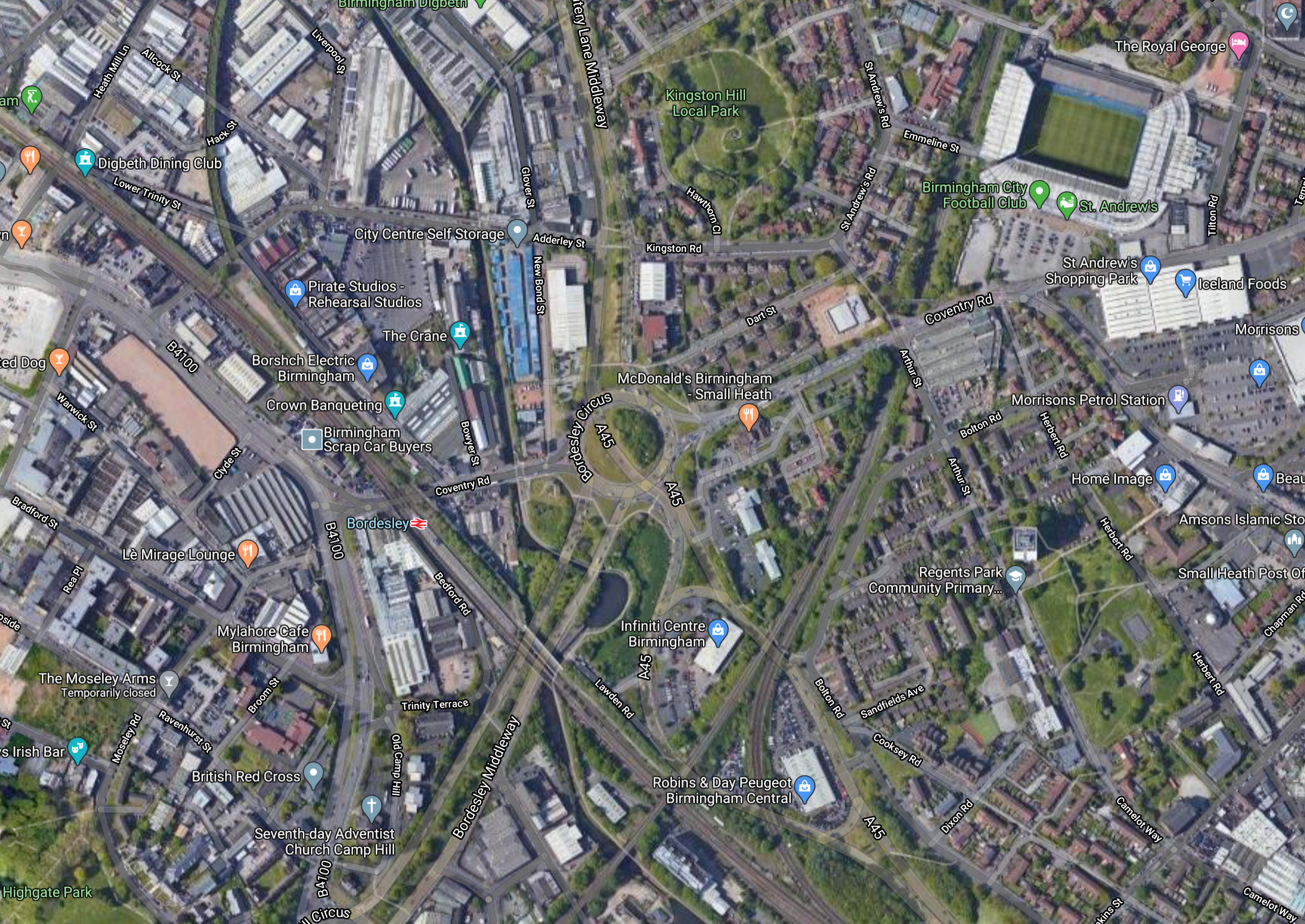
Note.
- The Football ground in the North-East corner of the map is St. Andrew’s, which is Birmingham City’s home ground.
- The rail line going North South across the map and passing to the West side of the ground is the Camp Hill Line, which leads to Water Orton station in the North and Kings Norton station in the South.
- The station in the middle of the map is Bordesley station.
- The rail line going NW-SE across the map through the station is the Chiltern Main Line into Birmingham Moor Street station, which is a couple of miles to the North-West.
The two Bordesley chords will be double-track chords linking the following routes.
- Moor Street station to the Camp Hill Line going South to Kings Norton via new stations at Moseley, Kings Heath and Hazelwell.
- Moor Street station to the Camp Hill Line going North to Water Orton station.
The initial service would appear to be two tph between Moor Street and Kings Norton stations.
CrossCountry Trains and Moor Street Station
Consider.
- Birmingham New Street station is very busy.
- Some CrossCountry trains take a Water Orton-Birmingham New Street-Kings Norton route across the city.
Could these trains go between Water Orton and Kings Norton, with a reverse in Moor Street station?
- Plymouth and Edinburgh Waverley
- Cardiff Central and Nottingham
And could these services terminate at Moor Street station?
- Birmingham New Street and Nottingham
- Birmingham New Street and Stansted Airport via Leicester
- Birmingham New Street and Leicester
It would seem there must be scope improve the operation of New Street station, by using Moor Street station and the Bordesley chords.
If all these trains used Moor Street station it would be a very busy station.
In an hour it would handle these trains via the Bordesley chords.
- CrossCountry – 1 tph – Cardiff Central
- CrossCountry – 1 tph – Edinburgh Waverley
- West Midlands Railway – 2 tph – Kings Norton
- CrossCountry – 2 tph – Leicester
- CrossCountry – 2 tph – Nottingham
- CrossCountry – 1 tph – Plymouth
- CrossCountry – 1 tph – Stansted Airport
That is a balanced five tph to the North and five tph to the South.
There would also be the existing services.
- Chiltern Trains – 2 tph – London Marylebone and Birmingham
- West Midlands Railway – 6 tph – Dorridge/Stratford-upon-Avon/Whittocks End and Stourbridge Junction
There would also be the proposed Moor Street and Oxford service.
Battery Electric Trains
If we assume that a battery electric train has a battery range equal to or longer than Hitachi’s quoted figure of 56 miles, these routes are possibilities for battery electric trains.
- Birmingham and Leicester with either electrification or charging at Leicester.
- Birmingham and Hereford with charging at Hereford
- Birmingham and Kings Norton
- Birmingham and Oxford with charging at Oxford and Banbury
- Coventry and Leicester
If the Midland Main Line is electrified in the Nottingham Area, then all services to Nottingham could be added.
CrossCountry And High Speed Two
Consider.
- There are up to half-a-dozen spare hourly paths on both the Northern legs of High Speed Two.
- Using High Speed Two tracks to the North of Birmingham can speed up services considerably.
- CrossCountry needs a new fleet of trains.
- Services could be run using classic-compatible High Speed Two trains.
- The trains might be shorter and would certainly have independent power sources.
It could be a large improvement in quality and journey times, with all current destinations served.
The only extra infrastructure needed would be a connecting junction near Water Orton station. A junction there would work, whether services used Moor Street or New Street station in Birmingham.
Cnnclusion
The concept of a Midlands Rail Hub is very sound.
Birmingham Airport Connectivity
On the Midlands Connect web site, they have a page, which is entitled Birmingham Airport Connectivity.
This is the introductory paragraph.
By using capacity released by HS2 and investing in new track south of Birmingham Airport, we can improve connections from the south of England, East Midlands, Yorkshire and the North East.
The page contains this helpful map.
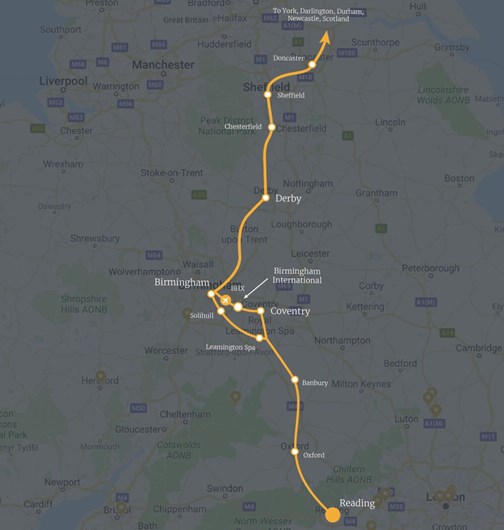
It looks like Midlands Connect are thinking about improving the Reading and Newcastle service.
Points made on the page and related articles, like this one on Rail News include.
- Birmingham Airport has plans to increase passenger numbers to 18 million by 2033.
- Coventry and Leamington Spa via Kenilworth will be double-tracked.
- High Speed Two will release capacity in the area.
- It will open up rail capacity between Birmingham and Solihull.
- There will be a new service between Birmingham Moor Street and Oxford via Solihull and Warwick Parkway.
- It will improve local connections to Birmingham Airport.
- Birmingham and Reading services will be increased to two trains per hour (tph)
- The Government is being asked to chip in £20 million.
These are my thoughts.
Birmingham Airport
Birmingham Airport can become a true Heart of England Airport.
I feel that the future of aviation will be very different to the past.
- COVID-19 and the future pandemics, that we will endure from the East and the Americas, will mean that flying will be a very different experience with hygiene and social distancing to the fore.
- Smaller aircraft, for flights up to 500 miles, will be odd-looking zero-carbon machines with exotic power systems.
- Larger aircraft will be energy efficient planes powered by aviation biofuels produced from household and industrial waste, and biomass.
- Boeing 747s and Airbus A380s will only be talked about in tales from older people to the young.
- Airports will be important rail hubs to more than just the local area.
Wikipedia also says this about expansion of Birmingham Airport.
Plans for a second runway (a third when demand requires) on the other side of the M42 and a new terminal complex and business park have been published, and they could help to create around 250,000 jobs. It has been estimated that if these plans went ahead, the airport could handle around 70,000,000 passengers annually, and around 500,000 aircraft movements.
This Google Map shows the Airport.
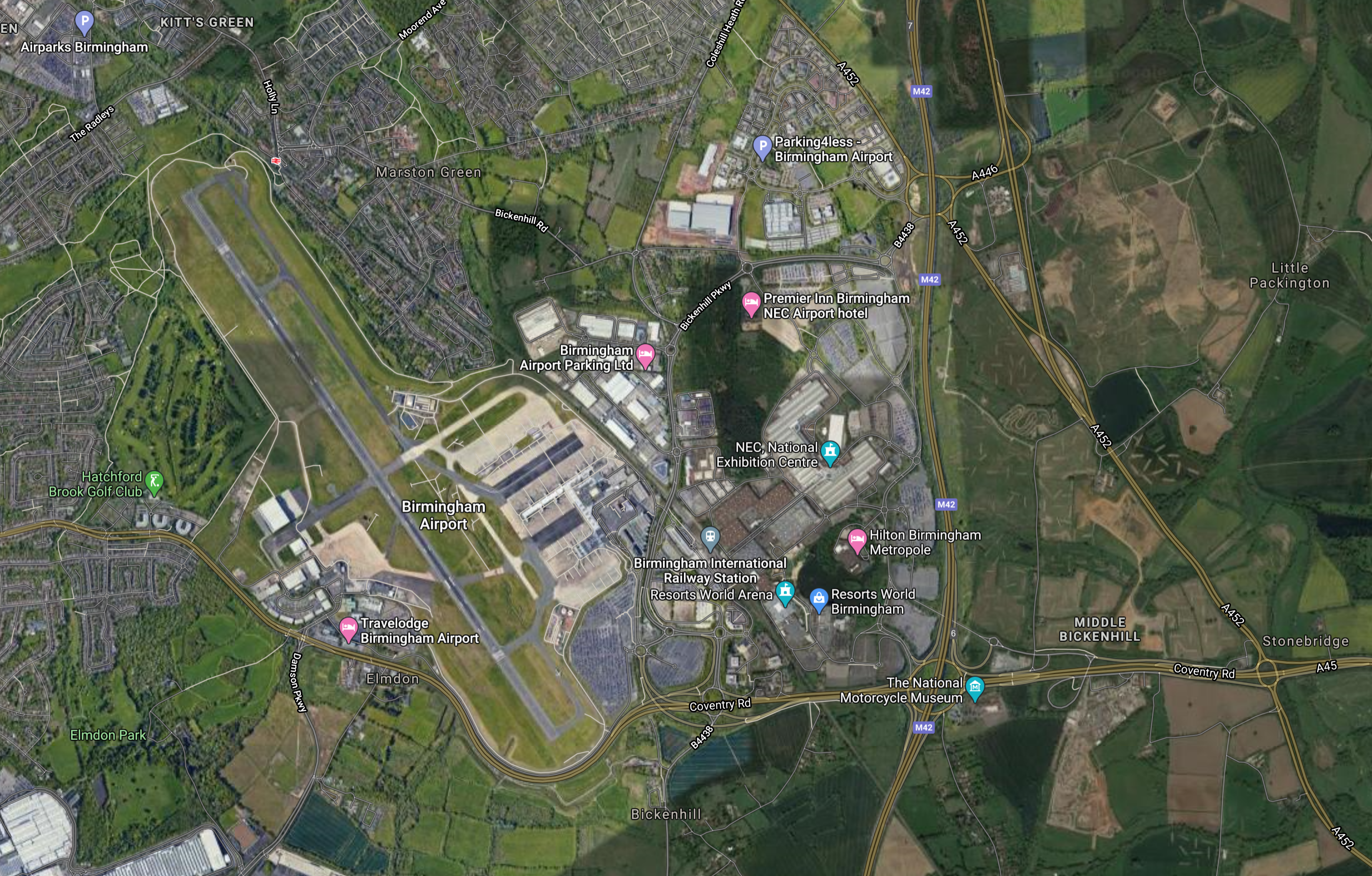
Note the M42 motorway passing North-South to the East of the Airport.
Could Birmingham Airport develop towards Birmingham Interchange and High Speed Two?
It is worth looking at the distance to other airports.
- Aberdeen – 328 miles
- Amsterdam – 280 miles
- Dublin – 199 miles
- Frankfurt – 478 miles
- Geneva – 558 miles
- Paris – 304 miles
All could be within range of an electric aircraft like the under-development Eviation Alice.
I believe that large airports will develop low-noise zero-carbon secondary runways.
Birmingham Airport is well-situated to take advantage.
Adding A Second Track Between Leamington Spa And Coventry
This section of track is about ten miles long, with probably under half only single-track.
This Google Map shows the single-track through the new Kenilworth station.

And these are pictures I took soon after the station opened.



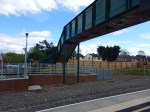
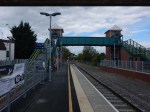
It is certainly one of the best of the current crop of new small stations.
I don’t think that adding a second track will be the most challenging of projects.
It should be noted that the Leamington Spa and Nuneaton service could be a candidate for a battery electric train.
- The route is twenty miles long
- Nuneaton and Coventry stations are fully electrified.
- There might be possibilities to extend this service at either or both ends.
- Nuneaton and Leicester are nineteen miles apart and a new Nuneaton Parkway station is proposed for the route. I wrote about this station in New Railway Station Between Hinckley And Nuneaton Receives Backing.
- Leamington Spa and Stratford-upon-Avon are fifteen miles apart and would need a reverse at Leamington Spa.
A battery electric train might give a faster and more passenger-friendly service, if the passenger numbers and forecasts would support an extended service.
A Birmingham Moor Street And Oxford Service
This Google Map shows Birmingham Moor Street station.
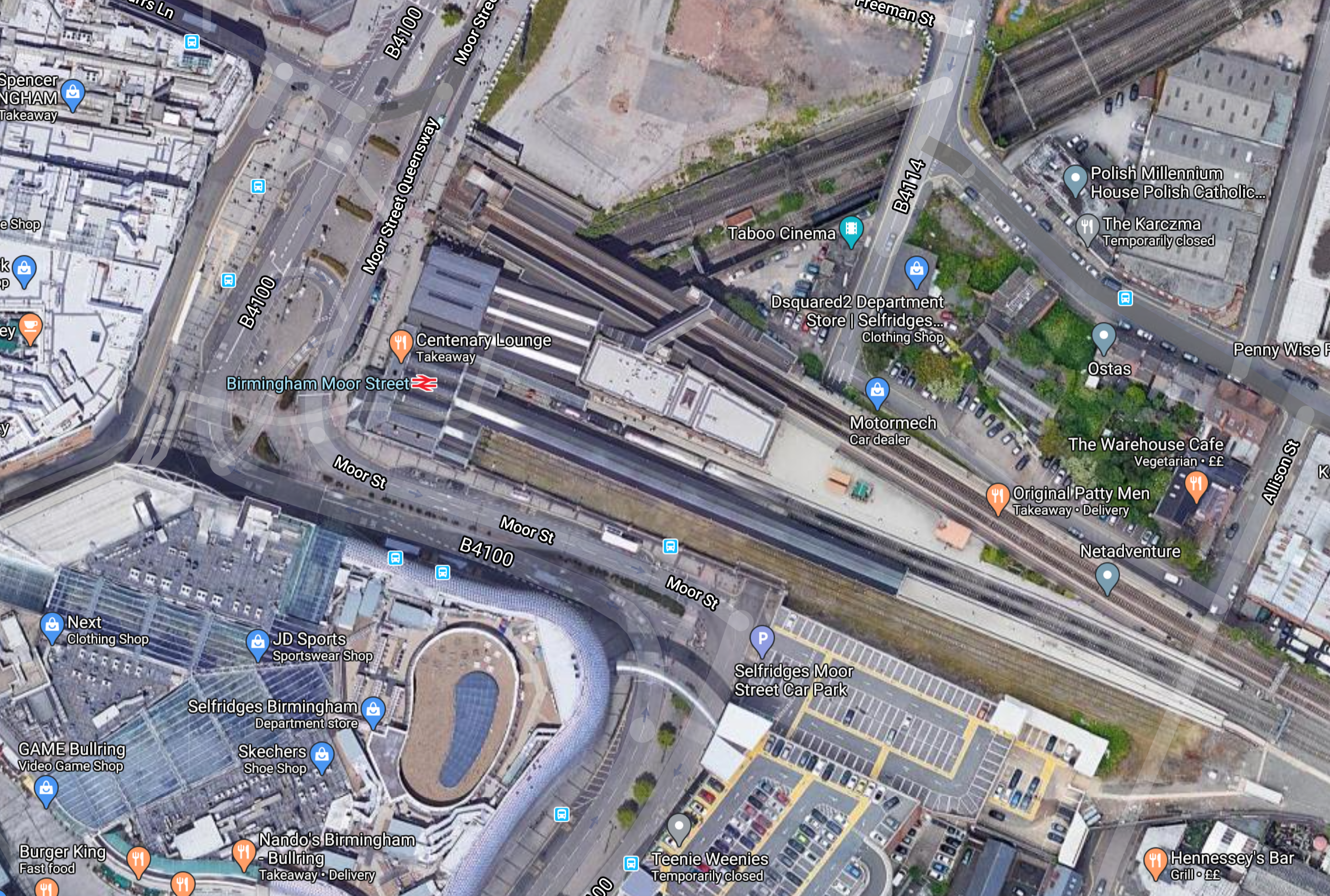
Note.
- The two Northern through platforms on the Snow Hill Lines, that continue under Birmingham to Birmingham Snow Hill station.
- At least two, but possibly three bay platforms, that can take Chiltern Railway’s longest trains.
- There is more space for possibly another two bay platforms to be reinstated or built.
Birmingham Moor Street station will also be a short walk from High Speed Two’s Birmingham Curzon Street station.
This Google Map shows Oxford station.
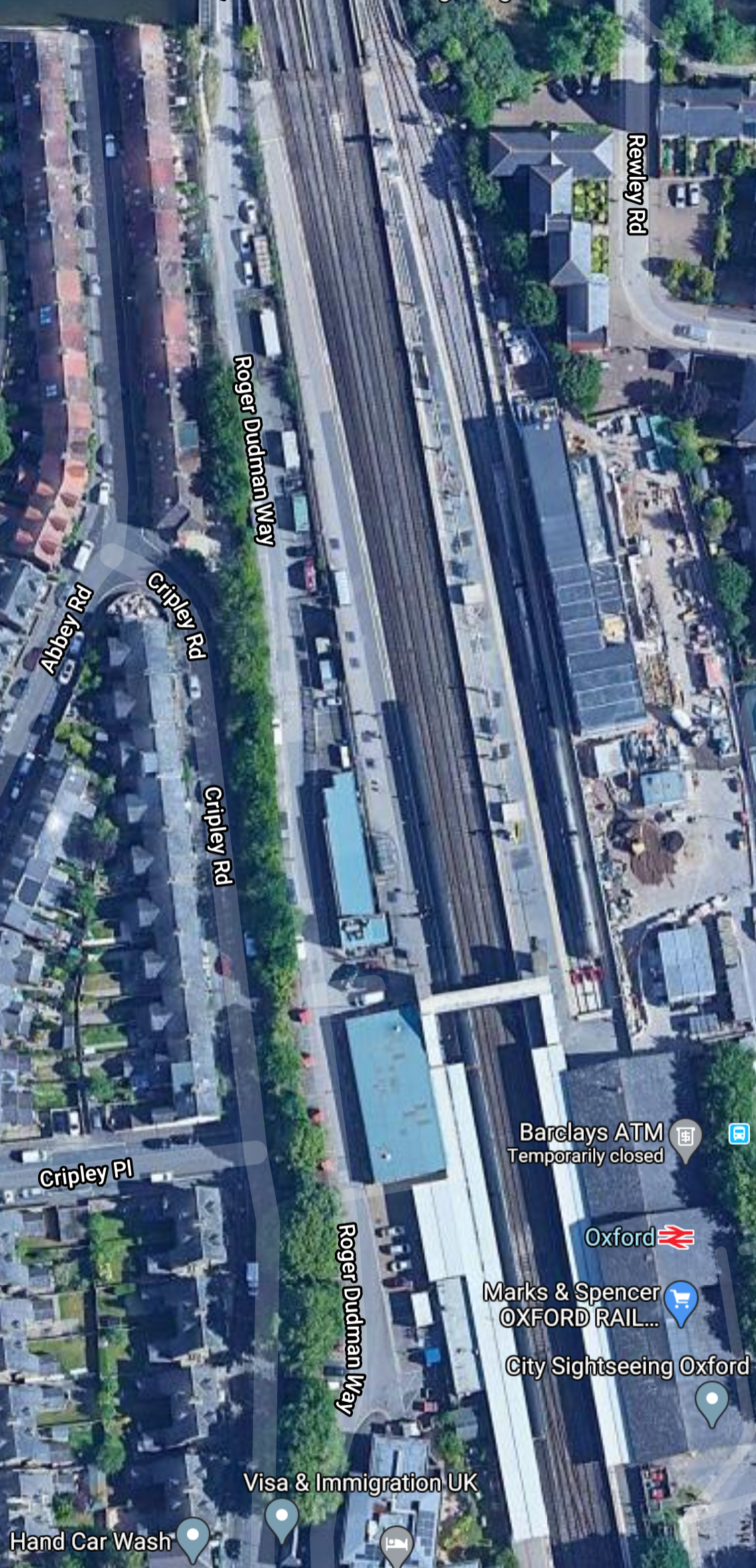
Note.
- Birmingham Moor Street station is to the North via Banbury and Warwick Parkway stations.
- The two long through platforms capable of taking a nine-car train.
- There are two bay platforms to the East of the two through platforms, at the Northern end of the station.
- The bay platforms handle Chiltern’s services from London Marylebone and could also handle the proposed service to Birmingham Moor Street.
Consider this about the proposed Birmingham Moor Street and Oxford service.
- The service could stop at Solihull, Warwick Parkway, Warwick, Leamington Spar and Banbury, as was thought necessary.
- I estimate that Birmingham Moor Street and Oxford are 66 miles apart and that a 100 mph train would take around 66 minutes.
- Birmingham Moor Street and Banbury are 43 miles apart.
- Oxford and Banbury are 23 miles apart.
With these timings and a few minutes to reverse at each end of the route, I would estimate that a 2.5 hour round trip would be possible.
But, I also think, that with charging facilities or short lengths of electrification at Birmingham Moor Street, Banbury and Oxford stations, this service could be run by battery electric trains.
- A three hour round trip should be possible.
- Three trains would be needed to provide an hourly service.
- Oxford, Banbury, Leamington Spa and Warwick would have a direct connection to High Speed Two.
It should also be noted
- Birmingham Moor Street and Stratford-upon-Avon stations are only 25 miles apart and the journey rakes 46 minutes
- Banbury and Stratford-upon-Avon are 35 miles apart. and the journey takes 57 minutes.
- Leamington Spa and Nuneaton are 20 miles apart and the journey takes 36 minutes.
There would appear to be tremendous potential for battery electric services between Birmingham and Oxford.
How many tourists would a Birmingham and Oxford service via Stratford-upon-Avon attract?
Improving The Reading And Newcastle Service
Currently, this is a one tph service between Reading and Newcastle stations.
- It is run by CrossCountry.
- Intermediate stops include Oxford, Banbury, Leamington Spa, Birmingham New Street, Derby, Sheffield, Doncaster, York, Darlington and Durham.
- It appears that the full journey takes four-and-a-half hours.
It looks like to run a two tph service would need as many as twenty trains.
There is an alternative route after High Speed Two opens.
- High Speed Two – Newcastle and Birmingham Curzon Street – 118 minutes
- Walk – Curzon Street and New Street – 10 minutes
- CrossCountry – Birmingham New Street and Reading – 90 minutes
This saves about forty-five minutes.
You could even do a double change.
- High Speed Two – Newcastle and East Midlands Hub – 96 minutes
- High Speed Two – East Midlands Hub and Birmingham Interchange – 17 minutes
- Walk – Birmingham Interchange and Birmingham International – 10 minutes
- CrossCountry – Birmingham International and Reading – 78 minutes
This gives a time of around three hours and twenty minutes.
High Speed Two certainly saves time.
But look at this map clipped from the High Speed Two web site.
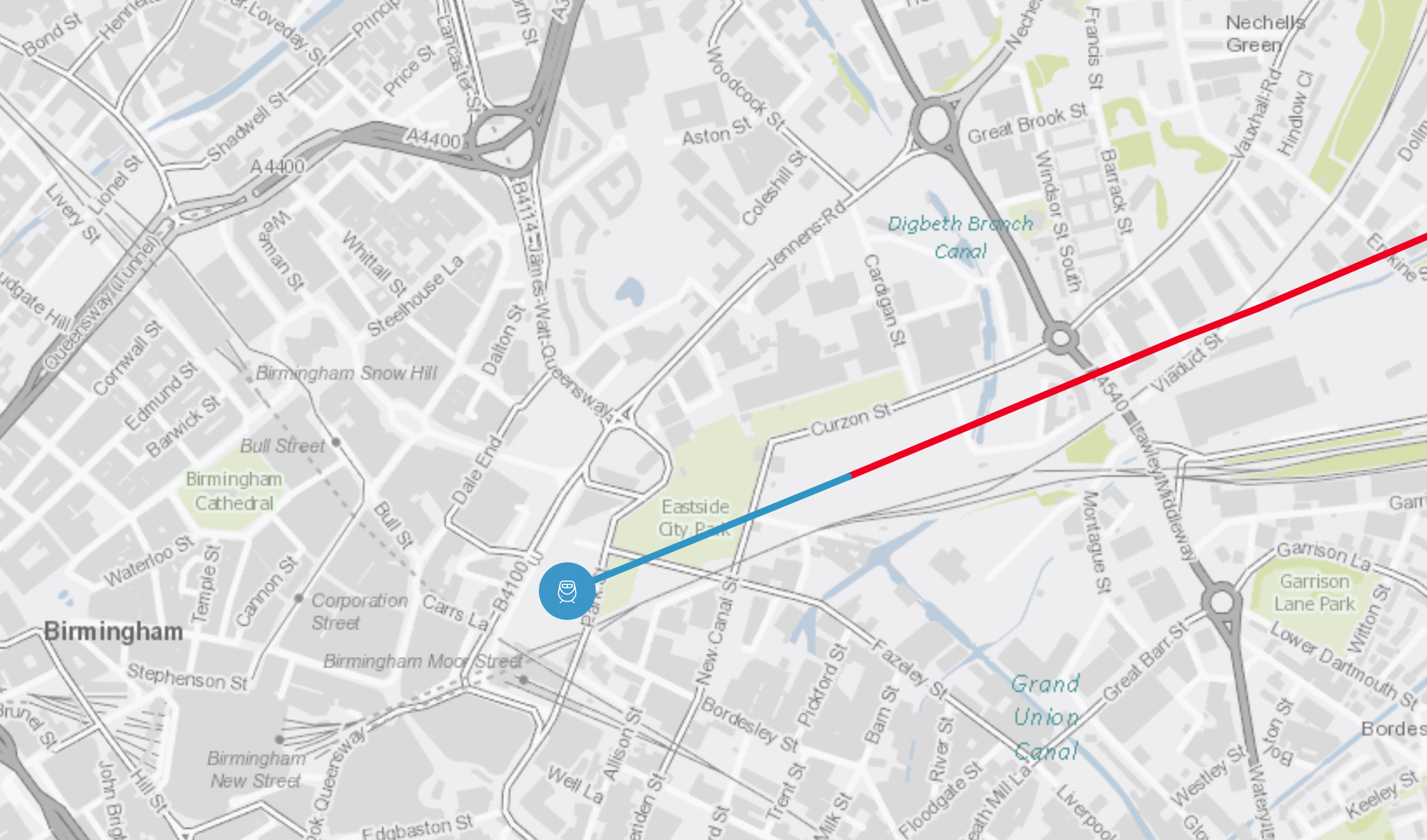
Note.
- The blue dot shows the location of Curzon Street station.
The West Coast Main Line running into New Street station, is just to the South of Curzon Street station.
New Street station can be picked out to the West of Curzon Street station.
This Google Map shows a close-up of the current Curzon Street station site.
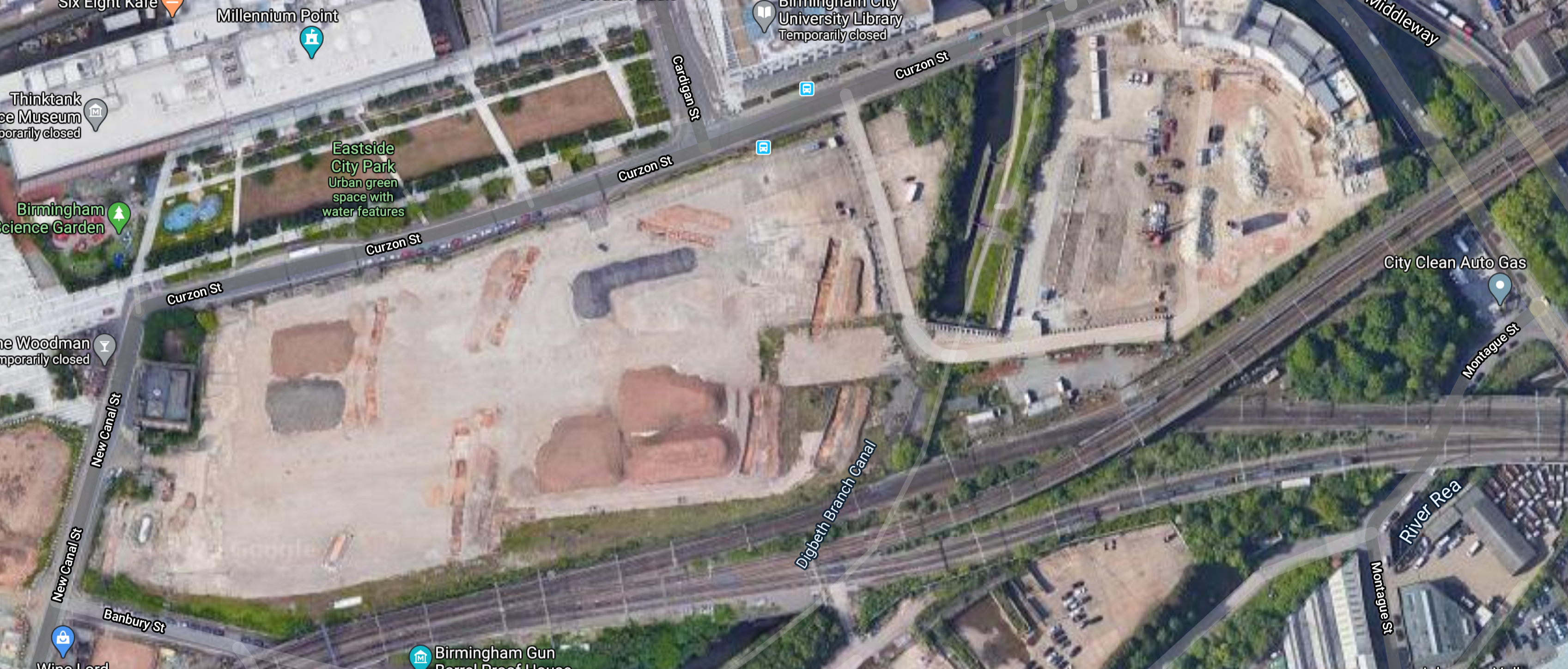
The same pattern of rail lines going past the Curzon Street site into New Street station can be picked out.
Surely, a connection could be made to allow trains from a couple of platforms in Curzon Street station to terminate trains from the West Coast Main Line.
To improve services between Newcastle and Reading, trains would do the following.
- Run on the current East Coast Main Line infrastructure between Newcastle and York. Station stops could be Durham, Darlington and York.
- Switch to new High Speed Two infrastructure South of York.
- Run on High Speed Two infrastructure to Birmingham Curzon Street station. Station stops could be Sheffield, Chesterfield and East Midlands Hub.
- The train would reverse at Birmingham Curzon Street station.
- Switch to the West Coast Main Line outside Birmingham Curzon Street station.
- Run on the West Coast Main Line to Birmingham International station.
- Take the route currently used by CrossCountry between Birmingham International and Reading. Station stops could be Leamington Spa, Warwick Parkway, Banbury and Oxford stations.
Timings would be as follows.
- Newcastle and Birmingham Curzon Street – 118 minutes – From High Speed Two web site.
- Birmingham Curzon Street and Reading – 90 minutes – Current CrossCountry timing.
Note.
- This saves about an hour over the current CrossCountry timings.
- It could use classic-compatible High Speed Two trains.
- Between Birmingham Curzon Street and Newcastle, it follows the same route as one of the current proposed High Speed Two services.
- The service could be extended to Edinburgh from Newcastle.
- The service could be extended to Southampton from Reading
- As there are only twelve tph planned to be running on the Eastern leg of High Speed Two, against a total capacity of eighteen tph, it should be possible to accommodate the extra service or services.
This would surely be a very useful High Speed Two service.
Conclusion
It is a comprehensive package of measures, some of which could have a high cost benefit ratio.
Connected Energy Wins First Order for Next-Gen Energy Storage System
The title of this post, is the same as that of this article on Renewable Energy Magazine.
This is the introductory paragraph.
Second life battery pioneer, Connected Energy will be installing the first of its new generation of optimized energy storage systems as part of Suffolk County Council’s latest project, The Hold. The Hold, a flagship heritage facility for Suffolk which is due to open later this year on the University of Suffolk’s Ipswich Campus, will house the council’s archive collection and feature a low carbon energy system of which Connected Energy’s E-STOR energy storage system will be a key part. The E-STOR will help optimize energy use and peak loads across a system including PV, EV chargers and critical HVAC, designed to create a controlled climate for the archived materials.
That certainly sounds like a good plan in a town, that I know well.
A few of my thoughts.
Second Life Renault Kangoo Batteries
This paragraph describes the system.
The new 300kW/360kWh containerized systems, which include 24 second life Renault Kangoo batteries, have benefitted from collaborative support from Renault and ABB to increase efficiencies on both the power and capacity sides of the system.
It is surely a good use of second-hand lithium-ion batteries from an electric Renault Kangoo. These batteries appear to have a capacity of 22 kWh and as only 15 kWh per battery is needed for 360 kWh, there must be a margin for refurbishing the batteries and removing any faulty cells.
Towns And Cities Like Ipswich
Ipswich is a town of around a hundred people, a hospital, a central shopping centre a small university, several office blocks, a railway station and a football team.
There must be many large towns and cities, with similar energy needs to Ipswich in the UK.
In East Anglia and Essex, there are fourteen; Basildon, Billericay, Bury St. Edmunds, Cambridge, Chelmsford, Colchester, Harlow, Harwich, Kings Lynn, Lowestoft, Norwich, Peterborough, Southend and Yarmouth
Connected Energy will have a large market to fill.
Distributed Propulsion ‘Maybe The Only Means’ For Small Electric Flight Progress
The title of this post, is the same as that of this article on the Institute of Mechanical Engineers web site.
If you want to fly again, then this article offers pointers to how you might do it.
The E-Fan X Airliner
It gives this latest information on the E-Fa X airliner being tested by Rolls-Royce and Airbus.
Amid the strain of the Covid-19 pandemic, Rolls-Royce and Airbus cancelled flight tests of their E-Fan X airliner, a promising project that could have provided vital data on issues such as thrust management and electric systems at altitude.
Does that mean cancelled or scrapped?
2.5 MW From A Beer Keg-Sized Generator
This paragraph could be important.
“Among the many great achievements from E-Fan X has been the generator – about the same size as a beer keg – but producing a staggering 2.5MW,” said Vittadini’s Rolls-Royce counterpart Paul Stein. “That’s enough power to supply 2,500 homes and fully represents the pioneering spirit on this project.”
This picture shows a Class 66 locomotive.
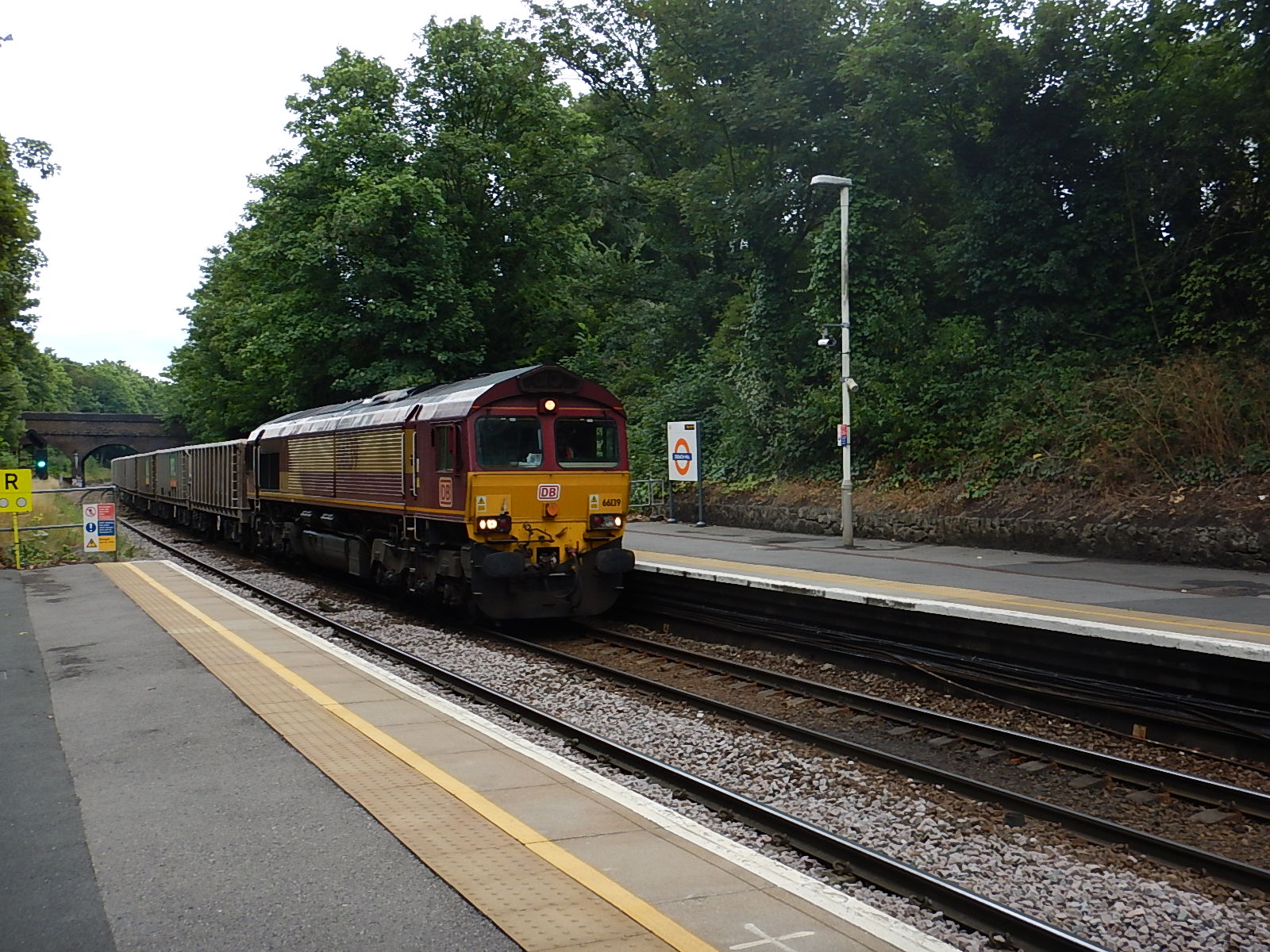
The locomotive has a 2,460 kW diesel engine and an electric transmission.
I just wonder, if Rolls Royce’s high-powered small generator could replace the large, noisy and smelly diesel engines in these locomotives.
- It will be a lot lighter in weight.
- Could some of the saved weight be used for a battery?
- It could run on aviation biofuel, rather than diesel.
- I wrote about aviation biofuel in Grant Shapps Announcement On Friday.
If the technology worked there are 455 of the noisy locomotives.
Snowballing Improvements
The article has a section with this title and it talks about how electric power may lead to other advantages.
Conclusion
Electric aircraft are more promising, than many think!
Are Fuel Cell Generators The Future For RVs?
The title of this post, is the same as that of this article on Hydrogen Fuel News.
It surely is an interesting concept to go and explore the great outdoors in a vehicle that pollutes what you are enjoying.
But hydrogen power solves the problem!
 The Anonymous Widower