Teeside’s Refurbished Trains
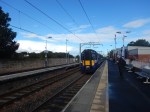
On my trip around Teeside, I took four trains.
There was none of the usual rubbish, that I have endured in the North like this scrapyard special at Carlisle.
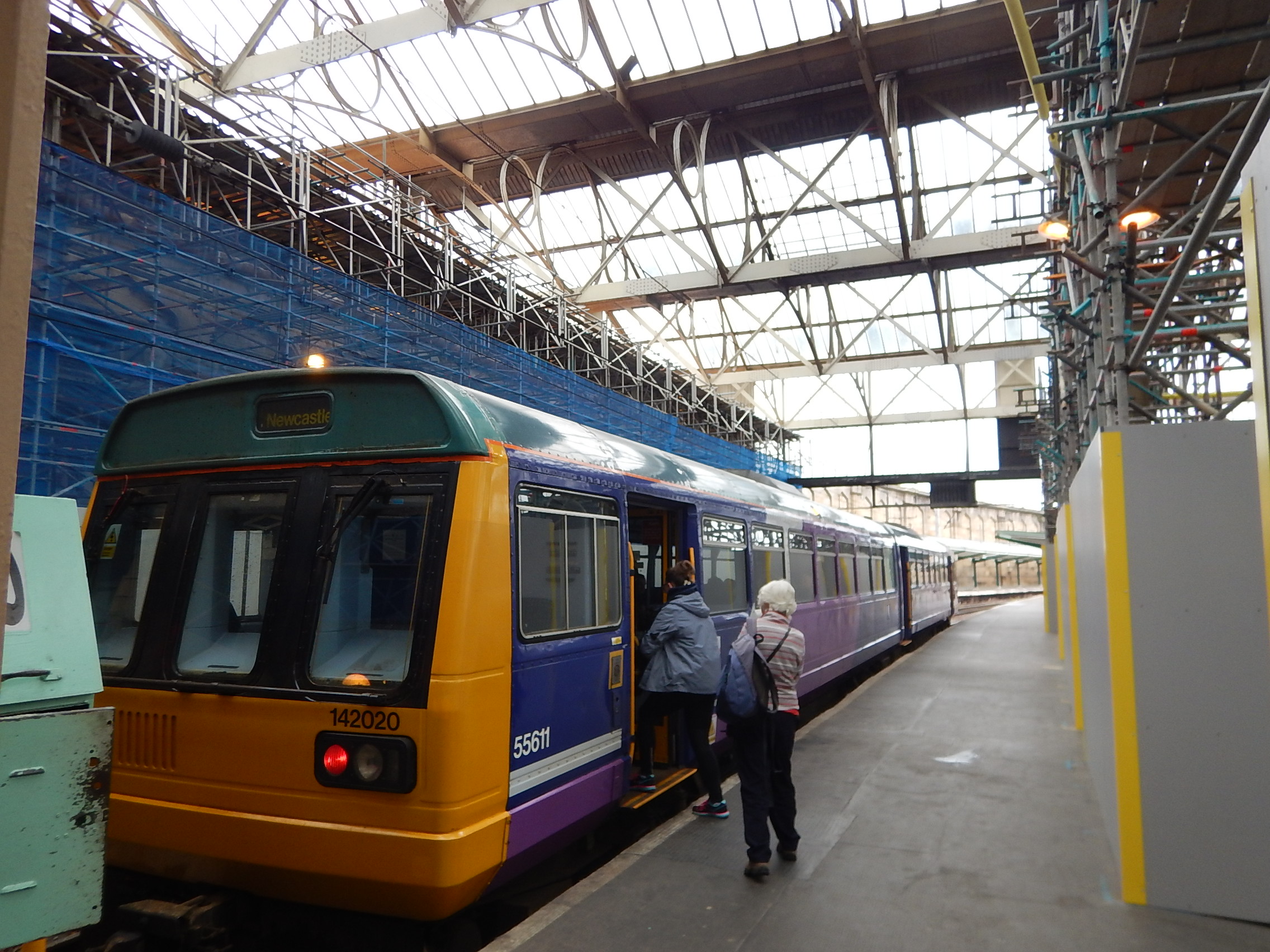
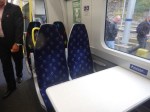
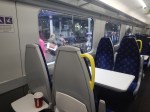
All trains were refurbished Class 158 trains.

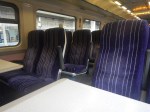
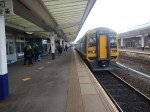
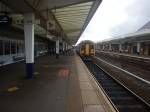
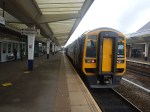
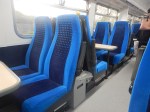
They were a lot better, with tables and clean, working toilets.
But will they get replaced with hydrogen or updated to zero-carbon trains?
Hydrogen Trains
In Fuelling The Change On Teesside Rails, I talked about the local services on Teesside being run by a fleet of hydrogen trains, based on an article in RAIL Magazine.
But the order has not been placed and it must be getting tight if trains are going to run in a few years.
There was this report in the November 2020 Edition of Modern Railways, which is entitled Tees Valley Hydrogen Hub.
This is the first paragraph.
Mott MacDonald is to create a masterplan for the development of a hydrogen transport hub in the Tees Valley. Transport Secretary Grant Shapps made the announcement as he travelled on the HydroFLEX on the 29th of September.
It appears the masterplan could be published in January and would cover several modes of transport.
Battery Electric Trains
There have been developments in the battery electric train field over the past few months.
Hitachi at Newton Aycliffe and Hyperdrive Innovation at Sunderland have partnered up to produce Hitachi’s Regional Battery Train. Three-car trains based on Hitachi’s Class 385 trains would be ideal for trundling around the North East.

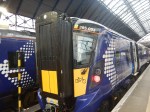
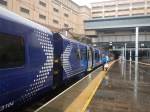
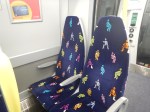
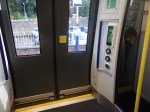
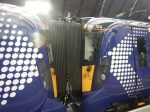
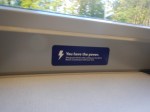
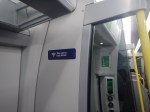
The trains would need charging and what better charging system is there than Vivarail’s Fast Charge system? And they could be produced at Vivarail’s factory at Seaham just up the coast towards Sunderland.
As I indicated in £100m Station Revamp Could Double Local Train Services, where I said this about the location of chargers to power battery electric trains in the Tees and the Tyne.
There will need to be strategically-placed battery chargers around the North-East of England. These could include.
-
- Hexham
- Nunthorpe
- Redcar or Saltburn – This would also be used by TransPennine Express’s Class 802 trains, if they were to be fitted with batteries.
- Whitby
If Grand Central did the right thing and ran battery electric between London and Sunderland, there would probably be a need for a battery charger at Sunderland.
It appears that Adrian Shooter of Vivarail has just announced a One-Size-Fits-All Fast Charge system, that has been given interim approval by Network Rail.
I discuss this charger in Vivarail’s Plans For Zero-Emission Trains, which is based on a video on the Modern Railways web site.
Vivarail might just have another card or should it be train to play.
In the video, Mr. Shooter discusses using Vivarail’s technology to convert British Rail era diesel multiple units to battery electric trains.
Northern have already refurbished the Class 158 trains, so it would surely be an economical route to convert them to battery electric operation.
£100m Station Revamp Could Double Local Train Services
The title of this post, is the same as that of this article on the Northern Echo.
This is the opening paragraph.
Officials behind plans for a £100m-plus transformation of Darlington’s Bank Top Station have confirmed it will remain the only one on the East Coast Mainline without a platform specifically for the London to Scotland service.
Darlington station has made various appearances in my life, all of which have been pleasurable ones.
I went several times to ICI’s Wilton site on Teesside in the 1970s, when the route to London was worked by the iconic Class 55 locomotives or Deltics.
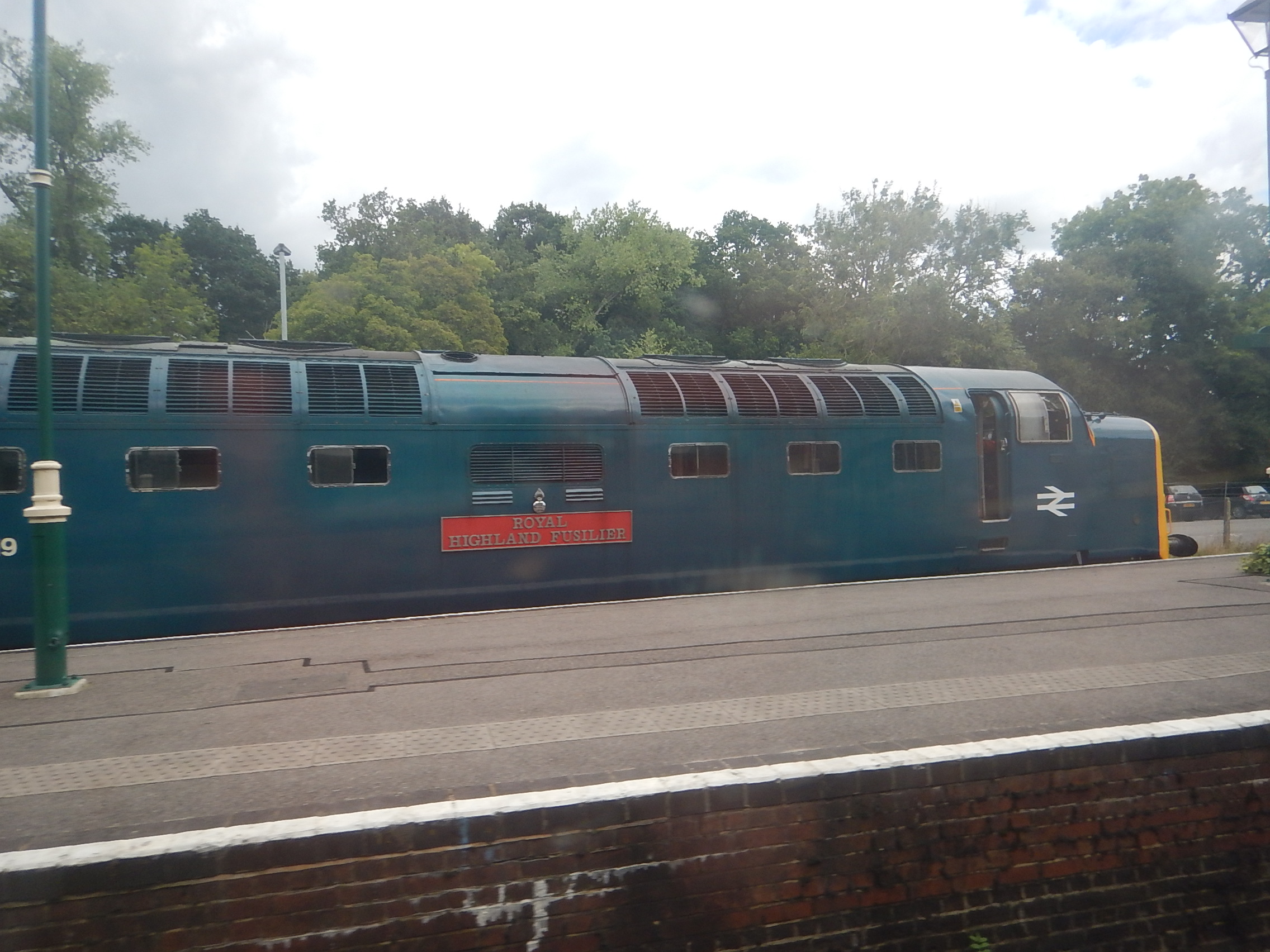
I wrote about one memorable trip home from Darlington in The Thunder of Three-Thousand Three-Hundred Horses.
Over the years, I also seem to have had several clients for my computing skills in the area, including the use of my data analysis software; Daisy at Cummins Engines in the town.
And lately, it’s been for football at Middlesbrough to see Ipswich play, where I’ve changed trains. Sometimes, Town even won.
The improvements planned for the station are two-fold.
Improvement Of Local Services
This paragraph from Wikipedia, sums up the local train services on the Tees Valley Line between Saltburn and Bishop Auckland via Darlington, Middlesbrough and Redcar.
Northern run their Tees Valley line trains twice hourly to Middlesbrough, Redcar and Saltburn (hourly on Sundays), whilst the Bishop Auckland branch has a service every hour (including Sundays). The company also operates two Sundays-only direct trains to/from Stockton and Hartlepool.
If ever a route needed improvement it is this one.
This paragraph from the Northern Echo article, outlines the plans for Darlington station.
The meeting was also told the overhaul, which will see new platforms, a new station building, parking and an interchange for passengers, alongside other improvements, would also double capacity on Tees Valley and Bishop Auckland lines, meaning four trains an hour on the former and two trains an hour on the latter.
I also believe that the route is a shoe-in for zero-carbon services; hydrogen or battery electric.
Hydrogen Trains On Teesside
In Fuelling The Change On Teesside Rails, I discuss using hydrogen powered trains for the lines in the area and they could certainly provide services on more than just the Tees Valley Line.
- Teesside certainly has big plans for hydrogen to fuel its chemical industry.
- Hydrogen powered transport in the area has been backed by the Government, as I wrote about in Tees Valley Wins £1.3million Project To Bring Hydrogen Vehicles To The Region.
- Plans are advancing for a depot for hydrogen-powered trains at Lackenby.
The hydrogen powered trains would probably be this Alstom Breeze.
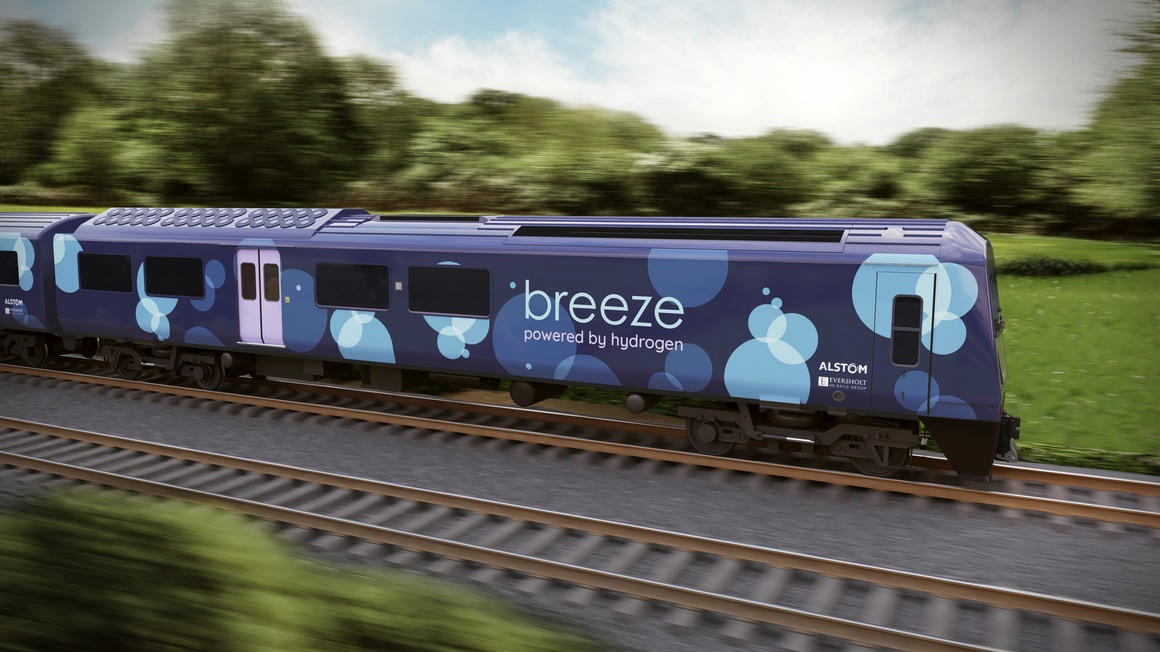
They would appear to be in pole position to change the image of Teesside’s trains.
Battery Electric Trains On Teesside
But I suspect. that an Anglo-Japanese partnership, based in the North-East could have other ideas.
- Hitachi have a train factory at Newton Aycliffe on the Tees Valley Line.
- Hyperdrive Innovation design and produce battery packs for transport and mobile applications in Sunderland.
The two companies have launched the Regional Battery Train, which is described in this Hitachi infographic.

Note than 90 kilometres is 56 miles, so the train has a very useful range.
Hitachi have talked about fitting batteries to their express trains to serve places like Middlesbrough, Redcar and Sunderland with zero-carbon electric services.
But their technology can also be fitted to their Class 385 trains and I’m sure that Scotland will order some battery-equipped Class 385 trains to expand their vigorous electric train network.
Both Scotland and Teesside will need to charge their battery trains.
Example distances on Teesside include.
- Darlington and Saltburn – 28 miles
- Darlington and Whitby – 47 miles
- Darlington and Bishop Auckland – 12 miles
The last route would be possible on a full battery, but the first two would need a quick battery top-up before return.
So there will need to be strategically-placed battery chargers around the North-East of England. These could include.
- Hexham
- Nunthorpe
- Redcar or Saltburn – This would also be used by TransPennine Express’s Class 802 trains, if they were to be fitted with batteries.
- Whitby
If Grand Central did the right thing and ran battery electric between London and Sunderland, there would probably be a need for a battery charger at Sunderland.
It appears that Adrian Shooter of Vivarail has just announced a One-Size-Fits-All Fast Charge system, that has been given interim approval by Network Rail.
I discuss this charger in Vivarail’s Plans For Zero-Emission Trains, which is based on a video on the Modern Railways web site.
There is more about Vivarail’s plans in the November 2020 Print Edition of the magazine, where this is said on page 69.
‘Network Rail has granted interim approval for the fast charge system and wants it to be the UK’s standard battery charging system’ says Mr. Shooter. ‘We believe it could have worldwide implications.’
I believe that Hitachi and Hyperdrive Innovation, with a little bit of help from friends in Seaham, can build a battery-electric train network in the North-East.
The Choice Between Hydrogen And Battery Electric
Consider.
- The hydrogen trains would need a refuelling system.
- The battery electric trains would need a charging structure, which could also be used by other battery electric services to and from the North-East.
- No new electrification or other infrastructure would be needed.
- If a depot is needed for the battery electric trains, they could probably use the site at Lackenby, that has been identified as a base for the hydrogen trains.
Which train would I choose?
I think the decision will come down to politics, money and to a certain extent design, capacity and fuel.
- The Japanese have just signed a post-Brexit trade deal and France or rather the EU hasn’t.
- The best leasing deal might count for a lot.
- Vivarail have stated that batteries for a battery electric train, could be leased on a per mile basis.
- The Hitachi train will be a new one and the Alstom train will be a conversion of a thirty year old British Rail train.
- The Hitachi train may well have a higher passenger capacity, as there is no need for the large hydrogen tank.
- Some people will worry about sharing the train with a large hydrogen tank.
- The green credentials of both trains is not a deal-breaker, but will provoke discussion.
I feel that as this is a passenger train, that I’m leaning towards a battery electric train built on the route.
An Avoiding Line Through Darlington
The Northern Echo also says this about track changes at the station.
A meeting of Darlington Borough Council’s communities and local services scrutiny committee was told a bus lane-style route off the mainline at the station would enable operators to run more high-speed services.
Councillors heard that the proposed track changes would enable very fast approaches to Darlington and allow other trains to pass as East Coast Mainline passengers boarded.
Some councillors seem to be unhappy about some trains passing through the station without stopping.
Are their fears justified?
This Google Map shows Darlington station.
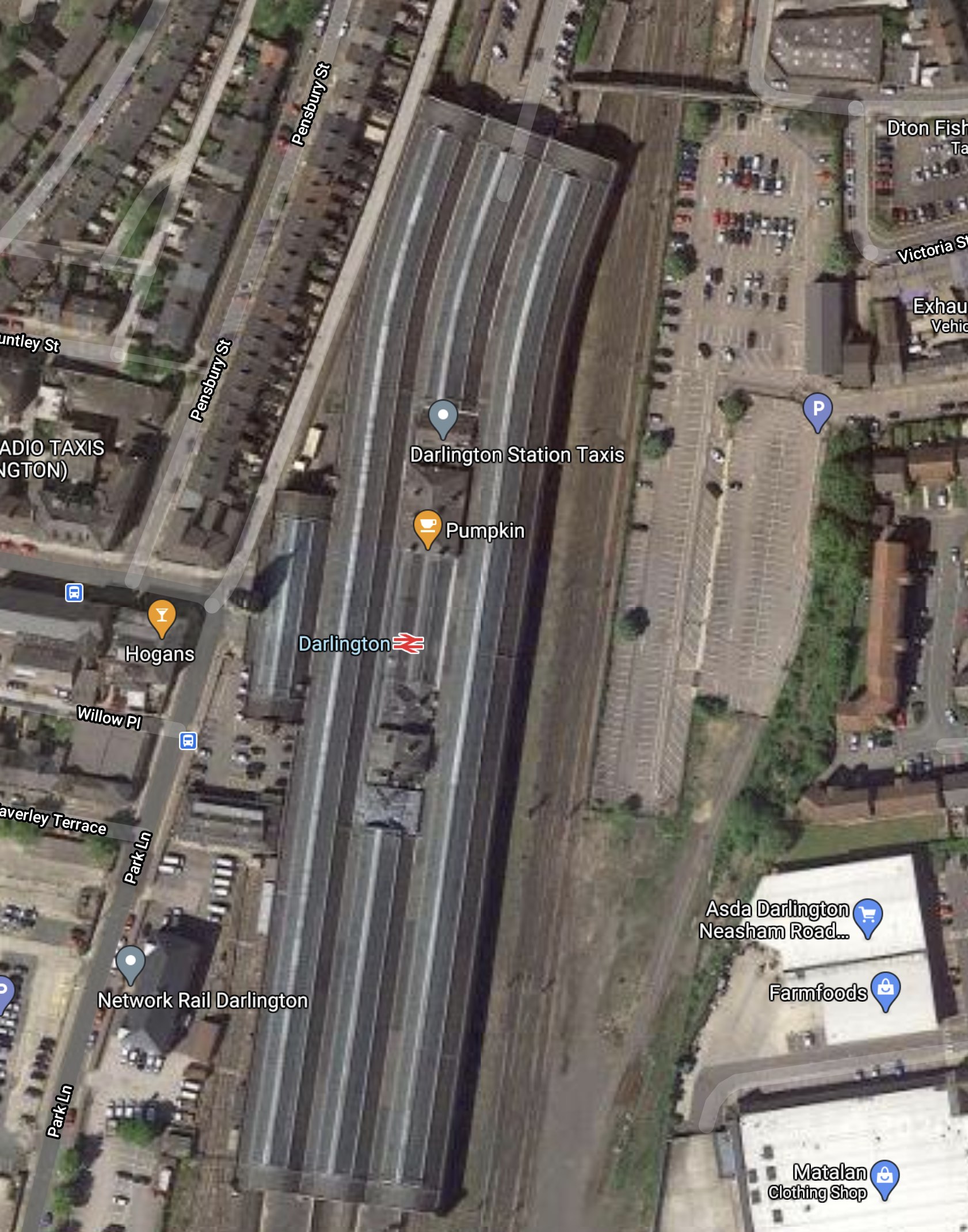
Note.
- The station has two long platforms and two South-facing bay platforms.
- There is plenty of space.
- There already appear to be a pair of electrified avoiding lines on the Eastern side of the station.
Wikipedia also says this about how Darlington station will be changed by High Speed Two.
The new high speed rail project in the UK, High Speed 2, is planned to run through Darlington once Phase 2b is complete and will run on the existing East Coast Main Line from York and Newcastle. Darlington Station will have two new platforms built for the HS2 trains on the Main Line, as the station is built just off the ECML to allow for freight services to pass through.
This would appear to suggest that the two current avoiding lines will be turned into high speed platforms.
Current High Speed Services At Darlington
The current high speed services at Darlington are as follows.
- LNER – two trains per hour (tph) – London Kings Cross and Edinburgh
- Cross Country – one tph – Plymouth and Edinburgh or Glasgow
- Cross Country – one tph – Southampton and Newcastle
- TransPennine Express – one tph – Liverpool and Edinburgh
- TransPennine Express – one tph – Manchester Airport and Newcastle
Northbound, this gives eight tph to Newcastle and four tph to Edinburgh
East Coast Trains
East Coast Trains‘s services are not planned to stop at Darlington.
High Speed Two Trains
Darlington is planned to be served by these High Speed Two trains.
- 1 tph – Birmingham Curzon Street and Newcastle via East Midlands Hub, York and Durham
- 1 tph – London Euston and Newcastle via Old Oak Common and York.
Both will be 200 metre High Speed Two Classic-Compatible trains
Northbound, this gives ten tph to Newcastle and four tph to Edinburgh.
As the Eastern Leg of High Speed Two has some spare capacity, I suspect there could be other services through Darlington.
Improvements To The East Coast Main Line
If you look at the East Coast Main Line between Doncaster and Newcastle, the route is a mixture of two and four-track railway.
- Between Doncaster and York, there are two tracks
- Between York and Northallerton, there are four tracks
- Between Northallerton and Darlington, there are two tracks
- North of Darlington, the route is mainly two tracks.
I have flown my virtual helicopter along much of the route and I can say this about it.
- Much of the route is through agricultural land, and where absolutely necessary extra tracks could possibly be added.
- The track is more-or-less straight for large sections of the route.
- Routes through some towns and cities, are tightly hemmed in by houses.
I also believe that the following developments will happen to the whole of the East Coast Main Line before High Speed Two opens.
- Full ERTMS in-cab digital signalling will be used on all trains on the route.
- The trains will be driven automatically, with the driver watching everything. Just like a pilot in an airliner!
- All the Hitachi Class 80x trains used by operators on the route, will be able to operate at up to 140 mph, once this signalling and some other improvements have been completed.
- All level crossings will have been removed.
- High Speed Two is being built using slab track, as I stated in HS2 Slab Track Contract Awarded. I suspect some sections of the East Coast Main Line, that are used by High Speed Two services, will be upgraded with slab track to increase performance and reduce lifetime costs.
Much of the East Coast Main Line could become a 140 mph high speed line, as against High Speed Two, which will be a 225 mph high speed line.
This will mean that all high speed trains will approach Darlington and most other stations on the route, at 140 mph.
Trains will take around a minute to decelerate from or accelerate to 140 mph and if the station stop took a minute, the trains will be up to speed again in just three minutes. In this time, the train would have travelled two-and-a-half miles.
Conclusion
I think that this will happen.
- The Tees Valley Line trains will be greatly improved by this project.
- Trains will generally run at up to 140 mph on the East Coast Main Line, under full digital control, like a slower High Speed Two.
- There will be two high speed platforms to the East of the current station, where most if not all of the High Speed Two, LNER and other fast services will stop.
- There could be up to 15 tph on the high speed lines.
With full step-free access between the high speed and the local platforms in the current station, this will be a great improvement.
Vivarail Targets Overseas Markets
The title of this post, is the same as that of this article on Rail Magazine.
This is an extract from the article.
Shooter told RAIL: “We are at the moment putting together a bid for an operator – not in this country – where the routes would be up to 500 miles long, to be provided totally with battery trains using this device.
“This bid we are putting together contemplates trains that are running for several hours – 60 to 70 miles between charging stations, but possibly going twice that far in emergency if the charging station should go down.”
By this device I suspect they mean their Fast Charge device, which is described in this press release from Vivarail.
This extract describes how it works.
The concept is simple – at the terminus 4 short sections of 3rd and 4th rail are installed and connected to the electronic control unit and the battery bank. Whilst the train is in service the battery bank trickle charges itself from the national grid – the benefit of this is that there is a continuous low-level draw such as an EMU would use rather than a one-off huge demand for power.
The train pulls into the station as normal and the shoegear connects with the sections of charging rail. The driver need do nothing other than stop in the correct place as per normal and the rail is not live until the train is in place.
That’s it!
That sounds simple to me.
Where Would This Possible Order Be From?
I have ridden in a Vivarail battery train, as I wrote in Battery Class 230 Train Demonstration At Bo’ness And Kinneil Railway.
I have also ridden the diesel variant, as I wrote in A First Ride In A Revenue-Earning Class 230 Train.
I very much feel, I can list a few of the good qualities of the trains.
Big Windows
The big windows give a good view, so I wonder if the trains would work well on a railway noted for its scenery.
Quietness
I have ridden in two battery trains.
The other was Bombardier’s Class 379 BEMU, that I wrote about in Is The Battery Electric Multiple Unit (BEMU) A Big Innovation In Train Design?.
Both were extremely quiet.
No Infrastructure Required
Except for the charging stations, no infrastructure is required.
Sturdy Engineering
Although the trains were only originally built for the London Underground, they are sturdily-built trains, as they used to share tracks with full-size trains.
I suspect, they are certified to share tracks with freight trains, as they do on the Marston Vale Line.
A Range Of Interiors And Customer Facilities
Although the trains tend to use the old London Underground seat frames, they have a range of interiors, which seem to be well-designed and comfortable.
I have been on Class 230 trains, with tables, a single toilet, onboard Wi-Fi, and electrical charging points.
Zero-Carbon
The trains are probably as near to zero-carbon, as any! Especially, if all the Fast Charge stations are powered by renewable electricity.
Remote Servicing
The trains have been designed for remote servicing.
Conclusion
All of these qualities lead me to think, that an ideal line in the UK could be the Far North Line, between Inverness and Wick and Thurso.
Although the train ticks a lot of boxes, it could well be too slow, It is also only a 160 mile route and not five-hundred
But there must be quite a few long, scenic lines in countries, where a passenger service needs to be added to a freight line, that perhaps serves a remote mining town.
Sweden and Norway are surely possibilities, but Finland is ruled out because it is Russian gauge.
Could the trains end up in parts of Africa, Canada and the United States?
Who knows?
Beeching Reversal – The Aston Rowant Extension Of The Chinnor Railway
This is one of the Beeching Reversal projects that the Government and Network Rail are proposing to reverse some of the Beeching cuts.
This Googlr Map shows the location of the proposed Aston Rowant station.
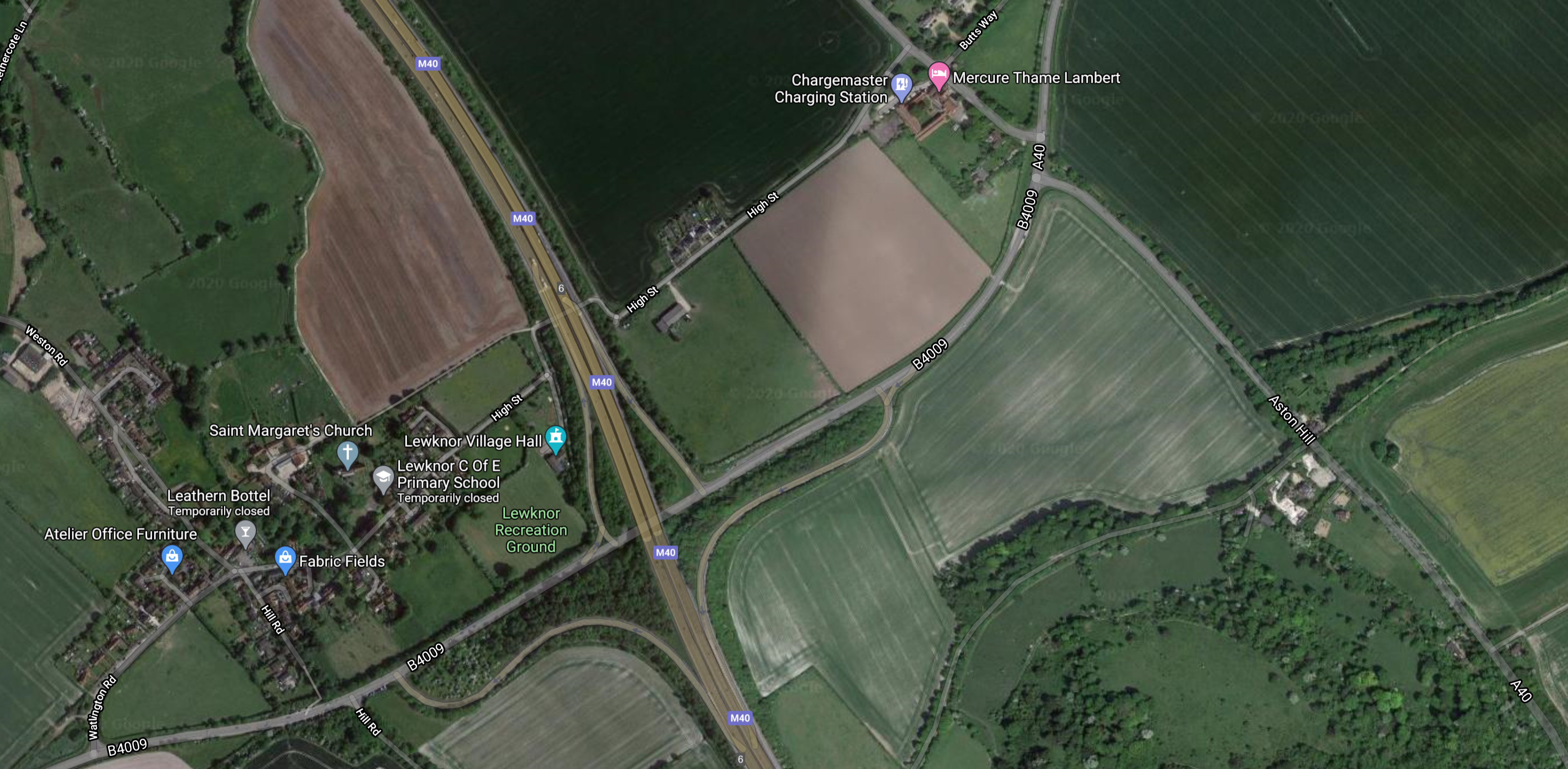
Note.
- The motorway junction is Junction 6 of the M40, where it joins the B4009.
- The hotel at the top of the map, which is marked by a pink arrow, is the Mercure Thame Lambert.
- A road passes the hotel and goes South East parallel to the motorway.
The original Aston Rowant station, appears to have been in the triangular piece of land to the East side of the road.
Wikipedia gives a plan for the future of the Aston Rowant station under a section called Future, where this is said.
There were reports in 1997 that the Chinnor and Princes Risborough Railway (CPRR) wished to extend its operations to Aston Rowant. A joint venture between the CPRR and Chiltern Railways was also proposed whereby the national rail operator would construct a new station at Aston Rowant to allow frequent weekday commuter services along the Icknield Line to connect with main line traffic through to London Marylebone, leaving the CPPR to run heritage services at other times. The scheme, which would cost around £3m, would seek to take advantage of Aston Rowant’s location near junction 6 of the busy M40 motorway.
There doesn’t seem to be any more details on the Internet, but I could see the full scheme having the following.
- A car-park by Junction 6 of the M40.
- Minimal station facilities.
- A shuttle train to Princes Risborough station using a diesel or battery Class 230 train or perhaps a heritage diesel.
- At weekends, it would act as parking for the Chinnor and Princes Risborough Railway.
- Given Adrian Shooter;s historic connections, this could be an ideal place for using Vivarail’s Pop-up Metro concept.
It could be a deal, where everyone’s a winner. Local commuters, Park-and-Ride users, the CPRR and Chiltern Railways could all benefit.
Conclusion
This is a simple scheme and I suspect the biggest problem could be getting the planning permission.
Retired London Underground Train Travels Forty Miles Solely On Battery Power
This article on Railnews is a summary of today’s news and has a subtitle of Battery Train Sets British Record.
This is the first sentence.
A battery train from Vivarail has achieved a British first by travelling 64km on battery power alone, and the feat has been repeated many times during tests.
The train was a Vivarail Class 230 train, that is based on retired London Underground D78 Stock.
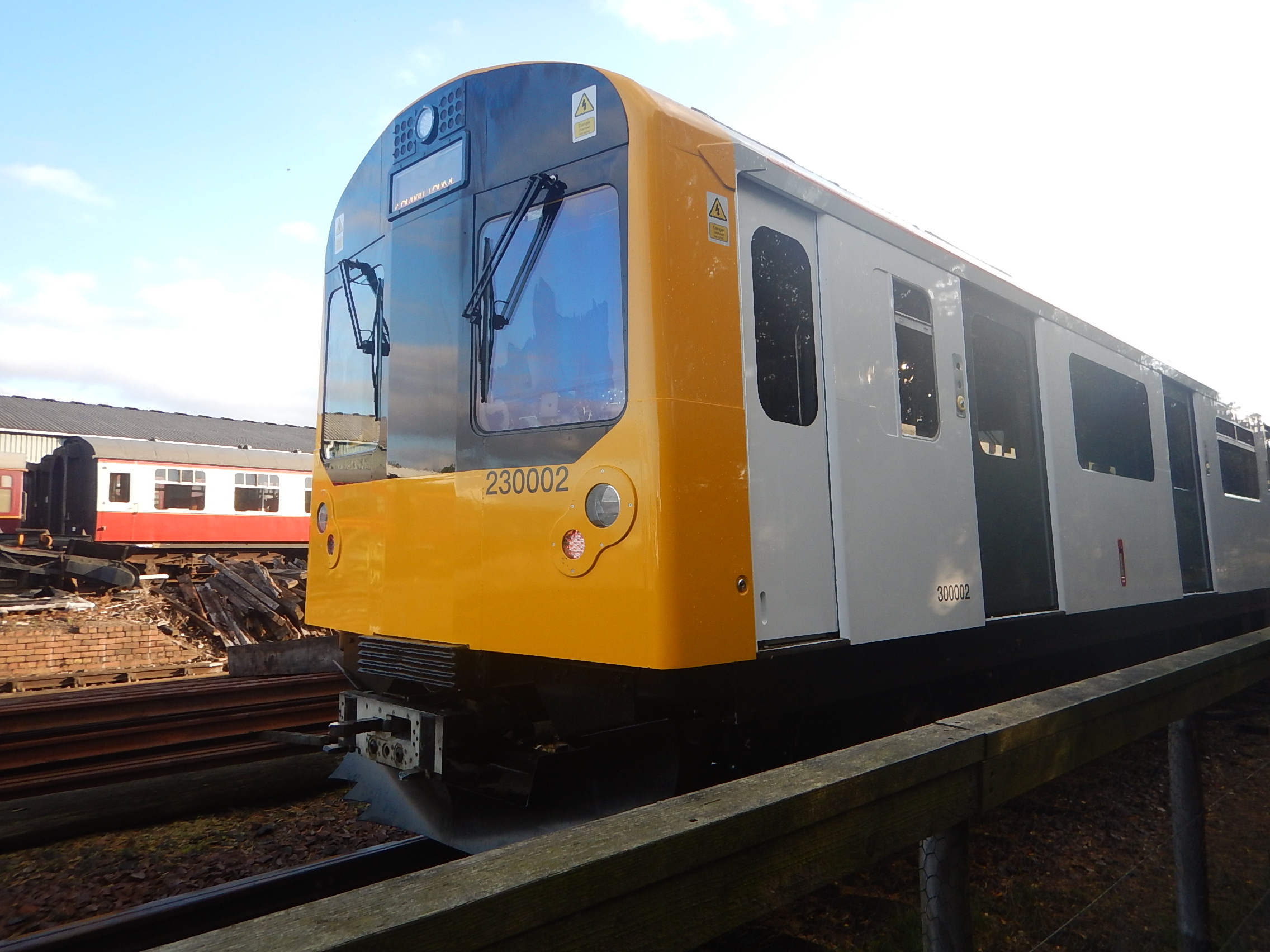
The picture shows the prototype battery train, when I rode it in 2018 at the Bo’ness And Kinneil Railway.
The article also says this.
Vivarail CEO Adrian Shooter is predicting that production versions of the battery trains will be able to run for almost 100km between charges, which will take just 10 minutes.
Battery trains appear to be going places.
Vivarail Units Take Over Marston Vale Services
The title of this post is the same asw this article on Railway Gazette.
The article contains an informative video of Adrian Shorter talking about the Class 230 train.
Much of the article and the video is information that has already been well reported.
Adrian Shooter does mention that the diesel-electric-battery versions of the Class 230 train for Transport for Wales will incorporate geo-fencing.
This would mean that in sensitive areas, the diesel engines would be cut out and only battery power would be used.
The process would be controlled automatically using the train’s position from GPS.
This technique has been used on hybrid buses to lower emissions and noise levels in sensitive areas.
Vivarail Unveils Fast Charging System For Class 230 Battery Trains
The title of this post is the same as that of this article on Railway Technology.
A few points from the article.
- Class 230 trains running on battery power have a range of sixty miles.
- Fully charging the train takes seven minutes.
- Short lengths of third and fourth-rail are used.
- Power is provided from a battery bank, which is trickle charged.
I feel this paragraph describes the key feature.
The automatic technique utilises a carbon ceramic shoe, which is capable of withstanding the significant amount of heat generated during the process.
The article finishes with a quote from Vivarail CEO Adrian Shooter.
I know how important it is to the public and the industry as a whole to phase out diesel units and our battery train is paving the way for that to take place today not tomorrow.
Consider.
- Alstom, Bombardier, Siemens and Stadler have built or are building third-rail powered trains for the UK.
- Bombardier, Porterbrook and Stadler are developing battery-powered trains for the UK.
- Trickle-charging of the secondary batteries could be performed by mains power or a local renewable source like wind or solar.
- Control electronics can make this a very safe system, with low risk of anybody being hurt from the electrical systems.
I’ve said it before, but I think that Vivarail may have some very important technology here.
If I have a worry, it is that unscrupulous companies and countries will probably find a way round any patent.
Should Railways Have A Pop-Up Service Capability?
Most of us will be familiar with the concept of Pop-Up Retail.
This is the first paragraph of the Wikipedia entry.
Pop-up retail, also known as pop-up store (pop-up shop in the UK, Australia and Ireland) or flash retailing, is a trend of opening short-term sales spaces that started in Los Angeles and now pop up all over the United States, Canada, China,Japan, Mexico, France, Germany, the United Kingdom and Australia. The pop-up industry is now estimated to be a $50 billion industry. Pop-up retail has been an increasing factor during the retail apocalypse of the 2010s, including seasonal Halloween retailer Spirit Halloween, who has operated stores in vacant spaces during the season.
Two of the units are scheduled for export to the United States, to demonstrate for the potential for ‘pop-up’ commuter services; the cost of a one-year period are said to be equivalent to the consultancy costs for opening a new route. Should such an approach be considered in this country too? The gestation period for new services on freight-only routes is probably the best part of 10 years, but it doesn’t have to be like that.
When floods swept away the road bridge at Workington in 2009; Network Rail and Northern constructed a pop-up station and introduced additional trains in less than two weeks.

I can envisage three types of simple stations.
- A one-platform station on a single-track line.
- A two-platform station on a double-track line.
- A one-platform station on a double-track line.
Note
- Type One, would be the simplest and would be worked bidirectionally.
- Type Two, would probably require a bridge across the tracks.
- Type Three, would need crossovers at both ends of the station, to allow the single platform to be worked bidirectionally.
Obviously, Type 1 would be the most affordable and probably easiest to install.


- It would certainly bridge the gap between two platforms with a double-track railway in between.
- In a rail application, the bridge would be interlocked with the signalling and controlled by the signaller.
- Signals and lights could be added to the bridge to ensure complete safety.
- Wikipedia says the original at the Paddington Basin cost £500,000, which could probably be reduced if more were built.
- This page on the Merchant Square web site, shows the bridge in action.
- I suspect this bridge would work on single- or double-track lines, without electrification, or with third-rail or with overhead electrification.
- At many stations it could just be dropped in place from a rail-mounted crane, after preparing the existing platforms.
- I suspect though, that there would be a limit to the number of trains per hour it could handle.
- The ability to execute a fast stop at a station.
- Level access will be possible between train and platform.
- On-board CCTV systems to ensure safe loading and unloading of passengers.
- Modern in-cab digital signalling.
This will enable the trains to make a station stop without causing problems to the existing timetable.
So if Network Rail, had the ability to quickly install a pop-up station, modern trains would allow a service to be tested at a reasonable cost.
The Practicalities Of Installing A Pop-Up Station
Suppose a station were to be installed at Soham or any other suitable place.
I would expect Network Rail to produce standard designs for the foundations of their pop-up stations.
Network Rail periodically close a line to replace track or do various other work. When a line is closed for this work and a pop-up station might be needed on the route, the standard foundations would be installed.
Then, when the budget for the station had been obtained, the station would be installed and commissioned in a suitable possession.
Conclusion
I believe a pop-up station is a feasible proposition.
If a pop-up station is a feasible proposition, then it follows that to install perhaps five stations on a freight-only line to create a totally new passenger service is also a feasible proposition.
Porterbrook Makes Case For Battery/Electric Bi-Mode Conversion
The title of this post is the same as that of this article on Global Rail News.
This is the first paragraph.
Rolling stock leasing company Porterbrook is working on a prototype battery/electric bi-mode Class 350/2 to demonstrate the technology’s viability to train operators.
So why would you fit batteries to an electric train like a Class 350 train?
Range Extension
An appropriately-sized battery can be used to power the train on an extension or branch line without electrification.
The classic route in London is the Barking Riverside Extension of the Gospel Oak to Barking Line.
Until someone says otherwise, I believe this short route will be built without electrification and the Class 710 trains will run on this route using stored battery power.
In my article in Issue 856 of Rail Magazine, I said this.
London is also designing and building another rail line, which will be used only by Aventras – The Barking Riverside Extension of the Gospel Oak and Barking Line.
I have read all of the published Transport for London documents about this extension and although electric trains are mentioned, electrification is not!
The extension is only a mile of new track and trains could leave the electrified c2c line with full batteries.
It would not be difficult to go to Barking Riverside and back on stored power.
Benefits would include.
- Less visual and audible intrusion of the new railway.
- Simpler track and station design.
- It might be easier to keep the railway at a safe distance from all the high voltage electricity lines in the area, that bring power to London.
- A possibly safer and more reliable railway in extreme weather.
- Costs would be saved.
No-one has told me, I’ve got it wrong.
Handling Regenerative Braking Energy
Normally, the energy generated by regenerative braking is returned through the overhead wires or third-rail to power nearby trains.
This does save energy, but it does have drawbacks.
- What happens if there are no nearby trains?
- The transformers and systems that power the track are more complicated and more expensive.
As trains slow and accelerate continuously, would it not be better if regenerative energy could be used to accelerate the train back up to line speed?
The train would need an intelligent control system to decide whether to use power from the electrification or the batteries.
In my view, a battery on the train is the obvious way to efficiently handle the energy from regenerative braking.
Handling Power Failures
Electrification failures do occur for a number of reasons.
If trains have an alternative power supply from a battery, then the driver can move the train to perhaps the next station, where the train can be safely evacuated.
I believe that Crossrail uses battery power for this purpose.
Electrically Dead Depots And Sidings
Depots and sidings can be dangerous places with electricity all over the place.
If trains can be moved using stored energy, then safer depots and sidings can be designed.
Remote Wake-Up
We’ve all got up early in the morning, to drive to work on a cold day.
One train driver told me, there was no worse start to the day, than picking up the first train from sidings in the snow.
I discuss, remote wake-up fully in Do Bombardier Aventras Have Remote Wake-Up?.
I suspect to do this reliably needs a battery of a certain size.
How Big Should The Batteries Be?
It is my belief, that the batteries on an electric train, must be big enough to handle the energy generated if a full-loaded train stops from maximum speed.
If we take the Class 350/2 train, as owned by Porterbrook, Wikipedia gives this information.
- Maximum Speed – 100 mph
- Train Weight – 175.5 tonnes
- Capacity – Around 380 passengers
If I assume each passenger weighs 90 Kg with baggage, bikes and buggies, the train weight is 209.7 tonnes.
This could be a bit high, but if you’ve been on one of TransPennine’s Class 350 trains, you might think it a bit low.
Using Omni’s Kinetic Energy Calculator, I get the following kinetic energies at various speeds.
- 60 mph – 20.9 kWh
- 70 mph – 28.5 kWh
- 80 mph – 37.2 kWh
- 90 mph – 47.1 kWh
- 100 mph – 58.2 kWh
- 110 mph – 70.4 kWh
- 120 mph 83.6 kWh
I have added the unrealistic 120 mph figure, to show how the amount of energy rises with the square of the speed.
As it would be advantageous for trains to run at 110 mph, the batteries must always have the capacity to handle at least 70.4 kWh, so perhaps 100 kWh would be a good minimum size.
How Much Battery Capacity Could Be Fitted Under A Train?
Wikipedia doesn’t give the formation of a Class 350 train, but it does give that of the similar third-rail version of the train; the Class 450 train.
- DMSO(A)
- TCO
- TSO
- DMSO(B)
Which is two identical Driver Motor Cars with two Trailer Cars in the middle. Looking at a Class 350 train in Euston, they appear to have a similar formation.
This page on the Vivarail web site is entitled Battery Train Update.
This is a paragraph.
Battery trains are not new but battery technology is – and Vivarail is leading the way in new and innovative ways to bring them into service. 230002 has a total of 4 battery rafts each with a capacity of 106 kWh and requires an 8 minute charge at each end of the journey. With a 10 minute charge this range is extended to 50 miles and battery technology is developing all the time so these distances will increase.
So it looks like Vivarail manage to put 212 kWh under each car of their two-car train.
This article on the Railway Gazette is entitled Battery-Powered Desiro ML Cityjet Eco Unveiled.
This is an edited version of the first two paragraphs.
An electric multiple-unit equipped with a prototype electric-battery hybrid drive system designed to enable through running onto non-electrified lines was unveiled by Siemens and Austrian Federal Railways in Wien on September 10.
The Desiro ML Cityjet Eco has been produced using a series-built version of the Desiro ML EMUs which Siemens is supplying to ÖBB. The middle car has been equipped with three battery containers with lithium-titanate batteries offering a total capacity of 528 kWh.
Although this train is designed for a different loading gauge, it is another Siemens product and they manage to fit 528 kWh in, on top or under one car.
I think, it would be reasonable to assume that around 400 kWh of batteries could be fitted under a Class 350 train.
These pictures show a Class 350 train at Euston.

Note that the trailer car with the pantograph has less free space underneath. I would assume that is because the transformer and other electrical gubbins are underneath the car to increase passenger space.
I’m certain there is space under a Class 350 train to fit an appropriate amount of storage.
What Battery Range Could Be Expected?
In an article in the October 2017 Edition of Modern Railways, which is entitled Celling England By The Pound, Ian Walmsley says this in relation to trains running on the Uckfield Branch, which is not very challenging.
A modern EMU needs between 3 and 5 kWh per vehicle mile for this sort of service.
So how far would a four-car Class 350 train go with a fully-charged 400 kWh battery?
- 5 kWh per vehicle mile – 20 miles
- 4 kWh per vehicle mile – 25 miles
- 3 kWh per vehicle mile – 33.3 miles
- 2 kWh per vehicle mile – 50 miles
Obviously, this is a very crude estimate, but it does show that the train could have a useful range on battery power.
But the following would increase the range of the train.
- A low energy interior.
- An increased battery capacity.
- Two cars in the four-car train are trailers, so should have more space underneath.
- Routes for battery trains could be reprofiled with gentle curves and gradients.
- Terminal platforms could be fitted with charging stations.
In Did Adrian Shooter Let The Cat Out Of The Bag?, Mr Shooter talked about a range of forty miles at sixty mph for the battery version of a Class 230 train.
That distance, would open up a surprising number of routes for battery trains.
Should A Small Diesel Generator Be Fitted?
It is worth noting that Transport for Wales has ordered two battery trains.
- Vivarail Class 230 trains for North Wales.
- Stadler Flirts for South Wales
Both trains have diesel engines, that can be used to back-up battery power.
In addition the Class 801 train has a diesel generator to rescue the electric train, when the power fails.
Are Hitachi, Stadler and Vivarail just being safe or do their figures show that a diesel engine is absolutely necessary? After all, the diesel generator can be easily removed, if it’s never used.
I think if it was easy, whilst the new battery-powered train was being tested and on probation, I’d fit a small diesel generator.
Remote Battery Charging
Most of the charging would be done, whilst running on electrified lines, which could be either 25 KVAC overhead or 750 VDC third-rail.
But the trains would be ideal for the sort of charging system, that I wrote about in Is This The Solution To A Charging Station For Battery Trains?.
To use this Opbrid system, all the train needs is the ability to connect through a 25 KVAC pantograph, which the train already has.
As there is a lot of interest in battery trains throughout Europe, I suspect that a charging station will be a standard piece of equipment, that can be easily installed in a terminal platform or a turnback siding.
We could see important towns and cities like Barrow-in-Furness, Blackburn, Chester, Dundee, Harrogate, Huddersfield, Hull, Middlesbrough, Perth and Sheffield, which are within battery range of the electrified network, being served by electric trains , without the disruption of installing electrification.
An Updated Interior
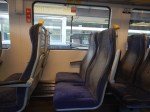
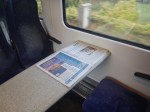
The Class 350 trains were ordered around 2000 and don’t have the features that passengers expect, as these pictures show.


An update would probably include.
- LED lighting.
- Low-energy air-conditioning.
- Wi-fi
- Power sockets
- USB sockets.
Other features would be cosmetic like new seat covers and flooring.
But overall, a better interior will surely reduce the energy needs of a train.
What Would Be The Maximum Speed?
The current maximum speed of Porterbrook’s Class 350/2 trains is 100 mph, but all other variants of the train are capable of 110 mph.
Under Description in the Wikipedia entry for the Class 350 train, this is said.
The top speed of the fleet was originally 100 mph (160 km/h), but all 350/1s were modified to allow 110 mph (180 km/h) running from December 2012, in order to make better use of paths on the busy West Coast Main Line.
So would the conversion to battery power, also include an uprating to 110 mph?
It would definitely be a prudent move, so as to make better use of paths on busy main lines.
Where Would These Trains Run?
I feel that Porterbrook will produce a four-car train with these characteristics.
- 110 mph operating speed.
- Forty or perhaps a fifty mile range on batteries.
- Quality interior.
- The ability to use a charging station in a terminal platform.
The Global Rail News article says this about possible use of the trains.
Engineers at Porterbrook have run models on a variety of routes, including the Windermere branch line and the West Coast main line, and believe a battery/electric bi-mode, known as a 350/2 Battery/FLEX, could offer various performance benefits.
The Windermere to Manchester Airport service would seem to be an ideal route for the Class 350/2 Battery/FLEX trains.
- Only ten miles are not electrified.
- The trains could easily work the return trip on the Windermere Branch Line on battery power.
- There would be no need for any charging station at Windermere station.
- Much of the route is on the West Coast Main Line, where a 110 mph electric train would fit in better than a 100 mph diesel train.
- As the trains would need a refurbishment, some could be fitted with an interior, suitable for airport travellers.
- The trains would fit the ethos and environment of the Lake District.
As the route will soon be run by Class 769 trains, I suspect there would need to be no modifications to the tracks, stations and signalling, as both trains are bi-modes, based on four-car electric trains.
I have other thoughts about, where Class 350/2 Battery/FLEX trains could be used.
Interchangability With Class 769 Trains
Both the Class 350/2 Battery/FLEX and Class 769 trains are trains owned by Porterbrook.
They are also surprisingly similar in their size, performance and capabilities.
- Both are four-car trains around eighty metres long.
- Both can work on 25 KVAC overhead electrification and both could be modified to work on 750 VDC third-rail electrification.
- Both are 100 mph trains, although it may be possible to uprate the Class 350/2 Battery/FLEX to 110 mph working.
- Both trains can be fitted with modern interiors giving operators, passengers and staff what they need or want.
- Many routes for bi-mode trains could be worked by either train.
There will be a few differences.
- The Class 350/2 Battery/FLEX train is a pure electric train and more environmentally-friendly.
- The Class 350/2 Battery/FLEX train could fit in better on a busy main line.
- The Class 769 train will probably have a longer range away from electrification.
- The Class 350/2 Battery/FLEX train is twenty years younger.
I think that this similarity will be used to advantage by Porterbrook and the train operating companies.
- A Class 350/2 Battery/FLEX train would be an ideal replacement for a Class 769 train, when the latter needs replacing.
- A Class 769 train could replace a Class 350/2 Battery/FLEX train, if say the latter was being serviced or repaired or perhaps the charging station at one terminus was out of action.
- A Class 769 train could be used for route-proving for both trains.
Porterbrook wins every way, as they own both trains.
But I can also see a time, when the Class 769 trains become a reserve fleet to be used, when a train operating company is in urgent need of more capacity.
Around Electrified Conurbations
The UK has several conurbations with a lot of electrification.
- Birmingham-Coventry-Wolverhampton
- Edinburgh-Glasgow-Stirling
- Leeds-Bradford-Doncaster-York
- Liverpool-Manchester-Preston-Blackpool
- London
Cambridge, Cardiff, Reading and Newcastle could also become major electrified hubs.
I suspect there will be a lot of routes for which these trains would be eminently suitable.
This is a selection of the easy routes, where there is electrification at one end of the route and a charging station could be added at the other, if required.
- Doncaster to Hull
- Dunblane to Perth
- Glasgow Central To East Kilbride
- Leeds to York
- London Bridge to Uckfield
- Manchester to Buxton
- Manchester to Chester
- Manchester to Clitheroe
- Preston to Barrow-in-Furness
- Preston to Blackpool South
- Preston to Colne
In total, there must be at least twenty of these routes in the UK.
Trains Across The North Of England
It should be noted that Leeds to Stalybridge is about thirty-five miles by rail and both ends of the route are electrified.
So could these trains have sufficient battery capacity to enable Northern to run fast electric services between Blackpool, Chester, Liverpool, Manchester, Manchester Airport and Preston in the West to Hull, Leeds and York in the East?
If the Class 350/2 Battery/FLEX train has sufficient battery capacity and the speed limits on various sections of the East West routes are increased from some of their miserable levels, I believe that a much better service could be provided.
At over seventy miles long, the Settle-Carlisle Line, is probably too long for battery operation, especially as the route is not electrified between Skipton and Carlisle, which is nearly ninety miles.
The same probably applies to the Tyne Valley Line, which has just over sixty miles without electrification.
But it is called the Tyne Valley Line for a good reason, it runs alongside the River Tyne for a long way and looks to be not very challenging.
I wouldn’t rule out, that in a few years time, the route is run by a battery hybrid train, like the Class 350 Battery/FLEX.
The secondary route between Leeds and Lancashire is the Calder Valley Line via Hebden Bridge, which is not electrified between Preston and Bradford, which is a distance of fifty-three miles.
Electrification of this route and especially between Burnley and Bradford would be extremely challenging due to mthe numerous bridges and the terrain, with the added complication of the Grade II Listed Hebden Bridge station.
It would be pushing it, but I believe the Class 350 Battery/Flex train could handle it.
There is a plan to reconnect Skipton in Yorkshire to Colne in Lancashire to create another route across the Pennines.
The trains would need to travel the forty-two miles between Preston and Skipton using battery power, but it would create a valuable route at an affordable cost, if no electrification was used.
What would improve the running of the routes via Hebden Bridge and Colne, would be to electrify the route between Preston and Blackburn, which would reduce the distance to be run on battery power by twelve miles.
The Hope Valley Line runs between Sheffield and Manchester Piccadilly and is forty-two miles long without electrification.
This route certainly needs a modern four-car train and I believe that the Class 350 Battery/FLEX train could handle it.
But it would need a charging station at Sheffield.
On this rough and ready analysis, it looks like the three Southern routes and a new one via Colne could be handled successfully by a Class 350 Battery/FLEX.
Summing up the gaps West of Leeds we get.
- Bradford and Manchester Victoria via Hebden Bridge – 40 miles
- Sheffield and Manchester Piccadilly via Hope Valley Line – 42 miles
- Stalybridge and Leeds via Hudderfield – 35 miles
- Preston and Skipton via Colne – 42 miles
If the Class 350 Battery/FLEX train can do around fifty miles on battery power, which I suspect is a feasible distance, then these trains could give Northern an electric stopping service on all their routes across the Pennines.
In my view the system could be improved by the following projects.
- Electrify between Preston and Blackburn and possibly Burnley Manchester Road.
- Electrify between Manchester Victoria and Todmorden.
- Renew the crap electrification between Manchester Piccadilly and Glossop, with an extension for a few miles along the Hope Valley Line to perhaps New Mills Central and Rose Hill Marple.
- Tidy up the electrification between Leeds and Bradford and extend it to the Northbound East Coast Main Line.
But the most important thing to do, is to increase the line speed on the routes across the Pennines.
Greater Anglia and Network Rail are talking about ninety minutes for the 114 miles between London and Norwich, which is an average speed of 76 mph.
Liverpool Lime Street to York is about the same distance and TransPennine take around 110 minutes for the journey, which is an average speed of around 60 mph.
- Both journeys have a few stops.
- Both routes are or will be run by 100 mph trains.
- The East Anglian route is electrified, but trans-Pennine is not.
The big difference between the routes, is that large sections of the East Anglian route can be run at 100 mph, whereas much of the Trans-Pennine route is restricted to far lower speeds, by the challenging route
Sort it!
Electric traction will make a difference to the acceleration, but it doesn’t matter if they get their power from overhead wires or batteries!
Putting up overhead wires on the current route will be throwing good money after bad, unless the track is fixed first.
Liverpool Lime Street to York should be ninety minutes in a Class 350 Battery/FLEX.
The Scottish Breakout
Finally, the electrification in the Scottish Central Belt is on track and the Scots are seeing the benefit of modern electric trains.
Trains like the Class 350 Battery/FLEX could be the key to extending Scotland’s growing network of electric trains.
In A Railway That Needs Electric Trains But Doesn’t Need Full Electrification, I described how the 11.5 mile service between Glasgow Central and East Kilbride station could be run by an electric train using batteries, which would be charged using the 25 KVAC overhead wires at the Glasgow end of the route.
If the Class 350 Bettery/FLEX train existed, they could work this route, as soon as drivers and other staff had been trained.
With a forty mile range on batteries, trains could reach from the electric core to many places, like Dumbarton, Perth and possibly Dundee.
It should be noted that Dundee is just under fifty miles from Dunblane, where the current electrification will end, so with a charging station in one of the bay platforms at Dundee, a Class 350 Battery/FLEX should be able to bridge the gap.
They could even probably handle the current Borders Railway, with a charging station at Tweedbank.
Scotland would not need to acquire a fleet of Class 350 Battery/FLEX, as they already have a fleet of Class 380 trains, which I am certain could be re-engineered in the same way to become battery/electric trains.
ScotRail may need a few more electric trains, but they could always keep the Class 365 trains, that have been used as cover for the much-delayed Class 385 trains.
South Western Railway
South Western Railway don’t have any obvious needs for a train like a Class 350 Battery/FLEX train.
But consider.
- They do have 127 Class 450 trains, which are the third-rail version of the Class 350 train, so could probably be converted into a Class 450 Battery/FLEX.
- They have ten Class 158 and thirty Class 159 diesel trains, some of which work partially-electrified routes.
- British Rail-era third-rail systems have their deficiencies in places.
- There are proposals and some plans to reopen branch lines to the West of Basingstoke and Southampton.
- The Class 450 trains could be converted to dual-voltage operation, as they have a pantograph well.
So perhaps a few Class 450 Battery/FLEX trains could be a useful possibility.
- Basingstoke to Salisbury is thirty-six miles and with a charging station at Salisbury, an electric service between Waterloo and Salisbury could be run.
- Salisbury to Southampton Central is twenty-five miles.
- Waterloo to Corfe Castle and Swanage, if it was decided to run this Saturday service, more frequently.
I also suspect that a Class 450 Battery/FLEX would give South Western Railway several operational and energy-efficiency advantages, which could lead to financial advantages.
I doubt though that the trains would have the capability to reach Exeter, as that is just too far.
These trains would also be ideal for the for the following services, run by other operators.
- London Bridge to Uckfield.
- The Marshlink Line.
- Reading to Gatwick, where they would replace the proposed Class 769 trains.
Converting these three lines to electric traction, would remove the final diesel passenger services from Kent and Sussex.
Other Routes
Use your imagination!
Conclusion
Porterbrook have just dropped an enormous flower-smelling bomb, into the electrification and train replacement plans of UK railways.
Did Adrian Shooter Let The Cat Out Of The Bag?
This article with a video in the Scotsman is entitled Video: Battery Trains On Track To Cut Emissions and gives a lot of information about the Class 230 train. This is a paragraph.
The train is restricted to a 25mph speed on this week’s test trips, but Vivarail Chief Executive Adrian Shooter says it can sustain speeds of “60 mph for 40 miles” when new batteries become available next year.
Moreover, the batteries need just four minutes to recharge.
So what does this mean for the various routes?
Borderlands Line
Transport for Wales have ordered Class 230 trains for the Borderlands Line.
The line runs between Bidston and Wrexham Central stations is around twenty-seven miles and takes an hour. There is a generous turnround time at both ends in the current schedule.
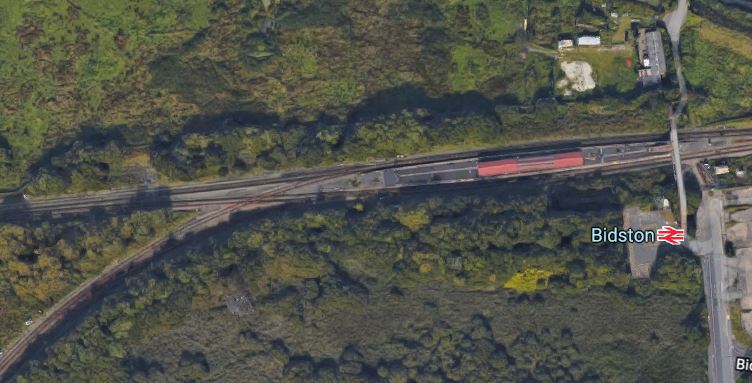
This Google Map shows the layout of the two-platform station at Bidston.
This picture shows the red-roofed shed in the middle of the island platform, with the tracks on either side.
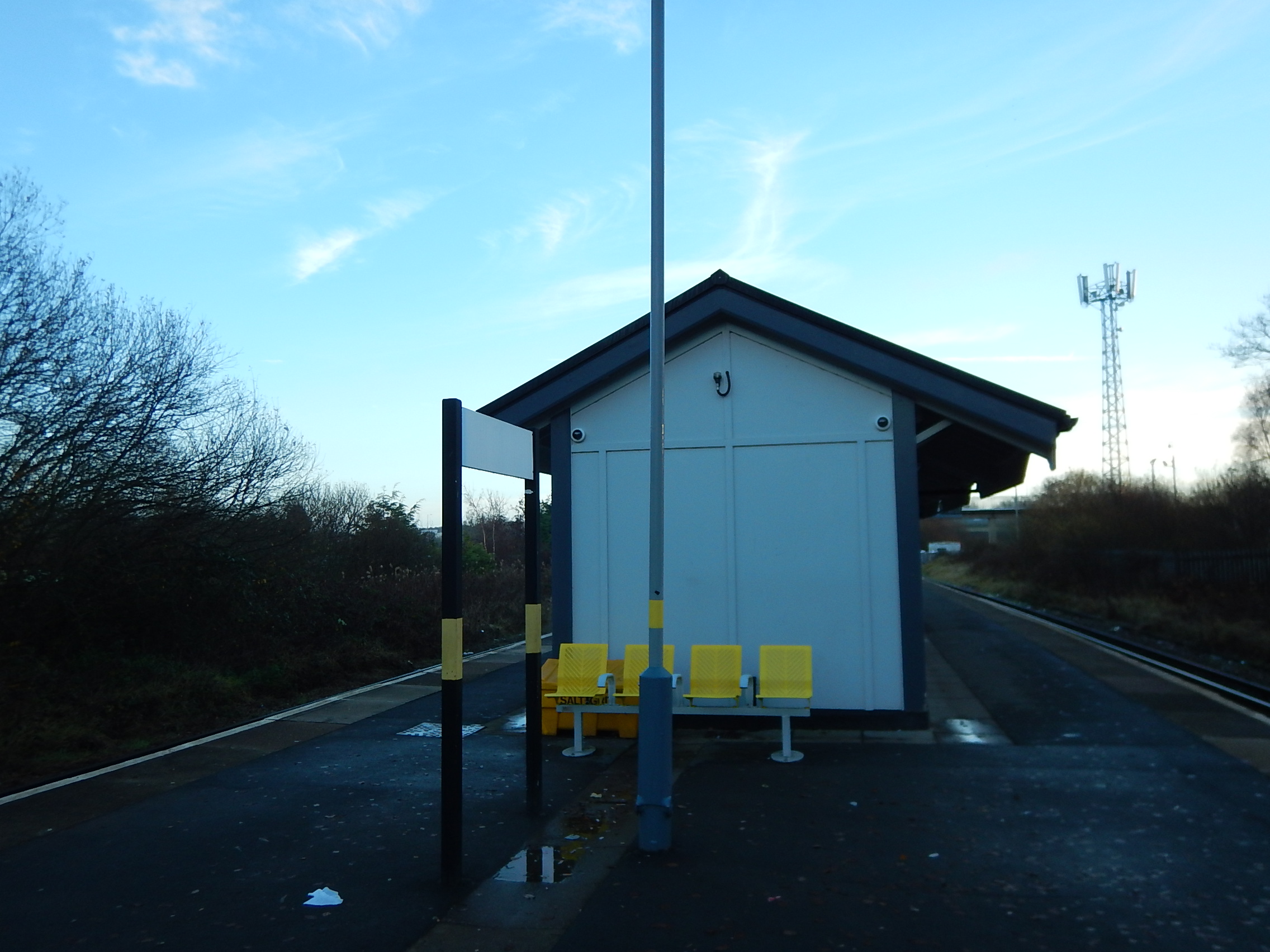
Would it be sensible to add a dedicated bay platform at Bidston for charging the battery trains?
The train will certainly be able to start with a full battery after a long charge at Wrexham Central and then do the following.
- Run to Bidston on battery power.
- Turnround at Bidston, where four minutes could be used to charge the batteries.
- Run back to Wrexham Central on battery power.
- Regenerative braking would be used at the thirteen intermediate stations.
If necessary during the long runs the diesel engines could be used to provide more power or top up the batteries.
Chester To Crewe Line
Transport for Wales have ordered Class 230 trains for the Chester to Crewe Line.
It runs between Chester and Crewe stations, is around twenty miles long and services take about twenty minutes.
As there are no stations between Chester and Crewe and the maximum speed of the Class 230 train is sixty mph, it looks like the train will be almost at maximum speed along this route.
So will the four diesel engines be working hard?
When these trains were built in the 1980s, I doubt that anybody thought they’d be running services on a section of the North Wales Coast Line.
Conwy Valley Line
Transport for Wales have ordered Class 230 trains for the Conwy Valley Line.
It runs between Llandudno and Blaenau Ffestiniog stations, is around thirty miles long and services take eighty minutes to ascend and seventy to come down.
The train will certainly be able to start with a full battery after a long charge at Llandudno and then do the following.
- Ascend to Blaenau Ffestiniog on battery power, with help from the diesel engines.
- Turnround at Blaenau Ffestiniog, where four minutes could be used to charge the batteries.
- Descend to Llandudno on battery power, with help from gravity.
- The descent would be controlled by regenerative braking.
- Regenerative braking would be used at the eleven intermediate stations.
If necessary during the long ascent the diesel engines could be used to provide more power or top up the batteries.
Greenford Branch
What do you do with a problem like the Greenford Branch?
In Could Class 165 HyDrive Trains Be The Solution To The Greenford Branch?, I looked at the possibility of using the proposed Class 165 HyDrive trains to provide a four trains per hour (tph) service on the Greenford Branch.
This was my conclusion.
Four tph is possible on the Greenford Branch, but it will need an extra crossover just outside West Ealing station.
Class 165 HyDrive trains with their extra performance would make the four tph timetable more reliable.
The lower noise and emissions of the trains would also please the local residents.
I also feel that a well-designed battery-powered two-car train, with perhaps a charging station at either end could also provide the improved service.
That well-designed battery-train has arrived in the shape of the Class 230 train.
Island Line
It appears likely, that Class 230 trains will be ordered for the Island Line.
It runs between Ryde Pier Head and Shanklin stations, is under nine miles long and a typical round trip is as follows.
- Shanklin to Ryde Pier Head – 24 minutes
- Turnround at Ryde Pier Head – 20 minutes
- Ryde Pier Head to Shanklin – 24 minutes
- Turnround at Shanklin – 5 minutes
The Island Line has an operating speed of just 45 mph.
Adding all that up, I would estimate that a train doing a round trip would do under twenty miles at a maximum speed of 45 mph.
Adrian Shooter said that the trains will be able to store 2,400 miles² /hour, whereas the Island Line would use only 900 miles² /hour in a round trip. They may be weird units, you won’t find in any text book, but I want to prove if something is possible or not.
It looks like it most definitely is possible for a battery-powered Class 230 train to perform a round trip on one charge of of the batteries.
Suppose though, the line was reinstated to Ventnor station, as a line without electrification. A quick estimate gives the round-trip as thirty miles, which would need 1350 miles² /hour.
There could even be a second charging station at Ventnor.
Could we see a future Island Line like this?
- No electrification.
- Extension to a new Ventnor station.
- A passing loop at Brading station.
- Battery trains.
- Relaid track for very gentle curves and high efficiency.
- Charging stations at Ryde Pier Head and Ventnor stations.
I suspect with some faster running, where it is possible and perhaps one diesel power pack per train, three-car Class 230 trains could run a two tph service.
This type of service would not be unique for long, as other places would quickly copy.
Marston Vale Line
West Midlands Trains have ordered Class 230 trains for the Marston Vale Line.
It runs between Bedford and Bletchley stations, is around twenty-four miles long and services appear to take about forty-five minutes, with a turn-round time of well over four minutes.
So it would seem that each leg of a return journey would be less than forty miles and there would be sufficient time for a full four-minute charge at either end.
The regenerative braking would be useful in handling the eleven stops.
Conclusion
It isn’t one cat!
It’s a whole destruction, glorying or nuisance of felines!
 The Anonymous Widower