The title of this post, is the same as that of this article on the BBC Future Web Site.
It is also one of the best articles, I’ve read on the economics of liquid-air energy storage.
This is the sub-heading.
An overlooked technology for nearly 50 years, the world’s largest liquid air energy storage facility is finally set to power up in 2026. It’s hoping to compete with grid-scale lithium batteries and hydro to store clean power, and reduce the need to fall back on fossil fuels.
These three introductory paragraphs add detail to the project.
As the world’s use of renewable electricity soars, surpassing coal for the first time, the need to store that energy when the Sun isn’t shining and the wind isn’t blowing is growing in step. While some turn to grid-scale lithium batteries and others to pumped hydro, a small but growing industry is convinced there’s a better solution still: batteries that rely on air.
Near the village of Carrington in north-west England, the foundations are being laid for the world’s largest commercial-scale liquid air energy storage facility, one of the first of its kind. The site will eventually become an array of industrial machinery and a number of large storage tanks, filled with air that has been compressed and cooled so much it has become a liquid, using renewable energy surplus to demand. The stored energy can be discharged later when demand exceeds supply.
If the project succeeds, more will follow. The site’s developers Highview Power are confident that liquid air energy storage will make it easier for countries to replace fossil fuels with clean renewable energy – though at present, the technology is expensive. But as the need for clean energy storage surges, they’re betting the balance will tip in favour of liquid air.
The BBC article, seems to have been written with input from Shaylin Cetegen, a chemical engineer at the Massachusetts Institute of Technology (MIT), who studies energy storage systems.
Topics discussed include.
- The intermittency problem of renewables and how this gives problems for the stability of electricity grids.
- The switchable nature of fossil-fuel power generation.
- A big part of the solution is to store the surplus energy so that it can be released when it’s needed. Think of it like an electricity deposit account!
- For decades, the main form of energy storage has been pumped hydro. In 2021, the world had 160 GW of pumped hydro capacity. The UK has a total of just 3 GW in Scotland and Wales! But more is on the way!
- Recently, large-scale battery storage systems have risen to the challenge and installed capacity has risen from 55.7 GW in 2023 to 150 GW / 348 GWh in 2025.
- The liquid air solution is then explained.
- A grid-scale stop-gap, that is the 30 MW/300 MWh Manchester hybrid liquid-air battery, is then described.
- In August 2026, the battery is set to begin operating.
- An alternative way of stabilising the grid will be provided.
- It will come online in two stages, says Highview Power CEO Richard Butland.
- Then in 2027 the liquid air storage is expected to begin fully operating.
Highview Power will make money by trading electricity, as pumped storage operators do.
The penultimate section of the article looks at the bottom line and comes to these conclusions.
Instead, she says governments could support the technology. In her study, subsidising the initial capital costs to set up the systems “could be a viable approach to achieve economic viability in the short term”, she says.
Furthermore, faster uptake of renewables would increase energy price volatility, making energy storage more economically viable.
Cetegen makes a final point in favour of liquid air energy storage: it’s cheap. Energy storage technologies are often assessed using a metric called the “levelised cost of storage”, which estimates how much each unit of stored energy costs over the lifespan of the project. For liquid air, this can be as low as $45 (£34) per megawatt-hour – compared to $120 (£89) for pumped hydro and $175 (£130) for lithium-ion batteries.
“While none of these storage methods are likely economically viable right now without policy support, liquid air energy storage stands out as a particularly cost-effective option for large-scale storage,” Cotegen says.
Ultimately, Butland expects electricity grids to rely on a mix of storage technologies. Pumped hydro is extremely effective and works for decades, but it’s location-dependent because it needs a water supply. Meanwhile, batteries are highly efficient and can be placed anywhere, but need to be replaced after about 10 years. Liquid air has the advantage that it can store energy for longer than batteries, with minimal losses.
As any country enters the green transition, its electricity grid needs to be remodelled to cope. “We’re rebuilding all grids globally, based on new generation,” says Butland. And that could well mean a lot of liquid air energy storage.
March 21, 2026
Posted by AnonW |
Energy Storage, Energy | Battery Energy Storage Systems (BESS), Carrington LDES, Coal, Grid Battery, Highview Power, Hunterston LAES, Lithium-Ion Battery, Pumped Storage Hydroelectricity, Renewable Energy, Scotland, Solar Power, Wind Power |
2 Comments
I asked Google AI, the title of this post and received this answer.
Yes, South Wales was once the world’s largest coal-exporting region and home to the busiest coal-exporting ports in the world. During its peak in 1913, the South Wales coalfield supplied almost one-third of total global coal exports, with Cardiff and Barry leading the world as the top coal ports.
Key details regarding the coal boom in South Wales:
Peak Production: In 1913, the region produced 57 million tons of coal, with more than half exported.
Top Export Ports: In 1913, Barry was recognized as the world’s largest coal-exporting port, closely followed by Cardiff.
The “Coal Metropolis”: Cardiff became the world’s leading coal and shipping metropolis, with the Cardiff Coal Exchange setting the global price for steam coal.
Economic Impact: The boom drove massive population growth in the South Wales Valleys and created tremendous wealth for cities like Cardiff, Barry, and Newport.
Global Demand: Welsh coal was highly sought after for its high quality, fueling steamships, railways, and industries across the world, from Russia to South America.
By 1920, the industry employed over 270,000 miners, but it saw a steep decline thereafter due to economic depression, international competition, and the exhaustion of accessible reserves.
March 13, 2026
Posted by AnonW |
Energy, Uncategorized | Cardiff, Coal, Coal Mines, South Wales, Wales |
2 Comments
The title of this post, is the same as that of this article in the Telegraph.
This is the sub-heading.
Culture war banter and point-scoring have left Maga facing a self-inflicted energy shortage
These are the first three paragraphs.
The US is in danger of losing the global AI race for the most banal and careless of reasons: it is critically short of electricity.
The country is sitting on a neglected pre-modern grid that cannot meet surging power demand for data centres, cryptocurrencies, the reshoring of semiconductor plants and the proclaimed revival of the American industrial base.
Nor can it meet the needs for air conditioning through hotter and more humid summers. While we all talk about AI, the chief cause of rising electricity use last year was for cooling. Bitcoin mining took another 2pc of US power, for no productive purpose.
It looks like we can add simple arithmetic to the skills the Trump Administration lacks.
The Telegraph article and myself have some other thoughts.
The Planned Increase In Electricity Is A Fifth Of What’s Needed
This is a paragraph from the Telegraph.
The US Energy Department said in its Resource Adequacy Report in July that the planned increase in firm electricity supply is a fifth of what is needed by 2030.
In Renewable Power By 2030 In The UK, I stated that by 2030, the UK would add nearly 59 GW of offshore wind.
Surely, using the population size difference of four times, 240 GW of offshore wind, would do the USA nicely?
But, Trump doesn’t like wind turbines.
Texas Has A Shortage Of Electricity
These are two paragraphs from the Telegraph.
The Texas grid operator Ercot expects peak power demand in its region to soar from 87 gigawatts (GW) this year to 138 GW by 2030. This is physically impossible.
Texas passed a law in June giving the state emergency authority to cut off power to data centres. Ercot is already having to deploy “mobile generation plants” at exorbitant cost to avert blackouts even today.
It sounds pretty desperate.
Texas needs another 51 GW by 2030, which is less than we intend to delivery from just offshore wind.
If Little Great Britain can do it, then surely Texas can? After all, Texas is three almost times larger than the UK.
I get the idea, that someone isn’t doing any planning.
The United States Needs A Lot Of Transformers
These are three paragraphs from the Telegraph.
The National Infrastructure Advisory Council (Niac) says the average age of America’s 60 million large power transformers is 38 years. Many are beyond their design life.
The US supply chain is not capable of delivering the 12 million new transformers needed each year to keep the show on the road. The backlog has risen to four years. The cost of transformers has jumped 80pc since the pandemic.
There is an acute shortage of electrical steel needed to make them. This comes mostly from China, Japan, Korea or Germany. In his infinite wisdom, Trump has imposed 50pc tariffs on steel, aluminium and copper. That cost shock has yet to feed through.
The Niac says it is a similar tale for “other critical grid components such as conduit, smart meters, switchgear and high-voltage circuit breakers”.
It looks like, there’s another fine mess, you’ve got us in, Donny!
Maga Wants More Coal
These are three paragraphs from the Telegraph.
The quickest way to generate more power is to roll out wind and solar. Trump is actively intervening to obstruct this. Maga wants coal instead.
This week the administration announced $625m of taxpayer subsidy to “expand and reinvigorate” the coal industry. It will open new federal lands, slash the royalty fees for extracting coal, and lift curbs on mercury pollution.
“In addition to drill, baby drill, we need to mine, baby, mine,” said Doug Burgum, the interior secretary.
When it should be spin, baby, spin.
Conclusion
Read the article in full.
We certainly, don’t want anybody, with an energy policy like Trump, influencing the UK’s energy policy.
If Trump carries on like this, he’ll end up in a terrible mess.
October 3, 2025
Posted by AnonW |
Energy | Artificial Intelligence, China, Coal, Data Centre, Donald Trump, Germany, Korea, Mathematics, Offshore Wind Power, Stupidity, Texas, Transformers, Wind Power |
Leave a comment
Yesterday, I visited the first meeting for the consultation on Ferrybridge Next Generation Power Station, which was held in the old town hall at Knottingley.
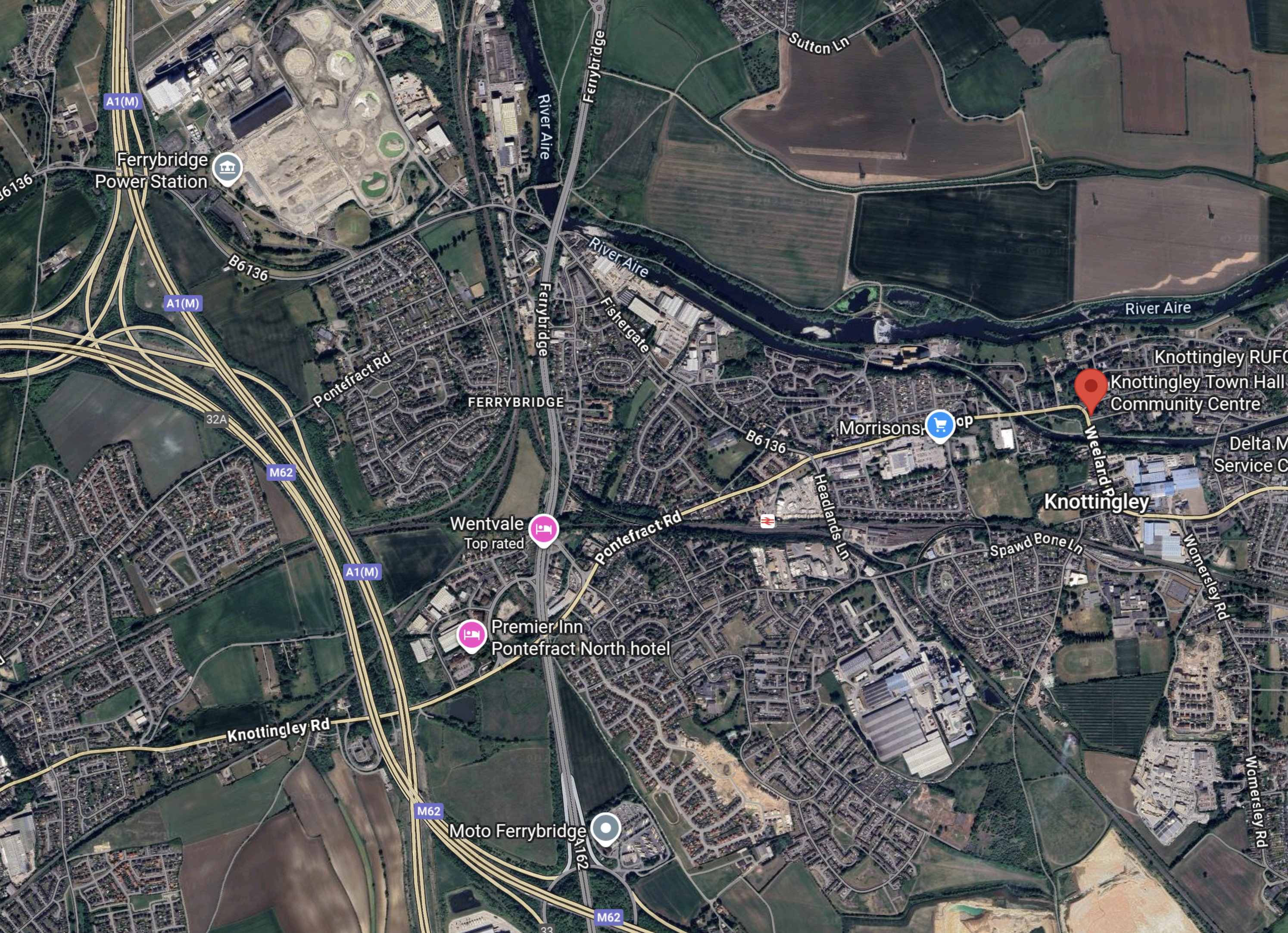
This Google Map shows the power station in relation to Knottingley.
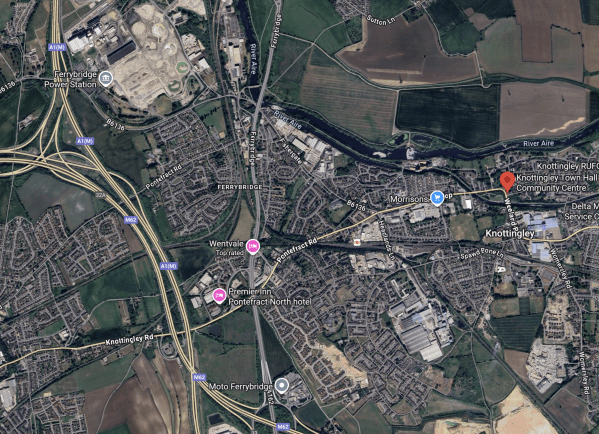
Note.
- The meeting was held in the Knottingley Town Tall Community Centre, which is marked by the red arrow.
- I had arrived by train from Wakefield at Knottingley station and I was lucky enough to be able to get a taxi to the Town Hall.
- Knottingley station is marked on the map about a twenty-minute walk to the West of the Town Hall.
- The Ferrybridge power station site is in the North-West corner of the map and appears to be bordered by the B6136 road.
- The A1 (M) and the M 62 motorways run North-South past the power station site.
- The A (M) motorway continues North-South to Newcastle and Scotland, and London respectively.
- The M62 motorway continues West-East to Liverpool and Manchester, and Hull respectively.
- The well-appointed Moto Ferrybridge services is accessible from both motorways.
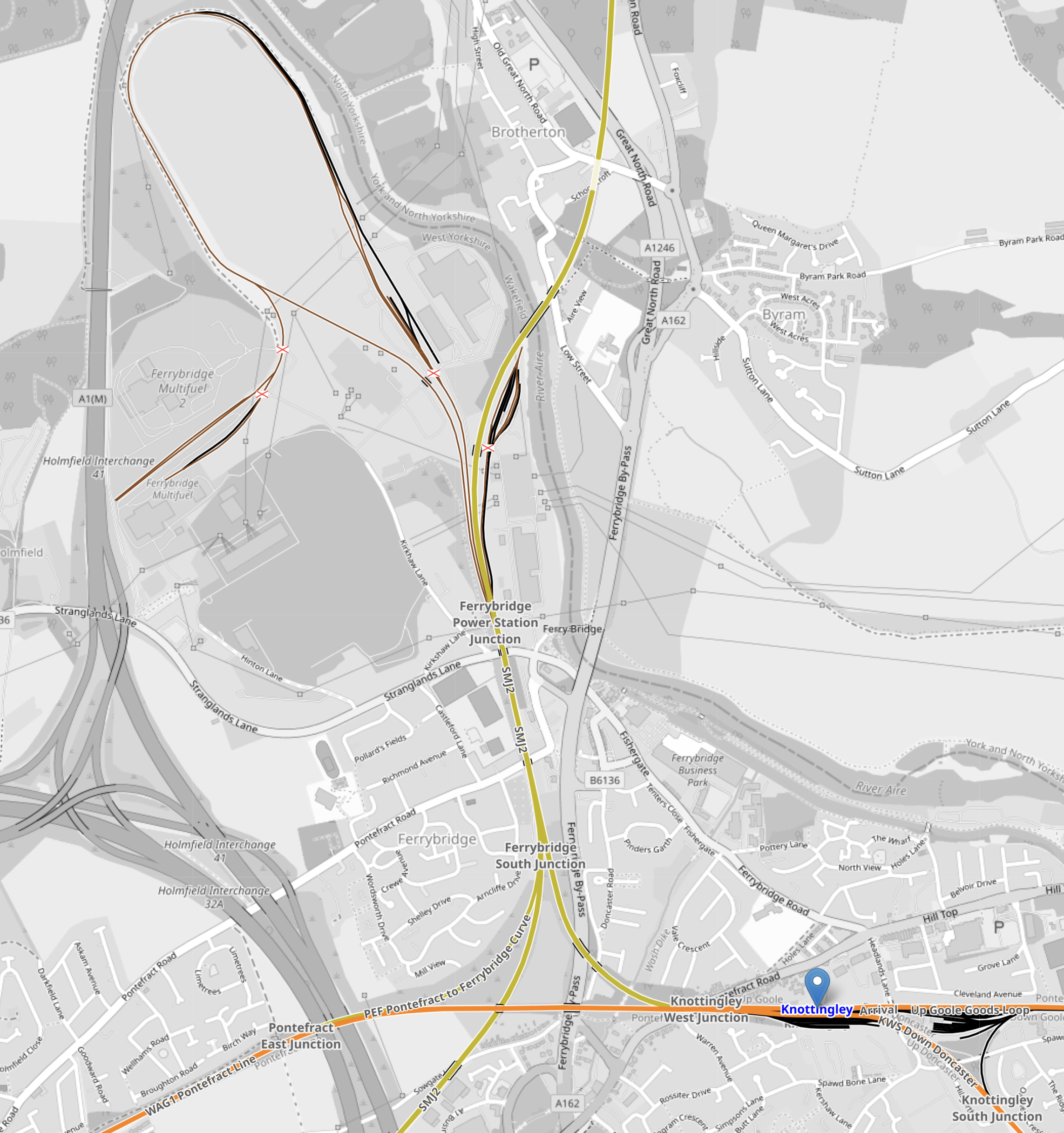
This OpenRailwayMap shows the rail lines in the area.

Note.
- The A 62 and A 1(M) motorways running down the West side of the map.
- Knottingley station is on the Pontefract Line, and is marked by a blue arrow.
- The Pontefract Line could have connections from both East and West to the Ferrybridge power station site via Ferrybridge Power Station junction.
- The loop, where the merry-go-round coal trains turned, appears to be still intact at the North of the power station site.
Will these rail lines be any use in the building and operation of the new power station?
These are my thoughts.
Fuel For The Power Station
The brochure for the consultation says this about the fuel for the Ferrybridge Next Generation Power Station.
Ferrybridge Next Generation Power Station will be designed to run on 100% hydrogen, natural gas or a
blend of natural gas and hydrogen.
The brochure has an informative section, which is entitled Natural Gas Pipeline Corridors.
Additionally, I should say, that I lived within a couple of hundred metres of a major gas pipeline in Suffolk, for over twenty years and it was the most unobtrusive of neighbours.
The brochure also says this about hydrogen safety.
As with all of our sites, appropriate measures will be
in place to ensure safe operation. Hydrogen is not
inherently more dangerous than other fuel sources.
Hydrogen is flammable and must be handled with care,
just like other flammable fuels. To ignite, hydrogen
must be combined with an additional oxidising agent,
such as air or pure oxygen, in a specific concentration
and with an ignition source (a spark).
It is nearly sixty years ago now, since I worked as an Instrument Engineer, in ICI’s Castner-Kellner works at Runcorn, where hydrogen, chlorine and caustic soda were produced by the electrolysis of brine.
The plant was an unhealthy one, as it used a lot of mercury and my main task, was to design instruments to detect mercury in air and operators’ urine.
The Wikipedia entry for the Castner-Kellner process is a fascinating read and explains why it is being replaced by much better modern mercury-free processes.
I asked Google AI, if the Castner-Kellner process is still used and received this reply.
No, the Castner-Kellner process, a type of mercury cell for producing chlorine and caustic soda, is now largely obsolete due to occupational health and mercury pollution concerns, though a few plants may still operate globally. Modern chlor-alkali processes primarily use safer diaphragm cell and membrane cell technologies to produce chlorine and other chemicals from brine electrolysis.
I suspect that countries, where life is cheap, still use this process, which is very dangerous to those that work on the plant.
INEOS now own ICI in Cheshire and they still produce a large proportion of the hydrogen, chlorine and caustic soda, that the UK needs, but in a much safer way.
The question has to be asked about how hydrogen will be delivered to the Ferrybridge site.
Consider.
- SSE are developing a large hydrogen store at Aldbrough.
- Centrica are developing a large hydrogen store at Brough.
- Both of these stores could be connected to the German AquaVentus system, as the Germans are short of hydrogen storage.
- There is an East Coast Hydrogen Delivery Plan, which could probably have an extension pipeline to the Ferrybridge site.
- The East Coast Hydrogen Delivery Plan, talks of a hydrogen capacity of 4.4 GW.
I don’t feel, that this is the sort of project, that will be delivered until the mid-2030s, at the earliest.
There is also one other important development, that will require hydrogen at Ferrybridge.
I asked Google AI, if there will be hydrogen-powered coaches by 2030 and received this reply.
Yes, there will be hydrogen-powered coaches and buses by 2030, particularly in the UK and EU, with government strategies and funding promoting their deployment, especially for routes requiring high range and quick refueling where battery-electric models may be less suitable. For example, the EU’s CoacHyfied project is developing fuel cell coaches, and the UK government envisions hydrogen playing a role in its transport decarbonization by 2030, with potential to accelerate its zero-emission bus goals.
The nearest you can get to a hydrogen-powered coach in England, is to take an upmarket Wrightbus upmarket hydrogen-powered bus between Sutton station and Gatwick Airport.
That journey convinced me of the superiority in many ways of a hydrogen bus or coach over its diesel cousins.
I believe that this superiority will see large growth in hydrogen-powered long-distance coaches in the next few years.
But I also feel that some specialist transport, like horse transport, will go the hydrogen route.
As there are services at Ferrybridge, where two important motorways cross, I can envisage that the services will need to be able to refuel passing hydrogen buses, coaches trucks and other heavy vehicles, as well as the occasional car.
So would it be possible to supply hydrogen for the motorway services, by the same route as the power station?
I believe that the hydrogen could come from Saltend to the East of Hull, so I gave Google AI the phrase “Saltend zero-carbon hydrogen” and received this reply.
Saltend is home to several initiatives for producing and utilizing zero-carbon hydrogen, most notably the H2H Saltend project by Equinor, which aims to build the world’s largest hydrogen production plant with carbon capture capabilities by 2026 to supply industrial users at the Saltend Chemicals Park. Additionally, a new green hydrogen facility is planned for the park by Meld Energy with a target operation in early 2027, and a separate low-carbon hydrogen plant by ABP, HiiROC, and px Group is also being developed to meet local industrial demand. These projects collectively contribute to the broader Zero Carbon Humber initiative, which seeks to significantly reduce industrial emissions in the region.
Note.
- Saltend will certainly have enough zero-carbon hydrogen for everybody who wants it.
- Delivery dates in a couple of years are being talked about.
- Local industrial demand could be satisfield using specialised trucks, just as ICI used in the 1960s.
- As the Germans want to connect their AquaVentus system to Humberside, any excess hydrogen, could always be sold across the North Sea.
- OpenRailwayMap shows that Saltend is rail-connected.
But how do you get hydrogen between Saltend and Ferrybridge?
I am sure, that hydrogen could be delivered by truck from Saltend to Ferrybridge, but would the locals allow a stream of hydrogen trucks on the roads.
On the other hand, both Saltend and Ferrybridge are both rail-connected, so would it be possible to deliver the hydrogen by rail?
Google AI says this about railway wagons for hydrogen.
Railway wagons for hydrogen transport include liquid hydrogen tank cars (tankers) for transporting cryogenic liquid hydrogen and compressed gas tank cars for carrying hydrogen in its gaseous state or bound within carrier mediums like ammonia or methanol. Hydrogen fuel cell technology is also being developed for use on trains themselves, with a hydrogen fuel cell generator wagon providing power for main-line, non-electrified freight routes.
I believe that it will be possible to develop trains of an appropriate length to shuttle hydrogen between where it is produced and where it is used.
Such a specially-designed shuttle train would be ideal for moving hydrogen between Saltend and Ferrybridge.
- Once at Ferrybridge, the train would be connected to the local hydrogen system feeding the power station, the motorway services and any local businesses that needed hydrogen.
- The trains could be hydrogen fuel cell powered, so they could use any convenient route.
- Like hydrogen powered buses, I suspect they could be mouse quiet.
- The trains would be sized to perhaps deliver a day’s hydrogen at a time.
- There could only be minor changes needed to the rail system.
- If required, the trains could could deliver their cargo in the dead of night.
It could even be based on the contept of the TruckTrain, which I wrote about in The TruckTrain.
September 23, 2025
Posted by AnonW |
Energy, Hydrogen, Transport/Travel | A1(M) Motorway, AquaVentus, Associated British Ports, Castner-Kellner Process, Caustic Soda, Chlorine, Coal, Equinor, Ferrybridge Hydrogen Power Station, Ferrybridge Motorway Services, Ferrybridge Power Station, H2H Saltend, HiiROC, Hydrogen-Powered Coaches, ICI, INEOS, Knottingley, Knottingley Station, Knottingley Town Hall, M62 Motorway, Mercury, Salt End, TruckTrain, ZeroCarbonHumber |
2 Comments
This article on WBOY is entitled West Virginia Senators Aim To Revitalize Coal Industry.
These are the introductory paragraphs.
If you’re tired of rising utility bills, you are not alone. West Virginia senators say they share the same feelings and believe the answer is right under our feet.
Revitalizing West Virginia’s coal industry and bringing down utility costs for customers is the goal of two pieces of legislation originating in the Senate.
A resolution known as the Coal Renaissance Act aims to keep current coal operations running as well as open up new opportunities for the industry, expanding mining in West Virginia.
According to Senators in support of the act, the optimum capacity factor for coal plants to run at is 69%. Currently, industry leaders say that number is down to around 30% to 40%.
A new bill known as the Reliable and Affordable Electricity Act incentivizes utility companies to rely on West Virginia coal.
There is also going to be a Senate bill, that will abolish tax breaks for wind farms.
In the UK, it is my belief, that coal died with the Aberfan disaster in 1966, which is described in this first paragraph of the disaster’s Wikipedia entry.
The Aberfan disaster (Welsh: Trychineb Aberfan) was the catastrophic collapse of a colliery spoil tip on 21 October 1966. The tip had been created on a mountain slope above the Welsh village of Aberfan, near Merthyr Tydfil, and overlaid a natural spring. Heavy rain led to a build-up of water within the tip which caused it to suddenly slide downhill as a slurry, killing 116 children and 28 adults as it engulfed Pantglas Junior School and a row of houses. The tip was the responsibility of the National Coal Board (NCB), and the subsequent inquiry placed the blame for the disaster on the organisation and nine named employees.
I do have memories of coal mining in my brain.
- As a young child, I can remember being driven past the Kentish collieries and seeing the blackened landscape of the Garden of England.
- Newspapers of the 1950s and 1960s published, their share of mining disasters.
- In the 1980s, I drove through coal mining country in the United States and was appalled at all the fumes and smoke from the coal-fired power stations and the trucks delivering coal. Nothing as civilised as a merry-go-round train was used.
- In 2015, I visited Katowice and wrote An Excursion In Katowice. The air was thick with coal smoke from the coal-fired power stations.
I also remember at the Jobs Fair, when I left Liverpool University in 1968, seeing the recruiter from the National Coal Board sitting there alone, as if he’d got the plague. Graduates had decided, that no way, were they going to work in the coal industry.
The West Virginia senators, should be certified, if they want to bring back coal.
March 15, 2025
Posted by AnonW |
Environment, World | Aberfan Disaster, Coal, Coal-fired Power Stations, Katowice, Liverpool University, National Coal Board, Poland, Pollution, United States, West Virginia |
2 Comments
The title of this post, is the same as that of this article on offshoreWIND.biz.
This is the sub-heading.
Brazil’s President Luiz Inácio Lula da Silva has signed into law the bill recently passed by the Brazilian Senate that establishes regulations on allocating and permitting offshore wind development areas. The Brazilian president has vetoed provisions related to fossil fuels in the final version of the legislation which were added while the bill was in the Chamber of Deputies.
It looks like President Luiz Inácio Lula da Silva has just struck himself off Trumkopf’s Christmas card list.
l
January 13, 2025
Posted by AnonW |
Energy | Brazil, Coal, Donald Trump, Offshore Wind Power, Wind Power |
Leave a comment
The title of this post, is the same as that of this article on the BBC.
This is the sub-heading.
Work is under way to create what has been described as Europe’s largest battery storage project at Coalburn in South Lanarkshire.
These three paragraphs add a bit more detail.
Developers say the two huge neighbouring battery farms – one at the site of a former opencast coal mine – will store enough electricity to power three million homes.
Battery Energy Storage Systems (BESS) are being built across the UK to help balance the electricity grid, which is becoming increasingly powered by renewables.
Almost 90% of the electricity generated in Scotland last year was from low carbon sources like wind, solar or nuclear, according to figures from the Scottish government.
A search of the Internet found this paragraph describing the size of the battery.
The CIP BESS portfolio (Coalburn 1, Coalburn 2, and Devilla) will have total power capacity of 1.5GW and will be able to store and supply the grid with a total of 3GWh of electricity, equivalent to the electricity demand of over 4.5 million households, across a 2-hour period.
Note.
- CIP is Copenhagen Infrastructure Partners, who are a large developer of energy infrastructure.
- It appears there are three separate 500 MW/ 1 GWh batteries being developed together.
- The batteries can supply electricity for two hours.
This looks like a sensible project in an area, where there could be plenty of spare electricity.
Competition With Highview Power
Highview Power’s web site has a Projects section, where this is said.
Scotland And The North-East, UK
Highview Power’s next projects will be located in Scotland and the North East and each will be 200MW/2.5GWh capacity. These will be located on the national transmission network where the wind is being generated and therefore will enable these regions to unleash their untapped renewable energy potential and store excess wind power at scale.
I can see Highview Power’s 200MW/2.5GWh liquid air batteries and 500 MW/ 1 GWh Battery Energy Storage System (BESS) competing for the same projects.
However, it does appear at Trafford Energy Park, both types of battery appear to be being installed.
Perhaps the two together give the best response?
January 10, 2025
Posted by AnonW |
Energy, Energy Storage | Battery Energy Storage Systems (BESS), Coal, Coalburn BESS, Copenhagen Infrastructure Partners, Highview Power, Scotland, Trafford BESS, Trafford Energy Park, Two-Hour BESS |
Leave a comment
This article on ITVx is entitled ‘Drill, baby, drill’: What Trump’s Re-election Could Mean For Our Climate
The article is a must-read.
It starts with a picture that has a placard that says “Trump Digs Coal”
I certainly don’t and have felt that way since probably the Aberfan disaster of 1966.
This is the first paragraph from the Wikimedia entry.
The Aberfan disaster was the catastrophic collapse of a colliery spoil tip on 21 October 1966. The tip had been created on a mountain slope above the Welsh village of Aberfan, near Merthyr Tydfil, and overlaid a natural spring. Heavy rain led to a build-up of water within the tip which caused it to suddenly slide downhill as a slurry, killing 116 children and 28 adults as it engulfed Pantglas Junior School and a row of houses.
In coal mining areas, disasters still happen.
We should all show our disgust at Trump ad the people who voted for him, by not buying any American products, unless it is absolutely necessary.
November 7, 2024
Posted by AnonW |
Energy | Aberfan Disaster, Coal, Decarbonisation, Donald Trump, Global Warming/Zero-Carbon, US Presidential Election 2024 |
1 Comment
Yesterday, the UK government issued a press release, which is entitled Landmark UK-Germany Defence Agreement To Strengthen Our Security And Prosperity.
This is the sub-heading.
A landmark defence agreement will be signed by Defence Secretary John Healey MP and German Defence Minister Boris Pistorius in London today in a major moment for NATO, and European security and prosperity. It is the first-of-its-kind agreement between the UK and Germany on defence.
This introductory paragraph, lays down the tone and objectives of the agreement.
The signing of the Trinity House Agreement marks a fundamental shift in the UK’s relations with Germany and for European security. This agreement between Europe’s two biggest defence spenders will strengthen national security and economic growth in the face of growing Russian aggression and increasing threats.
It is a wide-ranging document, but in this post, I will concentrate on one topic; gun barrel manufacture, which is talked about in this paragraph.
The new partnership will help drive investment into the UK – with the agreement paving the way for a new artillery gun barrel factory to be opened in the UK, supporting more than 400 jobs and nearly half a billion-pounds boost to the British economy. The opening of the Rheinmetall factory will see the UK manufacture artillery gun barrels for the first time in 10 years, using British steel produced by Sheffield Forgemasters.
Will Putin and his supporters like being shot at by the best German-designed artillery pieces, built from the best Sheffield steel in a British factory?
When I first heard of this story I thought of one short and powerful six-letter word – energy.
Some may think, we have an idiotic energy policy, which is abandoning all our coal, gas and oil in favour of renewables.
- We shut our last coal-fired power station a couple of weeks ago and I showed pictures of the last station in Last Of The Many.
- Germany had fifty-eight coal-fired power stations in operation, as late as July 2023.
- Germany has also lost all its cheap Russian gas.
- Germany is also short of energy and what they’ve got is expensive.
- It’s also likely, that making the quality of gun barrels, that will annoy Putin and his ilk will need a lot of energy.
So would it be better to move operations that need a lot of expensive energy out of Germany?
I’ve also read somewhere, that Germany intends to retire coal-fired energy generation by the end of the decade.
The Germans are also developing two massive hydrogen projects to replace the coal and cut their carbon dioxide emissions.
- AquaVentus will harvest 10.3 GW of hydrogen from the North Sea and is described in this post called AquaVentus.
- H2ercules will distribute the hydrogen and is described in this post called H2ercules.
Is it more affordable for the Germans to move high energy manufacturing to the energy?
I wonder, if the deal will eventually be something like this.
- Rheinmetall will build the gun barrel factory, somewhere that is convenient for Sheffield and Germany and that has access to lots of energy.
- The energy will need to be green to ease Germany’s Chancellor’s problem with the Greens.
- Siemens recently built a train factory at Goole and surely that area of North Humberside and East Yorkshire with its large supplies of wind energy and hydrogen, backed up by the gas- and hydrogen-fired power stations at Keadby, would be a good location for an energy-consumptive business.
- Sheffield Forgemasters might even build a factory next door, to tap into the energy of the area and reduce transport costs of the gun barrel blanks.
- Sheffield Forgemasters’s steel may even come from British Steel at Scunthorpe. If British Steel make rails, that are good enough for German railways, then surely, it is a good enough starting material for German gun barrels.
- The Port of Immingham is nearby for import and export of components and finished products.
- All of the German activity in the area, will surely see flights develop to and from Germany at the nearby well-quipped Humberside Airport.
- Hull Trains, LNER and TransPennine Express will increase their services to Doncaster, Hull, Lincoln, London, Manchester and Sheffield.
- I wouldn’t be surprised to see a train service between London and Hull via Doncaster, a new Goole parkway station and Brough. It could even use battery-electric or hydrogen trains assembled by Siemens at their Goole factory.
Humberside could be becoming Little Germany, as it has what Germany needs – energy!
October 23, 2024
Posted by AnonW |
Energy, Hydrogen, News, World | AquaVentus, British Steel, Coal, Coal-fired Power Stations, Germany, Gun Barrels, H2ercules, Hull Trains, Humberside Airport, Keadby Hydrogen Power Station, Keadby Power Stations, LNER, Port Of Immingham, Rheinmetall, Sheffield Forgemasters, TransPennine Express |
2 Comments
This article was inspired by this article in the Sunday Times, which is entitled ‘It’s A Slog’: Life Inside Britain’s Last Coal Power Station.
The article is about Ratcliffe-on-Soar power station, which is next to East Midlands Parkway station.
This is the first paragraph of the station’s Wikipedia entry.
Ratcliffe-on-Soar Power Station is a coal-fired power station owned and operated by Uniper at Ratcliffe-on-Soar in Nottinghamshire, England. Commissioned in 1968 by the Central Electricity Generating Board, the station has a capacity of 2,000 MW. It is the last remaining operational coal-fired power station in the UK, and is scheduled to close in September 2024.
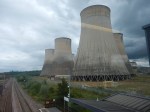
I took these pictures of the power station in 2019.
Ratcliffe-on-Soar is the last of a number of large coal-fired power stations, that were built in the area, mainly along the River Trent.
- Rugeley – 600 MW – 1961
- Drakelow – 1630 MW – 1964
- Willington – 800 MW – 1962
- Castle Donington – 600 MW – 1958
- Ratcliffe-on-Soar – 2000 MW – 1968
- High Marnham – 1000 MW – 1959
- Cottam – 2000 MW – 1968
- West Burton – 2000 MW – 1968
Note.
- The date is the commissioning date.
- That is 10,630 MW of electricity.
- There are also a few large gas-fired power stations along the river, that are still operating.
- Both coal and gas-fired stations use the water from the River Trent for cooling.
At the mouth of the river, there is the Keadby cluster of gas-fired power stations.
- Keadby 1 – 734 MW – 1996
- Keadby 2 – 849 MW – 2023
- Keadby 3 – 910 MW – 2027
- Keadby Hydrogen – 900 MW – 2030
Note.
- The date is the commissioning date.
- That is 3,393 MW of electricity.
- Keadby 2 is the most efficient CCGT in the world.
- Keadby 3 will be fitted with carbon capture.
- Keadby 2 has been designed to be retrofitted with carbon capture.
- Keadby Hydrogen will be fuelled by zero-carbon hydrogen.
As the years progress, I can see the Keadby cluster of power stations becoming a large zero-carbon power station to back-up wind farms in the North Sea.
- Hydrogen power stations will emit no carbon dioxide.
- Carbon dioxide from all gas-fired stations will be captured.
- Some carbon dioxide will be sold on, to companies who can use it, in industries like construction, agriculture and chemical manufacture.
- The remaining carbon dioxide will be stored in depleted gas fields.
As technology improves, more carbon dioxide will be used rather than stored.
Other Power Sources In The Humberside Area
In the next few sub-sections, I will list the other major power sources in the Humberside area.
Drax Power Station
Drax power station is a shadow of its former self, when it was one of the power stations fed by the newly discovered Selby coalfield.
These days it is a 2,595 MW biomass-fired power station.
Eastern Green Link 2
Eastern Green Link 2 will be a 2 GW interconnector between Peterhead in Scotland and Drax.
It is shown in this map.

Note.
- Most of the route is underwater.
- It is funded by National Grid.
- Contracts have been signed, as I talk about in Contracts Signed For Eastern Green Link 2 Cable And Converter Stations.
- It is scheduled to be completed by 2029.
This interconnector will bring up to 2 GW of Scottish wind-generated electricity to Drax and Humberside.
Drax has the substations and other electrical gubbins to distribute the electricity efficiently to where it is needed.
2 GW could also reduce the amount of biomass used at Drax.
In the long term, if the concept of the four Eastern Green Links is successful, I could see another Eastern Green Link to Drax to replace imported biomass at Drax.
I also, don’t see why a smaller Drax can’t be run on locally-sourced biomass.
Solar Farms And Batteries Along The River Trent
As the coal-fired power stations along the River Trent are demolished, solar farm developers have moved in to develop large solar farms.
Salt End Power Station And Chemical Works
These two paragraphs from the Wikipedia entry for Salt End describes the hamlet and its power station and chemical works.
Salt End or Saltend is a hamlet in the East Riding of Yorkshire, England, in an area known as Holderness. It is situated on the north bank of the Humber Estuary just outside the Hull eastern boundary on the A1033 road. It forms part of the civil parish of Preston.
Salt End is dominated by a chemical park owned by PX group, and a gas-fired power station owned by Triton Power. Chemicals produced at Salt End include acetic acid, acetic anhydride, ammonia, bio-butanol, bio-ethanol, ethyl acetate (ETAC) and ethylene-vinyl alcohol copolymer (EVOH) with animal feed also being produced on site.
I wonder, if running the complex on hydrogen would give cost and marketing advantages.
Aldbrough Hydrogen Storage Facility
This page on the SSE Thermal web site is entitled Plans For World-Leading Hydrogen Storage Facility At Aldbrough.
This is the most significant paragraph of the page, that is definitely a must-read.
With an initial expected capacity of at least 320GWh, Aldbrough Hydrogen Storage would be significantly larger than any hydrogen storage facility in operation in the world today. The Aldbrough site is ideally located to store the low-carbon hydrogen set to be produced and used in the Humber region.
This is a hydrogen storage facility for a much wider area than Humberside.
Rough Gas Storage Facility
This is the first paragraph of the Wikipedia entry for the Rough Gas Storage Facility.
Rough is a natural gas storage facility under the North Sea off the east coast of England. It is capable of storing 100 billion cubic feet of gas, nearly double the storage capacities in operation in Great Britain in 2021.
In Wood To Optimise Hydrogen Storage For Centrica’s Rough Field, I describe Centrica’s plans to convert the Rough gas storage into a massive hydrogen storage.
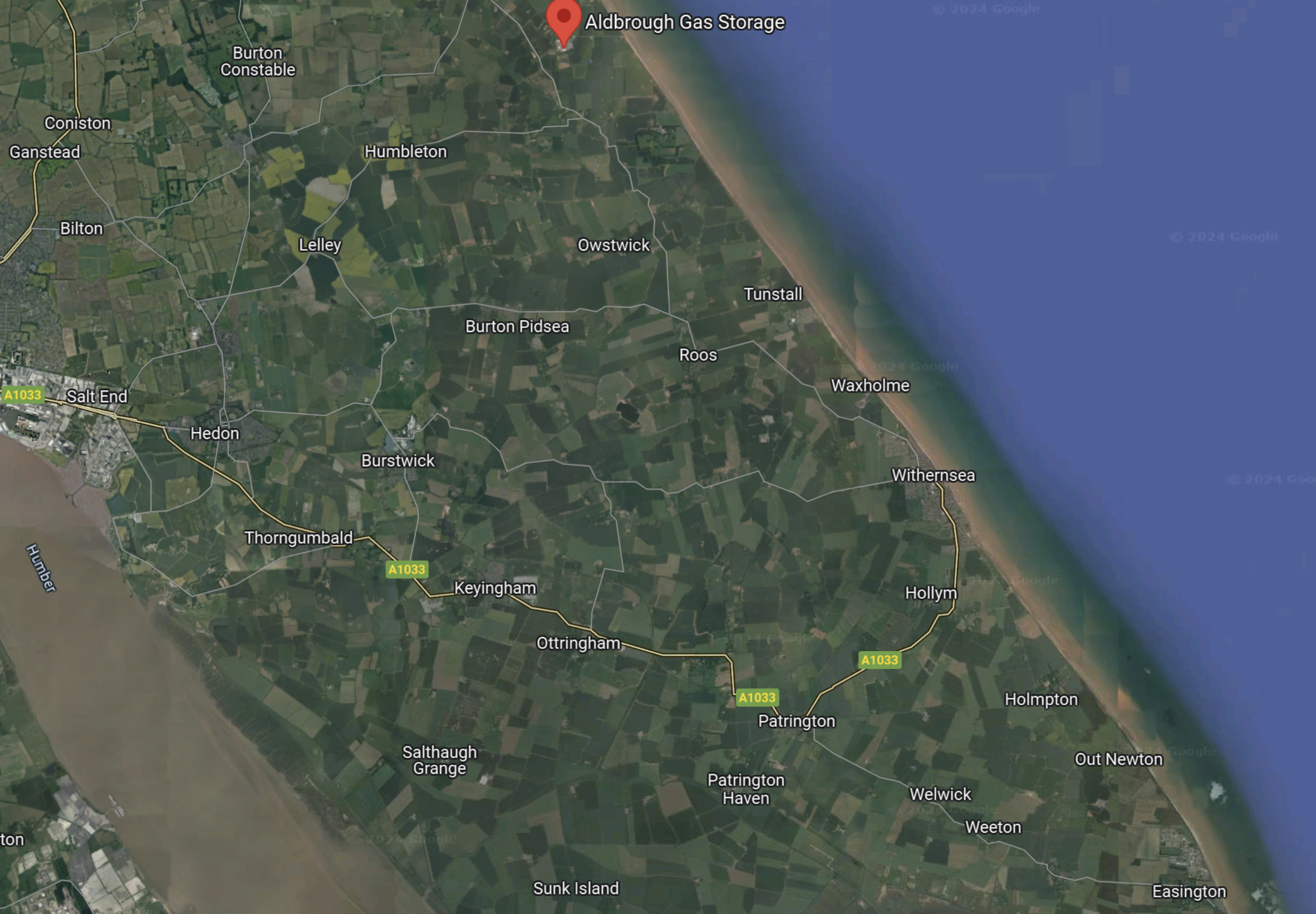
The Location Of Aldbrough Gas Storage, Rough Gas Storage, Salt End And Easington Gas Terminal
This Google Map shows between Salt End and the coast.
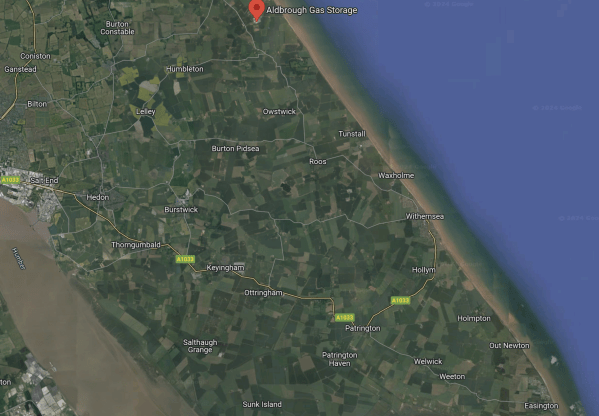
Note.
- The river crossing the South-West corner of the map is the Humber.
- Salt End with its power station and chemical works is on the North Bank of the Humber, where the river leaves the map.
- Aldbrough Gas Storage is marked by the red arrow at the top of the map.
- Easington Gas Terminal is in the South-East corner of the map.
- According to Wikipedia, gas flows into and out of the Rough Gas Storage are managed from Easington.
Looking at the map, I feel that the following should be possible.
- The two gas storage sites could be run together.
- Salt End power station and the related chemical works could run on hydrogen.
- Salt End will always have a reliable source of hydrogen.
- This hydrogen could be green if required.
All the chemical works at Salt End, could be run on a zero-carbon basis. Would this mean premium product prices? Just like organic does?
Enter The Germans
The Germans have a huge decarbonisation problem, with all their coal-fired power stations and other industry.
Three massive projects will convert much of the country and industry to hydrogen.
These would appear to be three of Europe’s largest hydrogen projects, that few have ever heard of.
AquaVentus And The UK
This video shows the structure of AquaVentus.
I clipped this map from the video.
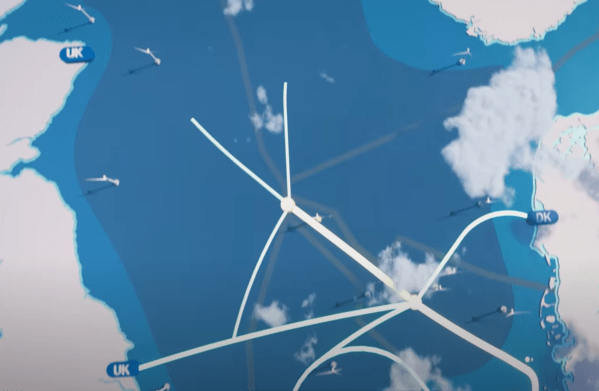
Note.
- The thick white line running North-West/South-East is the spine of AquaVentus, that delivers hydrogen to Germany.
- There is a link to Denmark.
- There appears to be an undeveloped link to Norway.
- There appears to be an undeveloped link to Peterhead in Scotland.
- There appears to be a link to just North of the Humber in England.
- Just North of the Humber are the two massive gas storage sites of Aldbrough owned by SSE and Brough owned by Centrica.
- There appear to be small ships sailing up and down the East Coast of the UK. Are these small coastal tankers, that are distributing the hydrogen to where it is needed?
In the last century, the oil industry, built a substantial oil and gas network in the North Sea.
It appears now the Germans are leading the building of a substantial hydrogen network in the North Sea.
These are my thoughts about development of the AquaVentus network.
Hydrogen Production And AquaVentus
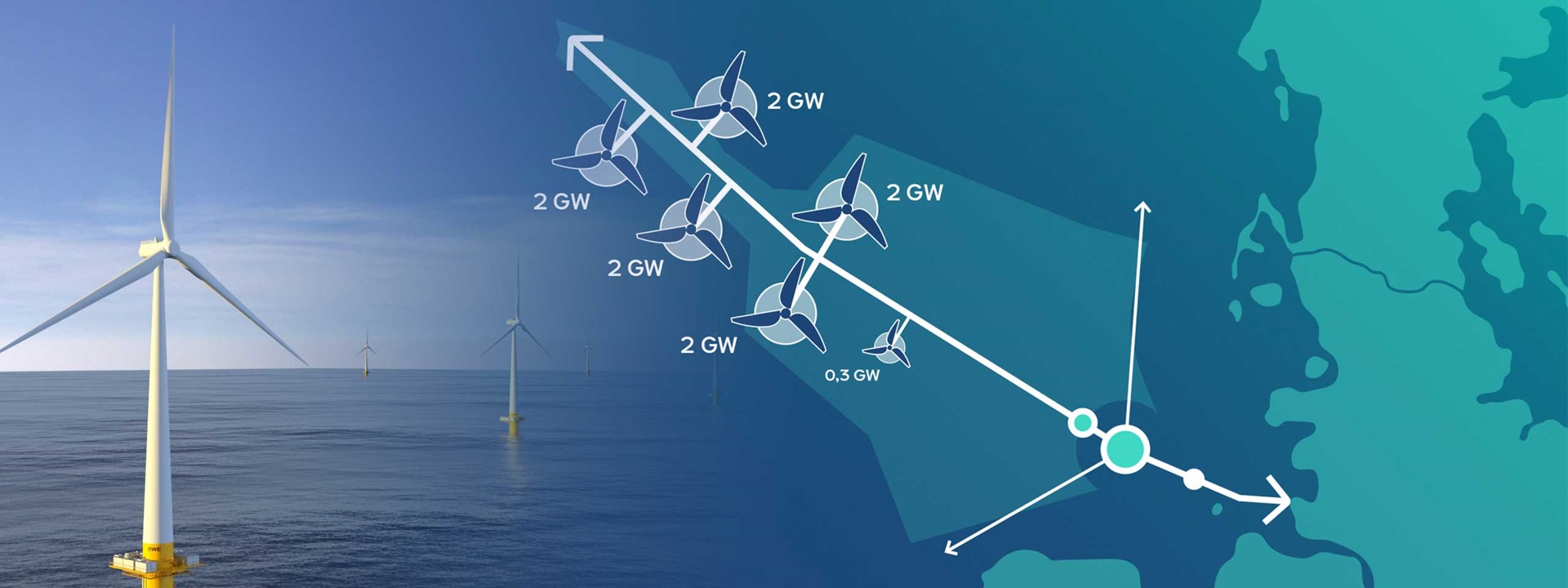
This RWE graphic shows the layout of the wind farms feeding AquaVentus.
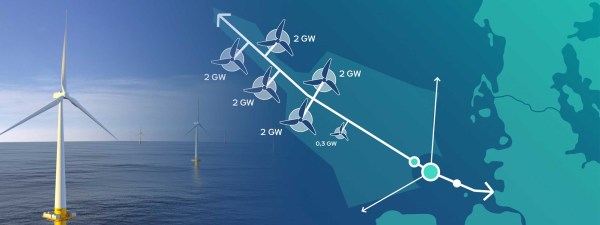
Note.
- There is a total of 10.3 GW.
- Is one of the 2 GW web sites on the UK-side of AquaVentus, the 3 GW Dogger Bank South wind farm, which is being developed by RWE?
- Is the 0.3 GW wind farm, RWE’s Norfolk wind farm cluster, which is also being developed by RWE?
Connecting wind farms using hydrogen pipelines to Europe, must surely mitigate the pylon opposition problem from Nimbys in the East of England.
As the AquaVentus spine pipeline could eventually connect to Peterhead, there will be other opportunities to add more hydrogen to AquaVentus.
Hydrogen Storage And AquaVentus
For AquaVentus to work efficiently and supply a large continuous flow of hydrogen to all users, there would need to be storage built into the system.
As AquaVentus is around 200 kilometres in length and natural gas pipelines can be up to 150 centimetres in diameter, don’t underestimate how much hydrogen can be stored in the pipeline system itself.
This page on the Uniper web site is entitled Green Wilhelmshaven: To New Horizons.
This is a sentence on the page.
Access to local hydrogen underground storage at the Etzel salt cavern site.
An Internet search gives the information, that Etzel gas storage could be developed to hold 1 TWh of hydrogen.
That would be enough hydrogen to supply 10 GW for a hundred hours.
Note that the UK branch of AquaVentus reaches the UK, just to the South of the massive hydrogen storage facilities at Aldbrough and Rough.
It would appear that both Germany and the UK are connected to AquaVentus through substantial storage.
I am certain, that all country connections to AquaVentus will have substantial storage at the country’s hydrogen terminal.
AquaDuctus
This would appear to be the first part of the AquaVentus network and has its own web site.
The web site is entitled Nucleus Of A Offshore Hydrogen Backbone.
These are the first two paragraphs.
The project partners are focusing on a scalable, demand-driven infrastructure: By 2030, AquaDuctus will connect the first large hydrogen wind farm site, SEN-1, with a generation capacity of approximately one gigawatt. SEN-1 is located in the German EEZ in the northwest of Helgoland. The pipeline will transport at a length of approx. 200 km green hydrogen produced from offshore wind to the German mainland and from there to European consumers via the onshore hydrogen infrastructure.
In the next project stage, AquaDuctus will be extended to the remote areas of the German exclusive economic zone towards the tip of the so-called duck’s bill. By that, additional future hydrogen wind farm sites will be connected. Along its way AquaDuctus will provide interconnection points with the opportunity for linking of adjacent national offshore hydrogen infrastructures originating from Denmark, Norway, the Netherlands, Belgium and United Kingdom which opens the door for Europe-wide offshore hydrogen transport by pipeline.
There is also an interactive map, that gives more details.
This paragraph explains, why the Germans have chosen to bring the energy ashore using hydrogen, rather than traditional cables.
Recent studies show that offshore hydrogen production and transport via pipelines is faster, cheaper, and more environmentally friendly than onshore electrolysis with a corresponding connection of offshore wind turbines via power cables. The German federal government has also recognized this advantage and has clearly expressed its intention to promote offshore hydrogen production in the North Sea.
I suspect, that some UK offshore wind farms will use the same techniques.
Hydrogen Production For The UK
Electrolysers will probably be built along the East Coast between Peterhead and Humberside and these will feed hydrogen into the network.
- Some electrolysers will be offshore and others onshore.
- Turning off windfarms will become a thing of the past, as all surplus electricity will be used to make hydrogen for the UK or export to Europe.
- Until needed the hydrogen will be stored in Albrough and Rough.
Backup for wind farms, will be provided using hydrogen-fired power stations like Keadby Hydrogen power station.
Financial Implications
I reported on Rishi Sunak’s Manifesto Speech, which he made on June 11th. This is an extract
This document on the Policy Mogul web site is entitled Rishi Sunak – Conservative Party Manifesto Speech – Jun 11.
These are three paragraphs from the speech.
We don’t just need military and border security. As Putin’s invasion of Ukraine has shown, we need energy security too. It is only by having reliable, home-grown sources of energy that we can deny dictators the ability to send our bills soaring. So, in our approach to energy policy we will put security and your family finances ahead of unaffordable eco zealotry.
Unlike Labour we don’t believe that we will achieve that energy security via a state-controlled energy company that doesn’t in fact produce any energy. That will only increase costs, and as Penny said on Friday there’s only one thing that GB in Starmer and Miliband’s GB Energy stands for, and that’s giant bills.
Our clear plan is to achieve energy security through new gas-powered stations, trebling our offshore wind capacity and by having new fleets of small modular reactors. These will make the UK a net exporter of electricity, giving us greater energy independence and security from the aggressive actions of dictators . Now let me just reiterate that, with our plan, we will produce enough electricity to both meet our domestic needs and export to our neighbours. Look at that. A clear, Conservative plan not only generating security, but also prosperity for our country.
I can’t remember any reports about an energy security policy, which he outlined in the last paragraph of my extract from his speech.
He also said we would have sufficient electricity to export to our neighbours. As I said earlier some of this energy will be in the form of hydrogen, which has been created by offshore electrolysers.
If we are exporting electricity and hydrogen to Europe, this is likely to have three effects.
- An improvement in Europe’s energy security.
- H2ercules will improve and decarbonise German industry, using UK hydrogen.
- The finances of UK plc will improve.
It looks like there would be winners all round.
Rishi Sunak had the cards and he played them very badly.
It is now up to Keir Starmer, Great British Energy and Jürgen Maier to play those cards to link the energy systems of the UK and Germany to ensure security and prosperity for Europe.
August 5, 2024
Posted by AnonW |
Energy, Finance & Investment, Hydrogen | Aldbrough Gas Storage, AquaVentus, Carbon Capture, Carbon Capture And Storage, Carbon Capture And Use, Carbon Dioxide, CCGT, Centrica, Coal, Coal-fired Power Stations, Derby, Dogger Bank South Wind Farm, Drax Power Station, East Midlands Parkway Station, Etzel Gas Storage, Gas-Fired Power Stations, Great British Energy, H2ercules, Hornsea Wind Farm, Hull, Hydrogen Storage, Jürgen Maier, Keadby Hydrogen Power Station, Keadby Power Stations, Keir Starmer, Leicester, National Grid, Nottingham, OGE, Ratcliffe-on-Soar Power Station, Rishi Sunak, Rough Gas Storage, RWE, Salt End, SSE, Ten Valley Power Stations, Uniper, Wilhelmshaven, Wood plc |
2 Comments







 The Anonymous Widower