Italian Operator Orders Hydrogen Fuel Cell Trains
The title of this post, is the same as that of this article on Railway Gazette.
This is the introductory paragraph.
Alstom is to supply Ferrovie Nord Milano with six hydrogen fuel cell multiple-units for use by the Lombardia regional operator’s Ferrovienord subsidiary on the non-electrified Brescia – Iseo – Edolo line from 2023.
The trains will be based on the Alstom Coradia Stream train, with technology coming from the Alstom Coradia iLint
Diesel Engine Giant Cummins Plans Hydrogen Future–With Trains Coming Before Trucks
The title of this post, is the same as that of this article on Forbes.
It is very much a must-read article about how Cummins, who are a traditional diesel engine manufacturer is embracing hydrogen technology.
Trains Before Trucks
As the title says, they are starting with trains rather than trucks.
They have started by building a factory to make fuel cells for Alstom’s Coradia iLint, as I wrote about in Cummins To Build Railway Fuel Cell Factory.
Reading the Forbes article, it appears that the decision has been made to focus on trains and buses, is because they run fixed subsidised routes and you only need a couple of hydrogen filling stations at the ends of the route. But for trucks, you need full infrastructure.
Cummins To Build Railway Fuel Cell Factory
The title of this post, is the same as that of this article on Railway Gazette.
This is the introductory paragraph.
Cummins’ hydrogen business Hydrogenics is to open a factory at Herten in the Ruhr region for the volume production of fuel cells for applications including Alstom’s Coradia iLint multiple-units.
Other points made include.
- The factory will have a capacity of 19 MW of fuel cells per year.
- It will open in 2021.
- It will manufacture fuel cell systems for Alstom’s Coradia iLint.
There will be research and development and full support for the products.
Hydrogen Train “Coradia iLint”
The title of this post, is the same as that on this page of the Austrian Railways web site.
One of the sections is entitled Tried And Tested On Geographically Demanding Routes, where this is said.
Up to now, hydrogen trains have mainly been used on flat routes in Northern Germany and the Netherlands. By testing on geographically demanding, alpine routes in the southern parts of Lower Austria, the hydrogen train is now being put through its paces for the first time.
They also give a link to a route timetable.
World’s First Hydrogen-Powered Passenger Train Hits The Rails In Austria
The title of this post is the same as that of this article on Silicon Republic.
This is the first paragraph.
This week in future tech, an Alstom hydrogen-powered train will start taking passengers in Austria for the first time.
But for the covids, I’d be on my way tomorrow to do a bit of advanced-level trainspotting.
Germany Builds The World’s First Hydrogen Train Filling Station
The title of this post, is the same as that of this article on electrek.
Hydrogen Trains In Germany
The hydrogen filling station for trains is described under this heading.
This is the introductory paragraph.
The town of Bremervörde in Lower Saxony, Germany, has broken ground on the world’s first hydrogen filling station for passenger trains. Chemical company Linde will construct and operate the hydrogen filling station for the Lower Saxony Regional Transport Company.
It will provide approximately 1600 Kg of hydrogen per day.
The Supergroup Of ‘Green Energy’
This is a second section, which I find an interest sting concept.
These are the introductory paragraphs.
Oil giant Shell and Dutch utility Eneco have won the tender to build a super-hybrid offshore wind farm in the Netherlands. It will consist of two sites located 11.5 miles (18.5 km) off the west coast, near the town of Egmond aan Zee.
The Shell/Eneco consortium, CrossWind, will build the Hollandse Kust (noord) project. They will pair the offshore wind farms with floating solar facilities and short-duration batteries. It will also generate green hydrogen via an electrolyzer, according to GreenTech Media.
It will be operational in 2023 and have an output of 759 MW.
Hyperdrive Innovation And Hitachi Rail To Develop Battery Tech For Trains
The title of this post, is the same as that of this article on The Engineer.
This is the introductory sub-title.
Hyperdrive Innovation and Hitachi Rail are to develop battery packs to power trains and create a battery hub in the North East of England.
The article gives this information.
- Trains can have a range of ninety kilometres, which fits well with Hitachi’s quoted battery range of 55-65 miles.
- Hitachi has identified its fleets of 275 trains as potential early recipients.
Hitachi have also provided an informative video.
At one point, the video shows a visualisation of swapping a diesel-engine for a battery pack.
As a world-class computer programmer in a previous life, I believe that it is possible to create a battery pack, that to the train’s extremely comprehensive computer, looks like a diesel-engine.
So by modifying the train’s software accordingly, the various power sources of electrification, diesel power-packs and battery packs can be used in an optimum manner.
This would enable one of East Midlands Railway’s Class 810 trains, to be fitted with a mix of diesel and battery packs in their four positions under the train.
Imagine going between London and Sheffield, after the High Speed Two electrification between Clay Cross North Junction and Sheffield has been erected.
- Between St. Pancras and Market Harborough power would come from the electrification.
- The train would leave the electrified section with full batteries
- At all stations on the route, hotel power would come from the batteries.
- Diesel power and some battery power would be used between stations. Using them together may give better performance.
- At Clay Cross North Junction, the electrification would be used to Sheffield.
For efficient operation, there would need to be electrification or some form of charging at the Sheffield end of the route. This is why, I am keen that when High Speed Two is built in the North, that the shsared section with the Midland Main Line between Clay Cross North Junction and Sheffield station, should be built early.
Hitachi have said that these trains will have four diesel engines. I think it will more likely be two diesel engines and two batteries.
The World’s First Battery-Electric Main Line
I suspect with electrification between Sheffield and Clay Cross North Junction, that a train fitted with four batteries, might even be able to run on electric power only on the whole route.
In addition, if electrification were to be erected between Leicester and East Midlands Parkway stations, all three Northern destinations would become electric power only.
The Midland Main Line would be the first battery electric high speed line in the world!
Hitachi On Hydrogen Trains
The press release about the partnership between Hitachi and Hyperdrive Innovation is on this page on the Hitachi web site.
This is a paragraph.
Regional battery trains produce zero tailpipe emission and compatible with existing rail infrastructure so they can complement future electrification. At the moment, battery trains have approximately 50% lower lifecycle costs than hydrogen trains, making battery the cheapest and cleanest alternative zero-emission traction solution for trains.
I have ridden in two battery-electric trains and one hydrogen-powered train.
I would rate them out of ten as follows.
- Class 230 train – 6 – Battery
- Class 379 train – 8 – Battery
- Coradia iLint – 4 – Hydrogen
It’s not that the iLint is a bad train, as the power system seems to work well, but the passenger experience is nowhere near the quality of the two battery trains.
In my view, battery vehicles are exceedingly quiet, so is this the reason?
On the other hand, it could just be poor engineering on the iLint.
Conclusion
This is as very big day in the development of zero- and low-carbon trains in the UK.
Could The Crewe And Derby Line Become A Much More Important Route?
On the Midlands Connect web site, they have a page, which is entitled Derby-Stoke-Crewe.
This is the introductory paragraph.
Our plans have the potential to increase passenger demand on the corridor by 72%, with faster, more frequent services.
They then give the outline of their plans, which can be summed up as follows.
- Currently, the service is one train per hour (tph) and it takes 79 minutes.
- The service frequency will go to two tph.
- Twenty minutes could be saved on the second service by adjusting calling patterns.
- Improved links at Crewe for High Speed Two. This must have been written before Stafford and Stoke got the High Speed Two service to Macclesfield.
- East Midlands Railway are planning to extend the current Crewe and Derby service to Nottingham.
It seems a safe, and not overly ambitious plan.
These are my thoughts.
The Route
I have flown my virtual helicopter along the route and it appears to be double track all the way, except for a three mile section to the East of Crewe, that British Rail reduced to single track
However, in recent years the A5020 was built under the railway and the new bridge appears to have space for the second track to be restored, as this Google Map shows.
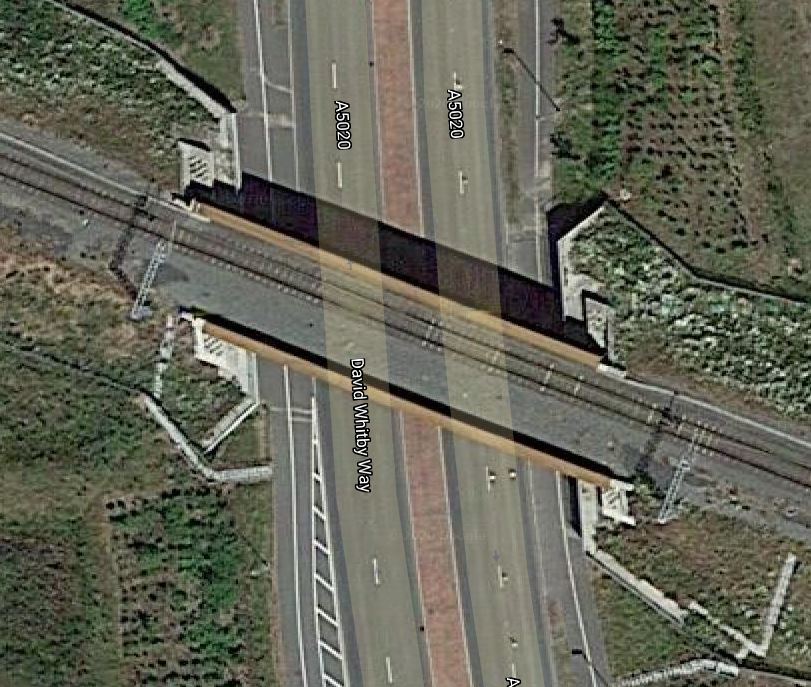
Note.
- The single track appears to be electrified, from the shadows of the gantries at either end of the bridge.
- West Midlands Trains appear to run an electric service between Crewe and Stafford on this route.
- I suspect it’s also used as a diversion route for Avanti West Coast’s Manchester service via Stoke-on-Trent or for train positioning.
Will this route allow High Speed Two trains to run between Stoke-on-Trent and Manchester Piccadilly?
From picture and comments in a rail forum, I suspect that the route could be redoubled fairly easily.
- The electrification runs for about 15.5 miles, between Crewe station and Stoke Junction, which is about half-a-mile on the other side of Stoke-on-Trent station.
- Trains seem to be connected to the electrification for over twenty minutes, so it could be useful for charging a battery train, running between Stoke-n-Trent and Crewe stations.
This Google Map shows Stoke Junction.
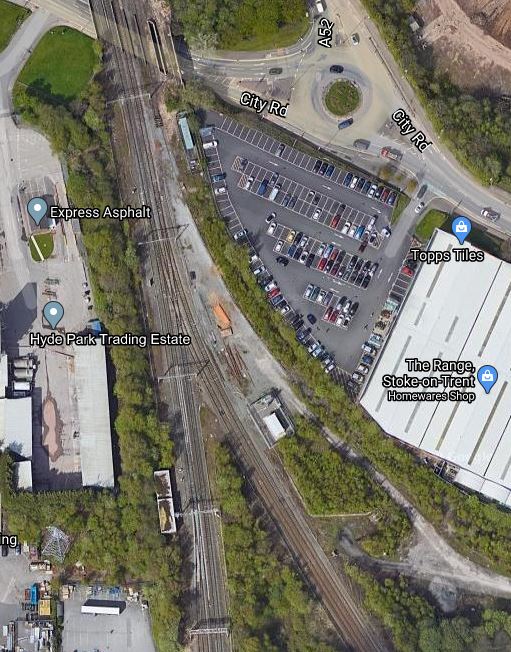
Note,
- Stoke-on-Trent station is to the North.
- The electrified railway going due South is the West Coast Main Line to Stone and Stafford stations.
- The line without electrification going off in a more South-Easterly direction is the line to Uttoxeter and Derby.
Following the route between Derby and Crewe, these are my observations.
- There is a level crossing at Blythe Bridge station.
- Most of the bridges over the route are modern, so I suspect will accept electrification.
- The route would appear to have a speed limit of 70 mph, but I would suspect that this could be increased somewhat as it doesn’t look too challenging.
- The route is 51 miles long, so a service that takes the current 79 minutes with nine stops, would average 38.7 mph.
- The proposed time of 59 minutes, would average 51.8 mph
I suspect there could be more to come, as the timetable is probably written for a Class 153 train.
A Crewe And Nottingham Service
The Midlands Connect plan says the service will be the following.
- Two tph
- A slow train in 79 minutes.
- A fast train in 59 minutes.
- East Midlands Railway want to extend services to Nottingham.
It could be a fairly simple easy-to-use timetable.
Fast Trains
Consider.
- Derby and Nottingham are 16 miles apart and fastest trains take between 19-22 minutes between the two cities.
- When it opens, all trains would stop at East Midlands Hub station between Nottingham and Derby.
- East Midlands Railway have a fleet that will include forty Class 170 trains.
- I suspect that these 100 mph trains will be able to run between Crewe and Nottingham including the turnround in under 90 minutes.
This would mean that a fast hourly service would need three trains.
Slow Trains
Consider.
- I wouldn’t be surprised to see the slower services continuing as now and not extending to Nottingham.
- 79 minutes is probably a convenient time, which would give a ninety minute time for each leg between Derby and Crewe, when turnround is included.
- Trains would be more of the Class 170 trains.
This would mean that a slow hourly service would need three trains.
Could Battery Electric Trains Be Used?
Consider.
- I think it is likely that the route between Derby and East Midlands Parkway via East Midlands Hub station, will be electrified, in conjunction with Midland Main Line electrification.
- Between Derby and Long Eaton stations via East Midlands Hub station is just under ten miles and takes ten minutes.
- Nottingham and Crewe is 66 miles of which 25 miles in total could be electrified.
- Derby and Crewe is 51 miles of which 15 miles are electrified.
- The longest section without electrification is between Derby station and Stoke Junction, which is 35.5 miles.
Batteries would be charged in the following places.
- Between Long Eaton and Derby stations.
- During turnround at a fully-electrified Derby station.
- Between Stoke-on-Trent and Crewe stations.
- During turnround at a fully-electrified Crewe station.
That’s a lot better than with an electric car.
In Sparking A Revolution, I quoted this Hitachi-specification for a battery-electric train.
- Range – 55-65 miles
- Performance – 90-100 mph
- Recharge – 10 minutes when static
- Routes – Suburban near electrified lines
- Battery Life – 8-10 years
I can’t see any problem with one of these trains or other battery-electric trains with a similar performance, running between Crewe and Nottingham or Derby via Stoke.
Could Hydrogen-Powered Trains Be Used?
I would suspect so, as the Alsthom Coradia iLint runs a similar route in Germany.
Connections To High Speed Two
Midlands Connect noted the route’s link to High Speed Two at Crewe.
But it also has other links to High Speed Two at Stoke-on-Trent and East Midlands Hub stations.
I suspect some stations like Uttoxeter or Alsager will have a choice of fast routes to London or Scotland.
Could Services Be Extended From Crewe?
In Connecting The Powerhouses, I talked about an article in the June 2017 Edition of Modern Railways, which proposed reopening the Midland Railway route between Derby and Manchester.
Some passengers and commentators fell a direct fast link is needed.
When High Speed Two is completed, the main route into Manchester Piccadilly will be a high speed spur from Crewe via Manchester Airport. Current plans include the following services.
- One tph from London Euston via Old Oak Common and Birmingham Interchange.
- Two tph from London Euston via Old Oak Common
- Two tph from Birmingham Curzon Street
Note.
- All services will call at Manchester Airport.
- It is likely that Northern Powerhouse Rail will add six tph to Manchester Piccadilly from Liverpool via Warrington.
- Some services will extend through Manchester Piccadilly to Bradford, Doncaster, Huddersfield, Hull, Leeds, Newcastle, Sheffield and York.
- High Speed lines will probably have a capacity of up to eighteen tph.
The Birmingham Curzon Street, Liverpool and London Euston services would be eleven tph, so there would be more than enough capacity for an hourly train from Nottingham.
What would the service be like?
- It would be between Nottingham and Manchester Piccadilly stations.
- It could call at East Midlands Hub, Derby, Uttoxeter, Stoke-on-Trent, Kidsgrove, Crewe and Manchester Airport stations.
- It would probably be hourly.
Timings could be as follows.
- Nottingham and Manchester Airport – 87 minutes
- Nottingham and Manchester Piccadilly – 91 minutes
- Derby and Manchester Airport – 67 minutes
- Derby and Manchester Piccadilly – 71 minutes
- Stoke-on-Trent and Manchester Airport – 32 minutes
- Stoke-on-Trent and Manchester Piccadilly – 36 minutes
The trains used on this and other local services that might need to use High Speed Two infrastructure would be performing a similar role as that of the Class 395 trains on High Speed One.
Possibilities must include.
- A classic-compatible High Speed Two train.
- A five-car AT-300 train, like East Midlands Railway’s Class 810 trains.
- An updated Class 395 train.
All trains would need a battery capability with a range of 40 miles.
It should also be noted that in Options For High Speed To Hastings, I worked through the options needed to run high speed commuter services to Hastings.
This was the last sentence in that post.
It’s all about selling trains and a company that had a 140 mph or 225 kph high-speed electric train, that could do perhaps 25 miles or 40 kilometres on batteries, would have a valuable addition to their product range.
A train with a range of 50 miles on battery power, would be suitable for the following routes.
- London St. Pancras and Hastings via Ashford International.
- Manchester Piccadilly and Nottingham via Manchester Airport, Crewe, Derby and East Midlands Hub.
- Manchester Piccadilly and Barrow-in-Furness via Manchester Airport, Warrington Bank Quay, Wigan North Western, Preston and Lancaster.
- Manchester Piccadilly and Chester via Manchester Airport and Crewe.
- Manchester Piccadilly and Shrewsbury via Manchester Airport and Crewe.
Charging might be needed at some of the terminal stations.
The World’s First Bi-Mode Hydrogen-Electric Train
This news page on the University of Birmingham web site is entitled HydroFLEX Secures Funding For Hydrogen-Powered Train Design.
The page is mainly about the new funding from Innovate UK, that I wrote about in First Of A Kind Funding Awarded For 25 Rail Innovation Projects, but it also includes this significant paragraph.
As well as being the UK’s first hydrogen-powered train, HydroFLEX is also the world’s first bi-mode electric hydrogen train. It will be undergoing mainline testing on the UK railway in the next few weeks.
One of my disappointments in the design of the Alstom Coradia iLint, is that, it is designed as a hydrogen-power only train, where it could surely have had a pantograph fitted, for more efficient working.
Consider.
- I suspect many hydrogen-powered trains will only be doing short distances, where electrification is not available, so daily distances under hydrogen power could be quite short.
- In the UK, a smaller hydrogen tank would certainly ease the design problems caused by a large fuel tank.
- There have been improvements in hydrogen storage in recent years.
The funding award to the project talks about raft production, so are the engineers, aiming to design a hydrogen power-pack on rafts, that could be fitted underneath the large fleets of retired electric multiple units, that are owned by Porterbrook.
Now that would be a game changer.
- Porterbrook have thirty-seven Class 350 trains, that will be replaced in the next few years by new trains. The electric trains are less than a dozen years old and Porterbrook have been talking about fitting batteries to these trains and creating a battery/FLEX train. Would making these trains bi-mode hydrogen-electric trains be better?
- Birmingham wants to open up new rail routes in the city on lines without electrification. What would be better than a hydrogen powered train, designed in the city’s premier university?
- Routes from Birmingham to Burton-on-Trent, Hereford, Leicester, Shrewsbury, Stratford-on-Avon and Worcester would be prime candidates for the deployment of a fleet of bi-mode hydrogen-electric trains.
- Birmingham have already asked ITM Power to build a hydrogen filling station in the city for hydrogen buses.
300th Coradia Polyvalent Train Delivered By Alstom
The title of this post is the same as rgar of this article on Rail Advent.
The Polyvalent is a variety of the Alston Coradia, that was first ordered for France.
This is the description of the train in Wikipedia.
As of 2018, the Coradia Polyvalent is the latest variant in the Coradia family. It can operated at a maximum speed of 160 km/h in electric or bi-mode at voltages of 25 kV and 1,500 kV; a cross-border version capable of operating at a voltage of 15 kV, suitable for the German and Swiss rail networks, has also been made available. The low integrated floor of the carriages provides improved accessibility and a high level of visibility to passengers. As a measure to restrict vibrations and noise levels, motorised bogies are placed at both ends of each carriage.
The Rail Advent article adds this.
In response to the hydrogen plan by the French Minister, Alstom is now looking to incorporate a dual-mode hydrogen version of the Coradia Polyvalent range.
I would assume, this means an electric train, that can use hydrogen power, when the electrification stops.
This is how a hydrogen train should work and from reports, it appears the Alstom Breeze based on a rebuilt Class 321 train, will work like this.
The Alstom Coradia iLint may have proved the concept of hydrogen power, but compared to other hydrogen and battery powered buses and trains, I’ve ridden, it scores poorly in terms of noise, vibration and harshness.
 The Anonymous Widower