More Trains To Carmarthen
The last time, I looked at the number of GWR trains to Carmarthen its Wikipedia entry, it was just a couple.
Today, one train per hour (tph) is shown between London Paddington and Swansea, with this supplementary information.
- 7 trains per day continue to Carmarthen, calling at Gowerton (limited), Llanelli, Pembrey & Burry Port, Kidwelly (limited) and Ferryside (limited)
- On Summer Saturdays, 2 trains per day run to Pembroke Dock, calling at all stations between Carmarthen and Pembroke Dock
In Regulator Approves New Grand Union Train Service From Carmarthen To London Paddington, I talked about the plans of Grand Union Trains to run five trains per day (tpd) between London Paddington and Carmarthen.
This would appear to give a total of twelve tpd between London Paddington and Carmarthen.
This page on the Crown Estate web site is entitled Celtic Sea Floating Offshore Wind, where this is said.
The Government has set an ambition to deliver up to 5GW of floating wind by 2030, with rapid expansion anticipated thereafter.
At The Crown Estate, we are committed to helping the UK achieve its net zero ambitions. To support this, we are excited to deliver a new leasing opportunity in the Celtic Sea for the first generation of commercial-scale floating offshore windfarms – unlocking up to 4GW of new clean energy capacity by 2035, kick-starting industry in the region, and providing power to almost four million homes.
We will be inviting full commercial scale projects up to 1GW, which may be developed in a phased or ‘stepping stone’ approach. Recognising the need to develop the UK supply chain and supporting infrastructure for this nascent technology, this approach is deliberately intended to provide opportunities for growth and investment. This will also facilitate the co-ordination of the necessary infrastructure, such as ports and grid connections, all of which are key to the sustainable development of the UK floating wind sector over the long term.
This leasing opportunity will provide the foundation for greater capacity in the future and help establish an exciting new industrial sector for the UK, creating opportunities for significant new investment in jobs, skills and infrastructure for the communities onshore.
It appears to me, that Great Western Railway and Grand Union Trains both believe that there will be large increase in demand for rail travel between London Paddington and Carmarthen and also along the South Wales Coast.
Grand Union Trains are also proposing the building of a new parkway station at Parc Felindre North of Swansea.
But then this area of South Wales and the Celtic Sea, has the four things needed for the development of up to 5 GW of offshore wind; a lot of wind, a large area of empty sea, steel and deep water ports to assemble all the floating wind turbines.
A Zero-Carbon High Speed Railway Between London Paddington And Carmarthen
Consider.
- The Great Western Railway between London Paddington and Carmarthen is 222.5 miles and trains take around three hours and fifty minutes, which is an average speed of 58 mph.
- Between Bristol Parkway and Reading stations, the operating speed is 125 mph.
- In South Wales, the operating speed is generally between 70 and 100 mph.
- Only the 77.4 miles between Cardiff Central and Carmarthen via Swansea is not electrified.
There is probably scope to increase the operating speed using digital signalling and by improving the track.
I would suspect that a time between London Paddington and Carmarthen of under three-and-a-half hours is possible.
The Range Of Battery-Electric Trains
Hitachi have not been specific about the zero-carbon range of their Intercity Tri-Mode Battery Train, which is described in this Hitachi infographic.

In Stadler FLIRT Akku Battery Train Demonstrates 185km Range, I talk about Stadler’s record-braking Battery-electric; Akku, which covered 185 km or 115 miles.
I suspect that Hitachi’s engineers and those at their battery suppliers; Turntide Technology will be ultra-competitive, so I wouldn’t be surprised that the zero-carbon range of the Hitachi train is very competitive to the Stadler FLIRT Akku.
A hundred mile range would allow electric services to be run on these routes.
- Cardiff and Carmarthen – 77.4 miles
- Chippenham and Bristol Temple Meads and return – 48.8 miles
- Chippenham and Bristol Western-super-Mare and return – 86.9 miles
- Swindon and Cheltenham Spa and return – 86.5 miles
- East Coast Main Line and Hull and return – 72.2 miles
- Plymouth and Penzance – 79.5 miles
- Taunton and Newbury – 89.6 miles
- York and Scarborough and return – 84.1 miles
I am fairly sure that Hitachi will aim for at least a hundred mile battery range for their Intercity Tri-Mode Battery Train.
- This would be competitive with other train manufacturers like Stadler and Siemens.
- They would handle a lot of important routes.
- With development they could probably handle Edinburgh and Inverness.
I can’t wait to have a ride.
Was Baldrick An Essex Man?
I have been looking at Network Rail’s page for Beaulieu Park station.
This is the heading.
Network Rail and Essex County Council are working together to develop proposals for the first railway station to be built on the Great Eastern main line for over 100 years.
These two paragraphs outline the project and where the finance is being obtained.
The new station is part of a wider regeneration of the Beaulieu Park estate in Chelmsford with new road infrastructure and up to 14,000 homes.
Essex County Council, in partnership with Chelmsford City Council, successfully secured £218m of funding from the Government’s Housing and Infrastructure (HIF) fund together with £34m contributions from the South East Local Enterprise Partnership and the developers of Beaulieu, Countryside and L&Q.
These features of Beaulieu Park station are listed on the page.
- Three platforms with a central loop line and new tracks to enable stopping services to call at the station while allowing fast trains to pass through unimpeded
- Step free access to all platforms via 2 lifts
- Accessible toilets, baby change facilities, waiting area and space for retail/catering
- Ticketing facilities, with ticket vending machines and a gate line
- Pedestrian and cycle access routes to the station
- 500 spaces for cycle parking and storage
- A bus interchange including bus stands for local services
- Pick up and drop off area with dedicated taxi bays
- Parking for over 700 cars, 5% of which to be designated Blue Badge bays, and motorcycle spaces, as well as dedicated parking for station staff, emergency services, and a dedicated space for service access.
Note.
- How many other parkway stations, other than Ebbsfleet International station have 700 parking spaces?
- The parking at Whittlesford Parkway can only hold 377 vehicles.
- How many other parkway stations have an overtaking loop for faster trains?
Beaulieu Park is not your average parkway station!
I have a few thoughts.
Which Of The Current Services Will Call?
The Network Rail page says this about services.
It will provide additional access to the railway with regular connections to the capital (only 40 minutes from London Liverpool Street station) and other destinations in the east of England. New tracks will enable stopping services to call at the station while allowing fast trains to pass through unimpeded.
Note.
- Trains between London and Hatfield Peverel station typically take under forty minutes.
- Two fast trains per hour (tph) between Liverpool Street and Norwich via Colchester, Ipswich and Stowmarket pass through.
- Only one of the fast trains stops at Chelmsford.
- Four stopping tph, one to each of Braintree, Clacton-on-Sea, Colchester Town and Ipswich pass through.
If all the stopping trains stopped, Beaulieu Park would have the following services.
- Braintree – 1 tph
- Chelmsford – 4 tph
- Clacton-on-Sea – 1 tph
- Colchester – 3 tph
- Colchester Town – 1 tph
- Hatfield Peverel – 1 tph
- Ingatestone – 2 tph
- Ipswich – 1 tph
- Kelvedon – 2 tph
- London Liverpool Street – 4 tph
- Marks Tey – 2 tph
- Romford – 1 tph
- Shenfield – 3 tph
- Stratford – 4 tph
- Witham – 4 tph
All trains are new Class 720 electric trains.
I also feel, that Network Rail could be being cunning.
Suppose, the Liverpool Street and Norwich express, that doesn’t stop at Chelmsford, stopped instead at Beaulieu Park.
- This would give an hourly express service between Beaulieu Park and Norwich, which stopped at Colchester, Manningtree, Ipswich, Stowmarket and Diss.
- It would also enable two tph between Beaulieu Park and Ipswich.
The 700 parking spaces at Beaulieu Park now start to make sense.
- Both Ipswich and Norwich stations are within walking distance of the town centres and the football grounds.
- Ipswich station has a shuttle bus service to the town centre and the hospital.
- Both stations have several local train services.
Beaulieu Park station appears to have been designed as a Park-and-Ride station for the Great Eastern Main Line and all its branches.
Services To And From Lowestoft
In Making Sense Of The New East Anglia Franchise, I looked in detail at Greater Anglia’s promises.
In a section, which is entitled London – Lowestoft – Yarmouth Services, I said this.
There are going to be four direct services between London and Lowestoft each day. This probably initially means two trains to London in the morning peak and two trains back in the evening one.
When, I first moved back to Suffolk in the 1970s, I regularly caught a diesel-hauled train from Wickham Market to London for the day.
This is all motherhood and apple pie for those in Lowestoft wanting to go to London, but I suspect it isn’t the easiest service for a train operator to schedule efficiently and make money.
Would a train operator really want to start a full train at Lowestoft at say six in the morning and then have it wait around all day in London before returning in the evening?
The service hasn’t started.
Services To And From Cambridge Or Peterborough
At some time in the last decade, one of the predecessors of Greater Anglia, used to run a service to Peterborough via Colchester and Ipswich, so that travellers in Essex could catch trains to the North.
Given too that Cambridge has an employment problem, if a service was run, it might attract passengers.
The Class 755 trains Could Serve Bury St. Edmunds, Cambridge, Lowestoft, Newmarket, Peterborough And Yarmouth
Consider.
- A pair of Class 755 trains would leave Liverpool Street.
- They would use electric power to run to Ipswich.
- The trains would run in one of the paths of the current hourly Ipswich service.
- Like their all electric siblings; the Class 745 trains, they would probably run most of the journey at near 100 mph.
- At Ipswich the trains would split.
- One train would go to on to Lowestoft and Yarmouth and the other would go to Cambridge and Peterborough.
If passenger numbers felt it was a good idea, I’m certain, it could be timetabled.
The Chelmsford Avoiding Line
In Will The Chelmsford Avoiding Line Be Rebuilt?, I described the avoiding line, that used to be between the two tracks at Chelmsford station.
It probably saved a few minutes, by allowing fast expresses to pass stopping trains.
Effectively, a new avoiding line is being built at Beaulieu Park, a few miles from the original position at Chelmsford.
So will the fast expresses save a few minutes?
Could The Elizabeth Line Run To Beaulieu Park?
Consider
- The end sections of the Elizabeth Line seem to be busy, as I wrote in Very Busy Lizzie.
- The City of Chelmsford is between Shenfield and Beaulieu Park.
- Paddington and Reading is 35.9 miles.
- Liverpool Street and Hatfield Peverel is 35.9 miles.
So Beaulieu Park is actually closer to London than Reading.
Perhaps, at some time in a few years, passenger traffic between Beaulieu Park and Shenfield will be such, that the Elizabeth Line will be extended to Beaulieu Park.
The ideal service from Beaulieu Park would surely be two tph to Heathrow, as getting to Heathrow from East Anglia by train needs a change at Liverpool Street.
The only drawback is that to work effectively on the Great Eastern Main Line, a sub-variant of the Class 345 trains will be needed with a 100 mph operating speed. I wrote about these trains in Extending The Elizabeth Line – High Speed Trains On The Elizabeth Line.
But they may have the advantage of being able to take the fast lines between Shenfield and Stratford.
Conclusion
Beaulieu Park may just look like any other station to serve a housing development.
But it’s a lot more than that!
- It’s a Park-and-Ride for the whole Great Eastern Main Line and London.
- It should speed up expresses between London and Colchester, Ipswich or Norwich.
- It should improve local connectivity.
- It could take a lot of traffic off the nearby A12.
- It could give the City of Chelmsford its own local metro.
- It could give Heathrow a direct link to much of Essex.
- How much carbon will be saved by passengers?
We need many more well thought out Park-and-Ride stations.
Great Northern’s Class 717 Fleet Receives Go-Ahead From ORR To Operate With In-Cab Digital Signalling
The title of this post is the same as that of this press release from Great Northern.
These five paragraphs outline how the new signalling will be introduced.
Govia Thameslink Railway (GTR) has received authorisation from the Office of Rail and Road (ORR) to place its Class 717 fleet into passenger service using Level 2 European Train Control System (ETCS) digital signalling.
This is a key step towards the introduction of digital signalling on both the Northern City Line, between Finsbury Park and Moorgate in London, and the East Coast Main Line between London and Grantham, as part of the government-funded East Coast Digital Programme (ECDP).
The programme will see traditional lineside signals replaced by state-of-the-art in-cab signalling technology (ETCS). On the Northern City Line this will give Great Northern passengers a more reliable service.
The trains, leased to GTR by Rock Rail, will begin running in passenger service once Network Rail has completed its approval works to switch on the trackside ETCS system. Once this second milestone is achieved later this year, GTR will start training, in passenger service, two hundred and fifty of its Great Northern drivers to drive using ETCS.
The new system overlays the traditional signals, so drivers will be able to continue using ETCS alongside their untrained colleagues once they are qualified, ensuring they maintain full competency until everyone is trained and the old system can be switched off.
I used the route from Essex Road to Moorgate stations, this morning about 09:30 and Great Northern seems to be running eight trains per hour (tph) on that section.
Is Liverpool Going To Get High Speed One-Point-Five?
Some of the best train journeys, I’ve ever had were not on high speed trains on specially-built tracks.
- The Thunder of Three-Thousand Three-Hundred Horses is from the early 1970s and describes a trip back from Darlington behind a Class 55 locomotive or Deltic.
- Norwich-In-Ninety Is A Lot More Than Passengers Think! describes a trip from London to Norwich and back, in the early days of the Norwich-in-Ninety timetable behind a Class 90 locomotive.
- I could add a journey on an InterCity 125 from London to Plymouth, which was running nearly thirty minutes late at Newbury, but was on time at Exeter.
The connection between these stories, was that all had a superb biological control system in the cab, who with help from the signallers was able to keep to a difficult schedule or make up time.
Last year, I made several journeys between Euston and Liverpool Lime Street. A couple of the journeys were unusual in that we arrived at our destination around six or more minutes early.
I suspect, that Avanti West Coast were experimenting to make sure that they get the new two trains per hour (tph) for the route perfect.
In Avanti West Coast Looks To Recover, I said this about Euston and Liverpool Lime Street services.
A paragraph talks about the second hourly service between London and Liverpool.
Avanti still has ambitions to introduce a second hourly service between Euston and Liverpool, but when this will come in will depend on demand recovery.
Consider.
- If would be desirable if some or all trains running on the route could achieve a timing of two hours between London and Liverpool.
- It is felt that the second service should stop at Liverpool South Parkway station, where the platforms are too short for eleven-car Class 390 trains.
- Avanti have stated they would like more stops in the Trent Valley, especially at Nuneaton, where they would connect to services to the East Midlands.
- Nuneaton is almost exactly halfway between London and Liverpool.
- Running two tph with Class 807 trains would need nine trains and Avanti have only ordered ten in total.
I believe that a practical timetable like this could work.
- Class 390 train – one tph – Non-stop or perhaps a single stop in the Midlands – Under two hours
- Class 807 train – one tph – Stopping at Nuneaton, Stafford, Crewe, Runcorn and Liverpool South Parkway – Current time or better
An hourly service between London and Liverpool in under two hours would surely be a passenger magnet.
So what is possible?
I found this service on Real Time Trains, which ran on the 16th February 2023.
- Scheduled to leave Liverpool Lime Street at 0943, but left at 1012 or 29 minutes late.
- Train did a ninety second unadvertised stop at Liverpool South Parkway. Now running 26 minutes late.
- There was a two minute stop at Runcorn and a four-minute stop at Crewe. Now running 25 minutes late
- There was a one-minute stop at Milton Keynes. Now running 20 minutes late.
- The train arrived in London Euston at 1220 or 16 minutes late.
Note.
- Liverpool Lime Street and London Euston took 2 hours and 8 minutes.
- As Liverpool Lime Street and London Euston is a distance of 193.6, a 128 minute journey is an average speed of 90.7 mph
- Liverpool Lime Street and Crewe took 32 minutes with two stops.
- Crewe and London Euston took 1 hour and 32 minutes with one stop.
- In West Coast Main Line Electro-Diesels On Test, I found that a Glasgow and London train took 1 hour and 28 minutes between Crewe and London Euston.
- All services last week had the unadvertised stop at Liverpool South Parkway
What can be deduced from these figures?
- If the Crewe stop were to be cut out, two hours and four minutes could certainly be possible between Liverpool Lime Street and London Euston with a Class 390 train.
- I also suspect that if the train were to be run non-stop, that the other four minutes could be saved.
So will Avanti West Coast run the current service using new Class 807 trains, with the extra stop at Liverpool South Parkway and perhaps other stations and the additional hourly train with a non-stop nine-car Class 390 train?
This way of delivering a two tph service would mean.
- Runcorn, Crewe and Milton Keynes would not lose any of their current fast services to and from Liverpool Lime Street and London Euston.
- Liverpool South Parkway station is probably a more convenient location for some passengers going to and from the South. It would gain an hourly service to London Euston.
- There will be an additional 77% of seats between Liverpool Lime Street and London Euston.
- Passengers who don’t like tilting trains could use the Class 807 trains.
- One tph would be timed for two hours or under and would be a marketing man’s dream.
No train would be slower than the current services.
Improvements To The Non-Stop Class 390 Train Service
I earlier said.
As Liverpool Lime Street and London Euston is a distance of 193.6, a 128 minute journey is an average speed of 90.7 mph.
An average speed of 90.7 mph, doesn’t seem fast for a Class 390 train with an operating speed of 125 mph or 140 mph under full ERTMS digital signalling.
These are some times for a selection of average speeds between Liverpool Lime Street and London Euston.
- 90 mph – 2 hours 9 minutes
- 100 mph – 1 hour 56 minutes
- 110 mph – 1 hour 46 minutes
- 120 mph – 1 hour 37 minutes
- 125 mph – 1 hour 33 minutes
- 130 mph – 1 hour 29 minutes
- 135 mph – 1 hour 26 minutes
- 140 mph – 1 hour 23 minutes
Note.
- Average speeds of upwards of 130 mph are unlikely, but I’ve added them to show that the train speed is less important than the speed of the track.
- High Speed Two’s planned time between Liverpool Lime Street and London Euston is 1 hour and 32 minutes.
But I do think times of around 1 hour and 35 minutes should be possible for non-stop Class 390 trains between Liverpool Lime Street and London Euston with an improved track and full ERTMS digital signalling.
Improvements To The Stopping Class 807 Train Service
As the track of the West Coast Main Line is improved with better track and full ERTMS digital signalling, this will also benefit the times of the stopping service run by the new Class 807 trains.
The Class 807 train with its lighter weight will have better acceleration than the current Class 390 trains. This will mean, that they will not be slowed as much, when they stop.
It may be possible to add extra stops at places like Watford Junction, Nuneaton and Stafford and still time the train for a few minutes over two hours.
Avanti West Coast Looks To Recover, is a post, that I wrote based on an interview in Modern Railways with Phil Whittingham, who is MD of Avanti West Coast.
There is a lot of talk in the article about.
- Using Nuneaton to connect the North West and the East Midlands.
- The acceleration of the Class 807 trains.
- Improving the Customer Service.
I think that Liverpool will find it is connected to more of the country on services with just a single change.
Conclusion
Liverpool is getting greater connectivity to the Midlands and the South-East of England, with times, that could be improved to be comparable with High Speed Two.
A Long Journey Home
A friend had booked between London and Edinburgh today on the 13:00 LNER train from King’s Cross. She was also travelling with her miniature Schnauzer.
.We had arranged to meet at Marylebone, so I could help them across London to King’s Cross and have a much-needed hot chocolate in King’s Cross before they caught the train North and I went to a meeting organised by my cardiologist.
I had checked out King’s Cross earlier and there was trouble with srveral delayed and cancelled trains.
It wasn’t strikes or bad management from LNER and the problem is explained in this article from the Yorkshire Evening Post, which is entitled Trains From Leeds To London Cancelled Or Delayed After Thieves Steal Signalling Cables From Railway Tracks.
In the end we made the train in time and also had time to have a hot chocolate in LEON, whilst we sat out the back with the dog.
We were texting each other most of the afternoon and with assistance from Real Time Trains, the journey went as follows.
- The train left King’s Cross at 13:08, which was eight minutes late.
- By Peterborough, the train was running seventeen minutes late.
- The driver kept this delay until Retford, where he lost another eighty minutes.
- The train was now running 97 minutes late and this grew by four more minutes by Newcastle.
- My friend reported that they stopped at Newcastle, as they had no driver.
- In the end, LNER found a driver or a way for the current driver to continue to Edinburgh and the train left Newcastle after a thirty minute stop.
- The train was now two hours and ten minutes late.
- Eventually, it pulled into Edinburgh, two hours and five minutes late, after the driver had picked up a few minutes on the approach to Edinburgh.
Note.
- The incoming train that formed this service arrived in King’s Cross from Edinburgh seventy two minutes late, mainly because of the cable theft. It should have arrived and returned to Edinburgh an hour earlier. But it arrived conveniently to form the 13:00 to Scotland.
- As the train presentation team turned the train in nineteen minutes instead of twenty-one, they saved a couple of minutes.
- I suspect the delay at Retford was getting through the area without any signalling.
- Had the driver run out of hours by Newcastle, as he had been in the cab for four-and-a-half hours?
- Normally, four-and-a-half hours would have enabled the driver to have driven to Edinburgh.
These are my thoughts.
Cable Theft
In the days of British Rail, I did some work for British Rail using my software called Daisy, which led to a report entitled Failure Reporting And Analysis On British Rail, which was written by J. S. Firth CEng, MIEE, MIRSE, who worked for SigTech, which was a Business Unit of the British Railways Board.
If anybody who has a legitimate reason to read the report, I still have the complimentary copy sent to me by Mr. Firth and would be happy to provide a copy.
I did flag up a project called Unauthorised Cable Removal And Fault Triage, as one of the winners in the First Of A Kind 2022 competition organised by the Dept of BEIS.
If there is anything I can do to help, let me know.
Problems In France
A friend in France told me that there is a problem with stealing overhead electrification cables in France.
This article on RFI is entitled Copper Wire Thieves Force France’s High-Speed TGV To Go Slow.
There are several similar stories on French and other European web sites.
Signalling Using Radio
The East Coast Main Line is being signalled using modern ERTMS digital signalling, where drivers read the signals on an in-cab display, which is connected by radio to the signalling system.
This extract from Wikipedia describes the first project.
In June 2020 it was reported that the UK government would provide £350 million to fund the UK’s first digital signalling system on a long-distance rail route. The signalling is to be fitted on a 100-mile (161 km) section of the East Coast Main Line between Kings Cross, London, and Lincolnshire, which will allow trains to run closer together and increase service frequency, speed and reliability. No date for when the new technology, already in use on the Thameslink lines at London Bridge and some London Underground lines, has been given.
If the cables are removed will this reduce crime?
LNER Delay Repay
My friend will be entitled for a full refund of her single ticket.
This page on the LNER web site gives full details.
Note.
- You have 28 days to claim.
- If you have a return ticket, you may be entitled to something for that leg of the journey.
I would add, that you should always keep all your tickets, in case the return journey goes belly-up.
Testing Of Digital Signalling To Close Northern City Line
The title of this post, is the same as that of this article on Rail Technology Magazine.
This first paragraph indicates what’s happening.
Any passengers travelling on the Northern City Line between Finsbury Park and Moorgate on Sunday 9th October are being asked to check before they travel due to testing.
I hope that when they’ve finished the testing, they will increase the number of trains on this important route.
Boris Baldrick’s Cunning Plan
This written statement to Parliament on the UK Government web site, is entitled Transport Update: Transpennine Route Upgrade.
It has been published by Grant Shapps and this is the sub-title.
Additional funding has been made available for the Transpennine route upgrade.
This is the complete statement.
Today 19 July 2022, the government has made available £959 million of additional funding to continue to progress the delivery of the ambitious Transpennine route upgrade.
This funding is a significant milestone and another step towards upgrading the key east-west rail artery across the north of England, to further this government’s levelling up and decarbonisation objectives.
In addition to progressing the design of aspects of the upgrade, this funding will enable further on-the-ground delivery of electrification and journey time improvement works, mostly west of Leeds.
One of the first tangible benefits will be enabling electric trains to run between Manchester and Stalybridge by the middle of the decade. We are also developing scope that will enable the Transpennine route upgrade to become the first phase of Northern Powerhouse Rail, including plans to unlock freight flows and take thousands of lorries off our roads.
We are also more than trebling the investment in the Transpennine route upgrade from £2.9 billion to between £9.0 billion and £11.5 billion.
This additional investment will enable the roll out of digital signalling technology, electrification of the full route and the provision of additional tracks for commercial and freight services, giving rail users more reliable, more punctual, more comfortable and greener rail journeys.
I have some thoughts.
It’s Not A Wish List, But A Reality
The last paragraph reads like a wish list.
This additional investment will enable the roll out of digital signalling technology, electrification of the full route and the provision of additional tracks for commercial and freight services, giving rail users more reliable, more punctual, more comfortable and greener rail journeys.
But it’s not a wish list, it’s what is to be done.
Where Will The Government Get Between Nine and Eleven-And-A-Half Billion Pounds?
It’s not the sort of small change that you have in a sock draw.
This document on the UK government web site, is entitled PM Opening Remarks At Press Conference With German Chancellor Olaf Scholz: 8 April 2022, where this is these three paragraphs.
We will also agree on the importance of weaning ourselves off dependence on Russian gas and oil, and ensuring that our energy security cannot be threatened by a rogue state.
This is not easy for any of us, and I applaud the seismic decisions taken by Olaf’s government to move Germany away from Russian hydrocarbons.
Today we have agreed to maximise the potential of the North Sea and collaborate on energy security and on renewables, where Germany and the UK lead the way in new technology.
So did Boris and Olaf sign the world’s first Green Alliance based on zero-carbon energy?
- They may not have signed an Alliance, but they have agreed on common actions.
- Over the last year or so, German money and technology has started to be more visible in our offshore wind farms.
- BP have been backed by German utility; enBW in some of their huge wind farms.
- Siemens Gamesa are providing a lot of wind turbines.
- Will German shipyards build the floats for floating wind farms?
- An interconnector between the Isle of Grain and Wilhelmshaven is planned.
- Rolls-Royce and its German subsidiary MTU are charging into battle against climate change.
- The Germans have taken a liking to ITM Power’s electrolysers to produce hydrogen.
I can see the North Sea or the German Ocean becoming Europe’s power station, with by 2030, a large amount of the energy not needed by the UK, being exported to the Continent, either as electricity or hydrogen.
The Germans could become our magische Geldbäume.
But unlike gas and oil, wind power in the North Sea won’t run out, as it’s renewable.
In How Britannia With Help From Her Friends Can Rule The Waves And The Wind, this was my conclusion.
Boris’s vision of the UK becoming a Saudi Arabia of wind is no fantasy of a man with massive dreams.
Standard floating wind turbines, with the possibility of also harvesting wave power could be assembled in ports along the coasts, towed into position and then connected up.
Several GW of wind-power capacity could probably be added each year to what would become the largest zero-carbon power station in the world.
By harvesting the power of the winds and waves in the seas around the British Isles it is an engineering and mathematical possibility, that could have been developed by any of those great visionary Victorian engineers like Armstrong, Bazalgette, Brunel and Reynolds, if they had had access to our modern technology.
Up Yours! Putin!
This energy and the money it provides will finance our infrastructure and our tax cuts.
Extending The Elizabeth Line – An Extension To Southend Airport
The Wikipedia entry for Crossrail, has a section for an extension to Southend Airport, where this is said.
Stobart Aviation, the company that operates Southend Airport in Essex, has proposed that Crossrail should be extended beyond Shenfield along the Shenfield–Southend line to serve Southend Airport and Southend Victoria. The company has suggested that a direct Heathrow-Southend link could alleviate capacity problems at Heathrow. The extension proposal has been supported by Southend-on-Sea City Council.
I have written about extending Crossrail to Southend before in Council Launches Campaign To Extend Crossrail To Southend-on-Sea.
In that post, I gave these reasons.
- Extra capacity between London and Southend
- A more intensive service to Southend Airport
- A twenty-four hour service to Southend Airport
- Enabling housing
- Taking pressure from Liverpool Street
I came to the conclusion, that extending the Elizabeth Line to Southend could have a lot going for it.
Times Change
But that post was written nearly four years ago and times change and they will change more in the next few years.
The Elizabeth Line Trains Are Shorter Than The Liverpool Street And Southend Victoria Trains
This has also happened and the pair of five-car Class 720 trains, that Greater Anglia use for Southend Victoria services are over thirty metres longer than the Elizabeth Line’s nine-car Class 345 trains.
This would mean that there would be no need for platform lengthening along the route to Southend Victoria.
Zero-Carbon Aircraft Are Under Development
Zero-carbon aircraft like the Heart Aerospace ES-19 could be in service by 2027. These aircraft will probably have a limited range of around 400 km and a charge time of 40 minutes.
- Southend Airport’s position on the East side of London would enable the creation of zero-carbon flights to places like Amsterdam, Brussels, Lille, Paris and Rotterdam.
- A quick estimate indicates that aircraft like the ES-19 could fly from Southend to Amsterdam and recharge in around two hours.
- Intensively scheduled, these electric aircraft could make several round trips per day.
- Would almost silent electric aircraft be able to fly twenty-four hours per day?
These flights could seriously increase the number of passengers to Southend Airport before the end of the decade.
More Housing
I think more housing will be built between Shenfield and Southend, which will increase the need for more services past Shenfield.
The Great Eastern Main Line Will Have Full Digital Signalling
More and more trains will be running on the Great Eastern Main Line and like other main lines in the UK, it will receive full digital signalling, which would probably be applied to the Shenfield and Southend Line.
This would give the extra capacity to Southend Victoria, that running the Elizabeth Line to Southend Airport and Southend Victoria would need.
Possible Services
I think there are two main possible options, but there may be others.
- A long Elizabeth Line extension all the way to Southend Victoria.
- A short Elizabeth Line extension only as far as Southend Airport.
My feelings are as follows.
- The Greater Anglia service should remain as it is with three trains per hour (tph) calling at all stations to Shenfield, Stratford and Liverpool Street.
- Perhaps three or four Elizabeth Line tph would extend to Southend Victoria, calling at all stations.
- All Elizabeth Line trains would call at all stations to and from London, as they do now!
Full digital signalling would handle the extra trains.
Conclusion
I think it will be unlikely that the Elizabeth Line will be extended to Southend in the next few years, but before the end of the decade, I can certainly see limited Elizabeth Line services going all the way to Southend Victoria.
Thales Supports Rollout Of UK Digital Railway Programme
The title of this post, is the same as that of this press release from Porterbrook.
The press release starts with these bullet points.
- Thales wins the fitment and supply of European Train Control System (ETCS) onboard units for Class 43 high-speed train retrofit.
- Implementation will benefit passengers and freight operators by delivering additional capacity, improving performance, enhancing safety and reducing the costs of operating the national railway.
Which is followed by this explanation.
As a key player in delivering this digital transformation, Thales has today been awarded the contract for the Class 43 First in Class (FiC) design and fitment project that will use Network Rail’s new measurement train power cars in the Infrastructure Measurement fleet. The FiC project will culminate in a Type approval from the Office of Road and Rail to enable subsequent Class 43 ETCS fleet fitments.
The new Thales onboard system will be integrated as part of the Digital Railway train control system, and will enable rolling stock to operate on ETCS-equipped infrastructure. The onboard equipment is an evolution of Thales’s level 1 ETCS system that has been successfully deployed worldwide.
This could be a smart move.
- Type Approval will mean that the Class 43 power cars of ScotRail’s Inter7Cities, Great Western Railway’s Castles and those of other operators can be retrofitted.
- Will the New Measurement Train also be used to test the digital signalling, as it covers all the tracks in Great Britain in a four-weekly cycle?
- Fitting of these iconic 1970’s designed power cars with the latest modern signalling could be a design exercise, that helps in the fitting of ETCS to other older and unusual locomotives.
I still think, that because of the iconic nature of the InterCity125, that we may see a conversion of Class 43 power cars to more sustainable operation.
- All power cars now have modern MTU diesel engines, which probably could be fuelled by hydrogen.
- The simplest way would be to run them on HVO, as I wrote about in Powered By HVO.
- Some operations like the short format trains in Scotland and South-West England might be more suitable for battery-electric operation.
- Given that there are 167 in operation or in store, it would be a good-sized order for the company converting the power cars.
I also believe that zero-carbon InterCity 125s could be an unusual tourist attraction.
Conclusion
The fitting of digital signalling to Class 43 power cars is a good move, but is it the start of a wider plan to bring these iconic trains up to modern standards.
Improving The North Throat Of York Station Including Skelton Bridge Junction
On the thirty mile stretch of the East Coast Main Line, between York and Northallerton stations, the route is mainly four tracks.
But three miles North of York there is Skelton Bridge over the River Ouse, which is shown in this Google Map.

Zooming closer, I clipped this second Google Map.
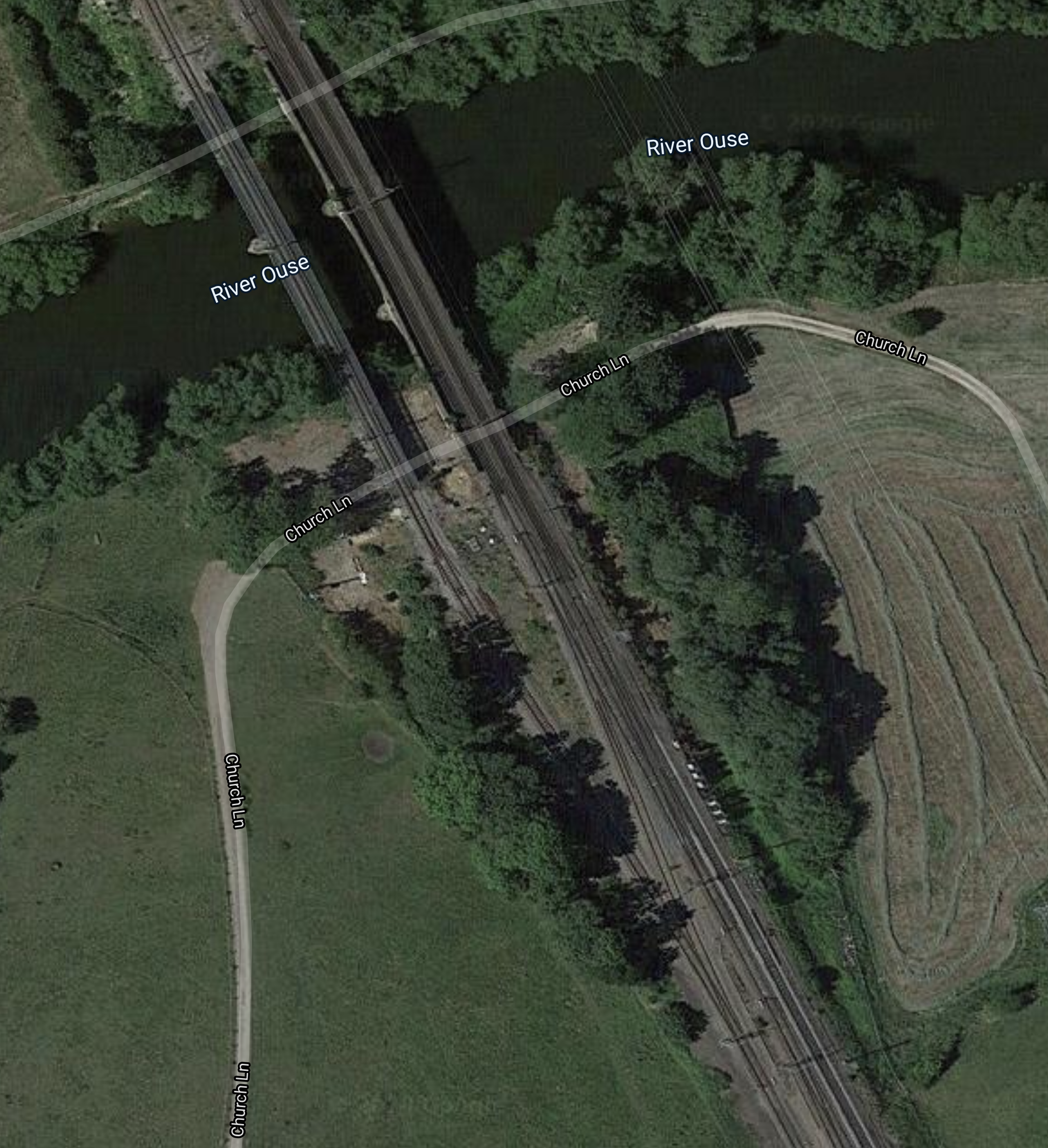
Note.
- There are actually two bridges over the River Ouse.
- The East bridge is a double-track bridge and is the original stone arch bridge.
- The West bridge was added later and I suspect has little architectural merit.
- The tracks on both sides of the bridge are extremely complicated.
If you look at the timings, trains seem to take one of two timings between York and Northallerton.
- 17-18 minutes, which is almost an average speed of 100 mph.
- 27 minutes, which is 67 mph.
Incidentally, one of Drax’s long biomass trains managed a time of 27 minutes.
Would going faster save any minutes?
- A 110 mph average would give a time of 16.4 minutes
- A 120 mph average would give a time of 15 minutes
- A 125 mph average would give a time of 14.4 minutes
- A 140 mph average would give a time of 12.9 minutes
On the face of it, it doesn’t appear that there are very large time savings, to be achieved.
On the other hand, if all trains can pass through Skelton Bridge and its complicated junction, without slowing, delays will be minimised and timetables can be faster.
But there is an anomaly in all the express trains that pass through York station. All stop, except those planned for East Coast Trains. In fact, their trains won’t stop between Stevenage and Newcastle.
The obvious solution to the Skelton Bridge problem, is to do what British Rail didn’t have the courage to do, when they electrified the East Coast Main Line in the 1980s. And that is to demolish the bridge and build a stylish modern four-track bridge!
It would eliminate many of the things, that could go wrong and would surely improve reliability. This could help to maintain a higher operating speed.
But would it be allowed by the Planning Authorities and the Heritage Taliban?
Hopefully, it doesn’t matter!
- I am a Control Engineer and mathematical modeller, who has programmed some immensely complex systems in the last fifty-five years.
- I have also flown light aircraft on instruments for many hours, where you control the plane according to what Air Traffic Controllers and the instruments tell you.
My experience tells me that, it would be possible to control a busy junction, like Skelton Bridge safely, by a well-programmed computer system helping the driver, to arrive at the junction at the right time to go straight through.
I also believe that if modern in-cab digital ERTMS signalling can handle twenty-four tph on Thameslink going to and from scores of stations, then it can handle Skelton Bridge Junction.
In Could ERTMS And ETCS Solve The Newark Crossing Problem?, I proposed a similar solution to the problem at Newark.
 The Anonymous Widower