GWR Buys Vehicles Outright In HST Fleet Expansion
The title of this post is the same as that of this article on Railway Gazette.
This is the introductory paragraph.
Despite concerns over future passenger numbers, the Department for Transport has given permission for Great Western Railway to procure three more shortened HST diesel trainsets, branded as the Castle Class by the franchisee.
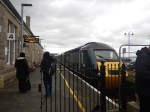
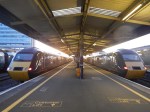
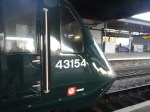
These pictures show some of the Castle Class trains.


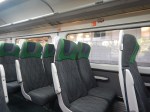


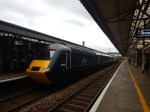
They must be profitable and/or popular with passengers.
If I have a problem with these trains, it is with the Class 43 diesel power cars.
- Each train has two power cars.
- It would appear that there are about 150 of the Class 43 power cars in regular service.
- Each is powered by a modern MTU 16V4000 R41R diesel engine, that is rated at 1678 kW.
- The engines are generally less than a dozen years old.
- They will be emitting a lot of carbon dioxide.
As the trains are now only half as long as they used to be, I would suspect, that the engines won’t be working as hard, as they can.
Hopefully, this will mean less emissions.
The article says this about use of the fleet.
With its fleet now increasing to 14, GWR expects to use 12 each day on services across the west of England. Currently the fleet is deployed on the Cardiff – Bristol – Penzance corridor, but the company is still evaluating how the additional sets will be used.
It also says, that they are acquiring rolling stock from other sources. Some of which will be cannibalised for spares.
Are First Rail Holdings Cutting Carbon Emissions?
First Rail Holdings, who are GWR’s parent, have announced in recent months three innovative and lower-carbon fleets from Hitachi, for their subsidiary companies.
- The Class 807 trains for Avanti West Coast will not have any diesel engines.
- The Class 805 trains for Avanti West Coast will initially have diesel engines, but these may be changedin a few years for battery power packs.
- The Class 803 trains for East Coast Trains will not have any diesel engines.
Hitachi have also announced a collaboration with Hyperdrive Innovation to provide battery packs to replace diesel engines, that could be used on Class 800 and Class 802 trains.
First Rail Holdings have these Class 800/802 fleets.
- GWR – 36 x five-car Class 800 trains
- GWR – 21 x nine-car Class 800 trains
- GWR – 22 x five-car Class 802 trains
- GWR – 14 x nine-car Class 802 trains
- TransPennine Express – 19 x five-car Class 802 trains
- Hull Trains – 5 x five-car Class 802 trains
Note.
- That is a total of 117 trains.
- As five-car trains have three diesel engines and nine-car trains have five diesel engines, that is a total of 357 engines.
- In Could Battery-Electric Hitachi Trains Work Hull Trains’s Services?, I showed that Hull Trains could run their services with a Fast Charging system in Hull station.
- In Could Battery-Electric Hitachi Trains Work TransPennine Express’s Services?, I concluded that Class 802 trains equipped with batteries could handle all their routes without diesel and some strategically-placed charging stations.
In the Wikipedia entry for the Class 800 train, there is a section called Powertrain, where this is said.
According to Modern Railways magazine, the limited space available for the GUs has made them prone to overheating. It claims that, on one day in summer 2018, “half the diagrammed units were out of action as engines shut down through overheating.
So would replacing some diesel engines with battery packs, also reduce this problem, in addition to cutting carbon emissions?
It does appear to me, that First Rail Holdings could be cutting carbon emissions in their large fleet of Hitachi Class 800 and Class 802 trains.
The Class 43 power cars could become a marketing nightmare for the company?
Could Class 43 Power Cars Be Decarbonised?
Consider.
- Class 43 power cars are forty-five years old.
- They have been rebuilt with new MTU engines in the last dozen years or so.
- I suspect MTU and GWR know everything there is to know about the traction system of a Class 43 power car.
- There is bags of space in the rear section of the power car.
- MTU are part of Rolls-Royce, who because of the downturn in aviation aren’t performing very well!
But perhaps more importantly, the power cars are iconic, so anybody, who decarbonises these fabulous beasts, gets the right sort of high-class publicity.
I would also feel, if you could decarbonise these power cars, the hundreds of diesel locomotives around the world powered by similar diesel engines could be a useful market.
What methods could be used?
Biodiesel
Running the trains on biodiesel would be a simple solution.
- It could be used short-term or long-term.
- MTU has probably run the engines on biodiesel to see how they perform.
- Biodiesel could also be used in GWR’s smaller diesel multiple units, like Class 150, 158, 165 and 166 trains.
Some environmentalists think biodiesel is cheating as it isn’t zero-carbon.
But it’s my view, that for a lot of applications it is a good interim solution, especially, as companies like Altalto, will be making biodiesel and aviation biofuel from household and industrial waste, which would otherwise be incinerated or go to landfill.
The Addition Of Batteries
This page on the Hitachi Rail Ltd web site shows this image of the V-Train 2.
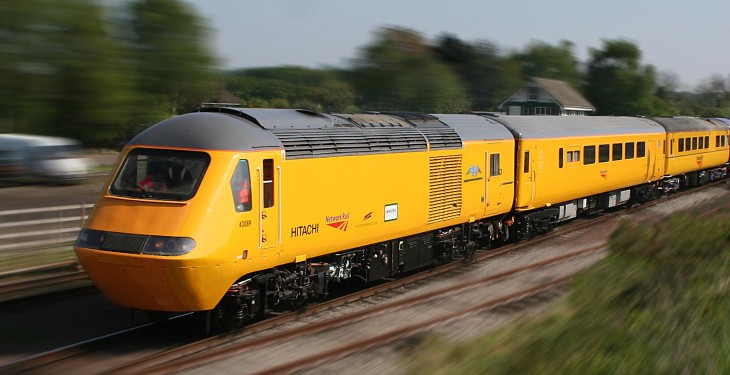
This is the introduction to the research program, which was based on a High Speed Train, fotmed of two Class 43 power cars and four Mark 3 carriages.
The V-Train 2 was a demonstration train designed in order to demonstrate our skills and expertise while bidding for the Intercity Express Programme project.
The page is claiming, that a 20 % fuel saving could be possible.
This paragraph talks about performance.
The V-Train 2 looked to power the train away from the platform using batteries – which would in turn be topped up by regenerative braking when a train slowed down to stop at a station. Acceleration would be quicker and diesel saved for the cruising part of the journey.
A similar arrangement to that Hitachi produced in 2005 could be ideal.
- Technology has moved on significantly in the intervening years.
- The performance would be adequate for a train that just trundles around the West Country at 90 mph.
- The space in the rear of the power car could hold a lot of batteries.
- The power car would be quiet and emission-free in stations.
- There would be nothing to stop the diesel engine running on biodiesel.
This might be the sort of project, that Hitachi’s partner in the Regional Battery Train; Hyperdrive Innovation. would probably be capable of undertaking.
MTU Hybrid PowerPack
I wouldn’t be surprised to find, that MTU have a drop-in solution for the current 6V4000 R41R diesel engine, that includes a significant amount of batteries.
This must be a serious possibility.
Rolls-Royce’s 2.5 MW Generator
In Our Sustainability Journey, I talk about rail applications of Rolls-Royce’s 2.5 MW generator, that has been developed to provide power for electric flight.
In the post, I discuss fitting the generator into a Class 43 power car and running it on aviation biofuel.
I conclude the section with this.
It should also be noted, that more-efficient and less-polluting MTU engines were fitted in Class 43s from 2005, so as MTU is now part of Rolls-Royce, I suspect that Rolls-Royce have access to all the drawings and engineers notes, if not the engineers themselves
But it would be more about publicity for future sales around the world, with headlines like.
Iconic UK Diesel Passenger Trains To Receive Green Roll-Royce Jet Power!
COVID-19 has given Rolls-Royce’s aviation business a real hammering, so perhaps they can open up a new revenue stream by replacing the engines of diesel locomotives,
I find this an intriguing possibility. Especially, if it were to be fitted with a battery pack.
Answering My Original Question
In answering my original question, I feel that there could be several ways to reduce the carbon footprint of a Class 43 power car.
It should also be noted that other operators are users of Class 43 power cars.
- ScotRail – 56
- CrossCountry – 12
- East Midlands Railway – 39
- Network Rail – 3
Note.
- ScotRail’s use of the power cars, is very similar to that of GWR.
- CrossCountry’s routes would need a lot of reorganisation to be run by say Hitachi’s Regional Battery Train.
- East Midlands Railway are replacing their Inter-City 125s with new Class 810 trains.
The picture shows the power car of Network Rail’s New Measurement Train.

These may well be the most difficult to decarbonise, as I suspect they need to run at 125 mph on some routes, which do not have electrification and there are no 125 mph self-powered locomotives. After the Stonehaven crash, there may be more tests to do and a second train may be needed by Network Rail.
Why Are GWR Increasing Their Castle Class Fleet?
These are possible reasons.
GWR Want To Increase Services
This is the obvious explanation, as more services will need more trains.
GWR Want To Update The Fleet
There may be something that they need to do to all the fleet, so having a few extra trains would enable them to update the trains without cutting services.
GWR Want To Partially Or Fully Decarbonise The Power Cars
As with updating the fleet, extra power cars would help, as they could be modified first and then given a thorough testing before entering passenger service.
GWR Have Been Made An Offer They Can’t Refuse
Suppose Rolls-Royce, MTU or another locomotive power plant manufacturer has a novel idea, they want to test.
Over the years, train operating companies have often tested modified trains and locomotives for manufacturers.
So has a manufacturer, asked GWR to test something in main line service?
Are Other Train Operators Thinking Of Using Introducing More Short-Formed InterCity 125 Trains?
This question has to be asked, as I feel there could be routes, that would be suitable for a net-zero carbon version of a train, like a GWR Castle or a ScotRail Inter7City.
Northern Trains
Northern Trains is now run by the Department for Transport and has surely the most suitable route in the UK for a shorted-formed InterCity 125 train – Leeds and Carlisle via the Settle and Carlisle Line.
Northern Trains may have other routes.
Transport for Wales Rail Services
Transport for Wales Rail Services already run services between Cardiff Central and Holyhead using diesel locomotive hauled services and long distance services between South Wales and Manchester using diesel multiple units.
Would an iconic lower-carbon train be a better way of providing some services and attract more visitors to the Principality?
Conclusion
GWR must have a plan, but there are few clues to what it is.
The fact that the trains have been purchased rather than leased could be significant and suggests to me that because there is no leasing company involved to consult, GWR are going to do major experimental modifications to the trains.
They may be being paid, by someone like an established or new locomotive engine manufacturer.
It could also be part of a large government innovation and decarbonisation project.
My hunch says that as First Rail Holdings appear to be going for a lower-carbon fleet, that it is about decarbonising the Class 43 power cars.
The plan would be something like this.
- Update the three new trains to the new specification.
- Give them a good testing, before certifying them for service.
- Check them out in passenger service.
- Update all the trains.
The three extra trains would give flexibility and mean that there would always be enough trains for a full service.
Which Methods Could Be Used To Reduce The Carbon Footprint Of The Class 43 Power Cars?
These must be the front runners.
- A Hitachi/Hyperdrive Innovation specialist battery pack.
- An MTU Hybrid PowerPack.
- A Rolls-Royce MTU solution based on the Rolls-Royce 2.5 MW generator with batteries.
All would appear to be viable solutions.
Rail Solar Projects Pave The Way For Renewables
The title of this post, is the same as that of this article on Engineering and Technology.
This is the introductory sub-title.
Electric trains could provide a huge guaranteed market for renewables, but it will need some railway-specific power equipment.
The article then goes on to describe how Riding Sunbeams are developing and sourcing the equipment to connect both 750 VDC and 25 KVAC electrification directly to solar panels.
It is not as easy, as you might think!
JCB Unveils World’s First Hydrogen Digger
The title of this post is the same as that of this article on International Vehicle Technology.
The signs have been there for some time.
- JCB are one of the backers of ITM Power, who make large scale electrolysers in Rotherham.
- Jo Bamford has a hydrogen company called Ryze Hydrogen.
- Jo Bamford took over Wrightbus and is saying he’ll be building thousands of hydrogen buses a year.
- Ryze Hydrogen have planning permission for a giant hydrogen electrolyser at Herne Bay.
To me, it is totally logical, that JCB build a hydrogen-powered digger.
And it appears they have got there first!
An Untidy Railway
I took these pictures as I returned from Eridge.




You see it all over the railways and not just in the UK; general untidiness!
When I joined ICI in 1968, I went on a thorough and excellent induction course.
One very experienced engineer, gave a Health and Safety Lecture and one thing he said, was that a neat and tidy chemical plant was less likely to have silly accidents.
Some years later, I went to the United States to see some of Metier’s clients, of whom some were nuclear power stations. This must have been just after the Three Mile Island accident, which is described like this in Wikipedia.
The Three Mile Island accident was a partial meltdown of reactor number 2 of Three Mile Island Nuclear Generating Station (TMI-2) in Dauphin County, Pennsylvania, near Harrisburg, and subsequent radiation leak that occurred on March 28, 1979. It is the most significant accident in U.S. commercial nuclear power plant history.
Artemis was involved in maintenance at the nuclear stations I visited. I can remember at AEP Donald C Cook nuclear station being shown a database of work to do and many of the actions were referred to as TMIs and checking them had been mandated by the US regulatory authorities.
I should say, the site on the shores of Lake Michigan impressed me, but another I visited later didn’t. I won’t name it, as it is now closed and it was the most untidy industrial plant of any type I have visited.
As we left, I gave my opinion to our support engineer and he told me they had a very large number of TMIs to process. I wasn’t surprised!
So why are railways generally so untidy?
Hydrogen Freight Trains And Anti-Slip Technology For UK Railways Get Share Of £9.4m Funding
The title of this post is the same as that of this article on Professional Engineering, which is published by the Institute of Mechanical Engineers.
This is the introductory summary.
A zero-emissions machine that removes and replaces rails, a hydrogen-based turbine system for freight trains and ‘cryogenic blasting’ to prevent wheel slip could all be coming to UK railways thanks to a new £9.4m fund.
The article is a good summary of the important projects and it also gives details of what a project in the last round of funding achieved.
I seem increasingly to be reposting articles from professional engineering institutions. Does this mean, that we’re all thinking that good engineering, is one of the ways out of this COVID-19 mess?
I also think, that if I look at the list of twenty-five new projects, that I listed in First Of A Kind Funding Awarded For 25 Rail Innovation Projects, that some will benefit the wider UK population in a world dominated by the remains of the COVID-19 pandemic.
Equipmake And HiETA Developing New Motor With 20kW/kg Power Density With Additive Manufacturing
The title of this post is the same as that of this article on Green Car Congress.
This is the introductory paragraph.
UK-based electrification company, Equipmake, has teamed up with additive manufacturing organization HiETA to develop a next-generation motor as part of a project grant-funded by Innovate UK.
Additive manufacturing is 3D-printing by another name. This has come to the fore in the COVID-19, where schools, colleges and individuals have been using it to produce PPE.
Equipmake and HiETA are printing exotic alloys in intricate shapes to create the powerful motor.
Additive manufacturing is starting an amazing revolution. How many other common products can be redesigned to be more efficient and manufactured at lower cost.
Thirsty High-Rollers … Mining’s Heavy Haulers Prime Candidates For Hydrogen Conversion
The title of this post, is the same as that of this article on ecogeneration.
You understand, what the author means about mining’s heavy haulers, when you open the article.
This paragraph describes their carbon emissions.
One large scale dump truck, depending on the haul road it is using, will use between 100 and 140 litres of diesel per 100km. These vehicles operate all day every day except for maintenance down time. That’s between 260kg and 360kg of CO2 per 100km per truck.
Large open pit mines have tens of these vehicles operating continuously, so the numbers build up very quickly.
The author then goes on to say why, that converting these vehicles to green hydrogen makes a lot of sense.
The dump trucks are already diesel/electric, which means that the diesel generator can be replaced with a hydrogen fuel cell and a battery.
Mining giant; Anglo-American will be introducing a prototype hydrogen-powered dump truck at a platinum mine in South Africa this year.
These paragraphs describe the transmission.
The vehicle, which is called a fuel cell electric vehicle (FCEV) haul truck, will be powered by a hydrogen fuel cell module paired with Williams Advanced Engineering’s scalable high-power modular lithium-ion battery system. Williams provides batteries for FIA’s E-Formula motorsport.
This arrangement will replace the existing vehicle’s diesel engine, delivering in excess of 1MWh of energy storage. The battery system will be capable of recovering energy through regenerative braking as the haul truck travels downhill.
Note that the truck has more energy storage than is proposed for a four-car battery-electric train, like the Class 756 train, which has only 600 kWh.
The author finishes with this concluding paragraph.
With the major mining companies focusing on making significant strides in decarbonisation by 2030 expect there to be more announcements such as this focusing this “low hanging fruit” for the mining industry’s to materially reduce its carbon foot print.
Reading this, I can’t help feeling that replacement of a Class 66 locomotive with a zero-carbon hydrogen-battery-electric hybrid unit could be possible.
Battery-Powered Shunter Ready To Begin Testing
The title of this post is the same as that of an article in Issue 903 of Rail Magazine. The article describes how 08649, which is a Class 08 shunter is being converted to diesel-electric hybrid power.
- It appears, that the shunter wasn’t in the best of condition.
- A 6.8 litre John Deere diesel engine is to be fitted, which will be enhanced to Euro Stage 5.
- Tesla battery packs with a capacity of 300 kWh will be fitted.
- A bespoke control system is being developed.
The shunter is to be tested on the Chinnor & Princes Risborough Railway, when COVID-19 restrictions allow.
The reason for doing the work is not outlined in the article, although it does say this.
The work has been carried out by Meteor Power Ltd., which won a contract last year as part of the Department of Transport’s Innovation Carbon Reduction programme.
According to Wikipedia, 996 shunters were produced with another nearly two hundred similar shunters in other classes. Eighty two are deemed to have been preserved in Wikipedia, with sixty or so labelled as operational. Two operational examples are on the Chinnor & Princes Risborough Railway.
As some of the preserved examples are used by successful heritage railways and even commercial companies like Bombardier, perhaps Meteor have identified several possible commercial conversions.
Or it could be that Meteor want to show how their technology can reduce a company’s carbon emissions by re-putting a diesel engine with a hybrid transmission in a railway engine or a piece of heavy plant.
 The Anonymous Widower