Destination Manchester
The title of this post is the same as the title of this page on the London North Western Railway web site.
The page introduces, the operator’s proposed new service to Manchester.
As a progressive rail operator we’re always looking to develop our services and timetables to provide a better travelling experience for our customers. We are ambitious and our team seek innovative solutions to create new journey opportunities.
That’s why we have developed proposals for our trains to begin serving Manchester for the first time. Under the plans, our existing hourly service between Crewe and London Euston would be extended to Manchester city centre from summer 2026.
Following the cancellation of the northern leg of HS2, these proposals will provide much-needed connectivity between Manchester, the West Midlands and London, with thousands of extra seats every day.
In more detail, the extended London Euston and Crewe service to Manchester Victoria station, will create the following.
- Additional capacity and comfortable, affordable journeys to and from Manchester city centre
- A great alternative to car and coach travel, with fares up to 50% cheaper than the main intercity train operator
- New regular direct services to Warrington for passengers at Milton Keynes, Rugby and Lichfield
- New regular direct services to Manchester for passengers at Rugeley, Lichfield, Tamworth and Atherstone
Note.
- The service will pass through Warrington Bank Quay, Stockport, Earlestown, Newton-le-Willows, Eccles and Salford Central to reach Manchester Victoria, so could be a comprehensive service to the Northern and Western parts of Manchester City Centre. It would just depend on the stopping pattern in the City Centre.
- There would be good connections to Manchester Metrolink at Eccles and Manchester Victoria.
- All stations on the Manchester Metrolink can be reached either direct or with a single change from Manchester Victoria.
- Manchester Metrolink is touch-in and out with a credit card.
- Manchester Victoria is very well connected by rail to cities and important destinations across the North including Blackburn, Blackpool, Bradford, Burnley, Halifax, Hebden Bridge, Huddersfield, Leeds, Liverpool, Preston, Wigan and York.
- The page talks of a London Euston and Manchester Victoria time of three hours and ten minutes.
- Manchester Stations is a group of the four stations; Manchester Piccadilly, Manchester Oxford Road, Manchester Victoria and Deansgate. Often a ticket to Manchester Stations is a few pounds cheaper and more convenient, if you are visiting several places in the City Centre.
The London Euston and Manchester Victoria service looks to me to be a well-thought out proposal.
A New Connection To Manchester Airport
Under a title of Anything Else on the page on the London North Western Railway web site, this is said.
As well as the proposal to extend our London Euston-Crewe services to Manchester Victoria, we are also proposing to begin running trains to Manchester Airport. This will involve extending our existing service between Stafford and Crewe, providing direct connectivity to the airport from Stoke-on-Trent and Staffordshire. More details on this proposal will be announced in due course.
Note.
- The extended Stafford and Manchester Airport service could call at Stone, Stoke-on-Trent, Longport, Kidsgrove, Alsager, Crewe, and possibly Wilmslow and Styal.
- Stafford, Stone, Stoke-on-Trent, Longport, Kidsgrove and Alsager would gain direct services to and from Manchester Airport.
- It would appear that the current Stafford and Crewe service waits in Stafford station for at least fifteen minutes.
- The current Stafford and Crewe service appears to always use platform 6 at Stafford.
- The current Euston and Crewe service appears to always use platform 3 at Stafford.
- The current Crewe and Euston service appears to always use platform 1 at Stafford.
- The current Birmingham and Liverpool service appears to always use platform 5 at Stafford.
- The current Liverpool and Birmingham service appears to always use platform 4 at Stafford.
I suspect that trains can be timetabled, so that the following is possible.
- An hourly London Euston and Manchester Airport service with a quick step-free change at Stafford between the London Euston and Manchester Victoria service and the Stafford and Manchester Airport service.
- An hourly Manchester Airport and London Euston service with a quick step-free change at Stafford between the Manchester Airport and Stafford service and the Manchester Victoria and London Euston service.
- An hourly Birmingham New Street and Manchester Airport service with a quick cross-platform change at Stafford between the Birmingham New Street and Liverpool Lime Street service and the Stafford and Manchester Airport service.
- An hourly Manchester Airport and Birmingham New Street service with a quick step-free change at Stafford between the Manchester Airport and Stafford service and the Liverpool Lime Street and Birmingham New Street service.
Note.
- I suspect more changes at Stafford could be cross-platform.
- I also suspect that it is possible to arrange that all services to the same destination, leave from the same platform, at the same time or times each hour.
- It would appear too, that if you want a cheap ticket price to Liverpool Lime Street, Manchester Victoria or Stoke-on-Trent, then you may have to change at Stafford.
It appears all more affordable London Northwestern Railway trains will go via Stafford.
I have some further thoughts.
Stafford And Manchester Airport Timings
With all the stops, it looks like Stafford and Manchester Airport will take about 78 minutes, but if they used the West Coast Main Line and didn’t stop the time could be reduced to just under an hour.
The Class 730 Trains
The services will be run by 110 mph Class 730 trains.
In 2018, there was talk of a bi-mode 125 mph Aventra, which I wrote about in Bombardier Bi-Mode Aventra To Feature Battery Power.
Currently, the Class 730 trains are 110 mph trains.
Would it help timetabling and capacity if these trains could be stretched to 125 mph?
Avanti West Coast
Several Avanti West Coast services stop at Stafford.
Their services could be half-an-hour quicker to Stafford, but they wouldn’t have the same stopping patterns.
In response to the competition, Avanti West Coast might run a few Manchester Airport Expresses using their new Class 805 trains.
A Second Service Between Stoke And Manchester Airport
I feel this might be needed and perhaps it could be faster, by using the direct route between Stafford and Crewe.
Avanti West Coast could use it to create a one-change fast service between London Euston and Manchester Airport, if they felt such a service were to be needed.
Conclusion
I like this proposal.
But there is a lot of fine tuning to do!
FirstGroup’s Lumo Seeks To Launch Rochdale – London Open Access Service
The title of this post, is the same as that of this article on Railway Gazette.
These two paragraphs outline the service.
FirstGroup has applied to operate Rochdale – London open access passenger trains, more than 20 years after a short-lived through service ran between the two destinations.
On May 17 FirstGroup said that it had applied to the Office of Rail & Road to launch six Lumo-branded return journeys per day linking London Euston and Rochdale via the West Coast Main Line. The trains would call at Warrington Bank Quay, Newton-le-Willows, Eccles and Manchester Victoria.
These are my thoughts.
The Route Isn’t Fully-Electrified
The route is electrified between London Euston and Manchester Victoria stations, but the 10.4 miles between Manchester Victoria and Rochdale is not electrified.
In Extra Luggage Racks For Lumo, I also talk about the possibility of fitting traction batteries to Lumo’s Class 803 trains, so they could handle the 88.5 mile diversion on the East Coast Main Line via Lincoln.
Trains with a traction battery, with an 88.5 mile range, would be able to travel between Manchester Victoria and Rochdale and return.
How Long Would London Euston And Rochdale Take?
Consider.
- The fastest London Euston and Warrington Bank Quay services take 1 hour and 44 minutes
- The fastest Warrington Bank Quay and London Euston services take 1 hour and 47 minutes
- Northern’s Class 195 trains take between 44-51 minutes Rochdale and Warrington Bank Quay with three stops.
- Northern’s Class 195 trains take between 29-32 minutes Manchester Victoria and Warrington Bank Quay with two stops.
- I will add two minutes for the extra stop.
These are my estimates for overall journey times.
- London Euston and Manchester Victoria – 2 hours and 15 minutes
- London Euston and Rochdale – 2 hours and 29 minutes
- Manchester Victoria and London Euston – 2 hours and 21 minutes
- Rochdale and London Euston – 2 hours and 40 minutes
The fastest direct Avanti West Coast services between London Euston and Manchester Piccadilly take 2 hours and 6 minutes.
Could The Service Be Extended To Leeds?
For my timings between Rochdale and Warrington Bank Quay, I used Northern’s Leeds and Chester service.
This service goes between Manchester Victoria and Leeds calling at Rochdale, Todmorden, Hebden Bridge, Halifax, Bradford Interchange, New Pudsey and Bramley.
I estimate it would take about 3 hours 32 minutes.
When Bradford has a new through station, I wouldn’t be surprised if a train operator looked at this route between London Euston and Leeds.
As Leeds and Manchester Victoria is only 49.8 miles, Lumo’s battery electric trains, with 88.5 mile batteries sized for the Lincoln diversion on the East Coast Main Line, would have no difficulty serving Leeds, where they would charge before return.
Could Lumo Run Pairs Of Five-Car Trains Between London Euston and Manchester Victoria?
As I said in Ten-Car Hull Trains, Lumo’s sister company; Hull Trains, runs the occasional ten-car service.
Perhaps for a big football match or other event, Lumo might like to run ten-car trains between Manchester Victoria and London Euston.
I suspect they could do it if the platforms were long enough, but they wouldn’t be able to run a 260 metre ten-car train to Rochdale, as that station only has a 135 metre long platform.
Warrington Bank Quay Station Will Get Six Extra Non-Stop Trains To And From London
This would provide real competition to Avanti West Coast over this route.
Newton-le-Willows Station Is Only A Few Miles From The Town Of St. Helen’s
Newton-le-Willows station has 400 parking spaces and 32 disabled parking spaces.
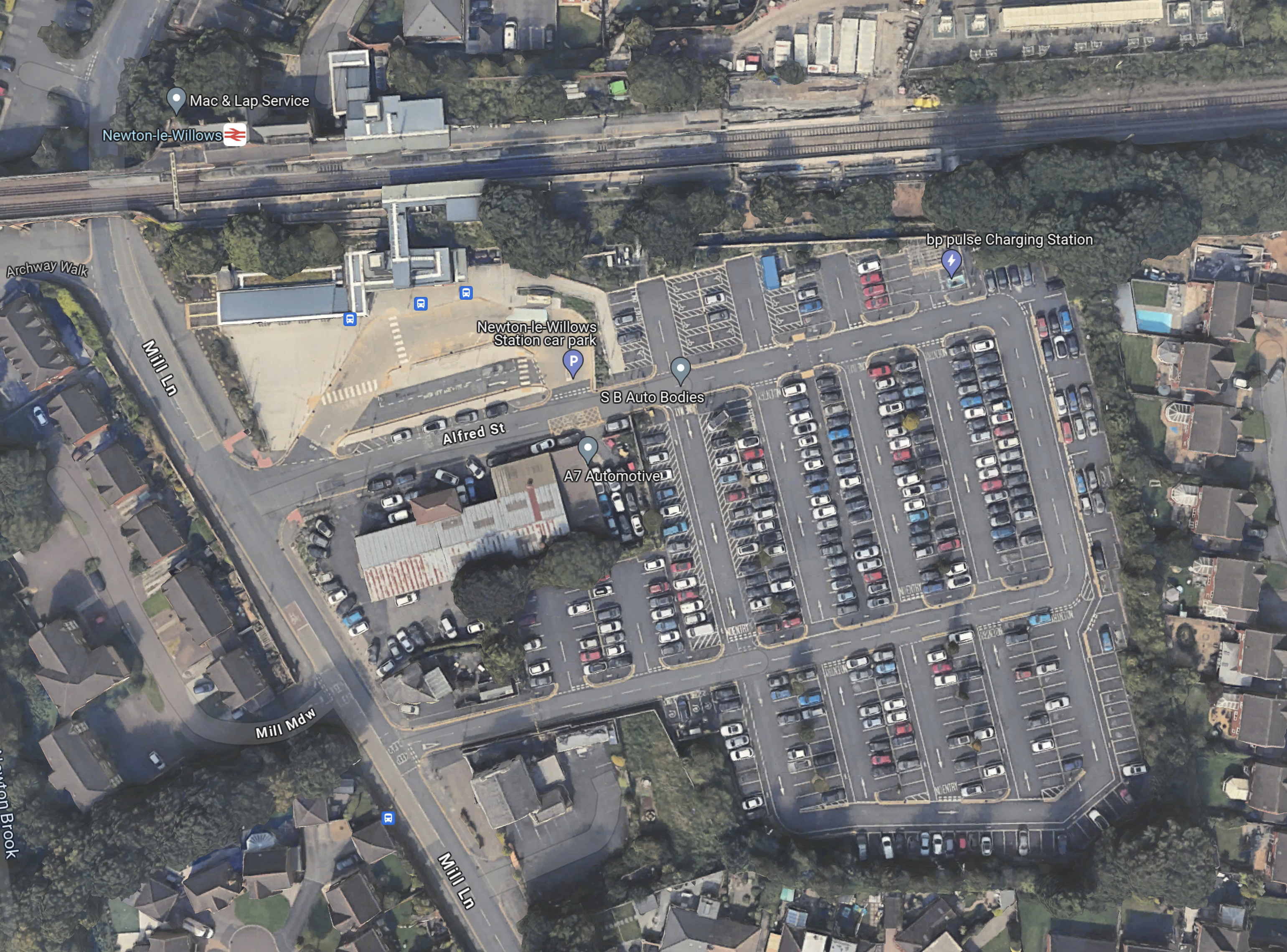
Note.
- The parking is all free!
- There are regular local trains to Chester, Leeds, Liverpool Lime Street, Manchester Airport and Wigan North Western.
A six trains-per-day service to and from London, will help fill up the parking spaces.
Eccles Station Is Within Walking Distance Of Eccles Interchange
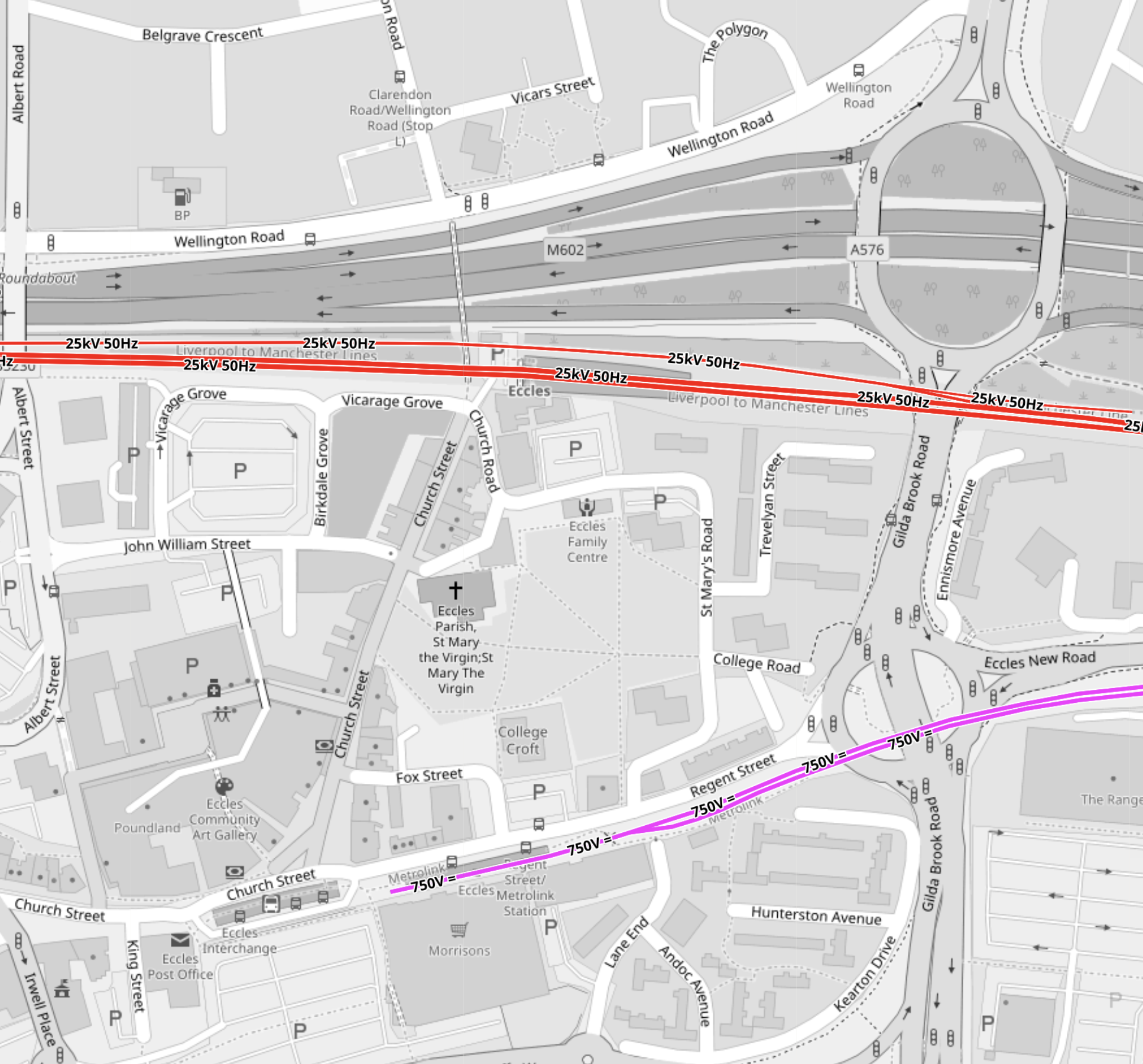
This OpenRailwayMap shows Eccles station and Eccles Interchange.
Note.
- The mauve tracks are the Manchester Metrolink.
- They terminate in the South-West at Eccles Interchange.
- The red tracks are the Liverpool-Manchester lines.
- Eccles station is a Northerly walk from Eccles Interchange.
This connection must be useful to more than a few.
I suspect if you’re going between London and Media City UK, Salford Quays or Piccadilly Gardens, you may be better to change to the Metrolink at Eccles.
Will Lumo’s Rochdale Service Run As A Flight With Avanti’s Glasgow Service?
Flighting is where two or more trains going on the same route run a few minutes apart.
- Every hour, on the half hour, an Avanti West Coast service for leaves London Euston for Glasgow Central.
- As with Lumo’s Rochdale service, the first stop is Warrington Bank Quay station.
- The Lumo service would leave London Euston a few minutes after Avanti’s Glasgow service.
- The distance between the two trains would be such, that if the first train stopped, the second train could stop safely.
- Digital signalling as is being installed on UK rail lines would make it easier to ensure safe separation.
But the benefit would be that both trains ran fast to Warrington Bank Quay station.
A Day-Trip To Manchester
If I’m right about the 2 hours and 15-21 minutes between London Euston and Manchester Victoria, then a day-trip would certainly be feasible.
Last Trains
This is a table of the last train times for Lumo between Newcastle and London.
- Weekdays – 20:27 21:35
- Saturdays – 18:27 19:22
- Sundays – 19:24 20:21
Note.
- The first time is the last Northbound departure.
- The second time is the last Southbound departure.
- Are these late enough for football matches?
I shall be interested to see the proposed last train times for the Manchester route.
- Will they be timed so you can get a tram from the Etihad or Old Trafford stadium after an evening match, that allowed you to get the last train back to London from Manchester Victoria?
- Taylor Swift gave the Manchester Arena a lot of favours with her concerts. Would you have been able to see her concert and get the last train back to London?
A few extra full trains wouldn’t hurt Lumo’s finances.
Conclusion
It looks like, this could be a very worthwhile service.
Could Open Access Operators Use High Speed Two?
In Mayors Propose New Staffordshire To Manchester Rail Line, I suggested the Grand Union Trains might like to run their service between London Euston and Stirling via High Speed Two.
But would this be a feasible idea?
These are my thoughts.
What Is An Open Access Operator?
The Wikipedia entry for Open-Access Operator, provide this answer.
In rail transport, an open-access operator is an operator that takes full commercial risk, running on infrastructure owned by a third party and buying paths on a chosen route and, in countries where rail services run under franchises, are not subject to franchising.
It then lists fifty-four operators in fifteen countries.
As the companies, who provide the services take full commercial risk and don’t get a subsidy from the taxpayer, I don’t see why, that providing, the operator can get the paths, they should be allowed to operate.
If they fail, then that’s the operator’s problem.
Are Any Paths Available On High Speed Two?
These are High Speed Two services as originally planned.
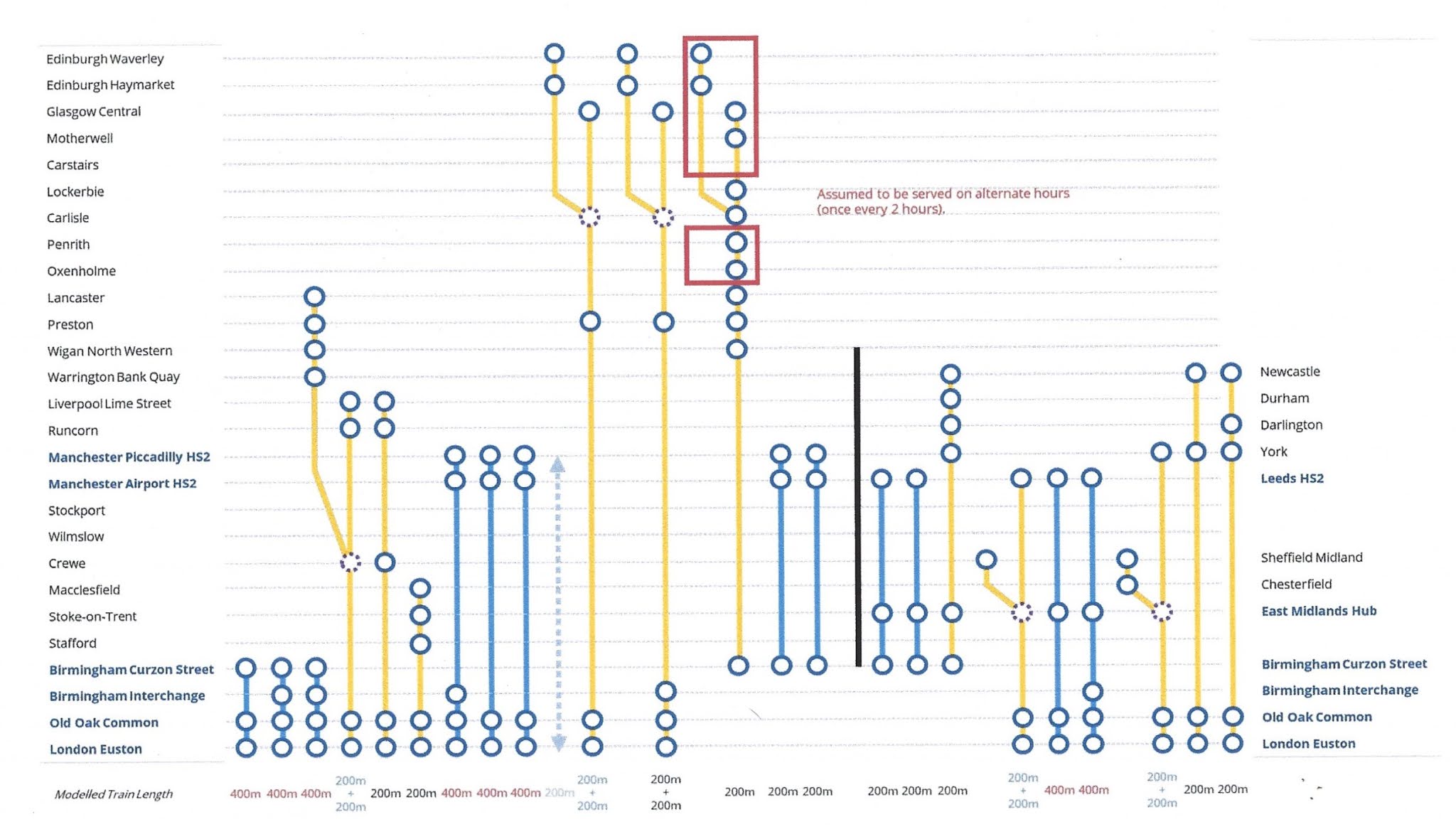
Since the Eastern Leg was cancelled, the following has happened.
- There are only eleven trains per hour (tph) between London Euston and Birmingham Interchange.
- There are only ten tph between Birmingham and Crewe.
- There is one tph between Birmingham and Macclesfield via Stafford and Stoke-on-Trent.
Note.
The Trent Valley Line section between Stafford and Crewe is 24.3 miles.
The Trent Valley Line between Handsacre Junction and Crewe is nearly all four tracks.
Currently, this section carries these fast trains.
- Avanti West Coast – 1 tph – London Euston to Blackpool North, Edinburgh or Glasgow via Birmingham New Street.
- Avanti West Coast – 1 tph – London Euston to North Wales
- Avanti West Coast – 1 tph – London Euston to Liverpool Lime Street
- Avanti West Coast – 2 tph – London Euston to Manchester Piccadilly
- Avanti West Coast – 1 tph – London Euston to Scotland
- West Midlands Trains – 1 tph – London Euston to Crewe.
- West Midlands Trains – 1 tph – Stafford to Crewe.
- West Midlands Trains – 1 tph – Birmingham New Street to Liverpool Lime Street.
This totals nine tph and will be 10 tph, when a second London Euston to Liverpool Lime Street is added.
When High Speed Two opens between London Euston and Birmingham Curzon and Handsacre Junction, trains between London Euston and Liverpool, Manchester, the North and Scotland will switch to the Trent Valley Line at Handsacre Junction.
The Trent Valley Line section between Stafford and Crewe will carry these fast trains.
- Avanti West Coast – 1 tph – London Euston to North Wales
- High Speed Two – 2 tph – London Euston to Liverpool Lime Street
- High Speed Two – 3 tph – London Euston to Manchester Piccadilly
- High Speed Two – 2 tph – London Euston to Scotland
- High Speed Two – 1 tph – Birmingham Curzon Street to Scotland
- High Speed Two – 2 tph – Birmingham Curzon Street to Manchester Piccadilly
- West Midlands Trains – 1 tph – London Euston to Crewe.
- West Midlands Trains – 1 tph – Stafford to Crewe.
- West Midlands Trains – 1 tph – Birmingham New Street to Liverpool Lime Street
Note.
- This totals to ten tph for High Speed Two, 1 tph for Avanti West Coast and the tph for West Midlands Trains.
- There is no service to Blackpool.
- It looks to me that the London Euston to North Wales should, as soon as the North Wales Coast Line is electrified become a High Speed Two service.
- Should the Birmingham New Street to Liverpool Lime Street service be replaced with a High Speed Two from Birmingham Curzon Street to Liverpool Lime Street?
There is plenty of paths South of Handsacre Junction on High Speed Two to accommodate a few services to Blackpool and an open access operator like Grand Union Trains, who have been given permission to run a service to Stirling.
Conclusion
My rough calculation says that open access services could be fitted in on the latest variant of High Speed Two.
In Mayors Propose New Staffordshire To Manchester Rail Line, the two Andies; Burnham and Street proposed that the Handsacre Junction and Manchester Airport section of High Speed Two should be built.
If this should happen, then it would open up several possibilities for open access services for the North.
Mayors Propose New Staffordshire To Manchester Rail Line
The title of this post, is the same as that of this article on Greater Birmingham Chambers of Commerce.
These five paragraphs introduce the article.
The mayors of the West Midlands and Greater Manchester have set out proposals for a new railway line between Staffordshire and Manchester Airport in a bid to improve connections to the north.
Work commission by West Midlands mayor Andy Street and Greater Manchester mayor Andy Burnham has concluded the new line is the preferred option to tackle congestion on the West Coast Mainline, following the government’s decision to curtail HS2 beyond Birmingham.
A private sector group – chaired by infrastructure expert Sir David Higgins – had been looking at three potential options to improve connectivity between Birmingham and Manchester.
The options included undertaking significant engineering upgrades to the West Coast Main Line, building bypasses at the pinch points on the line and building a new railway between Handsacre and Manchester Airport.
The group, convened by the mayors, is led by global engineering firm Arup with input from over 60 partners from six other firms – Arcadis, Addleshaw Goddard, EY, Dragados, Mace and Skanska.
This paragraph gives the conclusion.
The group has provisionally concluded that a new line – running approximately 70 miles between HS2 at Handsacre and Northern Powerhouse Rail at High Legh – is likely to offer the best combination of costs and benefits.
It looks to me, that this professional approach has led to a sensible answer.
I will now look at the route.
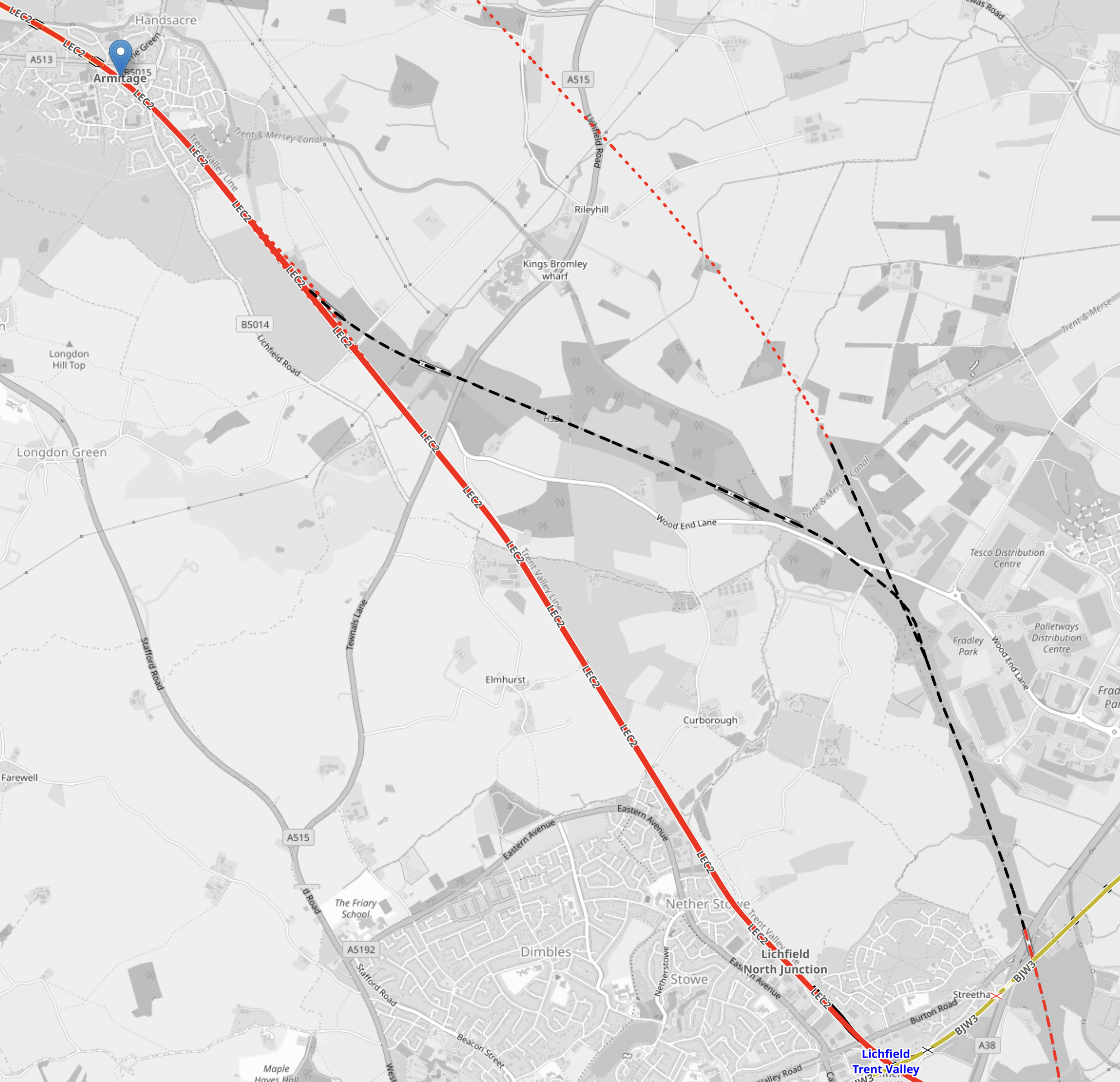
This Open Railway Map shows the tracks to the South of Handsacre.
Note.
- The blue arrow in the North-West corner of the map, indicates the location of the former Armitage station, which had the village of Handsacre to its North-East.
- The red line through Armitage station is the Trent Valley Line.
- Lichfield Trent Valley station is at the bottom of the map.
- The line drawn with large dashes from the South-East corner of the map is the proposed line of High Speed Two. Red indicates under construction and black indicates proposed.
High Speed Two splits into two.
One branch goes North-West to join the Trent Valley Line, whilst the other just stops after about a kilometre.
- All trains for Liverpool, Manchester, North Wales, The North and Scotland will take the Trent Valley Line, when High Speed Two opens.
- Trains for Stoke-on-Trent, Macclesfield and some to Manchester will leave the Trent Valley Line at Colwich Junction.
- All other trains, will take the same route as now and proceed to Crewe via Stafford.
The red dotted line leading from the cancelled branch of High Speed Two shows where the original fast line to Crewe was planned to go.
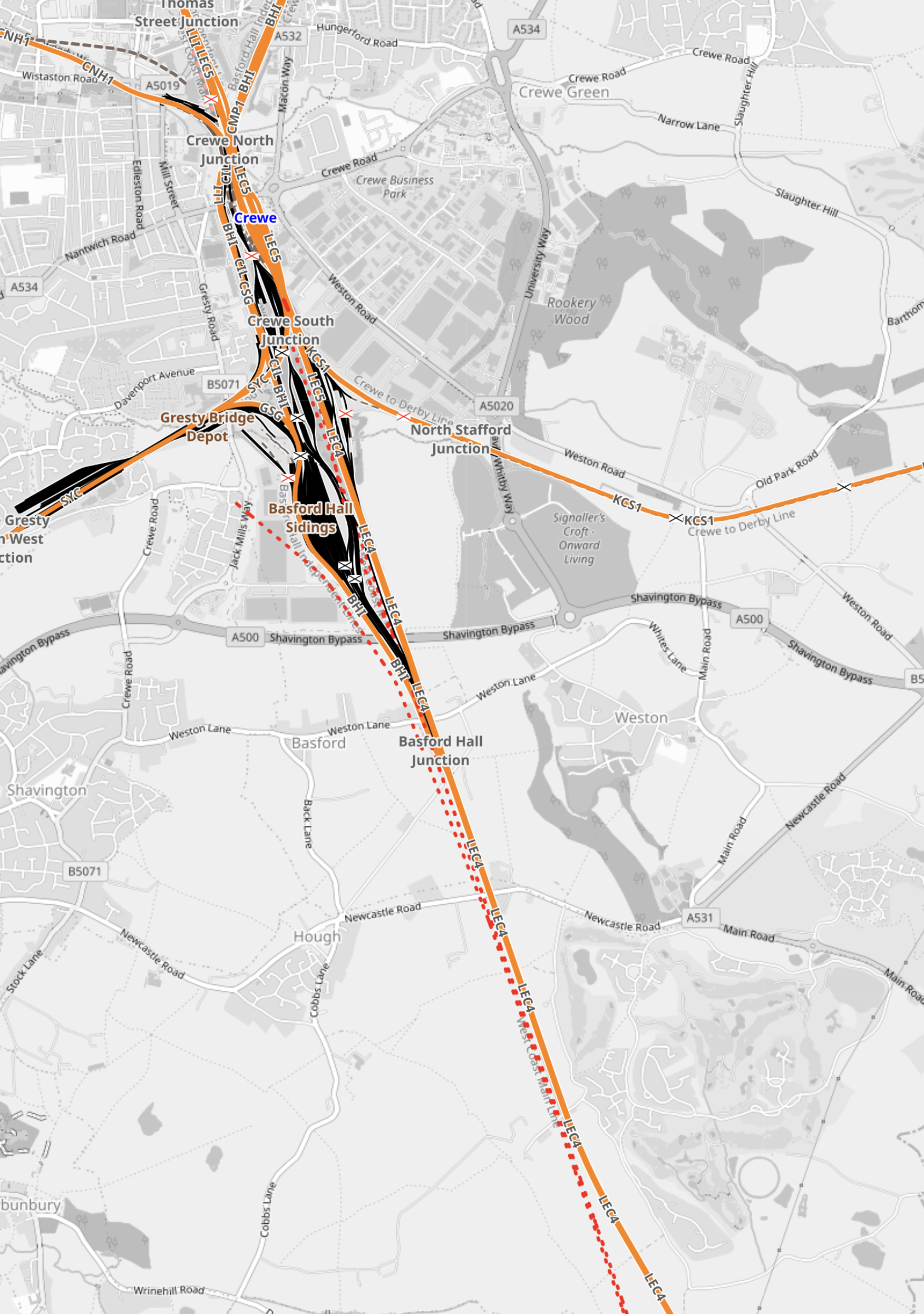
This Open Railway Map shows the tracks around Crewe.
Note.
- Crewe is the important junction station towards the North-West corner of the map.
- The orange line going South is the West Coast Main Line to The South and London.
- The red dotted line running along the West side of the West Coast Main Line was the proposed route of High Speed Two from Birmingham, London and the South.
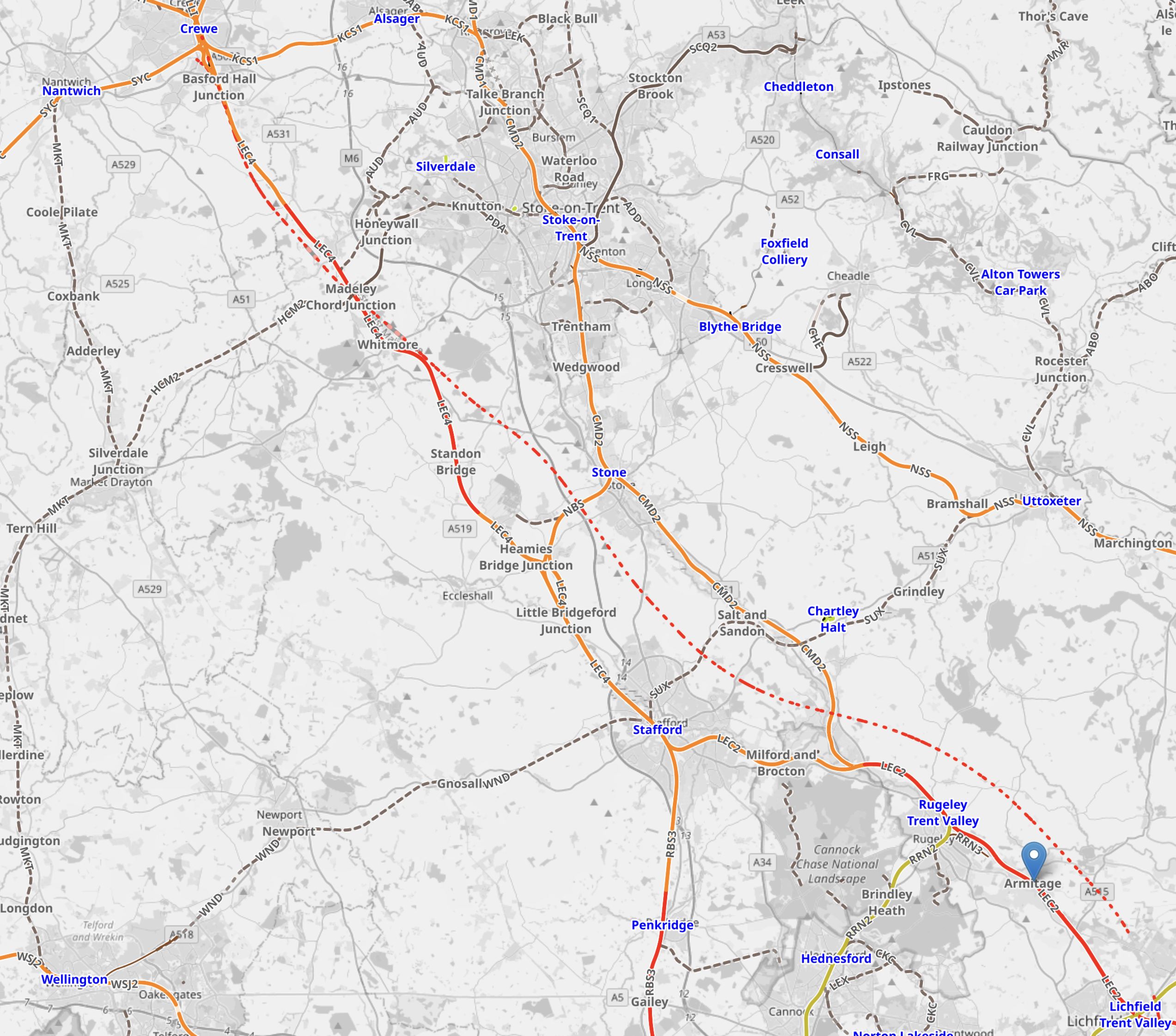
This Open Railway Map shows the originally proposed direct route of High Speed Two between Crewe and Handsacre.
Note.
- Crewe is in the North-West corner of the map.
- The blue arrow in the South-East corner of the map, indicates the location of the former Armitage station, which had the village of Handsacre to its North-East.
- The dotted red line was the originally proposed route of High Speed Two.
I feel that this route between Handsacre and Crewe has advantages if it were to be chosen as part of a route between Handsacre and Northern Powerhouse Rail, as recommended by the Mayors and their consultants.
- The route seems to stay well clear of large conurbations.
- A lot of the design work has been at least started and major problems will be known.
- Crewe is the only station on the route, which will need to be upgraded.
- Services to Liverpool, Manchester, North Wales, The North and Scotland will be speeded up.
- With Crewe, Liverpool and North Wales, times could be as High Speed Two promised in the first place.
I feel that building the Handsacre and Crewe section, as originally envisaged, will score high in a benefit/cost analysis
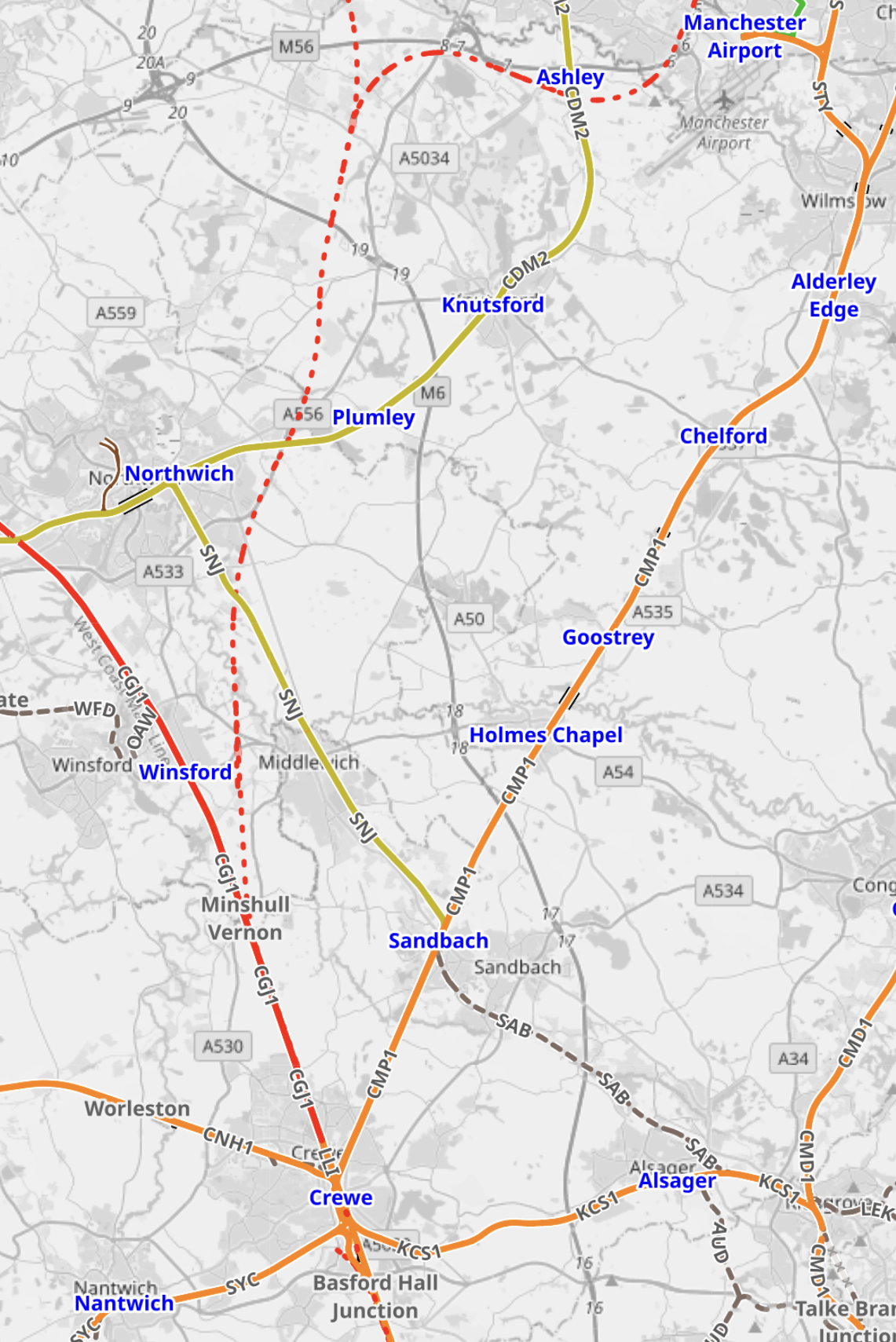
This OpenRailwayMap shows the originally proposed route of High Speed Two between Crewe and Manchester Airport.
Note.
- Crewe is towards the South-West corner of the map.
- Manchester Airport is in the North-East corner of the map.
- The red line going North from Crewe is the West Coast Main Line.
- The dotted red line was the originally proposed route of High Speed Two, between the West Coast Main Line and Manchester Airport.
Northern Powerhouse Rail will go West from Manchester Airport towards Warrington and Liverpool and will join with High Speed Two at a junction at High Legh.
Northern Powerhouse Rail is currently being planned, but surely, if High Speed Two and Northern Powerhouse Rail share a line from High Legh to Manchester Airport and Manchester Piccadilly, this will be a more affordable project.
Services To Crewe
In Could The High Speed Two Link Between Lichfield And Crewe Still Be Built?, which I wrote after much of High Speed Two was chopped in 2023, I said this.
Currently, Avanti West Coast trains take around one hour and thirty minutes between London and Crewe.
The Wikipedia entry for High Speed Two gives these times between London and Crewe.
- Fastest time before High Speed Two – one hour and thirty minutes.
- Time after Phase 2a of High Speed Two opens – fifty-six minutes.
Note.
- That is a time saving of thirty-four minutes.
- High Speed Two Trains will use the direct line between Lichfield and Crewe.
- High Speed Two will also add eighteen tph to the capacity between London and Crewe.
This would seem to mean that any trains going to or through Crewe will be thirty-four minutes faster, if they use High Speed Two between London and Crewe.
If the Handsacre and Crewe direct line is built, it looks like London and Crewe will be the full High Speed Two time of 56 minutes.
Services To Liverpool
Consider.
- Liverpool Lime Street was originally planned to get two trains per hour (tph) to and from London using High Speed Two.
- The approaches into Liverpool were improved a few years ago.
- No more improvements are planned between Crewe and Liverpool Lime Street stations.
- Between Crewe and Liverpool Lime Street stations currently takes 38 minutes.
- There could be time savings on the 16.3 miles between Crewe and Weaver Junction, which currently takes 21 minutes.
It looks like a time of one hour and 34 minutes could be possible, with under one hour and 30 minutes not being impossible.
Services To Manchester
Consider.
- Manchester was originally planned to get three tph to and from London using High Speed Two.
- No improvements are planned between Crewe and the Manchester stations.
- Between Crewe and Manchester Piccadilly stations currently takes 34 minutes.
It looks like a time of one hour and 30 minutes could be possible.
But there is still the option of building a new line between Crewe and Northern Powerhouse Rail at High Legh.
I showed this OpenRailwayMap earlier and it shows the originally proposed route of High Speed Two between Crewe and Manchester Airport.
Note.
- Crewe is towards the South-West corner of the map.
- Manchester Airport is in the North-East corner of the map.
- The red line going North from Crewe is the West Coast Main Line.
- The dotted red line was the originally proposed route of High Speed Two, between the West Coast Main Line and Manchester Airport.
Northern Powerhouse Rail is currently being planned. and will go West from Manchester Airport towards Warrington and Liverpool and will be built first.
A junction at High Legh will be built to link the West Coast Main Line to Northern Powerhouse Rail.
Services To North Wales
Why Not? With the cancellation of the Eastern Leg of High Speed Two, there must be a path available for North Wales.
Consider.
- The North Wales Main Line has been promised electrification.
- As Holyhead and Crewe is only 105.5 miles, it could even be in battery high speed train range in a few years.
- All times to and from Crewe are assumed to be as Avanti West Coast achieve now.
- As Crewe and Chester currently takes 23 minutes, London and Chester would take 1 hour and 19 minutes.
- As Crewe and Llandudno Junction currently takes 1 hour and 22 minutes, London and Llandudno Junction would take 2 hours and 18 minutes.
- As Crewe and Holyhead currently takes 2 hours and 7 minutes, London and Holyhead would take 3 hours and 3 minutes.
Could this open up a fast zero-carbon route between London and Dublin?
Services To Blackpool, Lancaster, Preston, Warrington And Wigan
Why Not, Blackpool? With the cancellation of the Eastern Leg of High Speed Two, there must be an extra path available, if it is needed.
Cpnsider.
- All routes are electrified.
- All times to and from Crewe are assumed to be as Avanti West Coast achieve now.
- As Crewe and Blackpool currently takes 1 hour and 20 minutes, London and Blackpool would take 2 hour and 16 minutes.
- As Crewe and Lancaster currently takes 60 minutes, London and Lancaster would take 1 hour and 56 minutes.
- As Crewe and Preston currently takes 40 minutes, London and Preston would take 1 hour and 36 minutes.
- As Crewe and Warrington Bank Quay currently takes 22 minutes, London and Warrington Bank Quay would take 1 hour and 18 minutes.
- As Crewe and Wigan North Western currently takes 33 minutes, London and Wigan North Western would take 1 hour and 29 minutes.
Note.
- Lancaster in under two hours will help the Eden Project Morecambe.
- For some areas of the North West, it might be more convenient to change at Crewe, Warrington Bank Quay, Wigan North Western or Preston.
Improvements to track and signalling could probably bring benefits.
Services To Carlisle And Central Scotland
Cpnsider.
- All routes are electrified.
- All times to and from Crewe are assumed to be as Avanti West Coast achieve now.
- As Crewe and Carlisle currently takes 1 hour and 55 minutes, London and Carlisle would take 2 hours and 51 minutes.
- As Crewe and Lockerbie currently takes 2 hours and 6 minutes, London and Lockerbie would take 3 hours and 1 minute.
- As Crewe and Motherwell currently takes 2 hours and 45 minutes, London and Motherwell would take 3 hours and 41 minutes.
- As Crewe and Edinburgh currently takes 3 hours and 9 minutes, London and Edinburgh would take 4 hours and 5 minutes.
- As Crewe and Glasgow Central currently takes 3 hours and 3 minutes, London and Glasgow Central would take 3 hours and 59 minutes.
Note.
- Just under four hours to Glasgow Central would please the Marketing Department.
- Selective splitting and joining could increase the number of destinations.
Improvements to track and signalling could probably bring benefits.
Services To Stirling
In ORR: Open Access Services Given Green Light Between London And Stirling, I wrote about Grand Union Trains’s new open access service to Stirling.
There has been good feedback on this service, so perhaps one of the spare paths on High Speed Two could be allocated to Open Access Operators, so that more of the country could have a high speed service to London Euston and Birmingham Curzon Street stations.
In the related post, I showed that London Euston and Stirling takes forty five minutes longer than a London Euston and Motherwell service.
This would mean that a London Euston and Stirling service via High Speed Two would take four hours and 26 minutes.
Services Between Birmingham Curzon Street and the North West
Under the plans for High Speed Two, the following services would have run North from Birmingham Curzon Street.
- One tph to Edinburgh or Motherwell and Glasgow via Wigan North Western, Preston, Lancaster, Oxenholme, Penrith, Carlisle, Lockerbie and Carstairs.
- Two tph to Manchester Airport and Manchester Piccadilly.
But there are now spare paths South of Crewe, so Could a one tph Birmingham Curzon Street and Liverpool Lime Street service be squeezed in?
Could The Line Be Privately Financed?
I suspect that building the section between Handsacre and Crewe could be financed in perhaps a similar way, to the Chiltern improvements or the M6 Toll Road were financed.
- The Handsacre and Crewe section is just a simple stretch of rail, with a number of trains passing along it.
- The number of trains passing through, is likely to increase.
- Every train passing through would pay a track charge, just as they do to Network Rail.
- Those with lots of money to lend, like simple projects like wind farms or road tunnels, but think very hard about anything complicated like nuclear power stations or High Speed Two’s station at Euston.
Certainly, my late and very good friend, David, who dealt with the finance of some of London’s largest projects and was on the top table of London’s bankers, would have found a way. It might though have been unorthodox.
But then David was a rogue. But a rogue on the side of the angels.
Conclusion
I have come to these conclusions.
- Building the direct route between Handsacre and Crewe could be good value as it improves all routes that will pass through Crewe.
- Combining High Speed Two and Northern Powerhouse Rail could substantially cut the costs of both routes to the centre of Manchester.
- London and Crewe times should be 56 minutes.
- London and Liverpool Lime Street times could be under one hour and thirty minutes.
- London and Manchester Piccadilly times could start at one hour and thirty minutes and reduce when Northern Powerhouse Rail is built and linked to the West Coast Main Line.
- London and Holyhead could be just over three hours and could open up a fast zero-carbon route between London and Dublin.
- London and Lancaster in under two hours could help the Eden Project Morecambe.
It’s certainly not a bad plan and it should be looked at in more detail.
Is Alstom’s Proposal For A Service Between London Euston And Wrexham Part Of A Cunning Plan?
Alstom have built and introduced into service between Buxtehude and Cuxhaven in Germany, the Coradia iLint hydrogen-powered train. The prototype has performed demonstrations in Austria, Canada, The Netherlands and Saudi Arabia.
This picture shows a Coradia iLint in Germany.

In the UK, Alstom had a plan to convert redundant Class 321 trains into a fleet of hydrogen-powered trains called Breeze, which I wrote about in Hydrogen Trains Ready To Steam Ahead, in January 2019.
This visualisation is from Alstom.
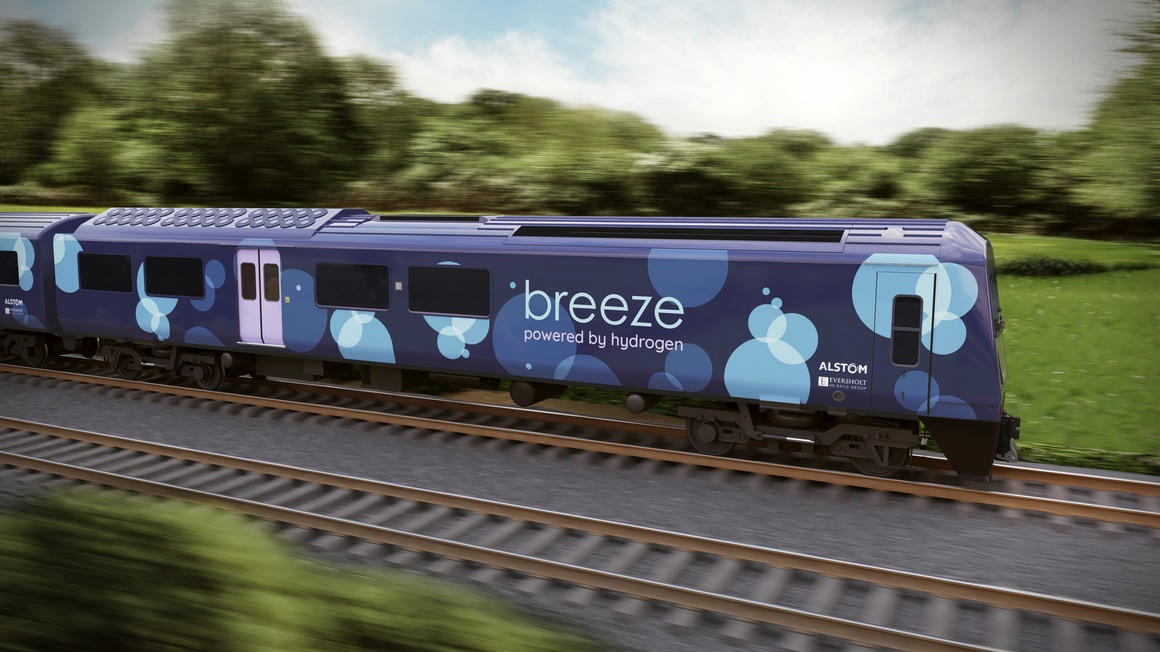
I suspect it didn’t appeal to train companies, as no orders appear to have been received.
But you can’t criticise Alstom for not trying, as in November 2021, they signed an agreement with Eversholt Rail Group to develop a hydrogen-powered Aventra, which I wrote about in Alstom And Eversholt Rail Sign An Agreement For The UK’s First Ever Brand-New Hydrogen Train Fleet.
This visualisation is from Alstom.
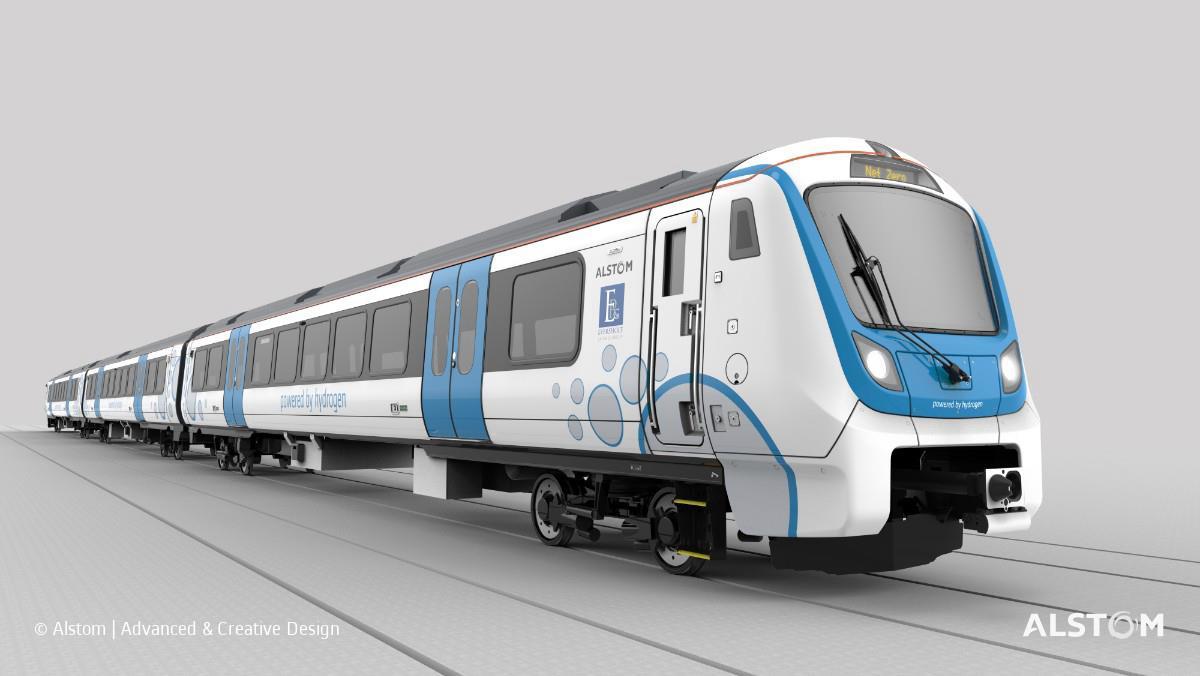
Visually, it looks just like any other Aventra and much better than the previous Breeze design.
In March 2018, I wrote Bombardier Bi-Mode Aventra To Feature Battery Power, which was based on this article in Rail Magazine.
These are a few points from the article.
- Development has already started.
- Battery power could be used for Last-Mile applications.
- The bi-mode would have a maximum speed of 125 mph under both electric and diesel power.
- The trains will be built at Derby.
- Bombardier’s spokesman said that the ambience will be better, than other bi-modes.
- Export of trains is a possibility.
- Bombardier’s spokesman also said, that they have offered the train to three new franchises. East Midlands, West Coast Partnership and CrossCountry.
Have Alstom looked at what they bought from Bombardier and decided the following train is possible, if they add some of their technology?
- A train the size needed by the customer, up to a length of at least ten cars.
- 125 mph under 25 KVAC overhead electrification.
- 100 mph with 750 VDC third rail electrification.
- Running on hydrogen away from electrification.
- 100 mph maximum speed running on hydrogen.
- A range of perhaps 500 miles, if it can emulate the hydrogen-powered Coradia iLint.
A train with this specification would have several applications in the UK.
- Fully-electric routes.
- Electric routes with perhaps a hundred miles of unelectrified track.
- Scenic routes, where the Nimbies wouldn’t like electrification.
These points should also be born in mind.
- There are now 110 mph Aventras in service with West Midland Trains on the West Coast Main Line.
- I recently came back from Cardiff to London in a twelve-car Class 387 train and there wasn’t too many unhappy passengers. It was certainly better than a rail replacement bus. I wrote about the trip in Cardiff To Reading In A Class 387 Train.
- Alstom believe you can certainly fit their hydrogen gubbins in an Aventra.
- The hydrogen gubbins appear to be from Cummins, who have a worldwide support network.
- Cummins can also supply complete hydrogen support systems. A truck can refuel the train, at one end of the route?
- Alstom have been doing the market research with the hydrogen-powered Coradia iLint, so I suppose they know what the market needs.
Could Alstom, with help from Cummins, have a zero-carbon 200 kph train and support systems, which has a hydrogen range of up to a thousand kms for export markets like the United States, Africa, Australia, India and South America?
Two big world-leading companies are surely better than one!
But Alstom has one big problem!
How do you fully test a 125 mph hydrogen-powered train?
- I know with aircraft, if you change the engine type on an existing aircraft, you only have to certify the engine and this is done on a Supplementary Type Certificate.
- Is it the same with trains, so a 110 mph Class 730 train, which is in service with West Midlands Trains, could be the basis of certifying a hydrogen-powered Aventra?
- The Coradia iLint was only a change from diesel to a hybrid hydrogen-electric engine, so was it certified this way?
- With the Coradia iLint, it seemed to go into service quite quickly, so did it do much of the testing in service?
I looks to me, that London Euston and Wrexham is an ideal route for a hydrogen bi-mode 125 mph train.
- The route has electrified sections, some of which have high operating speeds.
- The route has a convenient hydrogen supply from INEOS at Runcorn at the Northern end.
- Change between hydrogen and electric power would always take place in a station.
- A round trip needs less than 200 miles of running on hydrogen.
- South of Nuneaton, no hydrogen is used, so the train will be like a Class 730 train, that already uses the route.
- There are depots that can service Aventras on the route.
It is certainly a possibility, that the London Euston and Wrexham service will be used to test and showcase Alstom’s new Hydrogen Aventra.
Alstom Plans To Operate Its Own Passenger Train Service In The UK For The First Time
The title of this post, is the same as that of this press release from Alstom.
These two bullet points, act as sub-headings.
- Alstom is partnering with SLC Rail to form a new open access rail operation between North Wales, Shropshire, the Midlands and London
- Formal application now being submitted to the Office of Rail and Road (ORR) with passenger service sought from 2025
These are the first three paragraphs.
Alstom, global leader in smart and sustainable mobility, plans to operate a new passenger rail service across England and Wales. Working in partnership with consultancy SLC Rail, the open access operation will be known as Wrexham, Shropshire and Midlands Railway (WSMR).
As the country’s foremost supplier of new trains and train services, and a leading signalling and infrastructure provider, Alstom will operate its own rail service in the UK for the first time.
WSMR is seeking to introduce direct connectivity to and from North Wales, Shropshire, the Midlands and London that doesn’t exist today, linking growing communities and businesses, and making rail travel more convenient, enjoyable and affordable.
I can’t remember a service proposal being put forward by a train manufacturer since the privatisation of UK’s railways in the 1990s.
This is some more information and my thoughts.
The Route
This paragraph from the press release, describes the route.
The proposal envisages a service of five trains per day in each direction Monday to Saturday, with four travelling both ways on Sundays. Trains will stop at Gobowen, Shrewsbury, Telford Central, Wolverhampton, Darlaston, Walsall, Coleshill Parkway, Nuneaton and Milton Keynes on their journey between Wrexham General and London Euston.
Note.
- The proposed call at the new Darlaston station.
- The route is electrified between Euston and Nuneaton and Walsall and Wolverhampton.
- Much of the route North of Nuneaton is on tracks with a maximum speed of 70-80 mph.
The route is in these sections.
- Euston and Nuneaton – 96.7 miles – electrified
- Nuneaton and Walsall – 26.7 miles
- Walsall and Wolverhampton – 6.7 miles – electrified
- Wolverhampton and Shrewsbury – 29.7 miles
- Shrewsbury and Wrexham General – 30.3 miles
That is a total of 190.1 miles or 380.2 miles round trip.
I suspect that the service will need bi-mode trains.
Should The Service Call At Wellington?
This article on the BBC is entitled Rail Company Urged Not To Forget Wellington.
This is the sub-heading.
A rail company which is bidding to bring back a direct service between Shropshire and London has been urged not to forget a town.
These are the first three paragraphs.
Wrexham, Shropshire and Midlands Railway said it was preparing to apply to the government to run the service.
Trains would stop at Gobowen, Shrewsbury, Telford, Wolverhampton, Walsall, Coleshill and Nuneaton.
But Telford and Wrekin Council said the omission of Wellington as a stop was “short-sighted”.
Although Wellington is smaller than than Shrewsbury and Telford, it looks like a bit of analysis would provide a solution, that would be acceptable for all parties.
The Trains
In the press release, this phrase is used.
positive impact to both communities and the environment.
I can’t see any more electrification being erected on the route, so the trains will need to be bi-mode.
- Bi-mode diesel trains won’t have a positive impact on the environment.
- As the route between Wolverhampton and Wrexham General is not electrified, a battery-electric train would need a range of at least 60 miles or 120 miles for the round trip, if there were no charging at Wrexham General.
- But Alston are developing a Hydrogen Aventra, which I wrote about in Alstom And Eversholt Rail Sign An Agreement For The UK’s First Ever Brand-New Hydrogen Train Fleet.
So could Alstom be using this route to trial and showcase their new Hydrogen Aventra?
I believe that the route will be very suitable for a hydrogen train.
- Changeover between electric and hydrogen power can always take place in a station.
- All hydrogen refuelling could be performed at one end of the route.
- A large proportion of the UK’s green hydrogen is produced by INEOS at Runcorn, which is less than fifty miles from Wrexham. A refuelling tanker could supply the train, as they do on some hydrogen routes in Germany.
- London has only small amounts of hydrogen infrastructure.
I suspect that refuelling will be done at the Wrexham end of the route.
This Alstom visualisation shows the train.
But it is only a three-car train.
- That is not a problem, as Aventras can be lengthened as required to the length required for the number of passengers.
- Some Aventras, like the Class 701 trains for South Western Railway, have even been ordered as ten-car trains.
- Two three-car trains may also be the ideal capacity, running as a six-car train.
So capacity will not be a problem.
If it is assumed that Alstom’s trains for the WSMR route, can use the overhead wires, where they exist, each trip between Wrexham General and London will require a total of 86.7 miles or 140 kilometres of running on hydrogen.
- A round trip will therefor require 280 kilometres of running on hydrogen.
- But between London Euston and Nuneaton, it will just be another electric train.
- I suspect that like the similar Class 730 train, it will be capable of 110 mph on the West Coast Main Line.
- Alstom’s Coradia iLint hydrogen train has a range of around a 500-800 kilometres on hydrogen.
- The WSMR trains will probably be 100 mph trains using hydrogen on a route, where that speed is possible.
So if a Hydrogen Aventra has a similar range to the Coradia iLint, it will be able to do two round trips before refuelling.
How Long Will The Service Take?
West Midlands Trains, who use the similar Class 730 trains take one hour and eleven minutes between London Euston and Nuneaton with a single stop at Milton Keynes Central.
As the WSMR trains will use the same route, I suspect the same time can be used.
As Nuneaton and Wrexham General are 93.4 miles apart a table can be created showing the time for the rest of the journey for different average speeds
- 50 mph – 1 hour 52 minutes – 3 hours 3 minutes.
- 60 mph – 1 hour 33 minutes – 2 hours 44 minutes.
- 70 mph – 1 hour 20 minutes – 2 hours 31 minutes.
- 80 mph – 1 hour 10 minutes – 2 hours 21 minutes.
Note.
- The first time is the Nuneaton and Wrexham General time and the second time is the overall journey time.
- Typical Avanti West Coast services via Crewe and a change at Chester, take between two-and-a-half and three hours.
I suspect, if the WSMR trains can keep the speed up through the Midlands, that two hours and 30 minutes could be possible.
Could The Hydrogen Aventra Run At 125 mph Under The Wires?
In March 2018, I wrote Bombardier Bi-Mode Aventra To Feature Battery Power, which was based on this article in Rail Magazine.
These are a few points from the article.
- Development has already started.
- Battery power could be used for Last-Mile applications.
- The bi-mode would have a maximum speed of 125 mph under both electric and diesel power.
- The trains will be built at Derby.
- Bombardier’s spokesman said that the ambience will be better, than other bi-modes.
- Export of trains is a possibility.
- Bombardier’s spokesman also said, that they have offered the train to three new franchises. East Midlands, West Coast Partnership and CrossCountry.
Have Alstom looked at what they bought from Bombardier and decided the following train is possible?
- Five-cars or what the customer needs.
- 125 mph under the wires.
- Running on hydrogen away from the wires.
- 100 mph on tracks without electrification.
Obviously, maximum speeds would depend on track limits.
Looking at 125 mph Avanti West Coast trains that have a Milton Keynes stop between London Euston and Nuneaton, they can reach Nuneaton ten minutes quicker than West Midlands Trains 110 mph Class 730 trains.
Two hours and 30 minutes between London Euston and Wrexham is looking increasingly possible.
Are we seeing an audacious proposal from Alston to sell new trains to CrossCountry and a host of other franchises?
Conclusion
London Euston and Wrexham would appear to be an excellent route for an Aventra-based hydrogen train.
- It can probably cruise at 110 mph on the West Coast Main Line between London Euston and Nuneaton.
- All switchovers between electrification and hydrogen can be performed in electrified stations.
- Hydrogen would only be used North of Nuneaton.
- The train can be refuelled at Wrexham General, with fuel supplied from INEOS at Runcorn.
- Given the typical 1000 km. range of hydrogen trains, a train can probably do three round trips without refuelling.
I can see this being a service with an excellent operational record.
ORR: Open Access Services Given Green Light Between London And Stirling
The title of this post is the same as that of this press release from the Office of Rail and Road.
This is the sub-heading.
The latest access decision by the Office of Rail and Road (ORR) provides more services for rail passengers travelling between London and central Scotland.
These five paragraphs detail the ORR’s decision.
ORR has today (7 March) given the go-ahead for Grand Union Trains, an open access operator, to start a new train service between London and the city of Stirling, from June 2025. ORR’s decision will offer more choice to passengers, bring private sector investment to the railway and increase competition.
Grand Union Trains will introduce four new return services per day between London Euston and Stirling stations. These services will also call at Milton Keynes Central, Nuneaton, Crewe (subject to agreement between Grand Union Trains and Network Rail), Preston, Carlisle, Lockerbie, Motherwell, Whifflet, Greenfaulds and Larbert. Larbert, Greenfaulds and Whifflet will receive their first direct services to London.
ORR found that the proposed services would increase choice for passengers, significantly increasing direct journey opportunities to and from London and central and southern Scotland, while making use of existing capacity on the network.
The new services will be the first run by an open access operator on the West Coast Mainline. Open access operators run services independently of government funding as they do not have a franchise agreement with government.
Following ORR’s decision to approve new Grand Union Trains services between Carmarthen in south Wales and London Paddington in 2022, ORR has now approved open access services on three of Britain’s major routes.
Note.
- The Grand Union service appears to be running into London Euston. Earlier plans had it terminating at Queen’s Park station.
- Larbert, Greenfaulds and Whifflet will receive their first direct services to London.
- London Euston and Stirling is electrified all the way.
- The third open access service, that the ORR has approved is the Lumo service between King’s Cross and Edinburgh via the East Coast Main Line.
I have a few thoughts.
Stirling Is An Ideal Place To Explore Central Scotland By Train
In Stirling, I give the reasons, why I spent a couple of days in Stirling, when I wanted to visit several places in Central Scotland.
Note.
- Stirling has direct services to Aberdeen, Dundee, Edinburgh, Glasgow, Inverness and Perth.
- Aberdeen is one hour and 15 minutes away.
- Dundee is just 63 minutes away.
- Edinburgh is just 48 minutes away.
- Glasgow is just 39 minutes away.
- Inverness is two hours and 46 minutes away.
Stirling has about a dozen affordable hotels and guest houses within walking distance of the station, as this map shows.
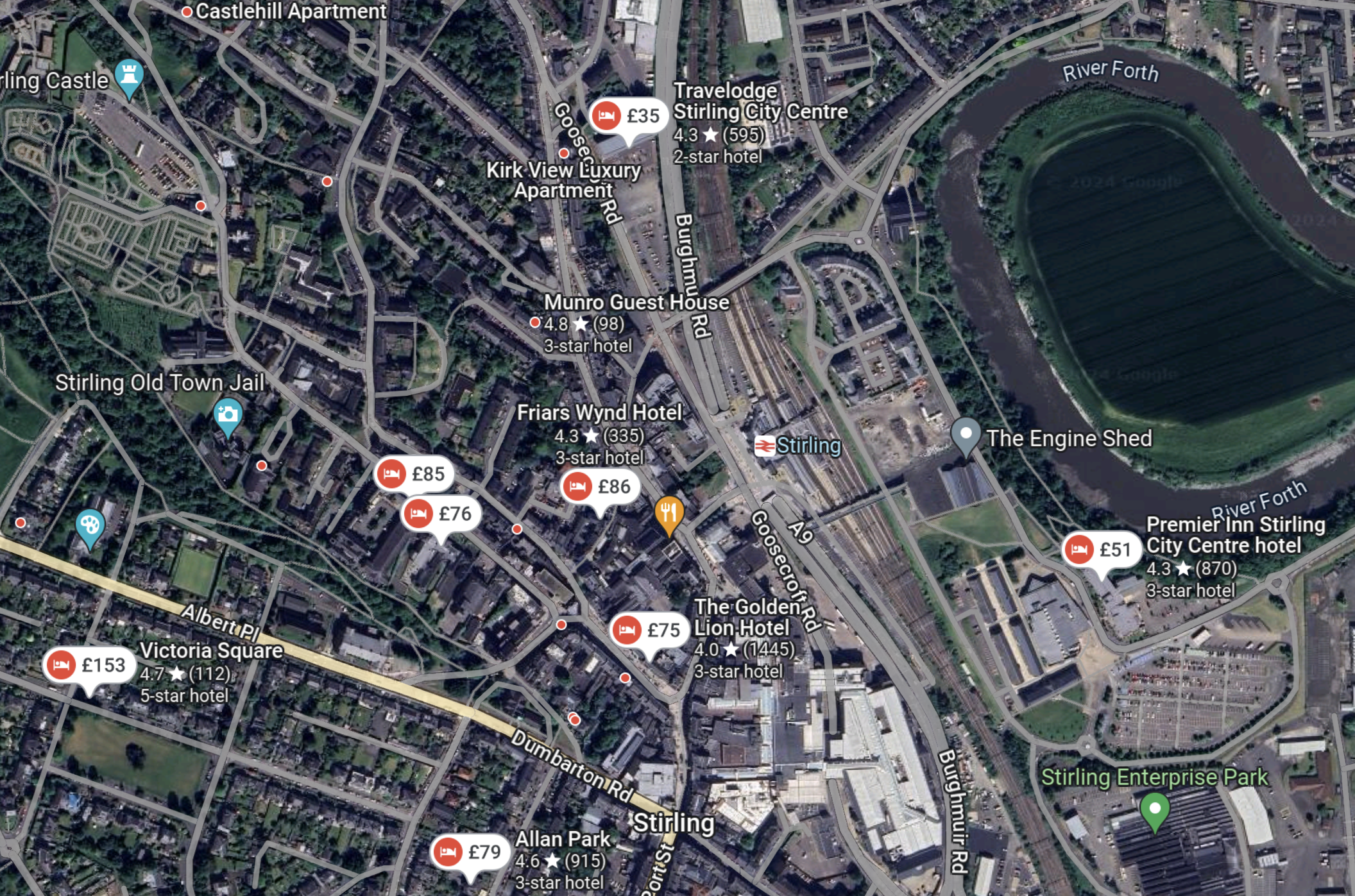
Stirling would appear to have got Central Scotland covered.
Could The Train Serve Gleneagles?
Gleneagles is about twenty minutes North of Stirling and is served by the Caledonian Sleeper from London.
This Google Map shows the area around Gleneagles station.
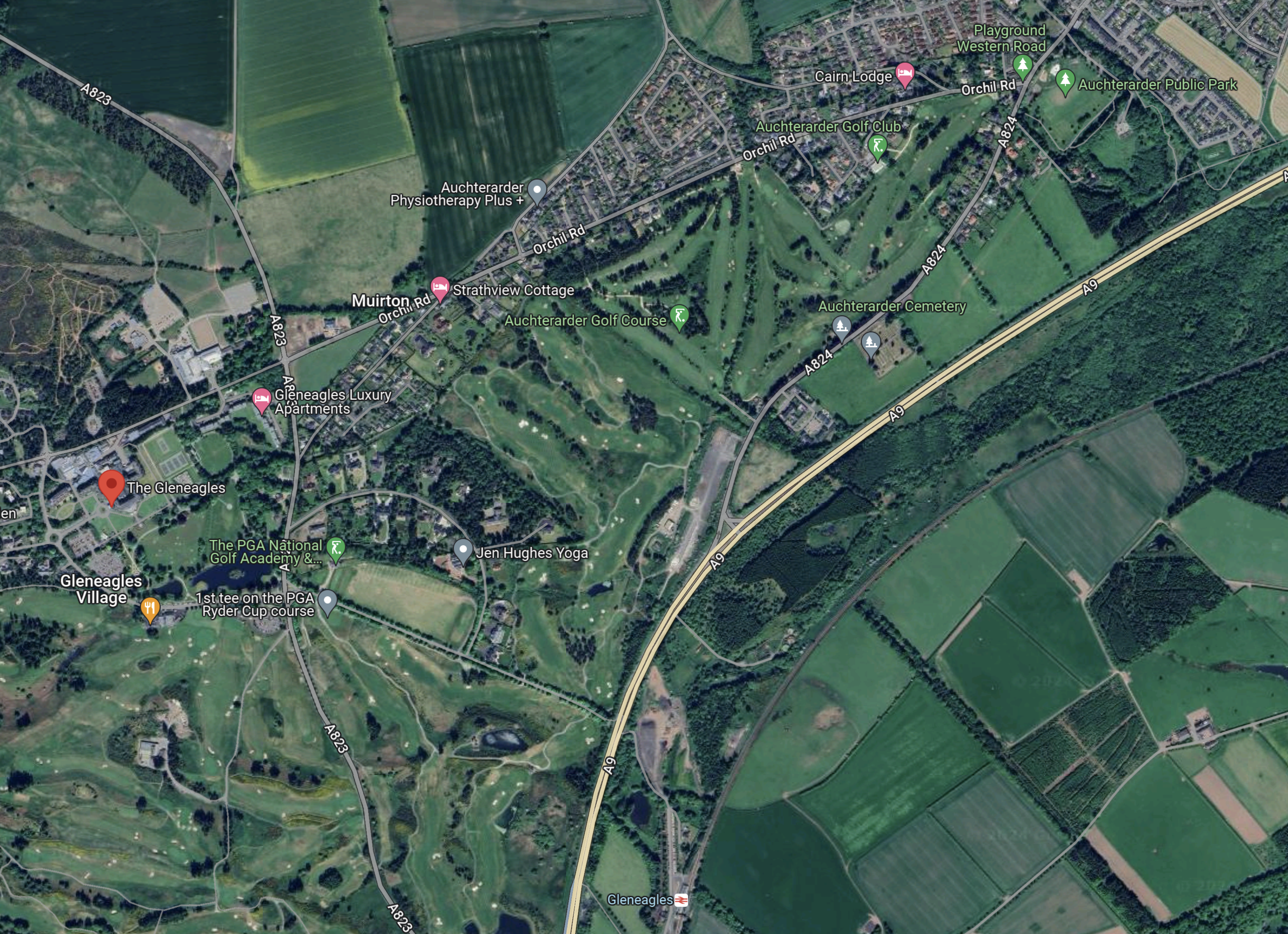
Note.
- Gleneagles station is at the bottom of the map.
- The red arrow indicates the famous Gleneagles hotel.
- The pink dots are other hotels.
- Airbnb lists several very splendid properties in the varea.
Not everybody, who goes to the Gleneagles area will be exceedingly rich and I could see the Gleneagles area generating substantial business for Grand Union Trains. I suspect the best way to serve Gleneagles would be a zero-emission coach from Stirling.
Along The Motherwell And Cumbernauld Line
Between Motherwell and Stirling, a lot of the route used is on the Motherwell and Cumbernauld Line.
- The line is fully-electrified.
- It is only 28.9 miles between Motherwell and Stirling.
- \cumbernaukd and Motherwell takes 20 minutes.
I do wonder, if extra stops might be worthwhile.
Motherwell Has Good Connections To Edinburgh And Glasgow
As well as Stirling, Motherwell has good connections to both Edinburgh and Glasgow, so some passengers might find their most convenient route involves a change at Motherwell.
Nuneaton And Scotland Would Get A New Service
Nuneaton has been named by Avanti West Coast, as a place that needs more trains, as it connects with the service between Birmingham and Stansted Airport, via Coleshill Parkway, Leicester, Peterborough, March, Ely and Cambridge.
I suspect that, Nuneaton will become an interchange, between East Anglia and, the North West and West Scotland.
Milton Keynes And Scotland Should Get An Improved Service
Consider.
- It appears that all Avanti West Coast services between Milton Keynes and Scotland, go via Birmingham.
- I suspect that Grand Union’s route using the Trent Valley Line could be faster with similar trains.
- Creating a new route between Milton Keynes and Stirling could be a good move, as it gives one-change access to much of Central Scotland.
- Milton Keynes has good local connections to places like Northampton, Rugby, Tring and Watford Junction.
- Milton Keynes will be a stop on the new East-West Railway.
- From many stations, it will be quicker to go via Milton Keynes rather than Euston.
I suspect Milton Keynes could be a nice little earner.
Will Grand Union’s Trains Be Fitted With Digital Signalling?
Consider.
- At some point in the next ten years the West Coast Main Line will be fitted with digital signalling, to enable trains to run at 140 mph on selected parts of the route.
- Digital signalling will allow extra services between London Euston and Motherwell.
- Motherwell and London Euston is 388 miles.
I suspect, that Grand Union’s Trains will need to be fitted with digital signalling, so they can save time on services and possibly add in a few more.
It will add costs, although the faster speed will surely attract passengers.
Will Grand Union’s Trains Be Electric?
There are these train services going between England and Scotland.
- Avanti West Coast – London Euston to Edinburgh Waverley via Birmingham New Street – 7 tpd – Class 390 – Electric
- Avanti West Coast – London Euston to Glasgow Central via Birmingham New Street – 5 tpd – Class 390 – Electric
- Avanti West Coast – London Euston to Glasgow Central via Trent Valley – 1 tph – Class 390 – Electric
- CrossCountry – Plymouth to Edinburgh Waverley – 1 tph – Class 220/221 – Diesel – Uses diesel all the time
- LNER – London King’s Cross/Leeds to Aberdeen – 4 tpd – Class 800 – Bi-mode – Uses diesel North of Edinburgh
- LNER – London King’s Cross to Inverness – 1 tpd – Class 800 – Bi-mode – Uses diesel North of Stirling
- LNER – London King’s Cross to Edinburgh Waverley – 3p2h – Class 800 – Bi-mode or Class 801 – Electric
- LNER – London King’s Cross to Glasgow Central – 1 tpd – Class 801 – Electric
- LNER – London King’s Cross to Stirling – 1 tpd – Class 801 – Electric
- Lumo – London King’s Cross to Edinburgh – 5 tpd – Class 803 – Electric
- TransPennine Express – Newcastle to Edinburgh Waverley – 7 tpd – Class 802 – Bi-mode
- TransPennine Express – Liverpool Lime Street to Glasgow Central – 2 tpd – Class 397 – Electric
- TransPennine Express – Manchester Airport to Edinburgh Waverly – 1 tp2h – Class 397 – Electric
- TransPennine Express – Manchester Airport to Glasgow Central – 1 tp2h – Class 397 – Electric
Note.
- tpd is trains per day.
- tph is trains per hour.
- tp2h is trains per two hours.
- LNER services to Glasgow and Stirling are likely to be dropped.
- Some Lumo services are likely to be extended from Edinburgh to Glasgow.
- Many services South from Stirling to Edinburgh Waverley and Glasgow Queen Street are electric.
The current two tpd direct trains to Stirling are electric and if you change at Edinburgh Waverley or Glasgow, it is likely to be an all-electric service.
For marketing reasons, I would recommend, that Grand Union Trains ran electric trains between London Euston and Stirling, as they are competing against an all-electric service.
Although to meet service dates it might be necessary to run something like a diesel Class 222 train to get the service started.
What Trains Will Grand Union Use?
The Wikipedia entry for Grand Union Trains, says this for their London Euston and Stirling service.
In 2023 Grand Union revised its proposal changing its planned rolling stock to Class 22x units, at the same time the start date for this service was changed to June 2025.
I would suspect they will put in the order for new electric trains fairly sharpish.
The new trains could be.
- A variant of Hitachi’s Class 800 trains.
- A variant of CAF’s Class 397 trains.
Would they have an emergency battery un case of overhead line failure?
How Long Will A Service Take?
The service can be divided into two sections.
- London Euston and Motherwell – 388 miles.
- Motherwell and Stirling – 28.9 miles.
Note.
- The 08:30 train from Euston to Motherwell takes 4 hours and 17 minutes with six stops via Nuneaton.
- The Grand Union Trains service will also have six stops and go via Nuneaton.
I would expect with today’s signalling and electric trains, that Euston and Motherwell would take a maximum of 4 hours and 17 minutes.
- The twenty minute time to Cumbernauld could be added.
- The twenty-five minute time between Cumbernauld and Stirling could be added.
It looks the time would be just over five hours.
I doubt there would be much scope for increasing speed North of Motherwell, but could there be savings made to the South of Motherwell?
Consider.
- London Euston and Motherwell is 388 miles.
- Four hours and 17 minutes is 257 minutes.
- Motherwell is on the main London Euston and Glasgow Central route.
This is an average speed between London Euston and Motherwell of 90.6 mph.
By comparison.
- London King’s Cross and Edinburgh is 392.6 miles.
- Journeys can take four hours and 20 minutes or 260 minutes.
This is an average speed between London King’s Cross and Edinburgh of 90.6 mph.
In the next decade, there will be improvements on both the East and West Coast Main Lines.
- King’s Cross and Edinburgh is currently being digitally signalled.
- London Euston and Glasgow Central is likely to be an early priority for digital signalling after London King’s Cross and Edinburgh is completed.
- When High Speed Two opens to Birmingham and Lichfield, High Speed Two trains between London Euston and Glasgow Central will use the West Coast Main Line to the North of Lichfield.
- I wouldn’t be surprised to see some track realignment and modifications to improve speeds on the West Coast Main Line to the North of Lichfield.
I can build a table of times between London Euston and Motherwell against average speed.
- 90 mph – 4 hours 19 minutes
- 100 mph – 3 hours 53 minutes
- 110 mph – 3 hours 32 minutes
- 120 mph – 3 hours 14 minutes
- 125 mph – 3 hours 6 minutes
- 130 mph – 2 hours 59 minutes
Note.
- Adding 15 minutes gives a London Euston and Glasgow Central time.
- Adding 45 minutes gives a London Euston and Stirling time.
- Averaging 120 mph would give London Euston and Glasgow Central or Stirling times of under four hours.
It strikes me, that to improve Anglo-Scottish relations and to make rail a better alternative to flying, a priority for all West Coast services is to improve the West Coast Main Line and install digital signalling, so that a 120 mph average is possible between London Euston and Motherwell.
What Difference Will High Speed Two Make?
High Speed Two is claiming it will knock thirty minutes off times between London Euston and Glasgow Central, when it opens to Birmingham and Lichfield.
But Grand Union Trains are not expected to use the new line between London Euston and Lichfield, as High Speed Two will, as it will make calling at Milton Keynes and Nuneaton impossible, as they are bypassed by High Speed Two.
Conclusion
This train service is going to be good for Milton Keynes, Nuneaton and Stirling and all the towns in Central Scotland.
But they must make full use of the available electrification.
British Land Unveils Plans To Transform London’s Euston Tower Into A Life Sciences And Innovation Hub
The title of this post, is the same as that of this press release from British Land.
The Wikipedia entry for the Euston Tower gives this paragraph of history.
The site was developed by Joe Levy who bought properties along the north side of Euston Road to enable him to build a complex of two tower blocks with office shops and apartments. The building, which was designed by Sidney Kaye Eric Firmin & Partners in the International style and built by George Wimpey, was completed in 1970. It is 36-storeys and 124 metres (407 ft) high. Early tenants included Inmarsat and Capital Radio.
When you get to over fifty years old, various parts of your body get tired and I suspect it is the same with buildings.
These are the two bullet points of the press release.
- Euston Tower represents a major retrofit and redevelopment opportunity at the heart of London’s Knowledge Quarter
- Proposals aim to transform the building into a world-class net zero home for world-leading life science and innovation occupiers
These two paragraphs then add a bit more vision.
Leading property company British Land has unveiled plans to redevelop Euston Tower through an innovative combination of retention, re-use and an ultra-low carbon new structure. The plans would transform the building into a pioneering, modern, net zero workspace for cutting-edge businesses of all sizes, including new world-class, lab-enabled spaces at the heart of London’s Knowledge Quarter.
Currently under discussion with Camden Council and other local stakeholders, the vision for Euston Tower will lead the way in low carbon retrofit and construction techniques, using inclusive design which creates high quality workspaces and continues to support the local community and economy. The current proposals will bring forward lab-enabled spaces for start-up and scale-up innovation businesses, as well as spaces for the local community to support education and training opportunities.
These are points from the press release.
- Leading the design are award-winning Danish architecture practice 3XN.
- They are supported by London-based architecture and landscape studio DSDHA who re-designed much of Broadgate’s public realm, including Exchange Square.
- In line with British Land’s longstanding commitment to net zero development, the design’s sustainability strategy is based on retaining, re-using and re-cycling existing material, specifying low carbon and recycled materials where new is required and only using certified carbon offsets as an action of last resort.
- This multi-layered approach to net zero development aims to create a blueprint for the sustainable redevelopment of challenging, inflexible old buildings that can be used in the future.
British Land has owned and operated Regent’s Place for nearly 40 years, which means they must have a lot of knowledge about how best to develop the building and its surroundings.
They certainly seem to be applying a modern net-zero approach to a building that was iconic and modern in the 1970s.
This afternoon I walked down the Euston Road between Euston and Great Portland Street stations and took these pictures.












































Note.
- Euston Station is a shadow of its former self.
- Euston Tower is the boxy tower on the North side of Euston Road.
- University College London Hospital (UCLH) is the tower on the South side of Euston Road.
- I believe the glass-fronted building opposite the hospital and Euston Tower contains a lot of BT infrastructure.
I have some thoughts.
Traffic Along The Euston Road
I took the pictures around 1400 in a Friday and they show how busy the Euston Road is most of the time.
According to the Wikipedia entry for the Euston Road, there was a plan to remove the underpass.
In the early-21st century, the Greater London Authority commissioned a plan to improve the road from the architectural firm, Terry Farrell and Partners. The original study proposed removing the underpass (which was subsequently cancelled) and providing a pedestrian crossing and removing the gyratory system connecting the Tottenham Court Road and Gower Street. The scheme was approved by the Mayor of London, Ken Livingstone as “the start of changing the Marylebone to Euston road from a highway into a series of linked public spaces.” The pedestrian crossing opened in March 2010. Livingstone’s successor, Boris Johnson, favours keeping the Euston Road underpass and declared it to be a good place to test his nerves when cycling around London.
Nothing is said about, where the traffic would have gone, if the underpass had been closed.
I walked along the South side of the Euston Road past the hospital and the air couldn’t be considered clean. As I write this, this website rates it Hazardous.
If we ignore the pollution for pedestrians and cyclists, is it really a road, that is fit for the purpose of moving traffic between King’s Cross and Baker Street, and vice-versa? I don’t think so!
The UK Needs More Lab Space
Cambridge innovators and developers were always saying they needed more lab space.
I also suspect, they are moaning in Oxford too!
So building high-quality space in London could reduce the pressure.
In Canary Wharf Boosts Its Science Ambitions, I talked about the ambitions of Canary Wharf to be a life sciences hub.
The Euston Tower Is Well-Connected
Consider.
- The Euston Tower is within walking distance of Euston, King’s Cross and St. Pancras stations, with all their long distance connections.
- The Euston Tower is within walking distance of Euston Square, Great Portland Street, King’s Cross St. Pancras and Warren Square stations, with all their Underground connections.
- There are buses everywhere.
But that’s not to say, that these links cannot be improved.
Euston High Speed Two Station Could Be Euston Tower’s Sister?
This Google Map shows the location of Euston Town and the proposed Euston High Speed Two station.
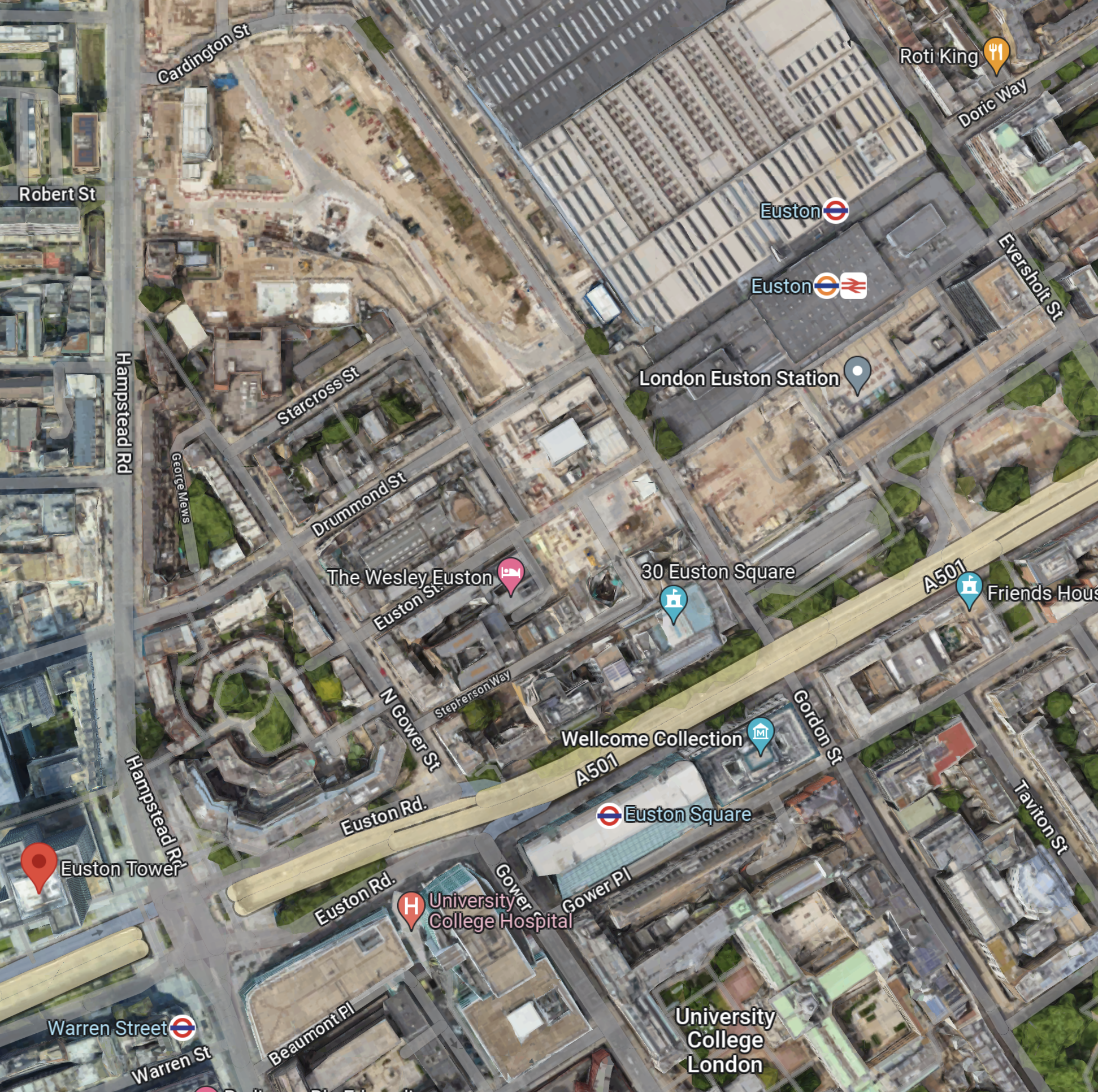
Note.
- Euston Tower is marked by a red arrow in the South-West corner of the map.
- The existing Euston station is in the North-East corner of the map.
- The High Speed Two station will be built along the Western side of the existing station.
With good landscaping, an excellent walking route, and perhaps a people mover Euston Tower could have superb connections to the rest of the UK.
Cycling And Walking Could Be A Possibility!
This Google Map shows the wider area around Euston Tower.
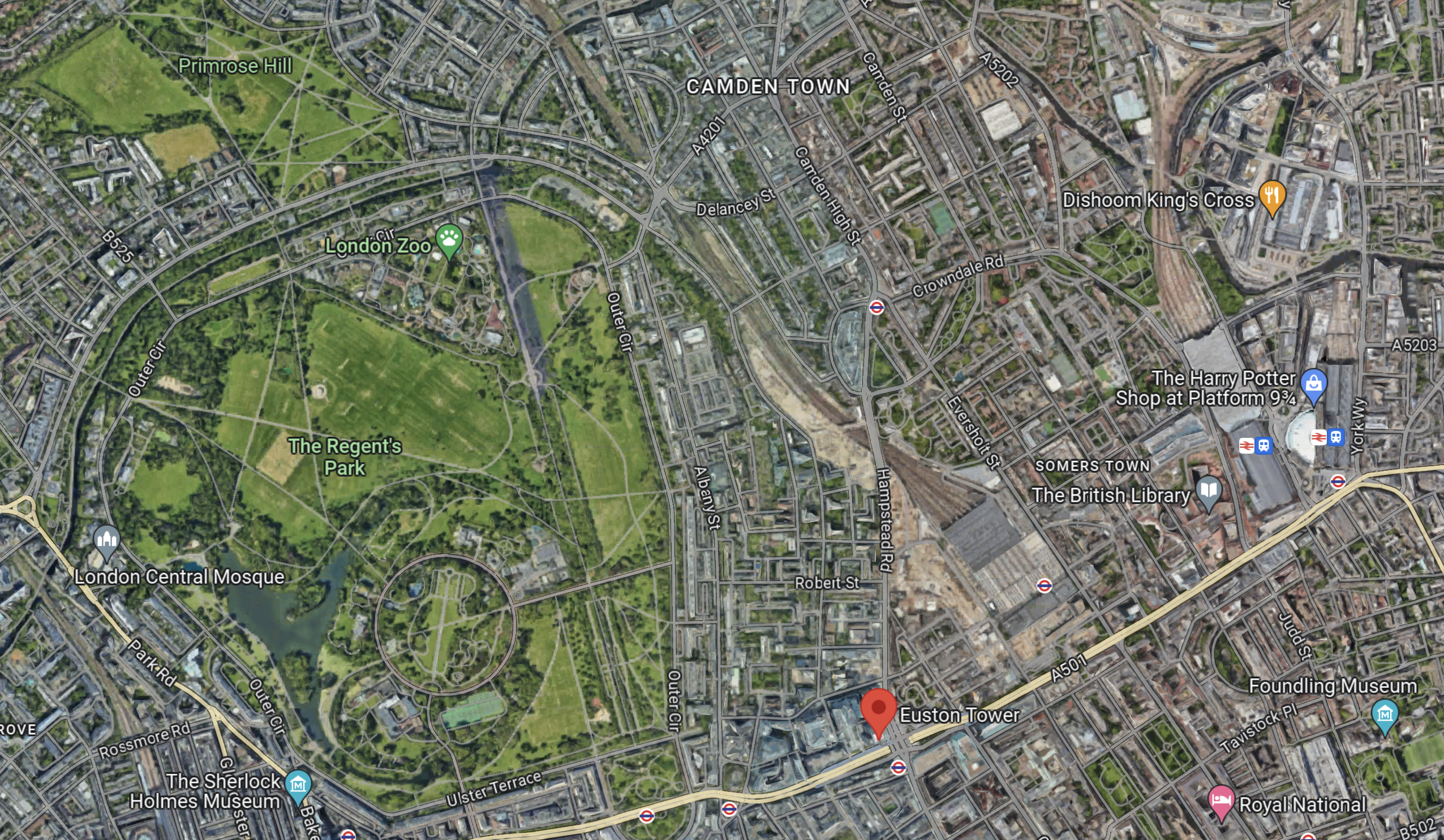
Note.
- Euston Tower is marked by the red arrow towards the bottom of the map.
- To its West lies the cycling- and walking-friendly spaces of Regents Park and Primrose Hill.
In the 1970s, I regularly walked or cycled across the park from where we lived near Primrose Hill to a client in Great Portland Street.
I also suspect other cycling and walking routes could be developed to Euston Tower from Euston, King’s Cross, St. Pancras and other stations.
Crossrail 2
Crossrail 2 would certainly help travelling to the Euston Tower, by linking Euston, King’s Cross and St.Pancras to North-East and South-West suburbs of London, with trains at frequencies of up to 30 thirty trains per hour (tph) in the central tunnel.
But.
- The new line will cost at least £31.2 billion. Who can afford it?
- The Elizabeth Line took sixteen years from approval to full opening.
- Crossrail 2 would still be a walk from Euston Tower.
So Crossrail 2 is unlikely to be any help to the redevelopment of Euston Tower.
Improving The Sub-Surface Lines
The Euston Tower is close to two stations on the sub-surface lines; Euston Square and Great Portland Street.
Services through these stations are currently as follows.
- Circle Line – 6 tph – In both directions all day.
- Hammersmith & City Line – 6 tph – In both directions all day.
- Aldgate and Amersham- 2 tph – In both directions all day.
- Aldgate and Chesham – 2 tph – In both directions all day.
- Aldgate and Uxbridge – 6 tph Peak – 8 tph – Off-Peak
- Aldgate and Watford – 4 tph – Peak
Note.
- In the Peak there are 26 tph through Great Portland Street and Euston Square stations.
- In the Off Peak there are 24 tph through Great Portland Street and Euston Square stations.
- In this article on Modern Railways,it is said that after digital signalling is installed on the sub-surface lines, the capacity on the lines, will be 32 tph in the Peak and 27 tph in the Off-Peak.
These figures give a 33 % capacity increase in the Peak and a 28 % increase in the Off Peak.
Both Great Portland Street and Euston Square stations are cramped and not fully step-free stations and could struggle with a 28 % and upwards increase in passenger numbers.
In The New Step-Free Entrance At Euston Square Station, I detailed TfL’s plans to put a new full step-free entrance South of Euston Road at Euston Square station.
This would not directly help travellers going between Euston Tower and Euston station, but hopefully, it would help to make Euston station less crowded and more passenger-friendly.
It would certainly ease walking between University College and the hospital, and the station.
This map from cartometro shows the Underground lines at Great Portland Street station.
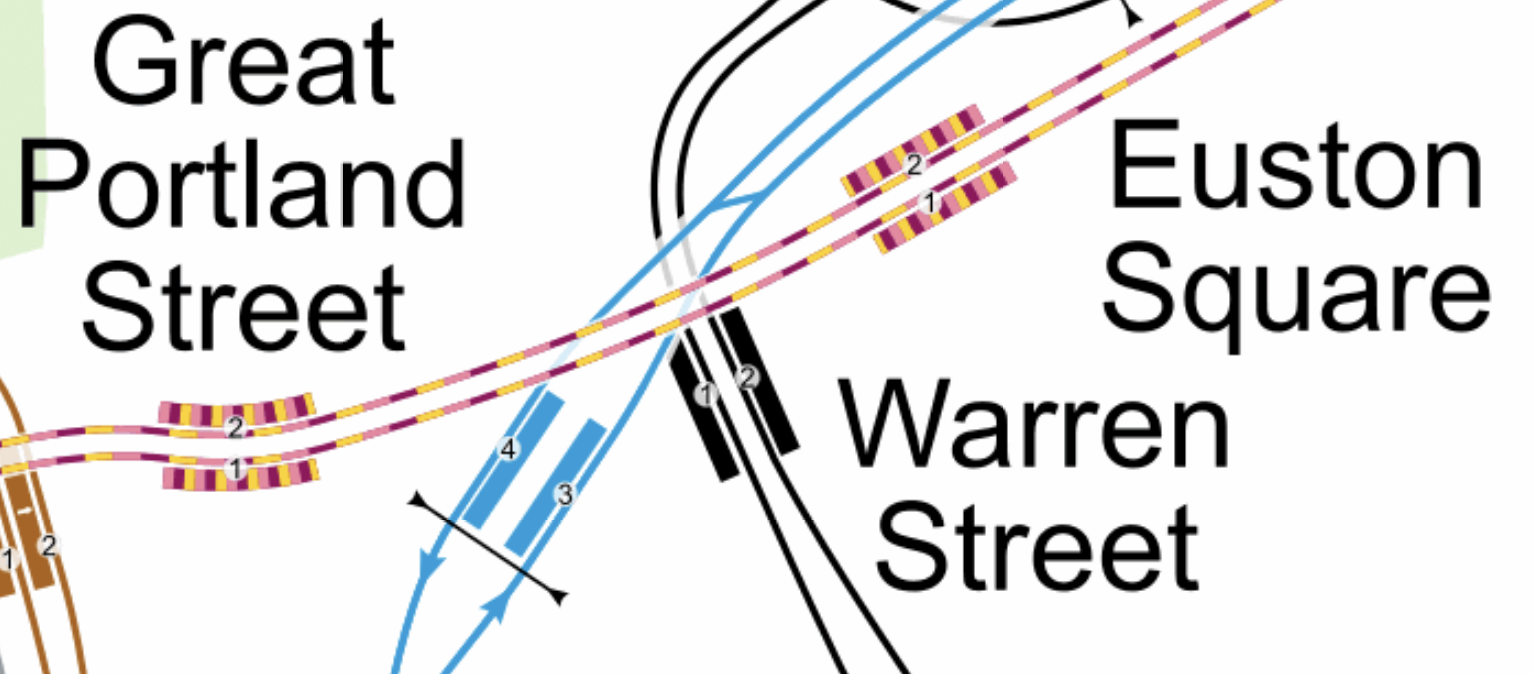
Note.
- The yellow and mauve tracks are the sub-surface lines.
- The black tracks are the Northern Line.
- The blue tracks are the Victoria Line.
This Google Map shows the Euston Tower, Great Portland Street and Warren Street stations.
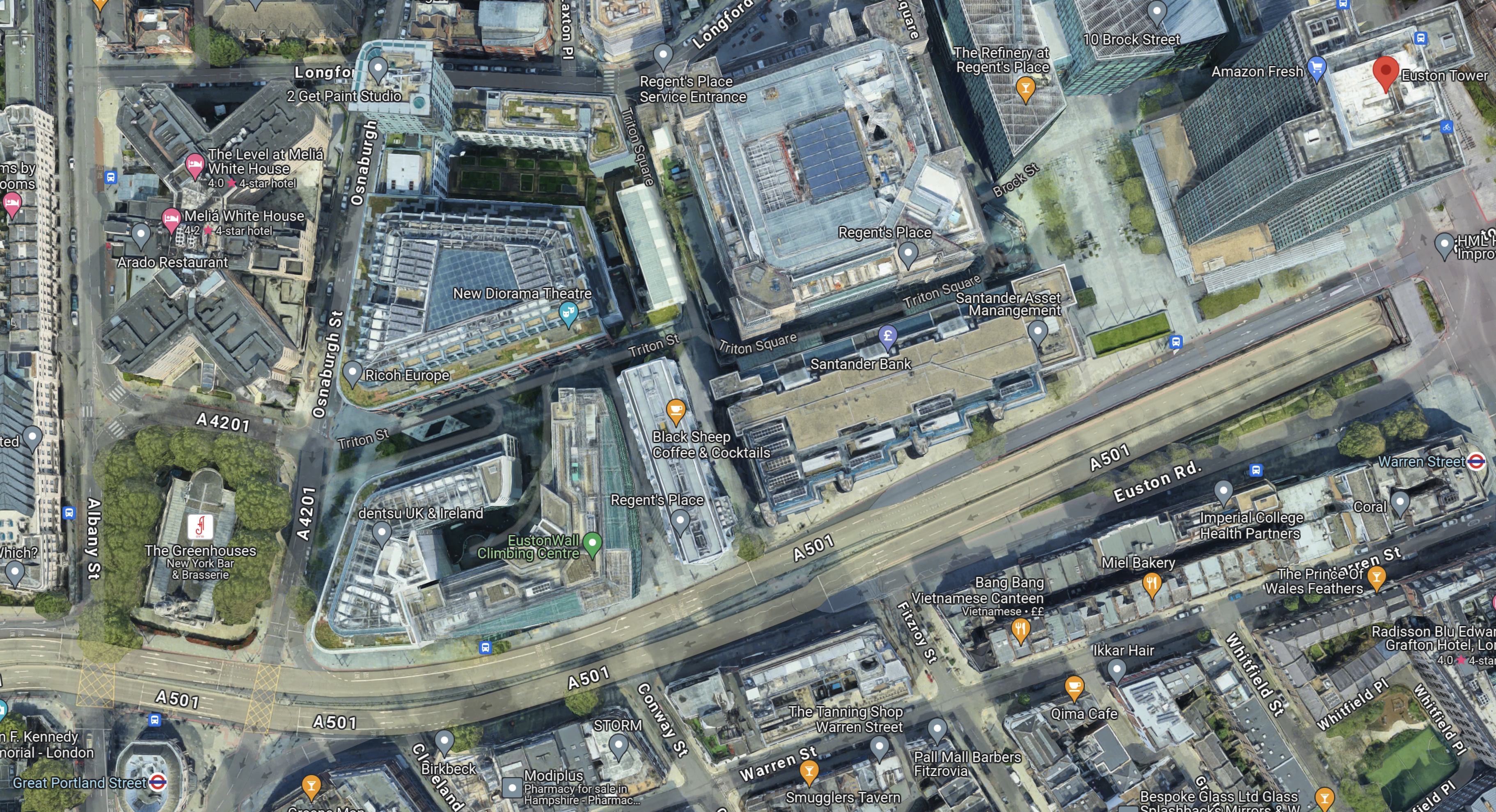
Note.
- The Euston Tower is indicated by a red arrow in the top-right corner of the map.
- Great Portland Street station is in the bottom-left corner of the map.
- Warren Street station is at the left of the map.
I wonder if the platforms were to be extended Eastwards at Great Portland Street station, that a new entrance to the station could be created perhaps fifty metres from Euston Tower.
I am convinced that the extra passenger traffic created by the life sciences and innovation hub can be handled by an augmented transport infrastructure, which would rely mainly on planned improvements to the sub-surface lines, which are approaching their final stages.
Conclusion
Converting Euston Tower into a life sciences and innovation hub is a plan that I believe can work well!
I would recommend the following improvements to public transport.
- The planned extra step-free entrance to Euston Square station on Gordon Street is constructed.
- An extra fully step-free entrance is built at the Eastern ends of the platforms at Great Portland Street station, which would be about halfway between Euston Tower and the station.
As improvements to the signalling of the sub-surface lines will deliver an upwards of 27 % capacity on the sub-surface lines, the life sciences and innovation hub might as well take advantage.
Is Six Platforms Enough At Euston For High Speed Two?
In this article in The Times, which is entitled What Is The New HS2 Route? The UK’s High-Speed Rail Network Mapped, this is said.
Sunak said a new six-platform station at Euston would save £6.5 billion compared with HS2’s vision of an 11-platform scheme.
But would it be possible to operate a full service with just six platforms?
This graphic shows High Speed Two services, as proposed by HS2 after Phase 2b opens.
Note.
- Services shown in blue are run by High Speed Two Full Size trains.
- Services shown in yellow are run by High Speed Two Classic-Compatible trains.
- Each service will run once an hour.
- There are seventeen services that terminate at Euston in every hour.
- Eight are High Speed Two Full Size trains, which are 400 metres long.
- Four are single High Speed Two Classic-Compatible trains, which are 200 metres long.
- Five are pairs of High Speed Two Classic-Compatible trains, which are 400 metres long.
I have a few thoughts.
The Capacity of High Speed Two
High Speed Two has been designed to have a capacity of eighteen trains per hour (tph).
That means it should be able to handle the seventeen tph to and from Euston.
Six Platforms Would Mean That Each Platform Would Handle Three tph
That is just simple arithmetic.
But could each platform handle three tph?
There are several places in the UK, where a single platform handles three or even four tph.
But these are generally smaller stations handling smaller trains.
I believe that with passenger entry to the platforms from both ends, as there is at King’s Cross, London Bridge and Manchester Piccadilly, that twenty minutes between trains should be possible.
What Happens If It Goes Wrong?
Occasionally trains fail, platforms get blocked or something more serious happens, which in the case of the HS2 Euston station would reduce the number of platforms available to five.
One of these actions could be taken.
Some Trains Can Terminate At Old Oak Common Station
Old Oak Common station is proposed to have six high speed platforms, so four platforms could be used to terminate trains in cases of trouble.
Two Services Run Using Single High Speed Two Classic-Compatible Trains Could Share A Platform
This would work as the platforms are designed to accept a pair of these trains.
Platforms 17 And 18 At The Current Euston Station Could Be Used In An Emergency?
This map from OpenRailwayMap shows the tracks and platforms at Euston station.
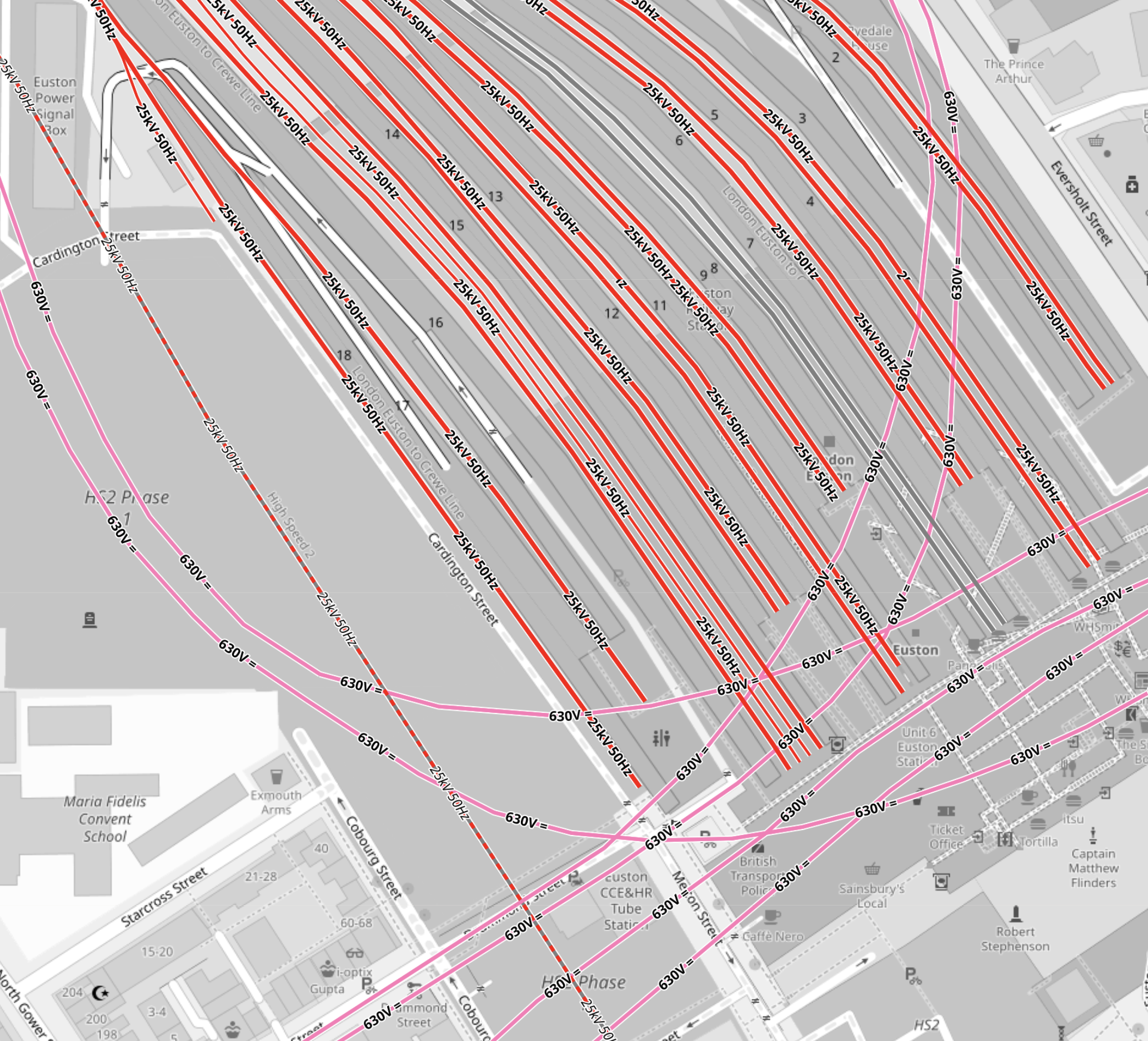
Note.
- Each red track is an electrified platform, with its number alongside.
- Platforms 17 and 18 are on the Western side.
- The pink tracks are London Underground lines.
- The dotted red and grey track down the Western side is the High Speed Two tracks.
Would it be possible to connect the High Speed Two tracks to Platforms 17 and 18 for use in an emergency?
I think it would be.
Conclusion
I believe that it’s possible to design a six-platform station to handle all the High Speed Two traffic at Euston.
Could High Speed Two Finish At Lichfield?
I wrote this post before Rishi Sunak made his speech.
I went to Manchester and Liverpool yesterday by train.
I took the 10:33 from Euston and this a summary of my journey.
- The train left Euston half a minute early.
- It arrived at Stafford (133.5 miles) at 11:50 and left at 11:52.
- It arrived at Crewe (158.0 miles) at 12:08 and left at 12.10.
- It arrived at Wilmslow (176.9 miles) at 12:25 and left at 12:27.
- It arrived at Stockport (183.0 miles) at 12:35 and left at 12:37.
- It arrived in Manchester Piccadilly (188.9 miles) at 12:46.
- It was two minutes late into Manchester and more or less on time at the other stops.
Note.
- The route was via the Trent Valley Line and the train passed through Nuneaton, Tamworth, Lichfield Trent Valley, Colwich and Stafford.
- Euston and Manchester had been timetabled at two hours and eleven minutes.
- This is an average speed of 86.5 mph.
- The Wikipedia entry for High Speed Two gives the fastest time before High Speed Two opens as one hour and fifty-four minutes.
- This will be an average speed of 99.4 mph.
Coming home, I took the 18:48 from Liverpool Lime Street and this a summary of my journey.
- The train left Liverpool on time.
- It arrived at Runcorn (13.2 miles) at 18:58 and left at 19:02.
- It arrived at Crewe (35.8 miles) at 19:26 and left at 19:28.
- It arrived at Milton Keynes (143.8 miles) at 20:27 and left at 20:29.
- It arrived in Euston (183.6 miles) at 21:00.
- It was five minutes late into Crewe and two minutes early at Euston.
Note.
- The route was via the Trent Valley Line and the train passed through Stafford, Colwich, Lichfield Trent Valley, Tamworth and Nuneaton.
- Liverpool and Euston had been timetabled at two hours and twenty minutes.
- This is an average speed of 78.7 mph.
- The Wikipedia entry for High Speed Two gives the fastest time before High Speed Two opens as two hours and three minutes.
- This will be an average speed of 89.6 mph.
This map clipped from the High Speed Two web site, shows the junction North of Lichfield, where High Speed Two connects to the Trent Valley Line through Stafford.

Note.
- High Speed Two runs North-South across the map.
- After the Junction by Fradley South, High Speed Two to Crewe and the North, is the branch to the East.
- The other branch connects to the Trent Valley Line at Handsacre junction.
- Trent Valley Line can be picked out North of Lichfield, where it passes through Lichfield Trent Valley station.
The Trent Valley Line is no Victorian double-track slow-speed bottleneck.
- The route between Rugby and Crewe is generally three or four tracks, with only one short stretch of double track, through Shugborough tunnel.
- The speed limit is generally 110 mph, with 90 mph at Shugborough.
- I wouldn’t be surprised to see Avanti West Coast’s Class 390 and Class 807 trains could be running at up to 140 mph on the route, if digital signalling were to be installed.
- This speed would probably be attained by High Speed Two trains.
London Euston and Stafford would only have under twenty miles of slower line and that could be 140 mph, so High Speed Two times on the route could be very fast.
This second map clipped from the High Speed Two web site, shows between High Speed Two’s two Birmingham stations and Lichfield.
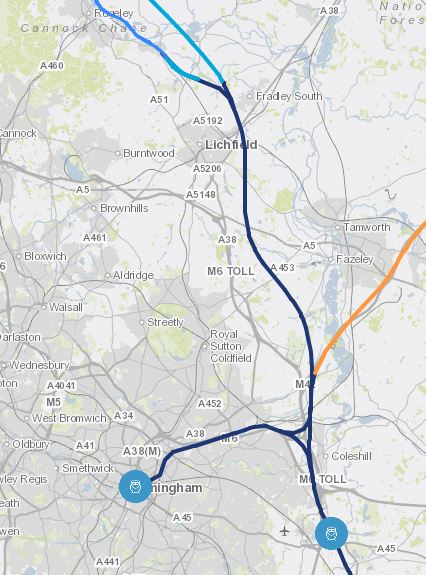
Note.
- High Speed Two Phases 1 and 2a are shown in blue.
- High Speed Two Phase 2b is shown in orange.
- At the top of the map, can be seen the junction, where High Speed Two to the North splits, that was shown in the previous map.
- The large blue dot in the West at the bottom of the map, is Birmingham Curzon Street station.
- The other large blue dot is Birmingham International station.
- The three sections of High Speed Two to London, Birmingham Curzon Street and the North meet at a triangular junction between the two Birmingham stations.
- High Speed Two to the East Midlands, branches off to the East North of the triangular junction.
This third map clipped from the High Speed Two web site, shows between Lichfield and Crewe.
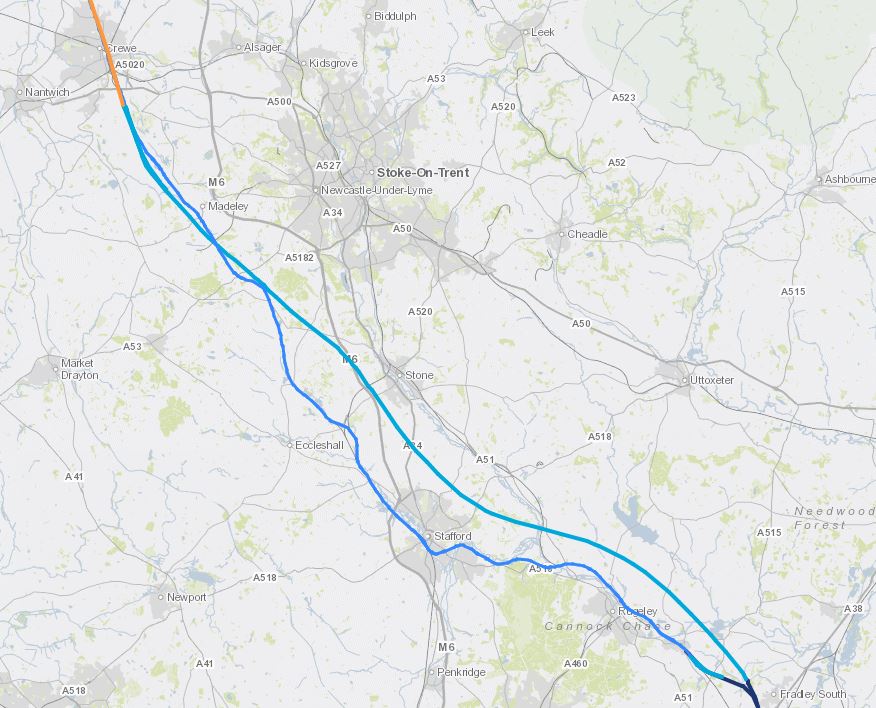
Note.
- High Speed Two Phase 2a is shown in blue.
- High Speed Two Phase 2b is shown in orange.
- Crewe is in the North-West corner of the map, where at the South end of the orange section.
- The junction at Lichfield is in the South-East corner of the map.
- The lighter blue route to the East, between the Lichfield junction and Crewe is the new tracks of High Speed Two.
- The darker blue route to the West, between the Lichfield junction and Crewe is the existing route of the Trent Valley Line and the West Coast Main Line.
- The Trent Valley Line joins the West Coast Main Line at Stafford.
These are a few thoughts and questions.
How Will Trains Go Between Birmingham Curzon Street And London?
Trains will use the triangular junction shown in the second map to go between the two Birmingham stations and then head South,
How Will Trains Go Between Birmingham Curzon Street And The North?
Trains will use the triangular junction shown in the second map to turn North and then take one of the two routes to the North; High Speed Two or Trent Valley Line/West Coast Main Line.
How Will Trains Go Between Birmingham Curzon Street And The North If High Speed Two Between Birmingham And The North Is Scrapped?
If High Speed Two is scrapped from the Northern point of the triangular junction to the North, there will be no way that trains could go North from Birmingham Curzon Street.
- The overcrowded Birmingham New Street station will still be the link to the North of England and Scotland for Birmingham.
- How would trains connect to the future branch to East Midlands Parkway, which connects just North of the triangular junction?
I suspect that a short stub will be built North of the triangular junction to connect to the Trent Valley Line, which is currently, the main route of trains between London and the North through the West Midlands, for trains that don’t go through Birmingham.
Trains Between London And Stafford
Currently, Avanti West Coast trains take around one hour and seventeen minutes between London and Stafford.
The Wikipedia entry for High Speed Two gives these times between London and Stafford.
- Fastest time before High Speed Two – one hour and seventeen minutes.
- Time after Phase 2a of High Speed Two opens – fifty-five minutes.
Note.
That is a time saving of twenty-two minutes.
High Speed Two Trains will use the link between the junction at Lichfield and the Trent Valley Line.
How Many Avanti West Coast Services Use The Trent Valley Line?
These trains use the Trent Valley Line.
- London and Holyhead – 8 tpd
- London and Liverpool Lime Street – 1 tph, which is planned to increase to 2 tph
- London and Manchester Piccadilly – 2 tph
- London and Blackpool North – 1 tpd
- London and Glasgow – 1 tph
Note.
- tpd is trains per day
- tph is trains per hour
This is roughly six tph.
Would It Be Possible To Finish High Speed Two At The Lichfield Junction And Connect It To The Trent Valley Line?
This is a repeat of the first map.
Note.
- High Speed Two runs North-South across the map.
- After the Junction by Fradley South, High Speed Two to Crewe and the North, is the branch to the East.
- The other branch connects to the Trent Valley Line at Handsacre junction.
- Trent Valley Line can be picked out North of Lichfield, where it passes through Lichfield Trent Valley station.
If the Eastern branch North from the junction were to be scrapped, all trains between London and North would go via Stafford.
As all these tracks are planned and must be at an advanced stage, that is ready for construction, I feel the route would be feasible.
It would have these benefits.
- Birmingham Curzon Street services and the North-West of England and the West of Scotland would be possible.
- Services between London and Stafford will be twenty-two minutes faster, than they are now.
- Time savings will also apply to services from London to Liverpool, Macclesfield, Manchester, Stoke-on-Trent and all stations between Crewe and Glasgow.
The capacity of the Trent Valley Line would be the limiting factor.
Time Savings Between Crewe And Preston
According to the Wikipedia entry for High Speed Two, after Phase 2a of High Speed Two opens, these will be the fastest times to Crewe and Preston.
- Crewe – 0:56
- Preston 1:18
Note.
- The fastest Preston service runs non-stop between Euston and Preston.
- Crewe and Preston are 51 miles apart.
A time of 22 minutes between Crewe and Preston, means the average speed is 139 mph.
Does this mean that High Speed Two will improve between Crewe and Preston to allow 140 mph non-stop running?
But 22 minutes is certainly an improvement on the current time between Crewe and Preston for Scottish trains of 40 minutes.
Time Savings Between Crewe And Liverpool
The upgrading of the line between might save another couple of minutes between Crewe and Weaver junction.
What Times Would Be Possible Via High Speed Two And The Trent Valley Line?
These times are based on the following.
- The twenty-two minute saving to Stafford, as all High Speed Two services to the North-West of England and the West of Scotland will go via Phase 1 of High Speed Two and Stafford.
- A saving of eighteen minutes will be applied to Scottish services because of savings between Crewe and Preston.
This would give these times in hours:minutes.
- Blackpool – 2:10
- Carlisle – 2:35
- Chester – 1:28
- Crewe – 1:08
- Glasgow – 3:50
- Holyhead – 3:10
- Lancaster – 2:03
- Liverpool Lime Street – 1:41
- Llandudno Junction – 2:24
- Macclesfield – 1:30
- Manchester Piccadilly via Crewe – 1:52
- Oxenholme – 1:54
- Preston – 1:46
- Runcorn 1:31
- Stafford – 0:55
- Stockport – 1:35
- Stoke-on-Trent – 1:10
- Warrington – 1:22
- Wigan 1:33
- Wilmslow – 1:25
I have calculated extra services to Blackpool and North Wales.
Adding The Lichfield And Crewe Section
Consider.
- My calculations indicate that London and Crewe will take 1:08.
- The Wikipedia entry for High Speed Two, after Phase 2a of High Speed Two opens, gives the fastest time to Crewe as 0:56.
This indicates that adding the section of High Speed Two between Lichfield and Crewe will save a further twelve minutes.
Conclusion
I strongly believe that an upgraded Trent Valley Line linked to a shortened High Speed Two at Lichfield could improve journey times between London, Birmingham and the North.
There are certainly savings to be made.
See Also
 The Anonymous Widower