How Leeds Bradford Airport Can Be Catalyst For Green Aviation
The title of this post, is the same as that of this article on the Yorkshire Post.
The article was written by a geography student from Yorkshire, who is studying at Cambridge University.
He makes some interesting points.
- Leeds Airport is not a good customer experience.
- Manchester Airport will take passengers away from Leeds.
- Leeds is the biggest financial centre in the UK outside London.
- Leeds Airport should be improved to the highest environmental standards.
- Aviation biofuels should be provided.
- Short haul flights should be replaced by a train journey if possible.
- By 2030, a lot of short haul flights will be replaced by electric aircraft.
I agree with a lot of what he says.
There will still be a need to fly and we must make it as environmentally-friendly as possible.
If we don’t find ways of making flying carbon-neutral, we’ll hurt the economy.
Hydrogen To Become A Source Of Cleaner Power On A Massive Scale
The title of this post, is the same as that of this article on Power Technology.
This is the introductory paragraph.
Hydrogen is light, storable, energy-heavy and does not produce direct carbon emissions or greenhouse gases (GHG). Sectors such as soil refining, ammonia production, methanol production and steel production use hydrogen extensively. Hydrogen will likely play a crucial role in clean energy transition with an increase in its use in sectors such as transportation, buildings and power generation. Interest in the use of hydrogen technology is increasing in a range of niche transport market segments, besides other applications. In the short to medium term, hydrogen technology could be used to replace compressed natural gas (CNG) in some areas with minor changes to the existing infrastructure.
The article is very much a must-read.
Will Steam Solve The Zero Carbon Freight Locomotive Problem?
Steamology Motion has now been awarded two Department of Transport grants to develop modern steam power for UK railways.
February 2019 – W2W Zero Emissions Power System
In Grants To Support Low-Carbon Technology Demonstrators, I quoted an extract from this article on Railway Gazette to describe their W2W Zero Emissions Power System.
Steamology’s Water 2 Water concept will use compressed hydrogen and oxygen gas in a ‘compact energy-dense steam generator’ to produce high pressure superheated steam to drive a turbine, which will generate electricity to charge the batteries as a ‘range extender’ for a Vivarail Class 230 multiple-unit produced from former London Underground vehicles.
There is not much on the Internet about this project, but I did find this article on the Bournemouth Echo, which is entitled Team Behind Chalres Burnett Steam Car Is Working On Trains.
Note that the typo in the headline is not mine, but one of the worst, I’ve seen in a newspaper, since the heady days of the Liverpool Echo in the 1960s, which gave Fritz Spiegl a second career, with all its spelling mistakes.
In the article, Chief Engineer; Christopher Lack describes the steam power like this.
We take hydrogen and oxygen and we burn them inside the chamber which then creates steam and we use that steam to drive a turbine which then powers the generator.
That all sounds very feasible, despite being a bit like the power system of a Space Shuttle, which carried liquid hydrogen and oxygen in the external tank.
At take-off the Space Shuttle carried 629.3 tonnes of liquid oxygen and 106.3 tonnes of liquid hydrogen. Will hydrogen and oxygen always have a similar 5.92 ratio by weight in any combustion process?
June 2020 – Zero Emission Rail Freight Power
In First Of A Kind Funding Awarded For 25 Rail Innovation Projects, I described this project like this.
Hydrogen-based steam turbine system to provide zero emission power for existing freight locomotives.
This is surely a much bigger challenge, as a Class 66 Locomotive for example, has a power output of nearly 2,500 kW, which might need to be sustained for three or four hours. That could be ten MWh, which explains why battery freight locomotives haven’t been developed.
As hydrogen contains 147 MJ/Kg of energy, does that mean that about 250 Kg of hydrogen and an equivalent amount of oxygen would be needed to power the locomotive for four hours?
The amount of space required for the fuel doesn’t seem to be ridiculously large, so that shouldn’t be a problem.
One of the processes in the chemical industry, that I haven’t modelled is combustion. This is probably because, when I was building mathematical models in the chemical industry, it was for ICI Plastics Division and their processes were all about pressure and/or mixing large amounts of chemicals in huge reaction vessels.
But thinking about it, if you burn hydrogen and oxygen in a combustion chamber, you’ll generate a lot of heat, but not much superheated steam to drive a turbine.
So could Steamology Motion have combined the combustion chamber and the boiler in some way?
Suppose, hydrogen and oxygen are burned in a combustion chamber and controlled amounts of water are injected into the chamber.
- Obviously, not enough to stop the combustion.
- The water would vaporise and surely join the combustion products and come out as turbine-ready superheated steam.
I suspect some researcher somewhere has used this process to see if they can drive a steam turbine from hydrogen and oxygen.
Perhaps, they were experimenting with a hydrogen-based energy storage system.
- An electrolyser powered by surplus renewable energy, would split water into hydrogen and oxygen, which would be stored under pressure.
- To recover the energy, the hydrogen and oxygen would be burned together to create superheated steam to drive a turbine.
The process could work, with an efficient hydrogen and oxygen to superheated steam generator.
But would it be economic, when compared with a hydrogen fuel cell? Fuel cells don’t need to have an oxygen feed and just uses common-or-garden air!
On the other hand, as the US space program has shown, it might work with liquid hydrogen and oxygen, which would possibly need less storage space and could mean a longer range for the locomotive.
Conclusion
It is a very large engineering challenge for Steamology Motion to get their system to work.
But, I do believe, that it’s possible to make the idea work.
I also think that the Government wouldn’t have signed up for a second project, if the first project had been a complete failure.
But, if Steamology Motion can convert a Class 66 locomotive from a polluting, noisy, carbon-spewing dinosaur into an eco-friendly hydrogen-electric locomotive, they will have done the planet an enormous favour, as there are tens of thousands of diesel locomotives, that could be converted.
They will also make billions for themselves!
Steam, But Not As You Know It…
The title of this post, is the same as that of a sub-section of this news article on the IMechE web site.
This is the introductory paragraph.
Burning vast amounts of coal, wood or oil, traditional steam locomotives are hardly environmentally friendly. Steamology Motion hopes to give steam a modern makeover with its W2W Zero Emissions Power System, a range extender for Vivarail Class 320 rolling stock.
This paragraph gives an outline of the technology.
Few details are available, but the project aims to boost air quality at stations and reduce noise and pollution. W2W stands for water-to-water, and the system has a compact energy dense steam generator at its heart. “Steam is generated using energy stored as compressed hydrogen and oxygen gas in tanks,” the project summary says. “High pressure, superheated steam is used to drive a turbine to do useful work by generating electricity.”
There is only a fine line between madness and genius.
Developer 8minute Says More Than 24GWh Of Batteries Included In Its US Solar-Plus-Storage Pipeline
The title of this post, is the same as that of this article on Energy Storage News.
What caught my eye was the 24 GWh!
When you consider that the biggest battery in the UK is Electric Mountain, which has a capacity of 9 GWh, 24 GWh of batteries is a large number!
It will need a lot of solar panels to keep that amount of batteries brim-full.
This is a sentence from the article.
The company’s projects include the Eland Solar & Storage Center, which will comprise 400MWac of PV and 300MW / 1,200MWh of battery energy storage, currently under construction in California’s Mojave Desert.
Those are big numbers against the UK’s largest solar park at Shotwick in Wales, which is just 72.2 MW.
Grant Shapps Announcement On Friday
I listened to Grant Shapps announcement on Friday, when he gave the daily COVID-19 Press Conference.
This article on the Velocys web site is entitled Government Announces Jet Zero Council And Confirms Support For Velocys Waste-To-Jet-Fuel Project.
The article shows a video of the speech and this summary paragraph.
At this afternoon’s COVID-19 press conference, Secretary of State for Transport, Grant Shapps, announced the establishment of a new Jet Zero Council and confirmed Government support for Velocys.
So who are the company with the strange name of Velocys?
This is a quote from the Velocys CEO; Henrik Wareborn.
Today’s announcement on the formation of a Jet Zero Council shows that a new era of net zero carbon flying is on a credible path, at a time when we need it more than ever. This follows news earlier today that our Altalto waste-to-jet fuel facility – the first of its kind in the UK – has received additional funding from Government and formally received planning permission, meaning it could be producing sustainable aviation fuel in commercial scale by the middle of this decade.
Is a new era of net zero carbon flying a possibility or is this a dream too far?
The AltAlto Project
Yhe project is called AltAlto and it has its own web site.
It is backed by British Airways and Shell, and uses technology from Velocys.
This description of the project is on the home page.
Altalto turns household and commercial waste into clean-burning fuels with reduced greenhouse gas emissions for air and road transport.
A page called Technology describes how it is done.
This is the initial summary.
Our process can accept a wide variety of waste, while delivering a clean product. There are very limited emissions to atmosphere from the plant except water and carbon dioxide. Components of the waste which do not get turned into fuel, such as metals and stones, are recycled; a small amount of it (less than 3%) goes to landfill.
This diagram from the Velocys web site illustrates the process.
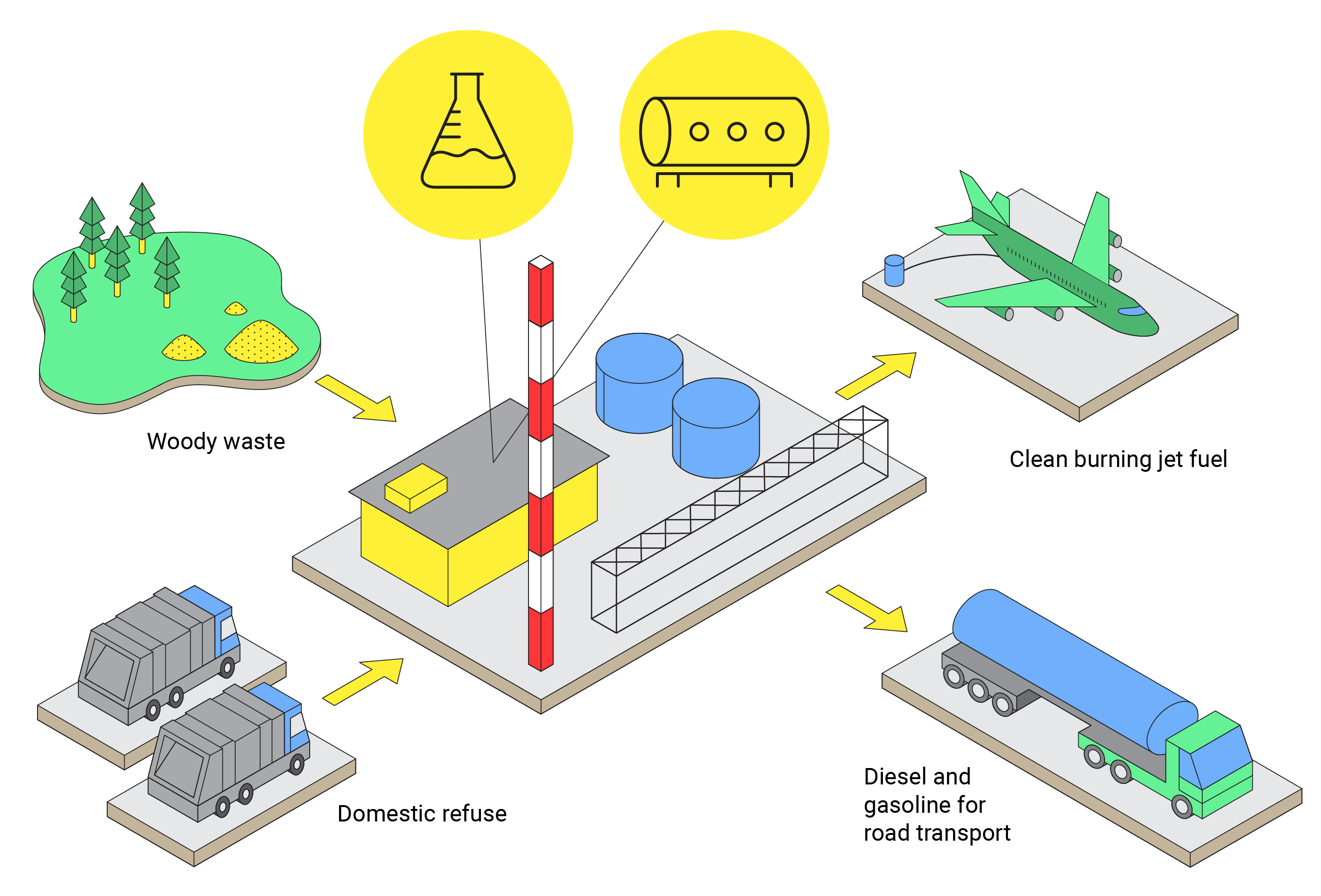
The then goes through the stages of the process.
- Stage 1 – Preparation – First the waste is treceived, sorted and prepared.
- Stage 2 – Gasification – Next the solid waste is gasified; heated to a high temperature to break it down and convert it into synthesis gas or syngas (carbon monoxide and hydrogen).
- Stage 3 – Synthesis – After cleaning, the syngas is used to synthesis hydrocarbons using the Fischer-Tropsch technology provided by Velocys.
- Stage 4 – Finishing – These hydrocarbons are then refined into the final products; renewable jet fuel (in the form of SPK) and naphtha.
They add this final summary.
The process is fundamentally different to incineration: instead of being burnt, the carbon in the waste is converted into a fuel for use in aircraft or vehicles.
There are many clean ways of making electricity, but it is really difficult to make sustainable jet fuel – this is one of the very few economic ways of doing so. It’s therefore a far better use of household waste than incineration, creating a much more valuable and environmentally beneficial product.
Could the process be considered a sophisticated waste incineration process, where the actual incineration is performed in the turbofan engine in the aircraft or the diesel engine in the truck to provide power?
I have a few questions.
What is Fischer-Tropsch Technology?
This is the first sentence for the Wikipedia entry for the Fischer-Tropsch Process.
The Fischer-Tropsch process is a collection of chemical reactions that converts a mixture of carbon monoxide and hydrogen into liquid hydrocarbons. These reactions occur in the presence of metal catalysts, typically at temperatures of 150-300 °C (302-572 °F) and pressures of one to several tens of atmospheres. The process was first developed by Franz Fischer and Hans Tropsch at the Kaiser-Wilhelm-Institut fur Kohlenforschung in Mulheim an der Ruhr, Germany, in 1925.
One of the companies involved in using the Fischer-Tropsch process is the South African company; Sasol. Wikipedia gives this summary about Sasol’s use of the process.
Another large scale implementation of Fischer-Tropsch technology is a series of plants operated by Sasol in South Africa, a country with large coal reserves, but little oil. The first commercial plant opened in 1952. Sasol uses coal and now natural gas as feedstocks and produces a variety of synthetic petroleum products, including most of the country’s diesel fuel.
The involvement with the apartheid regime in South Africa probably wasn’t the best of publicity for the process.
But have Oxford University and Velocys created a way of making net zero carbon aviation and diesel fuels?
What Is SPK?
SPK is Synthetic Paraffinic Kerosene and it is an aviation biofuel.
The Wikipedia entry for aviation biofuel has a sub-section called FT-SPK, where this is said.
The second route involves processing solid biomass using pyrolysis to produce pyrolysis oil or gasification to produce a syngas which is then processed into FT SPK (Fischer-Tropsch Synthetic Paraffinic Kerosene)
This sounds like the Velocys process.
What Are The Environmental Effects?
In the Wikipedia entry for aviation biofuel, there is a section called Environmental Effects. This is the first sentence.
A life cycle assessment by the Yale School of Forestry on jatropha, one source of potential biofuels, estimated using it could reduce greenhouse gas emissions by up to 85% if former agro-pastoral land is used, or increase emissions by up to 60% if natural woodland is converted to use. In addition, biofuels do not contain sulphur compounds and thus do not emit sulphur dioxide.
As Velocys produce their SPK from household waste, their fuel will have a different and more positive effect on greenhouse gas emissions.
This press release on the Velocys web site is entitled Plans Submitted For The First Waste To Jet Fuel Plant In The UK And Europe.
This is a paragraph.
The proposed plant will take hundreds of thousands of tonnes of household and commercial solid waste and turn it into clean burning sustainable aviation fuel, reducing net greenhouse gases by 70% compared to the fossil fuel equivalent – equal to taking up to 40,000 cars per year off the road.
Earlier, I quoted this about the process.
There are very limited emissions to atmosphere from the plant except water and carbon dioxide.
A lot depends on where the carbon dioxide is produced, but if it is produced by a well-designed process plant, it should be possible to capture it for storage.
There are also possibilities to reuse carbon-dioxide in the Fischer-Tropsch process.
Could Diesel Be Produced By The Process?
In the United States, Velocys are developing a project called Bayou Fuels.
This is said on the home page.
We are developing a plant in Mississippi that will create diesel fuel for road transportation in the U.S. It will process waste from the paper and lumber industries – woody biomass forest residue that would otherwise rot on the forest floor or contribute to forest fires.
It should be noted that this is said in the Wikipedia entry for the Port of Immingham.
In 2013 ABP began the development of the “Immingham Renewable Fuels Terminal” on the Humber International Terminal site, as part of a 15-year contract with Drax Power Station to supply biomass (wood pellet) to the powerplant. ABP’s total investment in biomass handling facilities, including installations at Hull and Goole was to be around £100 million.
As Velocys’s new plant will be at Immingham, close to the biomass port, I suspect the answer is yes.
Where Is The Plant Located?
This Google Map shows Immingham Port and the area to the South.
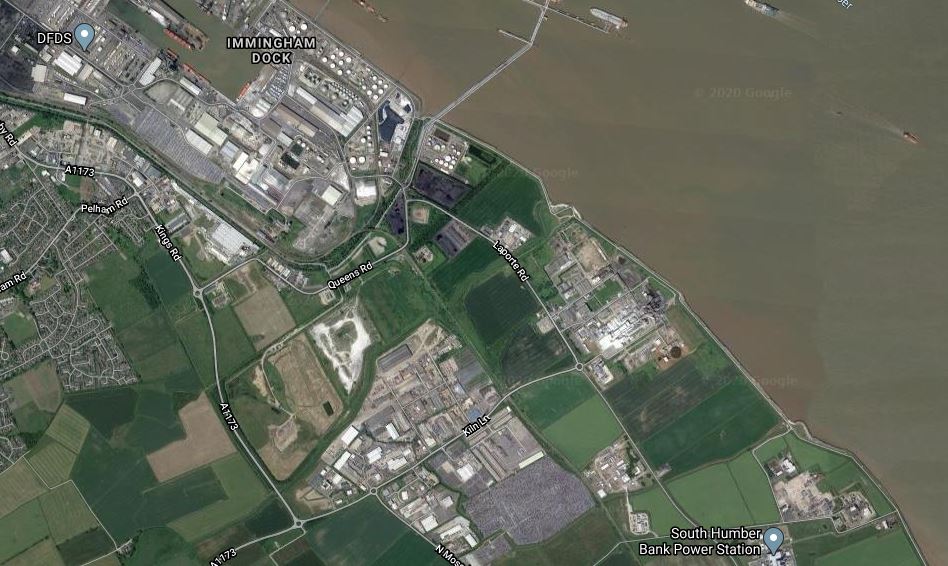
Note.
- Immingham Port is towards the North West corner of the map.
- South Humber Bank Power Station is towards the South East corner of the map.
It would appear that the Altalto plant, will be located on an 80 acre site between the port and the power station.
There would also appear from Google Maps that the Barton Line runs through the area, which would surely be handy for bringing in the waste and taking out the fuel.
This picture from the Altalto web site, shows a visualisation of the plant, looking North East.
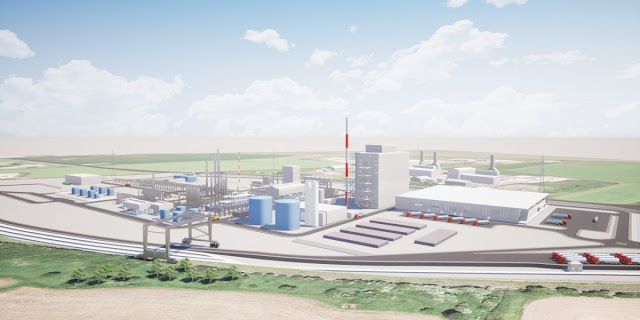
INote, what looks to be the railway, through the site in the foreground.
There are also a couple of informative videos, including one from the BBC, on this page of the Velocys web site.
t looks to be the ideal site.
How Much Fuel Will The Plant Produce?
According to the video on the web site, the plant will convert 500,000 tonnes of waste into 60,000,000 litres of fuel. I estimate that would be about 48,000 tonnes of jet fuel.
Could The Diesel Fuel Be Used To Decarbonise The Railways In The UK?
I believe that a substantial amount of the use of diesel on the UK’s railways will be cut by the use of battery and hydrogen power in multiple units and locomotives.
But some services like the heavy stone trains moving aggregates from the Mendips and the Peak District to London will be difficult to decarbonise, unless a locomotive manufacturer produces a hydrogen-powered locomotive with upwards of five megawatts of power. And that is a tough design challenge.
Low sulpur diesel produced from waste would be one way to reduce the carbon footprint.
Conclusion
It sounds a crazy idea to create aviation fuel and diesel from household waste!
Will It Work?
Consider.
- It appears that most of the technology used to produce this fuel has been around for decades.
- Sasol opened their first commercial plant in South Africa, using the Fischer-Tropsch process in 1952 and still use the technique today.
- Oxford University have added magic ingredients to the Fischer-Tropsch process.
- Velocys seem to have put in a lot of serious thought to get the Altalto project ticking all the right boxes.
The project could be late, but I feel it will deliver the main objective of converting household and commercial waste to jet fuel and diesel.
£35m Station Transformation Launched By Tees Valley Mayor
The title of this post, is the same as that of this article on Rail Technology Magazine.
This is the introductory paragraph.
Tees Valley Mayor Ben Houchen has announced (June 9th) a £35m transformation of Middlesbrough Station to transport more train services to the town, including the first direct rail link to London in decades.
The Rail Technology Magazine article indicates that Platform 2 at Middlesbrough station will be extended to handle Azuma trains. As the current platform looks to be around 150 metres long and this would be long enough for a five-car train, does this mean that in the future nine-car and ten-car Azumas will be able to run services to Middlesbrough?
Currently, LNER run one train per two hours (tp2h) between London and York. Could some or all of these trains be extended to Middlesbrough?
- TransPennines’ trains between York and Middlesbrough take fifty-eight minutes, but they are timed for slower Class 185 trains.
- I would expect faster Class 800 trains could go between York and Middlesbrough and back to York in under a convenient two hours.
- In addition, the lengthened Platform 2 at Middlesbrough would allow longer trains on the service between London and York to turn back at Middlesbrough.
- As the York service, which has a frequency of 1tp2h shares a path with the Lincoln service of a similar frequency, there must be the possibility to run a 1tp2h between Kings Cross and Middlesbrough.
- The same path is also used to run one train per day (tpd) to and from Hull.
- It should also be noted that all Class 800 trains have the ability to split and join together in under two minutes.
There would appear to be a large amount of scope to develop a comprehensive timetable between Kings Cross and Hull, Lincoln and Middlesbrough.
- If the first train left at 07:06 and the last at 22:06, there could be sixteen trains per day on the Kings Cross and Lincoln, Hull, York and Middlesbrough route.
- Each train could be two five-car trains that split and joined en route, which means there would be a total of 32 tpd.
- If five tpd went to both Lincoln and Middlesbrough and perhaps three tpd to Hull, that would leave nineteen tpd trains for other destinations.
- As many trains as possible would need to call at York.
I can certainly see extra destinations built into a intricate pattern in Lincolnshire, Yorkshire and County Durham.
- Nottingham could be served from Newark.
- Grimsby and Cleethorpes could be served by extending services from Lincoln.
- Sheffield, Hull, Scunthorpe, Grimsby and Cleethorpes could be serves from Doncaster.
- Scarborough could be served from York.
- Washington and Newcastle could be served on an alternative route using a reopened Leamside Line.
- Sunderland could be served by extending services from Middlesbrough along the Durham Coast Line.
- Saltburn and Redcar could be served by extending services from Middlesbrough.
Splitting and joining could occur at the following stations.
- Newark for Nottingham and Lincoln, Grimsby and Cleethorpes
- Doncaster for Sheffield, Hull and Scunthorpe, Grimsby and Cleethorpes.
- York for Scarborough and Middlesbrough.
- Middlesbrough for Sunderland and Redcar and Saltburn
Middlesbrough station would need to be able to take two five-car trains for splitting and joining, so the platform extension is required.
Kings Cross and Middlesbrough Could Be A Zero-Carbon Route
In Could Some of Hitachi’s Existing Trains In The UK Be Converted To Battery-Electric Trains?, I indicated that as Middlesbrough station is only 21 miles and 29 minutes from Northallerton and the East Coast Main Line, that a five-car Azuma train converted to battery-electric operation should be able to run between Middlesbrough and Kings Cross, totally on electric power, which would be zero-carbon, if the electricity were to be renewable.
Spanish Covid-19 Recovery Investment Scheme Funds 12 Energy Start-Ups
The title of this post, is the same as that of this article on Power Technology.
These are the two introductory paragraphs.
Several energy companies have announced they will assist and invest in a scheme to develop smaller companies assisting in Spain’s Covid-19 recovery.
The Positive Energy+ investment scheme has taken 396 proposals over 13 days. The promoters of the programme have chosen 12 businesses they believe will have a large impact on the country’s decarbonisation, digitalisation and mobility, while also considering their social impact.
It looks like Spain is going a similar route to Norway, with their fund.
After Coronavirus, What’s Next? China: More Coal, US: More Oil, EU: More Renewables
The title of this post, is the same as that of this article on CleanTechnica.
The title says it all, but read the article to get the detail.
 The Anonymous Widower