How Feasible Is A High Speed Line Between Birmingham And Nottingham?
In Red Wall Commuters To Get Rail Revolution, I indicated that the Department of Transport is considering creating three new high speed lines in the Midlands and the North of England.
One is proposed between Birmingham and East Midlands Parkway, which is described in the original article in The Sunday Times like this.
A 42-mile line from Birmingham to East Midlands Parkway, just south of Nottingham. This is expected to cut journey times between the two cities from 72 minutes to 27 minutes.
There is a currently, a CrossCountry service between Nottingham and Birmingham New Street stations.
- The frequency is two trains per hour (tph)
- Trains are generally three- or four-car formations of Class 170 diesel trains.
- All trains stop at Tamworth, Burton-on-Trent and Derby.
- Some trains stop at Wilnecote, Willington, Spondon, Long Eaton and Beeston
- The services take upwards of seventy-one minutes.
Note.
- The frequency between Birmingham New Street and Derby is four tph.
- Trains reverse at Derby which takes seven minutes.
- Three tph stop at Burton-on-Trent.
I feel that the current service is very much a compromise, which is trying to handle three services.
- A fast train between Birmingham and Nottingham.
- A fast train between Birmingham and Derby.
- A local service between Nottingham and Derby.
High Speed Two will be providing a non-stop service between Birmingham Curzon Street and East Midlands Hub stations.
- The frequency will be three tph.
- There will also be an hourly train between Birmingham Interchange and East Midlands Hub station.
- The services will take twenty minutes or slightly less from Interchange.
The services will only get you to East Midlands Hub station.
In addition after High Speed Two opens Midlands Connect are planning to run a direct service between Nottingham and Birmingham Curzon Street stations.
- The frequency will be one tph.
- The service will use High Speed Two Classic Compatible trains.
- The only stop will be East Midlands Hub station.
- The service will take thirty-three minutes.
So how does a new high speed line connect Birmingham and Nottingham in twenty-seven minutes?
Consider.
- The route between Birmingham New Street and North Stafford Junction is 35.9 miles
- At North Stafford junction a double-track freight line leads to the East.
- The freight line passes to the North of East Midlands Airport and South of Long Eaton station before joining the Midland Main Line at Trent junction to the North of East Midlands Parkway station.
- Trains can pass straight into Nottingham via Beeston.
- Nottingham is just 6.7 miles to the East of Trent junction and East Midlands Parkway is just a mile South of Trent junction.
- South Stafford junction to Trent junction is probably about seven miles.
I believe that this is the route that will be upgraded to create a high speed line between Birmingham and Nottingham.
- Part of the route between Tamworth and Burton-on-Trent was upgraded to 125 mph running by British Rail.
- Between Birmingham New Street and North Stafford Junction is used by CrossCountry services between Birmingham and Derby and Nottingham.
- I believe that the route can be fully electrified and upgraded, so that most of the route could be suitable for 125 mph running.
- The Midland Main Line is already capable of handling trains at 125 mph.
This should make it possible for services to run between Birmingham New Street and Nottingham in the required twenty-seven minutes.
I will answer a few questions.
Could The Trains Serve Birmingham Curzon Street In Birmingham?
In Birmingham Airport Connectivity, I said this
But look at this map clipped from the High Speed Two web site.
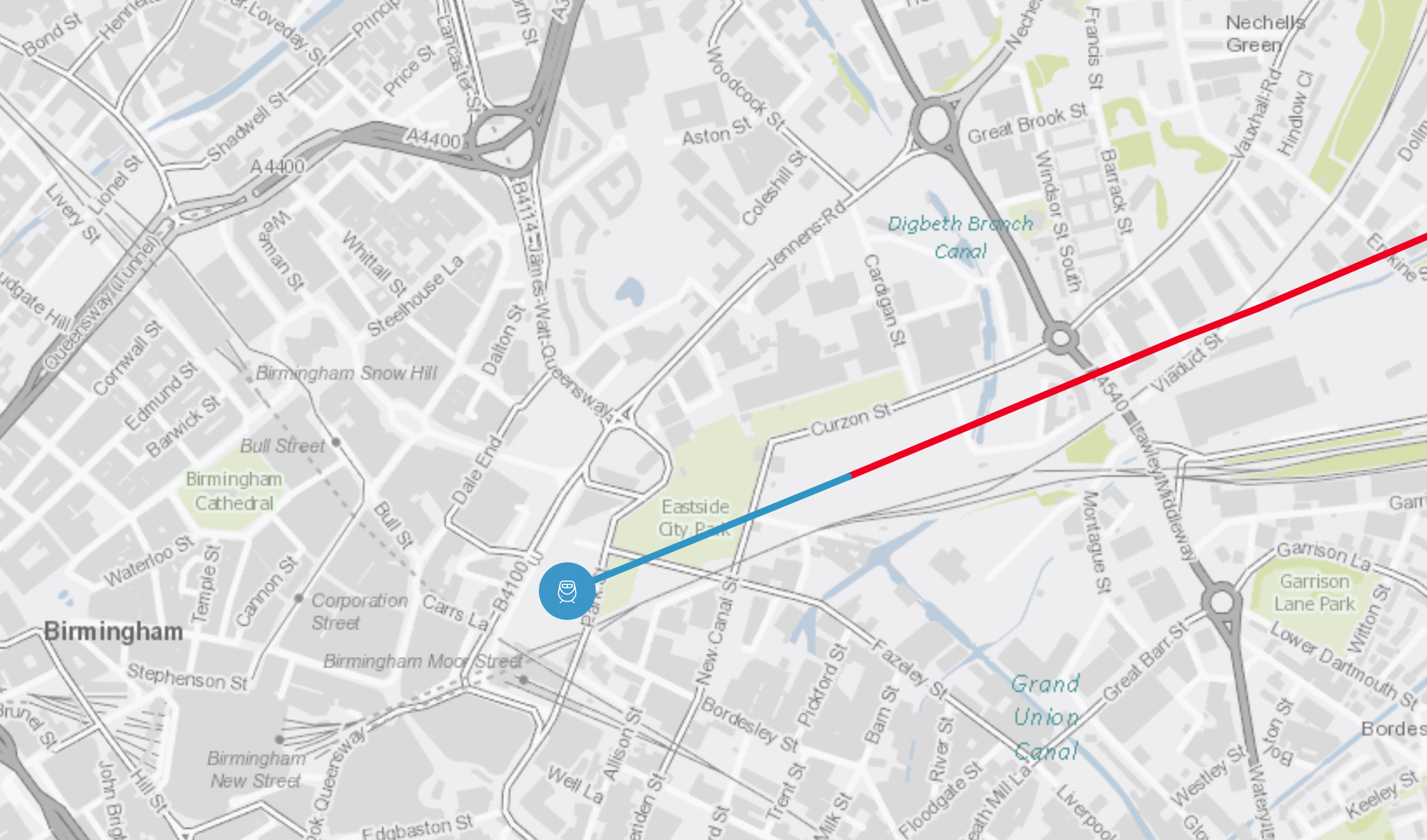
Note.
- The blue dot shows the location of Curzon Street station.
The West Coast Main Line running into New Street station, is just to the South of Curzon Street station.
New Street station can be picked out to the West of Curzon Street station.
This Google Map shows a close-up of the current Curzon Street station site.
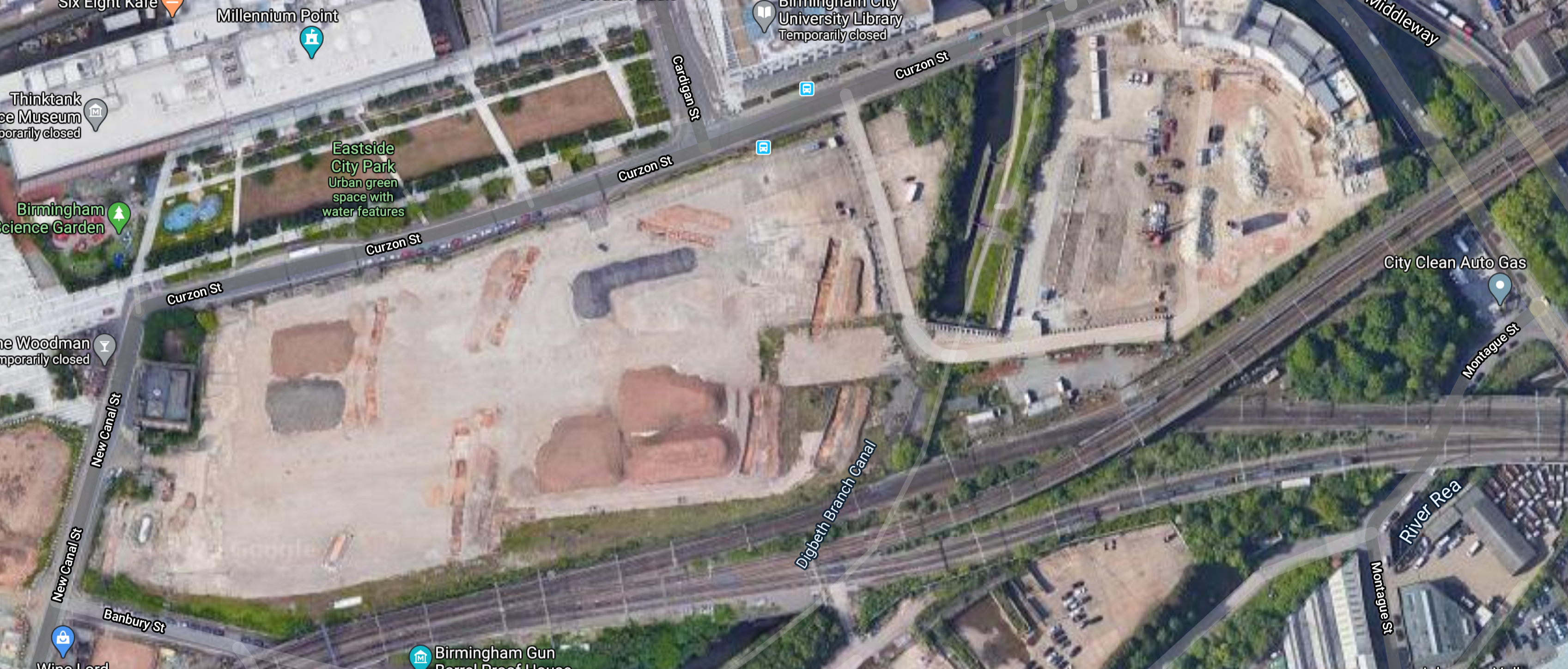
The same pattern of rail lines going past the Curzon Street site into New Street station can be picked out.
Surely, a connection could be made to allow trains from a couple of platforms in Curzon Street station to terminate trains from the West Coast Main Line.
Possible services could include.
- London Euston and Birmingham Curzon Street via Watford Junction, Milton Keynes, Rugby and Coventry
- Cardiff and Birmingham Curzon Street via Bristol Parkway, Swindon, Oxford and Milton Keynes.
- Cambridge and Birmingham Curzon Street via Bristol Parkway, Bedford and Milton Keynes.
There are a lot of possibilities to give High Speed Two much bigger coverage.
I also suspect that the proposed Nottingham and Birmingham service could terminate in Birmingham Curzon Street.
Could High Speed Two Classic Compatible Trains Run Between Birmingham And Nottingham?
As High Speed Two Classic Compatible Trains would have the same loading gauge as current trains, I don’t see why not.
Could A London Euston And Nottingham Service Be Run With A Reverse At Birmingham Curzon Street?
These are prospective times for High Speed Two.
- London Euston and Birmingham Curzon Street – 45 minutes
- London Euston and East Midlands Hub – 52 minutes
Note that East Midlands Hub and Nottingham could take at least twenty minutes.
And this is a current timing.
- London St. Pancras And Nottingham – 95 minutes
It is possible calculate the time for London Euston to Nottingham with a reverse at Birmingham.
- London Euston and Birmingham Curzon Street – 45 minutes
- Reverse at Birmingham Curzon Street – 3 minutes
- Birmingham Curzon Street and Nottingham – 27 minutes
This would give a time of 75 minutes between London Euston and Nottingham.
It does look to me, that the fastest route between London and Nottingham, will be to to go via Birmingham and the proposed new high speed route.
So the answer to the question in the title of this section is a Yes!
Could A London Euston And Sheffield Service Be Run With A Reverse At Birmingham Curzon Street?
These are prospective times for High Speed Two.
- London Euston and Birmingham Curzon Street – 45 minutes
- London Euston and East Midlands Hub – 52 minutes
- London Euston and Sheffield – 87 minutes
And these are current timings.
- London St. Pancras And Derby- 85 minutes
- London St. Pancras And Sheffield- 118 minutes
- Birmingham New Street And Derby- 33 minutes
- Birmingham New Street And Sheffield- 75 minutes
It is possible calculate the time for London Euston to Sheffield with a reverse at Birmingham.
- London Euston and Birmingham Curzon Street – 45 minutes
- Reverse at Birmingham Curzon Street – 3 minutes
- Birmingham Curzon Street and Sheffield – 75 minutes
This would give a time of 123 minutes between London Euston and Sheffield.
I wonder what time could be achieved between London Euston and Sheffield could be achieved with improvements to the following lines.
- The CrossCountry Route between North Stafford junction and Derby station.
- The Midland Main Line between Derby and Sheffield.
I would expect that the improvement to these routes would include.
- At least almost full electrification.
- Removal of level crossings.
- Full digital signalling.
- Upgrading to 140 mph running.
I could see the following service improvements.
- A substantial reduction of the times between Birmingham and Sheffield.
- Derby and Burton-on-Trent would get a fast service to London Euston via High Speed Two.
- Derby and Burton-on-Trent would get a fast service to Birmingham probably with a frequency of 4 tph.
- CrossCountry services between Birmingham and Sheffield would be faster.
Derby and Burton-on-Trent would get a much better train service.
Could Burton-on-Trent, Derby, Nottingham And Sheffield Be served By Trains Splitting And Reversing At Birmingham Curzon Street?
These are prospective frequencies for High Speed Two.
- Burton-on-Trent – No trains
- Chesterfield 1 tph
- Derby – No trains
- East Midland Hub – 7 tph
- Nottingham – 0 tph
- Sheffield – 2 tph
Suppose there were two tph between London and Birmingham Curzon Street, that split into two trains in Birmingham.
- One train could go to Nottingham and call at Tamworth and Burton-on-Trent.
- The other train could go to Sheffield and call at Tamworth, Burton-on-Trent, Derby and Chesterfield.
This would give the following frequencies from London on High Speed Two.
- Burton-on-Trent – 2 tph
- Chesterfield – 2 tph
- Derby – 2 tph
- Nottingham – 2 tph
- Sheffield – 2 tph
Note that I am ignoring the Eastern Leg of High Speed Two in this analysis.
Could We Go For The Full Burton?
In the previous sections, I suggested serving Nottingham and Sheffield from Euston using High Speed Two with a reverse at Birmingham Curzon Street, where the train would split into two trains, with one train going to Sheffield and the other going to Nottingham.
But could the split be at a rebuilt Burton station?
Consider.
- Burton station could become an Eastern terminus of Birmingham’s Cross-City Line.
- Burton station could become the Western terminus of the Ivanhoe Line to Leicester.
- If the Cross Country Route is upgraded, Burton station would have fast connections to Birmingham, Derby, Chesterfield, Sheffield and Leeds,
- If the new Birmingham and Nottingham route is created, this would mean fast connections to Nottingham and possibly Lincoln.
Burton-on-Trent could become the passenger rail hub for the Mid Midlands.
I
Hitachi Rail And Angel Trains To Create Intercity Battery Hybrid Train On TransPennine Express
The title of this post, is the same as that of this Press Release from Hitachi Rail.
The press release starts with these three points.
- Hitachi Rail, Angel Trains and TransPeninne Express (TPE) agree to trial retrofitting battery on intercity train
- Trial, starting next year, can cut fuel usage by at least 20% and reduce emissions on Transpennine network from 2022 onwards
- Tri-mode service can cut noise pollution in urban areas and improve air quality.
Hitachi also point to this infographic.
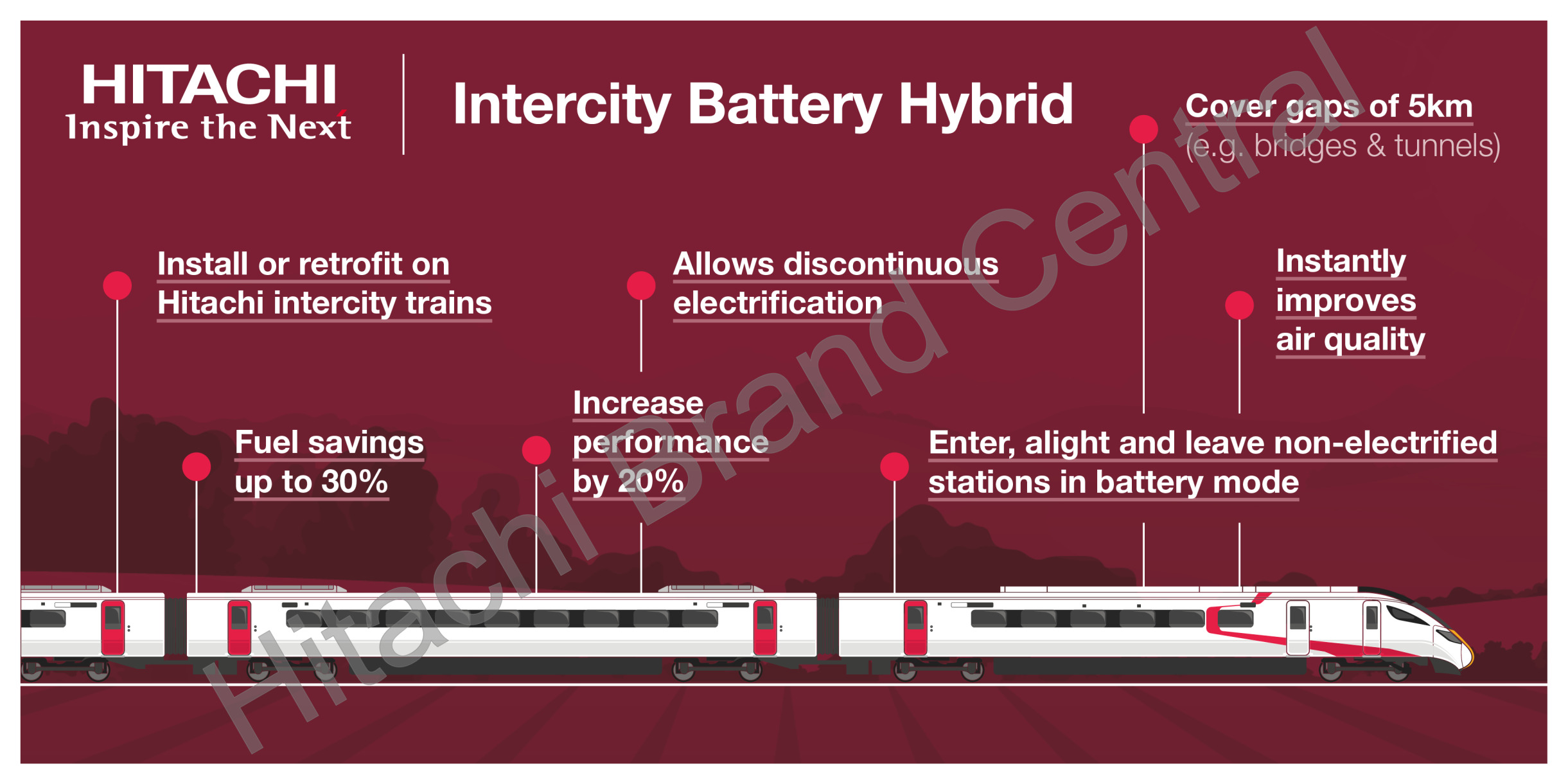
This very much looks to be a step forward from the Intercity Tri-Mode Battery Train that was announced in December 2020 in this press release from Hitachi which is entitled Hitachi And Eversholt Rail To Develop GWR Intercity Battery Hybrid Train – Offering Fuel Savings Of More Than 20%.
The Intercity Tri-Mode Battery Train is described in this Hitachi infographic.

The specifications are very similar, except for the following.
- The battery range is given as five kilometres.
- Fuel savings are up to 30% instead of at least 20%.
- A performance increase of 30 % is claimed.
- The upgrade appears to be able to be fitted to Hitachi intercity trains, as opposed to a straight replacement of one engine by batteries.
It looks to me, that Hitachi have been working hard to improve their design.
I think this paragraph of the press release is key.
The trial will see a diesel engine replaced by batteries to help power a five-carriage train, along with the two remaining engines. The power provided by the batteries will help to reduce the amount of fuel required to operate the train.
Hitachi don’t say, but I suspect the trains and their batteries have a lot of energy saving features.
- Regenerative braking is already used to power some services like lighting and air-conditioning on the trains.
- But I suspect regenerative braking will also be used to recharge the batteries.
- A sophisticated computer system will drive the train in the most optimal manner.
- Hopefully, diesel will only be used as a last resort.
Features like these and others will enable the trains to jump gaps in the electrification. As more and more tricks are added and batteries hold more charge, the gaps the trains will be able to cross will get larger.
Five kilometres might not sound much, but I think it could be surprisingly useful.
I will use an example from the Midland Main Line to illustrate how the trains and discontinuous electrification might work.
In Discontinuous Electrification Through Leicester Station, I described the problems at Leicester station and how discontinuous electrification could solve the problem.
The following is a modified extract from that post.
This Google Map shows the bridge and the Southern end of the station.
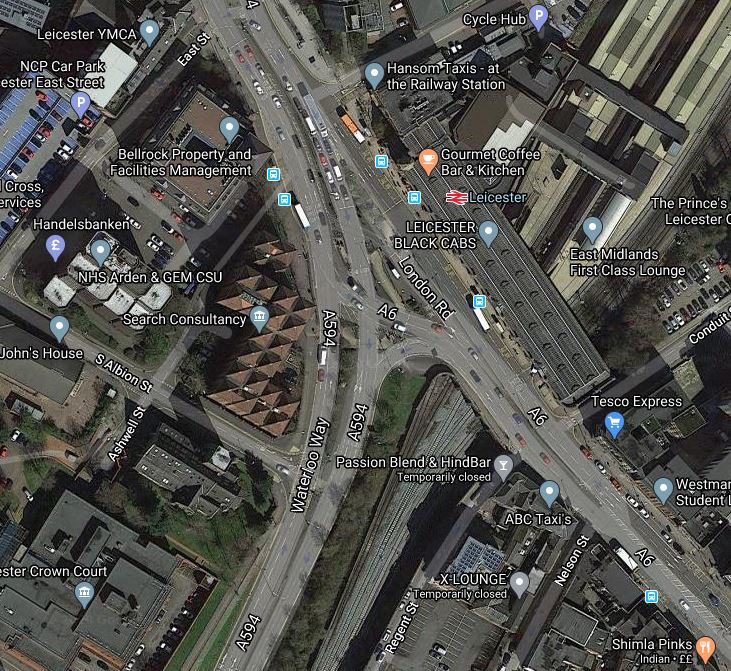
It looks to me, that Leicester station and the road, would have to be closed to traffic for some time, if the bridge were to be rebuilt, to allow the erection of electrification through the area. Leicester and all train passengers would love that!
A solution could be discontinuous electrification.
- The electrification from the South, would finish on the South side of bridge.
- The electrification from the North, would finish at a convenient point in Leicester station or just to the North.
- Electric trains would cover the gap of up to five kilometres on battery power.
Note.
Pantographs could be raised and lowered, where the wires exist.
Trains would probably use a stopping profile in Leicester station, that ensured they stopped with full batteries.
This would mean they had enough electricity to get back up to speed and reconnect to the electrification on the other side of the station.
To get an idea at how long five kilometres is in the Centre of Leicester, this Google Map shows the Leicester station.

Note that the platforms are around three hundred metres long.
In other words the electrification can be kept well away from the station and its troublesome bridge.
How much money would be saved and disruption avoided?
Application To The TransPennine Express Routes
These are the various routes, where Class 802 trains could be used.
Liverpool Lime Street And Edinburgh, Newcastle, Scarborough Or York
Sections are as follows.
- Liverpool Lime Street and Manchester Victoria – 31.7 miles – Electrified
- Manchester Victoria and Stalybridge – 8 miles – Electrified probably by 2024
- Stalybridge and Huddersfield – 18 miles – Diesel
- Huddersfield and Dewsbury – 8 miles – Electrified probably by 2024
- Dewsbury and Leeds – 9.2 miles – Diesel
- Leeds and York – 25.6 miles – Electrified probably by 2024
- York and Newcastle – 80.2 miles – Electrified
Note.
- All services take a common route between Liverpool Lime Street and York.
- A surprising amount is electrified.
- A further 42 miles are being electrified.
- The 3 km Morley Tunnel between Dewsbury and Leeds might not be electrified.
- The 5 km Standedge Tunnel between Huddersfield and Stalybridge might not be electrified.
It looks to me that the 5 km battery range will avoid electrification of two long Victorian tunnels.
Manchester Airport And Newcastle Or Redcar Central
Sections are as follows.
- Manchester Airport and Manchester Victoria – 13.2 miles – Electrified
- Manchester Victoria and Stalybridge – 8 miles – Electrified probably by 2024
- Stalybridge and Huddersfield – 18 miles – Diesel
- Huddersfield and Dewsbury – 8 miles – Electrified probably by 2024
- Dewsbury and Leeds – 9.2 miles – Diesel
- Leeds and York – 25.6 miles – Electrified probably by 2024
- York and Newcastle – 80.2 miles – Electrified
- Northallerton and Redcar Central – 29 miles – Diesel
The route goes through the Morley and Standedge tunnels.
Manchester Piccadilly And Hull
Sections are as follows.
- Manchester Piccadilly and Stalybridge – 7.5 miles – Electrified probably by 2024
- Stalybridge and Huddersfield – 18 miles – Diesel
- Huddersfield and Dewsbury – 8 miles – Electrified probably by 2024
- Dewsbury and Leeds – 9.2 miles – Diesel
- Leeds and Selby – 21 miles – Diesel
- Selby and Hull – 31miles – Diesel
The route goes through the Morley and Standedge tunnels.
Manchester Piccadilly And Huddersfield
The route goes through the Standedge tunnel.
Huddersfield And Leeds
The route goes through the Morley tunnel.
Manchester Airport And Cleethorpes
The Hope Valley Line which is part of this route has three tunnels.
Perhaps they will use a bit of diesel to get through Totley.
The Future
This paragraph sums up what Hitachi and Angel Trains could see as a possible future direction.
Once complete, the trial provides a pathway for Hitachi Rail, the train builder and maintainer, and Angel Trains, the train’s owner to develop plans to retrofit batteries to the wider fleet.
These plans will probably go in the directions like decarbonisation, more efficient operation and better standards for passengers.
Conclusion
This looks like a solution that has been helped by real ale in an appropriate hostelry.
- The battery range has been chosen so Network Rail don’t necessarily have to electrify the tunnels.
- Full electrification can be used either side of the tunnels.
- Will any stations not be electrified. After all if the trains are using battery power in stations do they need electrification?
- It might be useful to have some more bi-mode freight locomotives, that could traverse the tunnels on diesel or batteries.
Hitachi and Network Rail certainly seem to be cooking up a solution.
Electrification Between Clay Cross North Junction And Sheffield Station
Long term readers of this blog, will have noticed that I make regular references to this proposed electrification, that is part of High Speed Two’s proposals to connect Sheffield to the new high speed railway.
So I thought I would bring all my thoughts together in this post.
Connecting Sheffield To High Speed Two
Sheffield is to be accessed from a branch off the Main High Speed Two route to Leeds.
This map clipped from High Speed Two’s interactive map, shows the route of the Sheffield Branch, from where it branches North West from the main Eastern Leg of High Speed Two.
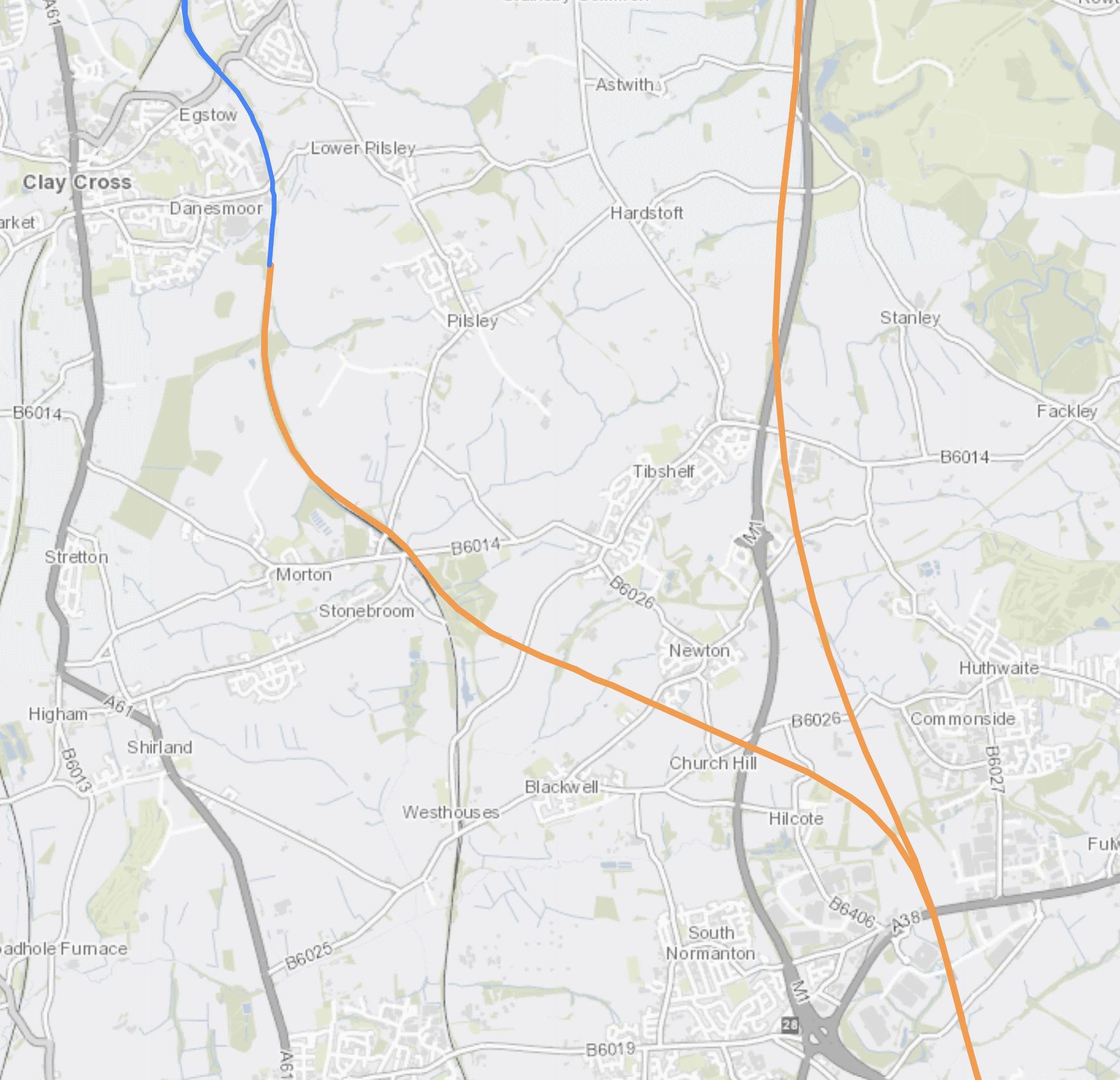
Note.
- Orange indicates new High Speed Two track.
- Blue indicates track that High Speed Two will share with other services.
- The orange route goes North to Leeds, along the M1
- The blue route goes North to Chesterfield and Sheffield, after skirting to the East of Clay Cross.
- The orange route goes South to East Midlands Hub station.
This second map, shows where the Erewash Valley Line joins the Sheffield Branch near the village of Stonebroom.
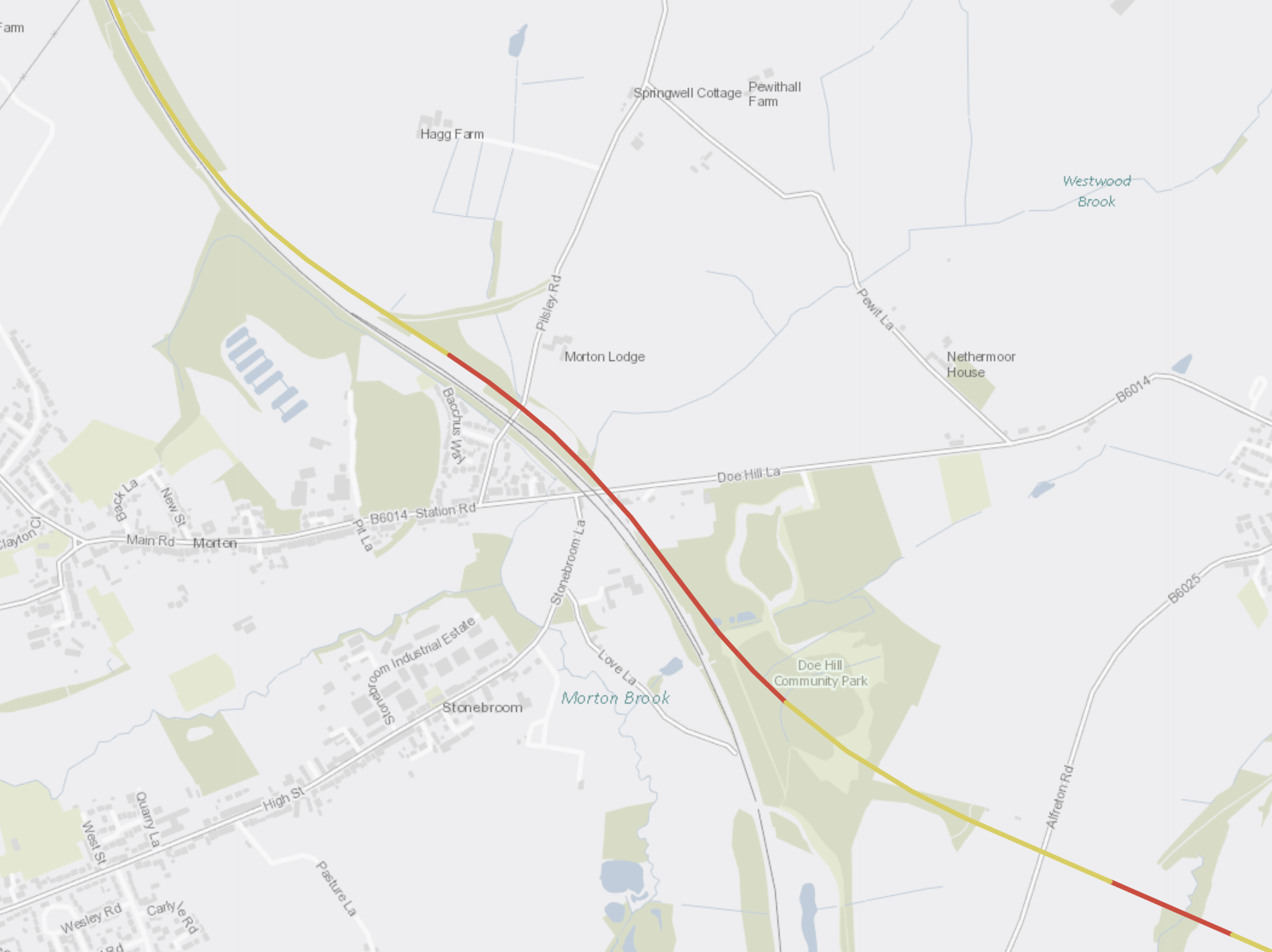
Note.
- Red is an embankment.
- Yellow is a cutting.
- The Sheffield Branch goes North-West to Clay Cross, Chesterfield and Sheffield
- The Sheffield Branch goes South-East to East Midlands Hub station.
- The Sheffield Branch goes through Doe Hill Country Park.
- The Sheffield Branch runs alongside the existing Erewash Valley Line, which goes South to Langley Mill, Ilkeston and the Derby-Nottingham area.
The Sheffield Branch and the Erewash Valley Line appear to share a route, which continues round Clay Cross and is shown in this third map.
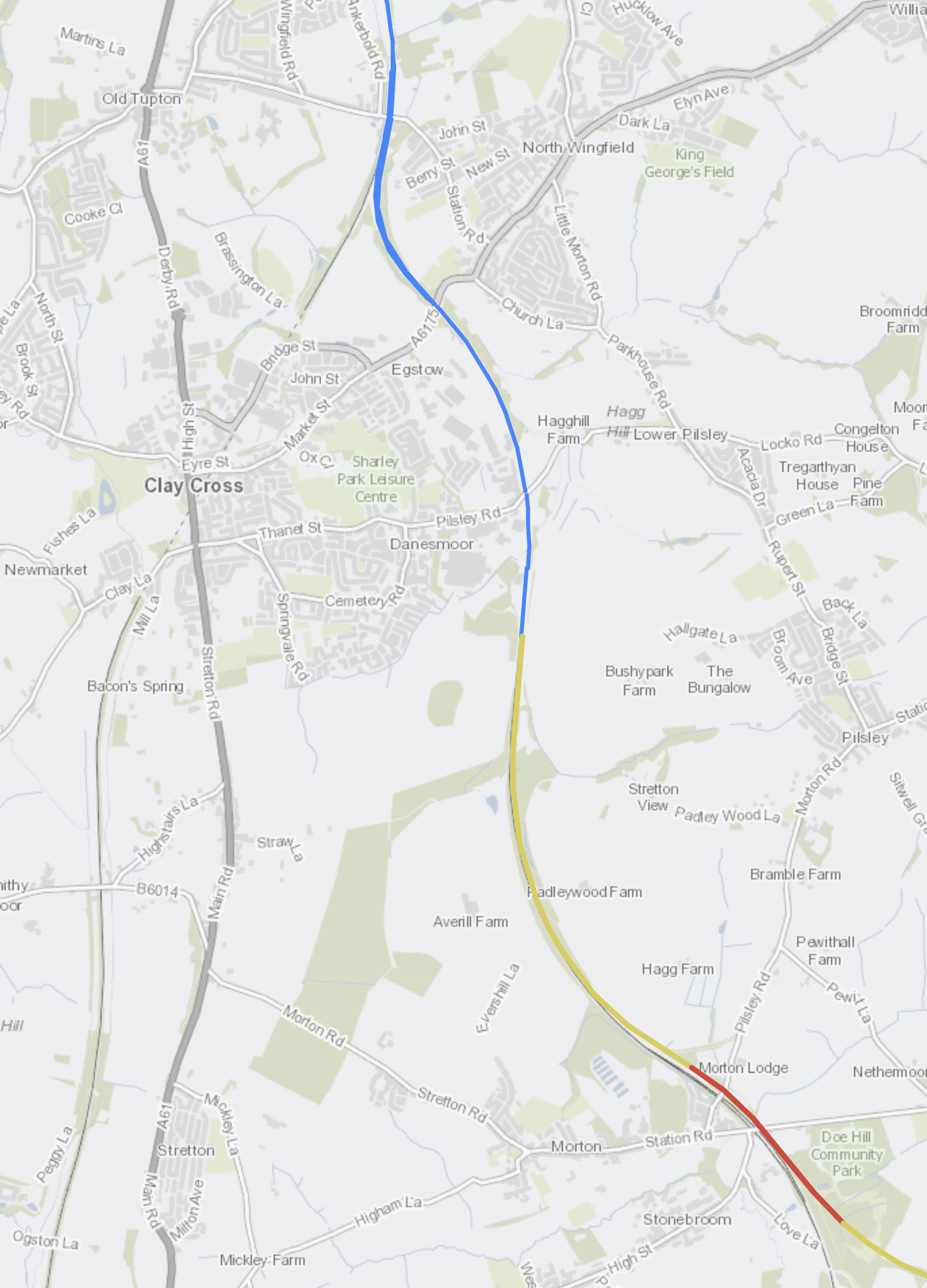
Note
- Doe Hill Country Park is in the South-East corner of the map.
- The dark line running North-South is the A61.
- Running to the West of the A61 is the Midland Main Line, which currently joins the Erewash Valley Line at Clay Cross North junction.
High Speed Two and the Midland Main Line will share a route and/or tracks from Clay Cross North junction to Sheffield.
This fourth map, shows where the combined route joins the Hope Valley Line to Manchester to the South West of Sheffield.
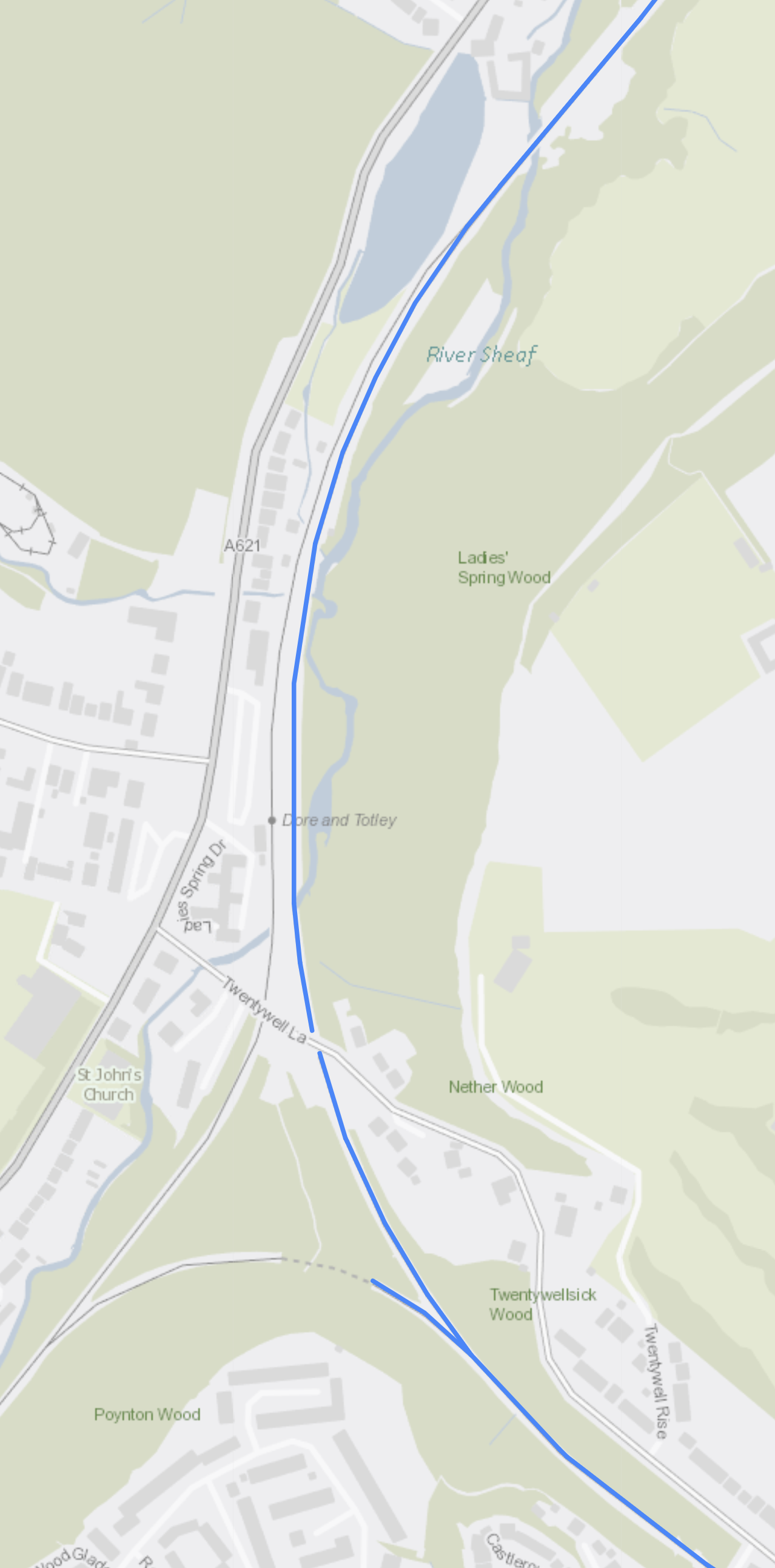
Note.
- Sheffield is to the North East.
- Chesterfield is to the South East,
- Totley junction is a large triangular junction, that connects to the Hope Valley Line.
These are some timings for various sections of the route.
- Clay Cross North Junction and Chesterfield (current) – 4 minutes
- Clay Cross North Junction and Sheffield (current) – 17 minutes
- Chesterfield and Sheffield (current) – 13 minutes
- Chesterfield and Sheffield (High Speed Two) – 13 minutes
- East Midlands Hub and Chesterfield (High Speed Two) – 16 minutes
- East Midlands Hub and Sheffield (High Speed Two) – 27 minutes
As Class Cross North Junction and Sheffield are 15.5 miles, this means the section is run at an average speed of 53 mph.
Can I draw any conclusions from the maps and timings?
- There would appear to be similar current and High Speed Two timings between Chesterfield and Sheffield.
- The various junctions appear to be built for speed.
The Midland Main Line will be electrified between Clay Cross North Junction and Sheffield, so that High Speed Two trains can use the route.
What will be the characteristics of the tracks between Clay Cross North Junction and Sheffield?
- Will it be just two tracks as it mainly is now or will it be a multi-track railway to separate the freight trains from the high speed trains?
- Will it have a high enough maximum speed, so that East Midland Railway’s new Class 810 trains can go at their maximum speed of 140 mph?
- Will it be capable of handling a frequency of 18 tph, which is the maximum frequency of High Speed Two?
Surely, it will be built to a full High Speed Two standard to future-proof the line.
Current Passenger Services Between Clay Cross North Junction And Sheffield Station
These trains use all or part of the route between Cross North Junction And Sheffield stations.
- CrossCountry – Plymouth and Edinburgh via Derby, Chesterfield, Sheffield and Leeds – 1 tph
- East Midlands Railway – London St. Pancras and Sheffield via Derby and Chesterfield – 2 tph
- East Midlands Railway – Liverpool Lime Street and Norwich via Stockport, The Hope Valley Line, Sheffield and Chesterfield – 1 tph
- Northern Trains – Manchester Piccadilly and Sheffield via the Hope Valley Line – 1 tph
- Northern Trains – Leeds and Nottingham via Meadowhall, Sheffield and Chesterfield – 1 tph
- TransPennine Express – Manchester Airport and Cleethorpes via Stockport, the Hope Valley Line and Sheffield – 1 tph
Note.
- tph is trains per hour.
- High Speed Two is currently planning to run two tph to Sheffield, which will run between Cross North junction and Sheffield stations.
- The services on the Hope Valley Line run on electrified tracks at the Manchester end.
These services can be aggregated to show the number of trains on each section of track.
- Hope Valley Line between Manchester and Totley junction – 3 tph
- Totley junction and Sheffield station – 7 tph
- Totley junction and Clay Cross North junction via Chesterfield – 4 tph
Adding in the High Speed Two services gives these numbers.
- Hope Valley Line between Manchester and Totley junction – 3 tph
- Totley junction and Sheffield station – 9 tph
- Totley junction and Clay Cross North junction via Chesterfield – 6 tph
This report on the Transport for the North web site, is entitled At A Glance – Northern Powerhouse Rail. It states that Transport for the North’s aspirations for Manchester and Sheffield are four tph with a journey time of forty minutes.
Adding in the extra train gives these numbers.
- Hope Valley Line between Manchester and Totley junction – 4 tph
- Totley junction and Sheffield station – 10 tph
- Totley junction and Clay Cross North junction via Chesterfield – 6 tph
This level of services can be accommodated on a twin-track railway designed to the right high speed standards.
Freight Services Between Clay Cross North Junction And Sheffield Station
The route is used by freight trains, with up to two tph on each of the three routes from Totley junction.
And these are likely to increase.
Tracks Between Clay Cross North Junction And Sheffield Station
I am absolutely certain, that two tracks between Clay Cross North junction And Sheffield station will not be enough, even if they are built to High Speed Two standards to allow at least 140 mph running under digital signalling.
Battery Electric Trains
The only battery-electric train with a partly-revealed specification is Hitachi’s Regional Battery Train, which is described in this Hitachi infographic.

Note.
- The train is a 100 mph unit.
- Ninety kilometres is fifty-six miles.
I would expect that battery-electric trains from other manufacturers like Alstom, CAF and Siemens would have similar performance on battery power.
In Thoughts On CAF’s Battery-Electric Class 331 Trains, I concluded CAF’s approach could give the following ranges.
- Three-car battery-electric train with one battery pack – 46.7 miles
- Four-car battery-electric train with one battery pack – 35 miles
- Four-car battery-electric train with two battery packs – 70 miles
I was impressed.
These are my thoughts on battery-electric trains on the routes from an electrified Sheffield.
Adwick
Sheffield and Adwick is 22.7 miles without electrification
I am sure that battery-electric trains can handle this route.
If the battery range is sufficient, there may not need to be charging at Adwick.
Bridlington
Sheffield and Bridlington is 90.5 miles without electrification, except for a short section through Doncaster, where trains could top up batteries.
I am sure that battery-electric trains can handle this route.
But there would need to be a charging system at Hull, where the trains reverse.
An alternative would be to electrify Hull and Brough, which is just 10.4 miles and takes about twelve minutes.
Derby Via The Midland Main Line
Clay Cross North junction and Derby is 20.9 miles without electrification.
I am sure that battery-electric trains can handle this route.
Gainsborough Central
Sheffield and Gainsborough Central is 33.6 miles without electrification
I am sure that battery-electric trains can handle this route.
But there will need to be a charging system at Gainsborough Central.
Huddersfield Via The Penistone Line
This is a distance of 36.4 miles with electrification at both ends, after the electrification between Huddersfield and Westtown is completed.
I am sure that battery-electric trains can handle this route.
Hull
Sheffield and Hull is 59.4 miles without electrification, except for a short section through Doncaster, where trains could top up batteries.
I am sure that battery-electric trains can handle this route.
But there will probably need to be a charging system at Hull.
An alternative would be to electrify Hull and Brough, which is just 10.4 miles and takes about twelve minutes.
Leeds Via The Hallam Or Wakefield Lines
This is a distance of 40-45 miles with electrification at both ends.
I am sure that battery-electric trains can handle this route.
Lincoln
Sheffield and Lincoln Central is 48.5 miles without electrification
I am sure that battery-electric trains can handle this route.
But there will probably need to be a charging system at Lincoln Central.
Manchester Via The Hope Valley Line
This is a distance of forty-two miles with electrification at both ends.
I am sure that battery-electric trains can handle this route.
Nottingham
Clay Cross North junction and Nottingham is 25.1 miles without electrification
I am sure that battery-electric trains can handle this route.
But there may need to be a charging system at Nottingham.
York
This is a distance of 46.4 miles with electrification at both ends.
I am sure that battery-electric trains can handle this route.
Is London St. Pancras And Sheffield Within Range Of Battery-Electric Trains?
In the previous section, I showed that it would be possible to easily reach Derby, as Clay Cross North junction and Derby is 20.9 miles without electrification.
- Current plans include electrifying the Midland Main Line as far North as Market Harborough.
- Market Harborough is 82.8 miles from London St. Pancras
- Derby is 128.3 miles from London St. Pancras
So what would be the best way to cover the 45.5 miles in the middle?
One of the best ways would surely be to electrify between Derby and East Midlands Parkway stations.
- Derby and East Midlands Parkway stations are just 10.2 miles apart.
- Current services take around twelve-fourteen minutes to travel between the two stations, so it would be more than enough time to charge a battery-electric train.
- Power for the electrification should not be a problem, as Radcliffe-on-Soar power station is by East Midlands Parkway station. Although the coal-fired power station will soon be closed, it must have a high class connection to the electricity grid.
- The East Midlands Hub station of High Speed Two will be built at Toton between Derby and Nottingham and will have connections to the Midland Main Line.
- An electrified spur could connect to Nottingham station.
I have flown my virtual helicopter along the route and found the following.
- Three overbridges that are not modern and built for large containers and electrification.
- Two level crossings.
- One short tunnel.
- Two intermediate stations.
- Perhaps half-a-dozen modern footbridges designed to clear electrification.
I’ve certainly seen routes that would be much more challenging to electrify.
I wonder if gauge clearance has already been performed on this key section of the Midland Main Line.
If this section were to be electrified, the sections of the Midland Main Line between London St. Pancras and Sheffield would be as follows.
- London St. Pancras and Market Harborough – Electrified – 82.8 miles
- Market Harborough and East Midlands Parkway – Not Electrified – 35.3 miles
- East Midlands Parkway and Derby – Electrified – 10.2 miles
- Derby and Clay Cross North junction – Not Electrified – 20.9 miles
- Clay Cross North junction and Sheffield – Electrified – 15.5 miles
Note.
- The World Heritage Site of the Derwent Valley Mills is not electrified, which could ease the planning.
- Leicester station with its low bridge, which could be difficult to electrify, has not been electrified.
- Under thirty miles of electrification will allow battery-electric trains to run between London St. Pancras and Sheffield, provided they had a range on batteries of around forty miles.
Probably, the best way to electrify between East Midlands Parkway and Derby might be to develop a joint project with High Speed Two, that combines all the power and other early works for East Midlands Hub station, with the electrification between the two stations.
Will The Class 810 Trains Be Converted To Battery-Electric Operation?
Hitachi’s Class 8xx trains tend to be different, when it comes to power. These figures relate to five-car trains.
- Class 800 train – 3 x 560 kW diesel engines
- Class 801 train – 1 x 560 kW diesel engine
- Class 802 train – 3 x 700 kW diesel engines
- Class 803 train – All electric – No diesel and an emergency battery
- Class 805 train – 3 x 700 kW diesel engines (?)
- Class 807 train – All electric – No diesel or emergency battery
- Class 810 train – 4 x 700 kW diesel engines (?)
Note.
- These figures relate to five-car trains.
- Class 807 train are seven-car trains.
- Where there is a question mark (?), the power has not been disclosed.
- Hitachi use two sizes of diesel engine; 560 kW and 700 kW.
It was generally thought with the Class 810 train to be used on the Midland Main Line, will be fitted with four engines to be able to run at 125 mph on diesel.
But are they 560 kW or 700 kW engines?
- A Class 802 train has an operating speed of 110 mph on diesel, with 2100 kW of installed power.
- To increase speed, the power will probably be related to something like the square of the speed.
So crudely the power required for 125 mph would be 2100*125*125/110/110, which works out at 2712 kW.
Could this explain why four engines are fitted? And why they are 700 kW versions?
Interestingly, I suspect, Hitachi’s five-car trains have two more or less identical driver cars, except for the passenger interiors, for the efficiency of manufacturing and servicing.
So does that mean, that a fifth engine could be fitted if required?
There probably wouldn’t be a need for five diesel engines, but as I also believe that the Hyperdrive Innovation battery packs for these trains are plug-compatible with the diesel engines, does that mean that Hitachi’s trains can be fitted with five batteries?
Suppose you wanted to run a Class 810 train at 125 mph to clear an electrification gap of forty miles would mean the following.
- It would take 0.32 hours or 19.2 minutes to cross the gap.
- In that time 2800 kW of diesel engines would generate 896 kWh.
- So to do the same on batteries would need a total battery capacity of 896 kWh.
- If all diesel engines were replaced, each battery would need to be 224 kWh
A battery of this size is not impractical and probably weighs less than the at least four tonnes of the diesel engine it replaces.
Conclusions
Electrification between Clay Cross North Junction and Sheffield station is an important project that enables the following.
- A high proportion of diesel services to and from Sheffield to be converted to battery-electric power.
- With electrification between Derby and East Midlands Parkway, it enables 125 mph battery-electric trains to run between London St. Pancras and Sheffield.
- It prepares Sheffield for High Speed Two.
It should be carried out as soon as possible.
Improving The Cross Country Route
The Cross Country Route is one of the UK’s forgotten railway lines.
- It runs between York and Bristol Temple Meads.
- Intermediate stations include Leeds, Wakefield Westgate, Rotherham Central, Meadowhall, Sheffield, Chesterfield, Derby, Burton-on-Trent, Tamworth, Birmingham New Street, University, Bromsgrove, Worcestershire Parkway, Cheltenham Spa and Bristol Parkway.
- At the Northern end trains can swap to the electrified East Coast Main Line and can extend services to Edinburgh and Aberdeen.
- At the Southern end trains can swap to the Great Western Main Line and extend services to Taunton, Exeter, Plymouth and Penzance.
- Trains can also swap to the South Wales Main Line in the Bristol area, to serve Cardiff and South Wales.
- Operating speeds are generally around 100 mph, but there are sections of 125 mph running.
- Some sections of the route have 25 KVAC overhead electrification.
I very much believe that it is a route that is ripe for improvement.
These are my thoughts.
Extra And Rebuilt Stations
Recently, Worcestershire Parkway station has been opened on the route.
Bromsgrove station was rebuilt and reopened in 2016.
Derby station was remodelled in 2018.
In addition, there are aspirations for other mew stations and station improvements on the route.
- University station is being rebuilt for the 2022 Commonwealth Games.
- Sheffield Region are proposing a station at Barnsley Dearne Valley. I wrote about this in Sheffield Region Transport Plan 2019 – A New Station At Barnsley Dearne Valley.
- Sheffield Region may be creating a new station in Rotherham.
I can see more station improvements and additions on the Cross Country Route.
New Trains
Most services are run by CrossCountry, who only use diesel trains.
Their core services are as follows.
Plymouth And Edinburgh uses the route between York and Bristol Temple Meads. The service runs under wires North of Leeds and at Bristol Parkway and at Birmingham New Street.
Southampton Central And Newcastle uses the route between York and Birmingham New Street. The service runs under wires North of Leeds and at Reading and at Birmingham New Street.
Bournemouth and Manchester Piccadilly uses the route at Birmingham New Street. The service runs under wires North of Birmingham New Street.
Bristol Temple Meads and Manchester Piccadilly uses the route between Bristol Temple Meads and Birmingham New Street. The service runs under wires at Bristol Parkway and North of Birmingham New Street.
Cardiff Central and Nottingham uses the route between Gloucester and Derby. The service runs under the wires West of Bristol Parkway and at Birmingham New Street.
Birmingham New Street and Nottingham uses the route between Birmingham New Street and Derby. The service runs under the wires at Birmingham New Street.
Birmingham New Street and Stansted Airport does not use the route. The service runs under the wires at Birmingham New Street and around Cambridge and Peterborough.
Birmingham New Street and Leicester does not use the route. The service runs under the wires at Birmingham New Street.
Note.
- Several services run under wires for sufficient time to charge a battery-electric train.
- Several services turn in stations for sufficient time to charge a battery-electric train.
- At least six or possibly seven of the services run for at least fifty miles on tracks that can handle 125 mph running. Some of this track will be upgraded to 140 mph with digital signalling.
This Hitachi infographic shows the Hitachi Intercity Tri-Mode Battery Train.
I believe that Hitachi could produce a version of this train, that would partially meet CrossCountry’s need for a new fleet to reduce their carbon footprint.
For the purpose of this analysis, I will assume this about the trains.
- Battery power will always be used in stations.
- The trains have a battery range of around forty miles at 100 mph.
- Running at 125 mph will need 25 KVAC overhead electrification.
This table shows the current electrification status of the Cross Country Route.
- York and South Kirby junction- 45.4 miles – Electrified
- South Kirby junction and Birmingham New Street – 96.6 miles – Not Electrified
- Birmingham New Street and Bromsgrove – 16 miles – Electrified
- Bromsgrove and Bristol Parkway – 69.8 miles – Not Electrified
- Bristol Parkway and Bristol Temple Meads – 4.8 miles- Not Electrified
The trains would appear to still need to use diesel on some parts of the route.
Or Hitachi ABB Power Grids could install short lengths of 25 KVAC overhead electrification to top up the trains’ batteries in appropriate places.
I believe CrossCountry could decarbonise this route using battery-electric trains and discontinuous electrification.
This would surely refresh the line and attract passengers, but would the trains speed up the service?
- Birmingham New Street and Leeds is 116.4 miles and currently takes just under two hours at an average speed of 59.3 mph in a Class 221 train.
- Several sections of line between Birmingham New Street and Leeds can sustain 125 mph running.
- London Liverpool Street and Norwich is 114.5 miles and has regularly been achieved by British Rail-era electric trains in ninety minutes on a 100 mph line, which is an average speed of 76 mph.
- Averaging 76 mph between Birmingham New Street and Leeds would give a time of 92 minutes.
For these and other reasons, I am fairly sure that a battery-electric train capable of running at 125 mph with fast acceleration could run between Birmingham New Street and Leeds in under ninety minutes, with the addition of some discontinuous electrification.
- There is currently one tph between Birmingham New Street and Leeds, which also serves Sheffield.
- There is also one tph between Birmingham New Street and Sheffield by a different route.
- There is two tph between Birmingham New Street and Nottingham.
- My calculations indicate that the Nottingham and Sheffield services would take under an hour to and from Birmingham New Street, with the Leeds service taking thirty minutes longer.
In normal circumstances no diesel would be used.
Track Improvements And Discontinuous Electrification
This table shows the current electrification status of the Cross Country Route.
- York and South Kirby junction- 45.4 miles – Electrified
- South Kirby junction and Birmingham New Street – 96.6 miles – Not Electrified
- Birmingham New Street and Bromsgrove – 16 miles – Electrified
- Bromsgrove and Bristol Parkway – 69.8 miles – Not Electrified
- Bristol Parkway and Bristol Temple Meads – 4.8 miles – Not Electrified
Solutions will have to be found to decarbonise a lot of the route.
I have flown my virtual helicopter from Tamworth to Sheffield and this part of the route seems to the sort of route that could be upgraded to a full 125 mph line, as it is fairly straight and some sections already allow trains to travel at this speed.
As the 15.5 miles between Clay Cross North Junction and Sheffield will be updated and electrified for High Speed Two’s spur into Sheffield sometime in the future, I would feel that as updating this section benefits High Speed Two, the Midland Main Line, the Cross Country Route and the Hope Valley Line, that this section should be rebuilt as necessary and electrified, as soon as is practically possible.
I believe that Clay Cross North Junction and Sheffield is one of the most important routes in the country to be electrified, if not the most important.
This table shows the electrification status of the Cross Country Route after electrification of Clay Cross North Junction and Sheffield.
- York and South Kirby junction- 45.4 miles – Electrified
- South Kirby junction and Sheffield – 18.8 miles – Not Electrified
- Sheffield and Clay Cross North junction – 15.5 miles – Electrified
- Clay Cross North junction and Birmingham New Street – 62.1 miles – Not Electrified
- Birmingham New Street and Bromsgrove – 16 miles – Electrified
- Bromsgrove and Bristol Parkway – 69.8 miles – Not Electrified
- Bristol Parkway and Bristol Temple Meads – 4.8 miles – Not Electrified
It looks that by electrifying the 15.5 miles between Sheffield and Clay Cross North junction, the gap of 18.8 miles between South Kirby junction and Sheffield could be easily bridged by a battery-electric train.
The section between Clay Cross North junction and Birmingham New Street can be split into three.
- Clay Cross North junction and Derby – 20.9 miles
- Derby and Tamworth – 23.9 miles
- Tamworth and Birmingham New Street – 17.3 miles
If Hitachi ABB Power Grids installed discontinuous electrification at Derby and Tamworth, this should bridge the gap to the electrification at Birmingham.
As some of this section can sustain 125 mph running, it may be better to fully electrify part of the route.
This table shows the electrification status of the route would become
- York and South Kirby junction- 45.4 miles – Electrified
- South Kirby junction and Sheffield – 18.8 miles – Not Electrified
- Sheffield and Clay Cross North junction – 15.5 miles – Electrified
- Clay Cross North junction and Derby – 20.9 miles – Not Electrified
- Derby and Tamworth – 23.9 miles – Not Electrified
- Tamworth and Birmingham New Street – 17.3 miles – Not Electrified
- Birmingham New Street and Bromsgrove – 16 miles – Electrified
- Bromsgrove and Bristol Parkway – 69.8 miles – Not Electrified
- Bristol Parkway and Bristol Temple Meads – 4.8 miles – Not Electrified
I have also flown my virtual helicopter from Bromsgrove to Westerleigh junction, where the Cross Country Route joins the electrified Great Western Main Line, about 4.5 miles East of Bristol Parkway station.
It looks to me that this Southern short section of electrified line would be able to charge a battery-electric train so that it could reach Bristol Temple Meads station.
But the sixty-plus miles of route without electrification between Bromsgrove and Westerleigh junction would be too far to travel without some electrification.
This could either be full electrification or discontinuous using the methods proposed by Hitachi ABB Power Grids.
It certainly looks to me, that Hitachi’s technology or similar, that I talked about in Solving The Electrification Conundrum could be used to run battery-electric trains between York and Bristol Temple Meads on the Cross Country Route.
Digital Signalling
I would assume this will be installed on the route, to give more precise control of trains on the more complicated sections of the route.
East Coast Main Line Improvements
There are several improvements to the North of York, that will reduce journey times on all services using the East Coast Main Line.
These could contribute time saving of up to ten minutes, according to High Speed Two’s Journey Planner and current timetables.
Comparison With The Proposed Eastern Leg Of High Speed Two
With all the talk about possible cancellation of the Eastern Leg of High Speed Two could an improved Cross Country Route be used in the interim?
I will look at a few timings from Birmingham.
Birmingham And Leeds
A fully-developed High Speed Two is claiming forty-nine minutes, as against the one hour and fifty-eight minutes today.
I have stated that ninety minutes is an attainable time on a 116.4 mile journey, where a good proportion of 125 mph running will be possible, sustained by electrification.
But with full electrification, more 125 mph running and even some 140 mph running under the control of digital signalling, I suspect that ninety minutes is only an upper limit to the journey time between Birmingham and Leeds.
High Speed Two are saying they will run two tph between Birmingham and Leeds, which is twice the current frequency.
I could see that an improved frequency on the Cross Country Route could be very convenient, if it increased the frequency between the two cities to four tph.
Is it going to annoy passengers, that services will leave from two different stations in Birmingham and if you go to the wrong one, you’ll have to wait thirty minutes for the next train?
Birmingham And Middlesbrough
Times between Birmingham and Middlesbrough will be determined by adding a Leeds and Middlesbrough time to the Birmingham and Leeds times.
The best time between Leeds and Middlesbrough today is one hour and 23 minutes, which I suspect will lose a few minutes due to East Coast Main Line improvements North of York.
This gives using High Speed Two to Leeds a time of two hours and eight minutes, as against two hours and forty-nine minutes using an improved Cross Country Route.
Birmingham And Newcastle
A fully-developed High Speed Two is claiming one hour and fifty-seven minutes, as against the three hours and twenty-six minutes today.
Based on the current and possible times between Birmingham at Leeds using CrossCountry, I feel times to stations North of Leeds will be reduced by at least twenty-eight minutes, putting the Birmingham and Newcastle time a few minutes under three hours.
Birmingham And Nottingham
A fully-developed High Speed Two is claiming twenty minutes to East Midlands Hub, which when adding in the tram to Nottingham City Centre will be thirty-five minutes..
,Current services are one hour and ten minutes today.
On an improved Cross Country Route, with with battery-electric trains and some 125 mph running, I can see this time shrink to under an hour, even with the reverse at Derby.
Midlands Connect are also proposing a high speed service between Birmingham Curzon Street and Nottingham station, which will take thirty-three minutes.
High Speed Two are saying they will run three tph between Birmingham and East Midlands Hub, which compares with two tph using the Cross Country Route.
Birmingham And Sheffield
A fully-developed High Speed Two is claiming fifty-seven minutes, as against the one hour and fifteen minutes today.
I have stated that an hour is an attainable time on this route, with battery-electric trains and some 125 mph running.
A time of an hour would be very competitive with the Eastern Leg of High Speed Two.
High Speed Two are saying they will run two tph between Birmingham and Sheffield with a change at East Midlands Hub, which compares with two tph using the Cross Country Route.
Conclusion
A fully developed East Coast Main Line will give High Speed Two a good run for its money on services between London and Yorkshire, North East England and Scotland. I indicated my thoughts and conclusions in What Is Possible On The East Coast Main Line?.
I also believe that an improved Cross Country Route could give the Eastern Leg of High Speed Two a very good run for its money.
Perhaps, we should safeguard the route of Eastern Leg of High Speed Two for building later to increase capacity when it is needed, but in the interim we should upgrade the following routes.
- Cross Country Route
- East Coast Main Line
- Midland Main Line
- Northern Powerhouse Rail
- West Coast Main Line
These routes should have at least these minimum standards.
- All passenger trains electric or battery-electric.
- All freight locomotives electric, battery-electric or hydrogen-electric.
- Where possible all lines should allow 125 mph running.
- Universal in-cab digital signalling
- There should be sections of 140 mph running, where possible.
We will need the Eastern Leg of High Speed Two in the future, but we don’t need it in the next few years.
Thoughts On The Eastern Leg Of High Speed Two
These are a few thoughts on the Eastern Leg of High Speed Two.
Serving The North-East Quarter Of England From London
In Anxiety Over HS2 Eastern Leg Future, I gave a table of timings from London to towns and cities in the North-East quarter of England from Lincoln and Nottingham Northwards.
I’ll repeat it here.
- Bradford – Will not be served by High Speed Two – One hour and fifty-four minutes
- Cleethorpes – Will not be served by High Speed Two – Two hours and fifty-one minutes
- Darlington – One hour and forty-nine minutes – One hour and forty-nine minutes
- Doncaster – Will not be served by High Speed Two – One hour
- Edinburgh – Three hours and forty minutes via Western Leg – Three hours and thirty minutes.
- Grimsby – Will not be served by High Speed Two – Two hours and thirty-six minutes
- Harrogate – Will not be served by High Speed Two – One hour and fifty-two minutes
- Huddersfield – Will not served by High Speed Two – Two hours and eight minutes
- Hull – Will not be served by High Speed Two – One hour and fifty minutes
- Leeds – One hour and twenty-one minutes – One hour and thirty minutes
- Lincoln – Will not be served by High Speed Two – One hour and fifty-one minutes
- Middlesbrough – Will not be served by High Speed Two – Two hours and twenty minutes
- Newcastle – Two hours and seventeen minutes – Two hours and sixteen minutes
- Nottingham – One hour and seven minutes – One hour and fifty minutes
- Scarborough – Will not be served by High Speed Two – Two hours and fifty-seven minutes
- Sheffield – One hour and twenty-seven minutes – One hour and twenty-seven minutes
- Skipton – Will not be served by High Speed Two – Two hours and seven minutes
- Sunderland – Will not be served by High Speed Two – Two hours and thirty minutes
- York – One hour and twenty-four minutes – One hour and twenty-four minutes
Note.
- I have included all destinations served by Grand Central, Hull Trains and LNER.
- I have included Nottingham and Sheffield for completeness and in case whilst electrification is installed on the Midland Main Line, LNER run services to the two cities.
- I suspect LNER services to Bradford, Harrogate, Huddersfield and Skipton will split and join at Leeds.
There are a total of nineteen destination in this table.
- Twelve are not served by High Speed Two.
- Six are not more than fifteen minutes slower by the East Coast Main Line.
Only Nottingham is substantially quicker by High Speed Two.
Serving The North-East Quarter Of England From Birmingham
Fenland Scouser felt the above table might be interesting to and from Birmingham with or without the Eastern Leg of High Speed Two.
I think, I can give more information than that and it should be possible to give for each destination the following.
- Whether of not the route exists on High Speed Two.
- Time on High Speed Two from Birmingham.
- Time on High Speed Two and Northern Powerhouse Rail from Birmingham via Manchester
- Time by current trains from Birmingham
In the following table, the fields are in the order of the previous table.
- Bradford – No direct route – No time – One hour and three minutes – Two hours and twenty-seven minutes
- Cleethorpes – No direct route – No time – Three hours and eight minutes – Three hours and eighteen minutes
- Darlington – Route Exists – One hour and twenty-three minutes – One hour and forty minutes – Two hours and fifty-five minutes
- Doncaster – No direct route – No time – One hour and thirty-six minutes – Two hours and nineteen minutes
- Edinburgh- Route Exists – Three hours and fourteen minutes – Four hours – Four hours and thirteen minutes
- Grimsby – No direct route – No time – Two hours and fifty-three minutes – Three hours and three minutes
- Harrogate – No direct route – No time – One hour and twenty-eight minutes – Three hours
- Huddersfield – No direct route – No time – Fifty-six minutes – Two hours and eleven minutes
- Hull – No direct route – No time – One hour and forty-four minutes – Three hours and two minutes
- Leeds – Route Exists – Forty-nine minutes – One hour and six minutes – One hour and fifty-nine minutes
- Lincoln – No direct route – No time – Two hours and fifty-three minutes – Two hours and thirteen minutes
- Middlesbrough – No direct route – No time – Two hours and twenty-nine minutes – Three hours and thirty-two minutes
- Newcastle – No direct route – No time – Two hours and four minutes – Three hours and twenty-six minutes
- Nottingham – Route Exists – Fifty-seven minutes – Two hours and fifty-five minutes – One hour and ten minutes
- Sheffield – Route Exists – Thirty-five minutes – One hour and thirty-four minutes – One hour and fifteen minutes
- Skipton – No direct route – No time – One hour and forty-three minutes – Two hours and fifty-two minutes
- Sunderland – No direct route – No time – Two hours and fifty-nine minutes – Three hours and fifty-eight minutes
- York – Route Exists – Fifty-seven minutes – One hour and twenty-eight minutes – Two hours and twenty-seven minutes
Note.
- No time means just that!
- One of the crucial times is that Birmingham Curzon Street and Leeds is just an hour and six minutes via High Speed Two and Northern Powerhouse Rail. This time gives good times to all destinations served from Leeds.
- Nottingham and Sheffield are both around an hour and fifteen minutes from Birmingham New Street, by the current trains.
I’ll now look at some routes in detail.
Birmingham And Leeds
The time of one hour and six minutes is derived from the following.
- Birmingham Curzon Street and Manchester Piccadilly by High Speed Two – Forty-one minutes
- Manchester Piccadilly and Leeds by Northern Powerhouse Rail – Twenty-five minutes
It would be seventeen minutes slower than the direct time of forty-nine minutes.
But it is quicker than the current time of one hour and fifty-nine minutes
Note.
- As Manchester Piccadilly will have a time to and from London of one hour and eleven minutes, Leeds will have a time of one hour and twenty-six minutes to London via Northern Powerhouse Rail and Manchester.
- If the Eastern Leg is built, The London and Leeds time will be one hour and twenty-one minutes.
- The Eastern Leg would therefore save just five minutes.
The Northern Powerhouse route could probably mean that Huddersfield, Bradford and Hull would be served by High Speed Two from London.
Manchester Airport, Manchester Piccadilly and Leeds would be connected by a tunnel deep under the Pennines.
- Manchester Piccadilly, Huddersfield and Bradford could be underground platforms added to existing stations.
- Piccadilly and Leeds would have a journey time of under 25 minutes and six trains per hour (tph).
- The tunnel would also carry freight.
- It would be modelled on the Gotthard Base Tunnel in Switzerland.
I wrote full details in Will HS2 And Northern Powerhouse Rail Go For The Big Bore?
Birmingham And Nottingham
The time of two hours and fifty-five minutes is derived from the following.
- Birmingham Curzon Street and Manchester Piccadilly by High Speed Two – Forty-one minutes
- Manchester Piccadilly and Leeds by Northern Powerhouse Rail – Twenty-five minutes
- Leeds and Nottingham – One hour and forty-nine minutes
It would be one hour and fifty-eight minutes slower than the direct time of fifty-nine minutes.
The current time of one hour and ten minutes is much quicker.
Birmingham And Sheffield
The time of two hours and thirty-four minutes is derived from the following.
- Birmingham Curzon Street and Manchester Piccadilly by High Speed Two – Forty-one minutes
- Manchester Piccadilly and Leeds by Northern Powerhouse Rail – Twenty-five minutes
- Leeds and Sheffield – One hour and twenty-eight minutes
It would be one hour and fifty-nine minutes slower than the direct time of thirty-five minutes.
The current time of one hour and fifteen minutes is much quicker.
Conclusions On The Timings
I am led to the following conclusions on the timings.
The building of the Eastern Leg of High Speed Two gives the fastest times between Birmingham and Leeds, Nottingham and Sheffield.
But if the Eastern Leg of High Speed Two is not built, then the following is true, if Northern Powerhouse Rail is created between Manchester and Leeds.
The time of an hour and six minutes between Birmingham Curzon Street and Leeds is probably an acceptable time.
This time probably enables acceptable times between Birmingham Curzon Street and destinations North of Leeds.
But with Nottingham and Sheffield the current CrossCountry service is faster than the route via Manchester.
The speed of the CrossCountry services surprised me, but then there is a section of 125 mph running between Derby and Birmingham, which is used by CrossCountry services between Birmingham New Street and Leeds, Nottingham and Sheffield.
This table gives details of these services.
- Birmingham New Street and Leeds – 116,4 miles – One hour and 58 minutes – 59.3 mph
- Birmingham New Street and Nottingham – 57.2 miles – One hour and 14 minutes – 46.4 mph
- Birmingham New Street and Sheffield – 77.6 miles – One hour and 18 minutes – 59.7 mph
Note.
- The Leeds and Sheffield services are run by 125 mph Class 220 trains.
- The Notting service is run by 100 mph Class 170 trains.
- All trains are diesel-powered.
As there is 125 mph running between Derby and Birmingham, the train performance probably accounts for the slower average speed of the Nottingham service.
CrossCountry And Decarbonisation
Consider.
- CrossCountry has an all-diesel fleet.
- All train companies in the UK are planning on decarbonising.
- Some of CrossCountry’s routes are partially electrified and have sections where 125 mph running is possible.
The only standard train that is built in the UK that would fit CrossCountry’s requirements, would appear to be one of Hitachi’s 125 mph trains like a bi-mode Class 802 train.
- These trains are available in various lengths
- Hitachi will be testing battery packs in the trains in the next year, with the aim of entering service in 2023.
- Hitachi have formed a company with ABB, which is called Hitachi ABB Power Grids to develop and install discontinuous electrification.
When CrossCountry do replace their fleet and run 125 mph trains on these services several stations will be connected to Birmingham for High Speed Two.
The route between Leeds and Birmingham via Sheffield is part of the Cross Country Route, for which electrification appears to have planned in the 1960s according to a section in Wikipedia called Abortive British Rail Proposals For Complete Electrification,
I suspect that the following times could be achieved with a frequency of two tph
- Birmingham New Street and Leeds – 90 minutes
- Birmingham New Street and Nottingham – 60 minutes
- Birmingham New Street and Sheffield – 60 minutes
It is not the Eastern Leg of High Speed Two, but it could do in the interim.
Electrification Of The Midland Main Line
I don’t believe that the Midland Main Line needs full electrification to speed up services to Derby, Nottingham and Sheffield, but I believe that by fitting batteries to Hitachi’s Class 810 trains, that will soon be running on the line and using the Hitachi ABB Power Grids system of discontinuous electrification, that the route can be decarbonised.
I would also apply full digital in-cab signalling to the Midland Main Line.
Conclusion
We will need the Eastern Leg of High Speed Two at some time in the future, but if we do the following we can do more than cope.
- Create Northern Powerhouse Rail between Manchester and Leeds, so that High Speed Two can serve Leeds and Hull via Manchester.
- Decarbonise CrossCountry with some 125 mph battery-electric trains.
- Electrify the Midland Main Line.
I would also deliver as much as possible before Phase 1 and 2a of High Speed Two opens.
Anxiety Over HS2 Eastern Leg Future
I did think about giving this post a title of Here We Go Again, as it yet another story about delaying or cancelling the Eastern Leg of High Speed Two.
But in the end I decided to use the title of the article in the September 2021 Edition of Modern Railways.
I wrote about this subject in Is The Eastern Leg Of High Speed Two Under Threat? in December 2020.
In that post, this was my major conclusion.
To achieve the required timings for High Speed Two, major improvements must be made to existing track on the East Coast Main Line and these improvements will mean that existing services will be competitive with High Speed Two on time.
It is backed up by the timings in the following table., which show the direct time by High Speed Two and my best estimate of time on an improved East Coast Main Line.
- Bradford – Will not served by High Speed Two – One hour and fifty-four minutes
- Cleethorpes – Will not served by High Speed Two – Two hours and fifty-one minutes
- Darlington – One hour and forty-nine minutes – One hour and forty-nine minutes
- Doncaster – Will not served by High Speed Two – One hour
- Edinburgh – Three hours and forty minutes via Western Leg – Three hours and thirty minutes.
- Grimsby – Will not served by High Speed Two – Two hours and thirty-six minutes
- Harrogate – Will not served by High Speed Two – One hour and fifty-two minutes
- Huddersfield – Will not served by High Speed Two – Two hours and eight minutes
- Hull – Will not served by High Speed Two – One hour and fifty minutes
- Leeds – One hour and twenty-one minutes – One hour and thirty minutes
- Lincoln – Will not served by High Speed Two – One hour and fifty-one minutes
- Middlesbrough – Will not served by High Speed Two – Two hours and twenty minutes
- Newcastle – Two hours and seventeen minutes – Two hours and sixteen minutes
- Nottingham – One hour and seven minutes – One hour and fifty minutes
- Scarborough – Will not served by High Speed Two – Two hours and fifty-seven minutes
- Sheffield – One hour and twenty-seven minutes – One hour and twenty-seven minutes
- Skipton – Will not served by High Speed Two – Two hours and seven minutes
- Sunderland – Will not served by High Speed Two – Two hours and thirty minutes
- York – One hour and twenty-four minutes – One hour and twenty-four minutes
Note.
- I have included all destinations served by Grand Central, Hull Trains and LNER.
- I have included Nottingham and Sheffield for completeness and in case whilst electrification is installed on the Midland Main Line, LNER run services to the two cities.
- I suspect LNER services to Bradford, Harrogate, Huddersfield and Skipton will split and join at Leeds.
There are a total of nineteen destination in this table.
- Twelve are not served by High Speed Two.
- Six are not more than fifteen minutes slower by the East Coast Main Line.
Only Nottingham is substantially quicker by High Speed Two.
In Is The Eastern Leg Of High Speed Two Under Threat?, I said that if Nottingham services ran at the sort of speed on the East Coast Main Line, that a time of one hour and twenty-one minutes between London St. Pancras and Nottingham could be possible. That would be just fourteen minutes slower than the time on High Speed Two with a change at East Midlands Hub.
Conclusion
I am getting more convinced that we don’t need the Eastern Leg of High Speed Two to East Midlands Hub and Leeds for a few years yet, as by uprating the East Coast and Midland Main Lines we can handle the traffic that we currently are generating with ease.
What Does High Speed Two Mean By Classic Compatible Trains?
The Classic-Compatible trains are described in this section in Wikipedia, by this sentence.
The classic-compatible trains, capable of high speed but built to a British loading gauge, permitting them to leave the high speed track to join conventional routes such as the West Coast Main Line, Midland Main Line and East Coast Main Line. Such trains would allow running of HS2 services to the north of England and Scotland, although these non-tilting trains would run slower than existing tilting trains on conventional track. HS2 Ltd has stated that, because these trains must be specifically designed for the British network and cannot be bought “off-the-shelf”, these conventional trains were expected to be around 50% more expensive, costing around £40 million per train rather than £27 million for the captive stock.
The Classic-Compatible trains will share these characteristics with the Full-Size trains.
- Maximum speed of 225 mph.
- Cruising speed of 205 mph on High Speed Two.
- Length of 200 metres.
- Ability to work in pairs.
- A passenger capacity around 500-600 passengers.
But what characteristics will the Classic-Compatible trains share with other trains on the UK network?
The Classic-Compatible trains will share some tracks with other trains, according to High Speed Two’s latest plans.
- On the East Coast Main Line, the trains will run between York and Newcastle.
- On the Liverpool Branch between Weaver junction and Liverpool Lime Street station.
- On the Midland Main Line between Clay Cross North junction and Sheffield.
- On the Midland main Line between East Midlands Hub and Bedford.
- On the West Coast Main Line, the trains will run between Crewe and Glasgow.
- On the West Coast Main Line, the trains will run between Stafford and Macclesfield.
As High Speed Two develops, the Classic-Compatible trains could venture off the main routes to places like Aberdeen, Barrow-in-Furness, Blackburn, Blackpool, Cleethorpes, Holyhead, Huddersfield, Inverness, Middlesbrough, Redcar, Scarborough, Stirling and Sunderland.
They will need to be able to go anywhere, which is worthwhile to connect to High Speed Two.
The main restriction is the size of the train and so a Classic-Compatible train probably can’t be larger than the largest train on the UK network, with respect to width, height and to a certain extend length.
Widths of typical trains are as follows.
- Class 319 train – 2.82 metres
- Class 321 train – 2.82 metres
- Class 387 train – 2.80 metres
- Class 700 train – 2.80 metres
- Class 710 train – 2.77 metres
- Class 745 train – 2.72 metres
- Class 800 train – 2.70 metres
- Mark 4 coach – 2.73 metres
Heights of typical trains are as follows.
- Class 319 train – 3.58 metres
- Class 321 train – 3.78 metres
- Class 387 train – 3.77 metres
- Class 710 train – 3.76 metres
- Class 745 train – 3.95 metres
- Mark 4 coach – 3.79 metres
Note.
- I find it odd, that the smallest width is one of the newest trains; Hitachi’s Class 800.
- Length is fairly irrelevant as many trains in the UK are almost 240 metres long.
I suspect that Classic-Compatible trains will have width of between 2.70 and 2.80 metres and a height of around 3.80 metres.
Could A High Speed Two Classic-Compatible Train Go Through The Thameslink Tunnel?
I ask this question, as surely in a post-pandemic world, where we are all flying there may be a case to be made for a train service between the North of England and Gatwick Airport.
But when East Midlands Railway has their new Class 810 trains, it might be possible, if they didn’t use the diesel engines.
Signalling would not be a problem, as in a few years time, all trains will be equipped with the latest digital signalling systems.
If running a Class 810 train, through the tunnel is possible, given that a Classic-Compatible train will not be larger than a Class 810 train, will High Speed Two’s trains be able to cross London in the Thameslink Tunnel?
As Midlands Connect are planning to run a Leeds and Bedford service using High Speed Two Classic-Compatible trains, could this service be extended through the Thameslink Tunnel to Gatwick Airport and Brighton?
I have a feeling that this will be physically possible.
- It would be under the control of the signalling.
- There’s no reason, why a high speed train can’t have a precise low speed performance.
- It would stop at all stations.
- It would use one of the Bedford and Brighton paths on Thameslink
Passengers would like catching a train at a station in Central London and like being whisked all the way to East Midlands Hub and Leeds.
Could A High Speed Two Classic-Compatible Train Go Through The Crossrail Tunnel?
Consider.
- It would surely be possible to arrange tracks at Old Oak Common to allow High Speed Two Classic-Compatible trains to go between High Speed Two and Crossrail.
- Crossrail is considering running to Ebbsfleet.
- It might even be possible to connect in East London.
- The High Speed Two Classic-Compatible trains would be digitally-signalled and controlled through Crossrail without stopping.
- Platform edge doors would ensure safety, but also prevent the trains from stopping at the existing stations.
I have just looked at the London railway map on carto metro, there are stretches of Crossrail under London, where there is space for a station with 200 metre, if not a 400 metre platforms, to the West or East of current Crossrail stations.
- To the West of Bond Street
- To the East of Tottenham Court Road
- To the West of Farringdon
- To the East of Liverpool Street
- To the West of Canary Wharf
- To the East of Canary Wharf
Would all appear to have the required space and be possibilities for extra High Speed Two platforms.
Effectively, some stations would have two sets of platforms on the tracks beside each other.
- One pair of platforms would be the existing station, with platform edge doors compatible with Crossrail’s Class 345 trains.
- The other pair of platforms would be the High Speed Two station, with platform edge doors compatible with High Speed Two Classic-Compatible trains.
- The signalling and train control systems would automatically stop trains in the appropriate platform.
- Extra passageways would link the new platforms to the existing station.
I suspect when Crossrail was designed, the possibility of adding extra stations to the underground section was considered and there is a method of adding extra platforms in Crossrail’s book of cunning engineering ideas.
Conclusion
I don’t rule out a High Speed service between Birmingham and stations in the North of Great Britain and major cities on the Continent.
- Crossrail would be used to link High Speed One and High Speed Two.
- High Speed Two Classic-Compatible trains would be used.
- Stops in London could be Old Oak Common, Bond Street, Liverpool Street, Canary Wharf and Ebbsfleet
It may sound to be a fanciful idea, but I believe it is possible.
Plans For £100m Coventry To Nottingham Rail Link Announced
The title of this post, is the same as that of this article on the BBC.
This is the first two paragraphs.
A £100m scheme to reconnect three Midlands cities by rail could be running by 2025, subject to funding, according to a regional transport group.
Midlands Connect said it had completed a strategic business case for a direct link between Coventry, Leicester and Nottingham.
The article also says this about the route.
The group said there was a “strong case” for the project and it had narrowed it down to two – one which called at the Warwickshire town of Nuneaton and one which ran direct between the three cities.
In A Potential Leicester To Coventry Rail Link, which I wrote in February 2019, I talked about this link and came to the conclusion it was feasible.
But things have moved on in those two years and these are my updated thoughts.
Via Nuneaton Or Direct
This Google Map shows the rail layout to the South of Nuneaton station.
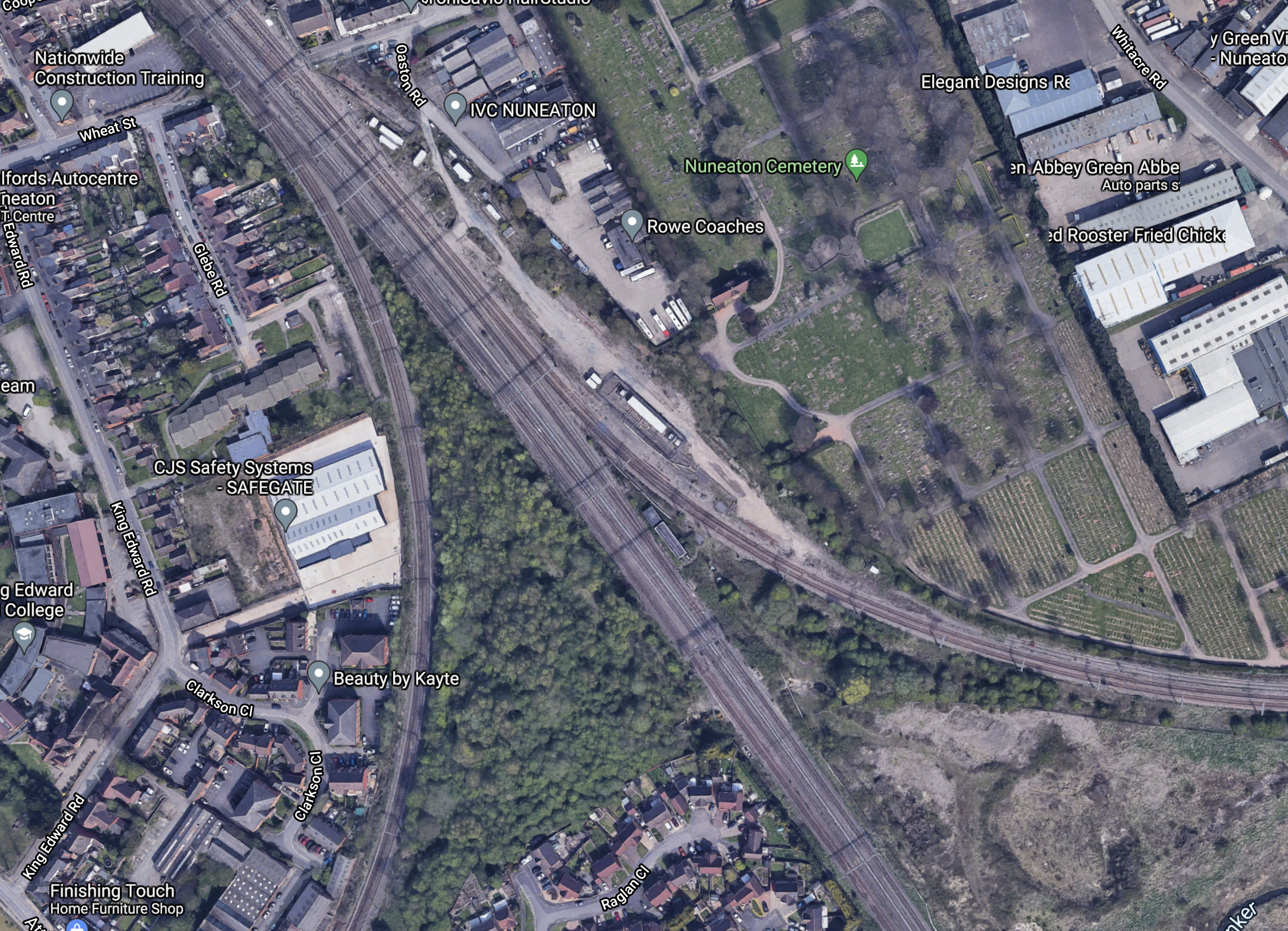
Note.
- The multi-track electrified railway running North-West and South-East is the Trent Valley section of the West Coast Main Line.
- Branching off to the South-West is the Coventry and Nuneaton Line.
- Branching off to the South-East is the line to Leicester.
Nuneaton station is off the map to the North on the West Coast Main Line.
Unfortunately, services to Coventry and Leamington Spa call in Platform 1 on the Western side of the station and services between Leicester and Birmingham call in platforms 6 and 7 on the Eastern side.
This probably rules out a clever solution, where perhaps an island platform, has Birmingham and Leicester services on one side and Coventry and Leicester services on the other.
This Google Map shows Nuneaton station.
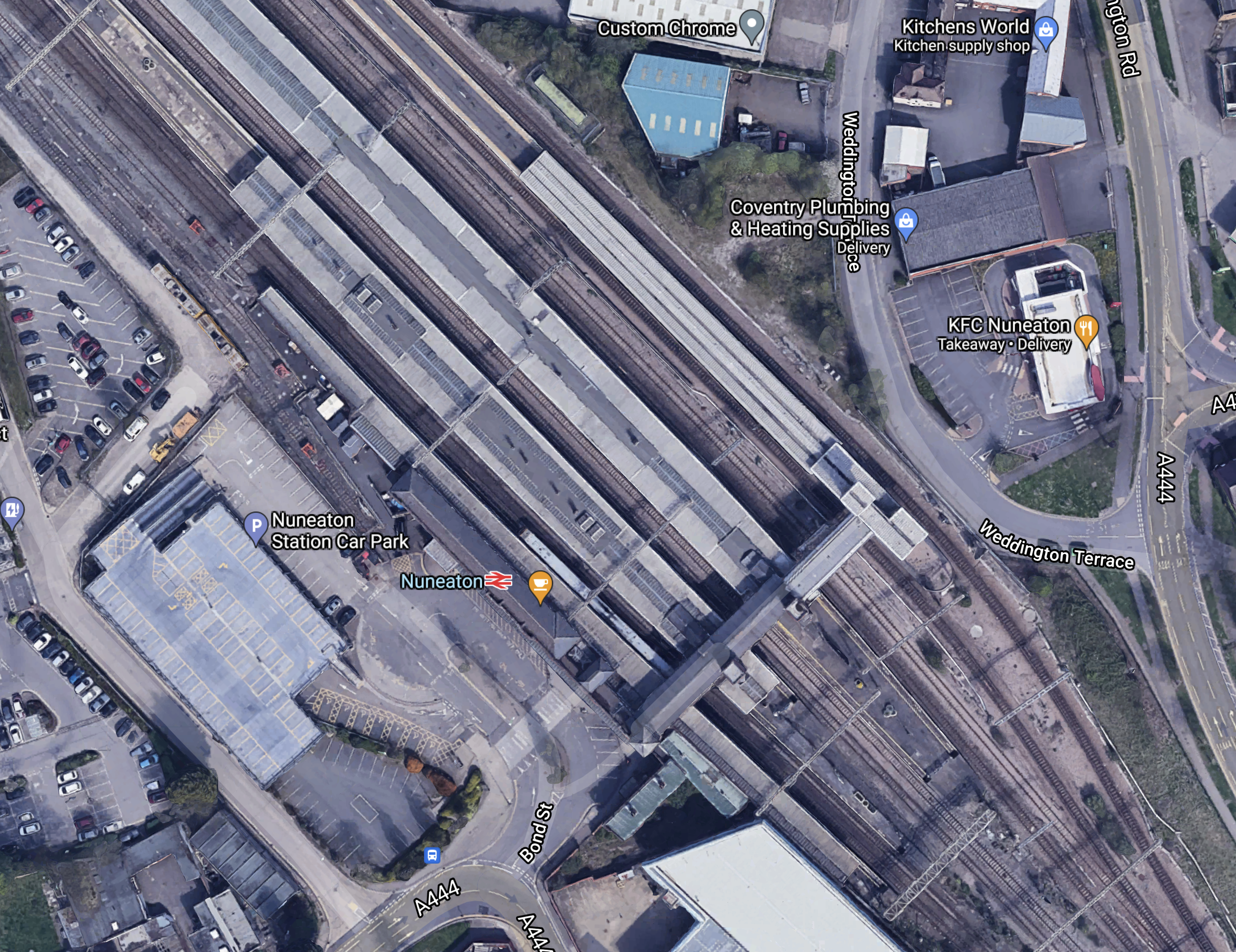
Note.
- Platform 6 and 7 form the island platform on the North-East side of the station.
- Birmingham trains call in Platform 6.
- Leicester trains call in Platform 7.
The track layout for Platforms 6 and 7 appears comprehensive with crossovers allowing both platforms to be used for services to both cities.
This Google Map shows the crowded track layout to the South of the station.
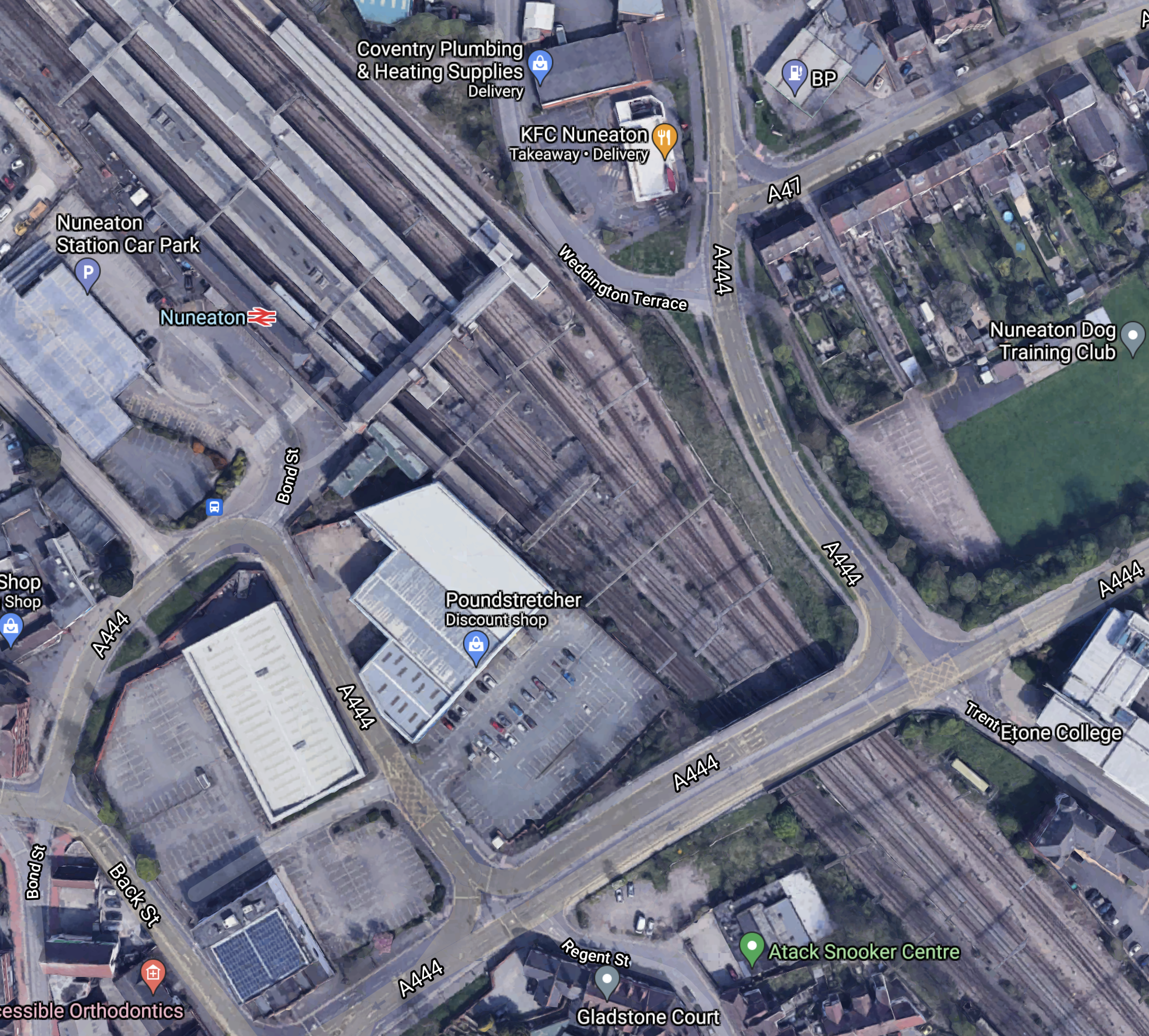
The only possibility would appear to be a single track dive-under that connected Platform 6 and/or 7 to the Coventry and Nuneaton Line on the other side of the West Coast Main Line.
I feel that costs would rule it out.
I suspect that a direct solution cutting out Nuneaton might be possible.
This Google Map shows the three routes diverging to the South of Nuneaton station.
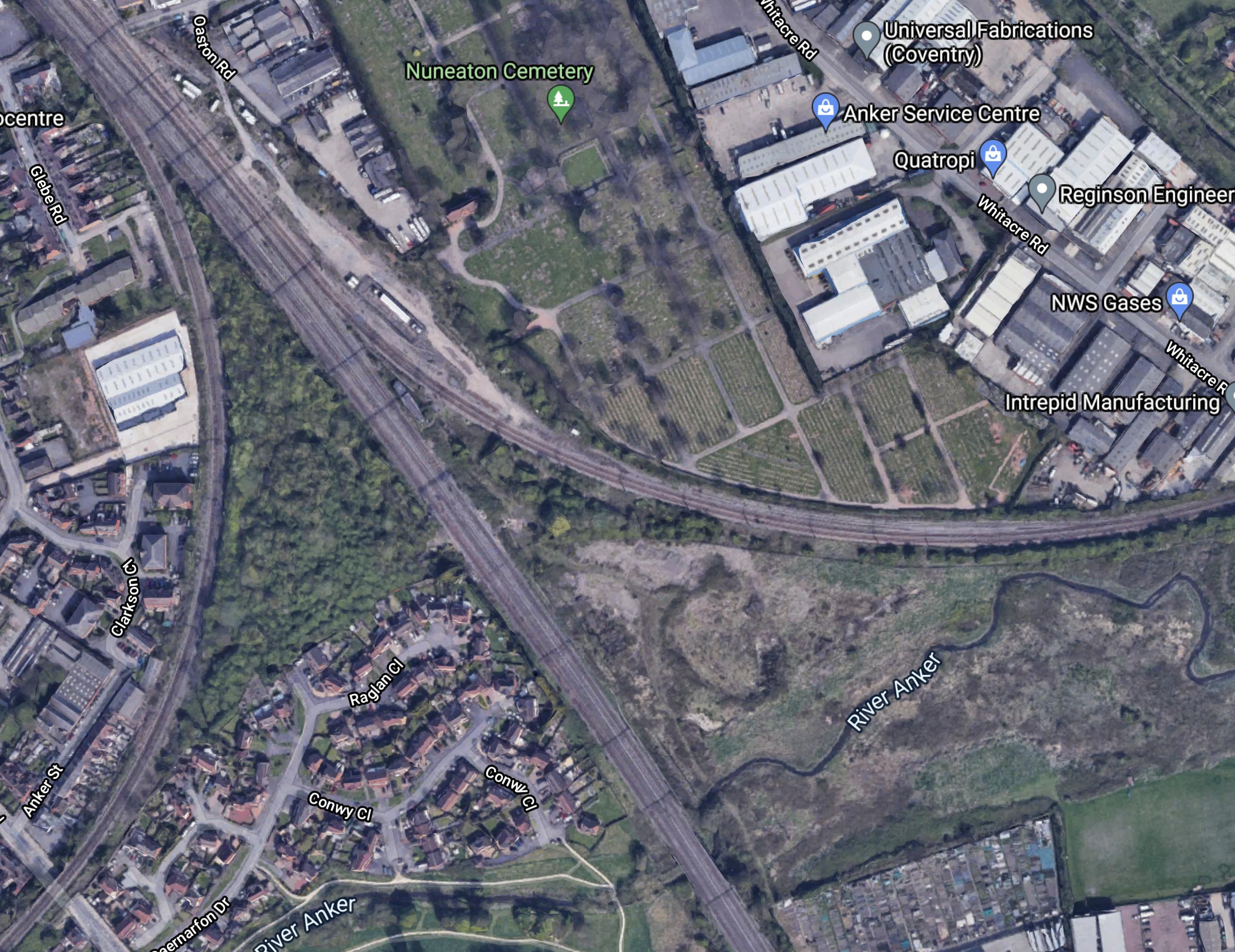
It might be possible to connect the Coventry and Leicester Lines, but the curve might be too tight.
The alternative could be to build a dive-under that would connect Platform 1 to the Leicester Line.
- It would appear that it could be the easiest and most affordable option.
- Trains would reverse in Nuneaton station.
It is certainly a tricky problem, but I do believe there is a simple cost-effective solution in there somewhere.
Nuneaton Parkway Station
This page on Coventry Live gives some information about the proposed Nuneaton Parkway station.
There is also a proposed station, to be called Nuneaton Parkway, situated off the A5 between Hinckley and Nuneaton.
This Google Map shows the area where the A5 crosses the Birmingham-Peterborough Line, that runs between Hinckley and Nuneaton..
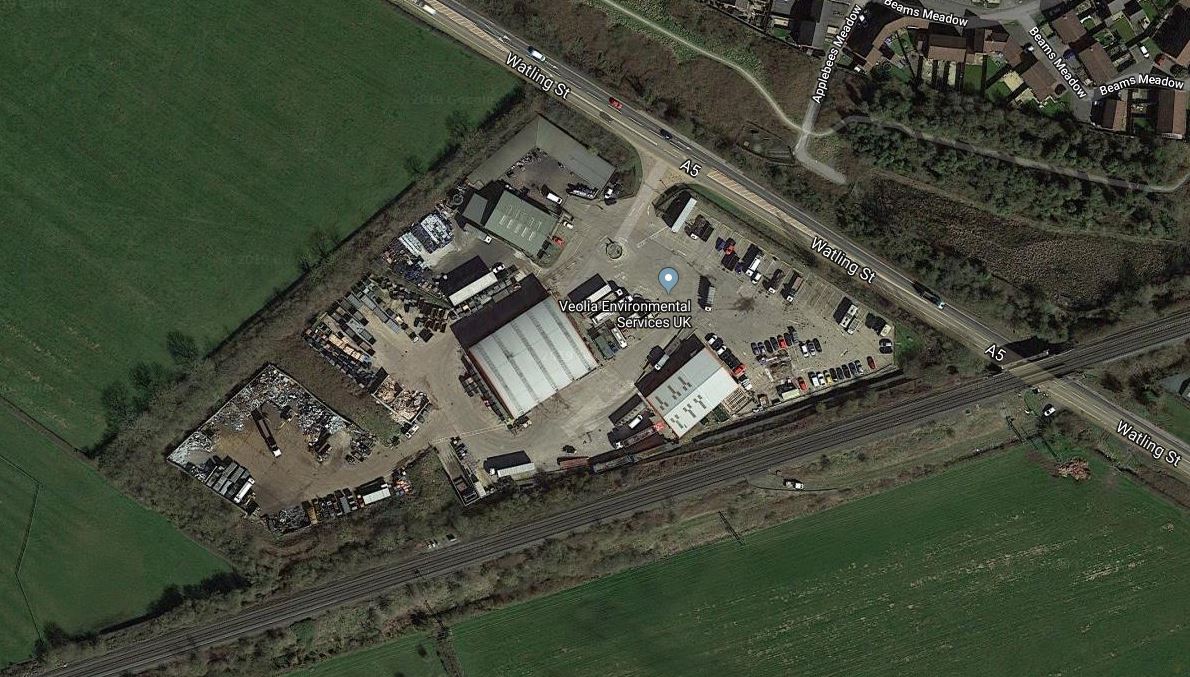
This must surely be one of the best sites to build a new Parkway station in the UK.
- The triangular site is a waste transfer station operated by Veolia Environmental Services UK.
- It has a direct connection to the A5, which could be easily improved, with perhaps a roundabout.
- Doing a crude estimate from the Google Map, I calculate that the site is about sixteen hectares, which is surely a good size for a Parkway station.
- There’s even quite a lot of new housing within walking and cycling distance.
It would also appear that the station could be built on this site without major disruption to either road or rail traffic.
The Stations And Timing
This document on the Midlands Connect web site, gives their aims for the service.
- Coventry and Leicester – 38 minutes from 54 minutes with one change.
- Coventry and Loughborough – 50 minutes from 88 minutes with otwo changes.
- Coventry and East Midlands Parkway – 56 minutes from 104 minutes with otwo changes.
- Coventry and Nottingham – 70 minutes from 108 minutes with otwo changes.
The service would have a frequency of two trains per hour (tph).
If the train did the same station stops as the current services between Coventry and Leicester, it could stop at all or a selection of the following intermediate stations.
- South Wigston
- Narborough
- Hinckley
- Nuneaton
- Bermuda Park
- Bedworth
- Coventry Arena
The total time would appear to be around fifty minutes, with 28 minutes for Leicester to Nuneaton and 22 minutes from Nuneaton to Coventry. Although the BBC article says that Coventry and Leicester would drop from the current 54 minutes to 38 minutes.
Currently services between Leicester and Birmingham New Street stations are run by CrossCountry.
- One tph – Birmingham New Street and Cambridge or Stansted Airport
- One tph – Birmingham New Street and Leicester
Note that not all intermediate stations receive a two tph service.
Would a two tph service between Leicester and Coventry enable all the stations on the route to have a two tph service?
The Current Leicester And Nottingham Service
Currently the following services run between Leicester and Nottingham.
- 1 tph – EMR InterCity – Direct
- 1 tph – EMR InterCity – Via Loughborough, East Midlands Parkway and Beeston
- 1 tph – EMR Regional – Via Syston, Sileby, Barrow-upon-Soar, Loughborough, East Midlands Parkway, Attenborough and Beeston
Note.
- Timings vary between 23 and 49 minutes.
- Four tph between Leicester and Nottingham would be a Turn-Up-and-Go service that would attract passengers.
- The BBC article is indicating a Coventry and Nottingham time of 70 minutes, which would indicate a Leicester and Nottingham time of 32 minutes, which would appear to be in-line with the EMR Intercity service that stops at Loughborough, East Midlands Parkway and Beeston.
It looks to me that a fourth semi-fast service between Leicester and Nottingham would not be a bad idea.
But Midlands Connect are proposing two extra tph between Coventry and Nottingham.
A Coventry And Nottingham Service
Consider.
- An two tph service would fit in well and give a Turn-Up-and-Go service between Leicester and Nottingham.
- The Coventry and Nottingham time of 70 minutes indicates that the train would need to be to EMR InterCity standard.
- If there is an allowance of twenty minutes at either end of the route, this would indicate a round trip of three hours.
This standard of service would need an operational fleet of six five-car Class 810 trains or similar for a frequency of two tph.
I very much feel that there should be electrification of the Midland Main Line between Leicester and either East Midlands Parkway or Derby.
This would mean that the Coventry and Nottingham route would break down as follows.
- Coventry and Nuneaton – 19,2 miles – No electrification
- Nuneaton and Leicester – 18.8 miles – No electrification
- Leicester and East Midlands Parkway – 19.1 miles – Possible electrification
- East Midlands Parkway and Nottingham – 8.4 miles – No electrification
Note that electrification is already available at Coventry and Nuneaton.
The Coventry and Nottingham route would appear to be possible with battery-electric trains, after the route between Leicester and East Midlands Parkway is electrified.
An Improved Birmingham And Cambridge Service
If Nottingham and Coventry needs a fast two tph service stopping at the major towns and cities in between, surely Birmingham and Cambridge need a similar service.
- It could call at Nuneaton, Leicester, Melton Mowbray, Oakham, Stamford, Peterborough, Ely and Cambridge North.
- Some services could be extended to Stansted Airport.
- It would have a frequency of two tph.
The Birmingham and Cambridge route would break down as follows.
- Birmingham and Nuneaton – 21 miles – No electrification
- Nuneaton and Leicester – 18.8 miles – No electrification
- Leicester and Peterborough – 40 miles – No electrification
- Peterborough and Ely – 30.5 miles – No electrification
- Ely and Cambridge – 14.7 miles – Electrified.
Note that electrification is already available at Birmingham, Nuneaton and Peterborough.
The Birmingham and Cambridge route would appear to be possible with battery-electric trains, if Leicester station were to be electrified.
Midland Connect’s Proposed Leeds and Bedford Service
I wrote about this service in Classic-Compatible High Speed Two Trains At East Midlands Hub Station.
It would run between Leeds and Bedford stations.
It would use the Midland Main Line between Bedford and East Midlands Hub stations.
It would use High Speed Two between East Midlands Hub and Leeds stations.
It would stop at Wellingborough, Kettering, Market Harborough, Leicester, Loughborough and East Midlands Hub stations.
- The service frequency could be hourly, but two trains per hour (tph) would be better.
- Leicester and Leeds would take 46 minutes.
Obviously, it wouldn’t run until the Eastern Leg of High Speed Two opens, but it could open up the possibility of Coventry and Leeds in under ninety minutes.
Driving takes over two hours via the M1.
Conclusion
This looks to be a very feasible and fast service.
It also illustrates how extending the electrification on the Midland Main Line can enable battery-electric trains to provide connecting services.
Enough electrification at Leicester and a few miles North of the station to fully charge passing trains would probably be all that is needed.
A Trip To Corby
I took these pictures on a trip to Corby this morning.




These are my thoughts.
Trains To And From Corby
I got a Class 222 train to Corby and an eight-car Class 360 train back.
Brent Cross West Station
There was a lot of constructruction activity at the new Brent Cross West station.
Luton Airport Parkway Station
The extensions to Luton Airport Parkway station look to be comprehensive, with several escalators.
The Luton DART connection to Luton Airport appears to be under test, so should open in 2022.
But will there be any air passengers to use it?
I last used it in 2008, when I went to see England play in Belarus.
Electrification North Of Bedford
The electrification North of Bedford station is obviously complete on the slow lines, but on the fast lines, as the pictures show, the gantries are all erected, but there are still wires to be installed.
But as the Class 810 trains won’t be in service until 2023, there’s still a bit of time.
The gantries certainly look sturdy, as this picture shows.
They’re certainly built for 125 mph, but as the Class 810 trains will be capable of 140 mph with full digital in-cab signalling, I would hope that the electrification has been installed to that standard. Or at least to a standard, that can be easily upgraded!
Corby Station
Corby station has been finished to a single-platform station, which is able to accept a twelve-car Class 360 train.
This should be adequate for the current half-hourly service, as a single platform can handle a least four trains per hour (tph) and several around the country regularly do.
Both tracks through the station are electrified and I suspect with a second platform bridge, both could be used by electric trains to create a two-platform station.
But there would appear to be no need at the moment.
Even, if it were to be decided to extend one tph to Oakham and Melton Mowbray stations, this could probably be accommodated on the single-platform.
Network Rail seem to have already installed a crossover South of Corby station, so that trains can use the single platform.
Serving Oakham And Melton Mowbray
I discussed this extension in detail in Abellio’s Plans For London And Melton Mowbray Via Corby And Oakham.
In the related post, I said this.
This page on the Department for Transport web site is an interactive map of the Abellio’s promises for East Midlands Railway.
These are mentioned for services to Oakham and Melton Mowbray.
-
- After electrification of the Corby route there will continue to be direct service each way between London and Oakham and Melton Mowbray once each weekday, via Corby.
- This will be operated with brand new 125mph trains when these are introduced from April 2022.
This seems to be a very acceptable minimum position.
When my Class 222 train arrived in Corby at 1154, it waited a couple of minutes then took off to the North.
I then took the next train to London, which was an eight-car Class 360 train which formed the 1211 service back to St. Pancras.
Meanwhile the Class 222 train, that I’d arrived on did a reverse in the Corby North Run Around Loop finally arriving back in Corby at 1345. The train had taken one hour and forty-nine minutes to return to Corby.
It might be just coincidence, but are East Midlands Railway doing timing tests to see if services can be extended to Oakham And Melton Mowbray?
It should be noted that service times North of Corby are as follows.
- Corby and Oakham – 19 mins – 14.3 miles
- Corby and Melton Mowbray – 31 mins – 25.7 miles
- Melton Mowbray and Leicester – 17 mins – 12.8 miles (estimate) – CrossCountry service
My logic goes like this.
- It looks to me that it would not be unreasonable that a Class 222 train could run between Corby and Leicester in forty-eight minutes.
- Double that and you get one hour and thirty eight minutes, for a journey from Corby to Leicester and back.
- Subtract that time from the one hour and forty-nine minutes that my train took to reverse and there is eleven minutes for a turnback at Leicester station.
- Eleven minutes would certainly be long enough to tidy a train and for the crew to change ends.
I also believe that the 35.8 miles would be possible for a Class 810 train fitted with one or more battery power-packs instead of a similar number of the four diesel engines.
So are East Midlands Railway doing tests to find the most efficient way to serve Oakham And Melton Mowbray?
On The Corby Branch
I travelled North on a Class 222 diesel train and South on an electric Class 360 train.
On the Corby branch, I was monitoring the train speed on an app on my phone and both trains travelled at around 90 mph for most of the way.
There were sections at up to 100 mph and the track was generally smooth.
I was left with the impression, that trains might be able to go faster on the branch.
Average speeds for the 2.5 miles of the branch were as follows according to these timings from realtimetrains.
- Class 222 train – Arriving – 5.25 mins – 28.6 mph
- Class 222 train – Leaving – 5 mins – 30 mph
- Class 360 train – Arriving – 7.5 mins – 20 mph
- Class 360 train – Leaving – 5 mins – 30 mph
It doesn’t appear that there are much difference in the timings, although it might be said, that the electric approach is more cautious.
The Class 360 Trains
The Class 360 trains have not been refurbished yet although as my pictures show, some have been given a new livery.
In Are Class 360 Trains Suitable For St. Pancras And Corby?, I said this about the train refurbishment.
This page on the Department for Transport web site is an interactive map of the Abellio’s promises for East Midlands Railway.
These features are mentioned for Midland Main Line services to Corby.
-
- Increased capacity
- Twelve-car trains in the Peak.
- More reliable service
- Improved comfort
- Passenger information system
- Free on-board Wi-Fi
- At-seat power sockets
- USB points
- Air conditioning
- Tables at all seats
- Increased luggage space
- On-board cycle storage
What more could passengers want?
It certainly hasn’t happened in full.
I did ask a steward, when the new interiors will be installed and he said they were running late because of the pandemic.
Performance Of The Class 360 Trains
I used my app to follow the speed of the Class 360 train, that brought me back to London.
- The train hit a maximum speed of about 105 mph.
- The train arrived in London a minute late.
I feel that as the drivers get used to their new charges, they will match the timetable.
Conclusion
I have a feeling that in a couple of years, these trains will fulfil Abellio’s promises.
Would A Mutant Many-Parent Child Help To Solve London’s Transport Problems?
London needs to increase the capacity of its public transport system, as the City continues to get larger and larger.
Current Major Projects
There are only three major rail projects ongoing in London at the present time.
The Bank Station Upgrade
The Bank Station Upgrade appears to be progressing well, albeit perhaps it’s a bit late due to the pandemic.
It is a complex project and from what I have heard and observed, it has been well designed and planned.
The Barking Riverside Extension
As with the Bank Station Upgrade the Overground extension to the new Barking Riverside station, appears to be going reasonably well.
But compared to that project, it is a relatively simple project, built mainly in the open air, with no tunneling.
Crossrail
Crossrail is in trouble, after what many believe was a very good tunnelling phase of the project.
But then tunnels under London usually seem to go well. I can remember the Victoria Line tunnelling and many other under London since the 1960s and all of these tunnels seem to have been dug without trouble. As I write, there don’t seem to be any tunneling problems with the Thames Tideway Tunnel.
Crossrail now has been reduced to a series of station builds and rebuilds, some of which are as large as the Bank Station Upgrade, with other ongoing projects like the testing of trains and systems.
So why are some of these stations running late in their delivery?
If you walk along the route of Crossrail in the City of London and through Clerkenwell and the West End, it is one massive building side as developers raise massive clusters of new developments around and above the Crossrail stations.
The picture shows Farrington station’s Eastern entrance, with a new development on top.
This one wasn’t a big one, but it went up in record time.
These buildings are often funded by Sovereign Wealth Funds, who want their buildings finished ASAP and as they have bottomless pockets, they are prepared to pay more to get the builders and tradesmen they need.
And where did they get the workers from? Other projects, including Crossrail.
This problem happened in Aberdeen at the height of the oil boom in the last century.
I also think that Brexit worsened the problem, as workers from mainland EU moved to large projects closer to home, like Stuttgart 21 and the new Berlin Brandenburg airport, that were both very much in trouble and could have been offering premium salaries as well!
The solution would have been to phase developments so that the limited pool of workers was not exhausted.
But that probably wouldn’t have suited the developers and politicians for all sorts of reasons.
- An uncompleted building doesn’t bring in money and jobs.
- Early completion must improve chances of letting the building.
- Delaying the building would probably have meant fewer holidays for politicians in exotic locations.
Hopefully, a comprehensive enquiry into the lateness of Crossrail will provide answers.
High Speed Two
High Speed Two is to my mind a London local project. But only in a secondary way!
- Rebuilding Euston station will improve Underground connections and interchange at Euston and Euston Square stations.
- It is claimed by High Speed Two, that the rebuilt Euston station will create 16000 jobs and 2200 homes.
- High Speed Two will enable massive development at Old Oak Common, with tens of thousands of homes and jobs.
- Old Oak Common station will be a very important rail hub in North-West London.
With seventeen trains per hour (tph) between Euston and Old Oak Common will High Speed Two attract local traffic?
- I suspect High Speed Two between Manchester Airport and Manchester Piccadilly and between Birmingham Interchange and Birmingham Curzon Street will also attract local traffic.
- I’ve used TGVs between Nice and Antibes.
- Tourists might visit, just like they did and still do at the Olympic Park.
- Many Londoners will join High Speed Two at Old Oak Common.
Some wag will suggest putting it on the Tube Map. But is it such a stupid idea?
Where Does London Need More Rail Services?
Having lived in London on and off for over seventy years, I feel the worst areas for rail links are probably.
- North West London
- South East London
- South Central London between Wimbledon and Croydon.
- South West London
Note.
- Over the years, there is no doubt that East and North London have improved considerably, with the development of the East London, North London and Gospel Oak to Barking Lines.
- Thameslink has been improved in North London and now it is being supported with improvements to the Northern City Line. Both routes now have new Siemens trains, which give a whole new dimension to using ironing-boards as seats.
- Crossrail will produce major improvements in West, East and South East London.
- Building of a new Penge Interchange station, which I wrote about in Penge Interchange could improve routes to and from South East London.
- Hopefully the work in recent years at Waterloo will improve suburban services out of Waterloo. In An Analysis Of Waterloo Suburban Services Proposed To Move To Crossrail 2, I showed that four tph could be run to Chessington South, Epsom, Hampton Court and Shepperton stations.
It looks like North West and South Central London are missing out.
How Can Services Be Improved In North West London?
There are radial routes from the centre of London to the suburbs.
Starting from the North and going to the West, there are the following lines.
- The High Barnet branch of the Northern Line
- The Mill Hill East branch of the Northern Line
- The Midland Main Line to St. Albans, Luton, Bedford and the East Midlands.
- The Edgware branch of the Northern Line
- The Jubilee Line to Stanmore
- The West Coast Main Line to Watford, Milton Keynes, the West Midlands, the North West of England and West Scotland.
- The Bakerloo Line to Harrow & Wealdstone.
- The Watford DC Line of the London Overground
- The Amersham, Chesham and Watford branches of the Metropolitan Line
- The Chiltern Route to Aylesbury.
- The Chiltern Main Line to High Wycombe, Banbury, Bicester, Birmingham and Oxford.
- The West Ruislip branch of the Central Line.
- The Uxbridge branch of the Metropolitan and Piccadilly Lines
When I used to live at Cockfosters as a child, to visit my many cousins in North West London, there was no alternative but to use a bus and take well over an hour each way.
There are now some circular rail routes in London but nothing in the North West of the capital.
The Dudding Hill Line And The West London Orbital Railway
But there is the little-used freight route called Dudding Hill Line.
- It runs between Cricklewood on the Midland Main Line and Acton Central on the North London Line.
- It is four miles of double-track railway.
This YouTube video shows a cab ride from Acton to Cricklewood.
Plans exist to turn it into the West London Orbital Railway, which will run two services.
- West Hampstead and Hounslow via Cricklewood, Neasden, Harlesden, Old Oak Common Lane, Acton Central, South Acton, Lionel Road, Brentford, Syon Lane and Isleworth
- Hendon and Kew Bridge via Brent Cross West, Neasden, Harlesden, Old Oak Common Lane, Acton Central, South Acton
Note.
- The proposed frequency of both services is four tph.
- There would be some stations to be built, but the track exists.
- There would be no new tunnels.
- The route is technically feasible.
- The route would connect West London to High Speed Two.
- There would be little disruption whilst it was built.
- The services could be run by dual-voltage battery-electric trains charged on the electrification at both ends of the route.
- The scheme represents a high value for money, with a benefit-cost ratio (BCR) of 2.2.
On the other hand, the scheme has two serious problems, as far as the current London Mayor is concerned.
- Transport for London has no money, partly because of London’s Fare Freeze.
- The project is not in South London.
This important and value-for-money project will not be built, whilst Sadiq Khan is still Mayor of London.
Harlesden Interchange
I believe that if we get the interchanges right on the West London Orbital Railway correct we can do things like.
- Increase the benefit cost ratio.
- Link the route to South London to make the Mayor a bit happier about the North London Scheme.
This Google Map shows Harlesden station.
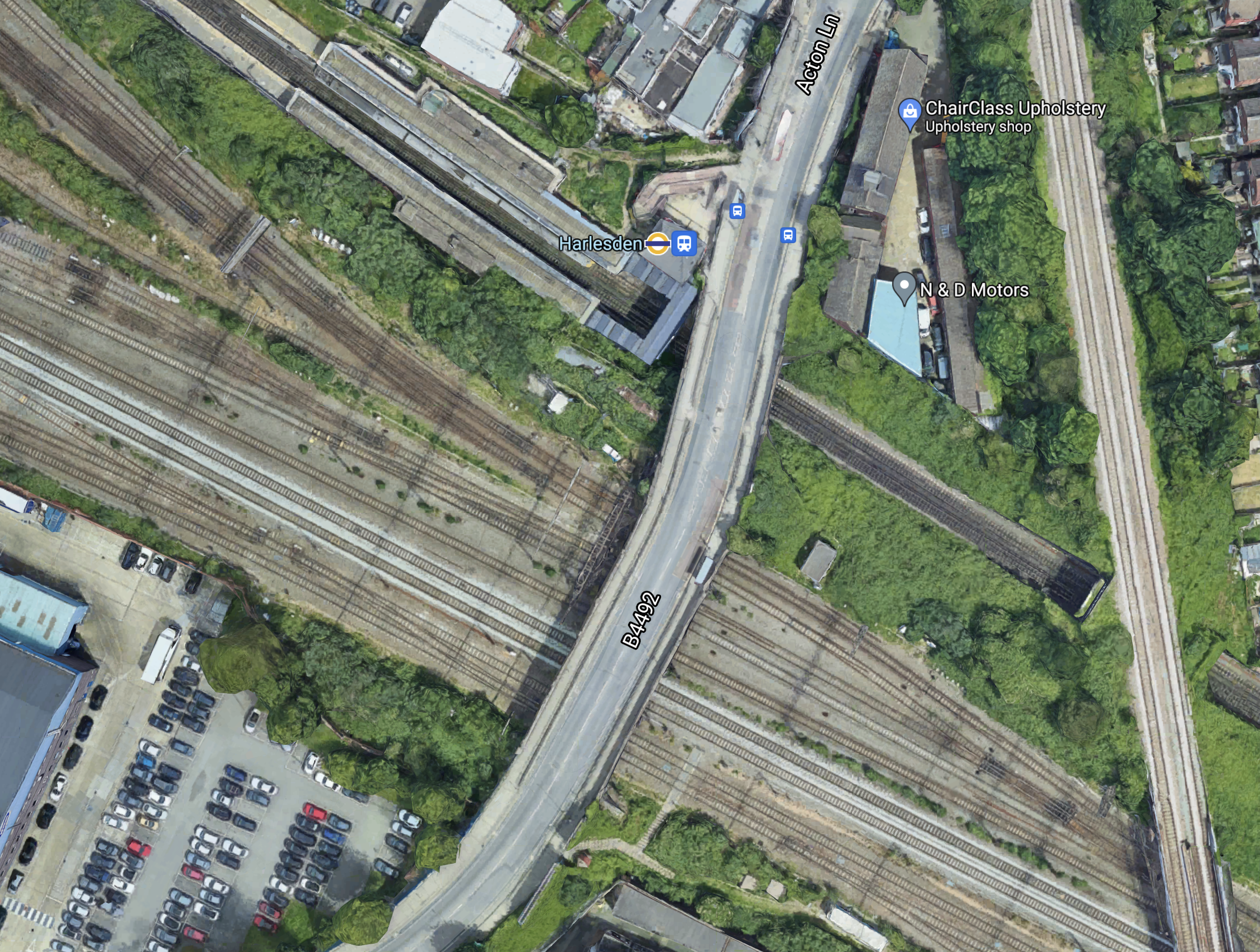
Note.
- The Bakerloo Line/Watford DC Line running North-West/South-East through Harlesden station.
- The West Coast Main Line in the Southern section of the map.
- The Dudding Hill Line running North-South across the map.
Platforms will be built on the Dudding Hill Line to connect that would probably be new or extended platforms in the current Harlesden station to enable interchange between the West London Orbital and the Watford DC Lines.
I also think there is a possibility that platforms could be added to the slow tracks of the West Coast Main Line, so that suburban services into London Euston can also connect to the West London Orbital Line.
It would also enable a connection between Southern’s Clapham Junction and Milton Keynes service and the West London Orbital Railway.
Looking at this from various angles, I think that an architect good at designing three-dimensional structures could develop a quality Harlesden Interchange station.
Neasden Interchange
Like Harlesden, Neasden is another possibility for a comprehensive interchange.
This Google Map shows Neasden station.
Note.
- There are a lot of lines going through Neasden station.
- The Dudding Hill Line goes across the South-East corner of the map.
- There is plenty of space in the area.
This map from cartometro.com shows the lines in the area.
Note.
- The Dudding Hill Line is indicated by the former Dudding Hill station.
- The red tracks are Metropolitan Line tracks.
- The silver tracks are Jubilee Line tracks.
- The Southerly pair of lines through Neasden and Dollis Hill stations are Chiltern’s lines into Marylebone.
- The Chiltern tracks divide to the West of Neasden station, with the Aylesbury line following the other tracks and the Chiltern Main Line diverging to the West.
- London’s largest Underground Depot at Neasden, lies to the North-West in an area of London noted for few merits with the North Circular Road passing through.
I wonder, if the station and the depot offers a unique opportunity to offer large scale additions to London’s housing stock over the top of a rebuilt station and depot.
This Google Map shows the wider area.
Note.
- Much of the depot appears to be open-air stabling for trains.
- The North Circular Road passes North-South between the depot and Neasden station.
- The Dudding Hill Line cuts across the South-East corner of the map.
- This corner of the map is labelled as Dudden Hill.
- According to Wikipedia, Dudding Hill is considered a more genteel spelling of Dudden Hill and could be as old as 1544.
It looks as if it would be relatively easy to develop over the top of the depot to create housing, industrial or commercial properties.
But why stop there and cover both the North Circular Road and the six tracks through Neasden station?
Neasden station could be rebuilt into a station with platforms on the following lines.
- Metropolitan Line
- Jubilee Line
- Chiltern Lines
- Dudding Hill Lines
Note.
- I estimate that Chiltern has a train about every six minutes, so some could stop.
- There might be space for a bay platform for Chiltern.
Neasden could be a major housing and transport hub.
- There could be large amounts of parking.
- Road access would be good.
- It would have good rail connections.
- It could have a bus interchange.
- London needs housing.
It might even be an alternative to Chiltern’s plan for a West Hampstead Interchange.
The Mayor of London, Transport for London and the Borough of Brent need to be bold!
Improvements To Chiltern’s Routes
Chiltern Railways have some plans that could improve services in North West London.
Using The Acton-Northolt Line
Wikipedia says this about using the Acton-Northolt Line to access new platforms at Old Oak Common station.
Upgrading the Acton–Northolt line (formerly the “New North Main Line”) to new platforms at Old Oak Common. This upgrade will also extend to London Paddington to increase capacity on the Chiltern Main Line as there is no room to expand the station at Marylebone.
This scheme has merit.
- The platforms would be connected to the Chiltern Main Line along the route of a partly-disused railway.
- The route could be double-tracked.
- There must be space for at least two new platforms.
- The new platforms could easily handle four tph.
- There may be a case for some new stations.
The scheme could add valuable extra capacity for Chiltern.
A Chiltern Metro
Wikipedia says this about a proposed metro service between Marylebone and West Ruislip stations.
- The Metro would have a frequency of four tph.
- It would call at Wembley Stadium, Sudbury & Harrow Road, Sudbury Hill Harrow, Northolt Park and South Ruislip.
- The service would require a reversing facility at West Ruislip.
- There would need to be passing loops at Sudbury Hill Harrow, and Wembley Stadium.
Given that the Chiltern Metro was first proposed over a decade ago, perhaps the concept could be increased in scope.
- Housing and other developments along the route may suggest that a station further out like High Wycombe might be a better terminal.
- ERTMS in-cab digital signalling is likely to be installed at some time, which would decrease headways between trains and allow more services.
- Electrification is likely in some form before 2040 and this will improve train performance.
- If Neasden station were to be rebuilt, as a comprehensive transport and residential development, I believe that this Metro service should also call at Neasden, as it would complement the West London Orbital Railway.
I believe that a review of the Chiltern Metro may mean, that an improved version is worth building.
Improvements To The Milton Keynes And Clapham Junction Service
I feel that this service could be key in improving services between North London and South London via the West London Line and High Speed Two’s station at Old Oak Common.
Currently, this service is as follows.
- It runs between Milton Keynes and Clapham Junction stations.
- It has a frequency of one tph.
- It calls at Bletchley, Leighton Buzzard, Tring, Berkhamsted, Hemel Hempstead, Watford Junction, Harrow & Wealdstone, Wembley Central, Shepherd’s Bush, Kensington (Olympia), West Brompton and Imperial Wharf stations.
- The service used to extend to South Croydon via Wandsworth Common, Balham, Streatham Common, Norbury, Thornton Heath, Selhurst and East Croydon.
- It uses Class 377 trains.
- It shares parts of the route with the London Overground.
I also think it has various issues and questions with respect to the future.
- The Class 377 trains are only 100 mph units, whereas the outer suburban trains on the West Coast Main Line are 110 mph Class 350 trains, which will soon be replaced by 110 mph Class 730 trains. Do the slower trains cause timetabling problems?
- Is one tph enough?
- The route doesn’t serve High Speed Two at Old Oak Common station.
- Is the service run by the right operator?
- What is the ideal Southern terminal?
These are my thoughts on the various issues.
The Service As A North-South Link
A friend, who lives in South London has told me, that if you go to an event at Wembley stadium the route is busy.
On the other hand, I’ve used it at midday on a Tuesday and found the trains empty.
But developed properly it could connect the following.
- Milton Keynes Central
- Bletchley for the East West Rail Link
- Watford for the West Coast Main Line to the North
- Wembley Central for Wembley Stadium and other entertainments
- Willesden Junction for the North London Line
- Hythe Road for High Speed Two, Crossrail and the Great Western Railway
- Shepherd’s Bush for the shopping.
- Clapham Junction for most of South London and the South of England
It would be a very useful cross-London route to complement Thameslink and the East London Line.
The Frequency
The current Milton Keynes and Clapham Junction has a frequency of one tph.
This may be enough for some parts of the route, as other services also provide services.
But many would argue, that perhaps South of Watford Junction, the service needs to be increased to connect the area to Old Oak Common and Clapham Junction.
I feel that High Speed Two, Crossrail and the Great Western Railway give so much connectivity, that between Clapham Junction and Willesden Junction needs a frequency of at least eight tph.
As the North London Line and the Watford DC Line are working at a frequency of four tph, this could indicate that a four tph direct service Watford Junction and Clapham Junction be ideal. Perhaps, it could continue North to Milton Keynes with a frequency of two tph.
The Trains
I am absolutely certain, that the full service needs to be operated by dual voltage trains, that are capable of running at 110 mph.
The Class 350/1 trains of West Midlands Trains would probably be ideal for the full service.
- They are dual voltage trains.
- They are 110 mph trains.
- They have a long distance interior.
They are being replaced with new Class 730 trains, so would be available.
If some services were running only as far North as Watford Junction, these could be either Class 378 or Class 710 trains of the London Overground.
The Connection To The West London Line And High Speed Two
This map from Wikipedia by Cnbrb shows the latest iteration of the lines at Old Oak Common station.
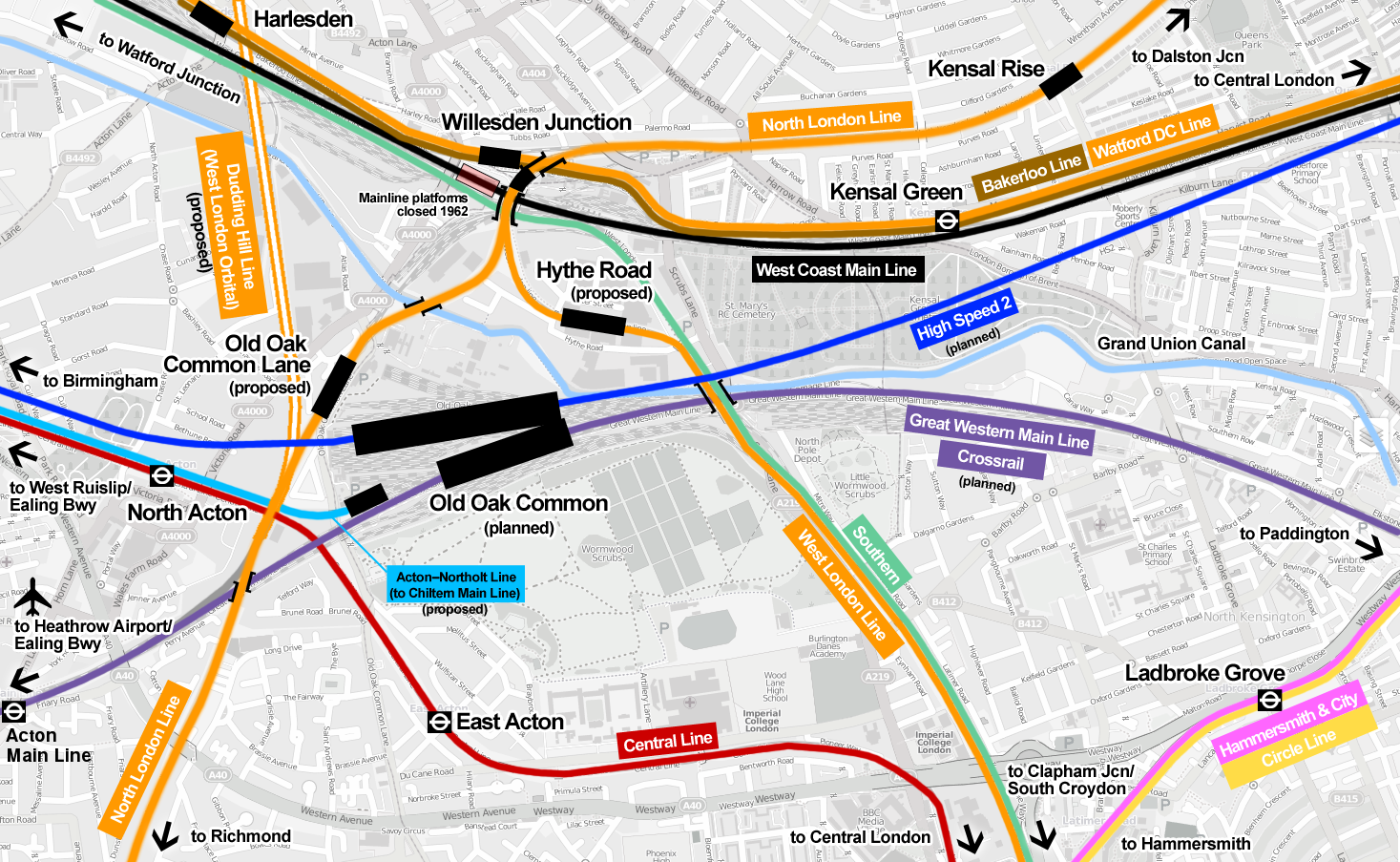
Note.
- The green route is taken by the Milton Keynes and Clapham Junction trains.
- The bright blue is High Speed Two.
- The purple is Crossrail.
- The orange is the Overground
- Hythe Road station is proposed for the West London Line to connect to Old Oak Common station for High Speed Two.
- Hythe Road station will have a bay platform to turn trains from the South.
- Old Oak Common Lane station is proposed for the North London Line to connect to Old Oak Common station for High Speed Two.
But where is the connection between the Milton Keynes and Clapham Junction service and Old Oak Common station for High Speed Two?
- Access from the South is not a problem as the Overground can be used to Hythe Road station.
- Extra services from the South can be run to and from the bay platform at Hythe Road station.
- Access from the East is not a problem as the Overground can be used to Hythe Road station.
- How do passengers go between say Wembley Central and Heathrow?
In addition for access from the West is the Overground can be used to Old Oak Common Lane station.
But as things stand at the moment the Milton Keynes and Clapham Junction service bypasses Hythe Road station and the only ways to go from Milton Keynes to Old Oak Common station for either High Speed Two, Crossrail or the Great Western is to do one of the following.
- Change to the Watford DC Line at Watford Junction, Harrow & Wealdstone or Wembley Central and then change to the Overground at Willesden Junction for either Old Oak Common Lane or Hythe Road station.
- Continue South to Shepherd’s Bush station, cross over to the other platform and then come back to Hythe Road station.
- Go via Euston station. OK for High Speed Two, but not for Crossrail or the Great Western.
They cannot be serious!
I hope that there is a cunning plan to enable the Milton Keynes and Clapham Junction service to connect.
Whilst on the subject of connections at Old Oak Common, where is the promised connection of Crossrail to the West Coast Main Line?
Were all these connections just kicked into the long grass and quietly forgotten, as they were deemed too difficult and/or expensive?
I think serious questions need to be asked about the design of Crossrail and High Speed Two at Old Oak Common.
Why weren’t Crossrail and High Speed Two designed to connect directly to the London Overground at Willesden Junction station perhaps by the use of a North South people mover serving the following lines?
- Bakerloo, Watford DC, West Coast Main and West London Orbital Lines at a rebuilt Harlesden station.
- London Overground at the high-level Willesden Junction station.
- High Speed Two
- Crossrail and the Great Western Railway
- The new Chiltern platforms.
- Central Line at East Acton station.
Note.
- Hythe Road and Old Oak Common stations would not be needed.
- The Milton Keynes and Clapham Junction service would call additionally at the rebuilt Harlesden station.
The current design of Old Oak Common stinks like a horse designed by a committee!
The Northern Terminal
I suggested earlier that some trains use Watford Junction and others use Milton Keynes Central.
Both stations have the capacity and the connectivity.
The Southern Terminal
In the last ten years, South Croydon, East Croydon and Clapham Junction have been used as the Southern terminal.
Thameslink seems to have chosen its various terminals to satisfaction of the travelling public, so perhaps the same method or personnel should be used.
The Operator
The Gibb Report said that this service should be transferred to the London Overground and I wrote about this proposal in Gibb Report – East Croydon – Milton Keynes Route Should Be Transferred To London Overground.
This is one suggestion, but I do wonder, if it should be transferred to West Midlands Trains and run in conjunction with their West Coast Main Line services.
- The service needs 110 mph trains.
- Timetabling and operation should be easier.
- London Overground trains don’t have a long-distance interior.
On the other hand, trains running between Watford Junction and Clapham Junction would probably be better if they were London Overground trains.
Conclusion
I believe that by using the current network and some modern trains and signalling, the passenger services to the West of the capital can be substantially improved.

