‘Mobilising EUR 1 Trillion in Investments’ | North Sea Countries, Industry, TSOs to Ink Offshore Wind Pact
The title of this post, is the same as that of this article on offshoreWIND.biz.
This is the sub-heading.
Government officials from Belgium, Denmark, France, Germany, Ireland, Luxembourg, the Netherlands, Norway and the UK are set to sign a declaration confirming the ambition to build 300 GW of offshore wind in the North Seas by 2050, and an investment pact with the offshore wind industry and transmission system operators (TSOs) that is said to mobilise EUR 1 trillion in economic activity.
These three paragraphs add a lot of powerful detail.
Under the Offshore Wind Investment Pact for the North Seas, to be signed today (26 January) at the North Sea Summit in Hamburg, governments of the nine North Sea countries will commit to building 15 GW of offshore wind per year from 2031 to 2040.
The heads of state and energy ministers will also vow to de-risk offshore wind investments through a commitment to provide two-sided Contracts for Difference (CfDs) as the standard for offshore wind auction design. The pact also commits governments to remove any regulatory obstacles to power purchase agreements (PPAs), according to WindEurope, which will sign the pact on behalf of the industry.
On the industry’s side, the commitment is to drive down the costs of offshore wind by 30 per cent towards 2040, mobilise EUR 1 trillion of economic activity for Europe, create 91,000 additional jobs and invest EUR 9.5 billion in manufacturing, port infrastructure and vessels.
These two paragraphs say something about cost reductions.
The cost reduction of offshore wind is planned to be achieved through scale effects, lower costs of capital and further industrialisation supported by clarity and visibility on the project pipeline.
The transmission system operators (TSOs) will identify cost-effective cooperation projects in the North Sea, including 20 GW of promising cross-border projects by 2027 for deployment in the 2030s.
I hope there is a project management system, that can step into this frenzy, just as Artemis did in the 1970s with North Sea Oil and Gas.
The BBC has reported the story under a title of UK To Join Major Wind Farm Project With Nine European Countries.
this is the sub-title.
The UK is set to back a vast new fleet of offshore wind projects in the North Sea alongside nine other European countries including Norway, Germany and the Netherlands.
These six paragraphs add more detail.
The government says the deal will strengthen energy security by offering an escape from what it calls the “fossil fuel rollercoaster”.
For the first time, some of the new wind farms will be linked to multiple countries through undersea cables known as interconnectors, which supporters say should lower prices across the region.
But it could prove controversial as wind farm operators would be able to shop around between countries to sell power to the highest bidder – potentially driving up electricity prices when supply is tight.
Energy Secretary Ed Miliband will sign a declaration on Monday at a meeting on the future of the North Sea in the German city of Hamburg, committing to complete the scheme by 2050.
Jane Cooper, deputy CEO of industry body RenewableUK, said the deal would “drive down costs for billpayers” as well as increasing “the energy security of the UK and the whole of the North Sea region significantly”.
But Claire Countinho, shadow energy secretary, warned “we cannot escape the fact that the rush to build wind farms at breakneck speed is pushing up everybody’s energy bills.”
Claire Coutinho, as an outsider at present and a member of a party out of Government had to say something negative, but her negotiations when she was UK Energy Minister with her German opposite number, which I wrote about in UK And Germany Boost Offshore Renewables Ties, seem very much a precursor to today’s agreement.
Great Yarmouth Terminal Set For Redevelopment Under Port Of East Anglia Name
The title of this post, is the same as that of this article on offshoreWIND.biz.
This is the sub-heading.
The UK’s Peel Ports Group has decided to invest a further GBP 10 million (approximately EUR 11.3 million) into its Great Yarmouth site, which is being rebranded as the Port of East Anglia.
These four paragraphs add details to the story.
The newly announced GBP 10 million brings this year’s total investment to GBP 70 million across the site and will be used to redevelop the port’s Northern Terminal, helping to accommodate the next generation of offshore wind projects across the region, according to Peel Ports.
Earlier this year, a substantial investment into its Southern Terminal was announced by the port, which has earmarked GBP 60 million to transform capacity and improve efficiencies.
This involves ensuring the port can support multiple hydrogen, carbon capture, offshore wind, and nuclear projects for decades to come.
Its existing terminals service a variety of construction customers, including infrastructure projects such as Sizewell C and offshore energy projects based in the southern North Sea.
Note.
- In Yarmouth Harbour To Be ‘Completed’ In £60m Project, I talk about the work to be done on the Southern Terminal.
- The work on the Southern Terminal includes a roll-on roll-off (RORO) lift ramp and a large storage area.
- Start on the work on the Southern Terminal will start in 2026.
With all the construction work mentioned in the last two paragraphs, I suspect that the Port of Great Yarmouth will be busy?
These are some further thoughts.
Why Is The Port Of Great Yarmouth Being Renamed?
The article says this.
The new name, which will come into effect in early 2026, also aligns with the creation of a new combined authority for Suffolk and Norfolk, according to Peel Ports.
Peel Ports name change is fairly sensible, but as I was conceived in Suffolk and I’m an Ipswich Town supporter, I don’t feel that the two counties should be merged.
Does The Mention Of Hydrogen Mean That The Port Of Great Yarmouth Will Be Hosting A Hydrogen Electrolyser, To Fuel Trucks And Ships?
I asked Google AI, “If A Hydrogen Electrolyser is To Be Built In The Port Of Great Yarmouth?”, and received this answer.
While there are no current public plans for an immediate construction of a large-scale hydrogen electrolyser within the Port of Great Yarmouth, significant port expansion and infrastructure upgrades are underway to ensure it can support future hydrogen projects and related clean energy initiatives.
Note.
- If technology to handle hydrogen, is copied from North Sea gas, there is certainly a lot of proven technology that can be used again.
- There may even be depleted gas fields, where captured carbon dioxide, hydrogen or North Sea gas can be stored.
I find the most exciting thing, would be to send hydrogen to Germany.
Why Would Anybody Export Hydrogen To Germany?
I asked Google AI, the question in the title of this section and received this answer.
Countries would export hydrogen to Germany because Germany has a large, growing demand for hydrogen to power its heavily industrialised economy and achieve its decarbonisation goals, but lacks sufficient domestic renewable energy capacity to produce the required amounts.
Germany also, uses a lot of bloodstained Russian gas and indigenous polluting coal.
How Could Anybody Export Hydrogen To Germany?
- Wilhelmshaven is one of the main import ports for hydrogen in North West Germany.
- Great Yarmouth is probably the closest larger port to Germany.
- Great Yarmouth and Wilhelmshaven are probably about 300 miles apart, by the shortest route.
- Great Yarmouth would need to build infrastructure to export hydrogen.
The easiest way to transport the hydrogen from Great Yarmouth to Wilhelmshaven, is probably to use a gas tanker built especially for the route.
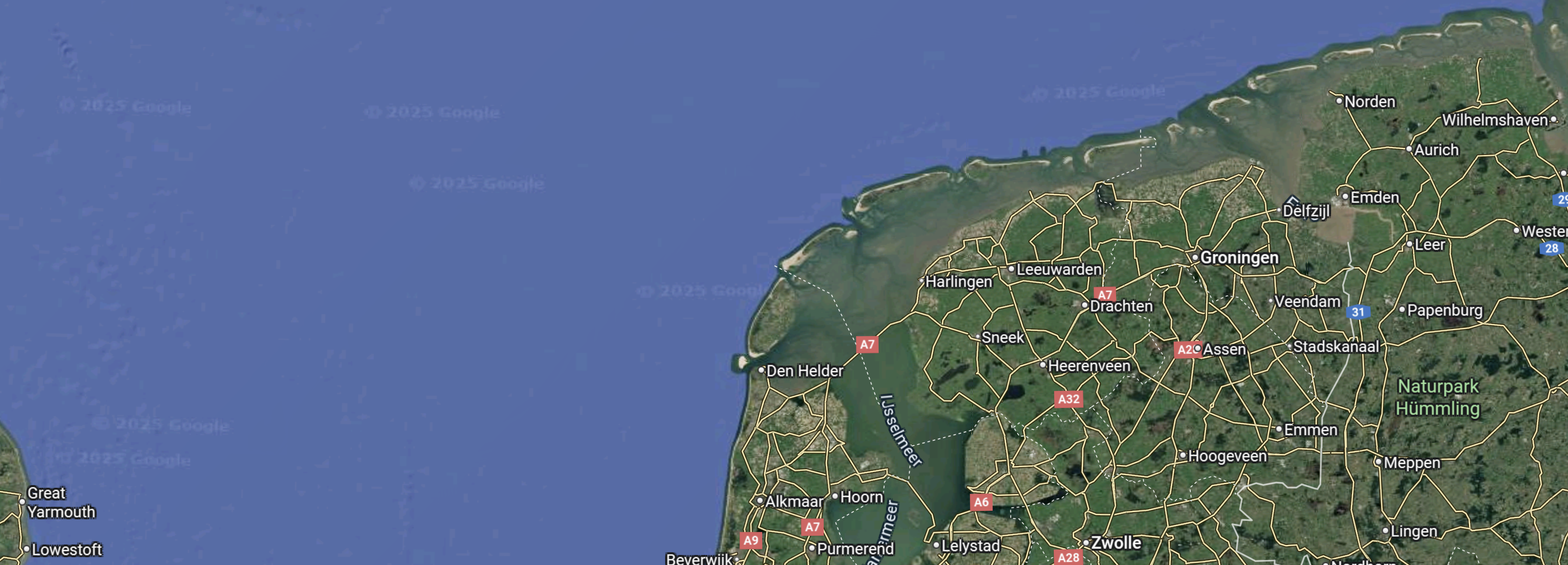
This Google Map shows the route between Great Yarmouth and Wilhelmshaven.
Note.
- The North-East corner of East Anglia with Great Yarmouth to the North of Lowestoft, is in the bottom-left corner of the map.
- Wilhelmshaven is a few miles inland in the top-right corner of the map.
- Could a coastal tanker go along the Dutch and German coasts to Wilhelmshaven?
I have no skills in boats, but would Great Yarmouth to Wilhelmshaven to take hydrogen to Germany?
RWE Are Developing Three Wind Farms To The North-East of Great Yarmouth
RWE are a large German Electricity company and the UK’s largest generator of electricity.
The company is developing three wind farms to the North-East of Great Yarmouth.
- Norfolk Boreas – 1.2 GW – 45 miles offshore
- Norfolk Vanguard West – 1.2 GW – 29 miles offshore
- Norfolk Vanguard East – 1.2 GW – 28 miles offshore
Note.
- The electricity for all three wind farms is to be brought ashore at Happisburgh South, which is about 22 miles North of Great Yarmouth.
- The original plan was to take the electricity halfway across Norfolk to the Necton substation to connect to the grid.
- The natives will not be happy about a 4.2 GW overhead line between Happisburgh and Necton.
- RWE have built offshore electrolysers before in German waters.
- Could an electrical cable or a hydrogen pipe be laid in the sea between Happisburgh South and the Port of Great Yarmouth?
- The electrolyser could either be offshore at Happisburgh or onshore in the Port of Great Yarmouth.
As I don’t suspect these three wind farms will be the last connected to the Port of Great Yarmouth, I would expect that RWE will put the electrolyser offshore at Happisburgh and connect it by a hydrogen pipeline to the Port of Great Yarmouth.
Could There Be A Connection To The Bacton Gas Terminal?
Consider.
The Bacton Gas Terminal, which feeds gas into the UK Gas Network, is only 4.2 miles up the coast from Happisburgh South.
Some climate scientists advocate blending hydrogen into the gas supply to reduce carbon emissions.
In Better Than A Kick In The Teeth – As C Would Say!, I disclosed that I now have a new hydrogen-ready boiler, so I’m not bothered, if I get changed to a hydrogen blend.
So could hydrogen from the Norfolk wind farms be fed into the grid to reduce carbon emissions?
Could The Port Of Great Yarmouth Become A Hydrogen Distribution Centre?
Thinking about it, the port could also become a distribution centre for green hydrogen.
Consider.
- Hydrogen-powered ships, tugs and workboats could be refuelled.
- Hydrogen-powered trucks could also be refuelled.
- Tanker-trucks could distribute hydrogen, to truck and bus operators, farms and factories, that need it for their transport and operations.
- I believe, that construction equipment will be increasingly hydrogen-powered.
In my life, I have lived at times in two country houses, that were heated by propane and there are about 200,000 off-grid houses in the UK, that are heated this way.
The two houses, where I lived would have been a nightmare to convert to heat pumps, but it would have been very easy to convert them to a hydrogen boiler and power it from a tank in the garden.
It should be noted, that the new boiler in my house in London is hydrogen-ready.
So the Port of Great Yarmouth could be the major centre for hydrogen distribution in Norfolk.
In the 1960s, I used to work in ICI’s hydrogen plant at Runcorn. If you ride in a hydrogen bus in England, it is likely that the hydrogen came from the same plant. Handled correctly, hydrogen is no less safe and reliable than natural gas or propane.
NSTA Gives 1.1bn Barrel Boost To North Sea Oil Reserve Estimates
The title of this post, is the same as that of an article on Energy Voice.
As I don’t have access to Energy Voice articles, I asked Google AI what it can tell me of North Sea oil and gas reserves boost and received this answer.
North Sea oil and gas reserves have increased by 1.1 billion barrels, driven by new licensing rounds, with the North Sea Transition Authority (NSTA) reporting a 31% rise in potential resources. This boost could significantly impact the UK’s energy security and economy by potentially allowing the UK to meet half its oil and gas needs and support jobs. However, this development occurs alongside political debate over new drilling licenses and the UK’s Net Zero targets.
These are my thoughts.
Am I Using AI To Get Round The Paywall?
Some may argue that I am, but then as my tame and pleasureable lawyer has passed on, I shall leave this question to Google’s lawyers.
Although in the 1970s, I will admit to spending hours in libraries finding data and algorithms for the solution of these problems.
- The understanding of the dynamics of the sulphonation reaction, which may have led to a valuable patent.
- The linking between datasets, which may have led to the first relational database.
My searches these days, would be a lot easier with artificial intelligence.
A 31% Rise Is Very Worthwhile
This article in the Telegraph also looks at the NSTA report and these are three paragraphs.
Martin Copeland, the chief financial officer at Serica Energy, a North Sea oil and gas producer, said: “This NSTA report shows that there at least 11 billion barrels of oil and gas which could still be developed in the North Sea.
“This almost meets the amount that the Climate Change Committee says we will need before the net zero target year of 2050 of 13 billion to 15 billion barrels.
“So with the right policy changes and tax regime, the UK could effectively be self-sufficient on the oil and gas it will need and would otherwise have to import.”
The rise must surely be very worthwhile for the UK.
RWE Opens ‘Grimsby Hub’ For Offshore Wind Operations And Maintenance
The title of this post, is the same as that of this article on offshoreWIND.biz.
This is the sub-heading.
RWE officially opened its ‘Grimsby Hub’ offshore wind operations and maintenance (O&M) facility in the UK on 9 July. From the new O&M base, located at Associated British Ports’ (ABP) Port of Grimsby, RWE’s teams will maintain and operate the Triton Knoll and Sofia offshore wind farms.
These are the first two paragraphs.
The Grimsby Hub also houses RWE’s new UK Centralised Control Room (CCR), which has been set up to provide 24/7 monitoring of the company’s UK offshore wind farms and can provide services such as marine coordination, turbine operations, alarm management, high voltage monitoring and Emergency Response services with a team of twelve operatives, the developer says.
The O&M facility is already employing over 90 Full-Time Equivalents (FTEs), according to RWE, and is expected to employ around 140 RWE staff by 2027, as well as create approximately 60 new locally sourced jobs through the development of the CCR and ongoing offshore operations.
Note.
- Does RWE’s new UK Centralised Control Room control all their UK offshore wind farms?
- I have added them all up and there are almost 12 GW around our shores.
- I’ve read somewhere, that RWE are the UK’s largest power generator. From these figures, that would not surprise me.
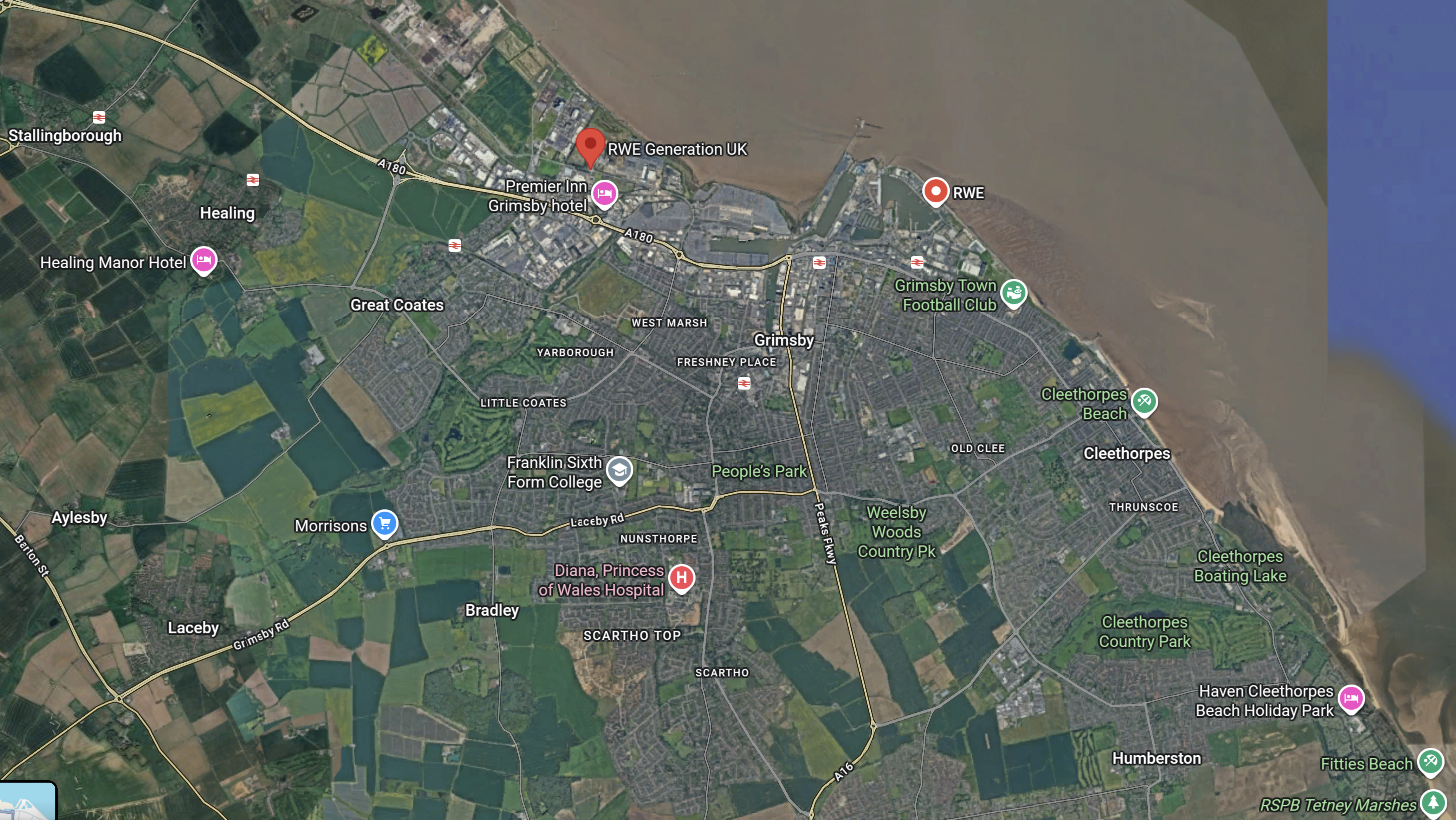
This Google Map shows the location of RWE’s facilities in Grimsby.
Note.
- The bright red arrow at the top of the map indicates RWE Generation UK in Grimsby Docks.
- There is another RWE location to the right of the bright red arrow.
- There is a line of stations along the coast, which from left-to-right are Stallingborough, Healing, Great Coates, Grimsby Town, Grimsby Docks, New Clee and Cleethorpes.
- Cleethorpes is not shown on the map.
- Doncaster and Cleethorpes are 52.1 mile apart, which is within the range of a battery-electric Hitachi and other trains.
- Charging would be at Doncaster, which is fully electrified and at Cleethorpes, by a short length of electrification.
This OpenRailwayMap shows the layout of and the railways around Grimsby Dock.

Note.
- Cleethorpes station is indicated by the blue arrow, in the South-East corner of the map.
- Cleethorpes station has four platforms, but no electrification.
- Grimsby Docks are to the North of the railway to Cleethorpes.
- This Wikipedia entry for Cleethorpes station, shows other railways and light railways served the area. Some were even electric.
These are a few of my thoughts on the development of railways between Sheffield and Cleethorpes.
RWE Will Be A Large Driver Of Employment In Grimsby
Earlier I wrote.
- Does RWE’s new UK Centralised Control Room control all their UK offshore wind farms?
- I have added them all up and there are almost 12 GW around our shores.
- I’ve read somewhere, that RWE are the UK’s largest power generator. From these figures, that would not surprise me.
It’s a long time, since I’ve added resources to a large project, so I asked Google AI, “How many people are needed to support a 1 GW offshore wind farm in the UK?”, and received this answer.
Direct & Indirect Support: For a large-scale project, this often breaks down into approximately 100–150 direct, permanent, high-skilled roles (technicians, engineers, management) and hundreds more in indirect, contracted, or supply chain roles (vessel crews, port operations, logistics).
Industry Average: Studies suggest that for operations and maintenance (O&M), around 50–100 full-time equivalent (FTE) jobs are generated per GW of installed capacity in terms of direct, permanent staff.
Key Takeaways for a 1 GW Farm:
- Direct Technicians/Operators: ~100–200+ (working on-site, turbines, or in control rooms).
- O&M Support Services: ~300–400+ (vessel operators, port logistics, supply chain).
- Total Operations Personnel: 300–600+ people.
Google AI appeared to have borrowed the figure from Ørsted and Hornsea 1 and 2.
So if it’s correct, there will be a total of 7,200 personnel supporting RWE’s wind farms in the UK. Even if only a third were employed in Grimsby, that is still a lot of people to accommodate and who will need to travel to work.
I also think a lot of personnel will come in by train, as the station is close to RWE’s locations.
Will Grimsby Have An Aberdeen-Sized Office-Shortage Problem?
One of the biggest problems, I was always hearing in the 1970s, was the shortage of offices in Aberdeen for the use of the oilmen.
In RWE Goes For An Additional 10 GW Of Offshore Wind In UK Waters In 2030, I talked about RWE’s plans for the future and published this table of new wind farms.
- Sofia – 1,400 MW
- Norfolk Boreas – 1380 MW
- Norfolk Vanguard East – 1380 MW
- Norfolk Vanguard West – 1380 MW
- Dogger Bank South – 3000 MW
- Awel y Môr – 500 MW
- Five Estuaries – 353 MW
- North Falls – 504 MW
Note.
- Sofia is nearly complete.
- Only the three Norfolk and the Dogger Bank South wind farms are on the East side of England and suitable to be serviced from Grimsby., but they still total 7,140 MW.
Has Grimsby got the office-space for all the people needed?
Could The Cleethorpes And Liverpool Lime Street Service Be Run By Battery-Electric Rolling Stock?
The various sections of this route are as follows.
- Cleethorpes and Doncaster – No Electrification – 52.1 miles
- Doncaster and Meadowhall – No Electrification – 15.2 miles
- Meadowhall and Sheffield – No Electrification – 3.4 miles
- Sheffield and Dore & Totley – No Electrification – 4.2 miles
- Dore & Totley and Hazel Grove – No Electrification – 29.2 miles
- Hazel Grove and Stockport – Electrification – 3.3 miles
- Stockport and Manchester Piccadilly – Electrification – 5.9 miles
- Manchester Piccadilly and Deansgate – Electrification – 0.8 miles
- Deansgate and Liverpool South Parkway -Not Electrified – 28.2 miles
- Liverpool South Parkway and Liverpool Lime Street – Electrified – 5.7 miles
Adding the sections together gives.
- Cleethorpes and Hazel Grove – No Electrification – 104.1 miles
- Hazel Grove and Deansgate – Electrification – 10 miles
- Deansgate and Liverpool South Parkway -Not Electrified – 28.2 miles
- Liverpool South Parkway and Liverpool Lime Street – Electrified – 5.7 miles
Note.
- To cover the 104.1 miles to Hazel Grove battery-electric trains would probably need to leave Cleethorpes with full batteries.
- Doncaster is a fully-electrified station and passing trains may be able to have a quick top-up.
- In South Yorkshire Now Has Better North-South Connections, I calculated that Doncaster is a very busy station with 173 express trains per day calling at the station or one every 8.5 minutes.
- Will trains be able to stop for a long period to charge batteries?
- It may be prudent to electrify between Meadowhall and Sheffield, under the Midland Mainline Electrification.
- Sheffield and Dore & Totley is shown that it will be electrified, under the Midland Mainline Electrification.
- Do we really want to have electrification marching along the Hope Valley Line?
- I believe that hydrogen-hybrid locomotives will be a better solution for freight trains on scenic lines like the Hope Valley, as they are zero-carbon, powerful and with a range comparable to diesel.
I believe CAF, Hitachi and Siemens have off the shelf rolling stock and factories in this country, who could build trains for the Cleethorpes and Liverpool Lime Street route.
How Would You Charge Battery-Electric Trains At Cleethorpes?
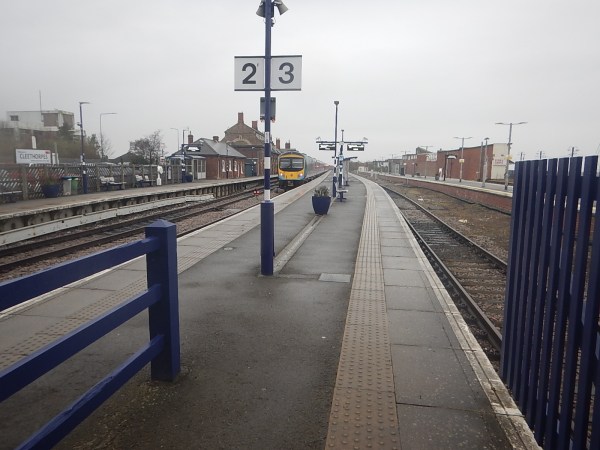
This picture shows Cleethorpes station
Note.
- The four long platforms without electrification.
- The platforms have recently been refurbished.
- The train in Platform 2 is a TransPennine Express Class 185 Siemens Desiro diesel train.
The simplest way to electrify the station would be to put up enough 25 KVAC overhead wires, so that battery-electric trains needing a charge could put up a pantograph and have a refreshing drink.
In Technology Behind Siemens Mobility’s British Battery Trains Hits The Tracks, I wrote about Siemens Rail Charging Converter.
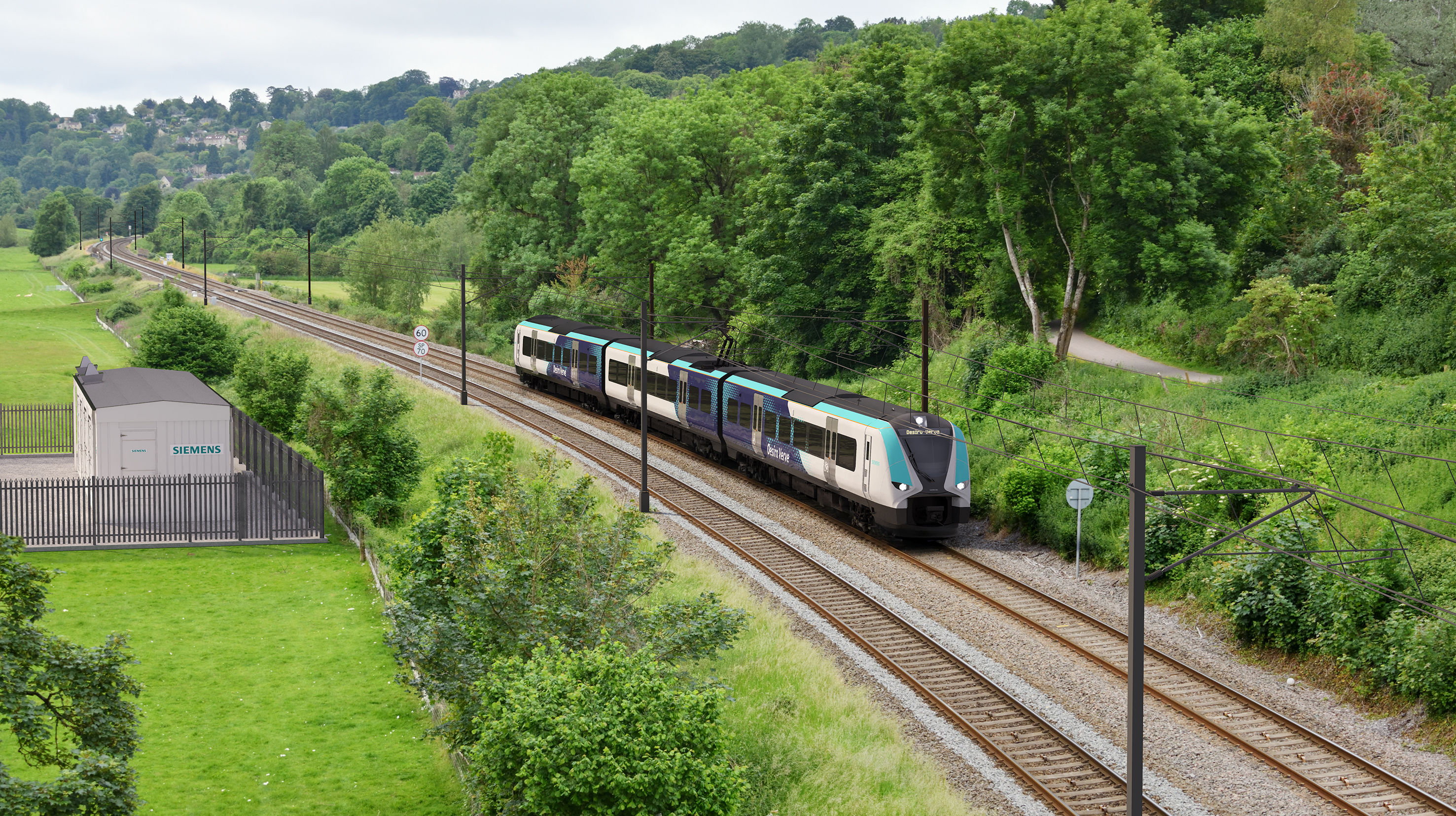
This is a visualisation of a Siemens Rail Charging Converter in action.
Note.
- The track is electrified with standard 25 KVAC overhead electrification.
- The train is a standard Siemens electric or battery-electric train.
- Siemens Rail Charging Converter, which is the shed in the compound on the left is providing the electricity to energise the catenary.
- I suspect, it could power third rail electrification, if the Office of Rail and Road ever allowed it to be still installed.
- The Siemens Rail Charging Converter does have one piece of magic in the shed. I suspect it uses a battery or a large capacitor to help power the electrification, as it can be powered from any typical domestic grid supply.
- I also wonder, if it has safety devices that cut the power outside the shed if track workers or intruders are detected, where they shouldn’t be?
- It could even cut the power, when trains are not running to save power and increase safety.
This looks to me, that a Siemens Rail Charging Converter could be a superb example of out-of-the-box thinking.
Could The Cleethorpes And Barton-on-Humber Service Be Run By Battery-Electric Rolling Stock?
This OpenRailwayMap shows the railways of North-East Lincolnshire.
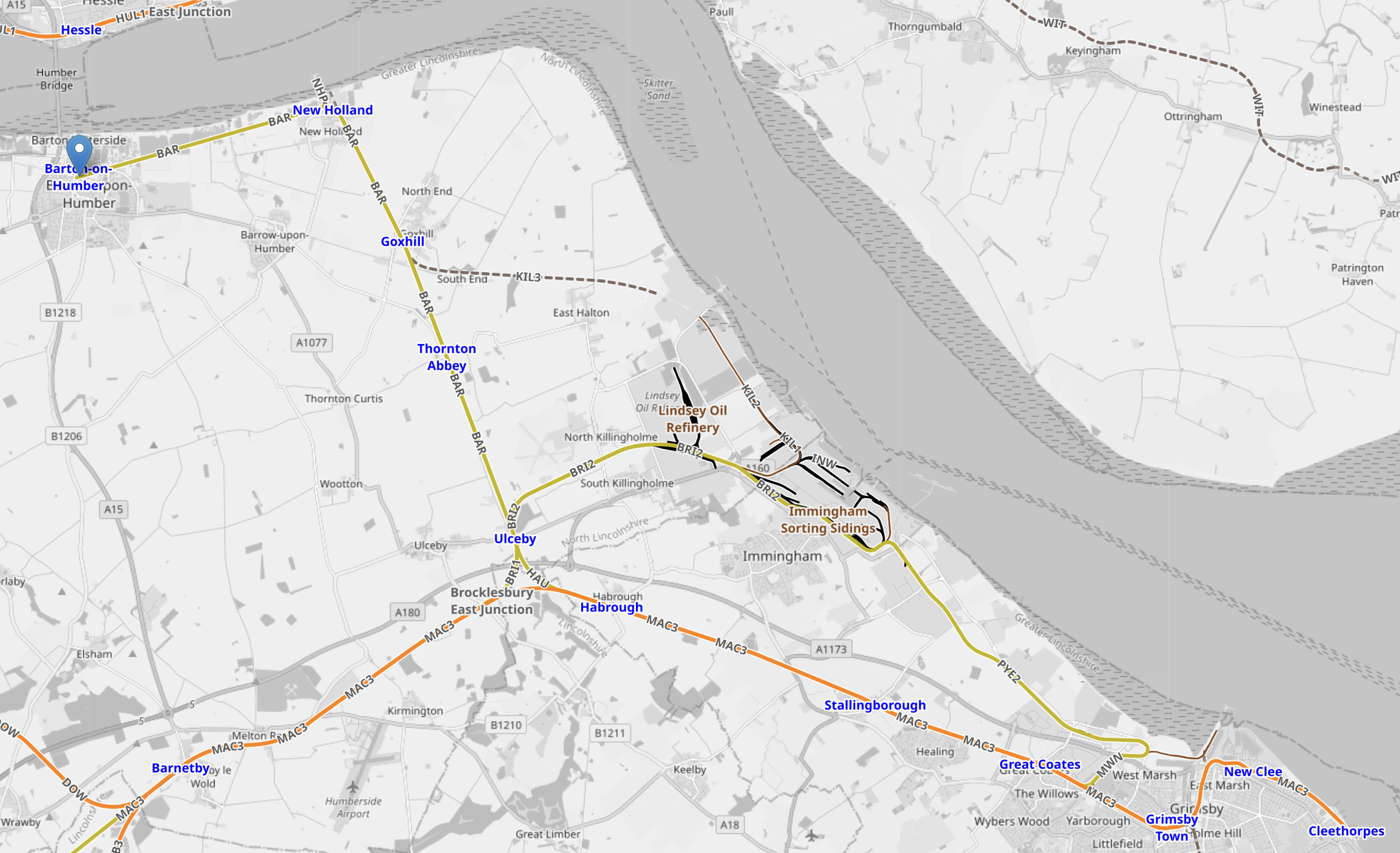
Note.
- Cleethorpes is in the South-East Corner of the map.
- Barton-on-Humber is in the North-West corner of the map and marked by a blue-arrow.
- Stations from South to North would be New Clee, Grimsby Docks, Grimsby Town, Great Coates, Healing, Stallingborough, Habrough, Ulceby, Thornton Abbey, Goxhill, New Holland and Barrow Haven.
- The line is double track.
- Cleethorpes and Barton-on-Humber is just 22.8 miles.
- A round trip would be under fifty miles, which would be well within range of a full-charge at one end.
- Service is one train per two hours (tp2h), which would only need a single train, shuttling between Cleethorpes and Barton-on-Humber.
- Two trains could provide an hourly service.
I would expect, that well-designed, solid and reliable German engineering could build a Siemens’ Rail Charging Connector that could charge four trains per hour (tph) at Cleethorpes station.
At present services are.
- TransPennineExpress – 1 tph to Liverpool Lime Street.
- East Midlands Railway – 1 tp2h to Barton-on-Humber
- East Midlands Railway – 1 tp2h to Matlock via Lincoln and Nottingham
- Northern Trains – 1 train per day (tpd) Sheffield via Brigg.
That is probably only about two tph.
Could The Cleethorpes And Sheffield Service Be Run By Battery-Electric Rolling Stock?
This is a description of the current Cleethorpes and Sheffield service.
- It is run by Northern Trains.
- The morning train leaves Sheffield at 09:54 and arrives in Cleethorpes at 11:40.
- The afternoon train leaves Cleethorpes at 13:20 and arrives in Sheffield at 15:10.
- The train is a Class 150 diesel train, which is a bit of a Joan Collins of a train – Of a certain age, but still scrubs up extremely well!
- Intermediate stations are Worksop, Retford, Gainsborough Central, Kirton Lindsey, Brigg, Barnetby and Grimsby Town
- The route length is 71.6 miles
- Trains take about 45-50 minutes.
It is also a parliamentary train.
The Wikipedia entry for parliamentary train gives this description of the Cleethorpes and Sheffield service.
Via Kirton Lindsey & Brigg. Became a parliamentary service when weekday services were withdrawn in 1993. Regular trains have operated between Gainsborough and Sheffield for most timetable periods since. Suspended January 2022 by Northern, who cited COVID-19 and staffing issues , but the service was reinstated in December 2022. Changed in May 2023 to be one return journey on weekdays only.
In the 1950s and 1960s I lived in Felixstowe part of the time and in the 1970s and 1980s I lived near Woodbridge and I observed first hand the development of the Port of Felixstowe and the effects it had on the surrounding countryside.
The development of the Port of Felixstowe, has brought the following.
- Improved roads and railways.
- Ipswich is now an hour from London by train.
- Ipswich is now a University town.
- New housing and other developments, both in Ipswich and Felixstowe and the surrounding countryside.
- Employment also has increased considerably, both in the Port and in surrounding towns.
- Ipswich’s football team is very much respected all over Europe and has won the English top division, the FA Cup and the UEFA Cup.
When you consider the jobs that RWE could create in the Port of Grimsby, I believe that this could have similar effects in Grimsby and Cleethorpes, as the Port of Felixstowe had in East Suffolk.
Already, the following are being talked about.
- A direct rail link between Cleethorpes and Grimsby to London.
- Battery-electric trains between Cleethorpes and Grimsby and Doncaster, Manchester and Liverpool Lime Street.
I believe that an improved rail link between Cleethorpes and Sheffield could be the catalyst for much needed housing along the route, which would be to the benefit of Cleethorpres, Grimsby, Sheffield and all the intermediate towns and villages on the route.
and the affects this will have on the countryside around the town, I believe that a strong case can be made out for a more frequent service between Cleethorpes and Sheffield.
Japanese Company Takes Part In Spain’s Floating Wind Demonstration Project
The title of this post, is the same as that of this article on offshoreWIND.biz.
This is the sub-heading.
Japan’s Electric Power Development, also known as J-Power, has joined the WHEEL floating offshore wind demonstration project in Spain.
These three paragraphs add more details.
The WHEEL demonstration project is led by the Madrid-headquartered company Esteyco. WHEEL will feature one turbine installed three kilometres off the eastern coast of Gran Canaria, Spain.
Through this project, J-Power aims to acquire knowledge in the manufacturing, assembly, installation, and operation of floating offshore wind power, contributing to the development of floating offshore wind projects in Japan and abroad, the company said.
A floating offshore wind turbine, with a capacity of 6.17 MW, will be constructed and tested using WHEEL, which combines the advantages of barge-type foundations and spar-type foundations.
There is a visualisation of the WHEEL project in the linked article.
Conclusion
I like the concept of WHEEL.
In Norwegians Developing Monopile Foundation For 100-Metre Depths, I write about my involvement with a company called Balaena Structures in the 1970s, who were trying to develop a reusable oil and gas platform. I have a feeling, that WHEEL and the Balaena have dynamic and floating properties in common.
SNP Ban On ‘Munitions’ Funds Puts Scottish Shipbuilding On The Line
The title of this post is the same as that of this article on The Times.
This is the sub-heading.
The president of Rolls-Royce submarines says plans for a world-class welding centre on the Clyde are at risk of being cancelled within days
These three paragraphs add more details to the story.
Ambitious plans to reverse a historic decline in Scottish shipbuilding are at risk after a £2.5 million taxpayer grant was axed due to an SNP ban on “munitions” funding.
A plan to build a specialist welding centre on the banks of the Clyde is now in grave doubt after Scottish Enterprise, the national economic development agency, was accused of reneging on a pledge to fund a building for the world-class facility.
Rolls-Royce, which is ready to support the project by providing £11 million worth of specialist equipment, expressed “dismay” at the news, saying the project had been classified as a “munitions” scheme solely on the basis that it would “support the construction of naval vessels”.
Given the experience of the Scottish Government in building ferries is documented in this Wikipedia entry, which is entitled Scottish Ferry Fiasco, the SNP must know something about how not to build ships.
The comments from readers of the Times Article are scathing, with many coming from those with Scottish names.
Welding And Nuclear Power
It doesn’t mention the other big use for welding in this article and that is in the manufacture of nuclear reactors. In fact one of the members of the Rolls-Royce consortium, that will build their small modular nuclear reactors is The Welding Institute – No prizes for guessing what they do!
Does that mean that Scotland won’t have anything to do with small modular nuclear reactors? Either in their manufacture or use.
This article in New Civil Engineer is entitled UK Plans New Nuclear Plant In Scotland Despite Scottish Government Opposition.
So if the Scottish Government wants nothing to do with making expensive, quality vessels for the nuclear industry, Rolls-Royce would surely be better building the welding centre in an area of the UK that would appreciate it.
Scots In High Positions Of Power
I like Scotland and the Scots and possibly, at one time, with all the North Sea Oil and Gas, I could have thought about relocating North of the Border. But I’m very glad I didn’t!
It does seem to me though, that when some Scots get to high positions of power, that they lose all sense of reason.
I would nominate.
- Fred the Shred
- The SNP
- That half-Scot, who was lucky enough to be elected US President twice.
There must be a few others.
Siemens Gamesa To Soon Install 21 MW Offshore Wind Turbine Prototype At Danish Test Site — Reports
The title of this post, is the same as that of this article on offshoreWIND.biz.
This is the sub-heading.
Siemens Gamesa is transporting a nacelle from its facility in Brande, Denmark, to the Østerild wind turbine test centre, a company spokesperson confirmed to offshoreWIND.biz. The spokesperson declined to reveal any specifics about the wind turbine but Danish media writes that it is the new prototype which Bloomberg reported earlier this year to have a capacity of 21 MW.
These first two paragraphs give a few more details.
DR (Danish Broadcasting Corporation) reported on 6 December that lamp-posts and traffic signs were being dismantled, and roundabouts widened last week to make room for an 11×11-metre nacelle to pass through on its way to Hvide Sande, starting last Friday. From there, the nacelle will be shipped to Hanstholm and then transported to Østerild, where it will be mounted on an already installed 170-metre tower, according to DR.
In June, Bloomberg reported sources familiar with the matter said that Siemens Energy had told customers it planned to build the largest wind turbine in the world by the end of the decade and the new offshore model would have an output of 21 MW, 40 per cent more than the company’s current largest turbine, the 14 MW platform that can reach up to 15 MW with the company’s feature called Power Boost.
I have a few thoughts.
Will Bigger Be Better?
Going back to the days of North Sea Oil and Gas, I can remember project managers saying that platform installation took off dramatically, as larger platforms, barges, cranes and equipment became available.
I can particularly remember one project manager extolling the virtues of giant 3000 tonne cranes.
Do We Need A Test Centre For Giant Turbines In The UK?
The question has to be asked, as we certainly have large open spaces of sea to put a 40 MW or larger turbine.
Mammoet Launches ‘World’s Strongest’ Land-Based Crane That Can Handle Large Offshore Wind Turbine Components
The title of this post, is the same as that of this article on offshoreWIND.biz.
This is the sub-heading.
Mammoet has launched the SK6000 ring crane, said to be the world’s strongest land-based crane, at its Westdorpe facility in the Netherlands. According to the company, the new crane supports the continued constructability of next-generation offshore wind turbines and foundations.
This is the first paragraph.
The new crane has a maximum capacity of 6,000 tonnes and can lift components of up to 3,000 tonnes to a height of 220 metres, and builds on the design philosophy of Mammoet’s SK190 and SK350 series, which are proven in the market, the company said.
In the early decades of North Sea Oil and Gas, I remember a project management consultant telling me how larger cranes were improving productivity.
It appears history is repeating itself.
The crane can also be transported in standard shipping containers, as this sentence details.
The crane design uses containerization techniques for ease of deployment and can be transported using shipping containers to any location worldwide.
Let’s hope wind farms can be erected faster.
How Clean Energy Will Help Deliver UK Economic Growth
The title of this post, is the same as this press release from SSE.
This is the sub-heading.
How To Actually Deliver UK Economic Growth
This press release appears to have been written by Alistair Phillips-Davies, who is Chief Executive of SSE.
These three paragraphs introduce the press release.
Prior to the election Labour had committed to tackling the planning system head on in order to unlock economic growth and get Britain building again.
If Rachel Reeves’ first speech as Chancellor is anything to go by, winning a commanding majority has only galvanised that intent.
The challenge is for policymakers to deliver at pace across the whole of the UK, including in Scotland where reform is devolved but is also urgently needed.
Alistair Phillips-Davies seems impressed.
Why We Need Planning Reform Urgently
Under this heading, he says this.
Let me give you two examples of how planning acts as a drag on economic growth and jobs.
It currently takes around 12 years to deliver a large offshore wind farm in UK waters. But only two or three years of that is the construction phase.
And when it comes to electricity grids that span the country it only takes one local authority in Scotland to object to a project for it to go to a public inquiry, adding costs and years of delay.
No-one wants to avoid appropriate scrutiny and proper engagement with communities but allowing decision making to drag on for years suits nobody and setting a reasonable 12-month limit is surely sensible for everyone involved, as is giving ministers greater discretion where projects are clearly deemed to be in the national interest.
I very much agree with what he says.
I also suspect that what he says, applies to England, Wales and Northern Ireland, just as much as Scotland.
Declaring His Ambitions
The next two section declare Alistair Phillips-Davies’s ambitions.
- Making The UK The Easiest Place In The world To Invest And Actually Build Projects
- Creating Good Jobs Here In The UK
They are certainly sections that need a full read.
We Need To Get A Move On
This is his final section, which I’ll insert in full.
Having worked in the energy industry for almost 30 years I have never been more excited about the prospects for this country.
As one of the largest investors in the UK, SSE alone has a current investment programme of more than £20bn, but we are ready to go further and many others in the industry will join us.
Britain has no shortage of opportunities. But we need to make them happen. If we can deliver on the clean energy mission, the growth will come. There’s a long way to go, but unblocking the planning gridlock is the right place to start.
I was there at the start of North Sea Oil and Gas, writing project planning software in a Suffolk attic.
Hopefully, I’ll see North Sea Energy turn full circle to renewables.
NSTA Reveals Winners Of Latest North Sea Licensing Round
The title of this post, is the same as that of this article on Energy Voice.
This is the sub-heading.
The North Sea Transition Authority (NSTA) has issued 31 new exploration licences as part of the third tranche of its latest Licensing Round, with firms including Hartshead Resources, Neptune Energy and Perenco UK among the winners.
These first two paragraphs give more detail.
The NSTA said the licences offered in the latest round are expected to add an estimated 600 million barrels of oil equivalent (mmboe) up to 2060, or 545mmboe by 2050.
The release of the third tranche follows the awarding of 27 licences in the first tranche in October last year, and 24 licences awarded in the second tranche in January.
Surely, with the growth of wind in the next twenty years, this oil and gas will get the UK through to 2050.
Hopefully too, we’ll need to import less oil and gas.
Conclusion
I would rate this as good news.
 The Anonymous Widower