Sizewell C Nuclear Power Station: Government To Take 20% Stake
The title of this post, is the same as that of this article on the BBC.
This is the first three paragraphs.
The government plans to take a 20% stake in a £20bn large-scale nuclear plant at Sizewell, the BBC has learned.
French developer EDF will also take a 20% stake in the Suffolk power station.
Ministers hope the confirmation of two cornerstone investors will encourage infrastructure investors and pension funds to take up the remaining 60%.
I used to live near Sixewell and the general feeling of local Suffolk people is not particularly against having nuclear power stations in their back yards.
There are several small points in favour of Sizewell C.
- Sizewell has been operating nuclear power plants safely since the 1960s.
- Leiston, which is the nearest town, has a very strong engineering tradition.
- Leiston also improved by several notches during the building of Sizewell B.
- The site is accessible by rail and possibly sea with the right ship.
- Nuclear fuel can be brought in and out by train.
- If they spent a small amount on the train service to Saxmundham, construction workers could come in by train.
- Sizewell C has been proposed to be used to generate hydrogen for Freeport East at the Ports of Harwich an Felixstowe.
- The power cable to take electricity from Sizewell C towards London is already built.
- Sizewell is much more convenient to get to from London, than other possible nuclear sites.
Overall, I feel that Sizewell is a good place for nuclear power station.
On the other hand, there are these points against the station.
- There will be at least 6.7 GW of wind farms built off the East Anglian coast before Sizewell C is completed.
- There may be substantial objection to the new power station.
- Large nuclear power stations are rarely built to time and on budget.
- I feel that if we go the nuclear route, that small modular nuclear reactors may be better.
I can understand why Governments like Sizewell as a nuclear power station site.
MacHairWind Wind Farm
MachairWind wind farm has its own page on the ScottishPower Renewables web site.
These are the two introductory paragraphs.
The MacHairWind project off the coast of Islay, which could deliver 2GW of cleaner renewable energy, will make a significant contribution to tackling climate change and achieving Net Zero, with the potential to generate enough clean electricity to power over 2 million homes in Scotland.
It will also build on ScottishPower’s long-standing presence and positive track record of investing in and working with local communities and businesses across Argyll & Bute to realise the benefits of renewable energy developments.
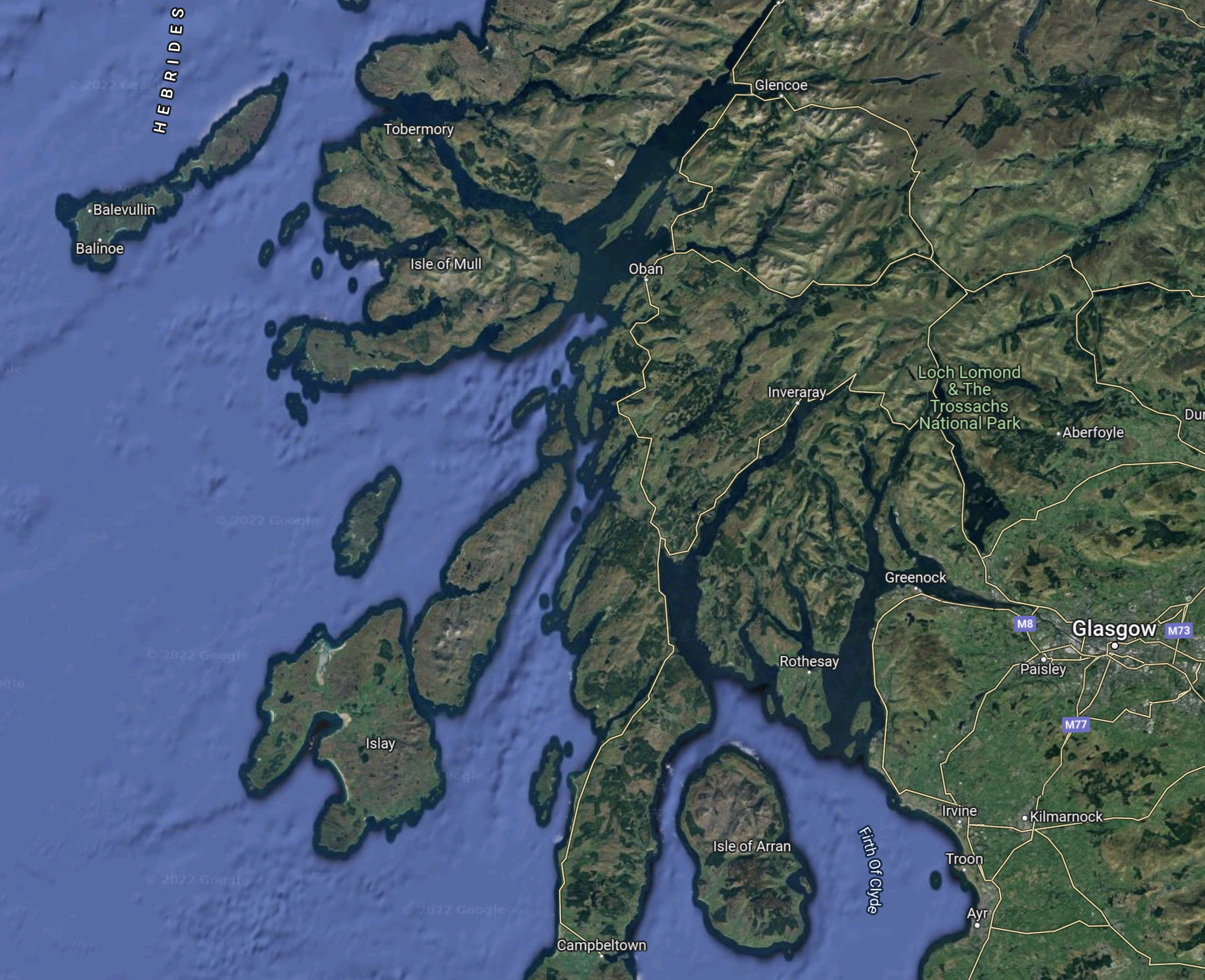
This Google Map shows the area of the wind farm, which is to the North West of the island of Islay.
Note.
- There certainly is a large space of empty sea to the North-West of Islay.
- Glasgow is not far away.
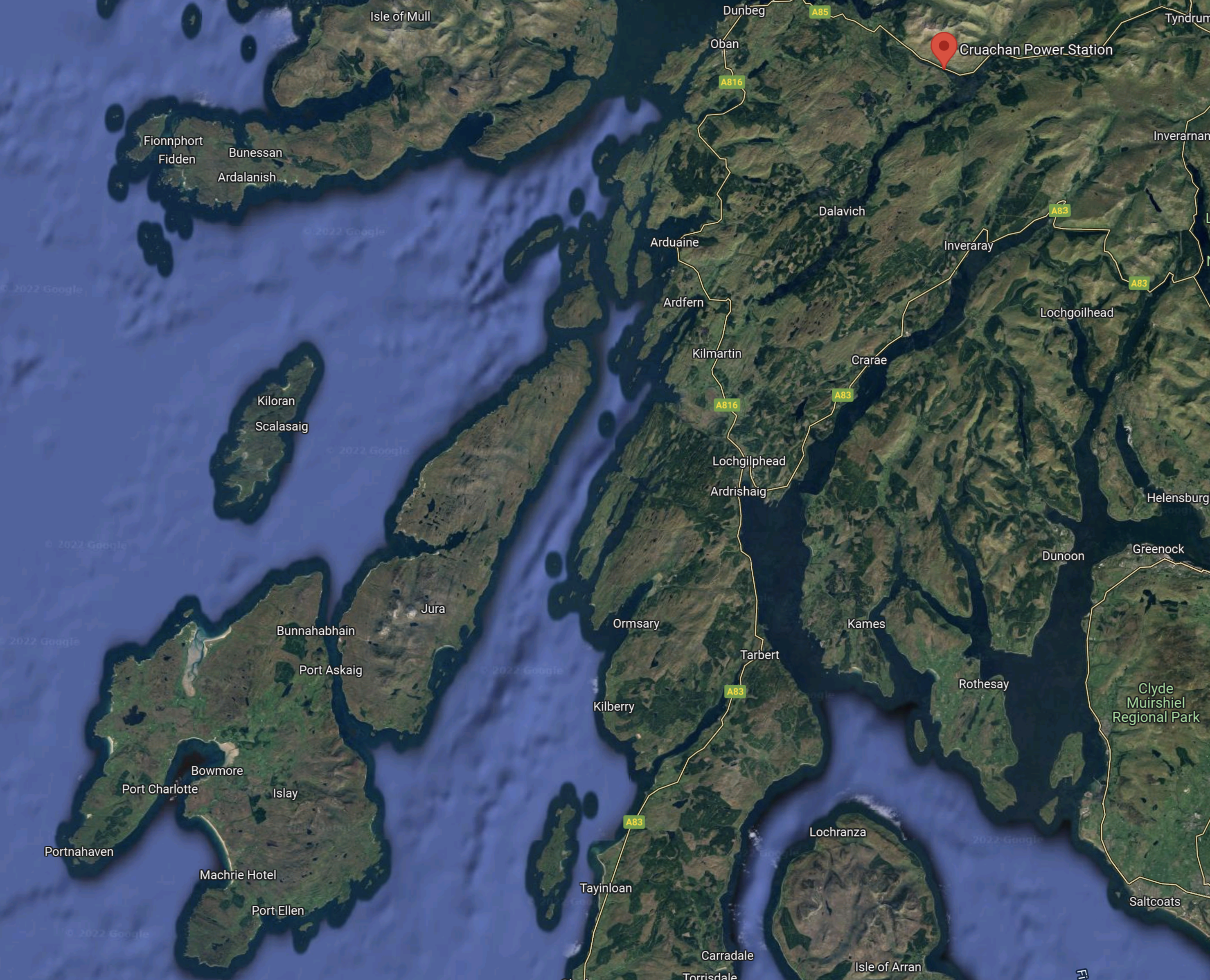
This second Google Map shows the area to the North-East of Islay.
Note.
- Islay is in the South-West corner of the map.
- Colonsay is the smaller island to the North.
- In the North-East corner of the map the red arrow indicate Cruachan pumped hydro power station.
- In the South-East corner of the map is the Clyde Estuary, where the two nuclear power stations at Hunterston were located.
- Hunterston is also the Northern end of Western HVDC Link to North Wales.
Wikipedia says this about the relationship of the Cruachan power station and Hunterston’s nuclear stations.
Construction began in 1959 to coincide with the Hunterston A nuclear power station in Ayrshire. Cruachan uses cheap off-peak electricity generated at night to pump water to the higher reservoir, which can then be released during the day to provide power as necessary.
Now that the two nuclear stations are being decommissioned, will the MacHairWind wind farm be used to pump water to Cruachan’s higher reservoir?
Conclusion
The MacHairWind wind farm seems a well-positioned wind farm.
- It is close to Glasgow.
- It can be used in tandem with the Cruachan pumped hydro power station.
- It will have access to the Western HVDC Link to send power to the North-West of England.
Is Scotland replacing the 1.2 GW Hunterston B nuclear power station with a 2 GW wind farm, with help from Cruachan and other proposed pumped storage hydro schemes to the North of Glasgow?
It also looks like increasing the power at Cruachan from the current 440 MW to a GW, by the building of Cruachan 2 would give the area even more energy security.
Plan For New Nuclear Reactors At Wylfa And Trawsfynydd A Step Closer As Natural Resource Wales Looks At Designs
The title of this post, is the same as that of this article on nation.cymru.
These are the first two paragraphs.
Plans for new nuclear power stations at Trawsfynydd and Wylfa have taken a step closer after the UK Government asked government regulators to assess designs for the reactors.
Natural Resources Wales will be among those assessing the designs by Rolls-Royce, with both Wylfa and Trawsfynydd have been named as potential sites for housing them within the UK.
These are points about the reactors.
- They will cost £1.8 billion each.
- They are capable of powering a city the size of Cardiff, which has a population of about half-a-million.
- I’ve read elsewhere that the reactors are planned to have a nameplate capacity of 470 MW.
The article did mention, that the Nimbys were lining up.
The Wylfa Site
The original Wylfa power station was a Magnox nuclear station generating 980 MW, that was decommissioned in 2015.
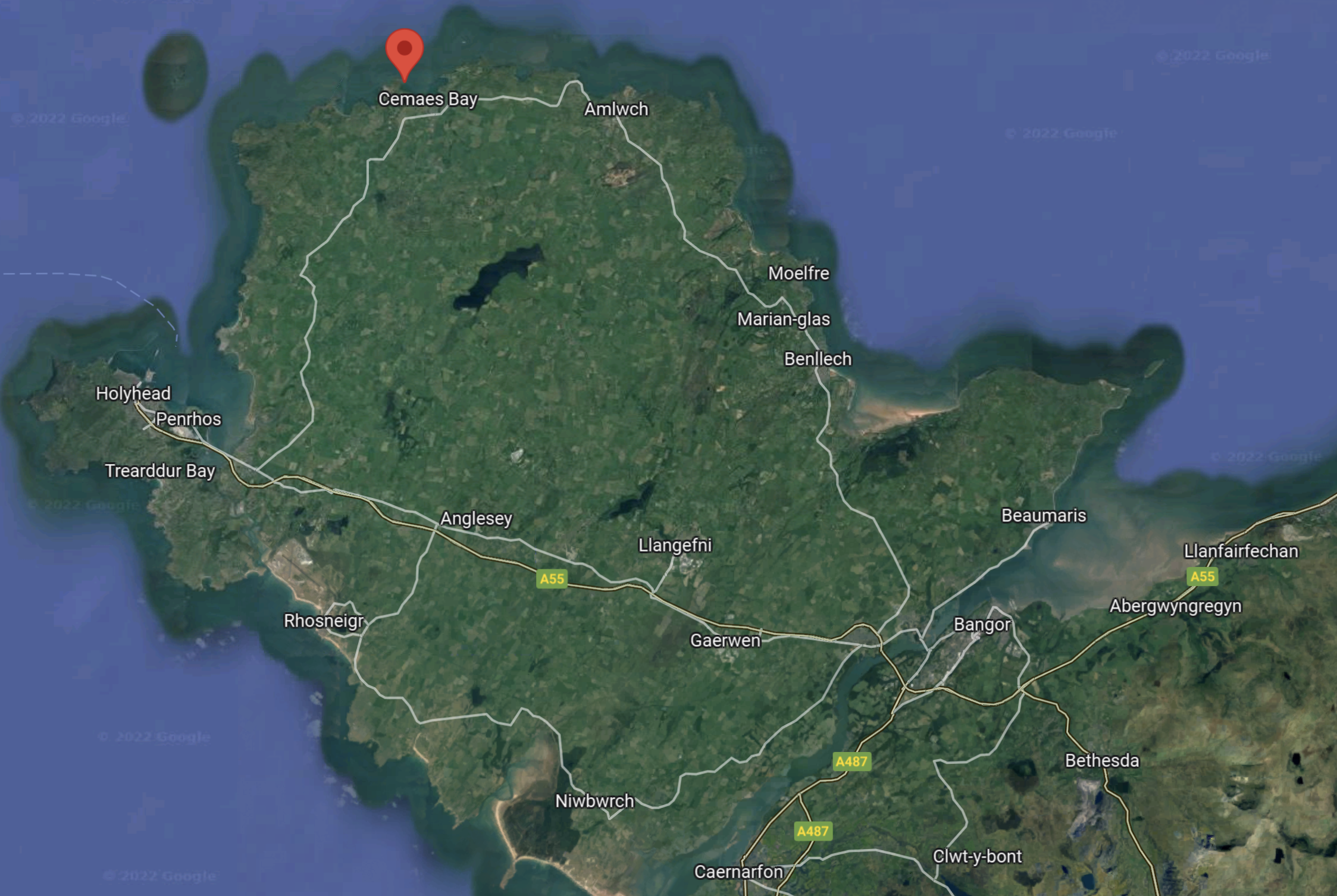
This Google Map shows the location of the site on Anglesey.
This second Google Map shows the site in more detail.
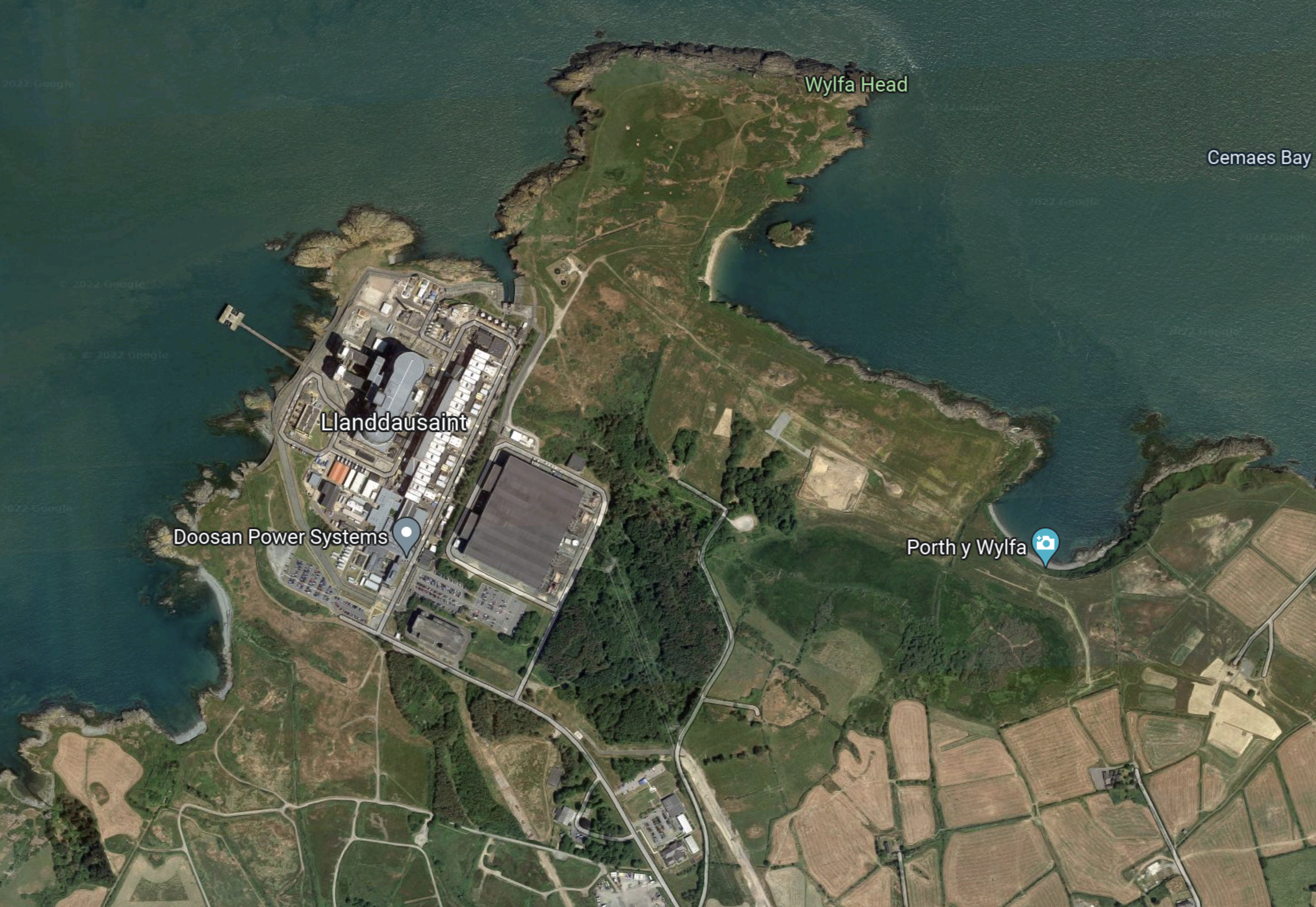
The power station doesn’t appear to have had a rail link, but there is a railway line a few miles away, with sidings that might have been used to handle fuel flasks.
There has been a proposal for a hybrid plant consisting of a wind farm and small modular nuclear reactors, which is described in this Wikipedia section, where this is said.
In January 2021, Shearwater Energy presented plans for a hybrid plant, to consist of a wind farm and small modular reactors (SMRs), to be installed adjacent to the existing Wylfa power station but separate from the proposed Wylfa Newydd site. Shearwater has signed a memorandum of understanding with NuScale Power for the SMRs. The plant could start generation as early as 2027 and would ultimately produce up to 3 GW of electricity and power a hydrogen generation unit producing up to 3 million kg of hydrogen per year.
Note.
- Wylfa Newydd was a proposal by Hitachi to build a nuclear station on the site.
- Shearwater Energy is a UK developer of energy opportunities.
- NuScale Power is an American company with its own design of small modular nuclear reactor.
In Holyhead Hydrogen Hub Planned For Wales, I talked about hydrogen and the port of Holyhead.
The Trawsfynydd Site
The original Trawsfynydd power station was a Magnox nuclear station generating 470 MW, that was decommissioned in 1991.
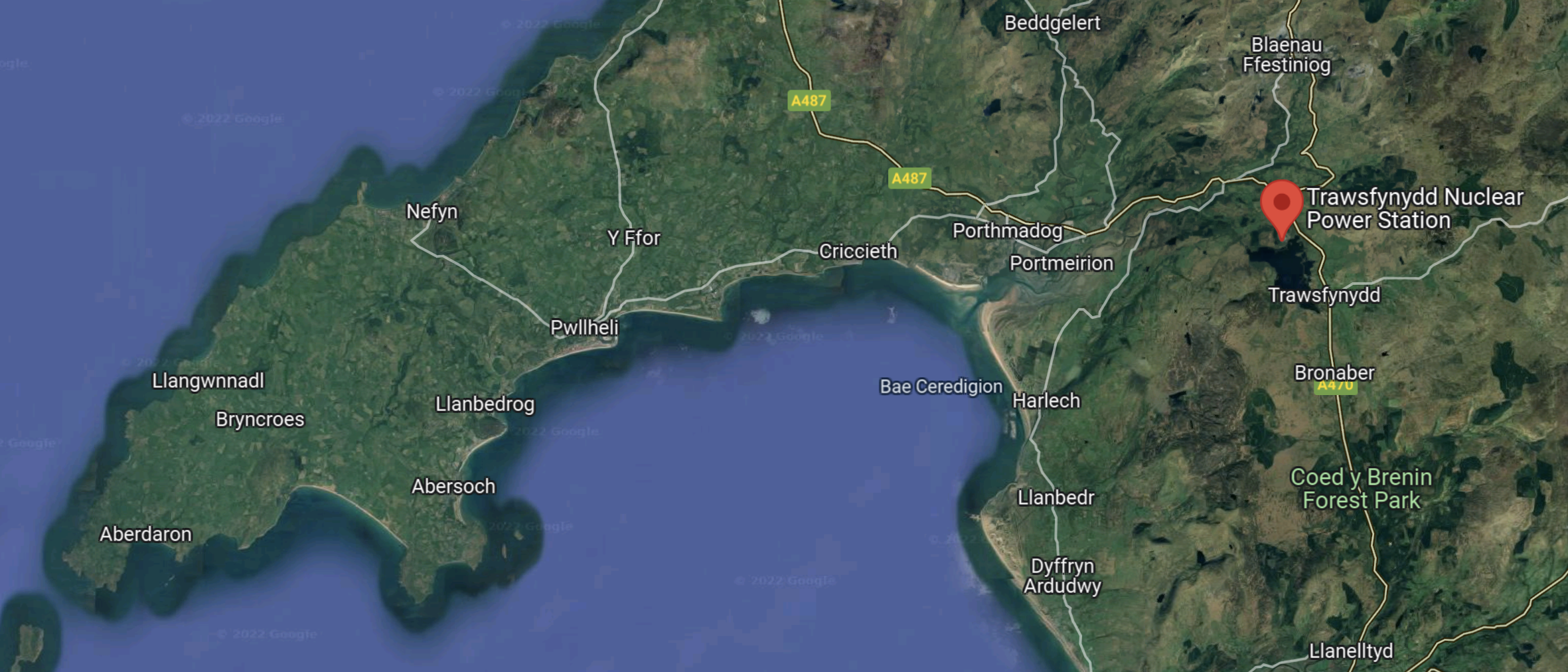
This Google Map shows the location of the site in North Wales.
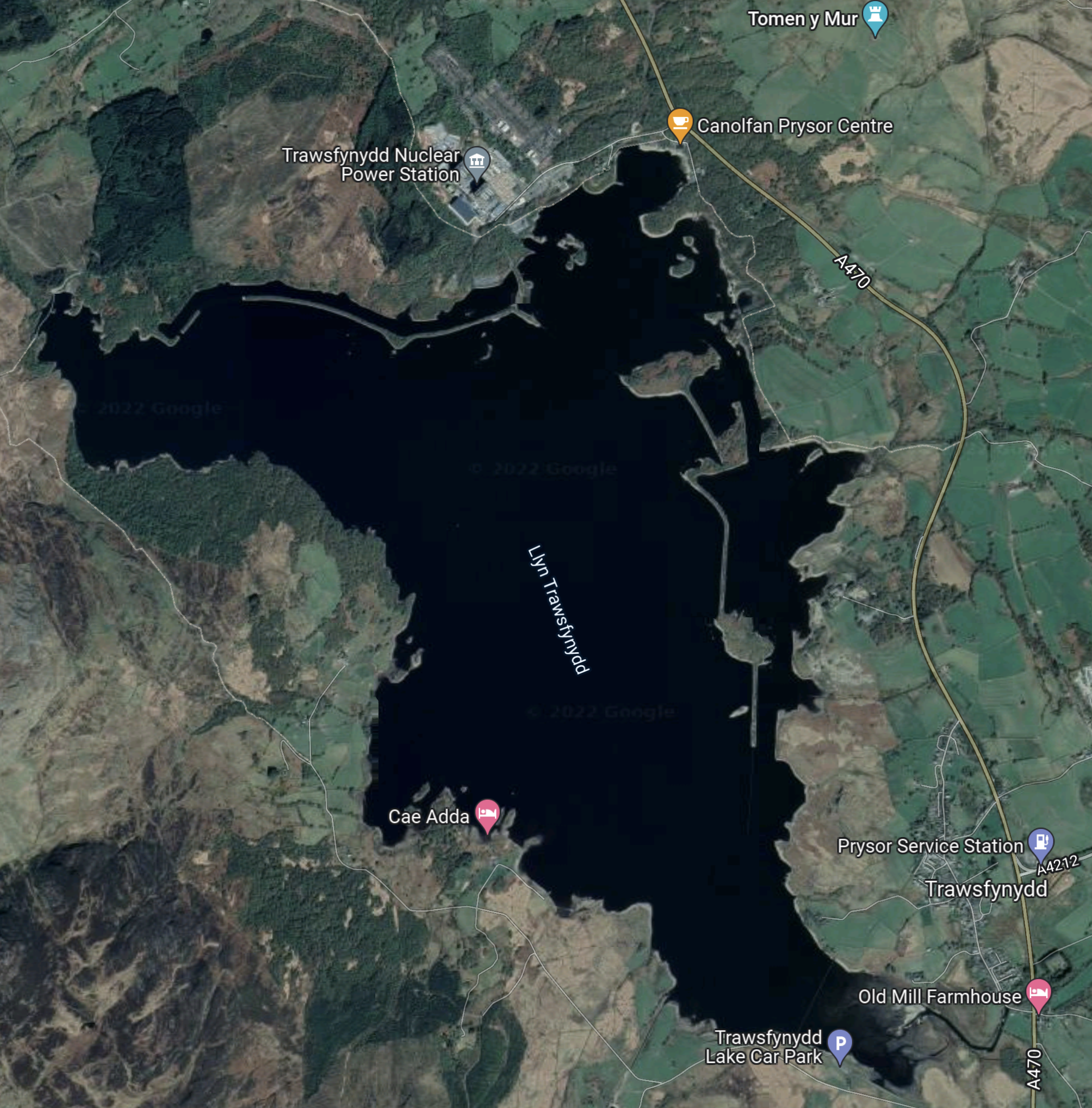
This second Google Map shows the site in more detail.
Note.
- The power station was built on the Northern shore of Llyn Trawsfynydd.
- Llyn Trawsfynydd is a man-made lake, that was built in the 1920s to supply water to the 24 MW Maentwrog hydro electric power station.
- There is a railway from near the site, that connects to the Conwy Valley Line at Blaenau Ffestiniog.
The Trawsfynydd site is a lot more than just a decommissioned Magnox power station.
Pumped Energy Storage In Snowdonia
Currently, there are two existing pumped storage in Snowdonia.
- Dinorwig power station, which is often called Electric Mountain, which has a capacity of 9.1 GWh.
- Ffestiniog power station, which has a capacity of around 1 GWh. If anybody has a better figure let me know!
A third scheme is under development at Glyn Rhonwy, which could have a capacity of 700 MWh.
Looking at the size of Llyn Trawsfynydd, I do wonder, if it could be the top lake of a future pumped storage scheme.
- Llyn Trawsfynydd, contains 40 million tonnes of water.
- There is a head of 190 metres.
That could give energy storage of 20 GWh. That sounds a lot of GWhs! But with two possible small modular nuclear reactors at possibly 500 MW each nearby and some help from windfarms, it could be filled within a day, if there is a suitable low-level reservoir.
Rolls-Royce And The Duisburg Container Terminal
In Rolls-Royce Makes Duisburg Container Terminal Climate Neutral With MTU Hydrogen Technology, I showed how Rolls-Royce and its subsidiary were providing an innovative climate neutral solution for Duisburg Container Terminal in Germany.
A North West Wales Powerhouse
Could Rolls-Royce be planning a Duisburg-style solution for North West Wales.
- Small modular nuclear reactors at Wylfa and Trawsfynydd.
- Hydrogen electrolysers to create hydrogen for the Port of Holyhead and heavy transport.
- Adequate pumped hydro storage for surplus energy.
But there could be little serious above-ground construction.
Conclusion
Something is awakening in North West Wales.
Where Is Zaporizhzhya Nuclear Power Plant?
I have been looking on Google Maps to find Zaporizhzhya Nuclear Power Plant in Ukraine.
This Google Map shows the power plant with respect to the Black Sea.

Note.
- Zaporizhzhya Nuclear Power Plant is marked by the red arrow above the Black Sea., at the top of the map.
- The River Dnieper runs between the Black Sea and the power plant.
- Crimea is the piece of land with Sevastopol marked on it.
This second Google Map shows the location of the power plant.

Note the wide River is the Dnieper, with what looks to be a series of breakwaters or a port enclosing a square patch of water towards the West.
This third Google Map shows the power plant in the North-East corner of the port.

Note that each of the red dots is one 3 GW nuclear reactor, which were built in the 1980s.
It appears that at this time of year, that the prevailing wind is in the East so Moldova will get any radiation.
But luckily, at the time of writing, everything seems OK.
New Electricity ‘Superhighways’ Needed To Cope With Surge In Wind Power
The title of this post, is the same as that of this article on the Telegraph.
This is the first two paragraphs.
Energy companies are pushing for the rapid approval of new electricity “superhighways” between Scotland and England amid fears that a lack of capacity will set back the country’s wind power revolution.
Businesses including SSE and Scottish Power are calling on the industry regulator Ofgem to approve a series of major new north-south power cables in a bid to ease congestion on the existing electricity network.
These points are mentioned in the article.
- Current capacity is 6 GW, which even now is not enough.
- Another 17 GW of capacity will be needed by 2033.
- Wind farms in Scotland have been switched off and replaced by gas-fired power stations because of a lack of grid capacity.
- Another 25 GW of wind farms could be built after leases were awarded last month.
Two North-South interconnectors are being planned.
Peterhead And Drax
This is being proposed by SSE and National Grid.
- It will be an undersea cable.
- It will be two cables, each with a capacity of 2 GW.
- Peterhead and Drax power station are four hundred miles apart by road and 279 miles as the seagull flies, as a lot of the route would be over the sea. So an undersea connection would appear to be sensible.
- Peterhead is on the coast, so connecting an undersea interconnector shouldn’t be too challenging or disruptive to the locals.
- Drax power station is a 4 GW power station and the largest in the UK, so it must have good grid connections.
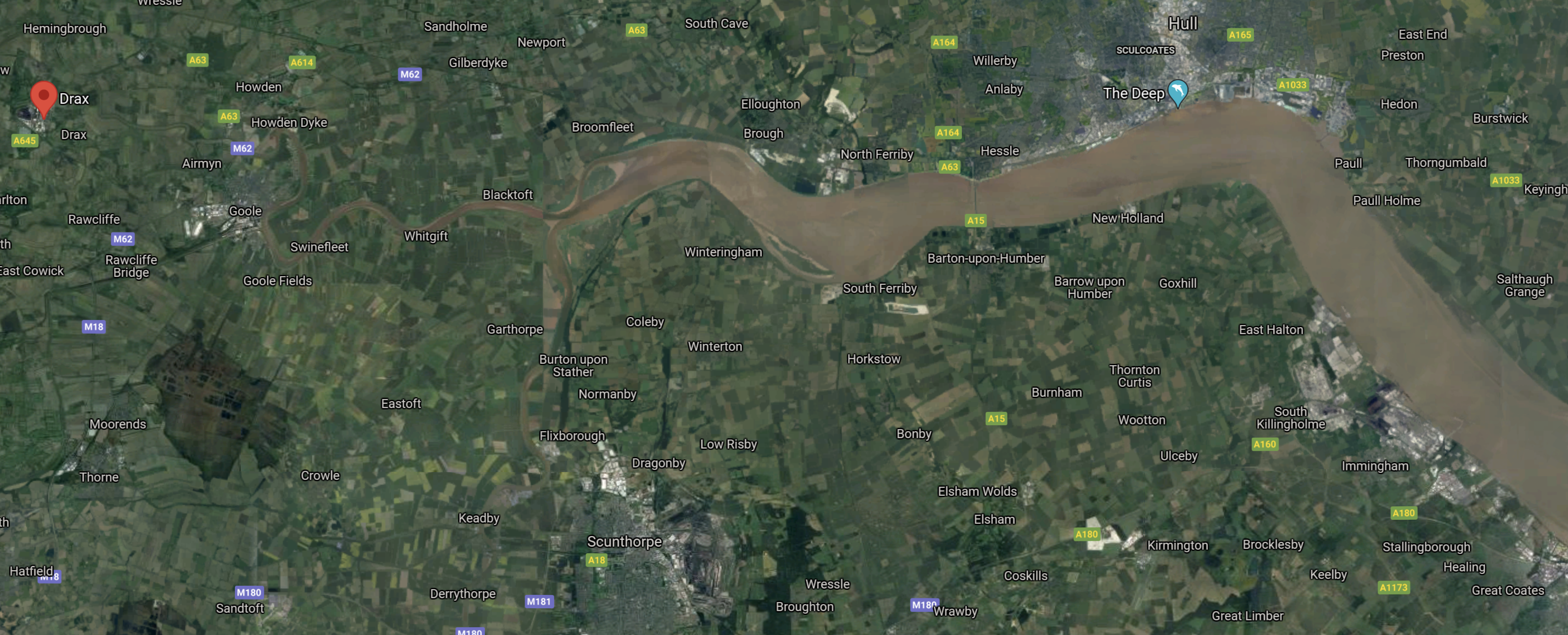
This Google Map shows the location of Drax power station in relation to Hull, Scunthorpe and the rivers in the area.
Note.
- Drax is marked by the red arrow in the West of the map.
- The large body of water in the East is the Humber Estuary.
- Hull is on the North Bank of the Humber.
- Scunthorpe, which is famous for its steel industry is South of the Humber in the middle of the map.
- To the West of Scunthorpe the Humber splits into the Trent and the Ouse.
- The Ouse leads all the way to Drax power station.
I suspect an undersea cable could go up the Humber and Ouse to Drax power station.
Is it a coincidence that both Drax power station and the proposed link to Peterhead are both around 4 GW?
Consider.
- Drax is a biomass power station, so it is not a zero carbon power station.
- Drax produces around six percent of the UK’s electricity.
- Most of the biomass comes by ship from North America.
- Protest groups regularly have protests at Drax because of its carbon emissions.
- Drax Group are experimenting with carbon capture.
- Drax is a big site and a large energy storage system could be built there.
- Wind is often criticised by opponents, saying wind is useless when the wind doesn’t blow.
- The Scots would be unlikely to send power to England, if they were short.
This is also said about Drax in Wikipedia.
Despite this intent for baseload operation, it was designed with a reasonable ability for load-following, being able to ramp up or down by 5% of full power per minute within the range of 50–100% of full power.
I take this it means it can be used to top up electricity generation to meet demand. Add in energy storage and it could be a superb load-follower.
So could the similar size of the interconnector and Drax power station be deliberate to guarantee England a 4 GW feed at all states of the wind?
I don’t think it is a coincidence.
Torness And Hawthorn Pit And Torness and South Humberside
These two cables are being proposed by Scottish Power.
- Each will be two GW.
- Torness is the site of the 1.36 GW Torness nuclear power station, which is likely to be decommissioned before 2030.
- Torness will have good grid connections and it is close to the sea.
- Hawthorn Pit is a large closed coal mine to the North of Newcastle, with a large substation close to the site. I suspect it will be an ideal place to feed power into the grid for Newcastle and it is close to the sea.
- Just South of Hawthorn Pit are the 1.32 GW Hartlepool nuclear power station, which will be decommissioned in 2024 and the landfall of the cables to the massive Dogger Bank wind farm.
- As I showed earlier with Drax, the Humber would be an ideal estuary to bring underwater power cables into the surrounding area. So perhaps the cable will go to Scunthorpe for the steelworks.
- As at Drax, there is backup in South Humberside, but here it is from the two Keadby gas-fired power stations.
The article in the Telegraph only gives the briefest of details of Scottish Power’s plans, but I suspect, that given the locations of the ends of the interconnectors, I suspect the cables will be underwater.
Conclusion
It strikes me that all three interconnectors have been well thought thought and they serve a variety of objectives.
- Bring Scottish wind power, South to England.
- Connect wind farms to the two nuclear power station sites at Hartlepool and Torness, that will close at the end of the decade.
- Allow the big 4 GW biomass-fired station at Drax to back up wind farms and step in when needed.
- Cut carbon emissions at Drax.
- Use underwater cables as much as possible to transfer the power, to avoid the disruption of digging in underground cables.
It looks to be a good plan.
Could Norfolk And Suffolk Be Powered By Offshore Wind?
This week this article on the BBC was published, which had a title of Government Pledges £100m For Sizewell Nuclear Site.
These are the first three paragraphs.
The government is putting up £100m to support the planned Sizewell C nuclear plant in Suffolk, Business and Energy Secretary Kwasi Kwarteng has announced.
The investment marks the latest stage in efforts to build the £20bn reactor on the east coast of England.
However, it does not commit the government to approving the project, which is still subject to negotiations.
My view of the proposed Sizewell C nuclear plant is that of an engineer, who used to live within thirty minutes of the Sizewell site.
- Hinckley Point C power station, which is currently being constructed, will have a nameplate capacity of 3.26 GW.
- Sizewell C would probably be to a similar design and capacity to Hinckley Point C.
- Sizewell C would likely be completed between 2033-2036.
- Sizewell B is a 1250 MW station, which has a current closing date of 2035, that could be extended to 2055.
- East Anglia and particularly the mega Freeport East, that will develop to the South at the Ports of Felixstowe and Harwich will need more electricity.
- One of the needs of Freeport East will be a large supply of electricity to create hydrogen for the trains, trucks, ships and cargo handling equipment.
- Sizewell is a large site, with an excellent connection to the National Grid, that marches as a giant pair of overhead cables across the Suffolk countryside to Ipswich.
But.
- We still haven’t developed a comprehensive strategy for the management of nuclear waste in the UK. Like paying for the care of the elderly and road pricing, it is one of those problems, that successive governments have kept kicking down the road, as it is a big vote loser.
- I was involved writing project management software for forty years and the building of large nuclear power plants is littered with time and cost overruns.
- There wasn’t a labour problem with the building of Sizewell B, as engineers and workers were readily available. But with the development of Freeport East, I would be very surprised if Suffolk could provide enough labour for two mega-projects after Brexit.
- Nuclear power plants use a lot of steel and concrete. The production of these currently create a lot of carbon dioxide.
- There is also a large number of those objecting to the building of Sizewell C. It saddened me twenty-five years ago, that most of the most strident objectors, that I met, were second home owners, with no other connection to Suffolk.
The older I get, the more my experience says, that large nuclear power plants aren’t always a good idea.
Small Modular Nuclear Reactors
In Is Sizewell The Ideal Site For A Fleet Of Small Modular Nuclear Reactors?, I looked at building a fleet of small modular nuclear reactors at Sizewell, instead of Sizewell C.
I believe eight units would be needed in the fleet to produce the proposed 3.26 GW and advantages would include.
- Less land use.
- Less cost.
- Less need for scarce labour.
- Easier to finance.
- Manufacturing modules in a factory should improve quality.
- Electricity from the time of completion of unit 1.
But it would still be nuclear.
Wind In The Pipeline
Currently, these offshore wind farms around the East Anglian Coast are under construction, proposed or are in an exploratory phase.
- East Anglia One – 714 MW – 2021 – Finishing Construction
- East Anglia One North 800 MW – 2026 – Exploratory
- East Anglia Two – 900 MW – 2026 – Exploratory
- East Anglia Three – 1400 MW – 2026 – Exploratory
- Norfolk Vanguard – 1800 MW – Exploratory
- Norfolk Boreas – 1800 MW – Exploratory
- Sheringham Shoal/Dudgeon Extension – 719 MW – Exploratory
Note.
- The date is the possible final commissioning date.
- I have no commissioning dates for the last three wind farms.
- The East Anglia wind farms are all part of the East Anglia Array.
These total up to 8.13 GW, which is in excess of the combined capacity of Sizewell B and the proposed Sizewell C, which is only 4.51 GW.
As it is likely, that by 2033, which is the earliest date, that Sizewell C will be completed, that the East Anglia Array will be substantially completed, I suspect that East Anglia will not run out of electricity.
But I do feel that to be sure, EdF should try hard to get the twenty year extension to Sizewell B.
The East Anglia Hub
ScottishPower Renewables are developing the East Anglia Array and this page on their web site, describes the East Anglia Hub.
This is the opening paragraph.
ScottishPower Renewables is proposing to construct its future offshore windfarms, East Anglia THREE, East Anglia TWO and East Anglia ONE North, as a new ‘East Anglia Hub’.
Note.
- These three wind farms will have a total capacity of 3.1 GW.
- East Anglia ONE is already in operation.
- Power is brought ashore at Bawdsey between Felixstowe and Sizewell.
I would assume that East Anglia Hub and East Anglia ONE will use the same connection.
Norfolk Boreas and Norfolk Vanguard
These two wind farms will be to the East of Great Yarmouth.
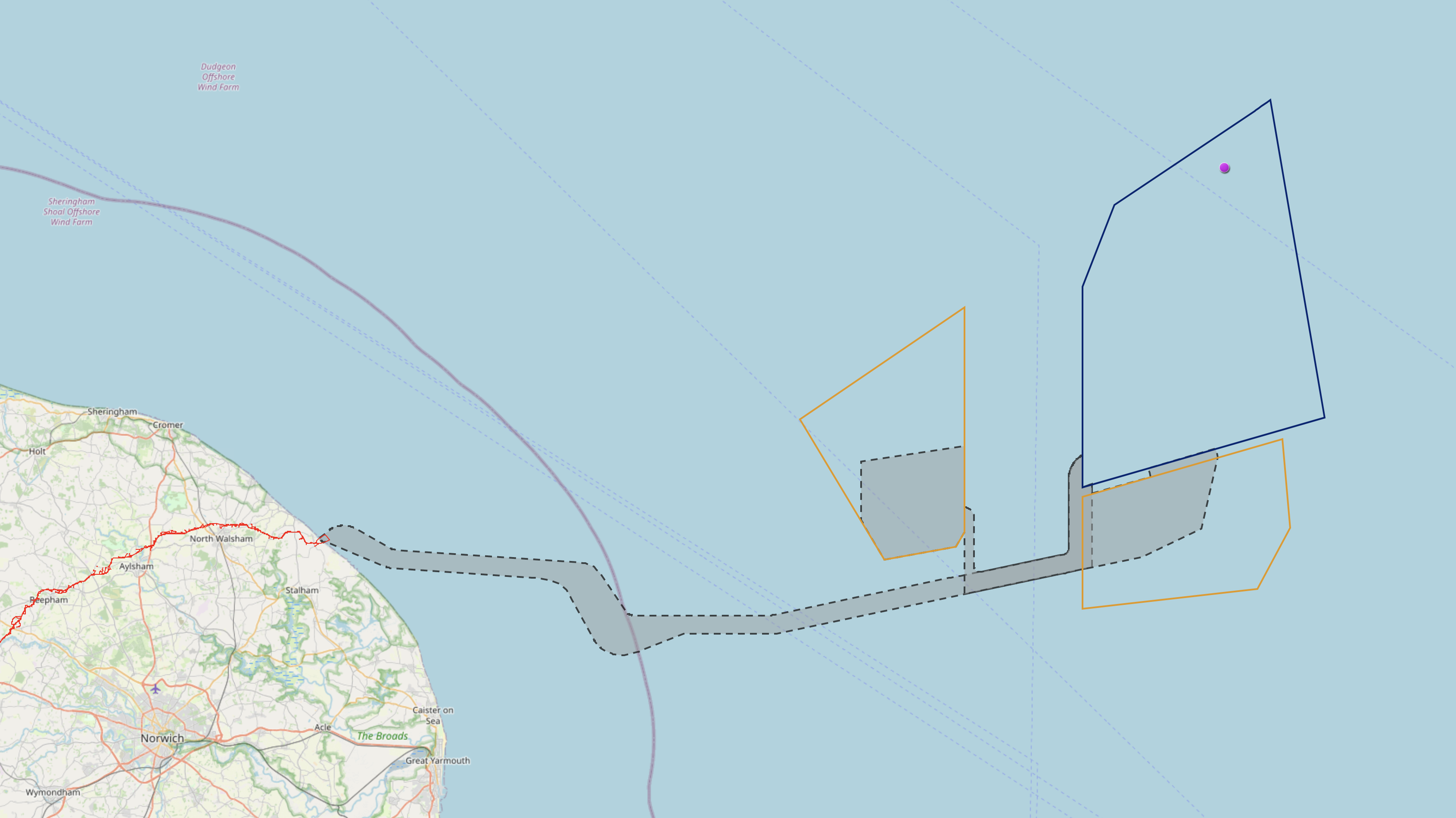
This map from Vattenfall web site, shows the position of the two wind farms.
Note.
- Norfolk Boreas is outlined in blue.
- Norfolk Vanguard is outlined in orange.
- I assume the grey areas are where the cables will be laid.
- I estimate that the two farms are about fifty miles offshore.
This second map shows the landfall between Eccles-on-Sea and Happisburgh.
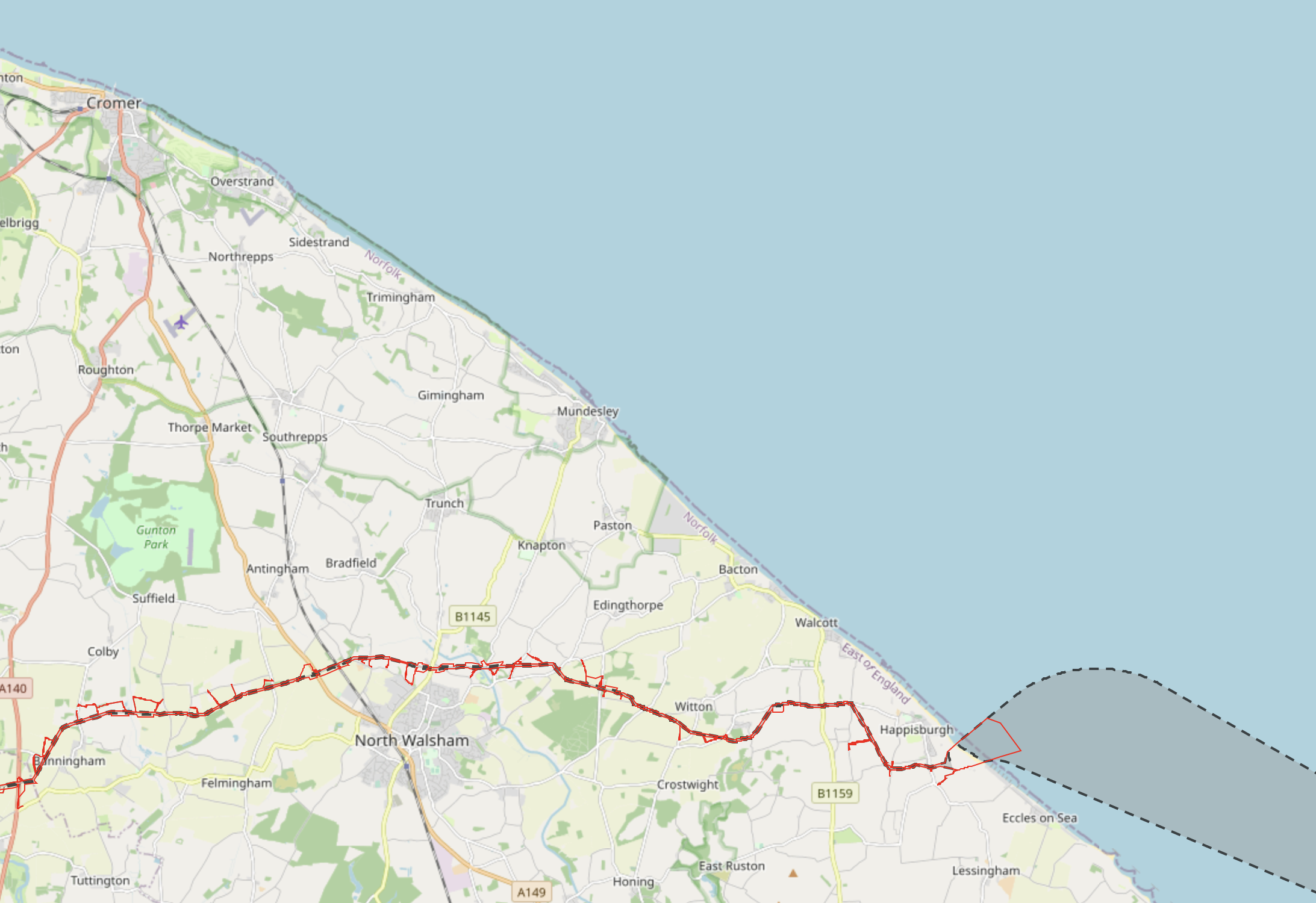
Note the underground cable goes half-way across Norfolk to Necton.
Electricity And Norfolk And Suffolk
This Google Map shows Norfolk and Suffolk.
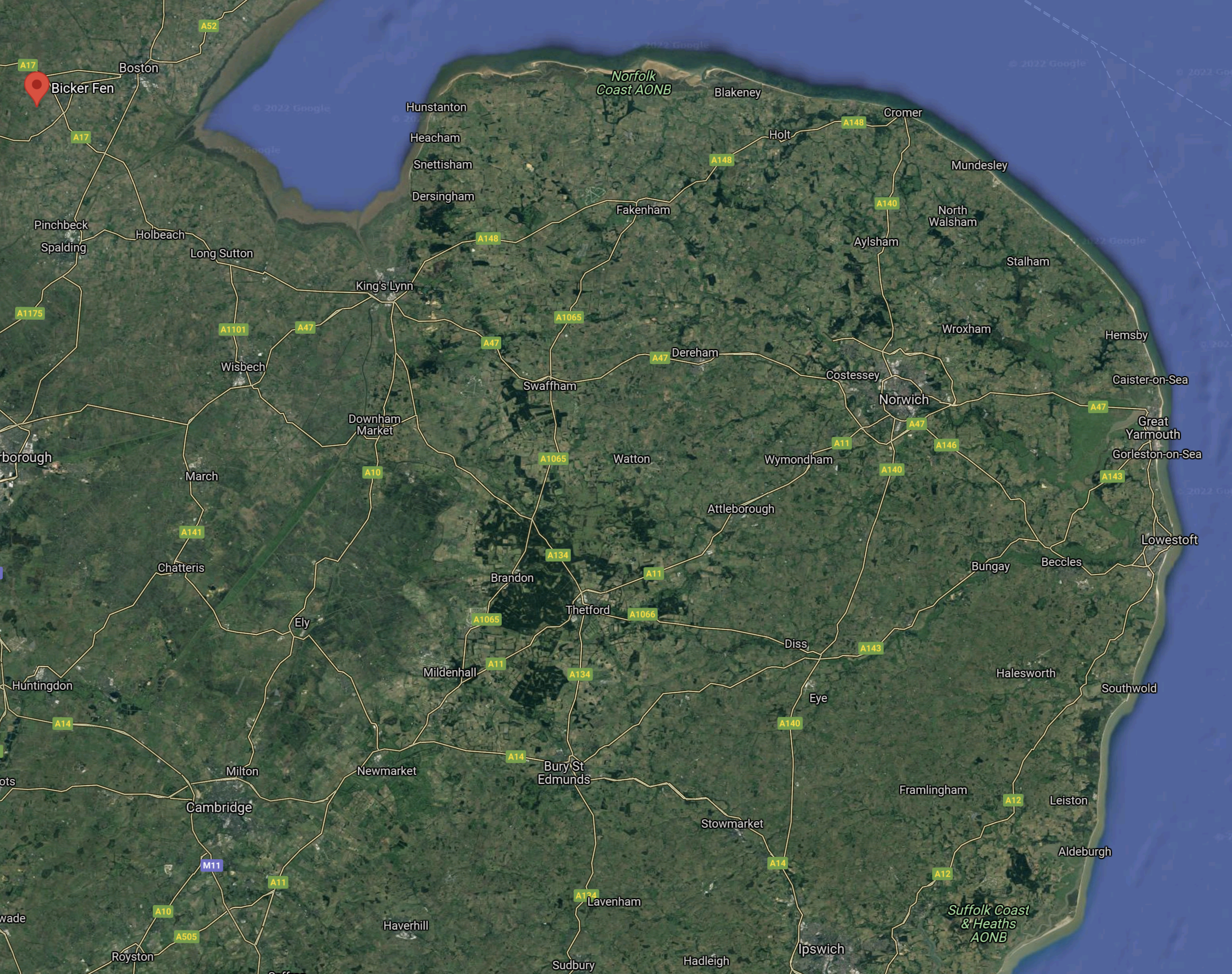
Note.
- The red arrow in the North-West corner marks the Bicker Fen substation that connects to the Viking Link to Denmark.
- The East Anglia Array connects to the grid at Bawdsey in the South-East corner of the map.
- Sizewell is South of Aldeburgh in the South-East corner of the map.
- The only ports are Lowestoft and Yarmouth in the East and Kings Lynn in the North-West.
There are few large towns or cities and little heavy industry.
- Electricity usage could be lower than the UK average.
- There are three small onshore wind farms in Norfolk and none in Suffolk.
- There is virtually no high ground suitable for pumped storage.
- There are lots of areas, where there are very few buildings to the square mile.
As I write this at around midday on a Saturday at the end of January, 49 % of electricity in Eastern England comes from wind, 20 % from nuclear and 8 % from solar. That last figure surprised me.
I believe that the wind developments I listed earlier could provide Norfolk and Suffolk with all the electricity they need.
The Use Of Batteries
Earlier, I talked of a maximum of over 7 GW of offshore wind around the cost of Norfolk and Suffolk, but there is still clear water in the sea to be filled between the existing and planned wind farms.
Batteries will become inevitable to smooth the gaps between the electricity produced and the electricity used.
Here are a few numbers.
- East Anglian Offshore Wind Capacity – 8 GW
- Off-Peak Hours – Midnight to 0700.
- Typical Capacity Factor Of A Windfarm – 20 % but improving.
- Overnight Electricity Produced at 20 % Capacity Factor – 11.2 GWh
- Sizewell B Output – 1.25 GW
- Proposed Sizewell C Output – 3.26 GW
- Largest Electrolyser – 24 MW
- World’s Largest Lithium-Ion Battery at Moss Landing – 3 GWh
- Storage at Electric Mountain – 9.1 GWh
- Storage at Cruachan Power Station – 7.1 GWh
Just putting these large numbers in a table tells me that some serious mathematical modelling will need to be performed to size the batteries that will probably be needed in East Anglia.
In the 1970s, I was involved in three calculations of a similar nature.
- In one, I sized the vessels for a proposed polypropylene plant for ICI.
- In another for ICI, I sized an effluent treatment system for a chemical plant, using an analogue computer.
- I also helped program an analysis of water resources in the South of England. So if you have a water shortage in your area caused by a wrong-sized reservoir, it could be my fault.
My rough estimate is that the East Anglian battery would need to be at least a few GWh and capable of supplying up to the output of Sizewell B.
It also doesn’t have to be a single battery. One solution would probably be to calculate what size battery is needed in the various towns and cities of East Anglia, to give everyone a stable and reliable power supply.
I could see a large battery built at Sizewell and smaller batteries all over Norfolk and Suffolk.
But why stop there? We probably need appropriately-sized batteries all over the UK, with very sophisticated control systems using artificial intelligent working out, where the electricity is best stored.
Note that in this post, by batteries, I’m using that in the loosest possible way. So the smaller ones could be lithium-ion and largest ones could be based on some of the more promising technologies that are under development.
- Highview Power have an order for a 50 MW/500 MWh battery for Chile, that I wrote about in The Power Of Solar With A Large Battery.
- East Anglia is an area, where digging deep holes is easy and some of Gravitricity’s ideas might suit.
- I also think that eventually someone will come up with a method of storing energy using sea cliffs.
All these developments don’t require large amounts of land.
East Anglia Needs More Heavy Consumers Of Electricity
I am certainly coming to this conclusion.
Probably, the biggest use of electricity in East Anglia is the Port of Felixstowe, which will be expanding as it becomes Freeport East in partnership with the Port of Harwich.
One other obvious use could be in large data centres.
But East Anglia has never been known for industries that use a lot of electricity, like aluminium smelting.
Conversion To Hydrogen
Although the largest current electrolyser is only 24 MW, the UK’s major electrolyser builder; ITM Power, is talking of a manufacturing capacity of 5 GW per year, so don’t rule out conversion of excess electricity into hydrogen.
Conclusion
Who needs Sizewell C?
Perhaps as a replacement for Sizewell B, but it would appear there is no pressing urgency.
Drax’s Plans For Cruachan
Cruachan Power Station is a pumped-storage hydroelectric power station in Argyll and Bute, Scotland.
- It can generate 440 MW of power.
- It has a storage capacity of 7.1 GWh.
- The power station is owned by Drax.
This Google Map shows the area around the power station.
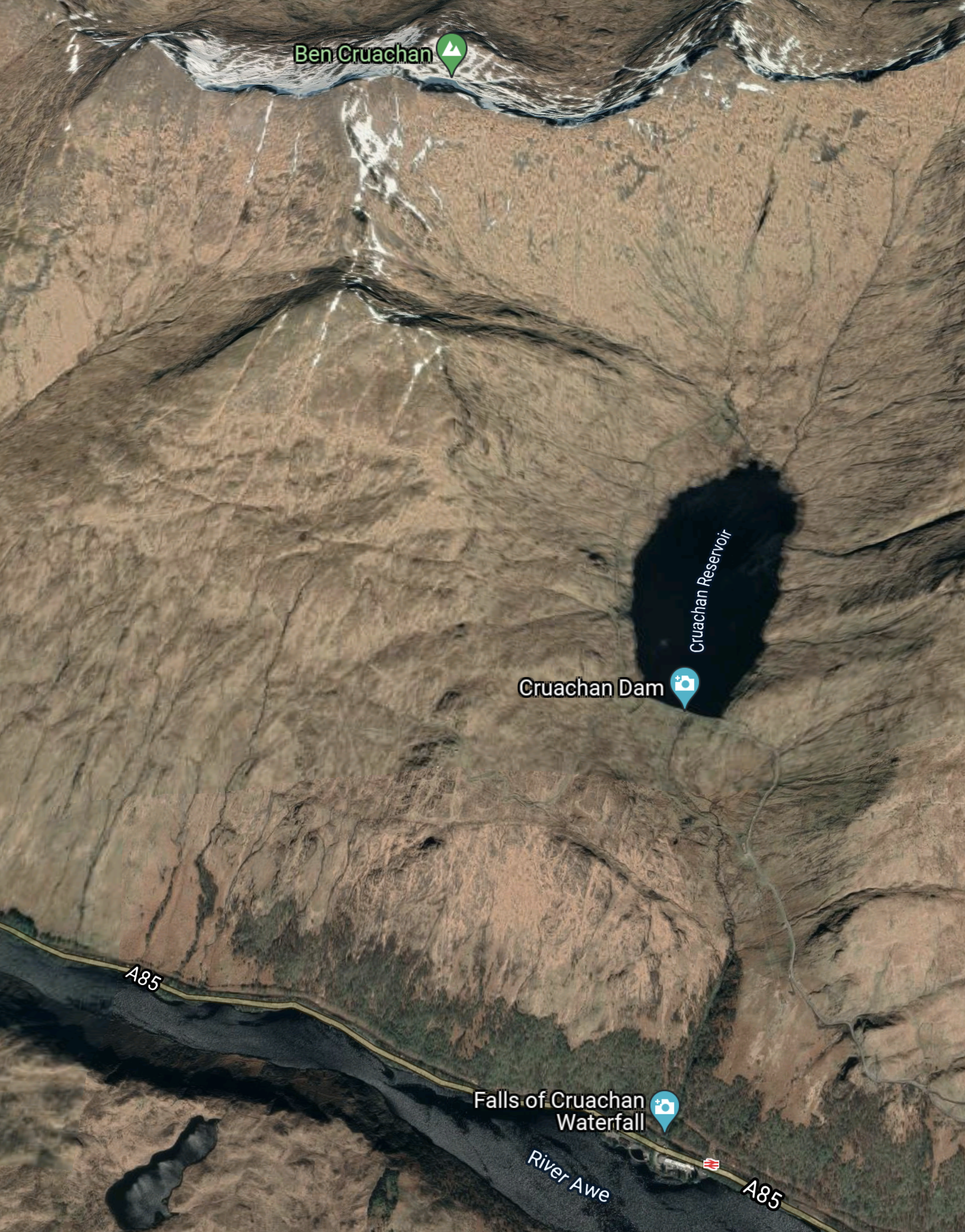
Note.
- Cruachan Reservoir is the upper reservoir for the power station.
- The River Awe is the lower reservoir.
- The turbines for the power station are in a hollowed-out Ben Cruachan.
- There is a visitor centre, which is two-hundred metres from the Falls of Cruachan station, that can be seen on the map, by the river.
More information on visiting can be found at the Visit Cruachan web site.
This second map shows the Southern part of the Cruachan Reservoir to a larger scale.
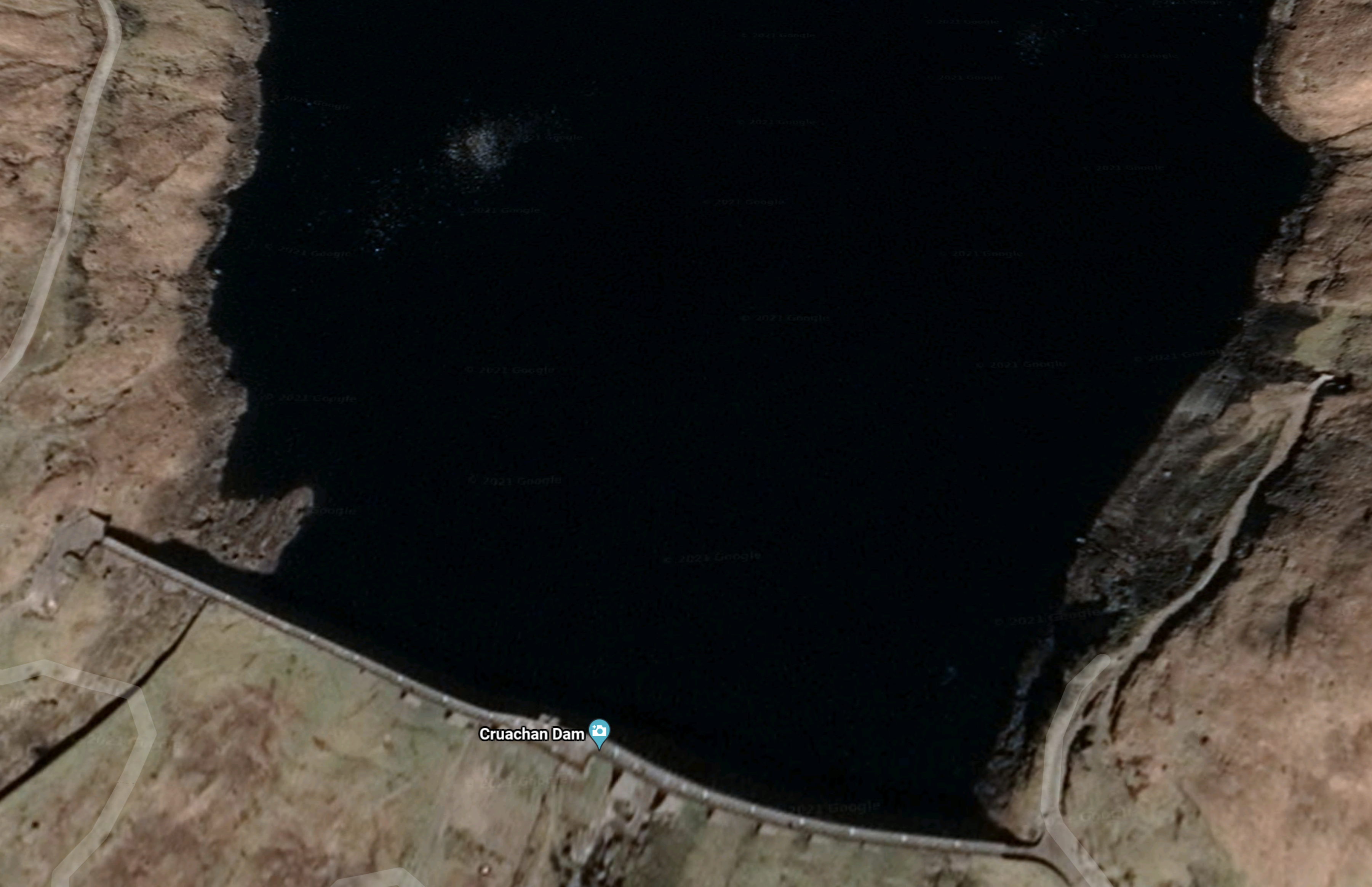
Note the strength of the dam.
The Operation Of Cruachan Power Station
Wikipedia says this about the operation of Cruachan power station.
The station is capable of generating 440 megawatts (590,000 hp) of electricity from four turbines, two of 100 megawatts (130,000 hp) and two of 120 megawatts (160,000 hp) capacity, after two units were upgraded in 2005. It can go from standby to full production in two minutes, or thirty seconds if compressed air is used to start the turbines spinning. When the top reservoir is full, Cruachan can operate for 22 hours before the supply of water is exhausted. At full power, the turbines can pump at 167 cubic metres (5,900 cu ft) per second and generate at 200 cubic metres (7,100 cu ft) per second.
What I find surprising, is that they only upgraded two turbines to 120 MW. I would suspect that there was some other factor that stopped all turbines from being upgraded.
So I would be very surprised if Drax upgraded the power of the existing station.
The Wikipedia extract claims that the Cruachan power station can provide power for 22 hours, if the reservoir, which has a capacity of 7.1 GWh is full. A simple calculation gives an average output in 323 MW. Does that indicate an efficiency of 73.4 %, by dividing 323 by 440.
But no pumped storage system of the 1950s is 100 % efficient. The Ffestiniog Power Station, which opened two years before Cruachan has an efficiency of 73 %. , which appears to be in line with the figures for Cruachan.
Cruachan Power Station And Nuclear Power
Wikipedia says this about Cruachan power station and Hunterston A nuclear power station.
Construction began in 1959 to coincide with the Hunterston A nuclear power station in Ayrshire. Cruachan uses cheap off-peak electricity generated at night to pump water to the higher reservoir, which can then be released during the day to provide power as necessary.
Note.
- Hunterston A power station closed in 1990.
- Hunterston B power station closed a few days ago.
- Scotland now only has one nuclear station at Torness.
It looks like the method of operation will have to change.
Cruachan Power Station And Wind Power
The obvious replacement source of energy at night to replace the nuclear power is wind power.
As I write this the UK is generating 8.5 GW of power from wind turbines.
Surely, enough can be diverted to Cruachan to fill the Cruachan Reservoir.
Cruachan 2
Drax’s plans for Cruachan are based around the building of a second underground power station, which is not surprisingly called Cruachan 2. This page on the Drax web site describes Cruachan 2.
- It will be a 600 MW power station.
- It will be to the East of the current power station.
- More than a million tonnes of rock would be excavated to build the power station.
The existing upper reservoir, which can hold 2.4 billion gallons of water, has the capacity to serve both power stations.
I think it is reasonable to assume the following about Cruachan 2.
- Design of the turbines will have improved in the sixty years since the Francis turbines for the original power station were ordered and designed.
- The turbines will now be precisely computer-controlled to optimise the operation of the power station.
- The turbines will have a faster response, than even that of Cruachan 1, which will help to match output to demand.
But most importantly, I suspect that the efficiency will be higher due to improved turbine design.
I can do a simple calculation, where I will assume the following figures for the two power stations.
- Cruachan 1 – 440 MW – Efficiency – 73 % – Full Power – 323 MW
- Cruachan 2 – 600 MW – Efficiency – 80 % – Full Power – 480 MW
It looks to me that 1040 MW can be used to store water in the reservoir and at this rate it would take 6.8 hours to fill the reservoir. With just Cruachan 1 in operation, filling the reservoir would take sixteen hours.
It looks like with moderate winds generating sensible amounts of electricity, it should be possible to fill the reservoir overnight using both Cruachan 1 and Cruachan 2.
When running flat-out, the combined station can generate 803 MW. At that rate it will generate the power for just under nine hours.
The Wikipedia entry for Francis turbines says this.
Francis turbines are the most common water turbine in use today, and can achieve over 95% efficiency.
Applying 95 % Efficiency to Cruachan 2 would give the following.
- An output of 570 MW for Cruachan 2.
- A total output of 1010 MW for the combined station.
- This would mean the combined station could deliver 1.01 GW for just over seven hours.
Modern control technology would probably be used to ensure that the output of the combined Cruachan station filled in the gaps between demand and supply.
Could The Size Of Cruachan Reservoir Be Increased?
This would increase the amount of energy stored.
I suspect that it probably can’t be increased, as any increases would have been done by now.
Conclusion
It looks like very good engineering to me.
- There is a good chance, that on most nights, the reservoir will be filled using wind energy
- The maximum output of the Cruachan power station has been more than tripled from 323 to 1010 MW.
- There has been no increase in the size of the Cruachan reservoir.
Scotland will now have a GW-sized hydro-electric power station.
Rolls-Royce Submits SMR Design For UK Assessment
The title of this post, is the same as that of this article on World Nuclear News.
This is the first paragraph.
Rolls-Royce SMR Limited has submitted its 470 MWe small modular reactor (SMR) design for entry to the UK’s Generic Design Assessment (GDA) regulatory process. The review of the SMR design – based on a small pressurised water reactor – will formally begin once the government has assessed the company’s capability and capacity to successfully enter the GDA process.
It’s good to see this project progressing.
Could The Morocco-UK Power Project Be Developed Into A Western Europe And Africa Interconnector?
This page on the Xlinks web site, describes the Morocco-UK Power Project, which is proposed to generate solar and wind power in Morocco and deliver it to the UK.
- The plan envisages 10.5 GW of electricity being generated.
- There will be a 5GW/20GWh battery in Morocco.
- They will export 3.6 GW of electricity to the UK for at least twenty hours per day.
- The electricity will be exported to the UK by an Interconnector that skirts to the West of Spain, Portugal and France.
- The interconnector will be 3,800 kilometres long.
I described the project in detail in Moroccan Solar-Plus-Wind To Be Linked To GB In ‘Ground-Breaking’ Xlinks Project.
This Google Map shows Western Europe And North Africa.

Note.
- The light blue of the Continental Shelf
- The darker blue of deeper water.
- The Southern end of the Morocco and the UK interconnector will at Guelmim Oued Noun in the South of Morocco, which is indicated by the red arrow.
- The UK end of the cable will be at Alverdiscott between Barnstaple and Bideford in North Devon.
- Southern Morocco and Algeria look to be mainly in the Sahara Desert.
If we look at the route of the cable, it connects a lot of possible renewable energy sources.
- Morocco – Solar and wind
- Spain – Solar and wind
- Portugal – Solar and wind
- France – Nuclear, tidal and wind
- UK – Nuclear and wind.
Could the UK and Morocco interconnector be developed into a bigger power project?
- Solar and wind power from Algeria could be added.
- Tidal power from a Severn Barrage could be added.
- Connections could be added to Gibraltar, the Irish Republic and Wales.
I believe that there could be a large amount of electricity developed on the Western costs of Europe and Africa.
An interconnector would move it to where it is needed.
Rolls-Royce Seeks Private Funds To Power Nuclear Project
The title of this post, is the same as that of this article on The Times.
The article is based on this press release on the Rolls-Royce web site, which is entitled More Power And Updated Design Revealed As Nuclear Power Team Targets First Place In The Assessment Queue In Autumn 2021.
This is the first two paragraphs.
The consortium, led by Rolls-Royce, which is creating a compact nuclear power station known as a small modular reactor (SMR), has revealed its latest design and an increase in power as it completes its first phase on time and under budget.
It has also announced it is aiming to be the first design to be assessed by regulators in the second half of 2021 in the newly-opened assessment window, which will keep it on track to complete its first unit in the early 2030s and build up to 10 by 2035.
It would appear that they are following AstraZeneca’s example and building the relationships with the regulators early, so the process of regulation doesn’t delay entry into service.
An Updated Design
These two paragraphs describe the design changes.
As the power station’s design has adjusted and improved during this latest phase – with more than 200 major engineering decisions made during this latest phase – the team has optimised the configuration, efficiency and performance criteria of the entire power station , which has increased its expected power capacity, without additional cost, from 440 megawatts (MW) to 470MW.
The refreshed design features a faceted aesthetic roof; an earth embankment surrounding the power station to integrate with the surrounding landscape; and a more compact building footprint, thanks to successes optimising the use of floor space.
These changes appear to be positive ones.
Transformation To A Focussed Business
Rolls-Royce are transforming the current consortium to an as yet unnamed stand-alone business, as detailed in this paragraph from the press release.
With a focus on continuing its progress at pace, the UK SMR team is transitioning from being a collaborative consortium to a stand-alone business, which will deliver a UK fleet of power stations to become a low carbon energy bastion alongside renewables, while securing exports to make the power station a key part of the world’s decarbonisation toolkit.
Are Rolls-Royce aiming to repeat the success they’ve had with Merlins in World War II and large turbofan engines for airliners with small modular nuclear reactors that decarbonise the world? The strategy is certainly not going against the heritage of the company.
Use Of A Small Modular Nuclear Reactor
This paragraph from the press release outlines a few uses.
The power station’s compact size makes it suitable for a variety of applications, helping decarbonise entire energy systems. Each power station can supply enough reliable low carbon power for around one million* homes, or be used to power net zero hydrogen and synthetic aviation fuel manufacturing facilities, desalination plants or energy intensive industrial sites.
Their size would appear to increase the number of applications.
Hydrogen Production
I particularly like the idea of using an SMR to produce hydrogen for chemical feedstock or to make steel.
I indicated this in Will INEOS And Rolls-Royce Get Together Over Hydrogen Production?
I estimate that a 470 MW SMR would produce around 4,900 tonnes of hydrogen per day.
The numbers certainly seem convenient.
Cost Of Energy And Capital Costs
Tom Samson, Chief Executive Officer of the UK SMR consortium is quoted as saying.
Nuclear power is central to tackling climate change, securing economic recovery and strengthening energy security. To do this it must be affordable, reliable and investable and the way we manufacture and assemble our power station brings down its cost to be comparable with offshore wind at around £50 per megawatt-hour.
Hinckley Point C has a strike price of over £80 per megawatt-hour.
The release also gives a price of around £2.2 billion per unit dropping to £1.8 billion by the time five have been completed.
Benefits To The UK
The press release lists these benefits to the UK.
- create 40,000 regional UK jobs by 2050
- generate £52 billion of economic benefit
- have 80% of the plant’s components sourced from the UK
- target an additional £250 billion of exports – memoranda of understanding are already in place with Estonia, Turkey and the Czech Republic
The value of exports would indicate export sales of over a hundred reactors.
Lifetime
The press release indicates the following about the lifetime of the reactors.
- The reactor will operate for at least 60 years.
- The design, which will be finalised at the end of the regulatory assessment process, proposes that all used fuel will be stored on each site for the lifetime of the plant.
I would assume that Rolls-Royce are developing a philosophy for taking the SMRs apart at the end of their life.
Construction
This paragraph from the press release talks about the construction process.
The power station’s design cuts costs by using standard nuclear energy technology used in 400 reactors around the world, so no prototyping is required. The components for the power station are manufactured in modules in factories, before being transported to existing nuclear sites for rapid assembly inside a weatherproof canopy. This replicates factory conditions for precision activities and further cuts costs by avoiding weather disruptions. The whole sequence secures efficiency savings by using streamlined and standardised processes for manufacturing and assembly, with 90% of activities carried out in factory conditions, helping maintain extremely high quality. In addition, all spoil excavated will be reused on site to build the earth embankment, removing the need for it to taken off site, reducing road journeys that are both financially and environmentally costly.
I have talked to project managers, who have assembled factory-built railway stations and their experiences would back the Rolls-Royce method of construction.
My project management knowledge would also indicate, that the construction of an SMR could be much more predictable than most construction projects, if the factory-built modules are built to the specification.
Funding
According to the article in The Times, the consortium now seems to be in line for £215 million of Government funding, which will unlock £300 million of private funding.
Conclusion
It looks like this project will soon be starting to roll.
 The Anonymous Widower