Electrification Of The Hope Valley Line
This news story from the Department of Transport is entitled Yorkshire And The Humber To Benefit From £19.8 billion Transport Investment.
This is said about the Hope Valley Line.
The Hope Valley Line between Manchester and Sheffield will also be electrified and upgraded, with the aim of cutting journey times from 51 to 42 minutes and increasing the number of fast trains on the route from 2 to 3 per hour, doubling capacity.
The fast trains are currently TransPennine’s service between Liverpool Lime Street and Cleethorpes.
- Between Platform 13 at Manchester Piccadilly station and Sheffield station is 42.6 miles.
- At the Manchester end, there will be electrification between Manchester Piccadilly and Hazel Grove stations, which is 8.7 miles and takes typically 17 minutes.
- After the electrification of the Midland Main Line to Sheffield, there will be electrification between Dore & Totley and Sheffield stations, which is 4.2 miles and takes typically 8 minutes.
The gap in the electrification between Dore & Totley and Hazel Grove stations will be 29.7 miles.
But it will not be an easy route to electrify.
- At the Western end, there is the Disley Tunnel, which is 3535 metres long.
- In the middle, there is the Cowburn Tunnel which is 3385 metres long, that is also the deepest tunnel in England.
- At the Eastern end, there is the Totley Tunnel, which is 5700 metres long.
Yorkshire doesn’t have an Underground railway, but the combined length of these three tunnels is 7.84 miles, which means that over 26 % of the electrification needed between Manchester Piccadilly and Sheffield will have to be installed in tunnels.
Could The Route Be Run Using Battery-Electric Trains?
Consider.
- The gap in the electrification between Dore & Totley and Hazel Grove stations will be 29.7 miles.
- There is electrified sections at Dore & Totley and Hazel Grove stations, which will be able to charge the trains.
- Merseyrail’s Class 777 trains have demonstrated a battery range of 84 miles.
- A Stadler Akku train has demonstrated a battery range of 139 miles.
- Hitachi are developing a battery-electric version of TransPennine’s Class 802 train.
- If all trains can run on batteries or be self-powered, there would be no need to electrify the long and possibly difficult tunnels.
I believe that it would be possible to electrify all passenger services between Manchester and Sheffield using appropriate battery-electric trains.
Freight would be a problem and I suspect that hydrogen-hybrid and other self-powered locomotives could handle the route.
Could The Complete TransPennine Liverpool Lime Street and Cleethorpes Service Be Run By Battery-Electric Class 802 trains?
These are the various electrified and unelectrified sections.
- Liverpool Lime Street and Liverpool South Parkway – Electrified – 5.7 miles – 10 minutes
- Liverpool South Parkway and Trafford Park – Not Electrified – 25.2 miles – 30 minutes
- Trafford Park and Hazel Grove – Electrified – 12.6 miles – 28 minutes
- Hazel Grove and Dore & Totley – Not Electrified – 29.7 miles – 35 minutes
- Dore & Totley and Sheffield – Electrified – 4.2 miles – 6 minutes
- Sheffield and Doncaster – Not Electrified – 18.6 miles – 25 minutes
- Doncaster and Cleethorpes – Not Electrified – 52.1 miles – 78 minutes
Note.
- This is a total of 125.6 miles without electrification.
- The Manchester Piccadilly and Sheffield time is 56 minutes.
- The distance is 37.8 miles.
- That is an average speed on 40.5 mph.
- Most of the line between Manchester Piccadilly and Sheffield has an maximum speed of 70 mph, but there is a short length of track with a 50 mph speed and another longer one with 90 mph.
To achieve 40 minutes between Manchester Piccadilly and Sheffield would need an average speed of 60.7 mph. Given the improvements being carried out by Network Rail at the current time, I believe that forty minutes between Manchester Piccadilly and Sheffield should be possible.
I’ll look at a train going East.
- The train will leave Liverpool Lime Street with a reasonably full battery after charging using the current electrification in the station.
- The train will leave Liverpool South Parkway with a full battery after charging using the current electrification from Liverpool Lime Street.
- The train will arrive at Trafford Park with a battery perhaps two-thirds full, but it will be fully charged on the current electrification to Hazel Grove.
- The train will arrive at Dore & Totley with a battery perhaps two-thirds full, but it will be fully charged on the Midland Main Line electrification to Sheffield.
- The train will arrive at Doncaster with a battery perhaps two-thirds full and the train would wait until it had enough charge to reach Cleethorpes.
I’ll look at a train going West.
- The train will leave Cleethorpes with a full battery after charging using the new electrification in the station.
- The train will arrive at Doncaster with a battery perhaps two-thirds full and the train would wait until it had enough charge to reach Sheffield.
- The train will arrive at Sheffield with a battery perhaps two-thirds full, but it will be fully charged on the Midland Main Line electrification to Dore & Totley.
- The train will arrive at Hazel Grove with a battery perhaps two-thirds full, but it will be fully charged on the current electrification to Trafford Park.
- The train will arrive at Liverpool South Parkway with a battery perhaps two-thirds full, but the route is electrified to Liverpool Lime Street.
Note.
- If the battery range on a full battery was over 90 miles, the two most easterly sections could be run without any charging at Doncaster.
- If the battery range was over 125.6 miles, the journey could be done by starting with a full battery.
- If every time the train decelerated, regenerative braking would recover energy, which could be reused.
- The only new electrification needed will be a short length at Cleethorpes station, that would charge the trains.
I certainly believe that Liverpool Lime Street and Cleethorpes services could be run by battery-electric trains.
Could The Complete TransPennine Liverpool Lime Street and Cleethorpes Service Be Run By Battery-Electric Class 802 trains Without The Midland Main Line Electrification?
In this section, I’m assuming, that there is no electrification at Sheffield.
These would be the various electrified and unelectrified sections.
- Liverpool Lime Street and Liverpool South Parkway – Electrified – 5.7 miles – 10 minutes
- Liverpool South Parkway and Trafford Park – Not Electrified – 25.2 miles – 30 minutes
- Trafford Park and Hazel Grove – Electrified – 12.6 miles – 28 minutes
- Hazel Grove and Cleethorpes – Not Electrified – 104.6 miles – 143 minutes
Note.
- This is a total of 129.6 miles without electrification.
- The battery range of the train, should probably be around 120 miles to make sure the train could run between Hazel Grove and Cleethorpes.
- One diesel power-pack could be installed for emergency use.
I’ll look at a train going East.
- The train will leave Liverpool Lime Street with a reasonably full battery after charging using the current electrification in the station.
- The train will leave Liverpool South Parkway with a full battery after charging using the current electrification from Liverpool Lime Street.
- The train will arrive at Trafford Park with a battery perhaps 80 % full, but it will be fully charged on the current electrification to Hazel Grove.
- The train would then eek out what power it had left to reach Cleethorpes.
If necessary, the train could stop in the electrified Doncaster station to top up the batteries from the East Coast Main Line electrification for the run to Cleethorpes.
I’ll look at a train going West.
- The train will leave Cleethorpes with a full battery after charging using new electrification in the station.
- The train will arrive at Doncaster with a battery perhaps 57 % full and the train would wait if needed, until it had enough charge to reach Hazel Grove.
- The train will arrive at Hazel Grove with a battery perhaps one-thirds full, but it will be fully charged on the current electrification to Trafford Park.
- The train will arrive at Liverpool South Parkway with a battery perhaps one-thirds full, but the route is electrified to Liverpool Lime Street.
Note.
- If the battery range on a full battery was over 105 miles, the Eastern section could be run without any charging at Doncaster.
- If the battery range was over 129.6 miles, the journey could be done by starting with a full battery.
- If every time the train decelerated, regenerative braking would recover energy, which could be reused.
- The only new electrification needed will be a short length at Cleethorpes station, that would charge the trains.
However, it might be prudent to electrify the through platforms at Sheffield, so that they could be used for emergency charging if required.
Northern Train’s Service Between Sheffield And Manchester Piccadilly Via The Hope Valley Line
There is a one train per hour (tph) Northern service between Sheffield and Manchester Piccadilly.
- The Class 195 diesel train takes 78 minutes.
- The distance is 42 miles.
- The first mile or so at the Manchester end is electrified.
- Trains seem to take about sixteen minutes to turn round at Manchester Piccadilly.
- Trains seem to take about nine minutes to turn round at Sheffield.
- The service runs via Reddish North, Brinnington, Bredbury, Romiley, Marple, New Mills Central, Chinley, Edale, Hope, Bamford, Hathersage, Grindleford and Dore & Totley.
- The max speed is generally 60 mph to the West of New Mills Central and 70 mph to the East, with short lower speed sections.
There would appear to be two ways to run this route withy battery-electric trains.
- As Manchester Piccadilly station is fully-electrified and trains could be connected to the electrification for upwards of twenty minutes, trains will certainly be able to be fully-charged at Manchester. As the round trip is only 84 miles, could trains run the service without a charge at Sheffield.
- Alternatively, there could be a dedicated electrified platform at Sheffield. But the problem with this, is that currently this service uses a random platform at Sheffield.
It looks like, if the train has the required range, that charging at the Manchester end would be the better solution.
Liverpool And Norwich Via The Hope Valley Line
This service uses a similar route between Liverpool Lime Street and Sheffield, as the Liverpool and Hull service and then it meanders, through the East Midlands.
- Liverpool Lime Street and Liverpool South Parkway – Electrified – 5.7 miles – 11 minutes
- Liverpool South Parkway and Trafford Park – Not Electrified – 25.2 miles – 33 minutes
- Trafford Park and Hazel Grove – Electrified – 12.6 miles – 26 minutes
- Hazel Grove and Dore & Totley – Not Electrified – 29.7 miles – 28 minutes
- Dore & Totley and Sheffield – Electrified – 4.2 miles – 6 minutes
- Sheffield and Nottingham – Being Electrified – 40.6 miles – 52 minutes
- Nottingham and Grantham – Not Electrified – 22.7 miles – 30 minutes
- Grantham and Peterborough – Electrified – 29.1 miles – 29 minutes
- Peterborough And Ely – Not Electrified – 30 miles – 31 minutes
- Ely and Norwich – Not Electrified – 53.7 miles – 56 minutes
This is a total of 161.3 miles without electrification.
But as Sheffield and Nottingham and Grantham and Peterborough will be fully electrified, this route will be possible using a battery-electric train.
Electrifying Sheffield Station
I said earlier in this post, that electrifying Sheffield station would be an option for electrifying the Sheffield and Manchester Piccadilly service.
If this were to be done, it would have collateral benefits for other services that terminate at Sheffield, which could be charged whilst they turned around.
I wrote about Sheffield station as a battery-electric train hub in Could Sheffield Station Become A Battery-Electric Train Hub?
Conclusion
I believe that full electrification of the Hope Valley Line is not needed, if battery-electric trains are used.
I also believe that battery-electric trains and the current improvements being carried out on the Hope Valley Line will enable a forty minute time between Manchester Piccadilly and Sheffield.
Thoughts On The East Midlands Railway Timetable After Class 810 Trains Enter Service
East Midlands Railway will soon be replacing their diesel Class 222 trains with new bi-mode Class 810 trains.
- 32 trains will be replaced by 33 trains.
- 167 cars will be replaced by 165 cars.
- The current trains come in four, five and seven cars.
- The new trains come in five-cars only.
- The platforms at St. Pancras station can accept a pair of the new trains.
- Both Class 222 and Class 810 trains are genuine 125 mph trains.
- St. Pancras and Corby takes one hour and fifteen minutes
- St. Pancras and Nottingham takes hour and forty-five minutes
- St. Pancras and Sheffield takes two hours
The current services are as follows.
- St. Pancras and Corby via Luton Airport Parkway, Luton, Bedford, Wellingborough and Kettering
- St. Pancras and Nottingham via Kettering, Market Harborough, Leicester, Loughborough (1 tph), East Midlands Parkway (1 tph) and Beeston (1 tph).
- St. Pancras and Sheffield via Leicester, Loughborough (1 tph), East Midlands Parkway (1 tph), Long Eaton (1 tph), Derby and Chesterfield.
Note.
All services are two trains per hour (tph)
If all services were run by single trains, the following number of trains would be needed for each service.
- St. Pancras and Corby – 6 trains
- St. Pancras and Nottingham – 8 trains
- St. Pancras and Sheffield – 9 trains
Note.
- This means a total of twenty-three trains.
- I am assuming, that trains can turn round in fifteen minutes at each end of the journey.
- If pairs of trains run, then the numbers can be doubled to forty-six trains.
These are my thoughts.
Do The Luton Airport Express Services Need Pairs Of Trains?
The Corby service is now branded as the Luton Airport Express.
This picture shows a packed Luton Airport Express at Luton Airport Parkway station.

After seeing this, I believe that a pair of trains must run to Corby to pick up passengers, who want a fast service to and from Luton Airport.
Will The Class 810 Trains Replace The Class 360 Trains To Corby?
If all services are run by single Class 810 trains, the following would apply.
- The current service pattern would need 23 trains.
- All stations would get the same number of trains to and from St. Pancras.
- All East Midlands Railway out of St. Pancras would use the same 125 mph electric trains and services could probably be speeded up.
- The Class 810 train has 2.94 MW on diesel and the Class 360 train has 1.55 MW on electric, so I suspect that the Class 810 train has the faster acceleration.
- Bedford, Kettering, Luton, Luton Airport Parkway, Market Harborough and Wellingborough would have 125 mph electric commuter services to and from London.
- Corby and Luton Airport Parkway services would have marginally more seats, if Corby services were pairs of trains.
There would be ten spare trains, if the Class 360 trains were replaced or four spare trains, if pairs of trains ran to Corby.
Would Class 810 Trains Running On Electric Execute Stops Faster?
This document on Rail Engineer gives these figures for total power on electric of Class 802 trains.
- Five-car – 2712 kW
- Nine-car – 4520 kW
Note.
- These figures are based on a Hitachi figure of 226 kW for the power of a traction motor.
- The five-car train has twelve motors and the nine-car has twenty.
- As a five-car train has three powered cars and a nine-car train has five, it looks like each powered car has four traction motors.
- The document also says that the power to weight ratio on electric is thirty percent more than on diesel.
This document on the Hitachi web site provides this schematic of the traction system.

Note that four traction motors are confirmed.
Consider the power of the various trains, that run or will run on the Midland Main Line.
- Four-car Class 180 train has one 559 kW diesel engine per car.
- Four, five and seven-car Class 222 train has one 559 kW diesel engine per car.
- Four-car Class 360 train has 1.55 MW on electric – 387 kW per car.
- Five-car Class 810 train has 2.94 MW on diesel – 588 kW per car.
- Five-car Class 810 train has 2.94 MW on electric – 588 kW per car.
Note.
- The Class 810 train will out-accelerate the Class 360 train as it has at least 40 percent more power on electric.
- The Class 810 train has pantographs on both driving cars.
- The Class 810 train has two powered cars; numbers 2 and 4.
- I have assumed that if the Class 810 train can handle 2.94 MW on both diesel and electric.
- With eight traction motors, they would need to be 367.5 kW.
- The Class 810 train should out-accelerate the Class 180 train and Class 222 train as it has at five percent more power on both diesel and electric.
I think it is also relevant that the order for the Class 810 trains was placed in August 2019 and Hitachi announced their collaboration with Eversholt Rail Group to develop the battery-electric versions of the Class 802 trains only sixteen months later. As the Class 810 appears to be an revolution of the Class 802 train, I suspect that Hitachi were working hard on battery design, as this train’s design evolved.
These are the five cars of the Class 810 train.
- 1 – DPTS – Driver-Pantograph-Trailer-Standard with Generator Unit
- 2 – MS – Motored-Standard with Generator Unit
- 3 – TS – Trailer-Standard with Transformer
- 4 – MC – Motored-Composite with Generator Unit
- 5 – DPTF – Driver-Pantograph-Trailer-First with Generator Unit
Note.
- Generator Unit is a diesel generator.
- Motored means the car has four traction motors.
- Composite means a car with both First and Standard accommodation.
- Cars 1-2, and 4-5, form two power units with two generator units, four traction motors and a pantograph, at each end of the train. Cables would connect them to the transformer in car 3.
It looks a neat solution, which probably has high reliability.
I can envisage the two generator units under cars 2 and 4 could be replaced by battery packs.
- The battery packs would mimic the function of the generator units.
- Noise in cars 2 and 4 would be reduced.
- Carbon emissions would be reduced.
- The battery packs would be charged, when running under the wires or possibly from chargers or short length of overhead wires at terminal stations.
- The battery packs would handle regenerative braking.
- Adding battery packs would allow the trains to jump gaps left in the electrification.
At some point in the future, the other two generator units could be removed or replaced with battery packs, depending on whether full electrification happens on the Midland Main Line.
These meanderings convince me that the Class 810 trains will be able to save time in the stops on the Midland Main Line.
Because of these savings, I can see East Midlands Railway, reorganising stops on the electrified section of the route, as although the stop will add a minute or two, this lost time will be picked up on savings at existing stops and by more 125 mph running.
Could The Nottingham And Sheffield Services Be Combined?
These are the current services to Nottingham and Sheffield.
- St. Pancras and Nottingham via Kettering, Market Harborough, Leicester, Loughborough (1 tph), East Midlands Parkway (1 tph) and Beeston (1 tph).
- St. Pancras and Sheffield via Leicester, Loughborough (1 tph), East Midlands Parkway (1 tph), Long Eaton (1 tph), Derby and Chesterfield.
Note.
- Both services call at Leicester , Loughborough and East Midlands Parkway.
- Some trains call at Luton Airport Parkway, Luton, Bedford, Wellingborough, Kettering and Market Harborough on the section of the Midland Main Line, which is currently being electrified between Kettering and Wigston.
- A lot of money has been spent on the Luton DART and it only has two fast trains from St. Pancras. Four tph would be ideal.
Suppose the Sheffield and Nottingham trains operated like this.
- A pair of Class 810 trains would leave St. Pancras.
- South of Leicester, they would call at one or two stations, as defined in the timetable.
- They would then call at Leicester , Loughborough and East Midlands Parkway.
- At East Midlands Parkway, the two trains would split.
- One train would go to Sheffield and the other would go to Nottingham, stopping as defined in the timetable.
Note.
- Because of the trains superior performance, they would be doing quicker calls at stations, which should allow the existing timetable to be maintained or even improved.
- Hitachi trains can split and join in around two minutes.
- These trains would call at Luton Airport Parkway, to give that station four tph from St. Pancras, Luton and Bedford.
I calculated earlier that a 2 tph Sheffield service would need nine trains. So if it served both Nottingham and Sheffield it would need another nine trains. This would give a total of eighteen trains.
- If the St.Pancras and Corby service were to be run by pairs of Class 810 trains, this would require twelve trains.
- Adding the two services together would require thirty trains. Would three trains be enough for backup and in maintenance?
I suspect splitting and joining at East Midlands Parkway could be beneficial.
Could Four tph Be Run To Nottingham And Sheffield?
Consider.
- Bristol, Cardiff, Edinburgh, Leeds, Liverpool, Manchester, Newcastle, Norwich, Southampton and York all get two tph from London.
- Some closer stations like Birmingham, Cambridge, Ipswich, Leicester, Oxford and Reading get more.
- Most of these routes are electrified and run modern trains.
I wouldn’t say never, but adding two tph to both Nottingham and Sheffield services would require.
- Two more hourly train paths on both between St. Pancras and Nottingham, and St. Pancras and Sheffield.
- Eighteen extra trains.
But as a sub-two hour service would be running on both routes, it would probably be possible to accurately predict, when more trains were needed.
Electrification Through Leicester
As more electrification is added, this should result in faster journeys, that reduce carbon emissions.
OpenRailwayMap is now showing the electrification as dotted lines on the Midland Main Line.
This map shows the electrification scheme through Leicester.
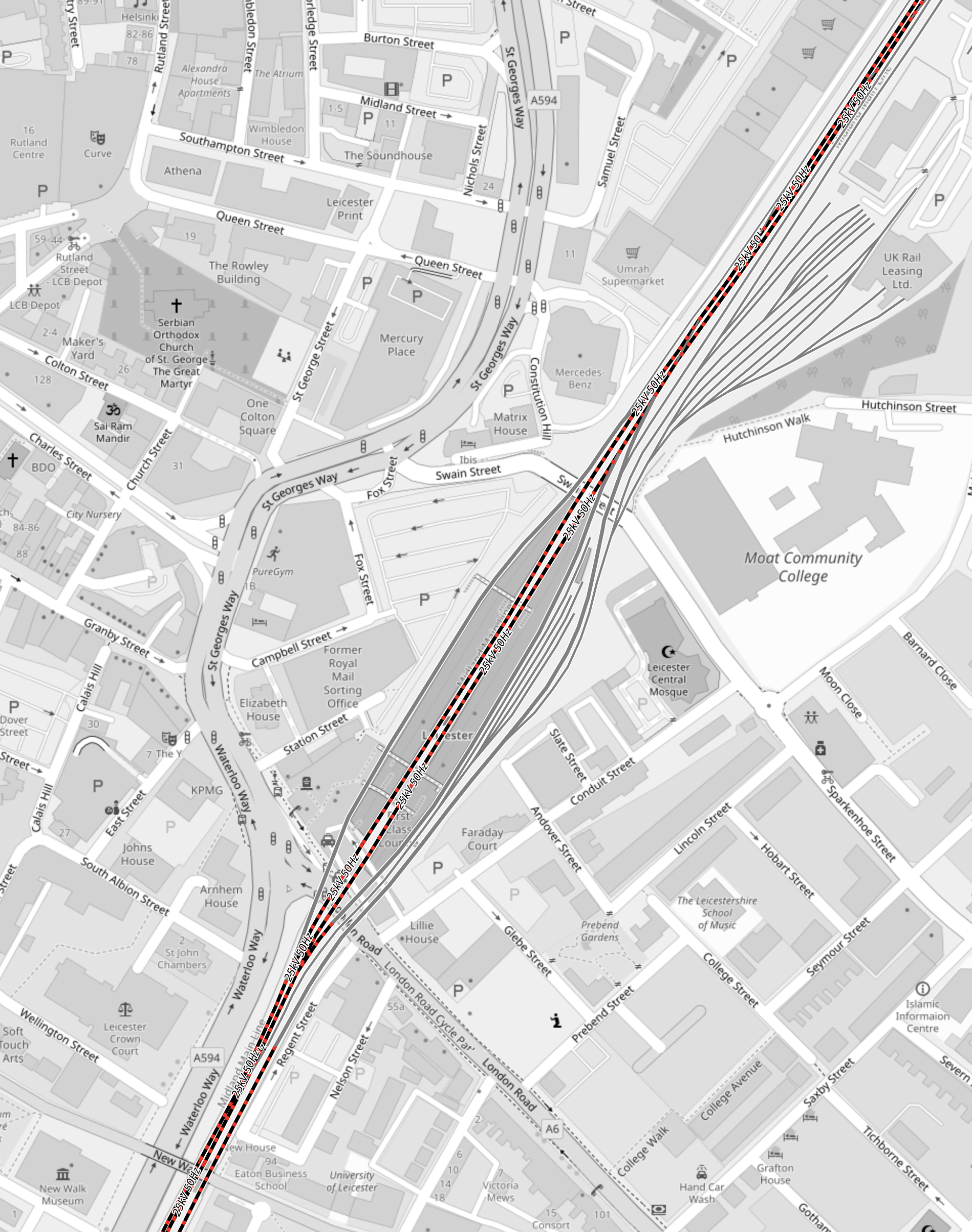
Note.
- Only the two main lines in the centre of the station seem to be going to be electrified.
- These lines are used by East Midlands Railway’s through trains and surprisingly some freight trains.
- Terminating services from places like Birmingham, Grimsby and Lincoln seem to stop in the outer platforms.
This picture shows the platforms from the Northern footbridge.

This picture shows the platforms from the Northern footbridge.
At the Southern end of the station, the tracks go under the London Road bridge. This map shows the tracks there.

Note.
- The two main tracks of the Midland Main Line appear that they will be electrified.
- But the lines at each side are not electrified.
Some years ago I came back to London from Leicester with a group of drivers. At one point, the conversation turned to electrification and they said that they had met a Network Rail engineer, who had told them, that the bridge was rather low for electrification and the track couldn’t be lowered because Leicester’s main sewer was underneath the railway.
It looks like Network Rail have found a way to squeeze two electrified tracks through the middle of the bridge and then use diesel, battery or other self-powered trains on lines without electrification on either side.
Discontinuous Electrification Through Derwent Valley Mills
One big problem area of electrification on the Midland Main Line could be North of Derby, where the railway runs through the World Heritage Site of the Derwent Valley Mills. There might be serious objections to electrification in this area.
But if electrification were to be installed between Leicester and Derby stations, the following would be possible.
- The Midland Main Line would be electrified at East Midlands Hub station.
- Power could be taken from High Speed Two’s supply at East Midland Hub station, even if High Speed Two is not built in full.
- Battery-electric trains could do a return trip to Nottingham from an electrified East Midlands Parkway station, as it’s only sixteen miles in total.
I am sure, that Hitachi’s Class 810 trains could be upgraded to have a of perhaps twenty-five miles on battery power, as this fits with Hitachi’s statements.
North of Derby, there would be electrification on the following sections.
- Derby station and South of the heritage-sensitive section at Belper station.
- Sheffield station and North of the heritage-sensitive section at Duffield station.
Milford Tunnel, which has Grade II Listed portals and is part of the World Heritage Site would not be electrified.
Belper and Duffield stations are 2.6 miles or 4.8 kilometres apart.
I believe it could be arranged that there would be no electrification in the sensitive section, where the Heritage Taliban might object.
The Hitachi Intercity Battery Hybrid Train
Hitachi will start testing their Intercity Battery Hybrid Train next year.
The train is described in this Hitachi infographic.
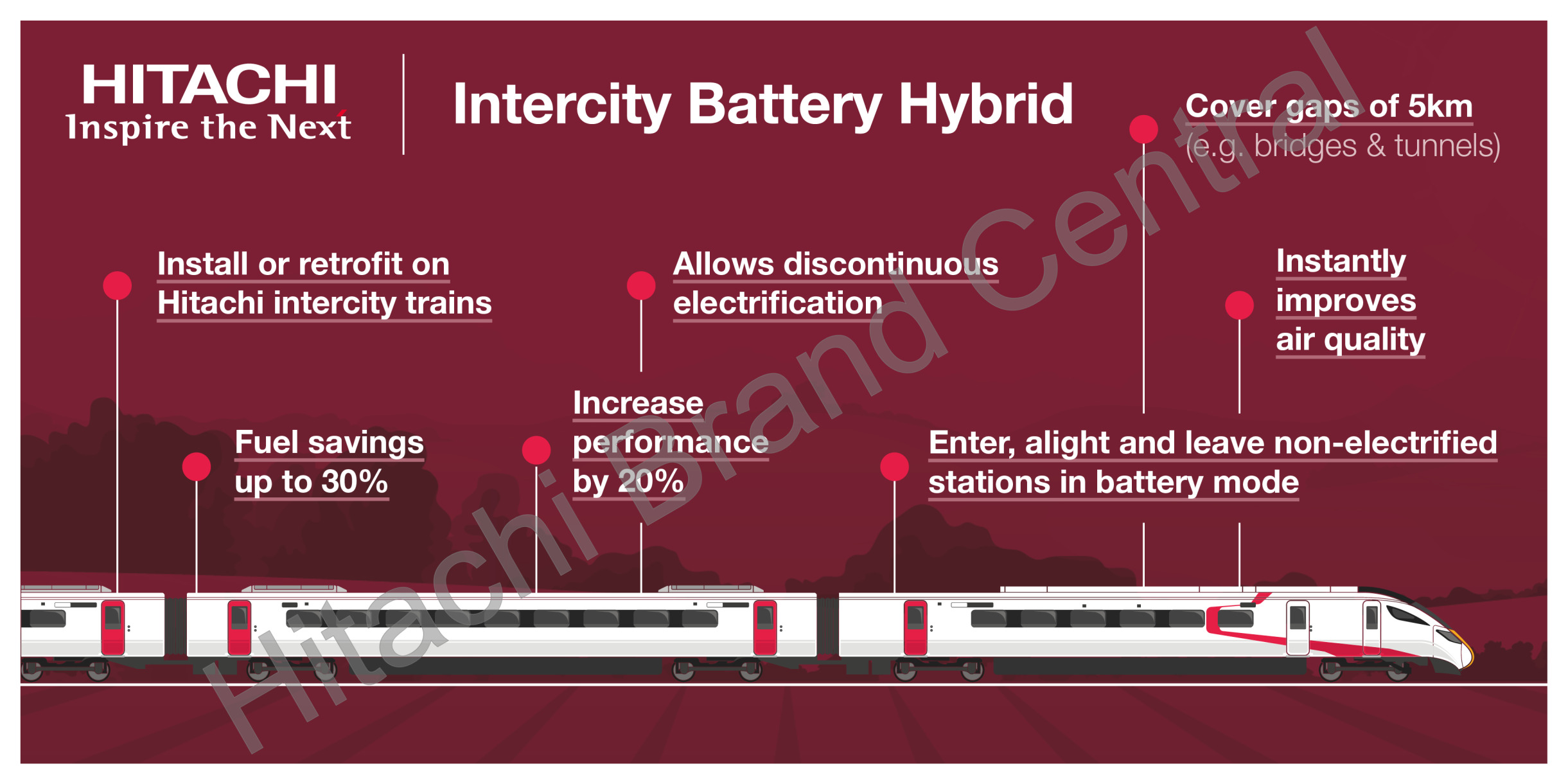
Note that is has a gap-jumping range of 5 km, which would handle the gap between Belper and Duffield stations.
CrossCountry Services Between Derby And Sheffield
CrossCountry operate the following services between Derby and Sheffield through Milford Tunnel and the World Heritage Site.
- Plymouth and Edinburgh Waverley/Glasgow Central
- Southampton/Reading and Newcastle
CrossCountry would need new trains and one of the current Hitachi Class 802 trains could handle this route and use electrification where it exists.
A five kilometre gap will be no big obstacle to designing a battery-electric train for these CrossCountry services.
Freight Trains
In Will Zero-Carbon Freight Trains Be Powered By Battery, Electric Or Hydrogen Locomotives?, I came to this conclusion.
In the title of this post, I asked if freight locomotives of the future would be battery, electric or hydrogen.
I am sure of one thing, which is that all freight locomotives must be able to use electrification and if possible, that means both 25 KVAC overhead and 750 VDC third rail. Electrification will only increase in the future, making it necessary for most if not all locomotives in the future to be able to use it.
I feel there will be both battery-electric and hydrogen-electric locomotives, with the battery-electric locomotives towards the less powerful end.
Hydrogen-electric will certainly dominate at the heavy end.
These locomotives would be able to handle the section of the Midland Main Line through Derwent Valley Mills.
Reopening The Don Valley Section Of The Former Woodhead Line Between Stocksbridge and Sheffield Victoria To Passenger Services
On October 27th this Beeching Reversal Project was given £50,000 to build a case for reopening.
Stocksbridge is introduced like this in its Wikipedia entry.
Stocksbridge is a town and civil parish, in the City of Sheffield, in South Yorkshire, England. Historically part of the West Riding of Yorkshire, it lies just to the east of the Peak District. The town is located in the steep-sided valley of the Little Don River, below the Underbank Reservoir. It blends into the areas of Deepcar, Bolsterstone and the eastern end of Ewden valley around Ewden village, which are also within the civil parish. The population of the civil parish as of the 2011 census was 13,455.
This Google Map shows the area.
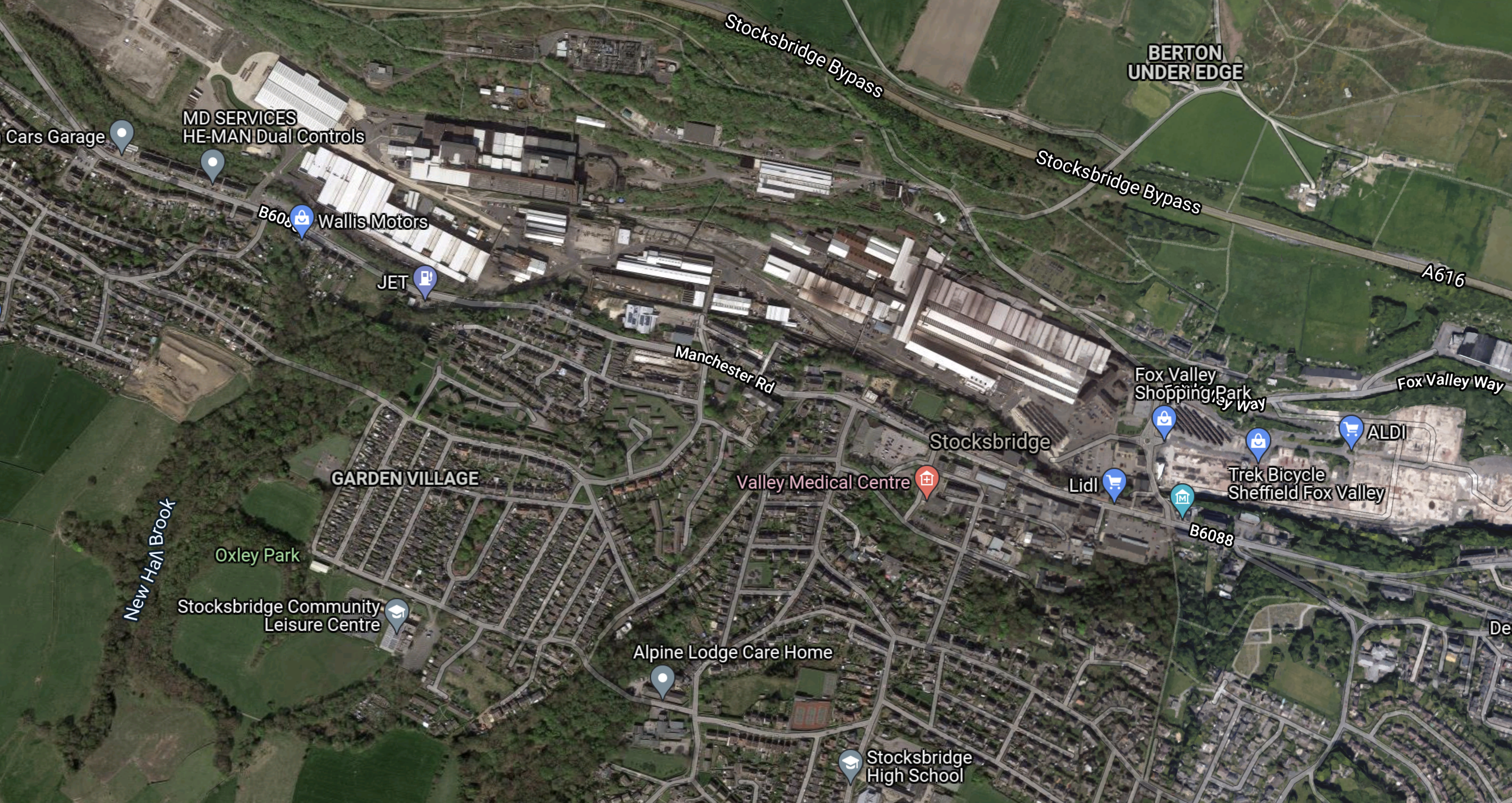
Note there are a large number of steel related industries all connected by an extensive railway system.
This Google Map shows part of the area to a more detailed scale.
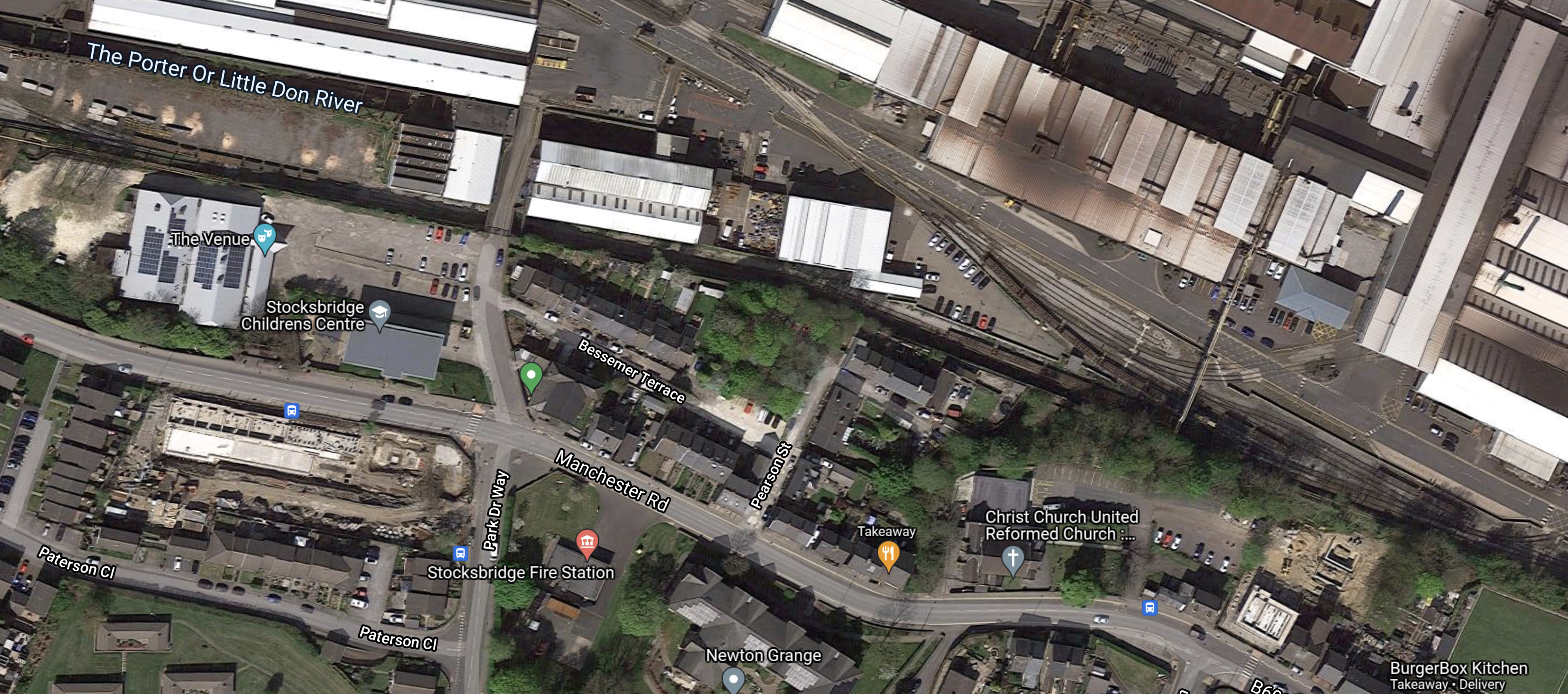
I suspect that a station could be built somewhere to the South of the works.
I have followed the Stocksbridge Railway out to the East and it takes a loop to the South to Deepcar Tram and Railway station, as is shown on this Google Map.
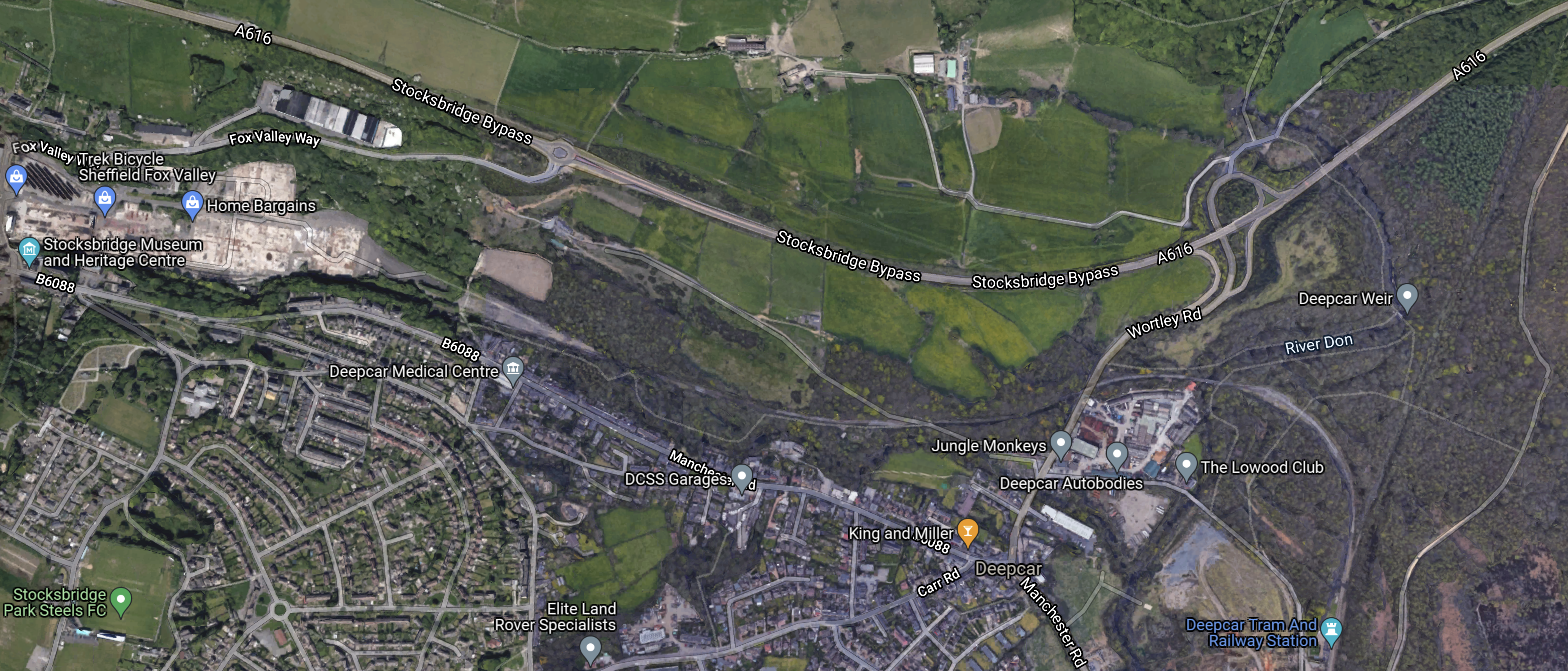
Note.
The Eastern end of the Stockbridge site is in the North-West of the map.
Deepcar station is shown by a blue dot in the South-East corner of the map.
This Google Map shows Deepcar station in greater detail.
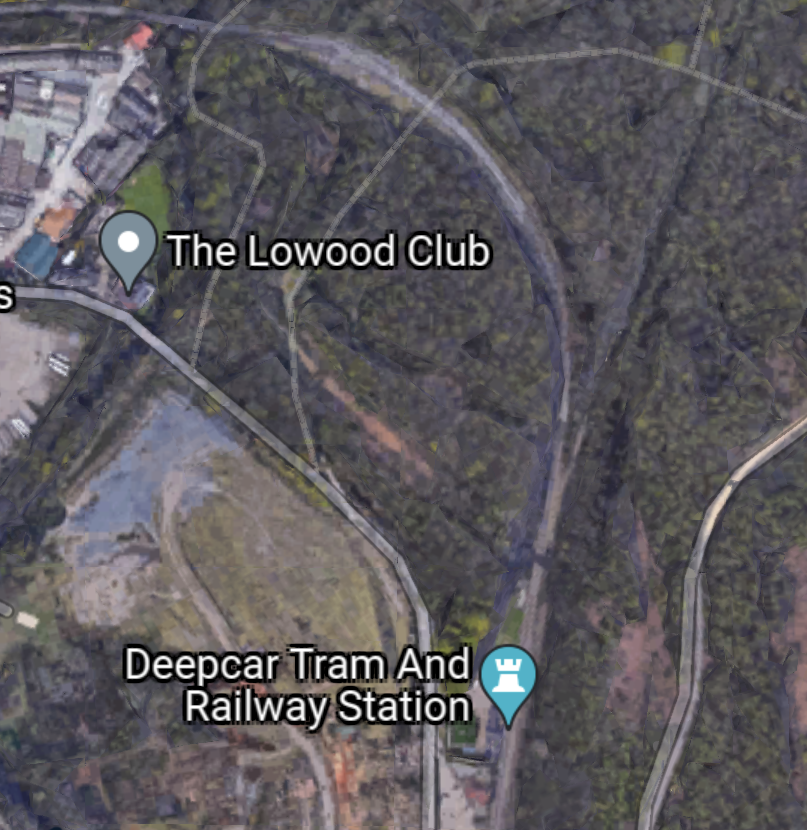
Note.
- The Stocksbridge Railway curving to the West is clearly visible.
- The other railway going North is the former Woodhead Line to Manchester.
This map clipped from Wikipedia shows the Lines through Deepcar station.
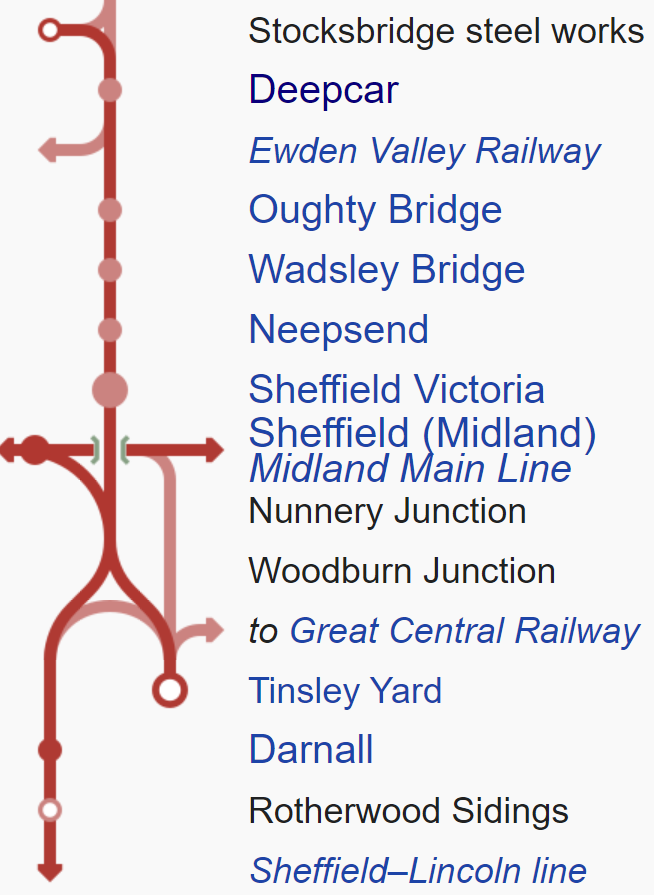
This shows the route between Stocksbridge and the former Sheffield Victoria station.
I have also found this article on the Sheffield Star, which is entitled Passenger Trains Could Return On Sheffield To Stocksbridge Don Valley Railway Line After major Funding Boost.
This is a paragraph.
The plans also involve reopening Sheffield Victoria station, which could serve a new Barrow Hill line to Chesterfield, stopping at Darnall, the Advanced Manufacturing Park, Woodhouse and other new stations, similar funding for which was granted last year.
This would seem to be a sensible plan.
These are my thoughts.
Sheffield Victoria Station
This Google Map shows the site of the Stocksbridge Line going through the centre of Sheffield.

The line starts in the North-West corner of the map and goes diagonally across.
The site of Sheffield Victoria station is at the Eastern edge of the map and is shown enlarged in this Google Map.

The street and hotel names are a giveaway.
There would appear to be space for a simple station with one or two platforms on the single-track through the area.
My preference would be for a single bi-directional platform, as has been used successfully at Galashiels station.
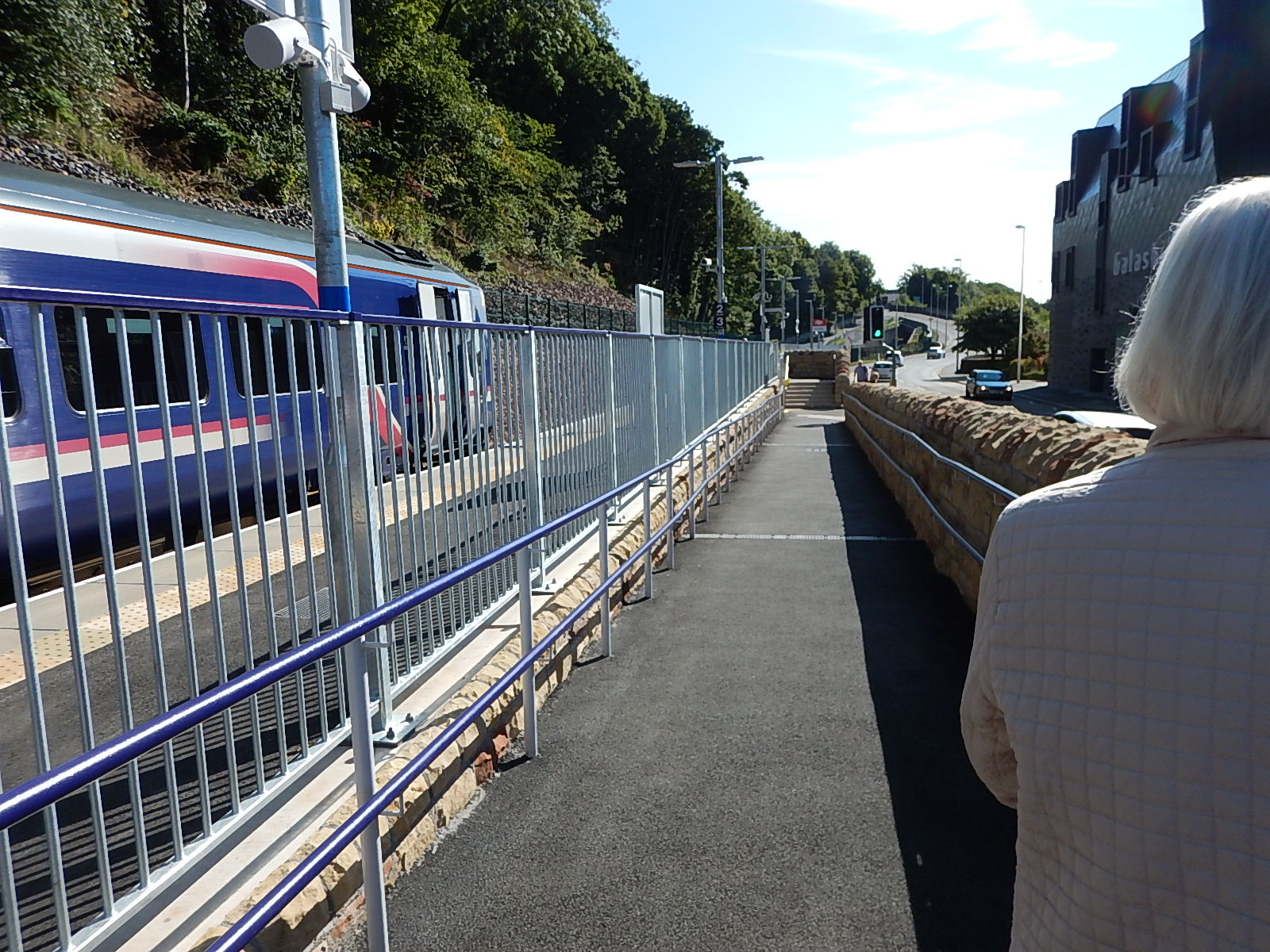
With well-placed passing loops, stations like these can handle two trains per hour (tph) and they can be step-free for all users.
Onward To Chesterfield
The plans as laid out in the paragraph in the Sheffield Star would appear to be feasible.
Darnall and Woodhouse are existing stations.
It would serve the proposed new station at Waverley, that I wrote about in Sheffield Region Transport Plan 2019 – A New Tram-Train Route To A New Station At Waverley.
Chesterfield station will be rebuilt for High Speed Two, so extra platforms could surely be added.
I wrote about plans for the Barrow Hill Line in Reinstatement Of The Barrow Hill Line Between Sheffield And Chesterfield.
It certainly looks to me, that taken together the Barrow Hill and Stocksbridge schemes could be a valuable new railway for Sheffield.
Rolling Stock
I have ridden all over Karlsruhe in Germany on their tram-trains, which are a German variant of Sheffield’s Class 399 tram-trains and I can see no reason, why the combined route couldn’t be designed and built for these trains.
- They are very good on hills.
- They can work on both 750 VDC and 25 KVAC overhead wires.
- The closely-related Class 398 tram-trains in Cardiff will have batteries.
- They are already working successfully in Sheffield.
- There must be design advantages for stations.
- Travellers in Sheffield are used to the tram-trains.
- There is maintenance and operational experience in Sheffield.
It is also my belief, that Class 399 tram-trains would make excellent replacements for Sheffield’s current trams. I wrote about this in Sheffield Region Transport Plan 2019 – Renewal Of Supertram Network.
Electrification
Looking at the Stocksbridge and Barrow Hill Lines together, I believe there is a strong case for electrification of both routes with 25 KVAC overhead wires.
This would enable the following.
- Class 399 tram-trains to work the combined route.
- East Midlands Railway’s Class 810 trains to access Sheffield station via the Barrow Hill Line on electricity.
- Electrified freight trains could use the route.
It could also be an easy route to electrify and be a good start to the electrification of Sheffield, which will happen in the future.
Electrification Between Sheffield And Clay Cross North Junction For High Speed Two
This electrification is needed for High Speed Two’s connection to Sheffield. It will also entail a lot of disruption for trains between Derby and Sheffield.
For these reasons, I believe that opening up the Barrow Hill route early between Sheffield and Chesterfield could be an excellent blockade buster.
Conclusion
There’s more to reopening the Stocksbridge Line, than as a local service in Sheffield.
Electrification Between Clay Cross North Junction And Sheffield Station
Long term readers of this blog, will have noticed that I make regular references to this proposed electrification, that is part of High Speed Two’s proposals to connect Sheffield to the new high speed railway.
So I thought I would bring all my thoughts together in this post.
Connecting Sheffield To High Speed Two
Sheffield is to be accessed from a branch off the Main High Speed Two route to Leeds.
This map clipped from High Speed Two’s interactive map, shows the route of the Sheffield Branch, from where it branches North West from the main Eastern Leg of High Speed Two.
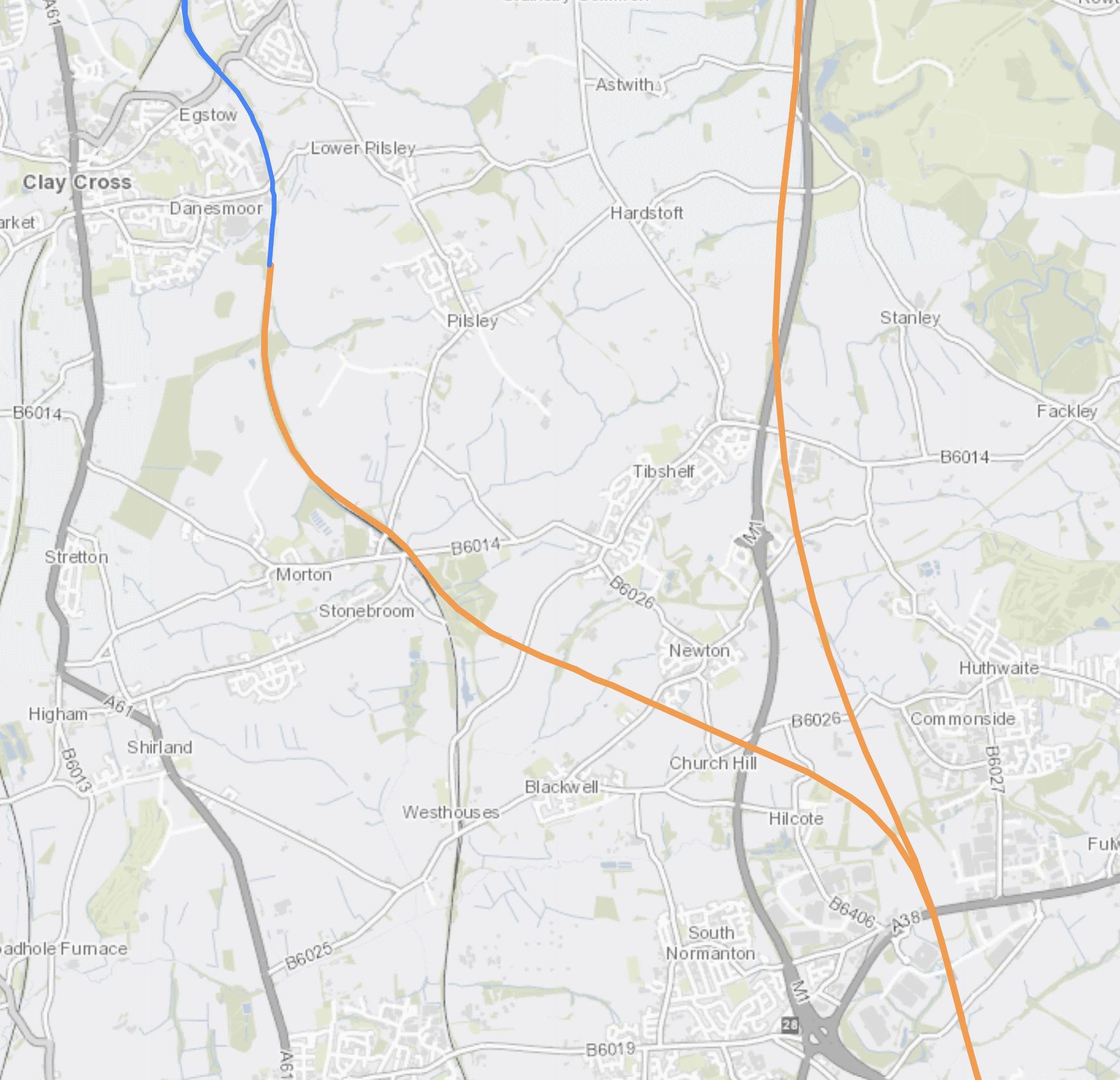
Note.
- Orange indicates new High Speed Two track.
- Blue indicates track that High Speed Two will share with other services.
- The orange route goes North to Leeds, along the M1
- The blue route goes North to Chesterfield and Sheffield, after skirting to the East of Clay Cross.
- The orange route goes South to East Midlands Hub station.
This second map, shows where the Erewash Valley Line joins the Sheffield Branch near the village of Stonebroom.
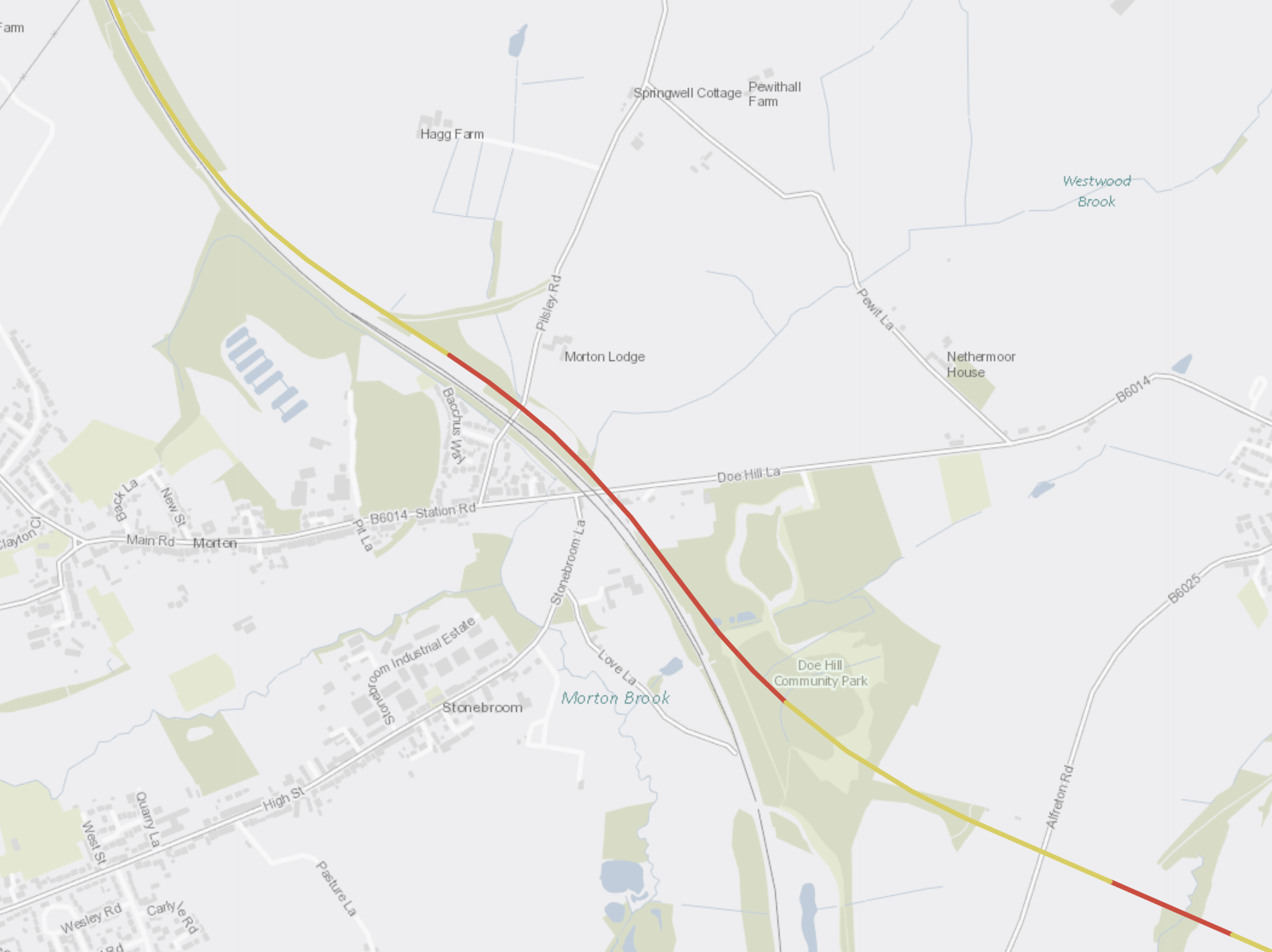
Note.
- Red is an embankment.
- Yellow is a cutting.
- The Sheffield Branch goes North-West to Clay Cross, Chesterfield and Sheffield
- The Sheffield Branch goes South-East to East Midlands Hub station.
- The Sheffield Branch goes through Doe Hill Country Park.
- The Sheffield Branch runs alongside the existing Erewash Valley Line, which goes South to Langley Mill, Ilkeston and the Derby-Nottingham area.
The Sheffield Branch and the Erewash Valley Line appear to share a route, which continues round Clay Cross and is shown in this third map.
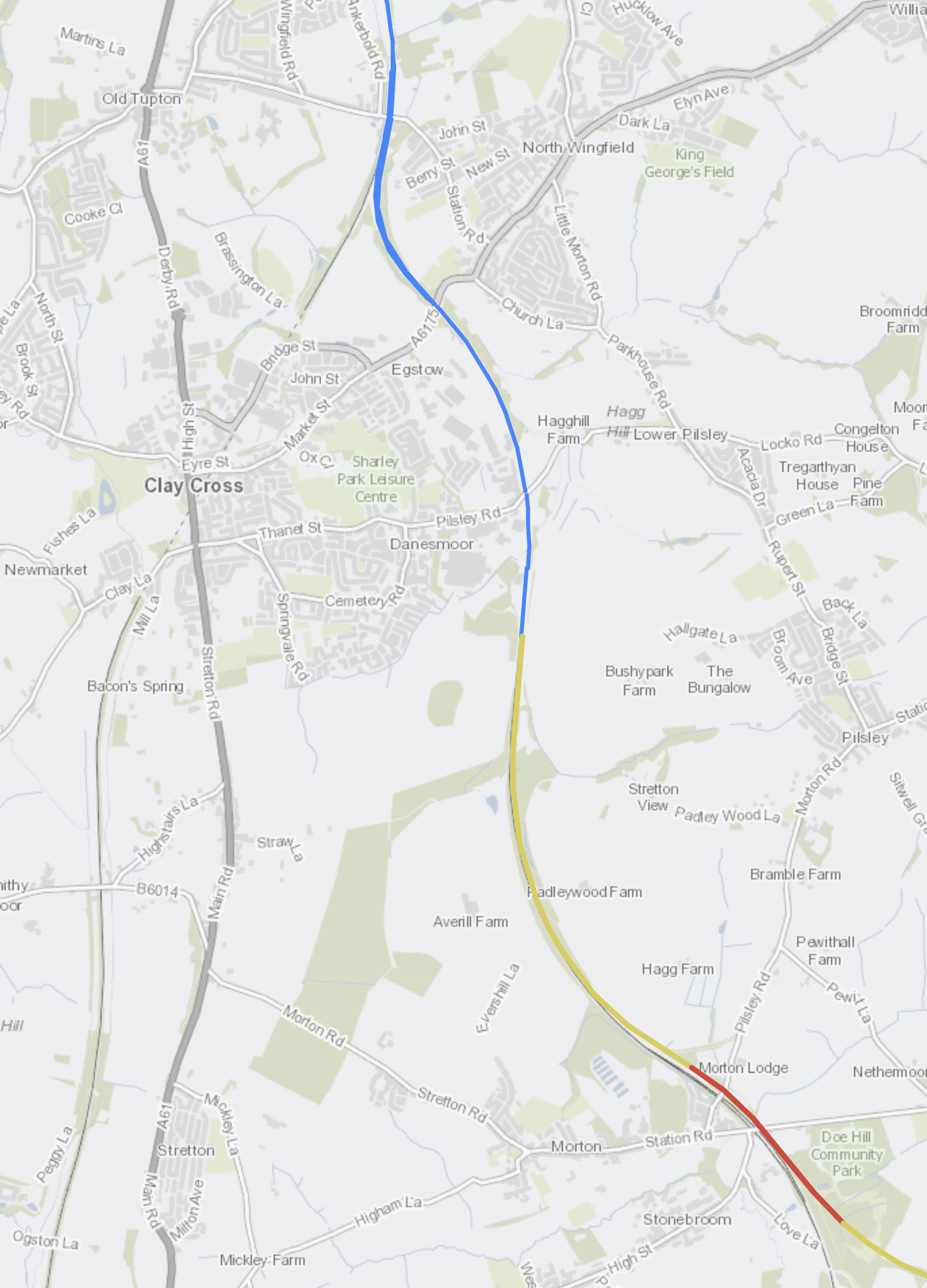
Note
- Doe Hill Country Park is in the South-East corner of the map.
- The dark line running North-South is the A61.
- Running to the West of the A61 is the Midland Main Line, which currently joins the Erewash Valley Line at Clay Cross North junction.
High Speed Two and the Midland Main Line will share a route and/or tracks from Clay Cross North junction to Sheffield.
This fourth map, shows where the combined route joins the Hope Valley Line to Manchester to the South West of Sheffield.
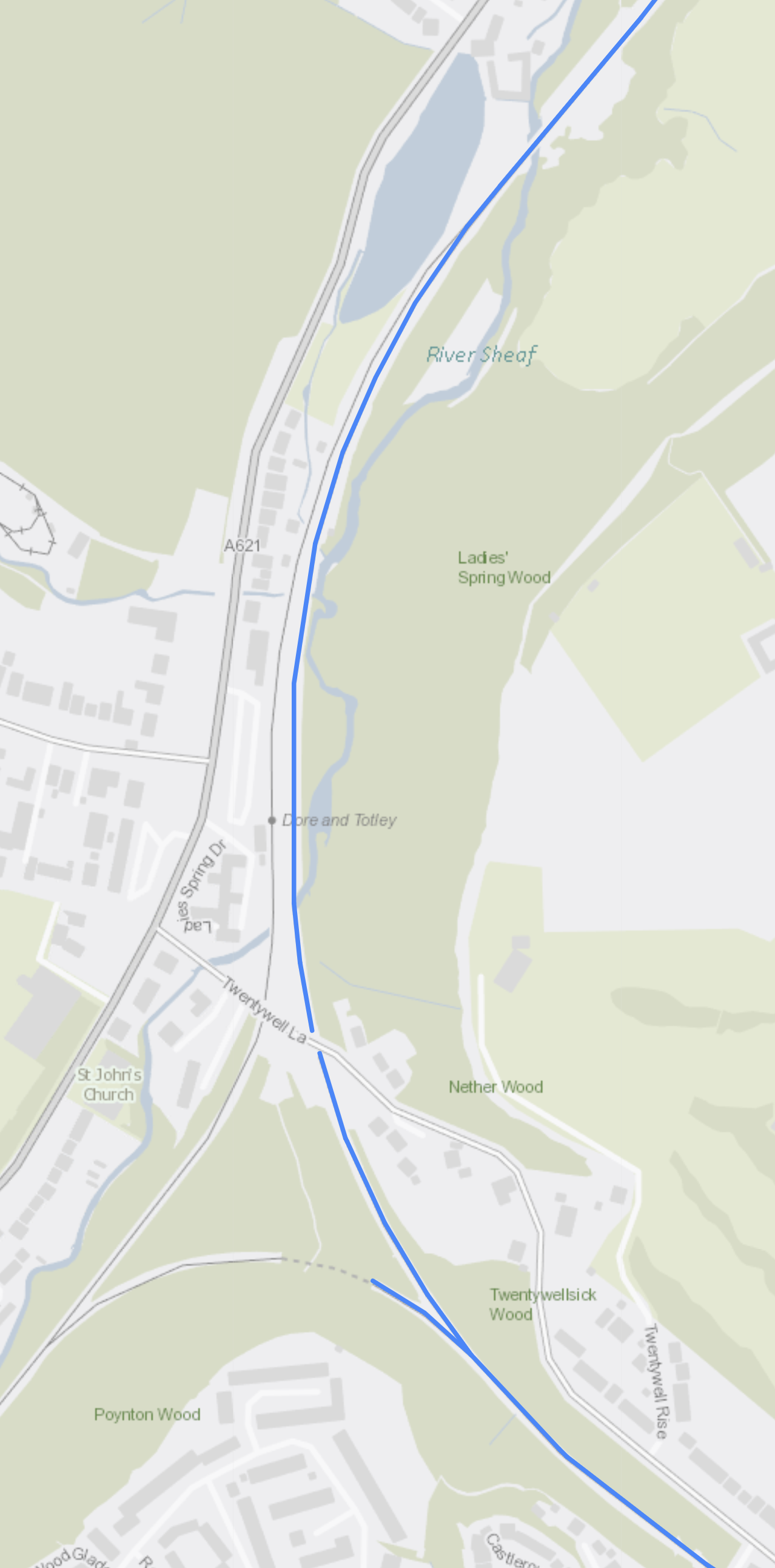
Note.
- Sheffield is to the North East.
- Chesterfield is to the South East,
- Totley junction is a large triangular junction, that connects to the Hope Valley Line.
These are some timings for various sections of the route.
- Clay Cross North Junction and Chesterfield (current) – 4 minutes
- Clay Cross North Junction and Sheffield (current) – 17 minutes
- Chesterfield and Sheffield (current) – 13 minutes
- Chesterfield and Sheffield (High Speed Two) – 13 minutes
- East Midlands Hub and Chesterfield (High Speed Two) – 16 minutes
- East Midlands Hub and Sheffield (High Speed Two) – 27 minutes
As Class Cross North Junction and Sheffield are 15.5 miles, this means the section is run at an average speed of 53 mph.
Can I draw any conclusions from the maps and timings?
- There would appear to be similar current and High Speed Two timings between Chesterfield and Sheffield.
- The various junctions appear to be built for speed.
The Midland Main Line will be electrified between Clay Cross North Junction and Sheffield, so that High Speed Two trains can use the route.
What will be the characteristics of the tracks between Clay Cross North Junction and Sheffield?
- Will it be just two tracks as it mainly is now or will it be a multi-track railway to separate the freight trains from the high speed trains?
- Will it have a high enough maximum speed, so that East Midland Railway’s new Class 810 trains can go at their maximum speed of 140 mph?
- Will it be capable of handling a frequency of 18 tph, which is the maximum frequency of High Speed Two?
Surely, it will be built to a full High Speed Two standard to future-proof the line.
Current Passenger Services Between Clay Cross North Junction And Sheffield Station
These trains use all or part of the route between Cross North Junction And Sheffield stations.
- CrossCountry – Plymouth and Edinburgh via Derby, Chesterfield, Sheffield and Leeds – 1 tph
- East Midlands Railway – London St. Pancras and Sheffield via Derby and Chesterfield – 2 tph
- East Midlands Railway – Liverpool Lime Street and Norwich via Stockport, The Hope Valley Line, Sheffield and Chesterfield – 1 tph
- Northern Trains – Manchester Piccadilly and Sheffield via the Hope Valley Line – 1 tph
- Northern Trains – Leeds and Nottingham via Meadowhall, Sheffield and Chesterfield – 1 tph
- TransPennine Express – Manchester Airport and Cleethorpes via Stockport, the Hope Valley Line and Sheffield – 1 tph
Note.
- tph is trains per hour.
- High Speed Two is currently planning to run two tph to Sheffield, which will run between Cross North junction and Sheffield stations.
- The services on the Hope Valley Line run on electrified tracks at the Manchester end.
These services can be aggregated to show the number of trains on each section of track.
- Hope Valley Line between Manchester and Totley junction – 3 tph
- Totley junction and Sheffield station – 7 tph
- Totley junction and Clay Cross North junction via Chesterfield – 4 tph
Adding in the High Speed Two services gives these numbers.
- Hope Valley Line between Manchester and Totley junction – 3 tph
- Totley junction and Sheffield station – 9 tph
- Totley junction and Clay Cross North junction via Chesterfield – 6 tph
This report on the Transport for the North web site, is entitled At A Glance – Northern Powerhouse Rail. It states that Transport for the North’s aspirations for Manchester and Sheffield are four tph with a journey time of forty minutes.
Adding in the extra train gives these numbers.
- Hope Valley Line between Manchester and Totley junction – 4 tph
- Totley junction and Sheffield station – 10 tph
- Totley junction and Clay Cross North junction via Chesterfield – 6 tph
This level of services can be accommodated on a twin-track railway designed to the right high speed standards.
Freight Services Between Clay Cross North Junction And Sheffield Station
The route is used by freight trains, with up to two tph on each of the three routes from Totley junction.
And these are likely to increase.
Tracks Between Clay Cross North Junction And Sheffield Station
I am absolutely certain, that two tracks between Clay Cross North junction And Sheffield station will not be enough, even if they are built to High Speed Two standards to allow at least 140 mph running under digital signalling.
Battery Electric Trains
The only battery-electric train with a partly-revealed specification is Hitachi’s Regional Battery Train, which is described in this Hitachi infographic.

Note.
- The train is a 100 mph unit.
- Ninety kilometres is fifty-six miles.
I would expect that battery-electric trains from other manufacturers like Alstom, CAF and Siemens would have similar performance on battery power.
In Thoughts On CAF’s Battery-Electric Class 331 Trains, I concluded CAF’s approach could give the following ranges.
- Three-car battery-electric train with one battery pack – 46.7 miles
- Four-car battery-electric train with one battery pack – 35 miles
- Four-car battery-electric train with two battery packs – 70 miles
I was impressed.
These are my thoughts on battery-electric trains on the routes from an electrified Sheffield.
Adwick
Sheffield and Adwick is 22.7 miles without electrification
I am sure that battery-electric trains can handle this route.
If the battery range is sufficient, there may not need to be charging at Adwick.
Bridlington
Sheffield and Bridlington is 90.5 miles without electrification, except for a short section through Doncaster, where trains could top up batteries.
I am sure that battery-electric trains can handle this route.
But there would need to be a charging system at Hull, where the trains reverse.
An alternative would be to electrify Hull and Brough, which is just 10.4 miles and takes about twelve minutes.
Derby Via The Midland Main Line
Clay Cross North junction and Derby is 20.9 miles without electrification.
I am sure that battery-electric trains can handle this route.
Gainsborough Central
Sheffield and Gainsborough Central is 33.6 miles without electrification
I am sure that battery-electric trains can handle this route.
But there will need to be a charging system at Gainsborough Central.
Huddersfield Via The Penistone Line
This is a distance of 36.4 miles with electrification at both ends, after the electrification between Huddersfield and Westtown is completed.
I am sure that battery-electric trains can handle this route.
Hull
Sheffield and Hull is 59.4 miles without electrification, except for a short section through Doncaster, where trains could top up batteries.
I am sure that battery-electric trains can handle this route.
But there will probably need to be a charging system at Hull.
An alternative would be to electrify Hull and Brough, which is just 10.4 miles and takes about twelve minutes.
Leeds Via The Hallam Or Wakefield Lines
This is a distance of 40-45 miles with electrification at both ends.
I am sure that battery-electric trains can handle this route.
Lincoln
Sheffield and Lincoln Central is 48.5 miles without electrification
I am sure that battery-electric trains can handle this route.
But there will probably need to be a charging system at Lincoln Central.
Manchester Via The Hope Valley Line
This is a distance of forty-two miles with electrification at both ends.
I am sure that battery-electric trains can handle this route.
Nottingham
Clay Cross North junction and Nottingham is 25.1 miles without electrification
I am sure that battery-electric trains can handle this route.
But there may need to be a charging system at Nottingham.
York
This is a distance of 46.4 miles with electrification at both ends.
I am sure that battery-electric trains can handle this route.
Is London St. Pancras And Sheffield Within Range Of Battery-Electric Trains?
In the previous section, I showed that it would be possible to easily reach Derby, as Clay Cross North junction and Derby is 20.9 miles without electrification.
- Current plans include electrifying the Midland Main Line as far North as Market Harborough.
- Market Harborough is 82.8 miles from London St. Pancras
- Derby is 128.3 miles from London St. Pancras
So what would be the best way to cover the 45.5 miles in the middle?
One of the best ways would surely be to electrify between Derby and East Midlands Parkway stations.
- Derby and East Midlands Parkway stations are just 10.2 miles apart.
- Current services take around twelve-fourteen minutes to travel between the two stations, so it would be more than enough time to charge a battery-electric train.
- Power for the electrification should not be a problem, as Radcliffe-on-Soar power station is by East Midlands Parkway station. Although the coal-fired power station will soon be closed, it must have a high class connection to the electricity grid.
- The East Midlands Hub station of High Speed Two will be built at Toton between Derby and Nottingham and will have connections to the Midland Main Line.
- An electrified spur could connect to Nottingham station.
I have flown my virtual helicopter along the route and found the following.
- Three overbridges that are not modern and built for large containers and electrification.
- Two level crossings.
- One short tunnel.
- Two intermediate stations.
- Perhaps half-a-dozen modern footbridges designed to clear electrification.
I’ve certainly seen routes that would be much more challenging to electrify.
I wonder if gauge clearance has already been performed on this key section of the Midland Main Line.
If this section were to be electrified, the sections of the Midland Main Line between London St. Pancras and Sheffield would be as follows.
- London St. Pancras and Market Harborough – Electrified – 82.8 miles
- Market Harborough and East Midlands Parkway – Not Electrified – 35.3 miles
- East Midlands Parkway and Derby – Electrified – 10.2 miles
- Derby and Clay Cross North junction – Not Electrified – 20.9 miles
- Clay Cross North junction and Sheffield – Electrified – 15.5 miles
Note.
- The World Heritage Site of the Derwent Valley Mills is not electrified, which could ease the planning.
- Leicester station with its low bridge, which could be difficult to electrify, has not been electrified.
- Under thirty miles of electrification will allow battery-electric trains to run between London St. Pancras and Sheffield, provided they had a range on batteries of around forty miles.
Probably, the best way to electrify between East Midlands Parkway and Derby might be to develop a joint project with High Speed Two, that combines all the power and other early works for East Midlands Hub station, with the electrification between the two stations.
Will The Class 810 Trains Be Converted To Battery-Electric Operation?
Hitachi’s Class 8xx trains tend to be different, when it comes to power. These figures relate to five-car trains.
- Class 800 train – 3 x 560 kW diesel engines
- Class 801 train – 1 x 560 kW diesel engine
- Class 802 train – 3 x 700 kW diesel engines
- Class 803 train – All electric – No diesel and an emergency battery
- Class 805 train – 3 x 700 kW diesel engines (?)
- Class 807 train – All electric – No diesel or emergency battery
- Class 810 train – 4 x 700 kW diesel engines (?)
Note.
- These figures relate to five-car trains.
- Class 807 train are seven-car trains.
- Where there is a question mark (?), the power has not been disclosed.
- Hitachi use two sizes of diesel engine; 560 kW and 700 kW.
It was generally thought with the Class 810 train to be used on the Midland Main Line, will be fitted with four engines to be able to run at 125 mph on diesel.
But are they 560 kW or 700 kW engines?
- A Class 802 train has an operating speed of 110 mph on diesel, with 2100 kW of installed power.
- To increase speed, the power will probably be related to something like the square of the speed.
So crudely the power required for 125 mph would be 2100*125*125/110/110, which works out at 2712 kW.
Could this explain why four engines are fitted? And why they are 700 kW versions?
Interestingly, I suspect, Hitachi’s five-car trains have two more or less identical driver cars, except for the passenger interiors, for the efficiency of manufacturing and servicing.
So does that mean, that a fifth engine could be fitted if required?
There probably wouldn’t be a need for five diesel engines, but as I also believe that the Hyperdrive Innovation battery packs for these trains are plug-compatible with the diesel engines, does that mean that Hitachi’s trains can be fitted with five batteries?
Suppose you wanted to run a Class 810 train at 125 mph to clear an electrification gap of forty miles would mean the following.
- It would take 0.32 hours or 19.2 minutes to cross the gap.
- In that time 2800 kW of diesel engines would generate 896 kWh.
- So to do the same on batteries would need a total battery capacity of 896 kWh.
- If all diesel engines were replaced, each battery would need to be 224 kWh
A battery of this size is not impractical and probably weighs less than the at least four tonnes of the diesel engine it replaces.
Conclusions
Electrification between Clay Cross North Junction and Sheffield station is an important project that enables the following.
- A high proportion of diesel services to and from Sheffield to be converted to battery-electric power.
- With electrification between Derby and East Midlands Parkway, it enables 125 mph battery-electric trains to run between London St. Pancras and Sheffield.
- It prepares Sheffield for High Speed Two.
It should be carried out as soon as possible.
Thoughts On The Eastern Leg Of High Speed Two
These are a few thoughts on the Eastern Leg of High Speed Two.
Serving The North-East Quarter Of England From London
In Anxiety Over HS2 Eastern Leg Future, I gave a table of timings from London to towns and cities in the North-East quarter of England from Lincoln and Nottingham Northwards.
I’ll repeat it here.
- Bradford – Will not be served by High Speed Two – One hour and fifty-four minutes
- Cleethorpes – Will not be served by High Speed Two – Two hours and fifty-one minutes
- Darlington – One hour and forty-nine minutes – One hour and forty-nine minutes
- Doncaster – Will not be served by High Speed Two – One hour
- Edinburgh – Three hours and forty minutes via Western Leg – Three hours and thirty minutes.
- Grimsby – Will not be served by High Speed Two – Two hours and thirty-six minutes
- Harrogate – Will not be served by High Speed Two – One hour and fifty-two minutes
- Huddersfield – Will not served by High Speed Two – Two hours and eight minutes
- Hull – Will not be served by High Speed Two – One hour and fifty minutes
- Leeds – One hour and twenty-one minutes – One hour and thirty minutes
- Lincoln – Will not be served by High Speed Two – One hour and fifty-one minutes
- Middlesbrough – Will not be served by High Speed Two – Two hours and twenty minutes
- Newcastle – Two hours and seventeen minutes – Two hours and sixteen minutes
- Nottingham – One hour and seven minutes – One hour and fifty minutes
- Scarborough – Will not be served by High Speed Two – Two hours and fifty-seven minutes
- Sheffield – One hour and twenty-seven minutes – One hour and twenty-seven minutes
- Skipton – Will not be served by High Speed Two – Two hours and seven minutes
- Sunderland – Will not be served by High Speed Two – Two hours and thirty minutes
- York – One hour and twenty-four minutes – One hour and twenty-four minutes
Note.
- I have included all destinations served by Grand Central, Hull Trains and LNER.
- I have included Nottingham and Sheffield for completeness and in case whilst electrification is installed on the Midland Main Line, LNER run services to the two cities.
- I suspect LNER services to Bradford, Harrogate, Huddersfield and Skipton will split and join at Leeds.
There are a total of nineteen destination in this table.
- Twelve are not served by High Speed Two.
- Six are not more than fifteen minutes slower by the East Coast Main Line.
Only Nottingham is substantially quicker by High Speed Two.
Serving The North-East Quarter Of England From Birmingham
Fenland Scouser felt the above table might be interesting to and from Birmingham with or without the Eastern Leg of High Speed Two.
I think, I can give more information than that and it should be possible to give for each destination the following.
- Whether of not the route exists on High Speed Two.
- Time on High Speed Two from Birmingham.
- Time on High Speed Two and Northern Powerhouse Rail from Birmingham via Manchester
- Time by current trains from Birmingham
In the following table, the fields are in the order of the previous table.
- Bradford – No direct route – No time – One hour and three minutes – Two hours and twenty-seven minutes
- Cleethorpes – No direct route – No time – Three hours and eight minutes – Three hours and eighteen minutes
- Darlington – Route Exists – One hour and twenty-three minutes – One hour and forty minutes – Two hours and fifty-five minutes
- Doncaster – No direct route – No time – One hour and thirty-six minutes – Two hours and nineteen minutes
- Edinburgh- Route Exists – Three hours and fourteen minutes – Four hours – Four hours and thirteen minutes
- Grimsby – No direct route – No time – Two hours and fifty-three minutes – Three hours and three minutes
- Harrogate – No direct route – No time – One hour and twenty-eight minutes – Three hours
- Huddersfield – No direct route – No time – Fifty-six minutes – Two hours and eleven minutes
- Hull – No direct route – No time – One hour and forty-four minutes – Three hours and two minutes
- Leeds – Route Exists – Forty-nine minutes – One hour and six minutes – One hour and fifty-nine minutes
- Lincoln – No direct route – No time – Two hours and fifty-three minutes – Two hours and thirteen minutes
- Middlesbrough – No direct route – No time – Two hours and twenty-nine minutes – Three hours and thirty-two minutes
- Newcastle – No direct route – No time – Two hours and four minutes – Three hours and twenty-six minutes
- Nottingham – Route Exists – Fifty-seven minutes – Two hours and fifty-five minutes – One hour and ten minutes
- Sheffield – Route Exists – Thirty-five minutes – One hour and thirty-four minutes – One hour and fifteen minutes
- Skipton – No direct route – No time – One hour and forty-three minutes – Two hours and fifty-two minutes
- Sunderland – No direct route – No time – Two hours and fifty-nine minutes – Three hours and fifty-eight minutes
- York – Route Exists – Fifty-seven minutes – One hour and twenty-eight minutes – Two hours and twenty-seven minutes
Note.
- No time means just that!
- One of the crucial times is that Birmingham Curzon Street and Leeds is just an hour and six minutes via High Speed Two and Northern Powerhouse Rail. This time gives good times to all destinations served from Leeds.
- Nottingham and Sheffield are both around an hour and fifteen minutes from Birmingham New Street, by the current trains.
I’ll now look at some routes in detail.
Birmingham And Leeds
The time of one hour and six minutes is derived from the following.
- Birmingham Curzon Street and Manchester Piccadilly by High Speed Two – Forty-one minutes
- Manchester Piccadilly and Leeds by Northern Powerhouse Rail – Twenty-five minutes
It would be seventeen minutes slower than the direct time of forty-nine minutes.
But it is quicker than the current time of one hour and fifty-nine minutes
Note.
- As Manchester Piccadilly will have a time to and from London of one hour and eleven minutes, Leeds will have a time of one hour and twenty-six minutes to London via Northern Powerhouse Rail and Manchester.
- If the Eastern Leg is built, The London and Leeds time will be one hour and twenty-one minutes.
- The Eastern Leg would therefore save just five minutes.
The Northern Powerhouse route could probably mean that Huddersfield, Bradford and Hull would be served by High Speed Two from London.
Manchester Airport, Manchester Piccadilly and Leeds would be connected by a tunnel deep under the Pennines.
- Manchester Piccadilly, Huddersfield and Bradford could be underground platforms added to existing stations.
- Piccadilly and Leeds would have a journey time of under 25 minutes and six trains per hour (tph).
- The tunnel would also carry freight.
- It would be modelled on the Gotthard Base Tunnel in Switzerland.
I wrote full details in Will HS2 And Northern Powerhouse Rail Go For The Big Bore?
Birmingham And Nottingham
The time of two hours and fifty-five minutes is derived from the following.
- Birmingham Curzon Street and Manchester Piccadilly by High Speed Two – Forty-one minutes
- Manchester Piccadilly and Leeds by Northern Powerhouse Rail – Twenty-five minutes
- Leeds and Nottingham – One hour and forty-nine minutes
It would be one hour and fifty-eight minutes slower than the direct time of fifty-nine minutes.
The current time of one hour and ten minutes is much quicker.
Birmingham And Sheffield
The time of two hours and thirty-four minutes is derived from the following.
- Birmingham Curzon Street and Manchester Piccadilly by High Speed Two – Forty-one minutes
- Manchester Piccadilly and Leeds by Northern Powerhouse Rail – Twenty-five minutes
- Leeds and Sheffield – One hour and twenty-eight minutes
It would be one hour and fifty-nine minutes slower than the direct time of thirty-five minutes.
The current time of one hour and fifteen minutes is much quicker.
Conclusions On The Timings
I am led to the following conclusions on the timings.
The building of the Eastern Leg of High Speed Two gives the fastest times between Birmingham and Leeds, Nottingham and Sheffield.
But if the Eastern Leg of High Speed Two is not built, then the following is true, if Northern Powerhouse Rail is created between Manchester and Leeds.
The time of an hour and six minutes between Birmingham Curzon Street and Leeds is probably an acceptable time.
This time probably enables acceptable times between Birmingham Curzon Street and destinations North of Leeds.
But with Nottingham and Sheffield the current CrossCountry service is faster than the route via Manchester.
The speed of the CrossCountry services surprised me, but then there is a section of 125 mph running between Derby and Birmingham, which is used by CrossCountry services between Birmingham New Street and Leeds, Nottingham and Sheffield.
This table gives details of these services.
- Birmingham New Street and Leeds – 116,4 miles – One hour and 58 minutes – 59.3 mph
- Birmingham New Street and Nottingham – 57.2 miles – One hour and 14 minutes – 46.4 mph
- Birmingham New Street and Sheffield – 77.6 miles – One hour and 18 minutes – 59.7 mph
Note.
- The Leeds and Sheffield services are run by 125 mph Class 220 trains.
- The Notting service is run by 100 mph Class 170 trains.
- All trains are diesel-powered.
As there is 125 mph running between Derby and Birmingham, the train performance probably accounts for the slower average speed of the Nottingham service.
CrossCountry And Decarbonisation
Consider.
- CrossCountry has an all-diesel fleet.
- All train companies in the UK are planning on decarbonising.
- Some of CrossCountry’s routes are partially electrified and have sections where 125 mph running is possible.
The only standard train that is built in the UK that would fit CrossCountry’s requirements, would appear to be one of Hitachi’s 125 mph trains like a bi-mode Class 802 train.
- These trains are available in various lengths
- Hitachi will be testing battery packs in the trains in the next year, with the aim of entering service in 2023.
- Hitachi have formed a company with ABB, which is called Hitachi ABB Power Grids to develop and install discontinuous electrification.
When CrossCountry do replace their fleet and run 125 mph trains on these services several stations will be connected to Birmingham for High Speed Two.
The route between Leeds and Birmingham via Sheffield is part of the Cross Country Route, for which electrification appears to have planned in the 1960s according to a section in Wikipedia called Abortive British Rail Proposals For Complete Electrification,
I suspect that the following times could be achieved with a frequency of two tph
- Birmingham New Street and Leeds – 90 minutes
- Birmingham New Street and Nottingham – 60 minutes
- Birmingham New Street and Sheffield – 60 minutes
It is not the Eastern Leg of High Speed Two, but it could do in the interim.
Electrification Of The Midland Main Line
I don’t believe that the Midland Main Line needs full electrification to speed up services to Derby, Nottingham and Sheffield, but I believe that by fitting batteries to Hitachi’s Class 810 trains, that will soon be running on the line and using the Hitachi ABB Power Grids system of discontinuous electrification, that the route can be decarbonised.
I would also apply full digital in-cab signalling to the Midland Main Line.
Conclusion
We will need the Eastern Leg of High Speed Two at some time in the future, but if we do the following we can do more than cope.
- Create Northern Powerhouse Rail between Manchester and Leeds, so that High Speed Two can serve Leeds and Hull via Manchester.
- Decarbonise CrossCountry with some 125 mph battery-electric trains.
- Electrify the Midland Main Line.
I would also deliver as much as possible before Phase 1 and 2a of High Speed Two opens.
Department Of Transport Claims London and Sheffield Times Could Be Cut By Thirty Minutes
In this article on the BBC, which is entitled Government Announce £401m Boost For Rail Services, this is said.
The funding announcement coincided with the completion of the first phase of the £1.5bn Midland Main Line Upgrade, which has supported the launch of East Midlands Railway’s (EMR) first electric services on the route between Corby in Northamptonshire and London St Pancras.
The project will see journey times between Sheffield and London cut by up to 30 minutes, the DfT said.
So how feasible is the claim of a thirty minute cut in London and Sheffield timings?
On Monday, the 07:30 train from London to Sheffield, covered the 164.7 miles in two hours and twelve minutes at an average speed of 74.9 mph.
If that train had done the trip in one hour and forty-two minutes, that would have been an average speed of 96.9 mph.
By the time, the new Class 810 trains arrive in a couple of years, they will be able to use the new electrification to Market Harborough, when on Monday the 82.8 miles without a stop, was covered in an hour, at an average speed of 82.8 mph.
These new trains are 125 mph electric trains under the wires and they will have two separate fast lines on which to run.
Example time savings at various average speeds to Market Harborough are as follows.
- 100 mph – 10 minutes saving.
- 110 mph – 14.8 minutes saving.
- 125 mph – 20.3 minutes saving
- 130 mph – 21.8 minutes saving
- 140 mph – 24.6 minutes saving
Note.
- The faster the average, the greater the time saving.
- Faster than 125 mph would only be possible with full in-cab digital signalling, which is currently being installed on the East Coast Main Line.
- I have been to Leicester in an InterCity 125, which was running at 125 mph most of the way.
But it does look like the new Class 810 trains will be able to save around twenty minutes to Sheffield, by making full use of the electrification between London and Market Harborough.
They would need to save just ten minutes between Market Harborough and Sheffield.
The Monday Train covered the 81.9 miles between Market Harborough and Sheffield in one hour and twelve minutes, which is an average speed of 68.3 mph.
To obtain the saving of ten minutes, it would need to do the journey in one hour and two minutes, which would be an average speed of 79.3 mph.
Given that the new Class 810 trains are designed to cruise at 125 mph on diesel, I don’t think this is an impossible objective.
What Will Be The Ultimate Time Between London and Sheffield On The Midland Main Line?
I believe that the following two sections of the Midland Main Line can be easily electrified.
- Between Leicester and Derby without the problem of the bridge at the South end of Leicester station, which would be so disruptive.
- Clay Cross North Junction and Sheffield which will be electrified for High Speed Two. I doubt Derby and Clay Cross Junction will be electrified as it’s a World Heritage Site.
On my Monday train, the following are times North of Leicester.
- Leicester and Derby is 29.3 miles, which is covered in 32 minutes at an average speed of 55 mph, which includes five stops. Raise this to 110 mph and the journey time is just 16 minutes or a saving of 16 minutes.
- Derby and Clay Cross North Junction is 21.8 miles, which is covered in 13 minutes at an average speed of 100 mph. By averaging 120 mph, there would be a saving of 2.1 minutes.
- Cross North Junction and Sheffield is 15.5 miles, which is covered in 16 minutes at an average speed of 58.2 mph.
Note.
- Savings would come between Leicester and Derby because of 125 mph linespeed and faster stops because of electrification.
- I believe that Hitachi battery-electric trains could sustain 125 mph on battery alone between Derby and Clay Cross North Junction, if they entered the section without electrification at full speed with full batteries. Now that is what I call a battery-electric train!
- There must be a minute or two to be saved on an electrified section into Sheffield with the stop at Chesterfield.
Add up all the savings and I feel that an hour and a half is possible between London and Sheffield.
And what time is High Speed Two claiming? One hour and twenty-seven minutes!
Could A Battery-Electric Train Cruise At 125 mph?
This may seem a silly idea, but then trains don’t care where they get their electricity from.
On the 21.8 miles between Derby and Clay Cross North, a sizeable proportion of energy will be used to accelerate the train up to the linespeed for the electrified section.
When the train enters the section without electrification, it will have two sources of energy.
- The electricity in the full batteries.
- The kinetic energy in the train at the required speed.
As the train runs through the section air and rolling resistance will tend to slow the train and electricity from the battery will be used to maintain speed.
In How Much Power Is Needed To Run A Train At 125 mph?. I estimated that for a Class 801 train to maintain 125 mph needs 3.42 kWh per vehicle mile.
A simple sum of 21.8 * 5 * 3.42 gives an energy need of 372.8 kWh to run between Derby and Clay Cross North Junction.
I’m sure than Hitachi can fit a 400 kWh battery in a five-car Class 810 train.
Would a slightly larger battery and in-cab signalling allow battery-electric trains to run at 140 mph? If the track allowed it, I don’t see why not!
Conclusion
I believe the Department of Transport’s statement of saving thirty minutes between London and Sheffield is feasible.
But so is a time of an hour-and-a half, which will give High Speed Two a run for its money!
Is The Eastern Leg Of High Speed Two Under Threat?
This page on the High Speed Two web site is entitled HS2 Phase 2b Eastern Leg.
These are the opening three paragraphs.
Earlier this year the government made clear in its response to the Oakervee Review its commitment to Phase 2b of HS2, ensuring we boost capacity, improve connectivity between our regions and share prosperity.
As part of this, the government plans to present an Integrated Rail Plan for the North and Midlands by the end of the year, informed by an assessment from the National Infrastructure Commission, which will look at how to deliver HS2 Phase 2b, Northern Powerhouse Rail, Midlands Rail Hub and other rail programmes better and more effectively.
In the meantime, the government has asked HS2 Ltd to pause work on the Eastern Leg. We recognise that this causes uncertainty and our Eastern Leg community engagement teams remain in place to support you.
The page then says that the work on the Western Leg should proceed, with the aim of a Western Leg Bill in early 2022.
In Northern Powerhouse Rail – Significant Upgrades Of The East Coast Main Line From Leeds To Newcastle (Via York And Darlington) And Restoration Of The Leamside Line, I showed that the current and future upgrades to the East Coast Main Line, required by the East Coast Main Line, Northern Powerhouse Rail and High Speed Two, will greatly reduce the times on services from London Kings Cross to Doncaster, Yorkshire, the North East and Scotland.
I said this on timings on the East Coast Main Line.
- London Kings Cross and Doncaster could be around an hour.
- London Kings Cross and Leeds could be around one hour and thirty minutes, using the current Doncaster and Leeds time, as against the one hour and twenty-one minutes for High Speed Two.
- London Kings Cross and York could be around one hour and twenty-three minutes, using the current Doncaster and York time, as against the one hour and twenty-four minutes for High Speed Two.
- Timings between York and Newcastle would be the same fifty-two minutes as High Speed Two, as the track will be the limitation for both services.
- High Speed Two’s timing for York and Newcastle is given as fifty-two minutes, with York and Darlington as twenty-five minutes.
- London Kings Cross and Darlington could be around one hour and forty-nine minutes
- London Kings Cross and Newcastle could be around two hours and sixteen minutes.
- London Kings Cross and Edinburgh would be under three-and-a-half hours, as against the proposed three hours and forty-eight minutes for High Speed Two.
LNER’s Azuma cavalry will hold the fort for as long as is needed.
I’ll now look at how various stations, will be affected if the Eastern Leg of High Speed Two is not built, until a couple of decades in the future.
Leeds
Current Long Distance Services At Leeds Station
Leeds station has the following long distance services in trains per hour (tph)
- CrossCountry – 1
- LNER – 2
- TransPennine Express – 5
It is a bit thin compared to say Birmingham or Manchester.
Northern Powerhouse Rail And Leeds
Northern Powerhouse Rail has plans for Leeds with these services to other Northern cities.
- Hull – two tph in 38 minutes
- Manchester – six tph in 25 minutes
- Newcastle – four tph in 58 minutes
- Sheffield – four tph in 28 minutes.
From what they have written, the following could also be possible.
- Bradford – six tph in a few minutes
- Liverpool – four or more tph in 51 minutes
- Manchester Airport – four or more tph in 35 minutes
It is an ambitious plan.
High Speed Two And Leeds
High Speed Two is planning to run the following trains to Leeds in every hour.
- Birmingham Curzon Street and Leeds – 200 metre train
- Birmingham Curzon Street and Leeds via East Midlands Hub – 200 metre train
- London Euston and Leeds via Old Oak Common and East Midlands Hub – 200 metre train
- London Euston and Leeds via Old Oak Common and East Midlands Hub – 400 metre train
- London Euston and Leeds via Old Oak Common, Birmingham Interchange and East Midlands Hub – 400 metre train
Timings will be as follows.
- Birmingham Curzon Street and Leeds – 49 minutes.
- London Euston and Leeds – One hour and 21 minutes.
There will be about 1000 seats per hour between Birmingham Curzon Street and Leeds and 2500 seats per hour Between London Euston and Leeds.
High Speed Two And Leeds Via Manchester
This report on the Transport for the North web site, is entitled At A Glance – Northern Powerhouse Rail.
This map shows Transport for the North’s ideas for connections in the West linking Crewe, Liverpool, Manchester, Manchester Airport, Warrington and Wigan.

A black line goes East from Manchester to link it to Leeds via Huddersfield and Bradford.
- This is proposed as a route shared between High Speed Two and Northern Powerhouse Rail.
- High Speed Two are promising that London Euston and Manchester will be timed at one hour and eleven minutes.
- London Euston and Manchester will have a frequency of three tph and will all be 400 metre High Speed Two Full Size trains, with about a thousand seats.
- Northern Powerhouse Rail have an objective of a twenty-five minute journey time between Manchester and Leeds.
I would also build the Manchester and Leeds route with the following characteristics.
- As a full-size tunnel capable of taking High Speed Two Full Size trains and the largest freight trains.
- Intermediate and underground stations at Huddersfield and Bradford.
- It could be built as a base tunnel, like the similarly-sized Gotthard base tunnel in Switzerland.
- The Swiss tunnel has a maximum operating speed for passenger trains of 125 mph.
If it can be built for a reasonable cost and in a reasonable time-scale, it could be a way of doing the following.
- Creating a straight 150 mph plus route across the Pennines, with a capacity of 18 tph.
- Running high-capacity fast trains between London Euston and Leeds via Manchester Airport and Manchester.
- Running freight trains between the two sides of the Pennines.
- Creating a high frequency route between Liverpool and Hull via Manchester Airport, Manchester, Huddersfield and Bradford and Leeds.
The passenger service between Liverpool and Hull could be the world’s first high speed metro.
If the London Euston and Manchester trains, were to be extended to Leeds, London Euston and Leeds would take one hour and thirty-six minutes, which would only be fifteen minutes slower, than is promised for the route going via the Eastern Leg of High Speed Two.
London Kings Cross And Leeds
When the in-cab digital signalling is complete between London Kings Cross and Leeds, I am fairly confident that with a few other improvements and more zoom from the Azumas, that a London Kings Cross and Leeds time of one hour and fifty minutes will be possible.
But will two nine-car or pairs of five-car trains per hour (tph), be enough capacity? Especially, as pairs of five-car trains will split and join to serve a wider catchment area, which will harvest more passengers.
LNER will in a couple of years have an extra path every hour into Kings Cross.
I would feel that best use of this path would be to run between London Kings Cross and Edinburgh via Leeds and Newcastle.
- Leeds and Newcastle could be the only intermediate stops.
- Leeds would be the ideal place to change to Northern Powerhouse Rail for anywhere in the North of England.
- My estimates, say it could run between London Kings Cross and Edinburgh in around three-and-a-half hours.
- It would run non-stop between London Kings Cross and Leeds, Leeds and Newcastle and Newcastle and Edinburgh.
It would increase capacity, between the four major destinations on the route; London Kings Cross, Leeds, Newcastle and Edinburgh.
It could start running, once the digital signalling and current improvements to the East Coast Main Line are complete.
London St. Pancras And Leeds
I discussed, Northern Powerhouse Rail’s plan for Sheffield and Leeds in Northern Powerhouse Rail – Connecting Sheffield To HS2 And On To Leeds.
This could see the following new infrastructure.
- Electrification between Clay Cross North Junction and Sheffield station of the route shared by the Midland Main Line and High Speed Two.
- Electrification through Sheffield and on to Leeds, via the Wakefield Line
- New stations for High Speed trains at Rotherham and Barnsley Dearne Valley.
I could see East Midlands Railway taking advantage of this route, with their new Class 810 trains and running a regular Leeds and St. Pancras service.
- It would call at Wakefield Westgate, Barnsley Dearne Valley, Rotherham and Meadowhall. between Leeds and Sheffield stations.
- It would take twenty-eight minutes between Leeds and Sheffield, if it met Northern Powerhouse Rail’s objective.
- Perhaps one of the two tph between London St. Pancras and Sheffield could be extended to Leeds.
As the current time between London St. Pancras and Sheffield, is a few minutes under two hours, I can see a time of comfortably under two-and-a-half hours between London St. Pancras and Leeds.
A Summary Of Journey Times Between London And Leeds
I can summarise my estimates, between London and Leeds.
- High Speed Two – Direct via Eastern Leg – One hour and twenty-one minutes.
- High Speed Two – via Manchester – One hour and thirty-six minutes.
- East Coast Main Line – via Doncaster – One hour and thirty minutes.
- Midland Main Line – via Derby and Sheffield – Two hours and twenty minutes.
The direct High Speed Two route is the fastest., but others could be viable alternatives for some passengers.
Bradford
Consider.
- Under current plans Bradford won’t be getting any high speed service from High Speed Two.
- The best it can get under current plans is several direct services per day, between Bradford Forster Square and London Kings Cross in perhaps two hours.
- The layout of the city and its two stations doesn’t give good connectivity.
Bradford, Harrogate, Huddersfield and Skipton could probably be served by trains to and from London Kings Cross that join and split at Leeds.
But if Northern Powerhouse Rail goes for a tunnel between Manchester and Leeds with Bradford as an underground station, it could be served by High Speed Two services going between London Euston and Leeds via Manchester.
I would estimate that if London Euston and Leeds via Manchester took around one hour and thirty-six minutes, London Euston and Bradford could take around an hour-and-a-half.
Darlington
I can summarise my estimates, between London and Darlington.
- High Speed Two – Direct via Eastern Leg – One hour and forty-nine minutes.
- High Speed Two – via Manchester and Leeds – Two hours and six minutes.
- East Coast Main Line – via Doncaster – One hour and forty-nine minutes.
Improvements on the East Coast Main Line, needed to enable and speed-up High Speed Two services to York, Darlington and Newcastle; will speed up East Coast Main Line services to Darlington.
Edinburgh
I can summarise my estimates, between London and Edinburgh.
- High Speed Two – Direct via Western Leg – Three hours and forty minutes.
- High Speed Two – via Manchester and Leeds – Three hours and forty-eight minutes.
- East Coast Main Line – via Doncaster – Three hours and thirty minutes.
Improvements on the East Coast Main Line, needed to enable and speed-up High Speed Two services to York, Darlington and Newcastle; will speed up East Coast Main Line services to Newcastle.
Harrogate
Consider.
- Under current plans Harrogate won’t be getting any high speed service from High Speed Two.
- The best it can get under current plans is several direct services per day, between Harrogate and London Kings Cross in perhaps two hours.
Bradford, Harrogate, Huddersfield and Skipton could possibly be served by trains to and from London Kings Cross that join and split at Leeds.
Huddersfield
- If Huddersfield is served by underground platforms beneath the current Huddersfield station, a lot of what I said for Bradford would apply to Huddersfield.
- The timings would probably be around an-hour-and-a-half from London Euston.
Bradford, Harrogate, Huddersfield and Skipton could possibly be served by trains to and from London Kings Cross that join and split at Leeds.
Hull
Hull is an interesting destination.
- Reaching Hull from the current High Speed Two network will need a change at Leeds or another station.
- Using Northern Powerhouse Rail’s objectives on timings, London Euston and Hull via Manchester on High Speed Two, would be a few minutes under two-and-a-half hours.
- I strongly feel, that London Kings Cross and Hull via Selby could be reduced to below two hours.
Hull would also make a superb Eastern terminal station for both Northern Powerhouse Rail and a High Speed Two service from London via Manchester and Leeds.
You pays your money and takes your choice.
Middlesbrough
Reaching Middlesbrough from the proposed High Speed Two network will need a change at York or another station.
But a time of two hours and twenty minutes, should be possible using the East Coast Main Line via Doncaster.
Improvements on the East Coast Main Line, needed to enable and speed-up High Speed Two services to York, Darlington and Newcastle, will speed up East Coast Main Line services to Middlesbrough.
Newcastle
I can summarise my estimates, between London and Newcastle.
- High Speed Two – Direct via Eastern Leg – Two hours and seventeen minutes.
- High Speed Two – via Manchester and Leeds – Two hours and thirty-four minutes.
- East Coast Main Line – via Doncaster – Two hours and sixteen minutes.
Improvements on the East Coast Main Line, needed to enable and speed-up High Speed Two services to York, Darlington and Newcastle; will speed up East Coast Main Line services to Newcastle.
Nottingham
I will compare average speeds on the Midland Main Line between London St. Pancras and Nottingham and on the East Coast Main Line, between London Kings Cross and Leeds.
Currently.
- London St. Pancras and Nottingham services, over the 126 mile route, take one hour and fifty minutes. which is an average speed of 69 mph.
- London Kings Cross and Leeds services, over the 186 mile route, take two hours and thirteen minutes, which is an average speed of 94 mph.
Note.
- The two routes are of similar character and are fairly straight with large sections of 125 mph running and quadruple tracks.
- The East Coast Main Line to Leeds is fully electrified, whereas the Midland Main Line is only partially electrified.
- Both routes have a small number of stops.
- In a few years time, services on both routes will be run by different members of the Hitachi AT-300 train family.
I don’t feel it would be unreasonable to assume that a London St. Pancras and Nottingham service could be run at an average speed of 94 mph, if the Midland Main Line were upgraded to the same standard as the East Coast Main Line.
This could mean a time of around one hour and twenty-one minutes between London St. Pancras and Nottingham, or a saving of twenty-nine minutes.
Is that possible?
- The new Class 810 trains, will have four engines instead of the normal three for a five-car AT-300 train. Will they be able to be closer to the 125 mph line-speed on diesel power, where it is available on the Midland Main Line.
- The trains will be able to use electrification between London St. Pancras and Market Harborough.
- There have been hints, that more electrification may be installed on the Midland Main Line.
- Hitachi have announced a battery electric version of the AT-300 train called an Intercity Tri-Mode Battery Train, where one or more of the diesel engines are replaced by battery packs.
- The new trains will be ready to accept in-cab ERTMS digital signalling, so they could be able to run at up to 140 mph, if the track were to be upgraded.
I certainly feel, that substantial time savings could be possible between London St. Pancras and Nottingham.
Eighty-one minutes would be very convenient, as it would comfortably allow a three hour round trip, which would mean just six trains or more likely pairs of trains would be needed for the current two tph service.
Eighty-one minutes would not be the fifty-two minute service promised by High Speed Two!
But!
- The new trains are planned to be introduced from 2023.
- Who knows, when High Speed Two will arrive at the East Midlands Hub station?
- They won’t need any new substantial infrastructure to replace the current trains.
I also suspect the new trains will have more seats, but, the capacity of the Class 810 train, has not been published.
Nottingham could also be served by a high speed service from London Kings Cross via Grantham, which I estimate would take about one hour and twenty minutes.
Sheffield
A lot of what I said for Nottingham can be applied to Sheffield.
- Currently, London St. Pancras and Sheffield services, over the 165 mile route, take two hours, which is an average speed of 82.5 mph.
- High Speed Two is promising a journey time of one hour and twenty-seven minutes.
- An average speed of 90 mph, would mean a journey time of one hour and fifty minutes.
- This would allow a four hour round trip, which would mean just eight trains or more likely pairs of trains would be needed for the current two tph service.
It would be very convenient for the operator.
It looks like if pairs of trains were to be run on both the Nottingham and Sheffield routes, that twenty-eight trains would be needed to run both services.
This fits well with a fleet size of thirty-three trains.
The only caveat, is that to get the required journey times, it might be necessary to rebuild and electrify the tracks, between Sheffield and Clay Cross North Junction.
- These tracks will be shared with the future Sheffield Branch of High Speed Two.
- It would only be 15.5 miles of double-track to rebuild and electrify.
- It could be rebuilt to allow 140 mph running. Several minutes could be saved!
The electrification could allow Hitachi’s Intercity Tri-Mode Battery trains to be able to run the Sheffield service.
These trains would certainly be a way of avoiding the tricky electrification of the Derby and Clay Cross section of the route, which goes through the World Heritage Site of the Derwent Valley Mills.
Sheffield could also be served by a high speed service from London Kings Cross via Doncaster, which I estimate would take about one hour and thirty minutes.
Skipton
Consider.
- Under current plans Skipton won’t be getting any high speed service from High Speed Two.
- The best it can get under current plans is several direct services per day, between Skipton and London Kings Cross in perhaps two hours.
Bradford, Harrogate, Huddersfield and Skipton could possibly be served by trains to and from London Kings Cross that join and split at Leeds.
Sunderland
Reaching Sunderland from the proposed High Speed Two network will need a change at York or another station.
But a time of two hours and thirty minutes, should be possible using the East Coast Main Line via Doncaster.
Improvements on the East Coast Main Line, needed to enable and speed-up High Speed Two services to York, Darlington and Newcastle, will speed up East Coast Main Line services to Sunderland.
York
I can summarise my estimates, between London and York.
- High Speed Two – Direct via Eastern Leg – One hour and twenty-four minutes.
- High Speed Two – via Manchester and Leeds – One hour and forty-two minutes.
- East Coast Main Line – via Doncaster – One hour and twenty-four minutes.
Improvements on the East Coast Main Line, needed to enable and speed-up High Speed Two services to York, Darlington and Newcastle; will speed up East Coast Main Line services to York.
I believe strongly, that York would be about as fast from London, by either of the direct routes, but both would serve different intermediate destinations.
Conclusion
My first conclusion is a surprising one, but the promised timings from High Speed Two and the current timings in the timetable make it clear.
To achieve the required timings for High Speed Two, major improvements must be made to existing track and these improvements will mean that existing services will be competitive with High Speed Two on time.
These improvements fall into this category.
- Improving the East Coast Main Line between York and Newcastle, will make East Coast Main Line services to York, Darlington, Durham and Newcastle competitive with High Speed Two services.
- Improving the East Coast Main Line between York and Newcastle, may also mean that London Kings Cross and Edinburgh will be faster than the High Speed Two service between London Euston and Edinburgh.
- Electrifying the route shared between Sheffield and Clay Cross North Junction, will speed up London St. Pancras and Sheffield services and make them more competitive with High Speed Two.
I suspect there may be similar mutual improvements on the Western leg of High Speed Two.
Other smaller conclusions from my analysis of the improvements include.
- These improvements will create some extra capacity on the East Coast and Midland Main Lines, by removing bottlenecks and improving line speeds.
- Electrification, even if it is only partial or discontinuous, will improve services on the Midland Main Line.
- Some places like Harrogate, Middlesbrough and Skipton will never be served directly by High Speed Two, but are easily served by East Coast Main Line services from London Kings Cross.
- Northern Powerhouse Rail is very much part of the North-South capacity for England.
- In-cab ERTMS signalling will play a large part in increasing capacity and line speeds.
Perhaps in our planning of High Speed Two, we should plan all the routes in the North and Midlands in a much more holistic way.
If we look at the capacity between London and the North, I feel that with the addition of Phase 1 of High Speed Two to Birmingham in 2029-2033 and hopefully Phase 2a soon afterwards, that Phase 2b will not be needed for reasons of speed and capacity until years later.
So, I would pause most construction of the Eastern Leg of High Speed Two until Phase 1 and Phase 2a are complete.
I would make exceptions for the following.
- Improvements to the shared section of the East Coast Main Line and High Speed Two, between York and Newcastle.
- Building a high speed connection between Leeds and York for the use of Northern Powerhouse Rail and the East Coast Main Line.
- Rebuilding and electrification of the shared section of the Midland Main Line and High Speed Two, between Clay Cross North Junction and Sheffield.
- Improve and electrify the route between Sheffield and Leeds.
But I would continue with the design, as I feel that East of Leeds is very much sub-optimal at the present time.
The route of the Eastern leg of High Speed Two would be safeguarded.
But the biggest problem with the Eastern Leg of High Speed Two to Leeds, is that however it is built travellers to and from Leeds, York and further North will not see any improvements for some years, but improving the East Coast Main Line wouldn’t exactly see jam tomorrow, but tons of it by 2024.
Northern Powerhouse Rail – Significant Upgrades And Electrification Of The Rail Lines From Leeds And Sheffield To Hull
In this article on Transport for the North, which is entitled Northern Powerhouse Rail Progress As Recommendations Made To Government, one of the recommendations proposed for Northern Powerhouse Rail is significant upgrades and electrification of the rail lines from Leeds and Sheffield to Hull.
Northern Powerhouse Rail’s Objective For The Leeds and Hull Route
Wikipedia, other sources and my calculations say this about the trains between Leeds and Hull.
- The distance between the two stations is 51.7 miles
- The current service takes around 57 minutes and has a frequency of one train per hour (tph)
- This gives an average speed of 54.4 mph for the fastest journey.
- The proposed service with Northern Powerhouse Rail will take 38 minutes and have a frequency of two tph.
- This gives an average speed of 81.6 mph for the journey.
This last figure of nearly 82 mph, indicates to me that a 100 mph train will be able to meet Northern Powerhouse Rail’s objective.
Northern Powerhouse Rail’s Objective For The Sheffield and Hull Route
Wikipedia, other sources and my calculations say this about the trains between Sheffield and Hull.
- The distance between the two stations is 59.4 miles
- The current service takes around 80 minutes and has a frequency of one tph.
- This gives an average speed of 44.6 mph for the fastest journey.
- The proposed service with Northern Powerhouse Rail will take 50 minutes and have a frequency of two tph.
- This gives an average speed of 71,3 mph for the journey.
This last figure of over 70 mph, indicates to me that a 90 mph train will be able to meet Northern Powerhouse Rail’s objective.
Services From Hull Station
Hull station is a full interchange, which includes a large bus station.
- Currently, the station has seven platforms.
- There appears to be space for more platforms.
- Some platforms are long enough to take nine-car Class 800 trains, which are 234 metres long.
- There are some good architectural features.
If ever there was a station, that had basic infrastructure, that with appropriate care and refurbishment, could still be handling the needs of its passengers in a hundred years, it is Hull.
- It would be able to handle a 200 metre long High Speed Two Classic-Compatible train, tomorrow.
- It would probably be as no more difficult to electrify than Kings Cross, Liverpool Lime Street, Manchester Piccadilly or Paddington.
- It would not be difficult to install charging facilities for battery electric trains.
These are some pictures of the station.






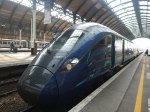
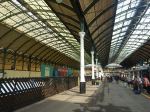
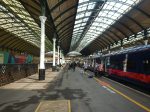
Currently, these are the services at the station, that go between Hull and Leeds, Selby or Sheffield.
- Hull Trains – 7 trains per day (tpd) – Hull and London via Brough, Selby and Doncaster.
- LNER – 1 tpd – Hull and London via Brough, Selby and Doncaster.
- Northern Trains – 1 tph – Hull and Halifax via Brough, Selby, Leeds and Bradford Interchange.
- Northern Trains – 1 tph – Hull and Sheffield via Brough, Gilberdyke, Goole, Doncaster, Rotherham Central and Meadowhall.
- Northern Trains – 1 tph – Hull and York via Brough and Selby.
- Northern Trains – 1 tph – Bridlington and Sheffield via Hull, Brough, Goole, Doncaster and Meadowhall.
- TransPennine Express – 1 tph – Hull and Manchester Piccadilly or Manchester Airport via Brough, Selby, Leeds, Huddersfield and Stalybridge.
Note.
- I have included services through Selby, as the station is on the way to Leeds and is a notorious bottleneck.
- All services go through Brough.
- All trains work on diesel power to and from Hull.
- Hull Trains and LNER use Hitachi bi-mode trains, that work most of the route to and from London, using the 25 KVAC overhead electrification.
- Northern use a variety of diesel trains only some of which have a 100 mph operating speed.
There would also appear to be freight trains working some of the route between Hull and Brough stations.
Upgrading The Tracks
I very much believe that to meet Northern Powerhouse Rail’s objectives as to time, that the lines to Hull from Leeds and Sheffield must have a 100 mph operating speed.
Hull And Leeds And On To London
This Google Map shows a typical section of track.
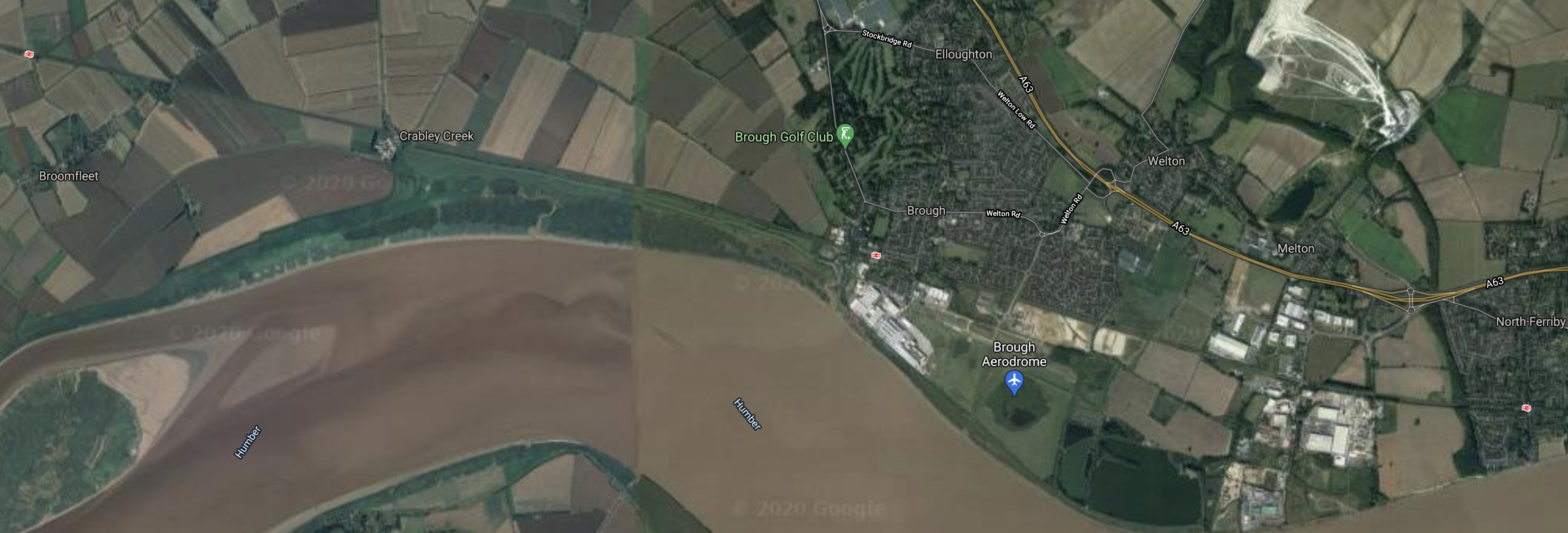
Note.
- Broomfleet station is in the North-West corner of the map.
- Brough station is just to the East of the middle of the map.
- Ferriby station is in the South-East corner of the map.
The Hull and Selby Line is fairly straight for most of its route.
The Selby Swing Bridge
The main problem is the Selby swing bridge, which is shown in this Google Map.
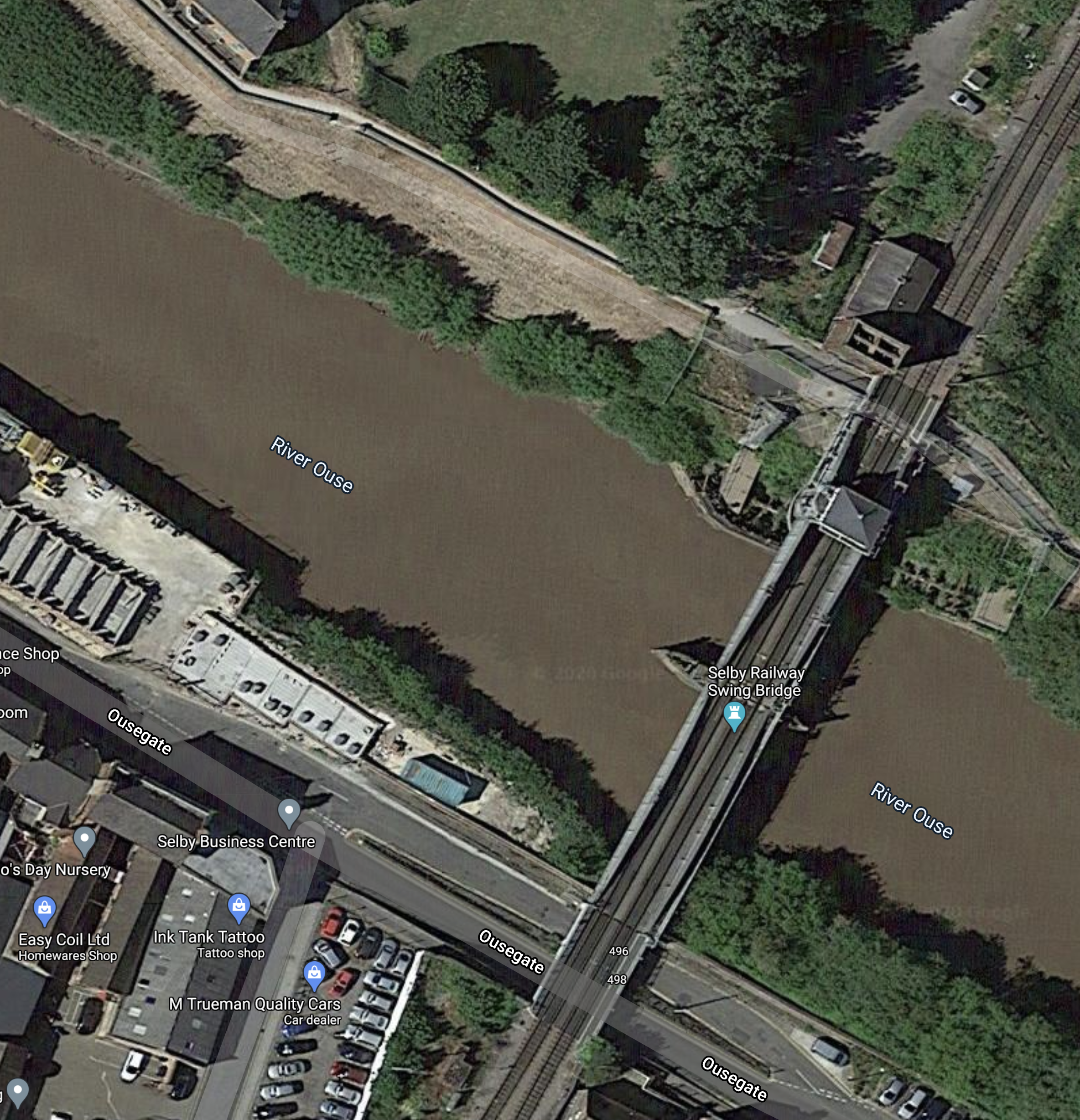
Note.
- The bridge was opened in 1891.
- It is a Grade II Listed structure.
- It is a double-track bridge.
- It swings through ninety degrees to allow ships to pass through.
- It has a low speed limit of 25 mph.
- The bridge regularly carries the biomass trains to Drax power station.
This page on the Fairfield Control Systems web site, describes the major refurbishment of the bridge.
- The bridge structure has been fully refurbished.
- A modern control system has been installed.
- The page says the bridge glides to an exact stop.
Network Rail are claiming, it will be several decades before any more work needs to be done on parts of the bridge.
It looks to me, that Network Rail have decided to live with the problems caused by the bridge and automate their way round it, if possible.
Level Crossings
One general problem with the route between Hull and Selby is that it has around a dozen level crossing, some of which are just simple farm crossings.
The main route West from Selby goes to Leeds and it is double track, fairly straight with around a dozen level crossings.
West from Selby, the route to the East Coast Main Line to and from London is also double track and reasonably straight.
But it does have level crossings at Common Lane and Burn Lane.
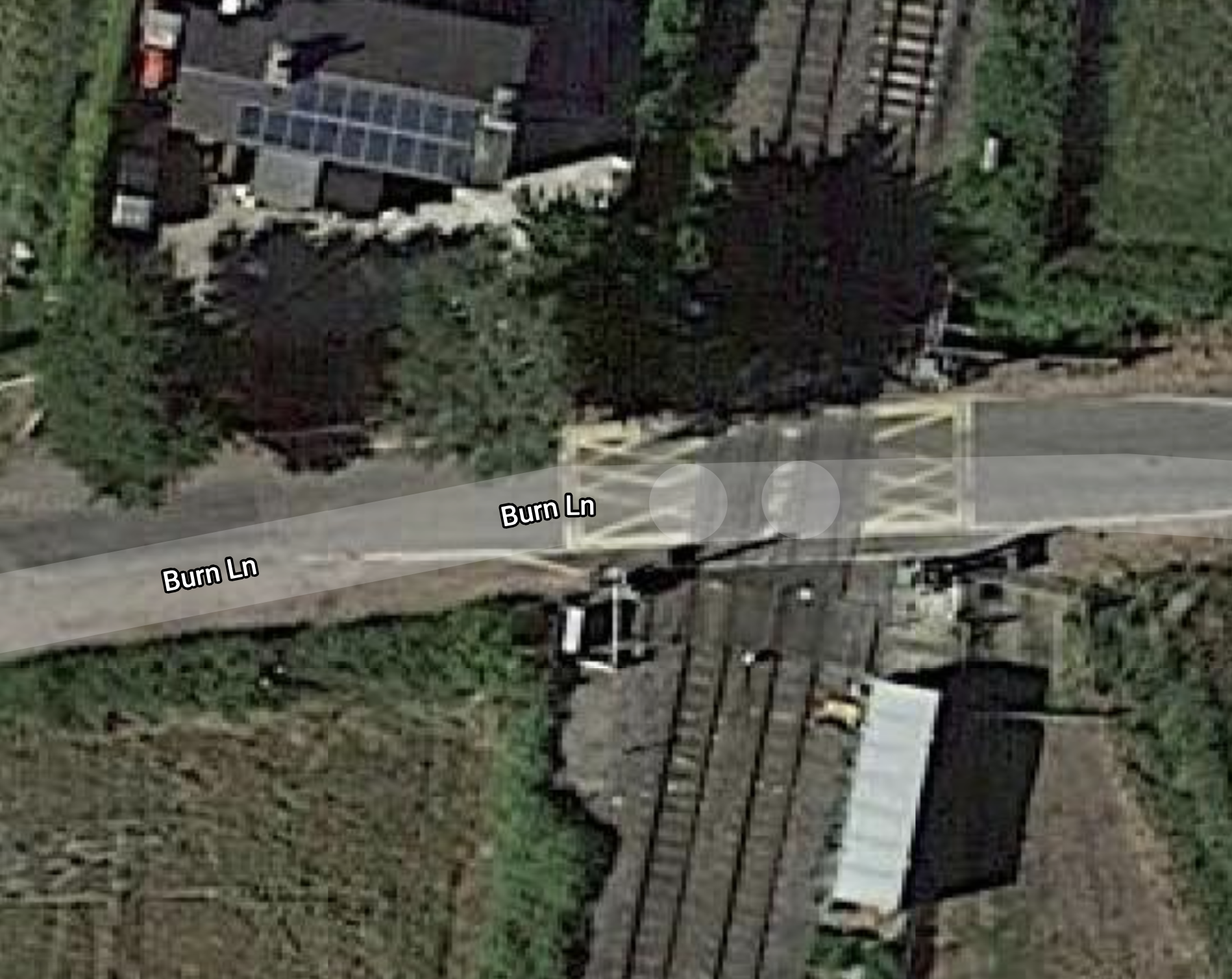
The Google Map show Burn Lane level crossing, which is typical of many in the area.
Hull And Sheffield
The other route West from Hull goes via Goole and Doncaster.
This Google Map shows the Hull and Doncaster Branch between Goole and Saltmarshe stations.
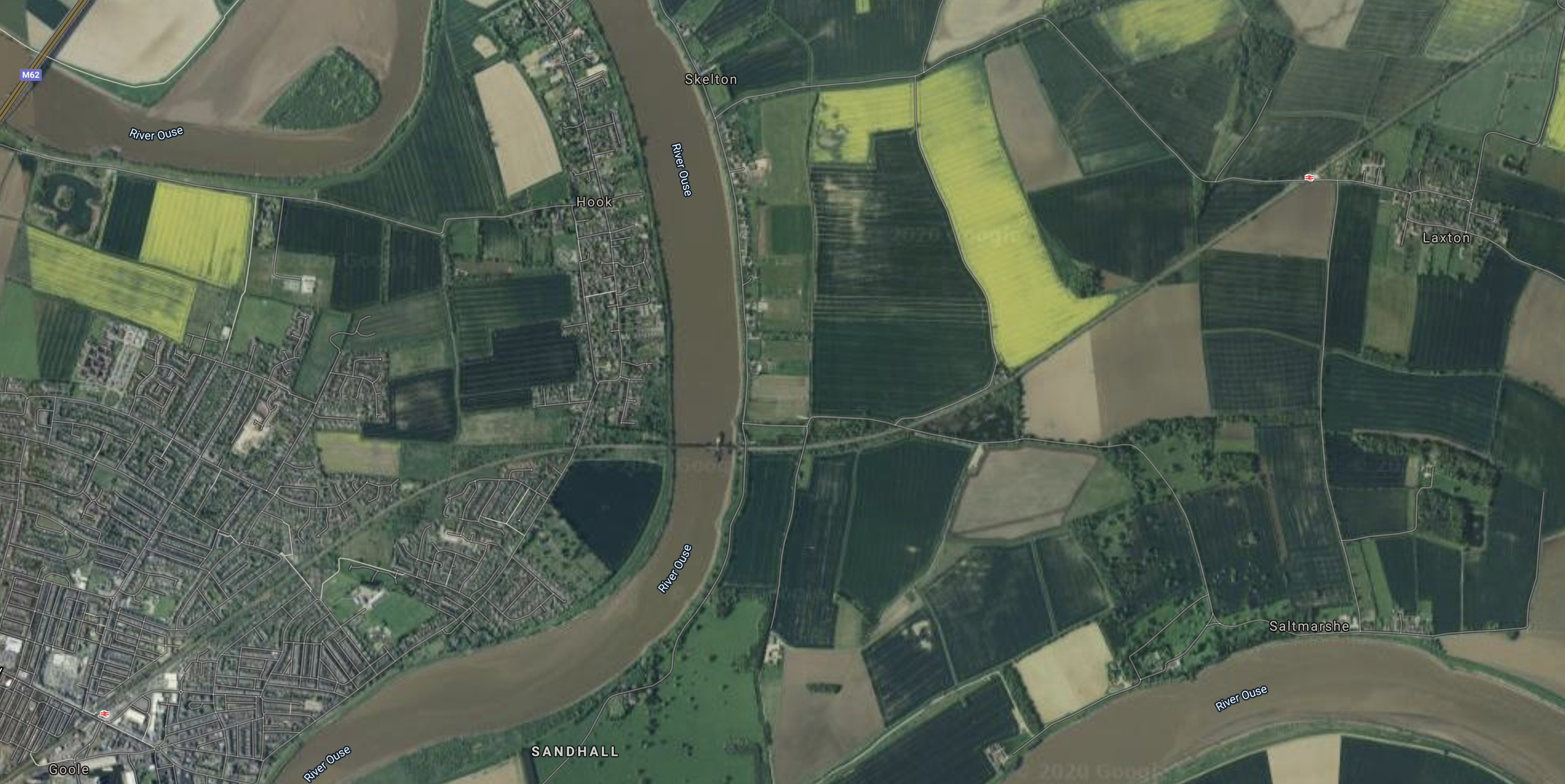
Note.
- The Hull and Doncaster Branch runs diagonally across the map.
- Goole and its station is in the South West corner of the map.
- The Hull and Doncaster Branch goes leaves the map at the North-East corner and then joins the Selby Line to the West of Gilberdyke station.
This Google Map shows that where the railway crosses the River Ouse there is another swing bridge.
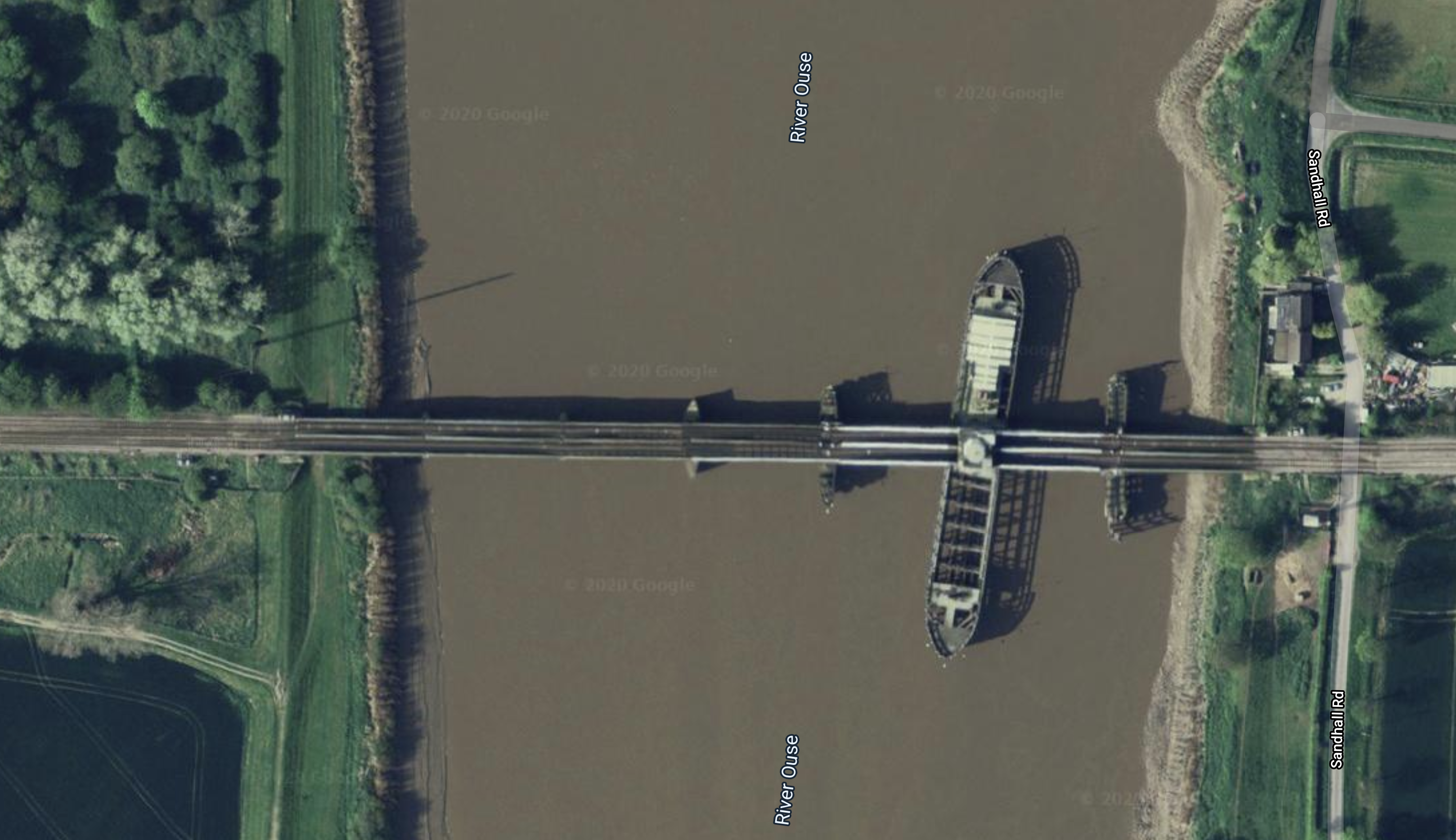
This is the Goole Railway Swing Bridge.
- The bridge was opened in 1869.
- The maximum speed for any train is 60 mph, but some are slower.
- It is a Grade II* Listed structure.
- In the first decade of this century the bridge was strengthened.
- It appears to carry a lesser number of freight trains than the Selby bridge
As with the Selby bridge, it appears to be working at a reasonable operational standard.
I’ve followed the line as far as Doncaster and it is fairly straight, mostly double-track with about a half-a-dozen level crossings.
Updating To 100 mph
It looks to my naïve eyes, that updating the lines to an operating speed of 100 mph, should be possible.
But possibly a much larger problem is the up to thirty level crossings on the triangle of lines between Hull, Leeds and Sheffield.
Full ERTMS In-Cab Digital Signalling
This is currently, being installed between London and Doncaster and will allow 140 mph running, which could save several minutes on the route.
The next phase could logically extend the digital signalling as far as York and Leeds.
Extending this signalling to Hull and Sheffield, and all the lines connecting the cities and towns of East Yorkshire could be a sensible development.
It might even help with swing bridges by controlling the speed of approaching trains, so that they arrive at the optimal times to cross.
Electrification
Eventually, all of these routes will be fully electrified.
- Hull and Leeds via Brough, Selby and Garforth.
- Hull and Scarborough via Beverley and Seamer.
- Hull and Sheffield via Brough, Goole, Doncaster and Rotherham.
- Hull and York via Brough and Selby.
- York and Scarborough via Seamer.
But there are two problems which make the electrification of the routes to Hull challenging.
- The Grade II Listed Selby swing bridge.
- The Grade II* Listed Goole Railway swing bridge.
There will be diehard members of the Heritage Lobby, who will resist electrification of these bridges.
Consider.
- Both bridges appear to work reliably.
- Adding the complication of electrification may compromise this reliability.
- Train manufacturers have developed alternative zero-carbon traction systems that don’t need continuous electrification.
- Hitachi have developed battery electric versions of the Class 800 and Class 802 trains, that regularly run to and from Hull.
- Other manufacturers are developing hydrogen-powered trains, that can use both hydrogen and overhead electrification for traction power.
My Project Management experience tells me, that electrification of these two bridges could be the major cost and the most likely cause of delay to the completion of the electrification.
It should also be noted that Network Rail are already planning to electrify these routes.
- Huddersfield and Dewsbury on the TransPennine Route, which might be extended to between Huddersfield and Leeds.
- York and Church Fenton
There is also electrification at Doncaster, Leeds and York on the East Coast Main Line, which would probably have enough power to feed the extra electrification.
Hitachi’s Regional Battery Trains
Hitachi and Hyperdrive Innovation are developing a Regional Battery Train.
This Hitachi infographic gives the specification.
Note.
- The train has a range of 90 kilometres or 56 miles on battery power.
- It has an operating speed of 100 mph on battery power.
- Class 800 and Class 802 trains can be converted to Hitachi Regional Battery Trains, by swapping the diesel engines for battery packs.
When running on electrification, they retain the performance of the train, that was converted.
Discontinuous Electrification
I would propose using discontinuous electrification. by electrifying these sections.
- Hull and Brough – 10.5 miles
- Hull and Beverley – 13 miles
- Doncaster and Sheffield – 20 miles
- Selby and Leeds – 21 miles
- Selby and Temple Hirst Junction – 5 miles
- Seamer and Scarborough – 3 miles
This would leave these gaps in the electrification in East Yorkshire.
- Brough and Doncaster – 30 miles
- Brough and Selby – 21 miles
- Brough and Church Fenton – 31 miles
- Seamer and Beverley – 42 miles
- Seamer and York – 39 miles
A battery electric train with a range of fifty miles would bridge these gaps easily.
This approach would have some advantages.
- There would only need to be 72.5 miles of double-track electrification.
- The swing bridges would be untouched.
- TransPennine services terminating in Hull and Scarborough would be zero-carbon, once Huddersfield and Dewsbury is electrified.
- LNER and Hull Trains services to London Kings Cross would be zero-carbon and a few minutes faster.
- LNER could run a zero-carbon service between London Kings Cross and Scarborough.
But above all, it would cost less and could be delivered quicker.
Collateral Benefits Of Doncaster and Sheffield Electrication
The extra electrification between Doncaster and Sheffield, would enable other services.
- A zero-carbon service between London Kings Cross and Sheffield.
- Extension of Sheffield’s tram-train to Doncaster and Doncaster Sheffield Airport.
- A possible electric service along the Dearne Valley.
As plans for Sheffield’s rail and tram system develop, this electrification could have a substantial enabling effect.
Hydrogen
This map shows the Zero Carbon Humber pipeline layout.

Note.
- The orange line is a proposed carbon dioxide pipeline
- The black line alongside it, is a proposed hydrogen pipeline.
- Drax, Keadby and Saltend are power stations.
- Easington gas terminal is connected to gas fields in the North Sea and also imports natural gas from Norway using the Langeled pipeline.
- There are fourteen gas feels connected to Easington terminal. Some have been converted to gas storage.
I can see hydrogen being used to power trains and buses around the Humber.
Conclusion
Discontinuous electrification could be the key to fast provision of electric train services between Leeds and Sheffield and Hull.
If long journeys from Hull were run using battery electric trains, like the Hitachi Regional Battery Train, perhaps hydrogen trains could be used for the local services all over the area.
Project Management Recommendations
I have proposed six sections of electrification, to create a network to allow all services that serve Hull and Scarborough to be run by battery electric trains.
Obviously with discontinuous electrification each section or group of sections to be electrified is an independent project.
I proposed that these sections would need to be electrified.
- Hull and Brough – 10.5 miles
- Hull and Beverley – 13 miles
- Doncaster and Sheffield – 20 miles
- Selby and Leeds – 21 miles
- Selby and Temple Hirst Junction – 5 miles
- Seamer and Scarborough – 3 miles
They could be broken down down into four sections.
- Hull station, Hull and Brough and Hull and Beverley
- Doncaster and Sheffield
- Selby station, Selby and Leeds and Selby and Temple Hirst Junction.
- Scarborough station and Scarborough and Seamer.
I have split the electrification, so that hopefully none is challenging.
Northern Powerhouse Rail – Connecting Sheffield To HS2 And On To Leeds
In this article on Transport for the North, which is entitled Northern Powerhouse Rail Progress As Recommendations Made To Government, one of the recommendations proposed for Northern Powerhouse Rail is connecting Sheffield to High Speed Two and on to Leeds.
Northern Powerhouse Rail’s Objective For The Sheffield and Leeds Route
Wikipedia, other sources and my calculations say this about the trains between Leeds and Sheffield.
- The distance between the two stations is 39 miles
- The current service takes around 40 minutes and has a frequency of one train per hour (tph)
- This gives an average speed of 58.5 mph for the fastest journey.
- The proposed service with Northern Powerhouse Rail will take 28 minutes and have a frequency of four tph.
- This gives an average speed of 84 mph for the journey.
This last figure of 84 mph, indicates to me that a fast route will be needed.
But given experience of 100 mph lines in other parts of the UK, 100 mph trains and infrastructure could make this demanding objective of twenty-eight minutes between Sheffield and Leeds a reality
Connecting Sheffield To High Speed Two
Sheffield is to be accessed from a branch off the Main High Speed Two route to Leeds.
This map clipped from High Speed Two’s interactive map, shows the route of the Sheffield Branch, from where it branches North West from the main Eastern Leg of High Speed Two.
Note.
- Orange indicates new High Speed Two track.
- Blue indicates track that High Speed Two will share with other services.
- The orange route goes North to Leeds, along the M1
- The blue route goes North to Chesterfield and Sheffield, after skirting to the East of Clay Cross.
- The orange route goes South to East Midlands Hub station.
This second map, shows where the Erewash Valley Line joins the Sheffield Branch near the village of Stonebroom.
Note.
- Red is an embankment.
- Yellow is a cutting.
- The Sheffield Branch goes North-West to Clay Cross, Chesterfield and Sheffield
- The Sheffield Branch goes South-East to East Midlands Hub station.
- The Sheffield Branch goes through Doe Hill Country Park.
- The Sheffield Branch runs alongside the existing Erewash Valley Line, which goes South to Langley Mill, Ilkeston and the Derby-Nottingham area.
The Sheffield Branch and the Erewash Valley Line appear to share a route, which continues round Clay Cross and is shown in this third map.
Note
- Doe Hill Country Park is in the South-East corner of the map.
- The dark line running North-South is the A61.
- Running to the West of the A61 is the Midland Main Line, which currently joins the Erewash Valley Line at Clay Cross North junction.
High Speed Two and the Midland Main Line will share a route and/or tracks from Clay Cross North junction to Sheffield.
This fourth map, shows where the combined route joins the Hope Valley Line to Manchester to the South West of Sheffield.
Note.
- Sheffield is to the North East.
- Chesterfield is to the South East,
- Totley junction is a large triangular junction, that connects to the Hope Valley Line.
These are some timings for various sections of the route.
- Clay Cross North Junction and Chesterfield (current) – 4 minutes
- Clay Cross North Junction and Sheffield (current) – 17 minutes
- Chesterfield and Sheffield (current) – 13 minutes
- Chesterfield and Sheffield (High Speed Two) – 13 minutes
- East Midlands Hub and Chesterfield (High Speed Two) – 16 minutes
- East Midlands Hub and Sheffield (High Speed Two) – 27 minutes
As Class Cross North Junction and Sheffield are 15.5 miles, this means the section is run at an average speed of 53 mph.
Can I draw any conclusions from the maps and timings?
- There would appear to be similar current and High Speed Two timings between Chesterfield and Sheffield.
- The various junctions appear to be built for speed.
The Midland Main Line will be electrified from Clay Cross North Junction to Sheffield, so that High Speed Two trains can use the route.
What will be the characteristics of the tracks between Clay Cross North Junction and Sheffield?
- Will it be just two tracks as it mainly is now or will it be a multi-track railway to separate the freight trains from the high speed trains?
- Will it have a high enough maximum speed, so that East Midland Railway’s new Class 810 trains can go at their maximum speed of 140 mph?
- Will it be capable of handling a frequency of 18 tph, which is the maximum frequency of High Speed Two?
Surely, it will be built to a full High Speed Two standard to future-proof the line.
Before finishing this section, I will answer a few questions.
Would It Be Possible For Class 810 Trains Fitted With Batteries To Run Between London St. Pancras And Sheffield?
East Midlands Railway’s new Class 810 trains could be fitted with batteries to become Regional Battery Trains with the specification, given in this Hitachi infographic.
Note.
- This would give the trains a range of 90 kilometres or 56 miles on batteries, if a number of diesel engines were exchanged for batteries.
- The trains would only be a few mph slower on batteries, than the current Hitachi trains on diesel.
- The Class 810 trains have four diesel engines. Is this to enable 125 mph running on diesel?
By perhaps replacing two diesel engines with batteries and using the remaining two diesel engines as range extenders or some other combination, I feel that Hitachi might be able to obtain a longer self-powered range for the train.
Consider.
- Between Sheffield and Clay Cross North Junction will be fully-electrified and at 15.5 miles, it will be long enough to fully-charge the batteries on the train.
- Between London St. Pancras and Market Harborough will be fully-electrified and at 83 miles, it will be long enough to fully-charge the batteries on the train.
- The section between Market Harborough and Clay Cross North Junction is not electrified and is 66 miles.
I feel that Hitachi and their partner; Hyperdrive Innovation can design a battery electric Class 810 train, that can travel between London St. Pancras and Sheffield, without using a drop of diesel.
A great advantage of this approach, is that, as more electrification is added to the Midland Main Line, as it surely will be, the trains will be able to use the wires to reduce journey times.
I believe there are two sections on the Midland Main Line. where traditional electrification is less likely.
- The bridge at the Southern end of Leicester station is low and would need to be rebuilt causing immense disruption to both road and rail in the city.
- Between Derby and Alfreton is the World Heritage Site of the Derwent Valley Mills. Will electrification be fought by the heritage lobby?
Both sections may eventually be electrified at some far off date in the future.
Why Is There A Spur Of Electrification At Totley Junction?
This map clipped from High Speed Two’s interactive map, shows the Southern Leg of Totley Junction, where the Hope Valley Line joins the Midland Main Line.
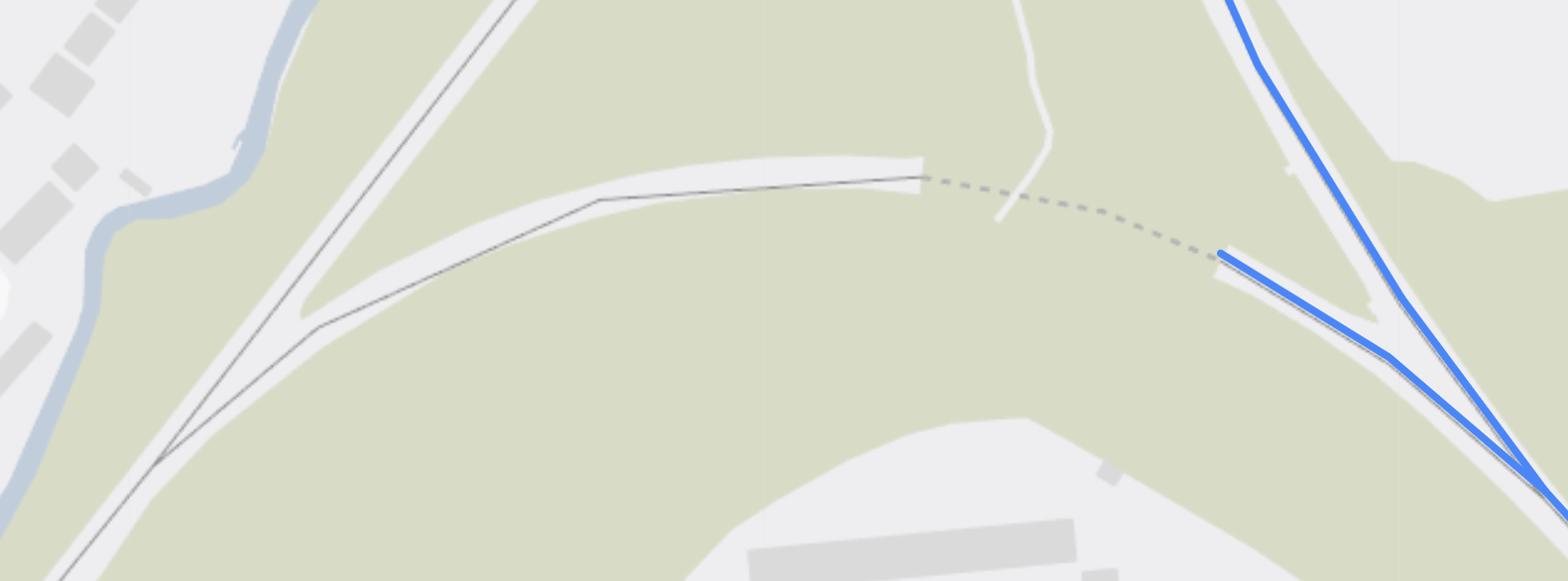
Note that a short length of electrification is shown, between the Midland Main Line and a tunnel on the Southern leg.
This Google Map shows the same area.

Note, that the line disappears into a tunnel.
- In Northern Powerhouse Rail -Significant Upgrades And Journey Time Improvements To The Hope Valley Route Between Manchester And Sheffield, I indicated, that running battery electric trains between Manchester and Sheffield would be a possibility and could be a way of meeting Northern Powerhouse Rail’s objectives for the route.
- A short length of electrification might help battery electric trains turn out to go South.
- I don’t think any passenger trains ever go that way now, but I have seen articles and heard complaints from passengers, that want a better service between Derby and/or Nottingham and Manchester.
- It might also help with the decarbonisation of freight trains to and from the quarries.
I also suspect, that if building High Speed Two in Manchester temporarily reduced the capacity of Manchester Piccadilly station, trains could use the Hope Valley Line to get to the city, as they have done previously, with Project Rio.
Accessing The Infrastructure Depot At Staveley
This map clipped from High Speed Two’s interactive map, shows the location of the infrastructure depot at Staveley.
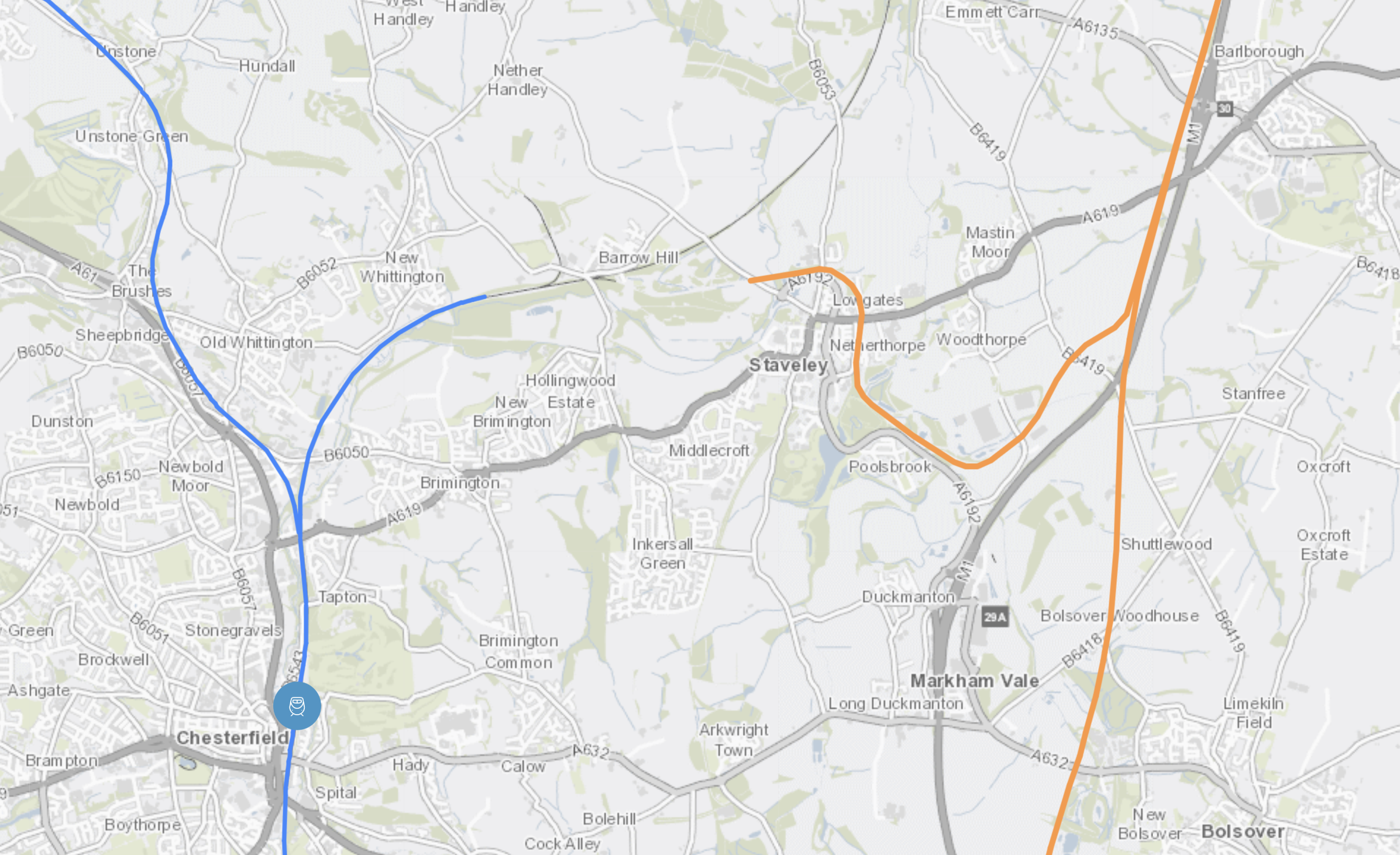
Note.
- Chesterfield is shown by the large blue dot.
- High Speed Two’s Sheffield Branch runs North from Chesterfield station.
- High Speed Two’s Eastern Leg runs down the Eastern side of the map.
- Two spurs from East and West go towards each other and would meet to the North of the town of Staveley.
The infrastructure depot will be located where they meet.
The route from the Sheffield Branch uses the Barrow Hill Line, which might be reopened as another passenger route between Chesterfield and Sheffield.
I wrote about this idea in Reinstatement Of The Barrow Hill Line Between Sheffield And Chesterfield.
If the line is being upgraded and electrified as far as Barrow Hill for the Infrastructure Depot, would it be worthwhile to create a new electrified route into Sheffield?
I also wrote in Could East Midlands Railway’s Liverpool And Norwich Service Avoid A Reverse At Sheffield By Using the Barrow Hill Line?, that the Barrow Hill Line might be an alternative route for the Liverpool and Norwich service.
When the railway routes in the area of the Infrastructure Depot are developed, I wouldn’t be surprised to see some routes changed.
Between Sheffield And Meadowhall Stations
One of the original designs for High Speed Two had it calling at Meadowhall station.
This map clipped from High Speed Two’s interactive map, clearly shows High Speed Two running across Sheffield.
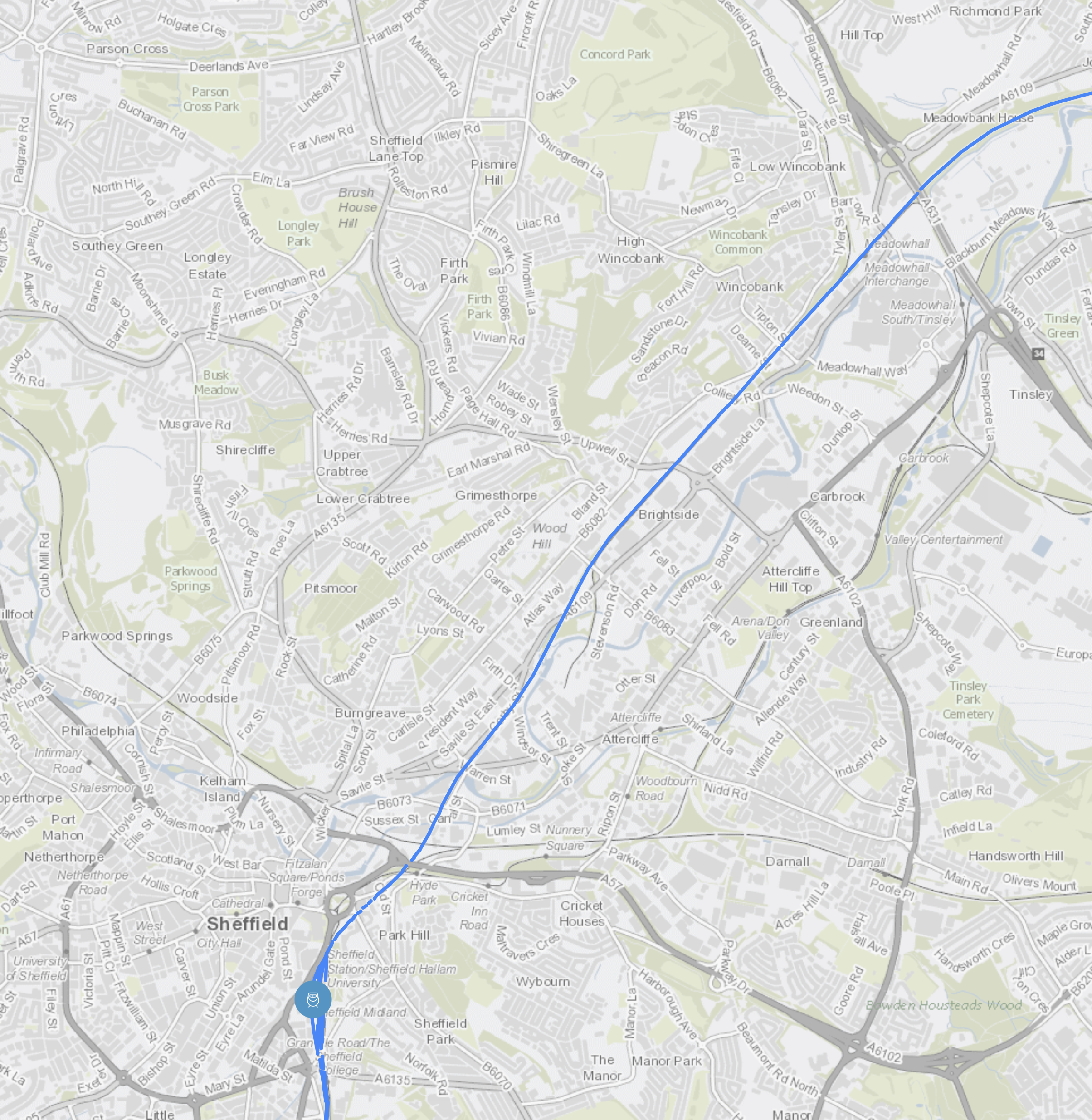
Note.
- Sheffield station is the big Blue dot in the South-West corner of the map.
- The M1 runs across the North-East corner of the map.
- The railway between Sheffield and Meadowhall stations already exists.
- Sheffield and Meadowhall stations are 3.5 miles apart and trains take seven minutes.
Is there any reason, why High Speed Two trains shouldn’t serve both Sheffield and Meadowhall stations, by just taking the existing line across the city?
Taking The Wakefield Line Towards Leeds
In extending to Meadowhall, High Speed Two’s route seems to be taking the current Wakefield Line.
This map clipped from High Speed Two’s interactive map, clearly shows High Speed Two passing through Sheffield and Rotherham and then going towards Leeds.
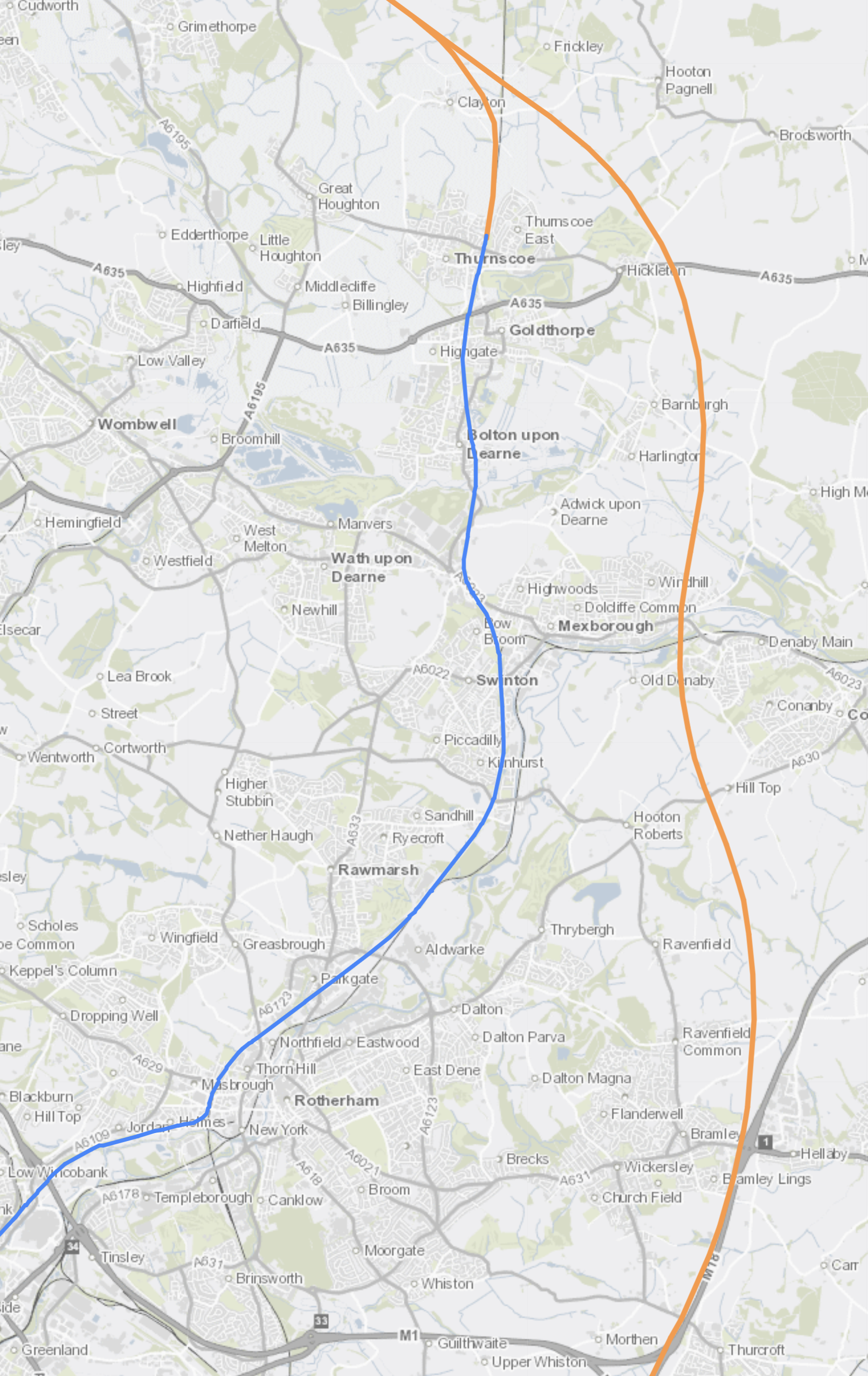
Note.
- Orange indicates new High Speed Two track.
- Blue indicates track that High Speed Two shares with other lines.
- The Wakefield Line is shown in blue and has stations at Meadowhall, Swinton, Bolton-upon-Dearne, Goldthorpe and Thurscoe.
- The main High Speed Two leg to Leeds is shown in orange.
It looks to me, that High Speed Two are aiming to provide a route, so that trains going to Sheffield can extend the journey to Leeds.
As Leeds will have three tph to and from London, why is this service being extended to Leeds?
I will explore a few reasons why in the next few sub-sections.
It’s Convenient For Running Trains
Consider.
- High Speed Two are saying London and Sheffield will be one hour and twenty-seven minutes.
- Northern Powerhouse Rail have an objective of Leeds and Sheffield in twenty-eight minutes.
- One hour and fifty-five minutes could be a convenient time for a London and Leeds service, as it could be a four hour round trip.
But High Speed Two are saying London and Leeds will be one hour and twenty-one minutes.
It looks to me, that it is a convenient way to serve Meadowhall, Rotherham, Bolton-upon-Dearne, Goldthorpe and Thurscoe stations
High Speed Two Through Rotherham
This map clipped from High Speed Two’s interactive map, clearly shows High Speed Two passing through Rotherham to the North of the Parkgate Shopping Park.
Note.
- High Speed Two is the bright blue line running North-East from the Western edge of the map.
- The grey blocks are the stores in the Shopping Park.
- The Rotherham Parkgate tram-train stop is marked.
This Google Map shows a similar area.
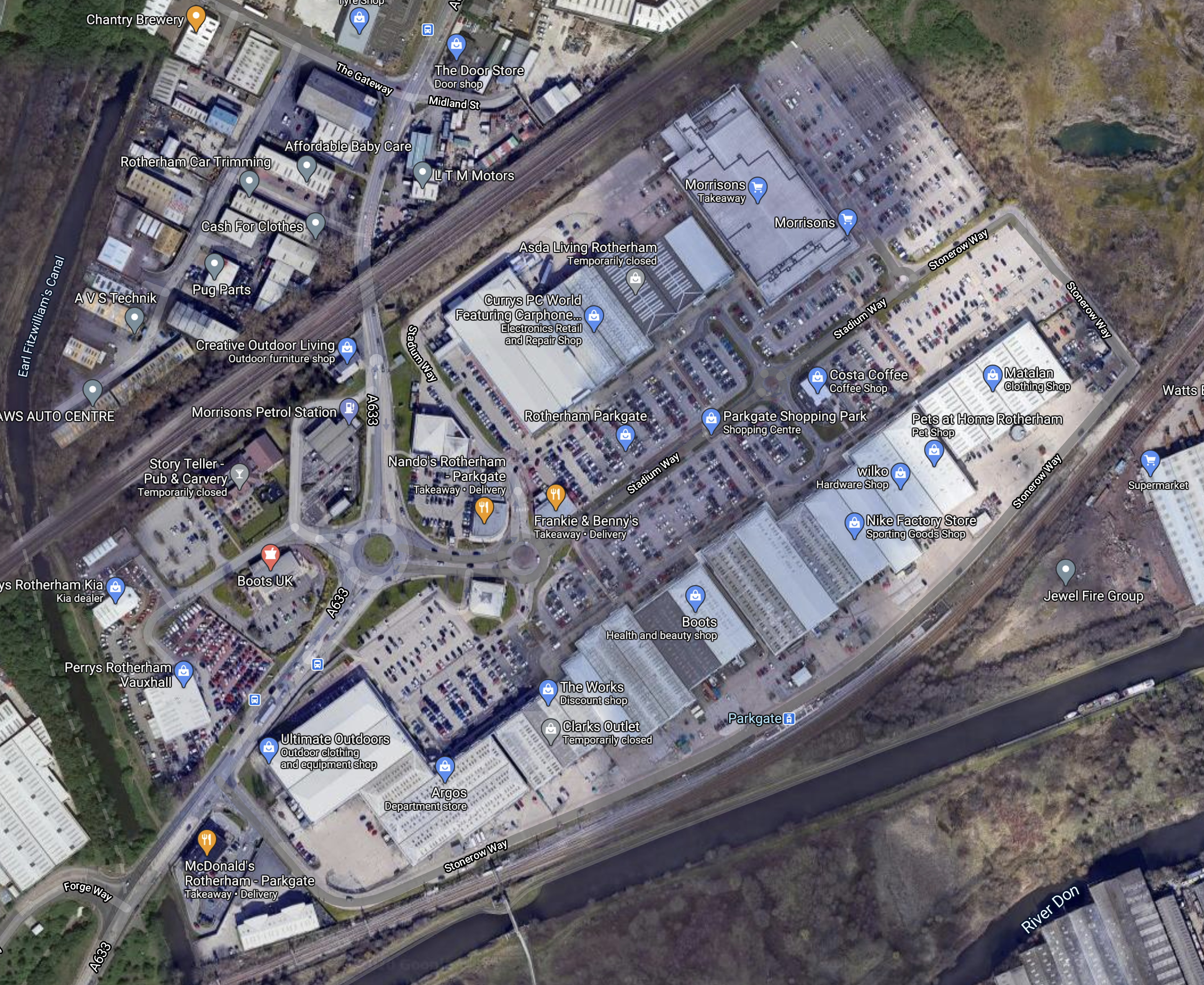
To the East of the Parkgate Shopping Park, is a large brownfield site, as this Google Map shows.

Could Rotherham have a station on the line North of this site?
- The rail line running SW-NE across this map is drawn in blue on High Speed Two’s interactive map.
- Rotherham Masborough station used to be in this area.
If High Speed Two is supposed to be a railway for all the people, or at least as many as possible, surely there should be a station in the town.
High Speed Two Through Bolton-upon-Dearne
In July 2019, I wrote a post called Sheffield Region Transport Plan 2019 – A New Station At Barnsley Dearne Valley.
So have High Speed Two taken on this feature of the Sheffield Region Transport Plan 2019, to add another station to their list of destinations?
Approach To Leeds
This map clipped from High Speed Two’s interactive map, clearly shows route High Speed Two will take to approach Leeds from the South East.
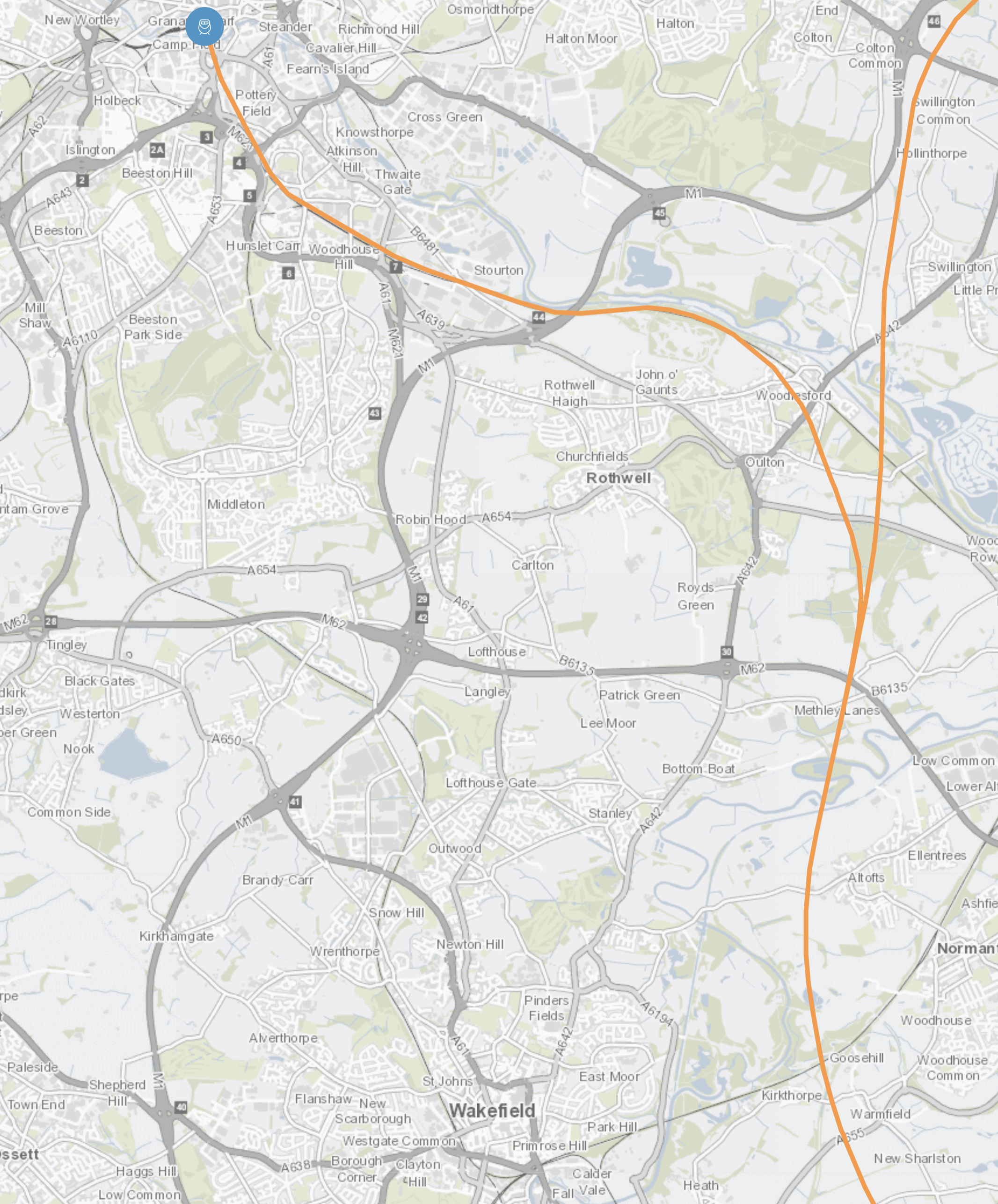
Note.
- Leeds station is the blue dot in the North West corner of the map.
- High Speed Two is shown in orange and continues North to York, where it joins the East Coast Main Line.
- Wakefield is in the middle at the bottom of the map and is on the Wakefield Line and the current route for LNER’s expresses from London.
It looks to me, that Leeds and Sheffield will eventually end up with two faster routes between the two cities.
- An upgraded Wakefield Line
- A route based on the Southern section of the Wakefield Line and the Eastern leg of High Speed Two route to Leeds.
If High Speed Two’s trains are to be able to get across Sheffield and call at Sheffield, Meadowhall, Rotherham and Barnsley Dearne Valley stations, then these conditions must be met.
- The trains must be High Speed Two’s Classic-Compatible trains or a train to a similar specification.
- Some platform lengthening might be needed to allow the two hundred metre long trains to call.
- The Wakefield Line must be electrified between Sheffield and just North of Goldthorpe station, where it will be able to join the link to the Eastern leg of High Speed Two.
It would probably be sensible to electrify the Wakefield Line all the way to Fitzwilliam station, from where the line is electrified all the way to Leeds.
This would enable the following.
- Electric trains to run between Sheffield and Leeds via Wakefield Westgate station.
- Would Northern Powerhouse Rail’s objective of a twenty-eight minute journey be achieved?
- East Midlands Railway could run their Class 810 trains between London St. Pancras and Leeds under electric power.
- High Speed Two could serve Leeds before the Northern infrastructure of the Eastern leg of High Speed Two is complete.
- High Speed Two could offer services to Wakefield, Barnsley and Rotherham via Sheffield.
I can see reasons for early upgrading of the Wakefield Line.
Conclusion
It appears that High Speed Two are planning an electrified route through Sheffield between Clay Cross North Junction on the Midland Main Line and Goldthorpe station on the Wakefield Line.
Once complete it would enable the following.
- Rotherham and Barnsley to have direct electric services to and from the capital.
- When East Midlands Railway introduce their new Class 810 trains, the electrification North of Clay Cross North Junction would mean faster services and less running on diesel power.
- I believe these Class 810 trains could run between London and Sheffield, if their four diesel engines are replaced with batteries, which would power the trains between Clay Cross North Junction and Market Harborough.
- The electrification at Sheffield would allow battery electric trains to work between Manchester and Sheffield as I outlined in Northern Powerhouse Rail -Significant Upgrades And Journey Time Improvements To The Hope Valley Route Between Manchester And Sheffield.
I think it is a good plan.
Project Management Recommendations
It is my view that the following projects should be started as soon as possible.
- Electrification between Clay Cross North Junction and Sheffield station.
- Electrification of the Wakefield Line between Sheffield and Fitzwilliam stations.
- Provision of new stations at Rotherham and Barnsley Dearne Valley on the Wakefield Line.
These projects could deliver worthwhile improvements in services in a couple of years, rather than the tens of years for High Speed Two.

