Power Storage Is The Next Big Net Zero Challenge
The title of this post, is the same as that of this Opinion from Bloomberg.
This is the sub-heading.
Britain’s pioneering plans for renewable energy show the global need could be massive. The means don’t yet exist.
The opinion is very much a well-written must-read.
One new project the article mentions is a 30 GWh pumped storage project at Coire Glas in the Scottish Highlands, that is planned by SSE.
I discuss this scheme in The Coire Glas Pumped Storage Scheme.
Bloomberg didn’t say it, but this pumped storage scheme could give the UK energy security.
Is Carbon Dioxide Not Totally Bad?
To listen to some environmentalists, there views on carbon dioxide are a bit like a variant of George Orwell’s famous phrase Four legs good, two legs bad from Animal Farm, with carbon dioxide the villain of the piece.
I have just read the Wikipedia entry for carbon dioxide.
For a start, we mustn’t forget how carbon dioxide, water and sunlight is converted by photosynthesis in plants and algae to carbohydrates, with oxygen given off as waste. Animals like us then breathe the oxygen in and breathe carbon dioxide out.
Various web sites give the following information.
- The average human breathes out 2.3 pounds of carbon dioxide per day.
- As of 2020, the world population was 7.8 billion.
This means humans breathe out 17.94 billion pounds of CO2 per day
This equates to 6548.1 billion pounds per year or 2.97 billion tonnes per year.
And I haven’t counted all the other animals like buffalo, cattle, elephants and rhinos, to name just a few large ones.
Wikipedia also lists some of the Applications of carbon dioxide.
- Precursor To Chemicals – Carbon dioxide can be one of the base chemicals used to make other important chemicals like urea and methanol.
- Foods – Carbon dioxide has applications in the food industry.
- Beverages – Carbon dioxide is the fizz in fizzy drinks.
- Winemaking – Carbon dioxide has specialist uses in winemaking.
- Stunning Animals – Carbon dioxide can be used to ‘stun’ animals before slaughter.
- Inert Gas – carbon dioxide has several uses, as it is an inert gas.
- Fire Extinguisher – Carbon dioxide is regularly used in fire extinguishers and fire protection systems.
- Bio Transformation Into Fuel – It has been proposed to convert carbon dioxide from power stations into biodiesel using a route based on algae.
- Refrigerant – Carbon dioxide can be used as a refrigerant. It was used before CFCs were developed and I know of a large Victorian refrigeration system on a farm in Suffolk, used on a store for apples, that still is in regular use that uses carbon dioxide.
- Dry Ice – The solid form of carbon dioxide has lots of applications, where cooling is needed.
Other important applications are under development.
- Agriculture – Carbon dioxide is piped to greenhouses to promote growth of crops. It is also used at higher concentrations to eliminate pests.
- Low Carbon Building Products – Companies like Mineral Carbonation International are developing ways of creating building products from carbon dioxide.
- Synthetic Rubber – Research is ongoing to create replacements for synthetic rubber.
I can only assume, that the demand for gaseous carbon dioxide will increase, as scientists and engineers get more innovative about using the gas.
Solving A Shortage Of Carbon Dioxide
At the present time, there is shortage of carbon dioxide, that I wrote about in Food Shortages Looming After Factory Closures Hit Production.
In the related post, I said this.
Perhaps we should fit carbon capture to a handy gas-fired power station, like SSE are planning to do at Keadby and use this carbon dioxide.
Consider.
- The Keadby complex of gas-fired power stations is close to a lot of depleted gas fields, some of which are in Lincolnshire and some are off-shore.
- Some gas fields are already being used to store natural gas imported from Norway.
- SSE plan to fit the later power stations with carbon capture.
I talk about SSE’s plans in Energy In North-East Lincolnshire.
If SSE were to build four large gas-fired power stations at Keadby, I calculated that they would produce 5.4 million tonnes of carbon dioxide per year.
It could be used or stored in depleted gas fields according to demand.
But the complex at Keadby would not release any carbon emissions.
Could Carbon Capture Be A Nice Little Earner?
If demand for carbon dioxide continues to rise, I could see power companies installing carbon capture on gas-fired power stations to generate an extra income stream.
Incidentally, there are 55 operational gas-fired power stations in the UK, that can generate a total of 30 GW, which are owned by perhaps ten different companies.
Development of carbon capture systems could be helped by Government subsidy.
Conclusion
I have long forgotten all the calculations I did with gases, but I do know that when one molecule of methane combusts it produces two molecules of water and one of carbon dioxide.
So I am fairly convinced that if you took X cubic kilometres of natural gas out of a gas field, after combustion there wouldn’t be anything like as much volume of carbon dioxide to put back, specially if a proportion could be used profitably in other processes.
If we are going to use gas to generate zero-carbon power, we probably need to do it with gas fields under our control either onshore or in the seas around our coasts. This is because the depleted gas fields can be used to store the carbon.
Gas-fired power stations with carbon capture supporting industries that need supplies of carbon dioxide will become a large part of our energy economy.
Uniper To Make Wilhelmshaven German Hub For Green Hydrogen; Green Ammonia Import Terminal
The title of this post, is the same as that of this article on Green Car Congress.
This is the first two paragraphs.
Under the name “Green Wilhelmshaven,” Germany-based international energy company Uniper plans to establish a German national hub for hydrogen in Wilhelmshaven and is working on a corresponding feasibility study.
Plans include an import terminal for green ammonia. The terminal will be equipped with an ammonia cracker for producing green hydrogen and will also be connected to the planned hydrogen network. A 410-megawatt electrolysis plant is also planned, which—in combination with the import terminal—would be capable of supplying around 295,000 metric tons or 10% of the demand expected for the whole of Germany in 2030.
I can’t help feeling that there is some bad thinking here.
The Wikipedia entry for ammonia, says this about green ammonia.
Even though ammonia production currently creates 1.8% of global CO2 emissions, a 2020 Royal Society report claims that “green” ammonia can be produced by using low-carbon hydrogen (blue hydrogen and green hydrogen). Total decarbonization of ammonia production and the accomplishment of net-zero targets are possible by 2050.
So why is green ammonia imported rather than green hydrogen, which may have been used to manufacture the ammonia?
Green ammonia would appear to have two main uses in its own right.
- As a feedstock to make fertiliser and other chemicals.
- As a possible fuel for large ships, which could also be powered by hydrogen.
The only thing, I can think of, is that as liquid hydrogen boils at -253 ° C and liquid ammonia at -33 ° C, ammonia may be easier to transport by ship.
It may make a better fuel for large ships for the same reason.
This policy briefing from The Royal Society is entitled Ammonia: Zero-Carbon Fertiliser, Fuel And Energy Store.
This is the introductory paragraph.
This policy briefing considers the opportunities and challenges associated with the manufacture and future use of zero-carbon or green ammonia.
It is an excellent explanation of green ammonia and a must read.
Hydrogen for Wilhelmshaven
On the other hand, Wilhelmshaven, which is situated on Germany’s North West Coast would be in a good position to be a terminal for a hydrogen pipeline or electrical interconnector from the Dogger Bank, where both the Netherlands and the UK have plans for some of the largest windfarms in the world.
The UK’s Dogger Bank Wind Farm, which is being developed by SSE, looks to have an initial capacity of 4.8 MW, whereas the North Sea Wind Power Hub, being developed by the Danes, Dutch and Germans on their side of the Dogger Bank could be rated at up to 110 GW.
Wikipedia says this about how the two huge projects could be connected.
The power hub would interconnect the three national power grids with each other and with the Dogger Bank Wind Farm.
We could be seeing a 200 GW power station in an area of the sea, generally only known to those who listen to the shipping forecasts and fans like Marti Caine.
Under a section in the Wikipedia entry for the North Sea Wind Power Hub, which is entitled the North Sea Wind Power Hub Consortium, these points are made.
- It is hoped that Norway, the United Kingdom, and Belgium will join the consortium.
- Dutch gas-grid operator Gasunie has joined the consortium, suggesting converting wind power to gas and using near offshore gas infrastructure for storage and transport.
- The Port of Rotterdam became the fifth member of the consortium.
This looks like a party, where some of our North Sea gas fields and infrastructure, lying in the triangle of the Humber, Teesside and the Dogger Bank could add a lot of value.
We could even see hydrogen generated in the European Eastern part of the Dogger Bank, stored in a worked-out gas field in the UK sector of the North Sea and then when needed, it could be pumped to Germany.
A 410 Megawatt Electrolyser
Ryze Hydrogen are building the Herne Bay electrolyser.
- It will consume 23 MW of solar and wind power.
- It will produce ten tonnes of hydrogen per day.
This would produce just 5.6 percent of the hydrogen of the Wilhelmshaven electrolyser
In H2 Green Steel Plans 800 MW Hydrogen Plant In Sweden, I wrote about a 800 MW electrolyser, that would produce 380 tonnes of hydrogen per day.
It looks like the Wilhelmshaven electrolyser is very much a middle-sized one and would produce around 65,000 tonnes per year.
Conclusion
It looks like the Germans will be importing lots of green ammonia and green hydrogen from the North Sea.
Plans Announced For ‘Low Carbon’ Power Stations In Lincolnshire
The title of this post, is the same as that of this article on the BBC.
This is the introductory paragraph.
Hundreds of jobs could be created after plans were announced to build two “low carbon” power stations in North Lincolnshire.
Last year, I only had one night away from home and that was in Doncaster, from where I explored North East Lincolnshire and wrote Energy In North-East Lincolnshire, where I made a few predictions.
These are my thoughts on my predictions and other points made in the BBC article.
Keadby 1
Keadby 1 is a 734 MW gas-fired power station, that was commissioned in 1996.
Keadby 2
- Keadby 2 will be a 840 MW gas-fired power station.
- It will be possible to add Carbon Capture and Storage technology to Keadby 2 to make the plant net-zero carbon.
- Keadby 2 will be able to run on hydrogen.
Keadby 2 is under construction.
Keadby 3 And Keadby 4
I predicted that two new power stations would be added to the Keadby cluster.
- When I wrote the other post, SSE were still designing Keadby 3, but had said it would be a 910 MW station.
- This would mean that Keadby 1, Keadby 2 and Keadby 3 would have a combined capacity of 2484 MW of electricity.
- Adding a fourth station, which I called Keadby 4, which I proposed to be the same size as Keadby 3 would give a combined capacity of 3394 MW.
This will be more than the planned capacity of the under-construction Hinckley Point C nuclear power station will be able to generate 3200 MW.
The BBC article says this about the plans for Keadby.
One plant would burn natural gas and use carbon capture technology to remove the CO2 from its emissions. The CO2 would then be transported along pipelines before being securely stored in rocks under the North Sea.
The hydrogen power station would produce “zero emissions at the point of combustion”, its developers claimed.
It looks like Keadby will have the power of a Hinckley Point nuclear station, but running on gas.
Carbon Capture And Storage
From what I read on the sseThermal web site and published in Energy In North-East Lincolnshire, it looks like Keadby 2 and Keadby 3 will use carbon capture and storage and Keadby 4 will use hydrogen.
There are plenty of depleted gas fields connected to the Easington terminal that can be used for carbon-dioxide storage.
The Zero Carbon Humber Network
The Zero Carbon Humber is going to be a gas network along the Humber, that will distribute hydrogen to large industrial users and return carbon dioxide for storage under the North Sea.
This map shows the Zero Carbon Humber pipeline layout.

Note.
- The orange line is a proposed carbon dioxide pipeline
- The black line alongside it, is a proposed hydrogen pipeline.
- Drax, Keadby and Saltend are power stations.
- Easington gas terminal is connected to around twenty gas fields in the North Sea.
- The terminal imports natural gas from Norway using the Langeled pipeline.
- The Rough field has been converted to gas storage and can hold four days supply of natural gas for the UK.
I can see this network being extended, with some of the depleted gas fields being converted into storage for natural gas, hydrogen or carbon dioxide.
Enter The Vikings
This article on The Times is entitled SSE and Equinor’s ‘Blue Hydrogen’ Power Plant Set To Be World First.
This is the introductory paragraph.
The world’s first large-scale power station to burn pure hydrogen could be built in Britain this decade by SSE and Equinor to generate enough low-carbon energy to supply more than a million homes.
This second paragraph explains the working of the production of the blue hydrogen.
The proposed power station near Scunthorpe would burn “blue hydrogen”, produced by processing natural gas and capturing and disposing of waste CO2 in a process that has low but not zero emissions. Equinor is already working on plans for a blue hydrogen production facility at Saltend in the Humber.
This may seem to some to be a wasteful process in that you use energy to produce blue hydrogen from natural gas and then use the hydrogen to generate power, but I suspect there are good reasons for the indirect route.
I believe that green hydrogen will become available from the North Sea from combined wind-turbine electrolysers being developed by Orsted and ITM Power, before the end of the decade.
Green hydrogen because it is produced by electrolysis will have less impurities than blue hydrogen.
Both will be zero-carbon fuels.
According to this document on the TNO web site, green hydrogen will be used for fuel cell applications and blue hydrogen for industrial processes.
Blue hydrogen would be able to power Keadby 2, 3 and 4.
I can see a scenario where Equinor’s blue hydrogen will reduce the price of hydrogen steelmaking and other industrial processes. It will also allow the purer and more costly green hydrogen to be reserved for transport and other fuel cell applications.
Using The Carbon Instead Of Storing
The document on the TNO web site has this surprising paragraph.
Hydrogen produced from natural gas using the so-called molten metal pyrolysis technology is called ‘turquoise hydrogen’ or ‘low carbon hydrogen’. Natural gas is passed through a molten metal that releases hydrogen gas as well as solid carbon. The latter can find a useful application in, for example, car tyres. This technology is still in the laboratory phase and it will take at least ten years for the first pilot plant to be realised.
This technical paper is entitled Methane Pyrolysis In A Molten Gallium Bubble Column Reactor For Sustainable Hydrogen Production: Proof Of Concept & Techno-Economic Assessment.
This may be a few years away, but just imagine using the carbon dioxide from power stations and industrial processes to create a synthetic rubber.
But I believe there is a better use for the carbon dioxide in the interim to cut down the amount that goes into long-term storage, which in some ways is the energy equivalent of landfill except that it isn’t in the least way toxic, as carbon-dioxide is one of the most benign substances on the planet.
Lincolnshire used to be famous for flowers. On a BBC Countryfile program a couple of weeks ago, there was a feature on the automated growing and harvesting of tulips in greenhouses.
There are references on the Internet to of carbon dioxide being fed to flowers in greenhouses to make them better flowers.
So will be see extensive building of greenhouses on the flat lands of Lincolnshire growing not just flowers, but soft fruits and salad vegetables.
Conclusion
The plans of SSE and Equinor as laid out in The Times and the BBC could create a massive power station cluster.
- It would be powered by natural gas and hydrogen.
- Blue hydrogen will be produced by an efficient chemical process.
- Green hydrogen will be produced offshore in massive farms of wind-turbine/electrolysers.
- It would generate as much electricity as a big nuclear power station.
- All carbon-dioxide produced would be either stored or used to create useful industrial products and food or flowers in greenhouses.
Do power stations like this hasten the end of big nuclear power stations?
Probably, until someone finds a way to turn nuclear waste into something useful.
SSE Goes Global To Reap The Wind
The title of this article on This Is Money is Renewable Energy Giant SSE Launches Plan To Become Britain’s First Global Windfarm Business As it Invests Up To £15bn Over Next Decade.
The title is a good summary of their plans to build wind farms in Continental Europe, Denmark, Japan and the US, in addition to the UK and Ireland.
I can also see the company developing more integrated energy clusters using the following technologies.
- Wind farms that generate hydrogen rather than electricity using integrated electrolysers and wind turbines, developed by companies like ITM Power and Ørsted.
- Reusing of worked out gasfields and redundant gas pipelines.
- Zero-carbon CCGT power stations running on Hydrogen.
- Lots of Energy storage.
I talked about this type of integration in Batteries Could Save £195m Annually By Providing Reserve Finds National Grid ESO Trial.
In the related post, I talked about the Keadby cluster of gas-fired power stations, which are in large part owned by SSE.
Conclusion
I think that SSE could be going the way of Equinor and Ørsted and becoming a global energy company.
It is also interesting the BP and Shell are investing in renewable energy to match the two Scandinavian companies.
Big Oil seems to be transforming itself into Big Wind.
All these companies seem to lack grid-scale energy storage, although hydrogen can be generated and stored in worked-out gas fields.
So I would expect that some of the up-and-coming energy storage companies like Gravitricity, Highview Power and RheEnergise could soon have connections with some of these Big Wind companies.
Equinor and SSE Renewables’ Dogger Bank Wind Farm Reaches Financial Close
The title of this post, is the same as that of this article on Energy Global.
It is a very matter of fact article to record the fact that SSE and Equinor have raised three billion pounds for the first two sections of their 3.6 GW wind farm on the Dogger Bank, in the middle of the North Sea.
Wikipedia indicates, they will be operational around 2023-2025.
All very boring! But we’ll see a lot more deals like this.
Keadby 3 Low-Carbon Power Station
This article on Business Live is entitled Huge Green Power Station Proposed By SSE As It Embraces Hydrogen And Carbon Capture.
SSE Thermal is working on a low-carbon 910 MW gas-fired power station to join Keadby and Keadby 2 power stations in a cluster near Scunthorpe.
A spokesman for SSE is quoted as saying they will not build the plant without a clear route to decarbonisation.
On this page of their web site, SSE Thermal, say this about Keadby 3.
As part of our commitment to a net zero emissions future, Keadby 3 will only be built with a clear route to decarbonisation, either using hydrogen as a low-carbon fuel, or equipping it with post-combustion carbon capture technology. The project is at the early stages of development and no final investment decision has been made.
It should also be noted that SSE Renewables have also built a wind farm at Keadby. The web site describes it like this.
Keadby Wind Farm is England’s largest onshore wind farm. This 68MW renewable energy generation site can power approximately 57,000 homes.
There are a lot of good intentions here and I think that SSE haven’t disclosed the full picture.
It would seem inefficient to use hydrogen to power a gas-fired power station to achieve zero-carbon power generation.
- If you are using hydrogen created from steam reforming of methane, this creates a lot of carbon-dioxide.
- If you are using green hydrogen produced by electrolysis, then, why don’t you store the electricity in a battery?
Perhaps, SSE are trying out a new process?
This Google Map shows the area of Keadby to the West of Scunthorpe.
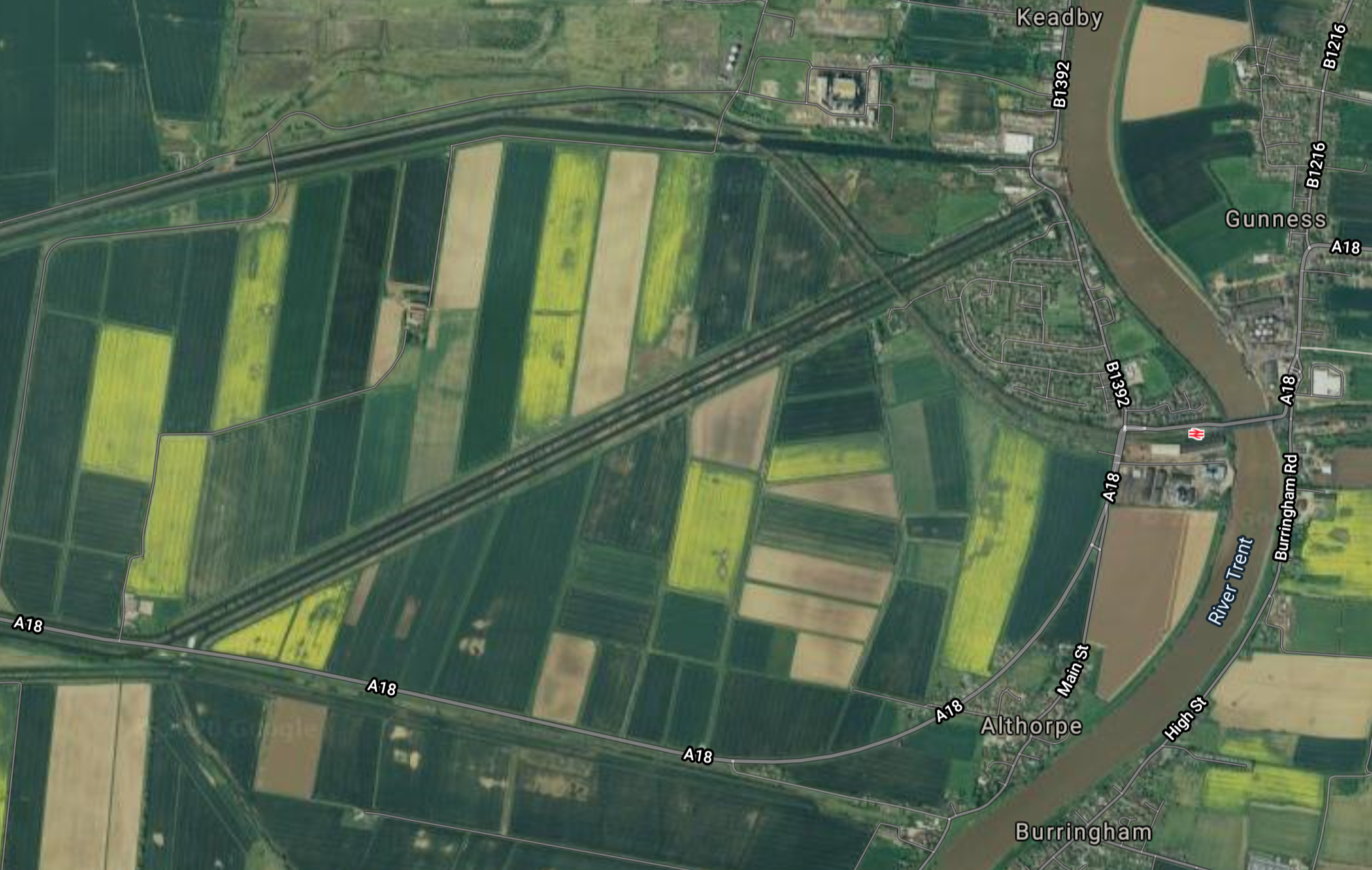
Note.
- The River Trent meandering through the area.
- Althorpe station is in the bend of the River,
- I’m fairly certain, that I remember an old airfield in the area.
- Keadby power station is a bit to the North of the waterway running West from the River and close to where the railway crosses the waterway.
This second Google Map shows a close-up of the power station.
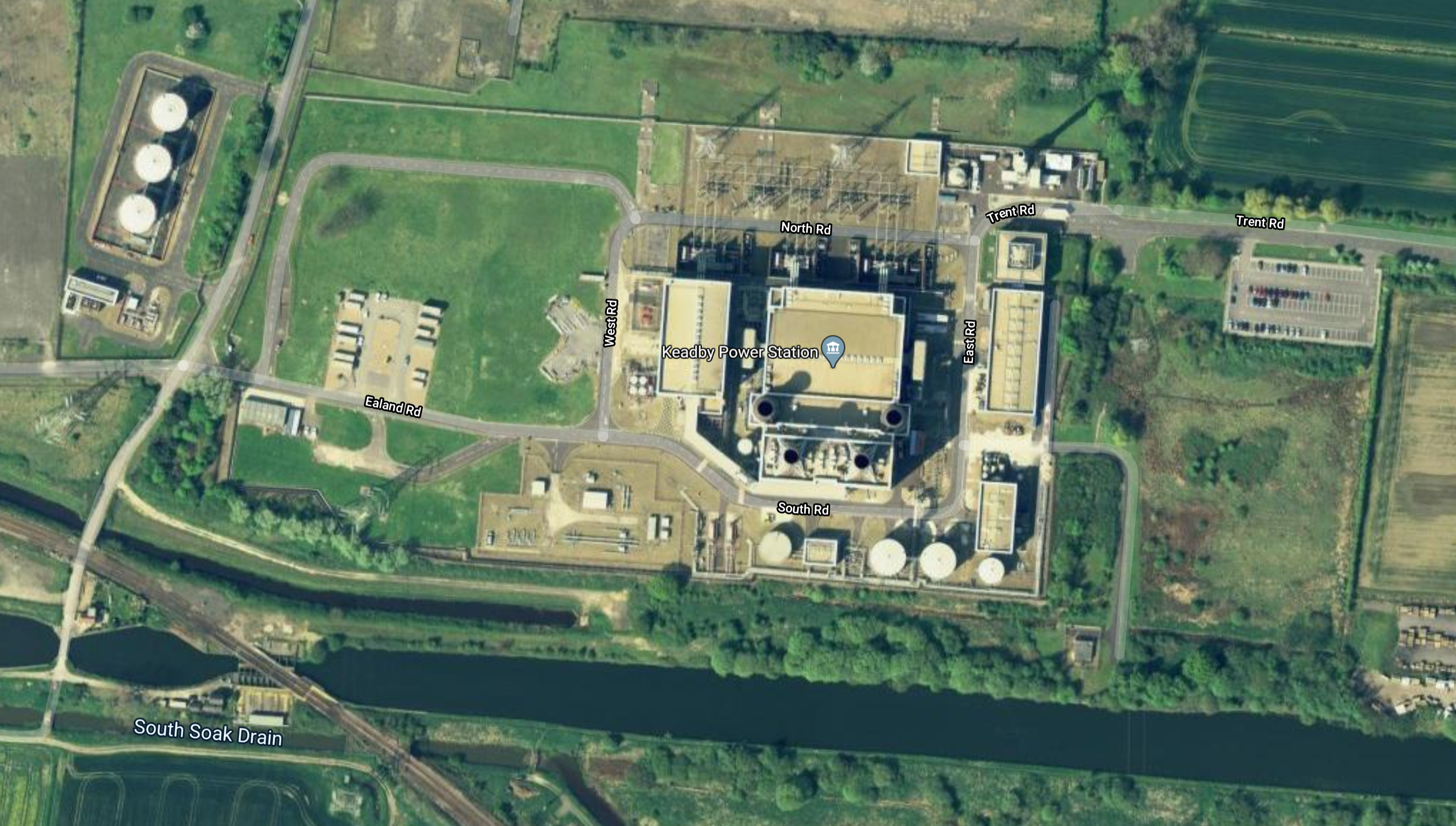
This visualisation from SSE Thermal shows how the site might look in the future.
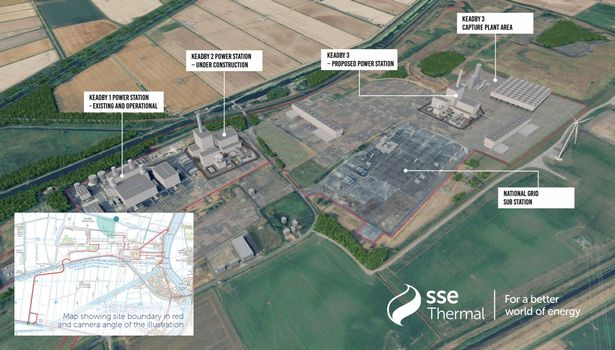
For me the interesting location is the village of Althorpe, where C and myself had friends.
They were always getting tourists arriving in the village looking for Princess Diana’s grave!
Carbon Capture And Storage At Keadby
If SSE have three large power stations at Keadby, a shared carbon capture and storage system could be worthwhile.
- There are numerous gas fields in the area and a big gas terminal at Theddlethorpe, to where they all connect.
- I was surprised to see, that one of thee fields; Saltfleetby is owned by President Putin’s favourite gas company; Gazprom.
- Some of these fields are actually on-shore.
- The power stations probably get their gas from the same terminal.
Some of these gas fields that connect to Theddlethorpe could be suitable for storing the carbon dioxide.
As there is masses of space at Keadby, I can see more gas-fired power stations being built at Keadby.
All would feed into the same carbon capture and storage system.
If gas was needed to be imported in a liquified form, there is the Port of Immingham nearby.
Absorption Of Carbon Dioxide By Horticulture
Consider.
- Increasingly, horticulture is getting more automated and efficient.
- Automatic harvesters are being developed for crops like tomatoes and strawberries.
- Instead of storing the carbon-dioxide in worked-out gas fields, it can also be fed directly to fruit and vegetables that are being grown in greenhouses.
- Keadby is surrounded by the flat lands of Lincolnshire.
How long will it be before we see tomatoes, strawberries, peppers and cucumbers labelled as British zero-carbon products?
Offshore Hydrogen
I’ll repeat what I said in ITM Power and Ørsted: Wind Turbine Electrolyser Integration.
This is from a press release from ITM Power, which has the same title as the linked article.
This is the introductory paragraph.
ITM Power (AIM: ITM), the energy storage and clean fuel company, is pleased to share details of a short project sponsored by the Department for Business, Energy & Industrial Strategy (BEIS), in late 2019, entitled ‘Hydrogen supply competition’, ITM Power and Ørsted proposed the following: an electrolyser placed at the wind turbine e.g. in the tower or very near it, directly electrically connected to the DC link in the wind turbine, with appropriate power flow control and water supplied to it. This may represent a better design concept for bulk hydrogen production as opposed to, for instance, remotely located electrolysers at a terminal or platform, away from the wind turbine generator, due to reduced costs and energy losses.
Some points from the remainder of the press release.
- Costs can be saved as hydrogen pipes are more affordable than under-water power cables.
- The proposed design reduced the need for AC rectification.
After reading the press release, it sounds like the two companies are performing a serious re-think on how wind turbines and their links to get energy on-shore are designed.
- Will they be using redundant gas pipes to bring the hydrogen ashore?
- Will the hydrogen come ashore at Theddlethorpe and use the existing gas network to get to Keadby?
It sounds inefficient, but then the steelworks at Scunthorpe will probably want masses of hydrogen for carbon-free steel making and processing.
Boosting Power Station Efficiency
There is also a section in the Wikipedia entry for Combined Cycle Power Plant called Boosting Efficiency, where this is said.
The efficiency of CCGT and GT can be boosted by pre-cooling combustion air. This is practised in hot climates and also has the effect of increasing power output. This is achieved by evaporative cooling of water using a moist matrix placed in front of the turbine, or by using Ice storage air conditioning. The latter has the advantage of greater improvements due to the lower temperatures available. Furthermore, ice storage can be used as a means of load control or load shifting since ice can be made during periods of low power demand and, potentially in the future the anticipated high availability of other resources such as renewables during certain periods.
So is the location of the site by the Trent, important because of all that cold water?
Or will they use surplus power from the wind farm to create ice?
The Proposed North Sea Wind Power Hub
The North Sea Wind Power Hub is a proposed energy island complex on the Eastern part of the Dogger Bank.
- The Dutch, Germans and Danes are leading the project.
- Along with the Belgians, we have been asked to join.
- Some reporting on the Hub has shown, airstrips in the middle of the complex to bring the workforce to the site.
- A Dutch report, says that as much as 110 GW of wind power could be developed by 2050.
- We are also looking at installing wind farms on our section of the Dogger Bank.
Geography says, that one of the most convenient locations to bring all this electricity or hydrogen gas ashore is North Lincolnshire
A Very Large Battery
I would also put a very large battery on the site at Keadby.
One of Highview Power‘s proposed 1 GWh CRYOBatteries would be a good start. This will be four times the size of the 250 MWh CRYOBattery, which the company is currently designing and building at Carrington in Greater Manchester.
Conclusion
The three power stations at Keadby are the following sizes
- Keadby 1 – 734 MW
- Keadby 2 – 803.7 MW
- Keadby 3 – 010 MW
This adds up to a total of 2447.7 MW. And if they fit carbon capture and storage it will be zero-carbon.
Note.
- Hinckley Point C is only 3200 MW and will cost around £20 billion or £6.25 billion per GW.
- Keadby 2 power station is quoted as costing £350 million. or £0.44 billion per GW.
These figures don’t include the cost of carbon capture and storage, but they do show the relatively high cost of nuclear.
 The Anonymous Widower