Renewable Power’s Effect On The Tory Leadership Election
I wouldn’t normally comment on the Tory Leadership Election, as I don’t have a vote and my preference has already been eliminated.
But after reading this article on the Telegraph, which is entitled Britain Will Soon Have A Glut Of Cheap Power, And World-Leading Batteries To Store It, I feel I have to comment both about this election and the General Election, that will follow in a few years.
These two paragraphs from the article illustrate the future growth of offshore wind power.
It is a point about the mathematical implications of the UK’s gargantuan push for renewables. Offshore wind capacity is going to increase from 11 to 50 gigawatts (GW) by 2030 under the Government’s latest fast-track plans.
RenewableUK says this country currently has a total of 86GW in the project pipeline. This the most ambitious rollout of offshore wind in the world, ahead of China at 78GW, and the US at 48GW.
If we assume that there is eight years left of this decade, that means that we should install about 4.9 GW of offshore wind every year until 2030. If we add in planned solar and onshore wind developments, we must be looking at at least 5 GW of renewable energy being added every year.
We have also got the 3.26 GW Hinckley Point C coming on stream.
I think we can say, that when it comes to electricity generation, we will not be worried, so Liz and Rishi can leave that one to the engineers.
If we have an electricity problem, it is about distribution and storage.
- We need more interconnectors between where the wind farms are being built and where the electricity will be used.
- National Grid and the Government have published plans for two interconnectors between Scotland and England, which I wrote about in New Electricity ‘Superhighways’ Needed To Cope With Surge In Wind Power.
- We need energy storage to back up the wind and solar power, when the wind isn’t blowing and the sun isn’t shining.
I think it is reasonable to assume, that we will get the interconnectors we need and the Telegraph article puts forward a very feasible and affordable solution to the energy storage problem, which is described in these two paragraphs from the article.
That is now in sight, and one of the world leaders is a British start-up. Highview Power has refined a beautifully simple technology using liquid air stored in insulated steel towers at low pressure.
This cryogenic process cools air to minus 196 degrees using the standard kit for LNG. It compresses the volume 700-fold. The liquid re-expands with a blast of force when heated and drives a turbine, providing dispatchable power with the help of a flywheel.
The article also talks of twenty energy storage systems, spread around the UK.
- They will have a total output of 6 GW.
- In total they will be able to store 600 GWh of electricity.
The first one for Humberside is currently being planned.
Surely, building these wind and solar farms, interconnectors and energy storage systems will cost billions of pounds.
Consider.
- Wind and solar farms get paid for the electricity they generate.
- , Interconnectors get paid for the electricity they transfer.
- Energy storage systems make a profit by buying energy when it’s cheap and selling it, when the price is better.
- In World’s Largest Wind Farm Attracts Huge Backing From Insurance Giant, I talked about how Aviva were funding the world’s largest wind farm at Hornsea.
- National Grid has a history of funding interconnectors like the North Sea Link from large financial institutions.
I believe that the islands of Great Britain and Ireland and the waters around our combined shores will become the largest zero-carbon power station in the world.
This will attract engineering companies and financial institutions from all over the world and we will see a repeat of the rush for energy that we saw for oil and gas in the last century.
If we get the financial regime right, I can see a lot of tax money flowing towards the Exchequer.
The big question will be what do we do with all this energy.
- Some will be converted into hydrogen for transport, the making of zero-carbon steel and cement and for use as a chemical feedstock.
- Industries that use a lot of electricity may move to the UK.
- A large supply of electricity and hydrogen will make it easy to decarbonise housing, offices and factories.
The Telegraph article also says this.
Much can be exported to the Continent through interconnectors for a fat revenue stream, helping to plug the UK’s trade deficit, and helping to rescue Germany from the double folly of nuclear closures and the Putin pact. But there are limits since weather patterns in Britain and Northwest Europe overlap – partially.
I suspect that more energy will be exported to Germany than most economists think, as it will be needed and it will be a nice little earner for the UK.
Given the substantial amount of German investment in our wind industry, I do wonder, if Boris and Olaf did a deal to encourage more German investment, when they met in April this year.
- BP have been backed with their wind farms by a German utility company.
- RWE are developing the Sofia wind farm.
- Only last week, the deal for the NeuConnect interconnector between the Isle of Grain and Wilhelmshaven was signed.
- Siemens have a lot of investments in the UK.
I wouldn’t be surprised to see more German investments in the next few months.
The Golden Hello
Has there ever been a Prime Minister, who will receive such a golden hello, as the one Liz or Rishi will receive in September?
The Tory Leadership Election
Some of the candidates said they would reduce taxes , if they won and Liz Truss is still saying that.
I wonder why Rishi isn’t saying that he would reduce taxes, as he must know the cash flow that is coming. It may be he’s just a more cautious soul.
Britain Will Soon Have A Glut Of Cheap Power, And World-Leading Batteries To Store It
The title of this post, is the same as that of this article on the Telegraph.
This is the first four paragraphs.
Today’s electricity price shock is the last crisis of the old order. Britain will soon have far more power at times of peak production than it can absorb. The logistical headache will be abundance.
Wind and solar provided almost 60pc of the UK’s power for substantial stretches last weekend, briefly peaking at 66pc. This is not to make a propaganda point about green energy, although this home-made power is self-evidently displacing liquefied natural gas (LNG) imported right now at nosebleed prices.
It is a point about the mathematical implications of the UK’s gargantuan push for renewables. Offshore wind capacity is going to increase from 11 to 50 gigawatts (GW) by 2030 under the Government’s latest fast-track plans.
RenewableUK says this country currently has a total of 86GW in the project pipeline. This the most ambitious rollout of offshore wind in the world, ahead of China at 78GW, and the US at 48GW.
The article goes on to give a comprehensive account of where we are with renewables, where we are going and how we will handle things, when the wind doesn’t blow.
Dogger Bank
The article says this about the Dogger Bank wind farm, which is being developed by SSE.
The giant hi-tech turbines to be erected on the Dogger Bank, where wind conditions are superb, bear no resemblance to the low-tech, low-yield dwarves of yesteryear. The “capacity factor” is approaching 60pc, which entirely changes the energy equation.
A capacity factor of 60 % seems a bit high to me and is what can be expected with the latest floating turbines. But these are fixed to the sea floor.
The Wikipedia entry for the Dogger Bank wind farm, says this about the building of the the first two sections of the massive wind farm.
On 21 September 2020, it was announced that Dogger Bank A and B will use 190 GE Haliade-X 13 MW offshore wind turbines over both sites, meaning that 95 turbines will be used on each site.[19] The availability of upgraded Haliade-X turbines rated at 13 MW rather than 12 MW means that each site will be capable of generating up to 1.235 GW, for a total of 2.47 GW. Turbines will be pre-assembled at Able Seaton Port in Hartlepool, an activity that will lead to the creation of 120 skilled jobs at the port during construction. Turbine installation is expected to commence in 2023 at Dogger Bank A.[20] Power Purchase Agreements (PPA) for 15 years were signed in November 2020. Offshore cable laying started in April 2022. Installation of the turbine foundations was started in July 2022.
This GE data sheet about the Haliade-X offshore wind turbine, says this about capacity factor.
it also features a 60-64% capacity factor above industry standard. Capacity factor compares how much energy was generated against the maximum that could have been produced at continuous full power operation during a specific period of time.
A 60-64% capacity factor is exceptional.
Current plans for Dogger Bank indicate that 3.6 GW will be installed and operational by 2024/25.
Could that mean that Dogger Bank will be able to deliver 2.16 GW almost continuously, on GE’s figures? Sizewell B is only 1.25 GW.
Sofia Wind Farm
There was going to be a fourth section to Dogger Bank, but this is now the separate Sofia wind farm.
- It is being developed by RWE.
- The first phase of three has a capacity of 1.4 MW. Does that mean Sofia will eventually be a 4.2 GW wind farm?
- RWE seem to be putting in a very large offshore substation. Could this support a lot more turbines?
- The wind farm seems to be using high-specification SiemensGamesa 14MW SG 14-222 DD wind turbines, which have a Power Boost facility to deliver up to 15 MW.
- I can’t find anything about capacity factor.
Wikipedia gives a delivery date of 2023 for the first phase of Sofia.
Storing Electricity
The article says this about storing electricity.
Much of the power will have to be stored for days or weeks at a time. Lithium batteries cannot do the job: their sweet spot is two hours, and they are expensive. You need “long duration” storage at a cost that must ultimately fall below $100 (£82) per megawatt hour (MWh), the global benchmark of commercial viability.
That is now in sight, and one of the world leaders is a British start-up. Highview Power has refined a beautifully simple technology using liquid air stored in insulated steel towers at low pressure.
I have had Highview Power on my radar for some time.
Highview Power
What is there not to like about Highview Power?
- The original idea was developed in a shed in Bishop’s Stortford, by a lone inventor.
- Sumitomo are one of their backers.
- They are also backed by English Universities and the UK Government.
- They have run a successful pilot plant in Bury.
- They are now building their first full-size 50 MW/250 MWh commercial plant at Carrington near Manchester.
- Much of the equipment they use to build their batteries is standard equipment from world-class companies like MAN.
- There are no exotic and expensive materials used.
The writer of the article has obviously had a long chat with Rupert Pearce, who is Highview’s chief executive and ex-head of the satellite company Inmarsat.
Pearce happily discloses this monster.
Highview is well beyond the pilot phase and is developing its first large UK plant in Humberside, today Britain’s top hub for North Sea wind. It will offer 2.5GW for over 12 hours, or 0.5GW for over 60 hours, and so forth, and should be up and running by late 2024.
Note.
- The world’s largest battery is at Ouarzazate Solar Power Station in Morocco and it is 3 GWh.
- Highview’s Humberside battery is megahuge at 30 GWh.
- The world’s largest pumped storage power station is Fengning Pumped Storage Power Station in China and it is 40 GWh.
- My experience of doing the calculations for large reaction vessels and other structures, tells me, that Highview should be able to construct huge systems.
I suspect that it will be easier and more affordable to build the Humberside battery.
This is another pair of paragraphs.
Mr Pearce said Highview’s levelised cost of energy (LCOE) would start at $140-$150, below lithium, and then slide on a “glide path” to $100 with over time. The company has parallel projects in Spain and Australia but Britain is the showroom.
“The UK is a fantastic place to do this. It has one of the most innovative grids in the world and an open, fair, liquid, market mechanism with absolute visibility,” he said.
It looks to me, that Rupert Pearce has taken Highview Power to a different level, in his short tenure at the company.
The world will soon be very familiar with the name of Highview Power.
Will We See More Multi-Country Renewable Energy Deals?
In this blog, I have talked about various deals, where two or more countries and/or companies are getting together to generate electricity in one country and transfer it to another, either as electricity or as hydrogen
Examples include.
- The Asian Renewable Energy Hub, which I first wrote about in Vast Australian Renewable Energy Site Powers BP’s Ambitions.
- The Australia-Asia PowerLink, which I first wrote about in Sun Cable’s Australia-Asia PowerLink.
- Fortescue Future Industries will convert cattle stations in Western Australia into renewable power stations.
- The EuroAfrica Interconnector is a HVDC interconnector and submarine power cable between the Greek, Cypriot, and Egypt power grids, which I first wrote about in The EuroAfrica Interconnector.
- The EuroAsia Interconnector is a proposed HVDC interconnector between the Greek, Cypriot, and Israeli power grids via the world’s longest submarine power cable, which I first wrote about in The EuroAsia Interconnector.
- Icelink is a proposed electricity interconnector between Iceland and Great Britain, which I first wrote about in Is Iceland Part Of The Solution To The Problem Of Russia?
- The Morocco-UK Power Project, which I first wrote about in Moroccan Solar-Plus-Wind To Be Linked To GB In ‘Ground-Breaking’ Xlinks Project.
- Namibian Green Hydrogen, which I first wrote about in Namibia Is Building A Reputation For The Cheapest Green Hydrogen.
There are also all the hydrogen deals done by Fortescue Future Industries.
Where Are There Possibilities Of More Multi-Country Renewable Energy Deals?
These are a few serious possibilities.
Argentina
This is an extract from this page on Wind Energy International, which is entitled Argentina.
Argentina has an estimated technical wind energy potential of 300 GW. In southern Patagonia (Chubut and Santa Cruz provinces), average wind speeds range between 9.0 and 11.2 m/s, whereas in the north (Neuquén and Río Negro provinces), wind speeds range from 7.2 to 8.4 m/s. The general average capacity factor for Argentina is 35% and in the Patagonia region it ranges between as much as 47% and 59%. Especially in Northwest Patagonia, locally known as the Comahue region, hydro and wind may seasonally complement each other and.benefit both technologies. One other promising region for wind power development is the Atlantic sea coast.
As I wrote in Australia’s FFI Plans $8.4 Billion Green Hydrogen Project In Argentina, it appears that Andrew Forrest and FFI are already on the ground.
Australia
There are already three major schemes based on Australia and I am certain they will be more. Especially, as Japan, Korea, Malaysia and Singapore will need the zero-carbon energy.
It would appear that except for the Australia-Asia PowerLink, the energy will be transferred as liquid hydrogen or liquid ammonia.
Bangladesh
Bangladesh wouldn’t be on the lists of many, where ideal countries for renewable energy are being discussed.
But, this report on Energy Tracker Asia is entitled The Renewable Energy Potential of Bangladesh, where this is said.
A report investigating the renewable energy technical capacity of Bangladesh found that the country could deploy up to 156 GW of utility-scale solar on 6,250 km2 of land and 150 GW of wind. Offshore wind power would account for 134 GW of this total capacity.
I wouldn’t be surprised to see Bangladesh, supplying renewable energy to the East, with international companies and organisations developing the renewable infrastructure.
I think it should be noted that international companies flock to countries, where the investment opportunities are good. That has happened in the UK, with offshore wind, where many wind farms have been developed by companies such as Equinor, Iberola, RWE and Wattenfall.
Chile
Chile has started to develop the 100,000 square kilometres of the Atacama Desert for solar power and I wrote about this in The Power Of Solar With A Large Battery.
This sentence in the Wikipedia entry for Energy In Chile, illustrates the potential of solar power in the Atacama Desert.
In 2013, Total S.A. announced the world’s largest unsubsidised solar farm would be installed with assistance from SunPower Corp into Chile’s Atacama desert.
I also wrote Chile Wants To Export Solar Energy To Asia Via 15,000km Submarine Cable, about Chile’s ambitions to supply Asia with energy.
Ethiopia
Andrew Forrest of Fortescue Future Industries is on the case, as I wrote in Fortescue Future Industries Enters Ethiopia to Produce Green Energy.
North Africa
Consider.
- The major North African countries of Morocco, Algeria, Tunisia, Libya and Egypt, all have and depend on to a certain extent on fossil fuels.
- There are gas pipelines to Spain and Italy.
- Morocco will be the Southern end of the Morocco-UK Power Project, if it gets developed.
- All five countries have some nuclear power stations.
- All five countries have lots of sun for solar power.
- Some Saharan countries to the South of Morocco, Algeria and Libya could also provide energy from the sun.
- Egypt has substantial hydro-electric power on the River Nile.
- Egypt will be connected to Greece through the EuroAfrica Interconnector.
I believe that a well-designed and co-ordinated project could generate a lot of electricity and hydrogen for Europe and bring much-needed income and employment to North Africa.
I feel that if the Morocco-UK Power Project can be successfully built, then this could create a flurry of activity all over North Africa.
Saudi Arabia
Saudi Arabia has a problem. As the rest of the world moves away from fossil fuels in the next few decades, they will see the revenues from oil and natural gas come under pressure.
But as a rich country, with 2.15 million km² of land and lots of sun, they must have some potential to generate solar electricity.
In the Wikipedia entry for Solar Power In Saudi Arabia, this is said.
The Saudi agency in charge of developing the nations renewable energy sector, Ka-care, announced in May 2012 that the nation would install 41 gigawatts (GW) of solar capacity by 2032.[2] It was projected to be composed of 25 GW of solar thermal, and 16 GW of photovoltaics. At the time of this announcement, Saudi Arabia had only 0.003 gigawatts of installed solar energy capacity. A total of 24 GW of renewable energy was expected by 2020, and 54 GW by 2032.
Wikipedia also says that Saudi Arabia also has nuclear ambitions.
I can see that Saudi Arabia will replace some of their oil and gas exports with green hydrogen.
Boris Baldrick’s Cunning Plan
This written statement to Parliament on the UK Government web site, is entitled Transport Update: Transpennine Route Upgrade.
It has been published by Grant Shapps and this is the sub-title.
Additional funding has been made available for the Transpennine route upgrade.
This is the complete statement.
Today 19 July 2022, the government has made available £959 million of additional funding to continue to progress the delivery of the ambitious Transpennine route upgrade.
This funding is a significant milestone and another step towards upgrading the key east-west rail artery across the north of England, to further this government’s levelling up and decarbonisation objectives.
In addition to progressing the design of aspects of the upgrade, this funding will enable further on-the-ground delivery of electrification and journey time improvement works, mostly west of Leeds.
One of the first tangible benefits will be enabling electric trains to run between Manchester and Stalybridge by the middle of the decade. We are also developing scope that will enable the Transpennine route upgrade to become the first phase of Northern Powerhouse Rail, including plans to unlock freight flows and take thousands of lorries off our roads.
We are also more than trebling the investment in the Transpennine route upgrade from £2.9 billion to between £9.0 billion and £11.5 billion.
This additional investment will enable the roll out of digital signalling technology, electrification of the full route and the provision of additional tracks for commercial and freight services, giving rail users more reliable, more punctual, more comfortable and greener rail journeys.
I have some thoughts.
It’s Not A Wish List, But A Reality
The last paragraph reads like a wish list.
This additional investment will enable the roll out of digital signalling technology, electrification of the full route and the provision of additional tracks for commercial and freight services, giving rail users more reliable, more punctual, more comfortable and greener rail journeys.
But it’s not a wish list, it’s what is to be done.
Where Will The Government Get Between Nine and Eleven-And-A-Half Billion Pounds?
It’s not the sort of small change that you have in a sock draw.
This document on the UK government web site, is entitled PM Opening Remarks At Press Conference With German Chancellor Olaf Scholz: 8 April 2022, where this is these three paragraphs.
We will also agree on the importance of weaning ourselves off dependence on Russian gas and oil, and ensuring that our energy security cannot be threatened by a rogue state.
This is not easy for any of us, and I applaud the seismic decisions taken by Olaf’s government to move Germany away from Russian hydrocarbons.
Today we have agreed to maximise the potential of the North Sea and collaborate on energy security and on renewables, where Germany and the UK lead the way in new technology.
So did Boris and Olaf sign the world’s first Green Alliance based on zero-carbon energy?
- They may not have signed an Alliance, but they have agreed on common actions.
- Over the last year or so, German money and technology has started to be more visible in our offshore wind farms.
- BP have been backed by German utility; enBW in some of their huge wind farms.
- Siemens Gamesa are providing a lot of wind turbines.
- Will German shipyards build the floats for floating wind farms?
- An interconnector between the Isle of Grain and Wilhelmshaven is planned.
- Rolls-Royce and its German subsidiary MTU are charging into battle against climate change.
- The Germans have taken a liking to ITM Power’s electrolysers to produce hydrogen.
I can see the North Sea or the German Ocean becoming Europe’s power station, with by 2030, a large amount of the energy not needed by the UK, being exported to the Continent, either as electricity or hydrogen.
The Germans could become our magische Geldbäume.
But unlike gas and oil, wind power in the North Sea won’t run out, as it’s renewable.
In How Britannia With Help From Her Friends Can Rule The Waves And The Wind, this was my conclusion.
Boris’s vision of the UK becoming a Saudi Arabia of wind is no fantasy of a man with massive dreams.
Standard floating wind turbines, with the possibility of also harvesting wave power could be assembled in ports along the coasts, towed into position and then connected up.
Several GW of wind-power capacity could probably be added each year to what would become the largest zero-carbon power station in the world.
By harvesting the power of the winds and waves in the seas around the British Isles it is an engineering and mathematical possibility, that could have been developed by any of those great visionary Victorian engineers like Armstrong, Bazalgette, Brunel and Reynolds, if they had had access to our modern technology.
Up Yours! Putin!
This energy and the money it provides will finance our infrastructure and our tax cuts.
Will Our Gas Supplies Hold Up This Winter?
I am prompted to ask this question because of this article in The Times, which is entitled ‘Really High Gas Prices’ Loom For UK As Europe Faces Winter Rationing.
These are a few thoughts.
UK Gas-Fired Power Station Capacity
This entry in Wikipedia is entitled List Of Natural Gas Power Stations In The United Kingdom.
This statement summarises the capacity.
There are currently 32 active gas fired combined cycle power plants operating in the United Kingdom, which have a total generating capacity of 28.0 GW.
This section is entitled Decline Of Gas For Power In The United Kingdom, where this is said.
In 2016 gas fired power stations generated a total of 127 TWh of electricity. Generation has dropped to 119 TWh in 2017, 115 TWh in 2018, 114 TWh in 2019 and 95 TWh in 2020. The decline is largely due to the increase in renewable sources outweighing the decline of coal, and an overall reduction in demand.
Putting these pictures as a table and applying a simple numerical analysis technique gives the following.
- 2016 – 127 TWh
- 2017 – 119 TWh – Drop of 8TWh
- 2018 – 115 TWh – Drop of 4 TWh
- 2019 – 114 TWh – Drop of 1 TWh
- 2020 – 95 TWh – Drop of 19 TWh
In four years the amount of electricity generated each year by gas-fired power stations has dropped by an amazing 8 TWh on average per year.
Factors like the increase in renewables and an overall reduction in demand will still apply.
I wouldn’t be surprised to see a continuous reduction of electricity generated by gas of 8 TWh per year.
Figures like these could be possible.
- 2021 – 87 TWh
- 2022 – 79 TWh
- 2023 – 71 TWh
- 2024 – 63 TWh
- 2025 – 55 TWh
- 2026 – 47 TWh
- 2027 – 39 TWh
I have stopped these figures at 2027, as one major event should happen in that year, as Hinckley Point C is planned to switch on in June 2027, which will contribute 3.26 GW. or 28.5 TWh per year.
In Will We Run Out Of Power This Winter?, I also summarised the energy that will be produced by the various projects, that were signed off recently in the Contracts for Difference Allocation Round 4′, where I said this.
Summarising the figures for new capacity gives.
- 2022 – 3200 MW
- 2023 – 1500 MW
- 3024 – 2400 MW
- 2025 – 6576 MW
- 2026 – 1705 MW
- 2027 – 7061 GW
This totals to 22442 MW.
Note that a 1 GW power source would generate 8.76 TWh of electricity per year.
One problem we may have is too much electricity and as we are not blessed with much storage in the UK, where will be able to put it?
In a strange way, Vlad the Mad may solve the problem, by cutting off Europe’s gas.
Jackdaw Gas Field
This document on the Shell web site is the standard information sheet for the Jackdaw field development.
This is the short description of the development.
The Jackdaw field is an uHPHT reservoir that will be developed with a not permanently
attended WHP. Four wells will be drilled at the Jackdaw WHP. Produced fluids will be
exported via a subsea pipeline to the Shearwater platform where these will be processed
before onward export via the Fulmar Gas Line and the Forties Pipeline System.
The proposed development may be summarised as follows:
- Installation of a new WHP
- Drilling of four production wells
- Installation of a new approximately 31 km pipeline from the Jackdaw WHP to the Shearwater platform
- Processing and export of the Jackdaw hydrocarbons via the Shearwater host platform
First production expected between Q3 – Q4 2025.
Note.
- Production could start in just over three years.
- This gas will come ashore at the Bacton gas terminal in Norfolk.
- Bacton has two gas interconnectors to Europe; one to Belgium and one to The Netherlands, so is ideally connected to export gas to Europe.
Given the high gas prices, I am sure any company would pull out all the stops to shorten the project development time.
HyDeploy
I described HyDeploy, which is a project to blend up to 20 % of hydrogen into the distributed natural gas in HyDeploy.
In The Mathematics Of Blending Twenty Percent Of Hydrogen Into The UK Gas Grid, I worked how much electricity would be needed for HyDeploy’s target blending of hydrogen.
It was 8.2 GW, but!
- It would save a lot of carbon emissions.
- Boilers and other appliances wouldn’t have to be changed, although they would probably need a service.
- It would significantly cut the amount of natural gas we need.
- It might even be a product to export in its own right.
I certainly feel that HyDeploy is a significant project.
Gas Imports And Existing Fields
This entry in Wikipedia is entitled Energy in the United Kingdom.
In this section, which is entitled Natural Gas, this is said.
United Kingdom produced 60% of its consumed natural gas in 2010. In five years the United Kingdom moved from almost gas self-sufficient (see North Sea gas) to 40% gas import in 2010. Gas was almost 40% of total primary energy supply (TPES) and electricity more than 45% in 2010. Underground storage was about 5% of annual demand and more than 10% of net imports.
Gasfields include Amethyst gasfield, Armada gasfield, Easington Catchment Area, East Knapton, Everest gasfield and Rhum gasfield.
Consider.
- We know that the amount of gas used for generating electricity is reducing , due to the increase in renewables and an overall reduction in demand.
- The cost of both gas imports and exports are rising.
- In two years time the Jackdaw gas field should be producing gas.
Would it be sensible to squeeze as much gas out of the existing fields, as by the time they run out, renewables, an overall reduction in demand, the Jackdaw gasfield and other factors will mean that we will have enough gas and electricity for our needs.
Will We Run Out Of Power This Winter?
Someone asked me if we will run out of power, if Vlad the Mad cuts all the gas to Western Europe.
This was my reply.
It appears that this year, 3.2 GW of new offshore wind farms could start producing electricity, followed by similar amounts in both 2023 and 2024.
One of those to come on stream about now is the 1.4 GW Hornsea 2 wind farm!
The follow-up 2.9 GW Hornsea 3, signed a contract last week for delivery in 2026/27.
Moray East in Scotland and Triton Knoll off Lincolnshire, are also scheduled to come on stream this year and they’re around 900 MW each.
As someone, who used to write project management software, I hope the companies building these fields have enough resources, in terms of people, boats, cranes and money. But as the companies are all the Shells of the wind industry, I would hope they have got their sums right.
What About The Contracts for Difference Awarded In Allocation Round 4?
We are currently fighting two wars at the moment.
- The main war in Ukraine, where we are giving that unfortunate country all the help we can.
- The secondary war in the UK against energy prices.
Would it help our cause in both wars, if we produced more energy?
- More renewable energy would reduce our dependence on imported gas.
- The gas saved could go to Europe.
- Europe would not be buying Vlad the Mad’s bloodstained gas.
- Replacing gas with solar and wind power might reduce energy prices.
If I put myself in the position of a struggling farmer with a contract for difference to build a solar farm on a poor field, I would want that farm to be earning money as soon as possible.
- Now that I have the contract can I start assembling that solar farm?
- Similar arguments can probably be used for onshore wind, which must be easier to assemble, than offshore wind.
- I don’t think that the hard-pressed energy suppliers would bother, if they received some quality cheap electricity earlier than they expected.
- Obviously, all the cables and the substations would need to be in place.
So I think that it is reasonable to assume, that energy might ramp up quicker than expected.
It could even be more front-loaded, if all the installers got a shift on.
Every little helps!
New Renewable Energy In 2023?
These wind farms are scheduled for commissioning in 2023.
- Neart Na Gaoithe – 450 MW
- Sofia Offshore Wind Farm – 1400 MW
- Seagreen Phase 1 – 1075 MW
We could see 2925 MW of offshore wind power commissioned in 2023.
New Renewable Energy In 2024?
These renewable energy sources are scheduled for commissioning in 2024.
- Dogger Bank A – 1200 MW
- Round 4 Solar – 125.7 MW
- Dogger Bank B – 1200 MW
- Dogger Bank C – 1200 MW
Note, where a windfarm is given a commissioning date of 2023/24 in Wikipedia , I will put it in 2024.
We could see 3726 MW of renewable energy commissioned in 2024.
New Renewable Energy In 2025?
These renewable energy sources are scheduled for commissioning in 2025.
- Moray West – 1200 MW
- Round 4 Solar – 1958 MW
- Round 4 Onshore Wind – 888 MW
- Round 4 Energy from Waste – 30 MW
- Vanguard Boreas Phase 1 – 1400 GW
We could see 6476 MW of renewable energy commissioned in 2025.
New Renewable Energy In 2026?
These renewable energy sources are scheduled for commissioning in 2026.
- East Anglia 1 North – 800 MW
- East Anglia 2 – 900 MW
- Round 4 Tidal Stream – 5.62 MW
We could see 1705 MW of renewable energy commissioned in 2026.
New Renewable Energy In 2027?
These renewable energy sources are scheduled for commissioning in 2027.
- Round 4 Tidal Stream – 35.2 MW
- Round 4 Floating Offshore Wind – 32 MW
- Round 4 Offshore Wind – 5594 MW
- Hornsea 3 Offshore Wind – 2852 MW
- Hinckley Point C Nuclear – 3,260 MW
We could see 13173 MW of renewable energy commissioned in 2027.
Too Much Electricity!
Summarising the figures for new capacity gives.
- 2022 – 3200 MW
- 2023 – 2925 MW
- 3024 – 3726 MW
- 2025 – 6476 MW
- 2026 – 1705 MW
- 2027 – 11773 MW
This totals to 28554 MW.
One problem we may have is too much electricity and as we are not blessed with much storage in the UK, where will be able to put it?
In a strange way, Vlad the Mad may solve the problem, by cutting off Europe’s gas.
We have a few interconnectors, where we can export the electricity to allow the Belgians, Dutch, French and the Germans to have a shower.
- BritNed – 1 GW – Isle of Grain and Rotterdam
- ElecLink – 1 GW – England and France through the Channel Tunnel.
- HVDC Cross-Channel – 2 GW – England and France
- IFA-2 – 1 GW – England and France
- Nemo Link – 1 GW – Richborough and Zeebrugge
- North Sea Link – 1.4 GW – Blyth and Norway
- Viking Link – 1.4 GW – Lincolnshire and Denmark
It looks like construction may be starting soon for another interconnector. NeuConnect will have a capacity of 1.4 GW between the Isle of Grain and Wilhelmshaven.
Conclusion
If I was the German Chancellor, I’d do everything in my power to accelerate the construction of NeuConnect!
Birth Of A Station
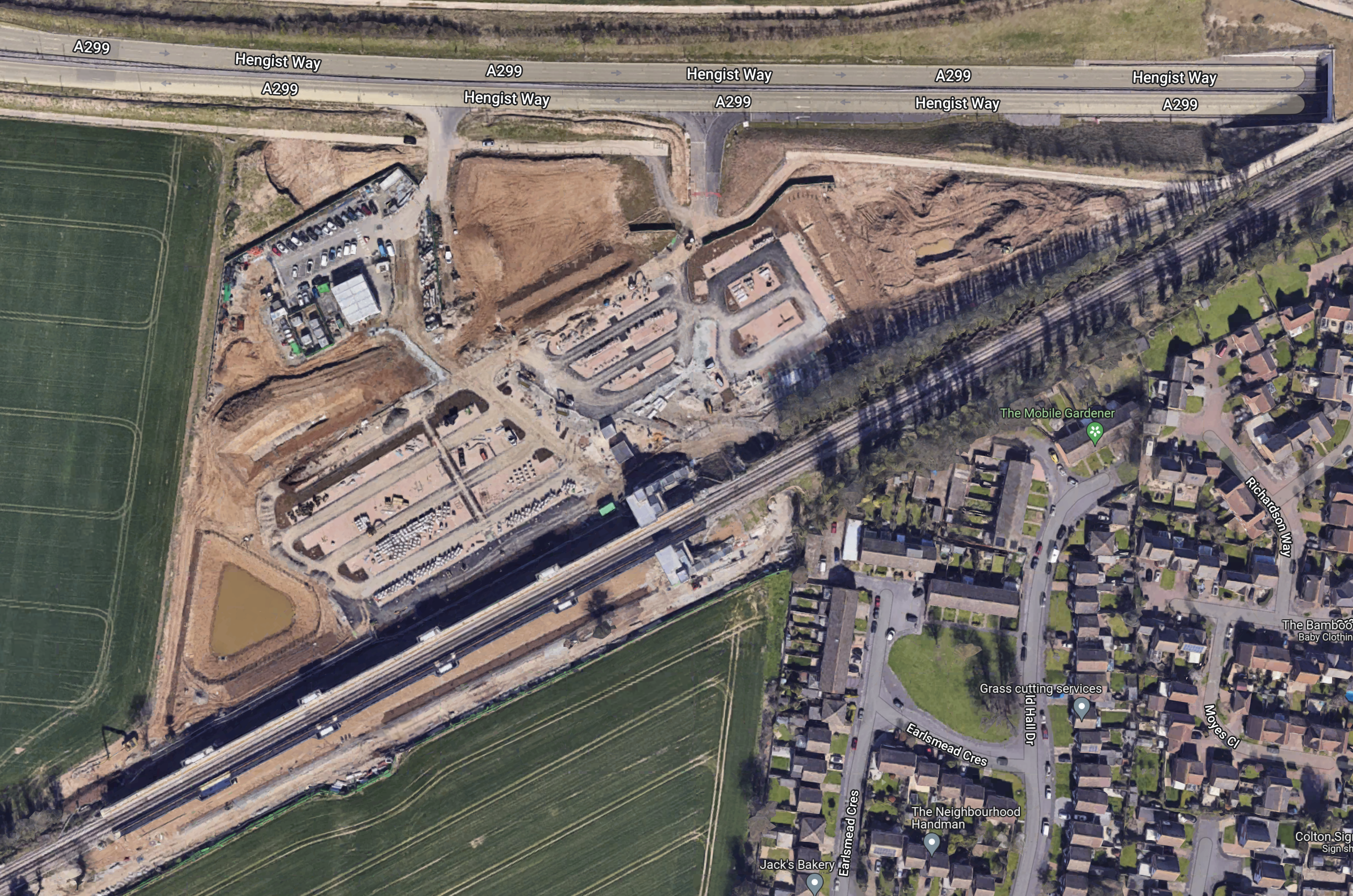
Thanet Parkway station is under construction and should be opened in May next year.
Work is progressing as this Google Map shows.
Note.
- The A299 goes across the top of the map.
- The Ashford – Canterbury – Ramsgate Line runs diagonally from South-West to North-East across the map.
- Ashford and Canterbury are to the South-West.
- Ramsgate is to the North-East.
The new Thanet Parkway station appears to be being built on the triangular site between the A299 and the railway.
- There appear to be two entrances/exits to the station from the A299.
- The pedestrian bridge over the railway is under construction.
- The roads and walkways around the station are being laid.
This video gives more details of the station.
Parking At Thanet Parkway
According to the video, there are nearly three hundred parking spaces, with a number of disabled spaces and spaces with charging for electric cars.
Is that going to be enough spaces?
But at least, there may be fields around the station, that could be used to provide additional parking.
Richborough Energy Park
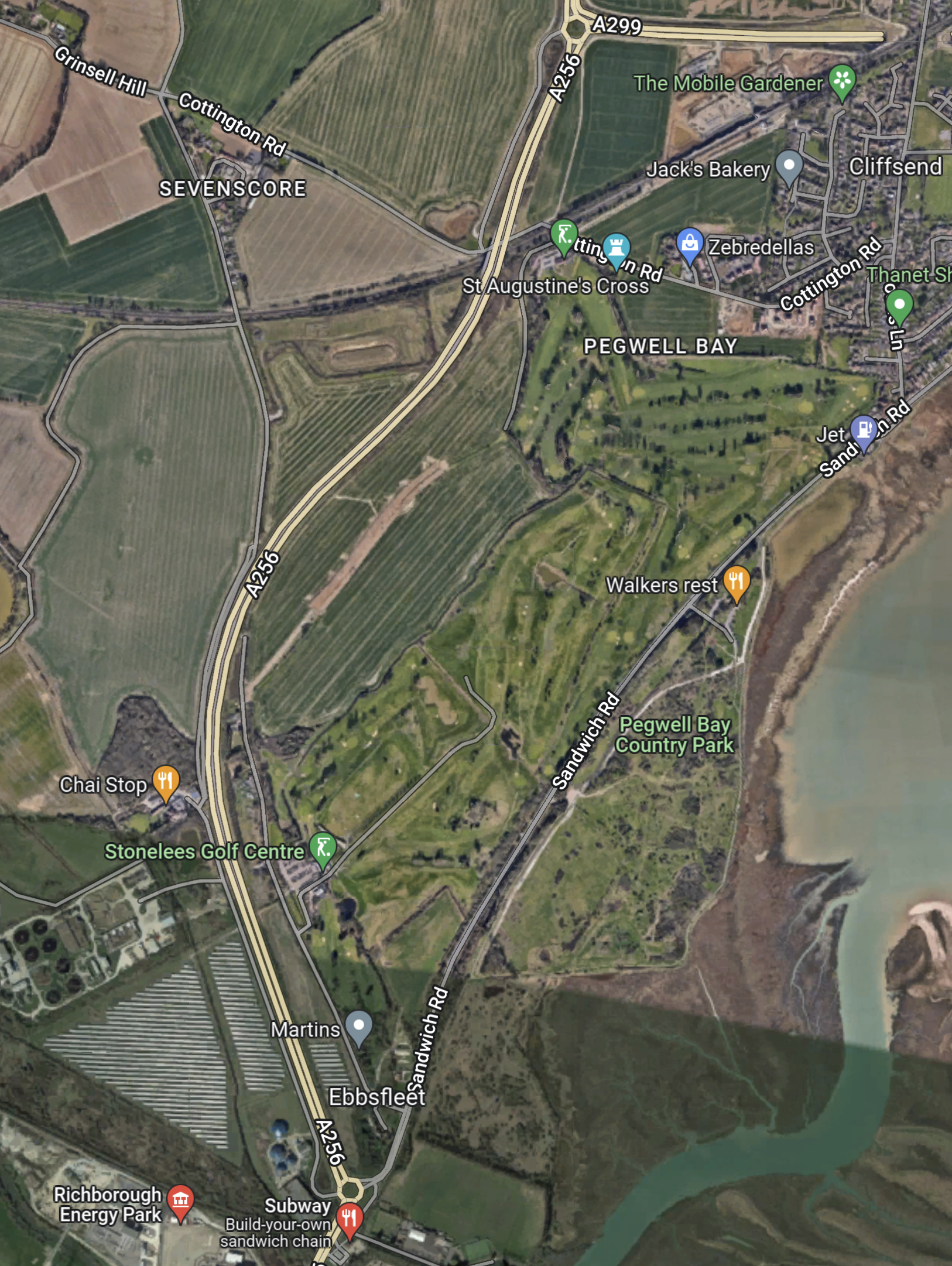
This Google Map shows the area around the station and to the South towards Richborough.
Note.
- The under-construction Thanet Parkway station is in the North-East corner of this map to the West of the village of Cliffsend.
- The dual-carriageway of the A256 runs North-South down the map to a roundabout.
- To the West of the roundabout is Richborough Energy Park.
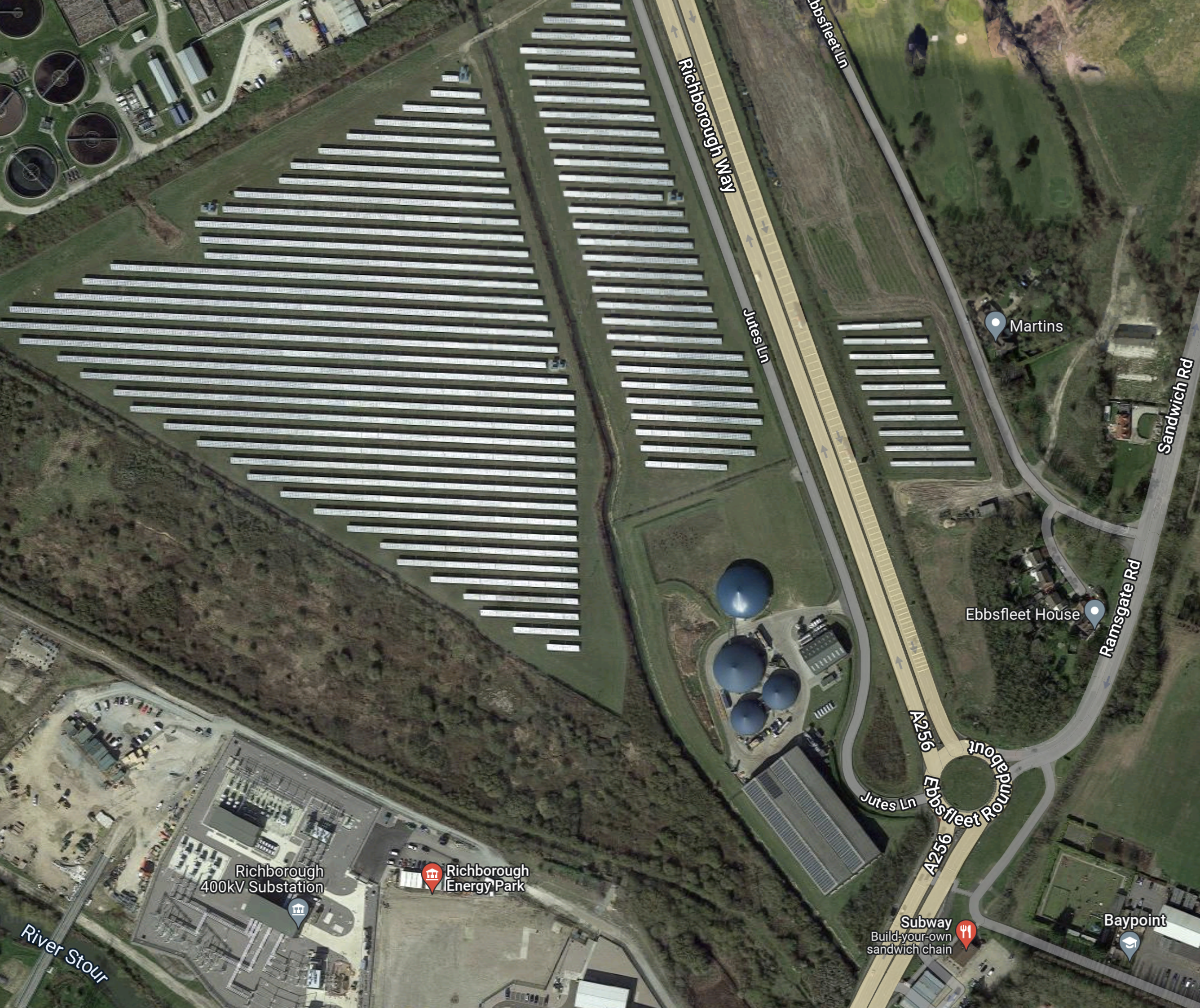
This Google Map shows the are round the energy park and the roundabout in more detail.
Note.
- The Richborough substation in the South-West corner of the map.
- The Richborough Energy Park sits to the East of the substation.
- The solar panels to the North of the roundabout are the 4.9 MW Ebbsfleet Solar Farm, which is part of Richborough Energy Park.
Richborough Energy Park is an ongoing project.
The national grid interconnector from the original power station is still in place, and is now the grid link for the 300 MW offshore Thanet Wind Farm.
It is the terminal for the NemoLink interconnector to Belgium.
Wikipedia says this about future plans.
The current owner of the site, BFL Management Ltd, plan to bring the site back into use as a £750 million green energy park. There are additional plans to create additional recycling and green energy facilities on site, including an anaerobic digester, a waste processing plant, a biomass combined heat and power generator, a pyrolysis plant and a peak demand 30MW diesel generator. When fully operational, the park could provide up to 1,400MW of power, employing 100 full-time equivalent, with up to 500 jobs in the construction phase.
I am surprised, that there is no mention of batteries or energy storage.
This press release from Network Rail is entitled Charge While You Travel With New Electric Vehicle Charging Points At Network Rail Stations.
This the body of the press release
Rail passengers with electric vehicles will be able to charge while they travel thanks to the introduction of 450 new electric vehicle charging points at Network Rail-managed car parks at railway stations.
The charging points, powered by guaranteed renewable energy, provide enough power to fully charge a vehicle in as little as 3-4 hours.
In this phase, Network Rail has powered: 160 charging points in Reading, 111 in Manchester, 84 in Edinburgh, 56 at Leeds and 41 in Welwyn Garden City.
Electric vehicle charging points will be installed across 10% of car parking spaces (approximately 779 spaces) at car parks managed by Network Rail by March 2024.
Rail is already the leading form of green public transport and this marks another milestone in Network Rail’s commitment to a low-emission railway – making sure rail is environmentally-friendly, resilient to climate change and able to provide an excellent service for years to come.
The new Compleo charging points are marked with green parking bays and passengers can pay for what they need quickly and easily via the APCOA Connect app.
Note, that there is no mention, if these are vehicle-to grid (V2G) chargers.
In Airport Plans World’s Biggest Car Parks For 50,000 Cars, I stated my belief that car parks, with hundreds or even thousands of vehicles could be turned into giant grid batteries.
- All electric vehicles, when they are parked would be plugged in to V2G chargers.
- The vehicle and the grid, would know your expected return time and how much power you would need. Probably from a parking app, assisted by AI!
- If the grid borrowed your electricity, whilst you were away, you wouldn’t know, until you received the payment for the loan.
- If your car runs on hydrogen, the parking could also handle the battery, that all hydrogen-powered vehicles have.
Thanet Parkway station would be an ideal station for such a parking system for electric vehicles.
Norfolk Boreas Offshore Windfarm Contract Awarded
The title of this post, is he same as that of this article on the BBC.
These are the introductory paragraphs.
A government contract has been awarded for the first phase one of the biggest offshore wind zones in the world.
The Norfolk Boreas is expected to secure renewable electricity to meet the needs of around 1.5 million homes, Swedish firm Vattenfall said.
Alongside the Norfolk Vanguard project, it is part of the Norfolk Offshore Wind Zone, which was approved in February.
Together, Norfolk Boreas and Norfolk Vanguard will probably produce over 3 GW of electricity.
Ørsted Awarded Contract For World’s Single Biggest Offshore Wind Farm
The title of this post, is the same as that of this press release from Ørsted.
This is the sub-title.
The UK Department for Business, Energy and Industrial Strategy (BEIS) has awarded Ørsted a contract for difference for its Hornsea 3 offshore wind farm. The project was awarded at an inflation-indexed strike price of GBP 37.35 per MWh in 2012 prices.
And this is the first paragraph, which describes the size of the farm.
With a capacity of 2,852 MW, Hornsea 3 will produce enough low-cost, clean, renewable electricity to power 3.2 million UK homes, making a significant contribution to the UK Government’s ambition of having 50 GW offshore wind in operation by 2030 as part of the British Energy Security Strategy.
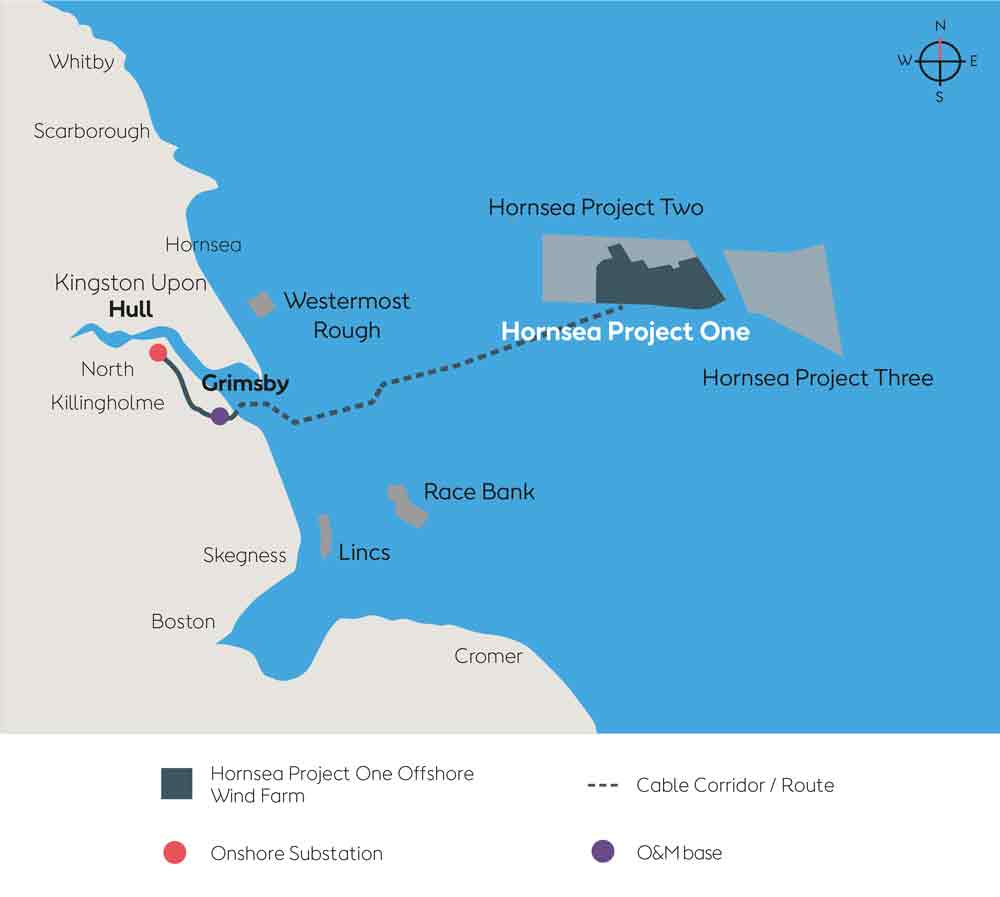
This map from Ørsted shows the location of the Hornsea wind farm and its three sections.
Note.
- The Hornsea Wind Farm, when fully developed, with a fourth section, is likely to have a capacity of around six GW.
- The Lincs, Race Bank and the Westernmost Rough wind farms are about another GW.
Looking at the map, I can see Humberside hosting the world’s largest hydrogen electrolyser to feed into the Humber Zero hydrogen network.
The Concept Of Remote Island Wind
This document from the Department of Business, Industry and Industrial Strategy lists all the Contracts for Difference Allocation Round 4 results for the supply of zero-carbon electricity that were announced yesterday.
The contracts have also introduced a concept that is new to me, called Remote Island Wind. All have got the same strike price of £46.39 per MWh.
Two of the projects on Orkney are community projects of around 30 MW, run by local trusts. This is surely, a model that will work in many places.
There is more on Orkney’s Community Wind Farm Project on this page of the Orkney Islands Council web site.
It could even have an electrolyser to provide hydrogen for zero-carbon fuel, when there is more electricity than is needed. Companies like ITM Power and others already build filling stations with an electrolyser, that can be powered by wind-generated electricity.
The other Remote Island Wind projects are larger with two wind farms of over 200 MW.
It does look to me, that the Department of BEIS is nudging wind farm developers in remote places to a model, that all stakeholders will embrace.
The Viking Wind Farm
I wrote about this wind farm in Shetland’s Viking Wind Farm.
There are more details in this press release from SSE enewables, which is entitled CfD Contract Secured For Viking Energy Wind Farm.
These introductory paragraphs, give a good explanation of the finances of this farm.
SSE Renewables has been successful in the UK’s fourth Contract for Difference (CfD) Allocation Round, announced today, and has secured a low-carbon power contract for 220MW for its wholly-owned Viking Energy Wind Farm (Viking) project, currently being constructed in Shetland.
Viking’s success in securing a contract follows a competitive auction process in Allocation Round 4 (AR4) where it competed within Pot 2 of the allocation round set aside for ‘less established’ technologies including Remote Island Wind.
The 443MW Viking project, which SSE Renewables is currently building in the Shetland Islands, has secured a CfD for 220MW (50% of its total capacity) at a strike price of £46.39/MWh for the 2026/27 delivery year.
The successful project will receive its guaranteed strike price, set on 2012 prices but annually indexed for CPI inflation, for the contracted low carbon electricity it will generate for a 15-year period. Securing a CfD for Viking stabilises the revenue from the project whilst also delivering price security for bill payers.
It’s very professional and open to explain the capacity, the contract and the finances in detail.
The press release also has this paragraph, which details progress.
Viking is progressing through construction with over 50 per cent of turbine foundation bases poured. When complete in 2024, Viking Energy Wind Farm will be the UK’s most productive onshore wind farm in terms of annual electricity output, with the project also contributing to Shetland’s security of supply by underpinning the HVDC transmission link that will connect the islands to the mainland for the first time.
SSE also released this press release, which is entitled Major Milestone Reached As First Subsea Cable Installation Begins On Shetland HVDC Link, where this is the first paragraph.
The first phase of cable laying as part of the SSEN Transmission Shetland High-Voltage Direct Current (HVDC) Link began this week off the coast of Caithness, marking a major milestone in the £660M project.
SSE seem to be advancing on all fronts on the two projects!
The Stornoway Wind Farm
This press release from EDF Renewables is entitled EDF Renewables UK Welcomes Contract for Difference Success, where these are the first two paragraphs.
Two EDF Renewables UK projects bid into the Contract for Difference (CfD) auction round held by the UK Government’s BEIS department have been successful.
The projects are the Stornoway wind farm on the Isle of Lewis and Stranoch wind farm in Dumfries and Galloway. Together these onshore wind farms will provide 300 MW of low carbon electricity which is an important contribution to reaching net zero.
The press release also gives this information about the contract and completion of the Stornoway wind farm.
Stornoway Wind Farm on the Isle of Lewis is a joint venture with Wood. The project has won a CfD for 200 MW capacity, the strike price was £46.39, the target commissioning date is 31 March 2027.
This page on the Lewis Wind Power web site, gives these details of the Stornoway Wind Farm.
The Stornoway Wind Farm would be located to the west of the town of Stornoway in an area close to the three existing wind farm sites.
The project has planning consent for up to 36 turbines and is sited on land owned by the Stornoway Trust, a publicly elected body which manages the Stornoway Trust Estate on behalf of the local community.
The local community stands to benefit as follows:
- Community benefit payments currently estimated at £900,000 per annum, which would go to an independent trust to distribute to local projects and organisations
- Annual rental payments to local crofters and the Stornoway Trust – which we estimate could total more than £1.3m, depending on the CfD Strike Price secured and the wind farm’s energy output
- Stornoway Wind Farm is the largest of the three consented wind farm projects with a grid connection in place and is therefore key to the needs case for a new grid connection with the mainland. Indeed, the UK energy regulator Ofgem has stated that it will support the delivery of a new 450MW cable if the Stornoway and Uisenis projects are successful in this year’s Contract for Difference allocation round.
Note the last point, where only the Stornoway wind farm was successful.
The Uisenis Wind Farm
This press release from EDF Energy is entitled Lewis Wind Power Buys Uisenis Wind Farm, gives these details of the sale.
Lewis Wind Power (LWP), a joint venture between Amec Foster Wheeler and EDF Energy Renewables has bought the Uisenis Wind Farm project on the Isle of Lewis. The wind farm has planning consent for the development of 45 turbines with a maximum capacity of 162 MW. This would be enough to power 124,000 homes and would be the biggest renewable energy development on the Western Isles.
LWP owns the Stornoway Wind Farm project located around 20km to the north of Uisenis which has planning consent to develop 36 turbines to a maximum capacity of 180 MW – enough to power 135,000 homes.
This would bring Stornoway and Uisenis wind farms under the similar ownership structures.
This is a significant paragraph in the press release.
On behalf of Eishken Limited, the owner of the site where the Uisenis Wind Farm will be located, Nick Oppenheim said: “I am delighted that LWP are taking forward the wind farm. The resources available on the Eishken estate, and the Western Isles in general, means that it is an excellent location for renewable energy projects and, as such, the company is also developing a 300MW pumped storage hydro project immediately adjacent to the Uisenis wind farm. With such potential for renewables and the positive effect they will have on the local community, economy, and the UK as a whole I am are looking forward to positive news on both support for remote island projects and the interconnector.”
Note the mention of pumped storage.
This article on the BBC is entitled Pumped Storage Hydro Scheme Planned For Lewis, where this paragraph introduces the scheme.
A pumped storage hydro scheme using sea water rather than the usual method of drawing on freshwater from inland lochs has been proposed for Lewis.
The only other information is that it will provide 300 MW of power, but nothing is said about the storage capacity.
It looks like Lewis will have a world-class power system.
Mossy Hill And Beaw Field Wind Farms
Mossy Hill near Lerwick and Beaw Field in Yell are two Shetland wind farms being developed by Peel L & P.
This press release from Peel L & P is entitled Government Support For Two Shetland Wind Farms, where these are the first two paragraphs.
Plans for two onshore wind farms on the Shetland Islands which would help meet Scotland’s targets for renewable energy production are a step closer to being delivered after receiving long-term Government support.
Clean energy specialists Peel NRE has been successful in two bids in the Department for Business, Energy and Industrial Strategy’s (BEIS) Contracts for Difference (CfD) scheme; one for its Mossy Hill wind farm near Lerwick and the other for Beaw Field wind farm in Yell.
It looks like the two wind farms will power 130,000 houses and are planned to be operational in 2027.
Conclusion
I must admit that I like the concept. Especially, when like some of the schemes, it is linked to community involvement and improvement.
Only time will tell, if the concept of Remote Island Wind works well.

