What Does the Future of Offshore Wind Energy Look Like?
The title of this post, is the same as that of this article on Real Clear Energy.
These topics are covered.
- Improved efficiency
- Aerodynamic blades
- Sturdiness and durability
- Big data, the cloud and artificial intelligence
- Drones
- Floating turbines and deeper waters
- Complicated coastal climate zones of which North America has eight.
Some topics weren’t covered.
- Artificial islands like the Dutch, German and Danish plan for The North Sea Wind Power Hub on the Dogger Bank.
- Conversion of wind power to hydrogen at or near the offshore turbines, which I wrote about in ITM Power and Ørsted: Wind Turbine Electrolyser Integration.
The author finishes with this statement.
The integration of wind energy, in any form, can ultimately benefit all 50 states in the US by 2050 if it starts now.
In 1962, Bob Dylan, wrote this famous phrase.
The answer, my friend, is blowin’ in the wind.
Fifty-eight years later he’s been proven right, in a big way!
Ryze Hydrogen Wants To Make The North East Of Scotland A World Leader In Hydrogen
The title of this post, is the same as that of this article on H2 View.
This is the introductory paragraph.
Ryze Hydrogen has pledged to work with the Scottish Government and local authorities to make the North East of Scotland a world leader in hydrogen.
I think this is both a laudable and a very sensible aim.
- Large offshore wind farms are being built both around Aberdeen and the Far North of Scotland.
- Production of hydrogen is a sensible way to use spare renewable electricity.
- That area of Scotland is not short of wind.
- Aberdeen will be taking delivery of hydrogen buses later this year.
- With their experience of the oil industry, there would not be a shortage of people with the necessary expertise.
The article also details Jo Bamford’s plans for hydrogen buses.
Newcomer Broad Reach Power To Deploy Increasingly Large Battery Systems In Texas
The title of this post is the same as that of this article on Energy Storage News.
This is the introductory paragraph.
US-based independent power producer (IPP) Broad Reach Power has said it will build 15 projects in Texas in 2020, each of them just under 10MW / 10MWh, with construction on six of them set to begin this summer.
The article then goes on to describe the electricity industry in Texas and where the battery storage fits in.
It’s all a far cry from the Texas portrayed in soaps like Dallas.
Wind Power In Texas
Wind Power in Texas has its own Wikipedia entry and this is the first paragraph.
Wind power in Texas consists of over 40 wind farms, which together have a total nameplate capacity of over 28,000 MW (as of 2019). If Texas were a country, it would rank fifth in the world: The installed wind capacity in Texas exceeds installed wind capacity in all countries but China, the United States, Germany and India. Texas produces the most wind power of any U.S. state.
But then everything in Texas, is famed as being the biggest in the world.
Their installed capacity of 28 GW compares with 17.64 GW of installed wind power in the UK.
Solar Power In Texas
Solar Power in Texas also has its own Wikipedia entry and this is the first paragraph.
Solar power in Texas, along with wind power, has the potential to allow Texas to remain an energy-exporting state over the long term. The western portion of the state especially has abundant open land areas, with some of the greatest solar and wind potential in the country. Development activities there are also encouraged by relatively simple permitting and significant available transmission capacity.
The Wikipedia entry also says that in 2019, Texas had 4.32 GW of installed solar power.
By comparison, the UK has 8.1 GW of installed solar power. Who’d have thought that?
As Texas is 2.87 times geographically larger than the UK, if Texas had the same solar panel density as the UK, Texas would have an installed capacity of 23.2 GW.
The Need For Energy Storage In Texas
With all this installed wind and solar energy in Texas and its potential for expansion, there would appear to a massive demand for energy storage in the state.
Conclusion
What would JR think?
Norway Announces $384.5m Clean Energy Fund To Aid In Covid-19 Recovery
The title of this post, is the same as that of this article on Power Technology.
These are the first one-and-a-half paragraphs.
Last week, Norway announced plans to fund a “green transition package”, investing $384.5m into sustainable power and infrastructure to help the country’s economy and productivity post-Covid-19.
The fund will be used to support a range of initiatives, including investments in hydrogen power and battery storage technology, building offshore wind infrastructure, and renovations to new and existing buildings, as Norway looks to reach the Paris Climate Agreement target of limiting global temperature rise to less than two degrees by 2050.
Perhaps we should follow Norway’s lead.
‘World First’: SGN Launches Bid For 300 Green Hydrogen Homes Project In Fife
This title of this post, is the same as that of this article on Business Green.
This is the introductory paragraph.
Around 300 homes in Scotland could soon have their heating and cooking powered by green hydrogen produced from renewable electricity under proposals for “the world’s first green hydrogen-to-homes network” unveiled today by SGN.
A few points from the article.
- Construction could start in the winter of 2020/21.
- The project will take two or three years.
- The modified houses appear to be in Levenmouth.
- The project has been dubbed H100 Fife.
- The hydrogen will be produced by electrolysis using electricity generated by offshore wind.
The article also gives a round-up of the state of hydrogen in the UK.
This is the home page of the H100 Fife project web site.
Could This Have Other Implications For Levenmouth?
In Scottish Government Approve £75m Levenmouth Rail Link, I discussed the rebuilding of the Levenmouth Rail Link.
I suggested that the route could be run by Hitachi Class 385 trains with batteries, which Hitachi have stated are being developed. I covered the trains in more detail in Hitachi Plans To Run ScotRail Class 385 EMUs Beyond The Wires.
If there were to be a source of hydrogen at Levenmouth, could hydrogen-powered trains be used on the route?
- The simplest rail service could be a hydrogen-powered shuttle train between Levenmouth and Glenrothes with Thornton stations.
- I estimate that the five-mile route could support two trains per hour, using a single train.
- Trains could be an Alstom Breeze, a Class 799 train or a hydrogen-powered Class 230 train.
The Levenmouth Rail link could be a prototype for other short rail links in Scotland.
In
Vietnam Has Potential For ‘160GW Of Offshore Wind’
The title of this post, is the same as that of this article on renews.biz.
This is the introductory paragraph.
The Danish Energy Agency (DEA) and the Vietnamese Electricity and Renewable Energy Authority are working together on input for a roadmap for offshore wind development in the south-east Asian country that has estimated potential for 160GW.
The report illustrates that windpower, is for all nations.
Floating Wind Swells, Hydrogen On A High And Here Comes The 150-Hour ‘Aqueous Air’ Battery
The title of this post is the same as that of this weekly summary on Recharge.
There are three major stories.
Floating Wind Turbines
A lot more floating wind turbines are under development, by the French, Swedes, South Africans and Japanese.
I do wonder, if these structures have borrowed the work done in Cambridge by Balaena Structures, for which I did the calculations, as I wrote about in The Balaena Lives.
From what I remember of my calculations fifty years ago, I suspect these floating turbines can be massive and places, in areas, where the winds are really strong.
I also believe that some could have built-in hydrogen generators and could be placed over depleted gas fields and connected to the existing gas pipes.
Hydrogen
The article describes how oil giants; BP and Shell are moving towards hydrogen.
Battery Storage
They also talk about Form Energy and their mysterious ‘aqueous air battery, which Recharge covered earlier. I discussed that article in The Mysterious 150-hour Battery That Can Guarantee Renewables Output During Extreme Weather.
Conclusion
This article is a must-read.
Recharge is also a site to follow, if you are interested in the developments in renewable energy.
Majority Of Ready-to-Build UK Battery Storage Projects Are Bigger Than 30MW
The title of this post is the same as that on this article on Energy Storage News.
This is the introductory paragraph.
There are 1.3GW of read-to-build battery storage projects in the UK, with the majority between 30MW and 49.9MW power output per project, according to new analysis from Solar Media Market Research.
There is certainly a lot of energy storage being developed in the UK.
But then Wind Power In The UK is set to rise substantially to at least 40GW, in the next few years.
Funding Award to Supply An 8MW Electrolyser
The title of this post, is the same as that of this Press Release from ITM Power.
This is the main body of the Press Release.
ITM Power, the energy storage and clean fuel company, is pleased to announce it has signed an agreement to supply an 8MW electrolyser in the UK. The agreement, including associated project costs, has a total value of £10m and funding will fall across FY2021 and FY2022. Further details will be announced in due course.
I bet they’re pleased!
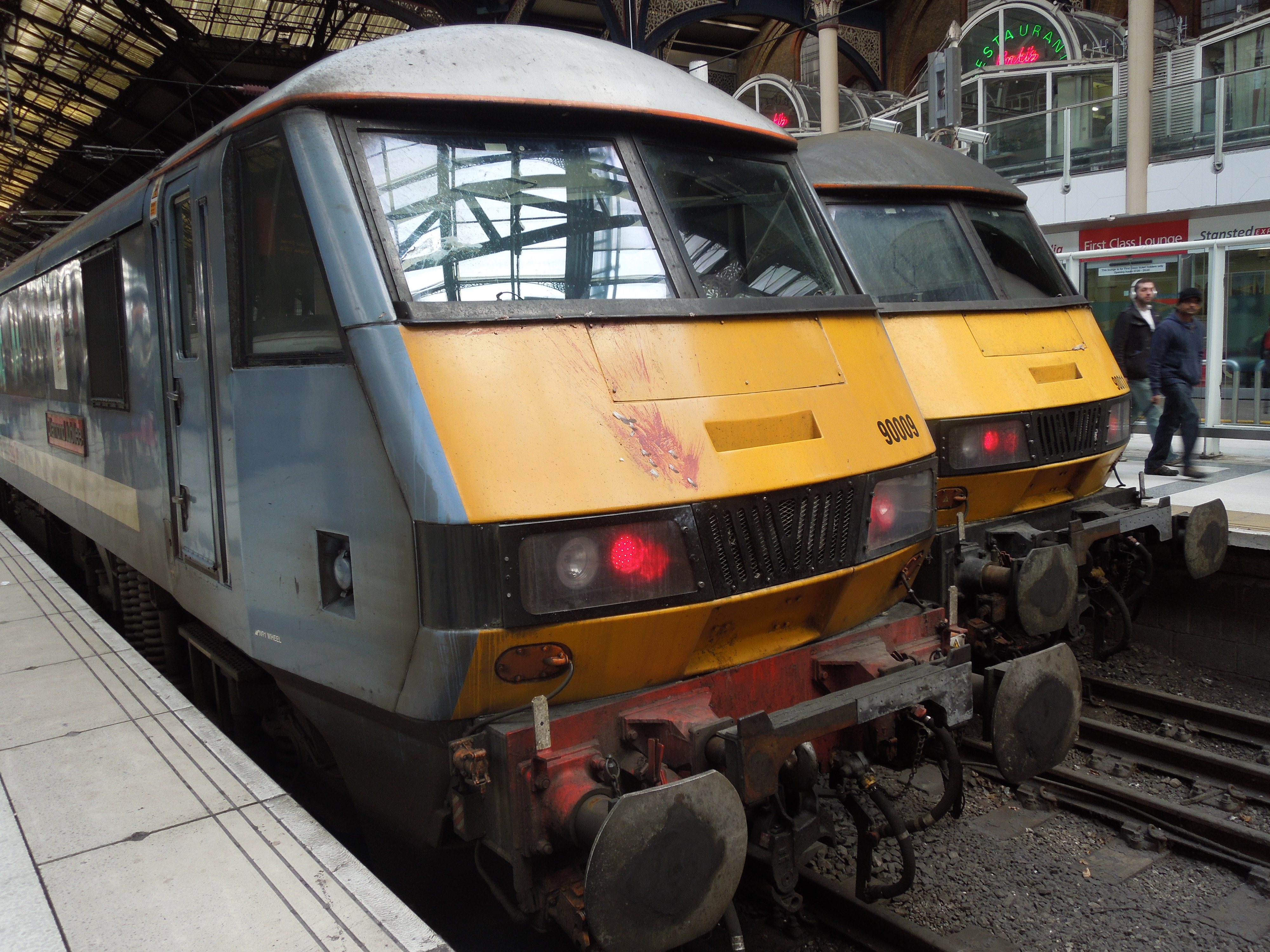
To get a hold on what 8 MW looks like, these Class 90 locomotive each have a power output of just under 4 MW and are capable of hauling an eight-coach express train at 110 mph.
Working at full rate, the electrolyser will be able in a year to convert 70 GWh of electricity into hydrogen.
Why Would You Want An 8MW Electrolyser?
These are a few ideas.
Green Hydrogen For Humberside
This is a project described in this ITM Power Press Release.
This is the first three paragraphs.
ITM Power, the energy storage and clean fuel company, is pleased to announce that it has won, with partner Element Energy, a first stage deployment project in the UK Government’s Industrial Strategy Challenge Fund competition “Decarbonisation of Industrial Clusters” to assess the feasibility and scope of deploying green hydrogen with some major industrial partners in Humberside.
“Green Hydrogen for Humberside” will lead to the production of renewable hydrogen at the Gigawatt (GW) scale distributed to a mix of industrial energy users in Immingham, Humberside. Decarbonisation of this cluster is critical in reaching the UK’s legally binding 2050 net zero emission targets. Humberside, the UK’s largest cluster by industrial emissions, (12.4Mt of CO2 per year), contributes £18bn to the national economy each year and has access to a large renewable resource from offshore wind in the North Sea.
The project will work with customers in the region to establish the feasibility of switching to renewable hydrogen and justify a number of 100MW deployments of electrolysers. The project will cost the supply of hydrogen to these end users. This includes the electricity supply to the electrolyser, the hydrogen production facility, hydrogen distribution across the Humber and conversion of existing processes to use renewable hydrogen.
The study talks about a number of 100 MW deployments of electrolysers.
Will the 8MW electrolyser be a demonstrator for this project?
To Convert Surplus Renewable Energy Into Hydrogen Which Is Injected Into The Gas Grid
The Wikipedia entry for ITM Power has a section entitled Energy Storage Power To Gas. This is the first paragraph.
Power-to-Gas is a methodology of introducing such hydrogen to the natural gas network, essentially converting renewable electrical power to a clean gas that can be more conveniently stored using existing assets. There are two main Power-to-Gas mechanisms. The first involves metering pressurised hydrogen into the gas network directly. The second involves combining hydrogen with carbon dioxide via a methanation process to produce synthetic natural gas prior to introduction to the grid.
The electrolyser could be used to convert a lot of electricity into zero-carbon hydrogen for use in the UK gas network.
Improving The Resilience Of The UK Gas Network
This article on the BBC is entitled Major Power Failure Affects Homes And Transport and it describes a major power failure, when two generators failed in August 2019.
Could the 8MW electrolyser be part of the solution to make the UK power network more robust, if parts of the network fail?
To Create Feedstock For An Oil Refinery Or Petro-Chemical Plant
Hydrogen can be used as a feedstock for an oil refinery or petro-chemical plant.
This ITM Power Press Release, describes such a project, where wind power from the North Sea is used to create hydrogen for Phillips 66 Limited’s Humber Refinery.
As Part Of An Experimental Steel-Making Plant
This is pure speculation on my part, but steel-making creates lot of carbon-dioxide.
I do believe that using hydrogen to make steel is possible and ITM Power are based in the steel-city of Sheffield.
On the other hand look at the HYBRIT web site.
This is the introductory paragraph.
In 2016, SSAB, LKAB and Vattenfall joined forces to create HYBRIT – an initiative that endeavors to revolutionize steel-making. HYBRIT aims to replace coking coal, traditionally needed for ore-based steel making, with hydrogen. The result will be the world’s first fossil-free steel-making technology, with virtually no carbon footprint.
During 2018, work started on the construction of a pilot plant for fossil-free steel production in Luleå, Sweden. The goal is to have a solution for fossil-free steel by 2035. If successful, HYBRIT means that together we can reduce Sweden’s CO2 emissions by 10% and Finland’s by 7%.
This page on their web site is entitled Steel Making Today And Tomorrow. This image compares traditional blast furnace steelmaking with HYBRIT.
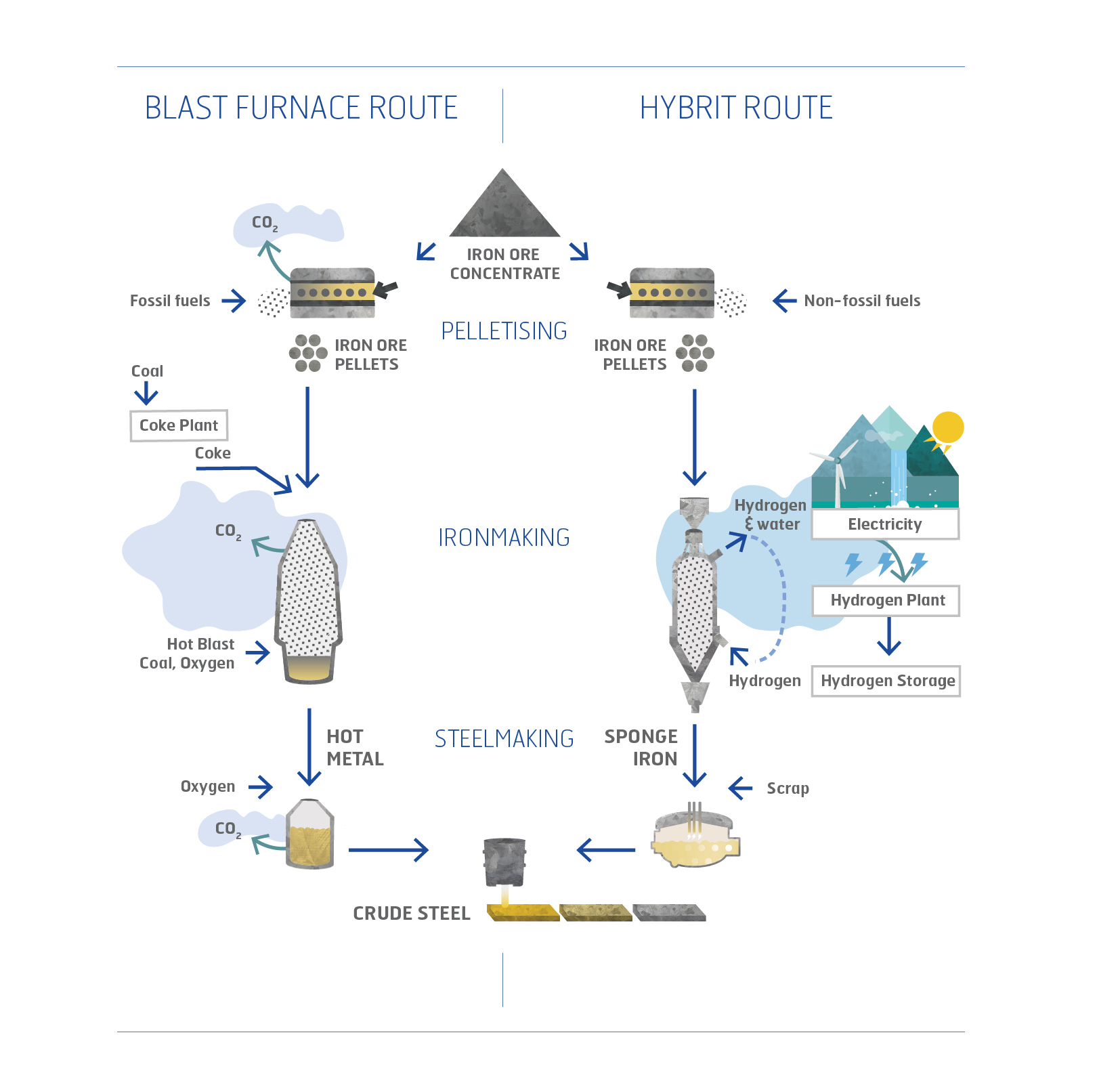
Note that at the heart of the process is the production of hydrogen from renewable electricity. This process will need a large electrolyser.
Could someone be doing something similar in Sheffield or more likely, Scunthorpe?
- British Steel may be owned by the Chinese, but it has a record of innovation.
- We will need a lot of long steel products, like railway rails and girders, in which British Steel specialise.
- In a few years, Humberside will have enough renewable electricity from North Sea wind to create an electro-magnetic gun to fire space capsules at Mars.
I will be watching out for hydrogen steelmaking.
Is Jim Ratcliffe Up To Something?
Jim Ratcliffe is a very rich man and the chairman and CEO of INEOS, which has a turnover of $83billion.
Consider.
- INEOS must know about hydrogen.
- I read some years ago, how they were using waste hydrogen to generate electricity on Teesside.
- I have a feeling that they have backed a hydrogen fuel-cell company.
- They own the hydrogen factory in Runcorn, where I worked in 1970.
- They have extensive interests in the North West, North East and Scotland.
- The company probably has an enormous carbon-footprint, that they’d probably like to reduce, by perhaps using hydrogen instead of natural gas as a feedstock for some processes, like production of ammonia.
But above all the cost of an 8MW electrolyser would be small change and probably cost a lot less, than running the cycling team.
The Fallback
It could of course be used to produce a large amount of hydrogen to power buses, cars and trains.
 The Anonymous Widower