Do Cummins And Stadler Have a Cunning Plan?
Roger Ford in the December 2022 Edition of Modern Railways has written an article called Traction à la mode.
The article is a series of small sections, with the last section but one, labelled Monster.
Roger says this.
Finally, we come to the mighty Class 99, which is not at all flakey. In the past I have often commented on the UK railways’ prejudice against Co-Co bogies.
But with the ’99’ six axles will give 6MW (8,000 hp) at the rail, with contact patches to use all its 113 tonnes. Plus the extra axles mean it can accommodate the weight of a 2,400 hp Cummins diesel.
At the recent Rail Freight Group conference, Ross Shepherd, Chief Technical Officer of Beacon Rail, which has 30 locomotives on order for GB Railfreight, revealed a computer simulation which showed a Class 99 would save 36 minutes on a run timed for 1 hr 40 minutes for diesel traction. To quote Mr Shepherd:’It’s a monster and it’s coming.’
I have been doing some digging around the Internet and have found this bulletin from Cummins, which is entitled QSK60 For Rail.
The Class 99 locomotive appears to have a QSK50, which appears to be a less powerful version.
The bulletin describes a Stadler locomotive with a Cummins QSK60 engine, which Stadler are delivering to Bolivia.
This paragraph introduces the locomotives.
Stadler and the Bolivian Ferroviaria Andina (Andean
Railway) FCA have signed a contract for the supply of the first three state-of-the art South American Light
Loco (SALi) locomotives, which will feature the
Cummins QSK60 engine.
The bulletin gives these details.
- Locomotive type – diesel-electric
- Track gauge – one metre
- Axle load – 18 ton/axle
- Power – 1865 kW – 2500 hp
- Diesel engine – QSK60
- Maximum Speed – 100 km/h
- Starting Tractive Effort – 415 kN
- Coupling – AAR
- Fuel Tank – Up to 6000 litres
The bulletin is marked as Printed in UK, so does that mean that the engines will come from Darlington.
The weight of this locomotive is 98 tonnes and Roger says that the Class 99 locomotive is 113 tonnes. But the Class 99 locomotive is an electro-diesel locomotive with 6 MW available when running on 25 KVAC overhead electrification.
It looks to me that Stadler have arranged the substantial electrical gubbins around the Cummins QSK50 diesel engine to create Beacon Rail’s monster.
Cummins And Hydrogen
Cummins is a company, that is big in hydrogen.
- They own hydrogen fuel cell and electrolysis company; Hydrogenics.
- They supply the fuel cells for Alstom’s hydrogen-powered Coradia iLint.
In Werner Enterprises Signs Letter Of Intent Planning To Secure 500 X15H Engines From Cummins, I said this.
More details of the X15H engine are given in this earlier press release, which is entitled Cummins Inc. Debuts 15-Litre Hydrogen Engine At ACT Expo, which has this first paragraph.
Today, Cummins Inc. debuted its 15-liter hydrogen engine at ACT Expo in Long Beach, California. This engine is built on Cummins’ new fuel-agnostic platform, where below the head gasket each fuel type’s engine has largely similar components, and above the head gasket, each has different components for different fuel types. This version, with expected full production in 2027, pairs with clean, zero-carbon hydrogen fuel, a key enabler of Cummins’ strategy to go further faster to help customers reduce greenhouse gas (GHG) emissions.
I certainly like the concept of a fuel-agnostic platform, where below the head gasket, everything is similar, and above the head gasket, there are appropriate components.
Could This Philosophy Be Used To Create An Electro-Hydrogen Locomotive?
It looks to me that if Stadler use the Cummins QSK diesel engine in their locomotives, then if Cummins develop a hydrogen version of the QSK, Stadler can convert the locomotives to hydrogen, if Cummins follow their philosophy of a fuel-agnostic platform, with everything identical below the cylinder head gasket.
Over twenty years ago, I did a small data analysis task for Cummins in Darlington. One of their engineers explained to me how they would rearrange the components of diesel engines, so they fitted with the customer’s application. It looks to me that they have taken this philosophy a step further, so that the customer can have diesel or hydrogen engines in the same application, depending on what the end user wants.
In the case of the order from Beacon Rail for thirty Class 99 locomotives, they will be delivered as electro-diesel locomotives, but at some point in the future, when Cummins has developed the hydrogen engine, they will be able to be converted to electro-hydrogen locomotives.
These locomotives could be in front-line service for over forty years!
The Very Long Range Electro-Hydrogen Locomotive
Hydrogen surely has the power and range to move freight trains across continents.
But can everything be fitted in a standard locomotive body?
Alstom have come up with an innovative solution, which I described in From 2025, Nestlé Waters France Will Use The First Hydrogen-Powered Freight Train Through An Innovative Solution Developed by Alstom and ENGIE
I would also suspect a simple tender containing a tank full of hydrogen will also work.
Collateral Benefits Of A Electro-Hydrogen Locomotive
These are possible benefits of electro-hydrogen locomotives.
- Staff in ports and freight depots get all the clean-air benefits of working with zero-carbon and low-pollution locomotives.
- Ports are becoming hydrogen hubs to fuel ships and ground-handling equipment, so electro-hydrogen locomotives could be easily-fueled.
- Ports and freight depots don’t like electrification, as containers occasionally get dropped.
- Electro-hydrogen locomotives will be able to do their own shunting.
- Electro-hydrogen locomotives will not need all tracks to ports and freight depots to be electrified, but won’t mind if they are.
These benefits would allow Network Rail and the operators of ports and freight depots to develop the best solutions for their operations.
London Bus Cuts: Sadiq Khan Pulls Handbrake On Planned Changes
The title of this post, is the same as that of this article on the BBC.
In The Mayor Of London Is Pruning The North London Bus Network Again, I pointed out Sadiq Khan’s lopsided pruning of the London bus network.
Sadiq Khan has now changed his mind, as this paragraph indicates.
Transport for London (TfL) has announced it will only get rid of three bus routes following a consultation which saw more than 20,000 replies.
These paragraphs explain the changes in detail.
As a result of the consultation, 17 routes which had been proposed to be cut will be saved and kept as they currently operate. Another 40 services will also no longer be changed as initially planned.
Only three routes will be removed entirely – the 521 between Waterloo and London Bridge, the 507 between Victoria and Waterloo, and the 332 between Brent Park and Paddington – while alterations will be made to another 11 services.
Of the plans consulted on:
Routes 4, 12, 14, 24, 31, 45, 72, 74, 78, 242, 349, C3, D7, N31, N72, N74 and N242 will be saved and kept as they are
Planned tweaks to routes 15, 19, 27, 43, 47, 49, 53, 56, 88, 98, 100, 113, 135, 148, 171, 189, 205, 214, 236, 254, 259, 277, 279, 283, 328, 343, 388, 414, 430, 476, D3, D8, N15, N19, N27, N98, N133, N205, N414 and N430 will no longer happen
Proposed changes to routes 3, 6, 11, 23, 26, 59, 77, 133, 211, C10 and N26 will still go ahead
TfL said the consultation had raised issues with the plans and as a result the mayor of London had been able to find extra funding to ensure the cuts did not happen on such a large scale.
That is certainly a substantial U-turn!
Construction Has Started On The Silvertown Tunnel
These pictures show that construction has started on the Silverton Tunnel.












Note that New Civil Engineer is reporting that tunnelling has started.
My Current Thoughts On The Silvertown Tunnel
In 2015, I wrote No To Silvertown Tunnel, which I started with these two paragraphs.
My personal feelings about the Silvertown Tunnel are that it is irrelevant to me, except that it might help some trucks bring goods that I buy online or at a local shop. Although as a sixty-eight year-old-widower living alone, I don’t think my transport needs through the tunnel will be high.
I don’t drive after my stroke and I like that lifestyle, except when last night it took me three trains, a coach and a taxi to get back from watching football at Ipswich. But that tortuous late night journey was caused because NuLabor spent my tax money on pointless wars that will haunt us for generations, rather than in extending and renewing our rail system, that will nurture and enrich our future.
But my objections to the Silvertown Tunnel have changed and expanded.
New Transport Infrastructure Attracts Passengers
This may seem obvious, but there has been several cases recently in London to prove my point.
- The London Overground has been a success beyond Transport for London’s wildest dreams and as an example the North London Line, that started with three x three-car trains per hour (tph) is now running eight x five-car tph. This is a four time increase in capacity.
- New buses and contactless ticketing have encouraged more passengers to use the buses.
- Electrification and new trains has transformed the Gospel Oak to Barking Line.
- The expansion of Thameslink and new trains now carries a lot more North-South traffic through London.
- Every time, a new section of the Elizabeth Line opens more passengers are attracted to the new line.
- The remodelling of London Bridge station has increased passenger numbers. And shoppers!
On a personal note, I live on a bus corridor, that runs between North London and Moorgate for the Lizzie Line. Since the Lizzie Line has been fully connected, passenger numbers have risen by a big margin.
I don’t believe that the ability to attract more traffic of the Silvertown Tunnel will be any different.
More Traffic Means More Congestion And Pollution
I live close to the Balls Pond Road, which increasingly seems to be a truck route across North London.
The Silvertown Tunnel will be two lanes each way; one for trucks and buses, and one for smaller vehicles.
I can’t see that pollution and congestion around the Silvertown Tunnel and on the routes to the tunnel, will not increase.
There Is Little Or No Provision For Cyclists And Pedestrians
This will be a big problem. Especially, as the local traffic in the area will increase dramatically.
Does Central London Have Enough Parking For The Increased Traffic?
Parking in Central London is probably close to capacity now!
So What Would I Do?
Given that construction has already started, I feel it is too late to cancel.
Better Alternatives Than Driving
I feel measures should be adopted that provide better alternatives than driving.
Obviously, this won’t help with trucks, but it could reduce the total number of vehicles going through the tunnel.
These could include.
- Increase the frequency of trains on both the Lizzie Line and Thameslink.
- Increase the number of destinations on both the Lizzie Line and Thameslink.
- Add an extra car to Lizzie Line trains.
- Remove First Class on the shorter eight-car Thameslink trains.
- Add provision on some Lizzie Line and Thameslink routes for bicycles.
- Add a Silvertown station to the Elizabeth Line for London City Airport.
- Add one or more pedestrian and cycling bridges across the Thames.
- Expand of the Docklands Light Railway.
- Expand the Thames Clipper.
- Connect Barking Riverside station to Thamesmead and Abbey Wood station either by a rail or a fast ferry.
- Keep the cable-car.
I suspect there are other viable ideas.
Develop Incentives To Use Public Transport
Incentives could be in these areas.
- Better station and bus terminals encourage more to use trains and buses.
- Full free onboard wi-fi and phone charging.
- Special fares for some journeys.
An example of the latter could be a discount for certain cross-river journeys.
Make The Silvertown Tunnel Available For Zero Carbon Vehicles Only
This would surely cut pollution in London.
Conclusion
We should use the Silvertown Tunnel to improve London’s air quality.
Beware Of Getting Hospital Appointments Wrong
On Monday, I had an appointment for an ultrasound examination on my liver at the local hospital at 09:40.
The appointment had been arranged by telephone and I also had a text which included the phrase “Please refer to your letter for pre-attendance advice and instructions.” I had been given basic instructions over the telephone, but I did not receive the letter. This is not the hospital’s fault, as I have received many letters in the past from the hospital and its Trust.
But my post has been very erratic these last few weeks and I suspect the letter is delayed somewhere.
As it happened, it didn’t matter, as the basic instructions sufficed and the ultrasound was a success all round.
Perhaps, in these days of problems with the Royal Mail, it may be prudent to include minimum instructions in the text message reminder.
100 MW Scottish Floating Wind Project To Deliver Lifetime Expenditure Of GBP 419 Million
The title of this post, is the same as that of this article on offshoreWIND.biz.
This is the sub heading, that gives more details on lifetime expenditure and full-time equivalent (FTE) jobs created.
The 100 MW Pentland Floating Offshore Wind Farm in Scotland is estimated to deliver lifetime expenditure of GBP 419 million in the UK and to support the creation of up to 1,385 full-time equivalent (FTE) jobs.
It does seem these figures have been compiled using the rules that will apply to all ScotWind leases and have used methods laid down by Crown Estate Scotland. So they should be representative!
Does it mean that a 1 GW floating wind farm would have a lifetime expenditure of £4.19 billion and create 13, 850 full-time equivalent (FTE) jobs?
This article from Reuters is entitled UK Grid Reforms Critical To Hitting Offshore Wind Targets and contains this paragraph.
The government aims to increase offshore wind capacity from 11 GW in 2021 to 50 GW by 2030, requiring huge investment in onshore and offshore infrastructure in England, Wales and Scotland.
If I assume that of the extra 39 GW, half has fixed foundations and half will float, that means that there will be 19.5 GW of new floating wind.
Will that mean £81.7 billion of lifetime expenditure and 270,075 full-time equivalent (FTE) jobs?
Conclusion
It does seem to me, that building floating offshore wind farms is a good way to bring in investment and create full time jobs.
Could Battery-Electric Trains Be Used To Fight Cable Theft On Third-Rail Electrified Lines?
This article on the Network Rail web site is entitled What We’re Doing To Beat The Thieves.
These two paragraphs introduce the article.
Cable theft costs us millions of pounds each year. The total cost to the economy – taking into account the impact of freight delays to power stations and supermarkets, and on passengers who miss appointments or have their day ruined – is even higher.
The theft of metal is a big problem for the railway as thieves target signalling cables, overhead power lines and even metal fences to sell for scrap.
I took these pictures of cables on a trip to Hayes station, where the electrification is third-rail.








They all seem to be big and fat and are almost solid copper. Note that the cables are fat as they are carrying 750 VDC, so they need to be so, to carry the power for the trains, which can be several megawatts.
This explains, why thieves love these cables lying around and easy to access.
I should also say from personal experience, that with the right tools, it is easy to cut cables like these. When I worked at Enfield Rolling Mills in one summer in the early 1960s, I was asked by an electrician to help him dismantle the power cables to a machine. He cut through one with ease with an ordinary hacksaw, whilst I held it, with a couple of clamps.
I suspect modern day cable thieves have more advanced tools than we did sixty years ago.
A rail network like the UK, generally has four main types of lines that are electrified using third rails.
- Main Lines, where trains run at 100 mph plus.
- Branch Lines, which are generally shorter and trains run more slowly.
- Sidings and depots.
- Junctions
Note.
- Main Lines are probably easier to protect using security cameras, drones and surveillance devices on trains.
- As trains are also more frequent and faster, this must make cable thefts less likely to happen on Main Lines.
- Branch Lines and especially rural ones, that may be quiet for long periods could be very difficult to protect.
- Judging by the amount of graffiti on trains put on in sidings and depots, these are not easy to protect.
- Junctions are complex, often with lots of cables, so could be magnets for thieves.
It should also be noted that there are phone apps, that can be used by the thieves to know when a train is coming.
So could it be possible to cut cable theft, by using battery-electric trains, that didn’t need electrification in theft-prone areas like branch lines, sidings, depots and junctions?
Dogger Bank – The Joke That Is Growing Up To Be A Wind Powerhouse
The Wikipedia entry for the Dogger Bank, describes it like this.
Dogger Bank is a large sandbank in a shallow area of the North Sea about 100 kilometres (62 mi) off the east coast of England.
But many of my generation remember it from its use in the Shipping Forecast and as a joke place like the Balls Pond Road, Knotty Ash and East Cheam, in radio and TV comedy from the 1950s and 1960s.
But now it is being turned into one of the largest wind powerhouses!
According to Wikipedia’s list of the UK’s offshore wind farms, these wind farms are being developed on the Dogger Bank.
- Sofia Offshore Wind Farm – 1400 MW – Under Construction – Commissioning in 2023/26 – £39.65/MWh – RWE
- Dogger Bank A – 1235 MW – Under Construction – Commissioning in 2023/24 – £39.65/MWh – SSE/Equinor
- Dogger Bank B – 1235 MW – Pre-Construction – Commissioning in 2024/25 – £41.61/MWh – SSE/Equinor
- Dogger Bank C – 1218 MW – Pre-Construction – Commissioning in 2024/25 – £41.61/MWh – SSE/Equinor
- Dogger Bank D – 1320 MW – Early Planning – SSE/Equinor
- Dogger Bank South – 3000 MW – Early Planning – RWE
Note.
- These total up to 9408 MW.
- The Dogger Bank wind farms have their own web site.
- The Sofia offshore wind farm has its own web site.
- The Dogger Bank South wind farms have their own web site.
- Dogger Bank A and Dogger Bank B will connect to the National Grid at Creyke Beck to the North of Hull.
- Sofia and Dogger Bank C will connect to the National Grid at Lazenby on Teesside.
But this is only the start on the British section of the Dogger Bank.
This map, which comes courtesy of Energy Network Magazine and 4C Offshore is entitled 2001 UK Offshore Windfarm Map shows all UK offshore wind farms and their status. It looks to my naive mind, that there could be space for more wind farms to the North and West of the cluster of Digger Bank wind farms.
The North Sea Wind Power Hub
The UK doesn’t have full territorial rights to the Dogger Bank we share the bank with the Danes, Dutch and Germans.
In the Wikipedia entry for the Dogger Bank wind farm, this is said about the North Sea Wind Power Hub.
Dutch, German, and Danish electrical grid operators are cooperating in a project to build a North Sea Wind Power Hub complex on one or more artificial islands to be constructed on Dogger Bank as part of a European system for sustainable electricity. The power hub would interconnect the three national power grids with each other and with the Dogger Bank Wind Farm.
A study commissioned by Dutch electrical grid operator TenneT reported in February 2017 that as much as 110 gigawatts of wind energy generating capacity could ultimately be developed at the Dogger Bank location.
Note.
- 110 GW shared equally would be 27.5 GW.
- As we already have 9.4 GW of wind power, under construction or in planning around the Dogger Bank, could we find space for the other 18.1 GW?
- I suspect we could squeeze it in.
If we can and the Danes, Dutch and Germans can generate their share, the four countries would each have a 27.5 GW wind farm.
What would put the icing on the cake, would be if there could be a massive battery on the Dogger Bank. It wouldn’t be possible now and many would consider it a joke. But who knows what the capacity of an underwater battery based on concrete, steel, seawater and masses of ingenuity will be in a few years time.
Where Does Norway Fit In To The North Sea Wind Power Hub?
It could be argued that Norway could also connect to the North Sea Wind Power Hub.
- 110 GW shared equally would be 22 GW.
- Norway can build massive pumped storage hydroelectric power stations close to the landfall of an interconnector to the North Sea Wind Power Hub.
- the British, Danes, Dutch and Germans can’t do that, as they don’t have any handy mountains.
- Norway is a richer country the others involved in the project.
I can see Norway signing up to the North Sea Wind Power Hub.
The North Sea Link
The Wikipedia entry for the North Sea Link, introduces it like this.
The North Sea Link is a 1,400 MW high-voltage direct current submarine power cable between Norway and the United Kingdom.
At 720 km (450 mi) it is the longest subsea interconnector in the world. The cable became operational on 1 October 2021.
It runs between Kvilldal in Norway and Blyth in Northumberland.
I wouldn’t be surprised to see that the North Sea Link is modified, so that it has a connection to the North Sea Wind Power Hub.
The Lincolnshire Wind Powerhouse
In August 2022, reports started to appear about the Outer Dowsing Wind Farm, like this article on offshoreWIND.biz, which is entitled Corio, Total Submit Scoping Report For 1.5 GW Outer Dowsing Offshore Wind Project.
There is now a web site.
- Outer Dowsing Offshore Wind is a 1.5GW project located approximately 54km off the Lincolnshire coast.
- It is a joint project between TotalEnergies and Corio Generation.
This map from the Outer Dowsing Wind Farm web site, shows the location of the wind farm.
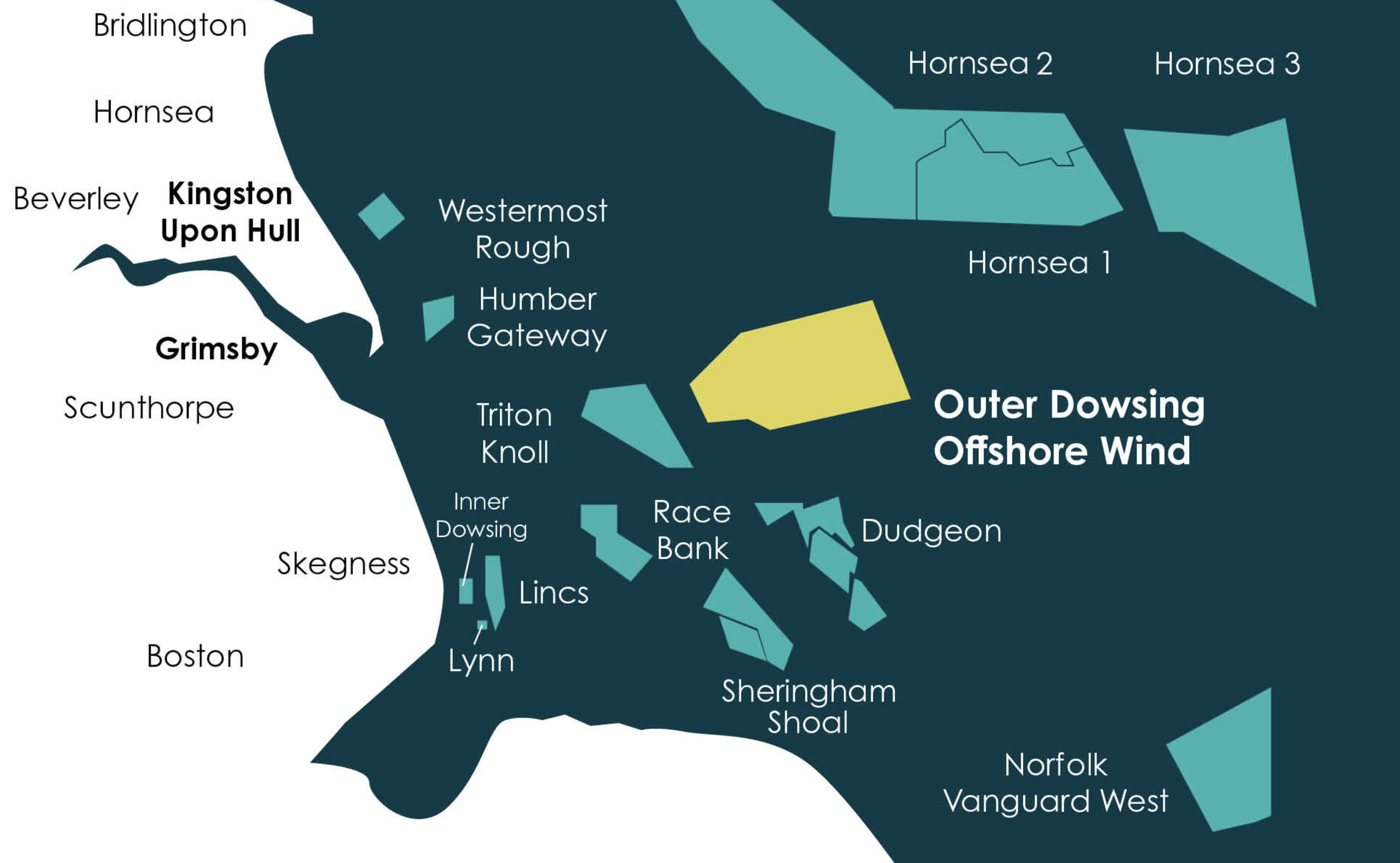
These are the sizes of the various windfarms, that are shown on the map.
- Dudgeon – 402 MW
- Hornsea 1 – 1218 MW
- Hornsea 2 – 1386 MW
- Hornsea 3 – 2852 MW
- Hornsea 4 – 1000 MW – Not shown on map.
- Humber Gateway – 219 MW
- Lincs – 270 MW
- Lynn and Inner Dowsing – 194 MW
- Norfolk Vanguard West – No information, but Norfolk Vanguard is 1800 MW
- Outer Dowsing – 1500 MW
- Race Bank – 580 MW
- Sheringham Shoal – 317 MW
- Sheringham Shoal and Dudgeon Extensions – 719 MW
- Triton Knoll – 857 MW
- Westernmost Rough – 210 MW
Note that these total up to 11724 MW, but with Norfolk Vanguard the total is 135224 MW.
Gas-Fired Power Stations
There are also several active gas-fired power stations.
- Immingham – 1240 MW
- Keadby – 734 MW
- Keadby 2 – 893 MW
- Keadby 3 – 910 MW – Planned to be fitted with carbon capture.
- Saltend – 1200 MW
- South Humber Bank – 1365 MW
- Spalding – 860 MW
- Sutton Bridge – 819 MW
Note that these total up to 8021 MW.
Viking Link
The Viking Link is a 1.4 GW interconnector, that links Bicker Fen in Lincolnshire and Denmark, that should be operational at the end of 2023.
Gas Storage
There are two major gas storage facilities in the rea.
- Aldbrough Gas Storage is formed of salt caverns to the North of the Humber.
- Rough Gas Storage is to the East of the Humber in a depleted gas field.
Both will eventually be converted to store hydrogen, which could be used by local industrial users or the proposed hydrogen power station at Keadby.
The Caledonia Wind Farm
Another of the ScotWind wind farms, that I described in ScotWind Offshore Wind Leasing Delivers Major Boost To Scotland’s Net Zero Aspirations, has been given a name and a web site.
This map shows the various ScotWind leases.

Note, that the numbers are Scotwind’s lease number in their documents.
9 is now Caledonia.
- It has grown from a 1,000 MW fixed foundation wind farm and is now 2,000 MW.
- A completion date of 2030 is now given.
The wind farm will be the fourth development in the area, after the 598 MW Beatrice, the 950 MW Moray East and the 882 MW Moray West wind farms. That is a total of nearly 4,500 MW.
Caledonia’s Unique Advantages
On the About Caledonia page on the Caledonia Wind Farm web site, there is a section called Caledonia’s Unique Advantages, which has four sections.
Water Depths
Caledonia’s water depths are 40 to 100 m. Three-quarters of the site is at depths that allow for fixed (rather than floating) foundations.
This means the majority of the site can be built using the same type of jacket foundations which Ocean Winds optimised at Moray East, seeing Caledonia implement a proven, low-risk, low-cost engineering solution.
Wind
The wind resource at Caledonia is proven through the experience of previous projects and is of a magnitude more usually associated with deeper waters, further from shore. This means Caledonia will benefit from an excellent wind resource, yielding a higher output at lower costs.
Distance from Shore
Caledonia is around 40km from shore and 70km from the nearest National Grid connection point. Beyond distances of approx 120km, DC technology becomes a necessity for subsea transmission. This means the additional costs associated with installing AC-DC convertors offshore and DC-AC convertors onshore can be avoided and the onshore substation will be smaller so will require less land and have a lesser impact on the surrounding environment.
Environment
The Moray Firth is the home of commercial-scale offshore wind generation in Scotland. Caledonia neighbours the Moray East, Moray West, and Beatrice sites, and Ocean Winds have had a presence here from the beginning of the area’s offshore wind development.
Conclusion
It does appear that if you do your planning well on projects like these, there are benefits to be reaped in terms of size, construction, capacity and financial returns.
MingYang Turbines to Spin on Hexicon’s Floating Offshore Wind Project
The title of this post, is the same as that of this article on offshoreWIND.biz.
This is the sub-heading.
Hexicon has selected China-headquartered Mingyang Smart Energy (Mingyang) as the preferred turbine supplier for its flagship 32 MW TwinHub floating offshore wind project in the UK.
These two paragraphs add a bit more detail.
Hexicon has also awarded Mingyang the wind turbine generator Front-End Engineering Design (FEED) contract for the project, which is located 16 kilometres off the coast of Cornwall, England.
TwinHub will use Hexicon’s TwinWind floating foundation technology which will allow two of Mingyang’s MySE 8.0-180 wind turbines to be placed on a single foundation, which could enable more energy to be generated in a given area while reducing the environmental impact compared with a single foundation.
Hexicon’s flagship project secured a Contract for Difference (CfD) in the UK Government’s most recent allocation round.
 The Anonymous Widower