From 2025, Nestlé Waters France Will Use The First Hydrogen-Powered Freight Train Through An Innovative Solution Developed by Alstom and ENGIE
The title of this post, is the same as that of this press release from Alstom.
These are the main points of the press release.
-
Nestlé Waters will be the first company in Europe to benefit from the hydrogen fuel cell solution developed by Alstom and ENGIE, for rail freight.
-
The purpose is to operate the first hydrogen-powered freight train from the Vosges plant, thanks to a hydrogen generator wagon system developed by Alstom and supplied with renewable hydrogen by ENGIE, from 2025.
-
Ultimately, this project should enable Nestlé Waters to reduce emissions by 10,000 tons of CO2 equivalent per year.
-
This new collaboration is in line with the actions Nestlé Waters has been carried out for several years to decarbonize its supply chain.
In this Alstom visualisation that accompanies the press release, an Alstom Prima locomotive can be seen pulling a tender full of hydrogen, that generates electricity.
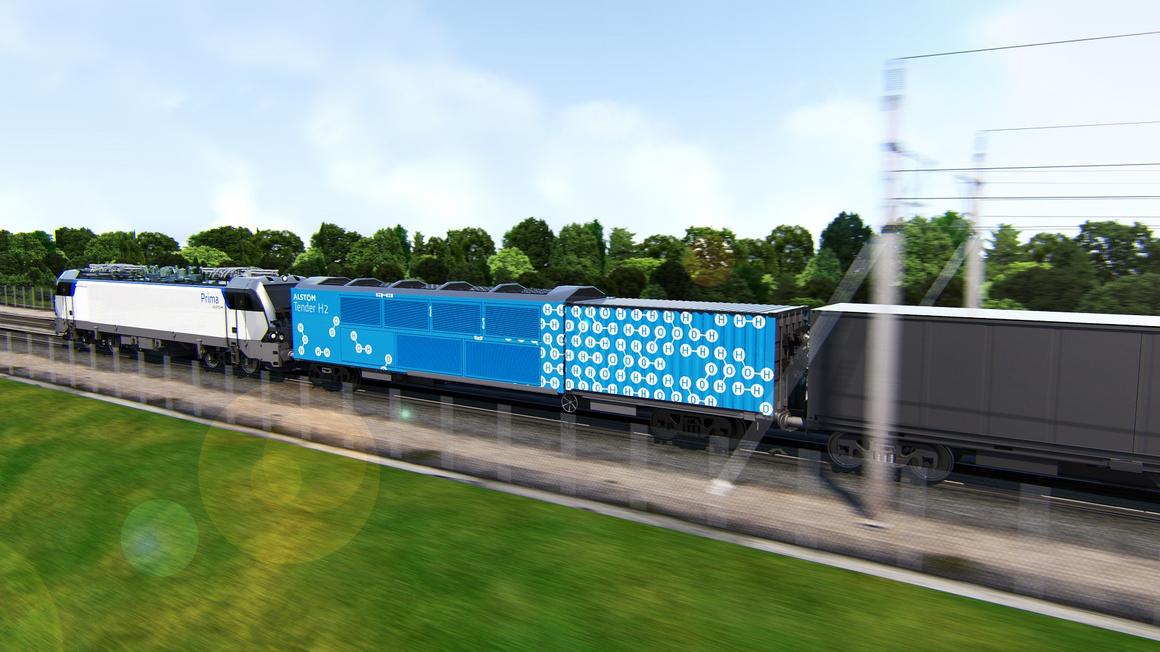
It would appear to be a very simple concept.
- The electric locomotive uses electrification where it is available.
- On lines without electrification, hydrogen is used to generate electricity.
- The locomotive and the tender are connected by a cable.
- I suspect for longer distances, larger generators with a larger hydrogen capacity can be developed.
- It would appear that typical SNCF Prima locomotives have at least 4 MW of power, so the generator must be at least this size.
I could see this concept being used with a 4 MW Class 90 electric locomotive.
Do Cummins And Stadler Have a Cunning Plan?
Roger Ford in the December 2022 Edition of Modern Railways has written an article called Traction à la mode.
The article is a series of small sections, with the last section but one, labelled Monster.
Roger says this.
Finally, we come to the mighty Class 99, which is not at all flakey. In the past I have often commented on the UK railways’ prejudice against Co-Co bogies.
But with the ’99’ six axles will give 6MW (8,000 hp) at the rail, with contact patches to use all its 113 tonnes. Plus the extra axles mean it can accommodate the weight of a 2,400 hp Cummins diesel.
At the recent Rail Freight Group conference, Ross Shepherd, Chief Technical Officer of Beacon Rail, which has 30 locomotives on order for GB Railfreight, revealed a computer simulation which showed a Class 99 would save 36 minutes on a run timed for 1 hr 40 minutes for diesel traction. To quote Mr Shepherd:’It’s a monster and it’s coming.’
I have been doing some digging around the Internet and have found this bulletin from Cummins, which is entitled QSK60 For Rail.
The Class 99 locomotive appears to have a QSK50, which appears to be a less powerful version.
The bulletin describes a Stadler locomotive with a Cummins QSK60 engine, which Stadler are delivering to Bolivia.
This paragraph introduces the locomotives.
Stadler and the Bolivian Ferroviaria Andina (Andean
Railway) FCA have signed a contract for the supply of the first three state-of-the art South American Light
Loco (SALi) locomotives, which will feature the
Cummins QSK60 engine.
The bulletin gives these details.
- Locomotive type – diesel-electric
- Track gauge – one metre
- Axle load – 18 ton/axle
- Power – 1865 kW – 2500 hp
- Diesel engine – QSK60
- Maximum Speed – 100 km/h
- Starting Tractive Effort – 415 kN
- Coupling – AAR
- Fuel Tank – Up to 6000 litres
The bulletin is marked as Printed in UK, so does that mean that the engines will come from Darlington.
The weight of this locomotive is 98 tonnes and Roger says that the Class 99 locomotive is 113 tonnes. But the Class 99 locomotive is an electro-diesel locomotive with 6 MW available when running on 25 KVAC overhead electrification.
It looks to me that Stadler have arranged the substantial electrical gubbins around the Cummins QSK50 diesel engine to create Beacon Rail’s monster.
Cummins And Hydrogen
Cummins is a company, that is big in hydrogen.
- They own hydrogen fuel cell and electrolysis company; Hydrogenics.
- They supply the fuel cells for Alstom’s hydrogen-powered Coradia iLint.
In Werner Enterprises Signs Letter Of Intent Planning To Secure 500 X15H Engines From Cummins, I said this.
More details of the X15H engine are given in this earlier press release, which is entitled Cummins Inc. Debuts 15-Litre Hydrogen Engine At ACT Expo, which has this first paragraph.
Today, Cummins Inc. debuted its 15-liter hydrogen engine at ACT Expo in Long Beach, California. This engine is built on Cummins’ new fuel-agnostic platform, where below the head gasket each fuel type’s engine has largely similar components, and above the head gasket, each has different components for different fuel types. This version, with expected full production in 2027, pairs with clean, zero-carbon hydrogen fuel, a key enabler of Cummins’ strategy to go further faster to help customers reduce greenhouse gas (GHG) emissions.
I certainly like the concept of a fuel-agnostic platform, where below the head gasket, everything is similar, and above the head gasket, there are appropriate components.
Could This Philosophy Be Used To Create An Electro-Hydrogen Locomotive?
It looks to me that if Stadler use the Cummins QSK diesel engine in their locomotives, then if Cummins develop a hydrogen version of the QSK, Stadler can convert the locomotives to hydrogen, if Cummins follow their philosophy of a fuel-agnostic platform, with everything identical below the cylinder head gasket.
Over twenty years ago, I did a small data analysis task for Cummins in Darlington. One of their engineers explained to me how they would rearrange the components of diesel engines, so they fitted with the customer’s application. It looks to me that they have taken this philosophy a step further, so that the customer can have diesel or hydrogen engines in the same application, depending on what the end user wants.
In the case of the order from Beacon Rail for thirty Class 99 locomotives, they will be delivered as electro-diesel locomotives, but at some point in the future, when Cummins has developed the hydrogen engine, they will be able to be converted to electro-hydrogen locomotives.
These locomotives could be in front-line service for over forty years!
The Very Long Range Electro-Hydrogen Locomotive
Hydrogen surely has the power and range to move freight trains across continents.
But can everything be fitted in a standard locomotive body?
Alstom have come up with an innovative solution, which I described in From 2025, Nestlé Waters France Will Use The First Hydrogen-Powered Freight Train Through An Innovative Solution Developed by Alstom and ENGIE
I would also suspect a simple tender containing a tank full of hydrogen will also work.
Collateral Benefits Of A Electro-Hydrogen Locomotive
These are possible benefits of electro-hydrogen locomotives.
- Staff in ports and freight depots get all the clean-air benefits of working with zero-carbon and low-pollution locomotives.
- Ports are becoming hydrogen hubs to fuel ships and ground-handling equipment, so electro-hydrogen locomotives could be easily-fueled.
- Ports and freight depots don’t like electrification, as containers occasionally get dropped.
- Electro-hydrogen locomotives will be able to do their own shunting.
- Electro-hydrogen locomotives will not need all tracks to ports and freight depots to be electrified, but won’t mind if they are.
These benefits would allow Network Rail and the operators of ports and freight depots to develop the best solutions for their operations.
The Lincolnshire Wind Powerhouse
In August 2022, reports started to appear about the Outer Dowsing Wind Farm, like this article on offshoreWIND.biz, which is entitled Corio, Total Submit Scoping Report For 1.5 GW Outer Dowsing Offshore Wind Project.
There is now a web site.
- Outer Dowsing Offshore Wind is a 1.5GW project located approximately 54km off the Lincolnshire coast.
- It is a joint project between TotalEnergies and Corio Generation.
This map from the Outer Dowsing Wind Farm web site, shows the location of the wind farm.
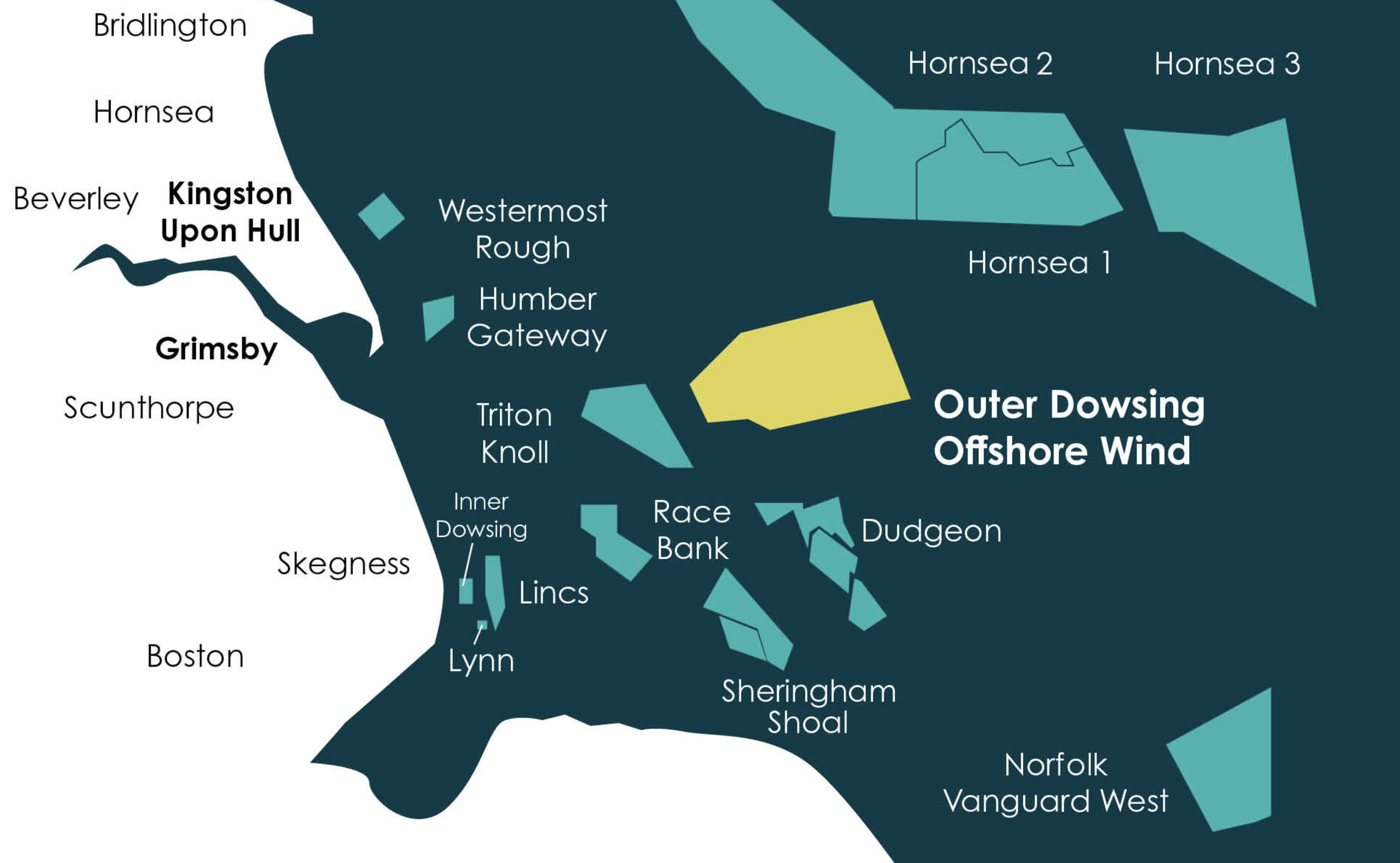
These are the sizes of the various windfarms, that are shown on the map.
- Dudgeon – 402 MW
- Hornsea 1 – 1218 MW
- Hornsea 2 – 1386 MW
- Hornsea 3 – 2852 MW
- Hornsea 4 – 1000 MW – Not shown on map.
- Humber Gateway – 219 MW
- Lincs – 270 MW
- Lynn and Inner Dowsing – 194 MW
- Norfolk Vanguard West – No information, but Norfolk Vanguard is 1800 MW
- Outer Dowsing – 1500 MW
- Race Bank – 580 MW
- Sheringham Shoal – 317 MW
- Sheringham Shoal and Dudgeon Extensions – 719 MW
- Triton Knoll – 857 MW
- Westernmost Rough – 210 MW
Note that these total up to 11724 MW, but with Norfolk Vanguard the total is 135224 MW.
Gas-Fired Power Stations
There are also several active gas-fired power stations.
- Immingham – 1240 MW
- Keadby – 734 MW
- Keadby 2 – 893 MW
- Keadby 3 – 910 MW – Planned to be fitted with carbon capture.
- Saltend – 1200 MW
- South Humber Bank – 1365 MW
- Spalding – 860 MW
- Sutton Bridge – 819 MW
Note that these total up to 8021 MW.
Viking Link
The Viking Link is a 1.4 GW interconnector, that links Bicker Fen in Lincolnshire and Denmark, that should be operational at the end of 2023.
Gas Storage
There are two major gas storage facilities in the rea.
- Aldbrough Gas Storage is formed of salt caverns to the North of the Humber.
- Rough Gas Storage is to the East of the Humber in a depleted gas field.
Both will eventually be converted to store hydrogen, which could be used by local industrial users or the proposed hydrogen power station at Keadby.
German Startup EVIA AERO Commits To Hydrogen-Powered Britten-Norman Islanders
The title of this post, is the same as that of this article on Simple Flying.
These two paragraphs outline the deal.
EVIA AERO has signed a letter of intent with Cranfield Aerospace Solutions (CAeS) to increase its order for hydrogen modification kits and aircraft. As part of the agreement, the startup airline expects to receive five additional hydrogen modification kits and ten 19-seat aircraft.
The hydrogen modification kits are designed to power the nine-seat Britten-Norman Islander aircraft and come in addition to a previous order with CAeS for 10 kits.
I can remember seeing the Islander prototype at a Farnborough Air Show in the mid-1960s on the BBC with commentary from the iconic Raymond Baxter.
Hydrogen-Powered Turbines May Help Clean And Improve Electrical Grid Reliability
The title of this post, is the same as that of this article on Hydrogen Fuel News.
This is the first paragraph.
In less than three years, one or more hydrogen-powered turbines are expected to be up and running at or near New Jersey’s Bayonne Energy Center power plant, which feeds power to New York City.
Note.
- The Bayonne Energy Center is a peaker plant with ten gas turbines, with a total capacity of 640 MW.
- Peaker plants automatically cut in, when power demand is high, but power generation is low.
- The Bayonne Energy Centre transfers power to New York, through an underwater cable.
- The electrolyzers will be made by Ohmium International Inc and I suspect they will be powered by offshore wind.
- The hydrogen that is created will be stored. As Bayonne has a history of chemical manufacturing, there may be salt caverns that can be used or the hydrogen could be stored as a compressed gas or liquid in tanks.
I can see hydrogen being used in peaker plants elsewhere in the world, where there is lots of renewable energy and suitable hydrogen storage.
The hydrogen can also be used to decarbonise local industries and transportation.
The Potential For Wind Power In New Jersey
Wikipedia says this about the potential of wind power in the state.
New Jersey has the potential to generate 373 GWh/year from 132 MW of 80 m high wind turbines or 997 GWh/year from 349 MW of 100 m high wind turbines located onshore as well as 430,000 GWh/year from 102,000 MW of offshore wind turbines.
Note.
- New Jersey used 76,759 GWh in 2011
- It appears that most of these turbines would be located along the coast.
There is also a worry about hurricanes. But solving that is an engineering problem.
From my experience of modelling floating structures, I believe they may stand up to high winds better. But I’m not sure!
Decarbonising Auxiliary Load In Freight Today
This project was one of the winners in the First Of A Kind 2022 competition run by Innovate UK.
In this document, this is said about the project.
Project No: 10039629
Project title: Decarbonising Auxiliary Load In Freight Today
Lead organisation: G-VOLUTION LTD
Project grant: £378,514
Public description: Freight locomotives have auxiliary electric power requirements which account for up to 10-15% of the total power demand, covering engine and traction motor cooling, safety and signalling systems and locomotive control systems.
These loads are currently serviced by an alternator on ubiquitous diesel ICE powertrains. This demand is persistent, requiring the diesel ICEs to remain powered up/idling during the significant periods of dwell time faced by freight services. Up to 20% of freight locomotive fuel consumption and emissions, from CO2 and particulates, therefore arise from non-traction aspects.
Whilst extreme traction requirements for freight operations restricts adoption of full decarbonised powertrains – unless compromises for traction power or range are made – no existing rail technology targets the significant auxiliary power requirements.
In response, G-volution have engaged a team cutting across the full UK supply chain to realise and integrate a first-of-a-kind system for on-board auxiliary power on freight locomotives, based on high energy-density fuel cells and a carbon neutral bio-LPG fuel system.
Whilst initially representing the lowest cost/technical barrier route to catalyse significant CO2, exhaust emission and diesel fuel savings in freight, this approach has potential to also substitute traction power in the long term, and supports the transition to green hydrogen as a rail transport fuel.
Through a live demonstration with a UK freight operator, the project will therefore prove that high efficiency fuel cells, which are able to use a range of cleaner, greener, cheaper zero net carbon renewable fuels, can work in the rail environment and also stimulate significant commercial benefits for all operators, via reduced fuel costs and future environmental levies.
My Thoughts And Conclusions
Note that another G-volution project is described in Grand Central DMU To Be Used For Dual-Fuel Trial.
I also suspect, this auxiliary power unit could have other applications.
HyBRADFORD: One Of Largest Hydrogen Power Plants In The Country Could Open In Yorkshire
The title of this post, is the same as that of this article on the Yorkshire Post.
This is the first paragraph.
Gas distributor Northern Gas Networks (NGN) has partnered with clean energy pioneers Hygen Energy Holdings and Ryze Hydrogen to work on a low carbon hydrogen production and dispensing facility in the heart of Bradford.
Good to see Bradford getting, its hydrogen act together, which is more than can be said for Sadiq Khan and London.
How Is The XLinks Project Progressing?
The Wikipedia entry for the XLinks project has this introductory paragraph.
The Xlinks Morocco-UK Power Project is a proposal to create 10.5 GW of renewable generation, 20 GWh of battery storage and a 3.6 GW high-voltage direct current interconnector to carry solar and wind-generated electricity from Morocco to the United Kingdom. Morocco has far more consistent weather, and so should provide consistent solar power even in midwinter.
I ask the question in the title of this post, as there are two articles about the XLinks project in The Times today.
This article is optimistic and is entitled Xlinks Morocco Project Could Throw Britain A Renewable Energy Lifeline.
On the other hand this article is more pessimistic and is entitled Britain ‘Risks Losing Out’ On Green Energy From The Sahara.
This is the first paragraph of the second article.
Sir Dave Lewis has complained of “frustratingly slow” talks with the government over an £18 billion plan to generate power in the Sahara and cable it to Britain. The former Tesco chief executive has warned that the energy could be routed elsewhere unless ministers commit to the scheme.
It appears there have been little agreement on the price.
I have some thoughts.
Will XLinks Get Funding?
Xlinks is going to be privately funded, but I have doubts about whether the funding will be made available.
As an engineer, who was involved in many of the major offshore projects of the last forty years of the last century, I believe that the XLinks project is feasible, but it is only 3.6 GW.
These wind farm projects are also likely to be privately funded.
- SSE’s Berwick Bank project opposite Berwick is 4.1 GW
- Aker’s Northern Horizon off Shetland is 10 GW.
- The Scotwind Leasing Round is 25 GW.
- There is talk of 10 GW being possible off East Anglia.
- 50 GW may be being possible in the Celtic Sea.
- BP is planning 3 GW in Morecambe Bay.
Many of these enormous wind power projects are looking for completion on or before 2030, which is the date given for the Morocco cable.
I do wonder, if those financing these energy projects will find these and other projects better value than a link to Morocco.
Is the Project Bold Enough?
Consider.
- Spain has high levels of solar, wind and hydro power.
- France is developing wind to go with their nuclear.
- Both countries and Portugal, also have mountains for sensibly-sized pumped-storage hydroelectric power stations.
- France, Spain, Portugal and Ireland also have the Atlantic for wind, tidal and wave power.
Perhaps, the solution, is an Atlantic interconnector linking the UK, Ireland, France, Spain, Portugal and Gibraltar to West Africa.
Any excess power would be stored in the pumped-storage hydroelectric power stations and withdrawn as required.
In the UK, the National Grid are already using the huge 7800 GWh Ulla-Førre pumped-storage hydroelectric power station to store excess wind-generated energy using the North Sea Link from Blyth.
To my mind XLinks is just a UK-Morocco project.
BP’s Project In Mauretania
In bp And Mauritania To Explore Green Hydrogen At Scale, I discussed BP’s deal to create green hydrogen in Mauretania.
Is this a better plan, as hydrogen can be taken by tanker to where it is needed And for the best price.
Conclusion
I wouldn’t be surprised to see the XLinks project change direction.
Research And Development Agreement Signed For Hydrogen Combustion Trains In US
The title of this post, is the same as that of this article on H2-View.
This is the opening paragraph.
Hydrogen combustion engine-powered trains are set to be at the centre of a collaborative research and development agreement between Argonne and Oak Ridge National Laboratories and Wabtec in a bid to decarbonise US rail.
The US is certainly calling up the heavy brigade in Argonne National Laboratory, Oak Ridge National Laboratories and Wabtec.
This appears to be the main objective.
It is hoped the team will be able to design train engines that will deliver the same power, range, and cost-effectiveness as current diesel technology.
The article states that there are 25,000 diesel locomotives in the United States, but because of exports to large parts of the world, including the UK, this research could clean up a lot more than just the United States.
The omens are good, in that both Cummins and Rolls-Royce mtu, who are two of the world’s big diesel engine manufacturers have successfully launched hydrogen combustion engines.
Is Hydrogen The Fuel Of The Future?
The title of this post, is the same as that as this article on Engineering and Technology Magazine.
The article is a must read about hydrogen.
 The Anonymous Widower