Rolls-Royce And easyJet Set New World First
The title of this post, is the same as that of this press release from Rolls-Royce.
These three paragraphs explain what the two companies have done and are planning to do.
Rolls-Royce and easyJet today confirmed they have set a new aviation milestone with the world’s first run of a modern aero engine on hydrogen.
The ground test was conducted on an early concept demonstrator using green hydrogen created by wind and tidal power. It marks a major step towards proving that hydrogen could be a zero carbon aviation fuel of the future and is a key proof point in the decarbonisation strategies of both Rolls-Royce and easyJet.
Both companies have set out to prove that hydrogen can safely and efficiently deliver power for civil aero engines and are already planning a second set of tests, with a longer-term ambition to carry out flight tests.
The test today was carried out at Boscombe Down and are shown in this picture from Rolls-Royce.
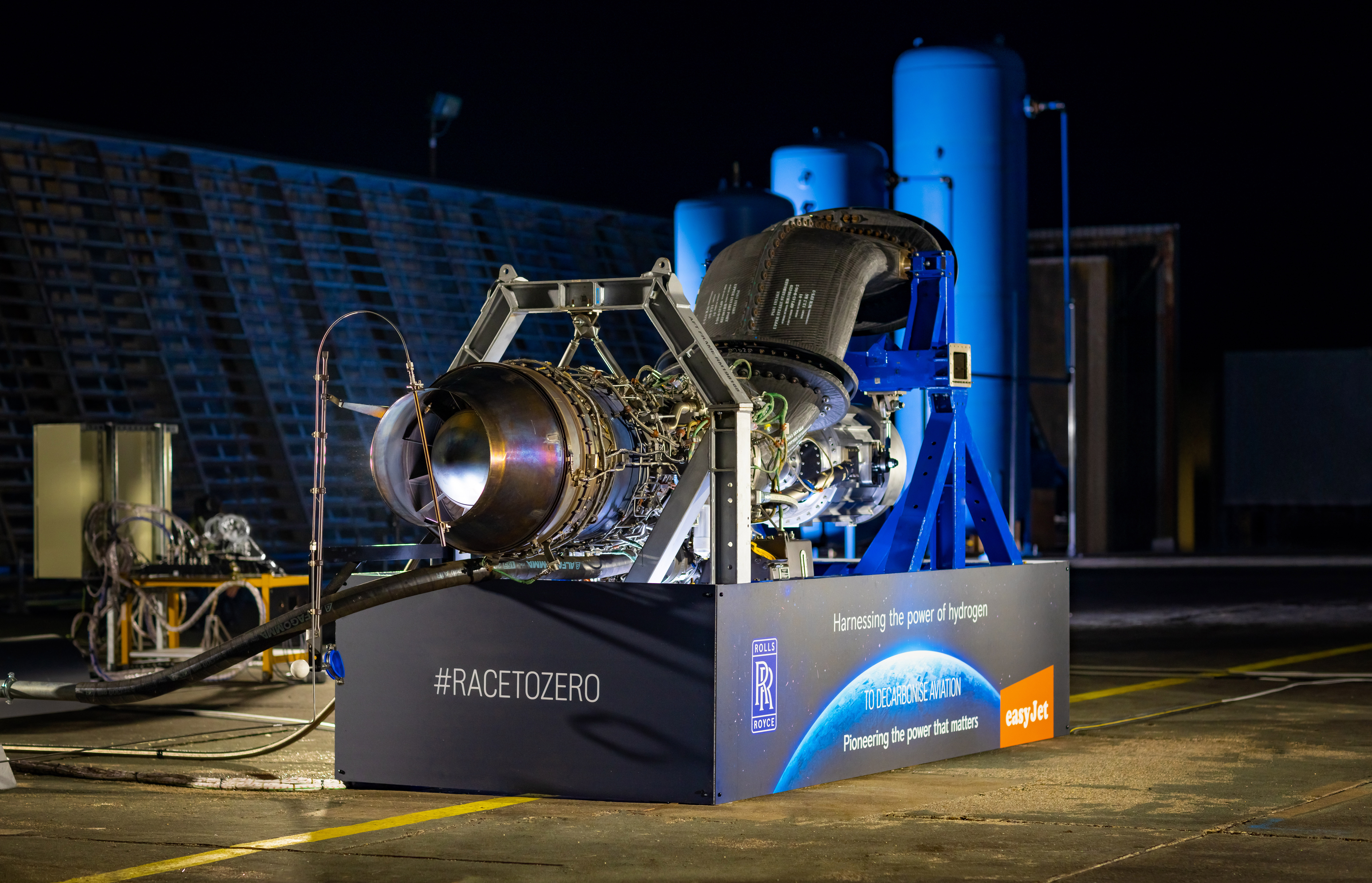
Rolls-Royce AE2100 Hydrogen Demonstrator engine preparing for test at RAF Boscombe Down
Note that the green hydrogen produced using Orcadian winds and tides.
We live in desperate times and I predict that a hydrogen-fuelled and Rolls-Royce-powered easyJet plane, will fly sooner than anybody thinks.
As with athletes, engineers love to be first!
Morley’s New Accessible Station Set To Open In Summer 2023
The title of this post, is the same as that of this press release from Network Rail.
These paragraphs outline the work to be done to create the new Morley station.
A new, fully accessible station is set to open in Morley, Leeds in summer 2023 to make way for longer trains, more seats, and better journeys as part of the Transpennine Route Upgrade.
As a multi-million-pound investment, the new station will boast longer platforms to provide space for faster, more frequent, greener trains with more seats available for passengers travelling between Manchester, Huddersfield, Leeds and York.
The new, remodelled station will sit 75 metres away from the existing station and be fully accessible, with a footbridge and lifts connecting the two platforms.
Moving the station opens up opportunities to transform the platforms and track layout while installing the overhead wires needed to power electric and hybrid trains in the future. It also means that the current station can largely remain open for passengers whilst the new one is built.
It is not often, that a station upgrade, is such a comprehensive demolish and rebuild of a not very large station as this.
But rarely have I seen such a long list of problems as the one in this section in the Wikipedia entry for the station.
It looks like the Government is having a go, at levelling-up Morley.
Network Rail seem to be attempting to do the rebuild in under a year.
AVL RACETECH Builds Hydrogen Combustion Engine For Motorsport
The title of this post, is the same as that as this article on Hydrogen Central.
This is the opening paragraph.
AVL RACETECH, the motorsport department of AVL, presents the prototype of an innovative H2 internal combustion engine. The power unit is a compact, hydrogen-powered 2-liter turbo engine, with intelligent water injection that enables it to achieve a totally new performance level. The prototype is the first racing engine that AVL RACETECH is developing and building in-house.
Note.
- The engine has a size of two litres.
- It generates about 150 kW/litre.
- It features water injection.
- It appears to be very interesting technically and has been designed with extensive computer simulation.
AVL RACETECH has a web site, which gives more information.
‘Castle’ HSTs To Be Withdrawn By Great Western Railway
The title of this post, is the same as that of this article on Rail Advent.
This quote from a GWR spokesman, sums up the action that will be taken.
The Castles were always designed to be a temporary measure on the Cardiff to Penzance route. We expect to replace the Castle Class trains on a phased basis over the next couple of years, bringing customers the benefit of more modern trains that will reduce both cost and carbon emissions across the route.
These are my thoughts.
Could The Engines In The Power Cars Be Replaced With Modern Carbon-Neutral Engines?
This would be an alternative way to solve the decarbonisation problem.
It would also mean that other applications of the Class 43 power cars, like ScotRail’s Inter7City trains, Cross Country’s HSTs and Network Rail’s New Measurement Train would have a decarbonisation route,
In Rolls-Royce Releases mtu Rail Engines For Sustainable Fuels, Rolls-Royce mtu outline their route to decarbonise rail engines using sustainable fuels.
This was the first paragraph of my conclusion in the linked article.
Rolls-Royce and Cummins seem to be doing a thoroughly professional job in decarbonising the diesel engines they have made in recent years.
The Class 43 power cars have Rolls-Royce mtu Series 4000 engines, which will soon be available to run on sustainable fuel.
I think as a possible fall-back, one Class 43 power car should be converted to carbon neutral.
Could The Engines In The Power Cars Be Replaced With Modern Hydrogen Engines?
I looked at this in Will We See Class 43 Power Cars Converted To Hydrogen?.
I came to the conclusion, that this might be possible and said this.
It would be the ultimate Roller.
But then Rolls-Royce know about winning battles with large internal combustion engines.
The Option Of New Trains
This quote from a GWR spokesman was fairly definite about new trains, when they said.
The Castles were always designed to be a temporary measure on the Cardiff to Penzance route. We expect to replace the Castle Class trains on a phased basis over the next couple of years, bringing customers the benefit of more modern trains that will reduce both cost and carbon emissions across the route.
What trains could replace the Castles?
- The Cardiff and Penzance route is just short of 250 miles or roughly 400 kilometres.
- Only about 30 miles at the Cardiff end is electrified.
- Trains would need to be able to handle 25 KVAC overhead electrification.
- 125 mph trains will be needed at the Cardiff end.
- Four or five passenger cars will be needed.
- Currently, there are twelve Castles, so I will assume twelve new trains.
As these trains will be lasting up to forty years, they must be zero-carbon, which must mean battery-electric or hydrogen.
Charging Battery-Electric Trains
Consider
- Bristol Temple Meads, Exeter St. Davis and Plymouth are large stations with several platforms. I suspect that a number of Furrer + Frey’s charging stations can be installed along the route.
- The timetable would be adjusted to allow trains to be charged as they stopped to set down and pick up passengers.
- Trains would dwell in the station and then use their 125 mph performance to regain the time.
- I’ve also found a Penzance to Cardiff service, that stopped at Plymouth for fourteen minutes, which is more than enough to charge the batteries.
- Regenerative braking to the batteries would further eke out the range.
- There might also be some extra electrification around Bristol or Exeter.
- Some form of charging would be needed at Penzance.
Note.
- Putting up electrification may mean that it will delay the new trains for a few years.
- Charging stations along the route could probably be installed to a tight timetable.
I believe that with some top-class work, by battery and charger manufacturers, that a battery-electric train could be developed that could run between Cardiff and Penzance.
Thoughts On Hydrogen
Consider.
- The Alstom Coradia iLint train has a range of about 1,000 km. on hydrogen.
- Companies like Airbus, Boeing and a host of rocket makers will improve the storage and safety of hydrogen.
- A range of a 1,000 km. would allow refuelling at one end of the route.
- Trains could be multiple units or a hydrogen-electric locomotive pulling a rake of coaches with a driving van trailer.
I feel that hydrogen would be very feasible as a power source.
Alstom Could Offer A Hydrogen Aventra
Consider.
- Alstom are developing a hydrogen-powered Aventra.
- Bombardier were offering a 125 mph Aventra.
- A typical Aventra like a Class 720 train seats a hundred passengers a car.
A hydrogen Aventra would be feasible.
Hitachi Could Offer A Battery-Electric Or Hybrid AT-300
In 2021, in Hitachi And Eversholt Rail To Develop GWR Intercity Battery Hybrid Train – Offering Fuel Savings Of More Than 20%, I wrote about the announcement of the Hitachi Intercity Tri-Mode Battery Hybrid Train, which is shown in this Hitachi infographic.

Note.
- Batteries replacing an engine to cut fuel usage and reduce carbon emissions.
- First time a modern UK intercity train, in passenger service, will use alternative fuel.
- These Hitachi trains use mtu engines, so I suspect they will be switched to sustainable fuel like HVO.
- The trains are 125 mph and 140 mph with the latest digital signalling.
- Great Western Railway already have 58 five-car Class 800/802 trains and 35 nine-car 800/802 trains.
- They would not need any changing stations or other infrastructure changes.
- Staff retraining would be minimal.
Testing of the prototype of these trains must be getting very close or even underway.
Stadler Could Offer A Battery-Electric Flirt Akku
Consider
- Stadler have run a Flirt Akku on batteries for 243 km.
- Flirt Akkus will go into service soon.
- Flirts have been designed for 125 mph running.
With charging at Cardiff, Bristol, Exeter, Plymouth and Penzance, I believe a Flirt Akku could handle the route.
Are Hitachi Home And Hosed?
I have a feeling that the announcement has been made about retiring the Castles as the prototype Hitachi Intercity Tri-Mode Battery Hybrid Train is under test and is performing well.
So I wouldn’t be surprised to see an order for twelve more Class 802 trains soon.
Avanti West Coast Applies For Second Hourly Euston And Liverpool Service
Tucked away beside the Grand Union Sets Out Stirling Ambitions article in the December 2022 Edition of Modern Railways is a report on Avanti West Coast’s application for a second service between Euston and Liverpool.
This is said.
Avanti West Coast has applied for access rights for its second hourly Euston to Liverpool service, starting from December 2023, although a phased introduction of the new service is likely. This would make use of Avanti’s new fleet of 10×7-car Class 807 Hitachi EMUs, which are expected to enter service from Autumn 2023. The ‘807s’ would be deployed on the current hourly Liverpool service, on which a call at Liverpool South Parkway would be added. (provision is made for this in the December 2022 timetable.).
Pendelinos would then operate the second service each hour, calling at Lichfield Trent Valley and Tamworth.
A linespeed project is in progress to raise the permissible speed for non-tilting trains on the West Coast Main Line, and Avanti’s new Hitachi trains will take advantage of this.
In Will Avanti West Coast’s New Trains Be Able To Achieve London Euston and Liverpool Lime Street In Two Hours?, I laid out my reasoning for a two-hour journey between Euston and Liverpool Lime Street.
I’m not sure, if they will reduce the time to two hours, but I wouldn’t be surprised if they do.
Grand Union Sets Out Stirling Ambitions
The title of this post, is the same as that of an article in the December 2022 Edition of Modern Railways.
This is the first paragraph.
Grand Union Trains has updated its plans to operate services between Stirling and London Euston. It is targeting a 10-year track access agreement with services starting in May 2025.
I have a few thoughts.
The Route
The route between Stirling and Euston is as follows.
- Trains will call at Larbert, Greenfauds, Whifflet, Motherwell, Lockerbie, Carlisle, Preston, Nuneaton and Milton Keynes.
- Station upgrades are proposed for Larbert, Greenfauds, Whifflet and Lockerbie.
- The route is fully-electrified.
- There will be four trains per day in both directions, with a slightly reduced service on Saturday evenings and Sunday mornings.
This sentence from the article sums up the philosophy of Grand Union Trains.
The company says the aim is to link towns which have no or limited long-distance services and to improve connectivity for some station pairs on the West Coast Main Line.
Note.
Currently Larbert, Greenfauds and Whifflet don’t have services running past Stirling or Motherwell.
- Currently, Nuneaton and Milton Keynes have no Scottish services.
- Nuneaton is well connected to Peterborough and the East.
- Milton Keynes will be on the East-West Railway to Oxford and Cambridge.
It looks to be a service that has been well-planned and offers good possibilities for travel.
The Trains
The article says this about the trains.
New bi-mode rolling stock would be used and GUT says discussions with potential suppliers and manufacturers are ongoing.
Why Are Bi-Mode Trains Needed?
I can think of these reasons.
- Grand Union Trains want to run their South Wales services with the same trains.
- They might want to extend Scottish services from Stirling to perhaps Perth or Dundee.
- They want to offer a reliable service, when the electrification is damaged.
Bi-mode trains will certainly offer flexibility and reliability.
How Long Will The Trains Be?
Consider.
- An eleven-car Class 390/1 train is 265.3 metres long.
- A pair if five-car Class 802 trains is 260 metres long.
I suspect a train has a maximum length of 260 metres and these can be run between London Euston and Stirling.
Could it be that station upgrades are needed for Larbert, Greenfauds, Whifflet and Lockerbie, is that these stations have short platforms?
Could the trains and platforms start short and grow with the business?
The Trains Will Have Three Classes
These classes will be offered.
- First Class in compartments
- Standard in a 2+1 arrangement
- Standard Economy in a 2+2 arrangement
You pays your money and you make your choice.
Vanload Freight May Be Carried
Consider.
- There has been a lot of speculation and some serious train conversions, looking at the possibilities of high speed freight.
- Imagine a train of perhaps five passenger cars and one freight car for containerised freight.
- I suggested earlier, that the trains might grow with the business.
- As business develops, extra cars can be added as appropriate.
- If business booms, then it might be best to run separate passenger and freight services.
Modern trains and refurbished older ones, offer a multitude of solutions.
The Finance
The article says this about finance.
Grand Union Trains has linked with European independent investment firm Serena Industrial Partners to support its ambitions for its new Great Western service, and the project is supported by Spanish operator RENFE.
Serena Industrial Partners are Spanish, so does that mean, that the trains could be Spanish too?
From 2025, Nestlé Waters France Will Use The First Hydrogen-Powered Freight Train Through An Innovative Solution Developed by Alstom and ENGIE
The title of this post, is the same as that of this press release from Alstom.
These are the main points of the press release.
-
Nestlé Waters will be the first company in Europe to benefit from the hydrogen fuel cell solution developed by Alstom and ENGIE, for rail freight.
-
The purpose is to operate the first hydrogen-powered freight train from the Vosges plant, thanks to a hydrogen generator wagon system developed by Alstom and supplied with renewable hydrogen by ENGIE, from 2025.
-
Ultimately, this project should enable Nestlé Waters to reduce emissions by 10,000 tons of CO2 equivalent per year.
-
This new collaboration is in line with the actions Nestlé Waters has been carried out for several years to decarbonize its supply chain.
In this Alstom visualisation that accompanies the press release, an Alstom Prima locomotive can be seen pulling a tender full of hydrogen, that generates electricity.
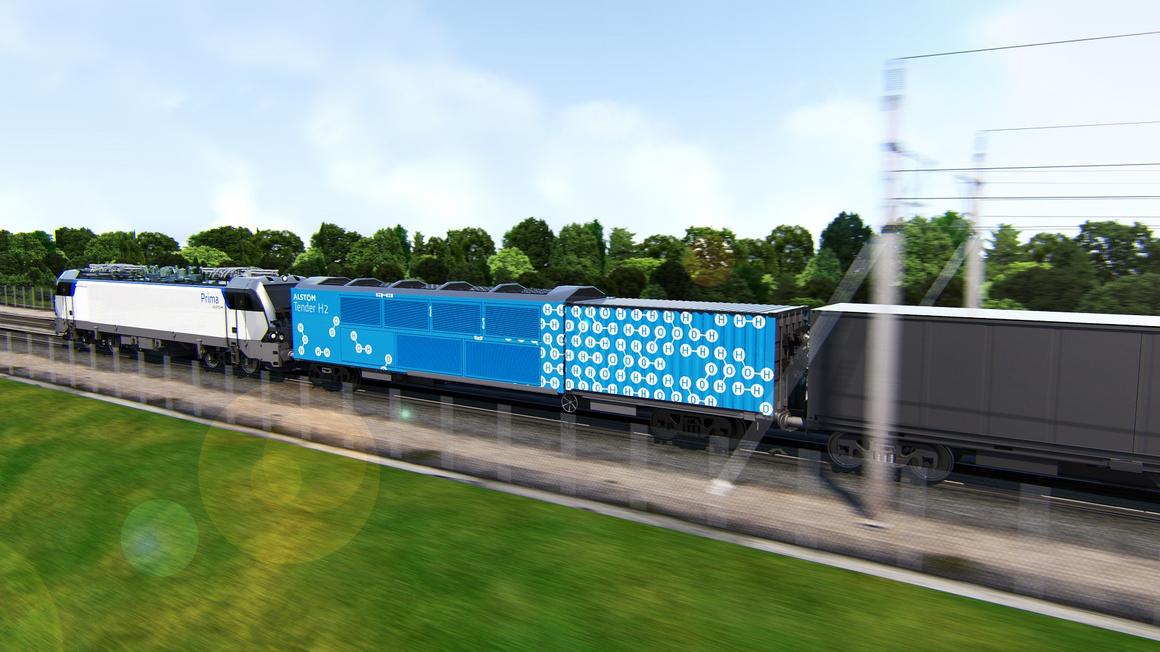
It would appear to be a very simple concept.
- The electric locomotive uses electrification where it is available.
- On lines without electrification, hydrogen is used to generate electricity.
- The locomotive and the tender are connected by a cable.
- I suspect for longer distances, larger generators with a larger hydrogen capacity can be developed.
- It would appear that typical SNCF Prima locomotives have at least 4 MW of power, so the generator must be at least this size.
I could see this concept being used with a 4 MW Class 90 electric locomotive.
Do Cummins And Stadler Have a Cunning Plan?
Roger Ford in the December 2022 Edition of Modern Railways has written an article called Traction à la mode.
The article is a series of small sections, with the last section but one, labelled Monster.
Roger says this.
Finally, we come to the mighty Class 99, which is not at all flakey. In the past I have often commented on the UK railways’ prejudice against Co-Co bogies.
But with the ’99’ six axles will give 6MW (8,000 hp) at the rail, with contact patches to use all its 113 tonnes. Plus the extra axles mean it can accommodate the weight of a 2,400 hp Cummins diesel.
At the recent Rail Freight Group conference, Ross Shepherd, Chief Technical Officer of Beacon Rail, which has 30 locomotives on order for GB Railfreight, revealed a computer simulation which showed a Class 99 would save 36 minutes on a run timed for 1 hr 40 minutes for diesel traction. To quote Mr Shepherd:’It’s a monster and it’s coming.’
I have been doing some digging around the Internet and have found this bulletin from Cummins, which is entitled QSK60 For Rail.
The Class 99 locomotive appears to have a QSK50, which appears to be a less powerful version.
The bulletin describes a Stadler locomotive with a Cummins QSK60 engine, which Stadler are delivering to Bolivia.
This paragraph introduces the locomotives.
Stadler and the Bolivian Ferroviaria Andina (Andean
Railway) FCA have signed a contract for the supply of the first three state-of-the art South American Light
Loco (SALi) locomotives, which will feature the
Cummins QSK60 engine.
The bulletin gives these details.
- Locomotive type – diesel-electric
- Track gauge – one metre
- Axle load – 18 ton/axle
- Power – 1865 kW – 2500 hp
- Diesel engine – QSK60
- Maximum Speed – 100 km/h
- Starting Tractive Effort – 415 kN
- Coupling – AAR
- Fuel Tank – Up to 6000 litres
The bulletin is marked as Printed in UK, so does that mean that the engines will come from Darlington.
The weight of this locomotive is 98 tonnes and Roger says that the Class 99 locomotive is 113 tonnes. But the Class 99 locomotive is an electro-diesel locomotive with 6 MW available when running on 25 KVAC overhead electrification.
It looks to me that Stadler have arranged the substantial electrical gubbins around the Cummins QSK50 diesel engine to create Beacon Rail’s monster.
Cummins And Hydrogen
Cummins is a company, that is big in hydrogen.
- They own hydrogen fuel cell and electrolysis company; Hydrogenics.
- They supply the fuel cells for Alstom’s hydrogen-powered Coradia iLint.
In Werner Enterprises Signs Letter Of Intent Planning To Secure 500 X15H Engines From Cummins, I said this.
More details of the X15H engine are given in this earlier press release, which is entitled Cummins Inc. Debuts 15-Litre Hydrogen Engine At ACT Expo, which has this first paragraph.
Today, Cummins Inc. debuted its 15-liter hydrogen engine at ACT Expo in Long Beach, California. This engine is built on Cummins’ new fuel-agnostic platform, where below the head gasket each fuel type’s engine has largely similar components, and above the head gasket, each has different components for different fuel types. This version, with expected full production in 2027, pairs with clean, zero-carbon hydrogen fuel, a key enabler of Cummins’ strategy to go further faster to help customers reduce greenhouse gas (GHG) emissions.
I certainly like the concept of a fuel-agnostic platform, where below the head gasket, everything is similar, and above the head gasket, there are appropriate components.
Could This Philosophy Be Used To Create An Electro-Hydrogen Locomotive?
It looks to me that if Stadler use the Cummins QSK diesel engine in their locomotives, then if Cummins develop a hydrogen version of the QSK, Stadler can convert the locomotives to hydrogen, if Cummins follow their philosophy of a fuel-agnostic platform, with everything identical below the cylinder head gasket.
Over twenty years ago, I did a small data analysis task for Cummins in Darlington. One of their engineers explained to me how they would rearrange the components of diesel engines, so they fitted with the customer’s application. It looks to me that they have taken this philosophy a step further, so that the customer can have diesel or hydrogen engines in the same application, depending on what the end user wants.
In the case of the order from Beacon Rail for thirty Class 99 locomotives, they will be delivered as electro-diesel locomotives, but at some point in the future, when Cummins has developed the hydrogen engine, they will be able to be converted to electro-hydrogen locomotives.
These locomotives could be in front-line service for over forty years!
The Very Long Range Electro-Hydrogen Locomotive
Hydrogen surely has the power and range to move freight trains across continents.
But can everything be fitted in a standard locomotive body?
Alstom have come up with an innovative solution, which I described in From 2025, Nestlé Waters France Will Use The First Hydrogen-Powered Freight Train Through An Innovative Solution Developed by Alstom and ENGIE
I would also suspect a simple tender containing a tank full of hydrogen will also work.
Collateral Benefits Of A Electro-Hydrogen Locomotive
These are possible benefits of electro-hydrogen locomotives.
- Staff in ports and freight depots get all the clean-air benefits of working with zero-carbon and low-pollution locomotives.
- Ports are becoming hydrogen hubs to fuel ships and ground-handling equipment, so electro-hydrogen locomotives could be easily-fueled.
- Ports and freight depots don’t like electrification, as containers occasionally get dropped.
- Electro-hydrogen locomotives will be able to do their own shunting.
- Electro-hydrogen locomotives will not need all tracks to ports and freight depots to be electrified, but won’t mind if they are.
These benefits would allow Network Rail and the operators of ports and freight depots to develop the best solutions for their operations.
London Bus Cuts: Sadiq Khan Pulls Handbrake On Planned Changes
The title of this post, is the same as that of this article on the BBC.
In The Mayor Of London Is Pruning The North London Bus Network Again, I pointed out Sadiq Khan’s lopsided pruning of the London bus network.
Sadiq Khan has now changed his mind, as this paragraph indicates.
Transport for London (TfL) has announced it will only get rid of three bus routes following a consultation which saw more than 20,000 replies.
These paragraphs explain the changes in detail.
As a result of the consultation, 17 routes which had been proposed to be cut will be saved and kept as they currently operate. Another 40 services will also no longer be changed as initially planned.
Only three routes will be removed entirely – the 521 between Waterloo and London Bridge, the 507 between Victoria and Waterloo, and the 332 between Brent Park and Paddington – while alterations will be made to another 11 services.
Of the plans consulted on:
Routes 4, 12, 14, 24, 31, 45, 72, 74, 78, 242, 349, C3, D7, N31, N72, N74 and N242 will be saved and kept as they are
Planned tweaks to routes 15, 19, 27, 43, 47, 49, 53, 56, 88, 98, 100, 113, 135, 148, 171, 189, 205, 214, 236, 254, 259, 277, 279, 283, 328, 343, 388, 414, 430, 476, D3, D8, N15, N19, N27, N98, N133, N205, N414 and N430 will no longer happen
Proposed changes to routes 3, 6, 11, 23, 26, 59, 77, 133, 211, C10 and N26 will still go ahead
TfL said the consultation had raised issues with the plans and as a result the mayor of London had been able to find extra funding to ensure the cuts did not happen on such a large scale.
That is certainly a substantial U-turn!
Construction Has Started On The Silvertown Tunnel
These pictures show that construction has started on the Silverton Tunnel.





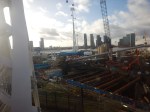
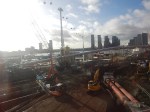
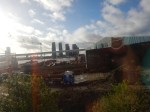

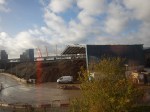
Note that New Civil Engineer is reporting that tunnelling has started.
My Current Thoughts On The Silvertown Tunnel
In 2015, I wrote No To Silvertown Tunnel, which I started with these two paragraphs.
My personal feelings about the Silvertown Tunnel are that it is irrelevant to me, except that it might help some trucks bring goods that I buy online or at a local shop. Although as a sixty-eight year-old-widower living alone, I don’t think my transport needs through the tunnel will be high.
I don’t drive after my stroke and I like that lifestyle, except when last night it took me three trains, a coach and a taxi to get back from watching football at Ipswich. But that tortuous late night journey was caused because NuLabor spent my tax money on pointless wars that will haunt us for generations, rather than in extending and renewing our rail system, that will nurture and enrich our future.
But my objections to the Silvertown Tunnel have changed and expanded.
New Transport Infrastructure Attracts Passengers
This may seem obvious, but there has been several cases recently in London to prove my point.
- The London Overground has been a success beyond Transport for London’s wildest dreams and as an example the North London Line, that started with three x three-car trains per hour (tph) is now running eight x five-car tph. This is a four time increase in capacity.
- New buses and contactless ticketing have encouraged more passengers to use the buses.
- Electrification and new trains has transformed the Gospel Oak to Barking Line.
- The expansion of Thameslink and new trains now carries a lot more North-South traffic through London.
- Every time, a new section of the Elizabeth Line opens more passengers are attracted to the new line.
- The remodelling of London Bridge station has increased passenger numbers. And shoppers!
On a personal note, I live on a bus corridor, that runs between North London and Moorgate for the Lizzie Line. Since the Lizzie Line has been fully connected, passenger numbers have risen by a big margin.
I don’t believe that the ability to attract more traffic of the Silvertown Tunnel will be any different.
More Traffic Means More Congestion And Pollution
I live close to the Balls Pond Road, which increasingly seems to be a truck route across North London.
The Silvertown Tunnel will be two lanes each way; one for trucks and buses, and one for smaller vehicles.
I can’t see that pollution and congestion around the Silvertown Tunnel and on the routes to the tunnel, will not increase.
There Is Little Or No Provision For Cyclists And Pedestrians
This will be a big problem. Especially, as the local traffic in the area will increase dramatically.
Does Central London Have Enough Parking For The Increased Traffic?
Parking in Central London is probably close to capacity now!
So What Would I Do?
Given that construction has already started, I feel it is too late to cancel.
Better Alternatives Than Driving
I feel measures should be adopted that provide better alternatives than driving.
Obviously, this won’t help with trucks, but it could reduce the total number of vehicles going through the tunnel.
These could include.
- Increase the frequency of trains on both the Lizzie Line and Thameslink.
- Increase the number of destinations on both the Lizzie Line and Thameslink.
- Add an extra car to Lizzie Line trains.
- Remove First Class on the shorter eight-car Thameslink trains.
- Add provision on some Lizzie Line and Thameslink routes for bicycles.
- Add a Silvertown station to the Elizabeth Line for London City Airport.
- Add one or more pedestrian and cycling bridges across the Thames.
- Expand of the Docklands Light Railway.
- Expand the Thames Clipper.
- Connect Barking Riverside station to Thamesmead and Abbey Wood station either by a rail or a fast ferry.
- Keep the cable-car.
I suspect there are other viable ideas.
Develop Incentives To Use Public Transport
Incentives could be in these areas.
- Better station and bus terminals encourage more to use trains and buses.
- Full free onboard wi-fi and phone charging.
- Special fares for some journeys.
An example of the latter could be a discount for certain cross-river journeys.
Make The Silvertown Tunnel Available For Zero Carbon Vehicles Only
This would surely cut pollution in London.
Conclusion
We should use the Silvertown Tunnel to improve London’s air quality.
 The Anonymous Widower