South Western Railway Completes Trial Of Class 159 Emission Reducing Technology
The title of this post, is the same as that of this article on Rail Advent.
This is Project 4 called Green Rail Exhaust After Treatment, that I wrote about in Grants To Support Low-Carbon Technology Demonstrators.
I also wrote about the project in SWR And Porterbrook Trial New Emission-Slashing Rail Technology.
This paragraph from the Rail Advent article sums up the results.
In partnership with Porterbrook and Eminox, South Western Railway has trialled a new system that has real-world reductions in pollution from nitrous oxides (NOx) by over 80% and hydrocarbons, carbon monoxide and particulate matter (PM) by over 90%.
The technology appears to have performed well in a six-month trial.
As the proof of the pudding is always in the eating, it will be interesting to see how many systems are installed on the two hundred trains in the closely-related Class 158 and Class 159 train fleets.
The Rival Plans For Piccadilly Station, That Architects Say Will ‘Save Millions’
The title of this post, is the same as that of this article on the Manchester Evening News.
This subtitle introduces the idea.
The speculative proposal includes a new underground HS2 station and an ‘s-shaped tunnel’ under the city centre.
The architects are Weston Williamson and I have felt for years that this was the best way and I put my ideas and some fragments from the press and Northern Powerhouse Rail in Manchester Piccadilly ‘Super Hub’ Proposed.
This picture from Weston Williamson, shows their proposed station.

Note.
- In the visualisation, you are observing the station from the East.
- The existing railway lines into Piccadilly station are shown in red.
- Stockport and Manchester Airport are to the left, which is to the South.
- Note the dreaded Castlefield Corridor in red going off into the distance to Oxford Road and Deansgate stations.
- The new high speed lines are shown in blue.
- To the left they go to Manchester Airport and then on to London, Birmingham and the South, Warrington and Liverpool and Wigan, Preston, Blackpool, Barroe-in-Furness, the North and Scotland.
- To the right, they go to Huddersfield, Bradford, Leeds, Hull and the North East, and Sheffield, Doncaster and the East.
- Between it looks like a low-level High Speed station with at least four tracks and six platforms.
- The Manchester Mretrolink is shown in yellow.
- The potential for over-site development is immense. If the Station Square Tower was residential, the penthouses would be some of the most desirable places to live in the North.
This Google Map shows the current station.
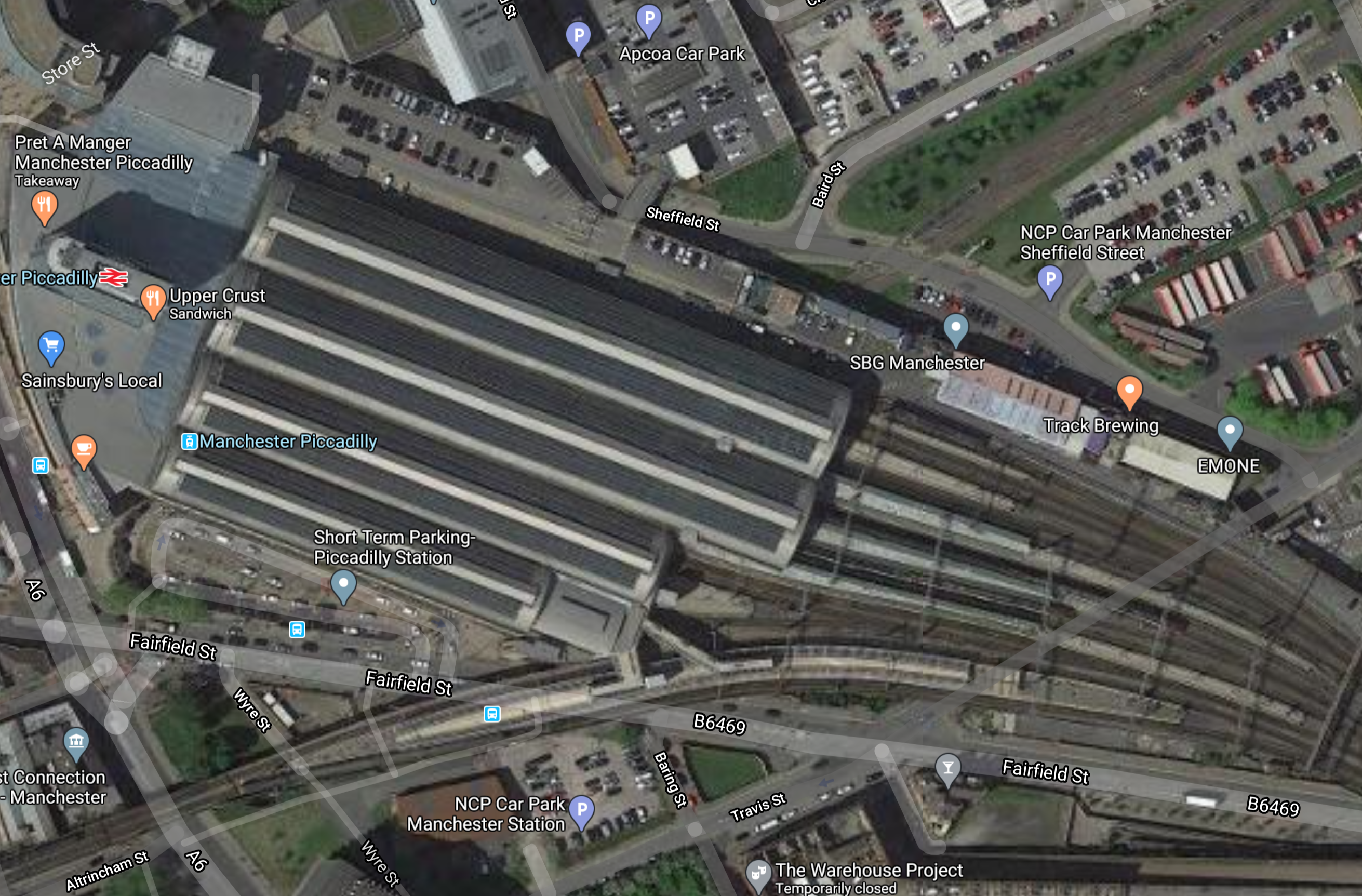
Unfortunately, the map is round the other way to the visualisation, but I hope you can see how the shape of the current station is intact and can be picked out in both.
If you’ve ever used London Paddington station in the last few years, you will know that Crossrail is being built underneath. But the massive construction project of building the Crossrail platforms has not inconvenienced the normal business of the station.
Weston Williamson’s proposed station can be built in the same way.
It could be truly transformational
- Manchester Piccadilly station would have at least 43 percent more platforms.
- Classic-compatible High Speed commuter trains would run to Barrow, Blackpool, Chester, Derby, Nottingham and Shrewsbury from the low-level High Speed station.
- The Northern Powerhouse Rail for all TransPennine Express services would use the low-level High Speed station.
- Glasgow services would use the low-level High Speed station.
- Manchester Piccadilly and Manchester Airport would have up to 18 high speed trains per hour and would be the finest airport service in the world.
- Some or all of the low-level High Speed platforms, would be able to take 400 metre long trains.
- 400 metre long platforms could handle one 200 metre long train from Manchester Airport and one 200 metre long train from Yorkshire.
- The Castlefield Corridor would only have local trains, limited to a number, with which it could cope.
- The use of the existing platforms would be reorganised.
It would be a massive increase in the capacity of the station and as been shown at Paddington with Crossrail, I am sure, that it could be built without massive disruption to existing services.
The Ultimate Train To The North
Imagine a pair of 200 metre long classic-compatible trains running between London Euston and Leeds.
- They would travel via Birmingham Interchange, Manchester Airport, Manchester Piccadilly, Huddersfield and Bradford.
- The trains would divide at Leeds.
- One train would go to Hull.
- The second train would go to York, Darlington, Durham and Newcastle. It could be extended to Edinburgh.
- It could even run with a Turn-Up-And-Go frequency of four tph.
Why not?
Bucks Council Supports New Internet Lines
The title of this post, is the same as that of this article on Mix96.
Buckinghamshire County Council are proposing to use the construction of the new East West Railway, as a route for extra Internet connectivity.
How sensible!
Are East West Railway and Buckinghamshire County Council talking to Hive Composites, about their next generation composite poles for a 5G-enabled railway, that won funding in the latest round of first-of-a-kind funding from Innovate UK?
Will other councils and companies be using other rail construction to advantage?
How Leeds Bradford Airport Can Be Catalyst For Green Aviation
The title of this post, is the same as that of this article on the Yorkshire Post.
The article was written by a geography student from Yorkshire, who is studying at Cambridge University.
He makes some interesting points.
- Leeds Airport is not a good customer experience.
- Manchester Airport will take passengers away from Leeds.
- Leeds is the biggest financial centre in the UK outside London.
- Leeds Airport should be improved to the highest environmental standards.
- Aviation biofuels should be provided.
- Short haul flights should be replaced by a train journey if possible.
- By 2030, a lot of short haul flights will be replaced by electric aircraft.
I agree with a lot of what he says.
There will still be a need to fly and we must make it as environmentally-friendly as possible.
If we don’t find ways of making flying carbon-neutral, we’ll hurt the economy.
Birmingham-Black Country-Shrewsbury
On the Midlands Connect web site, they have a page, which is entitled Birmingham-Black Country-Shrewsbury.
This is the introductory paragraph.
We’re examining the case to increase services from three to four per hour, made possible by capacity released post-HS2.
They then give the outline of their plans, which can be summed up as follows.
- Services on the corridor are slow and unreliable.
- Network Rail say the service is in danger of acute overcrowding.
- Services will be increased from three trains per hour (tph) to four.
- A direct hourly service from Shrewsbury, Wellington and Telford to London will be introduced.
- Services to Birmingham International will be doubled.
- The economic case will be examined for speeding up services between Shrewsbury and Birmingham from 56 to 45 minutes, via track upgrades and possible electrification.
It seems a safe, and not overly ambitious plan.
These are my thoughts.
Shrewsbury’s Unique Position
These are distances and times from important stations.
- Birmingham International – 51 miles and 83 minutes
- Birmingham New Street – 42.5 miles and 71 minutes
- Chester – 42.5 miles and 53 minutes
- Crewe – 33 miles and 53 minutes
- Hereford – 51 miles and 59 minutes
- Telford – 14 miles and 21 minutes
- Wellington – 10 miles and 13 minutes
- Welshpool – 20 miles and 25 minutes
- Wolverhampton – 30 miles and 50 minutes
In Sparking A Revolution, I quoted this Hitachi-specification for a battery-electric train.
- Range – 55-65 miles
- Performance – 90-100 mph
- Recharge – 10 minutes when static
- Routes – Suburban near electrified lines
- Battery Life – 8-10 years
I can’t see any problem, for a train with this specification being able to reach Shrewsbury from Birmingham International, Birmingham New Street and Crewe on battery power.
In Hitachi Trains For Avanti, I quote an article with the same title in the January 2020 Edition of Modern Railways as saying this.
Hitachi told Modern Railways it was unable to confirm the rating of the diesel engines on the bi-modes, but said these would be replaceable by batteries in future if specified.
I wouldn’t be surprised to see Shrewsbury served from Birmingham and Crewe by fast electric trains, that used battery power. Avanti West Coast certainly seem to have that thought in mind.
Zero Carbon Trains Between Shrewsbury And Wales
It will be a formidable challenge to run battery trains from Shrewsbury to the Welsh destinations.
- Aberystwyth – 81.5 miles
- Cardiff – 107 miles
- Carmarthen – 185 miles
- Holyhead – 133 miles
- Milford Haven – 225 miles
- Swansea – 121.5 miles
Note.
- These are challenging distances for battery-electric trains.
- South Wales destinations served via Newport and Cardiff could use the electrification on the South Wales Main Line.
- Many of these services start from East of Shrewsbury and can use the electrified lines that connects to Birmingham New Street and Manchester Piccadilly.
Unless someone like Riding Sunbeams, makes a breakthrough, I can’t see battery-electric trains running to Welsh destinations from Shrewsbury.
Transport for Wales New Trains
Transport for Wales have ordered seventy-seven new Class 197 trains, and these diesel trains will be used for services through Shrewsbury, mainly on services to Birmingham New Street and Birmingham International stations.
- If these trains are similar to Northern’s Class 195 trains, they will be diesel multiple units with a noisy mechanical transmission.
- I was surprised in these days of global warming that Transport for Wales didn’t buy something more eco-friendly, as they have for South Wales and the services around Chester.
- The transmission of the Class 197 trains has not been disclosed.
Perhaps, CAF are going to do something innovative.
- The CAF Civity is a modular train, with either electric or diesel power options.
- The diesel-powered options use MTU engines.
- A logical development would be to use an MTU Hybrid PowerPack to reduce diesel consumption and emissions.
- This PowerPack would also reduce noise, as it has an electric transmission.
- I wonder, if CAF can raid their parts bin and fit a pantograph, so where 25 KVAC overhead electrification is available, it can be used.
- If CAF can convert a bog standard diesel multiple unit into a hybrid diesel-electric-battery multiple unit, by performing a heart transplant, it is a neat way of keeping new diesel Civities running until a later date.
- Remember that Northern and West Modlands Trains have another seventy-four similar new diesel Civities in operation or on order. With trains having a forty year life, they don’t fit with an early phasing out of diesel.
I have no idea, what is actually happening, but my engineer’s nose tells me to expect a surprise from CAF.
Increasing Birmingham And Shrewsbury Services From Three Trains Per Hour To Four
Four trains per hour or one train every fifteen minutes seems to be a preferred frequency on several UK suburban lines.
These services seem to provide four tph or better on most, if not all of their routes.
- Birmingham Cross-City Line
- London Overground
- Merseyrail
- Tyne and Wear Metro
Four tph seems to be a very handy Turn-Up-And-Go frequency that encourages people to use rail services.
So I am not surprised to see Midlands Connect wanting four tph between Birmingham and Shrewsbury.
Currently, the following services seem to operate between Shrewsbury and Birmingham.
- Avanti West Coast – 2 trains per day (tpd) – Shrewsbury and London Euston via Birmingham New Street and Birmingham International.
- Trains for Wales – 1 train per two hours (tp2h) – Holyhead and Birmingham International via Birmingham New Street.
- Trains for Wales 1 tph – Aberystwyth/Pwllheli and Birmingham International via Birmingham New Street
- West Midlands Trains – 2 tph – Shrewsbury and Birmingham New Street – One semi-fast and one stopper.
Note.
- All services call at Wolverhampton, Telford and Wellington.
- Shrewsbury and Birmingham New Street is a 3.5 tph service.
- Shrewsbury and Birmingham International is a 1.5 tph service.
It relies heavily on services from Trains for Wales, who probably don’t put Shrewsbury and Birmingham services at the top of their priorities.
I remember, when local services in the North-East of London were run by Greater Anglia from Norwich. Moving some services to Transport for London, brought about a large improvement
Quite frankly, the current service is best described as pathetic.
Should Trains for Wales Services Terminate As Shrewsbury?
I suspect some local politicians in Shrewsbury and Birmingham, think it would be best to adopt this sort of strategy.
- All Welsh services terminate at Shrewsbury.
- Birmingham and Shrewsbury mandate West Midlands Trains and Avanti West Coast to provide a frequent service between Shrewsbury and Birmingham.
It might be the way to go, but many travellers from the Marches, would probably want direct connections to Birmingham, Birmingham Airport and in the future High Speed Two.
Introducing A Direct Hourly Service From Shrewsbury, Wellington And Telford To London
On the face of it, it looks like a much needed service to and from Shrewsbury.
- It will be hourly.
- Initially it will use Class 221 diesel multiple units, but these will be replaced with bi-mode Class 805 trains.
- The current infrequent service calls at Watford Junction, Rugby, Coventry, Birmingham International, Birmingham New Street, Sandwell and Dudley, Wolverhampton, Telford Central and Wellington.
- There are also six other stations between Shrewsbury and Wolverhampton, which might like an improved service.
- The service will be run by Avanti West Coast.
There might also be the possibility of using battery power between Wolverhampton and Shrewsbury, which is only thirty miles each way.
But there are other collateral benefits.
- The service increases the frequency between Shrewsbury and Birmingham New Street stations by one tph to 4.5 tph
- The service increases the frequency between Shrewsbury and Birmingham International by one tph to 2.5 tph.
- The service increases the frequency between Wolverhampton and London Euston by one tph.
- The service increases the frequency between Sandwell and Dudley and London Euston by one tph
- The service increases the frequency between Birmingham New Street and London Euston by one tph.
- The service increases the frequency between Birmingham International and London Euston by one tph.
- The new service will provide an hourly quality connection to High Speed Two at Birmingham International for stations between Shrewsbury and Coventry.
- It appears that the Class 390 trains to Birmingham New Street and being replaced by new Class 807 trains, so Birmingham will have three out of four tph, run by new trains.
- The new Shrewsbury service , has a similar calling pattern to that of the current Scottish service through Birmingham. Will it replace that service, when High Speed Two opens?
Note.
- Midlands Connect’s objective of four tph between Shrewsbury and Birmingham has been met.
- Several stations get a better direct service to London.
- Connectivity to High Speed Two is improved.
- Birmingham New Street and London is now a Turn-Up-And-Go frequency of four tph.
- The Class 805 train will also mean that Avanti West Coast could be zero-carbon in Birmingham. Especially, if it used battery power between Wolverhampton and Shrewsbury stations.
The hourly direct service between Shrewsbury and London will make a lot of difference to train services between Shrewsbury and Birmingham.
Avanti’s London Euston and Birmingham New Street Service
Consider.
- There are two tph that terminate in Birmingham New Street station, that take 88-89 minutes, from London Euston
- There is one tph that goes through Birmingham New Street station to Edinburgh, Glasgow, Preston, or Shrewsbury, that takes 82-84 minutes, from London Euston.
- Currently, the two terminating trains are Class 390 trains, whereas the through train can be a Class 221 train as well.
- Through trains are allowed 5-10 minutes to pass through Birmingham New Street.
- Trains that terminate at Birmingham New Street station are allowed 20-30 minutes to arrive and leave.
- Avanti West Coast have said, that they will be running Class 807 trains between London and Birmingham New Street.
It doesn’t seem to be the best use of scarce platform resources in a busy station to park a train there for half-an-hour.
In Will Avanti West Coast’s New Trains Be Able To Achieve London Euston and Liverpool Lime Street In Two Hours?, I came to the conclusion that the Class 807 trains have been designed as simple, fast, lightweight all-electric trains with no heavy batteries, diesel engines or tilt mechanism.
- I think they’ll be able to shave a few minutes on the timings between London Euston and Birmingham New Street station.
- I would suspect that they will match the 82-84 minutes of the through trains
- The ultimate would be if they could do a round trip between London Euston and Birmingham New Street in three hours.
- Two tph run by what would effectively be a London-Birmingham shuttle would need just six trains.
It might mean new methods of manning the trains, to reduce turnround times.
Doubling Of Services Between Shrewsbury And Birmingham International
The hourly direct London and Shrewsbury Avanti West Coast service will raise the current 1.5 tph service between Shrewsbury and Birmingham International to 2.5 tph, so will be a good start.
- Perhaps Trains for Wales could find the missing 0.5 tph.
- West Midlands Trains might be able to squeeze in another train.
But I suspect that the crowded line between Birmingham New Street and Birmingham International is the problem.
Shrewsbury And Birmingham In Forty-Five Minutes
This is the last objective and saving eleven minutes on this route would suggest that the best way would surely be to fully electrify the route.
- Between Wolverhampton and Birmingham International stations is fully electrified.
- Electric trains have faster acceleration and deceleration, so would probably achieve the required savings if they stopped more than five times.
- From my virtual helicopter it doesn’t appear to be the most challenging of routes to electrify.
- Only about thirty miles of double track would need to be electrified between Wolverhampton and Shrewsbury stations.
- Both Trains for Wales and West Midlands Trains would have to obtain new electric trains.
- Avanti West Coast have already got bi-mode Class 805 trains, that could use the electrification.
But will Trains for Wales go along with Midlands Connect, when they tell them to get electric or bi-mode trains to work between Shrewsbury and Birmingham International stations?
It is because of dilemmas like this, that I feel that electric trains using battery or hydrogen power, when away from electrification can be a very good alternative.
- There is no major disruption raising bridges for the electrification.
- Stations don’t need to be closed for electrification.
- The trains have all the comfort and performance of electric trains.
- Costs and timescales can be reduced.
- When running on battery or hydrogen power, these trains are very quiet, as there is no pantograph noise.
To run battery-electric trains between Shrewsbury and Wolverhampton, the only infrastructure needed would be a method of charging the train at Shrewsbury station.
This Google Map shows the Southern end of Shrewsbury station.

Note.
- The platforms are built over the River Severn.
- The five-car Class 221 train in Virgin livery sitting in Platform 5.
- When this train leaves it will turn left or to the East for Wolverhampton and Birmingham.
- Trains can turn right for Wales.
It is a very unusual station layout.
- Platform 5 is one of a pair of bay platforms; 5 & 6, that can access either Wales or Birmingham.
- Outside of the bay platforms are a pair of through platforms; 4 & 7, that can also access Wales or Birmingham, but they can also access Chester by going through the station.
- The 115 metre long Class 221 train fits easily in the bay platform 5.
- The 130 metre long Class 805 train would probably need to use Platform 4 or 7.
But with well-planned electrification, it would be ideal for charging electric trains as they pass through or turned back!
Once the train reaches Wolverhampton, it will connect to electrification again.
Shrewsbury And High Speed Two
Currently, Shrewsbury has three connections to stations, where it would be convenient to take a High Speed Two train.
- Birmingham International, which is 51 miles and 83 minutes away. Plus a ride on a people mover for High Speed Two.
- Birmingham New Street, which is 42.5 miles and 71 minutes away. Plus a walk to Birmingham Curzon Street for High Speed Two.
- Crewe, which is 33 miles and 55 minutes away.
Passengers will make their own choice.
Could Shrewsbury Have A Classic-Compatible High Speed Two Service To Manchester Piccadilly?
London To Shrewsbury, Now And Post-High Speed Two
Travel On Monday
If I want to go to Shrewsbury next Monday, one fast journey is taking the 09:10 from Euston and changing at Crewe, which gives a journey time of two hours and thirty-two minutes.
I can also get a train with a change at Birmingham International that takes seven minutes longer.
Travel On High Speed Two
After High Speed Two opens to Birmingham Curzon Street and Interchange in Phase 1 what sort of times to Shrewsbury can be expected?
I estimate the following.
- Travelling via Birmingham Curzon Street could produce a time of around one hour and fifty minutes, if you’re lucky with the trains.
- Travelling via Crewe could produce a time of one hour and thirty minutes, if you’re lucky with the trains.
- Travelling via Interchange could produce a time of around one hour and fifty-five minutes. or forty-four minutes faster.
If I was going to Shrewsbury after High Speed Two has opened, I would probably change at Birmingham Curzon Street, if the walk to New Street station was still within my capabilities, as there will be a Turn-Up-And-Go frequency of four tph between Birmingham New Street and Shrewsbury stations.
Looking at the Midlands Connect objectives, these help with linking Shrewsbury with London.
- Increasing services between Birmingham and Shrewsbury to four tph, as it’s Turn-Up-And-Go!
- The direct hourly service to London from Shrewsbury, Wellington and Telford might be the quickest way to London by changing at Birmingham New Street/Curzon Street or Interchange.
- Doubling the service between Shrewsbury and Birmingham International, may be a good move, as Interchange, which will be connected to Birmingham International by a high capacity people mover, will have five tph between London Euston and Old Oak Common stations.
- Saving eleven minutes between Shrewsbury and Birmingham will certainly help.
Travelling between London and Telford, Wellington and Shrewsbury will be much improved.
Could The Crewe And Derby Line Become A Much More Important Route?
On the Midlands Connect web site, they have a page, which is entitled Derby-Stoke-Crewe.
This is the introductory paragraph.
Our plans have the potential to increase passenger demand on the corridor by 72%, with faster, more frequent services.
They then give the outline of their plans, which can be summed up as follows.
- Currently, the service is one train per hour (tph) and it takes 79 minutes.
- The service frequency will go to two tph.
- Twenty minutes could be saved on the second service by adjusting calling patterns.
- Improved links at Crewe for High Speed Two. This must have been written before Stafford and Stoke got the High Speed Two service to Macclesfield.
- East Midlands Railway are planning to extend the current Crewe and Derby service to Nottingham.
It seems a safe, and not overly ambitious plan.
These are my thoughts.
The Route
I have flown my virtual helicopter along the route and it appears to be double track all the way, except for a three mile section to the East of Crewe, that British Rail reduced to single track
However, in recent years the A5020 was built under the railway and the new bridge appears to have space for the second track to be restored, as this Google Map shows.
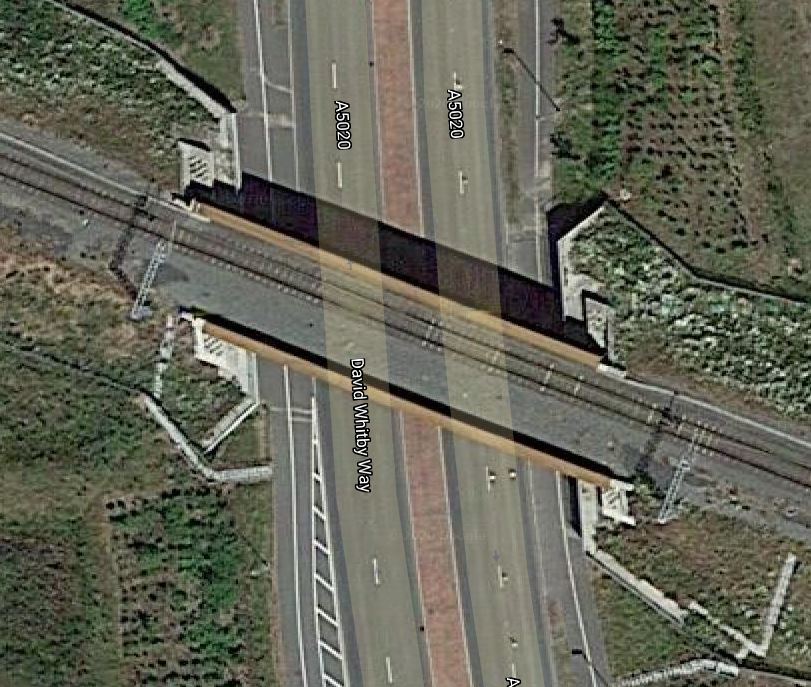
Note.
- The single track appears to be electrified, from the shadows of the gantries at either end of the bridge.
- West Midlands Trains appear to run an electric service between Crewe and Stafford on this route.
- I suspect it’s also used as a diversion route for Avanti West Coast’s Manchester service via Stoke-on-Trent or for train positioning.
Will this route allow High Speed Two trains to run between Stoke-on-Trent and Manchester Piccadilly?
From picture and comments in a rail forum, I suspect that the route could be redoubled fairly easily.
- The electrification runs for about 15.5 miles, between Crewe station and Stoke Junction, which is about half-a-mile on the other side of Stoke-on-Trent station.
- Trains seem to be connected to the electrification for over twenty minutes, so it could be useful for charging a battery train, running between Stoke-n-Trent and Crewe stations.
This Google Map shows Stoke Junction.
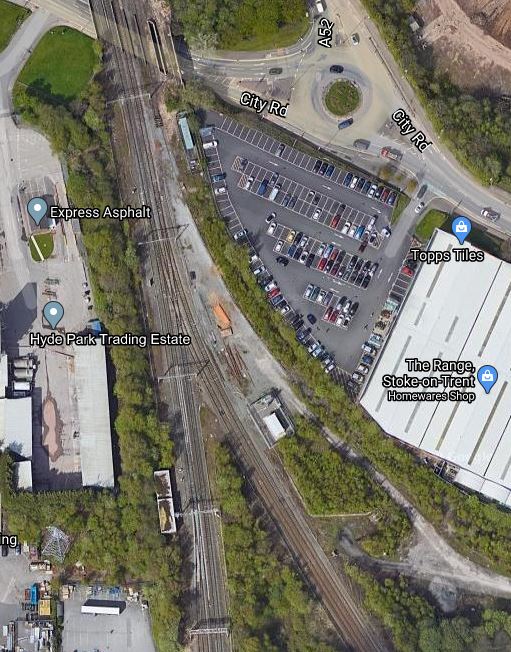
Note,
- Stoke-on-Trent station is to the North.
- The electrified railway going due South is the West Coast Main Line to Stone and Stafford stations.
- The line without electrification going off in a more South-Easterly direction is the line to Uttoxeter and Derby.
Following the route between Derby and Crewe, these are my observations.
- There is a level crossing at Blythe Bridge station.
- Most of the bridges over the route are modern, so I suspect will accept electrification.
- The route would appear to have a speed limit of 70 mph, but I would suspect that this could be increased somewhat as it doesn’t look too challenging.
- The route is 51 miles long, so a service that takes the current 79 minutes with nine stops, would average 38.7 mph.
- The proposed time of 59 minutes, would average 51.8 mph
I suspect there could be more to come, as the timetable is probably written for a Class 153 train.
A Crewe And Nottingham Service
The Midlands Connect plan says the service will be the following.
- Two tph
- A slow train in 79 minutes.
- A fast train in 59 minutes.
- East Midlands Railway want to extend services to Nottingham.
It could be a fairly simple easy-to-use timetable.
Fast Trains
Consider.
- Derby and Nottingham are 16 miles apart and fastest trains take between 19-22 minutes between the two cities.
- When it opens, all trains would stop at East Midlands Hub station between Nottingham and Derby.
- East Midlands Railway have a fleet that will include forty Class 170 trains.
- I suspect that these 100 mph trains will be able to run between Crewe and Nottingham including the turnround in under 90 minutes.
This would mean that a fast hourly service would need three trains.
Slow Trains
Consider.
- I wouldn’t be surprised to see the slower services continuing as now and not extending to Nottingham.
- 79 minutes is probably a convenient time, which would give a ninety minute time for each leg between Derby and Crewe, when turnround is included.
- Trains would be more of the Class 170 trains.
This would mean that a slow hourly service would need three trains.
Could Battery Electric Trains Be Used?
Consider.
- I think it is likely that the route between Derby and East Midlands Parkway via East Midlands Hub station, will be electrified, in conjunction with Midland Main Line electrification.
- Between Derby and Long Eaton stations via East Midlands Hub station is just under ten miles and takes ten minutes.
- Nottingham and Crewe is 66 miles of which 25 miles in total could be electrified.
- Derby and Crewe is 51 miles of which 15 miles are electrified.
- The longest section without electrification is between Derby station and Stoke Junction, which is 35.5 miles.
Batteries would be charged in the following places.
- Between Long Eaton and Derby stations.
- During turnround at a fully-electrified Derby station.
- Between Stoke-on-Trent and Crewe stations.
- During turnround at a fully-electrified Crewe station.
That’s a lot better than with an electric car.
In Sparking A Revolution, I quoted this Hitachi-specification for a battery-electric train.
- Range – 55-65 miles
- Performance – 90-100 mph
- Recharge – 10 minutes when static
- Routes – Suburban near electrified lines
- Battery Life – 8-10 years
I can’t see any problem with one of these trains or other battery-electric trains with a similar performance, running between Crewe and Nottingham or Derby via Stoke.
Could Hydrogen-Powered Trains Be Used?
I would suspect so, as the Alsthom Coradia iLint runs a similar route in Germany.
Connections To High Speed Two
Midlands Connect noted the route’s link to High Speed Two at Crewe.
But it also has other links to High Speed Two at Stoke-on-Trent and East Midlands Hub stations.
I suspect some stations like Uttoxeter or Alsager will have a choice of fast routes to London or Scotland.
Could Services Be Extended From Crewe?
In Connecting The Powerhouses, I talked about an article in the June 2017 Edition of Modern Railways, which proposed reopening the Midland Railway route between Derby and Manchester.
Some passengers and commentators fell a direct fast link is needed.
When High Speed Two is completed, the main route into Manchester Piccadilly will be a high speed spur from Crewe via Manchester Airport. Current plans include the following services.
- One tph from London Euston via Old Oak Common and Birmingham Interchange.
- Two tph from London Euston via Old Oak Common
- Two tph from Birmingham Curzon Street
Note.
- All services will call at Manchester Airport.
- It is likely that Northern Powerhouse Rail will add six tph to Manchester Piccadilly from Liverpool via Warrington.
- Some services will extend through Manchester Piccadilly to Bradford, Doncaster, Huddersfield, Hull, Leeds, Newcastle, Sheffield and York.
- High Speed lines will probably have a capacity of up to eighteen tph.
The Birmingham Curzon Street, Liverpool and London Euston services would be eleven tph, so there would be more than enough capacity for an hourly train from Nottingham.
What would the service be like?
- It would be between Nottingham and Manchester Piccadilly stations.
- It could call at East Midlands Hub, Derby, Uttoxeter, Stoke-on-Trent, Kidsgrove, Crewe and Manchester Airport stations.
- It would probably be hourly.
Timings could be as follows.
- Nottingham and Manchester Airport – 87 minutes
- Nottingham and Manchester Piccadilly – 91 minutes
- Derby and Manchester Airport – 67 minutes
- Derby and Manchester Piccadilly – 71 minutes
- Stoke-on-Trent and Manchester Airport – 32 minutes
- Stoke-on-Trent and Manchester Piccadilly – 36 minutes
The trains used on this and other local services that might need to use High Speed Two infrastructure would be performing a similar role as that of the Class 395 trains on High Speed One.
Possibilities must include.
- A classic-compatible High Speed Two train.
- A five-car AT-300 train, like East Midlands Railway’s Class 810 trains.
- An updated Class 395 train.
All trains would need a battery capability with a range of 40 miles.
It should also be noted that in Options For High Speed To Hastings, I worked through the options needed to run high speed commuter services to Hastings.
This was the last sentence in that post.
It’s all about selling trains and a company that had a 140 mph or 225 kph high-speed electric train, that could do perhaps 25 miles or 40 kilometres on batteries, would have a valuable addition to their product range.
A train with a range of 50 miles on battery power, would be suitable for the following routes.
- London St. Pancras and Hastings via Ashford International.
- Manchester Piccadilly and Nottingham via Manchester Airport, Crewe, Derby and East Midlands Hub.
- Manchester Piccadilly and Barrow-in-Furness via Manchester Airport, Warrington Bank Quay, Wigan North Western, Preston and Lancaster.
- Manchester Piccadilly and Chester via Manchester Airport and Crewe.
- Manchester Piccadilly and Shrewsbury via Manchester Airport and Crewe.
Charging might be needed at some of the terminal stations.
Discontinuous Electrification Through Leicester Station
Leicester station is an important station on the Midland Main Line
- Leicester is an urban area of half a million people.
- All of East Midlands Railway Intercity services call as they pass through the station.
- Leicester station is only sixteen miles North of the end of the Southern electrification at Market Harborough station.
- Birmingham New Street is 40 miles away.
- Clay Cross North Junction is 50 miles away.
- Derby is 29 miles away.
- East Midlands Parkway is 19 miles away.
- Long Eaton is 21 miles away.
- Nottingham is 27 miles away.
- Peterborough is 52 miles away.
- Sheffield is 66 miles away.
A sensible decision would probably be to extend the electrification from Market Harborough to a few miles North of Leicester, so that battery-electric trains could reach all the places in the above list.
Unfortunately, the following about the bridge at the Southern end of Leicester station, must be noted.
- The bridge doesn’t have sufficient clearance for electrification and would need to be rebuilt.
- It carries the main A6 road to London over the railway.
- The station building also spans the railway lines.
- To complicate matters, there is an important sewer either in or under the bridge.
This Google Map shows the bridge and the Southern end of the station.
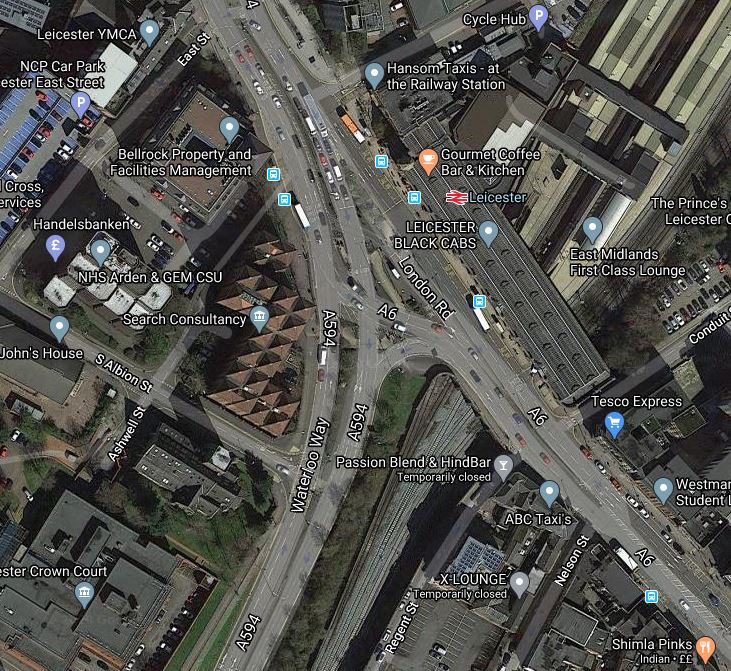
It looks to me, that Leicester station and the road, would have to be closed to traffic for some time, if the bridge were to be rebuilt, to allow the erection of electrification through the area.
A solution could be discontinuous electrification.
- The electrification from the South, would finish on the South side of bridge.
- The electrification from the North, would finish in Leicester station.
- Electric trains would cover the gap of a few hundred metres on battery power.
Pantographs could be raised and lowered, where the wires exist.
- On the North side of the bridge, this could be in Leicester station, whilst passengers are getting off and on the train.
- On the South side of the bridge, this could be as far South as Market Harborough, which is sixteen miles away.
The other big problem area of electrification on the Midland Main Line is North of Derby, where the railway runs through the World Heritage Site of the Derwent Valley Mills. There might be serious opbjections to electrification in this area.
- But if electrification were to be installed between Leicester and Derby stations, the following would be possible.
- The Midland Main Line would be electrified at East Midlands Hub station.
- Power could be taken from High Speed Two’s supply at East Midland Hub station.
- Battery-electric trains could do a return trip to Nottingham from an electrified East Midlands Parkway, as it’s only sixteen miles in total.
- Battery-electric trains could reach the High Speed Two spur into Sheffield at Clay Cross from Derby, as it’s only twenty-one miles.
I am assuming, that Hitachi’s Class 810 trains will have range of over fifty miles on battery power, which fits with Hitachi’s statements.
Conclusion
Discontinuous electrification and batteries on trains can solve the problem of electrification through Leicester station.
Also. electric trains could run between London and Sheffield, if the following were done.
- The Class 810 trains were to be given a range of twenty-five miles
- Electrification were to be erected between Leicester and Derby stations.
- Electrification were to be erected between Sheffield and Clay Cross Junction, as required by High Speed Two.
The electrification could be brought forward, to bring Sheffield early benefits of High Speed Two.
The Big Metro Fleet Upgrade That Could Make It ‘Easy’ To Finally Extend Train Services To New Areas
The title of this post, is the same as that of this article on the Newcastle Chronicle.
This is the first paragraph.
Every train in Metro’s new fleet will be capable of running via an on-board battery, reducing the chance of major shutdowns and making it much cheaper to extend the network.
The fact that it is technically possible, is not a surprise as Stadler’s Class 777 trains for Merseyrail will be using battery power to extend routes. I would be very surprised if the new Tyne and Wear Metro trains and those for Merseyrail, didn’t have a lot of design in common.
But what is surprising, is that the Tyne and Wear Metro’s whole fleet will be fitted with batteries. This must be the first time in the UK, that a whole fleet of trains has been said to have batteries.
The Merseyrail trains will also have a dual voltage capability and will be able to be modified for running on 25 KVAC overhead electrification, as well as 750 VDC third-rail electrification.
Will the Tyne and Wear trains be able to use 25 KVAC electrification? It could be useful in some places on the network and I’m sure, if there was a financial case for a service using existing 25 KVAC electrification, then some trains would be modified accordingly.
A Quick Comparison
This is a quick comparison between Merseyrail’s Class 777 trains and the Tyne and Wear Metro’s new trains.
- Cars – 777 – 4 – T&W – 5
- Operating Speed – 777 – 75 mph – T&W – 50 mph
- Capacity – 484 – T&W – 600
- Capacity Per Car – 121 – T&W – 125
- In Service – 2022 (?) – T&W – 2024
They are not that different and it looks like the Tyne and Wear trains will be built after the Merseyrail trains.
Battery Running
The article says this about running on battery power.
He said the 16km off-wire running would allow for a new loop extending out from South Hylton, through Washington, connecting back to Pelaw.
He added that it would be “easy” to create new connections between existing Metro lines – potentially allowing for a new route through Silverlink and the Cobalt business park in North Tyneside, or a link-up from South Shields towards Sunderland.
Battery power would also solve the problem of running Metro trains on Network Rail lines, which is currently impossible because they operate at different voltages.
Mr Blagburn said: “You could remove the electrification from the complex parts of the route, say over historic structures or through tunnels.
Note.
- The range of sixteen kilometres or ten miles could be very useful.
- The trains appear to be designed to run on Network Rail tracks, as the current trains already do.
- The current trains use the Karlsruhe model to effectively work as tram-trains on shared tracks.
I actually believe that the new Tyne and Wear trains could be modified to run on both 25 KVAC and 750 VDC overhead electrification, as Stadler’s Class 399 tram-trains do in Sheffield.
Conclusion
These trains are using all Stadler’s experience of trains and tram-trains from all over the world.
- They will normally operate using 750 VDC overhead electrification.
- But Stadler have the technology to enable the trains for 25 KVAC overhead electrification, if required.
- They have a range of ten miles on batteries.
- Are the batteries charged by using the energy created by the regenerative braking?
These are not bog-standard trains!
But then neither are the trains built for Greater Anglia by Stadler!
The Definitive High Speed Two Route Map
This map is shown on the High Speed Two web site.
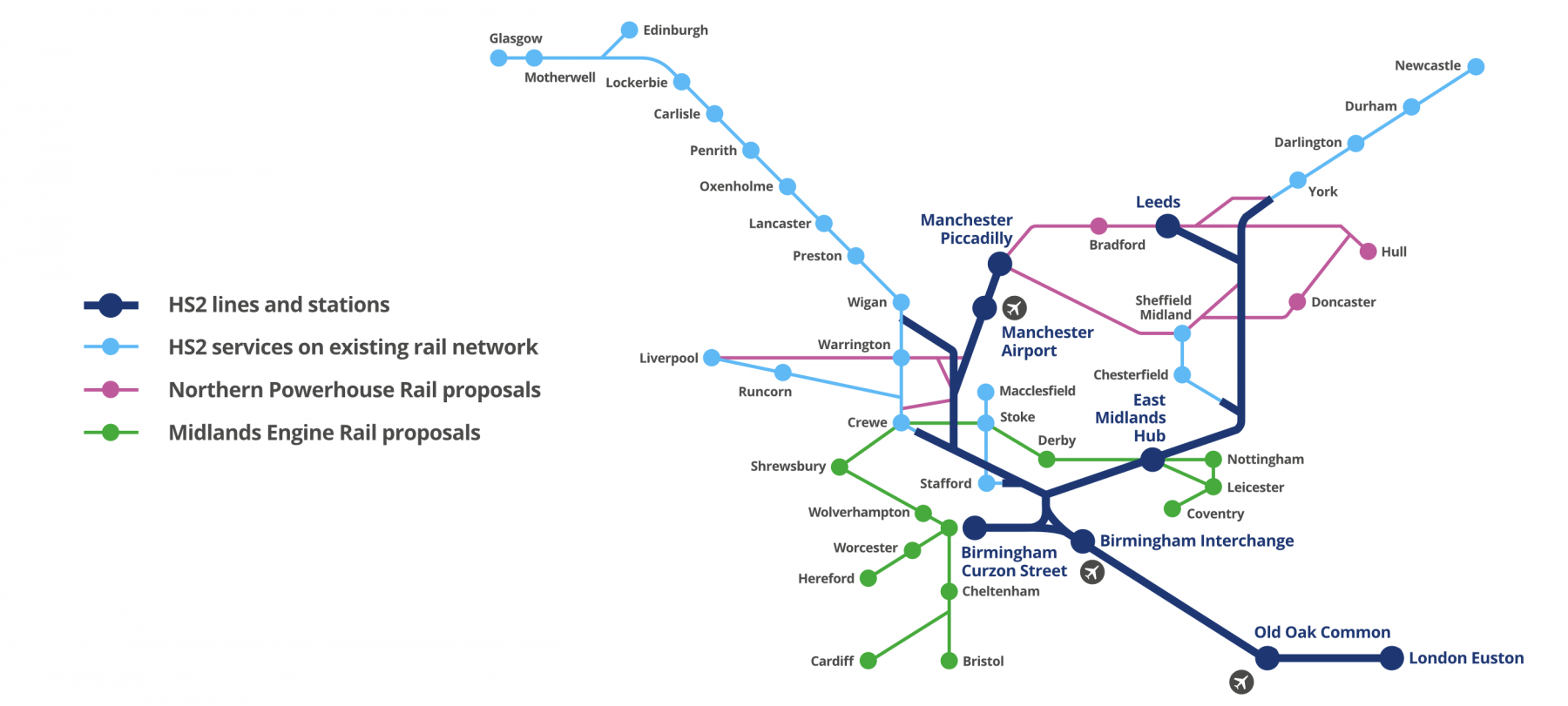
The map shows how it links to other routes.
- High Speed Two joins the West Coast Main Line at Crewe and South of Wigan.
- High Speed Two uses a route via Stafford and Stoke-on-Trent to serve Macclesfield.
- High Speed Two uses the current Crewe and Liverpool route to serve Runcorn and Liverpool.
- High Speed Two to Manchester Piccadilly share tracks with Northern Powerhouse Rail between Liverpool and Manchester Piccadilly via Warrington and Manchester Airport.
- High Speed Two uses the loop around Crewe to Wigan to serve North West England and Scotland.
- High Speed Two joins the East Coast Main Line South of York, to serve York, Darlington, Durham and Newcastle.
- High Speed Two joins the Midland Main Line at Clay Cross North Junction to serve Chesterfield and Sheffield.
- High Speed Two has connections to Midlands Rail Engine at Birmingham, Crewe and East Midlands Hub.
- High Speed Two has connections to Northern Powerhouse Rail at Liverpool, Manchester Airport, Manchester Piccadilly, Sheffield and Leeds.
 The Anonymous Widower