UK National Grid In Talks To Build An Energy Island In The North Sea
The title of this post, is the same as that of this article on the New Scientist.
This is the first paragraph.
UK company National Grid has revealed it is in talks with two other parties about building an “energy island” in the North Sea that would use wind farms to supply clean electricity to millions of homes in north-west Europe.
These are my thoughts.
An Artificial Island on the Dogger Bank
The idea of the North Sea Wind Power Hub in the area of the Dogger Bank has been around for a few years and has a comprehensive Wikipedia entry.
Wikipedia says that it would be an artificial island on the Dutch section of the Dogger Bank and the surrounding sea could eventually host up to 110 GW of wind turbines.
North Sea Wind Power Hub Programme
The Dutch and the Danes seems to have moved on and there is now a web site for the North Sea Wind Power Hub Programme.
The home page is split into two, with the upper half entitled Beyond The Waves and saying.
The incredible story of how the Netherlands went beyond technical engineering as it had ever been seen before. Beyond water management. To secure the lives of millions of inhabitants.
I have met Dutch engineers, who designed and built the Delta Works after the North Sea Floods of 1953 and I have seen the works all over the country and it is an impressive legacy.
And the lower half of the home page is entitled North Sea Wind Power Hub and saying.
Today, climate policy is largely national, decoupled and incremental. We need a new approach to effectively realise the potential of the North Sea and reach the goals of the Paris Agreement. We take a different perspective: harnessing the power of the North Sea requires a transnational and cross-sector approach to take the step-change we need.
Behind each half are two videos, which explain the concept of the programme.
It is a strange web site in a way.
- It is written totally in English with English not American spelling.
- The project is backed by Energinet, Gasunie and TenneT, who are Danish and Dutch companies, that are responsible for gas and electricity distribution networks in Denmark, Ger,many and The Netherlands.
- There are four sections to the web site; Netherlands, Germany, Denmark and North Sea.
It is almost as if the web site has been designed for a British company to join the party.
Hubs And Spokes In North Sea Wind Power Hub Programme
If you watch the videos on the site, they will explain their concept of hubs and spokes, where not one but several energy islands or hubs will be connected by spokes or electricity cables and/or hydrogen pipelines to each other and the shore.
Many electrical networks on land are designed in a similar way, including in the UK, where we have clusters of power stations connected by the electricity grid.
The Dogger Bank
The Dogger Bank is a large sandbank in a shallow area of the North Sea about 100 kilometres off the east coast of England.
Wikipedia says this about the geography of the Dogger Bank.
The bank extends over about 17,600 square kilometres (6,800 sq mi), and is about 260 by 100 kilometres (160 by 60 mi) in extent. The water depth ranges from 15 to 36 metres (50 to 120 ft), about 20 metres (65 ft) shallower than the surrounding sea.
As there are Gunfleet Sands Wind Farm and Scroby Sands Wind Farm and others, on sandbanks in the North Sea, it would appear that the engineering of building wind farms on sandbanks in the North Sea is well understood.
The Dogger Bank Wind Farm
We are already developing the four section Dogger Bank Wind Farm in our portion of the Dogger Bank and these could generate up to 4.8 GW by 2025.
The Dogger Bank Wind Farm has its own web site, which greets you with this statement.
Building the World’s Largest Offshore Wind Farm
At 4.8 GW, it will be 45 % larger than Hinckley Point C nuclear power station, which is only 3.3 GW. So it is not small.
The three wind farms; Dogger Bank A, B and C will occupy 1670 square kilometres and generate a total of 3.6 GW or 0.0021 GW per square kilometre.
If this density of wind turbines could be erected all over the Dogger Bank, we could be looking at nearly 40 GW of capacity in the middle of the North Sea.
Interconnectors Across The North Sea
This Google Map shows the onshore route of the cable from the Dogger Bank Wind Farm.
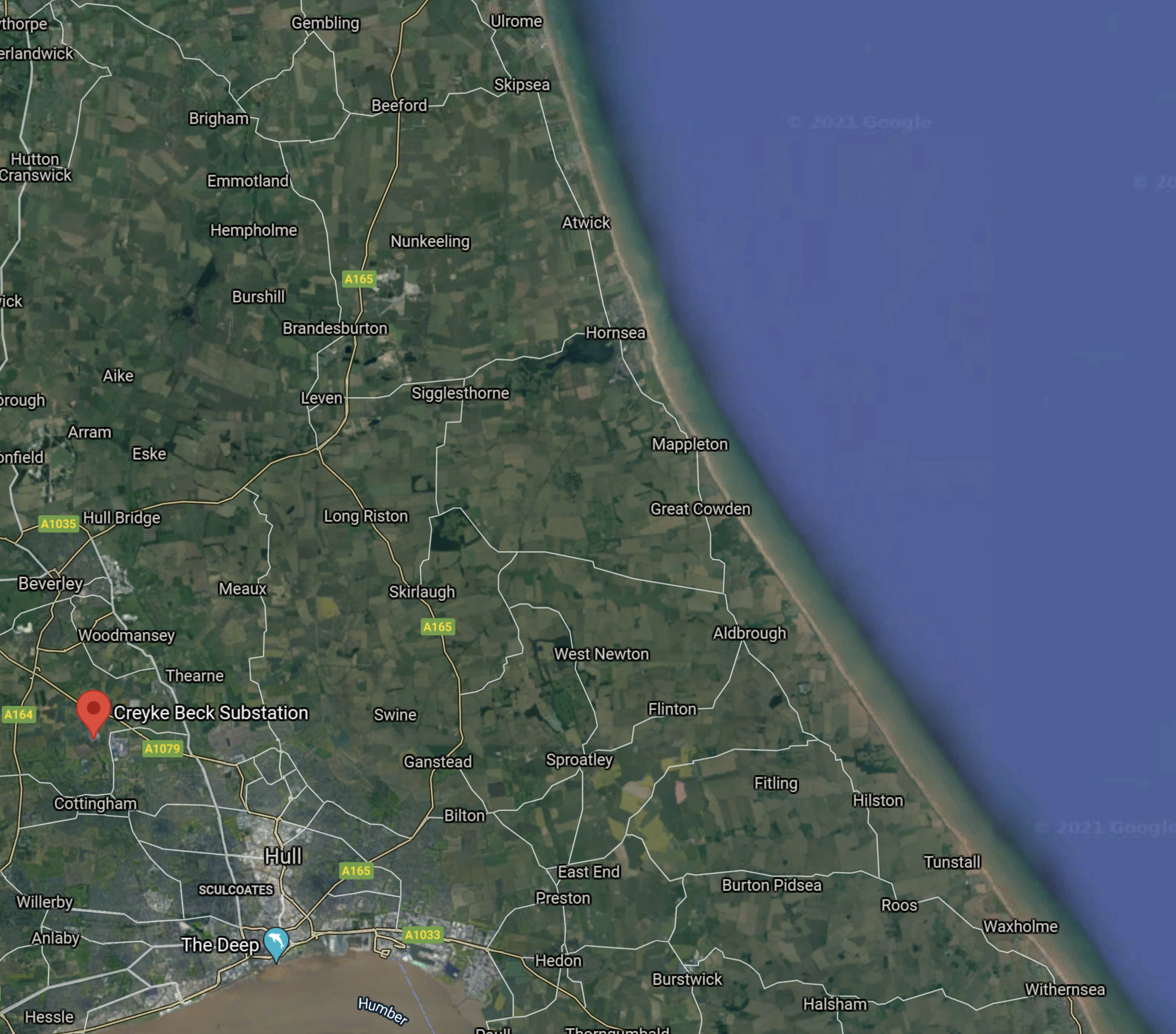
Note.
- Hull and the River Humber at the bottom of the map.
- The red arrow which marks Creyke Beck sub station, where the cable from the Dogger Bank Wind Farm connects to the UK electricity grid.
- At the top of the map on the coast is the village of Ulrome, where the cable comes ashore.
The sub station is also close to the Hull and Scarborough Line, so would be ideal to feed any electrification erected.
I would assume that cables from the Dogger Bank Wind Farm could also link the Wind Farm to the proposed Dutch/Danish North Sea Wind Power Hub.
Given that the cables between the wind farms and Creyke Beck could in future handle at least 4.8 GW and the cables from the North Sea Wind Power Hub to mainland Europe would probably be larger, it looks like there could be a very high capacity interconnector between Yorkshire and Denmark, Germany and The Netherlands.
It almost makes the recently-opened North Sea Link to Norway, which is rated at 1.4 GW seem a bit small.
The North Sea Link
The North Sea Link is a joint project between Statnett and National Grid, which cost €2 billion and appears to have been delivered as planned, when it started operating in October 2021.
So it would appear that National Grid have shown themselves capable of delivering their end of a complex interconnector project.
Project Orion And The Shetlands
In Do BP And The Germans Have A Cunning Plan For European Energy Domination?, I introduced Project Orion, which is an electrification and hydrogen hub and clean energy project in the Shetland Islands.
The project’s scope is described in this graphic.
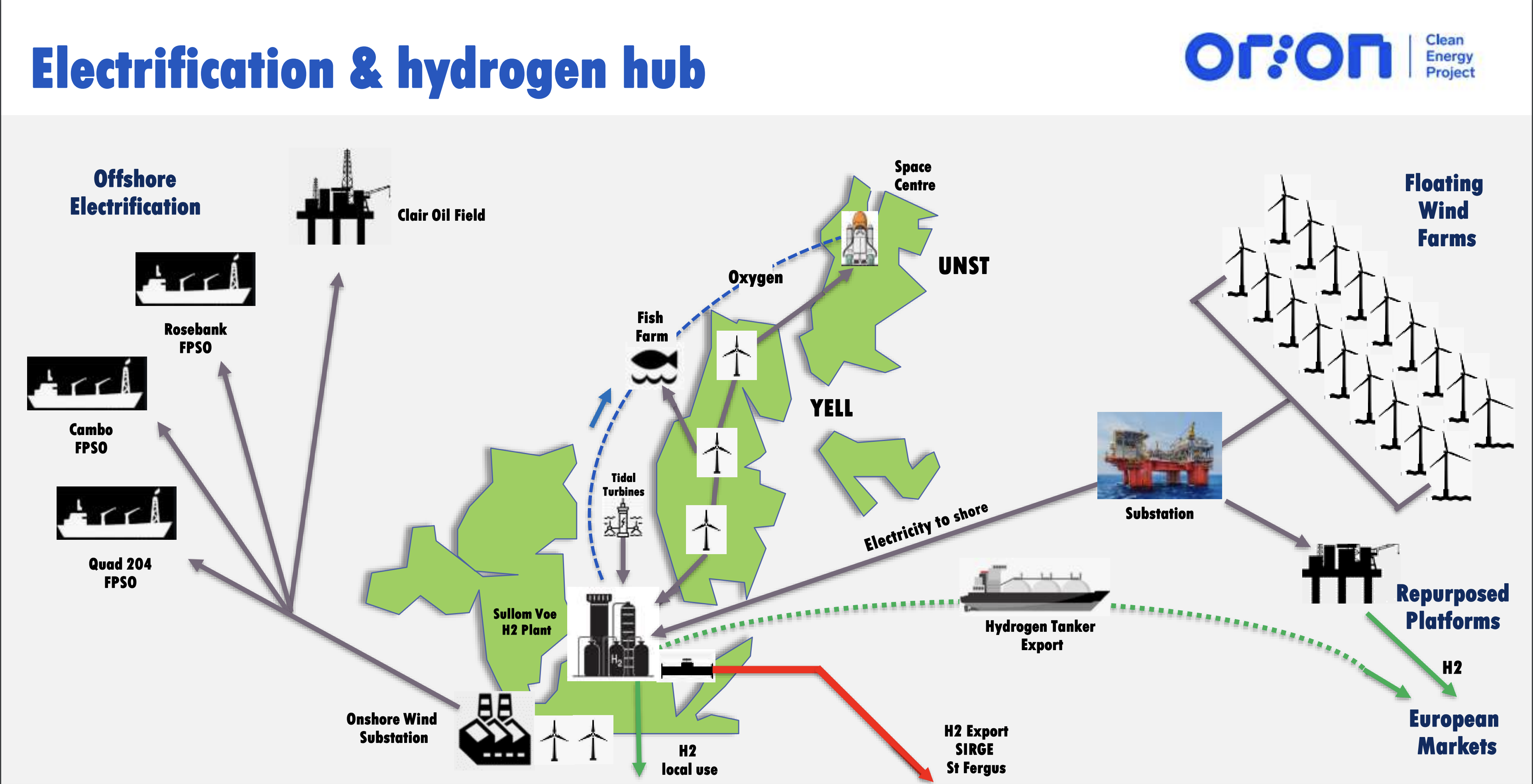
Note that Project Orion now has its own web site.
- Could the Shetlands become an onshore hub for the North Sea Power Hub Programme?
- Could Icelink, which is an interconnector to Iceland be incorporated?
With all this renewable energy and hydrogen, I believe that the Shetlands could become one of the most prosperous areas in Europe.
Funding The Wind Farms And Other Infrastructure In The North Sea
In World’s Largest Wind Farm Attracts Huge Backing From Insurance Giant, I described how Aviva were funding the Hornsea wind farm.
I very much believe that City of London financial institutions will be able to finance a lot of the developments in the North Sea.
After all National Grid managed to find a billion euros in a sock drawer to fund their half of the North Sea Link.
Electrifying The North Sea: A Gamechanger For Wind Power Production?
The title of this section, is the same as that of this article on Engineering and Technology Magazine.
This article in the magazine of the IET is a serious read and puts forward some useful facts and interesting ideas.
- The EU is targeting offshore wind at 60 GW by 2030 and 300 GW by 2050.
- The UK is targeting offshore wind at 40 GW by 2030.
- The article explains why HVDC electricity links should be used.
- The major players in European offshore wind are the UK, Belgium, the Netherlands, Germany, and Denmark.
- The foundations for a North Sea grid, which could also support the wider ambitions for a European super-grid, are already forming.
- A North Sea grid needs co-operation between governments and technology vendors. as well as technological innovation.
- National Grid are thinking hard about HVDC electrical networks.
- By combining HVDC links it can be possible to save a lot of development capital.
- The Danes are already building artificial islands eighty kilometres offshore.
- Electrical sub-stations could be built on the sea-bed.
I can see that by 2050, the North Sea, South of a line between Hull and Esbjerg in Denmark will be full of wind turbines, which could generate around 300 GW.
Further Reading
There are various articles and web pages that cover the possibility of a grid in the North Sea.
- National Grid – Interconnectors
- The Guardian – National Grid In Talks Over Plan For Energy Island In North Sea
- The Times – National Grid Planning ‘Energy Island’ In North Sea
I shall add to these as required.
Conclusion
I am coming to the conclusion that National Grid will be joining the North Sea Wind Power Hub Programme.
- They certainly have the expertise and access to funding to build long cable links.
- The Dogger Bank wind farm would even be one of the hubs in the planned hub and spoke network covering the North Sea.
- Only a short connection would be needed to connect the Dogger Bank wind farm, to where the Dutch and Danes originally planned to build the first energy island.
- There may be other possibilities for wind farm hubs in the UK section of the North Sea. Hornsea Wind Farm, which could be well upwards of 5 GW is surely a possibility.
- Would it also give access to the massive amounts of energy storage in the Norwegian mountains, through the North Sea Link or Nord.Link between Norway and Germany.
Without doubt, I know as a Control Engineer, that the more hubs and spokes in a network, the more stable it will be.
So is National Grid’s main reason to join is to stabilise the UK electricity grid? And in turn, this will stabilise the Danish and Dutch grids.
Vivarail To Unveil 80mph Super-Class 230 At COP26
The title of this post, is the same as that as of this article on Rail Magazine.
This is the first paragraph.
Vivarail intends to show off a new design of battery-powered zero-emission Class 230 unit at next month’s COP26 climate change conference in Glasgow.
Features of the train include.
- 80 mph operating speed, as opposed to 60 mph of the mph of the current Class 230 train and 45 mph of the original London Underground D78 Stock.
- Two driver cars and a trailer car in between.
- Ten minutes to fully charge the batteries.
- The two driver cars have three battery packs.
I doubt the designers of the train at Metro-Cammell, envisaged this future development.
Fortescue Future Industries Invests In Dutch Thin-Film Solar And H2 Firm HyET
I missed this article, when it was published, so I’m publishing it now!
The title of this post, is the same as that of this article on Renewables Now.
These two paragraphs outline the deal.
Australia’s Fortescue Future Industries (FFI) has taken a 60% stake in Dutch company High yield Energy Technologies (HyET) Group to assist in its ambition to supply 15 million tonnes of green hydrogen globally by 2030.
The green energy company of Fortescue Metals Group Ltd (ASX:FMG) has also provided the majority of financing for the expansion of the Dutch solar photovoltaic (PV) factory of HyET Solar.
Andrew Forrest certainly seems to be splashing the cash.
I first wrote about the hydrogen innovation of the HyET Group in December 2020 in New Device Separates Hydrogen From Natural Gas When The Two Gases Are Blended In Pipelines.
I finished that post, with this simple sentence.
This invention could change the world!
In the UK, there is a project called HyDeploy, which aims to blend twenty percent hydrogen into the UK’s natural gas.
- At this level, all boilers, appliances and processes would work without major changes.
- A significant amount of carbon emissions would be saved.
- Gas imports would be reduced.
Could HyET’s technology be used to piggyback a hydrogen delivery network alongside the UK’s gas network?
It might even be possible to attach hydrogen filling stations direct to the gas network.
The Route Map Of The East West Main Line
This image shows a schematic map of the East West Main Line.

Note.
- There is a lot of detail at the Eastern end. Is that the East Anglia influence in the Partnership?
- Bury St. Edmunds has been missed out. Is that the Ipswich influence in the Partnership?
- Of the four new stations only Winslow is not in Cambridgeshire. Is that the Cambridge influence in the Partnership?
It should also be noted that there are two links at the East, to the two ports of Freeport East; Felixstowe and Harwich.
Conclusion
This map makes a bold statement.
Related Posts
Birth Of The East West Main Line
Today, the East West Rail Consortium has changed its name to the East West Main Line Partnership.
The home page on the new web site, is emblazoned with this headline.
Championing The Ambition For East West Rail
This mission statement is then given.
The East West Main Line Partnership (previously the East West Rail Consortium) is led by local authorities and works closely with sub-national transport bodies, LEPs, government and its agencies to realise the vision for an East West Main Line.
It is followed by six main areas of interest.
Delivery Of Oxford-Cambridge
The Partnership will continue to work with government and the East West Railway Company to support delivery of Oxford-Cambridge (including Aylesbury-Milton Keynes) at the earliest opportunity.
Coast-To-Coast Connectivity
For East West Rail to realise its full potential, direct services must extend beyond Oxford-Cambridge. Its potential should truly be ‘coast to coast’ – from Norfolk and Suffolk to Bristol and South Wales.
North-South Connectivity
It is important to recognise that East West Rail is not just about improving east-west connectivity: it is integral to improving connectivity across the country.
Interchange And Strategic Transport Hubs
The East West Main Line’s potential to connect to services on other main lines is significant. Frictionless interchange is required for onward rail journeys and to other modes.
A 21st Century Main Line
The East West Main Line should reflect the 21st century communities it serves. It must be an exemplar for its high-quality standards of design, construction and operation.
Freight
Greater use of rail for freight and logistics provides additional resilience for the business community, while also supporting the need to achieve net zero.
Conclusion
It has to be remembered that the original driving force for the East West Rail Consortium was Ipswich Borough Council.
This new direction is a bold vision and it has the spirit of East Anglia written all over it.
Related Posts
Anglesey Hydrogen Can Bridge UK’s Energy Gap Says Economics Expert
The title of this post, is the same as that of this article on the University of Bangor web site.
This is the sub title.
Anglesey can become a UK leader in hydrogen energy technology, cleaning up the transport sector and creating high quality jobs across North Wales, according to a leading Welsh economic expert.
The University of Bangor is a respected university, that goes back to the nineteenth century.
But for Liverpool giving me an unconditional offer, as Bangor was one of the universities on my UCCA form, I could have studied in the North-West corner of Wales.
After a resume of where we are with hydrogen in the world, Dr. Edward Jones of Bangor University outlines how North West Wales can be turned into a hydrogen hub, to join similar hubs at Deeside in Flintshire and at Milford Haven in Pembrokeshire.
This is a paragraph of the article.
Dr Jones believes hydrogen could also hold the key to powering transport in future through a Welsh invention from the 19th century (the hydrogen fuel cell was developed in Swansea by William Grove in 1842).
William Grove was an interesting lawyer and scientist.
Dr. Jones would appear to be very much in favour of using hydrogen to take Wales forward to being zero-carbon in 2050.
I have written a few posts about the transformation of Anglesey and North West Wales, as Wales moves towards this goal. I also have some other thoughts of my own.
Holyhead Hydrogen Hub
This is happening and I wrote about it in Holyhead Hydrogen Hub Planned For Wales.
High Speed Two To Holyhead
I believe this could be a way to create a zero-carbon route between London and Dublin in under five hours and I wrote about it in Could High Speed Two Serve Holyhead?.
- London and Holyhead in a battery-equipped High Speed Two Classic-Compatible train should be under three hours.
- A single High Speed Two Classic-Compatible train would run between London and Holyhead, with a passenger capacity of around five hundred. It would probably split and join with another service at Crewe.
- Discontinuous electrification would be provided along the North Wales Coast Line.
- The trains could call at Old Oak Common, Birmingham Interchange, Chester, Crewe, Llandudno Junction and Bangor.
A High Speed catamaran would speed passengers between Holyhead and Dublin in under two hours.
Hydrogen-Powered Catamarans From Holyhead
The dynamics of a diesel-powered high speed catamaran are well-proven, with some large craft transporting passengers and vehicles on sea crossings all over the world.
Type “hydrogen-powered high speed catamaran” into Google and you get several hits to research and development projects, but no-one appears to have taken a large high speed craft and converted it to hydrogen.
But I do believe that someone somewhere is developing a hydrogen-powered catamaran with something like the following specification.
- 200 passengers
- 100-mile range
- 60 knot operating speed.
The HSC Francisco is a high speed craft that plies between Buenos Aires and Montevideo carrying over a thousand passengers and a hundred cars at 58 knots. It is powered by gas-turbine engines running on liquified natural gas.
I believe I’m not asking for the impossible.
Anglesey Airport As A Zero-Carbon Airport
Anglesey Airport uses part of RAF Valley and has hosted services to Cardiff.
This Google Map shows the runways of RAF Valley.
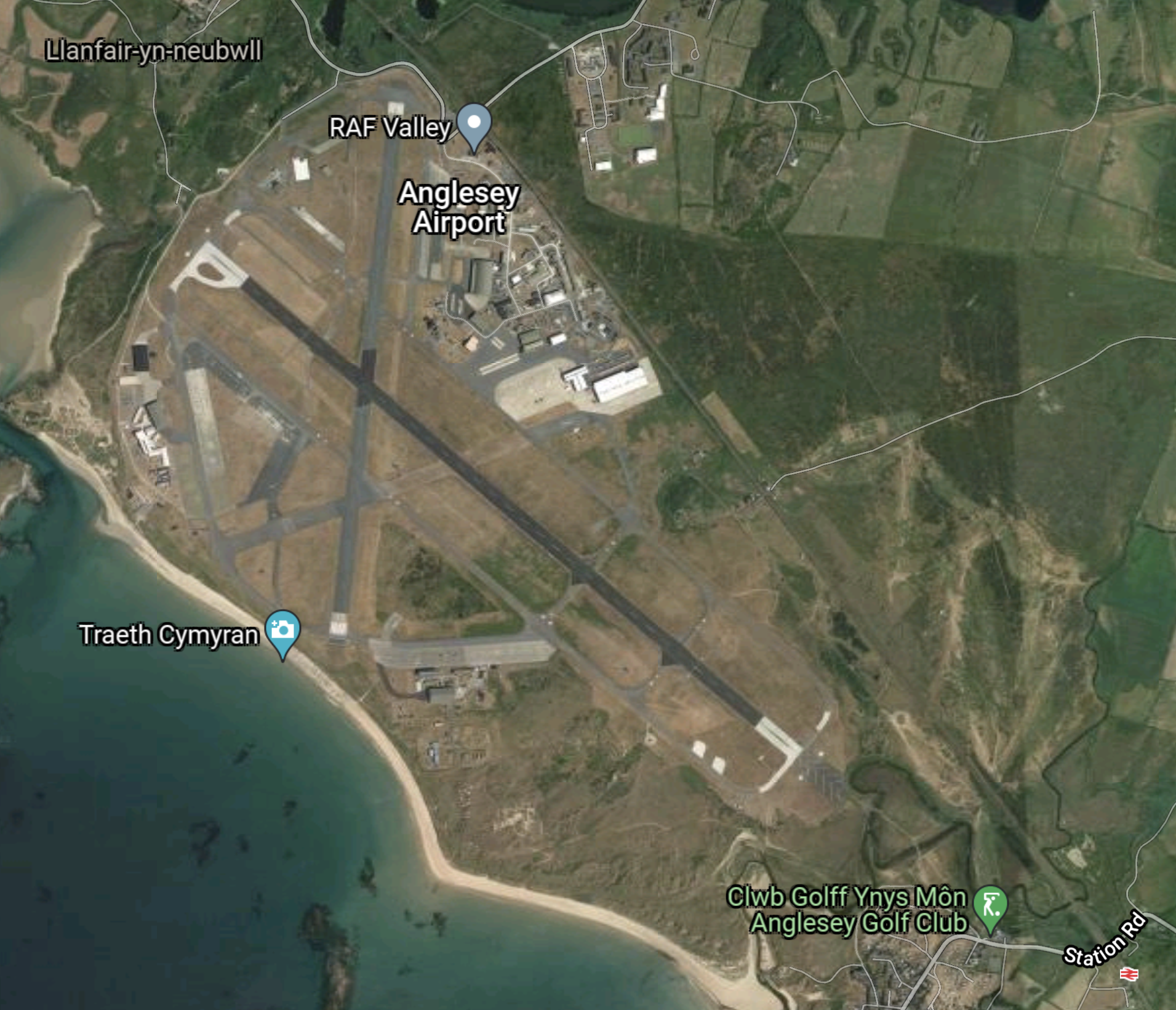
Note.
- The longest runway 14/32 is over two thousand metres long.
- Rhosneigr station in the South East corner of the map.
- The facilities of Anglesey Airport to the North-East of the runways.
The railway forms the border of the airport, as this second Google map shows.
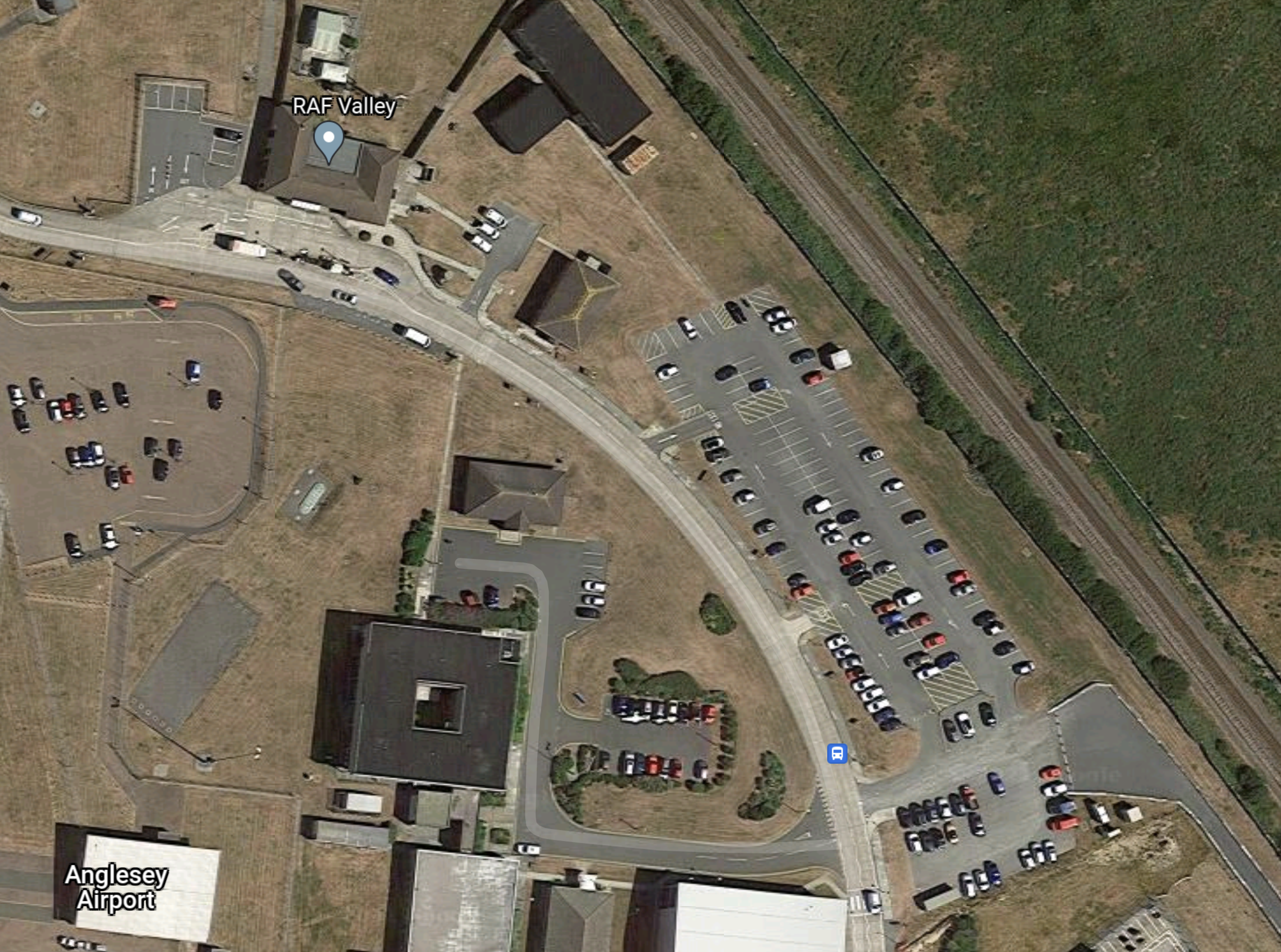
The railway is straight as it passes the Airport and there would be space for a two-hundred metre bi-directional step-free platform for passengers for the Airport.
Airbus are proposing a hydrogen-powered ZEROe Turbofan.

If you think it looks familiar, I believe that Airbus are proposing to develop the aircraft out of the current Airbus A320neo.
- The capacity will be up to 200 passengers.
- The range will be up to 2000 miles.
- Dublin and Anglesey Airports are just 71.5 miles apart.
- The cruising speed of Mach 0.78 would be irrelevant on this route, as it would probably fly a route to minimise noise.
The plane would probably be able to do several trips between Anglesey and Dublin without refuelling.
As the Port of Holyhead is developing a hydrogen infrastructure, I suspect that to provide hydrogen refuelling at Anglesey Airport would be possible.
I believe that by combining hydrogen-powered aircraft with battery-electric trains, some difficult sea crossings can be made carbon-free.
I believe that Anglesey Airport could be key to a zero-carbon London and Ireland service.
- Airbus are also proposing a 100-seat ZEROe Turboprop.
- Belfast, Cork, Derry and Shannon would also be in range.
Flights could also continue to and from Cardiff.
Reopening The Anglesey Central Railway
This has been proposed as a Beeching Reversal project.
I wrote about it in Reopening The Anglesey Central Railway.
It could be reopened as a zero-carbon railway.
Conclusion
There is a lot of scope to use hydrogen in North West Wales and Anglesey.
Historic Go-Ahead For Malaria Vaccine To Protect African Children
The title of this post, is the same as that of this article on the BBC.
This is the first paragraph.
Children across much of Africa are to be vaccinated against malaria in a historic moment in the fight against the deadly disease.
The vaccine has been developed by GSK, who have their headquarters on the Golden Mile in Brentford.
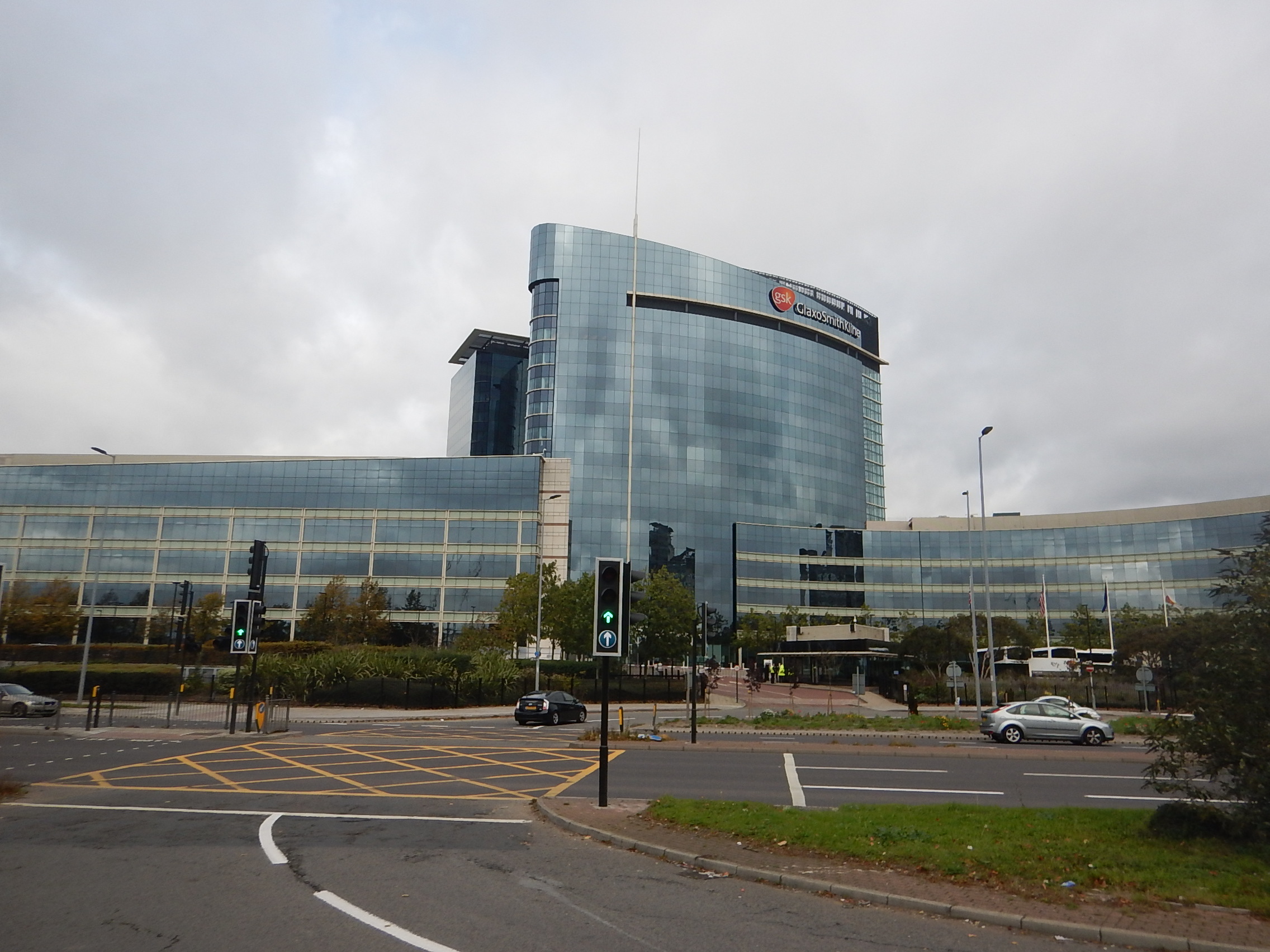
The vaccine is called RTS,S and is described like this in the first paragraph of its Wikipedia entry.
RTS,S/AS01 (trade name Mosquirix) is a recombinant protein-based malaria vaccine.
Approved for use by European regulators in July 2015, it is the world’s first licensed malaria vaccine and also the first vaccine licensed for use against a human parasitic disease of any kind. The RTS,S vaccine was conceived of and created in the late 1980s by scientists working at SmithKline Beecham Biologicals (now GlaxoSmithKline Vaccines) laboratories in Belgium. The vaccine was further developed through a collaboration between GSK and the Walter Reed Army Institute of Research and has been funded in part by the PATH Malaria Vaccine Initiative and the Bill and Melinda Gates Foundation. Its efficacy ranges from 26 to 50% in infants and young children. On 23 October 2015, the World Health Organization’s Strategic Advisory Group of Experts on Immunization (SAGE) and the Malaria Policy Advisory Committee (MPAC) jointly recommended a pilot implementation of the vaccine in Africa.
When you consider how fast the Covid-19 vaccines were developed, this might appear to have taken a long time to be developed. But then as Wikipedia states, “this is the first vaccine licensed for use against a human parasitic disease of any kind.”
I can’t describe this as anything other than good news.
Chemistry Nobel Awarded For Mirror-Image Molecules
The title of this post, is the same as that of this article on the BBC.
This is the introductory paragraph.
Two scientists have been awarded the 2021 Nobel Prize in Chemistry for their work on building molecules that are mirror images of one another.
Strangely, I was involved in a project, when I worked at ICI, where I was trying to sort out how a reaction could be persuaded to only produce one form of a chemical. So I do understand, something about what the two scientists were trying to achieve.
The involvement in that project has left me with a belief that chemical catalysts could be one of the routes to a greener and better world.
I have invested in one company, that is developing new catalysts.
Need To Call Your Bank? Many Can Now Dial 159 For Safety
The title of this post is the same as that of this article on Money Saving Expert.
This is the first paragraph.
Consumers wanting to avoid financial fraud now have a secure and easy-to-remember phone number to contact their banks on in order to avoid painful scams. It could prove to be the safest way for many to contact their provider if they have suspicions and concerns about their accounts, or even if they’re struggling to find a customer services number.
I like this anti-fraud measure and just heard it from Martin Lewis, who founded Money Saving Expert on the radio.
Many years ago before mobile phones, my late wife had her handbag snatched. This would surely help in a situation like this, as you can at least get in touch with your bank from a phone.
 The Anonymous Widower