Eurostar Orders First Double-Decker Trains
The title of this post, is the same as that of this article on the BBC.
This is the sub-heading.
Eurostar has revealed plans to run double-decker trains through the Channel Tunnel for the first time.
These three paragraphs add more details.
The cross-channel rail operator has confirmed it will order up to 50 trains from manufacturer Alstom, eventually increasing the size of its fleet by nearly a third.
The expansion plans would include investing heavily in a crucial London depot, it said.
But questions remain over whether the facility has enough space for both Eurostar and potential rival operators to use it.
This my solution to the problem outlined in the last paragraph.
Note, that I wrote the software that planned the building of the Channel Tunnel and the rail links to London and was also friends with the project manager of the 1960s attempt to build a Channel Tunnel.
We need more terminal platforms and depot space in the UK to handle Eurostar’s extra trains and the other companies who want to run to London.
We should split services into two groups.
Group 1 would terminate as now in an updated St. Pancras with more passenger handling capacity, which could probably be built over the tracks at the Northern end of the station. Trains would still be stabled at Temple Mills.
Group 2 would terminate at Ebbsfleet International, which would have extra platforms, a new depot, masses of car parking and a coach terminal.
Some trains from both groups could also stop at Ashford International.
To access Ebbsfleet from Central London and also create a Heathrow link to the Channel Tunnel, the Lizzie Line would be extended to Northfleet, where there is space to handle up to eight trains per hour in new platforms built in two disused sidings.
This OpenRailwayMap shows the location of Northfleet and Ebbsfleet stations.
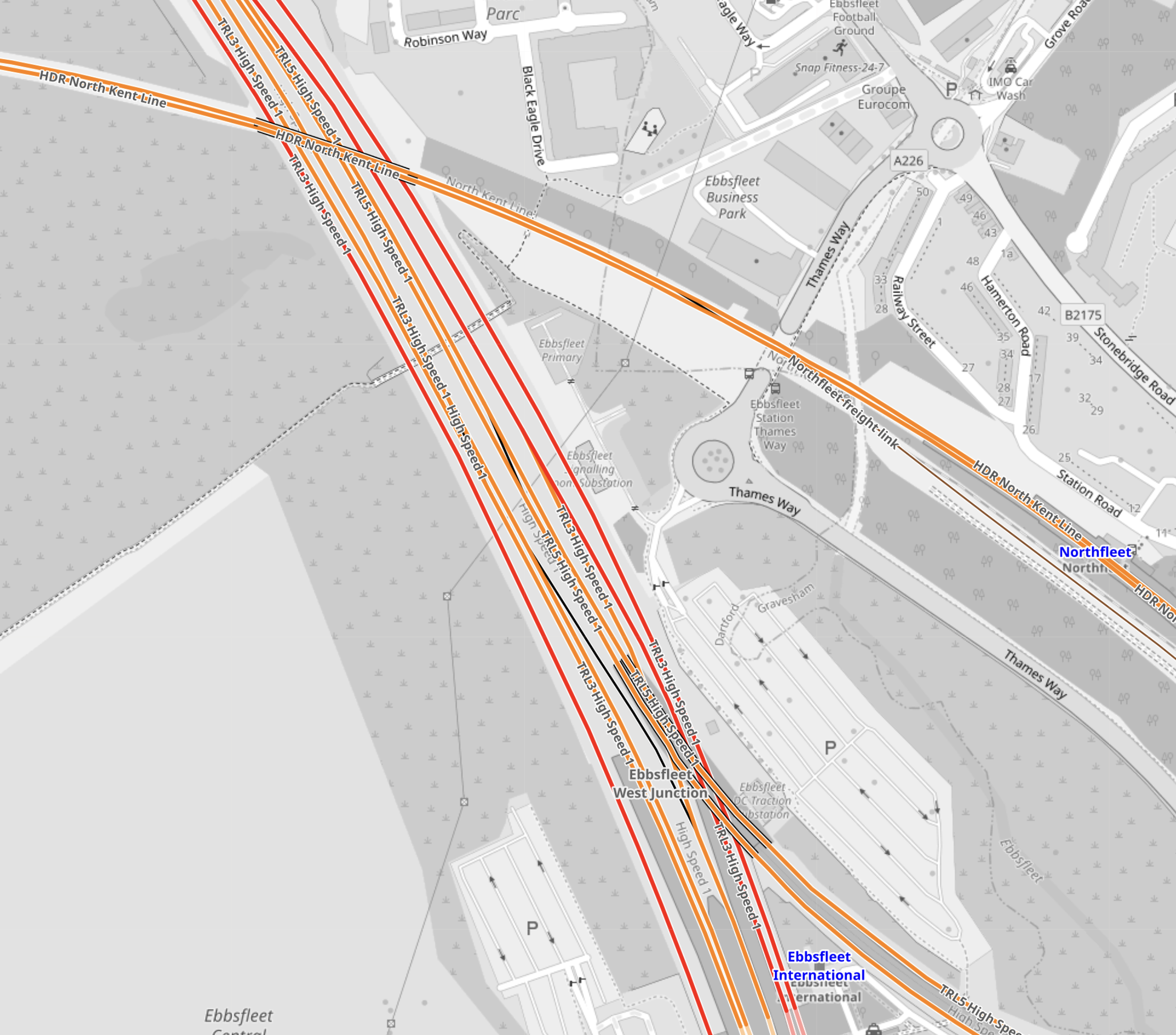
Note.
- Ebbsfleet International station at the bottom of the map.
- The red tracks are High Speed One.
- The orange tracks are third-rail electrified lines.
- The orange tracks going across the map is the North Kent Line.
- Northfleet station is at the right edge of the map on the North Kent Line.
- Northfleet and Ebbsfleet stations are less than a kilometer apart.
- Ebbsfleet has a lot of car parking spaces.
I believe a spectacular cable-car or other link would connect Northfleet and Ebbsfleet stations.
These are some other thoughts.
Ebbsfleet International Station Has Good Motorway Access
This Google Map shows the location of Ebbsfleet International station in relation to the motorways.
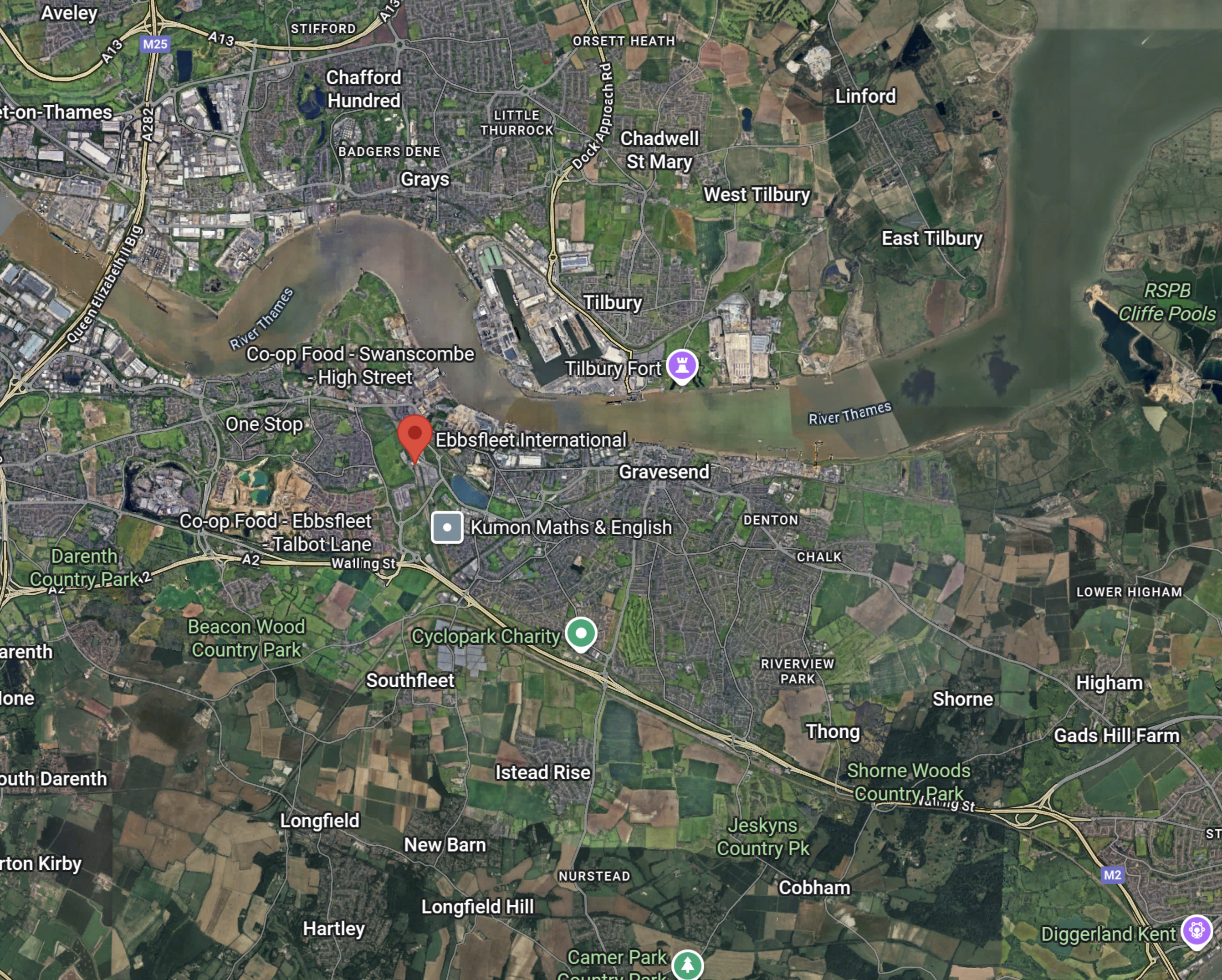
Note.
- The A2/M2 road runs across the bottom half of the map.
- The red arrow marks the position of Ebbsfleet International station.
- The Dartford Crossing is a few miles West of the station.
In my last few years, as an Ipswich season ticket holder, I regularly had a lift to Ebbsfleet International from a friend and the route to the station from the M25 and the A2/M2 wasn’t bad.
But it will be getting better.
This map from the Government’s consultation on the Lower Thames Crossing, shows the road layout in a few years.
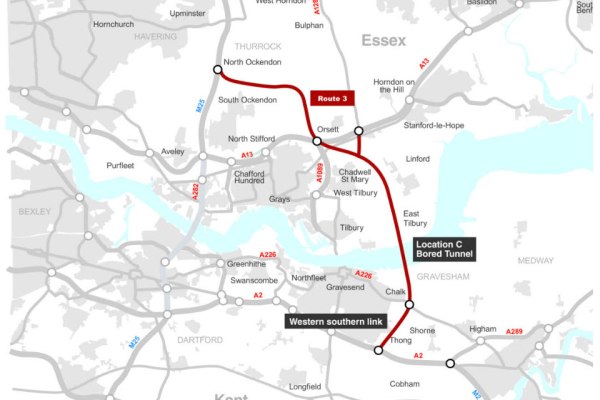
Note.
- The Lower Thames Crossing is shown in red.
- Ebbsfleet International station is about a mile South of Northfleet
- The new crossing will connect to the A2, a few miles East of the link road to the station.
Travellers from much of the East of and Middle England could use the new crossing to get to Ebbsfleet International station.
These are current times from Google.
- Birmingham – 2 hours and 41 minutes
- Cambridge – 1 hour and 17 minutes
- Edinburgh – 7 hours and 44 minutes
- Fishguard – 5 hours and 29 minutes
- Glasgow – 7 hours and 6 minutes
- Holyhead – 5 hours and 29 minutes
- Hull – 4 hours and 1 minute
- Ipswich – 1 hour and 29 minutes
- Leeds – 3 hours and 55 minutes
- Liverpool – 4 hours and 40 minutes
- Manchester – 4 hours and 28 minutes
- Milton Keynes – 1 hour and 37 minutes
- Newcastle 5 hours and 25 minutes
- Norwich – 2 hours 23 minutes
- Nottingham – 2 hours and 55 minutes
- Peterborough – 1 hour and 54 minutes
- Sheffield – 3 hours and 35 minutes
- Stoke-on-Trent – 3 hours and 25 minutes
- York – 4 hours and 16 minutes
Note.
- I would suspect that the opening of the Lower Thames Crossing will knock 10-15 minutes off these times.
- Edinburgh, Glasgow, Hull, Leeds, Newcastle, Nottingham, Peterborough, Sheffield and York would probably be quicker to Europe with a change to Continental train services at St. Pancras, rather than Ebbsfleet International.
- With improvements to rail services, more of these journeys will be quicker by train.
- High Speed Two should connect Birmingham, Liverpool, Manchester and Stoke-on-Trent to London, by the mid 2030s.
But there are some, who always feel their car is safer in a car park!
Ebbsfleet International Station Has A Large Amount Of Car Parking
This map shows the car parks at Ebbsfleet International station.

Note.
- Some of the parking areas are marked with a P.
- It is easy to pick-up and drop passengers.
- The car parks could be double-decked to add more spaces if needed.
- According to the Ebbsfleet International web site, the station currently has 5225 parking spaces, 68 accessible car parking spaces.
For those that have a lot of luggage or a large family, taking the car to Ebbsfleet International may be the best option.
Ebbsfleet International Station Should Have A Coach Station
Consider.
- In the next few years, hydrogen-powered coaches with a thousand kilometre range will come to dominate the long distance coach market.
- Mercedes and Wrightbus are know to be developing long-distance hydrogen-powered coaches.
- Hydrogen-powered coaches will be able to reach all of England and Wales and a large part of Scotland from Ebbsfleet International.
- Ebbsfleet International is closely connected to the UK motorway network.
- Continental coaches using the Channel Tunnel, could use Ebbsfleet as a coach interchange with the UK.
- Ebbsfleet International could also handle customs services for Continental coach services, which would take the pressure off the Channel Tunnel and the ferries.
- Ebbsfleet International could also have a coach link to Gatwick Airport.
These and other reasons make me feel, that a coach terminal at Ebbsfleet International is essential.
A Green Connection Between The Two Halves Of The European Union For the Gretas Of This World
Consider.
- There is no zero-carbon route between the island of Ireland and Continental Europe.
- Eurostar is all-electric between London and Continental Europe, but only serves a limited number of destinations.
- Low- or zero-carbon ferries are being designed, that run on hydrogen.
- Trains between London and the Irish ferries are diesel-powered.
- The simplest solution would surely be to run hydrogen-powered coaches between Ebbsfleet International and Fishguard and/or Holyhead. Both journeys would take three and a half hours.
Hydrogen-powered coaches are under development by Wrightbus.
I also asked Google AI if anybody is planning zero-carbon ferries between the UK and ireland and received this answer.
Yes, there are plans for zero-carbon ferries between the UK and Ireland, with a specific “Green Corridor” feasibility study underway for the Holyhead to Dublin route, and a separate, separate commuter service project planned between Belfast and Bangor. The Belfast Maritime Consortium is developing the zero-carbon commuter service, and a separate “Green Corridor” feasibility study is assessing potential low-carbon pathways between Holyhead and Dublin
I believe the green connection is feasible, provided the following happens.
- Ebbsfleet International is reopened and developed as a station for Continental Europe.
- The zero-carbon ferries are developed.
- The busmasters from Ballymena deliver the ultimate hydrogen-powered coach.
- Hydrogen and other fuels are made available, where they is needed.
This could do wonders for the economy of the island of Ireland.
Out of curiosity, I did ask Google AI, what is the longest coach route in the UK and received this answer.
The longest scheduled coach journey in the UK is the Scottish Citylink route from Glasgow to Uig on the Isle of Skye (route 915 or 916), which is about 230 miles and takes around 7 hours and 50 minutes. Historically, there have been much longer international bus routes, such as the Penn Overland tour from London to Ceylon, but these were not regular, scheduled services.
So my proposal at five hours and 29 minutes is only a short hop.
I also believe that with good project management that the additional infrastructure could be built by 2030, with little or no disruption to existing services.
Is It Advantageous For Student Doctors To See Patients Earlier In Their Careers?
I’m asking this for a friend.
I asked Google AI the question in the title of this post and received this answer.
Yes, it is advantageous for student doctors to see patients earlier, as it can increase motivation and confidence, provide a better theoretical understanding, and help them develop clinical and communication skills earlier. Early patient contact also helps students build professional identity, gain comfort with patient encounters, and better understand the realities of being a physician, which can also improve patient experiences and facilitate the transition to becoming a junior doctor
That all sounds pretty sensible to me.
These are some thoughts.
Could The Same Philosophy Be Used For Other Health Professionals Like Nurses, Pharmacists And Radiographers?
I don’t see why not!
I actually feel, this philosophy might be already being used by the City University, who train radiographers at Homerton Hospital in Hackney.
I Was Used By University College For Interview Practice
A few years ago, I spent four nights in University College Hospital.
- I had my own single room.
- They wanted to do a few more tests.
- So one of the Senior Tutors asked if I’d mind being interviewed by student doctors for practice.
As I said, I wouldn’t mind, I was interviewed by four student doctors over two nights.
It certainly relieved some of my boredom and at least two of the students had never met a coeliac before.
Conclusion
I believe this patient/student interaction could be used very much to the advantage of both groups.
Can You Take A Dulcolax With Uncomplicated Pancolonic Diverticular Disease?
I was suffering from constipation this morning, as the low barometric pressure was drawing the water out of my body.
So I wondered if I could safely take one of my usual Dulcolax tablets.
I asked Google AI, the question in the title of this post and received this reply.
You should not take Dulcolax with uncomplicated pancolonic diverticular disease, especially during a flare-up, without first consulting a healthcare provider. Stimulant laxatives like Dulcolax can be risky and may cause issues, such as gastrointestinal problems or increased risk of perforation. Instead, a healthcare provider will likely recommend consulting them for advice on which constipation treatments, if any, are appropriate, such as bulk-forming laxatives if your diet is insufficient.
I didn’t take any Dulcolax tablets.
But I’ve just hydrated myself with a bottle of Adnams Ghost Ship 0.5% Beer and it did the trick!
Can Uncomplicated Pancolonic Diverticular Disease Make My Left Foot Go Red?
In My Unusual Feet, which I wrote in February 2022, I showed this typical picture of my feet.

Note how the left foot is redder than the right.
This prompted me to ask Google AI, the question in the title of this post and I received this answer.
No, uncomplicated pancolonic diverticular disease itself is not likely to cause a red left foot, though it’s possible for pain to radiate to the legs. A red foot would be a symptom of a different issue, and could be related to complications from the diverticular disease, such as sepsis (a severe infection), or another unrelated condition like poor circulation or an infection. It’s important to see a doctor to determine the cause of the red foot and rule out a more serious problem, especially if you have symptoms like fever or severe pain.
As sepsis is mentioned, if it happens again, I’ll see a health professional.
Service Of Dedication For The Faculty Of Medicine And Dentistry At Queen Mary University Of London
I was invited to the Service of Dedication for the Faculty of Medicine and Dentistry at Queen Mary University of London, which was held on the 16th of October in the Church of Great St. Bartholomew in Smithfield.
These are the pictures I took.








































Note.
What Caused The Amazon Web Services Failure?
This article on Reuters is entitled Amazon’s AWS Struggles To Recover After Major Outage Disrupts Apps, Services Worldwide, sums up today’s big news story.
But what went wrong?
I asked Google AI, where BT have their data servers and received this reply.
BT hosts its data servers in various locations across the UK, including London, Birmingham, and Dublin, Ireland, as well as in mainland Europe such as Frankfurt, Germany, and Amsterdam and Nieuwegein, Netherlands. They also have a presence in the United States, with facilities in locations like New Jersey.
Note.
- Nieuwegein is South of Amsterdam.
- There’s almost a direct straight-line route between Dublin and Frantfurt.
- Cambridge would lie on that straight-line route.
- BT’s Research at Martlesham in Suffolk would lie on that straight-line route.
- Is BT’s worldwide network closely monitored from BT Research?
- For more about BT Research read their Wikipedia entry.
- The straight-line route by-passes London.
The network seems comprehensive and well spread-out.
These are my thoughts.
The Value Of Research
I asked Google AI, if there were any spin-out companies from BT Martlesham and received this reply.
Yes, spin-out companies have been formed from BT’s Adastral Park research facility, including Real Time Content (RTC) and iome. Both companies were supported by BT and developed technologies based on research from the Martlesham site, with RTC focusing on personalized video services and iome providing location-based services through mobile internet.
I used to live near to BT’s Research Centre until 1990.
At the time, I was writing Artemis, the project management system and the multi-user version of that software and a BT research computer system used the same Hewlett-Packard hardware and an operating system written by BT at Martlesham.
Because of this connection, I learned a lot about their methods and the breadth of the research being carried out in Suffolk and was generally impressed.
I would suspect that legacy telecom companies like BT, France Telecom and Deutsche Telecom spend a lot of money on research. Do newer companies spend similar amounts?
Having a good research department behind you is an excellent form of insurance!
Will BT Research Have A Reliable 24/7 Power Supply?
Consider.
- By 2030, there will be upwards of 4 GW of offshore wind power along the Suffolk coast.
- Sizewell B will be 22 miles away, pumping out 1.2 GW until at least 2035.
- Sizewell C could be pumping out 3.3 GW from the mid-2030s.
- The 1.8 GW LionLink between Walberswick in Suffolk and The Netherlands could be in operation by 2030.
I am fairly sure that BT Research will have enough power, even if several data centres are built on the Martlesham site.
The Domain Name Res0lution Problem
Consider.
- The root causeof Amazon’s disaster appeared to be problems with its domain name resolution system.
- Executing fast lookup of domain names is critical.
I had a similar problem with the project management system ; Artemis, when I extended it to be one of the first relational databases in the 1980s. So I went to IBM’s library on the South Bank and dug out all their 1950s papers on looking up keys in tables.
In those days, with slower computers, which had smaller amounts of memory, the efficiency of the algorithm was very important and I got a significant improvement in look-up speed, by digging up ideas from the past.
If anybody wants to check out their algorithm with me, I’m always happy to oblige, but at 78 with poor eye-sight I’m probably past coding anything myself.
When I was dealing with BT Research, they would have made sure that something like domain name resolution was given the full research treatment.
My Conclusion
As I don’t have all the data, I will not speculate, but will await Amazon’s conclusion with interest.
NSTA Gives 1.1bn Barrel Boost To North Sea Oil Reserve Estimates
The title of this post, is the same as that of an article on Energy Voice.
As I don’t have access to Energy Voice articles, I asked Google AI what it can tell me of North Sea oil and gas reserves boost and received this answer.
North Sea oil and gas reserves have increased by 1.1 billion barrels, driven by new licensing rounds, with the North Sea Transition Authority (NSTA) reporting a 31% rise in potential resources. This boost could significantly impact the UK’s energy security and economy by potentially allowing the UK to meet half its oil and gas needs and support jobs. However, this development occurs alongside political debate over new drilling licenses and the UK’s Net Zero targets.
These are my thoughts.
Am I Using AI To Get Round The Paywall?
Some may argue that I am, but then as my tame and pleasureable lawyer has passed on, I shall leave this question to Google’s lawyers.
Although in the 1970s, I will admit to spending hours in libraries finding data and algorithms for the solution of these problems.
- The understanding of the dynamics of the sulphonation reaction, which may have led to a valuable patent.
- The linking between datasets, which may have led to the first relational database.
My searches these days, would be a lot easier with artificial intelligence.
A 31% Rise Is Very Worthwhile
This article in the Telegraph also looks at the NSTA report and these are three paragraphs.
Martin Copeland, the chief financial officer at Serica Energy, a North Sea oil and gas producer, said: “This NSTA report shows that there at least 11 billion barrels of oil and gas which could still be developed in the North Sea.
“This almost meets the amount that the Climate Change Committee says we will need before the net zero target year of 2050 of 13 billion to 15 billion barrels.
“So with the right policy changes and tax regime, the UK could effectively be self-sufficient on the oil and gas it will need and would otherwise have to import.”
The rise must surely be very worthwhile for the UK.
New Chiltern Railways Trains Set To Unlock 10,000 More Seats A Day
The title of this post is the same as that of this press release from Chiltern Railways.
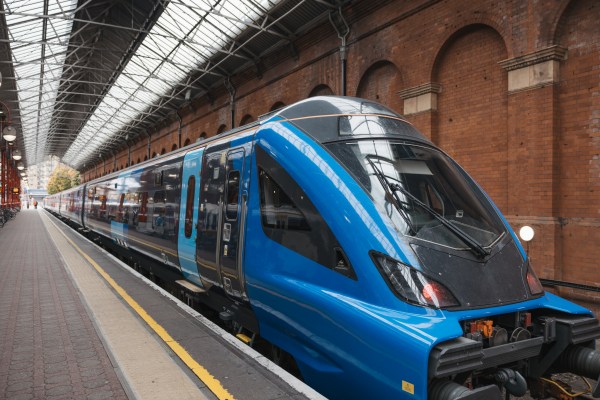
This picture from Chiltern Railways shows the train at Marylebone.
These three paragraphs are from the press release and add more details.
Chiltern Railways today (Tuesday 14 October) showcased for the first time its newest (Mark 5A) trains, set to add 10,000 more seats for customers each weekday from December 2026.
The trains, to be introduced between London to West Midlands from early 2026, will enable Chiltern to deliver more capacity across each of its West Midlands, Aylesbury, and Oxford routes as part of the operator’s efforts to deliver better journeys for customers.
The newest fleet will consist of 13 modern trains set to transform customer journeys during 2026. The trains will replace Chiltern’s oldest carriages, which are nearly 50 years old, with state-of-the-art equivalents, and provide a significant improvement to the on-board experience.
Today, I also received an update from Modern Railways, which was entitled Chiltern Railways Mk 5As To Enter Traffic Early Next Year, and included this delivery schedule.
From December 2026 there will be ten Mk 5A sets in traffic each day, with one ‘hot spare’ and one undergoing maintenance. That leaves one extra set which, CR has suggested, could eventually be pressed into traffic.
I have a few thoughts.
How Do The Trains Compare Physically?
These are basic figures for the two different types of train sets.
- The current Mark 3 are five-car sets of 23 metres coaches, that weigh about 36 tonnes. The driving van trailer is 18.83 metres and 43.7 tonnes
- The future Mark 5A are four-car sets of 22.2 metres coaches, that weigh about 43 tonnes. The driving trailer is 22.37 metres and 43 tonnes.
Lengths and weights of various sets will be as follows.
- Mark 3 – five-car and driving van trailer – 133.83 metres and 223.7 tonnes.
- Mark 5A – four-car and driving trailer – 111.17 metres and 215 tonnes
- Mark 5A – five-car and driving trailer – 155.57 metres and 258 tonnes
Note.
- Chiltern Railways and TransPennine Express use the same Class 68 locomotives.
- The five-car Mark 3 and the four-car Mark 5A sets are quite similar in length and weight
- This could mean that both sets would perform similarly with the same locomotives on the same route.
- I wouldn’t be surprised that the new Platform 4 at Birmingham |Snow Hill station will be able to handle all configurations.
I almost feel that when CAF designed the Mark 5A sets for TransPennine Express, they also had Chiltern in mind as another possible sale.
How Many Trains Would Be Needed To Run Between London Marylebone And Birmingham?
Consider.
- Trains currently run half-hourly on the route between 06:00 to 23:30, which is up to 36 services per day.
- When Platform 4 is operational at Birmingham Snow Hill station, all services could probably stop at both Birmingham Moor Street and Birmingham Snow Hill stations.
- A round trip between London Marylebone and Birmingham Snow Hill stations currently takes about five hours.
I’m fairly certain that to run a half-hourly core service would need ten trains.
Could Chiltern Develop Another Network On The Other Side Of Birmingham?
Consider.
- Trains could run twice an hour from 06:00 to 23:30, which is up to 36 services per day.
- When Platform 4 is operational at Birmingham Snow Hill station, all services could probably stop at both Birmingham Moor Street and Birmingham Snow Hill stations.
- Chiltern Railways already run several services a day to Stourbridge Junction.
- Chiltern Railways have run services to Kidderminster station in the past.
- Wrexham & Shropshire used to run locomotive-hauled Mark 3 four-car sets with driving van trailers, as far as Wrexham via Shrewsbury.
It looks to me, that with the right rolling stock configurations, Chiltern’s network can be developed on the other side of Birmingham.
- Destinations could include Stourbridge Junction, Kidderminster, Shrewsbury, Wolverhampton, Chirk, Ruabon and Wrexham General.
- Some services would need longer trains.
Obviously services would only be run if they were viable.
Would It Help Growth In A Town Or Area, If It Had A Rail Connection To London And/Or The Nearest Major City?
I know Lincoln is on the other side of the country, but I asked Google AI if Lincoln’s rail link to London has brought growth to the city and received this answer.
Yes, Lincoln’s rail link to London has brought significant growth by improving tourism, business travel, and student mobility, and is expected to spur further economic benefits through faster journey times and increased services. The direct link has made Lincoln more accessible for visitors and is a key part of the city’s long-term strategy for economic growth and development.
That was fairly definite.
How would that apply to an extended Chiltern Main Line.
- Politicians are always saying growth is important.
- An extended Chiltern Main Line servicewould improve connections of a lot of places to London and Birmingham.
- Shrewsbury is the easiest connection for West Wales.
- Surely a rail connection to a major city, might tempt someone to open a branch or a new factory.
Would a rail service make people feel more included?
Does Injecting Disinfectant Cure Covid?
I wrote this post to test one of Trump’s most famous pieces of advice.
I asked the question of Google AI and received this answer.
No, injecting disinfectant does not cure COVID-19 and is extremely dangerous, potentially lethal. The idea is a harmful myth that was widely debunked by medical and scientific experts during the pandemic.
The language is fairly clear too.

