High Speed Two And Scotland
In this post, I will only look at services and capacity.
I will leave the economics to others with the appropriate data.
Current Anglo-Scottish Services
Currently, these services run between England and Edinburgh Waverley and Glasgow Central stations.
- 1 train per hour (tph) – Avanti West Coast – London Euston and Glasgow Central via Warrington Bank Quay, Wigan North Western, Preston, Lancaster, Carlisle.
- 1 train per two hours (tp2h) – Avanti West Coast – London Euston and Glasgow Central via Milton Keynes Central, Coventry, Birmingham International, Birmingham New Street, Sandwell and Dudley, Wolverhampton, Crewe, Warrington Bank Quay, Wigan North Western, Preston, Lancaster, Carlisle.
- 1 tp2h – CrossCountry – South-West England and Edinburgh Waverley via Bristol Temple Meads, Birmingham New Street, Derby, Chesterfield, Sheffield, Wakefield Westgate, Leeds, York and Newcastle.
- 1 tp2h – CrossCountry – South-West England and Glasgow Central via Bristol Temple Meads, Birmingham New Street, Derby, Chesterfield, Sheffield, Wakefield Westgate, Leeds, York, Newcastle and Edinburgh Waverley.
- 1 tph – LNER – London Kings Cross and Edinburgh Waverley via York, Darlington, Newcastle and Berwick-upon-Tweed
- 1 tph – LNER – London Kings Cross and Edinburgh Waverley via Peterborough, Newark North Gate, Doncaster, York, Northallerton, Darlington, Durham and Newcastle
- 1 tph – TransPennine Express – Liverpool Lime Street and Edinburgh Waverley via Newton-le-Willows, Manchester Victoria, Huddersfield, Leeds, York, Darlington, Durham, Newcastle and Morpeth
- 1 tp2h – TransPennine Express – Manchester Airport and Edinburgh Waverley via Manchester Piccadilly, Manchester Oxford Road, Bolton, Preston, Lancaster and Carlisle.
- 3 trains per day (tpd) – TransPennine Express – Liverpool Lime Street and Glasgow Central via St. Helen’s Central, Wigan North Western, Preston, Lancaster and Carlisle.
- 1 tp2h – TransPennine Express – Manchester Airport and Glasgow Central via Manchester Piccadilly, Manchester Oxford Road, Bolton, Preston, Lancaster and Carlisle.
Note.
- I’ve not included service extensions to Aberdeen and Inverness.
- I’ve cut out a few smaller stations
- Some services call at both Edinburgh and Glasgow.
- Because of signalling and track improvements it is likely that London Kings Cross and Edinburgh timings will come down to four hours.
The services can be roughly summarised as follows.
- Birmingham and Edinburgh – 0.5 tph
- Birmingham and Glasgow – 1 tph
- London and Edinburgh – 2 tph
- London and Glasgow – 1.5 tph
- Leeds and Edinburgh – 1.5 tph
- Leeds and Glasgow – 0.5 tph
- Liverpool and Edinburgh – 1 tph
- Liverpool and Glasgow – 3 tpd
- Manchester and Edinburgh – 1.5 tph
- Manchester and Glasgow – 0.5 tph
- Manchester Airport and Edinburgh – 0.5 tph
- Manchester Airport and Glasgow – 0.5 tph
Note.
- I have ignored the five tpd London Kings Cross and Edinburgh service, that starts next year, which will be run by East Coast Trains.
- 0.5 tph is equivalent to one tp2h.
It looks a fairly well-balanced and comprehensive service.
High Speed Two Anglo-Scottish Services
According to a table in the June 2020 Edition of Modern Railways, these High Speed Two services will run between England and Edinburgh Waverley and Glasgow Central.
- 1 tph – London Euston and Edinburgh Waverley via Old Oak Common, Preston, Carlisle and Edinburgh Haymarket
- 1 tph – London Euston and Edinburgh Waverley via Old Oak Common, Birmingham Interchange, Preston, Carlisle and Edinburgh Haymarket
- 1 tph – London Euston and Glasgow Central via Old Oak Common, Preston and Carlisle
- 1 tph – London Euston and Glasgow Central via Old Oak Common, Birmingham Interchange, Preston and Carlisle
- 1 tp2h – Birmingham Curzon Street and Edinburgh Waverley via Warrington Bank Quay, Wigan North Western, Preston, Lancaster, Oxenholme or Penrith, Carlisle and Edinburgh Haymarket.
- 1 tp2h – Birmingham Curzon Street and Glasgow Central via Warrington Bank Quay, Wigan North Western, Preston, Lancaster, Oxenholme or Penrith, Carlisle, Lockerbie and Motherwell.
Note.
- All trains will be High Speed Two’s 200 metre long Classic-Compatible trains.
- The four one tph services will run as two pairs of trains and split and join at Carlisle.
The services can be roughly summarised as follows.
- Birmingham and Edinburgh – 1.5 tph
- Birmingham and Glasgow – 1.5 tph
- London and Edinburgh – 2 tph
- London and Glasgow – 2 tph
Note.
- Passengers between Liverpool or Manchester and Scotland will have to change at Preston.
- There is no connection between the Eastern Leg of High Speed Two and Edinburgh.
- London and Edinburgh Waverley will take three hours and forty minutes, which saves twenty minutes on the likely four hours on the East Coast Main Line.
- London and Glasgow Central will take three hours and forty minutes, which saves fifty minutes on the current time.
High Speed Two certainly provides good services between London, Birmingham and Scotland, but it leaves out travelling between the cities of the North and North of the Border.
High Speed Two Classic-Conventional Trains
In Thoughts On Class 807 Trains And High Speed Two’s Classic-Compatible Trains, I discussed a design of Classic-Compatible High Speed Two train based on the recently-ordered Class 807 trains for Avanti West Coast.
Except for the required speeds, the specifications of the trains are similar and this was my conclusion.
I wouldn’t be surprised that Hitachi’s offering for more trains on the West Coast Main Line and the Classic-Compatible trains for High Speed Two are very similar to the Class 807 trains.
-
- The Classic-Compatible trains for High Speed Two could be eight-car trains with twenty-five metre cars.
- The replacements for the eleven-car Class 390 trains could be nine-car trains with twenty-six metre cars.
Both would be based on the Class 807 train.
A common design would surely ease operation of the combined West Coast Partnership.
TransPennine Express Between Liverpool Lime Street And Edinburgh
Will this TransPennine Express service still be the primary connection between the North of England and Edinburgh?
- It has a frequency of one tph.
- It takes about four hours and fifty minutes.
- It connects Liverpool, Manchester, Huddersfield, Leeds, York, Darlington, Durham and Newcastle to the Scottish capital.
- According to Real Time Trains, it runs as far as York on diesel and then using the electrification.
Current plans envisage Northern Powerhouse Rail will create an electrified route across the Pennines.
This report on the Transport for the North web site, is entitled At A Glance – Northern Powerhouse Rail.
It gives these times and frequencies for the various legs of the route.
- Liverpool and Manchester via Manchester Airport – 26 minutes – 6 tph
- Manchester and Leeds – 25 minutes – 6 tph
- Leeds and Newcastle – 58 minutes – 4 tph
- Newcastle and Edinburgh – 90 minutes
This totals to three hours and nineteen minutes.
Note.
- The Newcastle and Edinburgh time is that currently achievable today by Class 801 trains.
- Liverpool and Manchester city centres have a six tph high speed service via Manchester Airport.
- Manchester and Edinburgh will be under three hours.
- Leeds and Edinburgh will be under two-and-a-half hours.
- The Manchester and Manchester Airport leg could be shared with High Speed Two.
Most of this will be achievable with the current TransPennine Express Class 802 trains, which are capable of 140 mph.
In addition, I think that it is likely that the East Coast Main Line will be upgraded between York and Newcastle for High Speed Two.
Liverpool Lime Street and Edinburgh will unlikely be to High Speed Two standards, but it could match the standards of the East Coast Main Line.
Improvements To The East Coast Main Line Between Newcastle and Edinburgh
Consider
- There have been reports that the power supply on the route is not very robust and Class 800 and Class 802 trains have to use diesel power.
- The route is fairly straight and could probably be partially-upgraded for 140 mph running with appropriate signalling.
- The route carries about five tph in both directions. Modern digital signalling could probably double this frequency.
- The Scottish Government has suggested adding new stations at East Linton and Reston.
- Edinburgh and Newcastle are 124.5 miles apart and trains typically take ninety minutes.
In addition, High Speed Two might like to extend some or all of their three Newcastle services to Edinburgh.
- 1 tph – Birmingham Curzon Street and Newcastle via East Midlands Hub, York, Darlington and Durham
- 1 tph – London Euston and Newcastle via Old Oak Common and York
- 1 tph – London Euston and Newcastle via Old Oak Common, York and Darlington.
High Speed Two will run between London Euston and Newcastle in two hours and seventeen minutes.
I think it could be possible, that an upgraded Newcastle and Edinburgh route could be covered in seventy minutes by either one of High Speed Two’s Classic Compatible trains or a Class 80x train.
This could mean these timings.
- Under four hours for classic services between London Kings Cross and Edinburgh.
- Around three hours for classic services between Liverpool and Edinburgh.
- Under three-and-a-half hours for High Speed Two services between London Euston and Edinburgh.
This shows the importance of improving the East Coast Main Line to the North of Newcastle.
Improvements To The West Coast Main Line Between Carlisle and Glasgow/Edinburgh
If the frequency and speed of trains on the East Coast Main Line can be increased, what can be done on the West Coast Main Line?
Consider.
- High Speed Two are showing Carlisle and Glasgow Central as a one hour and nineteen minute journey. Avanti West Coast do the journey in one hour and eleven minutes.
- High Speed Two are showing Carlisle and Edinburgh as a one hour and eleven minute journey. Avanti West Coast do the journey in one hour and fifteen minutes.
- Could the route be fully upgraded for 140 mph running with appropriate signalling?
- In a typical hour, there are two Avanti West Coast trains and one TransPennine Express passing along all or part of the West Coast Main Line North of Carlisle.
- The route carries a total of about four tph in both directions. Modern digital signalling could probably increase this frequency.
- Hitachi and Avanti West Coast seem to be saying that their new Class 807 trains have similar performance to the Class 390 trains, but without using tilting technology.
There doesn’t appear to be the scope for such dramatic improvement in the West, as in the East, but I can still see a succession of 140 mph trains running between Carlisle and Glasgow or Edinburgh in no more than an hour and eleven minutes.
These passenger services could be running North of Carlisle, when High Speed Two is fully open.
- 2 tph – High Speed Two – London Euston and Edinburgh – High Speed Two Classic-Compatible train
- 2 tph – High Speed Two – London Euston and Glasgow Central – High Speed Two Classic-Compatible train
- 0.5 tph – High Speed Two – Birmingham Curzon Street and Edinburgh – High Speed Two Classic-Compatible train
- 0.5 tph – High Speed Two – Birmingham Curzon Street and Glasgow Central – High Speed Two Classic-Compatible train
- 0.5 tph – TransPennine Express – Manchester Airport and Edinburgh – Class 397 train
- 0.5 tph – TransPennine Express – Manchester Airport and Glasgow Central – Class 397 train
- 3 tpd – TransPennine Express – Liverpool and Glasgow Central – Class 397 train
Note.
- I am assuming that Avanti West Coast’s services will be replaced by the High Speed Two services.
- As the TransPennine Express services share a path, it would appear that six tph will be running between Carlisle and Edinburgh or Glasgow.
There would appear to be space for more trains on the West Coast Main Line, to the North of Carlisle.
A Few Random Thoughts
These are a few random thoughts and ideas.
Avanti West Coast And High Speed Two Classic-Compatible Trains
Avanti West Coast will have these fleets of high-speed trains.
- 11-car Class 390 electric trains, which are 265.3 metres long
- 9-car Class 390 electric trains, which are 217.5 metres long.
- 7-car Class 807 electric trains, which will be 182 metres long
- 5-car Class 805 bi-mode trains, which will be 130 metres long
- High Speed Two Classic-Compatible trains, which will be 200 metres long
- Full-size High Speed Two trains, which will be 400 metres long.
It would appear that there could be some fleet simplification.
All Passenger Trains Between Newcastle Or Carlisle and Glasgow Central Or Edinburgh Should Be Capable Of Operating At 140 mph
Both the East and West Coast Main Lines between Carlisle and Newcastle in England and Edinburgh and Glasgow in Scotland are not far off being capable of running trains at 140 mph. Modern digital in-cab signalling and some track works will be needed.
Once 140 mph running is achieved, then all trains will need to be capable of making use of the speed, to maximise the capacity of the routes.
Freight Trains Between Newcastle Or Carlisle and Glasgow Central Or Edinburgh Should Be Capable Of Operating As Fast As Possible
Freight trains will need to be hauled by electric locomotives, at as high a speed as possible, to avoid slowing the express passenger trains.
More well-positioned freight loops may be needed.
Will TransPennine’s Manchester And Scotland Service Transfer To High Speed Two?
I think, that this is highly likely.
- The service would be run by High Speed Two Classic-Compatible trains.
- Depending on track layout, the Liverpool and Scotland service on the West Coast Main Line could be upgraded to the High Speed Two Classic-Compatible trains or discontinued.
This would mean, that all passenger trains on the West Coast Main Line North of Lancaster would be High Speed Two Classic-Compatible trains.
- 2 tph – High Speed Two – London Euston and Edinburgh – High Speed Two Classic-Compatible train
- 2 tph – High Speed Two – London Euston and Glasgow Central – High Speed Two Classic-Compatible train
- 0.5 tph – High Speed Two – Birmingham Curzon Street and Edinburgh – High Speed Two Classic-Compatible train
- 0.5 tph – High Speed Two – Birmingham Curzon Street and Glasgow Central – High Speed Two Classic-Compatible train
- 0.5 tph – High Speed Two – Manchester Airport and Edinburgh – High Speed Two Classic-Compatible train
- 0.5 tph – High Speed Two – Manchester Airport and Glasgow Central – High Speed Two Classic-Compatible train
- 3 tpd – High Speed Two – Liverpool and Glasgow Central – High Speed Two Classic-Compatible train
This must mean that if the operating speed on the West Coast Main Line were to be increased, all passenger services could take advantage, which would surely improve timings.
What About CrossCountry?
CrossCountry run a single hourly service between Plymouth and Edinburgh.
- The route goes via Bristol Temple Meads, Birmingham New Street, Derby, Chesterfield, Sheffield, Wakefield Westgate, Leeds, York, Newcastle.
- Some services are extended to Glasgow Central and Aberdeen.
Currently, this service is run by a diesel train, which surely will need to be replaced with a zero-carbon train.
Consider.
- Scotland is keen to electrify or allow electric trains to run between Edinburgh and Aberdeen.
- High Speed Two will provide an electrified route between Birmingham and York via East Midlands Hub for Derby, Chesterfield, Sheffield and Leeds.
- The likes of Hitachi and Adrian Shooter of Vivarail are very bullish about battery electric trains.
- Great Western Railway, Hitachi and Network Rail have probably hired Baldrick for a cunning plan to run battery electric trains between Bristol and Penzance.
Could it be possible for Hitachi or another manufacturer to design a High Speed Two Classic-Compatible train, with a battery capability?
A train with this specification, could be ideal for the Plymouth and Edinburgh service.
It might also be useful for these CrossCountry services.
- Southampton and Newcastle
- Bournemouth and Manchester Piccadilly
- Exeter St. Davids/Bristol and Manchester Piccadilly
- Cardiff Central and Nottingham
- Birmingham and Nottingham
- Birmingham and Stansted Airport
Note.
- All could run on High Speed Two fpr part of the route.
- Birmingham and Nottingham has already been proposed for running using High Speed Two Classic-Compatible train, by Midlands Engine Rail, as I wrote about in Classic-Compatible High Speed Two Trains At East Midlands Hub Station.
- I proposed a Birmingham and Cambridge service using High Speed Two Classic-Compatible trains in A Trip To Grantham Station – 4th November 2020.
High Speed Two could have a big positive effect on CrossCountry services.
Future Anglo-Scottish Services After High Speed Two Opens Fully
It is possible, that when High Speed Two fully opens, these services will run between England and Edinburgh Waverley and Glasgow Central stations.
- 1 tp2h – CrossCountry – South-West England and Edinburgh Waverley via Bristol Temple Meads, Birmingham New Street, Derby, Chesterfield, Sheffield, Wakefield Westgate, Leeds, York and Newcastle.
- 1 tp2h – CrossCountry – South-West England and Glasgow Central via Bristol Temple Meads, Birmingham New Street, Derby, Chesterfield, Sheffield, Wakefield Westgate, Leeds, York, Newcastle and Edinburgh Waverley.
- 1 tph – LNER – London Kings Cross and Edinburgh Waverley via York, Darlington, Newcastle and Berwick-upon-Tweed
- 1 tph – LNER – London Kings Cross and Edinburgh Waverley via Peterborough, Newark North Gate, Doncaster, York, Northallerton, Darlington, Durham and Newcastle
- 1 tph – High Speed Two – London Euston and Edinburgh Waverley via Old Oak Common, Preston, Carlisle and Edinburgh Haymarket
- 1 tph – High Speed Two – London Euston and Edinburgh Waverley via Old Oak Common, Birmingham Interchange, Preston, Carlisle and Edinburgh Haymarket
- 1 tph – High Speed Two – London Euston and Glasgow Central via Old Oak Common, Preston and Carlisle
- 1 tph – High Speed Two – London Euston and Glasgow Central via Old Oak Common, Birmingham Interchange, Preston and Carlisle
- 1 tp2h – High Speed Two – Birmingham Curzon Street and Edinburgh Waverley via Warrington Bank Quay, Wigan North Western, Preston, Lancaster, Oxenholme or Penrith, Carlisle and Edinburgh Haymarket.
- 1 tp2h – High Speed Two – Birmingham Curzon Street and Glasgow Central via Warrington Bank Quay, Wigan North Western, Preston, Lancaster, Oxenholme or Penrith, Carlisle, Lockerbie and Motherwell.
- 1 tph – TransPennine Express – Liverpool Lime Street and Edinburgh Waverley via Newton-le-Willows, Manchester Victoria, Huddersfield, Leeds, York, Darlington, Durham, Newcastle and Morpeth
- 1 tp2h – High Speed Two – Manchester Airport and Edinburgh Waverley via Manchester Piccadilly, Manchester Oxford Road, Bolton, Preston, Lancaster and Carlisle.
- 3 trains per day (tpd) – High Speed Two – Liverpool Lime Street and Glasgow Central via St. Helen’s Central, Wigan North Western, Preston, Lancaster and Carlisle.
- 1 tp2h – High Speed Two – Manchester Airport and Glasgow Central via Manchester Piccadilly, Manchester Oxford Road, Bolton, Preston, Lancaster and Carlisle.
Note.
- I have assumed that the Liverpool/Manchester services to Scotland via the West Coast Main Line have transferred to High Speed Two.
- All trains would be run by High Speed Two Classic-Compatible trains.
The services can be roughly summarised as follows.
- Birmingham and Edinburgh – 1.5 tph (0.5 tph)
- Birmingham and Glasgow – 1.5 tph (1 tph)
- London and Edinburgh – 4 tph (2 tph)
- London and Glasgow – 2 tph (1.5 tph)
- Leeds and Edinburgh – 1.5 tph (1.5 tph)
- Leeds and Glasgow – 0.5 tph (0.5 tph)
- Liverpool and Edinburgh – 1 tph (1 tph)
- Liverpool and Glasgow – 3 tpd (3 tpd)
- Manchester and Edinburgh – 1.5 tph (1.5 tph)
- Manchester and Glasgow – 0.5 tph (0.5 tph)
- Manchester Airport and Edinburgh – 0.5 tph (0.5 tph)
- Manchester Airport and Glasgow – 0.5 tph (0.5 tph)
Note.
- My estimates for the number of trains in the future, are probably best described as minimum figures.
- The figures in brackets are the current frequencies.
- Currently, there are eleven express trains between England and Scotland and after High Speed Two is fully open there could be at least fifteen express trains.
I have a few final thoughts.
Capacity Between England And Scotland
Capacity of the current and future Anglo-Scottish trains is as follows.
- High Speed Two Classic-Compatible train – 500-600
- Eleven-car Class 390 train – 589
- Nine-car Class 800 train – 611
It appears that the all the longer trains have roughly the same capacity.
As there are now eleven Anglo-Scottish long trains and these will be increased to fifteen, that indicates an minimum 36 % increase in capacity.
Will High Speed Two And Northern Powerhouse Rail Share A Route Across The Pennines?
Northern Powerhouse Rail have talked about extending High Speed Two services from Manchester to Huddersfield, Leeds, Hull, York and Newcastle.
I wrote about this in Changes Signalled For HS2 Route In North.
I like this plan for the following reasons.
It gives more places like Huddersfield and Hull access to High Speed Two.
It increases frequencies across the North.
But most importantly, as infrastructure is shared, it saves a lot of money.
It also opens up possibilities for services.
- The Liverpool and Edinburgh service could be run on the High Speed Two route across the Pennines and up the East Coast Main Line.
- London and Manchester services could be extends to Leeds, York, Newcastle and Scotland.
If Northern Powerhouse Rail were to be cleared for High Speed Two’s Full-Size trains, it opens up the possibility of running them further North.
Conclusion
High Speed Two will increase Anglo-Scottish capacity by more than a third.
Avanti West Coast Set To Transform Motherwell Cross-Border Connectivity
The title of this post, is the same as that of this article on Rail Technology Magazine.
These are the first two paragraphs of the article.
Motherwell is set to see a transformation in services as Avanti West Coast announces plans for a major timetable boost on its Anglo-Scottish route.
The change in Avanti West Coast’s timetable will see the cross-border operator serve Motherwell with a further 96 services per week, the most substantial increase in cross-border rail services for the Scottish town in decades.
I used to have a client in Motherwell, thirty years ago, when I lived in Suffolk and that sort of service, would have been very helpful then.
Consider.
- CrossCountry and TransPennine Express services also call.
- Motherwell station seems to have a variety of connections, most of which are electrified.
- It is likely in future, an electric route will be created between Motherwell and Perth.
In the future High Speed Two will call half-hourly.
Conclusion
This seems to be an excellent proposal.
How Many Trains Are Needed To Run A Full Service On High Speed Two?
The latest High Speed Two schedule was published in the June 2020 Edition of Modern Railways.
The Two Train Classes
Two separate train classes have been proposed for High Speed Two.
Full-Size – Wider and taller trains built to a European loading gauge, which would be confined to the high-speed network (including HS1 and HS2) and other lines cleared to their loading gauge.
Classic-Compatible – Conventional trains, capable of high speed but built to a British loading gauge, permitting them to leave the high speed track to join conventional routes such as the West Coast Main Line, Midland Main Line and East Coast Main Line.
The Wikipedia entry for High Speed Two has a section entitled Rolling Stock, where this is said about the design.
Both types of train would have a maximum speed of at least 360 km/h (225 mph) and a length of 200 metres (660 ft); two units could be joined together for a 400-metre (1,300 ft) train. It has been reported that these longer trains would have approximately 1,100 seats.
These are some of my thoughts.
Seating Density
I would assume that this means that a single 200 metre train, will have a capacity of approximately 550 seats or a density of 2.75 seats per metre. How does that compare with other trains?
- 9-car Class 801 train – 234 metres – 611 seats – 2.61 seats/metre
- 7-car Class 807 train – 182 metres – 453 seats – 2.49 seats/metre
- 9-car Class 390 train – 217.5 metres – 469 seats – 2.16 seats/metre
- 11-car Class 390 train – 265.3 metres – 589 seats – 2.22 seats/metre
- 12-car Class 745/1 train – 236.6 metres – 767 seats – 3.24 seats/metre
- 16-car Class 374 train – 390 metres – 902 seats – 2.31 seats/metre
Note.
- What I find strange with these figures, is that I feel most crowded and cramped in a Class 390 train. Could this be because the Pendelino trains are eighteen years old and train interior design has moved on?
- But I always prefer to travel in a Hitachi Class 80x train or a Stadler Class 745 train.
I very much feel that a seating density of 2.75 seats per metre, designed using some of the best modern practice, could create a train, where travelling is a very pleasant experience.
Step-Free Access
I have travelled in high speed trains all over Europe and have yet to travel in one with step-free access.
Surely, if Stadler can give their trains step-free access everybody can.
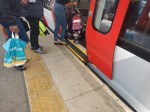
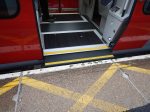
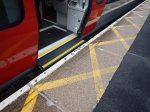
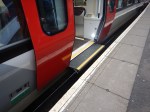
The pictures shows step-free access on Stadler Class 745 and Class 755 trains.
If I turned up pushing a friend in a wheelchair, would I be able to push them in easily? Or better still will they be able to wheel themselves in?
A Greater Anglia driver tp;d me recently, that now they never have to wait anymore for wheelchairs to be loaded.
So surely, it is in the train operator’s interest to have step-free access, if it means less train delays.
Double-Deck Trains
In my view double-deck trains only have one only good feature and that is the ability to see everything, if you have a well-designed window seat.
I may be seventy-three, but I am reasonably fit and only ever travel on trains with airline-sized hand baggage. So I don’t find any problem travelling upstairs on a double-deck bus or train!
But it could have been, so very different, if my stroke had been a bit worse and left me blind or in a wheelchair for life.
I have seen incidents on the Continent, which have been caused by double-deck trains.
- A lady of about eighteen in trying to get down with a heavy case dropped it. Luckily it only caused the guy she was travelling with, to roll unhurt down the stairs.
- Luggage is often a problem on Continental trains because of the step-up into the train and access is worse on double deck trains.
- I also remember on a train at Leipzig, when several passengers helped me lift a guy and his wheelchair out of the lower deck of a double-deck train, which was lower than the platform, as they often are with double-deck trains.
I am not totally against double-deck trains, but they must be designed properly.
Consider.
- High Speed Two’s Full-Size trains will only use London Euston, Old Oak Common, Birmingham Interchange, Birmingham Curzon Street, Manchester Airport, Manchester Piccadilly, East Midlands Hub and Leeds stations.
- All stations used by Full-Size trains will be brand-new or substantially rebuilt stations.
- Someone sitting in a wheelchair surely has the same right to a view from the top-deck of a double-deck train as anybody else.
- Jumbo jets seemed to do very well without a full-length top-deck.
- The A 380 Superjumbo has been designed so that entry and exit on both decks is possible.
I feel if High Speed Two want to run double-deck trains, an elegant solution can surely be found.
A Crude Estimate On The Number Of Trains
This is my crude estimate to find out how many trains, High Speed Two will need.
Western Leg
These are the services for the Western Leg between London , Birmingham, Liverpool, Manchester, Edinburgh and Glasgow.
- Train 1 – London Euston and Birmingham Curzon Street – 400 metre Full-Size – 45 minutes – 2 hour Round Trip – 4 trains
- Train 2 – London Euston and Birmingham Curzon Street – 400 metre Full-Size – 45 minutes – 2 hour Round Trip – 4 trains
- Train 3 – London Euston and Birmingham Curzon Street – 400 metre Full-Size – 45 minutes – 2 hour Round Trip – 4 trains
- Train 4 – London Euston and Lancaster – Classic Compatible – 2 hours 3 minutes – 5 hour Round Trip – 5 trains
- Train 4 – London Euston and Liverpool – Classic Compatible – 1 hours 34 minutes – 4 hour Round Trip – 4 trains
- Train 5 – London Euston and Liverpool – Classic Compatible – 1 hours 34 minutes – 4 hour Round Trip – 4 trains
- Train 6 – London Euston and Macclesfield – Classic Compatible – 1 hours 30 minutes – 4 hour Round Trip – 4 trains
- Train 7 – London Euston and Manchester – 400 metre Full-Size – 1 hour and 11 minutes – 3 hour Round Trip – 6 trains
- Train 8 – London Euston and Manchester – 400 metre Full-Size – 1 hour and 11 minutes – 3 hour Round Trip – 6 trains
- Train 9 – London Euston and Manchester – 400 metre Full-Size – 1 hour and 11 minutes – 3 hour Round Trip – 6 trains
- Train 10 – London Euston and Edinburgh – Classic Compatible – 3 hours 48 minutes – 8 hour Round Trip – 8 trains
- Train 10 – London Euston and Glasgow – Classic Compatible – 3 hours 40 minutes – 8 hour Round Trip – 8 trains
- Train 11 – London Euston and Edinburgh – Classic Compatible – 3 hours 48 minutes – 8 hour Round Trip – 8 trains
- Train 11 – London Euston and Glasgow – Classic Compatible – 3 hours 40 minutes – 8 hour Round Trip – 8 trains
- Train 12 – Birmingham Curzon Street and Edinburgh or Glasgow – Classic Compatible – 3 hours 20 minutes – 7 hour Round Trip – 7 trains
- Train 13 – Birmingham Curzon Street and Manchester – 200 metre Full-Size – 41 minutes – 2 hour Round Trip – 2 trains
- Train 14 – Birmingham Curzon Street and Manchester – 200 metre Full-Size – 41 minutes – 2 hour Round Trip – 2 trains
Note.
- I have assumed 400 metre Full-Size trains will be a pair of 200 metre trains.
- Trains 4, 10 and 11 are pairs of 200 metre long Classic-Compatible trains, that split and join at Crewe. Carlisle and Carlisle respectively.
- Trains 5 and 6 are single 200 metre long Classic-Compatible trains.
- The full schedule will need 34 Full-Size trains and 56 Classic-Compatible trains
According to Wikipedia, the first order will be for 54 Classic-Compatible trains, so I would assume, that more trains will be ordered.
Eastern Leg
These are the services for the Eastern Leg between London , Birmingham, East Midlands Hub, Leeds, Sheffield, York and Newcastle.
- Train 15 – Birmingham Curzon Street and Leeds – 200 metre Full-Size – 49 minutes – 2 hour Round Trip – 2 trains
- Train 16 – Birmingham Curzon Street and Leeds – 200 metre Full-Size – 49 minutes – 2 hour Round Trip – 2 trains
- Train 17 – Birmingham Curzon Street and Newcastle – Classic Compatible – 1 hour 57 minutes – 5 hour Round Trip – 5 trains
- Train 18 – London Euston and Sheffield – Classic Compatible – 1 hour 27 minutes – 4 hour Round Trip – 4 trains
- Train 18 – London Euston and Leeds – Classic Compatible – 1 hour 21 minutes – 3 hour Round Trip – 3 trains
- Train 19 – London Euston and Leeds – 400 metre Full-Size – 1 hour and 21 minutes – 3 hour Round Trip – 6 trains
- Train 20 – London Euston and Leeds – 400 metre Full-Size – 1 hour and 21 minutes – 3 hour Round Trip – 6 trains
- Train 21 – London Euston and Sheffield – Classic Compatible – 1 hour 27 minutes – 4 hour Round Trip – 4 trains
- Train 21 – London Euston and York – Classic Compatible – 1 hour 24 minutes – 3 hour Round Trip – 3 trains
- Train 22 – London Euston and Newcastle – Classic Compatible – 2 hour 17 minutes – 5 hour Round Trip – 5 trains
- Train 23 – London Euston and Newcastle – Classic Compatible – 2 hour 17 minutes – 5 hour Round Trip – 5 trains
Note.
- I have assumed 400 metre Full-Size trains will be a pair of 200 metre trains.
- Trains 15 and 16 work as a pair,
- Trains 18 and 21 are pairs of 200 metre long Classic-Compatible trains, that split and join at East Midlands Hub.
- Trains 22 and 23 are single 200 metre long Classic-Compatible trains
- The full schedule will need 16 Full-Size trains and 29 Classic-Compatible trains.
Adding the two legs together and I estimate that 50 Full-Size trains and 85 Classic-Compatible trains, will be needed to run a full schedule.
Trains Per Hour On Each Section
It is possible to make a table of how many trains run on each section of the High Speed Two network in trains per hour (tph)
- London Euston (stops) – 1-11, 18-23 – 17 tph
- London Euston and Old Oak Common – 1-11, 18-23 – 17 tph
- Old Oak Common (stops) – 1-11, 18-23 – 17 tph
- Old Oak Common and Birmingham Interchange – 1-11, 18-23 – 17 tph
- Birmingham Interchange (stops) – 2, 3, 7, 11, 20 – 5 tph
- Birmingham Curzon Street (stops) – 1-3, 12-14, 15-17 – 9 tph
- Birmingham and Crewe – 4,5, 7-9, 10-14 – 10 tph
- Crewe (stops) – 4,5 – 2 tph
- Crewe and Liverpool – 4,5 – 2 tph
- Crewe and Lancaster – 4, 10-12 – 4 tph
- Crewe and Manchester – 7-9, 13, 14 – 5 tph
- Crewe and Wigan via Warrington – 4 – 1 tph
- Crewe and Wigan via High Speed Two (new route) – 10-12 – 3 tph
- Lancaster (stops) 4 – 1 tph
- Lancaster and Carlisle – 10-12 – 3 tph
- Carlisle and Edinburgh – 10-12 – 2.5 tph
- Carlisle and Glasgow – 10-12 – 2.5 tph
- Birmingham and Stoke – 6 – 1 tph
- Stoke (stops) – 6 – 1 tph
- Stoke and Macclesfield – 6 – 1 tph
- Macclesfield (stops) – 6 – 1 tph
- Birmingham and East Midlands Hub – 15-17, 18-20, 21-23 – 9 tph
- East Midlands Hub (stops) – 15-17, 18-20, 21 – 7 tph
- East Midlands Hub and Sheffield – 18, 21 – 2 tph
- Sheffield (stops) – 18, 21 – 2 tph
- Midlands Hub and Leeds – 15, 16, 18-20 – 5 tph
- Leeds (stops) – 15, 16, 18-20 – 5 tph
- East Midlands Hub and York – 17, 21-23 – 4 tph
- York (stops) – 17, 21-23 – 4 tph
- York and Newcastle – 17, 22, 23 – 3 tph
- Newcastle (stops) – 17, 22, 23 – 3 tph
These are a few thoughts.
Capacity Of The Southern Leg
The busiest section is between London Euston and Birmingham Interchange, which handles 17 tph.
As the maximum capacity of High Speed Two is laid down in the Phase One Act as 18 tph, this gives a path for recovery, according to the article.
Trains Serving Euston
The following train types serve London Euston station.
- Full-Size – 8 tph
- 400 metre Classic-Compatible – 5 tph
- 200 metre Classic-Compatible – 4 tph
In the current service proposal, , Trains 5,6, 22 and 23 are just single 200 metre Classic Compatible trains.
This is inefficient and another four tph could be run into Euston station, by the use of appropriate splitting and joining.
- Train 5 could run an identical manner to Train 4 to give extra services to Lancaster, Preston, Wigan North Western and Warrington Bank Quay.
- Train 6 to Macclesfield is a problem and perhaps should call at Birmingham Interchange, where it could split and join to serve somewhere else like Wolverhampton and Shrewsbury.
- Trains 22 and 23 could split and join at East Midlands Hub and serve other places in the East of England like Cleethorpes, Hull, Lincoln, Middlesbrough and Scarborough.
Paths are expensive entities to provide and every path into Euston should support a 400 metre train or a pair of 200 metre trains.
Platform Use At Euston
This page on the High Speed Two web site, gives details of Euston High Speed Two station.
HS2 will deliver eleven new 400m long platforms, a new concourse and improved connections to Euston and Euston Square Underground stations. Our design teams are also looking at the opportunity to create a new northerly entrance facing Camden Town as well as new east-west links across the whole station site.
So how will the eleven platforms be used?
Destinations served from London are planned to be as follows.
- Birmingham Curzon Street – Full-Size – 3 tph
- Edinburgh/Glasgow – Classic-Compatible – 2 tph
- Lancaster – Classic-Compatible – 1 tph
- Leeds – Full-Size – 2 tph – Classic-Compatible – 1 tph
Liverpool – Classic-Compatible – 2 tph
- Macclesfield – Classic-Compatible – 1 tph
- Manchester Piccadilly – Full-Size – 3 tph
- Newcastle – Classic-Compatible – 2 tph
- Sheffield – Classic-Compatible – 2 tph
- York – Classic-Compatible – 1 tph
That is ten destinations and there will be eleven platforms.
I like it! Lack of resources is often the reason systems don’t work well and there are certainly enough platforms.
Could platforms be allocated something like this?
- Birmingham Curzon Street – Full-Size
- Edinburgh/Glasgow – Classic-Compatible
- Leeds – Full-Size
- Liverpool – Classic-Compatible – Also serves Lancaster
- Macclesfield – Classic-Compatible
- Manchester Piccadilly – Full-Size
- Newcastle – Classic-Compatible
- Sheffield – Classic-Compatible – Also serves Leeds and York
Note.
- No platform handles more than three tph.
- There are three spare platforms.
- Each platform would only be normally used by one train type.
- Only Birmingham Interchange, East Midlands Hub, Leeds, Preston and York are not always served from the same platform.
Platform arrangements could be very passenger- and operator-friendly.
Platform Use At Birmingham Curzon Street
Birmingham Curzon Street station has been designed to have seven platforms.
Destinations served from Birmingham Curzon Street station are planned to be as follows.
- Edinburgh/Glasgow – Classic-Compatible – 1 tph
- Leeds – Full-Size – 2 tph
- London Euston – Full-Size – 3 tph
- Manchester Piccadilly – Full-Size – 2 tph
- Newcastle – Classic-Compatible – 1 tph
- Nottingham – Classic-Compatible – 1 tph
Note.
- The Nottingham service has been proposed by Midlands Engine Rail, but will be running High Speed Two Classic Compatible trains.
- That is six destinations and there will be seven platforms.
I like it! For the same reason as London Euston.
Could platforms be allocated something like this?
- Edinburgh/Glasgow – Classic-Compatible
- Leeds – Full-Size
- London Euston – Full-Size
- Manchester Piccadilly – Full-Size
- Newcastle/Nottingham – Classic-Compatible
Note.
- No platform handles more than three tph.
- There are two spare platforms.
- Each platform would only be normally used by one train type.
- Only East Midlands Hub is not always served from the same platform.
Platform arrangements could be very passenger- and operator-friendly.
Back-to-Back Services via Birmingham Curzon Street
The current plan for High Speed Two envisages the following services between the main terminals served by Full-Size trains.
- London Euston and Birmingham Curzon Street – 3 tph – 45 minutes
- London Euston and Leeds – 2 tph – 81 minutes
- London Euston and Manchester Piccadilly – 3 tph – 71 minutes
- Birmingham Curzon Street and Leeds – 2 tph – 40 minutes
- Birmingham Curzon Street and Manchester Piccadilly – 2 tph – 41 minutes
Suppose a traveller wanted to go between East Midlands Hub and Manchester Airport stations.
Wouldn’t it be convenient if the Leeds to Birmingham Curzon Street train, stopped in Birmingham Curzon Street alongside the train to Manchester Airport and Piccadilly, so passengers could just walk across?
Or the two services could be run Back-to-Back with a reverse in Birmingham Curzon Street station?
Note.
- The current fastest times between Nottingham and Manchester Airport stations are around two-and-a-half hours, with two changes.
- With High Speed Two, it looks like the time could be under the hour, even allowing up to eight minutes for the change at Birmingham Curzon Street.
The design of the track and stations for High Speed Two, has some interesting features that will be exploited by the train operator, to provide better services.
Capacity Of The Western Leg Between Birmingham And Crewe
The section is between Birmingham and Crewe, will be running 10 tph.
As the maximum capacity of High Speed Two is laid down in the Phase One Act as 18 tph, this gives plenty of room for more trains.
But where will they come from?
High Speed One copes well with a few interlopers in the shape of Southeastern’s Class 395 trains, which run at 140 mph, between the Eurostars.
High Speed Two is faster, but what is to stop an operator running their own Classic-Compatible trains on the following routes.
- Birmingham Curzon Street and Liverpool via Crewe, Runcorn and Liverpool South Parkway.
- Birmingham Curzon Street and Holyhead via Crewe, Chester and an electrified North Wales Coast Line.
- Birmingham Curzon Street and Blackpool via Crewe, Warrington Bank Quay, Wigan North Western and Preston.
- Birmingham Curzon Street and Blackburn and Burnley via Crewe, Warrington Bank Quay, Wigan North Western and Preston.
Note.
- If these trains were say 130 metres long, they could call at all stations, without any platform lengthening.
- I’m sure that the clever engineers at Hitachi and Hyperdrive Innovation could come up with battery electric Classic-Compatible train, that could run at 225 mph on High Speed Two and had a battery range to reach Holyhead, with a small amount of electrification.
- A pair of trains, could work the last two services with a Split/Join at Preston.
The advantages of terminating these service in Birmingham Curzon Street would be as follows.
- A lot more places get a fast connection to the High Speed Two network.
- Passengers can reach London with an easy change at Birmingham Curzon Street station.
- They can also walk easily between the three Birmingham stations.
But the big advantage is the trains don’t use valuable paths on High Speed Two between Birmingham Curzon Street and London Euston.
Crewe Station
In the current Avanti West Coast timetable, the following trains pass through Crewe.
- London Euston and Blackpool – 4 trains per day (tpd)
- London Euston and Chester – 1 tph
- London Euston and Edinburgh/Glasgow – 2 tph
- London Euston and Liverpool – 1 tph
- London Euston and Manchester Piccadilly – 1 tph
Most trains stop at Crewe.
In the proposed High Speed Two timetable, the following trains will pass through Crewe.
- London Euston and Edinburgh/Glasgow – 2 tph
- London Euston and Lancaster/Liverpool – 2 tph
- London Euston and Manchester – 3 tph
- Birmingham Curzon Street and Edinburgh/Glasgow -1 tph
- Birmingham Curzon Street and Manchester – 2 tph
Note.
- Only the Lancaster and Liverpool trains stop at Crewe station.
- North of Crewe there will be a three-way split of High Speed Two routes to Liverpool, Wigan and the North and Manchester Airport and Piccadilly.
- High Speed Two will loop to the East and then join the West Coast Main Line to the South of Wigan.
- High Speed Two trains will use the West Coast Main Line to the North of Wigan North Western station.
This map of High Speed Two in North West England was captured from the interactive map on the High Speed Two web site.

Note.
- The current West Coast Main Line (WCML) and Phase 2a of High Speed Two are shown in blue.
- Phase 2b of High Speed Two is shown in orange.
- The main North-South route, which is shown in blue, is the WCML passing through Crewe, Warrington Bank Quay and Wigan North Western as it goes North.
- The Western Branch, which is shown in blue, is the Liverpool Branch of the WCML, which serves Runcorn and Liverpool.
- High Speed Two, which is shown in orange, takes a faster route between Crewe and Wigan North Western.
- The Eastern Branch, which is shown in orange, is the Manchester Branch of High Speed Two, which serves Manchester Airport and Manchester Piccadilly.
- The route in the East, which is shown in blue, is the Macclesfield Branch of High Speed Two, which serves Stafford, Stoke-on-Trent and Macclesfield.
The route of Northern Powerhouse Rail between Manchester Airport and Liverpool has still to be finalised.
Liverpool Branch
Consider.
- The Liverpool Branch will take two tph between London Euston and Liverpool.
- In the future it could take up to 6 tph on Northern Powerhouse Rail between Liverpool and Manchester Piccadilly via Manchester Airport.
I believe that Liverpool Lime Street station, after the recent updating can handle all these trains.
Manchester Branch
This document on the Government web site is entitled HS2 Phase 2b Western Leg Design Refinement Consultation.
It indicates two important recently-made changes to the design of the Manchester Branch of High Speed Two.
- Manchester Airport station will have four High Speed platforms instead of two.
- Manchester Piccadilly station will have six High Speed platforms instead of four.
These changes will help the use of these stations by Northern Powerhouse Rail..
Consider.
- The Manchester Branch will be new high speed track, which will probably be built in a tunnel serving Manchester Airport and Manchester Piccadilly stations.
- The Manchester Branch will terminate in new platforms.
- The Manchester Branch will take five tph between Birmingham Curzon Street or London Euston and Manchester Airport and Manchester Piccadilly.
- In the future it could take up to six tph on Northern Powerhouse Rail between Liverpool and Manchester Piccadilly via Manchester Airport.
- London Euston and Old Oak Common will be new stations on a tunnelled approach to London and will handle 18 tph.
If London Euston and Old Oak Common can handle 18 tph, I can’t see why Manchester Airport and Piccadilly stations can’t handle somewhere near a similar number of trains.
At the moment eleven tph have been allocated to the Manchester Branch.
I believe that if infrastructure for Northern Powerhouse Rail was designed so that as well as connecting to Manchester and Liverpool, it connected Manchester and the West Coast Main Line running North to Preston, Carlisle and Scotland, services to the following destinations would be possible.
- Barrow
- Blackburn
- Blackpool
- Edinburgh
- Glasgow
- Windermere
Note.
- Edinburgh and Glasgow would probably be a service that would alternate the destination, as it is proposed for High Speed Two’s Birmingham and Scotland service.
- There would probably be a need for a North Wales and Manchester service via Chester.
- All trains would be Classic-Compatible.
If the Manchester Branch were to be built to handle 18 tph, there would be more than enough capacity.
Crewe, Wigan And Manchester
My summing up earlier gave the number of trains between Crewe, Wigan and Manchester as follows.
- Crewe and Manchester – 5 tph
- Crewe and Wigan via Warrington – 1 tph
- Crewe and Wigan via High Speed Two (new route) – 3 tph
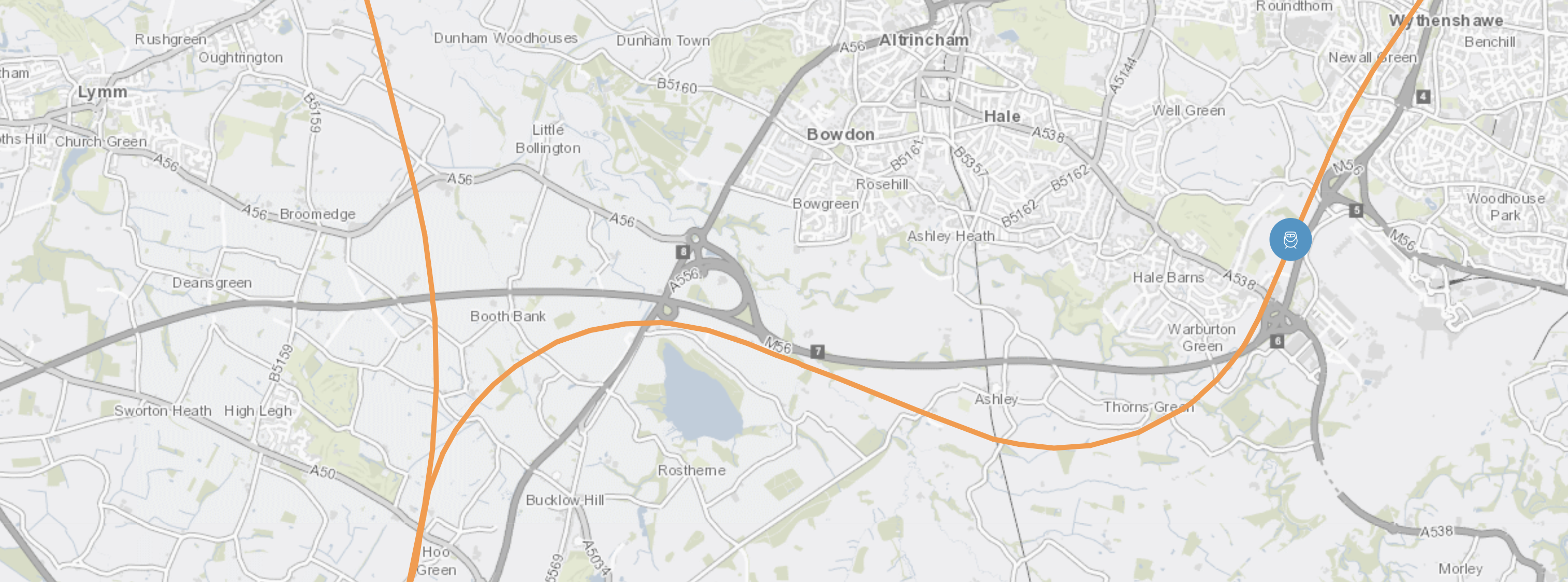
This map of High Speed Two where the Manchester Branch leaves the new High Speed Two route between Crewe and Wigan was captured from the interactive map on the High Speed Two web site.
Note.
- The Manchester Branch runs to the South of the M56,
- The large blue dot indicates Manchester Airport station.
- Wigan is to the North.
- Crewe is to the South.
- Manchester Piccadilly is to the North East.
I believe this junction will be turned into a full triangular junction, to connect Wigan directly to Manchester Airport and Manchester Piccadilly.
- Barrow, Blackburn, Blackpool, Preston and Windermere could all have high speed connections to Manchester Airport and Manchester Piccadilly. Trains could be shorter Classic-Compatible trains.
- A Manchester and Scotland service would take the same route.
Another pair of tracks could leave the junction to the West to create a direct route between Manchester Airport and Liverpool for Northern Powerhouse Rail, by sneaking along the M56.
Suppose extra services were as follows.
- Manchester and Barrow – 1 tph
- Manchester and Blackburn – 1 tph
- Manchester and Blackpool – 1 tph
- Manchester and Liverpool – 6 tph
- Manchester and Scotland – 1 tph
- Manchester and Windermere – 1 tph
The frequencies from the junction would be as follows.
- To and from Crewe – High Speed Two (Manchester) – 5 tph – High Speed Two (North) – 3 tph = 8 tph
- To and from Liverpool – Northern Powerhouse Rail – 6 tph = 6 tph
- To and from Manchester – High Speed Two – 5 tph – Northern Powerhouse Rail – 6 tph – Local – 4 tph – Scotland – 1 tph = 16 tph
- To and from Wigan – High Speed Two – 3 tph – Local – 4 tph – Scotland – 1 tph = 8 tph.
Only the Manchester Branch would be working hard.
The Liverpool Connection
I indicated that another pair of tracks would need to extend the Manchester Branch towards Liverpool in the West for Northern Powerhouse Rail.
- Would these tracks have a station at Warrington?
- Would there be a connection to allow services between Liverpool and the North and Scotland?
It might even be possible to design a Liverpool connection, that avoided using the current Liverpool Branch and increased the capacity and efficiency of all trains to Liverpool.
Capacity Of The Western Leg Between Wigan And Scotland
The sections between Crewe and Carlisle, will be running at the following frequencies.
- Wigan and Lancaster – 4 tph
- Lancaster and Carlisle – 3 tph
- Carlisle and Edinburgh – 2.5 tph
- Carlisle and Glasgow – 2.5 tph
Note.
- The unusual Scottish frequencies are caused by splitting and joining at Carlisle and alternate services to Edinburgh and Glasgow.
- Any local high speed services and a Scotland service from Manchester, will increase the frequencies.
Over this section the services will be running on an improved West Coast Main Line.
But in some cases the trains will be replacing current services, so the increase in total frequencies will be less than it first appears.
Avanti West Coast currently run the following Scottish services.
- One tph – London Euston and Glasgow via the most direct route.
- One tph – London Euston and alternately Edinburgh and Glasgow via Birmingham.
This means that effectively Glasgow has 1.5 tph and Edinburgh 0.5 tph from London Euston.
The capacity of the current eleven-car Class 390 trains is 145 First and 444 Standard Class seats, which compares closely with the 500-600 seats given in Wikipedia for High Speed Two trains. So the capacity of the two trains is not that different.
But High Speed Two will be running 2.5 tph Between London Euston and both Edinburgh and Glasgow.
I would expect, that Class 390 services to Scotland will be discontinued and replaced by High Speed Two services.
Capacity Of The Eastern Leg Between Birmingham And East Midlands Hub
The section is between Birmingham and East Midlands Hub, will be running 9 tph
As the maximum capacity of High Speed Two is laid down in the Phase One Act as 18 tph, this gives plenty of room for more trains.
But where will they come from?
Midlands Engine Rail is proposing a service between Birmingham Curzon Street and Nottingham.
- It will have a frequency of one tph.
- It will be run by High Speed Two Classic-Compatible trains.
- The journey will take 33 minutes.
- It will run on High Speed Two infrastructure between Birmingham Curzon Street and East Midlands Hub.
If High Speed Two has been designed with this service in mind, I doubt it will be a difficult service to setup.
- There might be enough capacity on High Speed Two for two tph on the route,
- It could possibly be extended to Lincoln.
It will also depend on the service timing being consistent with an efficient use of trains and platforms.
- Thirty-three minutes is not a good timing, as it means twenty-seven minutes wait in a platform to get a round trip time, that suits clock-face time-tabling.
- The current Lincoln and Nottingham service takes 56 minutes for 34 miles.
- LNER’s London Kings Cross and Lincoln service travels the 16 miles between Lincoln and Newark in 25 minutes.
- I estimate that after track improvements, with a single stop at Newark Castle station, that Nottingham and Lincoln could be achieved in several minutes under fifty minutes.
- This would enable a sub-ninety minute journey time between Birmingham Curzon Street and Lincoln, with enough time to properly turn the trains at both ends of the route.
- The three hour round trip would mean that an hourly service would need three trains.
This is probably just one of several efficient time-tabling possibilities.
Are there any other similar services?
The obvious one is surely Cambridge and Birmingham
- It would run via Peterborough, Grantham, Nottingham and East Midlands Hub.
- It would connect the three big science, engineering and medical centres in the Midlands and the East.
- It could be run by High Speed Two Classic-Compatible trains.
It might even be a replacement for CrossCountry’s Stansted Airport and Birmingham service.
Capacity Of The Eastern Leg Between East Midlands Hub And Sheffield
The section between East Midlands Hub and Sheffield, will be running 2 tph
As the maximum capacity of High Speed Two is laid down in the Phase One Act as 18 tph, this gives plenty of room for more trains.
But where will they come from?
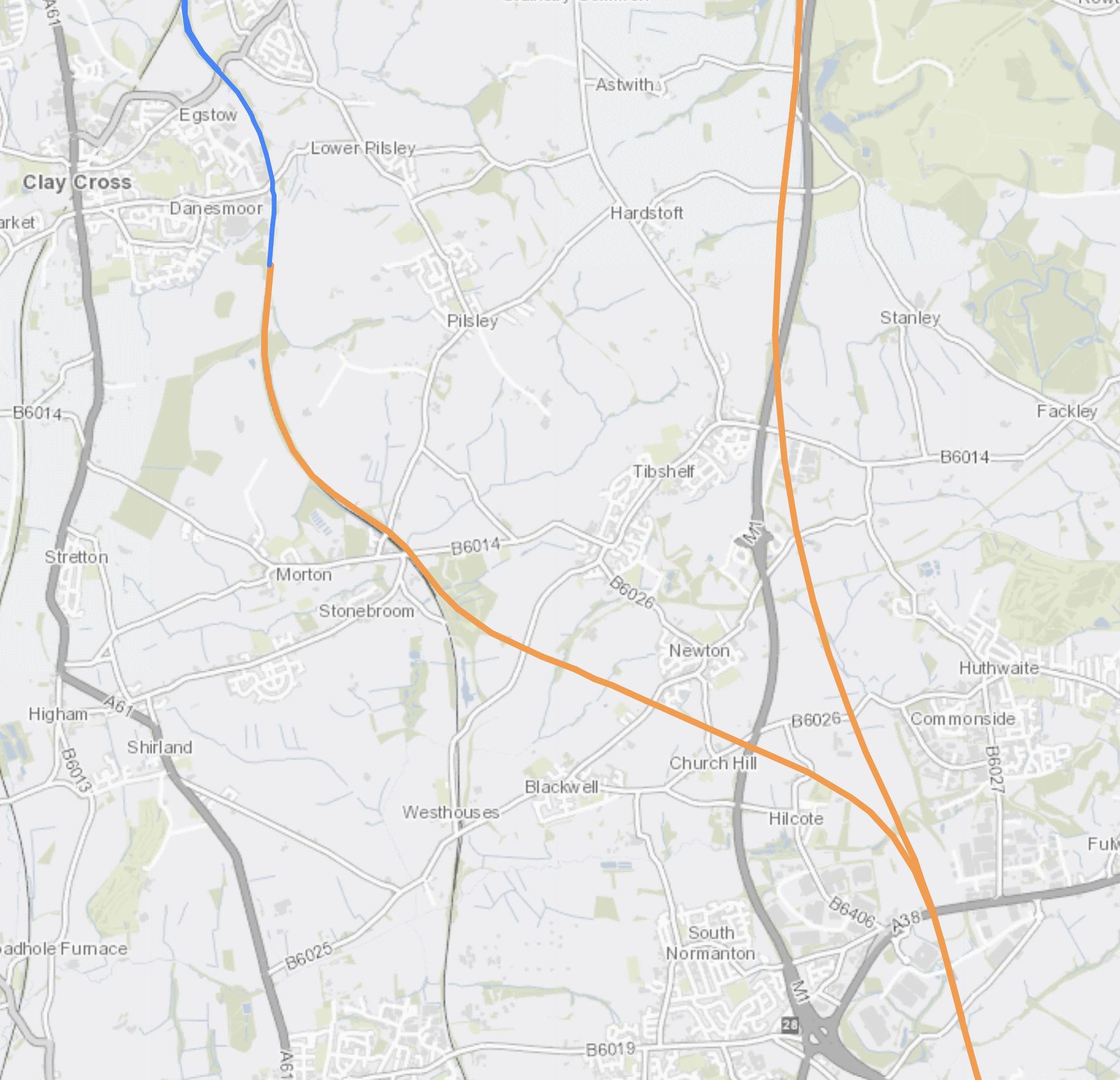
This map of High Speed Two where the Sheffield Branch leaves the new High Speed Two route between East Midlands Hub and Leeds was captured from the interactive map on the High Speed Two web site.
Note.
- The main route of High Speed Two between East Midlands Hub, is shown in orange and follows the route of the M1 Motorway, towards the East of the map.
- The Sheffield Branch is new track to Clay Cross North Junction, where is takes over the Midland Main Line to Sheffield, which is shown in blue.
- The line going South in the middle of the map is the Erewash Valley Line, which goes through Langley Mill and Ilkeston stations.
I suspect Clay Cross to Sheffield will be an electrified high speed line, with a maximum speed of at least 140 mph.
Could the Erewash Valley Line have been used as an alternative route to Sheffield?
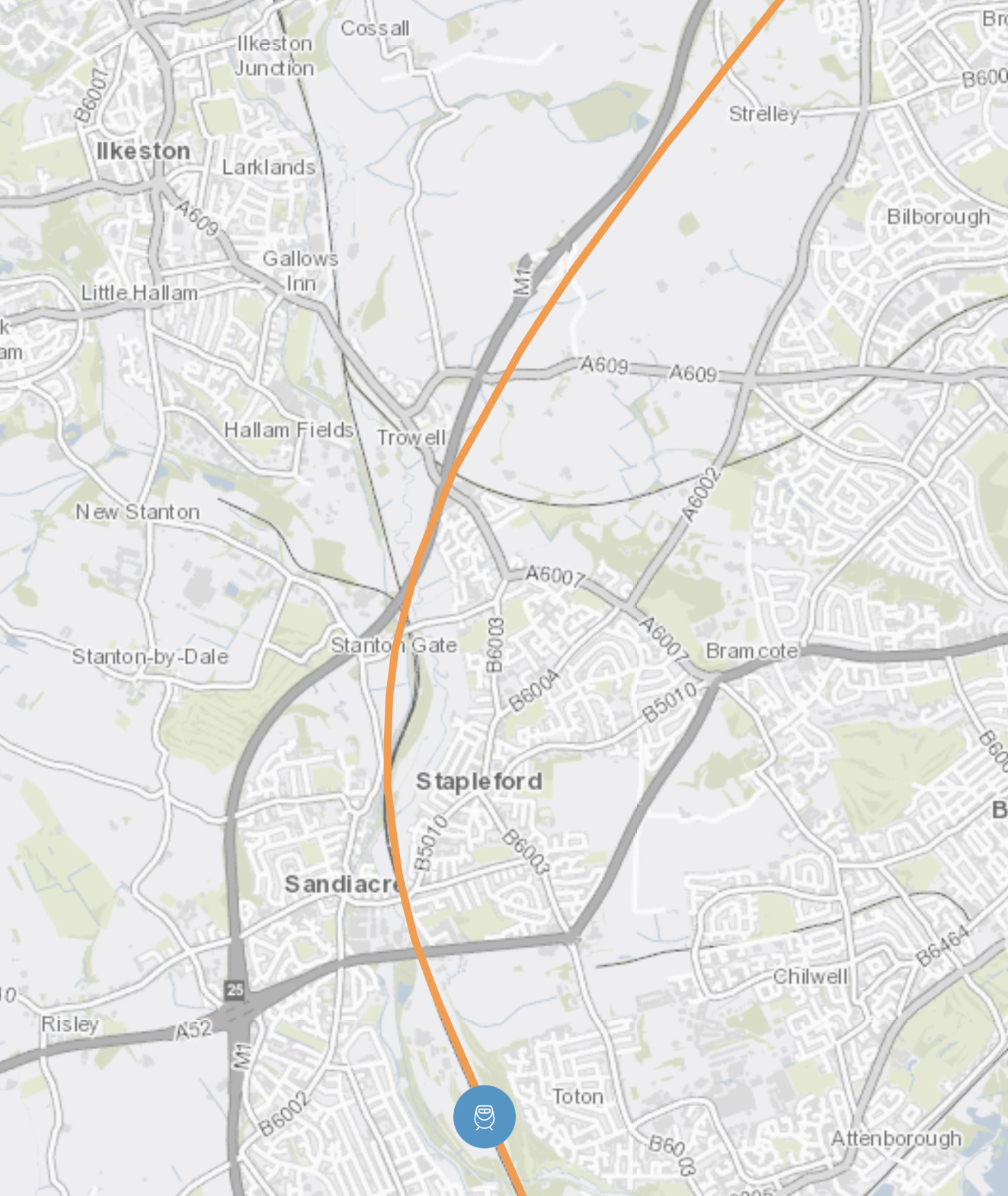
This map of High Speed Two captured from their interactive map, shows the connection of High Speed Two and the Erewash Valley Line to East Midlands Hub.
Note.
- East Midlands Hub is shown by the big blue dot.
- High Speed Two is shown in orange.
- The route to Leeds vaguely follows the M1 Motorway.
- The Erewash Valley Line goes North to the East of Ilkeston.
Would have been quicker and easier to electrify the Erewash Valley Line, as the High Speed Two route to Chesterfield and Sheffield?
- Network Rail updated the route a few years ago.
- It does not have the problems of electrification, through a World Heritage Site, as does the route through Derby.
- It could surely handle two tph, even if they were High Speed Two Classic Compatible trains.
- Sheffield will be just under ninety minutes from London by High Speed Two, as opposed to two hours now.
I suspect that it all comes down to saving a few minutes to Sheffield and the civic pride of having a High Speed Two connection.
So it looks like we’ll have the following capacity between East Midlands Hub and Sheffield.
- Between East Midlands Hub and Clay Cross North Junction, there will be the High Speed Two capacity of 18 tph.
- Between Clay Cross and Sheffield, there will probably be an upgraded capacity of perhaps 8-10 tph.
It seems a lot of capacity for just two tph.
Consider.
- High Speed Two is planning to run three tph between Birmingham Curzon Street and East Midlands Hub
- Midlands Rail Engine is planning to run one tph between Birmingham Curzon Street and East Midlands Hub
- Four tph is considered a Turn-Up-And-Go service, and could exist between Birmingham Curzon Street and East Midlands Hub.
- Sheffield and Leeds, both probably need a Turn-Up-And-Go service, to and from East Midlands Hub.
- Semi-fast services between Sheffield and East Midlands Hub, calling at Chesterfield, Alfreton, Langley Mill and Ilkeston would be possible, by using the Erewash Valley Line.
- The Maid Marian Line will join the Robin Hood Line in adding extra connectivity to East Midlands Hub Station.
- Leeds and East Midlands Hub could have a six tph service courtesy of High Speed Two and Midlands Rail Engine.
Using High Speed Two’s web site, the following times should be possible.
- Sheffield and East Midlands Hub – 27 minutes
- Sheffield and Birmingham Curzon Street – 47 minutes.
Both services allow time for an efficient service.
There are certainly many options to create a Turn-Up-And-Go service between Sheffield and East Midlands Hub and also improve connections to other locations across the area.
Capacity Of The Eastern Leg Between East Midlands Hub And Leeds
The section is between East Midlands Hub and Leeds, will be running 5 tph
High Speed Two between Midlands Hub and Leeds is a totally new high speed line.
- As the maximum capacity of High Speed Two is laid down in the Phase One Act as 18 tph, this gives plenty of room for more trains.
- The Southern section of the leg closely follows the M1 Motorway.
- Leeds, York and Newcastle will be 27, 36 and 93 minutes from East Midlands Hub, respectively.
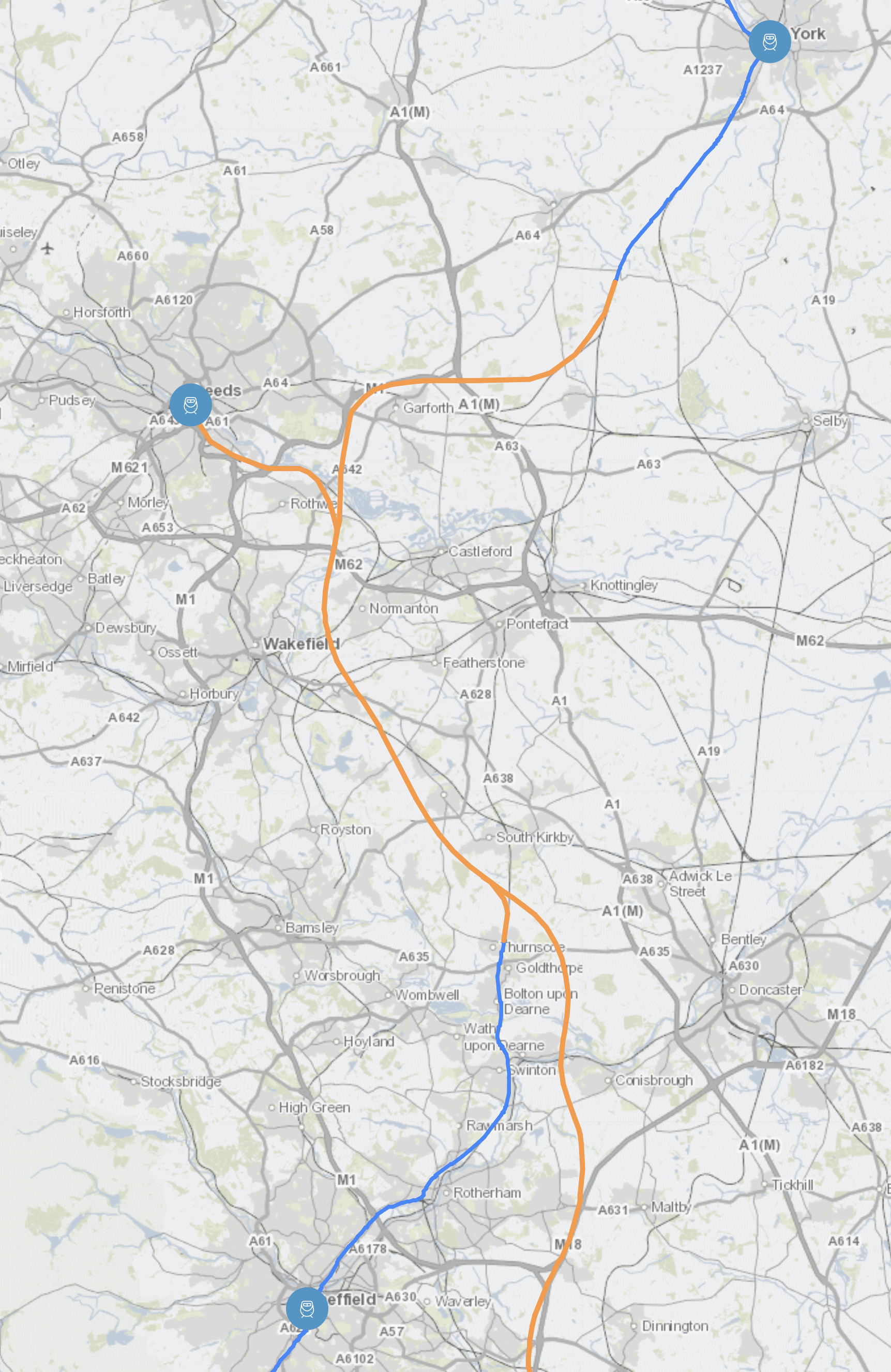
This map of High Speed Two, which shows the route of the line in Yorkshire, was captured from the interactive map on the High Speed Two web site.
Note.
- Sheffield is marked by the blue dot in the South.
- Leeds is marked by the blue dot in the North West.
- York is marked by the blue dot in the North East.
- New routes are shown in orange.
- Upgraded routes are shown in blue.
The route seems to open up several possibilities for extra routes.
- Leeds and Sheffield will be used by Northern Powerhouse Rail and there will be four tph, taking 28 minutes.
- Leeds and Bedford via East Midlands Hub has been proposed by Midlands Rail Engine.
- Services between Sheffield and the North via York must be a possibility.
This map of High Speed Two, which shows the routes to the East of Leeds, was captured from High Speed Two’s interactive map.
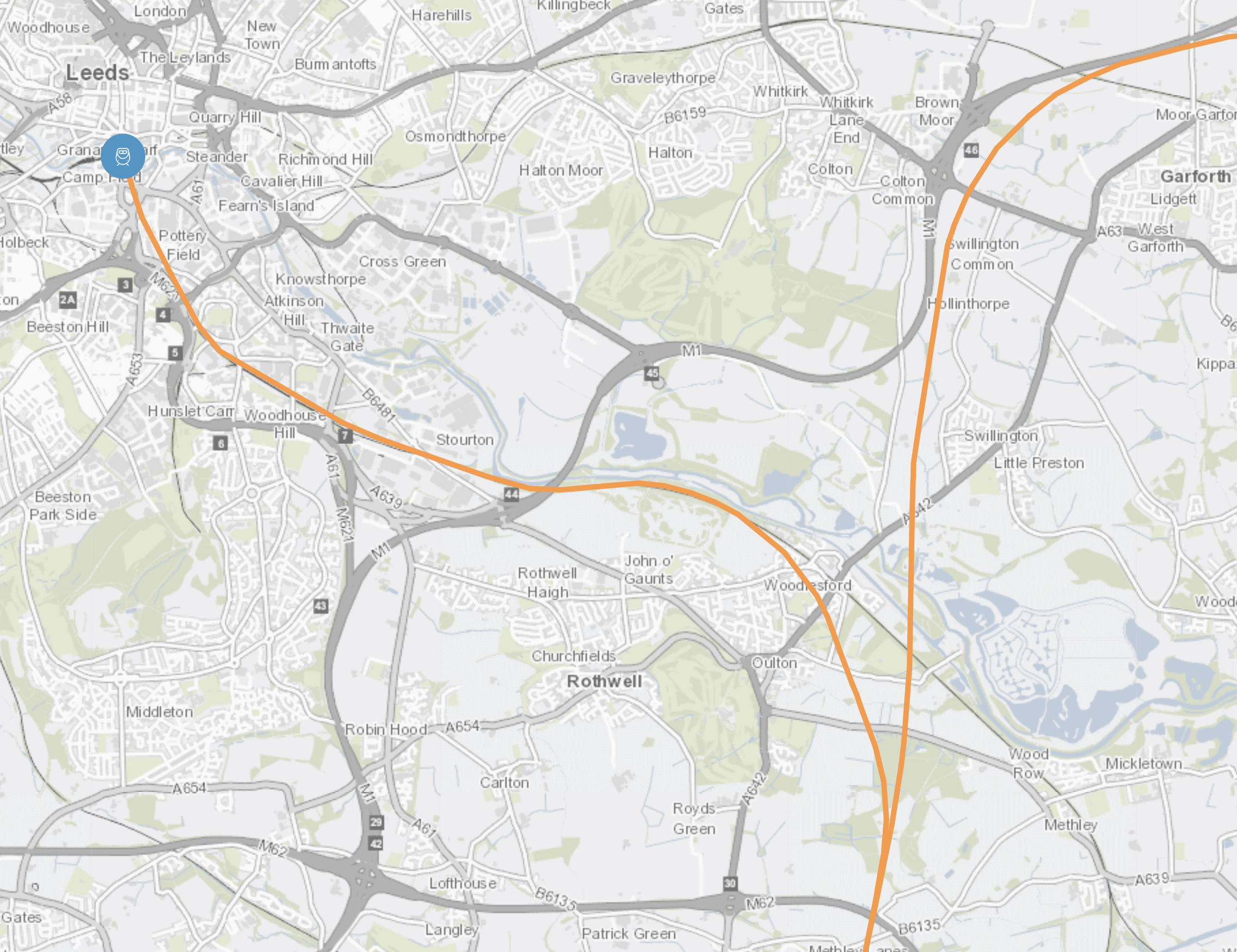
I think that two things might be missing.
- A full triangular junction would surely allow services between Leeds and the North via York.
- A high speed connection to Hull.
We shall see in the future.
Capacity Of The Eastern Leg Between York And Newcastle
The section between York and Newcastle, will be running at a frequency of 3 tph.
Over this section the services will be running on an improved East Coast Main Line.
Conclusion
I shall split the conclusions into various sections.
Route And Track Layout
I think there may be places, where the route and track layout might need to be improved.
- The Manchester Branch probably needs a triangular junction with the Western Leg of High Speed Two.
- How Liverpool is served by Northern Powerhouse Rail needs to be decided.
- The approach to Leeds probably needs a triangular junction with the Eastern Leg of High Speed Two.
- It is not clear how services will reach Hull.
Hopefully, these issues will become clear in the next year or so.
Capacity
The sections with the highest levels of capacity would appear to be the following.
- London Euston and Birmingham Interchange.
- The Manchester Branch
- The section shared with the East Coast Main Line between York and Newcastle.
- The section shared with the West Coast Main Line between Wigan and Scotland.
But on these sections extra trains can be run.
- Birmingham and North West England
- Birmingham and East Midlands Hub
- East Midlands Hub and Leeds
- East Midlands Hub and Sheffield
- East Midlands Hub and York
I can see, this capacity being filled by high speed local services, like those proposed by Midlands Rail Engine.
Rolling Stock
The only comment, I will make, is that there could be a need for a shorter Classic-Compatible train to work local services.
Seats On Avanti West Coast
I went to Liverpool yesterday on an Avanti West Coast Class 390 train in Standard Class.
I booked on Monday and asked for a table seat.
I actually got a set of four to myself, as this picture shows.

When I got back, out of curiosity I tried to book a complete set of four seats for possibly a family or a group, who were in the same bubble.
I got three seats together and a fourth a few seats away.
So if you need to do that, I would suggest you’re careful with the booking or do it in the traditional manner.
Having travelled twice to the North West in recent weeks, I wouldn’t recommend First Class, as all you get extra is a better pair of seats.
Incidentally, when I came back, because of the weather, I abandoned my trip around the city and got to Lime Street with an hour or so to wait.
But I was able to change my booking for an earlier train for about thirteen pounds and still got a set of four to myself.
Liverpool’s Forgotten Tunnel
The Wapping Tunnel in Liverpool was designed by George Stephenson and was the first tunnel in the world to be bored under a city.
It used to take goods trains between Liverpool Docks and the Liverpool and Manchester Line.
During the 1970s preparations were made to connect the Wapping Tunnel to Merseyrail’s Northern Line, so that trains could run between the Northern Line and the City Line, which would have connected the North and East of the City.
But the project was never completed.
It now appears, the project is on the agenda again.
This article on TransportExtra is entitled Liverpool CR Develops Plan To Boost City Centre Rail Capacity.
The plan outlined is as follows.
- At present, as many as two thirds of trains on the Northern Line turn back as Liverpool Central station.
- Between four and eight trains per hour (tph) could be diverted into the Wapping Tunnel to serve places like St. Helens, Warrington Central and Wigan.
- This would free up platforms in Liverpool Lime Street station for Inter-City and Inter-Regional services.
It is also pointed out, that a 2016 study, didn’t find any serious technical problems with the project.
I do have my thoughts on this project.
Services That Could Be Connected
Local services running from Liverpool Lime Street station include.
Manchester Oxford Road Via Warrington Central
This service is run by Northern.
- It has a frequency of two tph.
- One service calls at Edge Hill, Mossley Hill, West Allerton, Liverpool South Parkway, Hunts Cross, Halewood, Hough Green, Widnes, Sankey For Penketh, Warrington West, Warrington Central, Birchwood, Irlam, Urmston and Deansgate.
- The other service calls at Mossley Hill, West Allerton, Liverpool South Parkway, Hough Green, Widnes, Warrington Central, Padgate, Birchwood, Glazebrook, Irlam, Flixton, Chassen Road (1tp2h), Urmston, Humphrey Park, Trafford Park and Deansgate
- Both trains appear to take the same route.
- Some stations like Liverpool South Parkway, Warrington West and Deansgate have lifts, but disabled access is patchy.
- The service has a dedicated terminal at Manchester Oxford Road, which is without doubt Manchester’s worst central station for location, access to the Metrolink, onward travel and step-free access.
- It takes seventy-two minutes. which is an inconvenient time for train operators.
- The route is electrified with 25 KVAC overhead electrification at both ends.
I’ve used this route several times and usually pick it up from Deansgate, as it has a convenient interchange to the Metrolink.
I am fairly certain that Merseyrail’s new Class 777 trains running on battery power in the middle could handle this route.
- They would charge the batteries at the electrified ends of the route.
- They would join the route at Edge Hill station.
- They would offer step-free access between train and platform.
- These trains are built for fast stops, so could all services call at all stations?
- On Merseyrail’s principles, the service would probably be at least two tph, if not four tph.
I estimate that these trains are fast enough to do the return trip between the Wapping Tunnel portal at Edge Hill and Manchester Oxford Road in under two hours.
- A two-four tph stopping service between Liverpool and Manchester City Centres, that took less than an hour, would be very convenient for passengers.
- The service would be well-connected to local tram, train and bus services in both City Centres.
- The service would also very easy for train schedulers to integrate with other services.
Liverpool and Manchester would have the world’s first battery-powered inter-city railway.
Other than the connection of the Wapping Tunnel no extra infrastructure works would be needed.
Wigan North Western Via St. Helens Central
This service is run by Northern.
- It has a frequency of two tph.
- The service calls at Edge Hill, Wavertree Technology Park, Broad Green, Roby, Huyton, Prescot, Eccleston Park, Thatto Heath, St Helens Central, Garswood and Bryn
- The route is fully-electrified with 25 KVAC overhead.
- It takes fifty-one minutes. which is a very convenient time for train operators.
Merseyrail’s new Class 777 trains could handle this route, if fitted with pantographs for 25 KVAC overhead electrification.
- They would join the route at Edge Hill station.
- They would offer step-free access between train and platform.
- On Merseyrail’s principles, the service would probably be at least two tph, if not four tph.
I estimate that these trains are fast enough to do the return trip between the Wapping Tunnel portal at Edge Hill and Wigan North Western in under two hours.
- A two-four tph stopping service between Liverpool and Wigan, that took less than an hour, would be very convenient for passengers.
- Wigan North Western has good connections using the West Coast Main Line.
- The service would also very easy for train schedulers to integrate with other services.
Other than the connection of the Wapping Tunnel no extra infrastructure works would be needed.
Blackpool North
This service is run by Northern.
- It has an hourly frequency.
- The service calls at Huyton, St Helens Central, Wigan North Western, Euxton Balshaw Lane, Leyland, Preston, Kirkham & Wesham and Poulton-le-Fylde
- The route is fully-electrified with 25 KVAC overhead.
- It takes seventy-seven minutes. which is a reasonable time for train operators.
This is a service that could continue as now, but would probably be timed to fit well with four Merseyrail trains between the Wapping Tunnel and Wigan North Western.
Manchester Airport Via Warrington Central And Manchester Piccadilly
This service is run by Northern.
- It has an hourly frequency.
- The service calls at Liverpool South Parkway, Warrington West, Warrington Central, Birchwood, Manchester Oxford Road, Manchester Piccadilly and Mauldeth Road
- The route is partially-electrified with 25 KVAC overhead.
- The service is operated by diesel trains.
- The service uses the overcrowded Castlefield Corridor.
- It takes sixty-nine minutes, which is an inconvenient time for train operators.
This is one of those services, which I think will eventually be partially replaced by other much better services.
- Northern Powerhouse Rail is planning six tph between Liverpool Lime Street and Manchester Piccadilly via Warrington South Parkway and Manchester Airport, which will take just twenty-six minutes.
- Two-four tph on the route between Liverpool Lime Street and Manchester Oxford Road via Warrington Central would be a better service for the smaller stations. Passengers going to and from Manchester Airport would change at Liverpool Lime Street, Deansgate or Manchester Oxford Road.
Continuing as now, would definitely be possible.
Crewe And Manchester Airport Via Newton-le-Willows And Manchester Piccadilly
This service is run by Northern.
- It has an hourly frequency.
- The service calls at Edge Hill, Wavertree Technology Park, Broad Green, Roby, Huyton, Whiston, Rainhill, Lea Green, St Helens Junction, Earlestown, Newton-le-Willows, Patricroft, Eccles, Deansgate, Manchester Oxford Road, Manchester Piccadilly, Mauldeth Road, Burnage, East Didsbury, Gatley and Heald Green.
- The route is fully-electrified with 25 KVAC overhead.
- The service uses the overcrowded Castlefield Corridor
- It takes eighty-five minutes, which is an inconvenient time for train operators.
This is one of those services, which I think will eventually be partially replaced by other much better services.
- Northern Powerhouse Rail is planning six tph between Liverpool Lime Street and Manchester Piccadilly via Warrington South Parkway and Manchester Airport, which will take just twenty-six minutes.
- Two-four tph on the route between Liverpool Lime Street and Wigan North Western would be a better service for the smaller stations. Passengers going to and from Manchester Airport and Crewe would change at Liverpool Lime Street or Wigan North Western.
Continuing as now, would definitely be possible.
Warrington Bank Quay Via Earlstown
This service is run by Northern.
- It has an hourly frequency.
- The service calls at Edge Hill, Wavertree Technology Park, Broad Green, Roby, Huyton, Whiston, Rainhill, Lea Green, St Helens Junction and Earlestown.
- The route is fully-electrified with 25 KVAC overhead.
- The service takes forty-three minute, which is a convenient time for train operators.
Merseyrail’s new Class 777 trains could handle this route, if fitted with pantographs for 25 KVAC overhead electrification.
- They would join the route at Edge Hill station.
- They would offer step-free access between train and platform.
- On Merseyrail’s principles, the service would probably be at least two tph, if not four tph.
Other than the connection of the Wapping Tunnel no extra infrastructure works would be needed.
Three Possible Routes Through Wapping
Summing up this section, these are possible routes that could be replaced by services through the Wapping Tunnel.
- Two tph – Manchester Oxford Road
- Two tph – Warrington Bank Quay
- One tph – Wigan North Western
Increasing the Wigan North Western service to two tph, would increase the frequency between Edge Hill and Huyton to a very passenger-friendly four tph.
If eight tph could be accommodated in the Wapping Tunnel, the frequency could also be doubled to Manchester Oxford Road.
This would give the following services through the Wapping Tunnel.
- Four tph – Manchester Oxford Road
- Two tph – Warrington Bank Quay
- Two tph – Wigan North Western
The only local services that would need to run into Liverpool Lime Street would be.
- One tph – Northern – Blackpool North via Wigan North Western.
- One tph – Northern – Manchester Airport and Crewe via St. Helens and Newton-le-Willows.
- One tph – Northern – Manchester Airport via Warrington Central.
- One tph – Trains for Wales – Chester via Runcorn
I can understand, why so many seem to be enthusiastic about using the Wapping Tunnel to connect the Northern and City Lines.
Echoes Of The Brunels’ Thames Tunnel
George Stephenson’s Wapping Tunnel may be the first tunnel under a city, but the Brunels’ Thames Tunnel was the first under a navigable river.
The Brunels’ tunnel was built for horses and carts, but today it is an important rail artery of the London Overground, handling sixteen tph between Wapping and Rotherhithe.
I would expect that the Wapping Tunnel could do for Liverpool, what the Thames Tunnel has done for East London.
Modern signalling techniques probably mean that the theoretical capacity of the Wapping Tunnel is way in excess of the planned maximum frequency of eight tph.
High Speed Two Between Liverpool And London
The latest High Speed Two plans as laid out in the June 2020 Edition of Modern Railways, say that there will be two tph between Liverpool Lime Street and London Euston.
- Both trains will call at Old Oak Common, Crewe and Runcorn.
- Both trains will be 200 metres long classic-compatible High Speed Two trains.
- One train will split and join with a similar service between London Euston and Lancaster.
Will these High Speed Two services replace the current Avanti West Coast services?
Northern Powerhouse Rail Between Liverpool And Manchester
In Changes Signalled For HS2 Route In North, I looked at Transport for the North’s report, which is entitled At A Glance – Northern Powerhouse Rail.
This report says that Northern Powerhouse Rail between Liverpool and Manchester Piccadilly will be as follows.
- Services will go via Manchester Airport.
- There could be a new Warrington South Parkway station.
- Six tph between Liverpool and Manchester via Manchester Airport and Warrington are planned.
- Journey times will be 26 minutes.
I would assume that several of the six tph will continue across the Pennines to Huddersfield, Bradford, Leeds, York and Hull.
Will these Northern Powerhouse Rail services replace the current TransPennine and some of the Northern services?
Northern Powerhouse Rail Trains
Nothing has been said about the trains for Northern Powerhouse Rail.
I suspect they will be versions of the 200 metre long classic-compatible High Speed Two trains.
I do wonder, if Avanti West Coast have already ordered a prototype fleet of these trains,
Look at the specification of the Class 807 trains, they have ordered to boost services on the West Coast Main Line.
- 7 x 26 metre cars.
- 182 metres long. Shorter than an eleven-car Class 390 train.
- All-electric, with no diesel engines or traction batteries. Are they lightweight trains with sparkling acceleration?
- 125 mph operating speed. All Class 80x trains can do this.
- 140 mph operating speed with ERTMS digital signalling. All Class 80x trains can do this.
- Ability to work in pairs. All Class 80x trains can do this, up to a maximum length of twelve cars in normal mode and twenty-four cars in emergency mode. I doubt fourteen cars would be a problem!
To be classic-compatible High Speed Two trains, they would need to be able to cruise at 205 mph, whilst working on High Speed Two. I suspect that Hitachi have got some higher-capacity electrical gear and traction motors with lots more grunt in their extensive parts bin!
If these are a prototype fleet of classic-compatible High Speed Two trains, they will certainly get a lot of in-service testing even before the order is placed for the trains for High Speed Two.
Northern Powerhouse Rail will need trains with a slightly different specification.
- As they won’t generally work on high speed lines, for most trains an operating speed of 140 mph will be sufficient.
- For serving some destinations like Cleethorpes, Harrogate, Hull, Middlesbrough and Redcar an independently-powered capability would be desirable. Sixty miles on batteries would probably be sufficient!
Nothing would appear to be out of Hitachi’s current capabilities.
Liverpool Lime Street Station After Remodelling
Liverpool Lime Street station has two groups of platforms.
- Platforms 1-5 on the Western side
- Platforms 6-10 on the Eastern side.
These pictures show some views of the platforms at Liverpool Lime Street station after the remodelling of 2017-2019.
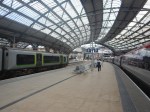
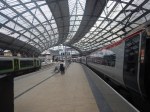
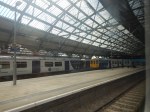
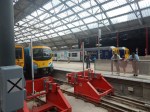
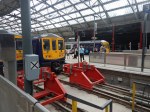

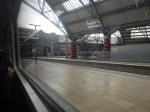
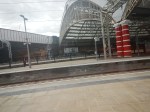
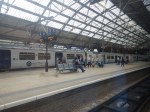
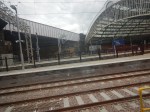
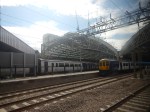

Note,
- The platforms are not narrow!
- It appears that the five platforms in the Eastern group are all long enough to take an eleven-car Class 390 train, which is 265.3 metres long.
- TransPennine Express trains can use the Western group.
I have looked at a whole day’s traffic on Real Time Trains and it appears that the new track layout allows almost all services to use any available platform.
This flexibility must make operation of the station much easily than it was!
Liverpool Lime Street Station As A High Speed Station
It would appear that the Eastern Group of Platforms 6-10 will all be capable of the following.
- Handling a 182 metre long Avanti West Coast Class 807 train.
- Handling a 200 metres long classic-compatible High Speed Two train.
- Handling a 130 metre long TransPennine Express Class 802 train.
- In the future, handling a Northern Powerhouse Rail train, which will probably be less than 200 metres long.
But they won’t be able to handle High Speed Two’s full-size trains.
Currently, these services capable of over 125 mph are running or are planned from Liverpool Lime Street station.
- 2 tph – Avanti West Coast – Liverpool Lime Street and London Euston
- 1 tph – TransPennine Express – Liverpool Lime Street and Newcastle
- 1 tph – TransPennine Express – Liverpool Lime Street and Scarborough
- 3 trains per day(tpd) – TransPennine Express – Liverpool Lime Street and Glasgow
This totals to four tph.
High Speed Two will add two classic-compatible High Speed Two trains.
Will these replace the two Avanti West Coast services?
- They will be run by the same company.
- They will take different routes.
- The current service takes 134 minutes.
- The High Speed Two train will take 94 minutes.
I can see Avanti West Coast running a one tph slower train via stations with difficult connections to Liverpool Lime Street. Think Watford Junction, Milton Keynes, Rugby, Stafford and Stoke-on-Trent.
This would bring the total to five tph.
Northern Powerhouse Rail will run six high speed trains to Manchester and beyond.
If they replaced the two TransPennine Express services, that would bring the maximum number of 200 metre long high speed trains to nine tph.
Could Liverpool Lime Street station handle nine high-speed tph?
Comparison With Birmingham Curzon Street Station
Birmingham Curzon Street station on High Speed Two will handle high speed trains from three directions, as will Liverpool Lime Street station.
The Birmingham station will handle nine tph on seven platforms.
As Liverpool Lime Street station will have ten platforms and also need to handle nine tph, I think it will be able to handle the trains.
Will There Be A Station In The Wapping Tunnel?
Just as London has its clay, which makes excavating for the Underground easy, the Centre of Liverpool has its sandstone, which has been honeycombed with tunnels. In addition to the Wapping Tunnel, there are two other tunnels from Edge Hill station to the Docks; the Waterloo Tunnel and the Victoria Tunnel.
Liverpool has plans for a Knowledge Quarter based on the Universities on Brownlow Hill.
As part of the development, it is intended to develop an area called Paddington Village.
Wikipedia says this about the village.
Paddington Village is a site at the eastern gateway to the city centre and has been earmarked as 1.8m sq ft of science, technology, education and health space.
This is also another paragraph.
Liverpool Mayor Joe Anderson announced that the council were looking into a new Merseyrail station to serve the site. A mention of a station is made in the October 2017 Liverpool City Region Combined Authority update to the Long Term Rail Strategy. Merseytravel commissioned a feasibility report into re-opening the Wapping Tunnel in May 2016 which found that it was a valid proposal which would allow for a new station to be built that could serve the Knowledge Quarter.
Someone has thought up a proposal for a Lime Line, which would be a tram or bus system, linking the Knowledge Quarter and the City Centre.
This map shows how their proposal fits in with all the other rail systems in Liverpool City.
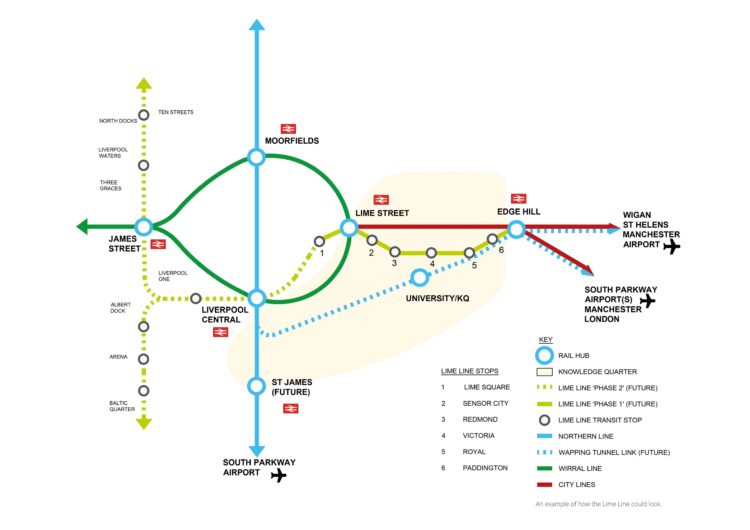
Note the Wapping Tunnel is shown on the map, as a dotted blue line.
- It connects to the Northern Line to the South of Liverpool Central station.
- It connects to the City Line to the West of Edge Hill station.
- A station named University/KQ is shown.
A new St. James station is also shown
Conclusion
Using the Wapping Tunnel to increase capacity in Liverpool City Centre could be used if required to improve capacity for the high speed network in the city, by removing local trains from Liverpool Lime Street station.
Should High Speed Two’s Macclesfield And London Service Call At Birmingham Interchange?
Connecting Manchester City Centre to the High Speed Two network will be a major undertaking.
- It looks increasingly likely that High Speed Two and Northern Powerhouse Rail will have a shared line running from the main High Speed Two route through Crewe to Manchester Piccadilly via Manchester Airport.
- Between Manchester Airport and Manchester Piccadilly will be in a high speed tunnel.
- Northern Powerhouse Rail will connect Liverpool Lime Street and Warrington to Manchester Airport and Manchester Piccadilly.
- There will be a major problem keeping train services running between Manchester and Birmingham, London and the South.
But just at Project Rio kept Manchester connected during the rebuilding of the West Coast Main Line in the early years of this century, I believe that a similar creditable alternative route may be starting to evolve.
Avanti’s Additional Class 807 Trains Will Be Delivered
These trains will allow additional services and release some Class 390 trains to reinforce other services.
Avanti West Coast’s Future West Coast Main Line Service
The small fleet of Class 807 trains are needed to provide extra services on the West Coast Main Line.
- But if these trains are successful, will more be used as replacements for the nearly twenty-years-old Class 390 trains?
- Will they also be given more traction power to double as the classic-compatible trains for High Speed Two.
- Other operators might also like to purchase a high capacity 200 metre long high speed train, which would share routes used by High Speed Two.
In Thoughts On Class 807 Trains And High Speed Two’s Classic-Compatible Trains, I discuss the design of extra trains for High Speed Two and the West Coast Main Line.
Surely, though having similar trains handling both roles on the West Coast Main Line and High Speed Two, would be an advantage to Avanti West Coast?
London And Manchester Services
Currently, there are these services between London Euston and Manchester Piccadilly stations.
- Via Milton Keynes Central, Stoke-on-Trent and Stockport
- Via Stoke-on-Trent, Macclesfield and Stockport
- Via Stafford, Crewe, Wilmslow and Stockport
All services have a frequency of one train per hour (tph)
High Speed Two plans to run these services between the South and the Manchester area.
- 1 tph – 200 metres – London Euston and Wigan North Western via Old Oak Common, Crewe and Warrington Bank Quay
- 1 tph – 200 metres – London Euston and Macclesfield via Old Oak Common, Stafford and Stoke.
- 1 tph – 400 metres – London Euston and Manchester Piccadilly via Old Oak Common, Birmingham Interchange and Manchester Airport
- 2 tph – 400 metres – London Euston and Manchester Piccadilly via Old Oak Common and Manchester Airport
- 2 tph – 200 metres – Birmingham Curzon Street and Manchester Piccadilly via Manchester Airport
- 1 tph – 200 metres – Birmingham Curzon Street and Wigan North |Western
Note.
- I have included Wigan North Western, as it has good connections to North Manchester.
- Services can’t go via Manchester Airport until the tunnel is completed.
- The 400 metre services will need to use dedicated High Speed Two tracks, so will need to use the tunnel via Manchester Airport.
Wigan and Macclesfield stations will not be requiring major rebuilding, during the construction of High Speed Two. That should mean the stations will not need to be closed for long periods.
- Macclesfield station could probably handle up to three tph from the South.
- Wigan North Western station could probably handle two tph from the South.
- Work in the Manchester Piccadilly area, may well close the station at times.
I suspect Macclesfield and Wigan North Western could be very useful alternative stations for travelling to and from the South.
Manchester And Birmingham Via Macclesfield
I can see that there could be difficulties for some passengers, if they found themselves at Macclesfield wanting to go to the Birmingham area.
A solution would be for the Macclesfield and London service to stop at Birmingham Interchange, which will be extremely well-connected.
Birmingham Interchange
This map from High Speed Two, shows Birmingham Interchange and Birmingham International stations.
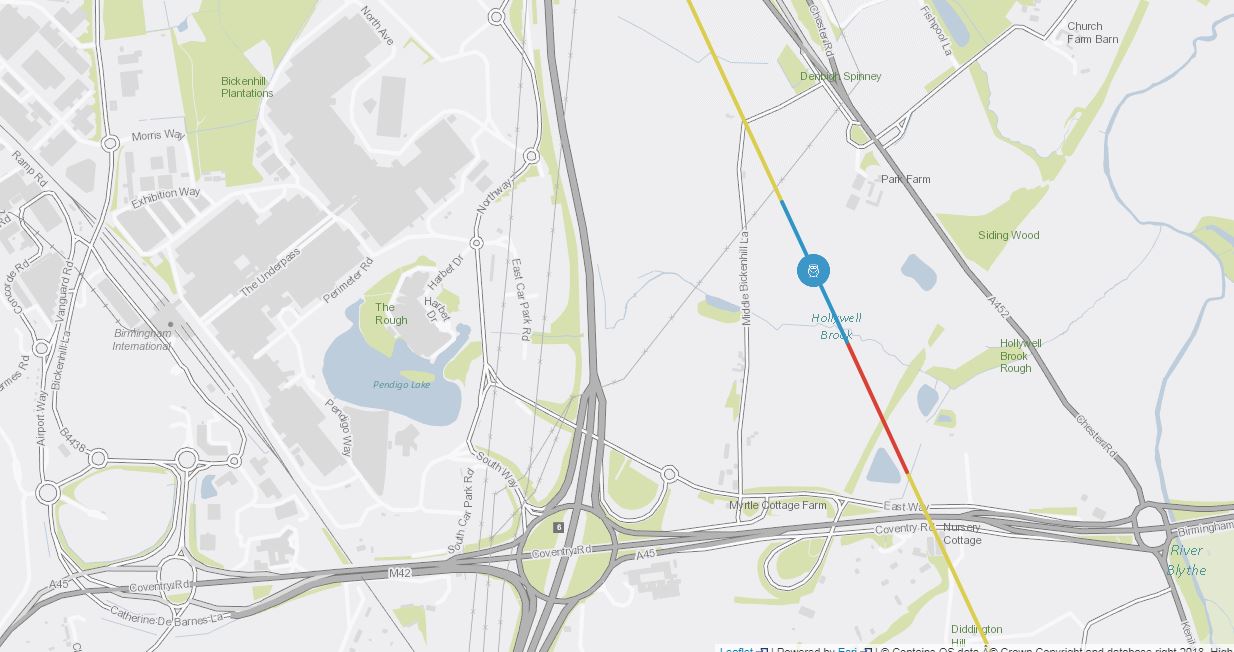
Note.
- Birmingham Interchange station is marked by the blue dot.
- Birmingham International station is to the West of the M42.
The two stations will be connected by an automatic people mover.
Destinations and their frequencies available from Birmingham Interchange, when High Speed Two is complete will include.
- 2 tph – Birmingham Curzon Street
- 1 tph – Carlisle
- 1 tph – East Midlands Hub
- 1 tph – Edinburgh Haymarket
- 1 tph – Edinburgh Waverley
- 1 tph – Glasgow Central
- 1 tph – Leeds
- 5 tph – London Euston
- 1 tph – Manchester Airport
- 1 tph – Manchester Piccadilly
- 5 tph – Old Oak Common
- 1 tph – Preston
It looks like if you miss your train to many important cities at Birmingham Interchange, it will be an hour to wait for the next train.
Destinations and their frequencies available from Birmingham International are currently.
- 8 tph – Birmingham New Street
- 1 tph – Bournemouth
- 1 tph – Crewe
- 0.5 tph to Edinburgh Waverley
- 0.5 tph to Glasgow Central
- 7 tph – London Euston
- 1 tph – Macclesfield
- 1 tph – Manchester Piccadilly
- 1 tph – Reading
- 1 tph – Shrewsbury
- 1 tph – Southampton
- 1 tph – Stafford
- 1 tph – Stoke-on-Trent
- 2 tph – Wolverhampton
Note that 0.5 tph is one train per two hours.
These two lists can be combined.
- 10 tph – Birmingham Curzon Street/New Street
- 1 tph – Bournemouth
- 2 tph – Carlisle
- 1 tph – Crewe
- 1 tph – East Midlands Hub
- 1.5 tph – Edinburgh Haymarket
- 1.5 tph – Edinburgh Waverley
- 1.5 tph – Glasgow Central
- 1 tph – Leeds
- 12 tph – London Euston
- 1 tph – Macclesfield
- 1 tph – Manchester Airport
- 2 tph – Manchester Piccadilly
- 5 tph – Old Oak Common
- 1 tph – Preston
- 1 tph – Reading
- 1 tph – Shrewsbury
- 1 tph – Southampton
- 1 tph – Stafford
- 1 tph – Stoke-on-Trent
- 2 tph – Wolverhampton
This list is surely missing Bristol, Cardiff, Liverpool, Sheffield and Newcastle.
Conclusion
We should not underestimate the importance of Macclesfield and Wigan North Western stations in getting to and from Manchester during the building of High Speed Two.
Thoughts On Class 807 Trains And High Speed Two’s Classic-Compatible Trains
Avanti West Coast’s New Class 807 Trains
Avanti West Coast have ordered a small fleet of Class 807 trains.
This article on Railnews, gives this short description.
There will be more seats, because a seven-car train will have 453 and five-car sets will have 301. First said the seven-car version will have about the same number of seats as a nine-car Pendolino, because each IET vehicle is longer, at 26m.
Adding standard details of other Hitachi trains in the family, the following seems to be known.
- They are seven-car trains.
- The cars are the standard twenty-six metres, so a seven-car train will be 182 metres.
- Ten trains have been ordered.
- I suspect that like all the other trains in the family, they will be 125 mph trains, that are capable of 140 mph, when the signalling and track allows.
- They are pencilled in for services between London Euston and Birmingham New Street, Blackpool North and Liverpool Lime Street stations
- They will not have batteries or diesel engines for emergency or hotel power. Could this mean, that the trains have been designed for high performance, by removing excess weight?
- The trains don’t have a tilting capability. Does this save weight and increase acceleration?
- The trains have 453 seats, as opposed to the nine-car Class 390 trains, which have 469 seats.
Could these trains be designed, to be able to better the Class 390 train schedules on the West Coast Main Line?
- They have no tilting capability.
- They can only work on electric power, like the Class 390 trains.
- They could have very fast acceleration, due to the weight loss.
- They only reduce capacity by 3.5 %, when compared to a nine-car Class 390 train.
In Will Avanti West Coast’s New Trains Be Able To Achieve London Euston and Liverpool Lime Street In Two Hours?, this was my conclusion.
I believe the following will be possible.
-
- A two hour service between London Euston and Liverpool Lime Street will be possible with Avanti West Coast’s new Class 807 trains.
- The current Class 390 trains could go a bit faster.
- I estimate that a Class 807 train could save as much as two-and-a-half-minutes at each stop.
- Blackpool North and London times will be comfortably under three hours.
- Coventry and London times will be comfortably under an hour.
The performance of these Class 807 trains will improve the West Coast Main Line.
What will London in two hours, do for Liverpool?
Class 807 Trains With Different Car Lengths
It is possible to create a table showing car length, train length and capacity for Class 807 trains
- 26 metres – 182 metres – 453 seats
- 26.5 metres – 185.5 metres – 462 seats
- 27 metres – 189 metres – 470 seats
- 27.5 metres – 192.5 metres – 479 seats
- 28 metres – 196 metres – 488 seats
- 28.5 metres – 199.5 metres – 497 seats
It seems that by lengthening all cars by half a metre, just adds nine seats.
Does this point to the fact, that twenty-six metres was a carefully-chosen optimal car length?
Class 807 Trains With Different Numbers Of Cars
A similar table can also be created for different numbers of twenty-six metre cars.
- 7 cars – 182 metres – 453 seats
- 8 cars – 208 metres – 518 seats
- 9 cars – 234 metres – 582 seats
- 10 cars – 260 metres – 647 seats
Note that as an eleven-car Class 390 train is 265.3 metres, a ten-car Class 807 train will fit all platforms, currently used by eleven-car Class 390 trains.
Replacement Of Eleven-Car Class 390 Trains With Class 807 Trains
The eleven-car Class 390 trains are 265.3 metres long and seat 589 passengers.
Looking at the two tables, nine-car Class 807 trains would be almost direct replacements for an eleven-car Class 390 trains.
- The performance of the Class 807 trains would be as good if not better.
- The passenger capacity of both trains would be similar, with just seven seats less in the new trains.
- The Class 807 trains would also be shorter and could fit any platform currently served by an eleven-car Class 390 train.
It should also be noted, that the Class 807 trains would have to run as singles, as platforms on the West Coast Main Line can’t handle a four hundred metre train.
I believe it is highly likely that the classic-compatible trains for High Speed Two and the trains that replace the Class 390 trains will be the same and based on the Class 807 trains, that are now being assembled at Hitachi’s factory at Newton Aycliffe.
Could A Class 807 Train Be Stretched To Become A High Speed Two Classic-Compatible Train?
The Classic-Compatible trains are described in this section in Wikipedia, by this sentence.
The classic-compatible trains, capable of high speed but built to a British loading gauge, permitting them to leave the high speed track to join conventional routes such as the West Coast Main Line, Midland Main Line and East Coast Main Line. Such trains would allow running of HS2 services to the north of England and Scotland, although these non-tilting trains would run slower than existing tilting trains on conventional track. HS2 Ltd has stated that, because these trains must be specifically designed for the British network and cannot be bought “off-the-shelf”, these conventional trains were expected to be around 50% more expensive, costing around £40 million per train rather than £27 million for the captive stock.
The trains will have the same characteristics as the full-size trains.
- Maximum speed of 225 mph.
- Cruising speed of 205 mph on High Speed Two.
- Length of 200 metres.
- Ability to work in pairs.
- A passenger capacity around 500-600 passengers.
A seven-car Class 807 train with twenty-six metre long cars would appear to be a partial match and tick all the boxes, except for the following.
- The train’s maximum and cruising speeds are well below what is needed.
- The train is only 182 metres long.
- The train has a passenger capacity of 453.
Would a train with eight twenty-five metre long cars be a better fit?
- The train length would be 200 metres.
- I doubt twenty-five metre cars would cause a problem!
- I estimate the passenger capacity would be 498 seats.
The trains or members of the same family have already shown.
- They can run on the East Coast, Great Western, Midland and West Coast Main Lines.
- They can run on High Speed One.
- They can split and join automatically.
- When needed they can run on local lines.
If I was Avanti West Coast’s train-Czar, I would be seriously interested in a Classic-Compatible High Speed Two train, that was very similar to one, that I already had in service. Provided, of course it did what it promised in the specification.
In Wikipedia, the car lengths for Class 800, Class 801, Class 802, Class 805 and Class 810 trains are all given and have been reported in the media.
But the car lengths of the Class 803 and Class 807 trains are not given. Is it just an omission or is it deliberate?
Both these trains are designed for demanding routes.
- The Class 803 trains are designed for London and Edinburgh in four hours.
- I believe that the Class 807 trains are designed for London and Liverpool in two hours.
To get these demanding times, have Hitachi changed the car lengths?
- Trains with shorter cars might accelerate better.
- A redesigned interior might get more passengers in the shorter length.
I shall await the launch of both these lightweight speedsters with interest!
Conclusion
I wouldn’t be surprised that Hitachi’s offering for more trains on the West Coast Main Line and the Classic-Compatible trains for High Speed Two are very similar to the Class 807 trains.
- The classic-compatible trains for High Speed Two could be eight-car trains with twenty-five metre cars.
- The replacements for the eleven-car Class 390 trains could be nine-car trains with twenty-six metre cars.
Both would be based on the Class 807 train.
Macclesfield Station And High Speed Two
Today, I went to Macclesfield station.
In the latest iteration of High Speed Two, two new destinations were added to the High Speed Two Network; Macclesfield and Lancaster.
These pictures show Macclesfield station.

It is a modern station, with three through platforms, two bridges and some Modernist architecture from the 1970s, that could be improved.
This Google Map shows the layout of the station.
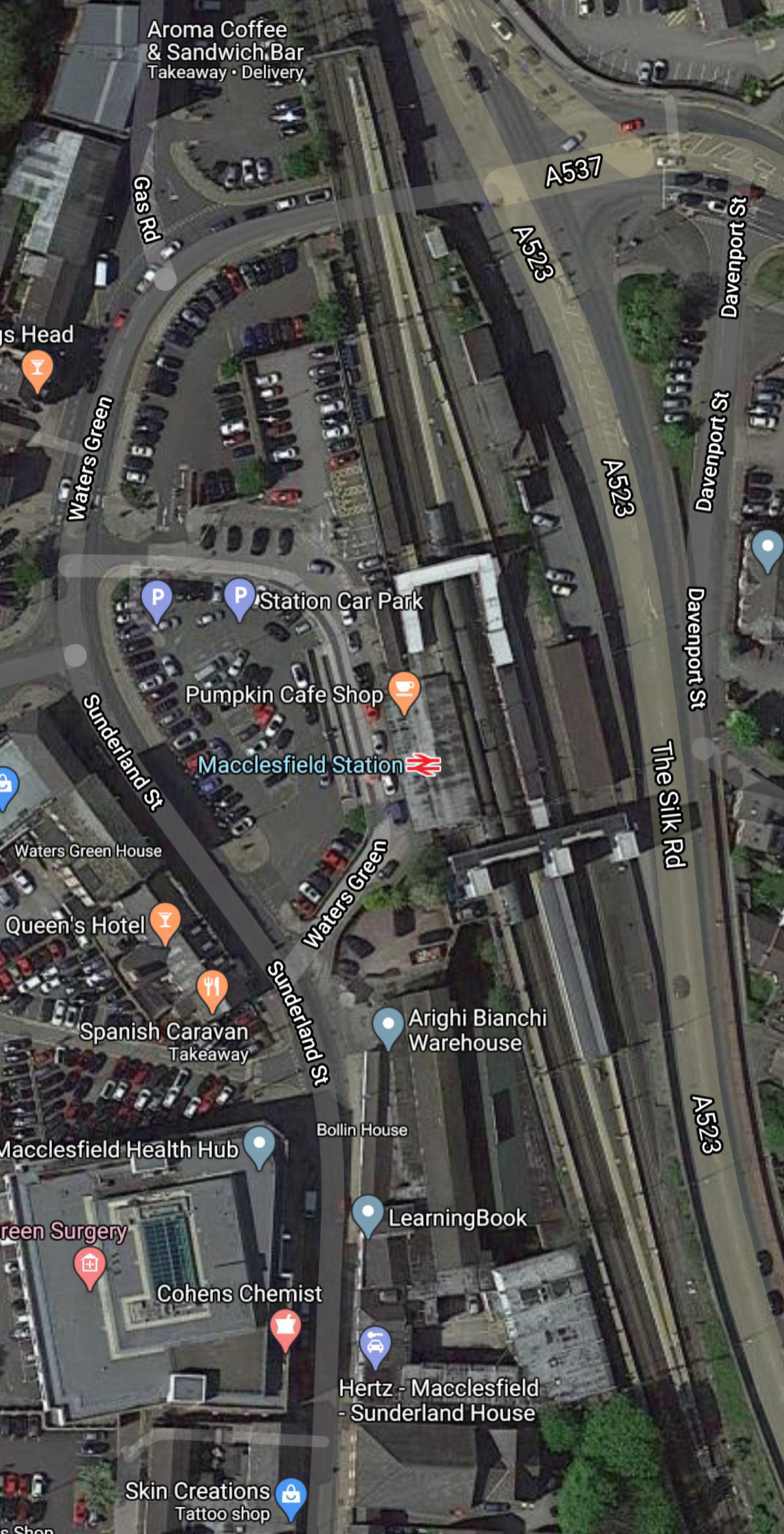
Note.
- Platform 1 is in the West and is used by trains to Stockport and Manchester Piccadilly.
- Platform 2 is in the middle and is used by trains going to Stoke, London and the South.
- Platform 3 is in the East and appears to be used a couple of times per day.
- It also appears there might have been a fourth platform.
All platforms appear capable of handling an eleven-car Class 390 train, which are over two hundred and sixty metres in length.
Is the plan to use Macclesfield as a High Speed Two terminal feasible?
Which Trains Will High Speed Two Use On Macclesfield Services?
It appears that High Speed Two will have two types of trains.
- Trains built to the European loading gauge, that will only be able to work on high lines like High Speed One and High Speed Two. Examples would be Eurostar’s Class 373 and Class 374 trains.
- Trains built to the UK loading gauge, that could also work on existing UK 125 mph routes like the East Coast, Great Western, Midland and West Coast Main Lines. Examples would be Class 800. Class 801, Class 802, Class 390 and Class 745 trains.
The second type, which are referred to, as class-compatible trains will be used to Macclesfield, as these services will share track with Class 390 and other trains, that have been or will be built to the smaller UK loading gauge.
Will Classic-Compatible High Speed Two Trains Fit Into Macclesfield Station?
Currently, every hour, one eleven-car Class 390 train calls in Macclesfield station in both directions, as they provide one of Avanti \west Coast’s three trains per hour (tph) between London Euston and Manchester Piccadilly stations.
The current trains are sixty metres longer than the proposed classic-compatible High Speed Two trains, that could be terminating in Macclesfield station.
How Would Passengers Who Started And Finished Their Journeys In Macclesfield, Connect to Manchester?
Currently, these hourly services connect Manchester Piccadilly and Stoke stations.
- Avanti West Cost – Manchester Piccadilly and London Euston.
- CrossCountry – Manchester Piccadilly and Bournemouth
- CrossCountry – Manchester Piccadilly and Bristol
- Northern – Manchester Piccadilly and Stoke, which stops at all stations.
The characteristics would be common to all these four trains.
- Services call at Stockport, Macclesfield and Stoke stations.
- As services share tracks with a High Speed Two service, they must be reasonably fast.
- All except the Northern service are 125 mph trains.
- The Northern service is run by a 90 mph Class 323 electric train.
- As Manchester Piccadilly and Stoke via Stockport is a fully-electrified route, the trains should probably be able to take advantage.
In an ideal world should the frequency be six tph or one train every ten minutes in each direction?
Which Platforms Would Be Used To Terminate High Speed Two Services?
Trains built to the UK loading gauge could probably terminate in any of the three platforms.
But it might be advantageous to terminate all services in the same platform.
Platform 3 would be the obvious choice.
- It shares an island platform with classic services going South between Manchester Piccadilly and Stoke.
- Passengers starting their journeys in Manchester Piccadilly or Stockport could just walk across from their connecting train to the High Speed Two train.
It must surely be a possibility to make Platform 2 able to operate bi-directionally, so that all trains between Manchester Piccadilly and Stoke stations in both directions, stop in Platform 2, alongside the High Speed Two train for London and the South, that is waiting in Platform 3. The combined frequency would be eight tph. All passengers would just walk across the island platform to change trains.
Could A North-Facing Bay Platform Be Fitted Into The Northern End Of The Island Platform 2/3?
If you are going to provide a High Speed Two service to and from Macclesfield station, it needs to have superb and comprehensive connections to as many places as possible.
The station currently has four tph to Manchester Piccadilly, Stockport and Stoke, but would a North-facing bay platform with level access to the High Speed Two platform make any of the following feasible?
- Run a second local stopping service between Manchester Piccadilly and Macclesfield to give all intermediate stations two tph to High Speed Two.
- Run hourly services to places that don’t have good connections to high speed services to London and the South.
- The Stockport and Stalybridge Line could be used to connect Stalybridge and Huddersfield to High Speed Two.
- There might even be a way of creating a link between Macclesfield and Manchester Airport.
Note.
- Looking at the platform layout at Macclesfield station, fitting in a bay platform would appear to be feasible.
- The important Stockport station, which seems to have been forgotten by High Speed Two would probably have at least six tph to High Speed Two at Macclesfield station.
- The local train could be timed to arrive at Macclesfield station, a convenient time before the High Speed Two train is scheduled to depart.
The bay platform could even be part of Platform 3, if it was decided that trains stopping in Platform 3, never used the platform as a through platform. It would be Macclesfield’s version of the Clapham Kiss.
I suspect more space could be found, by moving the signal box at the end of the station.
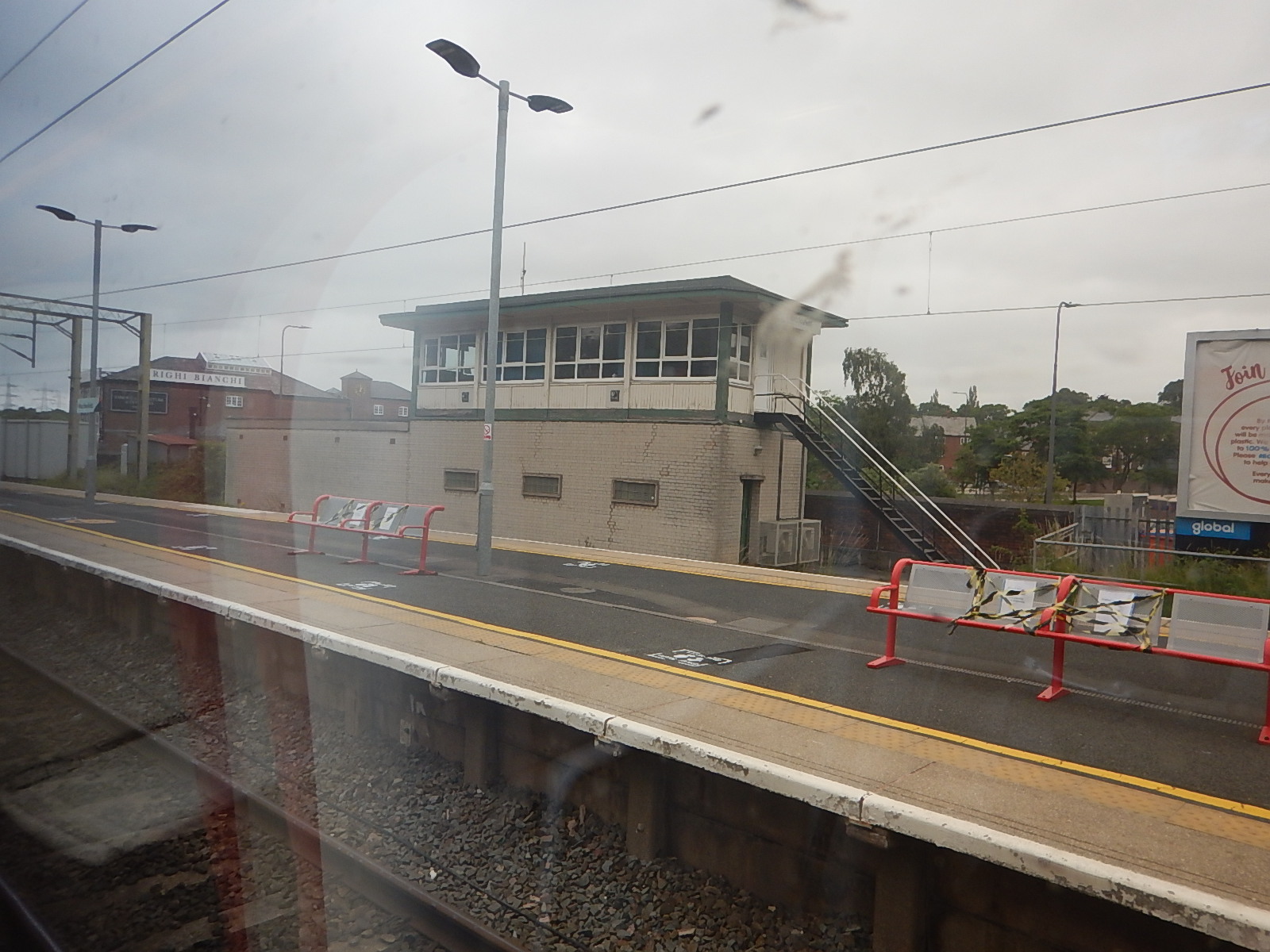
\remember that these days most signalling is controlled from centralised Rail Operation Centres.
Could High Speed Two Trains Run Between Macclesfield And Manchester Piccadilly?
As I said earlier, High Speed Two’s classic-compatible trains will be the same cross-section and shorter, than an eleven-car Class 390 train.
So the answer to my question must be yes!
- This would enable a stop at Stockport station.
- No platform lengthening would be required at Manchester Piccadilly and Stockport stations.
High Speed Two must have good reasons for using Macclesfield as a terminal.
- There are capacity issues between Macclesfield and Manchester Piccadilly stations.
- Macclesfield offers opportunities to connect to places, that are difficult to reach from Manchester Piccadilly station.
But these problems could probably be overcome by digital signalling or extension of the Manchester Metrolink.
Could More High Speed Two Services Run Between Macclesfield Station and The South?
Consider.
- I believe that Macclesfield station could handle more than an hourly High Speed Two train.
- It is a general principle, that on a metro like the London Overground or Merseyrail, that a single platform can handle up to four or even six tph.
- Four tph would surely be too high, but Macclesfield could easily handle a second classic-compatible train to and from Birmingham Curzon Street via Stoke and Stafford.
- During the inevitable works at Manchester Piccadilly station to sccomodate High Speed Two, Macclesfield could offer an alternative route, between London and Manchester.
Using Macclesfield station, as an alternative terminal for Manchester Piccadilly, builds in extra capacity for the future and offers a valuable alternative route during construction and upgrade works.
Rationalisation Between Cross Country And High Speed Two
Consider.
- In a lot of locations North of Birmingham, CrossCountry and High Speed Two seem to provide similar services between the same stations.
- Using currently proposed connections between High Speed Two and the classic network, CrossCountry’s services could run faster.
- CrossCountry’s new fleet of trains will probably be multi-mode trains, that will be very similar to the classic-compatible High Speed Two trains.
- Some of the routes used by CrossCountry’s services will have a substantial upgrade to allow higher speeds and more trains, to speed up High Speed Two services.
There must be a case for rationalisation of services.
Conclusion
The more I look at High Speed Two terminating at Macclesfield station, the more I like it.
I can see these services running from the station in the future.
- High Speed Two – Macclesfield and London Euston – One tph – This service would additionally call at Birmingham Interchange to link up with CrossCountry to the South.
- High Speed Two – Macclesfield and Birmingham Curzon Street – One tph
- CrossCountry – Macclesfield and Bournemouth, Plymouth or Reading – One tph.
- Northern and others – Macclesfield and Manchester Piccadilly via Stockport – Four-six tph
- Northern – Macclesfield and Huddersfield via Stockport and Stalybridge – Two tph
- Northern – Macclesfield and Manchester Airport – Two tph.
Obviously, this is all speculation, but Macclesfield will develop into an important rail hub to the South-East of Manchester.
Birmingham-Black Country-Shrewsbury
On the Midlands Connect web site, they have a page, which is entitled Birmingham-Black Country-Shrewsbury.
This is the introductory paragraph.
We’re examining the case to increase services from three to four per hour, made possible by capacity released post-HS2.
They then give the outline of their plans, which can be summed up as follows.
- Services on the corridor are slow and unreliable.
- Network Rail say the service is in danger of acute overcrowding.
- Services will be increased from three trains per hour (tph) to four.
- A direct hourly service from Shrewsbury, Wellington and Telford to London will be introduced.
- Services to Birmingham International will be doubled.
- The economic case will be examined for speeding up services between Shrewsbury and Birmingham from 56 to 45 minutes, via track upgrades and possible electrification.
It seems a safe, and not overly ambitious plan.
These are my thoughts.
Shrewsbury’s Unique Position
These are distances and times from important stations.
- Birmingham International – 51 miles and 83 minutes
- Birmingham New Street – 42.5 miles and 71 minutes
- Chester – 42.5 miles and 53 minutes
- Crewe – 33 miles and 53 minutes
- Hereford – 51 miles and 59 minutes
- Telford – 14 miles and 21 minutes
- Wellington – 10 miles and 13 minutes
- Welshpool – 20 miles and 25 minutes
- Wolverhampton – 30 miles and 50 minutes
In Sparking A Revolution, I quoted this Hitachi-specification for a battery-electric train.
- Range – 55-65 miles
- Performance – 90-100 mph
- Recharge – 10 minutes when static
- Routes – Suburban near electrified lines
- Battery Life – 8-10 years
I can’t see any problem, for a train with this specification being able to reach Shrewsbury from Birmingham International, Birmingham New Street and Crewe on battery power.
In Hitachi Trains For Avanti, I quote an article with the same title in the January 2020 Edition of Modern Railways as saying this.
Hitachi told Modern Railways it was unable to confirm the rating of the diesel engines on the bi-modes, but said these would be replaceable by batteries in future if specified.
I wouldn’t be surprised to see Shrewsbury served from Birmingham and Crewe by fast electric trains, that used battery power. Avanti West Coast certainly seem to have that thought in mind.
Zero Carbon Trains Between Shrewsbury And Wales
It will be a formidable challenge to run battery trains from Shrewsbury to the Welsh destinations.
- Aberystwyth – 81.5 miles
- Cardiff – 107 miles
- Carmarthen – 185 miles
- Holyhead – 133 miles
- Milford Haven – 225 miles
- Swansea – 121.5 miles
Note.
- These are challenging distances for battery-electric trains.
- South Wales destinations served via Newport and Cardiff could use the electrification on the South Wales Main Line.
- Many of these services start from East of Shrewsbury and can use the electrified lines that connects to Birmingham New Street and Manchester Piccadilly.
Unless someone like Riding Sunbeams, makes a breakthrough, I can’t see battery-electric trains running to Welsh destinations from Shrewsbury.
Transport for Wales New Trains
Transport for Wales have ordered seventy-seven new Class 197 trains, and these diesel trains will be used for services through Shrewsbury, mainly on services to Birmingham New Street and Birmingham International stations.
- If these trains are similar to Northern’s Class 195 trains, they will be diesel multiple units with a noisy mechanical transmission.
- I was surprised in these days of global warming that Transport for Wales didn’t buy something more eco-friendly, as they have for South Wales and the services around Chester.
- The transmission of the Class 197 trains has not been disclosed.
Perhaps, CAF are going to do something innovative.
- The CAF Civity is a modular train, with either electric or diesel power options.
- The diesel-powered options use MTU engines.
- A logical development would be to use an MTU Hybrid PowerPack to reduce diesel consumption and emissions.
- This PowerPack would also reduce noise, as it has an electric transmission.
- I wonder, if CAF can raid their parts bin and fit a pantograph, so where 25 KVAC overhead electrification is available, it can be used.
- If CAF can convert a bog standard diesel multiple unit into a hybrid diesel-electric-battery multiple unit, by performing a heart transplant, it is a neat way of keeping new diesel Civities running until a later date.
- Remember that Northern and West Modlands Trains have another seventy-four similar new diesel Civities in operation or on order. With trains having a forty year life, they don’t fit with an early phasing out of diesel.
I have no idea, what is actually happening, but my engineer’s nose tells me to expect a surprise from CAF.
Increasing Birmingham And Shrewsbury Services From Three Trains Per Hour To Four
Four trains per hour or one train every fifteen minutes seems to be a preferred frequency on several UK suburban lines.
These services seem to provide four tph or better on most, if not all of their routes.
- Birmingham Cross-City Line
- London Overground
- Merseyrail
- Tyne and Wear Metro
Four tph seems to be a very handy Turn-Up-And-Go frequency that encourages people to use rail services.
So I am not surprised to see Midlands Connect wanting four tph between Birmingham and Shrewsbury.
Currently, the following services seem to operate between Shrewsbury and Birmingham.
- Avanti West Coast – 2 trains per day (tpd) – Shrewsbury and London Euston via Birmingham New Street and Birmingham International.
- Trains for Wales – 1 train per two hours (tp2h) – Holyhead and Birmingham International via Birmingham New Street.
- Trains for Wales 1 tph – Aberystwyth/Pwllheli and Birmingham International via Birmingham New Street
- West Midlands Trains – 2 tph – Shrewsbury and Birmingham New Street – One semi-fast and one stopper.
Note.
- All services call at Wolverhampton, Telford and Wellington.
- Shrewsbury and Birmingham New Street is a 3.5 tph service.
- Shrewsbury and Birmingham International is a 1.5 tph service.
It relies heavily on services from Trains for Wales, who probably don’t put Shrewsbury and Birmingham services at the top of their priorities.
I remember, when local services in the North-East of London were run by Greater Anglia from Norwich. Moving some services to Transport for London, brought about a large improvement
Quite frankly, the current service is best described as pathetic.
Should Trains for Wales Services Terminate As Shrewsbury?
I suspect some local politicians in Shrewsbury and Birmingham, think it would be best to adopt this sort of strategy.
- All Welsh services terminate at Shrewsbury.
- Birmingham and Shrewsbury mandate West Midlands Trains and Avanti West Coast to provide a frequent service between Shrewsbury and Birmingham.
It might be the way to go, but many travellers from the Marches, would probably want direct connections to Birmingham, Birmingham Airport and in the future High Speed Two.
Introducing A Direct Hourly Service From Shrewsbury, Wellington And Telford To London
On the face of it, it looks like a much needed service to and from Shrewsbury.
- It will be hourly.
- Initially it will use Class 221 diesel multiple units, but these will be replaced with bi-mode Class 805 trains.
- The current infrequent service calls at Watford Junction, Rugby, Coventry, Birmingham International, Birmingham New Street, Sandwell and Dudley, Wolverhampton, Telford Central and Wellington.
- There are also six other stations between Shrewsbury and Wolverhampton, which might like an improved service.
- The service will be run by Avanti West Coast.
There might also be the possibility of using battery power between Wolverhampton and Shrewsbury, which is only thirty miles each way.
But there are other collateral benefits.
- The service increases the frequency between Shrewsbury and Birmingham New Street stations by one tph to 4.5 tph
- The service increases the frequency between Shrewsbury and Birmingham International by one tph to 2.5 tph.
- The service increases the frequency between Wolverhampton and London Euston by one tph.
- The service increases the frequency between Sandwell and Dudley and London Euston by one tph
- The service increases the frequency between Birmingham New Street and London Euston by one tph.
- The service increases the frequency between Birmingham International and London Euston by one tph.
- The new service will provide an hourly quality connection to High Speed Two at Birmingham International for stations between Shrewsbury and Coventry.
- It appears that the Class 390 trains to Birmingham New Street and being replaced by new Class 807 trains, so Birmingham will have three out of four tph, run by new trains.
- The new Shrewsbury service , has a similar calling pattern to that of the current Scottish service through Birmingham. Will it replace that service, when High Speed Two opens?
Note.
- Midlands Connect’s objective of four tph between Shrewsbury and Birmingham has been met.
- Several stations get a better direct service to London.
- Connectivity to High Speed Two is improved.
- Birmingham New Street and London is now a Turn-Up-And-Go frequency of four tph.
- The Class 805 train will also mean that Avanti West Coast could be zero-carbon in Birmingham. Especially, if it used battery power between Wolverhampton and Shrewsbury stations.
The hourly direct service between Shrewsbury and London will make a lot of difference to train services between Shrewsbury and Birmingham.
Avanti’s London Euston and Birmingham New Street Service
Consider.
- There are two tph that terminate in Birmingham New Street station, that take 88-89 minutes, from London Euston
- There is one tph that goes through Birmingham New Street station to Edinburgh, Glasgow, Preston, or Shrewsbury, that takes 82-84 minutes, from London Euston.
- Currently, the two terminating trains are Class 390 trains, whereas the through train can be a Class 221 train as well.
- Through trains are allowed 5-10 minutes to pass through Birmingham New Street.
- Trains that terminate at Birmingham New Street station are allowed 20-30 minutes to arrive and leave.
- Avanti West Coast have said, that they will be running Class 807 trains between London and Birmingham New Street.
It doesn’t seem to be the best use of scarce platform resources in a busy station to park a train there for half-an-hour.
In Will Avanti West Coast’s New Trains Be Able To Achieve London Euston and Liverpool Lime Street In Two Hours?, I came to the conclusion that the Class 807 trains have been designed as simple, fast, lightweight all-electric trains with no heavy batteries, diesel engines or tilt mechanism.
- I think they’ll be able to shave a few minutes on the timings between London Euston and Birmingham New Street station.
- I would suspect that they will match the 82-84 minutes of the through trains
- The ultimate would be if they could do a round trip between London Euston and Birmingham New Street in three hours.
- Two tph run by what would effectively be a London-Birmingham shuttle would need just six trains.
It might mean new methods of manning the trains, to reduce turnround times.
Doubling Of Services Between Shrewsbury And Birmingham International
The hourly direct London and Shrewsbury Avanti West Coast service will raise the current 1.5 tph service between Shrewsbury and Birmingham International to 2.5 tph, so will be a good start.
- Perhaps Trains for Wales could find the missing 0.5 tph.
- West Midlands Trains might be able to squeeze in another train.
But I suspect that the crowded line between Birmingham New Street and Birmingham International is the problem.
Shrewsbury And Birmingham In Forty-Five Minutes
This is the last objective and saving eleven minutes on this route would suggest that the best way would surely be to fully electrify the route.
- Between Wolverhampton and Birmingham International stations is fully electrified.
- Electric trains have faster acceleration and deceleration, so would probably achieve the required savings if they stopped more than five times.
- From my virtual helicopter it doesn’t appear to be the most challenging of routes to electrify.
- Only about thirty miles of double track would need to be electrified between Wolverhampton and Shrewsbury stations.
- Both Trains for Wales and West Midlands Trains would have to obtain new electric trains.
- Avanti West Coast have already got bi-mode Class 805 trains, that could use the electrification.
But will Trains for Wales go along with Midlands Connect, when they tell them to get electric or bi-mode trains to work between Shrewsbury and Birmingham International stations?
It is because of dilemmas like this, that I feel that electric trains using battery or hydrogen power, when away from electrification can be a very good alternative.
- There is no major disruption raising bridges for the electrification.
- Stations don’t need to be closed for electrification.
- The trains have all the comfort and performance of electric trains.
- Costs and timescales can be reduced.
- When running on battery or hydrogen power, these trains are very quiet, as there is no pantograph noise.
To run battery-electric trains between Shrewsbury and Wolverhampton, the only infrastructure needed would be a method of charging the train at Shrewsbury station.
This Google Map shows the Southern end of Shrewsbury station.

Note.
- The platforms are built over the River Severn.
- The five-car Class 221 train in Virgin livery sitting in Platform 5.
- When this train leaves it will turn left or to the East for Wolverhampton and Birmingham.
- Trains can turn right for Wales.
It is a very unusual station layout.
- Platform 5 is one of a pair of bay platforms; 5 & 6, that can access either Wales or Birmingham.
- Outside of the bay platforms are a pair of through platforms; 4 & 7, that can also access Wales or Birmingham, but they can also access Chester by going through the station.
- The 115 metre long Class 221 train fits easily in the bay platform 5.
- The 130 metre long Class 805 train would probably need to use Platform 4 or 7.
But with well-planned electrification, it would be ideal for charging electric trains as they pass through or turned back!
Once the train reaches Wolverhampton, it will connect to electrification again.
Shrewsbury And High Speed Two
Currently, Shrewsbury has three connections to stations, where it would be convenient to take a High Speed Two train.
- Birmingham International, which is 51 miles and 83 minutes away. Plus a ride on a people mover for High Speed Two.
- Birmingham New Street, which is 42.5 miles and 71 minutes away. Plus a walk to Birmingham Curzon Street for High Speed Two.
- Crewe, which is 33 miles and 55 minutes away.
Passengers will make their own choice.
Could Shrewsbury Have A Classic-Compatible High Speed Two Service To Manchester Piccadilly?
London To Shrewsbury, Now And Post-High Speed Two
Travel On Monday
If I want to go to Shrewsbury next Monday, one fast journey is taking the 09:10 from Euston and changing at Crewe, which gives a journey time of two hours and thirty-two minutes.
I can also get a train with a change at Birmingham International that takes seven minutes longer.
Travel On High Speed Two
After High Speed Two opens to Birmingham Curzon Street and Interchange in Phase 1 what sort of times to Shrewsbury can be expected?
I estimate the following.
- Travelling via Birmingham Curzon Street could produce a time of around one hour and fifty minutes, if you’re lucky with the trains.
- Travelling via Crewe could produce a time of one hour and thirty minutes, if you’re lucky with the trains.
- Travelling via Interchange could produce a time of around one hour and fifty-five minutes. or forty-four minutes faster.
If I was going to Shrewsbury after High Speed Two has opened, I would probably change at Birmingham Curzon Street, if the walk to New Street station was still within my capabilities, as there will be a Turn-Up-And-Go frequency of four tph between Birmingham New Street and Shrewsbury stations.
Looking at the Midlands Connect objectives, these help with linking Shrewsbury with London.
- Increasing services between Birmingham and Shrewsbury to four tph, as it’s Turn-Up-And-Go!
- The direct hourly service to London from Shrewsbury, Wellington and Telford might be the quickest way to London by changing at Birmingham New Street/Curzon Street or Interchange.
- Doubling the service between Shrewsbury and Birmingham International, may be a good move, as Interchange, which will be connected to Birmingham International by a high capacity people mover, will have five tph between London Euston and Old Oak Common stations.
- Saving eleven minutes between Shrewsbury and Birmingham will certainly help.
Travelling between London and Telford, Wellington and Shrewsbury will be much improved.
Existing Stations Where High Speed Two Trains Will Call
The June 2020 Edition Of Modern Railways has an article called HS2 Minister Backs 18 tph Frequency, which gives a detailed diagram of the route structure of High Speed Two and it is possible to summarise the stations, where High Speed Two trains will call.
- Carlisle – 3 tph – 400 metres – Split/Join
- Chesterfield – 1 tph – 200 metres
- Crewe – 2 tph – 400 metres – Split/Join
- Darlington – 2 tph – 200 metres
- Durham – 1 tph – 200 metres
- East Midlands Hub HS2 – 7 tph – 400 metres – Split/Join
- Edinburgh Haymarket – 2.5 tph – 200 metres
- Edinburgh Waverley – 2.5 tph – 200 metres – Terminal
- Glasgow Central – 2.5 tph – 200 metres – Terminal
- Lancaster – 2 tph – 200 metres – Terminal
- Leeds HS2 – 5 tph – 400 metres
- Liverpool Lime Street – 2 tph – 200 metres – Terminal
- Lockerbie – 1 tph – 200 metres
- Macclesfield – 1 tph – 200 metres – Terminal
- Manchester Airport HS2 – 5 tph – 400 metres
- Manchester Piccadilly HS2 – 5 tph – 400 metres
- Motherwell – 0.5 tph – 200 metres
- Newcastle – 3 tph – 200 metres – Terminal
- Oxenholme – 0.5 tph – 200 metres
- Penrith – 0.5n tph – 200 metres
- Preston – 4 tph – 400 metres
- Runcorn – 2 tph – 200 metres
- Sheffield – 2 tph – 200 metres
- Stafford – 1 tph – 200 metres
- Stoke-on-Trent – 1 tph – 200 metres
- Warrington Bank Quay – 1 tph – 200 metres
- Wigan North Western – 1 tph – 200 metres
- York – 4 tph – 200 metres
Note.
- HS2 after the station name indicates a new station for High Speed Two
- tph is trains per hour
- 0.5 tph is one train per two hours (tp2h).
- 200/400 metres is the maximum length of trains that will call.
- Terminal indicates that trains will terminate at these stations.
- Split/Join indicates that trains will split and join at these stations.
These are more detailed thoughts on how existing stations will need to be modified.
Train Lengths
Before, I look at the individual stations, I’ll look at the train lengths.
- High Speed Two train – Single – 200 metres
- High Speed Two train – Pair – 400 metres
- Class 390 train – 11-car – 265.3 metres
- Class 390 train – 9-car – 217.5 metres
- Class 807 train – 7-car – 182 metres
- Class 810 train – 5-car – 120 metres
- Class 810 train – Pair of 5-car – 240 metres
- InterCity 125 – 2+8 – 220 metres
- InterCity 225 – 9-car – 245 metres
- Class 222 train – 4-car – 93.34 metres
- Class 222 train – 5-car – 116.16 metres
- Class 222 train – 7-car – 161.8 metres
- Class 222 train – 4-car+5-car – 209.5 metres
- Class 222 train – 5-car+5-car – 232.32 metres
These are the thoughts on the individual stations.
Carlisle
Carlisle station will need two 400 metre through platforms, so each can accommodate a pair of 200 metre trains.
This Google Map shows the station.

I estimate the platforms are about 380 metres, but it looks like, they could be lengthened, without too much difficulty.
As High Speed Two trains to the North of Carlisle will be 200 metres long, there would probably be no need for platform lengthening North of Carlisle, as these trains are shorter than the Class 390 trains, that currently work the routes to Edinburgh and Glasgow.
Carlisle station is step-free, has good secondary rail connections and is within walking distance of the city centre.
The only thing it needs, is a connection to Edinburgh on a rebuilt Borders Railway.
Chesterfield
Consider.
- Chesterfield station will need to handle 200 metre trains.
- Chesterfield station may be rebuilt for High Speed Two.
- Chesterfield station can handle an InterCity 125, which is 220 metres.
- It will need to handle a pair of Class 810 trains, which would be 240 metres.
This Google Map shows Chesterfield station.
Note.
- The slow lines passing the station on the Eastern side.
- There are two long through platforms and a third bi-directional platform on the down slow line.
There is space to build two long platforms for High Speed Two, but is it worth it, when one one tph will stop?
- According to High Speed Two’s Journey Time Calculator, trains will take just twelve minutes between Sheffield and Chesterfield stations.
- This compares with 12-15 minutes for the current diesel trains.
- The distance between the two stations is 14 miles, which means that a twelve minute trip has an average speed of 70 mph.
- If there are still two tph to St. Pancras, there will be four tph, that run fast between the Sheffield and Chesterfield stations, of which three will stop at Chesterfield.
I think this could result in a simple and efficient design for the tracks between Sheffield and South of Clay Cross, where High Speed Two joins the Erewash Valley Line.
Chesterfield station is step-free.
Crewe
Crewe station will need two 400 metre through platforms, so each can accommodate a pair of 200 metre trains.
This Google Map shows the station.

There have been references to rebuilding of Crewe stations, but it does appear that some platforms are over 300 metres long.
Darlington
Darlington station will need to accommodate 200 metre trains.
As it already accommodates 245 metre InterCity 225 trains, there shouldn’t be too much of a problem.
Durham
Durham station will need to accommodate 200 metre trains.
As it already accommodates 245 metre InterCity 225 trains, there shouldn’t be too much of a problem.
Edinburgh Haymarket
Edinburgh Haymarket station will need to accommodate 200 metre trains.
As it already accommodates 245 metre InterCity 225 trains, there shouldn’t be too much of a problem.
Edinburgh Waverley
Edinburgh Waverley station will need to accommodate 200 metre trains.
As it already accommodates 245 metre InterCity 225 trains, there shouldn’t be too much of a problem.
Glasgow Central
Glasgow Central station will need to accommodate 200 metre trains.
As it already accommodates 265 metre Class 390 trains, there shouldn’t be too much of a problem.
Currently, Avanti West Coast runs the following services to Glasgow Central.
- One tph from London Euston calling at Warrington Bank Quay, Wigan North Western, Preston, Lancaster, Oxenholme Lake District (1tp2h), Penrith (1tp2h) and Carlisle.
- One tp2h from London Euston calling at Milton Keynes Central, Coventry, Birmingham International, Birmingham New Street, Sandwell and Dudley, Wolverhampton, Crewe, Warrington Bank Quay, Wigan North Western, Preston, Lancaster, Oxenholme Lake District (1tp2h), Penrith (1tp2h) and Carlisle.
High Speed Two is proposing to run the following trains to Glasgow Central.
- Two tph from London Euston calling at Old Oak Common, Preston and Carlisle.
- One tp2h from Birmingham Curzon Street calling at Wigan North Western, Preston, Lancaster, Oxenholme (1tp2h), Penrith (1tp2h), Carlisle, Lockerbie and Motherwell (1tp2h)
If the current services to Glasgow Central were to be replaced by the High Speed Two services, most travellers would get a similar or better service.
But if Avanti West Coast decide to drop their classic services to Glasgow via Birmingham, will travellers starting between Milton Keynes and Crewe, be a bit miffed to lose their direct services to Glasgow?
Glasgow Central station would appear to be ready for High Speed Two.
Lancaster
I was initially surprised, that on High Speed Two, one tph would terminate at Lancaster station.
This Google Map shows the station.
Note.
- There are two bypass lines without any platforms on the Western side of the tracks, where trains can speed through.
- The station has five platforms.
- Some Avanti West Coast services terminate at Lancaster station.
- 265 metre, eleven-car Class 390 trains, stop in Lancaster station.
As High Speed Two services will use 200 metre trains, which are shorter than all Class 390 trains, I would suspect that High Speed Two services will be able to be turned at Lancaster station, without too much difficulty.
Liverpool Lime Street
Liverpool Lime Street station will need to be able to turn two 200 metre High Speed Two tph.
- The remodelling of the station in 2018, probably allowed for two tph between London Euston and Liverpool Lime Street station.
- From 2022-2023, it will be turning two Class 807 trains per hour, which will probably be 182 metres long.
Liverpool Lime Street station may well be ready for Phase One of High Speed Two. It’s also very much step-free.
There are also alternative plans for a new High Speed station in Liverpool.
- It would be alongside the current Liverpool Lime Street station.
- The station would have a route to High Speed Two at Crewe via Warrington and a junction at High Legh.
- Northern Powerhouse Rail would start in the station and go to Manchester via Warrington, High Legh and Manchester Airport.
- It would enable six tph between Liverpool and Manchester, in a time of just 26 minutes.
I talked about this plan in Changes Signalled For HS2 Route In North, where I included this map.

High Legh Junction is numbered 5 and 6.
Nothing published about High Speed Two, would appear to rule this plan out.
Lockerbie
Lockerbie station will need to accommodate 200 metre trains.
As it already accommodates 265 metre Class 390 trains, there shouldn’t be too much of a problem.
Macclesfield
I was initially surprised, that on High Speed Two, one tph would terminal at Macclesfield station.
This Google Map shows the station.

Wikipedia says this about the platforms in the station.
There are three platforms but only two are in regular use, the up platform for services to Manchester and the down platform to Stoke-on-Trent and Birmingham. Platform 3 sees a small number of services. Evidence of a fourth platform can be seen, on which a Network Rail building now exists.
As the station has a regular Avanti West Coast service every hour, the platforms must be over 200 metres long and they will be long enough for the 200 metre High Speed Two trains.
So why would High Speed Two want to terminate a train at Macclesfield, rather than at Manchester Piccadilly as they do now?
Currently, Avanti West Coast runs these services between London Euston and Manchester Piccadilly.
- One tph via Milton Keynes Central, Stoke-on-Trent and Stockport.
- One tph via Stoke-on-Trent, Macclesfield and Stockport
- One tph via Stafford, Crewe, Wilmslow and Stockport
The diagram in the Modern Railways article shows these High Speed Two services to Manchester Piccadilly.
- One tph from London Euston via Old Oak Common, Birmingham Interchange and Manchester Airport
- Two tph from London Euston via Old Oak Common and Manchester Airport
- Two tph from Birmingham Curzon Street via Manchester Airport.
Note.
- None of these five tph serve Macclesfield, Milton Keynes Central, Stockport, Stoke-on-Trent or Wilmslow.
- All five proposed services are shown to call at Manchester Airport.
- It is likely, that a tunnel will be bored between Manchester Airport and Manchester Piccadilly stations.
- The High Speed Two station at Manchester Piccadilly might even be in a tunnel under the current Manchester Piccadilly station or central Manchester.
- A below-ground High Speed Two station for Manchester could also serve Northern Powerhouse Rail services to Leeds and the East.
- According to the plans, I talked about under Liverpool Lime Street earlier, there could also be up to six tph running between Liverpool and Manchester via Manchester Airport, as part of Northern Powerhouse Rail.
Plans need to be developed to serve the towns and cities, that will not be served by High Speed Two’s current proposals.
- It appears Stafford, Stoke-on-Trent and Macclesfield will be served by an independent High Speed Two service from London Euston.
- Terminating one tph at Macclesfield station doesn’t appear to be challenging.
- A rail route between Macclesfield and Manchester Airport to link up with the proposed tunnel could be very difficult.
- Manchester Piccadilly and Macclesfield stations have a frequent rail connection, with most trains calling at Stockport station.
- Perhaps during construction work for High Speed Two in the centre of Manchester, Macclesfield station can be used as an alternative route into the city, using the existing Manchester Piccadilly station.
The London Euston and Macclesfield service via Stafford and Stoke-on-Trent could be a pragmatic solution to part of the problem, but what about Milton Keynes, Wilmslow and Stockport?
According to the title of the Modern Railways article, High Speed Two will have a maximum frequency of 18 tph.
When fully-developed, the current proposed timetable shows the following.
- A frequency of 17 tph between London Euston and Birmingham Interchange stations.
- A frequency of 11 tph between Birmingham and Crewe.
- A frequency of 9 tph through East Midlands Hub station.
It would appear that if there is a capacity bottleneck, it is between London and Birmingham.
However if classic services to Manchester Piccadilly are replaced by the High Speed Two services to the city via the new tunnel from Manchester Airport to a new station in the City Centre, there will be spare capacity on the Crewe and Manchester Piccadilly route via Wilmslow and Stockport stations.
This could lead to a number of solutions.
- A direct High Speed Two service runs using the spare path, between London and the current Manchester Piccadilly station.
- Similar to the previous service, but the service splits and joins at Crewe, with one individual train going to Manchester Piccadilly and the other somewhere else. Blackpool?
- One service between London and Liverpool is planned to split and join at Crewe with individual trains going to Lancaster and Liverpool. The other Liverpool service could split at Crewe with individual trains going to Liverpool and Manchester Piccadilly.
- The service between London and Macclesfield is run by a pair of trains, that split at Birmingham Interchange, with individual trains going to Macclesfield and Manchester Piccadilly. The advantage of this service, is that if you got into the wrong train, you’d still be going to roughly the same destination.
- Wikipedia says “At peak times, the current Avanti West Coast services may additionally call at one or more of: Watford Junction, Rugby, Nuneaton, Tamworth, Lichfield Trent Valley.” So why not run classic services on the West Coast Main Line between Euston and Manchester Piccadilly via Milton Keynes using suitably fast trains. Perhaps, the new Class 807 trains would be ideal.
Note.
- All services serving the current Manchester Piccadilly station would call at Crewe, Wilmslow and Stockport stations.
- Passengers going to or from Manchester Airport would change at Crewe.
The more I look at Macclesfield, the more I like using it as a High Speed Two destination.
Motherwell
Motherwell station will need to accommodate 200 metre trains.
As it already accommodates 265 metre Class 390 trains, there shouldn’t be too much of a problem.
Newcastle
Newcastle station will need to accommodate 200 metre trains.
As it already accommodates 245 metre InterCity 225 trains, there shouldn’t be too much of a problem.
Oxenholme
Oxenholme station will need to accommodate 200 metre trains.
As it already accommodates 265 metre Class 390 trains, there shouldn’t be too much of a problem.
Penrith
Penrith station will need to accommodate 200 metre trains.
As it already accommodates 265 metre Class 390 trains, there shouldn’t be too much of a problem.
Preston
Preston station will need two 400 metre through platforms, so each can accommodate a pair of 200 metre trains.
This Google Map shows the station.

I estimate that the main through platforms aren’t much short of the required 400 metres.
But something must be done to make the station step-free.
Runcorn
Runcorn station will need to accommodate 200 metre trains.
As it already accommodates 217 metre Class 390 trains, there shouldn’t be too much of a problem. The station is also step-free.
Sheffield
Sheffield station will need to accommodate 200 metre trains.
This Google Map shows the station.

As the station can already handle a 220 metre InterCity 125, there shouldn’t be too much of a problem. The station is also substantially step-free.
Stafford
Stafford station will need to accommodate 200 metre trains.
This Google Map shows the station.

As it already accommodates 265 metre Class 390 trains, there shouldn’t be too much of a problem. The station is also step-free.
Wikipedia says this about Stafford station and High Speed Two.
Under current proposals, Stafford will be a part of the High Speed 2 network, via a ‘Classic Compatible’ junction, which will allow HS2 trains to operate to Stafford, and further on towards Liverpool. This would shorten journey time from Stafford to London, to an estimated 53 minutes. Under current proposals it is expected that an hourly services will operate in both directions, however it is currently unclear if these services will terminate at Stafford, or Liverpool.
This does appear to be rather out of date with High Speed Two’s latest proposals as disclosed in the Modern Railways article, which say that Stafford is served by the following service.
- One tph between London Euston and Macclesfield.
- Calls at Old Oak Common, Stafford and Stoke-on-Trent.
- A 200 metre train.
One possibility must surely be to run a pair of 200 metre trains to and from Stafford, where they would split and join.
- One could go as currently proposed to Stoke-on-Trent and Macclesfield.
- The second train could go to Liverpool via Crewe and Runcorn or Manchester Piccadilly via Crewe, Wilmslow and Stockport.
- The recent works at Norton Bridge Junction will have improved the route for the second train.
There would need to be platform lengthening at Stafford to accommodate the 400 metre pair of trains.
A split and join at Stafford does show the possibilities of the technique.
Another possibility is mentioned for Stafford in Wikipedia.
There is also been proposals to reintroduce services to Stafford to terminate on the Chase Line which was cutback to Rugeley Trent Valley in 2008. The Key Corridors states “Extension of Chase Line services to Stafford”. This is proposed to be in development.
It will surely connect a lot of people to Stafford for High Speed Two.
The extract from Wikipedia, that I used earlier, mentions a Classic Compatible junction, which will allow High Speed Two trains to reach Stafford.
This map clipped from the High Speed Two web site, shows the junction North of Lichfield, where High Speed Two connects to the Trent Valley Line through Stafford.

Note.
- High Speed Two runs North-South across the map.
- After the Junction by Fradley South,
- High Speed Two to Crewe and the North, is the branch to the East.
- The other branch connects to the Trent Valley Line, which can be picked out North of Lichfield, where it passes through Lichfield Trent Valley station.
The Trent Valley Line is no Victorian double-track slow-speed bottleneck.
- Most of the route between Rugby and Stafford is three or four tracks.
- The speed limit is generally 125 mph.
- I wouldn’t be surprised to see Avanti West Coast’s Class 390 and Class 807 trains running at 140 mph on the route.
- This speed would probably be attained by High Speed Two trains.
London Euston and Stafford would only have under twenty miles of slower line and that could be 140 mph, so High Speed Two times on the route could be very fast. High Speed Two is quoting 54 minutes on their Journey Time Calculator.
Stoke-on-Trent
Stoke-on-Trent station will need to accommodate 200 metre trains.
This Google Map shows the station.
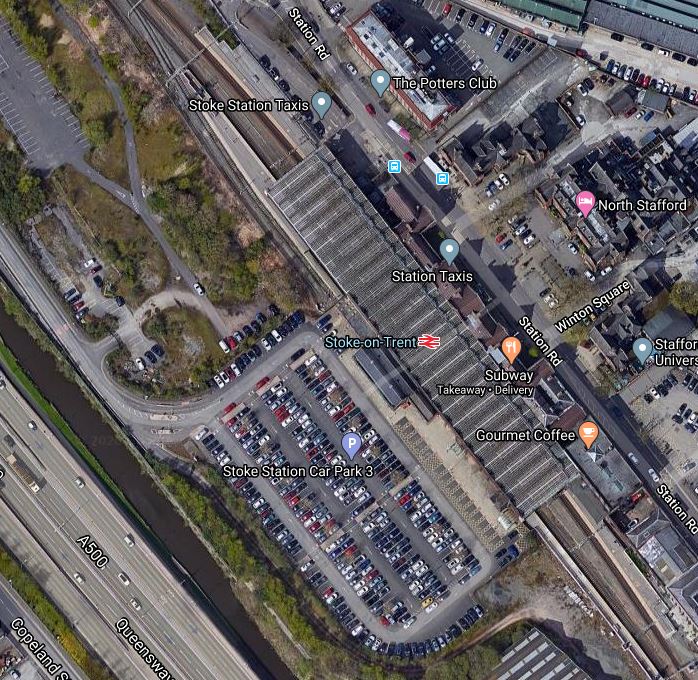
As it already accommodates 265 metre Class 390 trains, there shouldn’t be too much of a problem. The station is also step-free.
Warrington Bank Quay
Warrington Bank Quay station will need to accommodate 200 metre trains.
As it already accommodates 265 metre Class 390 trains, there shouldn’t be too much of a problem.
Wigan North Western
Wigan North Western station will need to accommodate 200 metre trains.
In Is Wigan North Western Station Ready For High Speed Two?, I said this.
Wigan North Western station would accept a single-train now, but the platforms would need lengthening to handle a double-train.
As all trains through Wigan North Western station will only be 200 metre single trains and the station is step-free, the station appears to be ready for High Speed Two.
York
York station will need to accommodate 200 metre trains.
As it already accommodates 245 metre InterCity 225 trains, there shouldn’t be too much of a problem.
Conclusion
I have come to these conclusions.
- Because most of these stations have been rebuilt in the last few decades to accommodate the 200-plus metre InterCity 125s, InterCity 225s and Class 390 trains, all the stations can handle a 200 metre High Speed Two train without significant lengthening.
- Some stations like Carlisle, Crewe, Preston and Stafford may need a small amount of platform lengthening to accommodate a pair of trains, but most of the improvements needed for a world-class High Speed railway will be more refurbishment than a complete rebuild.
- Using existing platforms at Lancaster and Macclesfield stations as terminal platforms is an elegant and a much more affordable solution than building new stations or even platforms.
- Because all five tph into the High Speed Two station at Manchester Piccadilly go via Manchester Airport, I would envisage that this will be in a tunnel, that can be part of a future Northern Powerhouse Rail.
I also think that the plan has been devised with the Project Management and minimising disruption to travellers in mind.

