Rail Agreement Signed ‘Subject To Value For Money’
The title of this post, is the same as that of this article on the BBC.
This is the sub heading.
An agreement to reopen a regional rail line has been signed by the transport secretary, subject to the assurance that it delivers good value for money.
These three paragraphs add detail to the story.
Further development work on the Leamside Line, which runs from Pelaw in Gateshead to Tursdale in County Durham, is set to progress as part of the Northern Powerhouse Rail (NPR) initiative.
Regional politicians said the line could provide train links for 100,000 people in the north-east of England, after it closed to passengers in the 1960s.
The document stated the government would ensure resources were available for the Leamside Line reopening “subject to agreement of that business case and assurance that this delivers good value for money”.
Note.
- There is an excellent map in the BBC article.
- It looks like there will be at least five new or refurbished stations at Ferryhill, Sincliffe, Belmont, West Rainton and Penshaw.
- Belmont appears to have an alternative name of Durham Parkway, so will it be a Park-and-Ride for the area?
- There will be an alternative path for freight trains between Newcastle and York.
- In New Direct Rail Link To Seaham: How This Picturesque Seaside Town Will Connect To London Starting December 2025, I described Seaham’s new link to London, courtesy of Grand Central Trains.
- In Arriva Group Invests In New Battery Hybrid Train Fleet In Boost To UK Rail Industry, I talked about Grand Central’s new trains, which should be in service by 2028 to Seaham and Sunderland.
- It was in June 2020, that I wrote about Boris Johnson making a speech about the Leamside Line in Boris Johnson Backs Station Opening Which Could See Metro Link To County Durham.
This important link has been a long time coming.
Will The Rail Improvements Between London and The North East Create More Tourism?
Consider.
- The digital signalling will create more paths for trains between London and the North East.
- Journey times will come down to generally below three hours.
- There is a lot of excellent walking in the area.
- The North-East doesn’t just host top-class football and athletics.
- A trip could be combined with a day-trip to Edinburgh, Glasgow or the Scottish Borders.
- I have met Americans, who’ve started their holiday in Europe, in Edinburgh and worked their way down via York and London to Paris by train, and then flown back non-stop to the United States.
As I’ve spent a couple of enjoyable weekends in Newcastle and Sunderland, I don’t see why the area can’t attract tourists.
Should The East Coast Main Line Be Renamed?
Consider.
- It is one of the oldest long-distance main lines in the world.
- It links two of the UK’s capitals.
- It is 331 miles long, which is covered in four and a half hours.
- There are some of the world’s best hotels at either end.
- There is good shopping at either end.
- There is no Trump hotel in London or Edinburgh.
Perhaps, it should be called High Speed East Coast?
mtu Engines From Rolls-Royce Provide Emergency Power On Offshore Wind Platforms In The UK
The title of this post, is the same as that of this press release from Rolls-Royce.
These two bullet points act as sub-headings.
- Four engines from the mtu Series 4000 provide emergency power for two converter platforms
- Norfolk wind farm will generate electricity for demand from more than four million households
This opening paragraph adds more detail.
Rolls-Royce has received a second order from Eureka Pumps AS to supply mtu Series 4000 engines to power emergency power generators for the Norfolk Offshore Wind Farm on the east coast of the United Kingdom. Rolls-Royce will thus supply a total of four mtu engines for the first and second phases of the large wind farm, which is operated by energy supplier RWE. The engines will be installed on two converter platforms at sea and onshore, which are the heart of the offshore grid connection: they ensure that the electricity generated at sea can be fed into the power grid. With a total capacity of 4.2 GW, the wind farm is expected to generate electricity for more than four million households during the course of this decade. It is located 50 to 80 kilometers off the east coast of the UK.
In some ways I find it strange, that a diesel generator is used to provide the necessary emergency power.
But when I asked Google if mtu 4000 generators can operate on hydrogen. I got this answer.
Yes, mtu Series 4000 engines, specifically the gas variants, can be adapted to run on hydrogen fuel. Rolls-Royce has successfully tested a 12-cylinder mtu Series 4000 L64 engine with 100% hydrogen fuel and reported positive results. Furthermore, mtu gas engines are designed to be “H2-ready,” meaning they can be converted to operate with hydrogen, either as a blend or with 100% hydrogen fuel.
That seems very much to be a definite affirmative answer.
So will these mtu Series 4000 engines for the Norfolk wind farms be “H2 ready”? The hydrogen needed, could be generated on the platform, using some form of electrolyser and some megawatts of electricity from the wind farms.
Will The Norfolk Wind Farms Generate Hydrogen For Germany?
Consider.
- Germany needs to replace Russian gas and their own coal, with a zero-carbon fuel.
- Germany is developing H2ercules to distribute hydrogen to Southern Germany.
- Germany is developing AquaVentus to collect 10 GW of hydrogen from wind-powered offshore electrolysers in the North Sea.
- The AquaVentus web site shows connections in the UK to Humberside and Peterhead, both of which are areas, where large hydrogen electrolysers are bing built.
- In addition Humberside has two of the world’s largest hydrogen stores and is building a 1.8 GW hydrogen-fired powerstation.
- The Norfolk wind farms with a capacity of 4.2 GW, are not far from the border between British and German waters.
- To the North of the Norfolk wind farm, RWE are developing the 3 GW Dogger Bank South wind farm.
- 7.2 GW of British hydrogen would make a large proportion of the hydrogen Germany needs.
I clipped this map from a video about Aquaventus.

Note.
- The thick white line running North-West/South-East is the spine of AquaVentus, that will deliver hydrogen to Germany.
- There is a link to Esbjerg in Denmark, that is marked DK.
- There appears to be an undeveloped link to Norway, which goes North,
- There appears to be an undeveloped link to Peterhead in Scotland, that is marked UK.
- There appears to be a link to just North of the Humber in England, that is marked UK.
- Just North of the Humber are the two massive gas storage sites of Aldbrough owned by SSE and Brough owned by Centrica.
- Aldbrough and Rough gas storage sites are being converted into two of the largest hydrogen storage sites in the world!
- There appear to be small ships sailing up and down the East Coast of the UK. Are these small coastal tankers, that are distributing the hydrogen to where it is needed?
When it is completed, AquaVentus will be a very comprehensive hydrogen network.
It will also be a massive Magic Money Tree for the UK Treasury.
So why is this vast hydrogen system never mentioned?
It was negotiated by Clair Coutinho and Robert Habeck, back in the days, when Boris was Prime Minister.
UK Government Sets 8-Hour Minimum For LDES Cap-And-Floor Scheme
The title of this post, is the same as that of this article on Energy Storage News.
This is the sub-heading.
The UK government has published a Technical Decision Document confirming crucial aspects of its long duration electricity storage (LDES) cap-and-floor scheme, which includes increasing the minimum duration required from six hours to eight.
These three paragraphs give more details.
The document, released by regulator Ofgem on 11 March, details the final overarching rules and requirements for the scheme as well as how it will be implemented, though significant detail still remains to be worked out.
The scheme will provide a cap-and-floor revenue protection for 20-25 years that will allow all capital costs to be recoverable, and is effectively a subsidy for LDES projects that may not be commercially viable without it. Most energy storage projects being deployed in the UK today are lithium-ion battery energy storage systems (BESS) of somewhere between 1-hour and 3-hour in duration (very occasionally higher).
One of the most significant new details of the scheme is that, following industry feedback, the minimum duration for projects to qualify has been increased from six hours to eight hours of continuous rated power.
As a control engineer, I believe this is all good stuff and is a good improvement on the previous regime.
The whole article is a must read and I believe that more investors, will invest heavily in energy storage.
But then the UK, with its massive potential for offshore wind, has the resources to create and fill many GW of energy storage.
Boris once said, that we would become the Saudi Arabia of wind!
Enabling The UK To Become The Saudi Arabia Of Wind?
The title of this post, is the same as that of a paper from Imperial College.
The paper can be downloaded from this page of the Imperial College web site.
This is a paragraph from the Introduction of the paper.
In December 2020, the then Prime Minister outlined the government’s ten-point plan for a green industrial revolution, expressing an ambition “to turn the UK into the Saudi Arabia of wind power generation, enough wind power by 2030 to supply every single one of our homes with electricity”.
The reference to Saudi Arabia, one of the world’s largest oil producers for many decades, hints at the significant role the UK’s energy ambitions hoped to play in the global economy.
Boris Johnson was the UK Prime Minister at the time, so was his statement just his usual bluster or a simple deduction from the facts.
The paper I have indicated is a must-read and I do wonder if one of Boris’s advisors had read the paper before Boris’s speech. But as the paper appears to have been published in September 2023, that is not a valid scenario.
The paper though is full of important information.
The Intermittency Of Wind And Solar Power
The paper says this about the intermittency of wind and solar power.
One of the main issues is the intermittency of solar and wind electricity generation, which means it cannot be relied upon without some form of backup or sufficient storage.
Solar PV production varies strongly along both the day-night and seasonal cycles. While output is higher during the daytime (when demand is
higher than overnight), it is close to zero when it is needed most, during the times of peak electricity demand (winter evenings from 5-6 PM).At present, when wind output is low, the UK can fall back to fossil fuels to make up for the shortfall in electricity supply. Homes stay warm, and cars keep moving.
If all sectors were to run on variable renewables, either the country needs to curb energy usage during shortfalls (unlikely to be popular with consumers), accept continued use of fossil fuels across all sectors (incompatible with climate targets), or develop a large source of flexibility such as energy storage (likely to be prohibitively expensive at present).
The intermittency of wind and solar power means we have a difficult choice to make.
The Demand In Winter
The paper says this about the demand in winter.
There are issues around the high peaks in heating demand during winter, with all-electric heating very expensive to serve (as
the generators built to serve that load are only
needed for a few days a year).Converting all the UK’s vehicles to EVs would increase total electricity demand from 279 TWh to 395 TWh. Switching all homes across the country to heat pumps would increase demand by a further 30% to 506 TWh.
This implies that the full electrification of the heating and transport sectors would increase the annual power needs in the country by 81%.
This will require the expansion of the electricity system (transmission capacity, distribution grids, transformers,
substations, etc.), which would pose serious social, economic and technical challenges.Various paths, policies and technologies for the decarbonisation of heating, transport, and industrial emissions must be considered in order for the UK to meet its zero-emission targets.
It appears that electrification alone will not keep us warm, power our transport and keep our industry operating.
The Role Of Hydrogen
The paper says this about the role of hydrogen.
Electrifying all forms of transport might prove difficult (e.g., long-distance heavy goods) or nigh impossible (e.g., aviation) due to the high energy density requirements, which current batteries cannot meet.
Hydrogen has therefore been widely suggested as a low-carbon energy source for these sectors, benefiting from high energy density (by weight), ease of storage (relative to electricity) and its versatility to be used in many ways.
Hydrogen is also one of the few technologies capable of
providing very long-duration energy storage (e.g., moving energy between seasons), which is critical to supporting the decarbonisation of the whole energy system with high shares of renewables because it allows times of supply and demand mismatch to be managed over both short and long timescales.It is a clean alternative to fossil fuels as its use (e.g., combustion) does not emit any CO2.
Hydrogen appears to be ideal for difficult to decarbonise sectors and for storing energy for long durations.
The Problems With Hydrogen
The paper says this about the problems with hydrogen.
The growth of green hydrogen technology has been held back by the high cost, lack of existing infrastructure, and its lower efficiency
of conversion.Providing services with hydrogen requires two to three times more primary energy than direct use of electricity.
There is a lot of development to be done before hydrogen is as convenient and affordable as electricity and natural gas.
Offshore Wind
The paper says this about offshore wind.
Offshore wind is one of the fastest-growing forms of renewable energy, with the UK taking a strong lead on the global stage.
Deploying wind turbines offshore typically leads to a higher electricity output per turbine, as there are typically higher wind speeds and fewer obstacles to obstruct wind flow (such as trees and buildings).
The productivity of the UK’s offshore wind farms is nearly 50% higher than that of onshore wind farms.
Offshore wind generation also typically has higher social acceptability as it avoids land usage conflicts and has a lower visual impact.
To get the most out of this resource, very large structures (more than twice the height of Big Ben) must be connected to the ocean floor and operate in the harshest conditions for decades.
Offshore wind turbines are taller and have larger rotor diameters than onshore wind turbines, which produces a more consistent and higher output.
Offshore wind would appear to be more efficient and better value than onshore.
The Scale Of Offshore Wind
The paper says this about the scale of offshore wind.
The geographical distribution of offshore wind is heavily skewed towards Europe, which hosts over 80% of the total global offshore wind capacity.
This can be attributed to the good wind conditions and the shallow water depths of the North Sea.
The UK is ideally located to take advantage of offshore wind due to its extensive resource.
The UK could produce over 6000 TWh of electricity if the offshore wind resources in all the feasible area of the exclusive economic zone (EEZ) is exploited.
Note.
- 6000 TWh of electricity per annum would need 2740 GW of wind farms if the average capacity factor was a typical 25 %.
- At a price of 37.35 £/MWh, 6000 TWh would be worth $224.1 billion.
Typically, most domestic users seem to pay about 30 pence per KWh.
The Cost Of Offshore Wind
The paper says this about the cost of offshore wind.
The cost of UK offshore wind has fallen because of the reductions in capital expenditure (CapEx), operational expenditure (OpEx), and financing costs.
This has been supported by the global roll-out of bigger offshore wind turbines, hence, causing an increase in offshore wind energy capacity.
This increase in installed capacity has been fuelled by several low-carbon support schemes from the UK government.
The effect of these schemes can be seen in the UK 2017 Contracts for Difference (CfD) auctions where offshore wind reached strike prices as low as 57.50 £/MWh and an even lower strike price of 37.35 £/MWh in 2022.
Costs and prices appear to be going the right way.
The UK’s Offshore Wind Targets
The paper says this about the UK’s offshore wind targets.
The offshore wind capacity in the UK has grown over the past decade.
Currently, the UK has a total offshore wind capacity of 13.8GW, which is sufficient to power more than 10 million homes.
This represents a more than fourfold increase compared to the capacity installed in 2012.
The UK government has set ambitious targets for offshore wind development.
In 2019, the target was to install a total of 40 GW of offshore wind capacity by 2030, and this was later raised to 50 GW, with up to 5 GW of floating offshore wind.
This will play a pivotal role in decarbonising the UK’s power system by the government’s deadline of 2035.
As I write this, the UK’s total electricity production is 31.8 GW. So 50 GW of wind will go a good way to providing the UK with zero-carbon energy. But it will need a certain amount of reliable alternative power sources for when the wind isn’t blowing.
The UK’s Hydrogen Targets
The paper says this about the UK’s hydrogen targets.
The UK has a target of 10 GW of low-carbon hydrogen production to be deployed by 2030, as set out in the British Energy Security Strategy.
Within this target, there is an ambition for at least half of the 10 GW of production capacity to be met through green hydrogen production technologies (as opposed to hydrogen produced from steam methane reforming using carbon capture).
Modelling conducted by the Committee on Climate Change in its Sixth Carbon Budget estimated that demand for low-carbon hydrogen across the whole country could reach 161–376 TWh annually by 2050, comparable in scale to the total electricity demand.
We’re going to need a lot of electrolyser capacity.
Pairing Hydrogen And Offshore Wind
The paper says this about pairing hydrogen and offshore wind.
Green hydrogen holds strong potential in addressing the intermittent nature of renewable generation sources, particularly wind and solar energy, which naturally fluctuate due to weather conditions.
Offshore wind in particular is viewed as being a complementary technology to pair with green hydrogen production, due to three main factors: a) the high wind energy capacity factors offshore, b) the potential for large-scale deployment and c) hydrogen as a supporting technology for offshore wind energy integration.
It looks like a match made in the waters around the UK.
The Cost Of Green Hydrogen
The paper says this about the cost of green hydrogen.
The cost of green hydrogen is strongly influenced by the price of the electrolyser unit itself.
If the electrolyser is run more intensively over the course of the lifetime of the plant, a larger volume of hydrogen will be produced and so the cost of the electrolyser will be spread out more, decreasing the cost per unit of produced hydrogen.
If the variable renewable electricity source powering the electrolyser has a higher capacity factor, this will contribute towards a
lower cost of hydrogen produced.Offshore wind in the UK typically has a higher capacity factor than onshore wind energy (up to 20%), and is around five times higher than solar, so pairing
offshore wind with green hydrogen production is of interest.
It would appear that any improvements in wind turbine and electrolyser efficiency would be welcomed.
The Size Of Wind Farms
The paper says this about the size of wind farms.
Offshore wind farms can also be larger scale, due to increased availability of space and reduced restrictions on tip heights due to planning permissions.
The average offshore wind turbine in the UK had a capacity of 3.6 MW in 2022, compared to just 2.5-3 MW for onshore turbines.
As there are fewer competing uses for space, offshore wind can not only have larger turbines but the wind farms can comprise many more turbines.
Due to the specialist infrastructure requirements for hydrogen transport and storage, and the need for economies of scale to reduce the costs of
production, pairing large-scale offshore wind electricity generation with green hydrogen
production could hold significant benefits.
I am not surprised that economies of scale give benefits.
The Versatility Of Hydrogen
The paper says this about the versatility of hydrogen.
Hydrogen is a highly adaptable energy carrier with numerous potential applications and has been anticipated by some as playing a key role in the future energy system, especially when produced through electrolysis.
It could support the full decarbonisation of “hard to decarbonise” processes within the UK industrial sector, offering a solution for areas which may be difficult to electrify or are heavily reliant on fossil fuels for high-temperature heat.
When produced through electrolysis, it could be paired effectively as an energy storage technology with offshore wind, with the potential to store energy across seasons with little to no energy degradation and transport low-carbon energy internationally.
The UK – with its significant offshore wind energy resources and targets – could play a potentially leading role in producing green hydrogen to both help its pathway to net zero, and potentially create a valuable export industry.
In RWE Acquires 4.2-Gigawatt UK Offshore Wind Development Portfolio From Vattenfall, I postulated that RWE may have purchased Vattenfall’s 4.2 GW Norfolk Zone of windfarms to create a giant hydrogen production facility on the Norfolk coast. I said this.
Consider.
- Vattenfall’s Norfolk Zone is a 4.2 GW group of wind farms, which have all the requisite permissions and are shovel ready.
- Bacton Gas terminal has gas pipelines to Europe.
- Sizewell’s nuclear power stations will add security of supply.
- Extra wind farms could be added to the Norfolk Zone.
- Europe and especially Germany has a massive need for zero-carbon energy.
The only extra infrastructure needing to be built is the giant electrolyser.
I wouldn’t be surprised if RWE built a large electrolyser to supply Europe with hydrogen.
The big irony of this plan is that the BBL Pipeline between Bacton and the Netherlands was built, so that the UK could import Russian gas.
Could it in future be used to send the UK’s green hydrogen to Europe, so that some of that Russian gas can be replaced with a zero-carbon fuel?
Mathematical Modelling
There is a lot of graphs, maps and reasoning, which is used to detail how the authors obtained their conclusions.
Conclusion
This is the last paragraph of the paper.
Creating a hydrogen production industry is a transition story for UK’s oil and gas sector.
The UK is one of the few countries that could produce more hydrogen than it consumes in hydrocarbons today.
It is located in the centre of a vast resource, which premediates positioning itself at the centre of the European hydrogen supply chains.
Investing now to reduce costs and benefit from the generated value of exported hydrogen would make a reality out of the ambition to become the “Saudi Arabia of Wind”.
Boris may or may not have realised that what he said was possible.
But certainly make sure you read the paper from Imperial College.
UK And Germany Boost Offshore Renewables Ties
The title of this post, is the same as that of this article on offshoreWIND.biz.
This is the sub-heading.
A new partnership between the UK and German governments has been agreed on 3 November to help secure safe, affordable, and clean energy for consumers in both nations for the long-term and bolster energy security. Both countries commit to strengthening cooperation in renewables, notably offshore wind and electricity interconnection.
These two paragraphs introduce the deal.
Under the new partnership signed in London by Energy Security Secretary Claire Coutinho and Germany’s Vice Chancellor, Robert Habeck, the UK and Germany have reaffirmed their shared ambition and commitment to net zero and progressing the energy transition.
Europe’s two largest economies have also doubled down on commitments made under the Paris Agreement to limit global warming to 1.5 degrees.
i think this could be a worthwhile follow-up to the relationship, that Boris Johnson and Olaf Scholz seemed to encourage after their high profile meeting in April 2022.
This press release from Downing Street is entitled PM meeting with German Chancellor Olaf Scholz: 8 April 2022 and this is the first two paragraphs.
The Prime Minister welcomed German Chancellor Olaf Scholz to Downing Street this afternoon to discuss the West’s response to Putin’s barbaric invasion of Ukraine.
The two leaders shared their disgust at the Russian regime’s onslaught and condemned Putin’s recent attacks.
I wrote Armoured Vehicles For Ukraine based on some of the things said in the press conference after what seemed to be a very wide discussion.
But it was these paragraphs in the press release that caught my eye.
They also agreed on the need to maximise the potential of renewable energy in the North Sea and collaborate on climate ambitions and green energy.
The Prime Minister said he wanted to further deepen the UK’s relationship with Germany, and intensify its cooperation across defence and security, innovation and science.
After Boris and Olaf’s meeting at Downing Street, I have been able to write these posts about the Anglo-German energy relationship and also make some other observations.
- Mona, Morgan And Morven
- UK-German Energy Link Reaches Financial Close
- RWE, Siemens and other German companies seem to be building a strong presence in the UK.
- Rolls-Royce are doing the same in Germany.
Claire Coutinho and Robert Habeck seem to be wanting to continue the co-operation, judging by this paragraph from the article on offshoreWIND,biz.
The energy and climate partnership sees both countries commit to enhancing cooperation in renewables, particularly in offshore wind and electricity interconnection, including offshore hybrid interconnection.
The most significant part of this paragraph is the mention of offshore hybrid interconnection.
If you want more details on their meeting, this document is the official UK Government declaration.
I have my thoughts.
What Is Meant By Offshore Hybrid Interconnection?
Type “Offshore Hybrid Interconnection” into Google and the first page is this page from National Grid, that is entitled Offshore Hybrid Assets, that has this sub-heading.
How the North Sea has the potential to become Europe’s green energy ‘powerhouse’
This is the introductory paragraph.
Now more than ever we need more renewable energy to make energy cleaner, more affordable, and more secure. The North Sea offers an incredible opportunity for the UK and our European neighbours to deliver huge increases in offshore wind. But delivering new offshore wind will require more infrastructure, which will have an impact on communities.
Hybrid is all-purpose comfort word like cashmere, platinum or puppies.
The page on the National Grid web site describes The Next Generation Interconnector with these paragraphs.
Interconnectors already provide a way to share electricity between countries safely and reliably. But what if they could do much more than that? What if interconnectors could become an offshore connection hub for green energy?
Instead of individual wind farms connecting one by one to the shore, offshore hybrid assets (OHAs) will allow clusters of offshore wind farms to connect all in one go, plugging into the energy systems of neighbouring countries.
And then there is this section entitled Tomorrow’s Solution: Offshore Wind And Interconnectors In Harmony, where this is said.
Today, offshore wind and interconnectors operate alongside each other, connecting to the shore individually. In the future, offshore hybrid assets could enable offshore wind and interconnection to work together as a combined asset.
We now call this type of infrastructure an offshore hybrid asset (OHA), but we used to refer to it as a multi-purpose interconnector (MPI). We changed it because we work so closely together with Europe, it made sense to use the same terminology.
The page on the National Grid web site also has an interactive graphic, which shows the benefit of the approach.
LionLink
National Grid are already developing LionLink, with Dutch grid operator; TenneT, which will be a multi-purpose interconnector linking the UK and the Netherlands.
LionLink is described on this page from National Grid, where this is the sub-heading.
We’re developing a first-of-its-kind electricity link to connect offshore wind between the UK and the Netherlands.
This is the introductory paragraph.
Designed together with our Dutch partners TenneT, LionLink (formerly known as EuroLink) is an electricity link that can supply around 1.8 gigawatts of clean electricity, enough to power approximately 1.8 million British homes. By connecting Dutch offshore wind to Dutch and British markets via subsea electricity cables called interconnectors, LionLink will strengthen our national energy security and support the UK’s climate and energy goals.
Will we be planning a similar electric handshake with the Germans?
How Much Offshore Wind Power Are We Talking About?
This is answered by the last two paragraphs of the article on offshoreWIND.biz.
Around 75 per cent of installed offshore wind capacity in the North Sea is in German and British waters. This is helping to drive the UK’s ambition for up to 50 GW of offshore wind, including up to 5 GW of floating wind, by 2030, the governments said.
Germany is aiming at installing 30 GW by 2030.
That is an Anglo-German starter for eighty GW.
Electrolysers In The Middle If The North Sea
Why Not?
This is a clip from National Grid’s graphic on the page that introduces Offshore Hybrid Assets,
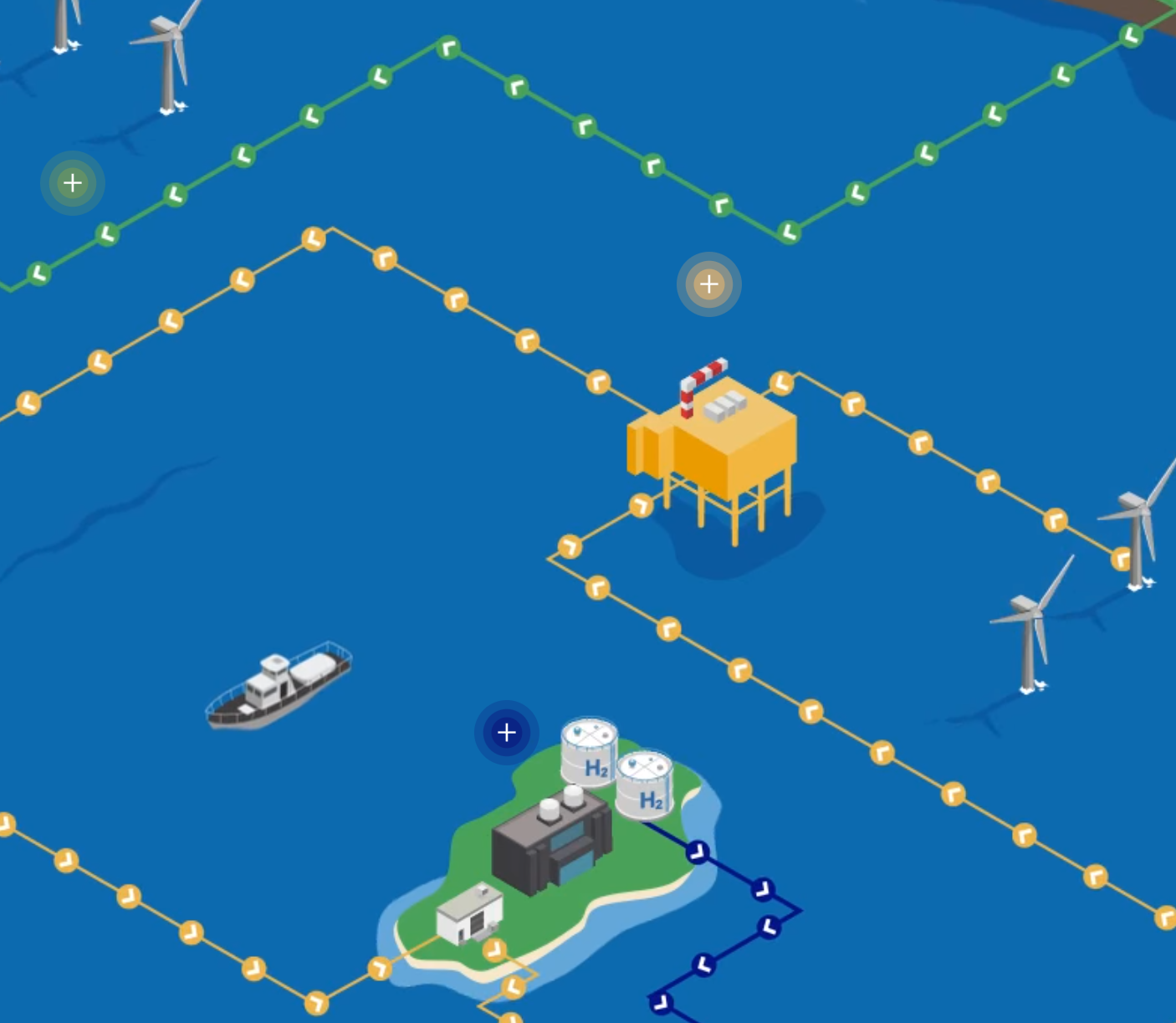
It shows an offshore hydrogen electrolyser.
- You could have an offshore hybrid asset that went between say Bacton in Norfolk and Hamburg via these assets.
- One or more wind farms in UK territorial waters.
- A mammoth offshore electrolyser, with hydrogen storage, possibly in a depleted gas field.
- One or more wind farms in German territorial waters.
Electricity will be able to go three ways; to the UK, to Germany or to the electrolyser.
The Involvement Of German Energy Companies In UK Territorial Waters
Wikipedia lists offshore fifteen wind farms, that have German owners in UK territorial waters, that total 12,960 MW.
This compares with.
- Equinor – 6 wind farms totalling 6466 MW.
- Ørsted – 15 wind farms totalling 9683 MW.
- Scottish Power – 2 wind farms totalling 5,000 MW.
- SSE Renewables – 15 wind farms totalling 15,591 MW.
- Vattenfall – 6 wind farms totalling 4384 MW.
As there is a number of partnerships, these figures only show the relative sizes of the investment by individual companies.
But at nearly 13 GW, the amount of total German investment in UK territorial waters is substantial.
Is This Solely An Anglo-German Club Or Can Others Join?
Consider.
- It seems to me, that because of the LionLink, the Dutch are already involved.
- TenneT is also a large electricity distributor in Germany.
- Countries with substantial shares of the water and winds of the North Sea in addition to Germany, the Netherlands and the UK, include Belgium, Denmark and Norway.
- The UK has interconnectors with Belgium, Denmark, France, Germany, Norway and the Netherlands.
It appears that the world’s largest multi-national power generator is evolving by stealth.
North Sea Wind Power Hub
This concept seems to have developed around 2017, by Danish, Dutch and German interests.
The Wikipedia entry introduces it like this.
North Sea Wind Power Hub is a proposed energy island complex to be built in the middle of the North Sea as part of a European system for sustainable electricity. One or more “Power Link” artificial islands will be created at the northeast end of the Dogger Bank, a relatively shallow area in the North Sea, just outside the continental shelf of the United Kingdom and near the point where the borders between the territorial waters of Netherlands, Germany, and Denmark come together. Dutch, German, and Danish electrical grid operators are cooperating in this project to help develop a cluster of offshore wind parks with a capacity of several gigawatts, with interconnections to the North Sea countries. Undersea cables will make international trade in electricity possible.
Currently, the UK is developing these wind farms on their portion of the Dogger Bank.
- Doggerbank A – 1235 MW – Started producing electricity in 2023.
- Doggerbank B – 1235 MW – Planned commissioning in 2024.
- Doggerbank C – 1218 MW – Planned commissioning in 2025.
- Doggerbank D – 1320 MW – Being planned.
- Doggerbank South – 3000 MW – Being planned.
Note.
- That’s a total of 8 GW.
- A, B, C and D are being developed by a consortium of SSE Renewables and Equinor.
- South is being developed by RWE.
- This web site is for Dogger Bank D.
- This web site is for Dogger Bank South.
This map from the European Atlas of the Seas, shows the various exclusive economic zones (EEZ) in the North Sea.

Note.
- The pinkish zone to the East of the UK, is the UK’s EEZ.
- The light blue zone at the top is Norway’s EEZ.
- The greenish zone in the North-East corner of the map is Denmark’s EEZ.
- The light blue zone below Denmark’s EEZ is Germany’s EEZ.
- Then we have the EEZs for The Netherlands, Belgium and France.
The Dogger Bank is situated where the British, Dutch, German and Norwegian EEZs meet.
All five Dogger Bank wind farms are in British waters.
The Wikipedia entry for the Dogger Bank says this about its size.
The bank extends over about 17,600 square kilometres (6,800 sq mi), and is about 260 by 100 kilometres (160 by 60 mi) in extent. The water depth ranges from 15 to 36 metres (50 to 120 ft), about 20 metres (65 ft) shallower than the surrounding sea.
This probably makes it easy to accommodate a large fixed-foundation wind farm.
Overlaying the map in the Wikipedia entry, with the EEZ map, I’m fairly sure that the northeast end of the Dogger Bank is close to where the EEZs meet.
Progress On The North Sea Wind Power Hub
The North Sea Wind Power Hub has a web site, but it seems to be more about thinking than doing.
It seems to have been hijacked by that august body; The Institute of Meetings Engineers.
This page on the web site, which is entitled Explore The Future Energy Highways, has a simple interactive map.
This shows its vision for 2030.
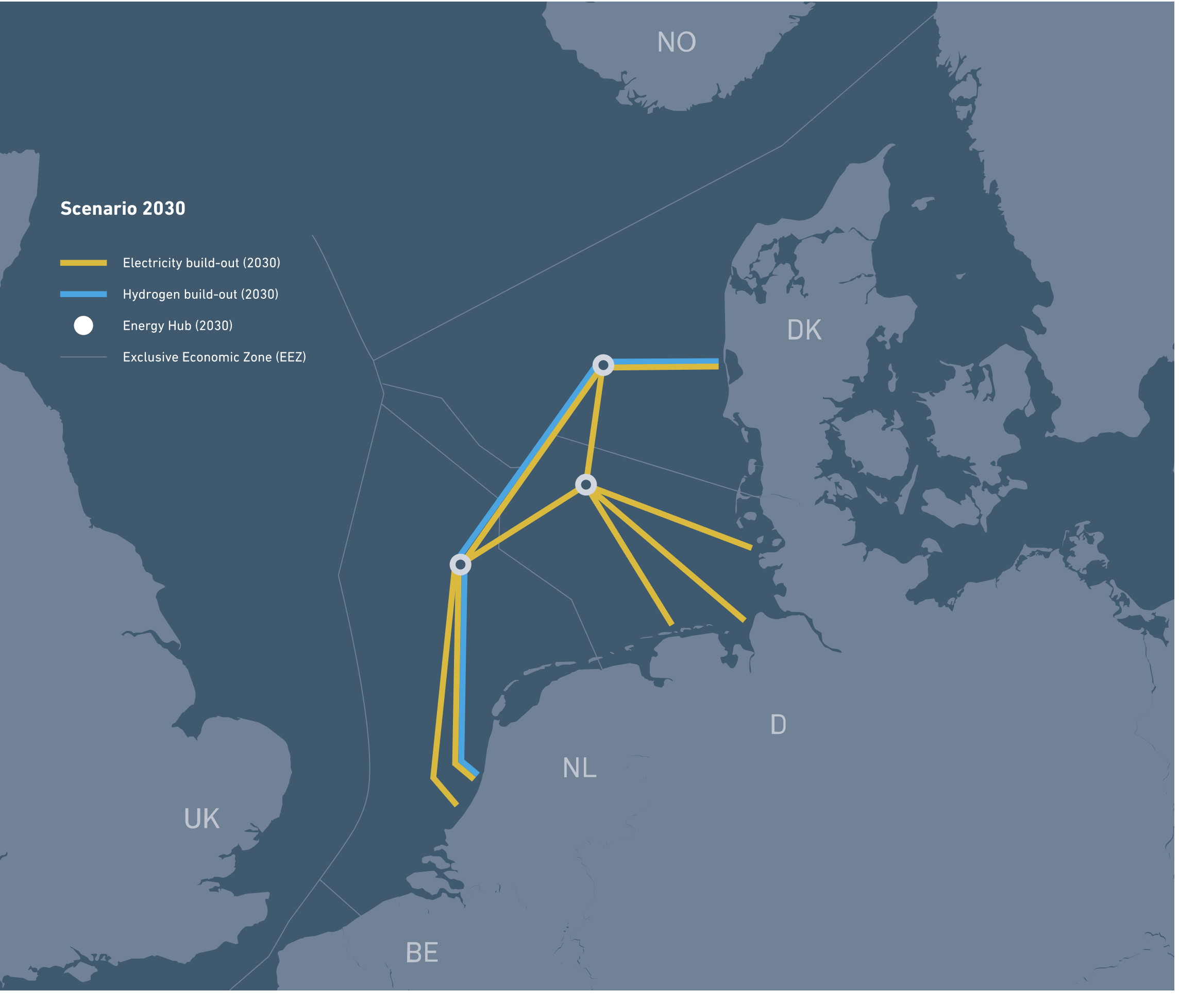
Note.
- Yellow is electricity links to be built before 2030.
- Blue is hydrogen links to be built before 2030.
- Feint lines indicate the EEZ boundaries.
There are two problems with this layout.
- It doesn’t connect to the Dogger Bank area, where the original plan as detailed in Wikipedia talked about “Power Link” artificial islands.
- No hydrogen is delivered direct to Germany.
This shows its vision for 2050.
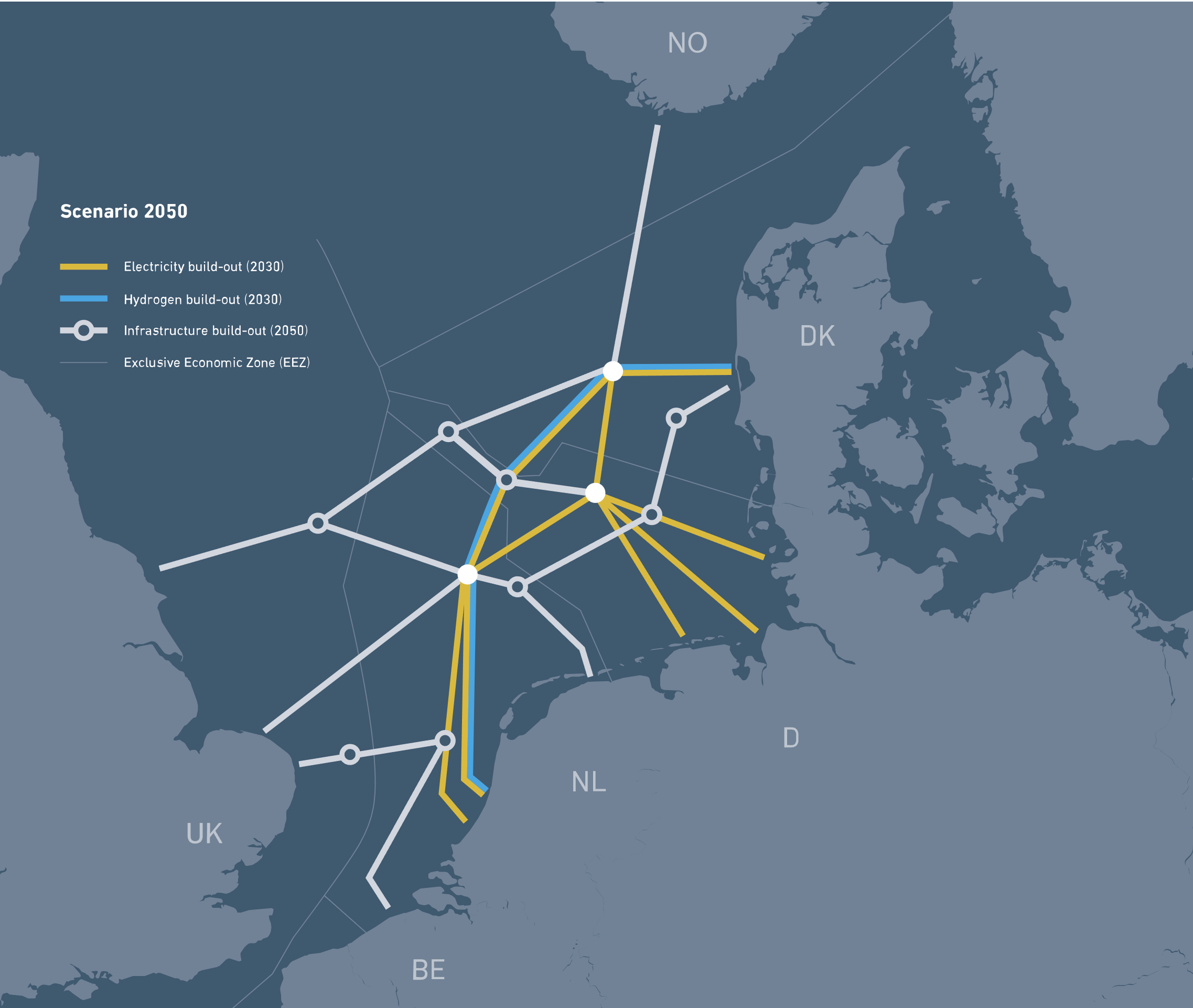
Note.
- Yellow, blue and feint lines are as before.
- White is electricity links to be built before 2050.
- There appears to be a node on the Dogger Bank in the German EEZ. This node could be connected to the “Power Link” artificial islands.
- The Southernmost connection to East Anglia could be Bacton.
- The other Norfolk connection could be where wind farms are already connected.
- The Northern connection could be Teesside, where some of the Dogger Bank wind farms connect.
- If the Northern connection to England is Teesside, then first node, which is in the British EEZ, could be one of the offshore sub-stations in the Dogger Bank wind farm complex.
This all seems a lot more feasible.
A New Offshore Hybrid Asset Between Teesside And Germany
Consider.
- A new offshore sub-station will be needed in the German EEZ to connect the “Power Link” artificial islands to the power network.
- The new offshore sub-station will eventually have three interconnectors to the German coast.
- Only the 1218 MW Dogger Bank C wind farm will be connected to the Teesside onshore substation.
- Germany has a power supply problem, after shutting down nuclear power stations and building more coal-fired power stations.
A new Offshore Hybrid Asset between Teesside and Germany could be created by building the following.
- A the new offshore sub-station in the German EEZ to connect the “Power Link” artificial islands to the power network.
- An interconnector between a sub-station of the Dogger Bank wind farm complex and the new sub-station
- A second interconnector to connect the new sub-station for the “Power Link” artificial islands to the German electricity grid.
All of the work would be done mainly in the German EEZ, with a small amount in the British EEZ.
Where Does Dogger Bank South Fit In?
Consider.
- Dogger Bank South is planned to be a 3 GW wind farm.
- It will need a 3 GW connection to the onshore electricity grid.
- Creyke Beck substation is the proposed location for the onshore connection.
- It is owned by German electricity company; RWE.
Could it be that some of the electricity produced by Dogger Bank South is going to be sent to Germany or to another node to produce hydrogen?
It certainly illustrates the value of an Offshore Hybrid Asset.
Boris Baldrick’s Cunning Plan
This written statement to Parliament on the UK Government web site, is entitled Transport Update: Transpennine Route Upgrade.
It has been published by Grant Shapps and this is the sub-title.
Additional funding has been made available for the Transpennine route upgrade.
This is the complete statement.
Today 19 July 2022, the government has made available £959 million of additional funding to continue to progress the delivery of the ambitious Transpennine route upgrade.
This funding is a significant milestone and another step towards upgrading the key east-west rail artery across the north of England, to further this government’s levelling up and decarbonisation objectives.
In addition to progressing the design of aspects of the upgrade, this funding will enable further on-the-ground delivery of electrification and journey time improvement works, mostly west of Leeds.
One of the first tangible benefits will be enabling electric trains to run between Manchester and Stalybridge by the middle of the decade. We are also developing scope that will enable the Transpennine route upgrade to become the first phase of Northern Powerhouse Rail, including plans to unlock freight flows and take thousands of lorries off our roads.
We are also more than trebling the investment in the Transpennine route upgrade from £2.9 billion to between £9.0 billion and £11.5 billion.
This additional investment will enable the roll out of digital signalling technology, electrification of the full route and the provision of additional tracks for commercial and freight services, giving rail users more reliable, more punctual, more comfortable and greener rail journeys.
I have some thoughts.
It’s Not A Wish List, But A Reality
The last paragraph reads like a wish list.
This additional investment will enable the roll out of digital signalling technology, electrification of the full route and the provision of additional tracks for commercial and freight services, giving rail users more reliable, more punctual, more comfortable and greener rail journeys.
But it’s not a wish list, it’s what is to be done.
Where Will The Government Get Between Nine and Eleven-And-A-Half Billion Pounds?
It’s not the sort of small change that you have in a sock draw.
This document on the UK government web site, is entitled PM Opening Remarks At Press Conference With German Chancellor Olaf Scholz: 8 April 2022, where this is these three paragraphs.
We will also agree on the importance of weaning ourselves off dependence on Russian gas and oil, and ensuring that our energy security cannot be threatened by a rogue state.
This is not easy for any of us, and I applaud the seismic decisions taken by Olaf’s government to move Germany away from Russian hydrocarbons.
Today we have agreed to maximise the potential of the North Sea and collaborate on energy security and on renewables, where Germany and the UK lead the way in new technology.
So did Boris and Olaf sign the world’s first Green Alliance based on zero-carbon energy?
- They may not have signed an Alliance, but they have agreed on common actions.
- Over the last year or so, German money and technology has started to be more visible in our offshore wind farms.
- BP have been backed by German utility; enBW in some of their huge wind farms.
- Siemens Gamesa are providing a lot of wind turbines.
- Will German shipyards build the floats for floating wind farms?
- An interconnector between the Isle of Grain and Wilhelmshaven is planned.
- Rolls-Royce and its German subsidiary MTU are charging into battle against climate change.
- The Germans have taken a liking to ITM Power’s electrolysers to produce hydrogen.
I can see the North Sea or the German Ocean becoming Europe’s power station, with by 2030, a large amount of the energy not needed by the UK, being exported to the Continent, either as electricity or hydrogen.
The Germans could become our magische Geldbäume.
But unlike gas and oil, wind power in the North Sea won’t run out, as it’s renewable.
In How Britannia With Help From Her Friends Can Rule The Waves And The Wind, this was my conclusion.
Boris’s vision of the UK becoming a Saudi Arabia of wind is no fantasy of a man with massive dreams.
Standard floating wind turbines, with the possibility of also harvesting wave power could be assembled in ports along the coasts, towed into position and then connected up.
Several GW of wind-power capacity could probably be added each year to what would become the largest zero-carbon power station in the world.
By harvesting the power of the winds and waves in the seas around the British Isles it is an engineering and mathematical possibility, that could have been developed by any of those great visionary Victorian engineers like Armstrong, Bazalgette, Brunel and Reynolds, if they had had access to our modern technology.
Up Yours! Putin!
This energy and the money it provides will finance our infrastructure and our tax cuts.
How Britannia With Help From Her Friends Can Rule The Waves And The Wind
The Government doesn’t seem to have published its future energy plans yet, but that hasn’t stopped the BBC speculating in this article on their web site, which is entitled Energy Strategy: UK Plans Eight New Nuclear Reactors To Boost Production.
These are the first two paragraphs.
Up to eight more nuclear reactors could be delivered on existing sites as part of the UK’s new energy strategy.
The plan, which aims to boost UK energy independence and tackle rising prices, also includes plans to increase wind, hydrogen and solar production.
Other points include.
- Up to 95% of the UK’s electricity could come from low-carbon sources by 2030.
- 50 gigawatts (GW) of energy through offshore wind farms, which would be more than enough to power every home in the UK.
- One of the big points of contention is thought to have been the construction of onshore wind turbines.
- Targets for hydrogen production are being doubled to help provide cleaner energy for industry as well as for power, transport and potentially heating.
- A new licensing round for North Sea oil and gas projects.
- A heat pump accelerator program.
In this post I shall only be looking at one technology – offshore wind and in particular offshore floating wind.
Who Are Our Friends?
I will start with explaining, who I see as our friends, in the title of this post.
The Seas Around Us
If we are talking about offshore winds around the the UK, then the seas around the UK are surely our biggest and most-needed friend.
The Island Of Ireland
The seas are shared with the island of Ireland and the UK and the Republic must work together to maximise our joint opportunities.
As some of the largest offshore wind farm proposals, between Wales and Ireland involve a Welsh company called Blue Gem Wind, who are a partnership between Irish company; Simply Blue Energy, and French company; TotalEnergies, we already seem to be working with the Irish and the French.
The City Of London
Large insurance and pension companies, based in the City of London like, abrdn, Aviva, L & G and others are always looking for investments with which to provide income to back their insurance business and our pensions.
In World’s Largest Wind Farm Attracts Huge Backing From Insurance Giant, I describe why and how, Aviva back wind farms.
Germany
Germany are certainly on our side, despite being in a mess of Mutti Merkel’s making, because she got the country too deeply dependant on Vlad the Mad’s tainted gas.
- German utilities are providing finance to build wind farms in British waters.
- German company; Siemens is manufacturing turbine blades in Hull.
- Germany wouldn’t mind buying any electricity and hydrogen we have spare. Especially, as we haven’t invaded them since 1944.
I suspect a mutually-beneficial relationship can be negotiated.
Norway
I have customised software for a number of countries, including Iran, Saudi Arabia, South Korea and the United States and despite selling large numbers of systems to Norway, the Norwegians never requested any modifications.
They are generally easy-going people and they are great friends of the UK. They were certainly a fertile country for the sale of Artemis systems.
Just as the UK worked together with the Norwegians to deliver North Sea Oil, we are now starting to work together to develop renewable energy in the North Sea.
In UK To Norway Sub-Sea Green Power Cable Operational, I describe how we have built the North Sea Link with the Norwegians, which will link the British and Norwegian energy networks to our mutual benefit.
In Is This The World’s Most Ambitious Green Energy Solution?, I describe an ambitious plan called Northern Horizons, proposed by Norwegian company; Aker Solutions to build a 10 GW floating wind farm, which will be 120 km to the North-East of the Shetlands.
Floating Wind Turbines
This is the introduction of the Wikipedia entry for floating wind turbines.
A floating wind turbine is an offshore wind turbine mounted on a floating structure that allows the turbine to generate electricity in water depths where fixed-foundation turbines are not feasible. Floating wind farms have the potential to significantly increase the sea area available for offshore wind farms, especially in countries with limited shallow waters, such as Japan, France and US West coast. Locating wind farms further offshore can also reduce visual pollution, provide better accommodation for fishing and shipping lanes, and reach stronger and more consistent winds.
At its simplest a floating wind farm consists of a semi-submersible platform, which is securely anchored to the sea-bed to provide a firm platform on which to erect a standard wind turbine.
There are currently two operational floating wind farms off the East Coast of Scotland and one in the Atlantic off the Portuguese coast.
- These wind farms are fairly small and use between three and five turbines to generate between 25-50 MW.
- The largest current floating turbines are the 9.5 MW turbines in the Kincardine Wind Farm in Scotland, but already engineers are talking of 14 MW and 20 MW floating turbines.
- Experience of the operation of floating wind turbines, indicates that they can have capacity factors in excess of 50 %.
- Floating wind turbines can be erected on their floats in the safety of a port using a dockside crane and then towed into position.
- Floating wind turbines can be towed into a suitable port for servicing and upgrading.
Many serious engineers and economists, think that floating wind farms are the future.
The Energy Density of Fixed Foundation And Floating Wind Farms
In ScotWind Offshore Wind Leasing Delivers Major Boost To Scotland’s Net Zero Aspirations, I summarised the latest round of Scotwind offshore wind leases.
- Six new fixed foundation wind farms will give a capacity of 9.7 GW in 3042 km² or about 3.2 MW per km².
- Ten new floating wind farms will give a capacity of 14.6 GW in 4193 km² or about 3.5 MW per km².
Note.
- Floating wind farms have a small advantage in terms of energy density over those with fixed foundations.
- Suppose these energy densities are achieved using 14 MW turbines.
- Engineers are talking of 20 MW turbines.
- Using large turbines could increase the energy density by 20/14 or 43 %
We could see in a few years with 20 MW turbines, fixed foundation turbines having an energy density of 4.6 MW per km², with floating turbines having 5 MW per km².
The Potential Of A Ten-Mile Square In The Seas Around Us
I will assume.
- It is at least 100 km from land.
- The water would be at least 100 metres deep.
- There are no structures in the area.
And calculate.
- The area will be a hundred square miles, which is smaller than the county of Rutland.
- This will be 259 square kilometres.
If it were to be filled with floating wind turbines at a density of 5 MW per km², the capacity would be 1300 MW or 1.3 GW.
There must be hundreds of empty ten-mile squares in the seas around us.
Offshore Hydrogen Production And Storage
I believe in the near future, that a lot of offshore wind energy will be converted to hydrogen offshore.
- Electrolysers could be combined with wind turbines.
- Larger electrolysers could be combined with sub-stations collecting the electricity.
- In Torvex Energy, I discuss a method to create hydrogen from seawater, without having to desalinate the water. Surely, this technology would be ideal for offshore electrolysis.
Hydrogen would be brought to shore using pipelines, some of which could be repurposed from existing gas pipelines, that are now redundant, as the gas-fields they served have no gas left.
I also suspect that hydrogen could be stored in a handy depleted gas field or perhaps some form of specialist storage infrastructure.
Combining Wind And Wave Power In A Single Device
Marine Power Systems are a Welsh company, that has developed a semi-submersible structure, that can support a large wind turbine and/or a wave-power generator.
This is the mission statement on their home page.
Marine Power Systems is revolutionising the way in which we harvest energy from the world’s oceans.
Our flexible technology is the only solution of its type that can be configured to harness wind and wave energy, either as a combined solution or on their own, in deep water. Built on common platform our devices deliver both cost efficiency and performance throughout the entire product lifecycle.
Our structurally efficient floating platform, PelaFlex, brings excellent stability and straightforward deployment and maintenance. The PelaGen wave energy converter represents market-leading technology and generates energy at an extremely competitive cost of energy.
Through optimised farm layout and the combination of wind and wave energy, project developers can best exploit the energy resource for any given area of seabed.
We are unlocking the power of oceans.
There is a link on the page to more pages, that explain the technology.
It looks to me, that it is well-designed technology, that has a high-chance of being successful.
It should also be noted that according to this news page on the Marine Power Systems web site, which is entitled MPS Lands £3.5M Of Funding From UK Government, the UK government feel the technology is worth backing.
I certainly believe that if Marine Power Systems are not successful, then someone else will build on their original work.
If wind and wave power can successfully be paired in a single float, then this must surely increase the energy production at each float/turbine in the floating wind farm.
Energy Storage In Wind Turbines
The output of wind farms can be very variable, as the wind huffs and puffs, but I believe we will see energy storage in wind turbines to moderate the electricity and deliver a steadier output.
Using lithium-ion or other batteries may be possible, but with floating offshore turbines, there might be scope to use the deep sea beneath the float and the turbine.
Hybrid Wind Farms
In the latest round of Scotwind offshore wind leases, one wind farm stands out as different. Magnora ASA’s ScotWind N3 Offshore Wind Farm is described as a floating offshore wind farm with a concrete floater.
I can see more wind farms built using this model, where there is another fixed or floating platform acts as control centre, sub-station, energy store or hydrogen electrolyser.
How Much Electricity Could Be Produced In UK And Irish Waters?
I will use the following assumptions.
- Much of the new capacity will be floating wind turbines in deep water.
- The floating wind turbines are at a density of around 5 MW per km²
This Google Map shows the British Isles.
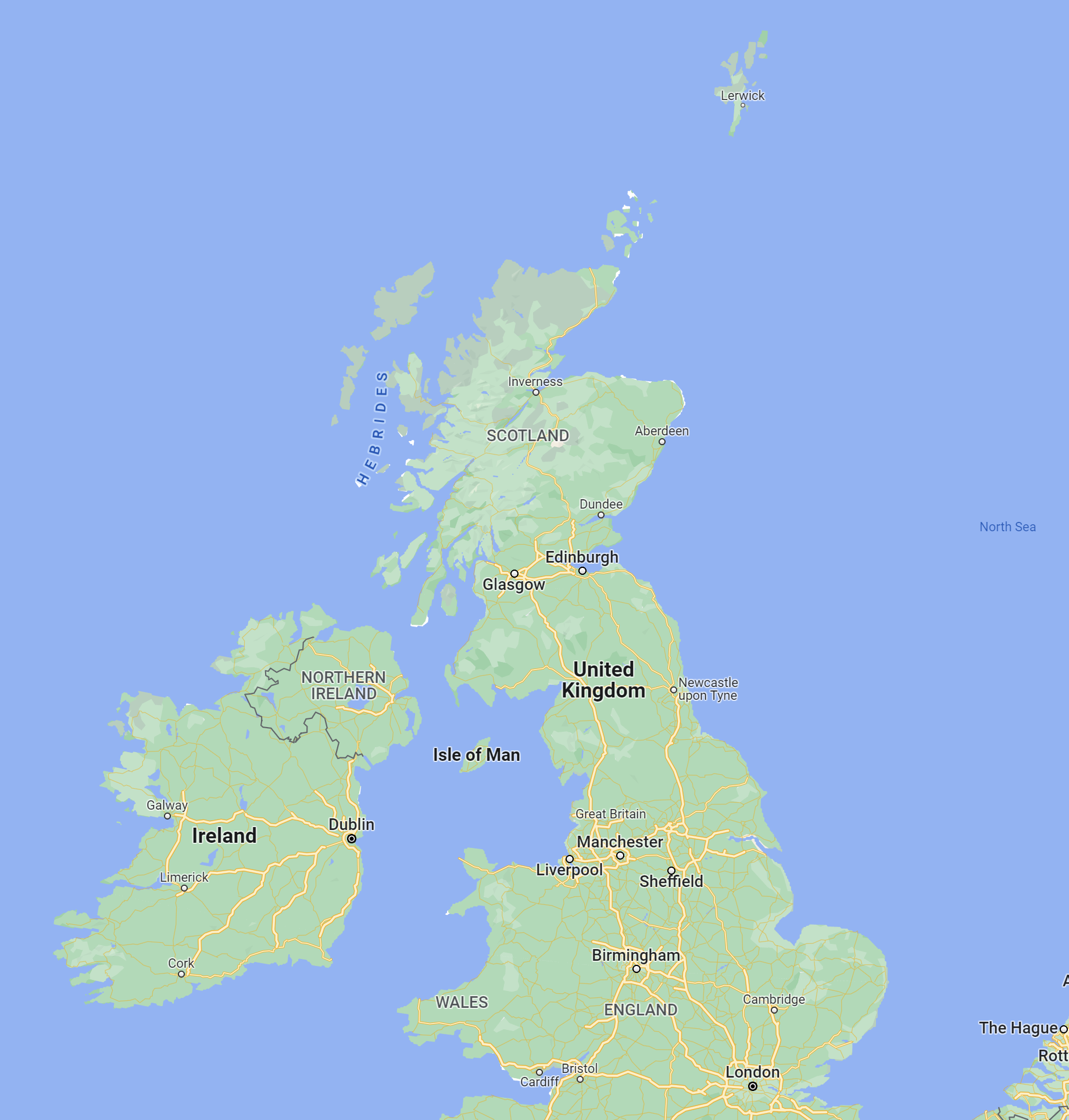
I will look at various seas.
The Celtic Sea
The Celtic Sea is to the South-West of Wales and the South of Ireland.
In Blue Gem Wind, I posted this extract from the The Our Projects page of the Blue Gem Wind web site.
Floating wind is set to become a key technology in the fight against climate change with over 80% of the worlds wind resource in water deeper than 60 metres. Independent studies have suggested there could be as much as 50GW of electricity capacity available in the Celtic Sea waters of the UK and Ireland. This renewable energy resource could play a key role in the UK meeting the 2050 Net-Zero target required to mitigate climate change. Floating wind will provide new low carbon supply chain opportunities, support coastal communities and create long-term benefits for the region.
Consider.
- The key figure would appear 50 GW of electricity capacity available in the Celtic Sea waters of the UK and Ireland.
- Earlier I said that floating turbines can have a wind turbine density of 5 MW per km².
- According to Wikipedia, the surface area of the Celtic Sea is 300,000 km².
To accommodate enough floating turbines to generate 50 GW would need 10000 km², which is a 100 km. square, or 3.33 % of the area of the Celtic Sea.
This wind generation capacity of 50 GW would appear to be feasible in the Celtic Sea and still leave plenty of space for the shipping.
The Irish Sea
According to Wikipedia, the surface area of the Irish Sea is 46,000 km².
Currently, there are ten wind farms in the Irish Sea.
- Six are in English waters, three are in Welsh and one is in Irish.
- None are more than sixteen kilometres from the coast.
The total power is 2.7 GW.
I feel that the maximum number of wind farms in the Irish Sea would not cover more than the 3.33 % proposed for the Celtic Sea.
3.33 % of the Irish Sea would be 1532 km², which could support 7.6 GW of wind-generated electricity.
I can’t leave the Irish Sea without talking about two wind farms Mona and Morgan, that are being developed by an enBW and BP joint venture, which I discussed in Mona, Morgan And Morven. This infographic from the joint venture describes Mona and Morgan.

That would appear to be a 3 GW development underway in the Irish Sea.
Off The Coast Of South-East England, East Anglia, Lincolnshire And Yorkshire
These wind farms are proposed in these areas.
- Hornsea – 6 GW
- Triton Knoll – 900 MW
- Dogger Bank – 3.6 GW
- Norfolk Boreas – 1.8 GW
- Norfolk Vanguard – 1.8 GW
- East Anglia Array – 7.2 GW
- Rampion Extension – 1.2 GW
Note.
All wind farms have comprehensive web sites or Wikipedia entries.
The total capacity of these wind farms is 22.5 GW
The North Sea
According to Wikipedia, the surface area of the North Sea is 570,000 km².
Would it is reasonable to assume, that perhaps a tenth of this area would be available for new wind farms in UK waters?
3.33 % of the available North Sea would be 1898 km², which could support 9.5 GW of wind-generated electricity.
On The East Coast Of Scotland
In Wind Farms On The East Coast Of Scotland, I summarised the wind farms off the East coast of Scotland, that are being built in a cluster in the First of Forth.
This map shows the proposed wind farms in this area.
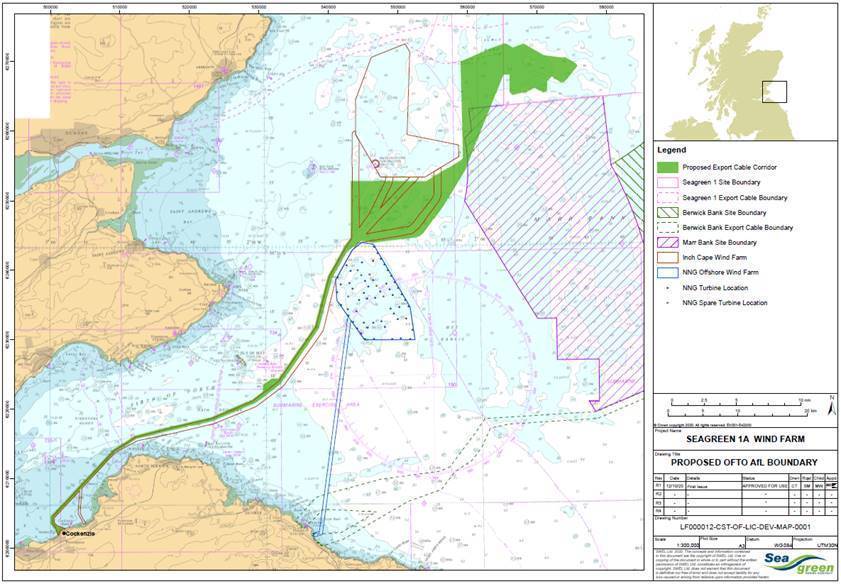
There are five wind farms in the map.
- The green area is the cable corridor for Seagreen 1a
- Inch Cape is the odd-shaped wind farm to the North and West of the green area
- Seagreen at the top of the map, to the North of Inch Cape.
- Marr Bank with the pink NE-SW hatching
- Berwick Bank with the green NW-SE hatching
- Neart Na Gaoithe is edged in blue to the South of the green area.
Berwick Bank and Marr Bank are both owned by SSE and appear to have been combined.
The capacity of the wind farms can be summarised as follows.
- Seagreen – 1075 MW
- Neart Na Gaoithe – 450 MW
- Inch Cape – 1000 MW
- Berwick Bank and Marr Bank – 4100 MW
This gives a total of 6625 MW or just over 6.6 GW.
Around The North Of Scotland
This map shows the latest successful ScotWind leases.

Note.
- Several of these proposed wind farms have detailed web sites.
These seventeen leases total up to 24.3 GW.
An Interim Total
I believe these figures are realisable.
- Celtic Sea – 50 GW
- Irish Sea – 7.6 GW – 3 GW already underway
- South East England, East Anglia, Lincolnshire And Yorkshire – 22.5 GW
- North Sea – 9.5 GW
- On The East Coast Of Scotland – 6.6 GW
- Around The North Of Scotland – 24.3 GW
Note.
- I have tried to be as pessimistic as possible.
- Irish and North Sea estimates are based on Blue Gem Wind’s professional estimate for the Celtic Sea.
- I have used published figures where possible.
My estimates total up to 120.1 GW of extra wind-power capacity. As I write this, current UK electricity production is around 33 GW.
Vikings Will Invade
This Google Map shows the Faroe Islands, the North of Scotland, Norway and Denmark.
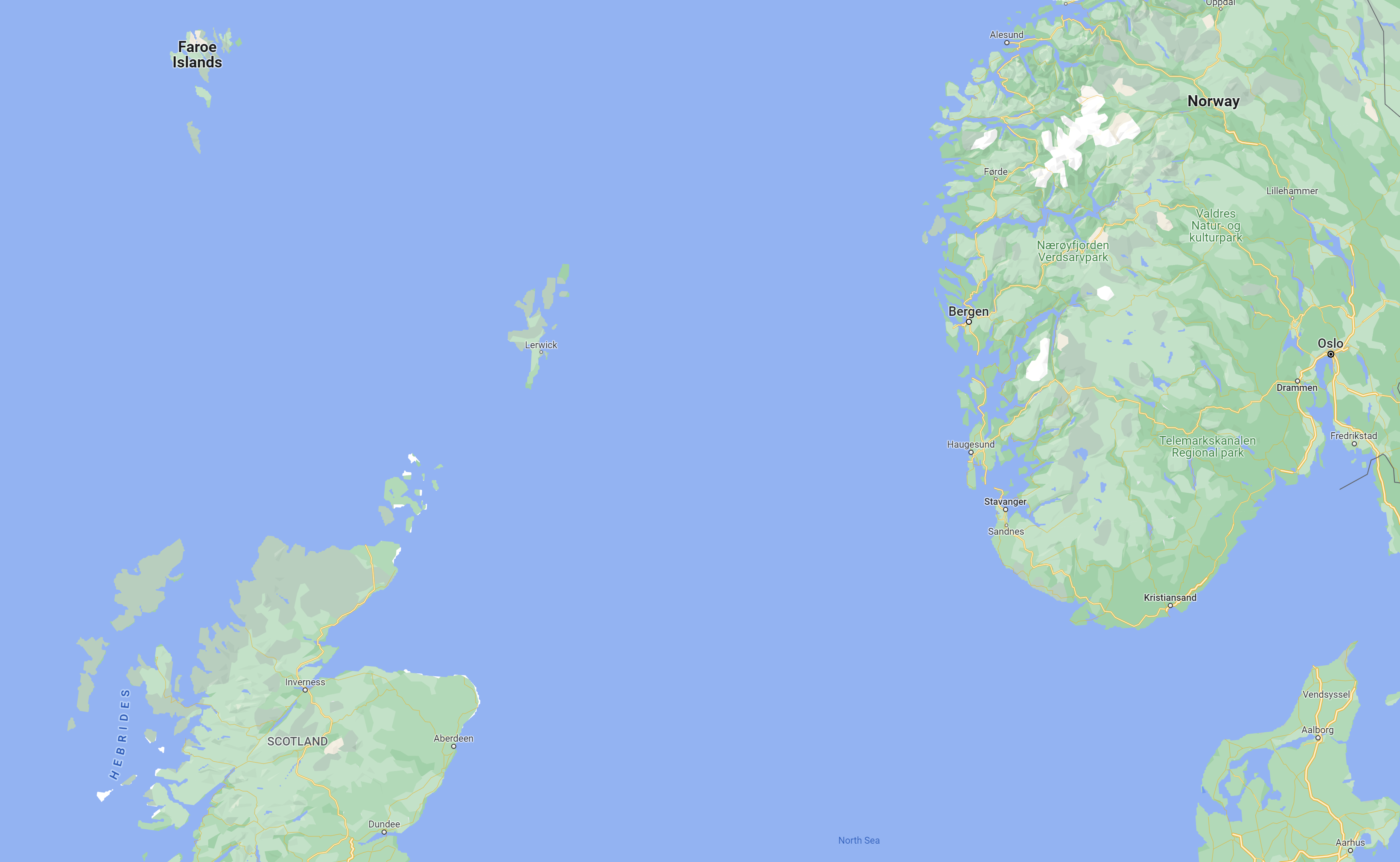
To get an idea of scale, the Shetland Isles are around 70 miles or 113 km. from North to South.
In Is This The World’s Most Ambitious Green Energy Solution?, I talked about Norwegian company; Aker Solutions’s plan for Northern Horizons.
- It would be a 10 GW offshore floating wind farm 136 km to the North-East of the Shetlands.
- This position would probably place it about halfway between the Faroes and the Norwegian coast.
- The project is best described in this article on the Engineer, which is entitled Northern Horizons Plans Clean Energy Exports For Scotland.
- In the article, there is a good graphic and a video.
This will be offshore engineering of the highest class, but then I first came across Norwegian offshore engineering like this in the 1970s, where nothing was too difficult for Norwegian engineers.
There are two major points to remember about the Norwegians.
- They have the Sovereign Wealth Fund to pay for the massive investment in Northern Horizons.
- They need to replace their oil and gas income, with a zero-carbon investment stream.
I feel that Northern Horizons will not be a one-off and the virgin sea in the map above will be liberally carpeted with more floating wind farms.
- On Shetland, electricity can be fed into the UK grid.
- On Norway, electricity can be fed into the Norwegian grid or stored in Norwegian pumped storage systems.
- On Scotland, more pumped storage systems can be built to store energy.
- Hydrogen can be piped to where it is needed to decarbonise heavy industry and transport.
- Norwegian fjords, Shetland harbours, Scottish lochs and possibly Scapa Flow would be ideal places to assemble and service the giant floating turbines and build the other needed floating infrastructure.
- I can also see Denmark getting in on the act, as they will probably want to decarbonise the Faroe Islands.
I estimate that between the Faroes, Scotland and Norway, there are 510,000 km² of virgin sea.
With a potential of 5 MW per km², that area has the potential to create an amazing amount of both electricity and hydrogen.
Exporting Power To Europe
There will need to be more interconnectors from the UK to Europe.
These are already working.
- BritNed – 1 GW – Isle of Grain and Rotterdam
- ElecLink – 1 GW – Through the Channel Tunnel
- HVDC Cross-Channel – 2 GW – England and France
- IFA-2 – 1 GW – England and France
- NemoLink – 1 GW – Kent and Belgium
- North Sea Link – 1.4 GW – Blyth and Norway
- Viking Link – 1.4 GW – Lincolnshire and Denmark
These are proposed.
- GridLink – 1.4 GW – Kent and Dunkirk
- NeuConnect – 1.4 GW – Isle of Grain and Germany
- North Connect – 1.4 GW – Scotland and Norway
There are also gas interconnectors, that could be converted to hydrogen.
This press release from National Grid, which is entitled Undersea Electricity Superhighways That Will Help Deliver Net Zero Move A Step Closer, has these bullet points.
- Positive progress on plans for £3.4bn electricity super-highway projects – Scotland to England Green Links.
- Ofgem opens consultation that recognises the “clear case” and “consumer benefit” of two subsea high voltage cables to transport clean between Scotland and England.
- The cables form part of a planned 16 project £10 billion investment from National Grid to deliver on the government’s target of 40GW of offshore wind generation by 2030.
This paragraph expands on the work by National Grid to meet the third point.
These projects are part of National Grid’s work upgrading the electricity transmission system to deliver the UK government’s target of 40GW of offshore wind generation by 2030. In addition to the Eastern Links, it is developing 14 major projects across its network to facilitate the target representing a £10 billion investment. This includes two further Scotland to England high voltage links (also in partnership with the Scottish transmission network owners) and proposals in the Humber, Lincolnshire, East Midlands, North of England, Yorkshire, North Kent, as well as four in East Anglia (one of which is a proposed offshore link between Suffolk and Kent).
I think we can assume, that National Grid will do their part to allow the UK government’s target of 40GW of offshore wind generation by 2030 to be met.
Will The UK Have 40 GW Of Offshore Wind Generation By 2030?
In the Wikipedia entry for Windpower In The UK, this is the opening sentence.
The United Kingdom is one of the best locations for wind power in the world and is considered to be the best in Europe. By the beginning of March 2022, the UK had 11,091 wind turbines with a total installed capacity of over 24.6 gigawatts (GW): 14.1 GW of onshore capacity and 10.4 GW of offshore capacity.
It would appear an extra 30 GW of wind power is needed.
In An Interim Total earlier, I gave these figures.
- Celtic Sea – 50 GW
- Irish Sea – 7.6 GW – 3 GW already underway
- South East England, East Anglia, Lincolnshire And Yorkshire – 22.5 GW
- North Sea – 9.5 GW
- On The East Coast Of Scotland – 6.6 GW
- ScotWind – 24.3 GW
The wind farms in South East England, East Anglia, Lincolnshire And Yorkshire and ScotWind and Mona and Morgan are either being planned or under construction, and in many cases leases to construct wind farms are being paid.
I would feel, that at least 30 GW of these 56.4 GW of wind farms will be completed by 2030.
Conclusion
Boris’s vision of the UK becoming a Saudi Arabia of wind is no fantasy of a man with massive dreams.
Standard floating wind turbines, with the possibility of also harvesting wave power could be assembled in ports along the coasts, towed into position and then connected up.
Several GW of wind-power capacity could probably be added each year to what would become the largest zero-carbon power station in the world.
By harvesting the power of the winds and waves in the seas around the British Isles it is an engineering and mathematical possibility, that could have been developed by any of those great visionary Victorian engineers like Armstrong, Bazalgette, Brunel and Reynolds, if they had had access to our modern technology.
Up Yours! Putin!
NeuConnect Awards Two Major Contracts
This page on the NeuConnect web site is entitled NeuConnect Awards Over £1.5 billion Of Major Contracts As First Ever UK-German Energy Link Moves An Important Step Closer.
NeuConnect is a proposed interconnector between England and Germany.
- It will have a capacity of 1.4 GW.
- The interconnector will be around 450 miles long.
- It will be HVDC, like many similar undersea power cables.
- As the title says, it will be the first-ever UK-German energy link.
Wikipedia describes the route like this.
The cable will run between the Greystones substation on the Isle of Grain, in Kent in England to the new Fedderwarden substation in Wilhelmshaven in the Lower Saxony region of Germany. Landfall will be next to Grain Coastal Park, in Kent, and at Hooksiel, near Wilhemshaven in Germany.
Two contracts have been awarded.
- The contract to design, manufacture, install, test and commission the 725km interconnector has been awarded to Prysmian Group.
- The contract to design and build two converter stations in the UK and Germany has been awarded to Siemens Energy.
This sounds like a very simple plan to add an important interconnector between the UK and Germany.
I have some observations and thoughts.
The Isle Of Grain
The Isle of Grain is described in Wikipedia like this.
Isle of Grain (Old English Greon, meaning gravel) is a village and the easternmost point of the Hoo Peninsula within the district of Medway in Kent, south-east England. No longer an island and now forming part of the peninsula, the area is almost all marshland and is a major habitat for diverse wetland birds. The village constitutes a civil parish, which at the 2011 census had a population of 1,648, a net decrease of 83 people in 10 years.
Apart for the birds, over the last few decades it has been home to the following.
- Until 1982, it was the location of a BP oil refinery.
- In the 1990s, the isle was used to make the segments for the lining of the Channel Tunnel.
- Following completion of the Channel Tunnel, the site is now part-occupied by Thamesport, the UK’s third largest container port.
- Next to the former BP site is Grain Power Station, built in the 1970s, which previously burnt oil.
- This power station was demolished in the 2015 and replaced with a 1.275 GW gas-fired power station.
- Another major installation is a new Grain Liquefied Natural Gas (LNG) import facility, which takes heat from the gas-fired power station.
- The Isle of Grain is the landing point for the BritNed undersea power cable between The Netherlands and the UK.
The Google Map shows the Isle of Grain.
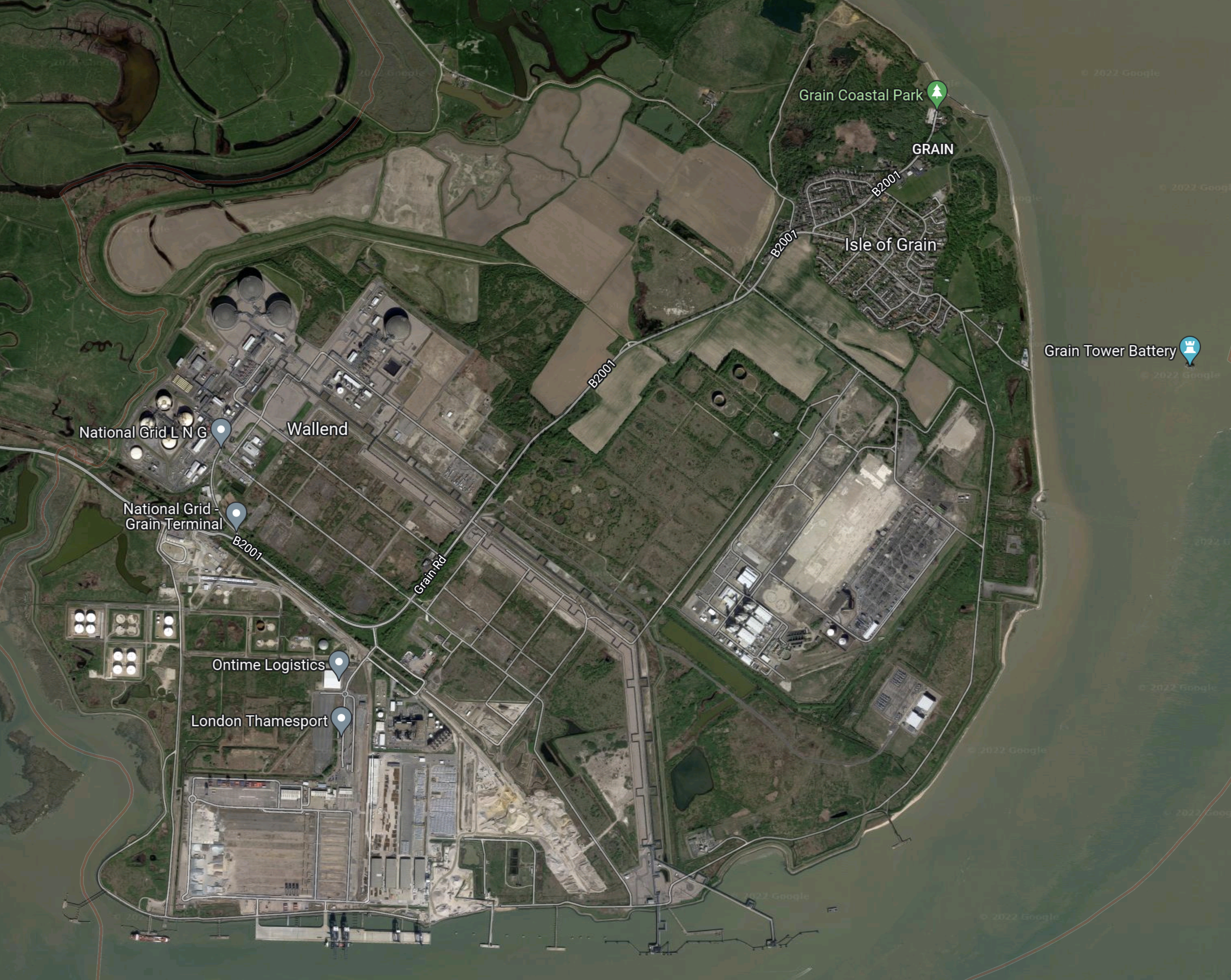
Note.
- Thamesport is in the South-West corner
- To its North is the LNG import facility.
- To the North-East of Thamesport is the 735 MW Medway power station.
- There is a rail connection to Hoo Junction on the North Kent Line.
This second Google Map shows the Eastern side of the Isle.
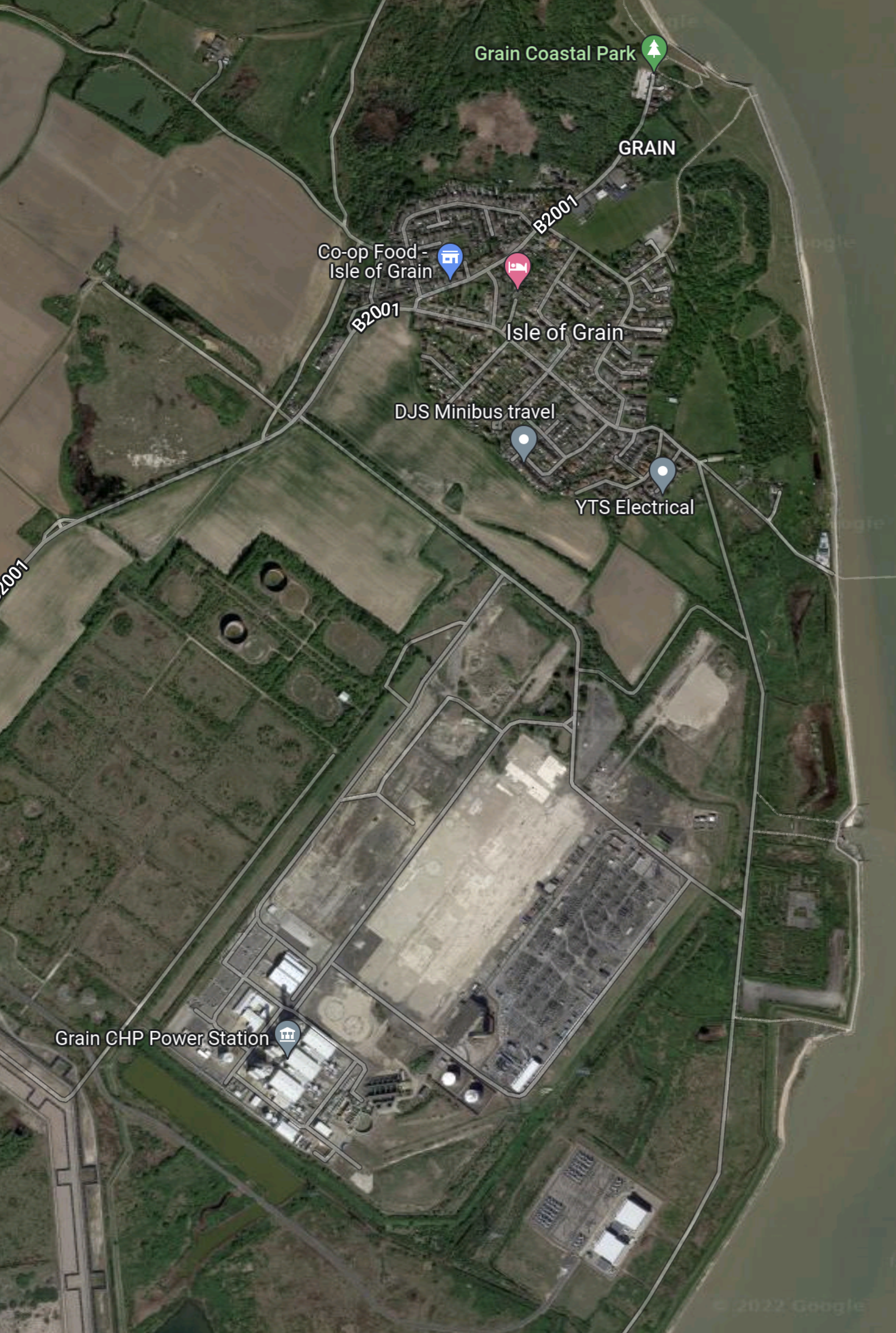
Note.
- Grain Coastal Park, where NeuConnect will make landfall, is marked by the green arrow at the top of the map.
- Towards the South-Eastern corner of the map is the 1.275 GW Grain gas-fired power station.
- To the East of the power station, there is more switchgear than you see in a bad Frankenstein film.
- The smaller square at the bottom with the two white squares could be the converter station for the BritNed interconnector.
I am sure there is space on the island for a connection for NeuConnect.
There is also a total of 2.01 GW of gas-fired power stations on the Isle of Grain.
Wind Power In The Thames Estuary
This Google Map shows the Thames Estuary.
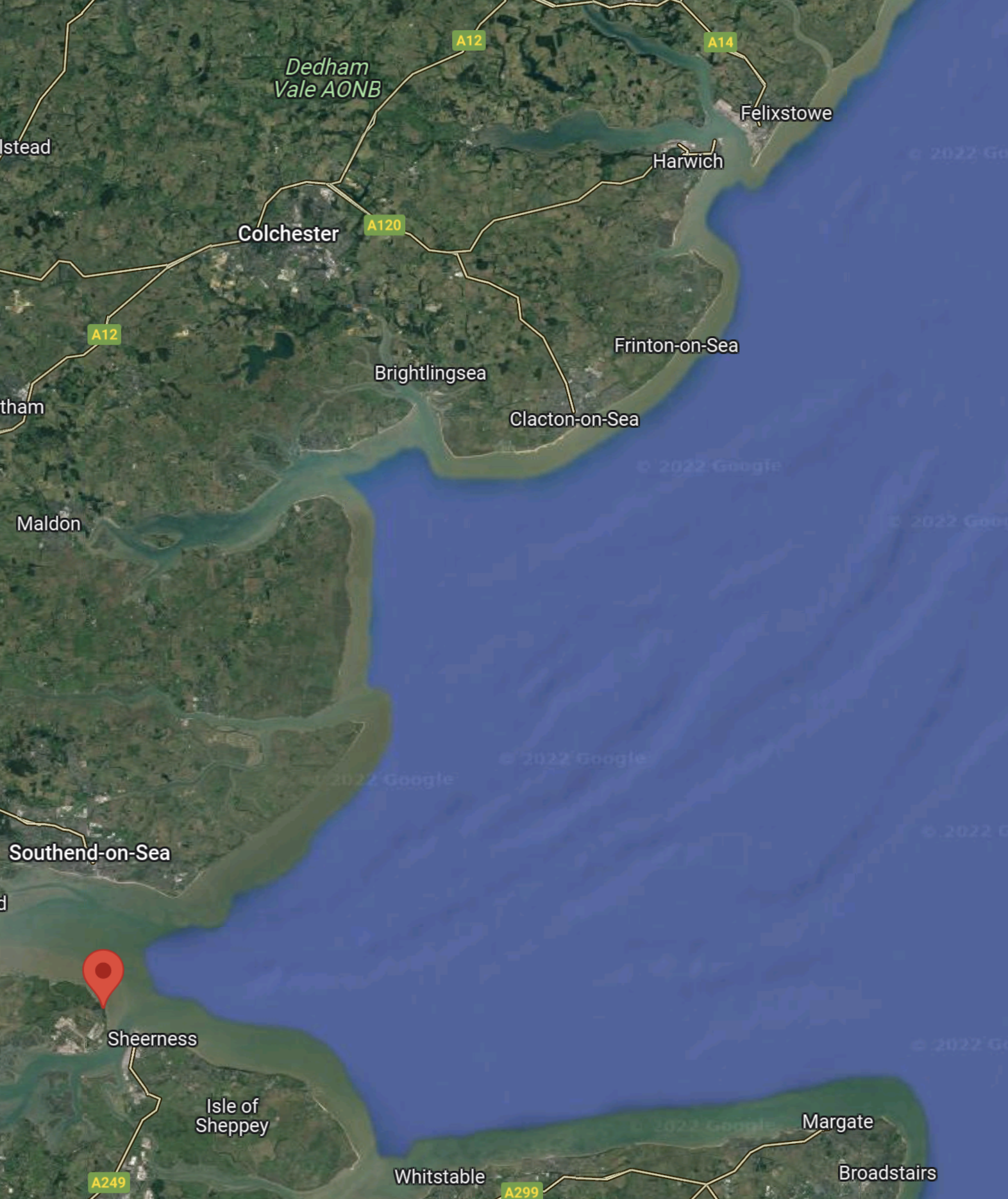
Note that the red arrow indicates the Isle of Grain.
This map from Wikipedia shows the wind farms in the area.
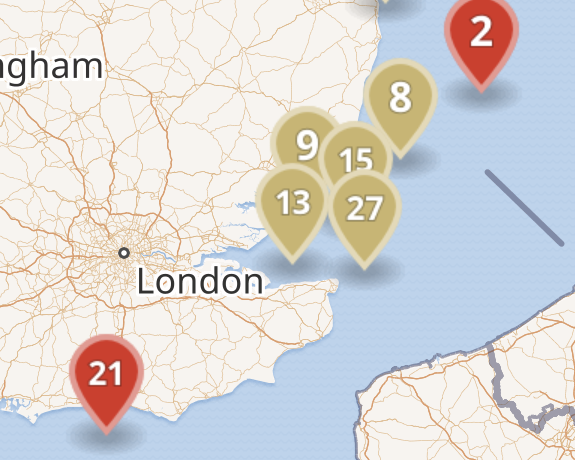
These are the ones that are operational.
- 2 – East Anglia Array – 714 MW
- 8 – Greater Gabbard – 504 MW
- 9 – Gunfleet Sands – 184 MW
- 13 – Kentish Flats – 140 MW
- 15 – London Array – 630 MW
- 27 – Thanet – 300 MW
Note.
- The Isle of Grain is just above the second o in London.
- I have ignored the Ramplion wind farm (21!), as it is too far from the Isle of Grain.
- This is a total of nearly 2.5 GW.
Planned extensions in the area include.
- East Anglia Array – 3.1 GW – Completion date of 2026
But the Wikipedia entry for the East Anglia Array says this about the wind farm.
The target capacity for the entire East Anglia Zone is 7200 MW which could require up to 1200 turbines.
Could we see one of the following?
- A connector from the East Anglia Array to the Isle of Grain.
- One or more new wind farms in the Thames Estuary connected to the Isle of Grain.
- German investment in a wind farm or farms connected to the Isle of Grain.
The Isle of Grain could become an island of energy providing power for London, the South-East of England, Germany and The Netherlands.
An Electrolyser On The Isle Of Grain
Consider.
- There will be plenty of renewable electricity.
- As there is a liquified natural gas terminal, there is plenty of gas storage.
- One or both of the gas-fired power stations can be converted to run on hydrogen.
- As more and more trucks are converted to hydrogen, there will be a large demand for hydrogen for heavy transport.
This must surely make a large electrolyser on the Isle of Grain a possibility.
The BritNed Interconnector
The BritNed interconnector is described like this in Wikipedia.
BritNed is a 1,000 MW high-voltage direct-current (HVDC) submarine power cable between the Isle of Grain in Kent, the United Kingdom; and Maasvlakte in Rotterdam, the Netherlands.
The BritNed interconnector would serve as a link for the foreseeable European super grid project.
Up to now, most of the electricity flow has been to the UK.
But surely, as more wind farms are developed power will flow the other way.
Wilhelmshaven Will Be A German Hub For Green Hydrogen
In Uniper To Make Wilhelmshaven German Hub For Green Hydrogen; Green Ammonia Import Terminal, I described plans by the Germans for a hydrogen hub at Wilhelmshaven.
The original story came from an article with the same name on Green Car Congress.
This is the first two paragraphs.
Under the name “Green Wilhelmshaven,” Germany-based international energy company Uniper plans to establish a German national hub for hydrogen in Wilhelmshaven and is working on a corresponding feasibility study.
Plans include an import terminal for green ammonia. The terminal will be equipped with an ammonia cracker for producing green hydrogen and will also be connected to the planned hydrogen network. A 410-megawatt electrolysis plant is also planned, which—in combination with the import terminal—would be capable of supplying around 295,000 metric tons or 10% of the demand expected for the whole of Germany in 2030.
As I said in the original post, I’m not happy about green ammonia, but the 1.4 GW NeuConnect interconnector has more than enough power to run a 410 MW electrolyser plant at full capacity.
It could even run three electrolysers of this size.
Hooksiel And Wilhelmshaven
NeuConnect will make landfall at Hooksiel.
This Google Map shows Hooksiel and Wilhelmshaven.
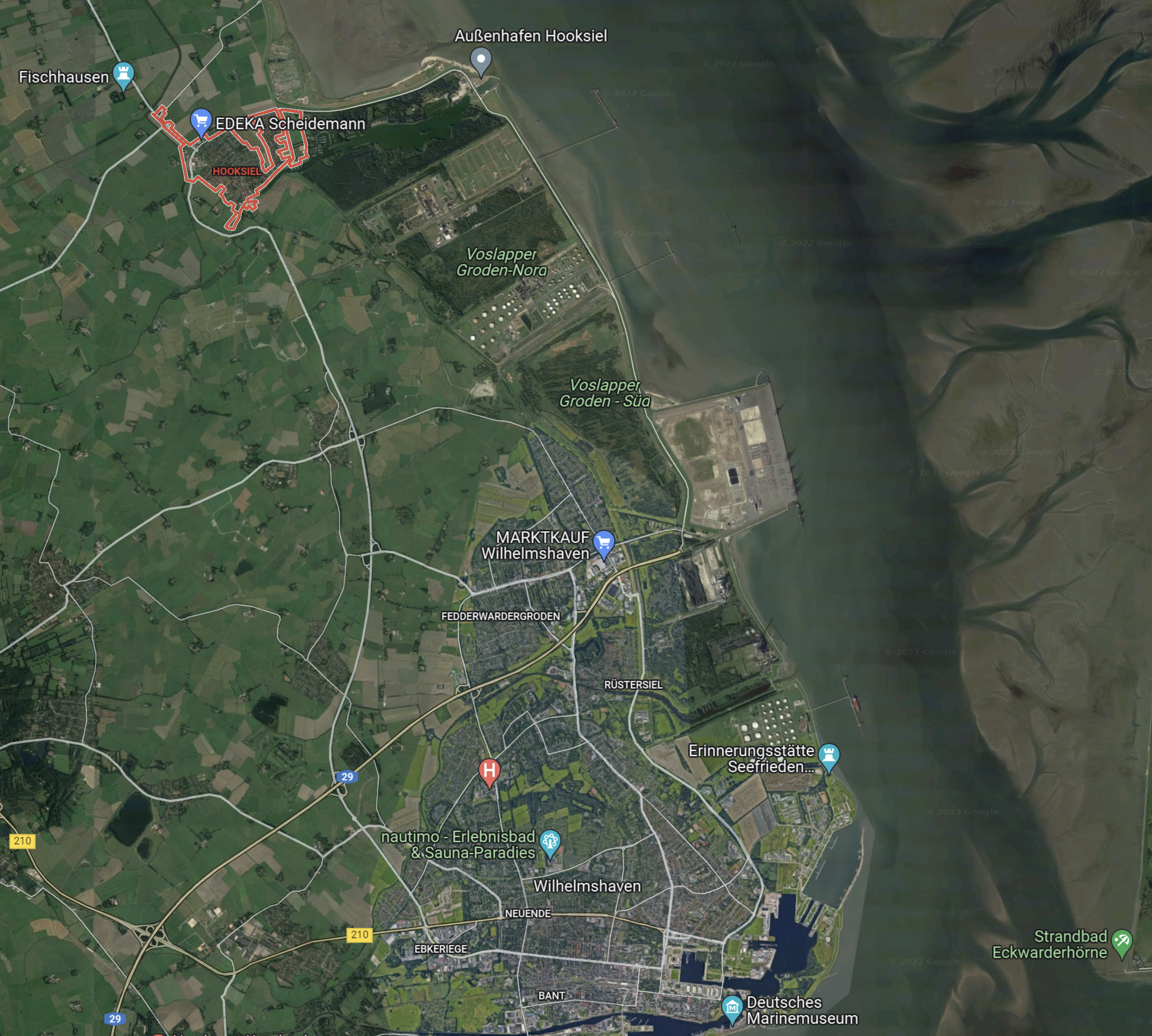
Note.
- Hooksiel is the village outlined in red.
- The water to the right of the map is the Jade Bight.
- The square block sticking out into the bight appears to be a container port.
- There appears to be chemical works or oil refineries North of the port.
- Wilhelmshaven is the town to the South of the port.
There would appear to be plenty of space for Uniper to construct Green Wilhelmshaven.
German And UK Wind Power Production
According to this page on Wikipedia, which is entitled Wind Power By Country, in 2020, these were installed wind power in various countries.
- Germany – 62,184 MW
- Spain – 27,089 MW
- UK – 24,665 MW
- France – 17,382 MW
- Italy – 10,389 MW
- Netherlands – 6,600 MW
In 2020 we were 37.5 GW behind Germany.
It looks like we’ll commission 3.3 GW this year and 6.1 in 2023, with Wikipedia saying that 12.9 GW is under development, which should close the gap to a certain extent.
In ScotWind Offshore Wind Leasing Delivers Major Boost To Scotland’s Net Zero Aspirations, I described how Scotland will add 15.1 GW of floating and 9.7 GW of fixed foundation offshore wind.
It looks like initially, we’ll be buying German wind-generated electricity, but in the future the direction could easily change around.
Boris And Olaf
There were mumblings from Boris, that energy was talked about in their meeting in Downing Street last week.
It does appear there is a lot of ways that the UK and Germany can co-operate in the future with respect to energy.
- German finance can be used to build wind farms in UK waters.
- German companies can build the turbines and the interconnectors we need to develop vast offshore wind farms.
- We can supply surplus energy to Germany through the NeuConnect interconnector.
I wouldn’t be surprised if Boris and Olaf had signed a very comprehensive energy co-operation agreement.
Armoured Vehicles For Ukraine
I have just listened to extracts of the press conference by Boris and Olaf on the BBC and there was talk of boxers.
Not the Mayor of Kyiv, the admirable Vitali Klitschko, but the German-produced armoured fighting vehicle.
Looking at the Wikipedia entry for the Boxer, it states that up to 1500 Boxers for the British Army will start to be delivered from an updated BAe factory in Telford this year, for entry into service in 2023. So with two factories in Europe and another in Australia, will this allow older armoured vehicles to be passed on to Ukraine?
Australia has already stated they will send the Ukraine twenty of their thousand Bushmasters.
Perhaps we could send Ukraine some Mastiffs.
Boris Johnson Wants To Build ‘Colossal’ Irish Sea Wind Farm Within A Year
The title of this post, is the same as that of this article in The Telegraph.
This is the sub-title.
Prime Minister tells industry leaders he has ‘a dream’ that giant floating wind farm could provide ‘gigawatts of energy’
These are the first three paragraphs of the article.
Boris Johnson is pushing energy firms to build a “colossal” offshore wind farm in the Irish Sea within 12 months.
The Prime Minister told industry leaders he has “a dream” that a giant floating wind farm could provide “gigawatts of energy and do it within a year”, according to a government source.
He was addressing wind energy firms at a round table discussion in Downing Street as the Government finalised its energy security strategy.
It is said in the article, that industry leaders smiled at the suggestion.
My feelings though are different and I wonder if Boris has been briefed by an offshore wind expert, who knows what they’re doing.
Quietly and unobtrusively, a new technology has been developed, that allows Boris the luxury to dream.
The World’s Largest Floating Wind Farm
In the UK, we are getting used to superlatives being applied to our offshore wind farms.
- According to Wikipedia at the current time, nine of the fifteenth largest offshore wind farms in the world are in the United Kingdom.
- The Hornsea wind farm, comprises the 1.4 GW Hornsea Two wind farm, which is the largest offshore wind farm in the world.
- Previously, the 1.2 GW Hornsea One wind farm was the largest offshore wind farm in the world.
In this article on offshoreWIND.biz, which is entitled World’s Largest Floating Offshore Wind Farm Fully Operational, this is said.
Located 15 kilometres off the coast of Aberdeenshire, Scotland, in water depths ranging from 60 metres to 80 metres, Kincardine is the largest operating floating wind farm.
The project consists of five Vestas V164-9.5 MW and one V80-2 MW turbine, each installed on WindFloat® semi-submersible platforms designed by Principle Power.
This picture from Cobra Group shows one of the turbines being towed into position at Kincardine.
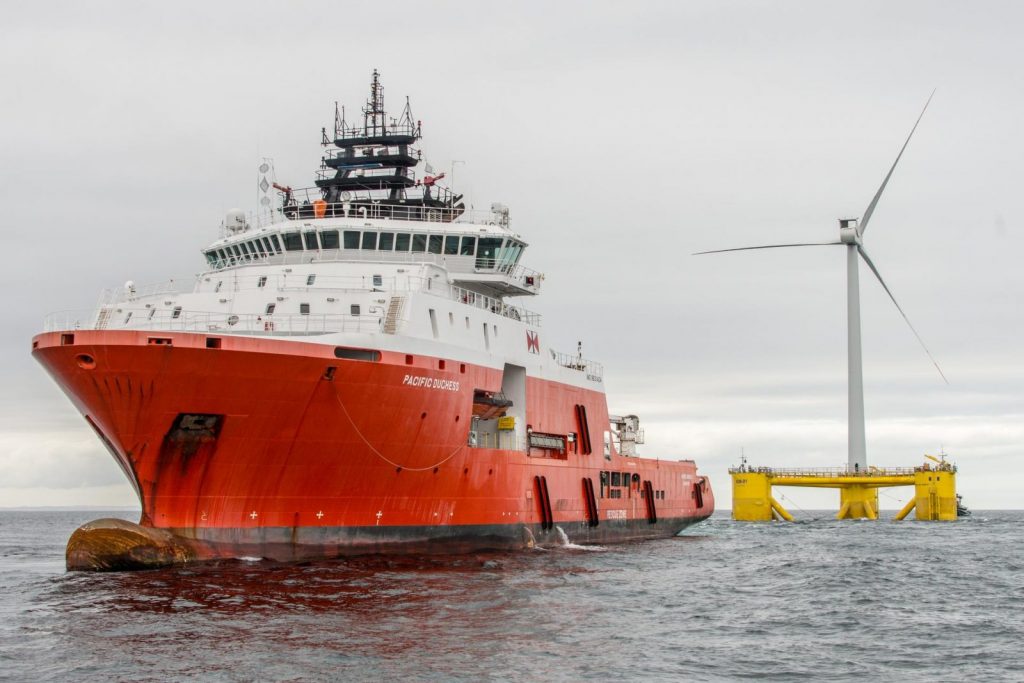
There are more pictures on this web page.
WindFloats would appear to be proven technology, as there are now two commercial wind farms using the technology and several others under development.
Erebus And Valorous
But Kincardine Wind Farm won’t be the world’s largest floating wind farm for long!
The next two wind farms, using the technology are Erebus and Valorous, who will provide a total of 400 MW from a company called Blue Gem Wind, which will use larger 14 MW turbines.
They will be installed to the South-West of the Pembrokeshire Coast.
Blue Gem Wind
Blue Gem Wind are based in Pembroke Dock and are a partnership of Simply Blue Energy, a pioneering Celtic Sea energy developer, and TotalEnergies.
Simply Blue Group are an Irish company, who are also working with Shell on the development of 1.35 GW of wind power to the West of Ireland.
50 GW Of Wind In The Celtic Sea
On the Projects page of the Blue Gem website, this is said about floating wind in the Celtic Sea.
Floating wind is set to become a key technology in the fight against climate change with over 80% of the worlds wind resource in water deeper than 60 metres. Independent studies have suggested there could be as much as 50GW of electricity capacity available in the Celtic Sea waters of the UK and Ireland. This renewable energy resource could play a key role in the UK meeting the 2050 Net-Zero target required to mitigate climate change. Floating wind will provide new low carbon supply chain opportunities, support coastal communities and create long-term benefits for the region.
Is this Boris’s project?
These are my thoughts.
How Many Turbines Would You Need For 50 GW?
If you need 7 x 14 MW turbines for each 100 MW, that would mean you need 3500 turbines and WindFloats for 50 GW.
How Would Each Turbine Be Installed?
It appears from pictures on the Cobra Group web site, that the turbine is mounted on the WindFloat using a large crane on a dock, whilst the WindFloat is alongside.
- The WindFloat and the turbine are then towed out into the desired position.
- It would then be anchored to the sea-bed.
- Finally, it would be connected to the power network.
I would doubt, that one team could probably install more than one turbine per day.
But I suspect more than one team could work in and out of one port at a time.
How Many Ports Could Be Used For Turbine Assembly?
As Blue Gem Wind is based in Pembroke Dock, I would assume that one of the ports would be on Milford Haven Waterway.
But there are other ports on the Welsh and Irish coasts, where the turbine lift could be accomplished.
How Much Capacity Could Be Installed In Twelve Months?
Suppose you had two ports doing assembly, with two teams working at each port, which would mean four turbines could be installed in a day.
- In a month, that would be 4 x 14 x 30 MW per month.
- This is nearly 1.7 GW per month or 20 GW per year.
It does appear to me, that floating wind farms with the right project management could be very much quicker to install than traditional fixed foundation wind turbines.
I believe that if we get the manufacturing and the project management right, that a colossal 20 GW of floating wind can be installed in twelve months.
Conclusion
Most people won’t believe Boris’s claim, but I feel that there is a degree of reality behind it, if we can produce four WindFloats and four turbines per day and enough cables and electrical gubbins to link them all together.
 The Anonymous Widower