The UK-Wide Need For Self-Powered Trains
How Many Diesel Trains Are In Service In The UK?
- Northern Trains – 73 x two-car and 6 x three-car.
- Great Western Railway – 20 x two-car.
- Transport for Wales – 36 x two-car.
- In Service – 129 x two-car and 6 x three-car.
These are 75 mph BR Second Generation trains.
- ScotRail – 5 x one-car.
- Transport for Wales – 31 x one-car.
- In Service – 36 x one-car.
- Stored – 27 x one-car.
These are 75 mph BR Second Generation trains.
- Northern Trains – 7 x two-car.
- In Service – 7 x two-car.
These are 75 mph BR Second Generation trains.
- Northern Trains – 58 x two-car.
- East Midlands Railway – 9 x two-car.
- ScotRail – 42 x two-car.
- In Service – 109 x two-car.
- Stored – 6 x two-car.
These are 75 mph BR Second Generation trains.
- ScotRail – 40 x two-car.
- Great Western Railway – 10 x two-car and 7 x three-car.
- East Midlands Railway – 26 x two-car.
- Northern Trains – 45 x two-car and 8 x three-car.
- Transport for Wales – 24 x two-car.
- South Western Railway – 10 x two-car.
- In Service – 155 x two-car and 15 x three-car.
These are 90 mph BR Second Generation trains.
- South Western Railway – 29 x three-car.
- In Service – 29 x three-car.
These are 90 mph BR Second Generation trains.
- Chiltern Railways – 39 x two-car.
- Great Western Railway – 20 x two-car and 16 x three-car.
- In Service – 59 x two-car and 16 x three-car.
These are 75 or 90 mph BR Second Generation trains.
- Great Western Railway – 21 x three-car.
- In Service – 21 x three-car.
These are 90 mph BR Second Generation trains.
- Chiltern Railways – 9 x two-car, 9 x three-car and 13 x four-car.
- In Service – 9 x two-car, 9 x three-car and 13 x four-car.
These are 100 mph Turbostar trains.
- CrossCountry – 7 x two-car and 22 x three-car.
- East Midlands Railway – 22 x two-car and 8 x three-car.
- Northern Trains – 16 x three-car.
- ScotRail – 17 x three-car.
- Transport for Wales – 8 x three-car.
- West Midlands Trains – 16 x three-car.
- In Service – 34 x two-car and 71 x three-car.
These are 100 mph Turbostar trains.
- Southern – 17 x three-car.
- In Service – 17 x three-car.
These are 100 mph Turbostar trains.
- West Midlands Trains – 24 x two-car and 15 x three-car.
- In Service – 24 x two-car and 15 x three-car.
These are 100 mph Turbostar trains.
- Transport for Wales – 9 x two-car and 15 x three-car.
- In Service – 9 x two-car and 15 x three-car.
- Stored – 2 x two-car and 1 x three-car.
These are 100 mph Coradia trains.
- Grand Central – 10 x five-car.
- East Midlands Railway – 1 x four-car and 2 x five-car.
- In Service – 1 x four-car and 12 x five-car.
These are 125 mph Coradia trains.
- TransPennine Express 51 three-car.
- In service – 51 three-car.
These are 100 mph Desiro trains.
- Northern Trains – 25 x two-car and 33 x three-car.
- In Service – 25 x two-car and 33 x three-car.
These are 100 mph CAF Civity trains.
- West Midlands Trains – 12 x two-car and 14 x four-car.
- In Service – 12 x two-car and 14 x four-car.
These are 100 mph CAF Civity trains.
- Northern Trains – 51 x two-car and 26 x three-car.
- In Service – 51 x two-car and 26 x three-car.
These are 100 mph CAF Civity trains.
- CrossCountry – 34 x four-car
- In Service – 34 x four-car
These are 125 mph Bombardier Voyager trains.
- Avanti West Coast -18 x five-cars
- CrossCountry – 24 x four-car.
- In Service – 24 x four-car and 18 x five-cars
- Stored – 2 x five-car
These are 125 mph Bombardier Voyager trains.
- CrossCountry – 23 x five-car and 4 x seven-car.
- In Service – 23 x five-car and 4 x seven-car.
These are 125 mph Bombardier Voyager trains.
- Transport for Wales – 11 x four-car.
- In Service – 11 x four-car.
These are 90 mph Stadler FLIRT bi-mode trains.
- Greater Anglia – 14 x three-car and 24 x four-car.
- In Service – 14 x three-car and 24 x four-car.
These are 100 mph Stadler FLIRT bi-mode trains.
- Transport for Wales – 7 x three-car and 17 x four-car.
- In Service – 7 x three-car and 17 x four-car.
These are 75 mph Stadler FLIRT bi-mode trains.
- Great Western Railway – 21 x five-car and 36 x nine-cars.
- LNER – 10 x five-car and 13 x nine-cars.
- In Service – 31 x five-car and 49 x nine-cars.
These are 125 mph Hitachi AT-300 trains.
- Great Western Railway – 22 x five-car and 14 x nine-cars.
- Hull Trains – 5 x five-car.
- TransPennine Express – 19 x five-car.
- In Service – 46 x five-car and 14 x nine-cars.
These are 125 mph Hitachi AT-300 trains.
- Avanti West Coast – 13 x five-car.
- In Service – 13 x five-car.
These are 125 mph Hitachi AT-300 trains.
- East Midlands Railways – 33 x five-car.
- In Service – 33 x five-car.
These are 125 mph Hitachi AT-300 trains.
These trains give totals as follows.
- One-car – 36
- Two-car – 601
- Three-car – 249
- Four-car – 135
- Five-car – 176
- Seven-car – 4
- Nine-car – 63
That is a total of 1254 trains that need to be decarbonised by either replacement or modification.
- Some trains are effectively double-counted, as both the current trains and their replacements are included.
- Some trains are planned to be replaced by electric trains.
- Some trains will be passed on.
But there are still a lot of trains to be decarbonised.
I will now look at each group in detail.
BR Second Generation Trains
- Class 150 – 129 x two-car and 6 x three-car.
- Class 153 – 36 x one-car.
- Class 155 – 7 x two-car.
- Class 156 – 109 x two-car.
- Class 158 – 155 x two-car and 15 x three-car.
- Class 159 – 29 x three-car.
- Class 165 – 59 x two-car and 16 x three-car.
- Class 166 – 21 x three-car.
Note.
- The trains have mostly Cummins engines, with some Perkins and a spattering of Rolls-Royce.
- Class 150,153, 155 and 156 trains are 75 mph trains and most of the others are capable of 90 mph.
- Condition of the interiors is variable, with some being excellent and others being terrible.
- There are 36 x one-car, 459 x two-car and 59 x three-car.
- There appears to be no plan to decarbonise these trains.
- Some will be replaced by new CAF diesel trains or new electric trains.
The best use of some of the better trains in this group would be to fill-in until zero-carbon trains are available.
Turbostar Trains
These trains are all Turbostars or their predecessor.
- Class 168 – 9 x two-car, 9 x three-car and 13 x four-car.
- Class 170 – 34 x two-car and 71 x three-car.
- Class 171 – 17 x three-car.
- Class 172 – 24 x two-car and 15 x three-car.
Note.
- The trains all have Rolls-Royce mtu engines.
- They are capable of 100 mph.
- Condition of the interiors is generally good.
- There are 67 x two-car, 112 x three-car and 13 x four-car.
- Rolls-Royce mtu engines may be able to run on sustainable fuel like Hydrotreated Vegetable Oil (HVO).
- 168329 has been converted into a diesel-hybrid, by Rolls-Royce mtu.
I feel that one way or another, the trains in this group should be capable of converting to net-zero operation.
Alstom Coradia, Bombardier Voyager and Siemens Desiro Trains
I am putting these trains together, as they are all 100-125 mph long-distance trains, that are not that old.
- Class 175 – 9 x two-car and 15 x three-car.
- Class 180 – 1 x four-car and 12 x five-car.
- Class 185 – 51 x three-car.
- Class 220 – 34 x four-car
- Class 221 – 24 x four-car and 18 x five-cars
- Class 222 – 23 x five-car and 4 x seven-car.
Note.
- The trains all have Cummins engines.
- They are capable of 100 mph or 125 mph.
- Condition of the interiors is generally good.
- There are 9 x two-car, 66 x three-car, 59 x four-car, 53 five-car and 4 x seven-car.
- Cummins engines may be able to run on sustainable fuel like Hydrotreated Vegetable Oil (HVO).
- In Grand Central DMU To Be Used For Dual-Fuel Trial, I described innovative fuel trails in a Class 180 train.
- I suspect Cummins will be taking an interest.
In Cummins And Leclanché S.A. To Collaborate On Lower-Emissions Solutions For Use In Marine And Rail Applications, I asked this question.
How many of these trains could be converted to hybrid operation, if Cummins and Leclanché were to create their version of the mtu Hybrid PowerPack?
I feel that one way or another, the trains in this group should be capable of converting to net-zero operation.
CAF Civity Trains
These three trains have all been recently introduced
- Class 195 – 25 x two-car and 33 x three-car.
- Class 196 – 12 x two-car and 14 x four-car.
- Class 197 – 51 x two-car and 26 x three-car.
Note.
- The trains all have Rolls-Royce mtu engines.
- They are capable of 100 mph.
- Condition of the interiors is probably as-new!
- There are 88 x two-car, 59 x three-car and 14 x four-car.
- All these trains were ordered between 2016 and 2018.
- Rolls-Royce mtu engines may be able to run on sustainable fuel like Hydrotreated Vegetable Oil (HVO).
I don’t believe that as these trains were only ordered a few years ago, that the trains were bought with the knowledge of a route which would convert these trains to net-zero operation.
I suspect the most likely route to net-zero operation, would involve the following.
- Replacing the Rolls-Royce mtu engines with mtu Hybrid PowerPacks.
- Running the trains on sustainable fuel.
The work needed would probably be the same for all trains.
Stadler FLIRT Bi-Mode Trains
- Class 231 – 11 x four-car.
- Class 755 – 14 x three-car and 24 x four-car.
- Class 756 – 7 x three-car and 17 x four-car.
Note.
- The trains all have Rolls-Royce mtu engines.
- They are capable of between 75 and 100 mph.
- Condition of the interiors is probably as-new!
- There are 21 x three-car and 52 x four-car.
- All these trains were ordered between 2016 and 2018.
- As with other recently ordered trains, I am fairly sure that the Deutz engines will be able to run on sustainable fuel like Hydrotreated Vegetable Oil (HVO).
Stadler have designed these trains, so that diesel engines can be replaced by battery packs.
I suspect the most likely route to net-zero operation, would involve the following.
- Replacing all or some the Deutz engines with battery packs.
- Running the trains on sustainable fuel.
The work needed would probably be the same for all trains.
Hitachi AT-300 Trains
Only the bi-mode trains are lists.
- Class 800 – 31 x five-car and 49 x nine-car.
- Class 802 – 46 x five-car and 14 x nine-car.
- Class 805 – 13 x five-car.
- Class 810 – 33 x five-car.
Note.
- The trains all have Rolls-Royce mtu engines.
- They are capable of 125 mph.
- Condition of the interiors is probably as-new!
- There are 123 x three-car and 63 x nine-car.
- Most were built after 2016.
- Rolls-Royce mtu engines may be able to run on sustainable fuel like Hydrotreated Vegetable Oil (HVO).
- Hitachi are developing battery packs for these trains.
I suspect the most likely route to net-zero operation, would involve the following.
- Replacing all or some the Rolls-Royce mtu engines with battery packs.
- Running the trains on sustainable fuel.
The work needed would probably be the same or similar for all trains.
High Speed Two To Crewe
There has been a lot of speculation about the Northern end of High Speed Two, so I might as well add sort out a few facts and add a bit of speculation of my own.
Sample Times Between London And Crewe
These are selected times from the 27th September 2023.
- 07:30 – Glasgow Non-Stop – 1:29
- 07:33 – Manchester Piccadilly – 1:37 – Stops at Stafford
- 07:43 – Liverpool Lime Street – 1:40 – Stops at Milton Keynes
- 08:30 – Glasgow Non-Stop – 1:29
- 08:33 – Manchester Piccadilly – 1:37 – Stops at Stafford
- 08:43 – Liverpool Lime Street – 1:40 – Stops at Milton Keynes
- 09:02 – Holyhead – 1:40 – Stop at Stafford
- 15:02 – Chester – 1:40 – Stops at Tamworth, Lichfield Trent Valley and Stafford
Note.
- The 07:30 and 08:30 Glasgow services appears to be pathed for one of the Class 390 Pendolino electric trains and were run by Pendolinos.
- The 07:33 and 08:33 Manchester services appears to be pathed for one of the Pendolino electric trains and were run by Pendolinos.
- The 07:43 and 08:43 Liverpool services appears to be pathed for one of the new Class 807 electric trains, but were run by Pendolinos.
- The 15:02 Chester service appears to be pathed for one of the new Class 805 bi-mode trains.
- All services except the Glasgow services stop at Crewe.
- As London Euston and Crewe is 158 miles, the non-stop Glasgow services average 107 mph, the one-stop Manchester service averages 98 mph and the one-stop Liverpool service averages 95 mph.
I have some further thoughts.
How Long Does A Stop Take?
I’ve looked at some stops of Glasgow, Liverpool and Manchester services
Crewe
Looking at timings between Weaver Junction and Norton Bridge, I have found the following times.
- Glasgow-Euston – 23 minutes
- Liverpool-Euston – 28 minutes
Note.
- Manchester services don’t go through Weaver Junction.
- Weaver Junction and Norton Bridge are respectively North and South of Crewe.
- The Liverpool service stops at Crewe, where it has a dwell time of two minutes.
- The Glasgow service goes straight through Crewe.
The Crewe stop takes a total of 5 minutes of which 3 minutes are deceleration and acceleration to and from linespeed.
Stafford
Looking at timings between Norton Bridge and Colwich, I have found the following times.
- Glasgow-Euston – 7½ minutes
- Liverpool-Euston – 7½ minutes
- Manchester -Euston – 14 minutes
Note.
- Norton Bridge and Colwich are respectively North and South of Stafford.
- The Manchester service stops at Stafford, where it has a dwell time of two minutes.
- The Glasgow and Liverpool services go straight through Stafford.
The Stafford stop takes a total of 6½ minutes of which 4½ minutes are deceleration and acceleration to and from linespeed.
Milton Keynes
Looking at timings between Weedon and Bletchley, I have found the following times.
- Glasgow-Euston – 11½ minutes
- Liverpool-Euston – 16 minutes
- Manchester -Euston – 12½ minutes
Note.
- Weedon and Bletchley are respectively North and South of Milton Keynes.
- The Liverpool service stops at Milton Keynes, where it has a dwell time of one minute.
- The Glasgow and Manchester services go straight through Milton Keynes.
The Milton Keynes stop takes a total of 4 minutes of which 3 minutes are deceleration and acceleration to and from linespeed.
Average Speeds Between Crewe And London
London Ruston and Crewe is 158 miles according to Real Time Trains.
So what would times would various average speeds deliver?
- 100 mph – 95 minutes
- 110 mph – 86 minutes
- 120 mph – 79 minutes
- 125 mph – 76 minutes
- 130 mph – 73 minutes
- 140 mph – 68 minutes
Obviously, any average speed with over 125 mph running, will need full digital signalling.
Liverpool And London In Two Hours
Tucked away beside the Grand Union Sets Out Stirling Ambitions article in the December 2022 Edition of Modern Railways is a report on Avanti West Coast’s application for a second service between Euston and Liverpool.
This is said.
Avanti West Coast has applied for access rights for its second hourly Euston to Liverpool service, starting from December 2023, although a phased introduction of the new service is likely. This would make use of Avanti’s new fleet of 10×7-car Class 807 Hitachi EMUs, which are expected to enter service from Autumn 2023. The ‘807s’ would be deployed on the current hourly Liverpool service, on which a call at Liverpool South Parkway would be added. (provision is made for this in the December 2022 timetable.).
Pendolinos would then operate the second service each hour, calling at Lichfield Trent Valley and Tamworth.
A linespeed project is in progress to raise the permissible speed for non-tilting trains on the West Coast Main Line, and Avanti’s new Hitachi trains will take advantage of this.
I’ll take a quick look at the Crewe and Runcorn section.
- It is 22.5 miles.
- It takes 19 minutes.
- That is an average speed of 71 mph.
- Crewe and Weaver Junction has a speed limit of at least 110 mph
- Runcorn and Weaver Junction has a speed limit of at least 90 mph for most of the way.
- If with their superior performance, the new Class 807 trains could average 90 mph between Crewe and Runcorn, they would take 15 minutes.
- Achieving the 90 mph average may need a bit of track realignment and some signaling changes.
The four minutes saved would be enough to handle the extra stop at Liverpool South Parkway.
Consider.
- Currently, Pendolino trains do Liverpool and Crewe in 38 minutes, which includes the stop at Runcorn.
- My calculation with the Class 807 trains, shows that with a bit of extra signalling, the new trains could do Liverpool and Crewe in 38 minutes with the two stops.
- The stop at Crewe will subtract 5 minutes from the base journey time.
- The stop at Milton Keynes will subtract 4 minutes from the base journey time.
This means the base journey time between Crewe and London will be 73 minutes.
This would indicate that the trains would be running at 130 mph to achieve the two hours.
But there are five accelerations and five decelerations on a journey between London and Liverpool and the new Class 807 trains are the Lotuses of Hitachi’s family of AT-300 trains; lightweight and powerful.
Suppose they could save thirty seconds for each acceleration and deceleration.
The base journey time between Crewe and London will be 78 minutes.
This would indicate that the trains would be running at over 120 mph to achieve the two hours.
I certainly feel, that Liverpool and London in two hours is certainly possible using the new Class 807 trains.
London and Crewe with two stops would be times at one hour and twelve minutes.
But what about the Pendolinos?
- My last return trip from Liverpool did a practice call at Liverpool South Parkway and still arrived in London a few minutes early.
- The Pendolinos will still benefit from any improvements, between Crewe and Runcorn, which could reduce the Liverpool and Crewe time from 38 minutes to 34 minutes.
- The stop at Crewe will subtract 5 minutes from the base journey time.
- The stops at Lichfield Trent Valley and Tamworth will both subtract 4 minutes from the base journey time.
This means the base journey time between Crewe and London will be 73 minutes, which is the same as for the Class 807 trains.
This would indicate that the trains would be running at 130 mph to achieve the two hours.
Could this average speed be achieved by the selective application of full digital signalling, perhaps on the Trent Valley Line?
But it does appear to me, that the Pendolinos can get very close to two hours between London and Liverpool.
London and Crewe with three stops would be times at one hour and sixteen minutes.
Crewe And London Non-Stop
Consider.
- Pendolinos between London and Glasgow, go non-stop between London and Crewe.
- I have calculated that Pendolinos between London and Liverpool, will take one hour and sixteen minutes with three stops between London and Crewe.
- The three stops take a total of thirteen minutes.
I wouldn’t be surprised to see London and Glasgow Pendolinos take one hour and three minutes between London and Crewe.
This would knock twenty-six minutes off journey times between London and Glasgow.
Conclusion
I believe that with relatively minor improvements on the West Coast Main Line and the Liverpool branch, the following can be achieved.
- Liverpool and London can be around two hours with new Class 807 trains or Pendolinos.
- Liverpool and London services can increase their calls in the Midlands.
- London and Glasgow services can be nearly half-an-hour faster.
- The fastest London and Crewe services could be just over an hour using Pendolinos.
I also believe that the only serious infrastructure needed is some track realignment and some updated signalling.
See Also
Could High Speed Two Finish At Lichfield?
Should There Be Five-Car High Speed Two Classic-Compatible Trains?
The High Speed Two Classic-Compatible Trains have the following characteristics.
- Eight cars.
- 200 metres long.
- 550 passengers.
- Two can be coupled together to make a 16-car train, that is 400 metres long.
- Trains can join and split en route.
This graphic shows the preliminary schedule.
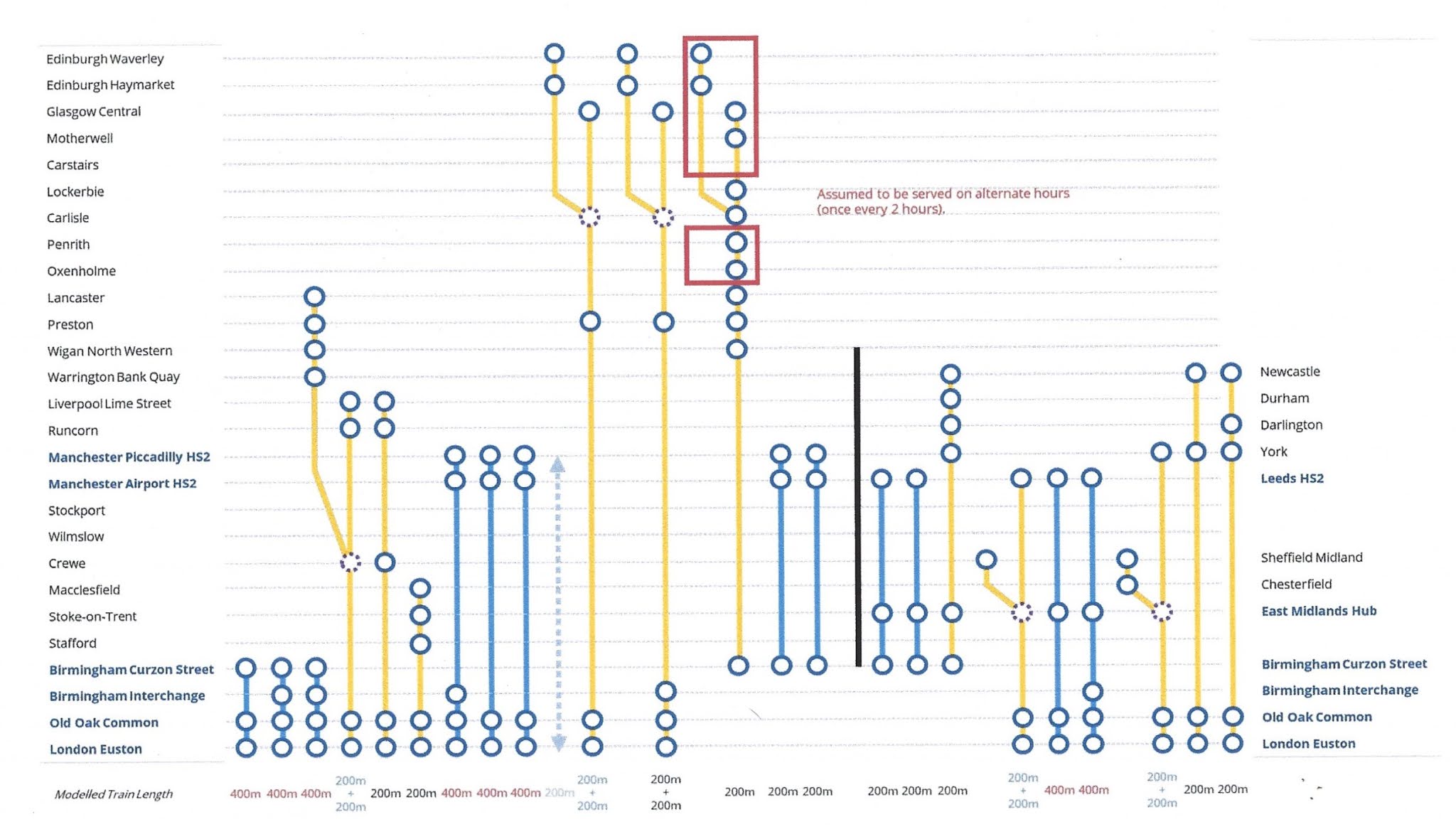
Note that Train 4, starts as a pair of trains, before splitting at Crewe, with one train going to Lancaster and the other to Liverpool Lime Street.
I wonder, if some trains were to be five-cars, would this give the operator more flexibility, by allowing three trains to be coupled together to serve three destinations.
This could be a simple example.
- A three train formation could leave Euston.
- At Crewe one train would detach and go to Liverpool Lime Street, with stops at Runcorn and Liverpool South Parkway.
- At Preston, the two remaining trains would split, with one train going to Lancaster and the other going to Blackpool with appropriate stops.
Three trains might give the operators more flexibility in providing appropriate capacity to various destinations.
Other Applications
I believe these trains would have other applications.
These are a few thoughts.
Battery-Electric High Speed Train
Battery technology is improving and I believe that a train could be designed with the following specification.
- Five cars
- High-Speed Two Classic-Compatible performance.
- A battery pack in each car.
- Up to maximum operating speed of digitally-signalled high speed lines.
- 140 mph on digitally-signalled classic high speed lines, like the East and West Coast Main Lines. the Midland Main Line and the Great Western Railway.
- Range on battery of around 120 miles at 100 mph.
- Ability to work with fully-electric versions.
Note.
- I suspect that like current Hitachi AT-300s and Bombardier Aventras, the onboard computer would know what cars have been coupled together and what the train can do.
- A battery in each car would distribute the extra weight of the batteries equally and not affect the handling too much.
- These trains would allow High Speed Two services to be extended onto non-electrified lines.
I suspect that an eight car battery-electric High-Speed Two Classic-Compatible train would also be possible for working with the standard length trains.
Northern Powerhouse Rail – Significant Upgrades Of The East Coast Main Line From Leeds To Newcastle (Via York And Darlington) And Restoration Of The Leamside Line
In this article on Transport for the North, which is entitled Northern Powerhouse Rail Progress As Recommendations Made To Government, one of the recommendations proposed for Northern Powerhouse Rail is significant upgrades to the East Coast Main Line and reopening of the Leamside Line.
Northern Powerhouse Rail’s Objective For The Leeds and Newcastle Route
Wikipedia, other sources and my calculations say this about the trains between Leeds and Newcastle.
- The distance between the two stations is 106 miles
- The current service takes around 85 minutes and has a frequency of three trains per hour (tph)
- This gives an average speed of 75 mph for the fastest journey.
- The proposed service with Northern Powerhouse Rail will take 58 minutes and have a frequency of four tph.
- This gives an average speed of 110 mph for the journey.
This last figure of 110 mph, indicates to me that a faster route will be needed.
These are example average speeds on the East Coast Main Line.
- London Kings Cross and Doncaster – 156 miles – 98 minutes – 95.5 mph
- London Kings Cross and Leeds – 186 miles – 133 minutes – 84 mph
- London Kings Cross and York – 188.5 miles – 140 minutes – 81 mph
- London Kings Cross and Hull – 205.3 miles – 176 minutes – 70 mph
- York and Newcastle – 80 miles – 66 minutes – 73 mph
I also predicted in Thoughts On Digital Signalling On The East Coast Main Line, that with full digital in-cab ERTMS signalling and other improvements, that both London Kings Cross and Leeds and York would be two-hour services, with Hull a two-and-a-half service.
- London Kings Cross and Leeds in two hours would be an average speed of 93 mph.
- London Kings Cross and York in two hours would be an average speed of 94.2 mph.
- London Kings Cross and Hull in two-and-a-half hours would be an average speed of 94.2 mph.
I am fairly certain, that to achieve the required 110 mph average between Leeds and Newcastle to meet Northern Powerhouse Rail’s objective of four tph in under an hour will need, at least the following.
- Full digital in-cab ERTMS signalling
- Completion of the electrification between Leeds and York.
- Ability to run at up to 140 mph in places.
- Significant track upgrades.
It could also eliminate diesel traction on passenger services on the route.
High Speed Two’s Objective For The York and Newcastle Route
At the present time, High Speed Two is not planning to run any direct trains between Leeds and Newcastle, so I’ll look at its proposed service between York and Newcastle instead.
- Current Service – 80 miles – 66 minutes – 73 mph
- High Speed Two – 80 miles – 52 minutes – 92 mph
Note.
- High Speed Two will be running three tph between York and Newcastle.
- Northern Powerhouse Rail have an objective of 58 minutes for Leeds and Newcastle.
High Speed Two and Northern Powerhouse Rail do not not have incompatible ambitions.
Current Direct Leeds And Newcastle Services
These are the current direct Leeds and Newcastle services.
- TransPennine Express – 1 tph – Liverpool Lime Street and Edinburgh
- TransPennine Express – 1 tph – Manchester Airport and Newcastle.
- CrossCountry – 1 tph – Plymouth and Edinburgh
Timings appear to be between 81 and 91 minutes.
What Would A Leeds And Newcastle In Under An Hour Do For London Kings Cross And Edinburgh Timings?
This question has to be asked, as a 58 minute time between Leeds and Newcastle will mean that timings between York and Newcastle must reduce.
York And Newcastle at various average speeds give the following times.
- 73 mph (current average) – 66 minutes
- 80 mph – 60 minutes
- 90 mph – 53 minutes
- 92 mph – 52 minutes (High Speed Two promise)
- 100 mph – 48 minutes
- 110 mph – 44 minutes
If any speed over 90 mph can be averaged between York and Newcastle, this means that with a London and York time of under two hours the following times are possible.
- London Kings Cross and Newcastle in under three hours. – High Speed Two are promising two hours and seventeen minutes.
- London Kings Cross and Edinburgh in under four hours. – High Speed Two are promising three hours and forty minutes.
Consider.
- An InterCity 225 achieved a time of under three-and-a-half hours between London and Edinburgh. in 1991.
- That record journey was at an average speed of 112 mph.
- There must be opportunities for speed improvements North of Newcastle.
- Train and signalling technology is improving.
- High Speed Two is promising three hours and forty minutes between London and Edinburgh.
I can see a fascinating rivalry between trains on High Speed Two and the East Coast Main Line, developing, about who can be faster between London and Edinburgh.
Current Projects Between Leeds And Newcastle
These projects are in planning or under way on the section of the East Coast Main Line between Leeds and Newcastle.
Phase 2 Of The East Coast Main Line Power Supply Upgrade
Phase 1 between London and Doncaster should have been completed, if the covids allowed and now work can be concentrated on Phase 2 to the North of Doncaster.
This page on the Network Rail web site describes the project. These paragraphs are the introduction to Phase 2.
Phase 2 of the project will involve the installation of feeder and substations along the route, capacity upgrades, new 132kv connection at Hambleton junction and upgrades to existing power supply connections.
The second phase of the project is currently in design stages and dates for carrying out the work are still being finalised.
Phase 2 will be delivering upgraded power to the East Coast Mainline railway between Bawtry and Edinburgh.
This project may not improve speeds on the railway, but it will certainly improve reliability and reduce the use of diesel power.
I do wonder, that as the reliability of the East Coast Main Line increases, this will reduce the need for the electric Class 801 trains, to have diesel engines for when the power supply fails.
It is known, that the Class 803 trains, that are under construction for East Coast Trains, will have only a small battery for emergency use.
A sensible weight saving would surely improve the acceleration and deceleration of the trains.
York to Church Fenton Improvement Scheme
This page of the Network Rail web site, describes the project. These paragraphs introduce the project.
Our work between York and Church Fenton is in preparation for the Transpennine Upgrade, which will provide more capacity and faster journeys between Manchester Victoria and York, via Leeds and Huddersfield.
The five mile stretch between Church Fenton and Colton Junction – the major junction where trains from Leeds join the East Coast Main Line towards York – sees over 100 trains each day, with up to one freight or passenger train passing through every five minutes. This is one of the busiest stretches of railway in the North.
The work will include.
- Modernising the signalling.
- Replacing about five miles of track between Holgate (York) and Colton Junction.
- Completing the eleven miles of electrification between York and Church Fenton stations.
I estimate that when the project is completed, there will be only around thirteen miles of track without electrification between Church Fenton station and Neville Hill TMD in Leeds.
The route between Church Fenton and Garforth stations, is shown in this map clipped from High Speed Two.
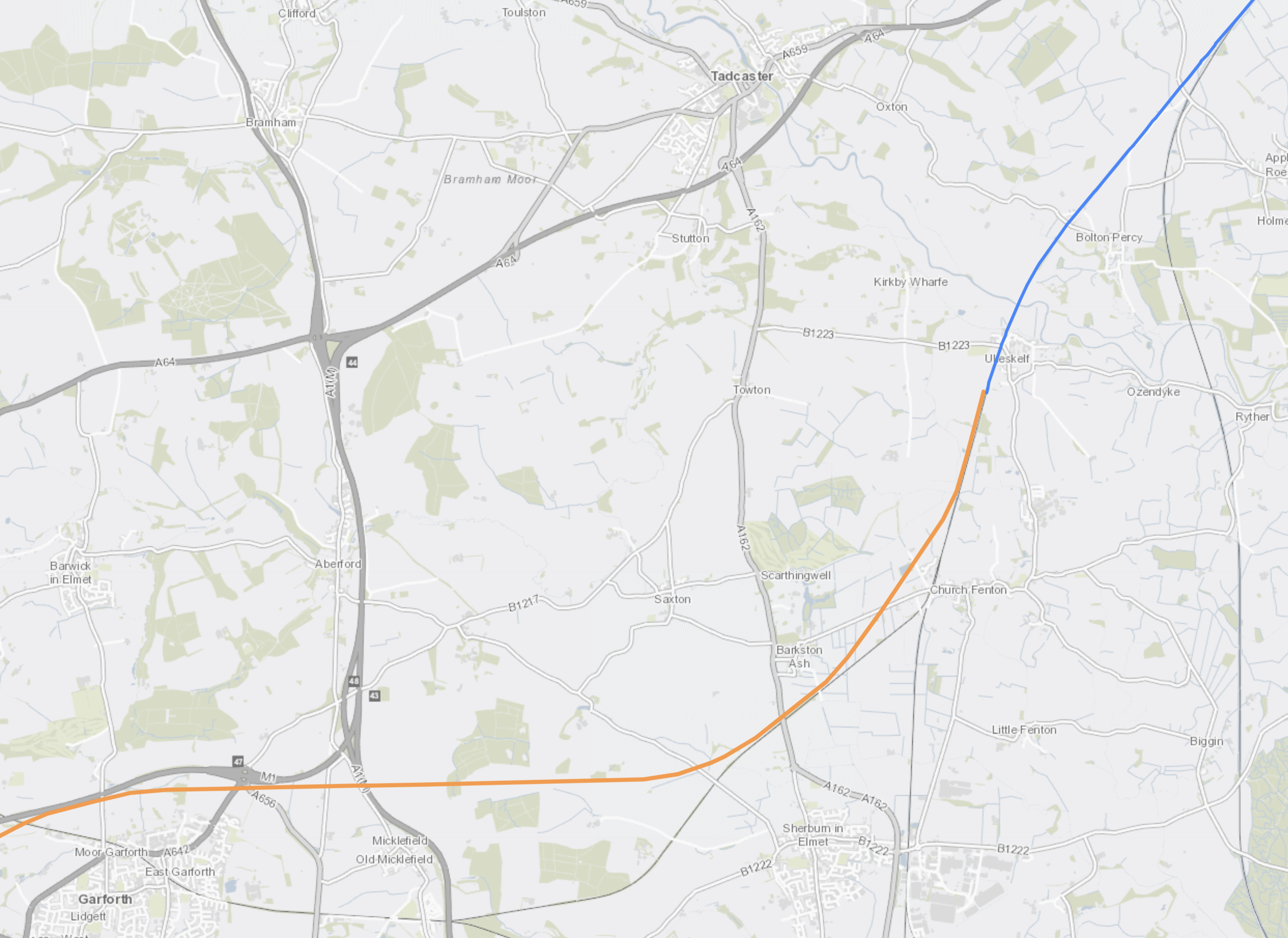
Note.
- York is just off the North-East corner of the map.
- Garforth is in the South-West corner of the map.
- Shown in orange is the new route of High Speed Two from East of Leeds towards York.
- Shown in blue is existing tracks, that will be used to take High Speed Two Trains to York and further North.
- The rail line running North-South on the edge of the map is the Selby Diversion, which opened in 1983 and was built to avoid possible subsidence from the Selby coalfield.
- The pre-Selby Diversion route of the East Coast Main Line goes South from the join of the blue and orange sections of High Speed Two.
- At Church Fenton station, this route splits, with one route going West through Micklefield, East Garforth and Garforth stations to Neville Hill TMD and Leeds.
- The main road going North-South is the A1 (M).
It seems to me, that High Speed Two’s and Northern Powerhouse Rail’s plans in this area, are still being developed.
- There has been no decision on the electrification between Church Fenton and Neville Hill TMD.
- How do Northern Powerhouse Rail trains go between Leeds and Hull?
- How do Northern Powerhouse Rail trains go between Leeds and York?
- How do High Speed Two trains go between Leeds and York?
I suspect, when the full plans are published, it will answer a lot of questions.
Darlington Station Remodelling
A remodelling of Darlington station is under consideration.
I outlined this in £100m Station Revamp Could Double Local Train Services.
This was my conclusion in the related article.
I think that this will happen.
-
- The Tees Valley Line trains will be greatly improved by this project.
- Trains will generally run at up to 140 mph on the East Coast Main Line, under full digital control, like a slower High Speed Two.
- There will be two high speed platforms to the East of the current station, where most if not all of the High Speed Two, LNER and other fast services will stop.
- There could be up to 15 tph on the high speed lines.
With full step-free access between the high speed and the local platforms in the current station, this will be a great improvement.
It will create a major interchange, where high speed trains from High Speed Two, LNER and Northern Powerhouse Rail will do the following.
- Approach at 140 mph or more.
- Perform a controlled stop in the station.
- Drop and pick-up passengers.
- Accelerate back up to linespeed.
The station stop will be highly-automated and monitored by the driver.
One of the objectives would be to save time for all fast trains.
Capacity And Other Problems Between Leeds And Newcastle Listed In Wikipedia
These problems are listed in a section called Capacity Problems in the Wikipedia entry for the East Coast Main Line.
The North Throat Of York Station Including Skelton Bridge Junction
I describe this problem and my solution in Improving The North Throat Of York Station Including Skelton Bridge Junction.
Use Of The Leamside Line
Wikipedia says this about capacity to the South of Newcastle.
South of Newcastle to Northallerton (which is also predominately double track), leading to proposals to reopen the Leamside line to passenger and freight traffic.
I could have included it in the previous section, but as it such a important topic, it probably deserves its own section.
Looking at maps, reopening is more than a a possibility. Especially, as reopening is proposed by Northern Powerhouse Rail and mentioned in the title of this post.
I discussed the Leamside Line in detail in Boris Johnson Backs Station Opening Which Could See Metro Link To County Durham, which I wrote in June this year.
These are some extra thoughts, that update the original post.
Ferryhill Station
I was prompted to write the related post, by something Boris Johnson said at PMQs and it was mainly about Ferryhill station.
In the latest copy of this document on the Government web site, which is entitled Restoring Your Railway: Successful Bids, a new station at Ferryhill has been successful. Another bid in the same area to restore rail services between Consett and Newcastle has also been successful.
This map shows the East Coast Main Line as it goes North South between Durham and Darlington.
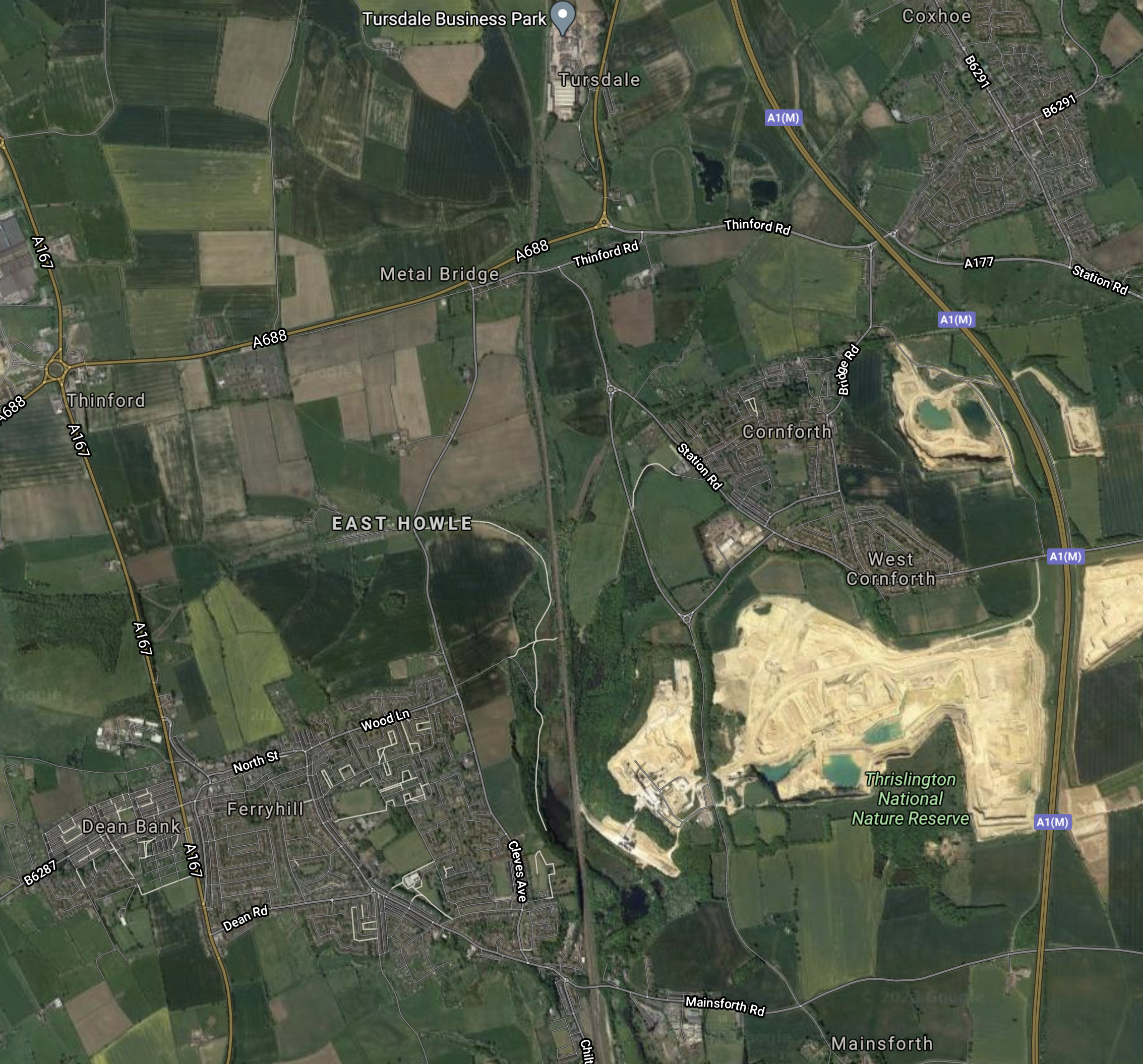
Note.
- Ferryhill is in the South-West of the map opposite the sand-pits in the South-East
- The East Coast Main Line runs North-South between the village an d the sand-pits.
- Follow the railway North and you come to Tursdale, where there is a junction between the East Coast Main Line and the Leamside Line.
- The East Coast Main Line goes North-Westerly towards Durham and Newcastle.
- The Leamside Line goes North to Washington and Newcastle.
- There is also the Stillington Freight Line going South-Easterly to Sedgefield and Stockton from Ferryhill.
Could Ferryhill be a useful interchange to local services connecting to Newcastle, Sunderland and Washington in the North and Hartlepool, Middlesbrough and Stockton in the South?
The Leamside Line As An East Coast Main Line Diversion
I didn’t discuss using the line as a diversion for the East Coast Main Line in my original post, but if the infrastructure is to the required standard, I don’t see why it can’t take diverted traffic, even if it is also used for the Tyne and Wear Metro.
It should be remembered, that to create extra capacity on the East Coast Main Line between Peterborough and Doncaster, the route of the Great Northern and Great Eastern Joint Railway, was upgraded. I first wrote about this line six years ago in Project Managers Having Fun In The East and the route seems to be working well. It is now being augmented by the addition of the £200 million Werrington Dive Under. See Werrington Dive-Under – 8th November 2018, for more details of this project, which will speed up all trains on the East Coast Main Line.
After the undoubted success of the upgrade of the Great Northern and Great Eastern Joint Railway, surely the team responsible for it, should be given the task of devising a similar plan for the Leamside Line, to take pressure off the East Coast Main Line between Newcastle and Northallerton.
Sharing The Leamside Line
The Tyne and Wear Metro also has its eyes on the Leamside Line for an extension.
It should be noted that the Extension To Wearside, uses the Karlsruhe Model to allow the Metro trains to share with freight and other passenger trains.
The new Stadler trains will probably make this even easier, so I wouldn’t be surprised to see a reopened Leamside Line handling a varied assortment of trains of all types.
The Sunderland Example
Sunderland station is a station, which has both Metro and mainline services from the same platforms.
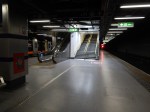
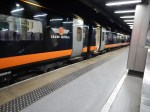
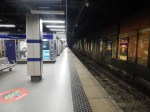

Could a station at Washington be built to similar principles, so that some long distance services to Newcastle used this station?
A Terminal Station On The Leamside Line
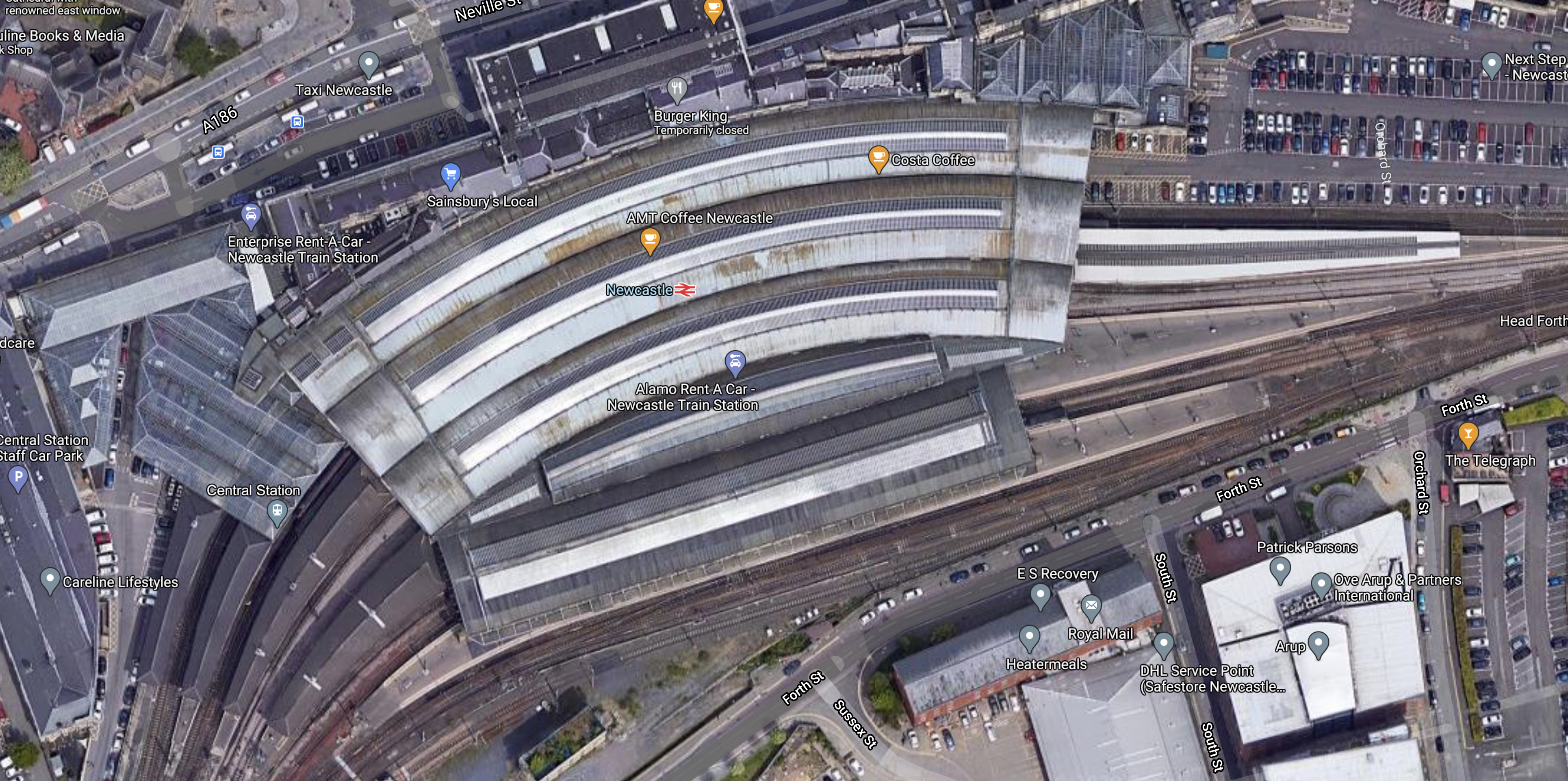
Newcastle station may be a Grade One Listed station, but it is built on a curve and would be a nightmare to expand with more platforms.
Sunderland station is already used as a terminal for London trains, so would it be sensible to provide a terminal at somewhere like Washington?
My Final Thought On The Leamside Line
Reopen it!
A Few Random Final Thoughts
This post has got me thinking.
Newcastle Station Capacity
I have seen reports over the years that Newcastle station, is lacking in capacity.
- There could be extra services, as High Speed Two is proposing two tph from London Euston stations and one tph from Birmingham Curzon Street station.
- There may be extra services because of Northern Powerhouse Rail, which has an objective of four tph from Leeds station.
- There may be extra services because of new services to Ashington and Blyth.
- There may be extra services because of new services to Consett.
Note.
- The first two services could use two hundred metre long trains.
- Some platforms can accept 234 metre long Class 800 trains.
- The last two services might use the Metro platforms.
As the station has twelve platforms, I feel with careful operation, that the station will have enough capacity.
This Google Map shows the station.
And this second Google Map shows the station, its position with relation to the Tyne and the lines rail routes to and from the station.

Note.
- Trains from the South arrive over the King Edward VII Bridge and enter Newcastle station from the West.
- Trains from England to Scotland go through the station from West to East and then go straight on and turn North for Berwick and Scotland.
- Next to the King Edward VII Bridge is the blue-coloured Queen Elizabeth II Bridge, which takes the Tyne and Wear Metro across the Tyne, where it uses two platforms underneath Newcastle station.
- The next bridge is the High Level Bridge, which connects the East end of the station to the rail network, South of the Tyne. It connects to the Durham Coast Line to Teeside and the Leamside Line.
History has delivered Newcastle a comprehensive track layout through and around Newcastle station.
- Services from the East can be run back-to-back with services from the West.
- The Metro and its two underground platforms removes a lot of traffic from the main station.
- There are seven through platforms, of which at least three are over two hundred metres long.
- There are four West-facing bay platforms and one facing East.
But most intriguingly, it looks like it will be possible for trains to loop through the station from the South, by perhaps arriving over the King Edward VII bridge and leaving over the High Level bridge. Or they could go the other way.
Could this be why reoopening the Leamside Line is important?
LNER’s Extra Paths
The sentence, from an article entitled LNER Seeks 10 More Bi-Modes, in the December 2020 Edition of Modern Railways indicates that more capacity will be available to LNER.
Infrastructure upgrades are due to prompt a timetable recast in May 2022 (delayed from December 2021) from which point LNER will operate 6.5 trains per hour, out of Kings Cross, compared to five today.
I suspect that LNER could use the half path to run a one train per two hour (tp2h) service to Hull.
- Currently, London Kings Cross and Hull takes a few minutes under three hours.
- Currently, Doncaster and Hull takes around 55 minutes.
- I have estimated that once full digital in-cab signalling is operational, that London Kings Cross and Hull could take a few minutes under two-and-a-half hours.
The full path to Hull could be shared with Hull Trains to provide an hourly service between London Kings Cross and Hull.
LNER could do something special with the full extra path.
Consider.
- Some train operating companies have said, that they’ll be looking to attract customers from the budget airlines.
- There could be a need for more capacity between London Kings Cross and all of Edinburgh, Leeds and Newcastle.
- Faster services would be attractive to passengers.
- York and Leeds will be fully electrified or trains could be fitted with batteries to bridge the thirteen mile gap in the electrification.
A limited-stop service between London Kings Cross and Edinburgh via Leeds could be an interesting addition.
- The train would only stop at Leeds and possibly Newcastle.
- One objective would be a time under three-and-a-half hours between London Kings Cross and Edinburgh.
- What time could be achieved between London Kings Cross and Leeds?
It would certainly give High Speed Two a run for its money!
A New Elizabethan
I can remember The Elizabethan, which was a steam-hauled non-stop express between London and Edinburgh between 1953 and 1961.
I have laid out my ideas for a modern express train of the same name in A New Elizabethan.
It could be an interesting concept, to increase capacity between London and Edinburgh.
As I indicated in the previous section, LNER certainly have a path, that could be used to their advantage.
High Speed Two
The East Coast Main Line and High Speed Two have a lot in common.
- The two routes will share tracks between a junction near Ulleskelf station and Newcastle station.
- High Speed Two Classic Compatible trains could be based on Hitachi AT-300 train technology.
- High Speed Two Classic Compatible trains would probably be able to run on the East Coast Main Line between London Kings Cross And Edinburgh.
- Trains from both routes will share platforms at York, Darlington, Durham and Newcastle stations.
- I would hope that the signalling systems on both routes are compatible.
From a project management point of view, this commonality means that in an ideal world the new route of both High Speed Two and Northern Powerhouse Rail, and the upgrades to the East Coast Main Line should be planned together.
I believe there are still details on the design of the joint route, that have not been disclosed, or perhaps not even decided.
- Will between Church Fenton station and Neville Hill depot be electrified?
- How will Northern Powerhouse Rail connect Leeds and Hull stations?
- How will Northern Powerhouse Rail connect Leeds and York stations?
- Will High Speed Two connect Leeds and York stations?
- What will be the operating speed of the joint section of the East Coast Main Line?
- What will be the capacity in trains per hour of the joint section of the East Coast Main Line?
- Will Newcastle station need an extra platform to handle three High Speed Two tph from London Euston
Two projects have been discussed in this post.
- The unlocking of the bottleneck at Skelton Bridge.
- The reopening of the Leamside Line.
I feel that these projects are important and will probably be needed for efficient operation of High Speed Two.
Other early projects could include.
- Upgrading and electrification of the chosen route between Leeds and Hull,
- Installation of the chosen system of in-cab ERTMS digital signalling on the route.
- Electrification between Church Fenton station and Neville Hill depot.
I would deliver these and other joint projects early, so that travellers see a positive benefit from High Speed Two before the main work has even started.
High Speed East Coast
I wonder what is the maximum speed of the Class 80x trains, that are the backbone of services on the East Coast Main Line.
Consider.
- It is known, that with in-cab digital ERTMS signalling, these trains will be capable of 140 mph, but could they go even faster.
- High Speed Two Classic Compatible trains will be capable of 225 mph.
- Will Hitachi’s offering for these trains, be based on the Class 80x trains?
I would think, that it is fairly likely, that the existing Class 80x trains could be updated to an operating speed in the range of 150-160 mph.
In Thoughts On Digital Signalling On The East Coast Main Line, I said this.
The combined affect of both track and signalling improvements is illustrated by this simple calculation.
-
- As Dalton-on-Tees is North of Doncaster, the route between Woolmer Green and Doncaster should be possible to be run at 140 mph
- Woolmer Green and Doncaster stations are 132.1 miles apart.
- Non-stop York and London Kings Cross trains are currently timed at 70 minutes between Doncaster and Woolmer Green stations.
- This is an average speed of 113.2 mph.
If 140 mph could be maintained between Doncaster and Woolmer Green, the section of the journey would take 56.6 minutes, which is a saving of 13.4 minutes.
I can do this calculation for higher speeds.
- 150 mph would take 52.8 minutes
- 160 mph would take 49.5 minutes
- 170 mph would take 46.6 minutes
- 180 mph would take 44 minutes
- 200 mph would take 39.6 minutes
Note.
- Eurostar’s latest Class 374 trains are capable of operating at 200 mph.
- A Class 395 train, which is closely related to the Class 80x trains, has attained a record speed of 157 mph.
There may be worthwhile time savings to be made, on some of the straighter sections of the East Coast Main Line.
Other improvements will also be needed.
- A solution to the Newark crossing problem, which could be solved by the use of in-cab ERTMS digital signalling. See Could ERTMS And ETCS Solve The Newark Crossing Problem?
- Some extra four-tracking of the route.
- Upgrading of Cambridge and Kings Lynn services for faster running. See Call For ETCS On King’s Lynn Route.
Note, that I am assuming, that the Digswell Viaduct section would not be updated, as it would cause too much disruption.
I also believe that by using selective joining and splitting at Edinburgh, Leeds and perhaps Doncaster, Grantham, Newark or York, that a very comprehensive network of direct trains to and from London can be built from Grantham Northwards.
Beverley, Bradford, Cleethorpes, Glasgow, Grimsby, Harrogate, Huddersfield, Hull, Lincoln, Middlesbrough, Nottingham, Perth, Redcar, Sheffield, Skipton, Sunderland and Washington could all be served at an appropriate frequency.
- Some like Bradford, Glasgow, Harrogate, Hull, Lincoln and Middlesbrough would have several trains per day.
- Others might have a much more limited service.
What sort of timings will be possible.
- London Kings Cross and Doncaster could be around an hour.
- London Kings Cross and Leeds could be around one hour and thirty minutes, using the current Doncaster and Leeds time, as against the one hour and twenty-one minutes for High Speed Two.
- London Kings Cross and York could be around one hour and twenty-three minutes, using the current Doncaster and York time, as against the one hour and twenty-four minutes for High Speed Two.
- Timings between York and Newcastle would be the same fifty-two minutes as High Speed Two, as the track will be the limitation for both services.
- High Speed Two’s timing for York and Newcastle is given as fifty-two minutes, with York and Darlington as twenty-five minutes.
- London Kings Cross and Darlington could be around one hour and forty-nine minutes
- London Kings Cross and Newcastle could be around two hours and sixteen minutes.
- London Kings Cross and Edinburgh would be under three-and-a-half hours, as against the proposed three hours and forty-eight minutes for High Speed Two.
High Speed East Coast would be a serious and viable alternative to High Speed Two for the Eastern side of England and Scotland.
Conclusion
This is an important joint project for Northern Powerhouse Rail, High Speed Two and the East Coast Main Line.
Project Management Recommendations
This project divides neatly into several smaller projects..
- Upgrade the power supply on the East Coast Main Line.
- Finish the York to Church Fenton Improvement Scheme
- Remodel Darlington station.
- Install of in-cab ERTMS digital signalling.
- Complete the electrification between Neville Hill TMD and York.
- Solve the problem of Skelton Bridge and its complicated track layout.
- Reopen the Leamside Line.
Most of these projects are independent of each other and all would give early benefits to the East Coast Main Line.
When complete, we’ll see the following timing improvements.
- Leeds and Newcastle will drop from 85 minutes to 56 minutes, with an increase in frequency from three to four tph.
- York and Newcastle will drop from 57-66 minutes to 52 minutes.
- There could be ten minutes savings on Edinburgh services.
Passengers and operators would welcome this group of projects being started early.
High Speed Two To Build Stabling Facility In Scotland
High Speed Two has announced the intention to build a stabling facility for trains at Annandale in Dumfries and Galloway.
This document on the Government web site is entitled HS2 Phase 2b Western Leg Design Refinement Consultation.
Details of the Annandale Depot, start on Page 43.
This is the introductory paragraph.
Phase 2b will provide an increased number of services to Scotland and North West England compared to Phase 2a or Phase One of HS2, with two 400m trains running from Euston each hour and splitting at Carlisle into two 200m trains to serve Glasgow and Edinburgh. HS2 trains will also serve Scotland from Birmingham. New HS2 trains serving Scotland and the north west of England will need overnight stabling and light maintenance in this area, near to where trains finish and start service. It would not be operationally efficient for these trains to run empty to the next closest HS2 depot north of Crewe, approximately 150 miles away.
Note the services are as laid out in the June 2020 Edition of Modern Railways, which was obviously the thinking at the time on High Speed Two.
If you ignore the splitting and joining and assume that they are two separate trains, the Anglo-Scottish services on High Speed Two are as follows.
- One train per hour (tph) – London Euston and Edinburgh Waverley via Old Oak Common, Preston, Carlisle and Edinburgh Haymarket.
- One tph – London Euston and Edinburgh Waverley via Old Oak Common, Birmingham Interchange, Preston, Carlisle and Edinburgh Haymarket.
- One tph – London Euston and Glasgow Central via Old Oak Common, Preston and Carlisle.
- One tph – London Euston and Glasgow Central via Old Oak Common, Birmingham Interchange, Preston and Carlisle.
- One train per two hours (tp2h) – Birmingham Curzon Street and Edinburgh Waverley via Wigan North Western, Preston, Lancaster, Oxenholme, Penrith, Carlisle. Lockerbie and Edinburgh Haymarket
- One tp2h – Birmingham Curzon Street and Glasgow Central via Wigan North Western, Preston, Lancaster, Oxenholme, Penrith, Carlisle. Lockerbie and Motherwell
Note.
- Oxenholme and Penrith might not be served by both Birmingham trains.
- All services would be run by High Speed Two’s Classic-Compatible trains.
- The two Birmingham services effectively provide a one tph service between Birmingham and Scotland.
- All services will be single 200 metre long trains to the North of Carlisle, as pairs will split and join at Carlisle station.
- There would appear to be a fairly consistent five tph between Carlisle and Carstairs, where the Glasgow and Edinburgh routes divide.
- Edinburgh Waverley and Glasgow Central will both have three tph to and from Carlisle and Preston.
These were factors in the choice of location of the depot, stated in the report.
- Be close to the existing railway.
- Be a relatively large, flat site.
- Preferably a brownfield rather than greenfield site.
- Located as close as feasible to where HS2 services will terminate or begin to minimise empty train movements.
- Be accessible to the workforce and local transport network.
- Be suitable for 24-hour working.
- Have enough space to accommodate equipment for light maintenance activities.
- Have enough space to accommodate the expected number of trains.
The site is also close to the M74.
A few of my thoughts.
The Location Of The Proposed Depot
This Google Map shows the area mentioned in the report.
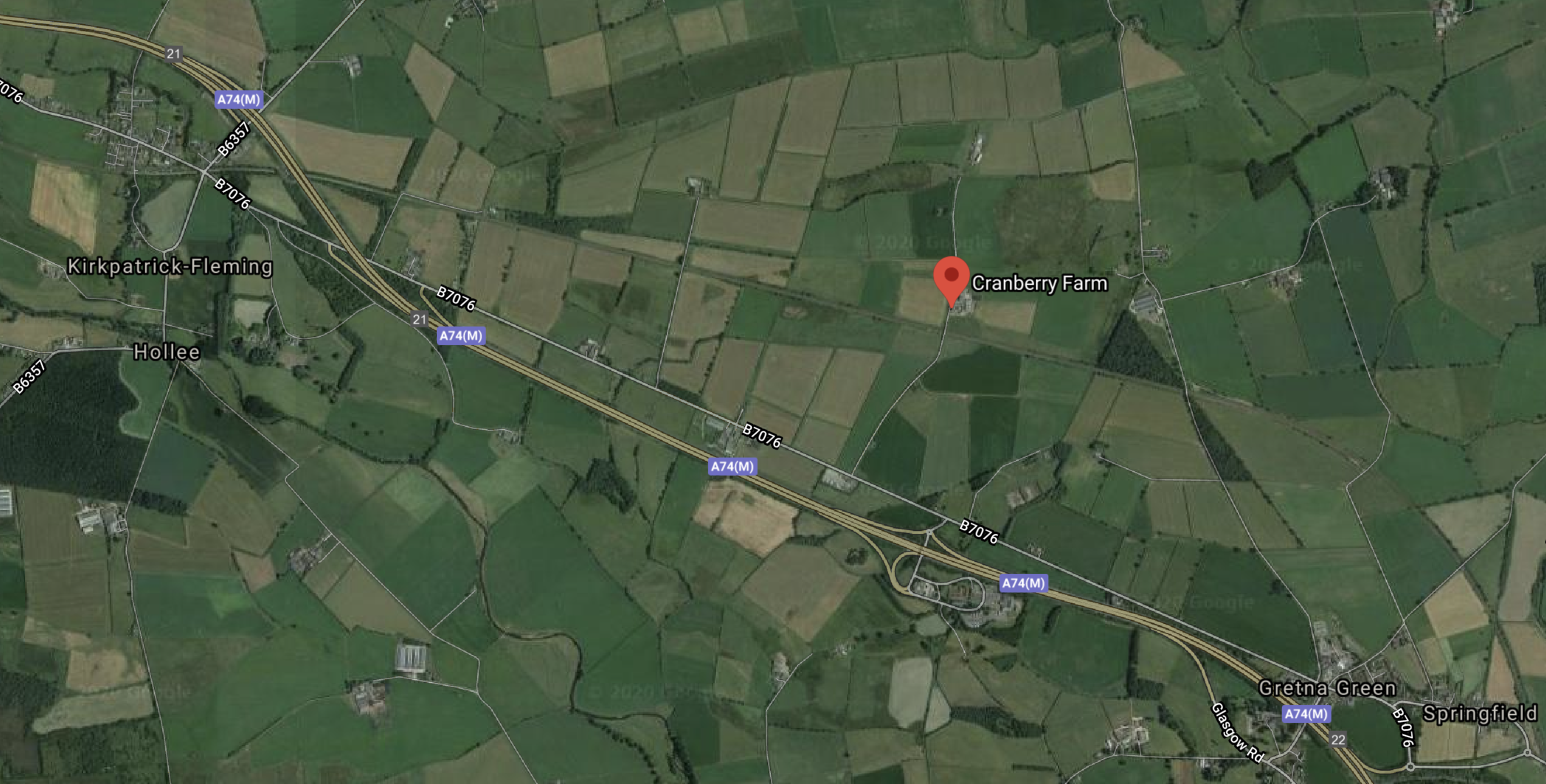
Note.
- The red arrow indicates Cranberry Farm, which will be just to the North of the site.
- The West Coast Main Line passing just South of Cranberry Farm, going across the map.
- The B 7076 and M74 will be to the South of the site.
It looks to meet many of the factors, I stated earlier. But it does appear to be a greenfield, rather than a brownfield site.
Distances And Times From The Depot
These are distances to places, where services will or might start.
- Carlisle – 9 miles – 6 minutes
- Edinburgh – 93 miles – 68 minutes
- Glasgow – 94 miles – 59 minutes
I have used distances from Gretna Green Junction, which is just to the South of the proposed depot.
Will The Depot Be Only For Classic-Compatible Trains?
Consider.
- All services North of Wigan North Western will be run by High Speed Two’s Classic-Compatible trains.
- A simpler depot would surely be possible if it only handled High Speed Two’s Classic-Compatible trains.
- With the possible exception of the occasional demonstration or test run High Speed Two;s full-size fleet will never be seen North of the Border.
The only thing this depot might have to do with the full-size fleet is turn-back a test train, which would only need a 400 metre long siding. A siding this length would probably be needed to turn a pair of High Speed Two’s Classic-Compatible trains.
Could The Depot Serve A Possible Irish Extension?
I believe that eventually High Speed Two will be extended across Southern Scotland and a bridge will connect it to Northern Ireland
In A Glimpse Of 2035, I gave a fictionalised version of the first journey from London Euston to Dublin, by high speed train.
I have just calculated the length of a high speed rail link between the proposed Annandale . Depot and a Belfast Parkway station. It is around 120 miles and the route would probably branch off between Lockerbie and Annandale Depot.
I feel that Annandale Depot could serve trains for Belfast, but there would probably need to be another depot in Dublin.
Extra HS2 Services To Scotland
Currently, TransPennine Express run services Between Liverpool and Manchester in England and Edinburgh and Glasgow in Scotland.
I can see High Speed Two replacing these services with a similar service to the one they are planning for Birmingham.
The current service is as follows,
- One tp2h – Manchester Airport and Edinburgh Waverley via Manchester Piccadilly, Preston, Lancaster, Carlisle and Haymarket
- One tp2h – Manchester Airport and Glasgow Central via Manchester Piccadilly, Preston, Lancaster, Carlisle and Motherwell
- Four trains per day (tpd) – Liverpool Lime Street and Glasgow Central via Wigan North Western, Preston, Lancaster, Carlisle and Motherwell
Note.
- They call at smaller stations like Wigan North Western, Lancaster, Oxenholme, Penrith and Lockerbie as appropriate, to even up the service.
- These services probably share one path between Preston and Carstairs.
- The Liverpool services are diverted Manchester services.
Could they be replaced by High Speed Two services?
The Manchester services could become.
- One tp2h – Manchester Piccadilly and Edinburgh Waverley via Manchester Airport, Preston, Lancaster, Carlisle and Haymarket
- One tp2h – Manchester Piccadilly and Glasgow Central via Manchester Airport, Preston, Lancaster, Carlisle and Motherwell.
Blackpool, Liverpool and other parts of the North West may be better served with high speed commuter services linking them to Preston.
Serving Scotland’s Seven Cities
Scotland has seven cities that are connected by Inter7City trains.
- Aberdeen – Not Electrified
- Dundee – Not Electrified
- Edinburgh – Will be served by High Speed Two
- Glasgow – Will be served by High Speed Two
- Inverness – Not Electrified
- Perth – Not Electrified
- Stirling – Fully Electrified
Can we forget about serving Aberdeen, Dundee, Inverness and Perth until they are fully electrified?
But Stirling must be a possibility.
There is a fully electrified route via Motherwell, Whifflet, Greenfaulds and Larbert
I estimate, that coming up from London will take four hours and five minutes, as against the current time of five hours and eighteen minutes.
Increasing Capacity On The West Coast Main Line In Scotland
Over the years, there have been several plans to run more and faster trains between England and Glasgow on the West Coast Main Line.
So would a High Speed Two service go to Stirling?
At present the maximum operating speed on the route is 125 mph. Trains like Avanti West Coast’s Class 390 trains and Hitachi’s AT-300 trains, could run at 140 mph, if digital in-cab signalling were rolled out on the route.
It is absolutely essential before High Speed Two trains run to Scotland, that the West Coast Main Line is digitally signalled.
In addition to faster running, trains can be closer together, so more trains can be run in an hour.
There are also other things, that could be done to help.
- Ensure, that all the many freight trains on the route are electrically-hauled and capable of operating at 100 mph or more.
- Make sure that local trains sharing the routes into Glasgow and Edinburgh are fast enough to keep out of the way of the expresses.
- Selectively, add extra tracks, so that fast trains can overtake slow ones.
- Ideally, a line like the West Coast Main Line, needs to be quadruple track all the way.
There also must be scope for flighting.
Consider.
- Class 390 trains take about 30 minutes between Edinburgh Waverley and Carstairs South Junction
- Class 390 trains take about 30 minutes between Glasgow Central and Carstairs South Junction
- Carstairs South Junction is where the two routes join.
Suppose two High Speed Two trains were to leave Edinburgh and Glasgow at similar times and run South from Carstairs South Junction, a safe distance apart.
- The lead train would be travelling at 140 mph perhaps three to five minutes in front of the second train.
- In-cab digital signalling would enforce the safe distance.
When the trains arrived in Carlisle, they would take a couple of minutes to join up physically for the high speed dash to London.
This Google Map shows Carstairs station and the splitting of the Glasgow and Edinburgh routes.
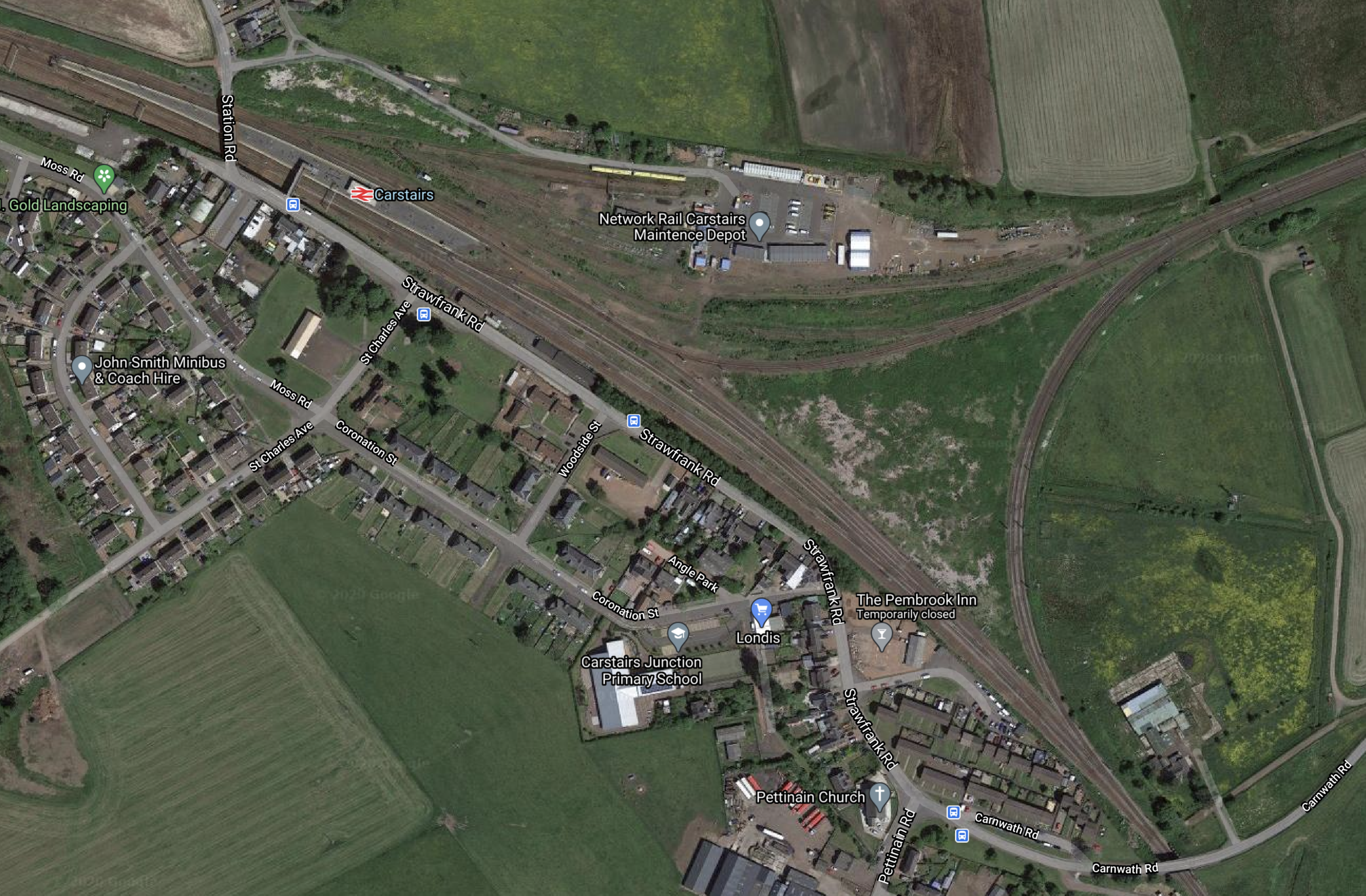
Note.
- The tracks going North-West to Glasgow.
- The tracks going North-East to Edinburgh.
- The tracks going South-East to Glasgow
- All tracks in the picture are electrified.
There might be a need for a passing loop to increase the efficiency of this junction.
It’s not just high speed passenger trains, that can use this technique, but it can be applied to trains with the same performance. So freight trains could form a convoy!
Flighting can decrease the number of train paths needed for a particular number of services and as digital in-cab signalling extends its reach across the UK, we’ll see more applications of the technique.
Effectively, by pathing the two London and Edinburgh/Glasgow trains and adding in one Birmingham and Manchester service, High Speed Two services would only need four paths between Carlisle and Carstairs.
But there would be.
- Four tph between Preston/Carlisle and Scotland. So capacity would be good.
- Three tph Between Carlisle and Edinburgh.
- Three tph Between Carlisle and Glasgow.
As Birmingham Curzon Street, Manchester Piccadilly and Manchester Airport all can handle a pair of High Speed Two’s Classic-Compatible trains, it might be possible in the future to serve both Edinburgh and Glasgow with the Birmingham and Manchester services, splitting the trains at Carlisle. This would mean.
- Four tph between Preston/Carlisle and Scotland.
- Four tph Between Preston/Carlisle and Edinburgh.
- Four tph Between Preston/Carlisle and Glasgow.
That looks strange mathematics, but that’s what you get when a train can serve two places by splitting.
What About The Glasgow And South Western Line?
The Glasgow And South Western Line, runs between Glasgow and Carlisle via Dumfries.
Consider.
- It is not electrified
- It can be used as a diversion, when the West Coast Main Line is blocked.
- It has always puzzled me, why this line wasn’t electrified, when the West Coast Main Line was electrified in the 1970s.
- High Speed Two’s need for more paths and higher speeds on the West Coast Main Line, may chase some of the freight on that route on to the Glasgow and South Western, as an alternative.
Perhaps, a small part of the High Speed Two budget could be used to electrify the route.
It certainly could be used to take some freight traffic from the West Coast Main Line and to ease diversions, if High Speed Two needed to close the West Coast Main Line for improvements to track, electrification or signalling.
It is also a line, where alternative methods of powering the trains could be used.
- It has electrification at both ends and with some electrification in the middle, battery electric passenger trains might be able to use the route.
- The City of Glasgow is majoring on hydrogen and the route, which is 115 miles long, could be ideal for a hydrogen train.
On the other hand full electrification could enable the electric services to be run at times, when the West Coast Main Line was blocked.
It is certainly a route, that could benefit from improvement.
Extension Of The Borders Railway To Carlisle
It is looking increasingly likely that the Borders Railway will be extended to Carlisle.
This report from the High Speed Rail Group is entitled Cross-Border High-Speed Rail And The Borders Railway Project.
The first paragraph is firm about why the Edinburgh and Glasgow services should split and join at Carlisle.
It has taken a while for HS2 service plans to focus on Carlisle as the right place to divide and join Glasgow/Edinburgh high-speed train portions. Earlier plans used Carstairs – and left Carlisle with no HS2 London service.
I also think it will be considerably more affordable and less disruptive to extend Carlisle’s already long platforms, than to build a massive new station at Carstairs capable of handling 400 metre long trains.
This paragraph puts its case for extending the Borders Railway to Carlisle.
To get best use out of the enhanced services that will then be possible, and to fully utilise the additional line capacity along the West Coast Main Line, onward rail connectivity is crucial. That’s why we flagged the compatibility with the Borders Railways re-opening from Tweedbank via Hawick to Carlisle in our report. With Carlisle-London journey times reduced to a little over 2 hours, and the Borders Railway fully re-instated, journey times from the Borders towns could be dramatically shortened – to London as well as to other major cities in England. Inward travel for tourists to the Borders region would be dramatically enhanced too.
They also add that a Borders Railway could be an useful diversion route, during the increasing number of problems on UK rail networks caused by the weather.
I believe that the Borders Railway should be extended to Carlisle and it should also be electrified.
- It would be a useful diversion route.
- It could handle some freight trains.
- It might be useful to move empty stock between Edinburgh and Annandale Depot, as the Borders Railway joins the West Coast Main Line not far from the depot.
We mustn’t underestimate how many passengers to and from the Borders will use the Borders Railway to catch High Speed Two at Carlisle.
Conclusion
Moving the depot to Annandale, may look to some like a way of giving the Scots a higher profile in High Speed Two.
But I do think it gives options to make a High Speed Network easier to run North of the border.
- High Speed Two have total control of their depot.
- It is well placed for Carlisle, Edinburgh and Glasgow.
It is also extremely well placed for the rail network of South Scotland.
Could Some of Hitachi’s Existing Trains In The UK Be Converted To Battery-Electric Trains?
The last five fleets of AT-300 trains ordered for the UK have been.
- Avanti West Coast – Bi-Mode, 13 x five-car, unknown number of diesel engines, that could be replaced by batteries.
- Avanti West Coast – Electric, 10 x seven-car, no diesel engines or batteries
- East Midlands Railway – Bi-Mode, 33 x five-car, Class 810 train with four diesel engines and 125 mph on diesel.
- East Coast Trains – Electric, 5 x five-car, Class 803 train with battery for emergency hotel power.
- Hull Trains – Bi-Mode, 5 x five-car, Standard Class 802 train with three diesel engines.
Each fleet seems to be tailored to the needs of the individual operator, which is surely as it should be.
I can make some observations.
Fast Electric Trains
Both all-electric fleets on the list, will run on routes, where speed will be important.
- The Avanti West Coast Class 807 trains on the West Coast Main Line, will have to be able to keep up keep with the Class 390 trains, that have the advantage of tilt for more speed.
- The East Coast Trains Class 803 trains on the East Coast Main Line, will have to work hard to maintain a demanding schedule, as I outlined in Thoughts On East Coast Trains.
Any reduction in weight will improve the acceleration.
- The seven tonne MTU 12V 1600 R80L diesel engines can be removed to reduce the weight.
- As a five-car Class 800 train with three diesel engine weighs 243 tonnes, this could save nearly 9 % of the train’s weight.
- East Coast Trains feel they need an appropriately-sized battery for emergency hotel power. Could this be because the catenary is not as good on the East Coast Main Line as on the West?
- Perhaps, Avanti West Coast feel a battery is not needed, but they could obviously fit one later. Especially, if there was already a ready-wired position underneath the train.
The extra acceleration given by 100% electric operation, must make all the difference in obtaining the required performance for the two routes.
Why Four Diesel Engines In A Class 810 Train?
The Class 810 trains are an update of the current Class 800/Class 802 trains. Wikipedia described the differences like this.
The Class 810 is an evolution of the Class 802s with a revised nose profile and facelifted end headlight clusters, giving the units a slightly different appearance. Additionally, there will be four diesel engines per five-carriage train (versus three on the 800s and 802s), and the carriages will be 2 metres (6.6 ft) shorter due to platform length constraints at London St Pancras.
Additionally, in this article in the October 2019 Edition of Modern Railways, which is entitled EMR Kicks Off New Era, this is said.
The EMR bi-modes will be able to run at 125 mph in diesel mode, matching Meridian performance in a step-up from the capabilities of the existing Class 80x units in service with other franchises.
The four diesel engines would appear to be for more power, so that these trains will be able to run at 125 mph on diesel.
In How Much Power Is Needed To Run A Train At 125 mph?, I calculated that a Class 801 train, which is all-electric, consumes 3.42 kWh per vehicle mile.
- At 125 mph a train will in an hour travel 125 miles.
- In that hour the train will need 125 x 5 x 3.42 = 2137.5 kWh
- This means that the total power of the four diesel engines must be 2137.5,
- Divide 2137.5 by four and each diesel must be rated at 534.4 kW to provide the power needed.
The MTU 12V 1600 R80L diesel engine is described in this datasheet on the MTU web site.
Note on the datasheet, there is a smaller variant of the same engine called a 12V 1600 R70, which has a power output of 565 kW, as compared to the 700 kW of the 12V 1600 R80L.
The mass of the engines are probably at the limits of the range given on the datasheet.
- Dry – 4500-6500 Kg
- Wet – 4700-6750 Kg
It would appear that the less-powerful 12V 100 R70 is about two tonnes lighter.
So where will four engines be placed in a Class 810 train?
- The five-car Class 800 and Class 802 trains have diesel-engines in cars 2, 3 and 4.
- The nine-car Class 800 and Class 802 trains have diesel-engines in cars 2,3, 5, 7 and 8.
- It appears that diesel-engines aren’t placed under the driver cars.
- Five-car AT-300 trains generally have a formation of DPTS+MS+MS+MC+DPTF.
- The car length in the Class 810 trains are two metres shorter than those in other trains.
Could it be that the intermediate cars on Class 810 trains will be an MC car, which has both First and Standard Class seating and two identical MS cars both with two smaller diesel engines?
- The two smaller diesel engines will be about 2.6 tonnes heavier, than a single larger engine.
- Only one fuel tank and other gubbins will be needed.
- The shorter car will be lighter in weight.
- MTU may have designed a special diesel engine to power the train.
I would suspect that a twin-engined MS car is possible.
Could The Battery And The Diesel Engine Be Plug-Compatible?
I found this document on the Hitachi Rail web site, which is entitled Development of Class 800/801 High-Speed Rolling Stock For UK Intercity Express Programme.
The document may date from 2014, but it gives a deep insight into the design of Hitachi’s trains.
I will take a detailed look at the traction system as described in the document.
This schematic of the traction system is shown.

Note BC is described as battery charger.
This is said in the text, where GU is an abbreviation for generator unit.
The system can select the appropriate power source from either the main transformer or the GUs. Also, the size and weight of the system were minimized by designing the power supply converter to be able to work with both power sources. To ensure that the Class 800 and 801 are able to adapt to future changes in operating practices, they both have the same traction system and the rolling stock can be operated as either class by simply adding or removing GUs. On the Class 800, which is intended to run on both electrified and non-electrified track, each traction system has its own GU. On the other hand, the Class 801 is designed only for electrified lines and has one or two GUs depending on the length of the trainset (one GU for trainsets of five to nine cars, two GUs for trainsets of 10 to 12 cars). These GUs supply emergency traction power and auxiliary power in the event of a power outage on the catenary, and as an auxiliary power supply on non-electrified lines where the Class 801 is in service and pulled by a locomotive. This allows the Class 801 to operate on lines it would otherwise not be able to use and provides a backup in the event of a catenary power outage or other problem on the ground systems as well as non-electrified routes in loco-hauled mode.
This is all very comprehensive.
Note that the extract says, that both the Class 800 trains and Class 801 trains have the same traction control system. A section called Operation in the Wikipedia entry for the Class 802 train, outlines the differences between a Class 802 train and a Class 800 train.
The Class 802s are broadly identical to the Class 800 bi-mode trains used in the Intercity Express Programme, and are used in a similar way; they run as electric trains where possible, and are equipped with the same diesel generator engines as the Class 800. However, they utilise higher engine operating power – 700 kW (940 hp) per engine as opposed to 560 kW (750 hp) – and are fitted with larger fuel tanks to cope with the gradients and extended running in diesel mode expected on the long unelectrified stretches they will operate on.
I would assume that the differences are small enough, so that a Class 802 train, can use the same traction control system, as the other two train classes.
The Hitachi document also describes the Train Management and Control System (TCMS), the function of which is described as.
Assists the work of the train crew; a data communication function that aids maintenance work; and a traction drive system that is powered by the overhead lines (catenaries) and GUs.
Several trains have been described as computers on wheels. That could certainly be said about these trains.
There would appear to be a powerful Automatic Train Identification Function.
To simplify the rearrangement and management of train configurations, functions are provided for identifying the train (Class 800/801), for automatically determining the cars in the trainset and its total length, and for coupling and uncoupling up to 12 cars in normal and 24 cars in rescue or emergency mode.
Now that would be a sight – One nine-car train rescuing another!
I would assume that this Automatic Train Identification Function has already been updated to add the Class 802 trains and it would appear to me, as a very experienced computer programmer, that in future it could be further updated to cater for the following.
- New classes of trains like the future Class 803 and Class 810 trains.
- The fitting of batteries instead of diesel engines.
Could the Function even be future-proofed for hydrogen power?
There are two main ways for trains to operate when the diesel engine in a car has been replaced by a battery.
- A plug-compatible battery module is designed, that in terms of function looks exactly like a diesel engine to the TCMS and through that the train crew.
- The car with a battery becomes a new type of car and the TCMS is updated to control it, in an appropriate manner.
Both methods are equally valid.
I would favour the first method, as I have come across numerous instances in computer programming, engineering and automation, where the method has been used successfully.
The method used would be Hitachi’s choice.
What Size Of Battery Could Be Fitted In Place Of The Diesel Engine?
Consider.
- The wet mass of an MTU 16V 1600 R80L diesel engine commonly fitted to AT-300 trains of different types is 6750 Kg or nearly seven tonnes.
- My engineering knowledge would suggest, that it would be possible to replace the diesel engine with an inert lump of the same mass and not affect the dynamics of the train.
So could it be that a plug-compatible battery module can be fitted, so long as it doesn’t exceed the mass of the diesel engine it replaces?
For an existing Class 800 or Class 802 train, that limit could be seven tonnes.
But for East Coast Train’s Class 803 train, that size would probably be decided by the required train performance.
How much power would a one tonne battery hold?
This page on the Clean Energy institute at the University of Washington is entitled Lithium-Ion Battery.
This is a sentence from the page.
Compared to the other high-quality rechargeable battery technologies (nickel-cadmium or nickel-metal-hydride), Li-ion batteries have a number of advantages. They have one of the highest energy densities of any battery technology today (100-265 Wh/kg or 250-670 Wh/L).
Using these figures, a one-tonne battery would be between 100 and 265 kWh in capacity, depending on the energy density.
This table can be calculated of battery weight, low capacity and high capacity.
- 1 tonne – 100 kWh – 265 kWh
- 2 tonne – 200 kWh – 530 kWh
- 3 tonne – 300 kWh – 895 kWh
- 4 tonne – 400 kWh – 1060 kWh
- 5 tonne – 500 kWh – 1325 kWh
- 6 tonne – 600 kWh – 1590 kWh
- 7 tonne – 700 kWh – 1855 kWh
As energy densities are only going to improve, the high capacity figures are only going to get larger.
If you look at the design of the Class 803 trains, which could have three positions for diesel engines or batteries, the designers of the train and East Coast Trains can choose the battery size as appropriate for the following.
- Maximum performance.
- Power needs when halted in stations.
- Power needs for emergency power, when the wires come tumbling down.
I suspect, they will fit only one battery, that is as small as possible to minimise mass and increase acceleration, but large enough to provide sufficient power, when needed.
Conversion Of A Five-Car Class 800/Class 802 Train To Battery-Electric Operation
If Hitachi get their design right, this could be as simple as the following.
- Any of the three MTU 12V 1600 R80L diesel engines is removed, from the train.
- Will the other diesel related gubbins, like the fuel tank be removed? They might be left in place, in case the reverse conversion should be needed.
- The new battery-module is put in the diesel engine’s slot.
- The train’s computer system is updated.
- The train is tested.
It should be no more difficult than attaching a new device to your personal computer. Except that it’s a lot heavier.
As there are three diesel engines, one, two or three could be replaced with batteries.
Trains would probably be able to have a mixture of diesel engines and battery modules.
A Class 802 train with one diesel engine and two five-tonne batteries would have the following power sources.
- 25 KVAC overhead electrification.
- A 700 kW diesel engine.
- Two five-tonne batteries of between 500 kWh and 1325 kWh.
With intelligent software controlling the various power sources, this train could have a useful range, away from the electrification.
Conversion Of A Five-Car Class 810 Train To Battery-Electric Operation
The process would be similar to that of a Class 800/Class 802 Train, except there would be more possibilities with four engines.
It would also need to have sufficient range to bridge the gaps in the electrification.
Perhaps each train would have the following power sources.
- 25 KVAC overhead electrification.
- Two 565 kW diesel engines.
- Two four-tonne batteries of between 400 kWh and 1060 kWh.
- Batteries might also be placed under the third intermediate car.
I estimate that with 400 kWh batteries, a train like this would have a battery range of sixty-five miles.
Conclusion
The permutations and combinations would allow trains to be tailored to the best compromise for a train operating company.
Electrification Between Exeter And Plymouth
Eventually, there will be electric passenger trains between Exeter and Plymouth! Great Western Railway’s objective must be for passengers to board their Hitachi AT-300 train at Paddington and be powered all the way to Penzance by electricity, without using a drop of diesel. The added ingredient will be battery power.
In Sparking A Revolution, I gave Hitachi’s specification for a proposed battery-electric train.
- Range – 55-65 miles
- Performance – 90-100 mph
- Recharge – 10 minutes when static
- Routes – Suburban near electrified lines
- Battery Life – 8-10 years
As the distance between Exeter and Plymouth is 52 miles, the Hitachi specification could have been designed around this route, which as these pictures show is in places, very close to the sea, where the line runs along the South Devon Railway Sea Wall.

Global warming will probably mean, we’ll see a repeat of the major sea wall breach that happened at Dawlish in 2014.
I would suspect that the Network Rail’s solution to the problems of efficient low or zero-carbon traction between Exeter and Plymouth includes the following.
- A very robust railway.
- Extreme protection from almost everything the sea and the weather can produce.
- Could we see some concrete tunnels, like the Swiss and others use in mountainous areas to protect from snow? Rail Magazine says yes! At Horse Cove.
- No electrification as water and electricity are not a good mix, except in an electrolyser to produce hydrogen, oxygen and/or chlorine.
- Battery or hydrogen-powered passenger trains or freight locomotives.
- Digital in-cab signalling. Traditional signalling is even more expensive equipment to be swept away.
From media reports, this looks like the way Network Rail are thinking.
Charging The Trains
Battery-electric trains will need to be charged. There are three convenient stations; Exeter St. Davids, Newton Abbott and Plymouth.
- All have multiple platforms.
- The stations could be given the ability to charge battery-electric trains, either using 25 KVAC overhead electrification or a specialist charging system, like the one designed by Vivarail, that I wrote about in Vivarail Unveils Fast Charging System For Class 230 Battery Trains.
- Newton Abbot station would also charge any trains running on the eight mile branch to Paignton station.
As far as passenger services are concerned, it could be a very efficient zero-carbon railway.
Electrification At Exeter St. Davids
Exeter St. Davids is an important hub for services between Devon and Cornwall and the rest of Great Britain.
- GWR services run to London Paddington via Newbury.
- GWR services run to London Paddington via Bristol
- GWR services run to Plymouth and Penzance via Newton Abbott.
- GWR local services run to Barnstaple, Exmouth and Paignton.
- CrossCountry services run to the Midlands, North and Scotland via Bristol.
- South Western Railway services run to London Waterloo via Basingstoke.
In future, there could be services running to Plymouth on the reopened route via Okehampton and Tavistock.
All these services could be run by battery-electric trains for sixty miles from Exeter, if they could be fully-charged at the station.
Note.
- Trains to London Paddington and Bristol could easily reach Taunton, which is thirty miles away.
- Trains to London Waterloo could reach Yeovil Junction, which is fifty miles away.
- Trains to the West could reach Plymouth, which is fifty-two miles away.
- Barnstaple is forty miles away, so would probably need some help to get back.
- Exmouth is eleven miles away, so a return journey is probably possible.
- Paignton is twenty-eight miles away, so a return journey is probably possible, with a top-up at Newton Abbot if required.
Exeter is going to be very busy charging trains.
It should be noted, that trains to and from London Paddington and Bristol, all share the same route as far as Cogload Junction, where the London Paddington and Bristol routes divide.
- Cogload Junction is thirty-six miles from Exeter.
- Cogload Junction and Newbury, where the electrification to London Paddington starts are eighty-five miles apart.
- Cogload Junction and Bristol Temple Meads, where the electrification to London Paddington starts are forty miles apart.
I wonder if it would be sensible to electrify between Exeter St. David station and Cogload Junction.
- From my virtual helicopter, the line doesn’t look to be in the most difficult category to electrify.
- There is only one tunnel and a few old bridges and a couple of level crossings.
- Some of the route is alongside the M5.
- Trains would arrive in Exeter with full batteries and could do a quick stop before continuing their journeys.
- Trains would arrive at Cogload Junction and could reach Bristol Temple Meads without stopping for a recharge.
- Bristol services that are extended to Taunton and Exeter could be run by battery-electric trains.
I also feel, that with upwards of twenty-five miles of extra electrification between Cogload Junction and Newbury, that battery-electric trains could run between London Paddington and Exeter via the Reading-Taunton Line.
Electrification At Plymouth
As with Exeter St. Davis, Plymouth is an important hub for services between Devon and Cornwall and the rest of Great Britain.
- Most services run to Penzance in the West and Exeter in the East.
- There is a local service to Gunnislake, which is fifteen miles away.
Lots of charging capacity, will enable battery-electric trains to reach their destinations, except for Penzance
Trains Between Plymouth And Penzance
Hitachi must have despaired, when it was pointed out that the distance between Penzance and Plymouth is eighty miles! This is fifteen miles longer than the range of their proposed battery-electric train.
The simplest solution would be to build a battery-electric train with an eighty mile range, that could travel between Plymouth and Penzance on a single charge. With charging at Penzance it could return to Plymouth.
The longer range, would also mean that, with perhaps ten extra miles of electrification, that battery-electric trains could bridge the electrification gap between Cogload Junction and Newbury.
Other solutions range from selective electrification, all the way up to full electrification of the Cornish Main Line.
It should be noted that there are the following branches on the Cornish Main Line.
- The Looe Valley Line at Liskeard station – 8.75 miles – Uses a separate platform at Lskeard
- The Fowey Branch At Lostwithiel station – 4.75 miles – Possible reopening
- The Atlantic Coast Line at Par station – 20.75 miles – Uses a separate platform at Par
- The Maritime Line at Truro station – 11.75 miles – Uses a separate platform at Truro
- The St. Ives Bay Line at St. Erth station – 4.25 miles- Uses a separate platform at St. Erth
If these branches are going to be served by battery-electric trains, arrangements will have to be made for their charging. This could either be on the main line, at the remote terminal or at both.
Would it be easier to run the branches using battery-electric trains, if the Cornish Main Line was fully electrified?
The Cornish Main Line also carries a number of heavy freight trains, most of which seem to be going to or from Burngullow, so I suspect they are in connection with the movement of china clay.
Currently, these heavy freight trains appear to be hauled by diesel locomotives, but if the Cornish Main Line were to be fully electrified, could they be run by electric locomotives?
Electrification Of A Reopened Northern Route
In the May 2020 Edition of Modern Railways, there is an article, which is entitled Beeching Reversal Fund Bids.
This is the introductory paragraph.
Bids have been submitted to Government for a share of the £500 million ‘Restoring your railway’ fund launched by the Department for Transport in January. The fund is to be used to support proposals to reinstate axed local services, to accelerate schemes already being considered for restoration and also to promote new and restored stations.
One of the bids is for the Tavistock-Okrhampton Reopening scheme (TORs), which would reopen the former Exeter to Plymouth railway of the LSWR, as a new route between Exeter and Taunton in the East and Plymouth in the West.
- The original railway was double-track.
- Most of the infrastructure is intact.
- The route would totally avoid Dawlish.
This is also said in the Modern Railways article.
It proposes journey times could be as little as six minutes longer than via the existing route between Exeter and Plymouth and that there could be opportunities for freight trains to avoid the steep gradients over the Devon banks between Newton Abbott and Plymouth. Provision of electrification for TORs as part of a wider programme for main lines in the region is also advocated.
Could an electrified route via Tavistock and Okehampton be connected to an electrified Cornish Main Line, to create an electrified route across Devon and Cornwall?
Connecting At The Royal Albert Bridge
This Google Map shows the Royal Albert Bridge and the Tamar Bridge over the River Tamar.
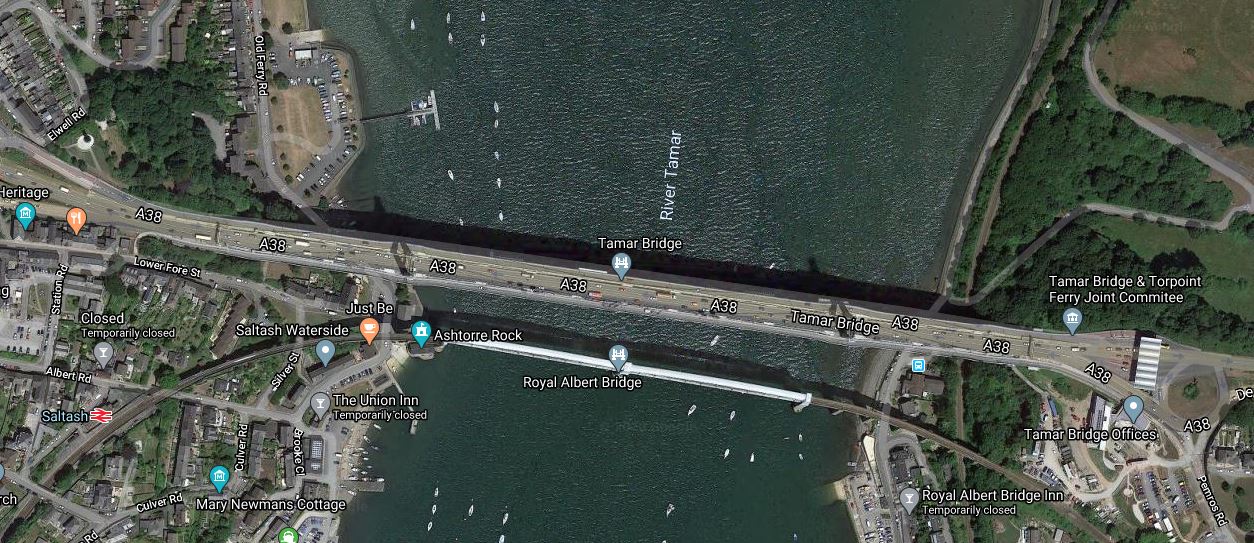
Note.
- The Royal Albert Bridge to the South of the modern Tamar Bridge.
- The Great Western Main Line running East to Plymouth and West to Penzance.
- The Tamar Valley Line running up the Eastern bank of the River Tamar and under the Eastern approaches to both bridges.
- Going North on the Tamar Valley Line leads to the TORs and going South leads to Plymouth station.
I can see a difficult design problem at the Eastern end of the Royal Albert Bridge, as a very complicated junction will be needed to allow all trains go the way they need.
Trains wanting to call at Plymouth station and use TORs will need to reverse in the station.
Connecting At The East Of Exeter
This Google Map shows The Tarka Line and the Bristol-Exeter Line join at Cowley Bridge Junction.
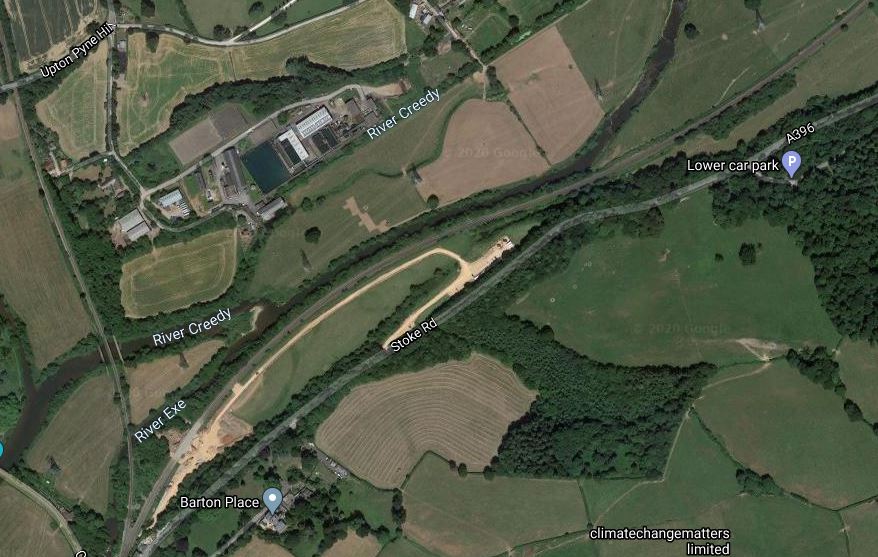
Note.
- The Tarka Line to Barnstaple and TORs leaves the map in the North West corner.
- The Bristol-Exeter Line to Taunton, Bristol and London Paddington leaves the map in the North East corner.
- Cowley Bridge Junction is in the South West corner of the map.
- Cntinuing South West leads to Exeter St. David’s station.
It looks to me, that Cowley Bridge Junction will need to be made into a full triangular junction, so that trains can go directly between the Bristol-Exeter Line and the Tarka Line.
Trains wanting to call at Exeter St. David’s station and use TORs will need to reverse in the station.
The Reversal Problem
If you wanted to run a passenger service between Taunton and Penzance using TORs with stops at Exeter, Okehampton, Tavistock, Plymouth and Truro, the train would need to reverse twice at Exeter and Plymouth.
These days with modern fast bi-mode multiple units, it’s not a problem, but in the days of Beeching, when the Tavistock and Okehampton route was originally closed in 1968, there probably wasn’t a suitable train other than a slow two-car diesel multiple unit.
I think, that fast expresses to and from Penzance will still take the current route.
- Battery-electric trains can handle the route at 100 mph.
- No reversals will be needed.
- There is a call at Newton Abbott for connections to Torquay and Paignton.
- Passengers wanting Okehampton, Tavistock and other stations on the TORs route can change at Exeter or Plymouth.
The Modern Railways article says this about services on the TORs route.
The case suggests that services could operate as an extension of the SWR Waterloo to Exeter service, or potentially as an extension of CrossCountry services beyond Exeter. During periods when the coastal route is blocked, additional services could use the TORs route, potentially running non-stop.
Note.
- As the extension of the SWR service would run the other way through Exeter St. David’s station, there would be no need to reverse.
- But I suspect the CrossCountry service would need the reverse.
- I feel for efficiency, that diverted freight services would need the efficient junctions at each end of TORs.
It probably would have helped if the Great Western and the London and South Western Railways had had a better crystal ball.
Fast Electric Freight Services To And From Devon And Cornwall
If the following lines are electrified.
- Cogload Junction and Exeter
- TORs
- Cornish Main Line
I feel that electric freight services will be able to run between Taunton and Penzance.
All it would need to complete the electrified route would be to electrify the following.
- Cogload Junction and Bristol
- Cogload Junction and Newbury
What would a high-speed freight route do for the economy of the two South Western counties?
A New Stansted Express Train At Liverpool Street Station
I took these pictures yesterday of a new Stansted Express train at Liverpool Street station.


Note that it is numbered 106 on the front. The leading one indicates a Class 745/1 train or one for use on Stansted Express.
The Class 745 train data sheet is now on the Stadler web site, which gives a lot of interesting data.
For instance, it gives the train’s mean acceleration between 0 and 40 mph as 0.9 m/s².
This compares with the following.
The maximum acceleration for a Hitachi AT-300 train given on this page of their web site as 0.75 m/s².
The acceleration of a Class 345 train is given as up to 1 m/s².
Eversholt give the acceleration of a Class 321 Renatus as 0.6 ms².
It looks to me that Class 745 trains have a quick getaway, but not as quick as the Crossrail trains.
But they do appear to be faster off the mark than the Hitachi trains.
Will Avanti West Coast’s New Trains Be Able To Achieve London Euston and Liverpool Lime Street In Two Hours?
Note that I have rewritten this post to take account of this information from the January 2020 and December 2022 Editions of Modern Railways, in an article, which is entitled Hitachi Trains For Avanti.
This is said about the ten all-electric AT-300 trains for Birmingham, Blackpool and Liverpool services, which have now been numbered as Class 807 trains.
The electric trains will be fully reliant on the overhead wire, with no diesel auxiliary engines or batteries.
It may go against Hitachi’s original design philosophy, but not carrying excess weight around, must improve train performance, because of better acceleration.
Currently, Avanti West Coast‘s trains between London Euston and Liverpool Lime Street stations are timetabled as follows.
- The journey takes two hours and thirteen or fourteen minutes.
- There are three stops at Stafford, Crewe and Runcorn.
- The stops with the current Class 390 trains seem to take around a minute.
- There is one train per hour (tph)
- A second hourly service with a stop at Liverpool South Parkway is planned to be introduced in December 2022.
In 2022, a new fleet of Hitachi AT-300 trains will be introduced on the route. I believe, it would be reasonable to assume, that these Class 807 trains will have similar or better performance, than the current Class 390 trains.
- Acceleration and braking are likely to be better.
- Regenerative braking energy may well be handled more efficiently.
- The trains may well be equipped with in-cab digital signalling and be able to travel in excess of 125 mph in places, where the track allows.
I would expect, that these trains could be running near to or at 125 mph for most of the journey.
London Euston and Liverpool Lime Street are 193.5 miles apart, so if a train could be running at 125 mph all the way, a train would take 93 minutes.
Extra time must be added for the following.
- Acceleration from a standing start to 125 mph at London Euston, Stafford, Crewe and Runcorn.
- Deceleration from 125 mph to a stop at Stafford, Crewe, Runcorn and Liverpool Lime Street.
- Dwell time in the platforms at Stafford, Crewe and Runcorn.
This page on the Eversholt Rail web site, has a data sheet for a Class 802 train, which is a bi-mode AT-300 train with three diesel engines.
The data sheet shows that a five-car train can accelerate to 125 mph and then decelerate to a stop in six minutes in electric mode. As Avanti West Coast’s Class 807 trains will be all-electric seven-car trains with no heavy engine or battery, I doubt they will be slower than a Class 802 train in electric mode. So four accelerations/deceleration cycles to 125 mph should take no more than twenty-four minutes.
I will assume two minutes for each of the three stops.
I can now give an estimate for the journey.
- Base journey time – 93 minutes
- Acceleration from and deceleration to stops – 24 minutes
- Station dwell time – 6 minutes
This gives a journey time between London Euston and Liverpool Lime Street of two hours and three minutes.
The journey time can probably be improved in the following ways.
- Take full advantage of the track improvements on the approach to Liverpool Lime Street station and at Norton Bridge Junction.
- Better train pathing, as has been done on London Liverpool Street and Norwich services to create the fast Norwich-in-Ninety services.
- Track and signal improvements to pinch a minute here and a minute there.
- As Runcorn now has an hourly Liverpool Lime Street and Chester service, will the Runcorn stop be dropped to save time?
- Reduction in station dwell time.
- Better driver aids.
- Better staff operating procedures at stops and whilst turning the train.
It should be born in mind, that a two hour journey between London Euston and Liverpool Lime Street would be a start-stop average speed of 97 mph on a 125 mph route. Intriguingly, this means the trains would run at 77 % of the maximum operating speed of the route, which is the same figure for Norwich-in-Ninety services.
Some of these improvements may enable the Class 390 trains to go a bit faster.
It has to be considered, that Avanti West Coast’s Marketing Department would be ecstatic, when told that London and Liverpool were less than two hours apart.
How Many Trains Would Be Needed?
Currently, this is a typical train round trip to Liverpool Lime Street.
- 07:07 – Leave London Euston
- 09:20 – Arrive Liverpool Lime Street
- 09:47 – Leave Liverpool Lime Street
- 12:02 – Arrive London Euston
The five-hour round-trip would indicate that five trains would be needed for the one tph service.
This train didn’t return to Liverpool, but went off to the Wembley Depot.
After their Liverpool trip, there is no real pattern of where the train will go next, as this table shows.
- 06:41 – 6 – 33 minutes – Wembley Depot
- 07:48 – 2 – 36 minutes – Manchester Piccadilly
- 08:47 – 1 – 40 minutes – Manchester Piccadilly
- 09:47 – 7 – 30 minutes – Wembley Depot
- 10:47 – 4 – 42 minutes – Preston
- 11:47 – 4 – 37 minutes – Preston
- 12:47 – 1 – 34 minutes – Preston
- 13:47 – 15 – 13 minutes – Birmingham New Street
- 16:47 – 6 – 16 minutes – Glasgow Central
- 17:47 – 1 – 42 minutes – Manchester Piccadilly
Note.
- The time is departure time from Liverpool Lime Street, the number is the platform and the minutes are the turnround time in Euston.
- I have left out a couple of trains as there was a very late train.
- There doesn’t seem to be any regular pattern.
- It looks like trains can be turned in under fifteen minutes.
- I think there was a time, when Liverpool couldn’t accept eleven-car trains, but the new longer platforms appear to accept them.
- Trains appear to be running services to Glasgow Central and Manchester Piccadilly, who seem to usually get eleven-car trains.
I almost think, that they’re allocating trains as they go.
With the new Class 807 trains, I suspect the following is possible.
- London Euston to Liverpool Lime Street – Two hours
- Turnround – Fifteen minutes
- Liverpool Lime Street to London Euston – Two hours
- Turnround – Fifteen minutes
This means it’s a four-and-a-half hour round trip.
- Journey times of two hours.
- Time enough for well-drilled staff to turn the trains.
- Dedicated platforms at London Euston and Liverpool Lime Street.
- It would be a very attractive customer-friendly service.
Two tph would need nine trains.
It would be everything the Marketing Department wanted!
Thoughts On The Current Class 390 Timings
As the Class 390 trains are a 125 mph train, their base timing of 93 minutes, between London and Liverpool should still be the same.
As their doors and lobbies are similar in design to those of the Hitachi AT-300 trains, I would allow the same two minutes of dwell time at each station.
Current timings of services on the route vary between 132 and 134 minutes. I’ll take the average of 133 minutes.
So the current services take thirty-four minutes to perform the four accelerate and decelerate sequences on the route.
It would appear that this sequence would take eight-and-a-half minutes in comparison with the six minutes of the new Hitachi AT-300 trains.
I have a feeling, if Class 390 trains cut out a couple of stops, given the other improvements, that they could achieve the magic two hour timing.
Plans For The Second Hourly Service From December 2023
These have been announced in the December 2022 Edition of Modern Railways.
- The Class 807 trains would take over the current service and will stop at Stafford, Crewe and Runcorn.
- There will be an additional call at Liverpool South Parkway on the Class 807 service.
- Class 390 trains will run the second hourly service to Euston.
- This service will stop at Lichfield Trent Valley and Tamworth.
The Class 807 service will stop four times and the Class 390 service will stop twice. I suspect the lesser number of stops from the Class 390 train, is to allow the train to match the timing of the Class 807 train.
I wouldn’t be surprised to see both trains take two hours.
An Improved London Euston and Blackpool North Service
The new AT-300 trains will also be running to Blackpool.
- London Euston and Blackpool North takes between two hours and forty-four minutes and two hours and fifty-nine minutes.
- Journey times are not very consistent, probably due to timetabling difficulties.
- Trains stop between four and five times on the West Coast Main Line.
Would the faster stops of the new AT-300 trains mean that Avanti West Coast could run a more regular timetable, with all services under three hours?
It should also be noted, that Grand Central will start a London Euston and Blackpool North service in Spring 2020.
As the rolling stock for this new service will be Class 90 locomotives hauling rakes of Mark 4 coaches, that will be limited to 110 mph, are Avanti West Coast making sure, that they have the fastest trains on the route?
Would AT-300 Trains Save Time To Other Avanti West Coast Destinations?
If we assume that AT-300 trains can save two-and-a-half minutes per accelerate and decelerate sequence times could change as follow.
- Birmingham New Street – One hour and twenty-two minutes – Three stops – One hour and twelve minutes
- Coventry – One hour – Two stops – Fifty-five minutes
- Crewe – One hour and thirty-four minutes – One stop – One hour and thirty minutes
- Glasgow – As services stop six or thirteen times, there may be substantial savings to be achieved.
- Manchester – Between two hours and seven minutes and two hours and thirteen minutes – Three stops – Between one hour and fifty-seven minutes and two hours and three minutes.
Note.
- The number of accelerate and decelerate sequences is one more than the number of stops.
- Coventry services would be under an hour.
- Two out of three Manchester services would be under two hours.
This analysis illustrates how fast train performance is important in more customer-friendly services.
Conclusion
I believe the following will be possible.
- A two hour service between London Euston and Liverpool Lime Street will be possible with Avanti West Coast’s new Class 807 trains.
- The current Class 390 trains could go a bit faster and if they cut out a couple of stops could probably break two hours.
- I estimate that a Class 807 train could save as much as two-and-a-half-minutes at each stop.
- Blackpool North and London times will be comfortably under three hours.
- Coventry and London times will be comfortably under an hour.
The performance of these Class 807 trains will improve the West Coast Main Line.
Could Battery-Electric Hitachi Trains Work Hull Trains’s Services?
Before I answer this question, I will lay out the battery-electric train’s specification.
Hitachi’s Proposed Battery Electric Train
Based on information in an article in Issue 898 of Rail Magazine, which is entitled Sparking A Revolution, the specification of Hitachi’s proposed battery-electric train is given as follows.
- Based on Class 800-802/804 trains or Class 385 trains.
- Range of 55-65 miles.
- Operating speed of 90-100 mph
- Recharge in ten minutes when static.
- A battery life of 8-10 years.
- Battery-only power for stations and urban areas.
- Trains are designed to be created by conversion of existing Class 80x trains.
For this post, I will assume that the train is five cars long. This is the length of Hull Trains’s Class 802 trains.
Recently, Hitachi have released this infographic.

This seems to give the same information and a definitive range of 90 km or 56 miles.
Hull Trains’s Services
Hull Trains run a train between Kings Cross and Hull, with some trains extending to Beverley.
- The service runs at a frequency of five trains per day (tpd) to Hull station and two tpd to Beverley station.
- Intermediate stations are Stevenage, Grantham, Retford, Doncaster, Selby, Howden, Brough and Cottingham
The Beverley service is 213 miles long and takes three hours and seven minutes.
These are facts about the operation of the service.
- The train changes between diesel and electric operation at Temple Hirst Junction, which is on the electrified East Coast Main Line.
- Temple Hirst Junction is forty-four miles from Beverley and thirty-six miles from Hull.
- Trains to and from Beverley reverse at Hull and and are allowed eighteen minutes for the operation.
- This reverse at Hull is enough time to charge the train’s batteries using a Fast-Charging system.
As these trains could have a range of at least fifty-five miles on battery power, is there any point to bother with diesel?
Could Hull Trains and TransPennineExpress Share A Fast-Charger?
In Could Battery-Electric Hitachi Trains Work TransPennine Express’s Services?, I said this about their Manchester Piccadilly and Hull service.
As with the Scarborough and Redcar Central services, a Fast-Charging system would probably be needed at Hull.
As Hull Trains and TransPennine Express are both First Group companies, I would assume they would share amicably!
But would they allow LNER’s Azumas to use their Fast-Charger?
Could Hull Station Go Zero-Carbon?
If all the Hitachi trains used by Hull Trains, LNER and TransPrnnine Express were to use battery power to run between Hull station and the nearest electrification, the only diesel trains using the station would be Northern‘s assortment.
Northern run services through or to Hull as follows.
- Sheffield and Hull
- Sheffield and Bridlington
- Hull and Scarborough
- Hull and York
All services have a frequency of around one train per hour (tph).
These services could be run by either battery-electric or hydrogen-electric trains.
Hull station is also a big bus interchange, so these would need to be converted to electric or hydrogen.
I’m sure iTM Power not far away in Sheffield, would be happy to provide a hydrogen system to fuel the buses and the trains.
Conclusion
It looks to me, that if a Fast-Charging system, were to be fitted at Hull and used during reverse or turnround at the station, that a Class 802 train fitted with batteries could work Hull Train’s service without using a drop of diesel.
I can just see the advertising – Hull Trains – Your carbon-free way between London and Hull!
It wouldn’t even need any electrification, other than the Fast-Charging system at Hull.
I also believe that Hull station and the co-located bus station could go carbon-free.
 The Anonymous Widower