Darlington And Bishop Auckland – 26th June 2025
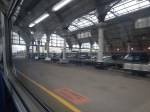
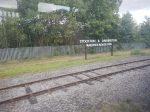
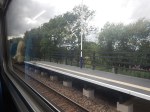
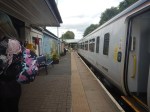
My second trip out from Darlington was to Bishop Auckland station and I took these pictures on the way up and down.

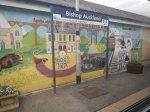





Note.
- Bishop Auckland station is a one-platform station, but all the other stations seem to be two-platform stations.
- The railway museum; Locomotion seems to be within walking distance of Shildon station.
- There is a short section of electrified track, that Hitachi use to test trains and get them to the East Coast Main Line.
The stations seemed tidy and clean, but more step-free access is needed.
I have some further thoughts.
The Location Of Hitachi Rail
This Google Map shows the location of Hitachi Rail.
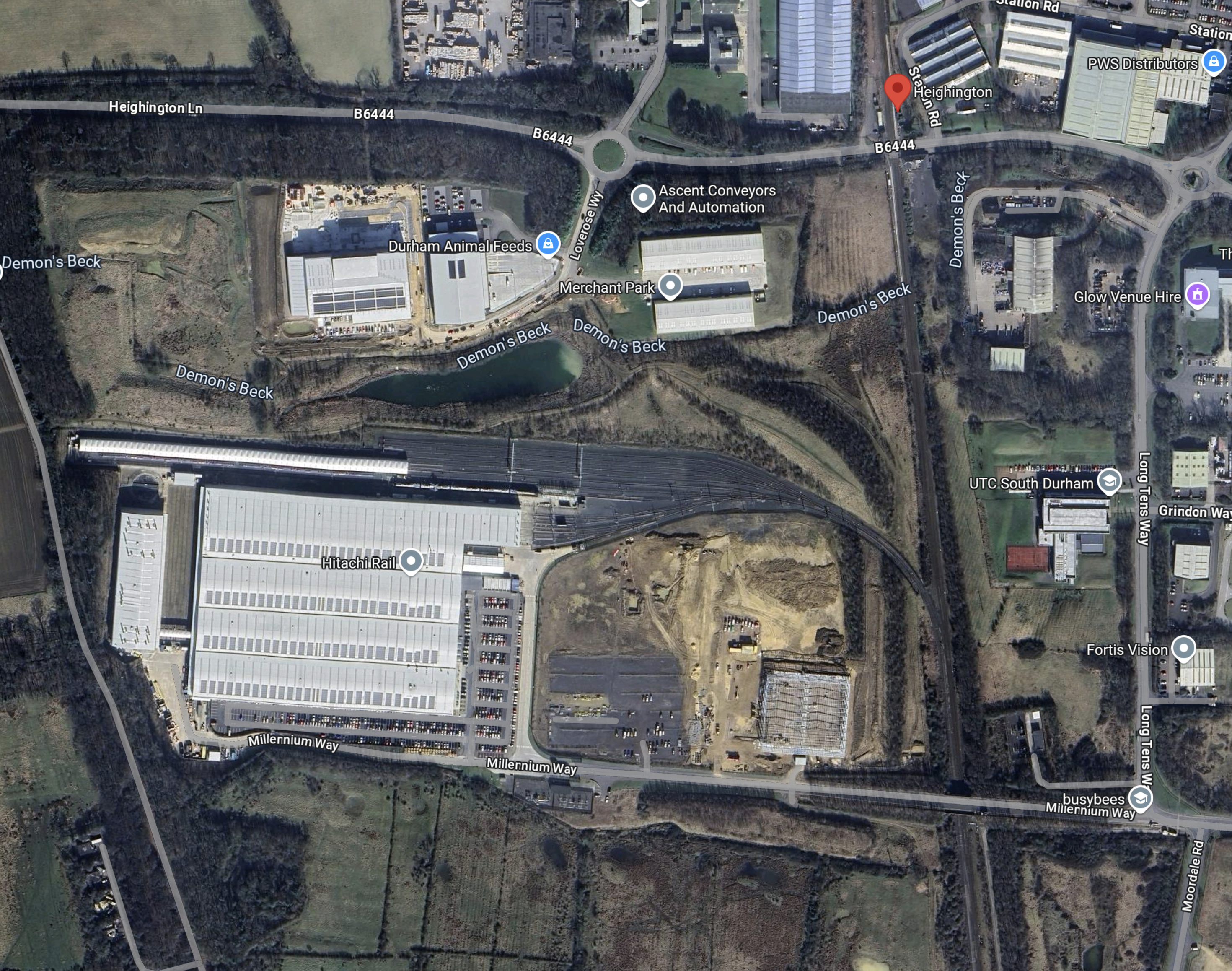
Note.
- Heighington station on the Tees Valley Line is marked by the red arrow.
- Hitachi Rail is the large building in the South-West corner of the map.
- There appear to be electrified sidings to the North of the factory, which have a connection to the Tees Valley Line.
From the map it looks efficient and well-designed.
Could The Services On The Branch Be Run By Battery-Electric Trains?
I don’t think there would be too many problems.
- Bishop Auckland and Darlington is only twelve miles.
- Both platforms at Darlington used by Tees Valley Line services are electrified.
- The single platform at Bishop Auckland station could be fitted with one of Siemens’s Rail Charging Convertors.
- Hitachi at Newton Aycliffe might like some more formal electrification between Newton Aycliffe and Darlington stations.
- An electrified Tees Valley Line would surely be useful to Hitachi for showing the capabilities of battery-electric trains.
This would be a very easy line to run using battery-electric trains.
Farage Wants HS2 Scrapped
The title of this post, is the same as a sub-title in this article on The Times. which is entitled HS2: Labour confirms delay until 2033.
This is the sub-heading.
Nigel Farage has called for the whole HS2 project to be scrapped.
These two paragraphs give NF’s view.
The Reform UK leader told the Commons: “Has the moment not come, rather than having another reset, to recognise this is a failure?
“Let’s scrap HS2, let’s use the tens of billions of pounds we can save in the next decade to upgrade railway lines across the entirety of the United Kingdom to the benefit of many millions and spend the rest on other national priorities in these financially straitened times.”
Farage’s simplistic plan will appeal to his disciples, but the major thing that is needed, is more capacity between South and North. Or North and South depending on where you live!
HS2 will provide an extra seventeen paths between London and a large triangular junction in the West Midlands.
If HS2 Is Not Built There Will Be More Cars And Trucks On The Roads
In Footage Released Of East West Rail’s First Commercial Freight Train, I wrote about the SEGRO Logistics Park Northampton (SLPN), which would generate lots of road and rail traffic. Without developments like HS2, the roads will just get clogged up.
High Speed Two’s Originally Proposed Service Pattern
This graphic shows the original service pattern for High Speed Two.
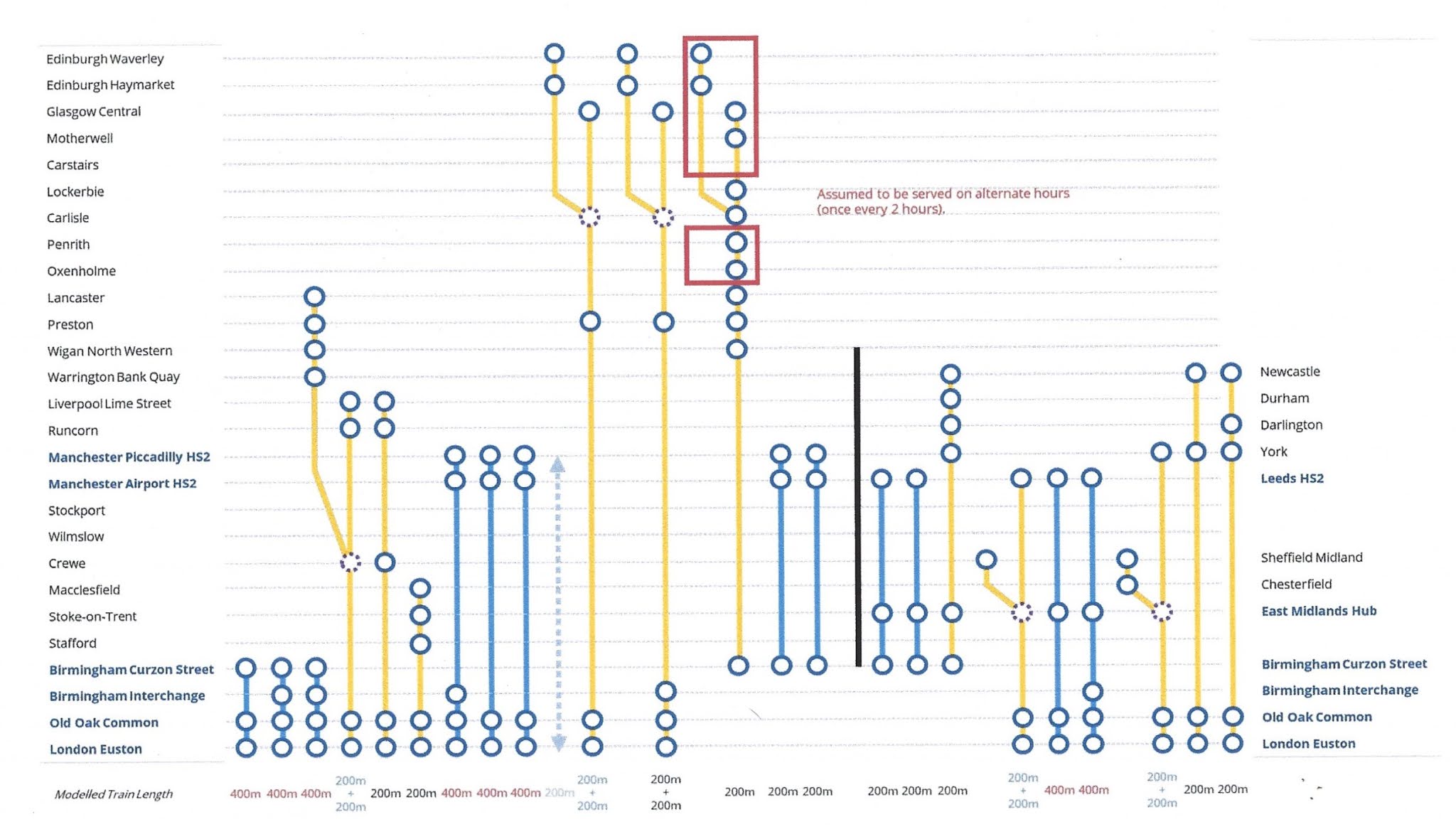
Note.
- There are seventeen paths terminating in the South at Euston station.
- Six of these paths go to Leeds, Newcastle or York.
- As the Eastern leg has been abandoned, that means six extra trains can run between London and the large triangular junction in the West Midlands.
Six extra trains running to the West side of England and Scotland could give a substantial improvement of services.
High Speed Yorkshire
HS2 needs to be paired with High Speed Yorkshire, which would mainly be an upgrading of the East Coast Main Line running at up to 160 mph to serve Lincolnshire, Yorkshire, the North-East and East Scotland.
Note.
- British Rail built the Selby Diversion in the 1980s to run at 160 mph.
- Digital signalling is currently being installed on this route and this will allow trains to speed through the two bottlenecks of the Digswell Viaduct and the Newark Crossing.
- Times of three-and-a-half hours between King’s Cross and Edinburgh, should be possible.
These times should give the airlines a good kicking on London-Newcastle and London-Scotland routes.
Fast services would run on High Speed Yorkshire to Alnwick, Barnetby, Barnsley, Beverley, Berwick, Bradford, Brough, Cleethorpes, Darlington, Doncaster, Durham, Edinburgh, Goole, Grantham, Grimsby, Harrogate, Huddersfield, Hull, Leeds, Lincoln, Middlesbrough, Newcastle, Peterborough, Pontefract, Retford, Rotherham, Scarborough, Scunthorpe, Sheffield, Skipton, Stevenage, Sunderland, Wakefield, Worksop and York.
Most of these towns and cities are already served by Hitachi or other high speed trains from King’s Cross.
A high proportion of the services to Yorkshire destinations will be under two hours from London.
When the current trains need replacing, they could be replaced by High Speed Two Classic-Compatible trains.
Onward From Handsacre Junction
Services to the North-West and Scotland will join the Trent Valley Line at Handsacre junction.
This OpenRailwayMap shows the Trent Valley Line between Crewe station and Handacre junction.
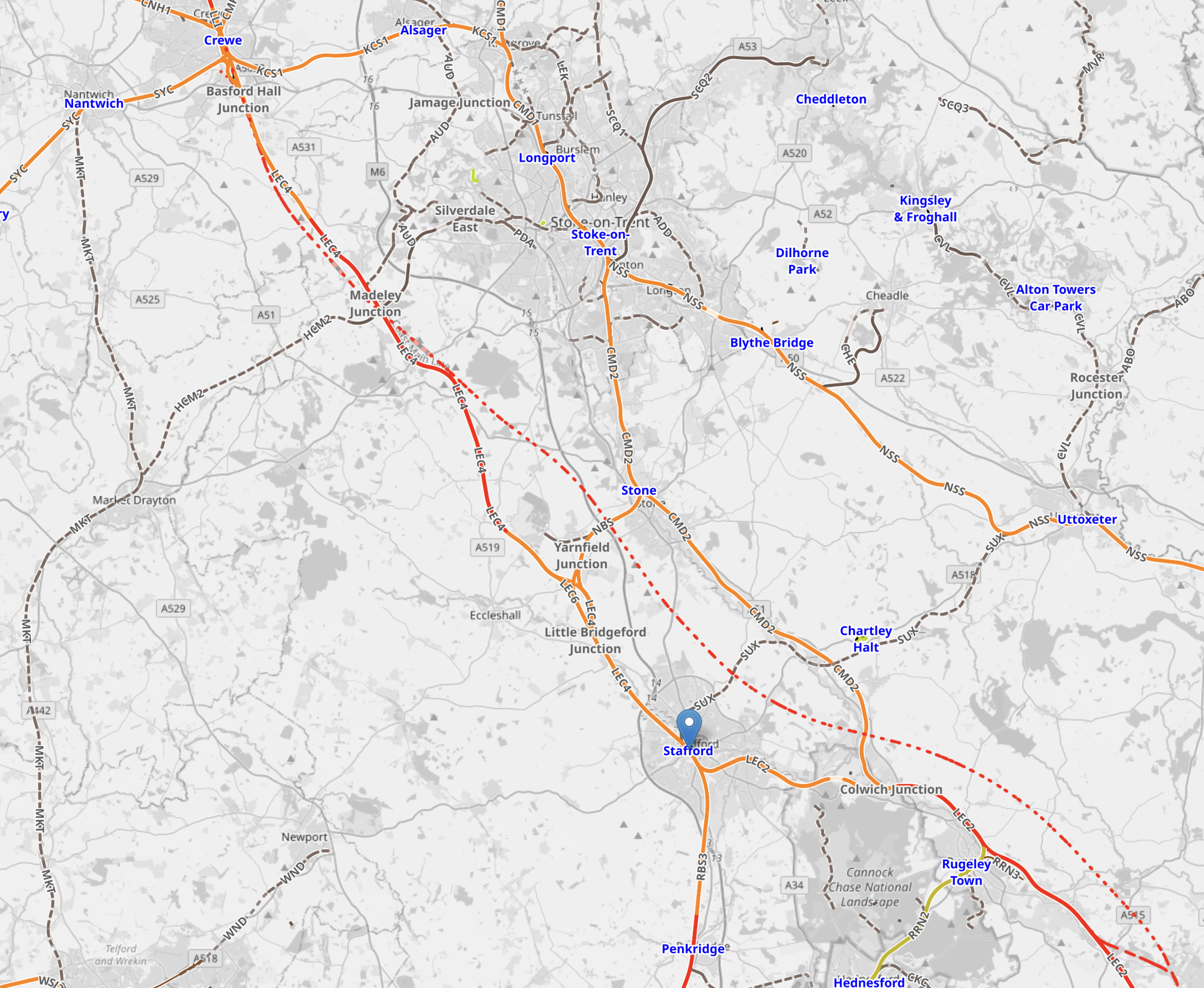
Note.
- The proposed route of High Speed Two is shown as a dotted line, running diagonally across the map.
- The red track to its West is the Trent Valley Line, which is a section of the West Coast Main Line.
- Handsacre junction is in the South-East corner of the map.
- The blue arrow indicates Stafford station on the West Coast Main Line.
- The main High Speed Two tracks will not connect to Stafford or Stoke-on-Trent stations.
- Crewe station is in the North-West corner of the map.
- Crewe station and Handsacre junction are 37.6 miles apart.
With the exception of the 6 mile twin-track section between Stafford Trent Valley and Colwich junctions, it appears that Crewe station and Handsacre junction is all quadruple track.
This OpenRailwayMap shows the Trent Valley Line between Stafford stationand Colwich junction.
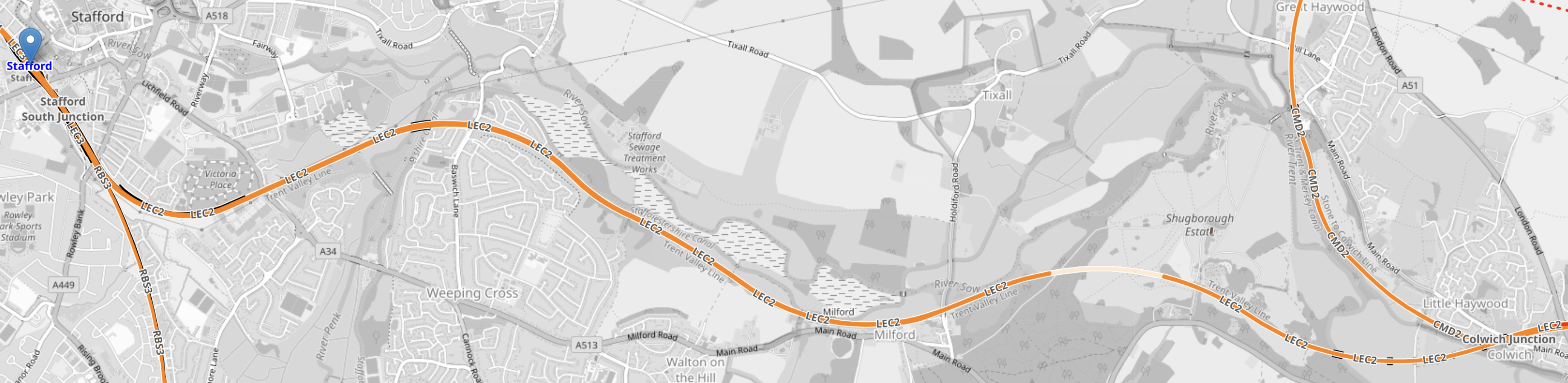
Note.
- The Trent Valley Line, which is a section of the West Coast Main Line, runs across the map.
- The arrow in the North-West corner of the map indicates Stafford station.
- Colwich junction is in the South-East corner of the map.
- About three-quarters of the way across, the track is shown in cream. This is the twin-track Shugborough Tunnel, which is around a half-mile long.
- The Shugborough Tunnel has a 100 mph maximum speed.
- The portals of Shugborough Tunnel are Grade II Listed and the Wikipedia entry for the tunnel is certainly worth a read.
How Many High Speed Two trains per hour (tph) will use the Trent Valley Line route?
The original proposal in the graphic earlier shows these trains.
- 4 – London to Lancaster/Liverpool Lime Street – Splits at Crewe
- 5 – London to Liverpool Lime Street
- 6 – London to Stafford, Stoke -on-Trent and Macclesfield
- 7 – London and Birmingham Interchange to Manchester Airport and Manchester Piccadilly
- 8 – London to Manchester Airport and Manchester Piccadilly
- 9 – London to Manchester Airport and Manchester Piccadilly
- 10 – London and Birmingham Interchange to Preston, Carlisle, Edinburgh Haymarket and Edinburgh Waverley/Glasgow Central – Splits at Carlisle
- 11 – London Euston to Preston, Carlisle, Edinburgh Haymarket and Edinburgh Waverley/Glasgow Central – Splits at Carlisle
- 12 – Birmingham Curzon Street to Wigan North Western, Preston, Lancaster, Oxenholme, Penrith, Carlisle, Edinburgh Haymarket and Edinburgh Waverley Or Wigan North Western, Preston, Lancaster, Carlisle, Lockerbie, Motherwell and Glasgow Central- Services alternate.
- 13 – Birmingham Curzon Street to East Midlands Hub, Manchester Airport and Manchester Piccadilly
- 14 – Birmingham Curzon Street to East Midlands Hub, Manchester Airport and Manchester Piccadilly
Note.
- It looks like there will be eleven High Speed Two tph on the Trent Valley Line.
- As East Midlands Hub will not be built, I will assume trains 13 and 14 will be Birmingham Curzon Street to Manchester Airport and Manchester Piccadilly.
- Other trains will need to use the route.
- I suspect that freight trains, that couldn’t maintain 100 mph would not be allowed.
I believe that digital signalling can handle all the trains between Handsacre Junction and Crewe.
- Trains 10 and 11 would run every thirty minutes to give two tph between London and Glasgow Central and two tph between London and the two Edinburgh stations.
- Each of these trains would lead a flight of trains behind them through the Trent Valley Line.
- The last trains going North in the flights, would be trains 4 and 6, as they stop on the Trent Valley Line section.
I have written a lot of scheduling algorithms in the last fifty years and I wouldn’t be surprised if flights could be up to 7 or 8 trains, running 3 or 4 minutes apart.
It would be an impressive sight.
What Timings Would Be Possible On High Speed Two Using Handsacre Junction And The Trent Valley Line?
In Where Is Handsacre Junction? I calculated some times on High Speed Two to various destinations, using Handsacre junction and the Trent Valley Line. This is a more comprehensive table.
- London and Blackpool North – 205 mph – 1:55
- London and Blackpool North – 140 mph – 2:12
- London and Carlisle – 205 mph – 2:45
- London and Carlisle – 140 mph – 3:01
- London and Crewe – 205 mph – 1:03
- London and Crewe – 140 mph – 1:19
- London and Edinburgh Waverley – 205 mph – 4:14
- London and Edinburgh Waverley – 140 mph – 4:30
- London and Glasgow Central – 205 mph – 4:22
- London and Glasgow Central – 140 mph – 4:38
- London and Handsacre junction – 205 mph – 0:35
- London and Handsacre junction – 140 mph – 0:51
- London and Lancaster – 205 mph – 1:50
- London and Lancaster – 140 mph – 2:06
- London and Liverpool Lime Street – 205 mph – 1:46
- London and Liverpool Lime Street – 140 mph – 2:02
- London and Manchester Piccadilly – 205 mph – 1:41
- London and Manchester Piccadilly – 140 mph – 1:57
- London and Preston – 205 mph – 1:31
- London and Preston – 140 mph – 1:47
- London and Stafford – 205 mph – 0:45
- London and Stafford – 140 mph – 1:01
- London and Stoke-on-Trent – 205 mph – 0:55
- London and Stoke-on-Trent – 140 mph – 1:11
- London and Wigan North Western – 205 mph – 1:17
- London and Wigan North Western – 140 mph – 1:33
Note.
- 205 mph could be the average speed between London Euston and Handsacre junction for High Speed Two Classic-Compatible trains.
- 140 mph could be the average speed between London Euston and Handsacre junction for Class 390 trains.
- Times are in hh:nn.
- For times North of Handsacre junction are typical Class 390 times.
A typical timing between London Euston and Handsacre junction for Class 390 trains is 71 minutes, so if High Speed Two services were run using Class 390 trains, twenty minutes would be saved on all services via Handsacre junction compared to current Avanti West Coast services.
I have some other thoughts.
Using Class 390 Trains Is Not My Idea
This article on Rail nBusiness UK is entitled Viewpoint: Buy tilting trains and finish Delta Junction to salvage HS2, says Gibb.
This is the sub-heading.
UK: Procurement of a fleet of tilting trains and a focus on Birmingham – Manchester services are key to making the most the descoped High Speed 2 scheme, former Virgin Trains executive Chris Gibb tells Rail Business UK.
Chris Gibb has the right experience. and has been used as a go-to man, when projects are in trouble.
The major points of his plan are as follows.
- Connect High Speed Two to the Trent Valley Line to go North from the Midlands.
- Initially, use Class 390 trains or Pendelinos on Liverpool, Manchester and Scottish services.
- Run Class 390 trains at 140 mph between Euston and Handsacre junction.
- When the Pendelinos need to be retired, buy a new set of tilting trains.
- Complete the North-to-West leg of High Speed Two’s triangular junction, so that trains can run between Birmingham Curzon Street and Manchester.
- Gibb proposes a Blackpool service, that splits and joins with a Liverpool service. I assume he means train 5.
Gibb feels a fundamental review of the operating principles and fleet requirements is now needed.
It is a well-thought out viewpoint and very much a must-read.
Train Lengths Between King’s Cross and Edinburgh
If you ask Google, what is the platform length at King’s Cross station, you get the following answers.
- Platform 0 – 305 metres
- Platform 1 – 304 metres
- Platform 2 – 285 metres
- Platform 3 – 289 metres
- Platform 4 – 290 metres
- Platform 5 – 270 metres
- Platform 6 – 288 metres
- Platform 7 – 288 metres
- Platform 8 – 289 metres
- Platform 9 – 276 metres
- Platform 10 – 276 metres
This OpenRailwayMap shows the tracks linking to the eleven platforms at King’s Cross.
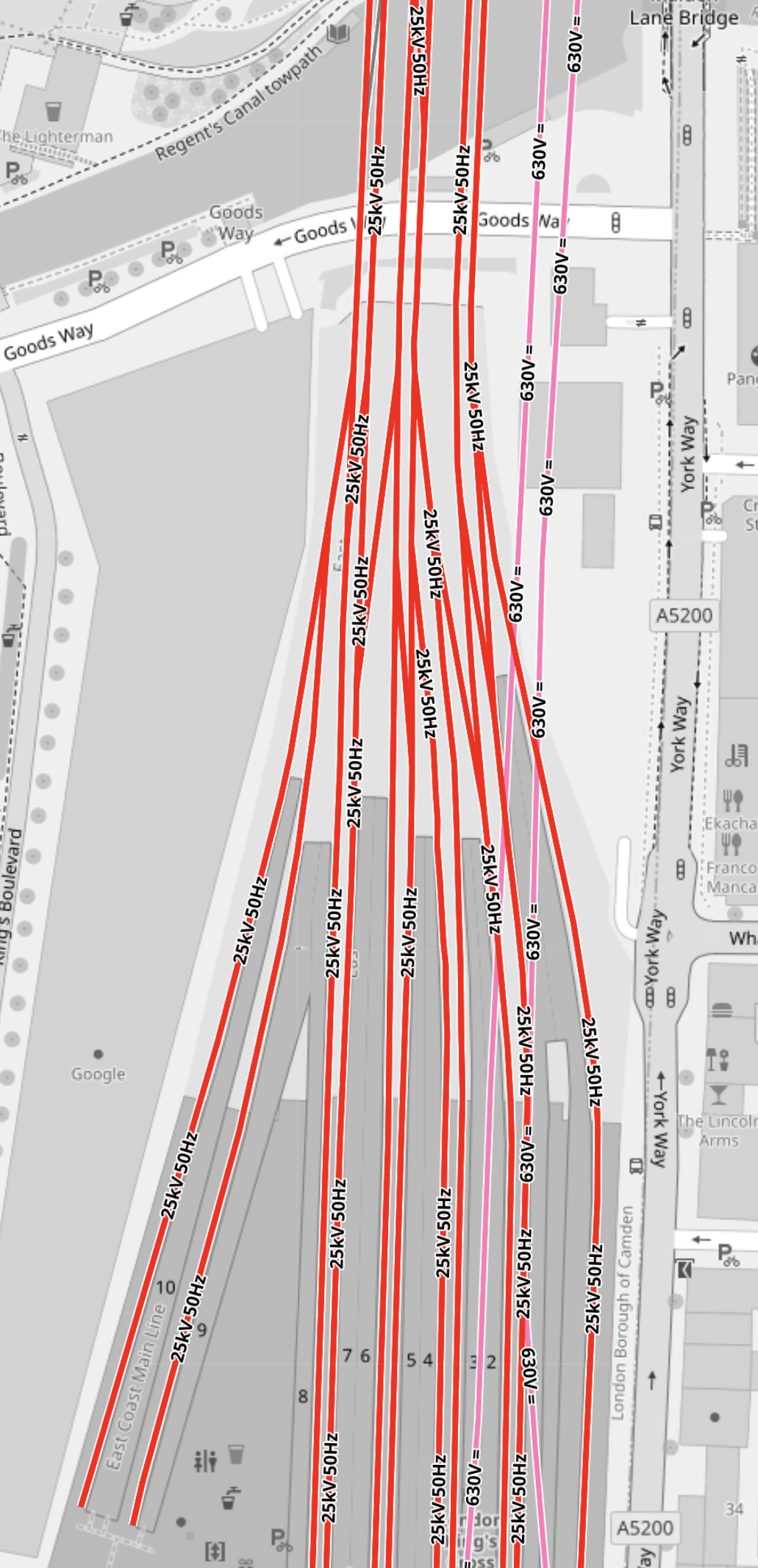
Note.
- The red tracks are the electrified platforms in King’s Cross.
- The two pink tracks are the Piccadilly Line underneath the station.
- Platform 0 is on the right and Platform 10 is on the left.
- The platform number is shown alongside the track.
Platform 0 is the newest platform, which opened in 2010 and also the longest at 305 metres.
Many of the trains using the station are Hitachi Class 800, 801, 802 and 803 trains, which have cars of the following lengths.
- Driving car – 25.85 metres
- Intermediate car – 26 metres
These lengths mean that individual trains have the following lengths.
- Five-car – 129.7 metres
- Nine-car – 233.7 metres
- Ten-car – Pair of five-cars – 259.4 metres
Note.
- It would appear that nine- and ten-car trains can use all platforms 0-8 in the main station.
- Platform 5 may be short at 270 metres, but Real Time Trains shows it can handle nine- and ten-car trains.
Real Time Trains doesn’t seem to show any nine- and ten-car trains using Platforms 9 and 10. Is the approach just a bit tight?
These are some further thoughts.
LNER’s New Class 897 Trains
I asked Google how long will be LNER’s new ten-car Class 897 trains. This is the answer I received.
The Class 897 train will be 218.7 meters (717 ft 6 in) long, according to Wikipedia. These trains will be ten-car units.
Have these trains been designed, so they can fit in Platforms 9 and 10 at King’s Cross and other shorter platforms, that LNER serve?
Other train classes, that could use Platforms 9 and 10 at King’s Cross include.
- Five-car Class 800, 801, 802 and 803 trains – 129.7 metres
- Five-car Class 180 trains – 116.52 metres
- Five-car Class 222 trains – 116.16 metres
- Six-car Class 717 trains – 121.7 metres
- Eight-car Class 379/387 trains – 163.12 metres
- Eight-car Class 700/0 trains – 162 metres
- Twelve-car Class 700/1 trains – 242.6 metres
Real Time Trains or my eyes have observed all these trains, except for the twelve-car Class 700 trains in Platforms 9 and 10 at King’s Cross.
It does appear that the shorter ten-car Class 897 trains improve utilisation of the platforms at King’s Cross station.
Could Twelve-Car Class 800, 801, 802 and 803 Trains Run Into King’s Cross?
Consider.
- LNER and Lumo have both said, they want to win passengers from the airlines on Anglo-Scottish routes.
- Extra paths on the East Coast Main Line are at a premium and hard to come by.
In Do Class 800/801/802 Trains Use Batteries For Regenerative Braking?, I found this extract in a Hitachi document on their web site.
To simplify the rearrangement and management of train configurations, functions are provided for identifying the train (Class 800/801), for automatically determining the cars in the trainset and its total length, and for coupling and uncoupling up to 12 cars in
normal and 24 cars in rescue or emergency mode.
So if say LNER or Lumo wanted a twelve-car train, it would be possible. It also looks like one twelve-car train can rescue another.
Train lengths would be as follows.
- Five-car Class 800, 801, 802 and 803 trains – 129.7 metres
- Six-car Class 800, 801, 802 and 803 trains – 155.7 metres
- Nine-car Class 800, 801, 802 and 803 trains – 233.7 metres
- Twelve-car Class 800, 801, 802 and 803 trains – 311.7 metres
- Twelve-car – Pair of six-car Class 800, 801, 802 and 803 trains – 311.4 metres
As Platform 0 is 305 metres and Platform 1 is 304 metres, I suspect that King’s Cross station could accept twelve-car formations of Hitachi Class 800, 801, 802 or 803 trains, with fairly minor modifications.
But what about other stations?
Berwick-on-Tweed
Both platforms are around 233/234 metres, so twelve-car trains couldn’t call, unless the platforms were lengthened.
Bradford Forster Square
From the pictures, that I took in Bradford Forster Square Station – 20th May 2025, of a pair of LNER five-car trains, I suspect that the new Platform 0 and the extended Platform 1 will accept twelve-car trains, or could easily be modified.
Darlington
Both platforms, where LNER call are over 350 metres long, so Darlington can handle twelve-car trains.
Doncaster
Doncaster has four long platforms and I am fairly sure, the station could be easily modified to handle twelve-car trains.
Durham
Both platforms are over 260 metres, so twelve-car trains couldn’t call, unless the platforms were substantially lengthened.
Edinburgh Waverley
Platform 5 and 6 at Edinburgh Waverley station were both lengthened to 275 metres to accept ten-car LNER trains in 2016. I suspect more lengthening will be needed.
Leeds
Platforms 8 and 11 at Leeds station are both over 320 metres, so should be long enough to accept twelve car LNER trains.
Newark Northgate
Platforms 1 and 2 at Newark Northgate station are only 133 metres. Some platform lengthening would be needed for twelve-car trains to be able to call.
Newcastle
Platforms 2, 3 and 4 at Newcastle station are 362, 304 and 268 metres respectively. I believe with small improvements, that the station could be easily modified to handle twelve-car trains.
Northallerton
Both platforms are around 261/270 metres, so twelve-car trains couldn’t call, unless the platforms were lengthened.
Peterborough
Platforms 3, 4 and 5 at Peterborough station are only 265 metres. Some platform lengthening would be needed for twelve-car trains to be able to stop.
Wakefield Westgate
Both platforms at Wakefield Westgate station are only 255 metres. Some platform lengthening would be needed for twelve-car trains to be able to stop.
York
Four platforms at York station are over 315 metres.
Could A Twelve-Car Class 800, 801, 802 and 803 Trains Run Between King’s Cross And Edinburgh?
This would surely be the ultimate competition for the airlines.
Consider.
- It would use a single twelve-car Hitachi train or a pair of six-car trains.
- It could be fitted with batteries, so it could use the Great Northern and Great Eastern Joint Line diversion, through Lincoln, when there is engineering works or overhead wiring troubles.
- It would use either Platform 0 or Platform 1 at King’s Cross.
- It would use a lengthened platform at Edinburgh.
- Peterborough, Doncaster, York, Darlington and Newcastle could be possible stops.
- I estimate an LNER layout would carry 696 Standard Class and 86 First Class passengers.
- I estimate that a Lumo layout would carry 965 Standard Class passengers.
Note that an Airbus A321neo single-aislr airliner can carry 244 passengers.
After 104 Years UK’s Longest Train Route Is Cancelled For Ever
The title of this post, is the same as that of this article on The Times.
These three paragraphs describe the last journey.
With a muted fanfare the UK’s longest train rolled out of Aberdeen on Friday morning for its final sojourn down to Penzance, ending a service that connected both ends of the country for more than 100 years.
The 8.20am CrossCountry train took 13 hours and 20 minutes, with stops at 35 stations along the way, to cover the 774-mile route. Passengers spent more than two hours of the journey in the stations.
The service, which was launched in 1921, headed south through York, Bristol, Taunton and Truro on its way past some of the country’s finest landscapes, and arrived in Penzance at 9.31pm.
Looking at a ticket site and it appears that by using two trains from Aberdeen to King’s Cross and Paddington to Penzance you can be a few minutes faster, if you know your Underground.
This route will get quicker.
- As the East Coast Main Line rolls out its new digital signalling, this should speed up trains, by allowing some running at 140 mph instead of the current 125 mph.
- LNER will also be bringing their new tri-mode (electric/battery/diesel) trains into service, which could give some speed improvements on the diesel section North of the Forth Bridge in terms of speed and ride noise, especially as ScotRail will be partially electrifying part of this section.
- GWR should also be upgrading some of their fleet to tri-mode, which should improve speed and ride noise on the sections, where the route is not electrified.
- CrossCountry could compete, by buying new trains, but it would be a big financial risk, as the London route should get quicker, as track improvements and increased use of digital signalling speed up services from London to Aberdeen and Penzance.
CrossCountry ‘s owner; Arriva isn’t standing still, but have applied for extra Grand Central open access services on the East Coast Main Line to Scunthorpe and Cleethorpes and a new service from Newcastle to Brighton via Birmingham, which will partly fill the gap caused by the loss of the Aberdeen and Penzance service, by linking with GWR at Reading and LNER at Newcastle.
The Future Of HS2 Could Lie In Its Original Vision
The title of this post, is the same as that of this article on Railway Gazette.
This is the sub-heading.
High Speed 2 should be rescoped to run from London Euston to Crewe, taking advantage of the lessons learned and supply chain foundations established during Phase 1, says Dyan Perry, Chair of the High Speed Rail Group.
The article has been written by Dyan Perry, who knows her railways and especially high speed ones well.
These two first paragraphs introduce her arguments.
High Speed 2 stands at a defining crossroads. Phase 1 from Old Oak Common to Birmingham has the green light, and under the new leadership of HS2 Ltd CEO Mark Wild the project is undergoing a positive and much needed ’reset’. With around 31 000 jobs currently supported, more than 75% of tunnelling completed and construction underway on two-thirds of HS2’s viaducts, momentum is building again.
This fresh injection of energy is welcome after years of shifting goalposts and cuts to the project’s scope. However, while Phase I pushes ahead, the handbrake has been pulled on the next critical phases of the project: the route from the West Midlands to Crewe and Old Oak Common to London Euston.
In the short term, this may appear fiscally sensible. However, as with all infrastructure investments, the project and potential returns must be viewed through a long-term lens. After all, a half-built railway moulded by short-term decision-making risks squandering investment to date and losing billions of pounds of taxpayers’ money.
The High Speed Rail Group (HSRG) has these recommendations.
- A “Euston to Crewe” Core.
- West Midlands to Crewe must be given the go-ahead before the powers to do so run out. This would provide much needed capacity on the West Coast Main Line.
- Use the lessons learned on Phase 1 to build West Midlands to Crewe more effectively.
- Build a streamlined, cost effective station at Euston.
- HSRG believes a concession let for a London to Birmingham and Crewe railway line, one that takes learning from the High Speed One financing model, could generate between £7·5bn and £10bn in concession value, a significant return for taxpayers.
High Speed Two needs a cohesive long term plan.
I very much agree with what Dyan and the HSRG are saying.
I also have some related thoughts.
High Speed East Coast
I am a Control Engineer by training and I’ve felt for some time, that the some of the bottlenecks on the East Coast Main Line to the South of Doncaster could be solved by intelligent digital signalling.
I believe that the major cities of the North-East of England and Eastern Scotland would be best served by direct high speed trains from London on the East Coast Main Line. I also think, that such an approach would deliver similar times to High Speed Two via Birmingham.
North of York
Just as stations on the West Coast to the North of Crewe will be served by High Speed Two and the West Coast Main Line, stations North of York will be served by trains going up the East Coast Main Line.
The Element Of Competition
I said earlier, that if a 30-year concession were to be sold for the West Coast Main Line, it could raise between £7.5bn and £10bn.
So why not sell a concession for the East Coast Main Line?
A further benefit, is that competition between the two concessions and the budget airlines, might bring down timings and prices, just as competition did in the Railway Races of 1888 and 1895.
High Speed North Wales
I have believed for some time, that there is a need for a zero-carbon (green) route between London and Dublin and ultimately between the Channel Tunnel and Dublin.
The last Conservative government promised to electrify Crewe and Holyhead along the North Wales Coast.
This route could deliver passengers to Holyhead for a zero-carbon high speed catamaran to Dublin.
The EU would be a beneficiary and might like to help fund the route.
Does Innovation Get Mr. Ed Miliband Better Prices To Doncaster?
The East Coast Main Line has ticketing unlike any other in the UK.
Turn up at any LNER station to go to any station that is served by trains from that station and you will be given a choice of the best prices at the ticket machines or at the booking office.
Effectively, you are sold your choice of the cheapest Advance tickets for your journey, at the time of booking.
In the last few months, I have taken three trips from London to Doncaster. All were priced between £20 and £25, with one trip on each of Grand Central, Hull Trains and LNER.
Some might argue it is because of the three Open Access operators on the route, that good value is available. But I would argue that it is down to the fact that because of the Open Access operators there is more seats on the route.
This ticketing model should be adopted on the West Coast Main Line and the Midland Main Line.
The ticketing has certainly modified my behaviour.
If I want to go to Sheffield, I go to Doncaster, as it’s a lot cheaper, then get a local train between Doncaster and Sheffield.
Ed Miliband Is A Doncaster MP
When he is going between his Doncaster North constituency and London, does he use last minute ticketing?
Council’s Boost To Aln Valley Railway Expansion Plan
The title of this post is the same as that of this news item from Northumberland County Council.
This is the body of the news item.
Northumberland County Council has agreed to assist the Aln Valley Railway in Alnwick to extend its rail line and expand its tourism offer in the town.
The county council has agreed to repair and adopt a bridge which is crucial to the expansion plans of the Aln Valley Railway Trust which is working towards the ultimate aim of extending the track from Alnwick to Alnmouth Station.
The Trust is wanting to continue laying track past Eden Hill Bridge which is currently owned by The Historic Railways Estate (part of Highways England). However, the Estate won’t allow the passage of trains under the bridge as it would impose maintenance obligations and costs onto them.
To overcome this hurdle and assist the popular tourist attraction , the county council, as the highways authority, has agreed adopt the bridge which has an unclassified road (U3203) running over it and to repair the bridge so that it can then give consent to the railway to lay track and ultimately operate trains under the bridge.
To bring this masonry arch bridge up to adoptable standards will cost in the region of £255k. One of the main areas of work that is needed is to install a waterproofing concrete overslab to eliminate the current water ingress. Extensive repointing together with masonry repair works are also needed on the bridge arch.
There is a Wikipedia entry for the Alnwick Branch Line, where this is the first paragraph.
The Alnwick branch line is a partly closed railway line in Northumberland, northern England. A heritage railway currently operates along one mile of the line, which originally ran from Alnmouth railway station, on the East Coast Main Line, to the town of Alnwick, a distance of 2+3⁄4 miles (4.4 km).
This OpenRailwayMap shows the route of the Alnwick Branch Line between Alnmouth and Alnwick.
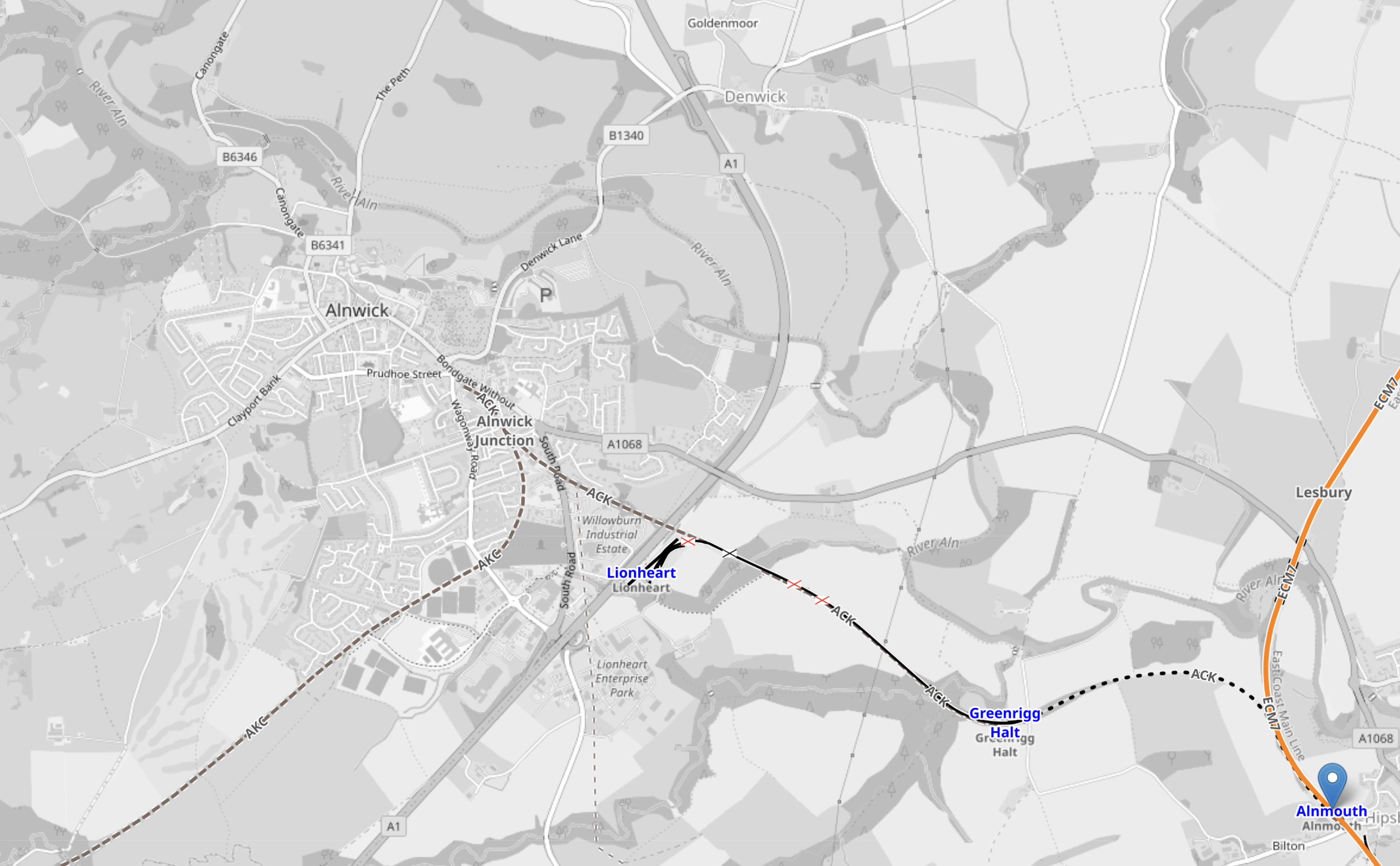
Note.
The blue arrow in the South-East corner of the map indicates Alnmouth station.
The orange line curving through Alnmouth station is the electrified East Coast Main Line between Newcastle and Scotland.
The dotted line curving away North-West from the East Coast Main Line is the route of the AlnwickBranch Line, which leads to Alnwick in the North-West of the map.
The blue text indicates the the two stations of the Aln Valley Railway.
Greenrigg Halt is nearest to the East Coast Main Line and Lionheart is nearest to the town.
The road encircling the town of Alnwick is the A1 Alnwick By-Pass.
This Google Map shows the area between Alnmouth station and Alnwick.
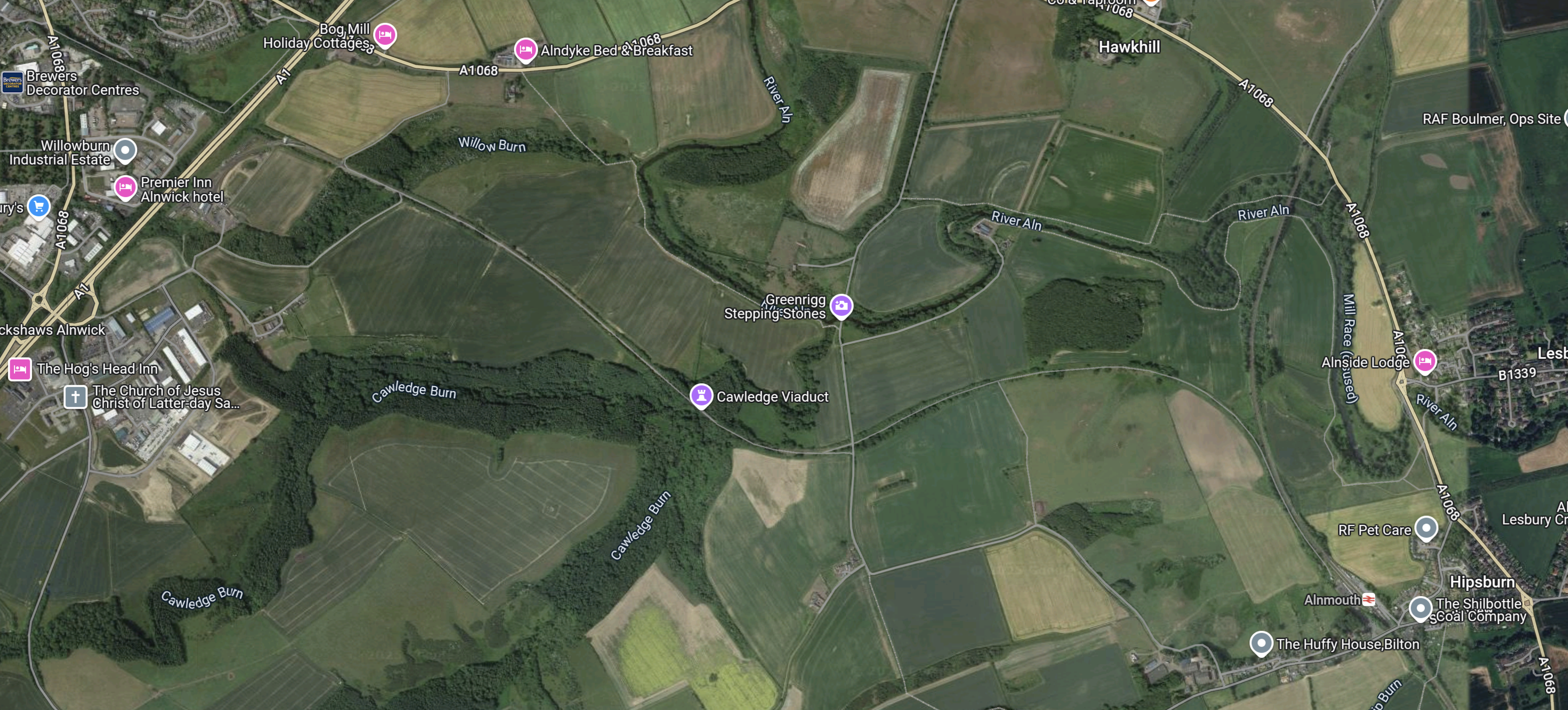
Note.
- Alnmouth and its station is in the South-East corner of the map.
- Alnwick is in the North-West corner of the map.
- The A1 crosses the North-West corner of the map.
- The line of the Alnwick Branch Line can be picked out crossing the map diagonally.
Click on the map to show it to a larger scale.
The Wikipedia entry for Alnmouth station says this about the ambitions of the Aln Valley Railway to connect to the East Coast Main Line.
The Aln Valley heritage railway has long-term ambitions of extending its running line to Alnmouth station[10] from its current terminus at Greenrigg Halt.
This picture shows a Stadler RS-ZERO.
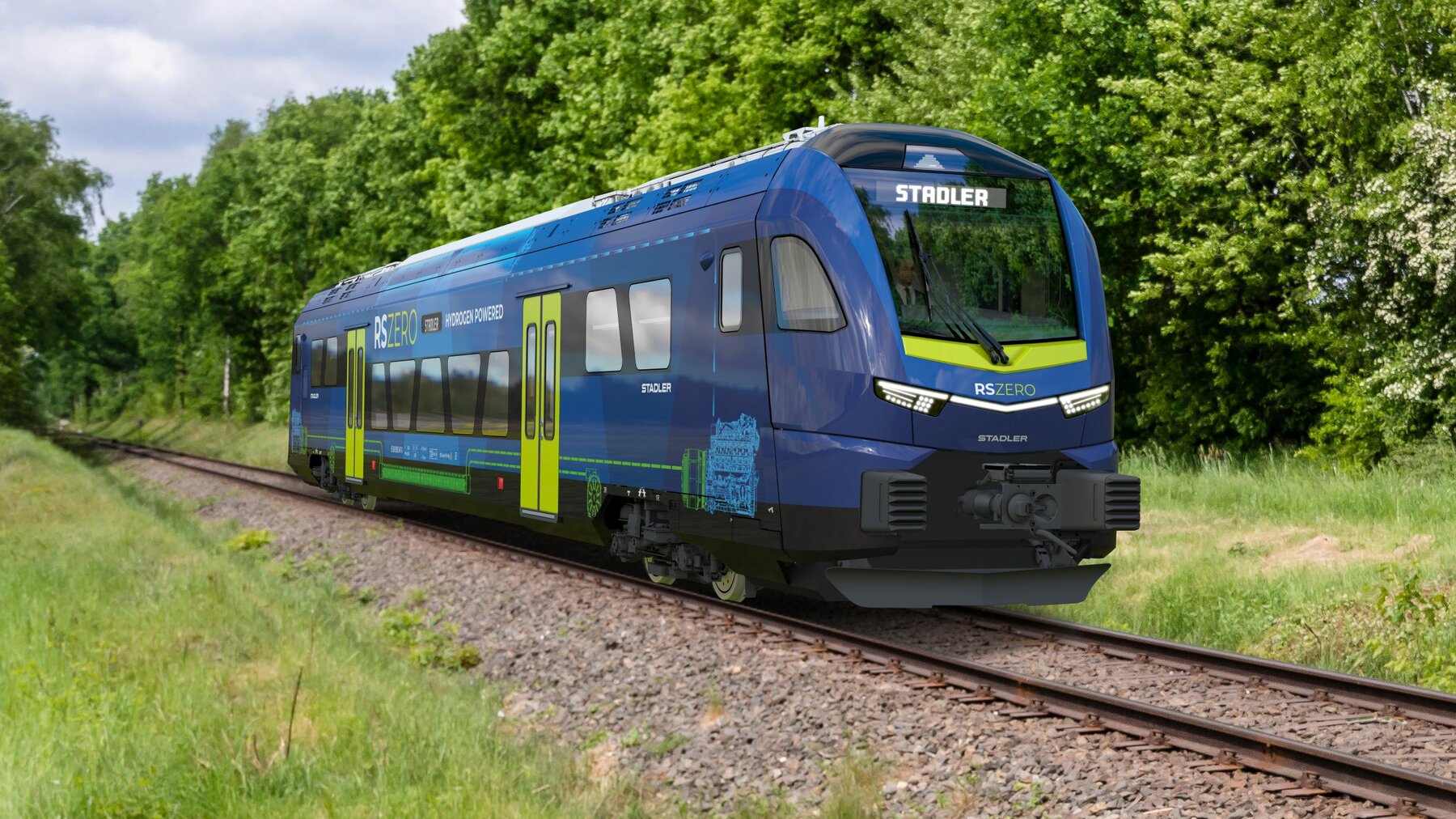
Could one of these powered by hydrogen shuttle between Alnmouth station and Alnwick? Probably, but it’s not powered by steam!
Cafe Plans For Derelict Building On New Rail Line
The title of this post, is the same as that of this article on the BBC.
This is the sub-heading.
A disused building on a newly reopened railway line could be saved if planners back proposals, external for its renovation.
These three paragraphs give more details.
One structure at Bedlington station in Northumberland has already been demolished but plans have been submitted which would save the building on the northbound side.
It was used until 1964 when the line closed, and while passenger services on the Northumberland Line between Ashington and Newcastle resumed last year, a new station in Bedlington has not yet been completed.
East Bedlington Parish Council chair Keith Grimes said: “It’s one of the oldest buildings in the parish, so it’s definitely worth keeping.”
I wrote about my visit to the new Northumberland Line in My First Trip On The Northumberland Line – 18th December 2024.
If the Northumberland Line is going to attract leisure travelers, a sprinkling of cafes along the line is a must.
These are pictures of Bedlington from my earlier trip.

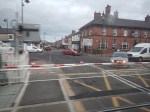
Note.
- I’d hoped I’d got a picture of the prospective cafe. But no luck.
- I didn’t see any Bedlington Terriers either.
- But then there are several of those excellent and distinctive dogs, near where I live in London.
The station should be operational this year, but it appears there’s still a lot of work to do.
Access To The Coast
This OpenRailwayMap shows the railway lines of Northumberland in relation to the coast.
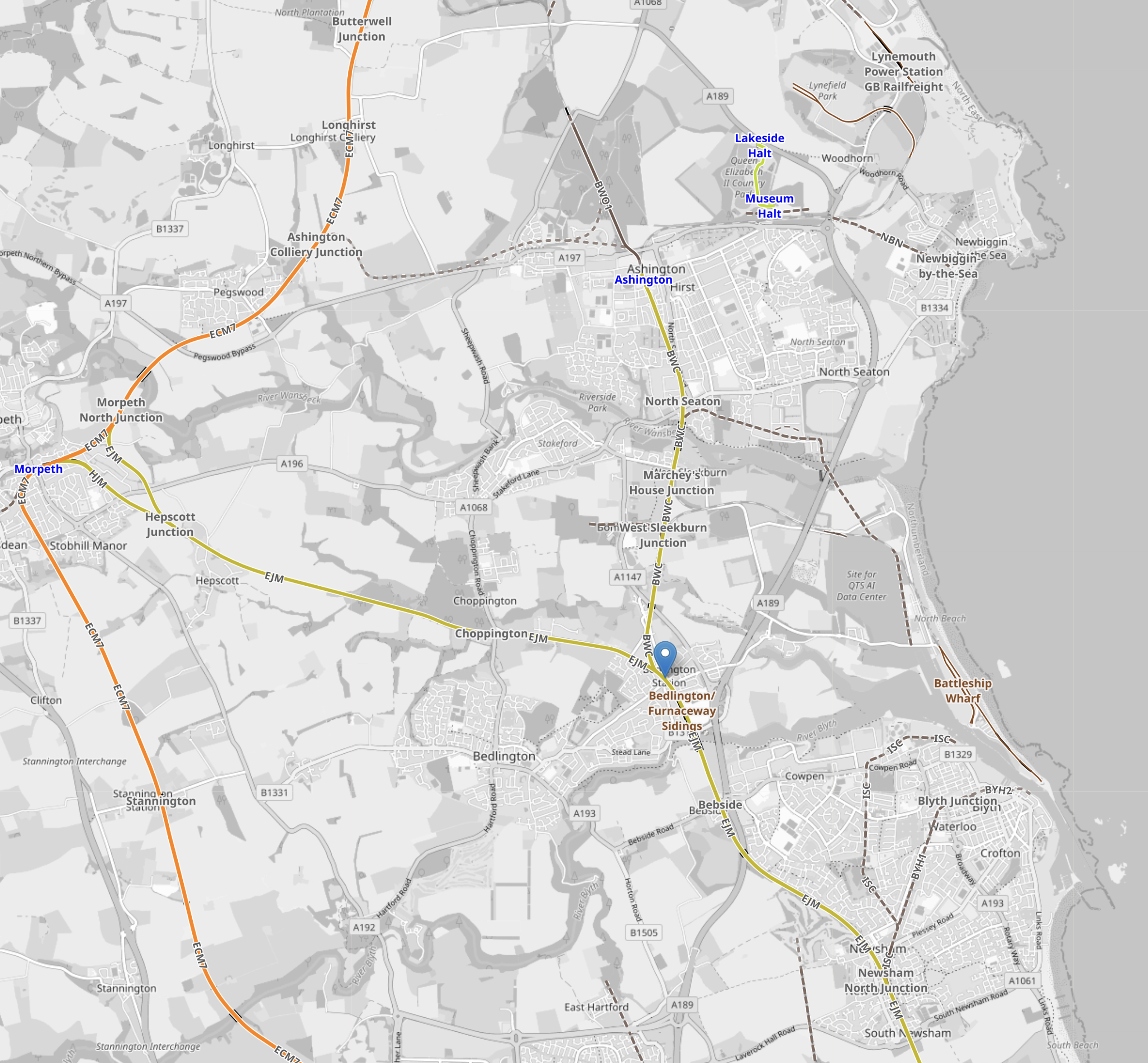
Note.
- The orange line is the East Coast Main Line between Newcastle and Edinburgh.
- Morpeth is the station on the Western edge of the map.
- The yellow line is the Northumberland Line between Newcastle and Ashington.
- The site of the new Bedlington station is indicated by the blue arrow.
It looks to me, that there are a lot of disused railway lines, that could be used to develop the Northumberland Line into a system with a much wider coverage.
The Wikipedia entry for the Northumberland line does say this about Ashington station.
Ashington station has been developed in such a way that an extension, such as that previously proposed to Newbiggin-by-the-Sea and Woodhorn could still be built, albeit part of a separate scheme.
Note.
- Newbiggin-by-the-Sea is East of Ashington.
- Woodburn is on a line that goes to the West of the East Coast Main Line.
- The extensions would open up the area for more housing and rail-oriented leisure activities.
This OpenRailwayMap shows the railway lines to the West and North of Newcastle.
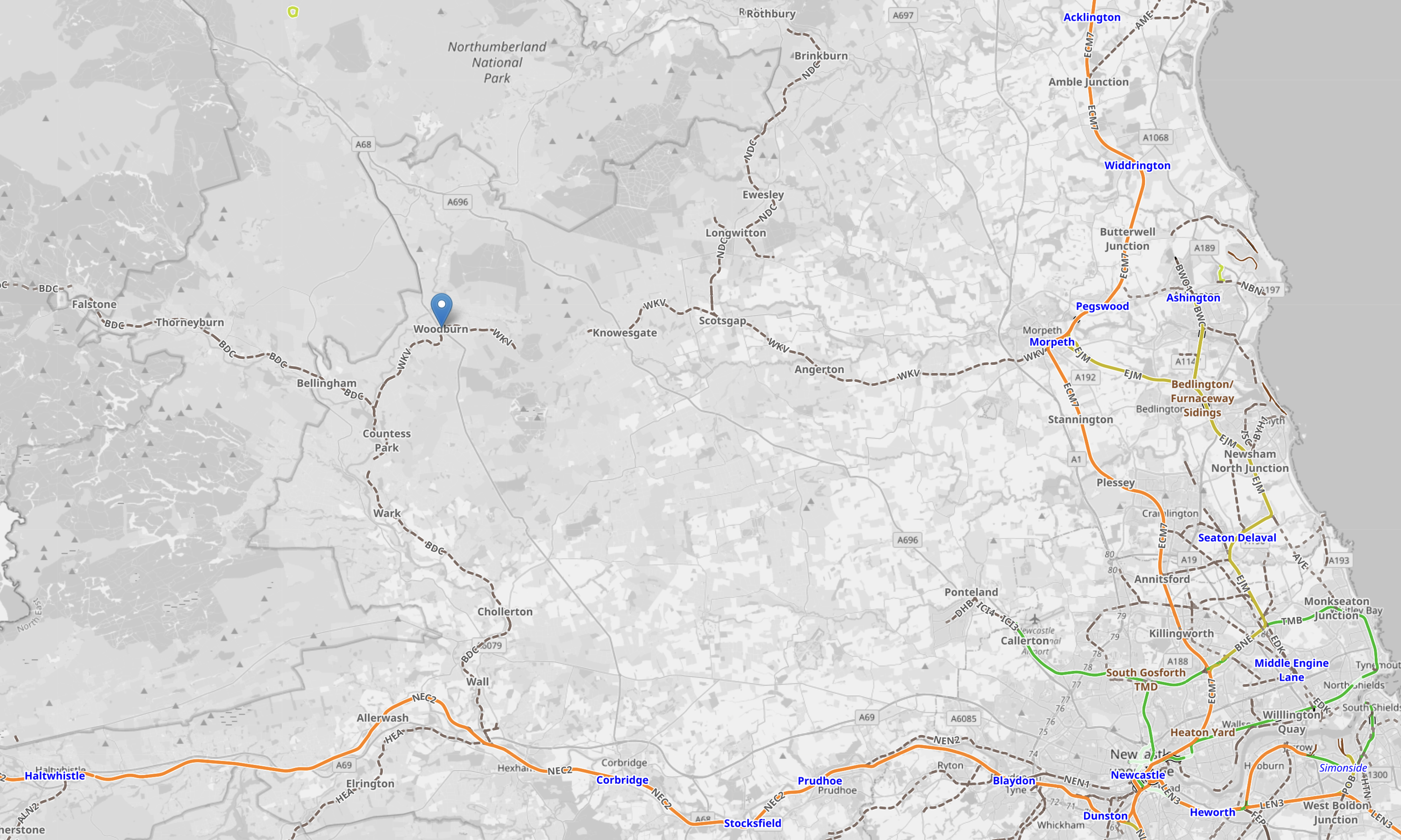
Note.
- The orange line on the East side of the map is the East Coast Main Line between Newcastle and Edinburgh via Morpeth.
- The yellow line to the East of the East Coast Main Line, is the Northumberland Line between Newcastle and Ashington.
- The green line is the Tyne and Wear Metro
- The orange line going along the bottom edge of the map is the Tyne Valley Line between Newcastle and Carlisle via Corbridge and Hexham.
- All the lines meet at Newcastle station.
- Woodburn station is indicated by the arrow on disused lines that connect Morpeth on the East Coast Main Line with the Tyne Valley Line.
Reopening the lines to Woodburn would create a new railway, that would encircle Newcastle and surely create lots of housing, business and leisure opportunities.
But let’s get Phase One finished first and see how passenger numbers develop.
Fourteen New Trains To Drive First Rail Open Access Growth
The title of this post, is the same as that of this press release from First Group.
These four bullet points are sub-headings.
- The Group has signed an agreement with Angel Trains and Hitachi to lease 14 new five-car class 80X Hitachi electric, battery electric or bi-mode trains (70 cars in total) at a cost of c.£500m including maintenance, over a ten year lease period
- The trains will be manufactured by Hitachi in County Durham, securing the skills base and jobs in the local area
- The new trains will enable FirstGroup to significantly expand its open access portfolio and will be used on the newly announced London-Carmarthen route and to increase the number of cars on the existing Lumo and Hull Trains services
- The agreement also contains an option for FirstGroup to lease up to an additional 13 trains on the same terms if the Group’s open access applications are granted by the Office of Rail and Road (‘ORR’)
These first three paragraphs add a bit more detail.
Prime Minister Sir Keir Starmer is visiting Newton Aycliffe, County Durham, today to celebrate a significant agreement for the Hitachi factory which has secured an order to manufacture 70 new rail cars for FirstGroup’s growing open access business, creating certainty for the manufacturing skills base, and the factory’s future.
The Lease Agreement will deliver 14 new trains, which will not only give the Group a homogenous fleet across its open access operations, ensuring flexibility and reliability for customers, but also facilitates the Group’s strategic objective of materially increasing its open access capacity. Delivery of the new trains is expected to commence in late 2027. The lease will be financed by Angel Trains, adding to their portfolio of Hitachi assets. The trains will be maintained by Hitachi at their facilities around the country.
The trains will be used on the Group’s open access rail services, including the Carmarthen-London route announced on 5 December, and the existing Hull Trains and Lumo services on the East Coast Mainline.
Note.
- Does the presence of Keir Starmer indicate any approval for open access?
- Trains could be electric, battery electric or bi-mode.
- Bi-mode trains should only be purchased these days, if they are convertible to battery-electric trains. Hitachi’s can.
- Delivery is expected to commence in late 2027.
- The first fourteen trains will be deployed on the London to Carmarthen, Edinburgh and Hull routes.
This table shows the trains needed initially for each route.
- Carmarthen – Class 802 trains – 5 tpd – 5 trains – 75.3 miles unelectrified
- Edinburgh – Class 803 trains – 5 tpd – 5 trains – electrified
- Hull – Class 802 trains – 5 tpd – 5 trains – 44.3 miles unelectrified
Note.
- tpd is trains per day.
- I’m assuming that as unelectrified distances to Carmarthen and Hull are not that far apart, the number of trains needed is the same.
- Class 802 trains are bi-mode.
- Class 803 trains are electric.
After the fourteen new trains are delivered, there will be a combined fleet of 29 trains.
Consider.
- Hull Trains have started running some services as pairs of trains. I wrote about this in Ten-Car Hull Trains.
- Lumo has been a success and perhaps needs more capacity.
The Wikipedia entry for Grand Union says this.
Grand Union proposed to operate with ex-LNER Class 91s and Rail Operations Group Class 93s hauling nine-car Mark 4s and a Driving Van Trailer.
So perhaps the Carmarthen service needs ten-car trains.
That would mean that the number of routes needed for the three routes would be as follows.
- Carmarthen – Class 802 trains – 5 tpd -10 trains
- Edinburgh – Class 803 trains – 5 tpd -10 trains
- Hull – Class 802 trains – 7 tpd – 10 trains
It would appear that we’re a train short with 29 in the combined fleet against a need of 30 trains.
But then it would also appear that Hull Trains can provide the required five/ten car service with only four trains.
I would assume that the extra train, goes to make up the numbers for Lumo’s Carmarthen service.
‘UK-First’ Intercity Battery Trial Exceeds Expectations
The title of this post, is the same as that of this press release from Hitachi.
These three bullet points, act as sub-headings.
- Intercity battery train completes testing in the north of England, demonstrating superior performance and cost-effectiveness compared to diesel engines.
- Trial confirms single battery technology can reduce fuels costs between 35%-50% and enter and leave stations in zero-emission mode.
- Ahead of Railway 200 celebration, this new UK rail innovation is ready to reduce cost and emissions on the railways.
These are the first two paragraphs.
Today, Angel Trains, Hitachi Rail and TransPennine Express are celebrating the successful completion of the UK’s first intercity battery trial in the North of England.
The powerful 700kw battery technology met, and in some cases even surpassed, the key objectives of the trial, including:
- Fuel costs savings between 35%-50%, surpassing previous predictions of up to 30%.
- Just one battery has managed to power the train to speeds greater than 75mph, clearly demonstrating this technology can enter, alight and exit stations solely in zero-emission battery-mode to improve air quality and reduce noise pollution.
- Able to achieve all journey times and performance requirements so can meet operators timetable requirements.
- The battery matches the weight of a diesel engine and is installed in the same undercarriage space, ensuring no risk of track degradation and no impact on the passenger environment.
Note.
- I would expect, that most of the fuel cost savings are due to the use of regenerative braking to the battery.
- 75 mph might seem slow, but Hull Trains average slower speeds than this on their diesel sections.
- Running in a non-polluting mode in stations and sensitive areas, is not going to be disliked by anyone.
- The most powerful diesel engines in Class 800 and Class 802 trains are rated at 700 kW. So with the same weight and power, it is not surprising that the performance is the same.
It looks to me, that Hitachi have designed an efficient battery-electric electric train, that can extend services from electrified main lines onto branch lines without electrification.
The One Battery Test Train And Hull Trains
Hull Trains currently run one service to Hull and Beverley and have applied for another service to serve Worksop, Woodhouse and Sheffield, where the trains would leave the East Coast Main Line at Retford.
Hitachi’s current test train has two diesel engines and one battery pack.
An Electric Service Between London and Hull/Beverley
Distances for the Hull and Beverley service are.
- ECML and Hull – 58.1 km. – 3 stops
- Hull and Beverley – 13.2 km or 26.4 km both ways. – 1 stop
Note.
- Trains will be fully-charged, when they leave the ECML.
- Trains could be fully-charged, when they leave Hull station, if the platform they use has a charging system.
- All Hull Trains call in Platform 7 at Hull station.
- The Hitachi press release said “During a trial run, the battery’s impressive power enabled the train to operate solely in battery mode for 70km.” A speed of 75 mph is indicated.
- I would assume the Hitachi train used regenerative braking to help recharge the batteries, at the intermediate stops.
- Trains average around 57 mph between the ECML and Hull and 38 mph between Hull and Beverley.
- Much of the track between the ECML and Hull has a speed limit of 75 mph.
- Much of the track between Beverley and Hull has a speed limit of 70 mph or less.
Because of these figures and what Hitachi have said of the train’s performance on batteries, I am convinced that Hull Trains will use an electrified Platform 7 at Hull station to charge the trains.
These pictures show a Hull Trains’s Class 802 train in Platform 7 at Hull station.

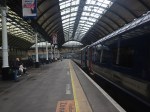
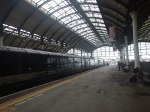
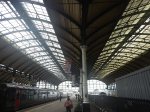


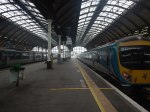
Note.
- The blue Hull Train is in Platform 7 in the pictures.
- Hull station has a classic Victorian cast-iron roof.
- Many other similar platforms have been electrified in the UK.
I believe that this platform can be electrified relatively easily with 25 KVAC overhead wires.
An Electric Service Between London and Worksop/Sheffield
Distances for the Worksop and Sheffield service are.
- ECML and Worksop – 12.2 km. – 1 stop
- Worksop and Sheffield- 25.3 km or 50.6 km both ways. – 1 stop
Note.
1. A train from London will leave Retford with a full battery.
2. Retford and Sheffield is only 37.5 km. So the round trip is only 75 km.
3. A full battery will power the train at 75 mph for 70 km – According to Hitachi.
4. Much of the track between Retford and Sheffield is only 60 mph. So going slower will give an energy saving.
5. Slowing at Worksop, Woodhouse and Sheffield will give the batteries a small charge.
6. There are no bridges in the Workshop station area, so a mile or so of electrification could be easy.
7. It’s an easy level route.
8. I’ve read somewhere that Hitachi have a full route simulator.
I calculate, that a two minute charge at Worksop would probably be all the train would need to travel the 75 km. on batteries.
We don’t know if Hitachi have licenced some of Vivarail’s FastCharge technology from FirstGroup. This could enable them to extract the maximum value from each stop at Worksop.
The One Battery Test Train And Lumo
Hitachi’s current test train has two diesel engines and one battery pack.
It is likely that a train with this configuration could be used on Lumo’s new service to Rochdale.
As London Euston and Manchester Victoria is fully electrified, the only unelectrified section is the 16.7 km. between Manchester Victoria and Rochdale. This would mean, that to complete the trip, Lumo’s train would need the ability to do 33.4 km on battery power.
As Hitachi’s test train can do 70 km on a full charge, Lumo could use trains with the standard two diesel engine and one battery pack configuration. The battery would be charged on the electrified sections of the route, between London Euston and Manchester Victoria stations.
It looks to me, to be a superb demonstration of the capabilities of a battery-electric InterCity train with two diesel engines and one battery pack.
The One Battery Test Train And LNER
Hitachi’s current test train has two diesel engines and one battery pack.
It is likely that a train with this configuration could be used on several LNER services from King’s Cross.
- Bradford Forster Square – 21.9 km. from Leeds
- Cleethorpes – 102.5 km. from Newark
- Grimsby Town – 97.9 km. from Newark
- Harrogate – 29.4 km from Leeds
- Lincoln – 26.9 km. from Newark
- Middlesbrough – 35.2 km. from ECML
- Cleethorpes – 102.5 km. from ECML
- Scarborough – 67.8 km. from York
Note.
- Some services like those to Bradford Forster Square, Harrogate and Lincoln could be run by only charging on the East Coast Main Line.
- Some services like those to Middlesbrough and Scarborough could be run by charging at the destination.
- Other services would need more batteries and/or charging at the destination.
I haven’t put in the Scottish services as running them may be more complicated.
Running Longer Distances On Battery Power
This paragraph is from the original Hitachi press release.
This success demonstrates that Hitachi Rail is ready to deliver the next stage of a full intercity battery-electric train. Based on real-world data, such a train would have a range between 100-150km. These ranges can cover significant sections of non-electrified routes, eliminating the need for wires in tunnels or stations, and potentially saving hundreds of millions of pounds on electrification projects.
Note.
- I would assume that as many diesel engines as possible would be replaced with battery packs.
- On a typical three-battery Class 800 train, 802 train or Class 805 train, this could be up to three batteries.
- But on a four-battery Class 810 train, this could be up to four batteries.
A strategy would need to be developed for all routes and trains would be configured and allocated to the routes accordingly.
 The Anonymous Widower