Rail Solar Project Seen As Stepping Stone For Renewables
The title of this post is the same as that of this article on Engineering & Technology.
This is the introductory paragraph.
A British solar power company is working on technology that could enable railways all over the world to be powered by renewable energy, with South Wales seen as a likely testbed for the equipment.
Riding Sunbeams is developing its technology to see if it can be part of the electrification of the South Wales Metro.
Some relevant points from the article.
- Their test installation at Aldershot, which is rated at 37 kW, is quite small.
- The Aldershot system is already delivering power to trains.
- The Welsh Government are aiming for the South Wales Metro to be powered by renewable energy, of which 50 % is generated in Wales.
- There could be export possibilities for the technology.
Note that the article gives an interesting insight into the various equipment needed to power railway electrification.
Highview Power And Railway Electrification
In Encore Joins Highview To Co-Develop Liquid Air Energy Storage System In Vermont, I gave brief notes about a proposed Highview Power CRYOBattery in Vermont.
- The system will supply 50 MW for eight hours.
- The total capacity will be 400 MWh.
Other articles have suggested, that the system could be built on the site of a demolished coal-fired power station, which still has a good connection to the electricity grid.
In other words, I believe that a CRYOBattery can be considered to be a small 50 MW power station.
- It could be charged by local excess renewable energy during the day.
- It could be charged by excess renewal energy from the electricity grid during the night, when there can be large amounts of wind energy, that needs a home.
- Intelligent control systems, would balance the output of the CRYOBattery to the needs of the electricity grid.
It would be used in very much the same way as gas-turbine power-stations are used in electricity grids all over the world.
The Braybrooke Feeder Station
The National Grid is providing a feeder station at Braybrooke to support the Midland Main Line electrification.
This page on the Harbough Rail Users site is entitled Electrification Substation Plan for Braybrooke.
It gives this description of the sub-station.
Electrification of part of the Midland Main Line has moved a tentative step closer with the plans being prepared by National Grid for a feeder substation at Braybrooke, just outside Market Harborough. The location is where a high-voltage National Grid power-line crosses over the railway and the plan is for a substation and associated equipment plus an access road from the A6. The substation is due to be completed by October 2020 and is intended to feed the power supply for the Corby line pending electrification of the main line through Market Harborough.
This Google Map shows the rough area, where it will be located.
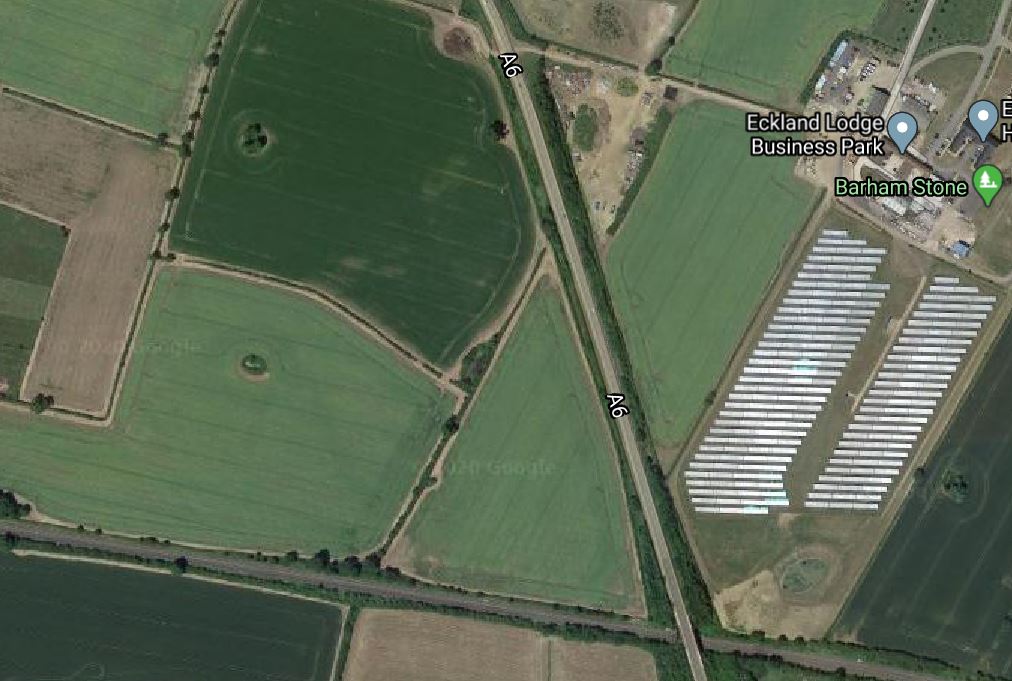
Note.
- The A6 crossing the Midland Main Line.
- The solar farm in the South-facing field, which has a 3MW capacity, according to the Eckland Lodge Business Park web site.
- Various planning documents say the transformers on the substation will be 400/25 kV units.
- This means that the power-line in the area must be a 400 kV.
Unfortunately, I can’t pick out the line of 400 kV pylons marching across the countryside. But they are rather large.
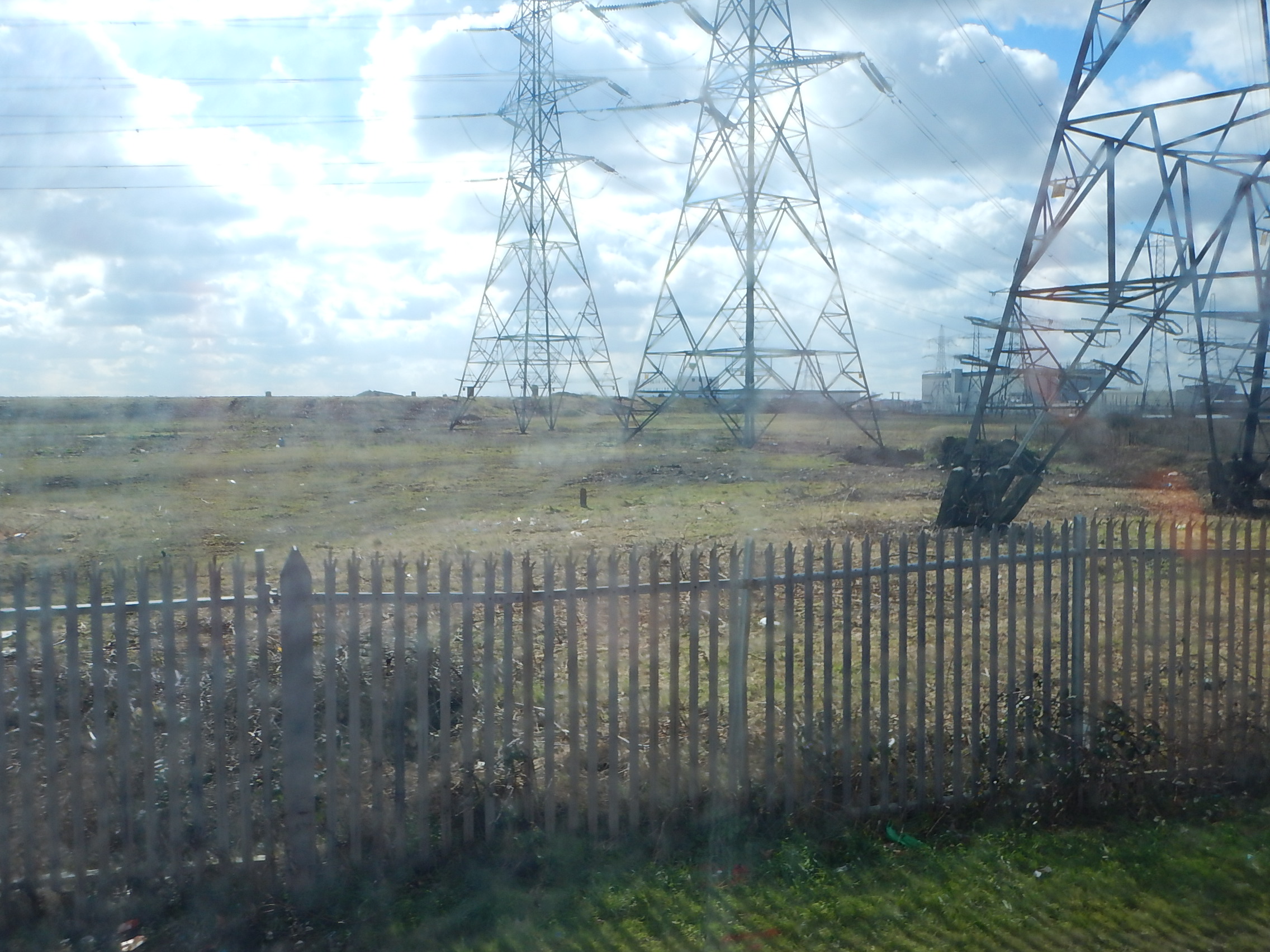
The pictures show a group of 400 kV pylons near Barking.
- The Midland Main Line at Braybrooke certainly seems to be getting a solid supply of electricity.
- It was originally planned, that the electrification would go all the way, but it was cut back to Kettering and Corby a couple of years ago.
- But to power, the electrification to Corby, it is being extended all the way to Braybrooke, so that the electrification can act as a giant extension lead for the Corby Branch Line.
The page on the Harborough Rail Users Site says this.
The Braybrooke substation is still planned, however, and the DfT has advised that the bi-mode trains will be able to switch power mode at speed. They would therefore be able to continue running electrically north from Kettering as far as Braybrooke before ‘pan down’
It would appear, that the end of the electrification will be at Braybrooke, but the sub-station seems to have enough power to extend the electrification further North if that is ever planned.
I also think, that is rather an efficient and affordable solution, with very little modification required to the existing electricity network.
But not all electricity feeds to railway electrification have a convenient 400 kV line at a handy site for installing all the needed transformers and other electrical gubbins.
How Much Power Will Needed To Be Supplied At Braybrooke?
This can probably be dismissed as the roughest or rough calculations, but the answer shows the order of magnitude of the power involved.
Consider.
- Braybrooke must be sized for full electrification of the Midland Main Line.
- Braybrooke will have to power trains North of Bedford.
- If there is full electrification of the Midland Main Line, it will probably have to power trains as far North as East Midlands Parkway station, where there is a massive power station.
- Trains between Bedford and Market Harborough take thirty minutes.
- Trains between Bedford and Corby take around thirty minutes.
- Four trains per hour (tph) run between Bedford and Market Harborough in both directions.
- The system must be sized to handle two tph between Bedford and Corby in both directions.
- The power output of each Class 360 train, that will be used on the Corby route is 1,550 kW, so a twelve-car set will need 4.65 MW.
- I can’t find the power output of a Class 810 train, but an InterCity 125 with similar performance has 3.4 MW.
- A Class 88 bi-mode locomotive has a power output of 4 MW when using the electrification.
I estimate that Braybrooke could have to support at least a dozen trains at busy times, each of which could need 4 MW.
Until someone gives me the correct figure, I reckon that Braybrooke has a capacity to supply 50 MW for trains on the Midland Main Line.
A Highview Power system as proposed for Vermont, would have enough power, but would need a lot more storage or perhaps local wind or solar farms, to give it a regular charging.
Riding Sunbeams
Riding Sunbeams are a company, who use solar power to provide the electricity for railway electrification.
I’ll let their video explain what they do.
It’s a company with an idea, that ticks a lot of boxes, but would it be able to provide enough power for a busy electrified main line? And what happens on a series of rainy or just plain dull days?
Highview Power
Could a Highview Power energy storage system be used?
- To store electricity from local or grid electrical sources.
- To power the local electrification.
If required, it could be topped up by affordable overnight electricity, that is generated by wind power.
The Highview Power system could also be sized to support the local electricity grid and local solar and wind farms.
Conclusion
I think that Riding Sunbeams and Highview Power should be talking to each other.
Steventon Listed Railway Bridge Saved From Demolition
The title of this post, is the same as that of this article on the BBC.
On the face of it it looks like victory for the Nimbys, who have saved a rather ordinary and possibly decrepit bridge from demolition.
But I believe there is more to this story than meets the eye.
The Bridge
The bridge at the centre of the argument may be Grade 2 Listed, but there are lots of similar bridges on UK railways in better condition with similar heritage, that don’t have a listing.
Type “steventon bridge electrification” into a search engine and you’ll find lots of images of the bridge.
- One picture shows, the bridge with the railway flooded, which puts an interesting slant on the debate. What are the foundations like?
- Notice, that the bridge seemed to suffer a rather botched repair at the hands of British Rail’s finest engineers.
- Having read a lot about this story, I suspect that the locals’ main reason for objecting, is that they don’t want the disruption, whilst it is rebuilt.
- Incidentally, I suspect Great Western Railway don’t want the bridge rebuilt either, as closure will be a long disruption to all services.
I have been involved in the refurbishment of several buildings of around the same age or even older than the bridge. This is the sort of construction, that will have to be replaced at some time. If it’s not replaced, some of the novel techniques that are now available to Network Rail will have to be applied.
Network Rail
The article says this about Network Rail’s solution to the problem.
But following what the company described as ‘extensive and breakthrough testing’ using computer simulations it found a speed reduction to 110mph through the village meant wires could pass underneath the existing bridge.
I do think, that 110 mph is rather convenient. if you look at the maximum operating speeds of trains and locomotives that will pass through.
- Class 801 train with digital signalling -140 mph
- Class 801 with conventional signalling – 125 mph
- Class 800/802 train on diesel power – 100 mph
- Class 80x train on battery power – 100 mph
- Class 387 train – 110 mph
- Class 90 locomotive – 110 mph
- Class 91 locomotive – 125 mph
- Class 93 locomotive – 110 mph
- High Speed Train – 125 mph
Very few trains will have to slow down.
Any train that used onboard power, like a High Speed Train or a Class 80x with batteries, could theoretically go through at the maximum speed, track, signalling and train taken together would allow.
Hitachi
In Issue 898 of Rail Magazine, there is an article, which is entitled Sparking A Revolution, which describes Hitachi’s work and plans on battery-powered trains. This is an extract.
Battery power can be used as part of electrification schemes, allowing trains to bridge the gaps in overhead wires where the costs of altering the infrastructure are high – in tunnels or bridges, for example. This would also have the immediate benefit of reducing noise and emissions in stations or built-up areas.
Elsewhere in the article, it is said that Hitachi trains will be able to do 100 mph on battery power for up to 60 miles.
But would they be able to do 125 mph on battery power for perhaps five miles? I can’t see why not!
The Google Map shows the track through Steventon.
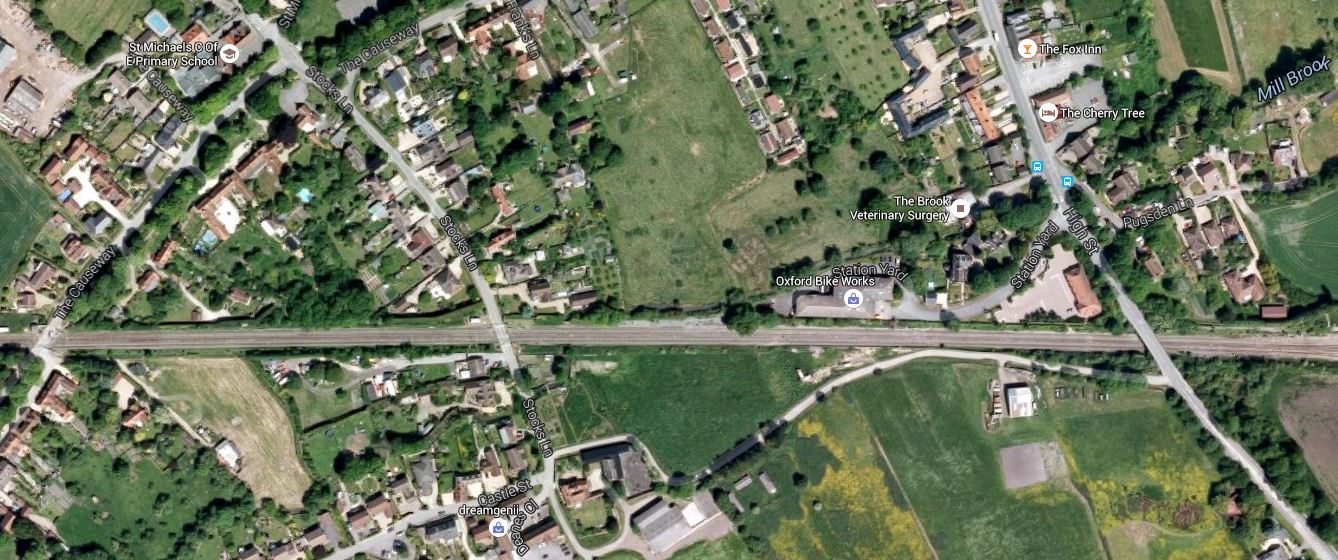
Note.
- The bridge in question is at the East.
- There are also a couple of level crossings in this stretch of track, where the height of wires is also regulated.
Perhaps, the pantograph should be dropped before going through section and raised afterwards, with power in the section taken from a battery.
Avoiding obstacles like this, may be an economic alternative, but it does require that all electric trains using the section are able to use battery power.
I have a feeling, I’ve read somewhere that a Class 88 locomotive can do a similar trick using the onboard diesel engine.
As a Control Engineer, who trained in the 1960s, I would expect that all pantographs can now be raised or lowered with all the precision and repeatability of an Olympic gold-medal gymnast!
I do wonder, if the Great Western Electrification Project had been designed around discontinuous electrification and battery-electric trains, the project would have gone better.
For instance, the Severn Tunnel is 7,000 metres long and trains take under four minutes to pass through. The Wikipedia entry for the tunnel has a section on Electrification, which details the complicated design and the trouble that there has been with corrosion.
Given that battery-electric trains have other advantages, design by hindsight, says that a tunnel without electrification and battery trains may have been a better solution.
Conclusion
Network Rail and Hitachi will get the speed of trains through Steventon up to 125 or even 140 mph, possibly by using battery power.
But whatever happens, I’m certain that the bridge will have to be rebuilt! It has the air of a derelict house, that will suck up all your money.
Electrification Between Exeter And Plymouth
Eventually, there will be electric passenger trains between Exeter and Plymouth! Great Western Railway’s objective must be for passengers to board their Hitachi AT-300 train at Paddington and be powered all the way to Penzance by electricity, without using a drop of diesel. The added ingredient will be battery power.
In Sparking A Revolution, I gave Hitachi’s specification for a proposed battery-electric train.
- Range – 55-65 miles
- Performance – 90-100 mph
- Recharge – 10 minutes when static
- Routes – Suburban near electrified lines
- Battery Life – 8-10 years
As the distance between Exeter and Plymouth is 52 miles, the Hitachi specification could have been designed around this route, which as these pictures show is in places, very close to the sea, where the line runs along the South Devon Railway Sea Wall.


Global warming will probably mean, we’ll see a repeat of the major sea wall breach that happened at Dawlish in 2014.
I would suspect that the Network Rail’s solution to the problems of efficient low or zero-carbon traction between Exeter and Plymouth includes the following.
- A very robust railway.
- Extreme protection from almost everything the sea and the weather can produce.
- Could we see some concrete tunnels, like the Swiss and others use in mountainous areas to protect from snow? Rail Magazine says yes! At Horse Cove.
- No electrification as water and electricity are not a good mix, except in an electrolyser to produce hydrogen, oxygen and/or chlorine.
- Battery or hydrogen-powered passenger trains or freight locomotives.
- Digital in-cab signalling. Traditional signalling is even more expensive equipment to be swept away.
From media reports, this looks like the way Network Rail are thinking.
Charging The Trains
Battery-electric trains will need to be charged. There are three convenient stations; Exeter St. Davids, Newton Abbott and Plymouth.
- All have multiple platforms.
- The stations could be given the ability to charge battery-electric trains, either using 25 KVAC overhead electrification or a specialist charging system, like the one designed by Vivarail, that I wrote about in Vivarail Unveils Fast Charging System For Class 230 Battery Trains.
- Newton Abbot station would also charge any trains running on the eight mile branch to Paignton station.
As far as passenger services are concerned, it could be a very efficient zero-carbon railway.
Electrification At Exeter St. Davids
Exeter St. Davids is an important hub for services between Devon and Cornwall and the rest of Great Britain.
- GWR services run to London Paddington via Newbury.
- GWR services run to London Paddington via Bristol
- GWR services run to Plymouth and Penzance via Newton Abbott.
- GWR local services run to Barnstaple, Exmouth and Paignton.
- CrossCountry services run to the Midlands, North and Scotland via Bristol.
- South Western Railway services run to London Waterloo via Basingstoke.
In future, there could be services running to Plymouth on the reopened route via Okehampton and Tavistock.
All these services could be run by battery-electric trains for sixty miles from Exeter, if they could be fully-charged at the station.
Note.
- Trains to London Paddington and Bristol could easily reach Taunton, which is thirty miles away.
- Trains to London Waterloo could reach Yeovil Junction, which is fifty miles away.
- Trains to the West could reach Plymouth, which is fifty-two miles away.
- Barnstaple is forty miles away, so would probably need some help to get back.
- Exmouth is eleven miles away, so a return journey is probably possible.
- Paignton is twenty-eight miles away, so a return journey is probably possible, with a top-up at Newton Abbot if required.
Exeter is going to be very busy charging trains.
It should be noted, that trains to and from London Paddington and Bristol, all share the same route as far as Cogload Junction, where the London Paddington and Bristol routes divide.
- Cogload Junction is thirty-six miles from Exeter.
- Cogload Junction and Newbury, where the electrification to London Paddington starts are eighty-five miles apart.
- Cogload Junction and Bristol Temple Meads, where the electrification to London Paddington starts are forty miles apart.
I wonder if it would be sensible to electrify between Exeter St. David station and Cogload Junction.
- From my virtual helicopter, the line doesn’t look to be in the most difficult category to electrify.
- There is only one tunnel and a few old bridges and a couple of level crossings.
- Some of the route is alongside the M5.
- Trains would arrive in Exeter with full batteries and could do a quick stop before continuing their journeys.
- Trains would arrive at Cogload Junction and could reach Bristol Temple Meads without stopping for a recharge.
- Bristol services that are extended to Taunton and Exeter could be run by battery-electric trains.
I also feel, that with upwards of twenty-five miles of extra electrification between Cogload Junction and Newbury, that battery-electric trains could run between London Paddington and Exeter via the Reading-Taunton Line.
Electrification At Plymouth
As with Exeter St. Davis, Plymouth is an important hub for services between Devon and Cornwall and the rest of Great Britain.
- Most services run to Penzance in the West and Exeter in the East.
- There is a local service to Gunnislake, which is fifteen miles away.
Lots of charging capacity, will enable battery-electric trains to reach their destinations, except for Penzance
Trains Between Plymouth And Penzance
Hitachi must have despaired, when it was pointed out that the distance between Penzance and Plymouth is eighty miles! This is fifteen miles longer than the range of their proposed battery-electric train.
The simplest solution would be to build a battery-electric train with an eighty mile range, that could travel between Plymouth and Penzance on a single charge. With charging at Penzance it could return to Plymouth.
The longer range, would also mean that, with perhaps ten extra miles of electrification, that battery-electric trains could bridge the electrification gap between Cogload Junction and Newbury.
Other solutions range from selective electrification, all the way up to full electrification of the Cornish Main Line.
It should be noted that there are the following branches on the Cornish Main Line.
- The Looe Valley Line at Liskeard station – 8.75 miles – Uses a separate platform at Lskeard
- The Fowey Branch At Lostwithiel station – 4.75 miles – Possible reopening
- The Atlantic Coast Line at Par station – 20.75 miles – Uses a separate platform at Par
- The Maritime Line at Truro station – 11.75 miles – Uses a separate platform at Truro
- The St. Ives Bay Line at St. Erth station – 4.25 miles- Uses a separate platform at St. Erth
If these branches are going to be served by battery-electric trains, arrangements will have to be made for their charging. This could either be on the main line, at the remote terminal or at both.
Would it be easier to run the branches using battery-electric trains, if the Cornish Main Line was fully electrified?
The Cornish Main Line also carries a number of heavy freight trains, most of which seem to be going to or from Burngullow, so I suspect they are in connection with the movement of china clay.
Currently, these heavy freight trains appear to be hauled by diesel locomotives, but if the Cornish Main Line were to be fully electrified, could they be run by electric locomotives?
Electrification Of A Reopened Northern Route
In the May 2020 Edition of Modern Railways, there is an article, which is entitled Beeching Reversal Fund Bids.
This is the introductory paragraph.
Bids have been submitted to Government for a share of the £500 million ‘Restoring your railway’ fund launched by the Department for Transport in January. The fund is to be used to support proposals to reinstate axed local services, to accelerate schemes already being considered for restoration and also to promote new and restored stations.
One of the bids is for the Tavistock-Okrhampton Reopening scheme (TORs), which would reopen the former Exeter to Plymouth railway of the LSWR, as a new route between Exeter and Taunton in the East and Plymouth in the West.
- The original railway was double-track.
- Most of the infrastructure is intact.
- The route would totally avoid Dawlish.
This is also said in the Modern Railways article.
It proposes journey times could be as little as six minutes longer than via the existing route between Exeter and Plymouth and that there could be opportunities for freight trains to avoid the steep gradients over the Devon banks between Newton Abbott and Plymouth. Provision of electrification for TORs as part of a wider programme for main lines in the region is also advocated.
Could an electrified route via Tavistock and Okehampton be connected to an electrified Cornish Main Line, to create an electrified route across Devon and Cornwall?
Connecting At The Royal Albert Bridge
This Google Map shows the Royal Albert Bridge and the Tamar Bridge over the River Tamar.
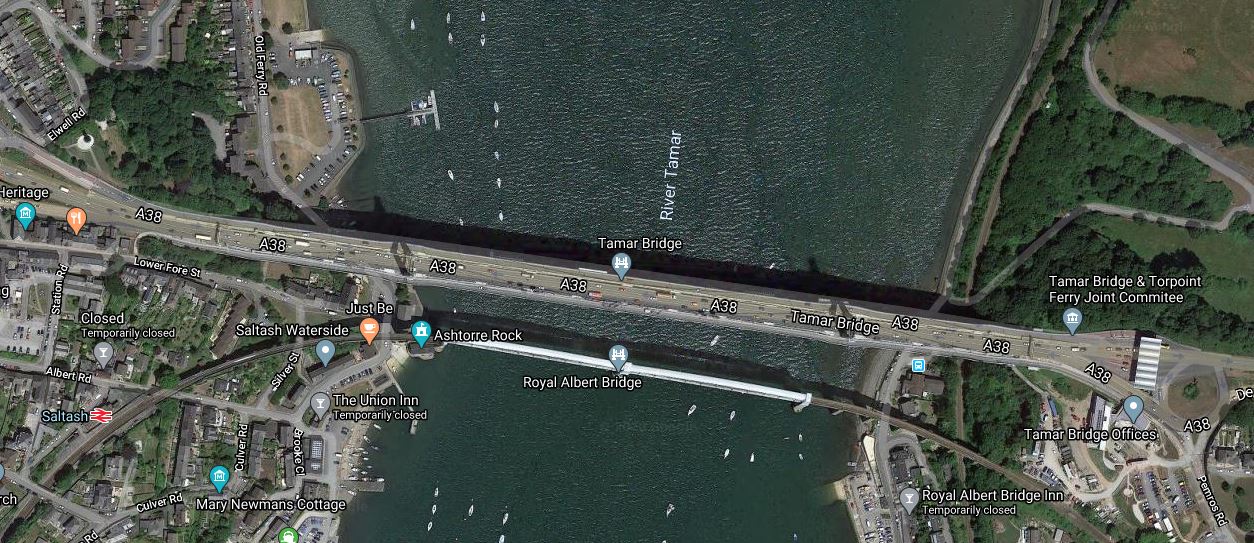
Note.
- The Royal Albert Bridge to the South of the modern Tamar Bridge.
- The Great Western Main Line running East to Plymouth and West to Penzance.
- The Tamar Valley Line running up the Eastern bank of the River Tamar and under the Eastern approaches to both bridges.
- Going North on the Tamar Valley Line leads to the TORs and going South leads to Plymouth station.
I can see a difficult design problem at the Eastern end of the Royal Albert Bridge, as a very complicated junction will be needed to allow all trains go the way they need.
Trains wanting to call at Plymouth station and use TORs will need to reverse in the station.
Connecting At The East Of Exeter
This Google Map shows The Tarka Line and the Bristol-Exeter Line join at Cowley Bridge Junction.
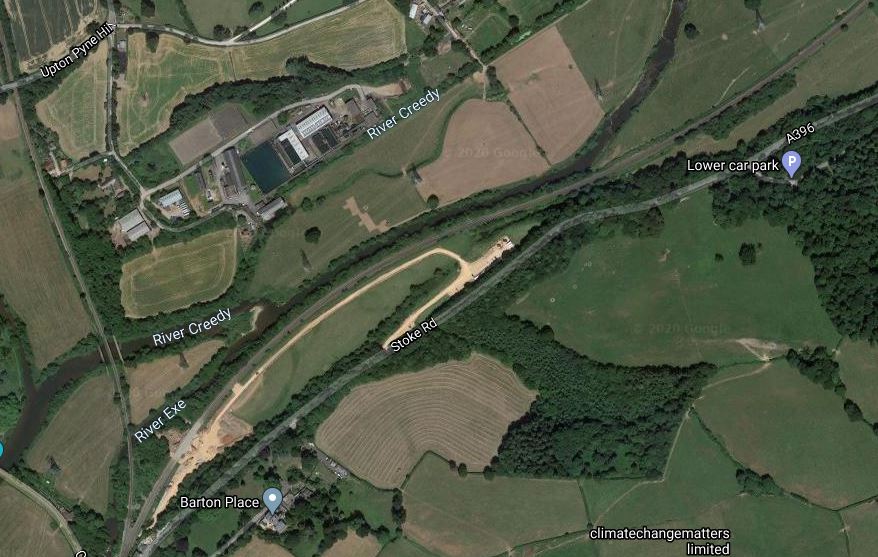
Note.
- The Tarka Line to Barnstaple and TORs leaves the map in the North West corner.
- The Bristol-Exeter Line to Taunton, Bristol and London Paddington leaves the map in the North East corner.
- Cowley Bridge Junction is in the South West corner of the map.
- Cntinuing South West leads to Exeter St. David’s station.
It looks to me, that Cowley Bridge Junction will need to be made into a full triangular junction, so that trains can go directly between the Bristol-Exeter Line and the Tarka Line.
Trains wanting to call at Exeter St. David’s station and use TORs will need to reverse in the station.
The Reversal Problem
If you wanted to run a passenger service between Taunton and Penzance using TORs with stops at Exeter, Okehampton, Tavistock, Plymouth and Truro, the train would need to reverse twice at Exeter and Plymouth.
These days with modern fast bi-mode multiple units, it’s not a problem, but in the days of Beeching, when the Tavistock and Okehampton route was originally closed in 1968, there probably wasn’t a suitable train other than a slow two-car diesel multiple unit.
I think, that fast expresses to and from Penzance will still take the current route.
- Battery-electric trains can handle the route at 100 mph.
- No reversals will be needed.
- There is a call at Newton Abbott for connections to Torquay and Paignton.
- Passengers wanting Okehampton, Tavistock and other stations on the TORs route can change at Exeter or Plymouth.
The Modern Railways article says this about services on the TORs route.
The case suggests that services could operate as an extension of the SWR Waterloo to Exeter service, or potentially as an extension of CrossCountry services beyond Exeter. During periods when the coastal route is blocked, additional services could use the TORs route, potentially running non-stop.
Note.
- As the extension of the SWR service would run the other way through Exeter St. David’s station, there would be no need to reverse.
- But I suspect the CrossCountry service would need the reverse.
- I feel for efficiency, that diverted freight services would need the efficient junctions at each end of TORs.
It probably would have helped if the Great Western and the London and South Western Railways had had a better crystal ball.
Fast Electric Freight Services To And From Devon And Cornwall
If the following lines are electrified.
- Cogload Junction and Exeter
- TORs
- Cornish Main Line
I feel that electric freight services will be able to run between Taunton and Penzance.
All it would need to complete the electrified route would be to electrify the following.
- Cogload Junction and Bristol
- Cogload Junction and Newbury
What would a high-speed freight route do for the economy of the two South Western counties?
Will A Rail Link Be Built Between Pitsea And Ingatestone?
In Issue 903 of Rail Magazine, there is a long article, which is entitled Felixstowe: Is 47 Trains A Day Achievable?.
The article details a large number of improvements that could be carried out to attain this frequency.
This is an interesting paragraph.
If anything. long-term plans could entail the building of a new rail link between Pitsea and Ingatestone, so that London Gateway traffic can run via Ipswich instead of Stratford.
So could a rail link between Pitsea and Ingatestone stations be built and how would it be used?
The Route
If you look at a map, that shows Pitsea and Chelmsford, you’ll notice that the dual-carriageway A130 links the two places.
- At the Chelmsford end it joins the A12 at junction 17.
- At the Pitsea end it joins the A13 to the East of the town.
- Sections of the road appear to have three-lane carriageways.
- Much of the road has been improved in recent years.
I feel a lot of the route of the rail link could follow the A130, with the rail link running down the Western side of the road.
Use Of The Shenfield-Southend Line
The Shenfield-Southend Line could be used for part of the route.
- It already connects to the Great Eastern Main Line (GEML) at Shenfield, though a flying junction.
- There is no connection between the Shenfield-Southend Line and the GEML to Chelmsford and Ipswich.
- The Shenfield-Southend Line crosses the A130 in an area of farmland.
Between Shenfield and the A130 are two important stations Billericay and Wickford.
The Connection At Shenfield
This Google Map shows the junction between the GEML and the Shenfield-Southend Line.
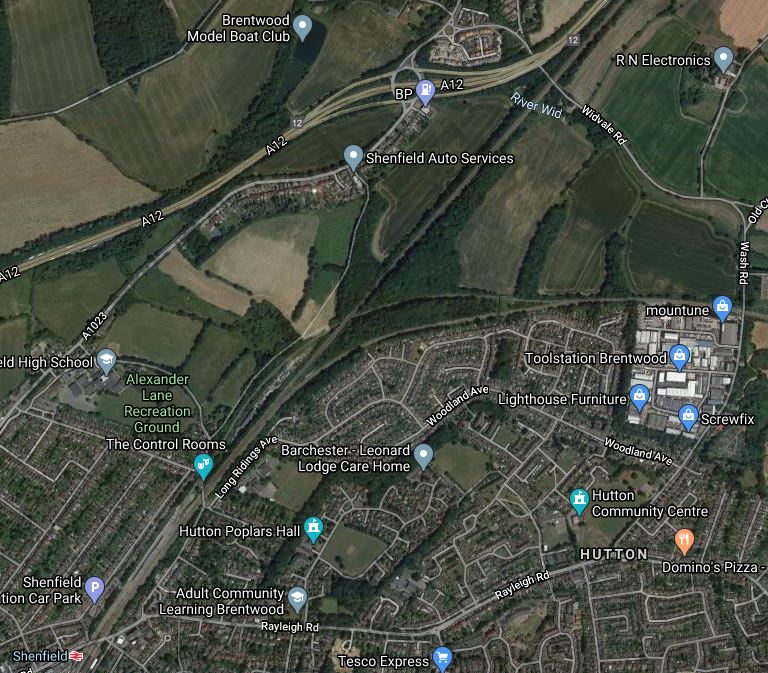
Note.
- Shenfield station is in the South-West corner of the map.
- The GEML goes straight in a North-Easterly direction to Ingatestone and Chelmsford.
- Ingatestone and Shenfield stations are about 3.5 miles apart.
- The Shenfield-Southend Line goes off to the East and connects to the GEML with a flying junction.
There would appear to be space to convert the flying junction into a full triangular junction by building chords, that allow access between the Shenfield-Southend Line and the GEML to Chelmsford.
Turning South At The A130
This Google Map shows where the Shenfield-Southend Line crosses the A130.
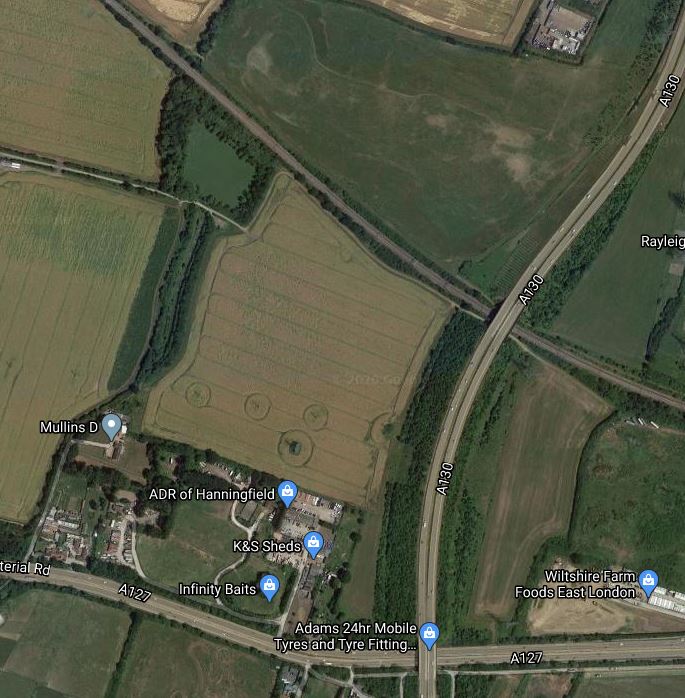
Note.
- The two major roads; the A130 and the A127 are clearly labelled.
- The Shenfield-Southend Line crosses the A130 from North-West to East.
- Billericay and Shenfield are to the North-West.
- Southend is to the East.
It looks like there is sufficient space to create a junction, which would allow trains to take a new rail line to and from the South, built alongside the A130.
The Connection At Pitsea Station
This Google Map shows the Southern section of the A130 that connects to the A13.
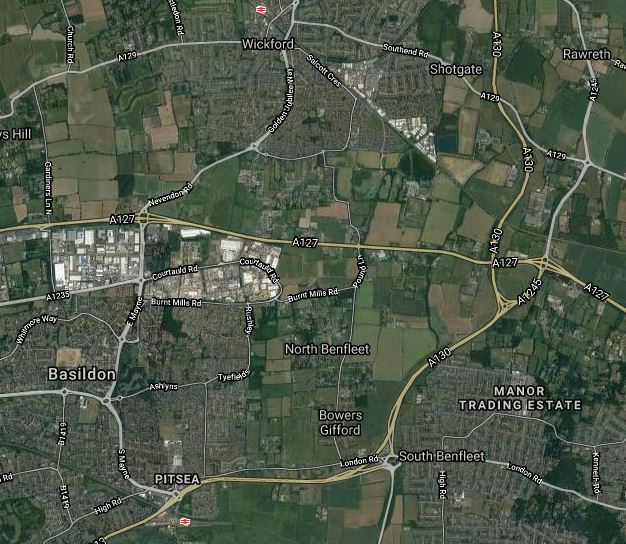
Note.
- Pitsea station is at the Southern side of the map.
- The A130 weaves its way North-South down the Eastern side of the map.
- The rail link could follow the A130.
The Google Map shows Pitsea station, the A13 and its junction with the A130.
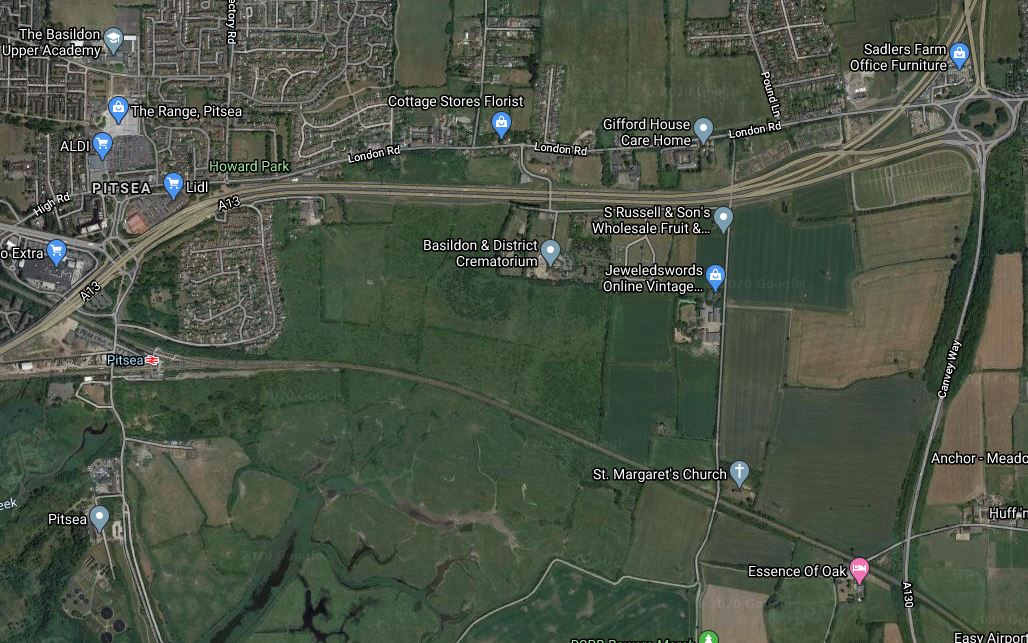
Note.
- The A13 going across the Northern side of the map.
- The A130 going down the Eastern side of the map.
- Pitsea station in the middle of the Western side of the map.
- The c2c railway between Pitsea and Southend Central stations going East from Pitsea station and passing to the South of St. Margaret’s Church.
It appears to me, that there would be enough space to build a full triangular junction between the rail link and the c2c railway.
A full triangular junction would enable trains to go between Chelmsford and all stations as far as Shoeburyness.
A Few Questions
These are a few questions.
Will Passenger Trains Use The Rail Link?
Consider.
- It would make it possible to create a direct train service that connected all the major towns in Essex; Colchester, Chelmsford and Southend.
- Chelmsford is the county town of Essex.
- Southend Central station has two West-facing bay platforms.
- Colchester station has a South-facing bay platform.
I think that the route must be built to perhaps allow an hourly CrossEssex service in both directions, at some date in the future.
Would There Be Any Stations On The Rail Link?
The route goes through Billericay and Wickford stations and also has a connection to the Crouch Valley Line.
How Long Is The Rail Link?
I estimate, it’s just under seventeen miles.
How Long Will Freight Trains Take Between Pitsea And Ingatestone?
The Felixstowe Branch is about twenty miles long and trains take a few minutes over the hour.
Will The Rail Link Be Single Or Double Track?
Despite the Covid-19 pandemic, there are still about a dozen trains going in and out of London Gateway on a typical day.
- This would be a train every ninety minutes in both directions on the rail link if they were all using it.
- London Gateway will expand.
- A passenger service on the rail link in the future, is a possibility.
- The Shenfield-Southend Line is double-track.
I feel that a single track railway would be short on capacity, so for preference, I’d build a double-track railway.
Will The Rail Link Be Electrified?
Consider.
- All passenger trains run by Greater Anglia and c2c to and from Southend are electric.
- Essex is a county where all rail lines are electrified, except for the spur that leads into London Gateway.
- The GEML and the lines to Southend have recently updated electrification.
- Freight trains can be hauled on the GEML by electric or bi-mode locomotives.
- Te section between the GEML and the A130 is already electrified.
It would be logical that the rail link should be electrified.
Thoughts About Capacity
Although a rai link between Pitsea and Ingatestone may be feasible, it doesn’t mean that it will be built.
- Will there be enough capacity across the Midlands or on the various routes to the North?
- Greater Anglia have ambitions and the trains to run more services.
- Would digital signalling on the GEML create extra capacity?
Extra Infrastructure
Thoughts On Powering Electrification Islands
In The Concept Of Electrification Islands, I didn’t say anything about how electrification islands would be powered. Although, I did link to this post.
The Need For A Substantial Electrical Supply
Electrification can use a lot of electricity.
This was illustrated by the electrification of the Midland Main Line, where a high-capacity feed from the National Grid had to be provided at Market Harborough.
But then the Government cancelled electrification North of Kettering leaving a twelve mile gap to be filled. I wrote about the problem in MML Wires Could Reach Market Harborough. In the end the sensible decision was taken and the electrification will now reach to Market Harborough station.
So places like Cambridge, Darlington, Doncaster, Leeds Norwich and York. which are fully electrified and on a main route probably have enough electrical power to charge passing or terminating battery-electric trains on secondary routes.
In Thoughts On The Actual Battery Size In Class 756 Trains And Class 398 Tram-Trains, I quoted the reply to a Freedom of Information Request sent to Transport for Wales, which said.
A four-car Class 756 train will have a battery capacity of 600 kWh.
A Class 756 train is similar to a Greater Anglia Class 755 train, which in Battery Power Lined Up For ‘755s’, I estimated weighs about 135 tonnes when full of passengers.
Weights for the Hitachi trains are difficult to find with a figure of 41 tonnes per car given for a Class 801 train on Wikipedia. In Kinetic Energy Of A Five-Car Class 801 Train, I estimated a full weight of a five-car Class 801 train at 233.35 tonnes.
Based on the Stadler figure, I would estimate that every train passing an electrification island will need to pick up as much as somewhere between 600-1000 kWh.
An Electrification Island At Sleaford
In The Concept Of Electrification Islands, I proposed an electrification island at Sleaford station.
- Sleaford is a market town of around 18,000 people.
- I doubt the power in the town has much surplus capacity.
- This station is served by four trains per hour (tph), one to each to Lincoln, Nottingham, Peterborough and Skegness.
- So it looks like a feed of three to four MW will be needed to charge passing trains.
Can the electricity supply in a town like Sleaford provide that sort of power for perhaps eighteen hours a day?
The only ways to provide that sort of power is to build a new power station or provide energy storage capable of boosting the supply.
Could Highview Power Provide The Solution?
I have been following Highview Power and their CRYOBatteries for some time.
They have already built a 5 MW pilot plant in Manchester and are currently aiming to build a plant with 250 MWh of energy storage, that can supply up to 50 MW. The company and this plant is discussed in this article on The Chemical Engineer.
One of these CRYOBatteries, would surely be ideal to power an electrification island, like the one at Sleaford.
- It could be scaled to the electricity needs of the town and the railway.
- It would be charged using renewable or excess energy.
- There is a lot of wind power in Lincolnshire and just off the coast, which needs energy storage.
- Similar systems could also be installed at other electrification islands at Cleethorpes, Lincoln, Skegness and other places, where the grid needs strengthening.
I have used Highview Power in this example, but there are other systems, that would probably boost the electricity just as well.
The Concept Of Electrification Islands
Consider how Imperial Airways and BOAC used to fly long routes to places like Sydney, Hong Kong and Cape Town before the days of long distance jet airliners. They used to fly from airport to airport, picking up fuel and supplies on the way.
If you want to know more about the details, read what is my favourite travel book, Beyond The Blue Horizon by Alexander Frater.

He followed the Imperial Airways route to Sydney, on what was reputed to be the most complicated ticket, that British Airways ever issued.
But can the concept of flying a short range airliner over a long distance refuelling as necessary, be applied to running a battery electric train by charging the batteries on a series of electrification islands?
In Ipswich And Peterborough In A Battery Train, I described how an Ipswich and Peterborough service could be run by a battery-equipped Class 755 train.
The Ipswich and Peterborough route is 82.5 miles long and it can be split as follows.
- Ipswich and Haughley Junction – 13.8 miles – Electrified
- Haughley Junction and Ely – 38.2 miles – Not Electrified
- Ely and Peterborough – 30.5 miles – Not Electrified
Legs two and three, should be within the capability of a battery-equipped Class 755 train. No definite figure has been given, but in the July 2018 Edition of Modern Railways, this was said about the similar Class 756 trains, ordered for the South Wales Metro.
The units will be able to run for 40 miles between charging, thanks to their three large batteries.
Perhaps, what is needed is to create an electrification island at Ely, that can be used to charge the batteries.
An Electrification Island At Ely
This map from Wikipedia shows the complicated railways at Ely,
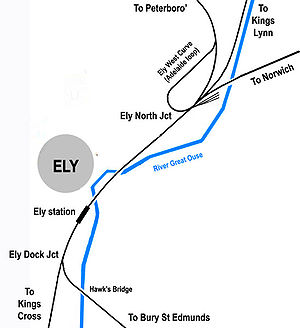
Note.
- Ely station is fully electrified.
- The line to Cambridge,Kings Cross, Liverpool Street and Stansted Airport is fully electrified. Greater Anglia’s Class 755 trains between Norwich and Stansted Airport, change between diesel and electrification at Ely.
- The line to Kings Lynn is fully electrified.
- The lines to Bury St. Edmunds, Norwich and Peterborough are not electrified.
- Ely is a city of 20,000 inhabitants, so I suspect it must have a robust electricity supply.
- Freight trains take about five minutes to pass between Ely West and Ely Dock Junctions.
- Ely West and Ely Dock Junctions are 2.5 miles apart.
- There appears to be an avoiding line South-East of Ely station, where I’ve seen trains from Felixstowe to Peterborough sometimes wait for a few minutes before proceeding.
- There is also a lot of space at March station, where a passing loop with a charging station could be built.
I believe it would be possibly to do the following at Ely.
- Electrify the West Curve and the South-East avoiding line.
- Electrify the Bury St. Edmunds, Norwich and Peterborough lines for perhaps five miles.
- If required, put a high capacity charging station on the avoiding line.
There would be plenty of electrification to charge the trains.
An alternative plan might be to electrify between March station and the new Soham station, which has been planned to open in 2021.
- This would be around eighteen miles of electrification.
- This would certainly be enough electrification to fully-charge passing freight and passenger trains.
- Soham to Ely could be doubled.
- The extra electrification would mean the two unelectrified sections of the Ipswich and Peterborough route; Haughley Junction-Soham and March-Peterborough would be well within range of a battery-electric train.
- The proposed service between Cambridge and Wisbech would only have the twelve miles of the Bramley Line between March and Wisbech to run on battery power.
It might also be possible to put in an extra curve to make Ely Dock Junction, a full triangular junction. This would allow the new Soham station to have direct services to both Cambridge and Cambridge North stations, without a reverse at Ely station.
Other Possible Electrification Islands
I’ll break these down by regions and train operators.
East Anglia (Greater Anglia)
Greater Anglia only runs trains on diesel to the North of Cambridge and Ipswich, which are both fully electrified, as is Norwich.
I would consider Cambridge, Ely, Ipswich and Norwich to be electrification islands.
- All have a good connection to the electrification power supply, as they handle main line electric trains.
- All or most platforms at the stations are electrified to charge trains.
- There are electrified sidings at Cambridge and Norwich and possibly at Ipswich.
Lowestoft and Yarmouth might be fitted with charging systems to make sure a fault doesn’t strand a train.
In Battery Power Lined Up For ‘755s’, I talked about a report in Rail Magazine, which said that the Class 755 trains will get a battery fitted at the first overhaul.
I wouldn’t be surprised, that in a couple of years, Greater Anglia announces the end of diesel power on some or all of their services.
East Coast Main Line (LNER and Others)
Hitachi AT-300 Trains On The East Coast Main Line
The East Coast Main Line (ECML), is increasingly becoming a railway where the vast majority of services are run by versions of Hitachi AT-300 trains.
- Hull Trains are running Class 802 trains.
- LNER are running Class 800 and Class 801 trains.
- TransPennine Express are running Class 802 trains.
- East Coast Trains will be running Class 803 trains.
Classes 800, 802 and 803 are bi-modes and can probably have some or all of their diesel engines replaced by batteries.
In Sparking A Revolution, I gave this specification for a Hitachi battery-electric train.
- Range – 55-65 miles
- Performance – 90-100 mph
- Recharge – 10 minutes when static
- Routes – Suburban near electrified lines
- Battery Life – 8-10 years
I will use these figures from Hitachi in this post.
Electrification Islands On The East Coast Main Line
There are several large and smaller stations along the ECML, that can act as electrification islands to support either local services or long-distance services from London.
Cleethorpes
Consider
- Cleethorpes station would need a decent electricity supply. Offshore wind?
- Doncaster is 52 miles away.
- Lincoln is 37 miles away.
- Newark is 63 miles away.
- Scunthorpe is 29 miles away.
If you can get battery-electric trains to Cleethorpes, you also serve Grimsby Town station, which is three miles closer to the ECML.
With electrification islands at Lincoln and Scunthorpe and Hitachi AT-300 trains with a battery range of at least sixty miles, electric trains could be run to Cleethorpes and Grimsby.
Would that improve the economy of the area?
Darlington
Darlington station is on the electrified ECML, so it must have a top class electricity supply.
- Bishop Auckland is 12 miles away.
- Middlesbrough is 15 miles away.
- Nunthorpe is 20 miles away.
- Saltburn is 27 miles away.
- Whitby is 47 miles away.
Darlington could support battery-electric operation of the Tees Valley Line, if the route doesn’t go for hydrogen. Note that hydrogen would probably also handle services from Middlesbrough to Newcastle, Nunthorpe and Whitby with ease.
Note my views on the definitive hydrogen train, which will be a battery-electric-hydrogen hybrid train, able to use power from a variety of sources.
Doncaster
Doncaster station is on the electrified ECML, so it must have a top class electricity supply.
- Cleethorpes is 52 miles away.
- Hull is 40 miles away.
- Scunthorpe is 25 miles away.
- Sheffield is 19 miles away.
Doncaster could certainly support some battery-electric services.
Grantham
Grantham station is on the electrified ECML, so it must have a top class electricity supply.
- Nottingham is 22 miles away.
- Sleaford is 18 miles away.
- Nottingham and Skegness services seem to take about four minutes to reverse in the station.
The Nottingham and Skegness service could take advantage of the driver changing ends to top up the battery.
Hull
Consider.
- Hull is a city of nearly 300,000 people, so it must have a decent electricity supply.
- Hull station is under forty miles from the electrification of the ECML.
- Doncaster is 40 miles away.
- Scarborough is 54 miles away.
- York is 52 miles away, with about 20 miles electrified.
I would certainly suspect that with an electrification island at Hull, the Hitachi AT-300 trains of Hull Trains and LNER could certainly run fully electric services to the city, if they were fitted with batteries.
With an electrification island at Scarborough, could Hull Trains and LNER services be extended to Scarborough?
Leeds
Leeds station is already an electrification island, as it is fully electrified.
- It also has electrified services to Bradford, Ilkley and Skipton.
- Leeds and Huddersfield will be electrified in the next few years.
Harrogate is 18 miles away, so a return journey is within range of a Hitachi AT-300 train with a battery, that is charged on the ECML.
Lincoln
Consider.
- Lincoln station would need a decent electricity supply.
- Cleethorpes is 37 miles away.
- Doncaster is 40 miles away.
- Newark is 16 miles away, so a return journey is within range of a Hitachi AT-300 train with a battery, that is charged on the ECML.
- Nottingham is 34 miles away and Leicester is 61 miles away.
- Peterborough is 57 miles away.
- Sleaford is 21 miles away.
With an electrification island at Lincoln, the following should be possible.
- Electric services between Cleethorpes and Lincoln using battery-electric trains.
- Electric services between Doncaster and Lincoln using battery-electric trains.
- Electric services between Nottingham/Leicester and Lincoln using battery-electric trains. Electrify the Midland Main Line (MML) and this is easy.
- Electric services between Peterborough and Lincoln using battery-electric trains. It may need an electrification island at Sleaford.
- Electric services between London Kings Cross and Grimsby/Cleethorpes using Hitachi AT-300 trains with a battery, that is charged on the ECML and at Lincoln.
The London Kings Cross and Lincoln services could top up their batteries if required if they were run using Hitachi AT-300 trains with a battery
Surely, if Class 755 trains are good enough for Norfolk and Suffolk and both franchises are run by Abellio, then battery versions of these trains would be ideal for running services from Lincoln to Cleethorpes/Grimsby, Doncaster, Newark, Nottingham, Peterborough and Skegness.
Middlesbrough
If required an electrification island could be placed at Middlesbrough station.
- Darlington is 15 miles away.
- Newcastle is 47 miles away.
- Saltburn is 13 miles away.
- Whitby is 35 miles away.
This area might opt for hydrogen, but I believe battery-electric trains could also work the routes through Middlesbrough and Darlington. Note my views on the definitive hydrogen train, which will be a battery-electric-hydrogen hybrid train, able to use power from a variety of sources.
Newark
Consider.
- Newark North Gate station is on the electrified ECML, so it must have a top class electricity supply.
- Cleethorpes is 63 miles away.
- Grimsby is 60 miles away.
- Lincoln is 16 miles away.
- Nottingham is 17 miles away.
With an electrification island at Cleethorpes/Grimsby, battery-electric services could be extended to either town. They would need to use the electrification island at Lincoln station to top-up the battery.
Newcastle
Newcastle station is on the electrified ECML, so it must have a top class electricity supply.
- Carlisle is 61 miles away.
- Middlesbrough is 47 miles away.
- Nunthorpe is 52 miles away.
Newcastle could surely support local services using battery-electric trains. They could be dual-voltage, so they can use Tyne and Wear Metro electrification.
Peterborough
Peterborough station is on the electrified ECML, so it must have a top class electricity supply.
- Ely is 31 miles away.
- Leicester is 52 miles away, with Birmingham another 40 miles further.
- Lincoln is 57 miles away.
- Sleaford is 35 miles away.
It might even be possible for Hitachi AT-300 trains with a battery to be able to run between Stansted Airport and Birmingham for CrossCountry.
- Stansted and Ely – 38 miles – Electrified
- Ely and Peterborough – 30.5 miles – Not Electrified
- Through Peterborough – 6 miles – Electrified (ECML)
- Peterborough and Leicester – 52 miles – Not Electrified
- Leicester and Nuneaton – 19 miles – Not Electrified
- Through Nuneaton – 3 miles – Electrified (WCML)
- Nuneaton and Birmingham – 21 miles – Not Electrified
Note.
- Trains would charge when running under electrification and also during station stops in Cambridge, Ely, Peterborough Leicester and Nuneaton.
- Trains would automatically raise and lower their pantographs as required.
- There may be scope to add sections of extra electrification.
- For example, electrification of the MML could add as much as eight miles of electrification, through Leicester.
As much as forty percent of the route between Birmingham and Stansted could be electrified.
Sandy/St. Neots
It is planned that the East West Railway (EWR) and the ECML will cross at an interchange station somewhere in this area.
Consider.
Both stations are on the electrified ECML, so must have a top class electricity supply.
- Bedford is 10 miles away.
- The electrification South of Cambridge is about 20 miles away.
It would surely be possible to create an electrification island, where the two major routes cross at Sandy/St. Neots.
Scarborough
Consider.
- Scarborough station would need a decent electricity supply.
- Hull is 54 miles away.
- York is 42 miles away.
With charging facilities at Scarborough battery-electric trains could be run to the seaside resort.
- I also think it would be possible to run a direct service between London Kings Cross and Scarborough using Hitachi AT-300 trains with batteries, either via York or Hull.
- TransPennine’s Hitachi trains could also read Scarborough from York, if fitted with batteries.
Would battery-electric trains between Hull, Scarborough and York attract more users of the services?
Sleaford
If required an electrified island could be placed at Sleaford station.
- Sleaford would need a decent electricity supply.
- The station is where the Nottingham and Skegness and Peterborough and Lincoln routes cross.
- Grantham on the ECML is 18 miles away.
- Lincoln is 21 miles away.
- Nottingham is 40 miles away.
- Peterborough is 35 miles away.
- Skegness is 40 miles away.
Services through Sleaford would be run as follows.
As Lincoln and Peterborough are likely to both have the ability to charge trains, the Peterborough and Lincoln route can probably be run using a battery-electric train, that also charges during the stop at Sleaford.
To run the Nottingham and Skegness route, there will need to be a charging facility or an electrification island at Skegness, as forty miles is to far from an out and back from Sleaford on battery power. The section between Sleaford and Nottingham is easier, as there is a reverse at the fully-electrified Grantham station, where the trains could top-up their batteries.
York
York station is already an electrification island, as it is fully electrified.
- Harrogate is 20 miles away, with Leeds another 18 miles further.
- Hull is 52 miles away, with about 20 miles electrified.
- Scarborough is 42 miles away.
It would appear that battery-electric trains could work the routes between Doncaster, Harrogate, Hull, Leeds, Scarborough and York.
Midland Main Line (East Midlands Railway)
Hitachi AT-300 Trains On The Midland Main Line
The Midland Main Line (MML) is a mixture of electrified and non-electrified sections. East Midlands Railway have chosen Hitachi Class 810 trains to cope with the mixed infrastructure.
- There will be thirty-three five car trains.
- They will have four diesel engines instead of three in the Class 800 trains.
- They will have a redesigned nose.
Are East Midlands Railway ordering a dual-purpose design?
In the January 2020 Edition of Modern Railways, this is said about the bi-mode Hitachi Class AT-300 trains for Avanti West Coast.
Hitachi told Modern Railways it was unable to confirm the rating of the diesel engines on the bi-modes, but said these would be replaceable by batteries in future if specified.
Consider.
- Both fleets of trains are for delivery in 2022.
- Ease of manufacture would surely mean, that Hitachi would want the two fleets to be substantially the same.
- A train with four engines could be needed to cruise at 125 mph on diesel.
- Four engine slots would mean that, if you were replacing some engines with batteries, you’d have more flexibility.
Hitachi seem to be playing an inscrutable game.
This section entitled Powertrain in the Wikipedia entry for the Class 800 train, says this about the powertrain for Class 800/801/802 trains.
Despite being underfloor, the generator units (GU) have diesel engines of V12 formation. The Class 801 has one GU for a five to nine-car set. These provide emergency power for limited traction and auxiliaries if the power supply from the overhead line fails. The Class 800 and Class 802 bi-mode has three GU per five-car set and five GU per nine-car set. A five-car set has a GU situated under vehicles 2/3/4 and a nine-car set has a GU situated under vehicles 2/3/5/7/8.
Hitachi must have found a way to arrange four GUs under a Class 810 train.
- They could be using slightly smaller engines. Smaller engines could be fitted to curb overheating.
- The engines might be in pairs under vehicles 2 and 4, possibly sharing utilities like fuel tanks and cooling systems.
But as the vehicles are two metres shorter, it wouldn’t be a shoe-in.
When the trains are to be upgraded to battery electric trains, an appropriate number of GUs would be replaced by batteries.
I wouldn’t be surprised to find out that both Avanti West Coast and East Midlands Railway will have trains that can be converted from five-car bi-mode trains into battery-electric trains, with a range of between 55 and 65 miles.
- As a control engineer, I believe that a battery could be made to be plug compatible with a GU.
- An extra battery could be placed under vehicle 3, in the spare engine position.
I reckon that Hitachi’s quote of a sixty-five mile range would at 3 kWh per vehicle-mile need about one MWh of batteries.
That is 200 kWh per vehicle, so I feel it should be possible.
Electrification Of The Midland Main Line
Current plans for electrified sections of the MML are as follows.
- London St. Pancras and Corby – 79.5 miles – Opening December 2020
- London St. Pancras and Market Harborough – 83 miles – Opening December 2020
- Clay Cross North Junction and Sheffield – 15.5 miles – To be built in conjunction with High Speed Two
The gap between Market Harborough and Clay Cross North Junction is about 66 miles.
Electrification Islands On The Midland Main Line
As with the ECML, there are several large and smaller stations along the MML, that can act as electrification islands to support either local services or long-distance services from London.
I will deal with the electrification islands, starting in London.
Bedford
In Looking At The East West Railway Between Bedford And Cambridge, I came to the conclusion, that the East West Railway (EWR) and the MML, would share electrified tracks through Bedford station.
- There are also rumours of electrification of the East West Railway, which I wrote about in EWR Targets Short-Term Fleet Ahead Of Possible Electrification, after an article in Rail Magazine with the same title.
- But even so Bedford and Cambridge are only thirty miles apart, which is well within the capability of a battery-electric train.
- Continuing to the West on the EWR, it is under twenty miles to the electrification at Bletchley on the West Coast Main Line (WCML).
It looks to be that battery-electric trains running on the EWR would be able to charge their batteries as they pass through Bedford.
- It does appear to me, that the EWR chose a route through Bedford that would make this feasible.
- It would also be relatively easy to electrify the EWR to the East and/or West of Bedford to increase the time using electrification, to fully charge the trains.
- As Cambridge and Bletchley are around fifty miles apart, this journey between two fully-electrified stations, would be possible for a battery-electric train, especially, if it were able to take a sip of electricity in the possible stops at Bedford and Sandy or St. Neots.
If in the end, it is decided to electrify the EWR, Bedford would surely be a location, with enough power to feed the electrification.
Leicester
Leicester station is an important station on the MML.
But it would be a difficult station to electrify because of a bridge with limited clearance.
In Discontinuous Electrification Through Leicester Station, I discussed how the following.
- Discontinuous electrification through Leicester station.
- Electrification between Leicester and Derby stations.
- Electrifying the High Speed Two route between Clay Cross Junction and Sheffield.
Would allow Hitachi Class 810 trains, equipped with batteries to run between London and Sheffield on electric power alone.
East Midlands Parkway
East Midlands Parkway station is nineteen miles North of Leicester station.
This Google Map shows its unique position.
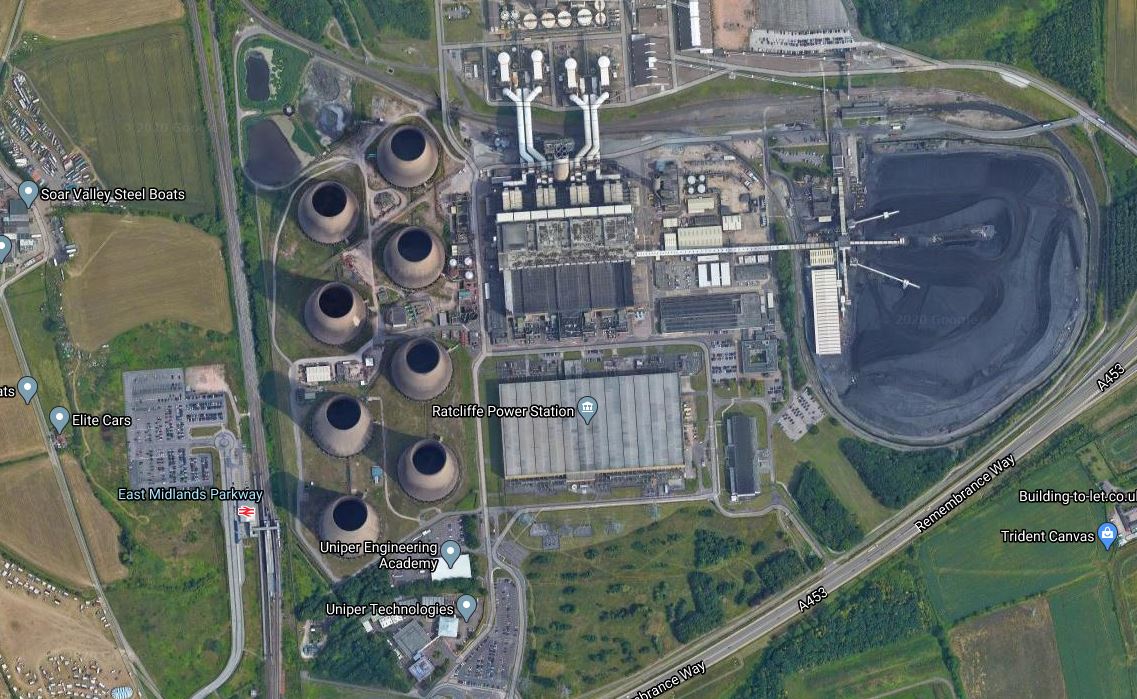
Ratcliffe-on-Soar power station is the eighteenth highest emitter of CO2 in Europe and will surely be closed soon.
But then, a power station, will have a good connection to the National Grid, ensuring there could be plenty of power for electrification, even after the current power station is long gone, as it will surely be replaced by another power station or energy storage.
East Midlands Parkway station is also well-connected.
- Clay Cross North Junction is 31 miles away.
- Derby is 10 miles away.
- Leicester is 18 miles away.
- Nottingham is 8 miles away.
- Sheffield is 47 miles away.
It should be possible to reach all these places on battery-power from East Midlands Parkway.
Electrification Between Leicester And East Midlands Parkway
The more I look at this stretch of the MML, the more I feel that this eighteen mile stretch should be electrified to create what could become a linear electrification island.
Consider.
- It is a 125 mph multi-track railway across fairly flat countryside.
- Connecting electrification to the grid is often a problem, but Ratcliffe-on-Soar power station is adjacent to East Midlands Parkway station.
- The section is only eighteen miles long, but this is surely long enough to fully-charge a battery train speeding to and from the capital.
- There are only four intermediate stations; Syston, Sileby, Barrow-on-Soar and Loughborough.
- The engineering for gauge clearance and electrification, looks to be no more difficult, than it will be between Kettering and Market Harborough.
- Between Leicester and Market Harborough stations is only sixteen miles.
- Between East Midlands Parkway and Nottingham is only eight miles, so it would be possible for Nottingham services to run without a charge at Nottingham station.
- Between East Midlands Parkway and Derby is only ten miles, so it would be possible for Derby services to run without a charge at Derby station.
- Between East Midlands Parkway and the shared electrified section with High Speed Two at Clay Cross North Junction is thirty-one miles, so it would be possible for Sheffield services to be run without using diesel, once the shared electrification is complete between Clay Cross North Junction and Sheffield.
- Battery-electric trains between East Midlands Parkway and Clay Cross North Junction could also use the Erewash Valley Line through Ikeston, Langley Mill and Alfreton.
- There would be no need to electrify through the World Heritage Site of the Derwent Valley Mills that lies between Derby and Clay Cross North Junction, as trains will be speeding through on battery power. Electrifying through this section, might be too much for some people.
- If the trains can’t switch between battery and overhead electrification power, the changeover can be in Leicester and East Midlands Parkway stations. However, I believe that Hitachi’s AT-300 trains can do the changeover at line speed.
The electrification could also be used by other services.
- Between Corby and Syston North Junction is only thirty-six miles, so it would be possible to run electric services between London St. Pancras and Derby, Nottingham and Sheffield via Corby, if the main route were to be blocked by engineering work.
- Between Peterborough and Syston East Junction is forty-seven miles, so it should be possible to run CrossCountry’s Stansted Airport and Birmingham service using battery-electric trains. If the train could leave Leicester with a full battery, both Birmingham New Street and Peterborough should be within range.
- East Midlands Railway’s Lincoln and Leicester service run for a distance of sixty-one miles via East Midlands Parkway, Nottingham and Newark stations. Electrification between Leicester and East Midlands Parkway, would mean there was just forty-two miles to do on battery power. An electrification island at Lincoln would charge the train for return.
Battery-electric trains with a range of between 55 and 65 miles would really open up the East Midlands to electric services if between Leicester and East Midlands Parkway were to be electrified.
London And Sheffield In A Battery-Electric Class 810 Train
This is speculation on my part, but I think this could be how trains run London to Sheffield before 2030.
- London to Market Harborough – 83 miles – Using electrification
- Switch to battery power at line speed.
- Market Harborough to Leicester – 16 miles – Using battery power
- Switch to electrification in Leicester station
- Leicester to East Midlands Parkway – 19 miles – Using electrification
- Switch to battery power at line speed.
- East Midlands Parkway to Clay Cross North Junction – 31 miles – Using battery power
- Switch to electrification at line speed.
- Clay Cross North Junction to Sheffield – 15.5 miles – Using electrification
Note.
- 118 miles would be run using electrification and 47 miles using battery power.
- Battery power has been used to avoid the tricky electrification at Leicester station and along the Derwent Valley.
I don’t believe any of the engineering will be any more difficult, than what has been achieved on the MML in the last year or so.
Nottingham
Consider
- Nottingham station would probably have access to a reliable electricity supply, as Nottingham is a large city of over 300,000 people.
- Nottingham station has a comprehensive network of local services.
- Nottingham station has an excellent connection to Nottingham Express Transit.
- Birmingham New Street is 57 miles away, via Derby and Burton.
- Burton-on-Trent is 27 miles away.
- Derby is 16 miles away.
- Grantham is 23 miles away.
- Lincoln is 34 miles away.
- Matlock is 33 miles away.
- Newark is 17 miles away.
- Sheffield is 40 miles away.
- Worksop is 32 miles away.
- Most of these local services are run by East Midlands Railway, with some services run by Northern and CrossCountry.
- Some services run back-to-back through Nottingham.
I feel very strongly that if charging is provided in Nottingham, when trains turnback or pass through the station, that many of the local services can be run by battery-electric trains.
Previously, I have shown, that if between Leicester and East Midlands Parkway is electrified, then services between London and Nottingham, can be run by battery-electric trains.
There is also a fall-back position at Nottingham, as the local services could be run by hydrogen-powered trains.
Sheffield
Sheffield station would at first glance appear to be very similar to Nottingham.
- Sheffield station would probably have access to a reliable electricity supply, as Sheffield is a large urban area of 700,000 people.
- Sheffield station has a comprehensive network of local services.
- Sheffield station has an excellent connection to the Sheffield Supertram.
But it looks like Sheffield station will see the benefits of electrification the Northern section of the MML from Clay Cross North Junction.
- The 15.5 miles of electrification will be shared with the Sheffield spur of High Speed Two.
- Currently, trains take sixteen minutes between Sheffield and Clay Cross North Junction.
- Electrification and an improved high-speed track will allow faster running, better acceleration and a small saving of time.
- A Sheffield train will be charged going to and from Sheffield, so will leave Clay Cross North Junction for Derby and the South with full batteries.
- There must also be opportunities for local trains running between Sheffield and Class Cross Junction North to use the electrification and be run by battery-electric trains.
Current destinations include.
- Derby is 36 miles away.
- Doncaster is 19 miles away.
- Huddersfield is 36 miles away.
- Leeds is 45 miles away.
- Lincoln is 49 miles away.
- Manchester Piccadilly is 42 miles away.
- Nottingham is 40.5 miles away.
Note.
- Doncaster, Leeds and Manchester Piccadilly stations are fully electrified.
- Work on electrifying Huddersfield and Leeds will start in a year or so, so Huddersfield will be electrified.
- I am firly sure that Lincoln and Nottingham will have enough electrification to recharge and turn trains.
- Some routes are partially electrified.
As with Nottingham, I am fairly sure, that local services at Sheffield could be run by battery-electric trains. And the same fall-back of hydrogen-powered trains, would also apply.
Sheffield And Manchester Piccadilly In A Battery-Electric Train
Consider.
- Once Sheffield and Clay Cross North Junction is electrified in conjunction with High Speed Two, at least five miles of the Hope Valley Line at the Sheffield end will be electrified.
- It may be prudent to electrify through Totley Tunnel to increase the electrification at Sheffield to ten miles.
- The route via Stockport is 43 miles long of which nine miles at the Manchester End is electrified.
- The route via Marple is 42 miles long of which two miles at the Manchester End is electrified.
There would appear to be no problems with running the TransPennine Express service between Manchester Airport and Cleethorpes using battery-electric trains, as from Hazel Grove to Manchester Airport is fully electrified and in the East, they can charge the batteries at Sheffield, Doncaster and a future electrification island at Cleethorpes.
The Northern service between Manchester Piccadilly and Sheffield could be run using battery-electric trains with some more electrification at the Manchester End or an extended turnback in Manchester Piccadilly.
Transport for Manchester has plans to run improve services at their end of the Hope Valley Line, with tram-trains possible to Glossop and Hadfield.
It would probably be worthwhile to look at the Hope Valley Line to make sure, it has enough future capacity. I would suspect the following could be likely.
- More electrification.
- More stations.
- Battery-electric trains or tram-trains from Manchester to Glossop, Hadfield, New Mills Central, Rose Hill Marple and Sheffield.
I would suspect one solution would be to use more of Merseyrail’s new dual-voltage Class 777 trains, which have a battery capability.
Sheffield And Nottingham In A Battery-Electric Train
Consider.
- Once Sheffield and Clay Cross North Junction is electrified in conjunction with High Speed Two, 15.5 miles of the route will be electrified.
- The total length of the route is 40.5 miles.
- There are intermediate stops at Dronfield, Chesterfield, Alfreton, Langley Mill and Ilkeston.
- Currently, journeys seem to take around 53 minutes.
I think it would be likely that the battery would need to be topped up at Nottingham, but I think a passenger-friendly timetable can be developed.
West Coast Main Line (Avanti West Coast)
Hitachi AT-300 Trains On The West Coast Main Line
The West Coast Main Line (WCML) is a mainly electrified and with some non-electrified extended routes. Avanti West Coast have chosen Hitachi AT-300 trains to cope with infrastructure.
- There will be ten seven-car electric trains.
- There will be thirteen five-car bi-mode trains.
As these trains will be delivered after East Midlands Railway’s Class 810 trains and East Coast Trains’ Class 803 trains, the following questions must be asked.
- Will the trains have the redesigned nose of the Class 810 trains?
- Will the bi-mode trains have four diesel engines (Class 810 trains) or three ( Class 800 trains)?
- Will the electric trains ordered by First Group companies; Avanti West Coast and East Coast Trains be similar, except for the length?
I would expect Hitachi will want the trains to be as similar as possible for ease of manufacture.
Electrification Islands On The West Coast Main Line
As with the ECML and the MML, there are a couple of large and smaller stations along the WCML, that can act as electrification islands to support either local services or long-distance services from London.
I will deal with the electrification islands, starting in London.
Watford Junction
Watford Junction station is already an electrification island, as it is fully electrified.
- St. Albans Abbey is 6.5 miles away.
- It would be possible to develop a battery-electric service to Aylesbury via Rickmansworth and Amersham, with is a distance of under 25 miles, if this was desired. I wrote about this service in Hertfordshire County Council’s Aspiration For A Watford Junction And Aylesbury Service.
Services around Watford Junction have possibilities to be expanded and improved using battery-electric trains.
Milton Keynes
Milton Keynes Central station is already an electrification island, as it is fully electrified.
- East West Railway services will call at Bletchley and not Milton Keynes.
- There may be a connection between East West Rail and High Speed Two at Calvert station, which is 15 miles away.
- Milton Keynes will get a service from Aylesbury, which is 22 miles away.
There may be possibilities to link Watford Junction and Milton Keynes via Aylesbury using battery-electric trains to give both places a connection to High Speed Two at a new Calvert station.
Ipswich And Peterborough In A Battery Train
Greater Anglia have a fleet of bi-mode electro-diesel Class 755 trains, that could be converted into tri-mode electro-diesel-battery trains. I reported on this in Battery Power Lined Up For ‘755s’.
If when fitted with batteries these trains had a range of say 55-65 miles on battery power, these Greater Anglia routes could be handled using battery and electric power.
- Ipswich and Cambridge
- Ipswich and Felixstowe
- Ipswich and Lowestoft
- London and Lowestoft
- Marks Tey and Sudbury
- Norwich and Cambridge
- Norwich and Great Yarmouth
- Norwich and Lowestoft
- Norwich and Sheringham
Note.
- Marks Tey and Sudbury is planned to be extended to Colchester Town. Is this to allow a Class 755 train with a battery capability to charge the batteries on the Great Eastern Main Line? No charging facilities would then be needed on the branch.
- I have left out the current Ipswich and Peterborough service.
- There is speculation that Greater Anglia want to run a Cambridge and Wisbech service via Ely and March.
It is also reported that some or all Peterborough and Ipswich services will continue to Colchester.
- There is a convenient bay platform at Colchester to reverse the trains.
- A Colchester and Peterborough service, would give travellers in North Essex easier access to LNER services at Peterborough.
- Frequencies from Colchester and Ipswich across Suffolk would be improved.
If the trains were to run on battery power between Stowmarket and Ely, the batteries could be charged between Colchester and Stowmarket. Note that Stowmarket and Ely is about forty miles, which should be within battery range.
Ely and Peterborough is thirty miles, which again is within battery range. So would the train top up the batteries at Ely in perhaps a five minute stop?
Extra Electrification At Ely
There could be three battery-electric services needing to charge batteries as they pass through Ely.
- Colchester/Ipswich and Peterborough
- Norwich and Stansted Airport
- Cambridge and Wisbech
So would it be sensible to extend the electrification for a few miles towards Peterborough and Norwich to give the battery a quick top-up? It should be noted that the notorious Ely Junction is to be remodelled.
Will The Railway Between Buxton And Matlock Be Reopened?
In Issue 901 of Rail Magazine in an article about reopening the Northern route between Exeter and Plymouth, this is said, about possible rail re-opening of Beeching cuts.
Although not yet confirmed, they are believed by RAIL to include bids to reinstate the former Midland Railway route from Matlock-Buxton, and the line between Lostwithiel and Fowey.
I have found this news story on the Matlock Mercury, which is entitled Quarry Firms And Heritage Operator Consider Peak District Railway Line.
This is the introductory paragraph.
Proposals to revive a disused rail line through the Peak District have moved a step forward, but not the passenger service some have called for.
The reasons for the reinstatement are given in the story.
- There is an enormous demand for stone from projects like Crossrail 2, High Speed Two and Heathrow Expansion and Derbyshire is a major source.
- Currently, stone trains between Derbyshire and the South-East take a roundabout route via the congested and unsuitable Hope Valley Line and Sheffield.
- A route via Matlock would join the Midland Main Line nearly thirty miles further South.
It should be noted that the original track-bed still exists and part is used for the double-track Peak Rail, with much of the rest being used for the cycling and walking route; the Monsal Trail.
Thoughts About The Design Of The Railway
In the June 2017 Edition of Modern Railways, there is an excellent article, which is entitled Connecting The Powerhouses, that was written by Colin Boocock.
I wrote a post with the same name, based on his article, from which a lot of the following thoughts are taken.
Colin Boocock’s Thoughts On The Design
I said this in my previous post.
The track bed of the Peak Main Line is still intact and the author of the article suggests that there could be two ways of rebuilding the railway.
- As a 75 mph single-track railway sharing the track-bed with the Monsal Trail.
- As a 90 mph double-track railway, after moving the Monsal Trail to a more picturesque route.
Four or five, reopened or new stations could be built with passing loops to enable the minimum service frequency to be achieved, which the author suggests should be the following in both directions in every hour.
- One fast passenger train
- One stopping passenger train.
- One freight train; full or empty.
But there are possible problems.
- The A6 has to be crossed.
- One local landowner didn’t allow consultants access to the line for an inspection.
- Severn Trent Water are digging a large pipe into the track-bed.
- Peak Rail have plans to extend their heritage line to Bakewell. Could both groups co-exist?
It sounds to me that everybody should find a good hostelry and thrash out a comprehensive co-operation agreement on the backs of engineering envelopes, fuelled by some excellent real ale.
But various improvements to the route and railway technology in general, in the last few years have probably made the reinstatement less challenging.
Ambergate Station And Junction
Ambergate station and the associated junction is where trains for Matlock station, leave the Midland Main Line and take the Derwent Valley Line.
This article on the BBC is entitled Major Rail Works To Affect Derbyshire Train Services and it describes work done to improve Ambergate Junction.
It is to be hoped, that the updating of the junction is at least well-documented, so that it can be updated easily to accept stone trains to and from the Derwent Valley Line.
Improved Handling Of Freight Trains At Buxton
In £14m Peak District Rail Freight Extension Unveiled, I indicated that the improvements at Buxton had been completed.
- There are now two long sidings, that can each take a 26 wagon stone train and allow them to reverse.
- Capacity has increased by 44 %
- No more trains will be running.
According to this document on the Network Rail web site, the sidings operate on a 24 hour basis and on average, accommodate 6-10 freight trains every 24 hour period.
I’m not sure, but it looks like the sidings also allow all stone trains to access the following.
- All quarries in the area with a rail connection.
- The Great Rocks Freight Line to access the Hope Valley Line and Sheffield
- The proposed reopened rail line to Matlock, Derby and the South.
The track layout at Buxton station would appear to allow trains to go between Manchester and Derby, once the Matlock and Buxton railway is reinstated.
Ambergate Station And Junction
Ambergate station and the associated junction is where trains for Matlock station, leave the Midland Main Line and take the Derwent Valley Line.
This article on the BBC is entitled Major Rail Works To Affect Derbyshire Train Services and it describes work done to improve Ambergate Junction.
It is to be hoped, that the updating of the junction is at least well-documented, so that it can be updated easily to accept stone trains to and from the Derwent Valley Line.
Signalling Improvements
One of Colin Boocock’s options for the route, is a 75 mph single-track railway sharing the track-bed with the Monsal Trail.
Single-track railways running an intense schedule could be a challenging signalling problem in the past, but with in-cab digital signalling, as used on Thameslink and the London Underground, it is much less onerous.
It should be possible to handle Colin Boocock’s desired minimum frequency of three trains per hour (tph) in both directions.
Colin Boocock’s second option of a 90 mph double-track railway, after moving the Monsal Trail to a more picturesque route, would be very much easier to signal to a very high degree of safety.
Electrification
Electrification would surely, be the best way to get heavy freight trains in and out of the area.
But I suspect the line could not be electrified in a traditional manner, as heavy gantries in the Peak District would not go down well!
But what about a design something like this?
I talk about this design in Prototype Overhead Line Structure Revealed.
It does seem to be a good attempt to reduce the clutter of girders, gantries and wires!
Freight Locomotives
If electrification is not possible, which is probably the case, as the locomotives will need access to large amounts of freight sidings, then diesel power will be needed,
The current Class 66 locomotives are not the most environmentally-friendly locomotives, but hopefully in a sensitive area like the Peak District, some more advanced locomotives could be used.
Passenger Trains
Quiet battery-electric or hydrogen-powered trains would be ideal for the route.
How Many Stone Trains Will Use The Route?
With the current lockdown because of COVID-19, it’s a bit difficult to ascertain how many stone trains are currently going into and out of the quarries in an hour.
But from the Network Rail figures, I have found and Colin Boocock’s minimum figure, it looks like one tph would be a frequency for which to aim.
Could this frequency be handled between Matlock And Buxton?
Even if the route was single-track with passing loops, Colin Boocock’s minimum timetable could be achieved.
Note that the Great Rocks Freight Line will still be capable of handling trains via the Hope Valley Line and Sheffield.
Conclusion
I think that this scheme could be feasible, if engineers used modern signalling and other designs to blend in with the scenery.
EWR Targets Short-Term Fleet Ahead Of Possible Electrification
The title of this post is the same as that of this article on Rail Magazine.
This is the introductory paragraph.
Electrification could yet be on the agenda for East West Rail, after Government ministers confirmed that the decision not to wire the reopened railway could be reversed.
East West Railway (EWR) also announced last week, that it was looking for second-hand diesel multiple units to start services.
- The lease will be for four years, with a possible extension of two years.
- The deal is worth £40million and will include maintenance.
- The deal will end on May the 10th 2028.
- 12 to 14 three-car trains are required.
- Services will start at the end of 2024.
It looks to me, that this deal has interim written all over it.
Could Class 170 Trains Be Used For East West Railway?
Class 170 trains come in two- and three-cars and by 2024 many could be being replaced by trains with a smaller carbon-footprint.
If you look at the three-car Class 170 trains, they are the following numbers of trains with various companies.
- Class 170/1 – CrossCountry – 10
- Class 170/2 – Transport for Wales – 8
- Class 170/3 – Abellio ScotRail – 26
- Class 170/3 – CrossCountry – 2
- Class 170/4 – Abellio ScotRail – 13
- Class 170/4 – Northern Trains – 16
There are also some Class 170/5 and Class 170/6 trains, that it appears will be consolidated into ten three-car trains for CrossCountry.
Could CrossCountry Provide The Trains For East West Railway?
I think one likely scenario would be for the trains for East West Rail to come from CrossCountry‘s mixed fleet of Class 170 trains.
Consider.
- CrossCountry need a bit of a fleet change as they still ten High Speed Trains, that will need to be replaced with more modern rolling stock.
- CrossCountry have been criticised for a lack of capacity.
- Several of CrossCountry’s services are run by diesel trains on electrified tracks.
Perhaps, if they replaced the fleet with a customised variant of Hitachi’s Class 800 trains, they might offer a better service to their customers.
- Each train would be five cars long.
- Trains would be able to work in pairs.
- Trains might have electric, battery and diesel capabilities.
- Some would be dual-voltage trains and able to work on both 25 KVAC overhead and 750 VDC third rail electrification.
I’m sure those clever people at Rock Rail are working on an appropriate specification, just as they did for Avanti West Coast with their customised variant of Hitachi’sClass 800 trains.
Looking at the delivery schedules for various fleets of Hitachi trains, we find.
- East Midlands Railway will be receiving 33 x five-car Class 810 bi-mode trains in 2020-2022.
- Avanti West Coast will be receiving 13 x five-car AT-300 bi-mode trains in 2020-2022.
- Avanti West Coast will be receiving 10 x seven-car AT-300 electric trains in 2020-2022.
Could the CrossCountry fleet be delivered in 2022-2024 to allow the Class 170 trains to be released?
Could Class 185 Trains Be Used For East West Railway?
TransPennine Express have a fleet of 51 three-car Class 185 trains.
The future of these trains is uncertain, as TransPennine Express is renewing their fleet.
- They are all fully-compliant with the latest regulations.
- They are 100 mph trains,
- They are the right length.
- They can work in pairs to increase capacity.
These trains would be easy to freshen up for East West Railway.
Could Bombardier Voyagers Provide The Trains For East West Railway?
There are four fleets of Bombardier Voyagers, that by the end of 2024 could be looking for a new home.
- Thirty-four Class 220 trains could be released by 2024 by CrossCountry, if they replace their fleet with new trains.
- Twenty-four Class 221 trains could be released by 2024 by CrossCountry, if they replace their fleet with new trains.
- Twenty Class 221 trains will be released by 2022 by Avanti West Coast, when they replace their fleet with new AT-300 trains.
- Twenty-seven Class 222 trains will be released by 2022 by East Midlands Railway, when they replace their fleet with new Class 810 trains.
These fleets could be updated for the East West Railway.
- They are all fully-compliant with the latest regulations.
- They are 125 mph trains.
- Bombardier have been working on various schemes to fit batteries to these trains, to reduce running on diesel.
They could also be rebuilt to any required length.
Fast Forward To May 2028
By 2028, the following will have happened.
- High Speed Two will have been substantially completed and electrified at Calvert, where it crosses the East West Railway.
- East West Railway will be connected to the electrified West Coast Main Line at Bletchley.
- East West Railway will be connected to the electrified Midland Main Line at Bedford.
- New Hitachi Class 810 trains will be running through Bedford.
- Future connections to the electrified East Coast Main Line at Sandy and the electrified West Anglia Main Line at Cambridge South will have been designed, if not well underway or even completed.
East of Calvert, there will be plenty of electricity to power any electrification.
The article also quotes a Government minister as saying there will be passive provision for electrification. This is sensible, as the clearances required for 25 KVAC overhead electrification are not that much higher, than those needed for the largest freight containers.
So the two major requirements for 25 KVAC overhead electrification; electricity supply and gauge-clearance, appear to be met in the basic design of the East West Railway.
The East West Railway will also have one characteristic, that has been lacked, by most of the railways we have electrified in the last few years.
It will be a substantially new railway, although quite a few miles will have been rebuilt on an existing track bed.
It is my view after looking at several electrification schemes in the last ten years, that when we have electrified a substantially new railway, we have made a much better fist of it, in terms of both cost and timescale.
Could this be, that if the track-bed has just been created or relaid, it is well surveyed and the engineers and workers, who laid it, can be asked their opinion, so fewer costly mistakes are made?
It should also be said, that the route of the East West Railway goes through fairly flat country, which probably doesn’t have the sewers and mine-shafts, that have plagued the erection of electrification in recent years.
I wonder, if having looked in detail at the costs, the builders of East West Railway have found that perhaps around 2023, after a detailed survey of the route, they can build the railway at a cost, which includes electrification, that still offers benefits.
What Would Be The Benefits Of Electrification Of The East West Railway?
The benefits of electrification are generally as follows.
- Faster passenger and freight trains because of higher cruising speed and greater acceleration.
- Lower carbon emissions.
Faster trains would lead to more trains running over the railway.
Will The Electrification Be Full Or Partial?
I believe that Hitachi and other ,manufacturers will produce passenger trains with the following abilities.
- To use either 25 KVAC overhead or 750 VDC third-rail electrification.
- To use onboard energy storage for running a number of miles.
- To charge onboard energy storage, whilst dynamically connected to electrification.
- To charge onboard energy storage, whilst stationary in a station or siding.
- To swap between electrification and energy storage modes at operating speed.
These trains will be able to run on partially-electrified lines, by using energy storage to bridge gaps in the electrification.
In Sparking A Revolution, I gave this specification for a Hitachi battery-electric train.
- Range – 55-65 miles
- Performance – 90-100 mph
- Recharge – 10 minutes when static
- Routes – Suburban near electrified lines
- Battery Life – 8-10 years
It looks like a route run by Hitachi battery-electric trains could have approximately sixty mile gaps in the electrification.
The trouble with gaps, is that they would mean that electric freight locomotives could not be used on the route.
One possibility could be the new tri-mode Class 93 locomotive, which has the following power sources.
- 1.3 MW on diesel
- 4.055 MW on electric
- A power boost on battery
Hopefully, it can switch seamlessly between the various modes at line speed.
Until we see these locomotives in operation, we will not know if they can haul a maximum weight freight train all the way from Felixstowe to Ipswich and on to London, Cambridge or Peterborough.
Freight Trains Through Cambridge And Onto The East West Railway
In Roaming Around East Anglia – Freight Trains Through Newmarket, I said this.
The East West Rail Consortium plan to change the route of freight trains to and from Haven Ports; Felixstowe, Harwich and Ipswich to the West of Kennett station.
In this document on the East-West Rail Consortium web site, this is said.
Note that doubling of Warren Hill Tunnel at Newmarket and
redoubling between Coldham Lane Junction and Chippenham Junction is included
in the infrastructure requirements. It is assumed that most freight would operate
via Newmarket, with a new north chord at Coldham Lane Junction, rather than
pursuing further doubling of the route via Soham.
How would these changes affect Newmarket and the horse-racing industry in the town?
I believe that many freight trains would go straight through Cambridge and Cambridge South stations and onto the East West Railway.
One point to note, is that all of the route between Felixstowe and Cambridge South station has been gauge-cleared for the largest container trains and electrification.
This would surely make it reasonably easy to electrify all the way between Felixstowe and Cambridge South station.
Conclusion
I am coming to the conclusion, that given the importance of the rail freight route between Felixstowe and the Midlands, that something like the following will happen.
- 2024 – Diesel passenger trains start running between Reading and Bedford via Didcot, Oxford and Bletchley
- 2026 – Opening of Cambridge South station.
- 2028 – Partial or full electrification is erected between Reading and Bedford
- 2028 – Battery-electric passenger trains replace the diesel passenger trains.
- 2030 – Opening of the full route between Reading and Cambridge.
- 2935 – Opening of a fully-developed route though Newmarket to allow freight trains to go between Felixstowe and the East West Railway.
It appears to me, that by using diesel trains for an interim period, they can open the Reading and Bedford service early, whilst they complete the East West Railway.

