From Reading To Gatwick Airport Along The North Downs Line
After writing Connecting Reading And The West To Gatwick Airport And Eurostar, I decided to go and look at the reality of the North Downs Line between Reading and Gatwick Airport stations.
I took my usual route to Reading, which is to go to Moorgate and get the Elizabeth Line direct to Reading using my Freedom Pass, after having breakfast in the Leon on Moorgate.
- I then had to leave the station at Reading, so that I could buy my ticket to Gatwick Airport.
- It would be so much easier, if there ere a couple of ticket machines on the bridge or platform at Reading station, so that passengers, who were changing trains could buy tickets quickly and easily.
In the end, I caught the 11:24 train to Gatwick with only a few minutes to spare.
From Reading To Gatwick Airport Along The North Downs Line
Along the North Downs Line, the train was a well-refreshed Great Western Railway Class 165 train.
These are some of the pictures, that I took on the route.








































Note.
- The route goes through a lot of typical Surrey heathland.
- I noticed several pubs along the way.
- I suspect that there are some good walks from the stations.
- Reading and Guildford are university cities.
- Sandhurst is home to the Royal Military Academy.
- Farnborough Airport used to be home to the Royal Aircraft Establishment.
- Most of the seats on the train were taken.
I would expect that for a mainly rural route it is fairly busy.
Hitachi’s Intercity Battery Trains
Hitachi have developed an Intercity battery train and it is described on this page on their web site, where this is said about converting the trains to battery-electric operation.
A quick and easy application of battery technology is to install it on existing or future Hitachi intercity trains. Hitachi Rail’s modular design means this can be done without the need to re-engineer or rebuild the train and return them to service as quickly as possible for passengers.
Replacing one diesel engine with just one battery reduces emissions by more than 20% and offers cost savings of 20-30%. Our intercity battery powered trains can cover 70km on non-electrified routes, operating at intercity speeds at the same or increased performance.
That performance is certainly enough for Reading and Ashford via Gatwick, as only 37.7 miles in total, is not electrified.
Does The North Downs Line Mirror The East-West Rail?
Consider.
- The East West Rail will encircle London to the North, between Oxford and Cambridge.
- The North Downs Line encircles London to the South, between Reading and Ashford.
They could be considered two complimentary rail lines.
A Milton Keynes And Ashford International Service
Looking at the track layout on OpenRailwayMap, it would appear that one of Hitachi’s proposed Intercity Battery Trains fitted with dual voltage could pick its way elegantly along the East West Rail and the North Downs Line between Milton Keynes and Ashford International via Oxford, Reading and Gatwick Airport.
An Occasional Sheffield And Ashford International Service
If you could run a service between Milton Keynes and Ashford International, why not extend it to Bedford or even Sheffield in the North?
I believe if you put these Hitachi’s proposed Intercity Battery Trains on a cross-country route, that they will quickly suffer from London Overground Syndrome. This is my definition of the syndrome.
This benign disease, which is probably a modern version of the Victorian railway mania, was first identified in East London in 2011, when it was found that the newly-refurbished East London Line and North London Line were inadequate due to high passenger satisfaction and much increased usage. It has now spread across other parts of the capital, despite various eradication programs.
Put simply, it can probably be summed up as Quality Attracts Passengers.
Serving Heathrow
There have been various plans to get rail access into Heathrow from the West, but none have so far got off the starting blocks.
It is my view, that in the interim period, after my trip last weekend in the superb Wrightbus hydrogen double deck bus from Sutton to Gatwick, that I wrote about in Sutton Station To Gatwick Airport By Hydrogen-Powered Bus, that we should ask Wrightbus, who are designing a hydrogen-powered coach, to design the ultimate coach to connect rail hubs to major airports.
I would then run these coaches every ten minutes between Reading station and Heathrow Airport.
Serving Attractions
I believe that pairing Hitachi’s proposed Intercity Battery Trains with Wrightbus’s hydrogen coach could be a winner for passengers and operators.
As an example, Lumo are hoping to run an open access service between Paddington and Carmarthen, if Heidi the Spoilsport permits. Would it not be sensible, if one of Wrightbus’s hydrogen coaches did the last mile duties to the ferry for Ireland at Fishguard harbour.
Connecting Reading And The West To Gatwick Airport And Eurostar
I have just checked the electrification between Reading and Ashford International using OpenRailwayMap.
- Between Cardiff and Reading the electrification is 25 KVAC overhead.
- Between Reading and Wokingham the electrification is 750 VDC third-rail.
- Between Wokingham and Reigate is not electrified.
- Between Reigate and Gatwick Airport the electrification is 750 VDC third-rail.
- Between Gatwick Airport and Ashford International the electrification is 750 VDC third-rail.
Only 37.7 miles is not electrified.
Hitachi’s Intercity Battery Trains, have a range on battery power of seventy kilometres or forty-five miles, so these trains could go between Reading or any station to the West to any station on the North Downs Line, including Guildford, Redhill, Gatwick Airport, Tonbridge and Ashford International stations.
The trains would need to be dual voltage and I’m fairly sure, that no new infrastructure would be needed.
A Green No-Fly Route Between Europe And Ireland
Consider.
- The Great Western Main Line is electrified to Cardiff.
- There is no electrification to the West of Cardiff.
- Cardiff and Fishguard Hsrbour is 115.6 miles.
- There is a ferry between Fishguard and Rosslare.
I suspect Hitachi could configure one of their Intercity Battery Trains, that could connect Ashford International and Fishguard Harbour stations.
Gatwick’s Hydrogen Advantage Over Heathrow
The Future Of Hydrogen In Aviation
I believe that hydrogen will have a big future in aviation.
Powering Aircraft
It will be some years, but not as many as some people think, before we see hydrogen-powered aircraft in the air.
Airbus have produced this infographic of three possible hydrogen-powered aircraft.

Discover the three zero-emission concept aircraft known as ZEROe in this infographic. These turbofan, turboprop, and blended-wing-body configurations are all hydrogen hybrid aircraft.
I wrote a bit more about these three hydrogen-powered concepts in ZEROe – Towards The World’s First Zero-Emission Commercial Aircraft.
My best estimate is that we’ll see hydrogen-powered aircraft in the air by 2035.
Towing Aircraft Around
Most aircraft are very heavy and towing them around needs a lot of zero-carbon energy.
So I think it is likely, that at some time in the near future,tugs to tow large aircraft around an airport will be hydrogen powered.
If you type “hydrogen-powered aircraft tug” into Google, you get several sensible product developments, including ones from.
- Exeter Airport
- Teesside Airport
- The Royal Air Force.
- The US Air Force
Note.
- The involvement of the military.
- At least two of the tugs are conversions of existing equipment.
- The extra weight of the battery in an electric-powered tug, may make the realisation of a viable electric aircraft-tug difficult.
I suspect we’ll see hydrogen-powered aircraft tugs in use on airports around the world in the near future.
Long-Term Car-Park Buses
I would have thought that using hydrogen-powered or battery-electric buses to serve long-term car-parks at an airport would be an obvious application. But it does appear that airports using zero-carbon buses to serve long-term car-parks are not very common.
- Gatwick uses a large fleet of hydrogen buses to bring passengers and staff to the airport, but these don’t appear to be linked to car parking.
- Incheon Airport in Korea does appear to use hydrogen-powered buses.
Please let me know, if you know of any other uses of hydrogen-powered vehicles at airports.
Hydrogen For Heathrow
This Google Map shows Heathrow Airport.
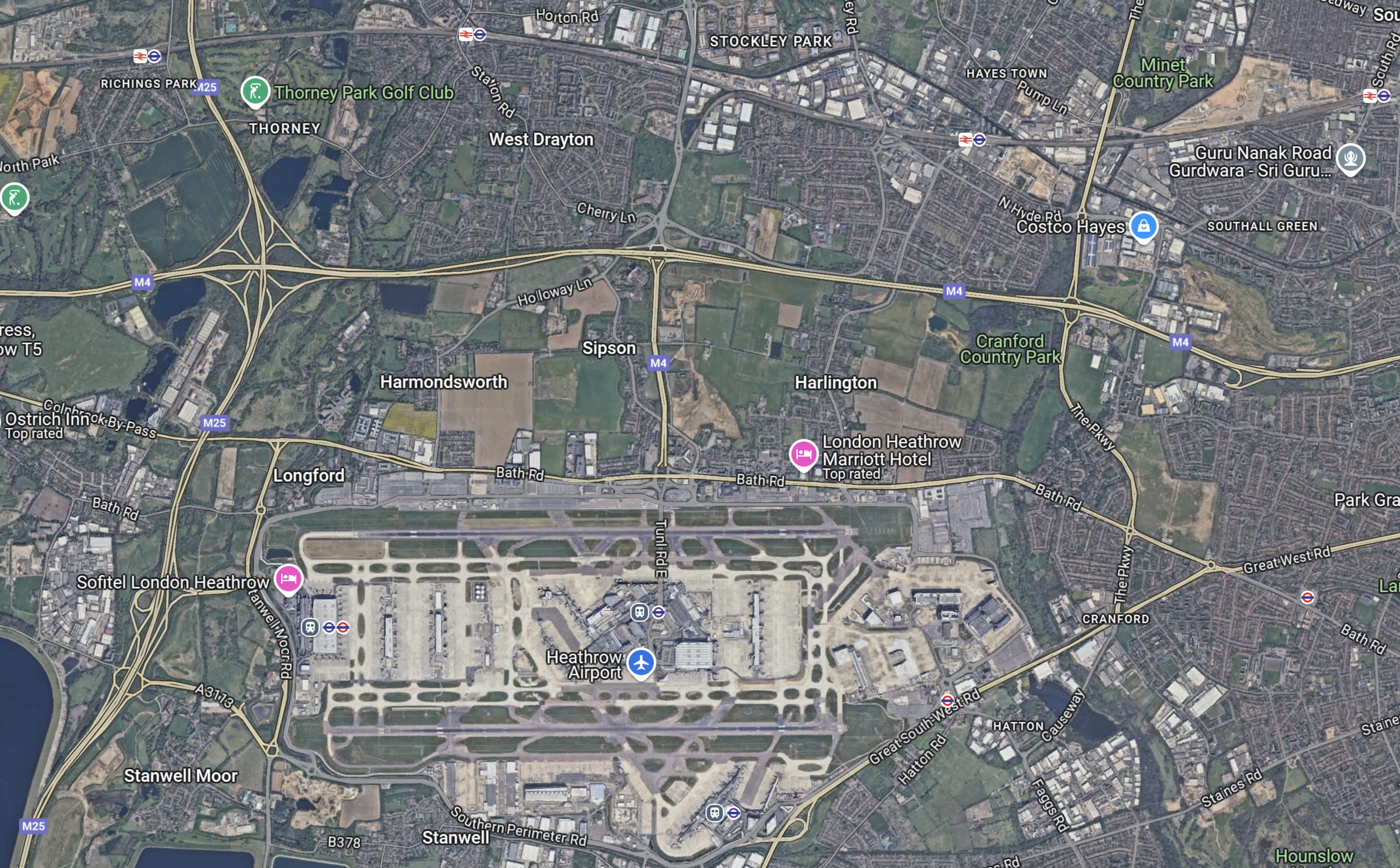
Note.
- The M4 going across the map.
- The two main runways.
- A new third runway would go between the M4 and the Northern runway.
It is likely if the third runway goes ahead, the village of Harmondsworth will be flattened.
It is likely that supplying hydrogen to Heathrow will mean a hydrogen terminal somewhere South of the M4, which could be supplied by rail tankers.
Hydrogen For Gatwick
This Google Map shows Gatwick Airport.
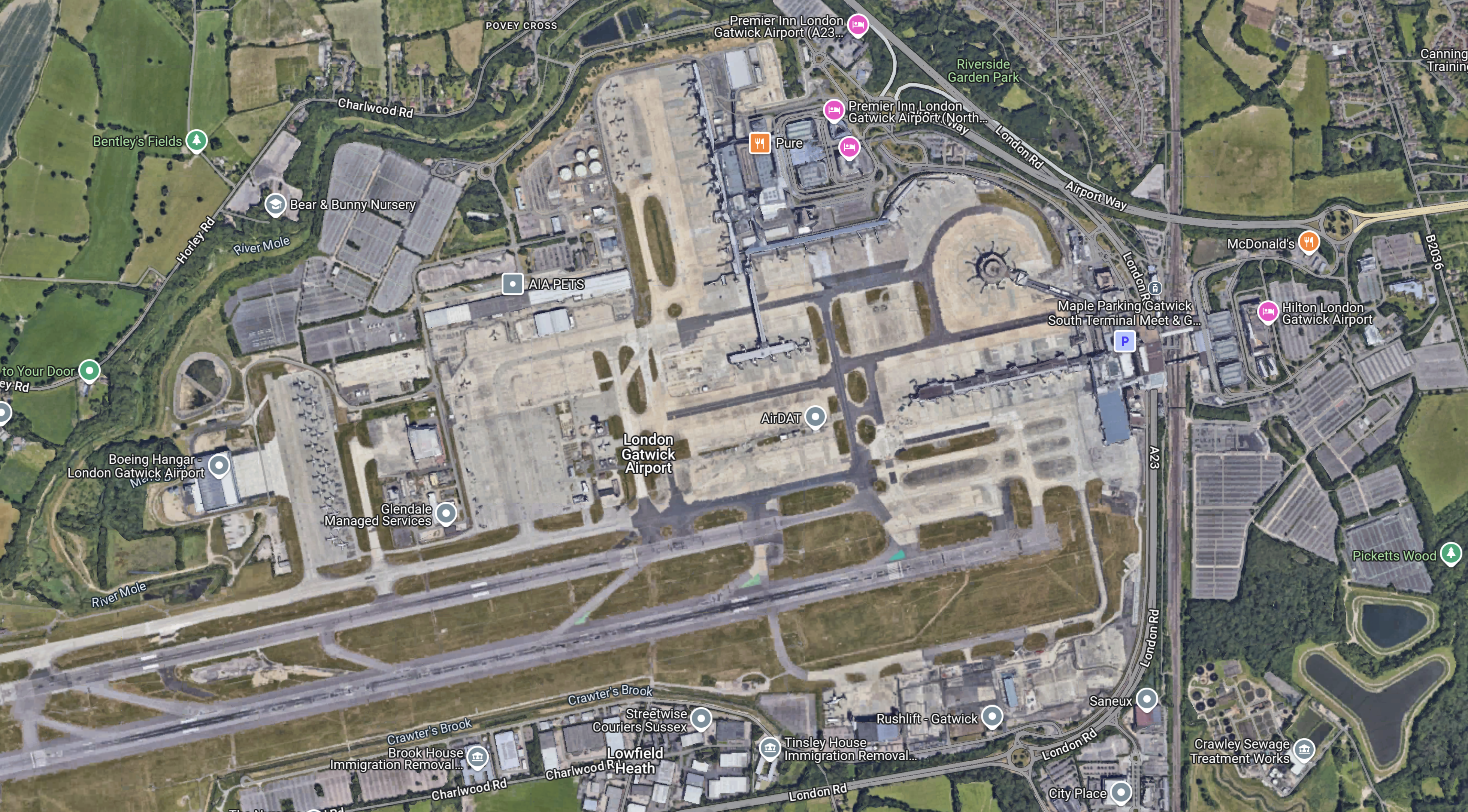
Note.
- The current main runway with the emergency runway to its North.
- Because the runways are too close together they cannot be used simultaneously.
- To create a second runway, the two runways would be moved further apart and the current emergency runway would be enlarged.
- The Brighton Main Line runs North-South past the Eastern end of the main runway.
Gatwick’s expansion plan doesn’t appear to require any properties outside the airport boundaries to be demolished.
This Google Map shows Sussex between Gatwick Airport and Brighton.
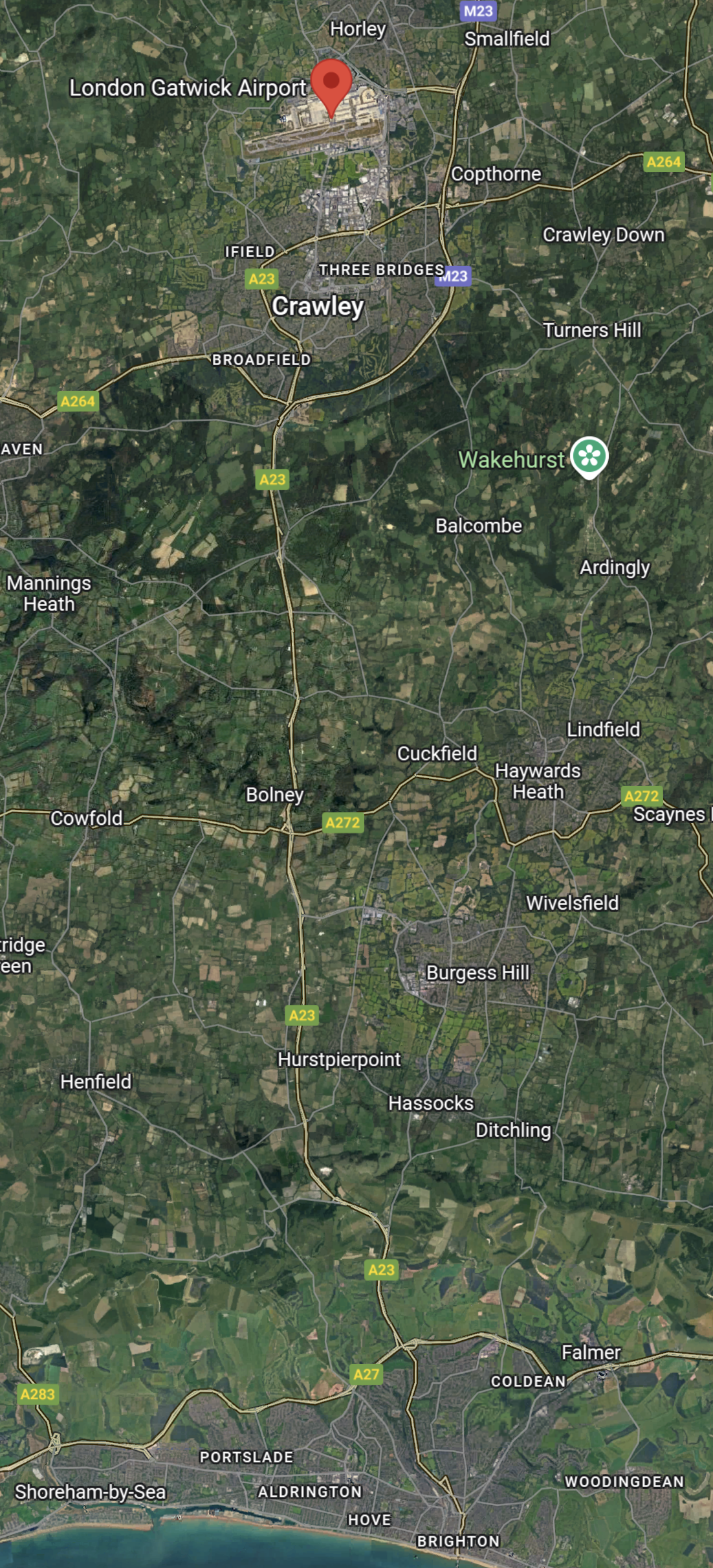
Note.
- Gatwick Airport is indicated by the red arrow at the top of the map.
- Gatwick’s runways can be picked out under the red arrow.
- The South Coast is at the bottom of the map.
- The M23 and the Brighton Main Line connect Gatwick Airport and Brighton.
- Shoreham and Brighton are on the South Coast.
- Click the map to show on a larger scale.
Under current plans, the Ramplion offshore wind farm off the South Coast is going to be increased in size to 1.6 GW.
The simplest plan to provide large amounts of green hydrogen to Gatwick would be to build a large electrolyser in the Port of Shoreham and pipe it along the railway to Gatwick Airport. Hydrogen could also be shipped at night into the Airport using rail tankers.
There’s no doubt in my mind, that it will be much easier to supply large quantities of hydrogen to Gatwick, rather than Heathrow.
In 2023, I wrote Discover How Greater Brighton Is Championing The Transition To Hydrogen, which probably indicates that the locals and their politicians, would welcome the investment in hydrogen in their city.
It should also be noted that world class consultants Ricardo, who are very much involved in the development and promotion of hydrogen technology are based in Shoreham.
Liquid hydrogen could also be imported and distributed from the Port of Shoreham.
Brighton could end up as the South of England’s Hydrogen City.
Never Mind Heathrow: Gatwick Airport Is Close To Getting A New Runway
The title of this post, is the same as that of this article on The Times.
A friend passed through at Gatwick Airport yesterday, so I went to wish him well. For a change , I took a Metrobus from Sutton station to the South terminal – This route is free and doesn’t need a ticket with a Freedom Pass!
The bus was no ordinary bus, but a brand new Wrightbus hydrogen double decker from Ballymena.
It took a round-about route, as its main function is to bring local workers and passengers into the airport and handle traffic to Redhilll, Reigate and East Surrey Hospital.
But if this is the shape of buses to come, then I’m for it. Quality was more coach than bus and performance was sparkling with little or no noise and vibration.
Gatwick and Metrobus are building a network of local hydrogen buses to bring workers and passengers into the airport and I suspect, if the Airport has the fuel, they’ll use it for other purposes, like air-side vehicles, aircraft tow-trucks and car park buses.
Gatwick unlike Heathrow has a close-by source of electricity to produce hydrogen in the soon-to-be-extended 1.6 GW Ramplion offshore wind farm, just off Brighton.
Airbus are talking about bringing hydrogen aircraft into service by 2035 and I believe that by this date we’ll be regularly seeing hydrogen-turboprops on short routes.
As someone, whose software planned the Channel Tunnel, I think it reasonable by 2035, the following projects will be completed.
- Zeroavia are talking of converting aircraft to hydrogen in the next few years.
- A number of short-haul hydrogen aircraft are in service.
- Gatwick’s new runway and terminals are built.
- Ramplion is pumping hydrogen to the airport.
- The station has been updated.
- The Thameslink frequency of trains will have been increased.
Gatwick could be the first major airport to use large amounts of hydrogen, to cut emissions.
Sutton Station To Gatwick Airport By Hydrogen-Powered Bus
In Central London and Gatwick Airport For Free On A Freedom Pass, I indicated it was possible to go to Gatwick Airport for nothing, if you had a Freedom Pass, which is also a free bus pass for England.
This morning I took public transport to Gatwick Airport by this route.
- I took a 43 bus to London Bridge station.
- This bus terminates in the bus station in front of the train station, so it was a simple step-free entry into the part of the station, where Southern Trains terminate.
- I took a Southern Train to Sutton station.
- I then took a Metrobus 420 bus from Sutton station to Gatwick Airport.
These pictures show the journey.


















































Note.
- The bus stop is directly outside the entrance to Sutton station.
- Sutton station is step-free.
- The information on the Metrobus’s buses at Sutton station is poor.
- The bus had a 74 number plate, so was registered after September 1st, 2024.
- The bus said it was a hydrogen bus.
- The seats were comfortable with leather facings.
- The route was mainly through rural Surrey.
- There were sections of dual-carriageway road with continuous 40 mph running.
- There were a number of steep hills.
- Previously, I have been told by a Bradford Councillor, that the City of Bradford is going for hydrogen-powered buses , as the city has lots of steep hills.
- The unusual Reigate and Redhill War Memorial on the A25.
- The route goes past Hadworth, Reigate and Redhill stations.
- Just before Gatwick Airport, the bus called at East Surrey Hospital.
I have some thoughts.
Does This Hydrogen Bus Have Almost The Quality Passengers Would Expect From A Coach?
Consider.
- I was very impressed with the quality of the bus and its fittings.
- But its biggest assets were the ride and mouse-quiet noise and being vibration-free.
- It was certainly up there, with the best British buses on UK roads.
- Strangely, I never rode in any of London’s Green Line coaches of the 1950s and 1960s.
But as Wrightbus are selling hydrogen-powered single-decker buses to the Germans, the quality must be of a certain standard.
The Performance Of The Bus
I would sum up the bus as follows.
- The bus didn’t hang around and it was well-driven.
- On much of the dual-carriageway, the bus appeared to be at the maximum speed limit of 40 mph
- Ride and seats were comfortable.
- There was virtually no vibration.
- At times, you almost felt you were in a top-of-the-range coach.
- The running gear is from German company ZF, which certainly doesn’t hinder the ride.
- The journey from Sutton to Gatwick Airport is twenty miles and took about ninety minutes.
I would feel that if Wrightbus design their CoachH2 chassis to the same standard of this bus, they’ll have a difficulty to meet sales demand.
Wrightbus Hydrogen Buses For My Local Bus Route 141
Consider.
- The 141 bus route is my local bus, which gets me to Moorgate, Bank, London Bridge and Manor House.
- The length of the full route is twenty miles and it takes about an hour to go from London Bridge station to Palmers Green.
- The route is currently run by older Wrightbus hybrid diesel-electric buses.
- I suspect that modern hydrogen buses could last almost all day on one fill of hydrogen, with perhaps a top-up at lunchtime.
They would have no difficulty handling the route and would greatly increase the customers current rock-bottom satisfaction.
Hydrogen Buses In Leafy Suburbs
- Where I live, is not particularly leafy or a suburb.
- But I seems to remember, when I moved here, that some of my neighbours complained about the noise of the 76 bus route.
- So Transport for London put on some quieter buses.
I would expect, that Metrobus might use the mouse quieter hydrogen buses in post areas, to avoid annoyance.
Hydrogen Buses As Route Extenders
Effectively, the Metrobus route 420 is acting as a route extender for Southern and Thameslink services coming South from London.
As it is a quality bus, that gets a move on, I suspect that some travellers, who previously took a train to Sutton, Tadworth, Reigate, Redhill or other stations and were then picked up, may take a hydrogen bus to a more convenient bus stop.
Because of the long range of a hydrogen bus or coach, zero-carbon performance, should be achieved without any range anxiety for passengers, driver or bus company.
Onward From Oakhampton Parkway Station
Consider.
- In 2014, storms destroyed the railway at Dawlish in Devon.
- As there was no alternative route, the storms cut everything west of Dawlish off from the rest of the UK.
- It is now likely, that a Park-and-Ride station will be built close to Okehanpton, which commuters would use for travel to Exeter.
- The main road to the South-West ; the A 30 will pass nearby.
It would appear, that Okehampton Interchange station could be used, if Nepture decided to show his power again.
Hopefully, the emergency plan will scare Nepture away.
Lumo To The Scottish Borders
Consider.
- Lumo have applied to extend some of their Edinburgh services to Glasgow.
- Talking to a friend in the Scottish Borders, they said, that travelers drive to Newcastle or Morpeth to catch Lumo for London.
- Four or five Lumo services every day stop in each direction at Morpeth station.
- So would it be sensible to run a bus or coach through the Scottish Borders to connect with the Lumo services?
This Google Map shows Morpeth in relation to the Border towns.
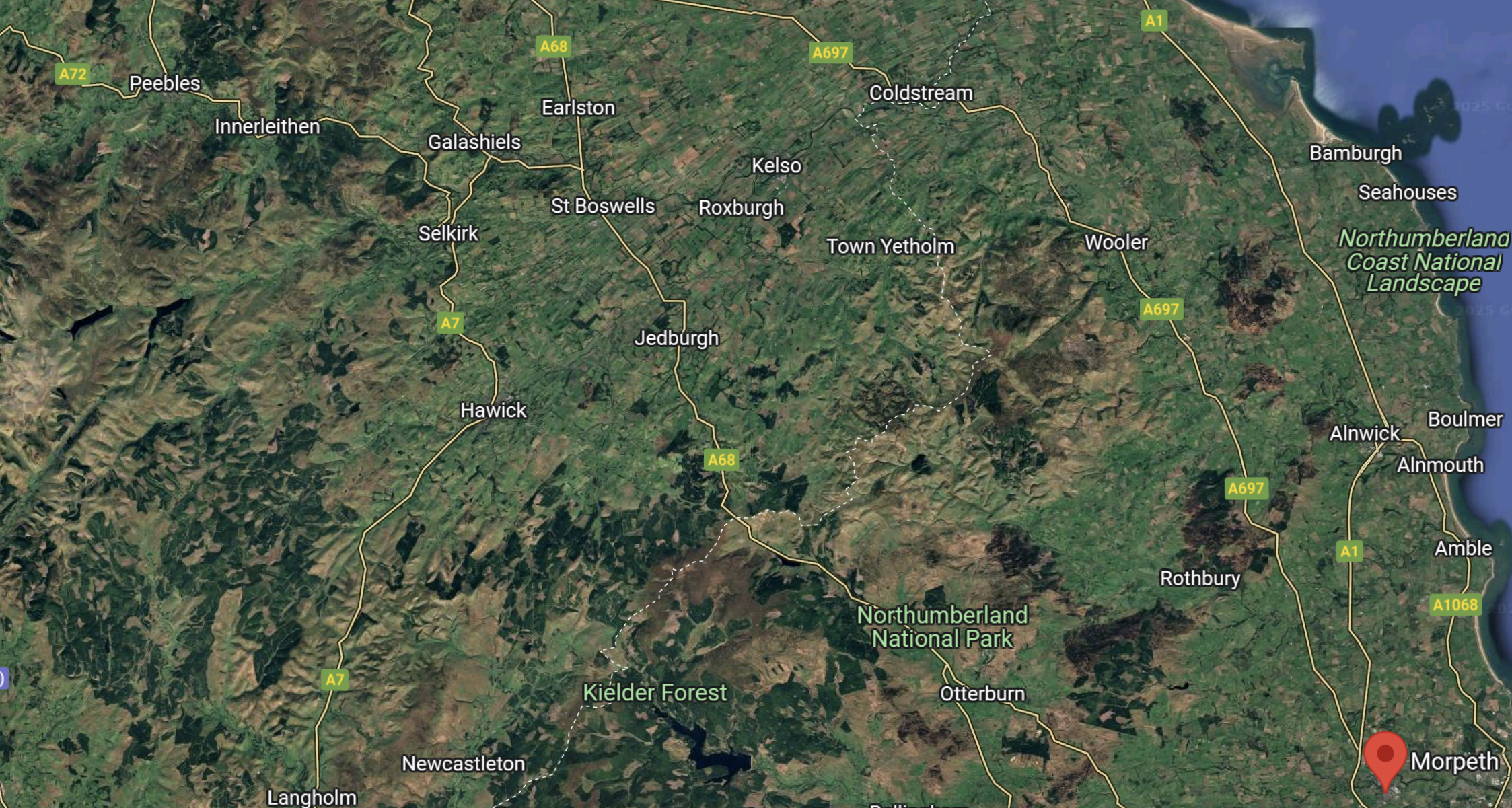
Note.
- Morpeth is marked by the red arrow in the South-East corner of the map.
- Galashiels, Galashiels, Hawick, Jedburgh, Peebles, Saint Boswells and Selkirk can be picked out on the map.
- The coach service would probably terminate at Galashiels, as it has a large bus terminal and and a railway station.
- Click the map to show it to a larger scale.
Morpeth to Galashiels is 69 miles and it should take about an hour and a half.
Hydrogen Buses As Rail Replacement Buses
Consider.
- I have had Rail Replacement Coaches as opposed to buses a few times in the UK.
- Once on the East Coast Main Line but usually on the Great Eastern Main Line to Ipswich or Norwich.
- They are generally more suited to their task. as they are faster and more luxurious.
- Many of our major rail lines run alongside trunk roads or motorways or fast dual carriageways.
So because hydrogen buses and coaches a have superior performance, than their diesel cousins, will hydrogen be the better fuel for a Rail Replacement Bus.
Metrobus’s Hydrogen Buses
This press release on the Metrobus web site is entitled Hydrogen Buses.
This is the sub-heading.
Our commitment to Zero Emissions
As part of our commitment to reducing emissions, twenty new hydrogen fuelled buses will operate on Fastway routes 10 & 20. These new buses demonstrate an ongoing commitment to reducing our local emissions. They deliver against science-based targets set by Metrobus and its parent company, The Go-Ahead Group, of becoming a net zero business by 2045 and decarbonising our bus fleet by 2035.
Conclusion
This bus is the best I’ve ridden in.
Central London and Gatwick Airport For Free On A Freedom Pass
I have always found it odd, that I can get to Heathrow Airport for free on my Freedom Pass, but for Gatwick Airport, I must buy a ticket.
Not that I’m bothered about the price of the ticket, but for some it might mean that they can’t get to their preferred holiday destination, as planes only fly from Heathrow.
The different treatment of the two airports must also annoy some airport and airline owners and bosses.
But recently, a free route for London’s Freedom Pass holders has opened.
This article on Inside Croydon is entitled Metrobus Rolls Out Zero-Emission Hydrogen Fleet Into Sutton.
These are the first two paragraphs.
Metrobus has been rolling out a fleet of hydrogen-powered buses, and last week its first double deckers, operating the 420 route from Sutton town centre to Gatwick Airport and Crawley, were brought into service.
Metrobus is planning on having more than 40 hydrogen-powered buses, in a partnership with West Sussex, Surrey and Kent county councils and Gatwick, in a £24million investment by the partners including a £10 million grant from the Department for Transport.
Note.
- The range of a Wrightbus Hydroliner is 280 miles on a full tank of hydrogen.
- It looks like as Crawley to Sutton station is a 42.2 miles round trip, so that means six round trips are possible on a tank of hydrogen.
- The Hydroliners may have the speed to use the M23 between Sutton and Crawley.
According to the article, refueling would be at Crawley.
A Zero-Carbon Extension To The Freedom Pass Zone
The free route for Freedom Pass holders to Gatwick Airport will be.
- Southern or Thameslink Train to Sutton.
- 420 bus to Gatwick Airport.
The article says this about the routes that are being planned.
The 420 route runs from Sutton town centre, through Belmont and Banstead, to Tadworth and then on to Reigate and Redhill, serving East Surrey Hospital before going on to the airport and Crawley. Metrobus is planning to use other hydrogen-powered buses on routes that will serve Caterham, Dorking, Tunbridge Wells, Haywards Heath and Brighton.
It appears that the hydrogen buses will add a large zero-carbon area to the Freedom Pass zone.
The only new infrastructure, would be the refueling equipment at Crawley.
I can also see the buses becoming an unusual tourist attraction for the area.
An Extension To An Electric Railway Or Tramway
They may also set a precedent for how a transport network can be extended in a zero-carbon manner from a tram or rail terminal served by an electric railway or tramway.
Battery electric buses could be used, but their range means that on anything but the shortest routes, they would constantly need recharging.
Okehampton Interchange Station
The first paragraph of the Wikipedia entry for Okehampton Interchange station describes it like this.
Okehampton Interchange (formerly known as Okehampton Parkway) is a proposed railway station in Okehampton on the Dartmoor Line. The station would be part of the Devon Metro and has been described as a priority station. The station is to be sited off Exeter Road, by the Business Park and close to the junction with the A30, in the Stockley Hamlet area of Okehampton. It would also serve 900 new homes to be built nearby.
But I believe that Okehampton Interchange station also has another purpose.
If the sea should destroy the coastal railway, as it did a few years ago, then passengers for the South-West could be ferried to and from Okehampton Interchange station by high-speed hydrogen-powered coaches along the A30, to catch trains to Exeter and London.
So, I would build a hydrogen filling station at Okehampton Interchange station, so that if the sea destroys the coastal railway again, the alternative is ready.
Normally, the hydrogen filling station would refuel local hydrogen buses, trucks, cars and other vehicles and those passing on the A30 to and from Cornwall.
Okehampton Interchange station would be the ultimate extension to an electric railway. Even if the Dartmoor Railway was worked by electro-diesel trains.
Gatwick Airport – 23rd November 2023
I went to Gatwick Airport to see the new railway station.









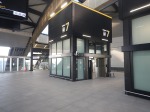








Note.
- As at Reading and Leeds stations, space has been created by building a wide concourse over the tracks.
- The experience certainly seemed better.
- Most platforms have up and down escalators and lifts.
- There were still a few things that needed to be finished.
But for me, as a man with a Freedom Pass and a Senior Railcard, the ticketing to Gatwick is still a pain.
- If I go to Heathrow or London City, I use my Freedom Pass to get to the Airport.
- If I go to Eurostar, I use my Freedom Pass to get to St. Pancras station.
- If I go to Stansted, I use my Freedom Pass to get to Liverpool Street station and buy a ticket for Stanstead Express.
If I go to Gatwick, Luton or Southend airports, I use my Freedom Pass to get to a station with a Booking Office and then buy an extension ticket from the Zone 6 boundary to the airport.
I believe there are three solutions.
Make It Possible To Link A Bank Card To A Freedom Pass
It should be possible to do something like the following.
- Touch in at Moorgate.
- Take the Elizabeth Line to Farringdon.
- Take Thames to Gatwick Airport.
- Check out at Gatwick Airport.
The credit card associated with the Freedom Pass would then be charged the fee for between the Zone 6 boundary and Gatwick Airport.
The credit card would be entered through the Freedom Pass web site.
On a related matter I believe that the Freedom Pass web site could be a nice little earner for Transport for London, by doing the following.
- Selling rail tickets on a best-priced basis. Savings are to be had by selling tickets for Freedom Pass holders from the Zone 6 boundary.
- Managing Railcards.
- Selling Transport for London merchandise.
Nobody would pay more than they do now, but Transport for London would pick up some commission from selling tickets.
Develop A Flexible App That Works With A Freedom Pass And Phone Payments
Similar to the first option, but the app charges accordingly.
Put Gatwick Airport In Zone 6
The management of Gatwick Airport might like to attract more travellers, so they would pay from the Zone 6 boundary for Freedom Farm users.
Conclusion
I would find the first two options acceptable, providing the charges were no more than now!
Could A Mega-Station Be Built For The Channel Tunnel?
This article on Railway Gazette International, is entitled Start-Up Announces Amsterdam To London And Paris High Speed Train Ambitions.
It talks about how Dutch start-up; Heuro wants to run fifteen trains per day (tpg) between London and Amsterdam.
The article then has this paragraph, which details other operators, who are wanting to run services between London and the near Continent.
Heuro’s announcement comes after Spanish start-up Evolyn announced plans in October for a Paris – London service, while on November 11 British newspaper The Daily Telegraph reported that Sir Richard Branson and Phil Whittingham, former head of Virgin Trains and Avanti West Coast, were also drawing up plans to compete with Eurostar and had held discussions with infrastructure managers.
This leads me to the conclusion, that there will be a need for more capacity for trains and/or passengers at some time in the future.
- There are six International platforms at St. Panvcras International station, which can each probably handle four trains per hour (tph), so I suspect the station could handle 24 International tph.
- As a modern high speed train can carry over 500 passengers, that is 12000 passengers per hour.
- Visit St. Pancras station in the morning and it is often crammed with travellers coming from and going to Europe.
I suspect that the number of trains may not be a problem, but the number of passengers will.
We could always join Shengen, but then that would be an open door to all the would-be migrants to the UK.
This Google Map shows Stratford International station.
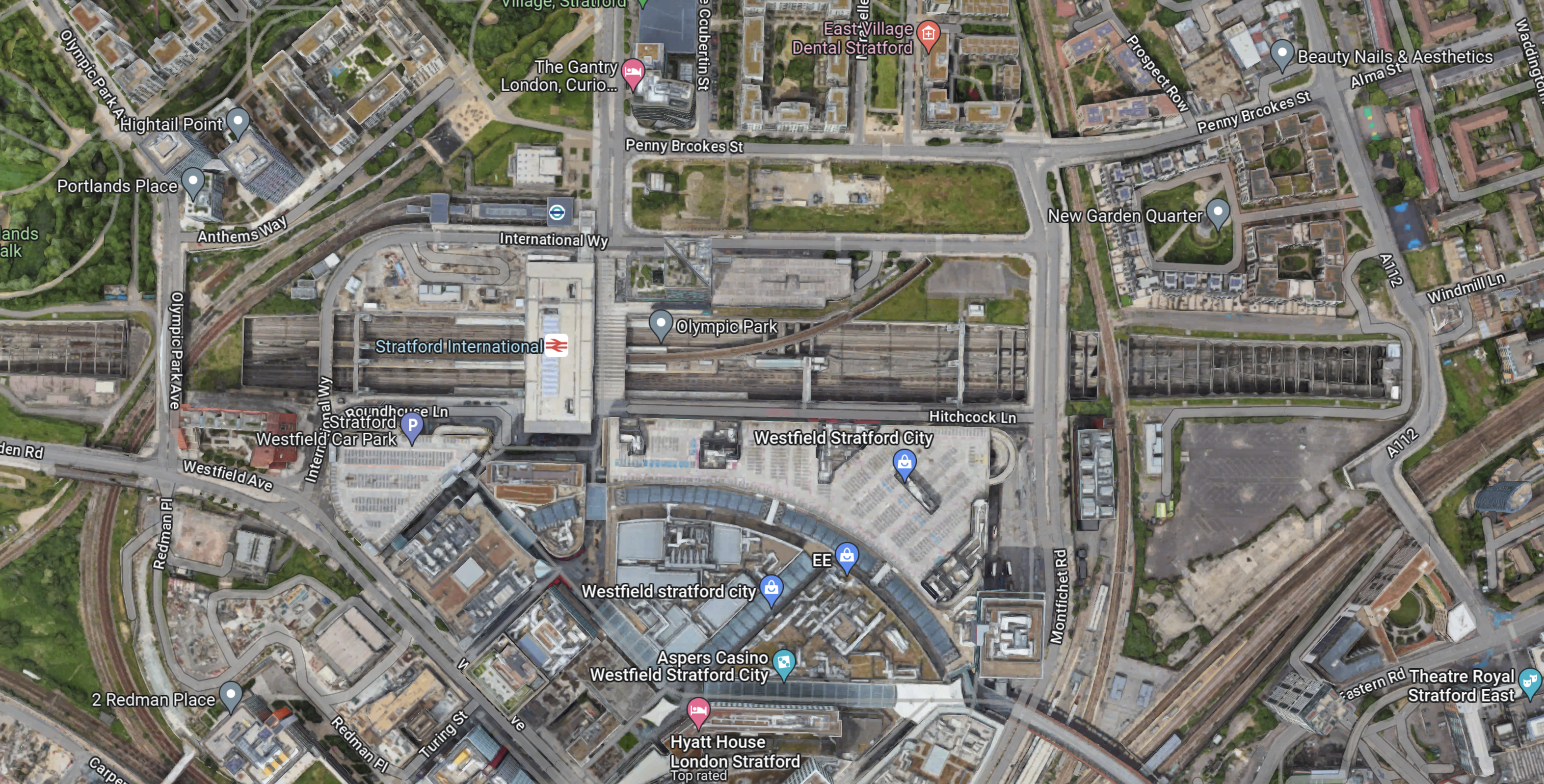
Stratford International station is in a soulless concrete cavern, that lies across the middle of the map.
In Platforms 1 And 4 At Stratford International Station, there are a lot of pictures of the station.
I think it would be extremely difficult to add extra platforms and passenger facilities to the station.
This Google Map shows Ebbsfleet International station.
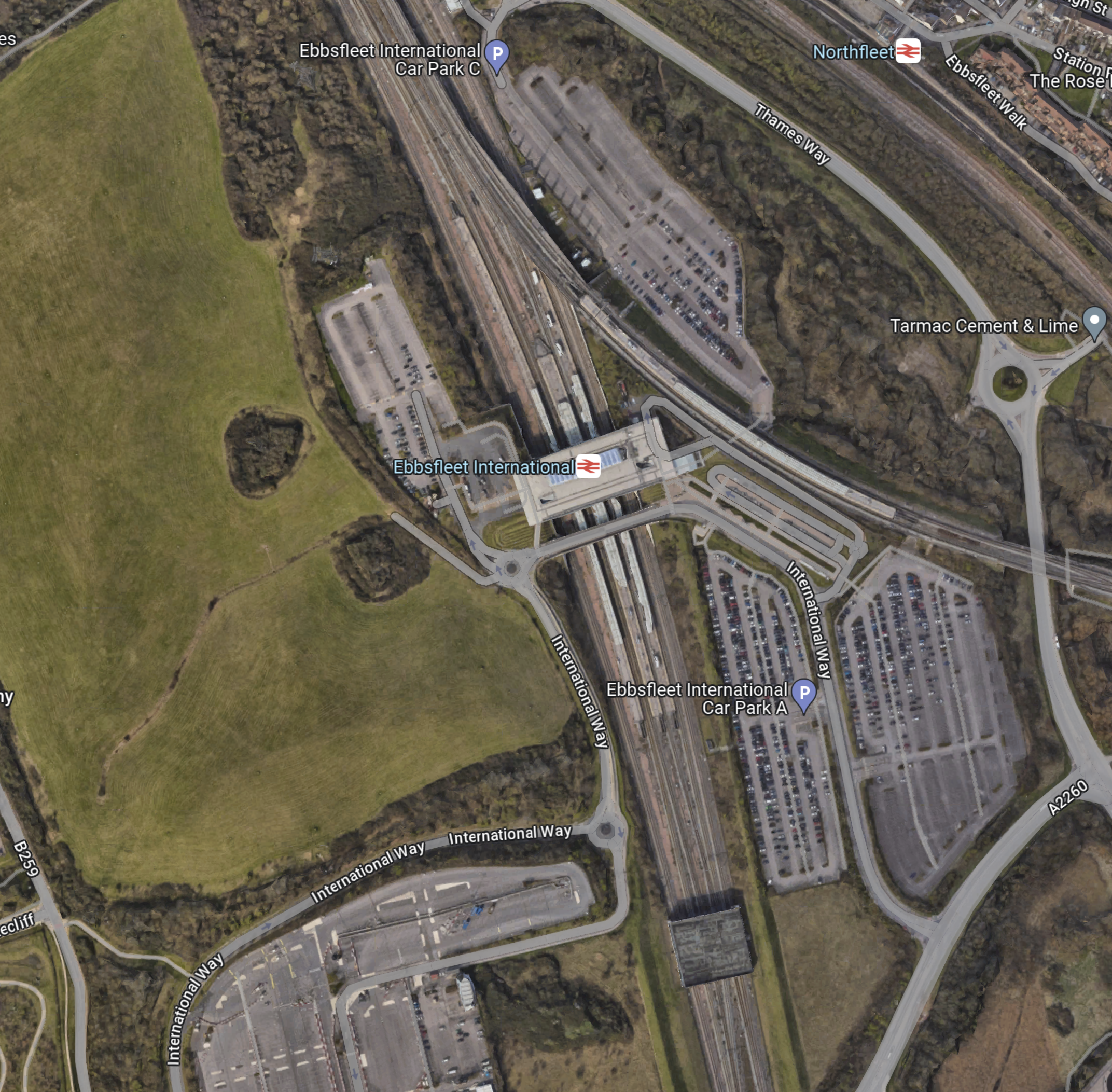
Note.
- Ebbsfleet International station, with its two International and four domestic platforms is in the middle of the map.
- The station is surrounded by car parks with a total of 5,000 spaces.
- Northfleet station is in the North-East corner of the map.
There is a lot of land, without any buildings on it.
These are my thoughts.
Enough Extra Bay Platforms To Handle The Additional Trains
There would appear to be space for perhaps two bay platforms to terminate trains.
But would passengers we happy being dumped outside Central London?
Would An Elizabeth Line Extension To Ebbsfleet Be Needed?
There are various plans to link the Elizabeth Line tp Ebbsfleet International.
In Elizabeth Line To Ebbsfleet Extension Could Cost £3.2 Billion, I showed this map from the Abbeywood2Ebbsfleet consultation.
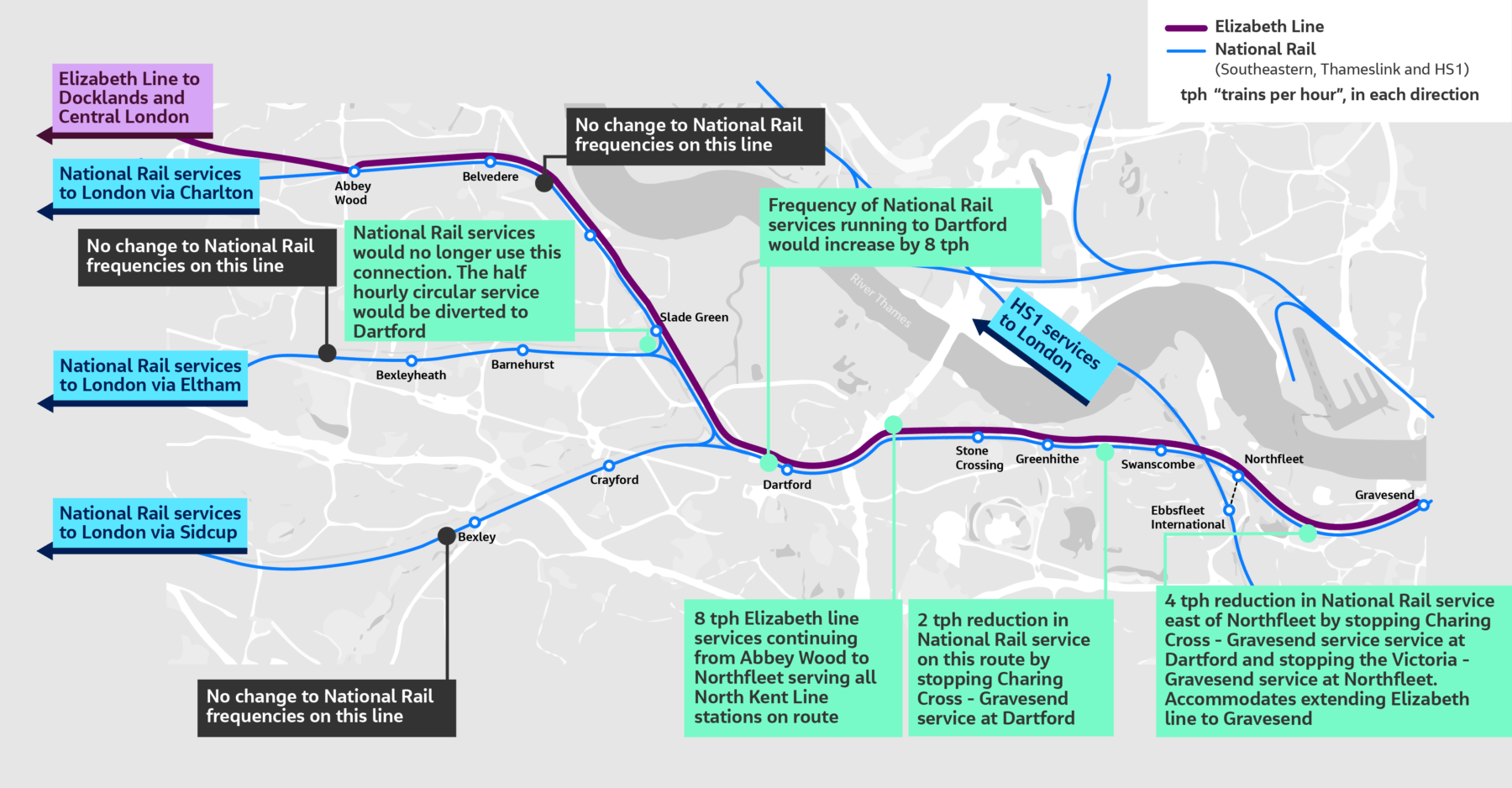
There doesn’t appear to be too much new infrastructure, except for a proper connection between Northfleet and Ebbsfleet stations. References on the Internet, say that the similar-sized Luton DART connection at Luton Airport, cost around £225 million.
The Elizabeth Line connects to the following.
- Bond Street
- Canary Wharf
- City of London
- Farringdon for Thameslink
- Heathrow Airport
- Old Oak Common for High Speed Two
- Liverpool Street station
- Oxford Street
- Paddington station
- Slough for Windsor
- Tottenham Court Road for the British Museum, Oxford Street, Soho, Theatreland and the Underground.
- West End of London
- Whitechapel for the Overground and Underground
For many people like me, the Elizabeth Line at Ebbsfleet will provide one of the quickest ways to get to and from European trains.
Ebbsfleet Has Space For A Bus Station
A bus station with comprehensive routes could be built at Ebbsfleet station, which I don’t think will be possible at St. Pancras.
It would also be possible to provide an easy route to Gatwick Airport along the M25.
Hotel Accommodation
This is surely necessary.
It would make an ideal base for tourists and business people, who wanted to visit several of the large cities connected to Ebbsfleet.
A Very Large Car Park
Consider.
- Heathrow Airport is looking at providing upwards of 50,000 car parking spaces.
- Some travellers are seriously allergic to public transport and will always use their car.
- Many travellers these days want to take a severely outside case with them, when they’re only having a weekend in Paris.
I feel that a mega-station for Europe will need upwards of 10,000 car parking spaces. All of them with vehicle-to-grid chargers.
A Very Large Storage Battery
According to this page on the E-on web site, the average size of the battery in an electric vehicle is 40 kWh.
If 5,000 car parking spaces were to be fitted with vehicle-to-grid charging (V2G), that would be 2 MWh of energy storage, that could be used by National Grid, to store surplus electricity.
Get V2G right and it could make a serious contribution to your parking costs.
Pictures Of Ebbsfleet Station
These are some pictures I took at Ebbsfleet station today.




















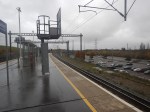



Note.
- The station is a fairly boring concrete, glass and steel construction.
- The SouthEastern HighSpeed services also go to St. Pancras, so they don’t offer any different connectivity towards the capital.
In addition, the SouthEastern HighSpeed Class 395 trains aren’t step-free at the platforms, as these pictures shows.




As I came back into St. Pancras International station, staff were struggling to load a wheelchair onto a train using a ramp.
Would A Two-Station Solution Increase Capacity?
High Speed Rail lines have high capacity trains and there are examples of more than one station at the end of a route.
- The London end of High Speed Two will have stations at Old Oak Common and Euston.
- The Manchester end of High Speed Two will have stations at Manchester Airport and Manchester Piccadilly.
- The Edinburgh end of the East Coast Main Line has stations at Waverley and Haymarket.
- The Amsterdam end of Eurostar and Thalys has stations at Rotterdam, Schipol Airport and Amsterdam.
A selection of stations gives choice and convenience for travellers.
Conclusion
I believe that selective development of Ebbsfleet International station could be used to take the pressure away from St. Pancras International station.
These developments could include.
- A comprehensive bus station
- Elizabeth Line to Northfleet
- Hotel Accommodation
- Lots Of Car Parking
Sussex Will Be Leader In Hydrogen Energy Production
The title of this post, is the same as that of this article on The Argus.
These are the first three paragraphs.
The county is today launching its bid to become a pioneer for use and production of hydrogen energy.
Experts will unveil Brighton’s hydrogen strategy this morning showing how the city and surrounding areas are championing a clean energy infrastructure.
With plans for a Worthing crematorium to become the first in the world powered entirely by hydrogen, development of a green energy production facility in Shoreham, and a growing fleet of hydrogen-powered buses in Crawley, the region is already breaking ground in the hydrogen industry – and shows no sign of stopping.
These are my thoughts.
The Plan Is Comprehensive
This document of the Council website, is entitled the Greater Brighton Hydrogen Strategy.
It is very comprehensive and discusses hydrogen in Sussex from all angles.
Every Council in the UK needs to have their own comprehensive strategy like this.
The Report Cautions That Greater Brighton May Need More Renewable Energy
Consider.
- The Rampion wind farm, with a capacity of 400 MW is already operating in the sea South of Brighton.
- This should be joined by the 1200 GW rampion 2 wind farm in the next few years.
It is unlikely substantial onshore wind and solar farms will be built in the area.
Gatwick Airport Is Expected To Need A Hydrogen Supply
The strategy says this about Gatwick and the two Rampion wind farms.
The offshore wind farm Rampion is large enough to be considered nationally significant infrastructure. There
is a second development for this wind farm planned for 2025-6, which will connect into Bolney substation as
per the existing wind farm.The GBEB energy plan suggested that an electrolyser could be sited there, although there are no identified demand locations nearby other than potential refuelling of passing traffic on the A23.
However, considering the relative distance to Gatwick airport, which is expected to be a significant future
demand, there may be an opportunity for a direct pipeline. This would be further into the future and requires
further analysis and bilateral engagement between Rampion and Gatwick. Engagement with Rampion found
that, given the large population supplied by the Rampion wind farms, and the relative lack of other large-scale
renewables locally, these wind farms are unlikely to face significant curtailment and will fully contribute to
decarbonising the local electricity grid. Therefore, using Rampion to produce hydrogen by electrolysis is not
seen as the best use case in the near term.
It looks to me, that because of the electricity demand in the Brighton and Gatwick area, that a big decision needs to be made to create some more renewable capacity.
Could this mean a Rampion 3 or perhaps a fleet of small modular nuclear reactors at Dungeness?
An Electrolyser At Bolney Substation
This Google map shows the position of Bolney substation.
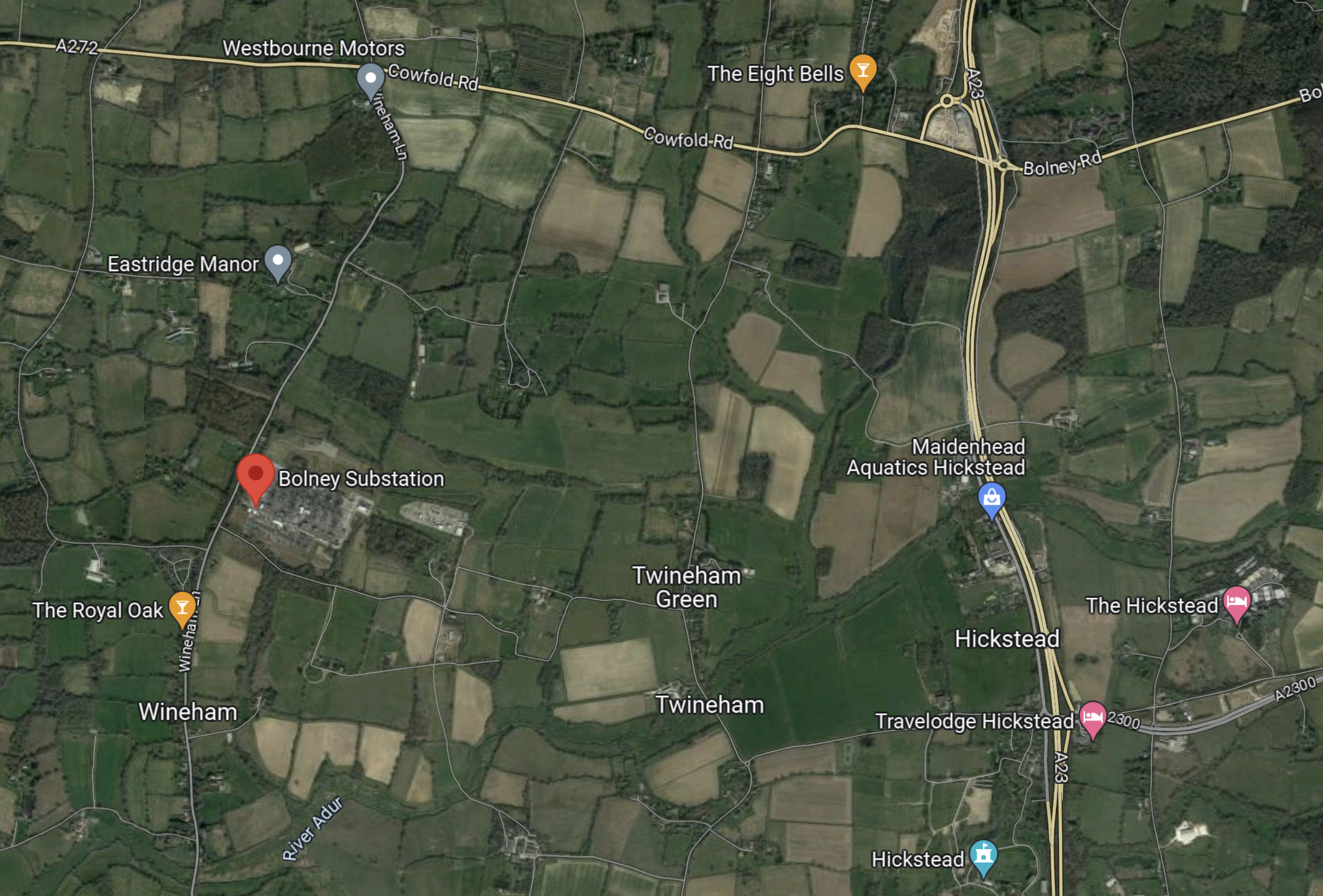
Note.
- The A23 is the main London-Brighton road.
- Bolney substation is indicated by the red arrow.
- The substation doesn’t have very good road access.
- I also suspect that the locals wouldn’t like an electrolyser in their midst.
On a brief look, I suspect that an electrolyser at Bolney substation will be a non-starter.
Shoreham Port As A Hydrogen Hub
The strategy mentions Shoreham Port several times, but gives the impression that progress is slow.
This Google Map shows Shoreham Port.
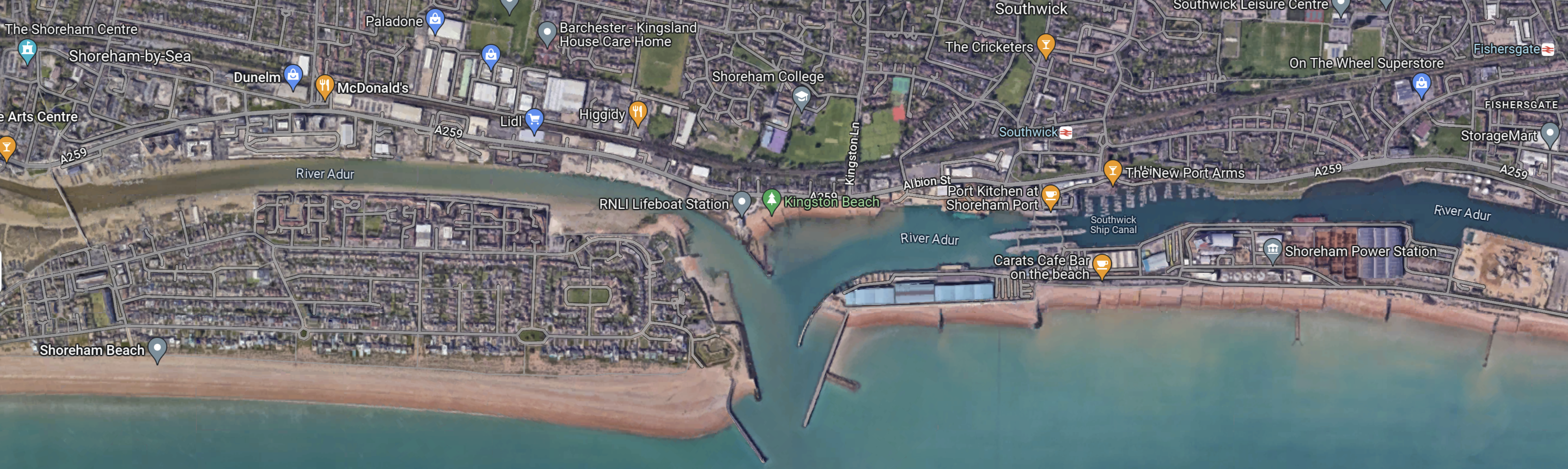
Note.
- Shoreham is in the West.
- The port reaches a long way to the East.
- The 420 MW gas-fired Shoreham Power station, is at the Eastern end of the port, close to the sea.
There appears to be spaces along the water for developing hydrogen infrastructure.
This page on the H2Green web site is entitled Agreement to Develop Clean Energy Hub for Shoreham Port, Sussex, starts with this paragraph.
Getech, the geoscience and geospatial technology provider and data-led energy asset developer, is pleased to announce that its wholly owned hydrogen subsidiary, H2 Green, has signed a Collaboration Agreement (the “Agreement”) with Shoreham Port.
It lists these three highlights.
- H2 Green granted a two-year legally binding exclusive right to develop a renewable energy hub (the “Hub”) at the Port of Shoreham, West Sussex.
- Under plans submitted by H2 Green to Shoreham Port, the Hub will initially focus on the provision of green hydrogen and renewable electricity to the Port’s fleet of 39 heavy forklift trucks and 12 heavy goods vehicles.
- Green Hydrogen will be sourced by a scalable green hydrogen production, storage and refuelling facility – the economics of which will be optimised by its integration with new solar and wind electricity generation capacity.
- The Hub will then be expanded to facilitate the decarbonisation of more than 800 heavy goods vehicles that enter Shoreham Port daily, and to provide fuel to port and coastal marine vessels.
That is all good stuff, but I do wonder, where the renewable electricity is going to come from.
In Further Thoughts On BP’s Successful INTOG Bid, I looked at BP’s plan for a 50 MW wind farm.
- It will be about twenty miles offshore from Aberdeen.
- With an appropriate electrolyser 50 MW of electricity would produce twenty tonnes of hydrogen per day.
- The electrolyser could be onshore or even offshore.
- The technology has all been developed.
Could H2Green be thinking of developing a similar hydrogen production facility?
 The Anonymous Widower