FirstGroup Adds Leeds-based J&B Travel To Growing Coach Portfolio
The title of this post, is the same as that of this article on Route One.
These two paragraphs add more detail.
J&B Travel of Leeds is the latest coach business to be acquired by FirstGroup.
The operator, which has been established for more than 40 years, has a fleet of 15 vehicles, with work including home-to-school, private hire and FlixBus contracts.
But in some ways, the most significant thing not mentioned is that FirstGroup have now acquired seven coach firms.
- AndersonTravel in London
- EnsignBus in London
- J & B Travel in Leeds
- Matthews Coaches in County Monaghan, Ireland
- Tetley’s Coaches in Leeds
- York Pullman in Harrogate, Hull, Leeds and York
Note.
- MatthewsCoaches are about halfway between Dublin and Belfast.
- Three of the English acquisitions are in Yorkshire and two are in London.
- Leeds isn’t far off being halfway between London and Central Scotland.
This looks like the first part of a master plan.
- Leeds and County Monaghan could be ideal refuelling points for zero-carbon coaches.
- Ferrybridge, just South of Leeds is getting a hydrogen-fired power station.
- Ferrybridge is a big site with a motorway service station on the M1.
- Wrightbus are building an electrolyser at Ballymena, which is 81 miles from Matthews Coaches.
- Wrightbus have said that Dublin and Cork would be an ideal route for a hydrogen coach.
- Wrightbus have said that Heathrow and Gatwick would be an ideal route for a hydrogen coach.
This plan could be built-on with routes to various cities and attractions.
I have some further sorts and questions.
Could The First Obvious Routes Be Run By Hydrogen Coaches?
From what Wrightbus have indicated, I would rate the obvious routes as.
- Dublin and Belfast – 103 miles or 206 miles round trip
- Dublin and Cork – 107 miles or 340 miles round trip
- Leeds and Glasgow – 224 miles or 448 miles round trip
- Leeds and Edinburgh – 222 miles or 444 miles round trip
- Leeds and London – 197 miles or 396 miles round trip
- Heathrow and Gatwick – 40 miles or 80 miles round trip
Note.
The longest route is 714.5 km.
It would appear that, if the hydrogen-powered coach had a range of 1,000 km. all routes would be possible.
How Far Would A Hydrogen Coach Get On A Tankful From London?
A thousand kilometres is 621.4 miles.
These are the distances from Scottish cities to London.
- Aberdeen – 537 miles
- Dundee – 472 miles
- Dunfermline – 430 miles
- Edinburgh – 410 miles
- Glasgow – 404 miles
- Inverness – 561 miles
- John O ‘Groats – 678 miles
- Perth – 451 miles
- Stirling – 418 miles
I’ve added John O’Groats for completeness, but all cities would be reached.
How Far Would A Hydrogen Coach Get On A Tankful Going West From London?
These are the distances from Western towns and cities to London.
- Aberystwyth – 236 miles
- Fishguard – 255 miles
- Holyhead – 289 miles
- Lands End – 310 miles
- Penzance – 307 miles
I’ve added Lands End for completeness, but all towns and cities would be reached.
John O’Groats And Lands End In A Hydrogen Coach
I asked Google AI how far the journey was and received this answer.
The distance from Land’s End to John o’ Groats varies by transport: about 837-874 miles (1347-1407 km) by road, roughly 600 miles (970 km) as the crow flies, and around 1,200 miles (1900 km) for an off-road walking route, with cyclists typically taking 10-14 days and walkers 2-3 months.
So it looks, like there will be a need for a refuel, but that would give 2,000 kilometres, which is more than the 1,347-1,407 kilometres needed.
Ferrybridge Could Be An Ideal Refuelling Point
I suspect, even in fifty years you could name the places in the UK, where you will be certain of refuelling any hydrogen vehicle on the fingers of one hand.
The list would include.
- Ferrybridge in Yorkshire, where SSE are building a hydrogen-fired power station.
- Felixstowe Docks in Suffolk, where there will be a need to fuel hydrogen trucks.
- Keadby in Lincolnshire, where SSE are building a hydrogen-fired power station.
- Kintore in Aberdeenshire, where an electrolyser is being built.
- Runcorn in Cheshire, where there was an electrolyser in 1968, when I worked there.
This web site lists all the UK hydrogen projects.
This Google Map shows the location of the Ferrybridge hydrogen-powered power station site in relation to Barnsley, Doncaster, Leeds and other towns and cities of Yorkshire.

Note.
- The red arrow indicates the former coal-fired power station site.
- Leeds is in the North-West corner of the map.
- Barnsley and Stocksbridge are in the South-West corner of the map.
- The city of Sheffield is to the South-West of Stocksbridge.
- Doncaster is in the South-East corner of the map.
Last September I wrote Visiting The Consultation For Ferrybridge Next Generation Power Station At Knottingley.
In that post, I wrote about supplying both the power station and the motorway services with hydrogen and felt that it could use one of two methods.
- A pipeline from the hydrogen storage in East Yorkshire.
- Some form of train from a hydrogen production site.
Recently, Network Rail have been conducting tests on the movement of hydrogen by train, which I wrote about in Network Rail’s Test Track Take Centre Stage As Hydrogen Is Delivered By Rail For The First Time.
The Ferrybridge Site Has most things needed.
This map shows the site.
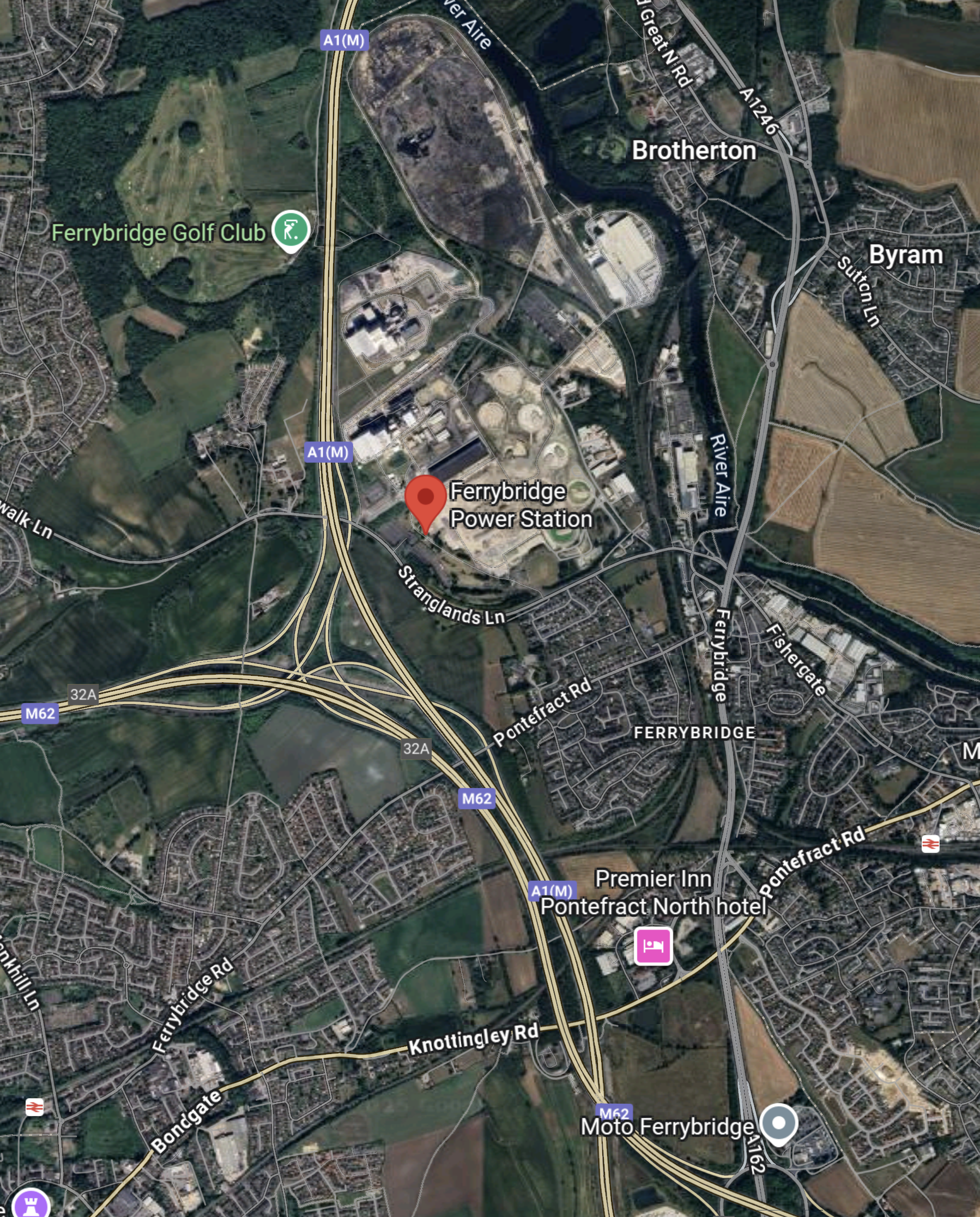
Note.
- The impressive motorway junction, where the North-South M1 crosses the East-West M62.
- Liverpool and Manchester are to the West.
- Leeds, Newcastle and Scotland is to the North.
- Hull is to the East.
- London is to the South.
- There is a Moto Services.
- There is a Premier Inn.
There is even two railway stations on the map.
This reply from Google AI gives the details of the distance between Ferrybridge and the South-West.
The driving distance from Ferrybridge, Yorkshire, to Land’s End is roughly 470 to 500 miles, taking about 8-9 hours, primarily via motorways like the M1, M5, and A30, though exact times and routes vary by real-time traffic and specific starting/ending points.
I am absolutely certain, that if you have a vehicle like a hydrogen coach and you want to go anywhere between A to B on the UK mainland, then if there is hydrogen-refuelling at Ferrybridge, you will be able too do the journey with a refuel at Ferrybridge.
Hull Trains Allows Delay Compensation To Be Donated To Charity
The title of this post is the same as that of this article on Rail Advent.
These four paragraphs fill in the details.
Customers of Hull Trains who claim compensation for train delays can now choose to donate their Delay Repay funds to charity.
Hull Trains’ new official charity partner for 2025 is P.A.U.L For Brain Recovery, which supports people across the Humber region affected by acquired brain injury. P.A.U.L For Brain Recovery is based in Hull, and has recently expanded its support to cover communities in north and northeast Lincolnshire, and has ambitions to support people further afield.
The new scheme will allow customers to opt for the delay compensation to be sent directly to the charity. Hull Trains operates trains between Hull and London King’s Cross, stopping at Grantham in Lincolnshire, and serving other stations on the East Coast route, including Doncaster and Beverley.
The founder and CEO of P.A.U.L For Brain Recovery is Paul Spence. In 2012, Paul suffered a brain haemorrhage when he was the victim of an unprovoked attack. After he was discharged from a high dependency unit, he and his family faced a long and challenging road to recovery, and quickly realised that support available in the community was sadly lacking.
I think it’s rather a good idea.
Start-Up’s Plan To Convert Food Waste Into Green Fuel
The title of this post, is the same as that, of this article in The Times.
This is the sub-heading.
Dark Green wants to build biogas production plants to supply local authorities and businesses
These three paragraphs give some detail to the plans.
A Nottingham-based start-up wants to become the first company to build a fleet of plants that would convert food waste into green energy in urban centres across Britain, producing an alternative fuel for businesses and local authorities attempting to shrink their carbon footprints.
Dark Green expects to submit planning applications for six biogas production plants, including one each in Birmingham and Huddersfield, with a further six in the pipeline.
The facilities, which are more usually sited on farms, will be capable of handling 60,000 tonnes of organic waste a year, saving the same amount of carbon dioxide as taking 65,000 cars off the road, the company estimates, and will produce seven megawatts of energy, capable of powering around 6,000 homes.
I have a feeling that Dark Green fit a theme, that this blog has been following for a couple of years now.
I have been commenting on a company called HiiROC.
- I first became aware of HiiROC and their new method of generating hydrogen in this news item from Centrica, which is entitled Centrica And HiiROC To Inject Hydrogen At Brigg Gas-Fired Power Station In UK First Project.
- HiiROC is a Hull-based startup-up, that is backed by Cemex, Centrica, Hyundai, Kia, Siemens and other big names.
- HiiROC can take any hydrocarbon gas from something like chemical plant off-gas, through biomethane to natural gas and split it into hydrogen and carbon black.
- HiiROC call their process thermal plasma electrolysis.
- The carbon black has uses in the manufacture of tyres and rubber products, anodes for lithium-ion batteries and other materials and in agriculture, it can be used to improve soils.
HiiROC claim that their method uses a fifth of the energy to create hydrogen, than electrolysis.
It looks to me that if you pipe Dark Green’s methane-rich gas into one of HiiROC’s thermal plasma electrolysers, you’ll get two valuable products; hydrogen and carbon black.
Centrica have also been active with an energy storage company called Highview Power recently, in the company of Goldman Sachs and Rio Tinto.
Centrica seem to have a cunning plan!
Is Dark Green going to be part of it?
Trump Calls On UK To ‘Get Rid’ of Offshore Wind Farms In Favour Of Oil & Gas; Gets Invited To Hull
The title of this post, is the same as that of this article on offshoreWIND.biz.
This is the sub-heading.
Donald Trump has urged the UK government to “get rid of windmills” in the North Sea and open it up for oil & gas, which earned the US president-elect an open invitation from Humber Marine and Renewables, a UK regional industry organisation, to visit Hull and witness the effects of offshore wind on the economy first-hand.
This paragraph sums up Trumps views on wind farms, which he incorrectly calls windmills.
According to global media, on 3 January, Donald Trump said via his social media platform Truth Social that the UK was “making a very big mistake” with wind energy and that it should “open up the North Sea”, accompanying the post with a link to news about US oil company Apache saying it would exit the North Sea, citing the windfall tax in the UK. The news on Apache’s UK exit followed the UK government’s announcement on raising the tax from 35 per cent to 38 per cent and using the profit for renewable energy.
But then he wouldn’t realise that a windmill grinds corn and a wind turbine generates electricity.
This paragraph describes the invitation of Trump to Hull.
After the incoming US president’s social media post, director of the UK industry organisation Humber Marine and Renewables, Dave Laister, said in a comment to BBC: “I’d like to invite Donald Trump, or a representative here in the UK, to come to Hull and take in Offshore Wind Connections 2025. He needs to hear what those ‘windmills’ have done for the economy, for our maritime heritage and for the region’s sense of purpose. I’d like him to understand the appetite for working in this clean, green sector from those at our schools and colleges, to sample the hunger to be part of a climate emergency solution.”
I doubt he’ll go to the city.
One problem, he’ll have getting to Hull, is that the city doesn’t have an airport, so he’ll have to go into Humberside, Leeds or Robin Hood.
If you would like to go to Offshore Wind Connections 2025, then this is the web site.
Enjoy the party!
Energy In – Hydrogen And Carbon Dioxide Out
This article was inspired by this article in the Sunday Times, which is entitled ‘It’s A Slog’: Life Inside Britain’s Last Coal Power Station.
The article is about Ratcliffe-on-Soar power station, which is next to East Midlands Parkway station.
This is the first paragraph of the station’s Wikipedia entry.
Ratcliffe-on-Soar Power Station is a coal-fired power station owned and operated by Uniper at Ratcliffe-on-Soar in Nottinghamshire, England. Commissioned in 1968 by the Central Electricity Generating Board, the station has a capacity of 2,000 MW. It is the last remaining operational coal-fired power station in the UK, and is scheduled to close in September 2024.
I took these pictures of the power station in 2019.





Ratcliffe-on-Soar is the last of a number of large coal-fired power stations, that were built in the area, mainly along the River Trent.
- Rugeley – 600 MW – 1961
- Drakelow – 1630 MW – 1964
- Willington – 800 MW – 1962
- Castle Donington – 600 MW – 1958
- Ratcliffe-on-Soar – 2000 MW – 1968
- High Marnham – 1000 MW – 1959
- Cottam – 2000 MW – 1968
- West Burton – 2000 MW – 1968
Note.
- The date is the commissioning date.
- That is 10,630 MW of electricity.
- There are also a few large gas-fired power stations along the river, that are still operating.
- Both coal and gas-fired stations use the water from the River Trent for cooling.
At the mouth of the river, there is the Keadby cluster of gas-fired power stations.
- Keadby 1 – 734 MW – 1996
- Keadby 2 – 849 MW – 2023
- Keadby 3 – 910 MW – 2027
- Keadby Hydrogen – 900 MW – 2030
Note.
- The date is the commissioning date.
- That is 3,393 MW of electricity.
- Keadby 2 is the most efficient CCGT in the world.
- Keadby 3 will be fitted with carbon capture.
- Keadby 2 has been designed to be retrofitted with carbon capture.
- Keadby Hydrogen will be fuelled by zero-carbon hydrogen.
As the years progress, I can see the Keadby cluster of power stations becoming a large zero-carbon power station to back-up wind farms in the North Sea.
- Hydrogen power stations will emit no carbon dioxide.
- Carbon dioxide from all gas-fired stations will be captured.
- Some carbon dioxide will be sold on, to companies who can use it, in industries like construction, agriculture and chemical manufacture.
- The remaining carbon dioxide will be stored in depleted gas fields.
As technology improves, more carbon dioxide will be used rather than stored.
Other Power Sources In The Humberside Area
In the next few sub-sections, I will list the other major power sources in the Humberside area.
Drax Power Station
Drax power station is a shadow of its former self, when it was one of the power stations fed by the newly discovered Selby coalfield.
These days it is a 2,595 MW biomass-fired power station.
Eastern Green Link 2
Eastern Green Link 2 will be a 2 GW interconnector between Peterhead in Scotland and Drax.
It is shown in this map.

Note.
- Most of the route is underwater.
- It is funded by National Grid.
- Contracts have been signed, as I talk about in Contracts Signed For Eastern Green Link 2 Cable And Converter Stations.
- It is scheduled to be completed by 2029.
This interconnector will bring up to 2 GW of Scottish wind-generated electricity to Drax and Humberside.
Drax has the substations and other electrical gubbins to distribute the electricity efficiently to where it is needed.
2 GW could also reduce the amount of biomass used at Drax.
In the long term, if the concept of the four Eastern Green Links is successful, I could see another Eastern Green Link to Drax to replace imported biomass at Drax.
I also, don’t see why a smaller Drax can’t be run on locally-sourced biomass.
Solar Farms And Batteries Along The River Trent
As the coal-fired power stations along the River Trent are demolished, solar farm developers have moved in to develop large solar farms.
Salt End Power Station And Chemical Works
These two paragraphs from the Wikipedia entry for Salt End describes the hamlet and its power station and chemical works.
Salt End or Saltend is a hamlet in the East Riding of Yorkshire, England, in an area known as Holderness. It is situated on the north bank of the Humber Estuary just outside the Hull eastern boundary on the A1033 road. It forms part of the civil parish of Preston.
Salt End is dominated by a chemical park owned by PX group, and a gas-fired power station owned by Triton Power. Chemicals produced at Salt End include acetic acid, acetic anhydride, ammonia, bio-butanol, bio-ethanol, ethyl acetate (ETAC) and ethylene-vinyl alcohol copolymer (EVOH) with animal feed also being produced on site.
I wonder, if running the complex on hydrogen would give cost and marketing advantages.
Aldbrough Hydrogen Storage Facility
This page on the SSE Thermal web site is entitled Plans For World-Leading Hydrogen Storage Facility At Aldbrough.
This is the most significant paragraph of the page, that is definitely a must-read.
With an initial expected capacity of at least 320GWh, Aldbrough Hydrogen Storage would be significantly larger than any hydrogen storage facility in operation in the world today. The Aldbrough site is ideally located to store the low-carbon hydrogen set to be produced and used in the Humber region.
This is a hydrogen storage facility for a much wider area than Humberside.
Rough Gas Storage Facility
This is the first paragraph of the Wikipedia entry for the Rough Gas Storage Facility.
Rough is a natural gas storage facility under the North Sea off the east coast of England. It is capable of storing 100 billion cubic feet of gas, nearly double the storage capacities in operation in Great Britain in 2021.
In Wood To Optimise Hydrogen Storage For Centrica’s Rough Field, I describe Centrica’s plans to convert the Rough gas storage into a massive hydrogen storage.
The Location Of Aldbrough Gas Storage, Rough Gas Storage, Salt End And Easington Gas Terminal
This Google Map shows between Salt End and the coast.
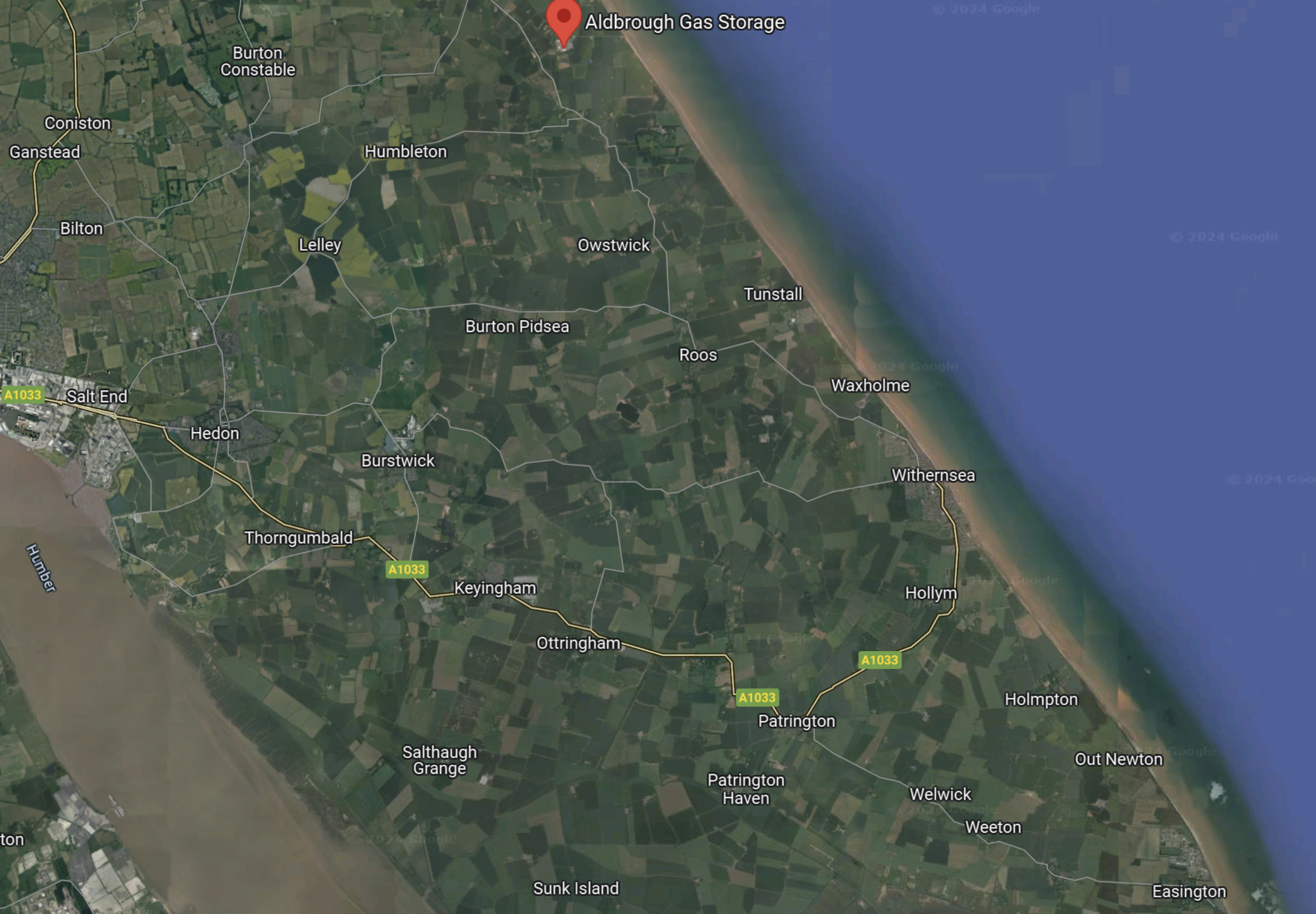
Note.
- The river crossing the South-West corner of the map is the Humber.
- Salt End with its power station and chemical works is on the North Bank of the Humber, where the river leaves the map.
- Aldbrough Gas Storage is marked by the red arrow at the top of the map.
- Easington Gas Terminal is in the South-East corner of the map.
- According to Wikipedia, gas flows into and out of the Rough Gas Storage are managed from Easington.
Looking at the map, I feel that the following should be possible.
- The two gas storage sites could be run together.
- Salt End power station and the related chemical works could run on hydrogen.
- Salt End will always have a reliable source of hydrogen.
- This hydrogen could be green if required.
All the chemical works at Salt End, could be run on a zero-carbon basis. Would this mean premium product prices? Just like organic does?
Enter The Germans
The Germans have a huge decarbonisation problem, with all their coal-fired power stations and other industry.
Three massive projects will convert much of the country and industry to hydrogen.
- H2ercules, which is a project of OGE and RWE, will create a hydrogen network to bring hydrogen, to where it is needed.
- In Uniper To Make Wilhelmshaven German Hub For Green Hydrogen; Green Ammonia Import Terminal, I describe how Uniper are going to build a hydrogen import terminal at Wilhelmshaven.
- AquaVentus is an RWE project that will use 10.3 GW of offshore wind power in German territorial waters to create a million tonnes per year of green hydrogen.
These would appear to be three of Europe’s largest hydrogen projects, that few have ever heard of.
AquaVentus And The UK
This video shows the structure of AquaVentus.
I clipped this map from the video.

Note.
- The thick white line running North-West/South-East is the spine of AquaVentus, that delivers hydrogen to Germany.
- There is a link to Denmark.
- There appears to be an undeveloped link to Norway.
- There appears to be an undeveloped link to Peterhead in Scotland.
- There appears to be a link to just North of the Humber in England.
- Just North of the Humber are the two massive gas storage sites of Aldbrough owned by SSE and Brough owned by Centrica.
- There appear to be small ships sailing up and down the East Coast of the UK. Are these small coastal tankers, that are distributing the hydrogen to where it is needed?
In the last century, the oil industry, built a substantial oil and gas network in the North Sea.
It appears now the Germans are leading the building of a substantial hydrogen network in the North Sea.
These are my thoughts about development of the AquaVentus network.
Hydrogen Production And AquaVentus
This RWE graphic shows the layout of the wind farms feeding AquaVentus.
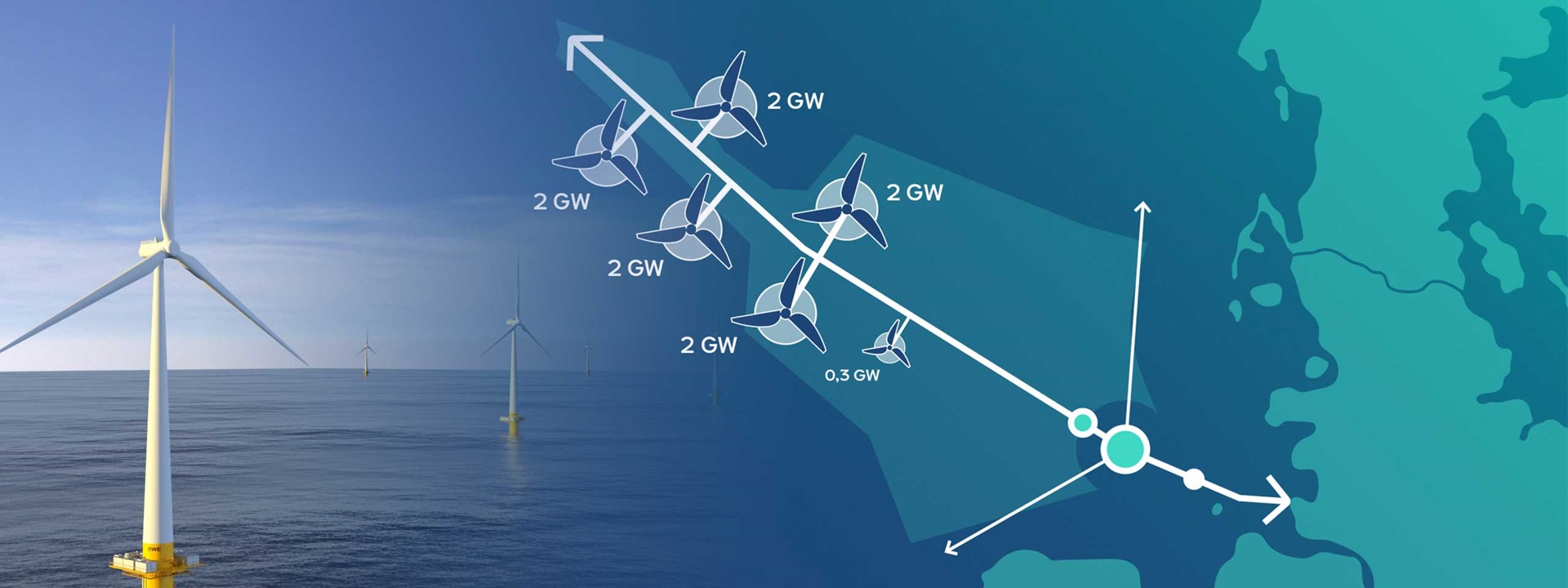
Note.
- There is a total of 10.3 GW.
- Is one of the 2 GW web sites on the UK-side of AquaVentus, the 3 GW Dogger Bank South wind farm, which is being developed by RWE?
- Is the 0.3 GW wind farm, RWE’s Norfolk wind farm cluster, which is also being developed by RWE?
Connecting wind farms using hydrogen pipelines to Europe, must surely mitigate the pylon opposition problem from Nimbys in the East of England.
As the AquaVentus spine pipeline could eventually connect to Peterhead, there will be other opportunities to add more hydrogen to AquaVentus.
Hydrogen Storage And AquaVentus
For AquaVentus to work efficiently and supply a large continuous flow of hydrogen to all users, there would need to be storage built into the system.
As AquaVentus is around 200 kilometres in length and natural gas pipelines can be up to 150 centimetres in diameter, don’t underestimate how much hydrogen can be stored in the pipeline system itself.
This page on the Uniper web site is entitled Green Wilhelmshaven: To New Horizons.
This is a sentence on the page.
Access to local hydrogen underground storage at the Etzel salt cavern site.
An Internet search gives the information, that Etzel gas storage could be developed to hold 1 TWh of hydrogen.
That would be enough hydrogen to supply 10 GW for a hundred hours.
Note that the UK branch of AquaVentus reaches the UK, just to the South of the massive hydrogen storage facilities at Aldbrough and Rough.
It would appear that both Germany and the UK are connected to AquaVentus through substantial storage.
I am certain, that all country connections to AquaVentus will have substantial storage at the country’s hydrogen terminal.
AquaDuctus
This would appear to be the first part of the AquaVentus network and has its own web site.
The web site is entitled Nucleus Of A Offshore Hydrogen Backbone.
These are the first two paragraphs.
The project partners are focusing on a scalable, demand-driven infrastructure: By 2030, AquaDuctus will connect the first large hydrogen wind farm site, SEN-1, with a generation capacity of approximately one gigawatt. SEN-1 is located in the German EEZ in the northwest of Helgoland. The pipeline will transport at a length of approx. 200 km green hydrogen produced from offshore wind to the German mainland and from there to European consumers via the onshore hydrogen infrastructure.
In the next project stage, AquaDuctus will be extended to the remote areas of the German exclusive economic zone towards the tip of the so-called duck’s bill. By that, additional future hydrogen wind farm sites will be connected. Along its way AquaDuctus will provide interconnection points with the opportunity for linking of adjacent national offshore hydrogen infrastructures originating from Denmark, Norway, the Netherlands, Belgium and United Kingdom which opens the door for Europe-wide offshore hydrogen transport by pipeline.
There is also an interactive map, that gives more details.
This paragraph explains, why the Germans have chosen to bring the energy ashore using hydrogen, rather than traditional cables.
Recent studies show that offshore hydrogen production and transport via pipelines is faster, cheaper, and more environmentally friendly than onshore electrolysis with a corresponding connection of offshore wind turbines via power cables. The German federal government has also recognized this advantage and has clearly expressed its intention to promote offshore hydrogen production in the North Sea.
I suspect, that some UK offshore wind farms will use the same techniques.
Hydrogen Production For The UK
Electrolysers will probably be built along the East Coast between Peterhead and Humberside and these will feed hydrogen into the network.
- Some electrolysers will be offshore and others onshore.
- Turning off windfarms will become a thing of the past, as all surplus electricity will be used to make hydrogen for the UK or export to Europe.
- Until needed the hydrogen will be stored in Albrough and Rough.
Backup for wind farms, will be provided using hydrogen-fired power stations like Keadby Hydrogen power station.
Financial Implications
I reported on Rishi Sunak’s Manifesto Speech, which he made on June 11th. This is an extract
This document on the Policy Mogul web site is entitled Rishi Sunak – Conservative Party Manifesto Speech – Jun 11.
These are three paragraphs from the speech.
We don’t just need military and border security. As Putin’s invasion of Ukraine has shown, we need energy security too. It is only by having reliable, home-grown sources of energy that we can deny dictators the ability to send our bills soaring. So, in our approach to energy policy we will put security and your family finances ahead of unaffordable eco zealotry.
Unlike Labour we don’t believe that we will achieve that energy security via a state-controlled energy company that doesn’t in fact produce any energy. That will only increase costs, and as Penny said on Friday there’s only one thing that GB in Starmer and Miliband’s GB Energy stands for, and that’s giant bills.
Our clear plan is to achieve energy security through new gas-powered stations, trebling our offshore wind capacity and by having new fleets of small modular reactors. These will make the UK a net exporter of electricity, giving us greater energy independence and security from the aggressive actions of dictators . Now let me just reiterate that, with our plan, we will produce enough electricity to both meet our domestic needs and export to our neighbours. Look at that. A clear, Conservative plan not only generating security, but also prosperity for our country.
I can’t remember any reports about an energy security policy, which he outlined in the last paragraph of my extract from his speech.
He also said we would have sufficient electricity to export to our neighbours. As I said earlier some of this energy will be in the form of hydrogen, which has been created by offshore electrolysers.
If we are exporting electricity and hydrogen to Europe, this is likely to have three effects.
- An improvement in Europe’s energy security.
- H2ercules will improve and decarbonise German industry, using UK hydrogen.
- The finances of UK plc will improve.
It looks like there would be winners all round.
Rishi Sunak had the cards and he played them very badly.
It is now up to Keir Starmer, Great British Energy and Jürgen Maier to play those cards to link the energy systems of the UK and Germany to ensure security and prosperity for Europe.
Hull Trains Open Access Model Drives £185m-380m Economic Boost To Region, New Report Reveals
The title of this post, is the same as that of this article on Rail Technology Magazine.
This is the first paragraph.
Open Access rail operator Hull Trains has announced the launch of a report by Arup, highlighting the significant economic, social, and environmental benefits its services have brought to the Hull and Humberside region.
The key findings of the report are as follows.
- Economic benefits: Since it launched in 2000, Hull Trains estimates that it has delivered between £185m-380m since launch. It also projects those benefits will reach an estimated £325m-700m by 2032.
- Increased connectivity: Frequency between Hull and London has grown to seven trains per day (tpd) from just a single train.
- Enhanced capacity: 10-car trains and additional Sunday services doubled seating capacity compared to 2000.
- Sustainability: Modal shift from road to rail has reduced carbon emissions and air pollution.
- Employment: £35m-£70m (2023 prices) generated in direct employment since launch.
As the report is by respected consultancy Arup, I would put a high level of confidence in the findings.
I have a few thoughts.
Did Hull’s Rail Service Help Hull Become UK City Of Culture In 2017?
In the shortlist, the cities were Dundee, Hull, Leicester and Swansea Bay.
If Hull had had just a single tpd from London, would it have been chosen?
Do Hull Trains Make It More Likely That Companies from Outside Will Develop There?
Hull and Humberside in general has GWs of wind energy, several gas-fired power stations and uniquely plenty of storage for natural gas and/or hydrogen.
So if your company uses a lot of energy, Hull would probably be on your short list.
A good well-respected train service to London could help with your choice.
Hullensians Seem Proud Of Their Train Company
In First Class Gluten-Free Food, I described some good service of a gluten-free meal on Hull Trains.
I praised the steward and her mother-in-law said thanks.
Perhaps Other Independent Cities Need Their Own Open-Access Operator?
Hull Trains seems to have been a success and according to the Arup report, Hull has benefitted.
LNER Are Developing Services To Bradford, Cleethorpes/Grimsby Harrogate, Lincoln And Middlesbrough.
Will LNER run services that are tied to the destination, as if they were an open access operator?
Conclusion
Pairing an independent city with its own train company seems a good business practice.
Perhaps it should be done more often?
Centrica Bolsters UK’s Energy Security By Doubling Rough Storage Capacity
The title of this post, is the same as that of this news item from Centrica.
These are the first three paragraphs.
Following further engineering work and investment, Centrica has announced increased gas storage capacity at Rough, the UK’s largest gas storage facility.
The facility, which is 18 miles off the coast of East Yorkshire, stopped storing gas in 2017 but was re-opened for gas storage in October 2022. Rough now provides half of the UK’s total gas storage.
At the time of reopening Rough for gas storage it was able to store approximately 30 billion cubic feet (bcf) of gas for UK homes and businesses. Further investment in the facility means Rough will now be able to store up to 54 bcf of gas, boosting the UK’s energy resilience for the coming winter – this would provide the equivalent volume of gas to heat 2.4 million homes over winter.
This work and investment has increased the storage capacity by a massive eighty percent.
The news item finishes with this quote from Centrica Group Chief Executive, Chris O’Shea.
We stand ready to invest £2 billion to repurpose the Rough field into the world’s biggest methane and hydrogen storage facility, bolstering the UK’s energy security, delivering a net zero electricity system by 2035, creating 5,000 skilled jobs and decarbonising the UK’s industrial clusters by 2040. But to do this we need the right regulatory support framework. This world class North Sea asset has the potential to help the UK economy return to a position of being a net exporter of energy once again.
As East Yorkshire also boasts the Aldbrough Gas Storage in the salt formations under Hull, the area will have plenty of gas to keep them warm in the winter.
Did I See The UK’s Hydrogen-Powered Future In Hull Today?
I went from London to Hull today on Hull Trains for £50.80 return (with my Senior Railcard) to see SSE’s presentation for their Aldbrough Pathfinder Hydrogen project, which will feature a 35 MW green hydrogen electrolyser and 320 GWh of hydrogen storage in the thick layers of salt under East Yorkshire.
- Green electricity would come mainly from the part-SSE owned 8 GW Dogger Bank wind farm complex.
- According to their web site, Meld Energy are planning a 100 MW electrolyser, which would produce 13,400 tonnes of hydrogen per year.
Every large helps!
- It should be noted that the thick layers of salt stretch all the way to Germany, and as drilling and storage technology improves, the amount of hydrogen storage available will increase.
- I was also impressed by the ambition, competence and enthusiasm, of the SSE engineers that I met.
- As has been pointed out, HiiROC, who have backing from Centrica, Hyundai, Kia and others, are also in Hull!
I believe, that I saw our hydrogen-powered future in Hull today!
We need more hydrogen mega-projects like these! Perhaps in Aberdeen, Clydeside, Freeport East, Isle of Grain, Merseyside, Milford Haven and Teesside?
How Britannia With Help From Her Friends Can Rule The Waves And The Wind
The Government doesn’t seem to have published its future energy plans yet, but that hasn’t stopped the BBC speculating in this article on their web site, which is entitled Energy Strategy: UK Plans Eight New Nuclear Reactors To Boost Production.
These are the first two paragraphs.
Up to eight more nuclear reactors could be delivered on existing sites as part of the UK’s new energy strategy.
The plan, which aims to boost UK energy independence and tackle rising prices, also includes plans to increase wind, hydrogen and solar production.
Other points include.
- Up to 95% of the UK’s electricity could come from low-carbon sources by 2030.
- 50 gigawatts (GW) of energy through offshore wind farms, which would be more than enough to power every home in the UK.
- One of the big points of contention is thought to have been the construction of onshore wind turbines.
- Targets for hydrogen production are being doubled to help provide cleaner energy for industry as well as for power, transport and potentially heating.
- A new licensing round for North Sea oil and gas projects.
- A heat pump accelerator program.
In this post I shall only be looking at one technology – offshore wind and in particular offshore floating wind.
Who Are Our Friends?
I will start with explaining, who I see as our friends, in the title of this post.
The Seas Around Us
If we are talking about offshore winds around the the UK, then the seas around the UK are surely our biggest and most-needed friend.
The Island Of Ireland
The seas are shared with the island of Ireland and the UK and the Republic must work together to maximise our joint opportunities.
As some of the largest offshore wind farm proposals, between Wales and Ireland involve a Welsh company called Blue Gem Wind, who are a partnership between Irish company; Simply Blue Energy, and French company; TotalEnergies, we already seem to be working with the Irish and the French.
The City Of London
Large insurance and pension companies, based in the City of London like, abrdn, Aviva, L & G and others are always looking for investments with which to provide income to back their insurance business and our pensions.
In World’s Largest Wind Farm Attracts Huge Backing From Insurance Giant, I describe why and how, Aviva back wind farms.
Germany
Germany are certainly on our side, despite being in a mess of Mutti Merkel’s making, because she got the country too deeply dependant on Vlad the Mad’s tainted gas.
- German utilities are providing finance to build wind farms in British waters.
- German company; Siemens is manufacturing turbine blades in Hull.
- Germany wouldn’t mind buying any electricity and hydrogen we have spare. Especially, as we haven’t invaded them since 1944.
I suspect a mutually-beneficial relationship can be negotiated.
Norway
I have customised software for a number of countries, including Iran, Saudi Arabia, South Korea and the United States and despite selling large numbers of systems to Norway, the Norwegians never requested any modifications.
They are generally easy-going people and they are great friends of the UK. They were certainly a fertile country for the sale of Artemis systems.
Just as the UK worked together with the Norwegians to deliver North Sea Oil, we are now starting to work together to develop renewable energy in the North Sea.
In UK To Norway Sub-Sea Green Power Cable Operational, I describe how we have built the North Sea Link with the Norwegians, which will link the British and Norwegian energy networks to our mutual benefit.
In Is This The World’s Most Ambitious Green Energy Solution?, I describe an ambitious plan called Northern Horizons, proposed by Norwegian company; Aker Solutions to build a 10 GW floating wind farm, which will be 120 km to the North-East of the Shetlands.
Floating Wind Turbines
This is the introduction of the Wikipedia entry for floating wind turbines.
A floating wind turbine is an offshore wind turbine mounted on a floating structure that allows the turbine to generate electricity in water depths where fixed-foundation turbines are not feasible. Floating wind farms have the potential to significantly increase the sea area available for offshore wind farms, especially in countries with limited shallow waters, such as Japan, France and US West coast. Locating wind farms further offshore can also reduce visual pollution, provide better accommodation for fishing and shipping lanes, and reach stronger and more consistent winds.
At its simplest a floating wind farm consists of a semi-submersible platform, which is securely anchored to the sea-bed to provide a firm platform on which to erect a standard wind turbine.
There are currently two operational floating wind farms off the East Coast of Scotland and one in the Atlantic off the Portuguese coast.
- These wind farms are fairly small and use between three and five turbines to generate between 25-50 MW.
- The largest current floating turbines are the 9.5 MW turbines in the Kincardine Wind Farm in Scotland, but already engineers are talking of 14 MW and 20 MW floating turbines.
- Experience of the operation of floating wind turbines, indicates that they can have capacity factors in excess of 50 %.
- Floating wind turbines can be erected on their floats in the safety of a port using a dockside crane and then towed into position.
- Floating wind turbines can be towed into a suitable port for servicing and upgrading.
Many serious engineers and economists, think that floating wind farms are the future.
The Energy Density of Fixed Foundation And Floating Wind Farms
In ScotWind Offshore Wind Leasing Delivers Major Boost To Scotland’s Net Zero Aspirations, I summarised the latest round of Scotwind offshore wind leases.
- Six new fixed foundation wind farms will give a capacity of 9.7 GW in 3042 km² or about 3.2 MW per km².
- Ten new floating wind farms will give a capacity of 14.6 GW in 4193 km² or about 3.5 MW per km².
Note.
- Floating wind farms have a small advantage in terms of energy density over those with fixed foundations.
- Suppose these energy densities are achieved using 14 MW turbines.
- Engineers are talking of 20 MW turbines.
- Using large turbines could increase the energy density by 20/14 or 43 %
We could see in a few years with 20 MW turbines, fixed foundation turbines having an energy density of 4.6 MW per km², with floating turbines having 5 MW per km².
The Potential Of A Ten-Mile Square In The Seas Around Us
I will assume.
- It is at least 100 km from land.
- The water would be at least 100 metres deep.
- There are no structures in the area.
And calculate.
- The area will be a hundred square miles, which is smaller than the county of Rutland.
- This will be 259 square kilometres.
If it were to be filled with floating wind turbines at a density of 5 MW per km², the capacity would be 1300 MW or 1.3 GW.
There must be hundreds of empty ten-mile squares in the seas around us.
Offshore Hydrogen Production And Storage
I believe in the near future, that a lot of offshore wind energy will be converted to hydrogen offshore.
- Electrolysers could be combined with wind turbines.
- Larger electrolysers could be combined with sub-stations collecting the electricity.
- In Torvex Energy, I discuss a method to create hydrogen from seawater, without having to desalinate the water. Surely, this technology would be ideal for offshore electrolysis.
Hydrogen would be brought to shore using pipelines, some of which could be repurposed from existing gas pipelines, that are now redundant, as the gas-fields they served have no gas left.
I also suspect that hydrogen could be stored in a handy depleted gas field or perhaps some form of specialist storage infrastructure.
Combining Wind And Wave Power In A Single Device
Marine Power Systems are a Welsh company, that has developed a semi-submersible structure, that can support a large wind turbine and/or a wave-power generator.
This is the mission statement on their home page.
Marine Power Systems is revolutionising the way in which we harvest energy from the world’s oceans.
Our flexible technology is the only solution of its type that can be configured to harness wind and wave energy, either as a combined solution or on their own, in deep water. Built on common platform our devices deliver both cost efficiency and performance throughout the entire product lifecycle.
Our structurally efficient floating platform, PelaFlex, brings excellent stability and straightforward deployment and maintenance. The PelaGen wave energy converter represents market-leading technology and generates energy at an extremely competitive cost of energy.
Through optimised farm layout and the combination of wind and wave energy, project developers can best exploit the energy resource for any given area of seabed.
We are unlocking the power of oceans.
There is a link on the page to more pages, that explain the technology.
It looks to me, that it is well-designed technology, that has a high-chance of being successful.
It should also be noted that according to this news page on the Marine Power Systems web site, which is entitled MPS Lands £3.5M Of Funding From UK Government, the UK government feel the technology is worth backing.
I certainly believe that if Marine Power Systems are not successful, then someone else will build on their original work.
If wind and wave power can successfully be paired in a single float, then this must surely increase the energy production at each float/turbine in the floating wind farm.
Energy Storage In Wind Turbines
The output of wind farms can be very variable, as the wind huffs and puffs, but I believe we will see energy storage in wind turbines to moderate the electricity and deliver a steadier output.
Using lithium-ion or other batteries may be possible, but with floating offshore turbines, there might be scope to use the deep sea beneath the float and the turbine.
Hybrid Wind Farms
In the latest round of Scotwind offshore wind leases, one wind farm stands out as different. Magnora ASA’s ScotWind N3 Offshore Wind Farm is described as a floating offshore wind farm with a concrete floater.
I can see more wind farms built using this model, where there is another fixed or floating platform acts as control centre, sub-station, energy store or hydrogen electrolyser.
How Much Electricity Could Be Produced In UK And Irish Waters?
I will use the following assumptions.
- Much of the new capacity will be floating wind turbines in deep water.
- The floating wind turbines are at a density of around 5 MW per km²
This Google Map shows the British Isles.
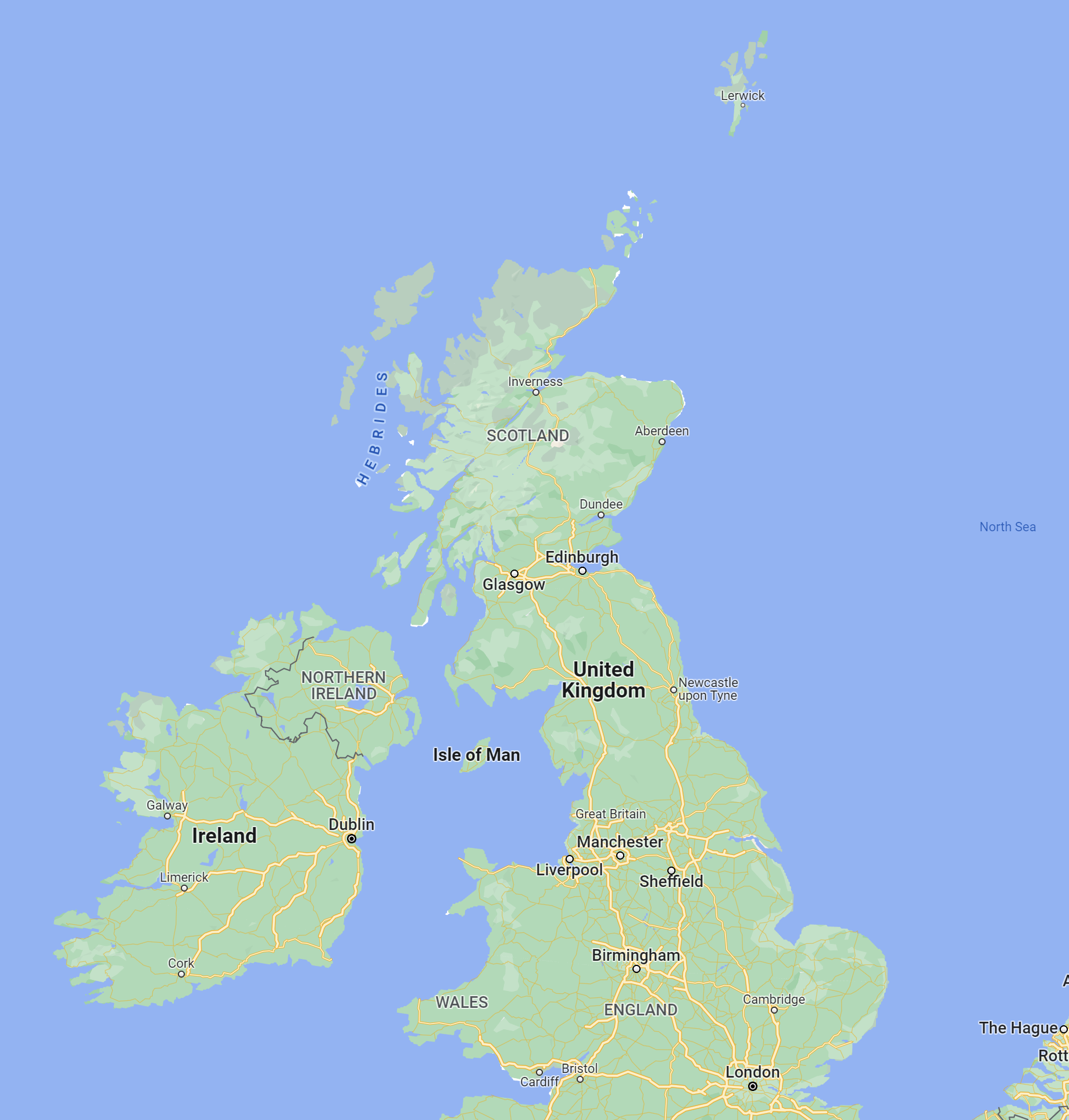
I will look at various seas.
The Celtic Sea
The Celtic Sea is to the South-West of Wales and the South of Ireland.
In Blue Gem Wind, I posted this extract from the The Our Projects page of the Blue Gem Wind web site.
Floating wind is set to become a key technology in the fight against climate change with over 80% of the worlds wind resource in water deeper than 60 metres. Independent studies have suggested there could be as much as 50GW of electricity capacity available in the Celtic Sea waters of the UK and Ireland. This renewable energy resource could play a key role in the UK meeting the 2050 Net-Zero target required to mitigate climate change. Floating wind will provide new low carbon supply chain opportunities, support coastal communities and create long-term benefits for the region.
Consider.
- The key figure would appear 50 GW of electricity capacity available in the Celtic Sea waters of the UK and Ireland.
- Earlier I said that floating turbines can have a wind turbine density of 5 MW per km².
- According to Wikipedia, the surface area of the Celtic Sea is 300,000 km².
To accommodate enough floating turbines to generate 50 GW would need 10000 km², which is a 100 km. square, or 3.33 % of the area of the Celtic Sea.
This wind generation capacity of 50 GW would appear to be feasible in the Celtic Sea and still leave plenty of space for the shipping.
The Irish Sea
According to Wikipedia, the surface area of the Irish Sea is 46,000 km².
Currently, there are ten wind farms in the Irish Sea.
- Six are in English waters, three are in Welsh and one is in Irish.
- None are more than sixteen kilometres from the coast.
The total power is 2.7 GW.
I feel that the maximum number of wind farms in the Irish Sea would not cover more than the 3.33 % proposed for the Celtic Sea.
3.33 % of the Irish Sea would be 1532 km², which could support 7.6 GW of wind-generated electricity.
I can’t leave the Irish Sea without talking about two wind farms Mona and Morgan, that are being developed by an enBW and BP joint venture, which I discussed in Mona, Morgan And Morven. This infographic from the joint venture describes Mona and Morgan.

That would appear to be a 3 GW development underway in the Irish Sea.
Off The Coast Of South-East England, East Anglia, Lincolnshire And Yorkshire
These wind farms are proposed in these areas.
- Hornsea – 6 GW
- Triton Knoll – 900 MW
- Dogger Bank – 3.6 GW
- Norfolk Boreas – 1.8 GW
- Norfolk Vanguard – 1.8 GW
- East Anglia Array – 7.2 GW
- Rampion Extension – 1.2 GW
Note.
All wind farms have comprehensive web sites or Wikipedia entries.
The total capacity of these wind farms is 22.5 GW
The North Sea
According to Wikipedia, the surface area of the North Sea is 570,000 km².
Would it is reasonable to assume, that perhaps a tenth of this area would be available for new wind farms in UK waters?
3.33 % of the available North Sea would be 1898 km², which could support 9.5 GW of wind-generated electricity.
On The East Coast Of Scotland
In Wind Farms On The East Coast Of Scotland, I summarised the wind farms off the East coast of Scotland, that are being built in a cluster in the First of Forth.
This map shows the proposed wind farms in this area.
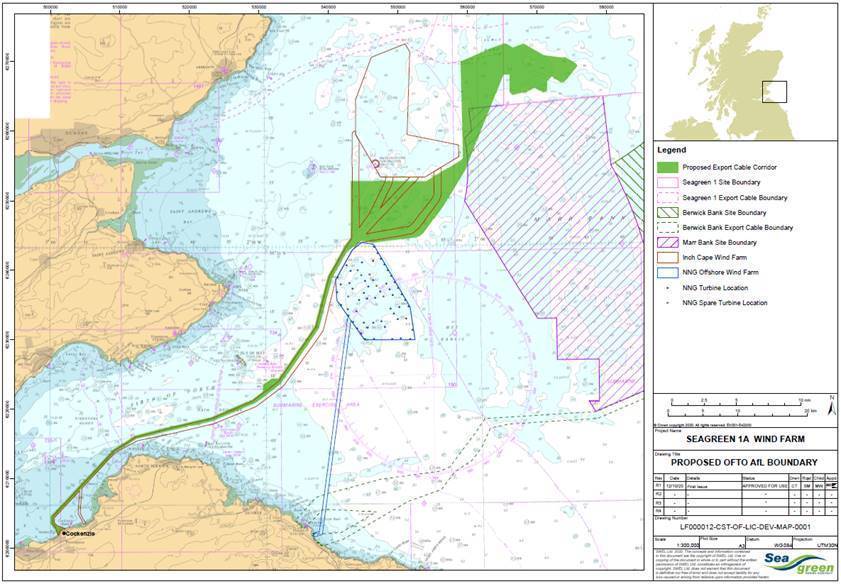
There are five wind farms in the map.
- The green area is the cable corridor for Seagreen 1a
- Inch Cape is the odd-shaped wind farm to the North and West of the green area
- Seagreen at the top of the map, to the North of Inch Cape.
- Marr Bank with the pink NE-SW hatching
- Berwick Bank with the green NW-SE hatching
- Neart Na Gaoithe is edged in blue to the South of the green area.
Berwick Bank and Marr Bank are both owned by SSE and appear to have been combined.
The capacity of the wind farms can be summarised as follows.
- Seagreen – 1075 MW
- Neart Na Gaoithe – 450 MW
- Inch Cape – 1000 MW
- Berwick Bank and Marr Bank – 4100 MW
This gives a total of 6625 MW or just over 6.6 GW.
Around The North Of Scotland
This map shows the latest successful ScotWind leases.

Note.
- Several of these proposed wind farms have detailed web sites.
These seventeen leases total up to 24.3 GW.
An Interim Total
I believe these figures are realisable.
- Celtic Sea – 50 GW
- Irish Sea – 7.6 GW – 3 GW already underway
- South East England, East Anglia, Lincolnshire And Yorkshire – 22.5 GW
- North Sea – 9.5 GW
- On The East Coast Of Scotland – 6.6 GW
- Around The North Of Scotland – 24.3 GW
Note.
- I have tried to be as pessimistic as possible.
- Irish and North Sea estimates are based on Blue Gem Wind’s professional estimate for the Celtic Sea.
- I have used published figures where possible.
My estimates total up to 120.1 GW of extra wind-power capacity. As I write this, current UK electricity production is around 33 GW.
Vikings Will Invade
This Google Map shows the Faroe Islands, the North of Scotland, Norway and Denmark.
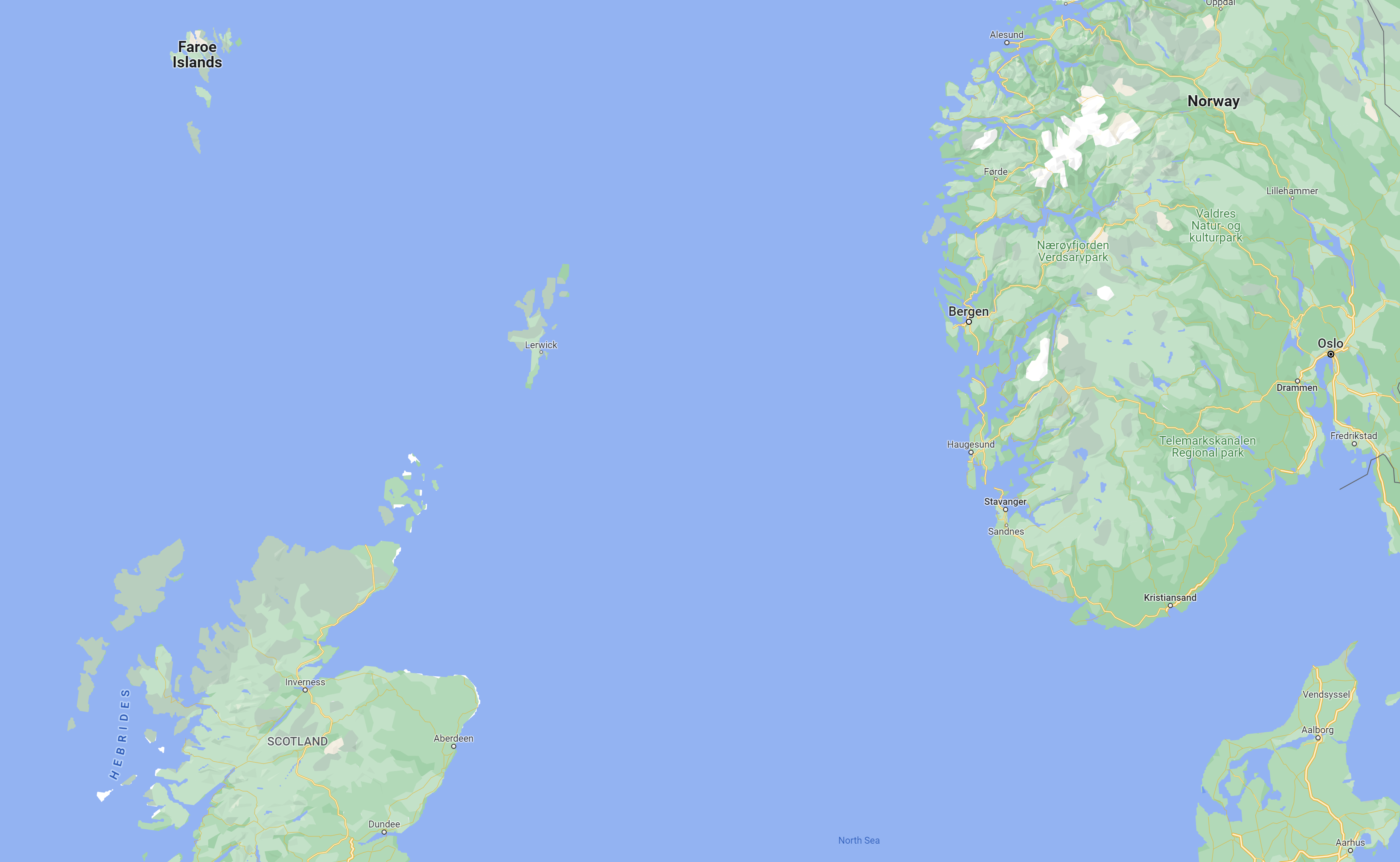
To get an idea of scale, the Shetland Isles are around 70 miles or 113 km. from North to South.
In Is This The World’s Most Ambitious Green Energy Solution?, I talked about Norwegian company; Aker Solutions’s plan for Northern Horizons.
- It would be a 10 GW offshore floating wind farm 136 km to the North-East of the Shetlands.
- This position would probably place it about halfway between the Faroes and the Norwegian coast.
- The project is best described in this article on the Engineer, which is entitled Northern Horizons Plans Clean Energy Exports For Scotland.
- In the article, there is a good graphic and a video.
This will be offshore engineering of the highest class, but then I first came across Norwegian offshore engineering like this in the 1970s, where nothing was too difficult for Norwegian engineers.
There are two major points to remember about the Norwegians.
- They have the Sovereign Wealth Fund to pay for the massive investment in Northern Horizons.
- They need to replace their oil and gas income, with a zero-carbon investment stream.
I feel that Northern Horizons will not be a one-off and the virgin sea in the map above will be liberally carpeted with more floating wind farms.
- On Shetland, electricity can be fed into the UK grid.
- On Norway, electricity can be fed into the Norwegian grid or stored in Norwegian pumped storage systems.
- On Scotland, more pumped storage systems can be built to store energy.
- Hydrogen can be piped to where it is needed to decarbonise heavy industry and transport.
- Norwegian fjords, Shetland harbours, Scottish lochs and possibly Scapa Flow would be ideal places to assemble and service the giant floating turbines and build the other needed floating infrastructure.
- I can also see Denmark getting in on the act, as they will probably want to decarbonise the Faroe Islands.
I estimate that between the Faroes, Scotland and Norway, there are 510,000 km² of virgin sea.
With a potential of 5 MW per km², that area has the potential to create an amazing amount of both electricity and hydrogen.
Exporting Power To Europe
There will need to be more interconnectors from the UK to Europe.
These are already working.
- BritNed – 1 GW – Isle of Grain and Rotterdam
- ElecLink – 1 GW – Through the Channel Tunnel
- HVDC Cross-Channel – 2 GW – England and France
- IFA-2 – 1 GW – England and France
- NemoLink – 1 GW – Kent and Belgium
- North Sea Link – 1.4 GW – Blyth and Norway
- Viking Link – 1.4 GW – Lincolnshire and Denmark
These are proposed.
- GridLink – 1.4 GW – Kent and Dunkirk
- NeuConnect – 1.4 GW – Isle of Grain and Germany
- North Connect – 1.4 GW – Scotland and Norway
There are also gas interconnectors, that could be converted to hydrogen.
This press release from National Grid, which is entitled Undersea Electricity Superhighways That Will Help Deliver Net Zero Move A Step Closer, has these bullet points.
- Positive progress on plans for £3.4bn electricity super-highway projects – Scotland to England Green Links.
- Ofgem opens consultation that recognises the “clear case” and “consumer benefit” of two subsea high voltage cables to transport clean between Scotland and England.
- The cables form part of a planned 16 project £10 billion investment from National Grid to deliver on the government’s target of 40GW of offshore wind generation by 2030.
This paragraph expands on the work by National Grid to meet the third point.
These projects are part of National Grid’s work upgrading the electricity transmission system to deliver the UK government’s target of 40GW of offshore wind generation by 2030. In addition to the Eastern Links, it is developing 14 major projects across its network to facilitate the target representing a £10 billion investment. This includes two further Scotland to England high voltage links (also in partnership with the Scottish transmission network owners) and proposals in the Humber, Lincolnshire, East Midlands, North of England, Yorkshire, North Kent, as well as four in East Anglia (one of which is a proposed offshore link between Suffolk and Kent).
I think we can assume, that National Grid will do their part to allow the UK government’s target of 40GW of offshore wind generation by 2030 to be met.
Will The UK Have 40 GW Of Offshore Wind Generation By 2030?
In the Wikipedia entry for Windpower In The UK, this is the opening sentence.
The United Kingdom is one of the best locations for wind power in the world and is considered to be the best in Europe. By the beginning of March 2022, the UK had 11,091 wind turbines with a total installed capacity of over 24.6 gigawatts (GW): 14.1 GW of onshore capacity and 10.4 GW of offshore capacity.
It would appear an extra 30 GW of wind power is needed.
In An Interim Total earlier, I gave these figures.
- Celtic Sea – 50 GW
- Irish Sea – 7.6 GW – 3 GW already underway
- South East England, East Anglia, Lincolnshire And Yorkshire – 22.5 GW
- North Sea – 9.5 GW
- On The East Coast Of Scotland – 6.6 GW
- ScotWind – 24.3 GW
The wind farms in South East England, East Anglia, Lincolnshire And Yorkshire and ScotWind and Mona and Morgan are either being planned or under construction, and in many cases leases to construct wind farms are being paid.
I would feel, that at least 30 GW of these 56.4 GW of wind farms will be completed by 2030.
Conclusion
Boris’s vision of the UK becoming a Saudi Arabia of wind is no fantasy of a man with massive dreams.
Standard floating wind turbines, with the possibility of also harvesting wave power could be assembled in ports along the coasts, towed into position and then connected up.
Several GW of wind-power capacity could probably be added each year to what would become the largest zero-carbon power station in the world.
By harvesting the power of the winds and waves in the seas around the British Isles it is an engineering and mathematical possibility, that could have been developed by any of those great visionary Victorian engineers like Armstrong, Bazalgette, Brunel and Reynolds, if they had had access to our modern technology.
Up Yours! Putin!
New Electricity ‘Superhighways’ Needed To Cope With Surge In Wind Power
The title of this post, is the same as that of this article on the Telegraph.
This is the first two paragraphs.
Energy companies are pushing for the rapid approval of new electricity “superhighways” between Scotland and England amid fears that a lack of capacity will set back the country’s wind power revolution.
Businesses including SSE and Scottish Power are calling on the industry regulator Ofgem to approve a series of major new north-south power cables in a bid to ease congestion on the existing electricity network.
These points are mentioned in the article.
- Current capacity is 6 GW, which even now is not enough.
- Another 17 GW of capacity will be needed by 2033.
- Wind farms in Scotland have been switched off and replaced by gas-fired power stations because of a lack of grid capacity.
- Another 25 GW of wind farms could be built after leases were awarded last month.
Two North-South interconnectors are being planned.
Peterhead And Drax
This is being proposed by SSE and National Grid.
- It will be an undersea cable.
- It will be two cables, each with a capacity of 2 GW.
- Peterhead and Drax power station are four hundred miles apart by road and 279 miles as the seagull flies, as a lot of the route would be over the sea. So an undersea connection would appear to be sensible.
- Peterhead is on the coast, so connecting an undersea interconnector shouldn’t be too challenging or disruptive to the locals.
- Drax power station is a 4 GW power station and the largest in the UK, so it must have good grid connections.
This Google Map shows the location of Drax power station in relation to Hull, Scunthorpe and the rivers in the area.
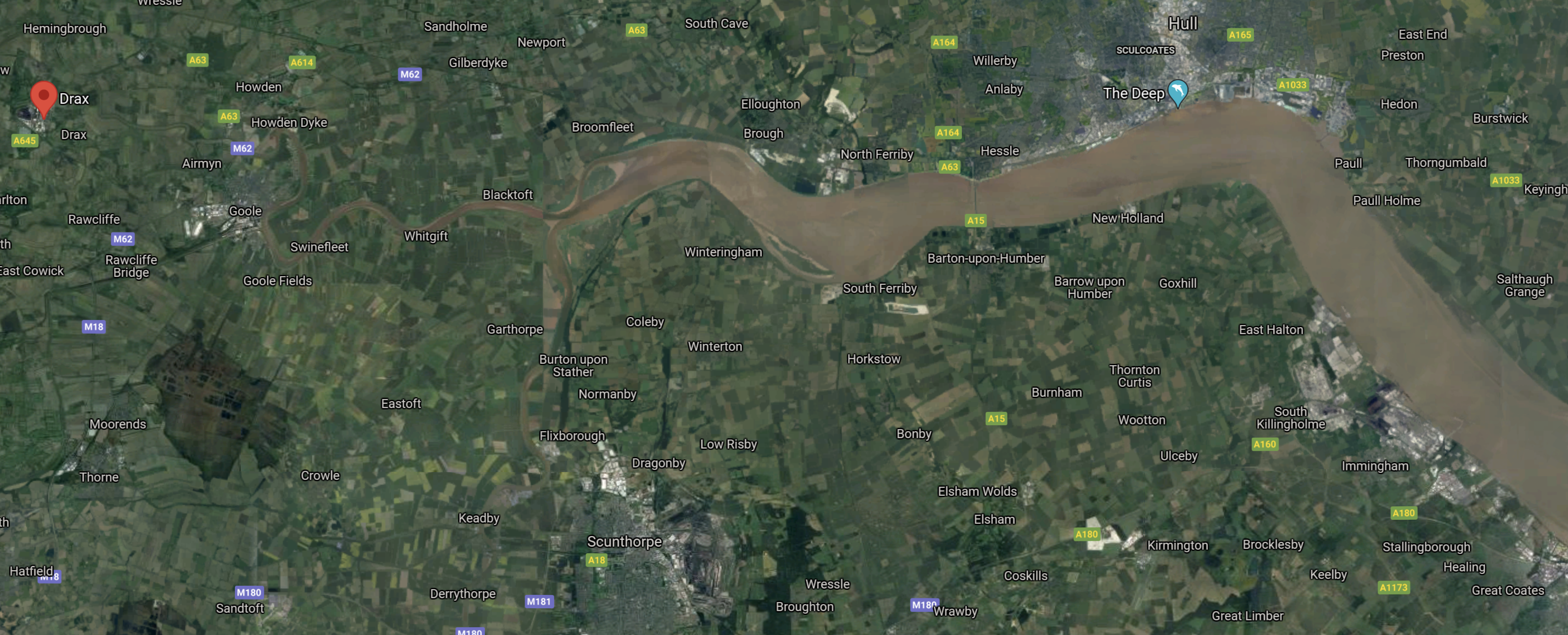
Note.
- Drax is marked by the red arrow in the West of the map.
- The large body of water in the East is the Humber Estuary.
- Hull is on the North Bank of the Humber.
- Scunthorpe, which is famous for its steel industry is South of the Humber in the middle of the map.
- To the West of Scunthorpe the Humber splits into the Trent and the Ouse.
- The Ouse leads all the way to Drax power station.
I suspect an undersea cable could go up the Humber and Ouse to Drax power station.
Is it a coincidence that both Drax power station and the proposed link to Peterhead are both around 4 GW?
Consider.
- Drax is a biomass power station, so it is not a zero carbon power station.
- Drax produces around six percent of the UK’s electricity.
- Most of the biomass comes by ship from North America.
- Protest groups regularly have protests at Drax because of its carbon emissions.
- Drax Group are experimenting with carbon capture.
- Drax is a big site and a large energy storage system could be built there.
- Wind is often criticised by opponents, saying wind is useless when the wind doesn’t blow.
- The Scots would be unlikely to send power to England, if they were short.
This is also said about Drax in Wikipedia.
Despite this intent for baseload operation, it was designed with a reasonable ability for load-following, being able to ramp up or down by 5% of full power per minute within the range of 50–100% of full power.
I take this it means it can be used to top up electricity generation to meet demand. Add in energy storage and it could be a superb load-follower.
So could the similar size of the interconnector and Drax power station be deliberate to guarantee England a 4 GW feed at all states of the wind?
I don’t think it is a coincidence.
Torness And Hawthorn Pit And Torness and South Humberside
These two cables are being proposed by Scottish Power.
- Each will be two GW.
- Torness is the site of the 1.36 GW Torness nuclear power station, which is likely to be decommissioned before 2030.
- Torness will have good grid connections and it is close to the sea.
- Hawthorn Pit is a large closed coal mine to the North of Newcastle, with a large substation close to the site. I suspect it will be an ideal place to feed power into the grid for Newcastle and it is close to the sea.
- Just South of Hawthorn Pit are the 1.32 GW Hartlepool nuclear power station, which will be decommissioned in 2024 and the landfall of the cables to the massive Dogger Bank wind farm.
- As I showed earlier with Drax, the Humber would be an ideal estuary to bring underwater power cables into the surrounding area. So perhaps the cable will go to Scunthorpe for the steelworks.
- As at Drax, there is backup in South Humberside, but here it is from the two Keadby gas-fired power stations.
The article in the Telegraph only gives the briefest of details of Scottish Power’s plans, but I suspect, that given the locations of the ends of the interconnectors, I suspect the cables will be underwater.
Conclusion
It strikes me that all three interconnectors have been well thought thought and they serve a variety of objectives.
- Bring Scottish wind power, South to England.
- Connect wind farms to the two nuclear power station sites at Hartlepool and Torness, that will close at the end of the decade.
- Allow the big 4 GW biomass-fired station at Drax to back up wind farms and step in when needed.
- Cut carbon emissions at Drax.
- Use underwater cables as much as possible to transfer the power, to avoid the disruption of digging in underground cables.
It looks to be a good plan.
 The Anonymous Widower