Sweden’s Grand Plan To Make Zero-Carbon Steel
The title of this post is the same as that of this article on theTelegraph.
It adds a lot of colour and background to Sweden’s plan to make zero-carbon stell using a process called HYBRIT, that I wrote about in Funding Award to Supply An 8MW Electrolyser and is illustrated in this infographic.
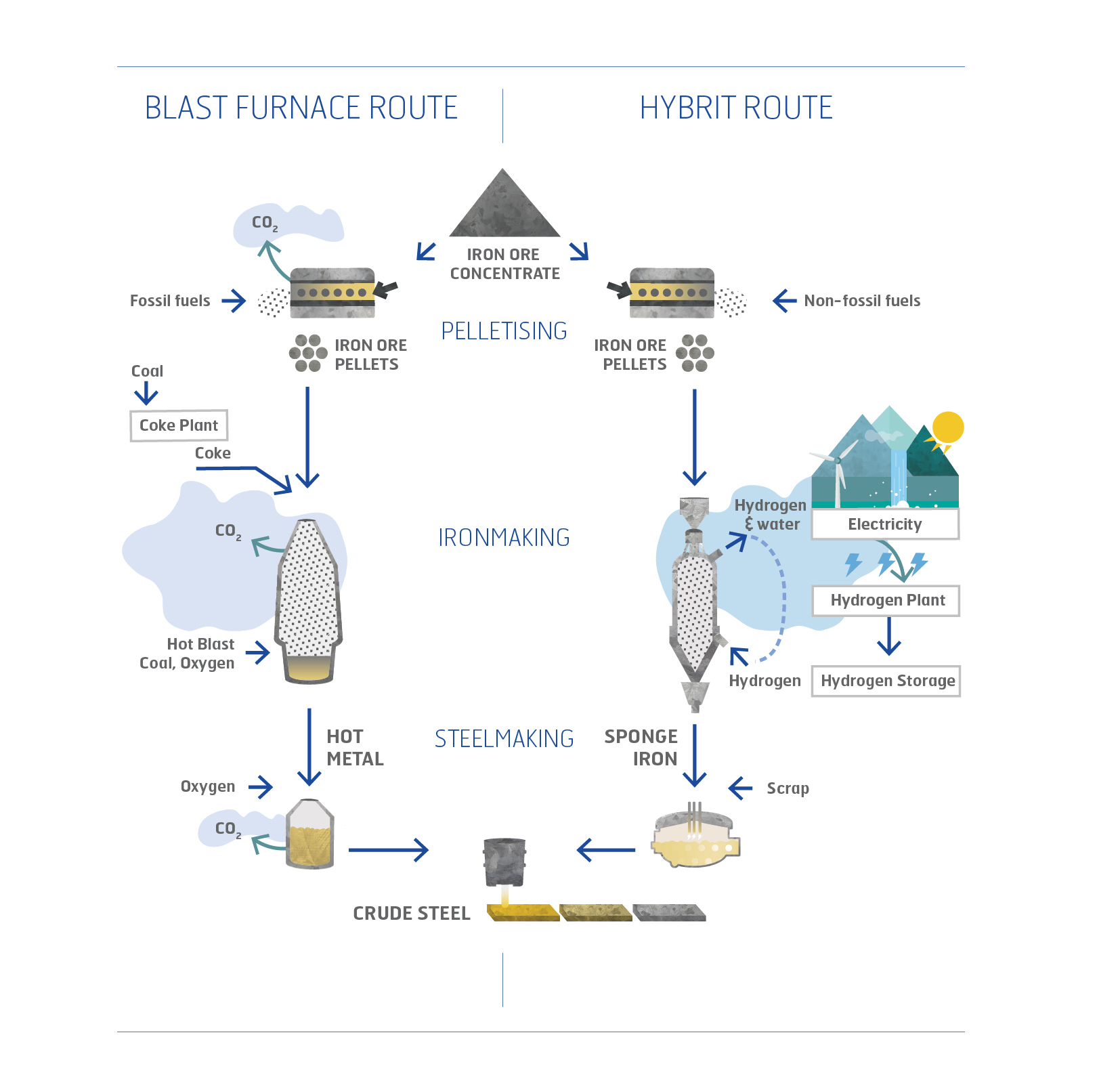
The amount of hydrogen needed is large as this paragraph from the Telegraph article says.
HYBRIT’s demonstration plant, for which an investment decision is due in 2022, will require 400MW of power just for the electrolysers to make the hydrogen. Sweden’s largest existing wind farm, Björkhöjden, produces just 288MW. Then to store the hydrogen, Vattenfall plans to build 120,000 m3 of lined underground storage, enough to store 100GWh worth of the gas.
Will they procure the electrolysers from the UK’s experts in the field; iTM Power? This innovative company is building the world’s largest electrolyser factory in Rotherham, which will be able to produce a GW of electrolysers in a year.
Conclusion
This well-written article in the Telegraph explains a lot about steel produced using hydrogen instead of coal.
Sweden has a lot of advantages at Lulea to create steel.
- The iron ore is mined locally.
- Sweden has ninety percent of Europe’s iron ore.
- Ships can sail to Lulea, which is at the top of the Baltic.
- There is gigawatts of zero-carbon electricity from the River Lule.
- They can build wind farms in the area, which has a low population.
It does look that they might export the iron ore as sponge iron, which can then be processed directly into steel products using electric arc furnaces.
Snam, ITM Power To Develop Green Hydrogen Projects
The title of this post, is the same as that of this article on Renewables Now.
Points from the article.
- Snam will pump £30 million into ITM Power.
- Snam are planning up to 100 MW of green hydrogen projects.
In Joint Venture With Linde AG And £38M Strategic Investment, I asked “How Much Hydrogen Would A 5 MW Electrolyser Create In A Day?”
- I gave the answer as 2.182 tonnes of hydrogen, so multiplying up by twenty gives 43.6 tonnes of hydrogen.
- In a Wikipedia entry called Renewable Energy in Italy, it is stated that Italy produced 51.5 GW of renewable energy in 2015.
- The UK produced 30 GW of renewable energy in 2015, but our capacity is growing fast.
I suspect Italy will have plenty enough renewable electricity to supply 100 MW for hydrogen.
As iTM Power are building a factory to manufacture one GW of electrolysers per year, I suspect they can provide their part of the hasrdware for the Italian job.
Renewable Hydrogen Will Replace Natural Gas In Millions Of Australian Households
The title of this post, is the same as that of this article on Hydrogen Fuel News.
This is the introductory paragraph.
Under a new Australian government-backed initiative, millions of households across the country will be supplied with renewable hydrogen in the place of natural gas.
The project will start in a small way by adding 10 % of hydrogen to the natural gas networks by the end of 2022.
Eventually, hydrogen will completely replace natural gas.
According to one of the comments to the article, ITM Power will supply the electrolysers.
That could be a nice little order.
Can The UK Have A Capacity To Create Five GW Of Green Hydrogen?
This article in The Times today is entitled Net Zero By 2050: Bold Aims Are An Example To Other Nations.
It is an analysis of the Government’s plans for a greener future.
This is a paragraph.
Only a few small-scale green hydrogen plants exist globally, and so five gigawatts of low-carbon hydrogen generation by 2030 is a bold commitment. For context, BP recently announced that it was building its first full-scale green hydrogen facility, in Germany — with a 50-megawatt capacity.
I don’t think from the tone, that the writer thinks it is possible.
On the other hand I do believe it is possible.
ITM Power
ITM Power are the experts in electrolysis and have the largest electrolyser factory in the world, which is capable of supplying 1 GW of electrolyser capacity per annum.
It would appear they can supply the required five GW of electrolyser capacity in time for 2030.
The Herne Bay Electrolyser
Ryze Hydrogen are building the Herne Bay electrolyser.
- It will consume 23 MW of solar and wind power.
- It will produce ten tonnes of hydrogen per day.
- The hydrogen it produces will be mainly for hydrogen buses in London.
- Delivery of the hydrogen will be by truck.
The electrolyser will consume 552 MWh to produce ten tonnes of hydrogen, so creating one tonne of hydrogen needs 55.2 MWh of electricity.
To produce five gigawatts of hydrogen would require nearly 220 electrolysers the size of Herne Bay.
ITM Power and Ørsted: Wind Turbine Electrolyser Integration
But ITM Power are working on a project with Ørsted , where wind turbines and hydrogen electrolysers are co-located, at sea to produce the hydrogen offshore.
ITM Power talks about the project in this press release on their web site.
This is the introductory paragraph.
ITM Power, the energy storage and clean fuel company, is pleased to share details of a short project sponsored by the Department for Business, Energy & Industrial Strategy (BEIS), in late 2019, entitled ‘Hydrogen supply competition’, ITM Power and Ørsted proposed the following: an electrolyser placed at the wind turbine e.g. in the tower or very near it, directly electrically connected to the DC link in the wind turbine, with appropriate power flow control and water supplied to it. This may represent a better design concept for bulk hydrogen production as opposed to, for instance, remotely located electrolysers at a terminal or platform, away from the wind turbine generator, due to reduced costs and energy losses.
The proposed concept is also described.
- A marine environment capable electrolyser
- ‘Type IV’ wind turbine generators and their ‘DC link’ have the potential to power the electrolyser directly
- This enables fewer power conversion steps and thereby reduces both energy losses and electrolyser footprint
- Readily abundant cooling capacity via the sea water
- Energy in the form of Hydrogen gas supplied to shore by pipe rather than via electricity
- Connecting one electrolyser with one turbine wind generator
- Other avoided costs of this concept include permitting, a single process unit deployment
Note.
- I can’t find a Type IV wind turbine generator, but the largest that Ørsted have installed are about 8 MW.
- This size would require 750 turbines to provide the UK’s five gigawatts of hydrogen.
- 12 MW turbines are under development.
The Hornsea wind farm is being developed by Ørsted
- Hornsea 1 has a capacity of 1.2 GW and was completed in 2020.
- Hornsea 2 will have a capacity of 1.8 GW and will be completed in 2022.
- Hornsea 3 will have a capacity of 2.4 GW and will be completed in 2025.
- Hornsea 4 will have a yet-to-be-determined capacity and could be completed in 2027.
This wind farm will probably supply over 6 GW on its own, when the wind is blowing.
Bringing The Hydrogen Ashore
This has been done since the 1960s in UK waters and it will be very traditional projects for the UK’s engineers.
- Some of the existing pipes could be repurposed.
- Worked out gas fields could probably be used to store the hydrogen or carbon dioxide captured from gas- or coal-fired power stations.
I’m fairly sure that by the use of valves and clever control systems, the pipes linking everything together could be used by different gases.
Conclusion
Producing 5 GW of green hydrogen per year by 2030 is possible.
Plans For £45m Scottish Green Hydrogen Production Plant Revealed
The title of this post, is the same as that of this article on H2 View.
This is the opening paragraph.
UK-built hydrogen buses powered by Scottish-made green hydrogen, transporting COP26 delegates around Glasgow in 2021: that’s the vision of a new £45m project unveiled today (3rd Nov).
Some details of the plant are also given.
- It will be built at Lesmahagow.
- It will be co-located with wind turbines and solar panels.
- It will have an initial capacity of 9 MW, with a possible increase to 20 MW.
- It will produce 800 tonnes of hydrogen per annum.
- The company behind it, is called Hy2Go
It sounds like the electrolyser is the one mentioned in Green Hydrogen For Scotland, which was announced in a press release from ITM Power.
Although, that electrolyser may be situated at Whitelee Wind Farm, which is a few miles closer to the coast.
Will Scotland Have Two Electrolysers To the South Of Glasgow?
Consider.
- Whitelee is the UK’s largest onshore wind farm with a capacity of 539 MW.
- It is planned to install a large battery at Whitelee. See Super Battery Plan To Boost UK’s Biggest Onshore Windfarm on this page on the Scottish Power web site.
- Lesmahagow’s turbines and solar panels have not been installed yet.
- Much of the wind power in the South of Scotland and the North of England is mainly onshore, rather than onshore.
- The location of the Lesmahagow electrolyser will be close to the M74.
- The location of the Whitelee electrolyser will be close to the M77.
- There is a good motorway network linking the electrolysers’ to the major cities in the South of Scotland and the North of England.
- Newcastle might be a bit difficult to supply, but that may receive hydrogen from Teesside or the Humber.
Perhaps, the economics of onshore wind, with electrolysers nearby, makes for an affordable source of plentiful green hydrogen.
I would expect that if Scotland built two large electrolysers South of Glasgow, they wouldn’t have too much trouble using the hydrogen to reduce the country’s and the North of England’s carbon footprint.
Have These Two Projects Merged?
Consider.
- The Lesmahagow site is stated in the article to possibly have two electrolysers with a total capacity of 20 MW.
- The Lesmahagow site is in an excellent position close to a junction to the M74 motorway, with easy access to Edinburgh, Glasgow and England.
- The Lesmahagow site could probably have a pipeline to a hydrogen filling station for trucks and other vehicles on the M74.
- The Whitelee wind farm is huge.
- Lesmahagow and Whitelee are about twenty miles apart.
- More wind turbines might be possible between the two sites.
- There must also be a high-capacity grid connection at Whitelee.
Combining the two projects could have advantages.
- There could be cost savings on the infrastructure.
- It might be easier to add more wind turbines.
There may be time savings to be made, so that hydrogen is available for COP26.
Conclusion
Scotland is making a bold green statement for COP26.
A network of very large hydrogen electrolysers is stating to emerge.
- Glasgow – Lesmahagow.
- Herne Bay for London and the South East – Planning permission has been obtained.
- Humber – In planning
- Runcorn for North West England – Existing supply
- Teesside – Existing supply
Joe Bamford’s dream of thousands of hydrogen-powered buses, is beginning to become a reality.
Green Hydrogen For Scotland
The title of this post, has been taken from this press release from ITM Power, which is entitled ‘Green Hydrogen For Scotland’ To Help Reach Net Zero Targets: First Project To Deliver A 10MW Electrolyser To Glasgow Facility.
This is the introductory paragraph.
A pioneering Strategic partnership has been established to create new green hydrogen production facilities with clusters of refuelling stations across Scotland, supporting the country’s efforts to achieve net zero by 2045. ‘Green Hydrogen for Scotland’ – a partnership of ScottishPower Renewables, BOC (a Linde company) and ITM Power – brings together industry-leading names in the renewables and clean fuel industries to offer an end-to-end market solution for reducing vehicle emissions through the provision of green hydrogen.
Other details include.
- The green hydrogen production facility located on the outskirts of Glasgow will be operated by BOC.
- ITM Power will deliver a 10 MW electrolyser.
- Electricity will come from , wind and solar produced by ScottishPower Renewables.
- The project aims to supply hydrogen to the commercial market within the next two years.
This ITM Power infographic outlines Green Hydrogen for Scotland.
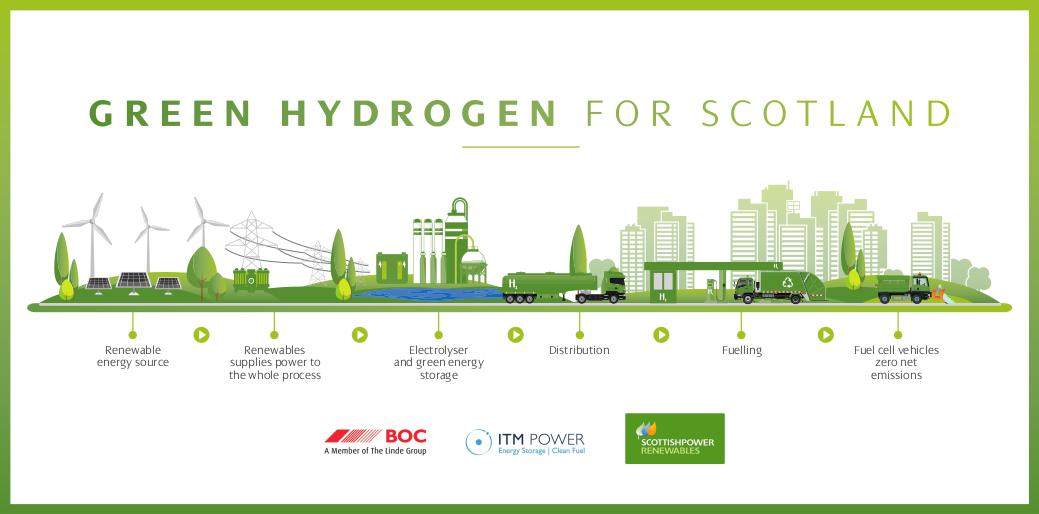
Surely it should be called tartan hydrogen. Does anybody know a tartan containing the blue of Scotland, the white of Yorkshire and the black, red and gold of Germany?
JCB Unveils World’s First Hydrogen Digger
The title of this post is the same as that of this article on International Vehicle Technology.
The signs have been there for some time.
- JCB are one of the backers of ITM Power, who make large scale electrolysers in Rotherham.
- Jo Bamford has a hydrogen company called Ryze Hydrogen.
- Jo Bamford took over Wrightbus and is saying he’ll be building thousands of hydrogen buses a year.
- Ryze Hydrogen have planning permission for a giant hydrogen electrolyser at Herne Bay.
To me, it is totally logical, that JCB build a hydrogen-powered digger.
And it appears they have got there first!
What Does the Future of Offshore Wind Energy Look Like?
The title of this post, is the same as that of this article on Real Clear Energy.
These topics are covered.
- Improved efficiency
- Aerodynamic blades
- Sturdiness and durability
- Big data, the cloud and artificial intelligence
- Drones
- Floating turbines and deeper waters
- Complicated coastal climate zones of which North America has eight.
Some topics weren’t covered.
- Artificial islands like the Dutch, German and Danish plan for The North Sea Wind Power Hub on the Dogger Bank.
- Conversion of wind power to hydrogen at or near the offshore turbines, which I wrote about in ITM Power and Ørsted: Wind Turbine Electrolyser Integration.
The author finishes with this statement.
The integration of wind energy, in any form, can ultimately benefit all 50 states in the US by 2050 if it starts now.
In 1962, Bob Dylan, wrote this famous phrase.
The answer, my friend, is blowin’ in the wind.
Fifty-eight years later he’s been proven right, in a big way!
South Korea Is On The Hunt For An Overseas Hydrogen Production Location
The title of this post, is the same as that of this article on Hydrogen Fuel News.
It is an interesting article, which talks about how both South Korea and Japan are looking to source hydrogen from another country and how Australia is in prime position.
This Wikipedia entry, which is entitled Energy In South Korea, has this breakdown of electricity production in South Korea.
- Thermal – 65.3%
- Nuclear – 31.1%
- Hydro – 1.6%
- Other – 2%
Note that at the time of writing the UK is producing 39.0% of electricity from renewables and 15.9% from low-carbon sources.
Consider.
- As South Korea imports a lot of liquified natural gas and has no oil or gas resources of its own, importing hydrogen is just replacing a carbon-dioxide producing fuel with a zero-carbon one, that is produced from renewables.
- Other than Australia, other possible sources of hydrogen mentioned include Saudi Arabia and the United States, but is their hydrogen produced from renewables or steam-reforming of methane?
- I suspect another could be South Africa, as they can develop a lot of wind power around the Cape.
I think we’ll see more countries going down the same route as Japan and South Korea and importing large quantities of hydrogen.
- Countries with lots of renewables like geothermal, hydro, solar and wind will benefit.
- Countries with plenty of gas can use steam-reforming to create hydrogen.
But surely, the biggest beneficiaries will be world-class companies, like ITM Power in Rotherham, who build electrolysers.
Do We Need A UK Lithium-Ion Battery Factory?
My post, Gore Street Acquires 50MW Ferrymuir Battery Project, Eyes More In Scotland and the article on the Energyst with the same name, got me thinking.
It was this statement about Gore Street Energy Fund, that really started the thought.
The fund said the addition takes its portfolio built or under development to 293MW and added that is has options for a further 900MW.
Gore Street obviously have the money to build all of this energy storage.
- I have also looked at some of their projects on Google Maps and there are still plenty of sites on green- or brown-field land close to electricity sub-stations, where energy storage would be easy to connect.
- I suspect, they have some good engineers or electricity marketing specialists available.
- My worry, would be, with many countries going the energy storage route, is there enough capacity to build all the batteries we need.
We have three routes, we could easily take in this country.
- Convert suplus energy to hydrogen using electrolysers from ITM Power in Rotherham.
- Develop some BALDIES (Build Anywhere Long Duration Intermittent Energy Storage). British technology is available as the CRYObatteryfrom Highview Power, who signed to build their first full-size plant in the UK, last week.
- Build a lithium-ion battery factory. Preferably of the next generation, so that battery vehicles will go further on a charge.
It is my view, that we should do all three!
Will Gore Street, add a BALDIES to their portfolio of lithium-ion energy storage.
- In World First As Liquid-Air Energy Storage Makes Commercial Debut Near Manchester United Ground, I gave costs of £110/MWh for a CRYObattery and £231-470/MWh for lithium-ion batteries.
- Nothing exotic like lithium is needed to build a CRYObattery.
- Highview claim they can build bigger batteries than Elon Musk.
- They wouldn’t be the first substantial order.
I think the decision makers at Gore Street would sleep comfortably in their beds if they bought a CRYObattery for a location, that needed a larger battery.
Conclusion
As to the answer to my question, the answer is yes, as mobile application will need more and better batteries and on balance, we should have our own supply.
 The Anonymous Widower