Are The Office Of Rail And Road (Or Their Lawyers) Too Risk Averse?
An article in the April 2022 Edition of Modern Railways is entitled Uckfield Third Rail Is NR Priority.
This is the first two paragraphs.
Electrification of the line between Hurst Green and Uckfield in East Sussex and the remodelling of East Croydon are the top Network Rail investment priorities south of the river, according to Southern Region Managing Director John Halsall. He told Modern Railways that third rail is now the preferred option for the Uckfield Line, as it would allow the route to use the pool of third-rail EMUs in the area. This is in preference to the plan involving overhead electrification and use of dual-voltage units put forward by then-Network Rail director Chris Gibb in his 2017 report (p66, September 2017 issue).
NR has put forward options for mitigating the safety risk involved with the third-rail system, including switching off the power in station areas when no trains are present and section isolation systems to protect track workers. ‘The Office of Rail and Road hasn’t yet confirmed third rail would be acceptable, but we are working out ways in which it could be’ Mr Halsall told Modern Railways. He added that bi-mode trains with batteries were not a feasible option on this line, as the 10-car trains in use on the route would not be able to draw sufficient charge between London and Hurst Green to power the train over the 25 miles on to Uckfield.
As an Electrical Engineer, who’s first real job in industry at fifteen was installing safety guards on guillotines nearly sixty years ago, I don’t believe that an acceptable solution can’t be devised.
But as at Kirkby on Merseyside, the Office Of Rail And Road, do seem to be stubbornly against any further third-rail installations in the UK.
I wonder what, the Office Of Rail And Road would say, if Transport for London wanted to extend an Underground Line for a few miles to serve a new housing development? On previous experience, I suspect Nanny would say no!
But is it more than just third-rail, where the Office Of Rail And Road is refusing to allow some technologies on the railway?
Battery-Electric Trains
I first rode in a viable battery-electric train in February 2015, but we still haven’t seen any other battery-electric trains in service on UK railways running under battery power.
Does the Office Of Rail And Road, believe that battery-electric trains are unsafe, with the lithium-ion batteries likely to catch fire at any time?
Hydrogen-Powered Trains
The hydrogen-powered Alstom Coradia iLint has been in service in Germany since September 2018.
But progress towards a viable hydrogen train has been very slow in the UK, with the only exception being demonstrations at COP26.
Are The Office Of Rail And Road still frightened of the Hindenburg?
Although hydrogen-powered buses have been allowed.
A Tale From Lockheed
When Metier Management Systems were sold to Lockheed, I worked for the American company for a couple of years.
I met some of their directors and they told some good American lawyer jokes, such was their disgust for the more money-grabbing of the American legal profession.
At the time, Flight International published details of an innovative landing aid for aircraft, that had been developed by Lockheed. It was a suitcase-sized landing light, that could be quickly setup up on a rough landing strip, so that aircraft, like a Hercules, with an outstanding rough field performance could land safely.
I read somewhere that a Flying Doctor service or similar had acquired some of these landing aids, so they could provide a better service to their clients.
But Lockheed’s lawyers were horrified, that they would get sued, if someone was seriously injured or even died, whilst the aid was being used.
Apparently, in the end, the aids were marked Not For Use In The USA.
Conclusion
I do wonder, if third-rail electrification, battery-electric trains and hydrogen-powered trains have come up against a wall created by over-cautious lawyers.
Effort To Contain Costs For Hoo Reopening
The title of this post, is the same as that of an article in the April 2022 Edition of Modern Railways.
This is the first paragraph.
Medway Council is working with Network Rail and other industry players in an effort to make restoration of a passenger service to Hoo on the Isle of Grain branch feasible. The Council was awarded £170 million from the Housing Infrastructure Fund in 2020 to support schemes to facilitate building of 12,000 new houses in the area, with £63 million of the HIF money for reinstatement of services on the Hoo Branch.
The article mentions, this new infrastructure.
- A new station South of the former Sharnal Street station.
- Works to level crossings, of which there are six between Gravesend station and proposed site of the new Hoo station.
- A passing place at Hoo Junction, where the branch joins the North Kent Line.
- A passing place at Cooling Street.
Note.
- The single-platform Bow Street station cost £8 million.
- The single-platform Soham station cost nearly £22 million, but it has a bridge.
- Reopening the Okehampton branch and refurbishing Okehampton station cost £40 million.
I think costs will be very tight.
Possible Train Services
This is said in the article about the train service on the branch.
While third rail electrification was originally proposed, this idea has been discarded in favour of self-powered trains on the branch, such as battery-operated trains. Possible destinations include Gravesend, Northfleet or Ebbsfleet for interchange with trains going to London, or extension of London to Dartford or Gravesend services over the branch, using hybrid third-rail/battery trains.
Consider.
- Merseyrail will be using battery-electric trains to provide services to the new Headbolt Lane station, as permission was not available for extending the existing third-rail track.
- Electrification would probably cost more than providing a charging system at Hoo station.
- Turning the trains at Gravesend, Northfleet or Ebbsfleet could be difficult and a new bay platform would probably break the budget.
- Both Dartford and Gravesend have two trains per hour (tph), that could be extended to the new Hoo station.
- Hoo junction to Hoo station is no more than five or six miles.
- There are also half-a-dozen level crossings on the route, which I doubt the anti-thord rail brigade would not want to be electrified.
- The Dartford services have a possible advantage in that they stop at Abbey Wood station for Crossrail.
- It may be easier to run services through Gravesend station, if the terminating service from Charing Cross were to be extended to Hoo station.
- A two tph service between London Charing Cross and Hoo stations, with intermediate stops at at least London Bridge, Lewisham, Abbey Wood and Dartford would probably be desirable.
I feel that the most affordable way to run trains to Hoo station will probably be to use battery-electric trains, which are extended from Gravesend.
It may even be possible to run trains to Hoo station without the need of a charging system at the station, which would further reduce the cost of infrastructure.
Possible Trains
Consider.
- According to Wikipedia, stopping Gravesend services are now run by Class 376, Class 465, Class 466 and Class 707 trains.
- Real Time Trains indicate that Gravesend services are run by pathed for 90 mph trains.
- Class 376, Class 465 and Class 466 trains are only 75 mph trains.
- Class 707 trains are 100 mph trains and only entered service in 2017.
I wonder, if Siemens designed these trains to be able to run on battery power, as several of their other trains can use batteries, as can their New Tube for London.
In Thoughts On The Power System For The New Tube for London, I said this.
This article on Rail Engineer is entitled London Underground Deep Tube Upgrade.
This is an extract.
More speculatively, there might be a means to independently power a train to the next station, possibly using the auxiliary battery, in the event of traction power loss.
Batteries in the New Tube for London would have other applications.
- Handling regenerative braking.
- Moving trains in sidings and depots with no electrification.
It should be born in mind, that battery capacity for a given weight of battery will increase before the first New Tube for London runs on the Piccadilly line around 2023.
A battery-electric train with a range of fifteen miles and regenerative braking to battery would probably be able to handle a return trip to Hoo station.
An Update In The July 2022 Edition Of Modern Railways
This is said on page 75.
More positive is the outlook for restoration of passenger services on the Hoo branch, where 12,000 new houses are proposed and Medway Council is looking to build a new station halfway down the branch to serve them. As the branch is unelectrified, one idea that has been looked at is a shuttle with a Vivarail battery train or similar, turning round at Gravesend or another station on the main line.
Steve White worries that this could mean spending a lot of money on infrastructure work and ending up with what would be a sub-optimal solution. ‘Do people really want to sit on a train for 10 minutes before having to get out and change onto another train? I don’t think so. Ideally what you want is through trains to London, by extending the Gravesend terminators to Hoo.’
That would require a battery/third rail hybrid unit, but Mr. White thinks that is far from an outlandish proposal; with Networker replacement on the horizon, a small bi-mode sub-fleet could dovetail neatly with a stock renewal programme. Medway Council and rail industry representatives are working on coming up with a solution for Hoo that could do what it does best; facilitating economic regeneration in a local area.
Note that Steve White is Managing Director of Southeastern.
I’ll go along with what he says!
Conclusion
I believe that a well-designed simple station and branch line could be possible within the budget.
A battery-electric upgrade to Class 707 trains could be a solution.
But the trains could be very similar to those needed for Uckfield and to extend electric services in Scotland.
Advance Warning Of Brixton To Beckenham Junction Rail Closure In July
The title of this post, is the same as that of this article on Ian Visits.
These are the first two paragraphs.
In late July, the railway between Brixton and Beckenham Junction will be closed for 9-days as Network Rail carry out a major upgrade of the tracks in the Penge railway tunnel.
Over the 9-day closure Network Rail says that it will be delivering a £4.5 million investment to replace the tracks through the Penge tunnel to help improve train service reliability. During the works, they will be replacing 3,970 metres of track in total, using engineering trains, road-rail vehicles and other heavy machinery to complete the work.
The railway will be closed between Herne Hill and Beckenham Junction stations for the week of Saturday 23rd to Sunday 31st July 2022.
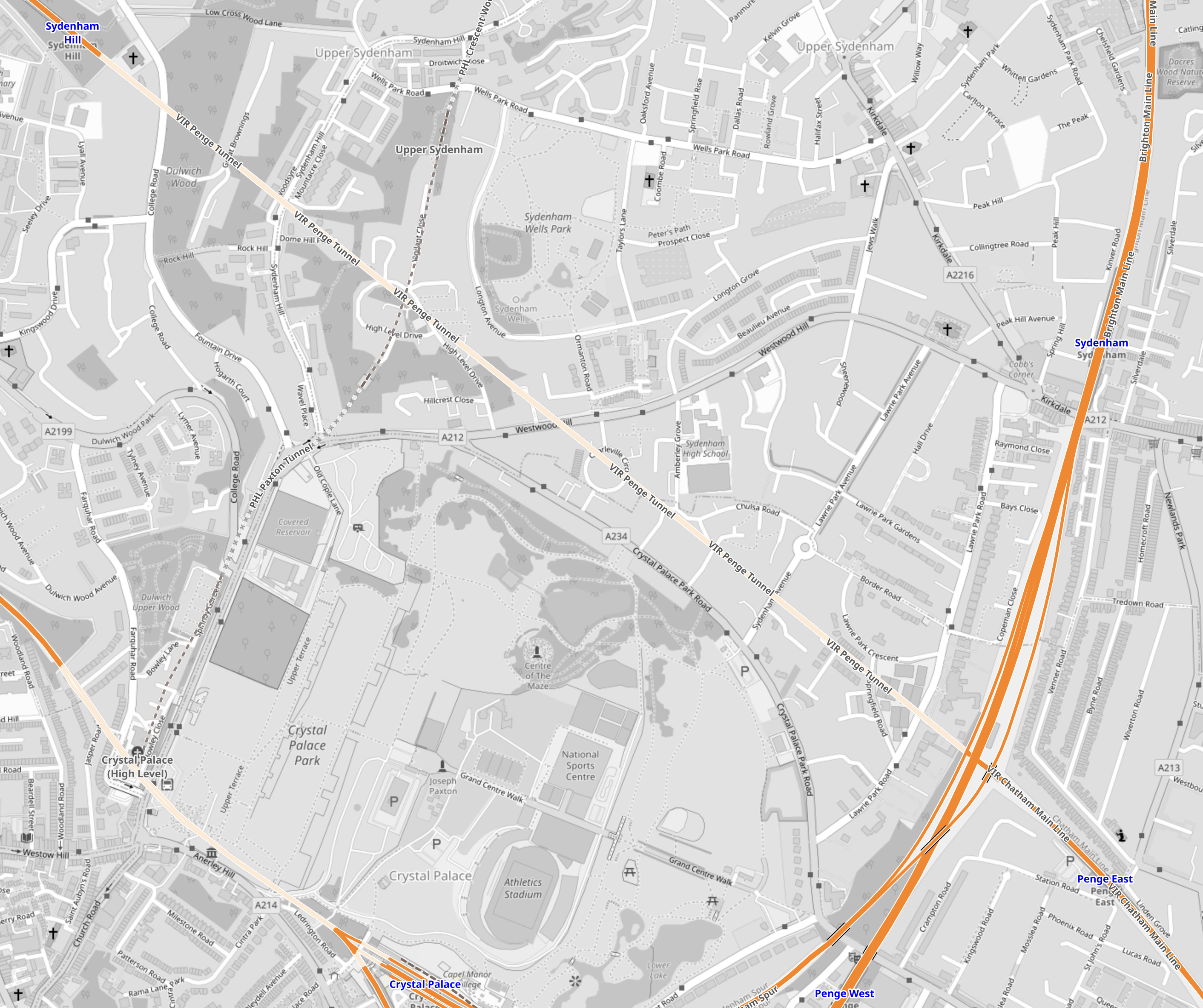
This map from OpenRailwayMap shows the tunnel.
Note.
- The North-South railway is the Brighton Main Line, that passes through Sydenham and Penge West stations.
- The NW-SE railway is the Chatham Main Line, with Sydenham Hill station in the North-West and Penge East station in the South-East.
- Penge East Station – 11th March 2022 shows the station and the distance to Penge Tunnel.
- Sydenham Hill Station – 11th March 2022 shows the station and Penge Tunnel.
- Penge Tunnel is between the two stations and is shown in cream.
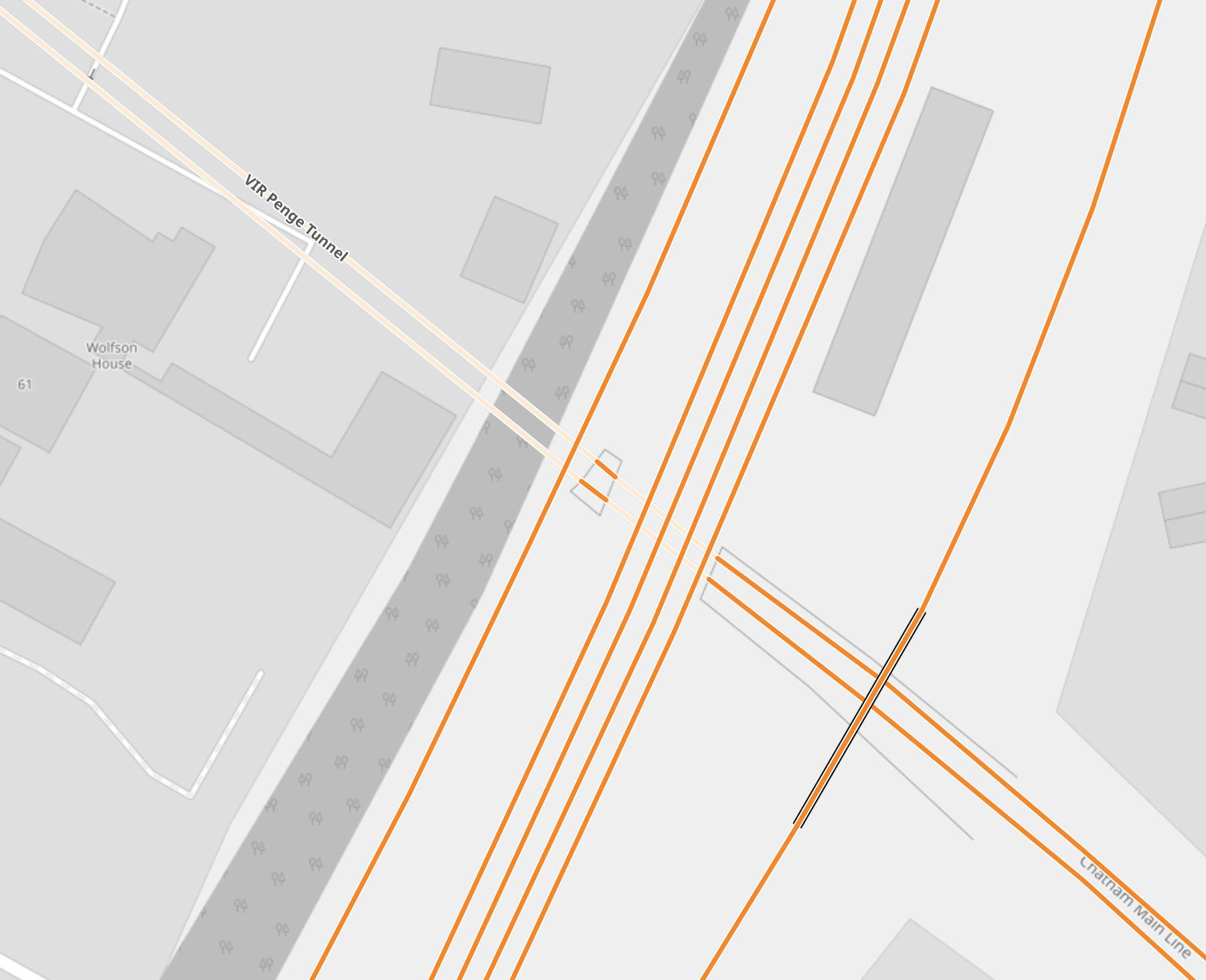
This second map, shows where the two lines cross.
In Penge Interchange, I described how Transport for London would like to build a new Penge Interchange station to possibly replace both Penge East and Penge West stations.
- It could be fully step-free.
- The station would be built on railway land.
- It would have four tph between Victoria and Bromley South stations.
- It would have four tph between Highbury & Islington and West Croydon stations.
- It would have two tph between London Bridge and Caterham stations
- It might also be possible to have platforms on the Crystal Palace branch, thus adding six tph between Highbury & Islington and Crystal Palace stations.
- The station could have Thameslink platforms.
I feel it would offer the following benefits.
- Better connection between South East and North London, without going through Central London.
- Better connection between South East London and Crossrail, with all its connections.
- Closure of the two older Penge stations.
I hope that whilst the railway is closed for the relaying of track, that Network Rail will do a full survey to at least find out whether a Penge Interchange station is feasible.
Timber Freight Train Runs For First Time In 18 Years
The title of this post, is the same as that of this article on Rail Technology Magazine.
These are the first two paragraphs.
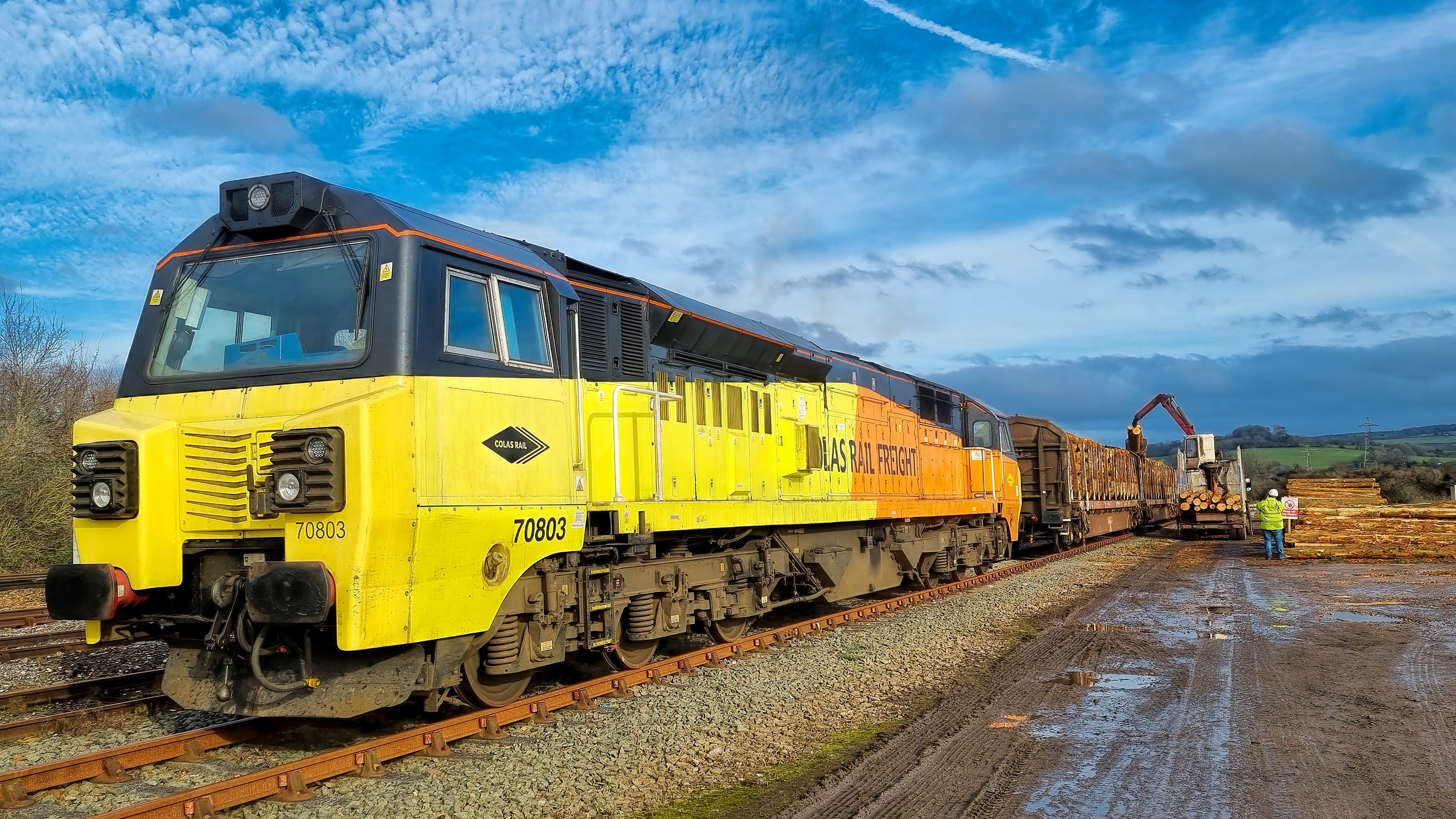
Network Rail has partnered with Colas Rail in a pilot project to run a timber freight train for the first time in 18 years.
A sawmill in Abergavenny has received the first rail-transported timber since 2004 which was transported 92 miles from Hackney Yard near Newton Abbot.
I do wonder how many other specialised freight trains like these could be run.
As it was only 320 tonnes on eight wagons, it was probably hauled by a diesel Class 66 or Class 70 locomotive.
If there were hydrogen-powered locomotives available, would this encourage more companies to switch from road to rail.
It also appears that for this movement, Network Rail had strengthened a bridge. Are there enough yards, where heavy trucks can access the railway?
Timber Imports
With the situation in Ukraine, I wondered if we imported any timber from Russia, that could perhaps be replaced by locally-grown timber.
I found this page on the Forest Research web site from the UK Government, which is entitled Origin Of Wood Imports.
Our biggest timber imports from Russia are wood pellets and plywood.
Wood pellets are an obvious import, as we also import large amounts from the United States and Canada and all three countries have extensive forests and I suspect they all produce large amounts of woody waste, that is only suitable for making into pellets.
Are we recycling scrap wood and woody waste, as best we can in the UK or are we just burning it on bonfires? The guy opposite lost a tree in the recent storms and a tree surgeon came with a special truck and a shredder to reduce it to small pieces of woody waste. Did that go to make pellets for Drax and other boilers that burn them?
It strikes me, that there may be opportunities For creating or enlarging our own wood pellet industry to cut imports.
Plywood comes mainly from China (37 %), Brazil (18 %), Finland (9 %) and Russia (8 %). Of these, I suspect only one has good environmental standards.
As this softwood plywood for lower-grade applications only needs wood from trees, that we can grow in this country, perhaps we should make a lot more in automated plants.
I’m sure Network Rail would be happy to arrange the transport.
Are Network Rail Clearing Up The Hall Farm Curve?
I passed the Hall Farm Curve today and took these pictures.




Note.
- The truck appears to be one of Network Rail’s.
- It looks like there’s ongoing work at the other end of the chord, where it joins the West Anglia Main Line.
It’s been in a derelict state for years, so why are they tidying up now?
Engineers At Network Rail Are Building A Tiny Railway Crossing For Wild Hazel Dormice To Help Protect The Endangered Species From Extinction
The title of this post is the same as that of this article on Railway News.
This is the brief introductory paragraph.
This dormouse bridge will be the first of its kind. It will be built in summer 2022 on the Furness line in Lancashire.
Let’s hope after all this care and work, the dormice like it.
Nuggets From The Union Connectivity Review
The Union Connectivity Review has now been published and it can be read online.
This paragraph outlines the objective of the Review.
The UK Government asked Sir Peter Hendy CBE to undertake a detailed review into how transport connectivity across the UK can support economic growth and quality of life in England, Scotland, Wales and Northern Ireland.
Sir Peter was also asked to make recommendations as to whether and how best to improve transport connectivity between the nations of the UK.
Sir Peter Hendy is the Chairman of Network Rail.
In no particular order, these are some nuggets from the review.
The Case For UKNET – A Strategic Transport Network For The Whole United Kingdom
This paragraph introduces the case for UKNET.
Having identified the importance of good connections across internal borders and the challenges that currently prevent a pan-UK strategic vision or investment strategy, the Review recommends that the UK Government develop UKNET – a strategic transport network for the whole United Kingdom which would connect all the nations of the
UK, with appropriate funding and coordination with the devolved administrations to deliver it.
The creation only follows best practice from the European Union and large countries like the United States.
These three paragraphs sum up how UKNET would work and how it would bring benefits to the whole of the UK.
UKNET would provide a network into which transport investment would be made on a pan-UK basis to support economic growth, jobs, housing and social cohesion, across the nations of the UK, for the benefit of the whole country.
It would allow transport appraisals for schemes on the network to be undertaken on a UK-wide basis with all costs and benefits being fully accounted for. This would limit the risk of cross-border schemes being deprioritised.
The development of such a network would provide additional certainty for businesses and the private sector, allowing them to plan complementary investments in specific regions and to invest in the supply chain across the country.
I think overall that UKNET is sound thinking, but my only feeling is that it should also look at transport links to and from the whole island of Ireland.
The Case for Faster Rail Journey Times Between England And Scotland
These three paragraphs probably apply to most rail journeys in the world, that compete against air and road travel.
Both the UK and Scottish Governments have previously agreed to develop options which could support a rail journey time between London and Scotland of three hours. A journey time improvement of this size, even when compared to expected journey times once HS2 opens, would dramatically increase the number of people travelling by rail.
There is a correlation between journey times and how many people choose to travel by rail over air. If it takes the same amount of time to travel by rail or by air, the evidence shows that people choose to travel by rail. Rail is typically favoured when the journey time is around three hours between city centres.
Work undertaken by Network Rail and HS2 Ltd on behalf of the Review has demonstrated the potential for increased trips by rail if journey times are reduced. For assurance purposes, two forecasting models were used to assess savings of 20, 35 and 50 mins on the journey times forecast for HS2 Phase 2b. The outcomes for both models were broadly similar and the approach built upon the changes in mode share observed between rail and aviation following previous UK and European rail investments.
Three hours between London and Scotland could be a tough ask.
Note these points about the East Coast Main Line.
- An InterCity 225 ran between London and Edinburgh on the 26th September 1191 in three hours and 29 minutes.
- Full digital in-cab signalling will allow running at 140 mph.
- There are improvements to come on the East Coast Main Line.
- As now, the review says two tph will run between London and Edinburgh.
- London Kings Cross and Edinburgh is 393 miles
- On the East Coast Main Line a non-stop train between would need to average 131 mph.
Three hours is tough but not impossible.
And these points about the West Coast Main Line.
- Trains will run on High Speed Two between London Euston and Crewe.
- High Speed Two are claiming fifty-six minutes between London Euston and Crewe.
- Full digital in-cab signalling will allow running at 140 mph.
- Crewe and Glasgow Central is 243.4 miles.
- Current fastest time between Crewe and Glasgow Central is three hours and five minutes.
- Between Crewe and Glasgow Central, a non-stop train would need to average 118 mph.
A well-driven InterCity 125, with a clear track, could average that speed between Crewe and Glasgow Central.
Three hours is tough but very possible.
This paragraph sums up the mode shift expected between air and road to rail.
These initial estimates indicated that a three-hour journey time was forecast to increase the number of passengers by around four million a year and increase rail mode share from the 2019 level of 29% to around 75%. It was also forecasted that journey times in the region of three hours would generate considerable transport user benefits and revenues over the lifetime of the scheme.
People travelling from the Midlands and North West England to and from Scotland would also get substantial reductions in journey times.
Linking High Speed Two With The WCML
The review says this about linking High Speed Two with the West Coast Main Line.
The UK Government has already acknowledged some of the issues identified by the Review. The ‘Golborne Link’—the current proposed connection between HS2 and the WCML—is expected to deliver quicker journey times and more capacity between England and Scotland and resolve some of the constraints between Crewe and Preston.
However, the ‘Golborne Link’ does not resolve all of the identified issues. The suitability of alternative connections between HS2 and the WCML have been considered by the Review. The emerging evidence suggests that an alternative connection to the WCML, for example at some point south of Preston, could offer more benefits and an opportunity to reduce journey times by two to three minutes more than the ‘Golborne Link’. However, more work is required to better understand the case for and against such options.
These benefits could also include additional operational flexibility when timing freight services and less disruption to the WCML than major upgrades as most construction could take place away from the railway.
An infrastructure philosophy is also detailed.
- Replacing and enhancing track, signalling and power supply.
- Possible new sections of line north of Preston.
- Maximising of line speed.
My feeling is that for good project management reasons and to give faster journey times with the existing trains, that a lot of these improvements should be started as soon as possible.
Borders Railway
The Review says this about the Borders Railway.
Communities in the Scottish Borders region are enthusiastic about the economic and social benefits they see resulting from an extension of the Borders Railway south, across the border, to Carlisle.
The Review also welcomes the £5 million in funding that the UK Government has made available for the development of a possible extension to the Borders Railway which would support improved connections to and from Scotland and with the WCML at Carlisle.
I would build this early, as when the West Coast Main Line is being upgraded between Carlisle and Glasgow, this would be available as a diversion route.
Perhaps too, the Glasgow South Western Line should be improved and electrified as well.
Air Passenger Duty
The Review has a sizeable session on Air Passenger Duty, where it concentrates on the problems of its application to domestic flights.
The Review makes this recommendation.
Where journeys are too long to be reasonably taken by road or rail, the UK Government should reduce the rate of domestic aviation tax.
I believe that before the end of this decade, there will be smaller zero-carbon airliners, that will be ideal for domestic routes, which could totally change the regime of domestic Air Passenger Duty.
Decarbonisation And The Future Of Flight
This is a section in the Review, where this is the first paragraph.
In July 2021, the Department for Transport published the Jet Zero Consultation: a consultation on our strategy for net zero aviation127, alongside the Transport Decarbonisation Plan. This includes the ambition to have zero-emission routes connecting different parts of the UK by 2030 and a commitment to assess the feasibility of serving PSO routes with low carbon aviation. The Review welcomes the commitments made in both publications to accelerate the uptake of sustainable aviation fuels (SAFs) and develop low and zero-emission aircraft.
The Review goes on to make two recommendations.
- Drive the uptake of sustainable fuels and zero emission technologies on domestic aviation through a combination of incentives, tax benefits and subsidies to make the UK a world leader in developing these fuels and technologies.
- Support the development of sustainable aviation fuel plants in parts of the United Kingdom that are particularly reliant on aviation for domestic connectivity.
Note.
- PSO means Public Service Obligation.
- One of the world leaders in the field of sustainable aviation fuels is Velocys, which is a spin out from Oxford University.
- The Review also suggests building a sustainable aviation fuel plant in Northern Ireland.
The Review gives the impression it is keen on the use of sustainable aviation fuel
Conclusion
There are some good nuggets in the sections I have read in detail.
This post is not finished and there will be additions to the list.
The Integrated Rail Plan For The North And Midlands And The East Coast Main Line
Note that this is not a finished post.
To read the The Integrated Rail Plan For The North And Midlands (IRP), click this link.
There is a section in the IRP called Serving Leeds, York and North East England.
It is a section of six paragraphs and I shall describe their contents in detail separately.
Paragraph 3.41
This is said in the IRP.
Under the original plans, HS2 trains would have served Leeds, York and North East England via the West Midlands, with the Eastern Leg branching off from the Phase One line just north of Birmingham Interchange.
This is a significantly longer route than the current East Coast Main Line from King’s Cross, which goes directly up the eastern side of the country.
Due to capacity constraints north of Doncaster HS2 trains to Newcastle and York could also only be accommodated at the expense of existing services, potentially reducing or removing connections between the North East and Doncaster, Newark and Peterborough.
Unlike the West Coast Main Line, there is also potential to lengthen existing trains by up to three carriages, increasing the number of seats on those trains by around 40%.
Geography wins and I’ll discuss the train lengthening later.
Paragraph 3.42
This is said in the IRP.
The IRP has concluded in favour of a significant package of upgrades to the East Coast Main Line which could deliver similar journey times to London and capacity improvements for York and the North East as the original proposals – but many years sooner, and with operational carbon savings because trains will be taking a shorter route.
Speed is important in both project delivery and running of the trains.
Paragraph 3.43
This is said in the IRP.
We are therefore taking forward a substantial package of investment for the East Coast Main Line between London and Leeds and the North East, subject to future business case. Development work will consider interventions from both NPR designs undertaken by Network Rail, mainly focussed on York and northwards, and work undertaken by Mott MacDonald for the Department for Transport focused on the line south of York. North of York we will look to increase the number of paths for long distance high speed trains from 6 to 7 or 8 per hour. In addition to the already planned roll-out of digital signalling, work is expected to include looking at opportunities to improve rolling stock performance; power supply upgrades to allow longer and faster trains; route upgrades to allow higher speeds, including of up to 140mph on some sections; measures to tackle bottlenecks, for example south of Peterborough and at stations and junctions such as Newark, Doncaster, York, Northallerton, Darlington and Newcastle all of which limit speed and capacity; and to replace level crossings where needed.
We will ask Network Rail to now take forward these proposals, including considering any alternatives which may deliver better outputs and/or more cost-effective solutions.
I’ll discuss a lot of this later in more detail.
Paragraph 3.44
This is said in the IRP.
This package is intended to:
-
- Cut journey times from London to a range of destinations, including Leeds, Darlington, Northallerton, Durham, and Newcastle by up to 28 minutes, bringing journey times closer to those proposed by HS2, much earlier than previously planned;
- Allow the introduction of longer trains, increasing the number of seats;
- Provide 7–8 long distance high speed paths per hour north of York to Newcastle, compared to the current 6 paths (and so allowing a minimum of two fast Manchester to Newcastle services each hour alongside other ambitions);
- Improve performance and reliability, enabling faster and more reliable services for passengers.
I’ll discuss a lot of this later in more detail.
Paragraph 3.45
This is said in the IRP.
Journey times from London to Newcastle under this plan could be as little as 2 hrs 25-28 minutes (subject to stopping pattern), about 21-24 minutes faster than now and 8 minutes slower than under the full HS2 plans.
Journey times to York and Darlington under this plan would be about 15 minutes faster than now and 12-14 minutes slower than under the full HS2 plans.
Journey times from London to Leeds, at around 1 hour 53, would be about 20 minutes faster than now, but 32 minutes slower than under the full HS2 plans.
I’ll discuss a lot of this later in more detail.
Paragraph 3.46
This is said in the IRP.
Journey times from Birmingham to Leeds would be around 30 minutes faster than the current typical time, and, subject
to further analysis, York and the North East could be would be around 30 minutes faster than the current typical time,
via HS2 Western Leg, Manchester and NPR (based on indicative train service).
I’ll discuss a lot of this later in more detail.
My Thoughts
These are my thoughts.
Longer Trains
This is said in Paragraph 3.41
Unlike the West Coast Main Line, there is also potential to lengthen existing trains by up to three carriages, increasing the number of seats on those trains by around 40%.
The Hitachi Class 800, Class 801, Class 802 and Class 803 trains, that run the routes out of King’s Cross come in lengths of five, nine and ten coaches.
- The maximum length of an individual train is twelve cars according to this Hitachi document.
- All destinations with the possible exception of Harrogate, Lincoln and Middlesbrough can handle the current nine-car trains.
- Lengthening a five-car train by three cars would increase capacity by 60 %. You’d just run a current nine-car train.
- Lengthening a nine-car train by three cars would increase capacity by 33.3 %. Poor maths but possible.
- Lengthening a ten-car train by three cars would increase capacity by 30 %. Two trains would have to be lengthened, as ten-car trains are a pair of five-car trains.
It looks to me that the IRP is talking about running twelve-car trains.
- The Hitachi trains are all plug-and-play.
- The main stations on the route are Doncaster, Edinburgh, King’s Cross, Leeds, Newcastle and York.
- Some platforms would need to be lengthened, but some like Edinburgh, Leeds and York are probably already long enough.
But what about the important London terminus at King’s Cross?
These pictures show the Northern ends of the platforms at King’s Cross station.
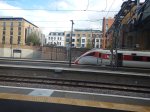
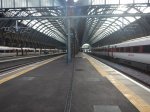
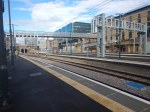
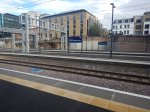
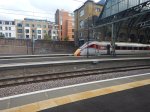
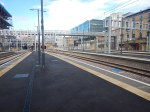
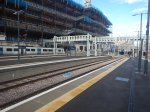
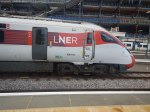
The two trains are both nine-car Hitachi Class 800 or Class 801 trains and I was standing in line with their noses.
I wonder what is the maximum length of trains that can be handled in these platforms.
- They can certainly handle ten-car trains, as LNER run these to Leeds.
- Looking at maps, I suspect that eleven-car trains could be the largest that can be handled.
I suspect it will be tight, but I suspect with a simple platform extension, twelve car trains could be accommodated in King’s Cross station.
Journey Times
These times come from High Speed Two’s Journey Planner and the IRP.
- London and Edinburgh – Three hours and forty-eight minutes – Four hours and nineteen minutes – Three hours and fifty-eight minutes – My estimate based on IRP figures
- London and Newcastle – Two hours and seventeen minutes – Two hours and forty-nine minutes – Two hours and 25-28 minutes
- London and Durham – Two hours and sixteen minutes – Two hours and fifty-five minutes – Two hours and forty minutes
- London and Darlington – One hour and fifty minutes – Two hours and twenty-two minutes – Two hours and seven minutes
- London and York – One hour and twenty-four minutes – Two hours and ten minutes – One hour and fifty-five minutes – My estimate based on IRP figures
- London and Leeds – One hour and twenty-one minutes – Two hours and thirteen minutes – One hour and fifty-three minutes
Note.
- The first time is that from High Speed Two, which assumes the Eastern Leg of High Speed Two has been built.
- The second time is the current best time via the East Coast Main Line.
- The third time is the IRP’s estimate via an upgraded East Coast Main Line.
- Where the estimates are mine it is noted.
London and York and London and Leeds are under two hours, London and Newcastle is under three hours and London and Edinburgh is under four hours.
Are these times fast enough for modal shift from the Air and Roads to Rail?
Project Delivery
Rail projects in the UK have a variable record in the delivering of projects on time and on budget.
I haven’t done the full analysis, but I do believe that smaller projects have a better record of delivery, based on media reports.
In Railway Restored: Regular Trains To Run On Dartmoor Line For First Time In 50 Years, Network Rail have delivered an important smaller project, for which I said.
Network Rail have set themselves a good precedent to open the line in nine months and £10 million under budget.
As the improvement of the East Coast Main Line is more of a succession of smaller projects, rather than one large project does this mean it is more likely to be delivered on time and on budget?
Extra Paths
This is said in Paragraph 3.43
North of York we will look to increase the number of paths for long distance high speed trains from 6 to 7 or 8 per hour.
One of the min reasons for building High Speed Two, but here we have extra capacity being created on the East Coast Main Line.
One extra path would be very good, but two would be excellent.
Power Supply Upgrades
In the last eighteen months, I’ve written two articles about updating of the power supply on the East Coast Main Line.
- East Coast Main Line Northern Power Supply Works Funded
- East Coast Main Line Electrification Research Agreement
The second article talks about the involvement of the University of Leeds to get the power supply to a high standard.
It does appear that Network Rail are doing all they can to enable the East Coast Main Line to handle the eight electric trains per hour
140 mph Running
There are several elements to the successful achievement of 140 mph running on a railway.
- The trains must be capable of running safely at 140 mph.
- The track must be able to support trains at that speed.
- The signalling must be in-cab and fully tested.
- The electrification must be designed for running at the required speed.
- The drivers must be fully trained.
Note.
- There are certainly 140 mph trains in service and there are tracks in the UK, where they can be tested at that speed.
- I wouldn’t be surprised as we have been running 140 mph InterCity 225 trains on the East Coast Main Line for thirty years, that a lot of the track is already profiled for 140 mph running.
- The digital signalling is being installed.
- The electrification on the East Coast Main Line has been dodgy for years, but is now being upgraded.
- Drivers are probably the least to worry about, as they probably know the route well and are honing their skills in simulators.
I can see 140 mph running being delivered in stages and on time.
Darlington Improvements
In First Phase Of ‘Transformational’ Darlington Rail Station Upgrade Approved, I said this about the improvements at Darlington station.
This upgrade is on the Eastern side of the current station and will include a new entrance, station building, concourse and three new platforms.
This design should allow the following.
-
- LNER, High Speed Two and other expresses not stopping at the Darlington station to pass through at speeds of up to 125 mph or more.
- Expresses stopping in the station will slow and accelerate in less time than they do now.
- It will probably allow more local trains to Bishops Auckland, Middlesbrough and Saltburn
A seventy-five percent increase in platforms probably offers other advantages.
This could knock several minutes off journey times.
York Improvements
I describe this problem and my solution in Improving The North Throat Of York Station Including Skelton Bridge Junction.
My solution won’t happen, as I advocate replacing the historic Skelton Bridge with a modern four-track bridge.
Effects On Lincoln Service
It will be interesting to see how the improvements to the East Coast Main Line effect LNER’s service between King’s Cross and Lincoln.
Any time improvements South of Newatk will surely be reflected in the time between King’s Cross and Lincoln.
Conclusion
The plan seems feasible to me.
Digital Signalling Work Outlined By Network Rail For Northern City Line
The title of this post, is the same as that of this article on Rail Business Daily.
This is the first paragraph.
Network Rail has detailed work due to be delivered on the Northern City Line to Moorgate.
I use this line regularly and I believe that with digital signalling the Northern City Line could see a large increase in frequency.
Currently, the service from Moorgate is as follows.
- 4 tph to Welwyn Garden City via Potters Bar
- 4 tph to Hertford North of which 2 tph extending to Watton-at-Stone and 1tph of those continuing to Stevenage.
Note.
- tph is trains per hour.
- Although the service is reduced from that shown, because of the pandemic and lower passenger demand.
But eight tph means a train every seven minutes and thirty seconds.
If you look at London’s high frequency lines, they have or will have passenger frequencies as follows.
- Crossrail – 24 tph on dedicated tracks with digital signalling.
- East London Line – 16 tph on dedicated tracks.
- North London Line – 8 tph on tracks shared with freight trains.
- Thameslink – 24 tph on dedicated tracks with digital signalling.
Note.
- The East London Line is planned to go to 20 tph with two extra tph to Clapham Junction and Crystal Palace.
- 20 tph means a headway between trains of three minutes.
- 24 tph means a headway between trains of two minutes and thirty seconds.
It should also be noted that the Victoria Line runs upwards of thirty tph on a fully digitally-signalled line.
What Level Of Service Would Be Possible?
These are my thoughts on various aspects of the Northern City Line.
How Many Trains Could Be Handled Between Finsbury Park And Moorgate?
This section of track is a simple double-track with a diamond crossing to the North of the two platforms at Moorgate, so that trains can use either platform.
This layout is used at Brixton and Walthamstow Central on the Victoria Line and Battersea Power Station on the Northern Line to name just three of many.
So I suspect that the track layout at the terminus at Moorgate can handle well-upwards of twenty tph.
The new Class 717 trains that run into Moorgate have an operating speed of 85 mph, which is faster than the previous Class 313 trains, which appear to have run at 30 mph South of Drayton Park.
I suspect that eventually twenty or even twenty-four tph will be possible on a digitally-signalled route between Finsbury Park and Moorgate.
But in the interim, sixteen tph would be a good compromise.
How Many Trains Could Be Handled On The Current Routes?
Currently, four tph use the both the Welwyn Garden City and the Hertford East/Stevenage routes.
I am fairly sure that both routes could handle eight tph, with the only proviso, that there is enough terminal capacity to turn the trains.
Looking at the layout of Welwyn Garden City station, I am certain that it could be modified to be able to handle eight tph.
I would hope that the new platform at Stevenage station, built to handle trains to and from Moorgate, can cater for four tph. As there are turnback platforms at Gordon Hill and Hertford North stations, I’m sure the other four tph could be handled.
The Piccadilly Line And The City of London
It has always been difficult to get between the Northern section of the Piccadilly Line and the City of London.
In the 1960s, I used to use my bicycle. By public transport, you generally had to use the bus or the 641 trolley bus to Moorgate.
With the improvement of the Northern City Line and Finsbury Park station, the fastest route to Moorgate is probably to change between the Piccadilly and Northern City Lines at Finsbury Park station.
Increasing the frequency of Northern City Line services between Finsbury Park and Moorgate would create a high-capacity route to the City for those commuting from the Northern section of the Piccadilly Line.
The Piccadilly Line And Crossrail
There is no connection between the Piccadilly Line and Crossrail.
A trip between Oakwood and Canary Wharf would be difficult.
As with getting to the City of London, the improvement of the Northern City Line and Finsbury Park station offers a route to Crossrail.
Oakwood and Canary Wharf would probably be done with changes at Finsbury Park and Moorgate.
The Victoria Line And The City of London
There is a cross-platform interchange at Highbury & Islington station between the Victoria and Northern City Lines.
With an increased frequency of Northern City Line services between Finsbury Park and Moorgate, I would expect that more people would use this route.
The Victoria Line And Crossrail
There is no connection between the Victoria Line and Crossrail.
The easiest route will be to take the route in the previous section and join Crossrail at Moorgate.
Conclusion
It does look that with the current routes sixteen tph to and from Moorgate could be a practical limit.
But that would still be a train every three minutes and forty-five seconds between Finsbury Park and Moorgate.
This increased frequency could be needed to create a high capacity link between the Northern sections of the Piccadilly and Victoria Lines and the City of London and Crossrail.
‘Box Structure’ Flyover Saves £70m And Six Months For East West Rail
The title of this post, is the same as that of this press release on Network Rail.
This is the first paragraph.
Engineers have saved £70m of taxpayers’ money by using creative new methods to build a railway flyover as part of the East West Rail project.
This Network Rail picture shows how the new flyover rests on a concrete box, that spans the West Coast Main Line (WCML).
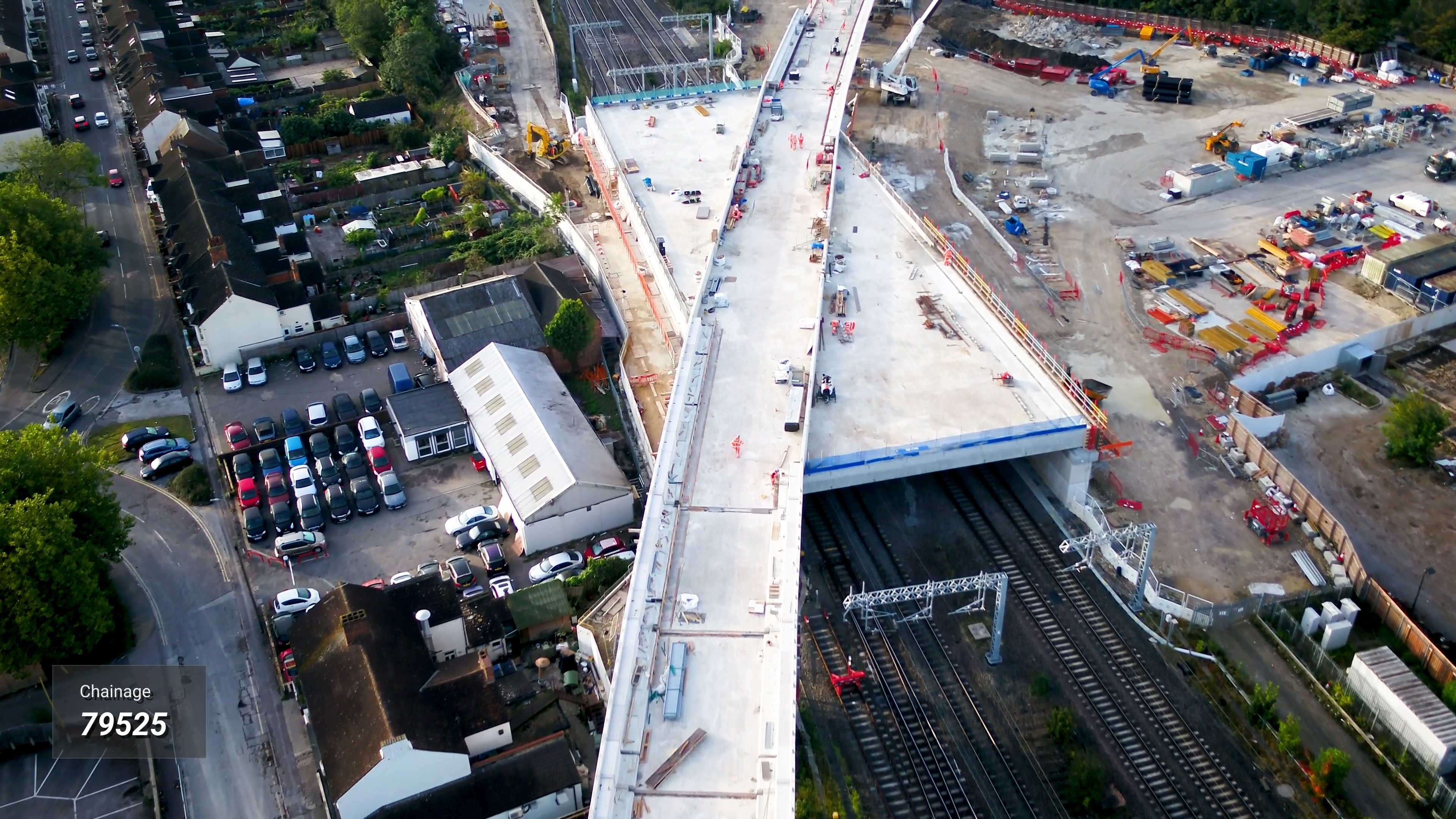
Note that the press release contains a video that explains how the flyover was replaced and why the method of construction saved all the money and time.
The main cost savings came about because of the following.
- Construction could go on above the WCML without having to stop the trains.
- Components for the flyover were made in a factory, with subsequent cost reductions and quality increases.
Anybody, who’s ever poured a concrete slab in typical British weather will understand the second point.
According to the press release, the method of construction gives a hundred and twenty year life span for the structure.
For comparison, this 3D Google Map visualisation shows the Hitchin flyover, which was opened in 2013.
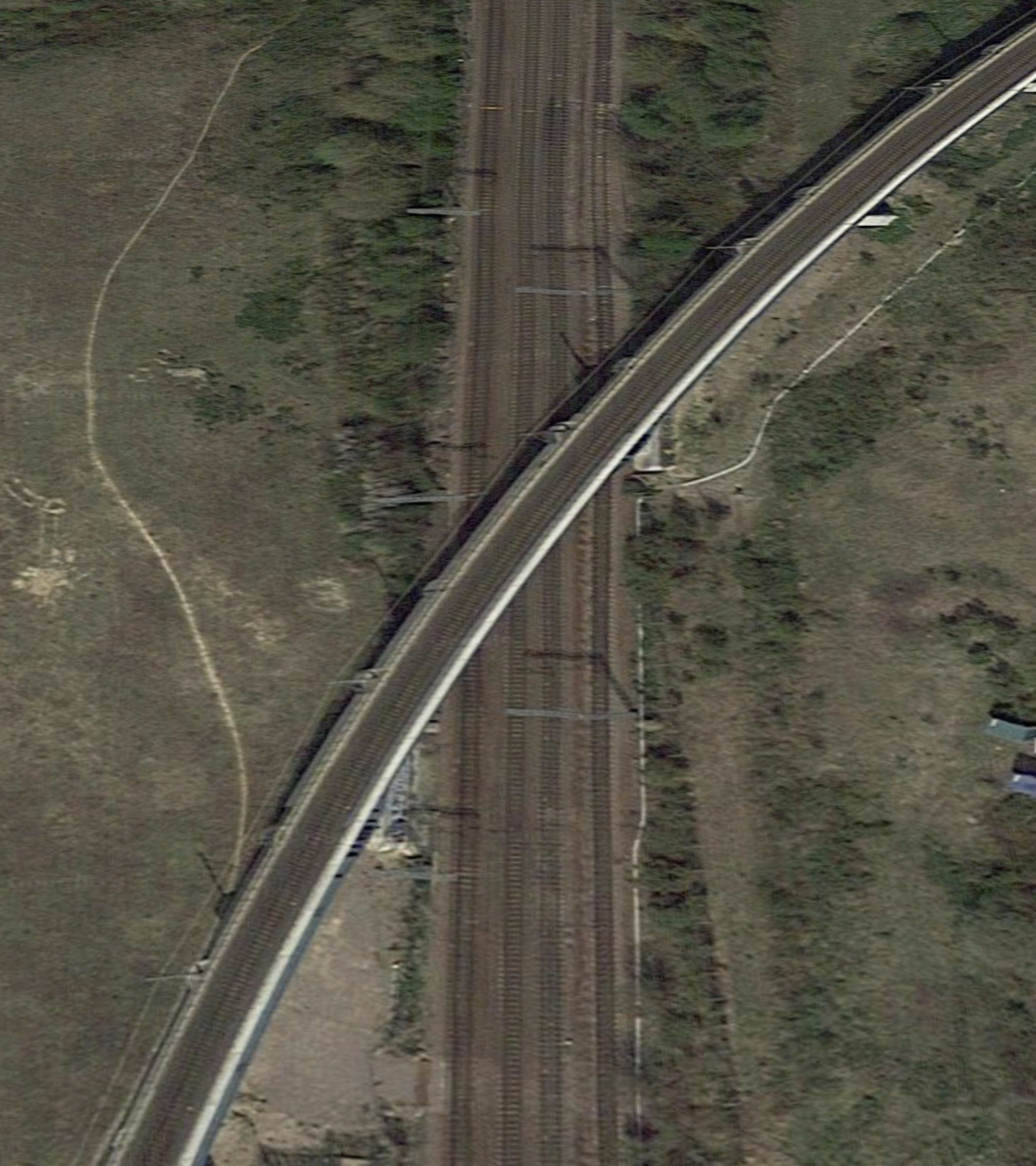
Note the columns supporting the single-track railway.
If this was being built today, would a box be used as at Bletchley?
 The Anonymous Widower