Centrica Really Can’t Lose At Sizewell
The title of this post, is the same as that of this article in The Times.
This is the sub-heading.
Centrica’s £1.3 billion investment in Sizewell C guarantees substantial returns, even with cost overruns.
These two-and-a-half paragraphs explain the funding.
Now we know what Ed Miliband means by his “golden age of nuclear” — golden for the companies putting their money into Sizewell C. Yes, reactor projects have a habit of blowing up private investors. But maybe not this one. It looks more like an exercise in transferring risk to consumers and the taxpayer.
Sure, nobody builds a £38 billion nuke on a Suffolk flood plain without a frisson of danger. But the energy secretary and his Treasury chums have done their bit to make things as safe as possible for the companies putting in equity alongside the government’s 44.9 per cent stake: Canada’s La Caisse with 20 per cent, British Gas-owner Centrica (15 per cent), France’s EDF (12.5 per cent) and Amber Infrastructure (7.6 per cent).
For starters, nearly all the debt for the 3.2 gigawatt plant, three-quarters funded by loans, is coming from the state-backed National Wealth Fund. It’s bunging in up to £36.6 billion, with £5 billion more guaranteed by a French export credit agency.
It looks to me that between them the British and French governments are providing £41.5 billion of loans to build the £38 billion nuke.
These are my thoughts.
Hydrogen And Sizewell C
This page on the Sizewell C web site is entitled Hydrogen And Sizewell C.
Under a heading of Hydrogen Buses, this is said.
At Sizewell C, we are exploring how we can produce and use hydrogen in several ways. We are working with Wrightbus on a pilot scheme which, if successful, could see thousands of workers transported to and from site on hydrogen double decker buses. You can read more about the pilot scheme in our press release
Firstly, it could help lower emissions during construction of the power station. Secondly, once Sizewell C is operational, we hope to use some of the heat it generates (alongside electricity) to make hydrogen more efficiently.
This would appear to be a more general statement about hydrogen and that the following is planned.
- Hydrogen-powered buses will be used to bring workers to the site. A press release on the Sizewell C web site, talks about up to 150 buses. That would probably be enough buses for all of Suffolk.
- Hydrogen-powered construction equipment will be used in the building of the power station.
- It also talks about using the excess heat from the power station to make hydrogen more efficiently. I talk about this process in Westinghouse And Bloom Energy To Team Up For Pink Hydrogen.
This is a substantial investment in hydrogen.
Centrica And Electricity From Sizewell C
The article in The Times, also says this.
Even so, there’s a fair bit of protection for the likes of Centrica, which has also agreed a 20-year offtake deal for its share of Sizewell’s electricity. The price of that is not yet known.
Nothing is said in the article about the size of Centrica’s electricity offtake.
- If they get 15 % of Sizewell C, that would by 480 MW.
- If they get 15 % of Sizewell B + C, that would by 660 MW.
If they use their share to generate hydrogen, Suffolk would have a massive hydrogen hub.
To power the buses and construction of Sizewell C, Sizewell B could be used to provide electricity to create the hydrogen.
How Would The Hydrogen Be Produced?
Centrica, along with other companies, who include Hyundai and Kia, are backers of a company in Hull called HiiROC, who use a process called Thermal Plasma Electrolysis to generate hydrogen.
On their web site, they have this sub-heading.
A Transformational New Process For Affordable Clean Hydrogen
The web site also describes the process as scalable from small modular units up to industrial scale. It also says this about the costs of the system: As cheap as SMR without needing CCUS; a fraction of the energy/cost of water electrolysis.
If HiiROC have achieved their objective of scalability, then Centrica could grow their electrolyser to meet demand.
How Would The Hydrogen Be Distributed?
Consider.
- Currently, the Sizewell site has both road and rail access.
- I can still see in my mind from the 1960s, ICI’s specialist articulated Foden trucks lined up in the yard at Runcorn, taking on their cargoes of hydrogen for delivery all over the country.
- As that factory is still producing hydrogen and I can’t remember any accidents in the last sixty years, I am fairly sure that a range of suitable hydrogen trucks could be developed to deliver hydrogen by road.
- The road network to the Siewell site is being updated to ensure smooth delivery of workers and materials.
- The rail access to the Sizewell site is also being improved, for the delivery of bulk materials.
I believe there will be no problems delivering hydrogen from the Sizewell site.
I also believe that there could be scope for a special-purpose self-propelled hydrogen tanker train, which could both distribute and supply the hydrogen to the vehicles, locomotives and equipment that will be using it.
Where Will The Hydrogen Be Used?
I have lived a large part of my life in Suffolk and know the county well.
In my childhood, there was quite a lot of heavy industry, but now that has all gone and employment is based on agriculture, the Port of Felixstowe and service industries.
I can see hydrogen being used in the following industries.
Transport
Buses and heavy trucks would be powered by hydrogen.
The ports in the East of England support a large number of heavy trucks.
Large Construction Projects
Sizewell C is not the only large construction project in the East of England, that is aiming to use low-carbon construction involving hydrogen. In Gallagher Group Host Hydrogen Fuel Trial At Hermitage Quarry, I talked about a hydrogen fuel trial for the Lower Thames Crossing, that involved JCB and Ryse Hydrogen.
Hydrogen for the Lower Thames Crossing could be delivered from Sizewell by truck, down the A12.
Rail
We may not ever see hydrogen-powered passenger trains in this country, but I do believe that we could see hydrogen-powered freight locomotives.
Consider.
- The latest electro-diesel Class 99 locomotives from Stadler have a Cummins diesel engine.
- The diesel engine is used, when there is no electrification.
- Cummins have developed the technology, that allows them to convert their latest diesel engines to hydrogen or natural gas power, by changing the cylinder head and the fuel system.
- Access to the Port of Felixstowe and London Gateway needs a locomotive with a self-powered capability for the last few miles of the route.
A Class 99 locomotive converted to hydrogen would be able to run with out emitting any carbon dioxide from Felixstowe or London Gateway to Glasgow or Edinburgh.
Ports
Ports have three main uses for hydrogen.
- To power ground-handing equipment, to create a pollution-free atmosphere for port workers.
- To fuel ships of all sizes from the humblest work-boat to the largest container ships.
- There may need to be fuel for hydrogen-powered rail locomotives in the future.
There are seven ports with excellent road and/or rail connections to the Sizewell site; Felixstowe, Great Yarmouth, Harwich, Ipswich, London Gateway, Lowestoft and Tilbury.
The proposed Freeport East is also developing their own green hydrogen hub, which is described on this page on the Freeport East web site.
Airports
Airports have two main uses for hydrogen.
- To power ground-handing equipment, to create a pollution-free atmosphere for airport workers.
- In the future, there is likely to be hydrogen-powered aircraft.
There are three airports with excellent road and/or rail connections to the Sizewell site; Norwich, Southend and Stansted.
Agriculture And The Rural Economy
Agriculture and the rural economy would be difficult to decarbonise.
Consider.
- Currently, most farms would use diesel power for tractors and agricultural equipment, which is delivered by truck.
- Many rural properties are heated by propane or fuel oil, which is delivered by truck.
- Some high-energy rural businesses like blacksmiths rely on propane, which is delivered by truck.
- Electrification could be possible for some applications, but ploughing the heavy land of Suffolk, with the added weight of a battery on the tractor, would probably be a mathematical impossibility.
- JCB are developing hydrogen-powered construction equipment and already make tractors.
- Hydrogen could be delivered by truck to farms and rural properties.
- Many boilers can be converted from propoane to run on hydrogen.
I feel, that hydrogen could be the ideal fuel to decarbonise agriculture and the rural economy.
I cover this application in detail in Developing A Rural Hydrogen Network.
Exports
Consider.
- Sizewell B and Sizewell C nuclear powerstations have a combined output of 4.4 GW.
- A rough calculation shows that there is a total of 7.2 GW of wind farms planned off the Suffolk coast.
- The East Anglian Array wind farm alone is said in Wikipedia to be planned to expand to 7.2 GW.
- The Sizewell site has a high capacity connection to the National Grid.
Nuclear plus wind should keep the lights on in the East of England.
Any excess electricity could be converted into hydrogen.
This Google Map shows the location of Sizewell B in relation to Belgium, Germany and The Netherlands.
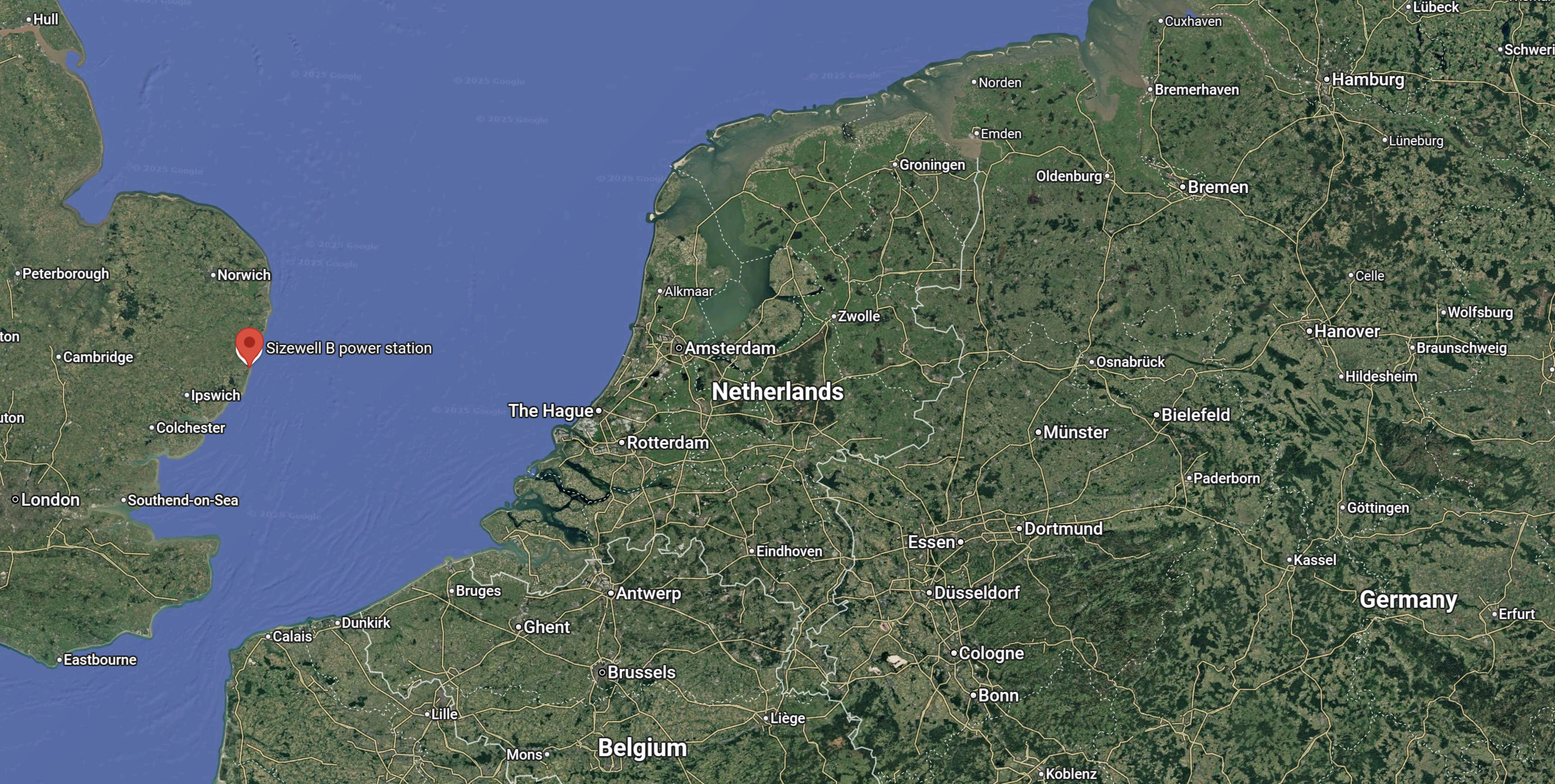
The Sizewell site is indicated by the red arrow.
The offshore oil and gas industry has used technology like single buoy moorings and coastal tankers to collect offshore natural gas for decades.
I don’t see why coastal hydrogen tankers couldn’t export excess hydrogen to places around the North Sea, who need the fuel.
It should be born in mind, that Centrica have a good reputation in doing natural gas trading. This expertise would surely be useful in hydrogen trading.
Conclusion
I believe that a hydrogen hub developed at Sizewell makes sense and I also believe that Centrica have the skills and technology to make it work.
Back To The Dark Ages In West Virginia?
This article on WBOY is entitled West Virginia Senators Aim To Revitalize Coal Industry.
These are the introductory paragraphs.
If you’re tired of rising utility bills, you are not alone. West Virginia senators say they share the same feelings and believe the answer is right under our feet.
Revitalizing West Virginia’s coal industry and bringing down utility costs for customers is the goal of two pieces of legislation originating in the Senate.
A resolution known as the Coal Renaissance Act aims to keep current coal operations running as well as open up new opportunities for the industry, expanding mining in West Virginia.
According to Senators in support of the act, the optimum capacity factor for coal plants to run at is 69%. Currently, industry leaders say that number is down to around 30% to 40%.
A new bill known as the Reliable and Affordable Electricity Act incentivizes utility companies to rely on West Virginia coal.
There is also going to be a Senate bill, that will abolish tax breaks for wind farms.
In the UK, it is my belief, that coal died with the Aberfan disaster in 1966, which is described in this first paragraph of the disaster’s Wikipedia entry.
The Aberfan disaster (Welsh: Trychineb Aberfan) was the catastrophic collapse of a colliery spoil tip on 21 October 1966. The tip had been created on a mountain slope above the Welsh village of Aberfan, near Merthyr Tydfil, and overlaid a natural spring. Heavy rain led to a build-up of water within the tip which caused it to suddenly slide downhill as a slurry, killing 116 children and 28 adults as it engulfed Pantglas Junior School and a row of houses. The tip was the responsibility of the National Coal Board (NCB), and the subsequent inquiry placed the blame for the disaster on the organisation and nine named employees.
I do have memories of coal mining in my brain.
- As a young child, I can remember being driven past the Kentish collieries and seeing the blackened landscape of the Garden of England.
- Newspapers of the 1950s and 1960s published, their share of mining disasters.
- In the 1980s, I drove through coal mining country in the United States and was appalled at all the fumes and smoke from the coal-fired power stations and the trucks delivering coal. Nothing as civilised as a merry-go-round train was used.
- In 2015, I visited Katowice and wrote An Excursion In Katowice. The air was thick with coal smoke from the coal-fired power stations.
I also remember at the Jobs Fair, when I left Liverpool University in 1968, seeing the recruiter from the National Coal Board sitting there alone, as if he’d got the plague. Graduates had decided, that no way, were they going to work in the coal industry.
The West Virginia senators, should be certified, if they want to bring back coal.
Petition Calls Made To Scrap Blackwall And Silvertown Tolls
The title of this post, is the same as that of this article on the BBC.
This is the sub-heading.
A petition containing more than 37,000 signatures calling for proposed tolls on the Blackwall and Silvertown tunnels to be scrapped has been presented at City Hall.
These four paragraphs give more details.
Toll charges of up to £4 per journey through the soon-to-open Silvertown Tunnel and the neighbouring Blackwall Tunnel were announced by Transport for London (TfL) on 26 November.
The Silvertown Tunnel will open next spring and will provide a new road crossing under the Thames between Silvertown and the Greenwich Peninsula.
The charges are “designed to manage levels of traffic using the tunnels”, TfL has said.
A TfL spokesperson added that without the tolls, “traffic would increase in both tunnels causing delays and congestion, which contribute to poorer air quality”.
Note.
- 37,000 is a large petition.
- If Transport for London wanted to reduce pollution, they could encourage greater use of hydrogen.
I have done some simple modeling using Excel.
- There are six vehicle crossings; Dartford Bridge, Dartford Crossing, Woolwich Ferry, Silvertown Tunnel, Blackwall Tunnel and Rotherhithe Tunnel.
- Matters are complicated by each crossing being a different size.
- There are several reliable rail crossings and a number of foot crossings, which offer alternatives, for those travellers on foot.
- Currently the worst disruption occurs, when more than one route is out of action at the same time.
It is a very complex river crossing,
I feel strongly that we aren’t going to get a true picture of traffic flow through the two new tunnels, until we see serious disruption on the Dartford Crossing.
But what worries me most, is that in the last few years, TfL have made decisions, where they must have done extensive mathematical modelling and they seem to have come up with answers, that are wide of the mark.
Congestion Prediction
I believe that we now have enough data, that by the use of modern computing, advanced vehicle detection techniques and a liberal dollop of artificial intelligence we should be able to accurately predict the traffic flow over the Thames between Dartford and Silvertown, better than we have done in the past.
But will this just mean, that everybody just takes the least-congested route?
Trucks On Moorgate
I took these pictures of trucks on Moorgate this morning in one twenty minute period.
















Note.
- All of the large trucks were diesel-powered.
- Some smaller vans might have been electric.
- Six of the trucks were concrete mixer trucks.
- One of the concrete mixer trucks was advertising ECOPact The Green Concrete.
Surely, if large heavy good vehicles, like these were hydrogen-powered, it would cut carbon footprints and reduce pollution.
I doubt we’ll see many hydrogen trucks in London, until we have a Mayor, who has a hydrogen policy that isn’t to ignore hydrogen and hope it goes away.
Lumo Carbon Data Shows Its Trains Are 22 Times Greener Than Flying
The title of this post, is the same as that of this article on Rail Advent.
These paragraphs detail how the figures were obtained.
To mark the second anniversary of its branding as ‘Lumo’, the operator commissioned consultancy firm Arup to provide an independent report about all direct emissions from its operations; emissions from the grid-supplied energy it uses; and other emissions in its supply chain.
Scope 1: Direct emissions from operations that are owned and controlled by Lumo;
Scope 2: Emissions from the use of grid-supplied electricity, heat, steam and/or cooling by Lumo;
Scope 3: All other emissions that occur in the value chain of Lumo.In the last two years, Lumo has carried over two million passengers. The figures reveal that, per passenger, emissions from a London-to-Edinburgh journey are twenty-two times the level for flying (149 kgCO2e) than for using Lumo (6.8kgCO2e).
I have a few thoughts.
Carbon Savings With LNER
LNER’s Class 801 trains are similar to Lumo’s Class 803 trains.
The main difference, is that the LNER have emergency diesel engines, whereas Lumo have emergency batteries to run the trains systems, if the catenary goes down.
So LNER on balance will generate a bit more carbon than Lumo.
But the difference will be marginal.
Carbon Savings With Avanti West Coast
Avanti’s Class 390 trains to Scotland, are all-electric, so there will be a carbon-saving.
Probably about the same as with LNER.
Avanti West Coast’s New Class 807 Trains
If the Class 807 trains were cars, they would be Lotuses.
- They are electric only and have no heavy diesel engines or traction batteries.
- They don’t even have emergency batteries for when the catenary fails.
- They have a redesigned nose. Is it more aerodynamic?
- The heavy tilt mechanism is history.
- As with all the other Hitachi high speed trains, they are capable of 125 mph, or 140 mph if the signalling permits.
These trains will undoubtedly have faster acceleration and deceleration and could probably knock minutes off the timings at all the stops.
Tucked away beside the Grand Union Sets Out Stirling Ambitions article in the December 2022 Edition of Modern Railways is a report on Avanti West Coast’s application for a second service between Euston and Liverpool.
This is said.
Avanti West Coast has applied for access rights for its second hourly Euston to Liverpool service, starting from December 2023, although a phased introduction of the new service is likely. This would make use of Avanti’s new fleet of 10×7-car Class 807 Hitachi EMUs, which are expected to enter service from Autumn 2023. The ‘807s’ would be deployed on the current hourly Liverpool service, on which a call at Liverpool South Parkway would be added. (provision is made for this in the December 2022 timetable.).
Pendolinos would then operate the second service each hour, calling at Lichfield Trent Valley and Tamworth.
A linespeed project is in progress to raise the permissible speed for non-tilting trains on the West Coast Main Line, and Avanti’s new Hitachi trains will take advantage of this.
I can’t wait to go to Liverpool in one of these trains.
Their carbon emissions should be in line with Lumo.
Avanti West Coast’s New Class 805 Trains
These are equivalent to the Class 802 trains, but with probably Class 807 train interiors and looks.
I wonder how long these trains will keep their diesel engines before battery power is the most affordable option.
Once they go battery-electric, their carbon emissions should be in line with Lumo.
Conclusion
I can’t see any other mantra than.
Electric good, diesel bad
Especially, if like most computers, it’s just plug and play.
Silvertown Tunnel: Cracks In Mayoral Policies
The title of this post is the same as that of this article on the BBC.
This is the sub-heading.
It is an infrastructure project that is well-underway with the boring almost completed — but it has a very low profile.
These are the first three paragraphs.
Every step of the Crossrail tunnelling, the media were invited along. Not so with this project.
This is Silvertown Tunnel. It is more than 1km long and will be London’s first road tunnel in over 30 years.
Perhaps one of the reasons it isn’t being pushed publicity-wise, is it is very controversial.
Tom Edwards gives a detailed outline of why the tunnel is controversial.
Under a heading of HGVs Using Bus Lanes, this is said.
Instead of using the Dartford Crossing, larger HGVs will be able to use the tunnel — and its bus lane.
Campaigners said that will mean more HGVs going through Newham and Greenwich.
I’ve also never heard this before.
Sheila Keeble, of the Greenwich Society, said the tunnel “will be magnet for bigger traffic than we’ve got at the moment”.
“One of the issues we have is all the developers are now looking at building distribution centres,” she said.
“At the moment the Blackwall Tunnel protects us from bigger traffic… Silvertown won’t.”
That is all very logical and I suspect we’ll see larger trucks in Hackney and Waltham Forest too!
There was also this bit of nonsense from Transport for London.
TfL says the tunnel will lead to an overall improvement in air quality.
How will all those trucks through the two tunnels reduce pollution?
In 2024, London must vote for a Mayor, who understands hydrogen, mathematics and science!
Should Hydrogen-Powered Trucks Pay A Lower Charge In The Silvertown And Blackwall Tunnels?
London has a lot of heavy diesel trucks, which include.
Cement mixer trucks.
Large eight-wheeler trucks transporting aggregate, building materials and construction spoil to and from construction sites.
Council refuse trucks.
Skip trucks.
Supermarket delivery trucks.
They are large polluters and the only way they will be made zero-carbon, will be to use hydrogen.
In Cummins Agrees To Integrate Its Hydrogen ICE Technology Into Terex® Advance Trucks, I write about how Cummins and Terex are going to be building hydrogen-powered cement mixers.
This picture shows the baby of the range, which could be ideal for a smaller country like the UK.
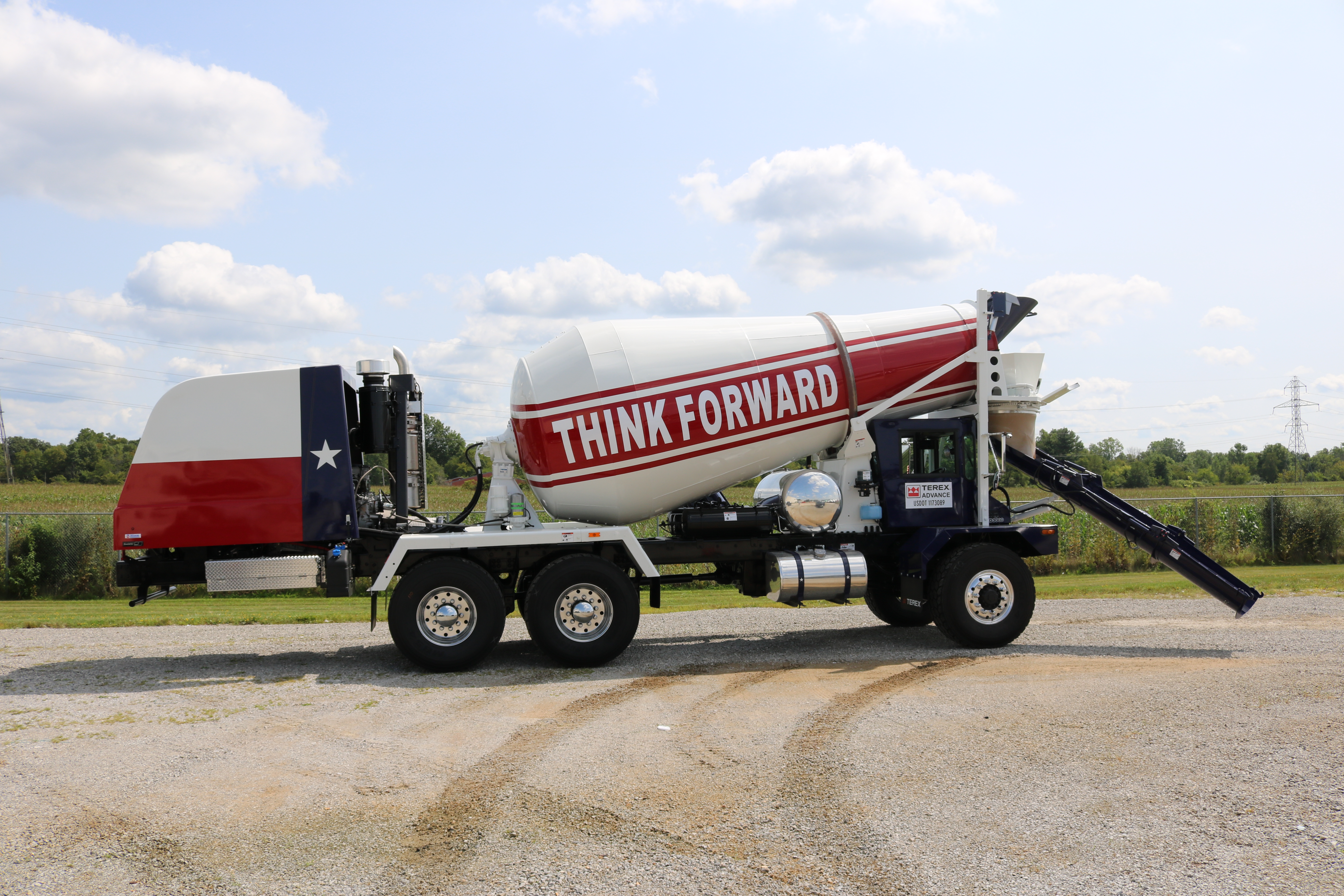
Note how it is the other way round to traditional cement mixer trucks.
As companies are now selling low-carbon concrete in the UK, I suspect, it won’t be long before they will be delivering it in a hydrogen-powered zero-carbon truck.
If hydrogen-powered trucks could be given an economic boost, by lowering their charges for the Silvertown And Blackwall Tunnels, this might increase their uptake by owners of large trucks, which would in turn reduce pollution.
But this would need the election of a London Mayor, who had a hydrogen policy other than ignore it and hope it goes away.
Maverick Clean Air Candidate Who Ran For Mayor Of London Is Back In Politics
The title of this post, is the same as that, of this article on Air Quality News.
This is the sub-heading.
One of the most enthusiastic political advocates of clean air is once again throwing his hat into the electoral ring by announcing that he will stand in both the forthcoming Rutherglen and Hamilton West by-election and the Mid Bedfordshire by-election.
This is the introductory paragraph.
Prince Ankit Love, Emperor of India* may not be the best known political figure, but he’s certainly a persistent one. Representing the One Love Party, he was the youngest candidate in the 2016 London Mayoral election, where his policies focussed on London’s housing crisis and air pollution.
I didn’t know you could stand in two by-elections at the same time! What if you won both?
Air-Purifying Totems Trial At Birmingham New Street Station
The title of this post, is the same as that of this article on Railway Gazette.
These two paragraphs outline the trial.
The use of air-purifying totems to reduce the impact of diesel train exhaust fumes on air quality is to be tested at Birmingham New Street station.
The Pluvo Column devices take in air at the bottom of the totem and pass it through a series of filters before releasing it at head height.
Note.
- This is the Pluvo web site.
- The company has an impressive list of backers including Innovate UK and Land Securities.
- Land Securities Group plc is the largest commercial property development and investment company in the United Kingdom.
- From my experience of Birmingham New Street station, the station could be an interesting application of the technology.
I believe this technology can be developed for a large number of applications.
Silvertown Tunnel: Cracks In Mayoral Policies
The title of this post, is the same as that, as this article on the BBC.
This is the sub-heading.
It is an infrastructure project that is well-underway with the boring almost completed — but it has a very low profile.
These three paragraphs possibly explain why.
Every step of the Crossrail tunnelling, the media were invited along. Not so with this project.
This is Silvertown Tunnel. It is more than 1km long and will be London’s first road tunnel in over 30 years.
Perhaps one of the reasons it isn’t being pushed publicity-wise, is it is very controversial.
Reading the rest of the article it certainly is controversial in many people’s minds.
These are my thoughts.
Avoiding The Dartford Crossing
When I drove back to Suffolk from Gatwick, Kent or Sussex, in the last century, because of congestion at the Dartford Crossing, I would sometimes cut through London and use the Blackwall Tunnel, when I thought it would be quicker.
When the Silvertown Tunnel opens, this could be a viable alternative for vehicles.
My experience of modelling flows, tells me, that water finds its own level. With driving, Satellite Navigation will be able to tell drivers, which will be the fastest route.
It is my view, that the Silvertown Tunnel will become the biggest rat-run in London.
Except some of these rats will be super-rats in 45-tonne HGVs.
Cutting Pollution In London
If super-rat-running is going to happen, then this will raise pollution in Central London, with all those heavy trucks going through.
The only way to cut pollution would be to have differential pricing for vehicles in the tunnels.
Perhaps hydrogen and electric vehicles should be at a discount.
But then Sadiq Khan doesn’t have a hydrogen policy, except to ignore it and hope it goes away.
The Elizabeth Line Effect
Talking to Elizabeth Line staff at Whitechapel station, they feel that there is an increasing number of passengers, who do journeys in East London on an up-one-branch-down-t’other basis between places like Ilford and Woolwich.
I believe, that other cross-river railways and the Bank station improvements, will also take passengers out of their cars, which will free up the Silvertown Tunnel for more HGVs.
A City Airport Station On The Elizabeth Line
I wrote about this in Thoughts On London City Airport And The Elizabeth Line.
How many cars would this remove from the tunnels under the Thaames?
 The Anonymous Widower