The Anonymous Widower

Centrica Really Can’t Lose At Sizewell

The title of this post, is the same as that of this article in The Times.

This is the sub-heading.

Centrica’s £1.3 billion investment in Sizewell C guarantees substantial returns, even with cost overruns.

These two-and-a-half paragraphs explain the funding.

Now we know what Ed Miliband means by his “golden age of nuclear” — golden for the companies putting their money into Sizewell C. Yes, reactor projects have a habit of blowing up private investors. But maybe not this one. It looks more like an exercise in transferring risk to consumers and the taxpayer.

Sure, nobody builds a £38 billion nuke on a Suffolk flood plain without a frisson of danger. But the energy secretary and his Treasury chums have done their bit to make things as safe as possible for the companies putting in equity alongside the government’s 44.9 per cent stake: Canada’s La Caisse with 20 per cent, British Gas-owner Centrica (15 per cent), France’s EDF (12.5 per cent) and Amber Infrastructure (7.6 per cent).

For starters, nearly all the debt for the 3.2 gigawatt plant, three-quarters funded by loans, is coming from the state-backed National Wealth Fund. It’s bunging in up to £36.6 billion, with £5 billion more guaranteed by a French export credit agency.

It looks to me that between them the British and French governments are providing £41.5 billion of loans to build the £38 billion nuke.

These are my thoughts.

Hydrogen And Sizewell C

This page on the Sizewell C web site is entitled Hydrogen And Sizewell C.

Under a heading of Hydrogen Buses, this is said.

At Sizewell C, we are exploring how we can produce and use hydrogen in several ways. We are working with Wrightbus on a pilot scheme which, if successful, could see thousands of workers transported to and from site on hydrogen double decker buses. You can read more about the pilot scheme in our press release

Firstly, it could help lower emissions during construction of the power station. Secondly, once Sizewell C is operational, we hope to use some of the heat it generates (alongside electricity) to make hydrogen more efficiently.

This would appear to be a more general statement about hydrogen and that the following is planned.

  1. Hydrogen-powered buses will be used to bring workers to the site. A press release on the Sizewell C web site, talks about up to 150 buses. That would probably be enough buses for all of Suffolk.
  2. Hydrogen-powered construction equipment will be used in the building of the power station.
  3. It also talks about using the excess heat from the power station to make hydrogen more efficiently. I talk about this process in Westinghouse And Bloom Energy To Team Up For Pink Hydrogen.

This is a substantial investment in hydrogen.

Centrica And Electricity From Sizewell C

The article in The Times, also says this.

Even so, there’s a fair bit of protection for the likes of Centrica, which has also agreed a 20-year offtake deal for its share of Sizewell’s electricity. The price of that is not yet known.

Nothing is said in the article about the size of Centrica’s electricity offtake.

  • If they get 15 % of Sizewell C, that would by 480 MW.
  • If they get 15 % of Sizewell B + C, that would by 660 MW.

If they use their share to generate hydrogen, Suffolk would have a massive hydrogen hub.

To power the buses and construction of Sizewell C, Sizewell B could be used to provide electricity to create the hydrogen.

How Would The Hydrogen Be Produced?

Centrica, along with other companies, who include Hyundai and Kia, are backers of a company in Hull called HiiROC, who use a process called Thermal Plasma Electrolysis to generate hydrogen.

On their web site, they have this sub-heading.

A Transformational New Process For Affordable Clean Hydrogen

The web site also describes the process as scalable from small modular units up to industrial scale. It also says this about the costs of the system: As cheap as SMR without needing CCUS; a fraction of the energy/cost of water electrolysis.

If HiiROC have achieved their objective of scalability, then Centrica could grow their electrolyser to meet demand.

How Would The Hydrogen Be Distributed?

Consider.

  • Currently, the Sizewell site has both road and rail access.
  • I can still see in my mind from the 1960s, ICI’s specialist articulated Foden trucks lined up in the yard at Runcorn, taking on their cargoes of hydrogen for delivery all over the country.
  • As that factory is still producing hydrogen and I can’t remember any accidents in the last sixty years, I am fairly sure that a range of suitable hydrogen trucks could be developed to deliver hydrogen by road.
  • The road network to the Siewell site is being updated to ensure smooth delivery of workers and materials.
  • The rail access to the Sizewell site is also being improved, for the delivery of bulk materials.

I believe there will be no problems delivering hydrogen from the Sizewell site.

I also believe that there could be scope for a special-purpose self-propelled hydrogen tanker train, which could both distribute and supply the hydrogen to the vehicles, locomotives and equipment that will be using it.

Where Will The Hydrogen Be Used?

I have lived a large part of my life in Suffolk and know the county well.

In my childhood, there was quite a lot of heavy industry, but now that has all gone and employment is based on agriculture, the Port of Felixstowe and service industries.

I can see hydrogen being used in the following industries.

Transport

Buses and heavy trucks would be powered by hydrogen.

The ports in the East of England support a large number of heavy trucks.

Large Construction Projects

Sizewell C is not the only large construction project in the East of England, that is aiming to use low-carbon construction involving hydrogen. In Gallagher Group Host Hydrogen Fuel Trial At Hermitage Quarry, I talked about a hydrogen fuel trial for the Lower Thames Crossing, that involved JCB and Ryse Hydrogen.

Hydrogen for the Lower Thames Crossing could be delivered from Sizewell by truck, down the A12.

Rail

We may not ever see hydrogen-powered passenger trains in this country, but I do believe that we could see hydrogen-powered freight locomotives.

Consider.

  • The latest electro-diesel Class 99 locomotives from Stadler have a Cummins diesel engine.
  • The diesel engine is used, when there is no electrification.
  • Cummins have developed the technology, that allows them to convert their latest diesel engines to hydrogen or natural gas power, by changing the cylinder head and the fuel system.
  • Access to the Port of Felixstowe and London Gateway needs a locomotive with a self-powered capability for the last few miles of the route.

A Class 99 locomotive converted to hydrogen would be able to run with out emitting any carbon dioxide from Felixstowe or London Gateway to Glasgow or Edinburgh.


Ports

Ports have three main uses for hydrogen.

  • To power ground-handing equipment, to create a pollution-free atmosphere for port workers.
  • To fuel ships of all sizes from the humblest work-boat to the largest container ships.
  • There may need to be fuel for hydrogen-powered rail locomotives in the future.

There are seven ports with excellent road and/or rail connections to the Sizewell site; Felixstowe, Great Yarmouth, Harwich, Ipswich, London Gateway, Lowestoft and Tilbury.

The proposed Freeport East is also developing their own green hydrogen hub, which is described on this page on the Freeport East web site.

Airports

Airports have two main uses for hydrogen.

  • To power ground-handing equipment, to create a pollution-free atmosphere for airport workers.
  • In the future, there is likely to be hydrogen-powered aircraft.

There are three airports with excellent road and/or rail connections to the Sizewell site; Norwich, Southend and Stansted.

Agriculture And The Rural Economy

Agriculture and the rural economy would be difficult to decarbonise.

Consider.

  • Currently, most farms would use diesel power for tractors and agricultural equipment, which is delivered by truck.
  • Many rural properties are heated by propane or fuel oil, which is delivered by truck.
  • Some high-energy rural businesses like blacksmiths rely on propane, which is delivered by truck.
  • Electrification could be possible for some applications, but ploughing the heavy land of Suffolk, with the added weight of a battery on the tractor, would probably be a mathematical impossibility.
  • JCB are developing hydrogen-powered construction equipment and already make tractors.
  • Hydrogen could be delivered by truck to farms and rural properties.
  • Many boilers can be converted from propoane to run on hydrogen.

I feel, that hydrogen could be the ideal fuel to decarbonise agriculture and the rural economy.

I cover this application in detail in Developing A Rural Hydrogen Network.

Exports

Consider.

  • Sizewell B and Sizewell C nuclear powerstations have a combined output of 4.4 GW.
  • A rough calculation shows that there is a total of 7.2 GW of wind farms planned off the Suffolk coast.
  • The East Anglian Array wind farm alone is said in Wikipedia to be planned to expand to 7.2 GW.
  • The Sizewell site has a high capacity connection to the National Grid.

Nuclear plus wind should keep the lights on in the East of England.

Any excess electricity could be converted into hydrogen.

This Google Map shows the location of Sizewell B in relation to Belgium, Germany and The Netherlands.
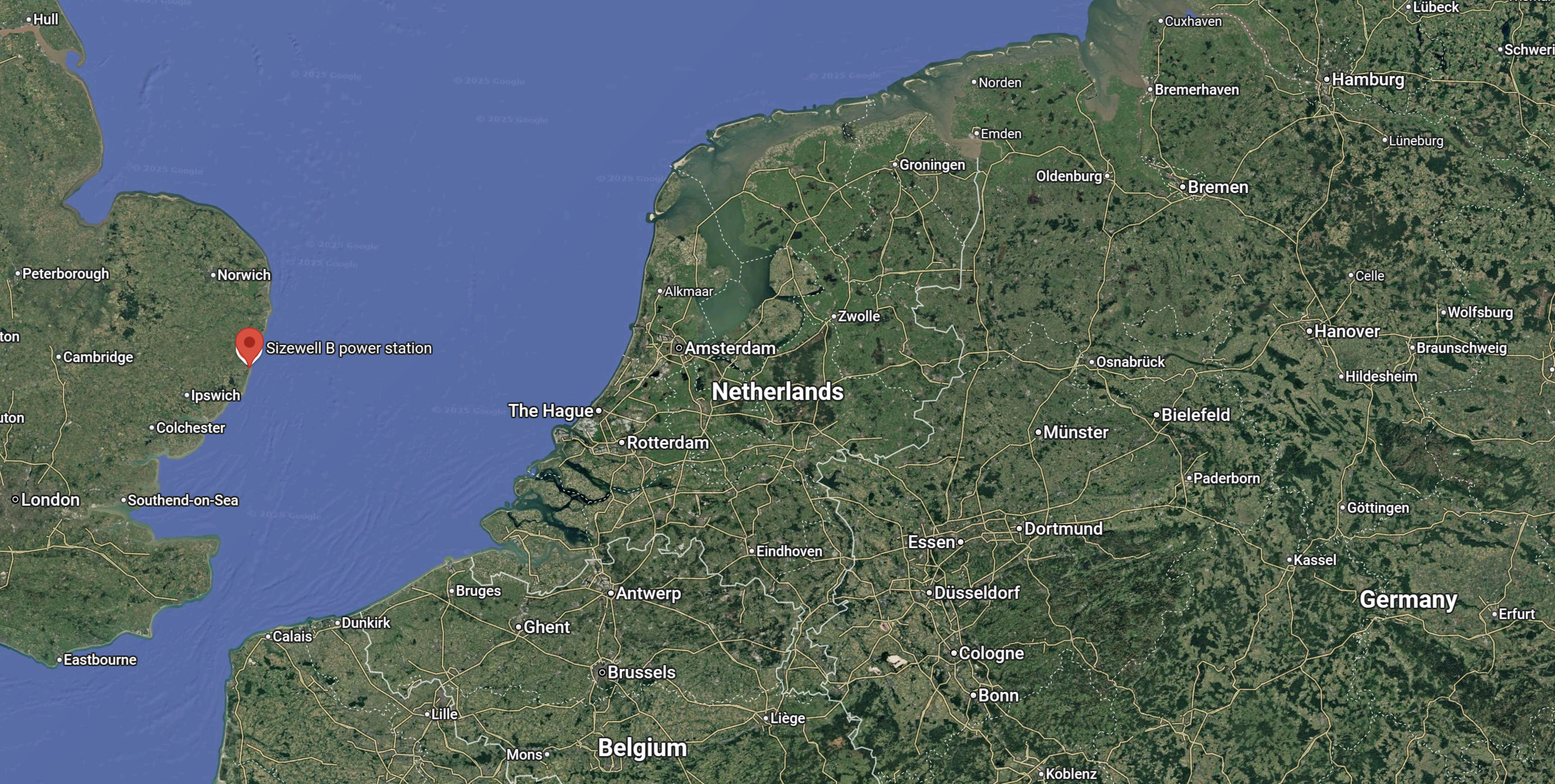
The Sizewell site is indicated by the red arrow.

The offshore oil and gas industry has used technology like single buoy moorings and coastal tankers to collect offshore natural gas for decades.

I don’t see why coastal hydrogen tankers couldn’t export excess hydrogen to places around the North Sea, who need the fuel.

It should be born in mind, that Centrica have a good reputation in doing natural gas trading. This expertise would surely be useful in hydrogen trading.

Conclusion

I believe that a hydrogen hub developed at Sizewell makes sense and I also believe that Centrica have the skills and technology to make it work.


July 24, 2025 Posted by | Energy, Finance, Hydrogen | , , , , , , , , , , , , , , , , , , , , , , , , , , , , , , , , , , , , , , , , , , , , | 1 Comment

Gallagher Group Host Hydrogen Fuel Trial At Hermitage Quarry

The title of this post is the same as that of this article on Agg-Net.

This is the sub-heading.

Landmark plant trial in collaboration with Lower Thames Crossing, JCB, and Ryze Power

These two paragraphs add more detail.

As part of their journey to Net Zero by 2050, Gallagher Group recently hosted a landmark hydrogen-powered plant trial at their Hermitage Quarry, in Kent, in collaboration with the Lower Thames Crossing (LTC) project, JCB, and Ryze Power.

The trial represents a major step forward for the Lower Thames Crossing’s ambition to eliminate diesel use from its construction sites by 2027, and Gallagher Group said they were honoured to provide the setting for LTC’s first successful trial of low-carbon, hydrogen combustion-powered machinery – a JCB 540-180H Loadall.

I like the way that the JCB is not in its traditional bright yellow, but a much softer green.

It must be so much better to work on a site like Sizewell C or the Lower Thames Crossing, if they are low-carbon or even carbon and pollution-free.

June 7, 2025 Posted by | Environment, Hydrogen, Transport/Travel, World | , , , , , , | 1 Comment

Guardian To Use Hydrogen In Its Glass Manufacturing

The title of this post, is the same as that of this article on Glass International.

These two paragraphs introduce the application.

Ryze Hydrogen has signed a long-term deal to provide hydrogen to flat glass manufacturer, Guardian Glass

Ryze will supply hydrogen to be used in the manufacture of float glass, which is used in everything from car windscreens and windows in buildings to mirrors and furniture.

This extract from the article explains how the hydrogen is used.

It will be used as a technical gas during the float glass process.

Chris Duguid, Plant Manager from Guardian Glass, said: “We are really pleased to be starting this partnership with Ryze.

“Hydrogen is vital to our float glass production process. Hydrogen is used to create an oxygen-free environment as a blanket to avoid oxidation of the tin onto which we float molten glass.

“As this is needed 24-hours-a-day, seven-days-a-week, 365-days-a-year, it is absolutely critical that we partner with a reliable supplier, which is what we have with Ryze.”

This Wikipedia section, describes the manufacture of float glass.

I’ve never come across a use for hydrogen, where the gas is used for its physical properties and not burned for heat.

How many other applications like this, will the ready availability of hydrogen open up?

I wonder, if the next step will be to use hydrogen to heat the tin and create the actual glass, so that Guardian Glass will be able to make zero-carbon glass.

As the temperatures required are over a 1000 °C, this process could use a lot of hydrogen.

As Guardian Glass are based at Goole, I suspect that they’ll be able to get a hydrogen pipeline from the electrolyser, that SSE are building on Humberside.

December 14, 2023 Posted by | Hydrogen | , , , , | Leave a comment

Hydrogen Business Model / Net Zero Hydrogen Fund: Shortlisted Projects Allocation Round 2022

The title if this post, is the same as this notice from the Department of Energy Security and Net Zero.

These are the the first three paragraphs.

The shortlist contains the following electrolytic hydrogen projects, totalling 408MW of capacity across England, Scotland and Wales.

Projects that have not been shortlisted for this allocation round are encouraged to submit updated bids for the second allocation round – see more details.

We expect to award contracts totalling up to 250MW of capacity from HAR1, subject to affordability and value for money. We aim for contracts to be awarded in Q4 2023, with first projects becoming operational in 2025.

Note.

  1. A rough calculation says that 408 MW of electrolysers could product about 177 tonnes of hydrogen per day.
  2. It’s not long to the fourth quarter of 2023, when hopefully we shall know more.

These are the seventeen shortlisted projects.

Aldbrough Hydrogen Pathfinder

Aldbrough Hydrogen Pathfinder is being developed by SSE Thermal in Yorkshire.

This paragraph outlines the operation of the Aldbrough Hydrogen Pathfinder.

The concept would see green power sourced from grid through Renewable PPAs, in compliance with the Low Carbon Hydrogen Standard. Hydrogen would then be produced via a 35MW electrolyser before being stored in a converted salt cavern and then used in a 100% hydrogen-fired turbine, exporting flexible green power back to grid at times of system need. In future, hydrogen storage will also benefit offtakers in other sectors, for example in industry, heat or transport.

Initial storage at Aldbrough could be as high as 320 GWh.

I went to see their presentation in June and wrote about my visit in Did I See The UK’s Hydrogen-Powered Future In Hull Today?.

Barrow Green Hydrogen

Barrow Green Hydrogen is being developed by Carlton Power in North West England.

The Barrow Green Hydrogen project has its own web site, where this is the introductory paragraph.

Barrow Green Hydrogen is an industry leading project, that will use renewable energy to produce green hydrogen fuel which will decarbonise industry, and in the future, transport and heating. The development will have an initial capacity of 35 MW, which will produce enough hydrogen to heat the equivalent of 14,000 homes. The project has the potential to expand to several hundred megawatts.

There is also a section, that is entitled; Why Barrow?, where this is said.

Barrow-in-Furness is ideally located because the area has several industrial sites, which are able to take green hydrogen without extensive modification to decarbonise their operations, which otherwise rely on natural gas. Further to this, it is well placed to serve commercial applications in other areas of Cumbria, once the project is scaled up and these applications become hydrogen ready. The site in Barrow is also well positioned to use renewable electricity from existing installations and will also enable additional new generation capacity to be installed.

In Government Hydrogen Boost To Help Power Kimberly-Clark Towards 100% Green Energy Target, I explain how this hydrogen hub will supply one of Kimberly-Clark’s factories with hydrogen to replace natural gas.


Bradford Low Carbon Hydrogen

Bradford Low Carbon Hydrogen is being developed by Hygen in Yorkshire.

These paragraphs from this press release on the Hygen web site outline the operation of Bradford Low Carbon Hydrogen.

A partnership between gas distributor Northern Gas Networks (NGN) and clean energy pioneers Hygen Energy (Hygen) and Ryze Hydrogen for an ambitious low carbon hydrogen production and dispensing facility in the heart of Bradford has been shortlisted for government funding.

NGN, the gas distributor for the North East, Cumbria and much of Yorkshire, is carrying out the project in a Joint Venture with the two companies.

The project will be built on NGN’s decommissioned gas storage site of Bowling Back Lane in the heart of Bradford. It will deliver one of the UK’s largest low carbon hydrogen production facilities with a clear objective of using renewable energy to power an electrolyser which will produce clean hydrogen. The site will also have on-site refuelling for hydrogen vehicles, EV charging, and a low carbon technology education centre. Residents and businesses in West Yorkshire will be able to use the refuelling facilities, with Ryze distributing hydrogen to industrial users across the region.

Note.

  1. The press release has an excellent visualisation of the project.
  2. Using a site that was previously used for gas storage, must give advantages in designing the project and its operational procedures.
  3. If anybody knows the capacity, please tell me!

It looks like a hydrogen facility for all of Bradford, its citizens and its businesses.

Cheshire Green Hydrogen

Cheshire Green Hydrogen is being developed by Progressive Energy Net Zero in North West England.

This press release from HyNet NorthWest gives these details.

HyNet partner, Progressive Energy, Statkraft and Foresight, will be working together to jointly develop a suite of green (‘electrolytic’) hydrogen projects in the North West of England.

This includes the proposed 28 megawatt (MW) Cheshire Green Hydrogen project which will use renewable electricity from Frodsham wind farm in Cheshire. This will generate green hydrogen which will supply low carbon hydrogen via the HyNet project’s planned pipeline.

The initial phase of 100MW of projects will reduce carbon dioxide emissions from industry by up to 180,000 tonnes.

The initial capacity will be 28 MW.

Commercial Scale Demonstrator

Commercial Scale Demonstrator is being developed by ERM Dolphyn in Scotland.

There is not much specific information on the ERM Dolphyn web site.

Cromarty Hydrogen Project

Cromarty Hydrogen Project is being developed by Pale Blue Dot Energy in Scotland.

This paragraph describes the Cromarty Hydrogen Project.

The facility would have a maximum output of up to 50 megawatt (MW) although this is likely to be limited in the first instance to around 30MW and be able to produce up to 20,000 kg of green hydrogen per day. The facility will have multiple electrolysers feeding on-site low pressure storage containers. The hydrogen will then be compressed onto tube trailers for transportation off-site to customers. It is our intention to use low or zero carbon fuels for the hydrogen transport vehicles wherever possible.

There is a lot of information on the web site.

Gigastack

Gigastack is being developed by Phillips 66 in North East England.

The Gigastack web site appears to be lacking in updates.

Gordonbush Hydrogen Project (GBH2)

Gordonbush Hydrogen Project is being developed by SSE Renewables in Scotland.

The proposed development is introduced like this.

The proposed development comprises a green hydrogen production facility. This would be located within the existing infrastructure of Gordonbush Wind Farm.

At this stage, the detailed design has not been fully developed and a level of refinement of the scheme is expected prior to submission of the planning application.

As with much of what SSE Renewables does, it seems a very professional project.

Green Hydrogen 1, 2 And 3

I’ll discuss these three projects together.

  • Green Hydrogen 1 is being developed by RES and Octopus Renewables in Scotland.
  • Green Hydrogen 2 is being developed by RES and Octopus Renewables in Wales.
  • Green Hydrogen 3 is being developed by RES and Octopus Renewables in South East England.

RES and Octopus Renewables have formed a joint company called Hyro.

On the Hyro web site, this is said on the opening page.

Market Leaders Coming Together For Decarbonisation

HYRO is a joint venture between Octopus Energy Generation and RES

RES is the world’s largest independent renewable energy developer – having delivered 23GW of generation in 11 countries.

Octopus Energy Generation is one of Europe’s largest investors in renewable energy. The team manages over 3GW of green power assets worth £5bn across 11 countries. It’s the generation arm of Octopus Energy Group, the global energy tech pioneer, using technology to unlock a customer focused and affordable green energy revolution.

That’s not a bad opening statement.

In Government Hydrogen Boost To Help Power Kimberly-Clark Towards 100% Green Energy Target, I explain how Green Hydrogen 2 and 3 will supply two of Kimberly-Clark’s factories with hydrogen to replace natural gas.

The initial capacity of Green Hydrogen 2 and 3 will be 50 MW. So will Green Hydrogen 1, 2 and 3 all be 25 MW electrolysers?

I wouldn’t be surprised to see Hyro doing more deals with large natural gas users.

H2 Production Plant at High Marnham

H2 Production Plant at High Marnham is being developed by J G Pears in the East Midlands of England.

J G Pears is the driver here and the About page of their web site is a must-read.

This section describes their approach.

From our humble beginnings, we have grown to become one of the largest businesses in the UK animal by-products sector. We’ve achieved this thanks to constant innovation and investment plus a relentless focus on building relationships with customer and partner businesses.

Innovation, investment and customer focus.

We actively look for new and better ways to work, and invest continuously in new ideas and processes. We plan everything we do around the twin goals of making our operations as clean and green as possible and delivering products and services that meet customer needs.

And this section details their story.

We started as a family business, and we’re still a family business. But today, our family now includes a group of companies, customers and suppliers worldwide, and a large workforce across our various sites.

The story starts in 1972, with the Pears family developing a livestock farming business in and around Penistone, South Yorkshire.

As time went on, the family farming business diversified into animal by-product and food waste collection services. More recently we added two by-product processing facilities to the Group’s activity portfolio. This ensures complete control of our end to end collection and processing services.

The original family farm in Penistone is still very much part of the business, continuing our farming heritage and housing the Group’s head office.

They’ve recently added a combined heat and power plant (CHP).

These two paragraphs describe how they use the CHP.

The CHP plant generates renewable energy by providing steam and electricity to our existing businesses as well as exporting its excess electrical power to the National Grid.

This biomass-fired CHP plant will use meat and bone meal (MBM) to replace over 90% of the fossil fuels used in the current business processes. MBM is a sustainable alternative with a calorific value of the same magnitude as coal, meaning that more than 150,000 tonnes of carbon dioxide will be saved per year. MBM can also be sourced more locally than the fuels currently used, which in turn reduces carbon emissions from transport and transport kilometres.

It’s a new one on me, to use meat and bone meal to replace coal.

Their services and products are worth a look.

The company are certainly proof of the old Yorkshire saying of “Where there’s muck there’s brass!”

HyBont

HyBont is being developed by Marubeni Europower on Wales.

Hybont has a comprehensive web site, where this is said about the concept.

We are developing plans for a green hydrogen production and refuelling facility at Brynmenyn Industrial Estate, partially powered by a solar farm at Bryncethin.

A wide number of uses for the hydrogen, including vehicle fuelling are proposed.

HyGreen Teesside

HyGreen Teesside is being developed by BP Alternative Energy Investments in North East England.

HyGreen Teesside has a comprehensive web site, where this is said about the project.

HyGreen Teesside aims to be one of the biggest green hydrogen production facilities in the UK. Green hydrogen is made by electrolysing water using power from low carbon energy sources such as solar or wind.

Located in Teesside, HyGreen Teesside is targeting 80MWe of green hydrogen capacity by 2025 – and targeting growth to 500 MW by 2030, delivering up to 5% of the UK government’s hydrogen target of 10GW by 2030.

It is eventually going to be a large electrolyser.

Langage Green Hydrogen

Langage Green Hydrogen is being developed by Carlton Power in South West England.

Langage Green Hydrogen has a comprehensive web site, where this is said about the project.

Langage Green Hydrogen is an industry leading project, that will use renewable energy to produce green hydrogen fuel which will decarbonise industry, and in the future, transport and heating. The development will have an initial capacity of 10 MW, which will produce enough hydrogen to heat the equivalent of 14,000 homes. The project is part of the wider Langage Energy Park.


Note.


Quill 2

Quill 2 is being developed by INOVYN ChlorVinyls in North West England.

There is very little about Quill 2 on the Internet.

Personally, I find that a pity, as I used to work on what is now INOVYN’s Runcorn site.

Tees Green Hydrogen

Tees Green Hydrogen is being developed by EDF Renewables Hydrogen in North East England.

This page on the EDF Renewables web site gives this spotlight for Tees Green Hydrogen.

Tees Green Hydrogen, will be a pioneering project, using the green electricity from nearby Teesside Offshore Wind Farm along with a new solar farm, which EDF Renewables UK intends to construct near Redcar, to power its hydrogen electrolyser. The project will supply local business customers with hydrogen to support decarbonisation efforts and a significant reduction in industrial pollution.

There is also an informative animation.

This is said about the capacity.

In its initial phase, the electrolyser will have a 7.5MW capacity. It is hoped that work could begin on site in 2024, with the facility operational by 2026. Future phases will seek to deliver up to 300MW in Teesside before 2030.

Quel énorme!

Trafford Green Hydrogen

Trafford Green Hydrogen is being developed by Carlton Power in North West England.

This is the introduction on the project web page.

Trafford Green Hydrogen is an industry leading project, that will use renewable energy to produce green hydrogen fuel for industry, transport and heating. The development will have an ultimate capacity of 200MW, which will be sufficient to take around 8,000 petrol cars off the road annually. The initial phase will be 20MW.

Carlton are also developing two other projects;

West Wales Hydrogen Project – Phase 1

West Wales Hydrogen Project – Phase 1 is being developed by H2 Energy and Trafigura in Wales.

The best source of information is this must-watch Youtube video.

The company appears to be able to lease you a hydrogen truck on a pay per mile basis, at the same price as a diesel truck.

Get the finance right for your customers and yourself and everybody will be happy.

Whitelee Green Hydrogen

Whitelee Green Hydrogen is being developed by Scottish Power in Scotland.

The Whitelee wind farm is described like this on this web page.

Whitelee is the UK’s largest onshore windfarm, located on Eaglesham Moor just 20 minutes from central Glasgow. Its 215 turbines generate up to 539 megawatts of electricity, enough to power over 350,000 homes*.

With more than 130 kilometres of trails to explore, on foot, by cycle or by horse, with free parking and free entry to our onsite Visitor Centre, Whitelee is a great destination for a day out with the whole family.

I wrote about this project in Whitelee Green Hydrogen Facility To Power Public Transport.

Conclusion

These projects will create a lot of green hydrogen.

These are my highlights.

  • J G Pears, who have developed an animal by-products business with a distinct green agenda.
  • Kimberly-Clark planning three hydrogen plants in Cumbria, Kent and North Wales to decarbonise their paper products business.
  • The up to 300 MW Tees Green Hydrogen being developed by EDF Renewables.
  • The H2 Energy and Trafigura hydrogen truck business in West Wales.

Don’t forget to watch the video for the last project.


August 19, 2023 Posted by | Energy, Hydrogen | , , , , , , , , , , , , , , , , , , , , , , , , , | 2 Comments

Preparing For Take-Off: Aviation Embraces Clean Hydrogen

The title of this post, is the same as that, of this article on Ryse Hydrogen.

These three paragraphs introduce the article.

Aviation’s clean hydrogen revolution is coming from all directions.

Taking a bottom-up approach, start-ups such as ZeroAvia are developing technology to convert small aircraft to hydrogen fuel, while at the other end of the spectrum, industry giants such as Airbus and Rolls-Royce are exploring how they can carry hundreds of passengers 1,000s of miles across the world.

The timescales for these projects are very different but progress is visible for both approaches.

The last two paragraphs are optimistic.

Hydrogen fuel could make up 32% of the market by 2050 if it becomes commercially available by 2035, according to a study from climate think-tank Energy Transition Commission.

It would seem that it’s only a matter of time before truly clean air travel is cleared for take-off and hydrogen-powered aircraft are carrying passengers and cargo across the skies.

The article is a good summary of the state of zero-carbon hydrogen-powered aircraft. Read it!

February 23, 2023 Posted by | Hydrogen, Transport/Travel | , , , , , | Leave a comment

Centrica And Ryze Agree To Develop Hydrogen Pathway

The title of this post, is the same as that of this press release from Centrica.

These are the first three paragraphs.

Centrica and Ryze Hydrogen are set to jointly build and operate hydrogen production facilities aimed at providing a reliable supply of hydrogen for industry and transportation.

Under the landmark agreement the firms will jointly develop hydrogen production projects on existing Centrica sites and work with third-parties to build production on their sites too.

A Memorandum of Understanding has been signed and will combine expertise in order to kickstart the development of the UK hydrogen economy, targeting the mobility, industrial and commercial markets.

There are also some other interesting statements in the press release.

  • Centrica’s Head of Hydrogen, says that we should be bold in our thinking about hydrogen.
  • The partnership will explore how the UK can work with international hydrogen production facilities.
  • Jo Bamford, green entrepreneur and Executive Chairman of Ryze, believes that Centrica are very serious about hydrogen.
  • Centrica and Ryse will convert some of the British Gas fleet to hydrogen.

I feel this could be a very significant deal for the decarbonisation of the UK.

December 1, 2022 Posted by | Hydrogen | , , , , | 3 Comments

HyBRADFORD: One Of Largest Hydrogen Power Plants In The Country Could Open In Yorkshire

The title of this post, is the same as that of this article on the Yorkshire Post.

This is the first paragraph.

Gas distributor Northern Gas Networks (NGN) has partnered with clean energy pioneers Hygen Energy Holdings and Ryze Hydrogen to work on a low carbon hydrogen production and dispensing facility in the heart of Bradford.

Good to see Bradford getting, its hydrogen act together, which is more than can be said for Sadiq Khan and London.

November 17, 2022 Posted by | Energy, Hydrogen | , , , , , | Leave a comment

UK Funds Hydrogen-Enabled Decarbonisation Of Steel, Cement, Ceramics Production

The title of this post, is the same as that of this article on Ryse Hydrogen.

This is the first paragraph.

The latest round of grants under the UK government’s Industrial Hydrogen Accelerator Programme shows the breadth of decarbonisation opportunities that hydrogen provides and the depth of innovative talent in our country.

Industries targeted by the projects that received funding include steelmaking, asphalt, cement, waste, paint, and ceramics manufacturing.

The article is good background to how hydrogen will change industry.

October 20, 2022 Posted by | Hydrogen | , , , | Leave a comment