Centrica And Canada’s Ksi Lisims LNG Sign HoA For Long-Term LNG Supply
The title of this post, is the same as that of this news item from Centrica.
This is the sub-heading.
Centrica and Ksi Lisims LNG LP have entered into a Heads of Agreement (HOA) for the sale and purchase of 1 million tonnes per annum of LNG. Sales to Centrica will be on a free-on-board basis for 20 years and are subject to the completion of a Sale and Purchase Agreement.
These two paragraphs, add more details.
This long-term agreement strengthens the resilience of Centrica’s LNG portfolio, adding reliable supply for its customers during a time of continued volatility in global energy markets.
With this announcement, Ksi Lisims LNG has now entered into long-term supply agreements or Heads of Agreement covering 9 mtpa of its planned 12 mtpa capacity.
The next paragraph shows how LNG is moving towards low-emission and low-carbon.
Ksi Lisims LNG is a proposed 12 mtpa floating export facility located on the northwest coast of British Columbia, developed in partnership between the Nisga’a Nation, Rockies LNG, and Western LNG. It is designed to be one of the world’s lowest-emission LNG projects, using renewable hydroelectricity from British Columbia’s grid to power liquefaction and cut carbon intensity by up to 90 per cent versus conventional plants.
The news item also states that they are in a genuine partnership with the Nisga’a Nation.
How Do Tankers Go From British Columbia To The Isle Of Grain?
I had to ask Google AI this question and received this answer.
Vessels travel from British Columbia (such as the Port of Vancouver or Prince Rupert) to the Grain LNG Terminal on the Isle of Grain in Kent, England, by sailing through the Pacific Ocean, transiting the Panama Canal, and crossing the Atlantic Ocean into the English Channel and the Thames Estuary.
The Maritime Route
Departure: Ships load cargo (such as liquefied natural gas or bulk goods) at a British Columbia port on Canada’s Pacific coast.
Pacific Leg: Vessels head south along the North American west coast or out into the Pacific.
The Panama Canal: Ships enter the canal to shortcut from the Pacific Ocean to the Caribbean Sea / Atlantic Ocean.
Atlantic Crossing: From the Caribbean, vessels cross the open North Atlantic Ocean toward Europe.
European Approach: Ships enter the English Channel, pass through the Straits of Dover, and navigate into the Thames Estuary / River Medway to dock at the Isle of Grain.
It’s a long way.
This Must Be The Ninth Or Tenth Deal, Like This I’ve Found
Perhaps, if we can extract gas in a Canadian low emission/low carbon way from the North Sea, it may be better all round, as the gas wouldn’t have so far to go.
Could Centrica Build An Alternative Grid For The UK?
Andy Burnham’s Speech In Liverpool Introduced The Great British Grid
This extract is what he said on energy and the grid.
One of the biggest barriers to growth in the UK is the cost of energy. British businesses and billpayers pay some of the highest energy costs in Europe.
Within 10 years, I want those costs to be in line with our neighbours.
This means reforming a broken energy market so it better serves the public interest.
We are already taking more control of our electricity prices with a massive expansion of home-grown renewables and nuclear. I have asked Miatta to speed up the breaking of the link between what we pay for power at home and the international gas market, to get bills down.
And we will be pragmatic in relation to the North Sea as we build a bridge to a clean energy future and face the climate crisis.
But it’s not just the price. The system needs to work better too. You would not believe how many businesses complain to me they can’t get going because they can’t get connected to the grid.
It pushes costs up. It drags growth down. And it holds Britain back. We won’t get the growth and inward investment we need if we don’t fix it.
So, for the first time, we will have a national energy plan and we will bring back local democratic control through a stronger role for mayors and local leaders.
But we must go further. Today I can announce our plan for Great British Grid. A new branch of Great British Energy. A publicly-owned company that will challenge the private sector operators.
But is Andy Burnham’s plan realisable?
The Great Grid Upgrade From Norwich To Tilbury
National Grid are aiming to replace the grid between Norwich and Tilbury to add extra capacity and the details of the project are on this web site.
This is a map of the route.

To ascertain the level of objections, I asked Google AI “Norwich to Tilbury grid objections” and received this reply.
Local councils, residents, and organizations object to National Grid’s Norwich to Tilbury Project primarily due to the visual and ecological damage of using 50-meter overhead pylons instead of offshore or underground alternatives.
Key Objections and Concerns
Overhead Pylons vs. Alternatives: Opposition to roughly 100 miles (159–183 km) of towering onshore overground lines. Objectors demand fully costed offshore high-voltage direct current (HVDC) or underground cabling options.
Environmental & Landscape Harm: Severe impact on protected and valued landscapes, including the Dedham Vale national landscape and Waveney Valley, alongside extensive tree loss and disruption to local wildlife habitats.
Heritage & Property Impacts: Damage to the settings of historic buildings and significant property or land devaluation, including negative impacts on planned developments like the Dunton Hills Garden Village in Brentwood.
Unrealistic Delivery Timeline: Concern that the targeted 2030/2031 completion deadline is overly ambitious, forcing rushed implementation without proper scrutiny of cumulative effects from multiple East Anglian energy projects.
Community Disruption: Strain on local highways, disruptive weekend and bank holiday working hours, agricultural disruption, and a lack of adequate community compensation or tangible social value.
The Nimbys don’t seem very keen on more and bigger overhead power lines.
Conclusion
I believe building a second set of power lines across the country will be very difficult, if not impossible.
The Investment Of Centrica And Others In innovative Energy Technology
I think we’ll see innovation from the likes of Centrica, Octopus, National Grid and others, as to how we get our energy delivered.
Centrica and others, who include the UK Government, have backed four British companies, that I’m sure will be used in the grid of 2030.
- Ceres have developed a fuel cell that runs on hydrogen, biomethane or natural gas. It was thought it would be used to power data centres, but it could be used to provide power anywhere there is a gas supply, like a big factory or a new housing estate.
- Heata was developed by British Gas Research and is part of a data centre, which sits in a domestic hot water tank and the waste heat gives you affordable hot water.
- Highview Power make liquid-air batteries up to 300 MW/3.2 GWh. Significantly, Andy Burnham performed the groundbreaking for a 50 MW/300 MWh battery in Manchester, when he was Mayor of Greater Manchester.
- HiiROC from Hull University have a way to make hydrogen that uses only a fifth of the electricity. Cemex are using HiiROC to make low-carbon cement at Rugby. I also think Jim Ratcliffe has plans for HiiROC, as he is an investor with Centrica and others.
Could Centrica build an innovative Great British Grid from their investments?
I don’t think so because of the problem I indicated earlier with Norwich to Tilbury of putting up more overhead cables.
But all of these four companies can provide support and enhancement to the existing grid.
- Ceres could be used to provide extra power, where it is needed, if there is a suitable gas supply.
- Heata could be used to give a large proportion of houses and flats affordable hot water.
- Highview Power could be used to provide energy storage where too much energy is being generated at times and needs to be stored for a number of hours.
- I believe that many large wind farms will be connected to the grid, with a Highview Power battery at the sub-station.
- I also believe that we could see Highview Power batteries installed offshore to smooth wind farm output.
- HiiROC could produce hydrogen when and where it is needed.
The big problem will be that the grid will get more complicated and will be more difficult to control.
In Centrica And Return Partner To Scale Battery Flexibility In Germany, I ask Google AI if Centrica are good at optimising batteries and received this reply.
Yes, Centrica is considered a strong and established player in grid battery (BESS) optimisation.
Centrica Energy leverages over 15 years of flexible asset trading experience and has actively optimised battery energy storage systems since 2018. They currently manage over 950 MW of grid-scale batteries on contract across the UK and Europe.
It may be difficult to manage all these assets, but it does appear that Centrica have the mathematicians and engineers, who are up to the task.
The Future Of Nuclear
Consider.
- The four nuclear stations at Hartlepool, Heysham 1, Heysham 2 and Torness are to be shut down by March 2030, which will lose approximately 5 GW of zero-carbon electricity.
- Hinckley Point C will deliver 3.2 GW from the early 2030s.
- Sizewell C will deliver 3.2 GW at some time in the future.
Can we rely on solar and wind power to power the UK?
It is not a question of can, but we have to.
But Centrica have made a bold move to link up with X-energy of the US to build a fleet of small modular reactors called an Xe-100.
- I wrote about the initial deal in Centrica And X-energy Agree To Deploy UK’s First Advanced Modular Reactors.
- In Hartlepool Nuclear Reactor Moves To UK Regulatory Assessment, I talk about how the first reactor will be built at Hartlepool.
- In Centrica, X-energy Advance Nuclear Plans As UK Regulators To Begin Design Review For Xe-100, I say more about the design and the parners in the Xe-100.
- In With Federal Funding Windfall, X-energy Advances Small Nuclear Reactor, I talk about US Federal funding for X-energy.
- In TRISO-X Completes Vertical Construction Of TX-1 Fuel Fabrication Facility, I describe how they are cracking on with the fuel facility in the US.
It certainly, seems to be a project that has started with a certain degree of momentum, which says to me, they have got the project management right.
But believe that these 80 MW Xe-100 reactors, if strategically placed around the country will keep us going as older nuclear and gas power stations are retired.
The Relationship Between Andy Burnham And Chris O’Shea
I wrote about this in Have Chris O’Shea And Andy Burnham Met?
I will assume its a good relationship, until proven otherwise.
Conclusion
I wonder whether in the end, the Great British Grid is a series of extensions to the current grid we have.
Councillors Urged To Raise No Objection To Hydro Scheme Near Loch Ness
The title of this post, is the same as that of this article on the BBC.
This is the sub-heading.
Highland Council planning officials have recommended councillors raise no objection to a hydro-electric project that would use water from Loch Ness
These initial four paragraphs give more details.
Under the proposals, Glen Earrach Pumped Storage Hydro scheme would use Loch nam Breac Dearga in hills above Drumnadrochit as an upper reservoir and Loch Ness as a lower one.
Glen Earrach Energy said its 2GW project would be one of the UK’s largest and most water efficient energy storage schemes.
Highland Council’s south planning applications committee is due to debate the proposals next week.
The Scottish government has consulted the local authority on the plans.
But has Nessy been consulted?
Seriously though, if you want to learn more the project has a web site.
This paragraph introduces the project.
Glen Earrach Energy is a 2GW, 34GWh pumped storage hydro project located on the Balmacaan Estate above Loch Ness. Using the site’s unique topography and a 480m head height, it will be one of the UK’s largest and most water efficient energy storage schemes.
It then gives these facts.
2GW of installed pumped capacity, 1.8GW of installed electrical generation capacity
34 GWh of clean energy output
10% reduction in the electricity grid’s post-2030 carbon footprint.
Over £2.9 billion in savings to electricity grid running costs
This really is a monster of a project!
Have Chris O’Shea And Andy Burnham Met?
I feel that this is a sensible question to ask Google AI.
I received this answer.
Yes, Centrica CEO Chris O’Shea and Prime Minister Andy Burnham have met.
They most recently crossed paths at the September 2026 Labour Party Conference in Liverpool.
During the event, Chris O’Shea was part of a slimmed-down delegation of top British business executives who attended a private meeting where Andy Burnham took questions and delivered a frank address regarding the “cost of business” and his future economic strategy.
They have also met previously during Burnham’s tenure as Mayor of Greater Manchester.
For instance, in April 2022, the banking group NatWest arranged a high-level meeting involving both Andy Burnham and Chris O’Shea to discuss green energy initiatives and policy incentives for sustainable housing.
It should also be noted, that Centrica, where Chris O’Shea is Chief Executive, have backed Highview Power’s 50 MW/300 MWh battery at Carrington in Greater Manchester. I wouldn’t be surprised that given the NatWest meetings, that Burnham and O’Shea met at Carrington at some point. In Andy Burnham and Highview Power, I investigated Burnham’s attitude to the Carrington battery and it appears to be positive.
I have just read this interview with Chris O’Shea in the Guardian.
Burnham and O’Shea have a lot of similarities in their lives.
- There is only a four years difference in their ages.
- Both are from Catholic families.
- Both may have had financial troubles in their families as children.
- Both went to good universities.
- Both are keen football supporters.
I can expect that on a lot of important issues, they are in agreement.
Power Lines Disappear From Cornish Beauty Spot
The title of this post, is the same as this news item from National Grid.
This is the sub-heading.
Visitors to a North Cornwall beauty spot will be able to enjoy improved views after overhead power lines were removed by our engineers.
These three paragraphs add more detail.
They took down more than a mile of poles and lines at Hawkers Cove, near Padstow, which have been replaced by underground cables.
The cove is a popular destination known for its coastal scenery and views across the Camel Estuary, and we worked with Cornwall National Landscape, Cornwall Council, local landowners and a tenant farmer to identify which overhead equipment could be removed.
This resulted in more than a dozen poles and 15 spans of high and low voltage conductors covering 1,600 metres being taken down.
It appears that National Grid work in partnership with National Parks and National Landscapes, to identify and prioritise schemes.
I posted this story, as in Burnham’s speech, he said he would be setting up Great British Grid.
Will this mean, if you vote Labour, you’ll get ugly cables removed from around your house, so that it goes up in value?
Subsea Micropiles To Invest GBP 5 Million In Expanding Manufacturing, Offshore Ops At Scottish Port
The title of this post, is the same as that of this article on offshoreWIND.biz.
This is the sub-heading.
Subsea Micropiles is investing GBP 5 million (approximately EUR 6 million) over the next three years to expand its manufacturing and offshore operations at Montrose Port in Scotland, supported by GBP 1.45 million (approx. EUR 1.7 million) from Scottish Enterprise.
These three paragraphs add more details.
The company plans to expand its infrastructure and manufacturing capabilities at the port to support the production and maintenance of subsea technology for offshore survey and construction. The investment is expected to create around 80 jobs over the next three to five years.
Subsea Micropiles announced the investment on 28 September, during a visit to its Montrose facility by Scotland’s First Minister John Swinney and Scottish Enterprise’s Managing Director of Investment and International, Reuben Aitken.
As reported today, SSE also announced that it has selected Montrose Port as the O&M base for its 1.4 GW Berwick Bank B offshore wind farm.
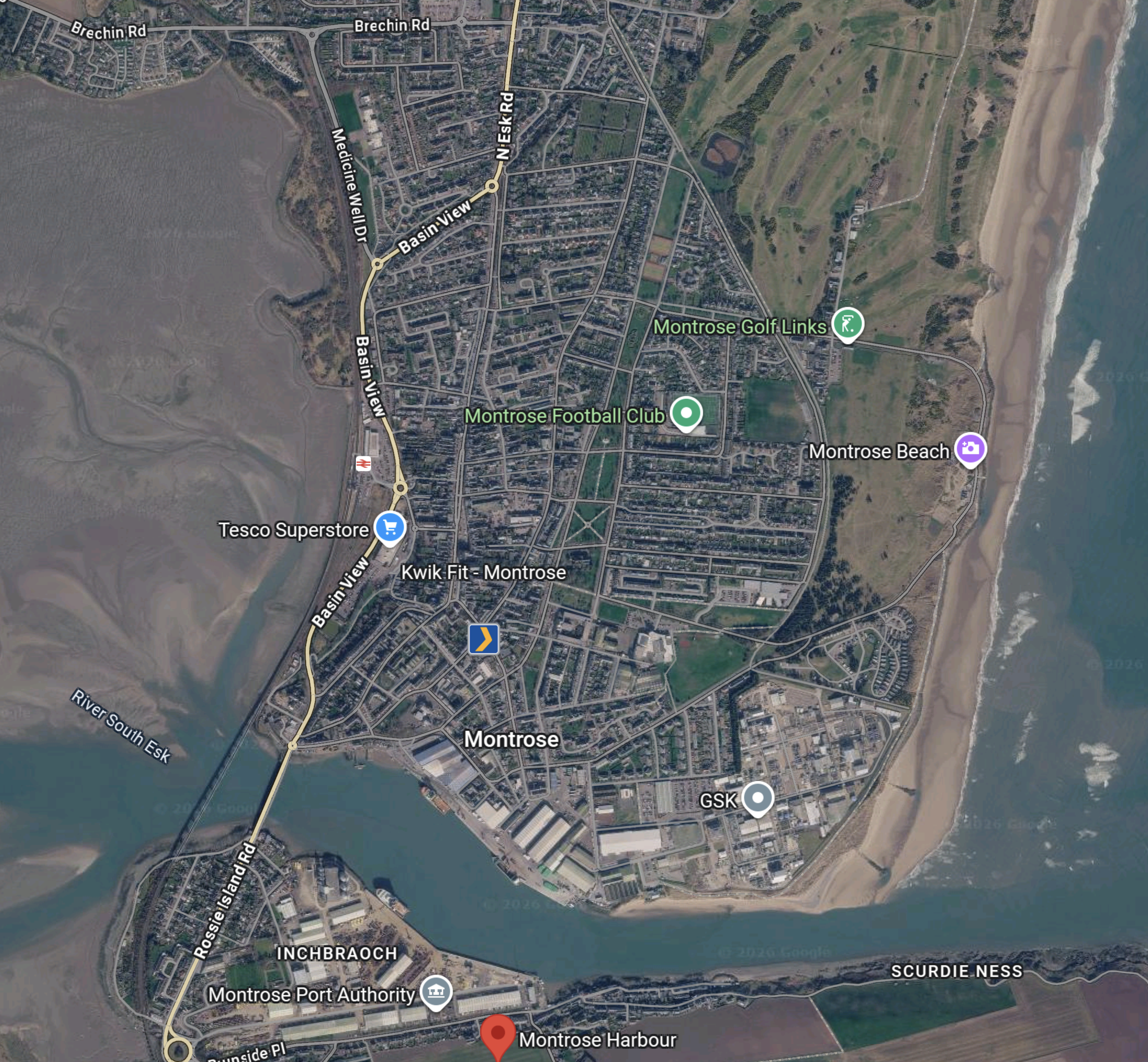
This Google Map shows the town of Montrose and its port at the South.
Note.
- Montrose station is on the West side of the town, on the main Edinburgh and Aberdeen railway.
- Montrose looks to have a major beach.
- Montrose Port is on both sides of the River South Esk.
- There looks to be plenty of space for Subsea Micropiles to build their micropiles.
Subsea Micropiles have a comprehensive web site.
They appear to have offices in Dublin and Aberdeen and say this about micropiles.
We are leading the adaption land-based micro piling technology to create superior marine foundation and anchor solutions.
Micropile has a Wikipedia entry.
TRISO-X Completes Vertical Construction Of TX-1 Fuel Fabrication Facility
The title of this post, is the same as that of this news item from X-energy.
These two bullet-points act as sub-headings.
Completion of vertical construction marks major milestone for first-in-the-nation commercial scale advanced nuclear fuel fabrication facility
Project advances into interior buildout, fuel fabrication equipment installation and construction of supporting facilities
These two paragraphs add more detail.
TRISO-X, LLC (“TRISO-X” or the “Company”), a wholly-owned subsidiary of X-Energy, Inc. (Nasdaq: XE) (“X-energy”), today announced the completion of vertical construction at TX-1, its first-in-the-nation advanced nuclear fuel fabrication facility in Oak Ridge, Tennessee. The milestone completes the primary building structure of the 214,000-square-foot facility and enables the project to advance fully into its next phase of construction, including interior buildout, installation of fuel fabrication equipment and continued construction of supporting facilities.
“Completing vertical construction is a major milestone for TX-1 and another tangible demonstration of the progress our team is making in Oak Ridge,” said Joel Duling, President of TRISO-X. “We are moving from constructing the core and shell of the facility to building out the interior utilities, installing manufacturing equipment, and constructing key support capabilities. Every milestone brings us closer to establishing a new domestic source of advanced nuclear fuel and supporting the deployment of the next generation of American nuclear reactors.”
Note.
- Oak Ridge is one of the United States premier nuclear facilities.
- It would be like building a similar facility for specialist nuclear reactor fuel at Harwell in the UK.
This is without doubt a very professional start to the X-energy programme.
I also feel that the fourth paragraph has important information.
Once operational, TX-1 is expected to produce approximately 700,000 TRISO-X fuel pebbles annually, equivalent to 5 metric tons of uranium (“MTU”), with capacity to provide fuel for up to 11 Xe-100 reactors. The U.S. Nuclear Regulatory Commission (“NRC”) granted TRISO-X a 40-year Special Nuclear Material License for the facility earlier this year, the first-ever NRC Category 2 fuel fabrication license issued for the processing of high-assay low-enriched uranium. TX-1 is expected to be the first new commercial-scale advanced U.S. nuclear fuel fabrication facility built in more than 50 years.
Note.
- TX-1 will be able to support eleven Xe-100 reactors.
- Four Xe-100 reactors will be built initially at Dow’s Seadrift site.
- In Hartlepool Nuclear Reactor Moves To UK Regulatory Assessment, I said that Hartlepool will eventually be a 12-pack site.
I can envisage a fuel strategy based on TX-1, which is something like this.
TX-1 will provide the TRISO fuel for the four reactors at Dow’s Seadrift site.
TX-1 will provide the TRISO fuel for the initial reactor or reactors at a new site like Hartlepool, or for other licensees like Amazon or North Western.
TX-1 will be cloned as necessary to create TX-2, TX-3, TX-4 etc. as more Xe-100 reactors are built.
I am sure, that there is relevant expertise to make TRISO-X fuel pebbles safely in Japan, Korea and the UK of the known partners of X-energy.
The Wikipedia entry for the Dragon reactor finishes with these three paragraphs.
The choice of helium coolant was made after a long debate within the UKAEA between proponents of helium and carbon dioxide, with helium ultimately selected. Groundbreaking occurred in 1960. It operated from 1965 to 1976, and is generally considered extremely successful.
Dragon’s construction was followed by similar work in the US, leading ultimately to the much larger Fort Saint Vrain Nuclear Power Plant. This suffered from a number of problems due to corrosion and the customer soured on the design. Contracts for similar models in the US that were being signed were cancelled, and although Dragon suffered none of these issues, no orders were forthcoming in Europe either. By this time the market had largely standardized on the pressurized water reactor (PWR) for the large buildout that occurred during the 1970s and 80s, and the decision was made to shut down Dragon.
As of 2023, Dragon is being decommissioned.
Note.
- It appears only two reactors using TRISO fuel have been constructed.
- The 20 MW Dragon reactor was extremely successful.
- The 330 MW Fort Saint Vrain reactor had corrosion problems.
- Both reactors used helium gas as a coolant.
- The Wikipedia entry for the Fort Saint Vrain reactor details the corrosion problems.
- According to Google AI fuel for Fort Saint Vrain was fabricated at the General Atomic Fuel Fabrication Facility in San Diego, California.
- According to Google AI fuel for the Dragon reactor was fabricated on-site at Winfrith.
After writing these seven points, I have concluded that TRISO-fueled helium-cooled nuclear reactor designs better suited to small reactors?
What does Google AI think?
I asked Google AI “Are TRISO-fueled helium-cooled nuclear reactor designs better suited to small reactors?” and received this reply.
TRISO-fueled, helium-cooled reactor designs are exceptionally well-suited for small and micro-modular reactor applications because their physical properties scale down efficiently to provide inherent safety and high-temperature operation.
Why They Suit Small Reactors
Inherent Safety (Walk-Away Safe): Each TRISO fuel particle acts as its own tiny containment system, capable of withstanding extreme temperatures (well over 1,600°C) without melting or releasing radioactive fission products. In a small reactor design, the high surface-area-to-volume ratio allows residual decay heat to dissipate passively through the reactor vessel walls, meaning the reactor cannot suffer a catastrophic meltdown even if active cooling completely fails.
Simplified Helium Cooling: Helium is chemically inert and does not absorb neutrons or become radioactive. In smaller reactor configurations, helium’s single-phase gas state eliminates the high-pressure water loops and massive containment structures required by traditional large light-water reactors.
High-Temperature Process Heat: Because helium can operate at very high temperatures without boiling off, small TRISO-gas systems can deliver high-grade industrial heat (useful for chemical plants or hydrogen production) alongside electricity.
Compact Footprint: Small modular reactor (SMR) and microreactor developers (such as X-energy and Ultra Safe Nuclear Corporation) leverage these traits to design factory-fabricated units that can be transported and sited near urban or off-grid industrial locations.
Key Challenges
Power Density and Size: Helium has a lower volumetric heat capacity than water, meaning gas-cooled cores can be physically bulkier per megawatt than water-cooled equivalents, placing a premium on optimizing core geometry for micro-scales.
Supply Chain and Cost: High-Assay Low-Enriched Uranium (HALEU) and specialized TRISO manufacturing face immature supply chains and higher first-of-a-kind costs.
The more I read about X-energy’s technology, the more I like it.
With Federal Funding Windfall, X-energy Advances Small Nuclear Reactor
The title of this post, is the same as this article on Canary Media.
This is the sub-heading.
The Amazon-backed firm is aiming to build up to 144 of its novel Xe-100 reactors as the U.S. government seeks to revitalize an industry beset by rising costs
These three initial paragraphs add more detail.
The federal government has thrown its weight into reviving America’s long-stagnant nuclear industry, and X-energy’s first-of-a-kind reactor project is among the biggest beneficiaries so far.
The U.S. Department of Energy last month said it would award $1 billion to X-energy, an Amazon-backed advanced nuclear startup working to bring four novel 80-megawatt electric reactors online at a Dow Chemical facility in Seadrift, Texas, in the early 2030s.
The award nearly doubles the federal government’s commitment to X-energy, following a $1.2 billion investment in early 2021. Both tranches were structured as 50-50 cost-sharing agreements under the DOE’s Advanced Reactor Demonstration Program, launched in 2020 to commercialize next-generation nuclear technologies.
Note.
- It looks like X-energy are well-funded.
- It also looks like they have received funding under two different presidents.
- I like Dow’s concept of using nuclear to power a chemical complex, which needs both lots of electricity and heat.
- If they build 144 reactors, this will be twelve of the 12-pack power station, that they have said they will build at Hartlepool and I wrote about in Hartlepool Nuclear Reactor Moves To UK Regulatory Assessment.
The next phase would appear to be up to the regulators.
The article on Canary Media is well worth giving a full read.
These are some important highlights.
Dow Seem Enthusiastic And Would Be An Ideal First Customer
In any large project the first customer is always important.
- Dow seem to fit the part well.
- I also suspect, that as Dow turned over around $40 billion in fiscal year 2025, they know what they want.
Even in nuclear power, the customer is generally right.
Has X-energy Found Any Customers For The Xe-100?
I asked Google AI, this question and received this answer.
Yes, X-energy has secured major commercial customers and strategic partners for the Xe-100 reactor.
Key Customers and Partners
Dow: Partnering to deploy an Xe-100 four-pack plant at the Seadrift chemicals manufacturing site in Texas to provide low-carbon heat and power.
Amazon: Bankrolling and collaborating on up to 12 Xe-100 units via Energy Northwest in Washington state, alongside broader clean energy scaling for AI infrastructure.
Centrica: Partnering in the UK to deploy a potential fleet of up to 6 GW (10 to 20 reactors), targeting the Hartlepool site.
Energy Northwest: A Washington public power utility working collaboratively on project deployment frameworks.
Note.
When, the four partners, of which I was one, started to develop the Artemis project management system, the salesman of the four, did a survey of who might buy.
A proportion of these became valuable clients.
As X-energy also has a world-class engineering partner from Japan and Korea, I feel that they have done their preparation thoroughly.
Where Is The TRISO Fuel To Be Made?
According to the Canary Media article, it will be made near Oak Ridge National Laboratory in Tennessee.
- This could be handy for support.
- It could ease recruiting some of the staff with the right experience.
- There may also be useful sub-contractors in the area, with the right experience and certification.
The location is an excellent one.
Has Centrica Been Recruited Because They Are British?
According to its Wikipedia entry, the Dragon reactor, which used TRISO fuel, was generally considered extremely successful.
So by inviting Centrica to be involved, will X-energy be able to get access to the British files concerning the details of the Dragon reactor?
Their interpretation may be the difference between success and failure of the project.
I wouldn’t be surprised that there is a very trustworthy and knowledgeable network of very elderly British nuclear engineers, who enjoy meeting in pubs, with only the best real ales.
Centrica To Invest In Fund Backing The Technologies Driving The Energy Transition
The title of this post, is the same as that of this press release from Centrica.
This is the sub-heading.
Centrica has made a $13.5 million anchor commitment to the first close of ERV Fund II, a new fund from London-based venture capital firm Energy Revolution. The fund is targeting US$50 million and invests at Seed and Series A in energy storage, grid technology and advanced materials.
These two paragraphs add more details.
The electrification of transport, heating and industry, alongside the rapid growth of data centres, is accelerating demand for electricity. That is putting greater pressure on the grids, storage systems, and materials needed to generate, move and deliver reliable power.
Founded in 2021, ERV Group backs early-stage energy technology companies through ERV Fund II and its venture builder, Prosemino. Its technical committee is led by three UK experts: Professor Paul Shearing, Director of the Zero Institute at Oxford University; Professor Chris Howard, Professor of Materials Physics at University College London; and Daniel Brett, CEO of Sention Technologies and formerly co-head of UCL’s Electrochemical Innovation Lab. The firm also has seven full-time PhDs across its technical team.
It looks to me, that this is a good long-term strategy from Centrica.
Can The Hiiroc Process Be Used To Make Sustainable Aviation Fuel (SAF)?
After Writing Cemex To Install World-First Hydrogen Process At UK Cement Plant, I just had to ask this question of Google AI and I received this reply.
Yes, the HiiROC process is currently being developed and studied to produce Sustainable Aviation Fuel (SAF).
How the Process Works
Thermal Plasma Electrolysis (TPE): HiiROC’s core technology splits hydrocarbons (like biomethane, natural gas, or flare gas) into clean hydrogen and solid carbon without burning them or emitting carbon dioxide.
Thermal Plasma Reforming (TPR): Building on TPE, this adaptation is being evaluated to create synthetic e-SAF by combining the produced clean hydrogen with carbon dioxide at a lower electricity cost than traditional water electrolysis.
Current Developments
Feasibility Study: HiiROC received grant funding from Scottish Enterprise to study a negative-carbon SAF business in Scotland through its subsidiary Zeleno Ltd and partner Stratus Energy Partners.
Partnerships: The initiative has drawn interest from aviation and energy stakeholders like Airbus, World Kinect, and the Forth Green Freeport to make power-to-liquid SAF more scalable and affordable.
It certainly seems it could be a possible route to SAF.
I should say, that when I worked at ICI at Runcorn, for a period, I had the privilege of sharing an office, with an elderly scientist, who before the Second World War, was closely involved in the development of polythene.
That was a long process, but in the end they got there, mainly because radar needed a top-class insulator for which polythene was the only solution.

