Why Monopile Lowering Is Becoming A Critical Load Case For Jack-Ups
The title of this post, is the same as that of this article on offshoreWIND.biz.
This is the sub-heading.
As offshore wind monopiles continue to increase in size, the installation phase is emerging as a key structural design consideration for jack-up vessels. According to a recent GustoMSC study, loads generated during monopile lowering can approach — and in some cases exceed — those associated with extreme survival conditions.
This paragraph adds more detail.
With monopile diameters now exceeding 10 metres and weights surpassing 2,000 tonnes, installation dynamics are becoming increasingly complex. The challenge is no longer simply about crane capacity. Instead, the interaction between the suspended monopile and the supporting jack-up is becoming a governing factor.
In the 1970s, I worked on a similar problem as a consultant to a Cambridge company called Balaena Structures.
I described the Balaena in The Balaena Lives, but I believe the design could be applied to a large monopole foundation for a large wind turbine.
- The idea came from two Cambridge University engineering professors, who were much older than me, so they’ve probably passed on.
- The design was patented.
- None were built, as no-one ordered one.
- The computer, that I ran the simulation on doesn’t exist anymore.
- But, I’m fairly certain, I could create a design of XXL Monopile for the world’s largest wind turbine.
- The Balaena was designed to be reuseable.
- I did all the calculations and I believe that the Balaena could be turned into an easier-to-handle XXL Monopole.
None of the details of this project are written down, but they are locked safely in my head.
Hornsea 3 Battery Energy Storage To Start Operations Next Year, Ørsted Selects Arenko’s Platform to Operate BESS
The title of this post, is the same as that of this article on offshoreWIND.biz.
This is the sub-heading.
Arenko has been selected by Ørsted to deploy its Nimbus optimisation, asset management and trading platform at the 300 MW/600 MWh Iceni battery energy storage system (BESS) that will be part of the 2.9 GW Hornsea 3 offshore wind farm in the UK. The BESS project is scheduled to enter operations in the first quarter of 2027.
These are the first three paragraphs.
Named Iceni, the battery storage project is being developed as one of the UK’s first large-scale co-location projects under the Offshore Transmission Network Review (OTNR).
Iceni is designed to share transmission infrastructure and an onshore grid connection with Hornsea 3, rather than securing a separate grid connection. According to Arenko, this makes it the world’s first utility-scale battery to be directly integrated into offshore transmission infrastructure.
Under the agreement with Ørsted, Arenko’s Nimbus software will be used to forecast market and asset conditions, determine how battery capacity should be allocated in real time and automate trading across power markets. The platform will also support the technical, data and controls integration required to operate the battery alongside the offshore wind farm through their shared connection.
Note.
The Offshore Transmission Network Review (OTNR) has a web site.
The Hornsea 3 wind farm has a capacity of about ten times that of the battery.
Centrica Energy And Zelestra Sign Battery Storage Tolling Agreement
The title of of this post, is the same as that as this press release from Centrica.
This is the sub-heading.
Centrica Energy and Zelestra have signed a physical tolling agreement for 99 MW / 297 MWh of battery storage capacity at Zelestra’s Hilgermissen BESS project, located in Lower Saxony, Germany.
These three paragraphs add some more details.
Under the agreement, Zelestra will develop, construct and own the battery storage project, building on their experience in delivering major projects in other markets and their extensive pipeline across Europe. Engineering and procurement activities will be completed this year leading to start of construction in 2027 and operations in 2028.
Under the tolling agreement, the battery will be optimised through Centrica Energy’s multi-market trading and optimisation services, enabling participation across Day-Ahead, Intraday and Ancillary Services in Germany.
Lower Saxony has a strong industrial base, from the automotive industry to agriculture and food production, as well as being a strong wind power and biomass energy producer. With a growing need for flexible capacity to support the stability and resilience of the power system, the BESS project will help accelerate renewable integration, strengthen grid flexibility and support Germany’s wider decarbonisation objectives.
In some ways, I find this press release a bit surprising.
Surely, a nation like Germany has the mathematicians, who are capable of doing this optimisation of a Battery Energy Storage System or BESS.
In New Optimisation Agreement For 70 MW / 160 MWh BESS In Sweden, I wrote about Centrica doing the same thing for the Swedes.
It strikes me, that somewhere in Centrica are one or more very bright mathematicians.
They have a web page, where they describe what they can do for your BESS.
I also believe, that underlying the management of the UK’s gas and the Grain LNG Terminal, which I talk about in Andy Burnham Set For Clash With MPs Over North Sea Oil And Gas, there is some very clever mathematics.
Andy Burnham Set For Clash With MPs Over North Sea Oil And Gas
The title of this post, is the same as that of this article in The Times.
This is the sub-heading.
The prime minister must decide whether to approve the Rosebank oilfield and Jackdaw gasfield but will face opposition from backbenchers if he goes ahead
These are the first three paragraphs.
Andy Burnham faces a potential showdown with Labour MPs after suggesting faster extraction of North Sea oil and gas could help pay for the transition to clean energy.
The prime minister is preparing to decide whether to approve the Rosebank oilfield and Jackdaw gasfield after consultations on both projects closed.
Industry sources have told The Times they believe Burnham will approve Jackdaw but may resist calls to go ahead with Rosebank because of opposition from MPs.
These are my thoughts.
My Boiler, Gas And Jackdaw
Consider.
- This year my boiler died. So I spent several thousand pounds, but I did get a new gas boiler with a 12-year guarantee.
- I am now 79, so can this government, or any for that matter, give me a guarantee, that I will live to 91 to get value from my boiler?
- I know enough about heating, as I have installed a couple of systems for myself, to know that my current house is not suitable for a heat pump.
- But it may be suitable for some type of electric data centre boiler like heata, which was invented by British Gas Research. But, I’m not hopeful yet!
- Meanwhile, Centrica have done a large hand-full of deals to keep the country in enough gas to power us through the winter.
- Some of these are MiQ-certified, which is a bit like Organic for methane, except that emissions are kept to a minimum.
- I covered MiQ-certification in What Is MiQ-Certification?.
So provided we don’t get an extreme-left scientifically-incorrect government, led by someone like the lady with pink hair in Hackney, I should be able to keep myself warm in winter.
But would I vote for any party, that was going to cut off my gas supply?
But Centrica have been clever.
- They have plenty of gas storage at Rough.
- Their press releases show they are buying gas according to MiQ.
- Grain LNG Terminal, which they bought last year has an export facility, so any spare gas they have can be exported to a country to replace coal or Russian gas.
- MiQ-certified gas probably fetches a higher price.
- Centrica would be an obvious purchaser for any North Sea gas.
This gives some dates of the players and Jackdaw
- BG Group and Centrica were demerged from British Gas plc in 1997.
- BG Group discovered Jackdaw in 2005.
- BG Group were taken over by Shell in 2015.
If I was the owner of Jackdaw, I would make sure that my gas had the highest MiQ possible.
If I was energy minister, I’d enforce it.
Will Jackdaw Be A Tie-Back To Shearwater?
I’ve read that it might be, so I asked Google AI and received this answer.
Yes, Jackdaw is designed and developed as a 30-kilometer (approx. 18.5 miles) subsea tie-back to the existing Shearwater platform in the central North Sea.
Project Connection Details
Infrastructure: A multi-phase subsea pipeline links the unstaffed Jackdaw wellhead platform directly to the Shearwater hub.
Processing: Hydrocarbons extracted from Jackdaw will be processed and routed through Shearwater before final export onshore to the St Fergus terminal.
Distance: The subsea pipeline spans roughly 30 kilometers (18.5 miles) northwest from the Jackdaw field to the Shearwater installation.
I also found this detailed article on the Chemical Engineer which is entitled Shell To Invest In Shearwater Gas Infrastructure Hub.
Shell certainly seem to be doing comprehensive planning to bring the gas from Jackdaw to the mainland.
- Currently, gas from the Shearwater hub is sent to Bacton in Norfolk.
- After, Jackdaw is connected to Shearwater, the gas will be sent to St. Fergus, which is North of Aberdeen.
- Google AI says that The Shearwater hub is located approximately 140 miles (225 kilometers) east of Aberdeen in the Central North Sea.
It’s probably all in a day’s work for engineers in the North Sea, but it doesn’t sound to be the easiest project to me.
Will The Jackdaw Gas Field Be Used For CO2 Storage?
I felt this could be a possibility, so I asked Google AI, the question and received this answer.
No, the Jackdaw gas field will not be used for CO2 storage.It is an active natural gas extraction project in the North Sea, though CO2 separated from its extracted gas may eventually be routed to external storage.
Field Status and CO2 Handling
Extraction only: The underground reservoirs at Jackdaw contain natural gas and high-pressure/high-temperature hydrocarbons rather than being purposed for carbon storage.
Onshore processing: Gas from the field comes ashore at St Fergus, where carbon dioxide mixed into the raw gas stream is removed during processing.
Broader CCS links: While Jackdaw itself is a producing asset, its operations tie into Shell’s broader involvement with the regional Acorn Carbon Capture and Storage project, which aims to pipe and sequester CO2 elsewhere.
That was a definite no, that Jackdaw will not be used for Carbon Capture and Storage, but the carbon dioxide in the gas may be stored in the Acorn Carbon Capture and Storage project.
Will Centrica Be Applying Just-in-Time-Delivery To Gas Cargoes?
One of the jobs, I was involved in was scheduling container ships for OCL, in the 1970s.
- I’m fairly certain, that ships were speeded up and slowed down, so that ports weren’t overloaded.
- It was all done with my PERT7 project management software, which ran on Time Sharing at Great Portland Street.
I can envisage a clever programmer at Centrica writing a large simulation of all their natural gas deals and calling off gas cargoes, when required.
- Gas tankers would be constantly sailing between the gas fields in the Americas and LNG Terminals like Grain, where the cargo was needed.
- It would be nice to have a local supply of natural gas to fill in the gaps between cargoes, but delaying and speeding up of deliveries would have the same effect.
- I also suspect cargoes could be diverted to Germany, Poland or the highest bidder, when there is a glut of gas.
It could be a classic example of advanced control engineering, but very similar to what OCL were doing fifty years ago.
By applying just-in-time-delivery to gas cargoes, Centrica would reduce the need for storage in the UK.
At least gas doesn’t have a sell-by date!
How Much Liquid Natural Gas Storage Is There At The Grain LNG Terminal?
Google AI gave me this answer to the question in the title of this section.
The Grain LNG terminal on the Isle of Grain in Kent has a total liquid natural gas (LNG) storage capacity of 1.2 million cubic metres (1,200,000 m³) following recent site expansions.
Terminal Storage Overview
Total Capacity: 1.2 million m³ of cryogenic tank space (increased from the original 1.0 million m³ capacity).
Tank Configuration: Consists of massive full-containment cryogenic storage tanks (such as the 190,000 m³ tanks added in phases).
System Throughput: The facility can process up to 15 million tonnes per annum (mtpa), meeting a significant share of the UK’s total gas demand.
It should be remembered that storing gas as liquid reduces the space needed.
What Is The Capacity Of A Typical LNG Carrier?
Google AI gave me this answer to the question in the title of this section.
A typical modern liquefied natural gas (LNG) carrier has a cargo capacity of approximately 174,000 cubic meters (m³).
This size has become the conventional standard for new builds, balancing port compatibility with transport scale, though global fleet capacities range widely from small-scale vessels to massive ultra-large ships.
Vessel Size Categories
Small-scale carriers: Hold roughly 1,000 m³ to 40,000 m³, used for regional distribution and bunkering.
Medium-scale carriers: Range from 40,000 m³ to 80,000 m³.
Conventional large carriers: Standard modern designs cluster around 140,000 m³ to 180,000 m³, with 174,000 m³ dominating recent ship orders.
Maxi-size carriers (Q-Flex and Q-Max): Specialized ultra-large vessels reach capacities between 210,000 m³ and 266,000 m³, primarily built to service long-distance routes out of Qatar.
Grain LNG Terminal can hold about four cargoes from the largest LNG Carriers.
My extensive experience of writing scheduling algorithms, which go back to one I wrote at ICI Mond in 1968, feels that by scheduling the arrival of the ships, there may well be enough storage at Grain LNG Terminal to keep the UK in gas.
I wonder, if for some time, Centrica have known, that they don’t need Rough for natural gas storage, which is why they have ambitions to turn it into hydrogen storage.
What Is MiQ-Certification?
This is one for AI
I asked Google AI and received this answer.
MiQ certification is an independent, third-party framework that grades natural gas and oil based on how well operators manage and reduce their methane emissions.Developed by RMI and SYSTEMIQ, the MiQ standard assigns facilities a transparent grade from A through F to help create a market for certified low-emissions gas.
Key Evaluation Pillars
Methane Intensity: Measures the quantity of methane lost relative to the total amount of gas produced.
Company Practices: Evaluates internal corporate policies and operational management procedures.
Monitoring Technology: Checks the deployment and effectiveness of advanced detection and measurement tools.
How the System Works
Independent Auditing: Certified, accredited third-party auditors perform rigorous on-the-ground asset evaluations.
Grading and Issuance: Facilities receive a grade (A-F) determined by their lowest score across the core pillars.
MiQ has a web site.
Centrica And MiQ
In February 2026, I wrote Centrica Energy And Seneca Resources Company Sign First-of-Its-Kind Long-Term MiQ Methane Emissions Certificates Agreement, which was based on a Centrica press release with the same title.
This is the sub-heading of the press release.
Centrica Energy and Seneca Resources Company are proud to announce a groundbreaking agreement, marking the first long-term deal of its kind to support independently verified methane emissions from an MiQ-certified US natural gas producer, helping to underpin reductions over time. This ten-year agreement underscores the commitment of Centrica and Seneca to support global efforts to reduce methane emissions.
It looks to me, that Centrica have put down a marker for the sort of gas deals they would like.
Could MiQ Certification For Methane Be A Bit Like Organic Certification For Food?
Google AI gave this answer to my question.
MiQ certification for methane and organic certification for food share a similar core concept: both are independent, third-party verification systems that audit production standards to provide transparency, market differentiation, and trust for buyers.
How They Are Alike
Independent Auditing: Both systems rely on certified, independent third parties to inspect operations and verify claims rather than trusting self-reporting by producers.
Graded Labels: Organic food uses labels like “100% Organic” or “Made with Organic Ingredients” to show quality levels, while MiQ uses a letter grading scale (from A to F) based on methane intensity, quantification accuracy, and company practices.
Market Incentives: Both create economic value for cleaner practices, allowing producers to market their goods at a premium or meet growing demand from eco-conscious buyers and regulators.
How They Are Different
Core Focus: Organic certification measures a broad set of agricultural practices (avoiding synthetic pesticides, GMOs, or artificial fertilizers), whereas MiQ strictly measures methane emissions intensity and management in oil and gas operations.
Measurement Approach: Organic food rules are largely binary compliance standards (you use or do not use forbidden substances), while MiQ uses continuous or periodic performance metrics to score the precise volume of leaked or vented gas.
Regulatory Role: Organic standards are heavily codified by government bodies (like the USDA or EU rules), whereas MiQ operates as an independent, non-profit standard backed by market adoption rather than direct government mandates.
I think it is a classic case of great minds thinking alike or did MiQ just apply, what they saw was working with Organic food and apply it to methane?
Gwynt Glas Offshore Wind Project Strengthens Development And Welcomes New Partner, Sumitomo
The title of this post, is the same as that of this news item from Gwynt Glas.
These three initial paragraphs add some detail.
The Gwynt Glas offshore wind project has today announced a significant strengthening of its joint venture with Sumitomo Corporation joining as an equal partner alongside EDF power solutions UK and Ireland and ESB. Each partner now holds a 33.33% stake, while DP Energy continues to provide critical development support, leveraging its expertise in early stage project delivery and local engagement.
This strategic collaboration brings together three global leaders in renewable energy combining deep expertise in large scale development and delivery. The partnership positions Gwynt Glas to advance confidently through its next phases, reinforcing its role in delivering clean, homegrown energy for Wales and the UK while supporting energy security and economic growth.
Gwynt Glas is a proposed innovative floating offshore wind farm in the Celtic Sea. The up to 1.5 GW project continues to make strong progress and successfully submitted its Scoping Report to the Planning Inspectorate this summer.
Are Sumitomo Involved In Offshore Wind?
I asked Google AI, the question in the title of this section and received this answer.
Since making its first investment in a European offshore wind project in 2014, Sumitomo Corporation
has accumulated extensive expertise throughout the development, construction and operation phases of offshore wind projects.This marks Sumitomo Corporation’s first participation in a floating offshore wind project.
Are Sumitomo learning about floating offshore wind, by participating in a major project or are they up to something very innovative technically?
In Is Sumitomo Heavy Industries Highview Power Energy Storage System On Line At Hiroshima?, I talked about how Sumitomo’s engineers had taken Highview Power’s ideas for energy storage using liquid-air and downsized it to improve the efficiency of an LNG Terminal at Hiroshima, by adding a 4MW/20 MWh battery.
I just wonder, if some of the steel floats that will support the wind turbines, will also be used for liquid-air tanks as part of one of Highview Power’s batteries. As initially, there will be 66 turbines at Gwynt Glas, the battery could be a monster, but a very environmentally-friendly one!
RWE To Build Large-Scale Storage At Hambach Mine
The title of this post is the same as that of this press release from RWE.
These four bullet points act as sub-headings.
- 236 megawatts capacity and 470 megawatt-hours storage capacity
- First battery containers have been delivered; commissioning is planned for 2027
- Large-scale storage system balances fluctuations in the electricity grid in fractions of a second
- RWE currently constructing around 1.7 Gigawatts of battery storage capacity in Germany
This first paragraph gives some more details.
RWE is continuing to expand its battery storage portfolio and is constructing a new large-scale storage facility on the site of the Hambach opencast mine. The battery storage facility is being built near the village of Niederzier in the district of Düren. Preparatory work on a three-hectare site began at the end of 2025. The first of a total of 128 lithium-ion battery containers have already been delivered. The large-scale storage facility will have a capacity of 236 megawatts (MW) and a storage capacity of 470 megawatt-hours (MWh). The facility is scheduled to come on stream in 2027.
Note.
- According to the Wikipedia entry for the Hambach opencast mine, it was used to mine lignite or brown coal.
- The battery will be a two-hour battery.
- The site was originally the Hambach Forest, of which only ten percent remains, as the rest has been cut down because of the mining.
- The pit is 500 metres deep.
- Full cessation of lignite mining planned by 2030 as part of Germany’s coal phase-out.
The site is being gradually transformed into a reclaimed landscape, including the future Hambach lake.
It is well-worth reading the whole Wikipedia entry for the Hambach opencast mine.
ENGIE And La Caisse Select GE Vernova For The Next Phase Of The Modernization Of Dinorwig Pumped Storage Hydropower Plant In North Wales, UK
The title of this post is the same as this news item from Engie.
These are the three bullet points.
First Hydro Company – a 75:25 joint venture between ENGIE and La Caisse, has selected GE Vernova for the modernization/replanting of the first two units of the Dinorwig pumped storage hydropower plant in North Wales, UK.
GE Vernova is expected to replace two 315 Megawatt (MW) units to improve the plant’s reliability, availability and efficiency.
By the end of the decade, the two new units at Dinorwig will help ensure the continued delivery of the fast, flexible generation that plays a crucial role in supporting UK grid stability.
These three paragraphs add some more detail.
First Hydro Company (joint venture between ENGIE and La Caisse), and GE Vernova Inc. (NYSE: GEV), announce the next phase of the modernization/replanting of the Dinorwig pumped storage hydropower plant in North Wales, UK. Under the agreement, GE Vernova is expected to replace two pumped storage units as part of First Hydro’s long-term replanting programme at Dinorwig, to help extend the life of the plant for decades to come, while enhancing the plant’s reliability, availability and performance in support of UK grid stability.
Now over 40 years old, Dinorwig is Europe’s largest pumped storage hydropower plant and is renowned for its rapid response capability, delivering up to 1,320 MW of power within 12 seconds from standby, and up to 1,800 MW in under a minute. With such characteristics, this plant plays a vital role in grid resilience and frequency response, providing a capacity equivalent to power around one million homes in the UK.
As majority owner and operator of the plant through First Hydro Company, ENGIE is making a significant long-term investment to extend its operational life. The wider programme includes the replacement of key plant components across all six generating units, alongside significant infrastructure upgrades.
Note.
- According to the Wikipedia entry, Dinorwig power station has a storage capacity of around 9.1 GWh.
- It was commissioned in 1984.
- The plant was built by an Alfred McAlpine / Brand / Zschokke consortium.
As in 1984, Artemis was very busy, managing projects like this, I’d be very interested to know, if this was a project managed by Artemis.
1.5 GW Morgan Offshore Wind Site Up For Grabs Again As Crown Estate Launches Accelerated Tender
The title of this post, is the same as that of this article on offshoreWIND.biz.
This is the sub-heading.
The Crown Estate has launched an accelerated tender process to select a new developer for the up to 1.5 GW Morgan offshore wind project in the Irish Sea after the previous developer discontinued the project earlier this year.
These two paragraphs add more detail.
The Morgan site was originally awarded through Offshore Wind Leasing Round 4 in 2021 and was held by a joint venture between EnBW and JERA Nex BP. Its development was discontinued in January 2026 after EnBW decided to exit the Morgan and Mona offshore wind projects in the UK. JERA Nex BP then acquired EnBW’s stake in 1.5 GW Mona, while the joint venture discontinued the development of the Morgan project and returned the lease rights to the Crown Estate.
The Crown Estate announced in March 2026 that it would re-tender the site.
Given, that the article mentions an accelerated tender process, is the Crown Estate expecting the developer to put the hammer down.
Google AI says this about the original connection date.
Expected to be operational in 2028/2029 at the earliest, or by 2030 according to initial scheduling.
If it made 2030, that would mean a total offshore wind fleet of 55.15 GW and the Government’s 50 GW target of offshore wind power by 2030 would have been achieved.
That would do nicely.
On The Bonnie, Bonnie Banks o’ Loch Lomon’
I couldn’t resist using the first line of one of the most famous Scottish traditional songs, as the title of this post.
But a very significant power station project, is to be undertaken in the area.
These are the opening few sentences of the Wikipedia entry for the Loch Sloy Hydro-Electric Scheme.
The Loch Sloy Hydro-Electric Scheme is a hydro-electric facility situated between Loch Sloy and Inveruglas on the west bank of Loch Lomond in Scotland. It is also within the Arrochar Alps. The site was originally suggested as the location of a huge pumped-storage scheme in 1936 by Edward MacColl, but this was rejected as being uneconomic. After the North of Scotland Hydro-Electric Board was created in 1943, it became the first of their proposed schemes.
This Google Map shows Loch Lomond and Loch Sloy.
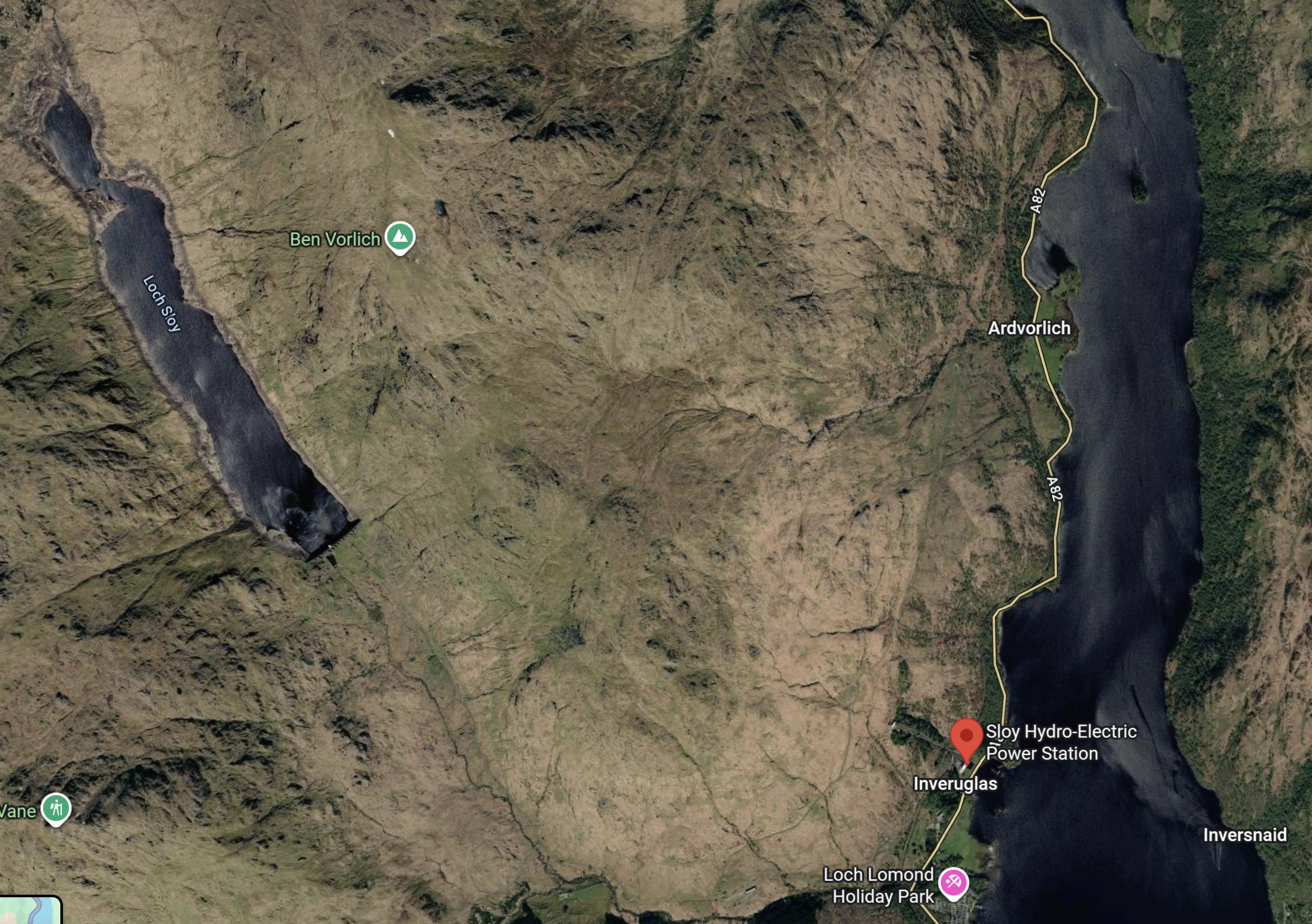
Note.
- Loch Sloy is in the North-West corner of the map.
- Loch Lomond is on the Eastern side of the map.
- The red arrow indicates the main buildings of the LochSloy Hydro-Electric Power Station.
- Loch Sloy is eight-hundred feet above Loch Lomond.
- The total generating capacity of the power station is 152.5 MW.
The facility is operated by Scottish and Southern Energy, and is normally in standby mode, ready to generate electricity to meet sudden peaks in demand. It can reach full capacity within 5 minutes from a standing start.
This second Google Map shows the power station to a larger scale.
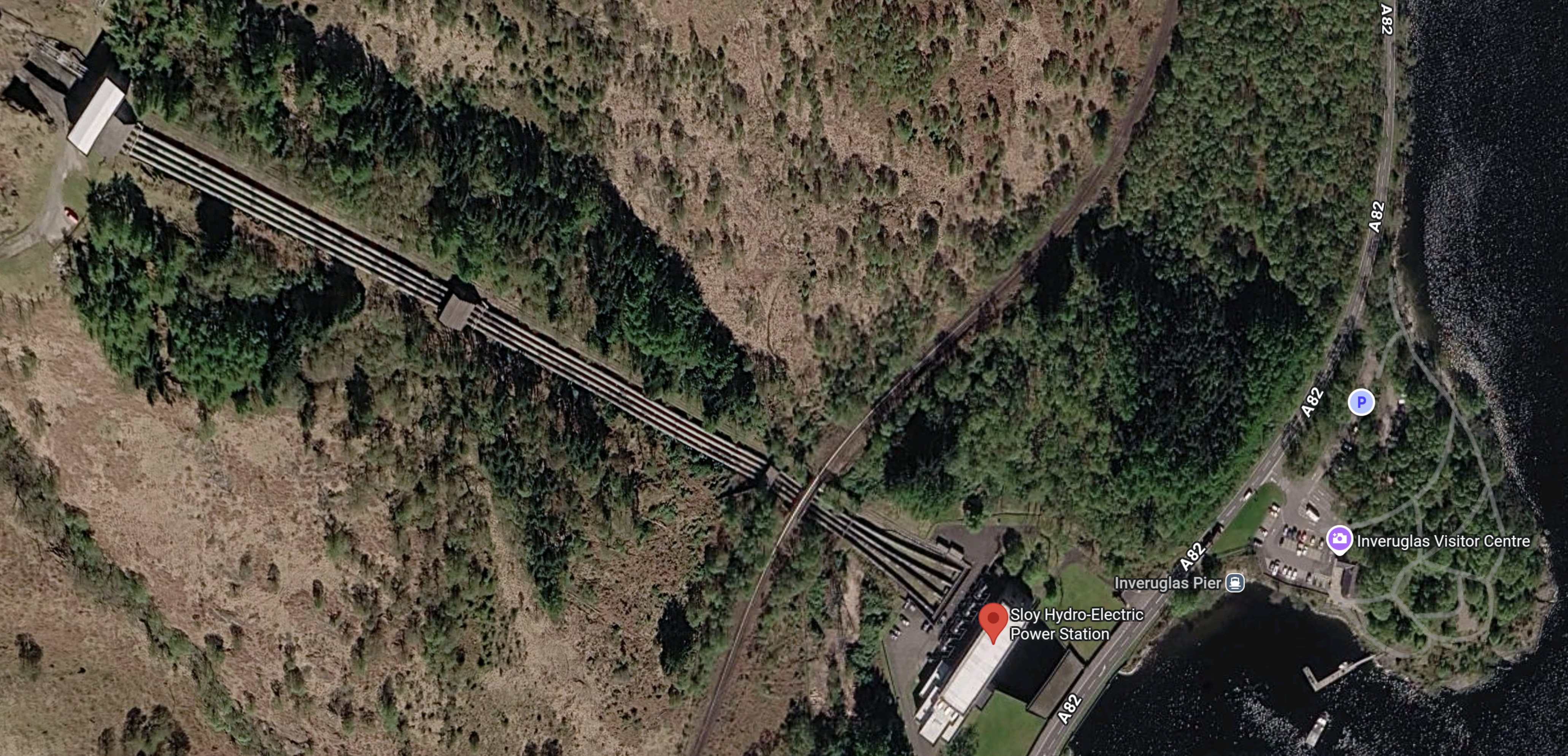
Note.
- Loch Sloy is to the North-West of the North-West corner of the map.
- Loch Lomond is on the Eastern side of the map.
- The red arrow indicates the main buildings of the Loch Sloy Hydro-Electric Power Station.
- The four pipes carry water from Loch Sloy to the actual power station.
- The single-track West Highland Line crosses over the four pipes at their South-Eastern end.
The design of Loch Sloy Hydro-Electric Power Station is typical of many hydro-electric stations all over the world.
This third map is an OpenRailwayMap of the area.
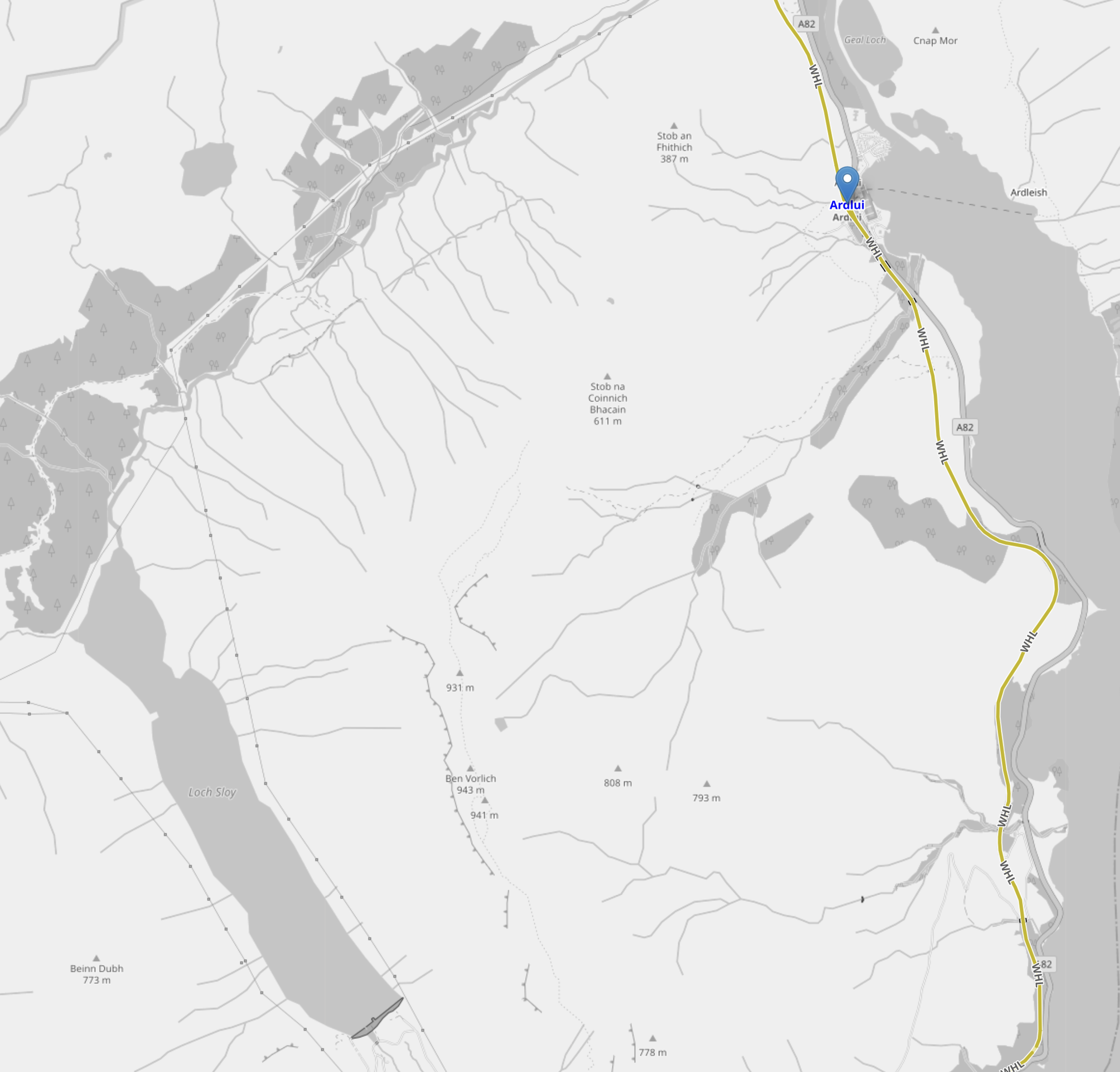
Note.
- Loch Sloy is on the Western side of the map.
- Loch Lomond is on the Eastern side of the map.
- The yellow track is the single-track West Highland Line between Glasgow and Mallaig via Fort William
- The blue arrow indicates Ardlui station.
The railway goes close to the power station.
A Platinum Celebration for Sloy Power Station!
The title of this section is the same as this must-read web page on the SSE web site, which dates from 2020.
Sloy Power Station Development Plans
This second must read web page on the SSE web site is entitled Sloy Power Station.
This is the sub-heading.
We’re Proposing To Convert Our Iconic 1950s Hydro Station To Pumped Storage Hydro
This is the introduction to the development.
In April 2025, we submitted a planning application to the Scottish Government to convert the iconic Sloy Power Station into a pumped storage hydro scheme.
Our proposals would bolster energy security and help provide the large-scale and flexible renewable energy back-up needed in a future UK net zero power system, helping meet the UK Government’s ambition of Clean Power by 2030.
If approved for delivery, the converted Sloy scheme would be capable of delivering up to 16GWh of long-duration electricity storage capacity.
It could provide firm, flexible renewable energy for up to 100 hours non-stop.
It appears that the upgraded power station will effectively become a 160 MW/16 GWh long duration energy store.
Currently, the UK’s largest pumped storage power station is the 1727 MW/9.1 GWh Electric Mountain in North Wales.
The updated Sloy power station will have less output, but more storage capacity, than Electric Mountain.
Should There Be A Railway Station At Loch Sloy Power Station?
Google AI gives this answer in reply to “Loch Sloy Railway Station”.
There was never a permanent public railway station called Loch Sloy, but temporary private platforms like Inveruglas railway station and Faslane Platform railway station served the area. These stops were built in 1945 by the London and North Eastern Railway (LNER) to haul materials and workers—including prisoners of war—for the construction of the Loch Sloy Hydro-Electric Scheme.
Note.
- Surely, similar reasons to those in 1945 could apply to the development of the power station. Materials and workers could be brought in by rail.
- Given, the power station’s historic significance, I believe that it could become a tourist attraction and/or education centre.It could be a stop for the Caledonian Sleeper.
I believe that as time passes, the power station’s historic significance will increase.
Are There Any Other Hydro Power Stations, That Can Be Upgraded To Pumped Storage Hydro?
Google AI can’t find anything at present.

