Racing Towards A Green Future
The title of this post, is the same as that of this article on Ricardo.
This is the first paragraph.
While Formula E and its sibling electric race series, Extreme E and RX2e, are burnishing battery-powered vehicles credentials, motorsport from Formula 1 down is actively pursuing how traditional internal combustion engine (ICE) race and rally cars can be made more environmentally acceptable.
The article, which is a must-read, then describes the various routes and options, that motorsport is taking towards zero-carbon.
The article finishes with this paragraph.
While motorsport technology can, and does, transfer to production cars, especially in the higher echelons, whether the path it is beating on AS fuels will convince legislators that battery electric vehicles are only an answer rather than the answer remains to be seen.
I believe that when an affordable small hatchback powered by hydrogen hits the road as it inevitably will, it will have Ricardo’s fingerprints all over it.
Coal Sales Could Lose Tens Of Millions For Consumers
The title of this post, is the same as that of this article on The Times.
These two paragraphs outline the story.
A huge stockpile of coal bought for emergency use in power stations this winter is due to be resold at a loss of tens of millions of pounds to consumers.
National Grid funded the procurement of hundreds of thousands of tonnes of coal as part of a deal to keep open five coal-fired units this winter. The estimated £368 million cost of the “winter contingency contracts”, which includes an undisclosed sum for the coal purchases, is being recouped via energy bills.
Note.
- None of the coal has been burned, as the weather was warmer than expected,
- It is now sitting in various places around the country.
- It will probably sell at a loss and there will be transport costs.
I will look at the mathematics of disposal.
Burning Fossil Fuels
On the Internet, I have found these figures.
- If you burn a kilogram of natural gas you create 15.5 KWh of electricity and 2.75 kilograms of carbon dioxide.
- If you burn a kilogram of coal you create 2.46 KWh of electricity and 2.38 kilograms of carbon dioxide.
This means that natural gas and coal create 0.18 and 0.97 kilograms of carbon dioxide respectively for every KWh generated.
I believe these figures say, that if we have to use a fossil fuel, gas will be much better than coal for climate change reasons.
The Size Of The Problem
We are talking about 130,000 tonnes of coal for EDF and 400,000 for Drax. Uniper’s figure is not stated. Let’s say they make the coal pile up to 600,000 tonnes.
Burning this pile will generate 1,476,000 KWh or 1.476 GWh of electricity and create 1428,000 tonnes of carbon dioxide.
Effect On Total UK Carbon Dioxide Emissions
According to government figures on the Internet in 2021 we emitted 107.5 million tonnes of carbon dioxide.
Burning all that coal in a year, would add less than 1.5 % to our carbon dioxide emissions. Perhaps we should burn it strategically over a number of years, when there are energy supply problems, as it is after all a crude form of energy storage.
What Would I Do With The Savings?
The money saved on the transport and making loss-making sales could be spent on other ways to save carbon emissions, like converting surplus wind energy into hydrogen and blending it with the gas.
I discussed the mathematics of hydrogen blending in UK – Hydrogen To Be Added To Britain’s Gas Supply By 2025.
If we put 2 % hydrogen in our natural gas, this would save nearly 2.5 million tonnes of carbon dioxide emissions in a year. This figure is much bigger than the 1428,000 tonnes of carbon dioxide, that would be created by burning all the coal.
At a level of 2 %, most appliances, boilers and industrial processes would work without change. But a good service would help.
UK – Hydrogen To Be Added To Britain’s Gas Supply By 2025
The title of this post, is the same as that of this article on Hydrogen Central.
These are the first three paragraphs.
Hydrogen to be added to Britain’s gas supply by 2025.
Hydrogen is to be pumped into Britain’s main gas pipeline by 2025 as part of a scramble to ditch fossil fuels and move to net zero.
Between 2% and 5% of the fuel flowing through the country’s transmission network will be hydrogen in two years under plans drawn up by National Gas, which owns the pipelines.
Note.
- The article says that.on a winter’s day, you’ve got seven times more energy going through the gas network than the electricity network.
- Between 2% and 5% of hydrogen, would be unlikely to mean that appliances, boilers and industrial processes would need to be changed.
- I suspect that domestic appliances and boilers would just need a good service.
- HyDeploy has shown that 20 % of hydrogen could be possible.
- The hydrogen could be added, where the natural gas enters the UK gas network.
The exercise would save a lot of carbon emissions.
How Much Electricity Would Be Needed To Create The Hydrogen?
In The Mathematics Of Blending Twenty Percent Of Hydrogen Into The UK Gas Grid, I calculated the amount of hydrogen that would be needed for 20 %, how much electricity it would need and how much carbon dioxide would not be emitted.
How Much Hydrogen Needs To Be Added?
This page on worldodometer says this about UK gas consumption.
The United Kingdom consumes 2,795,569 million cubic feet (MMcf) of natural gas per year as of the year 2017.
I will now calculate the weight of hydrogen needed to be added.
- 2,795,569 million cubic feet converts to 79161.69851 million cubic metres.
- I will round that to 79161.7 million cubic metres.
- Twenty percent is 15832.34 million cubic metres.
- A cubic metre of hydrogen weighs 0.082 Kg, which gives that in a year 1,298.25188 million kilograms will need to be added to the UK gas supply.
This is 1,298,251.88 tonnes per year, 3,556.85 tonnes per day or 148.2 tonnes per hour.
How Much Electricity Is Needed To Create This Amount Of Hydrogen?
In Can The UK Have A Capacity To Create Five GW Of Green Hydrogen?, I said the following.
Ryze Hydrogen are building the Herne Bay electrolyser.
- It will consume 23 MW of solar and wind power.
- It will produce ten tonnes of hydrogen per day.
The electrolyser will consume 552 MWh to produce ten tonnes of hydrogen, so creating one tonne of hydrogen needs 55.2 MWh of electricity.
To create 148.2 tonnes per hour of hydrogen would need 8,180.64 MW of electricity or just under 8.2 GW.
How Much Carbon Dioxide Would Be Saved?
This page on the Engineering Toolbox is entitled Combustion Of Fuels – Carbon Dioxide Emission and it gives a list of how much carbon dioxide is emitted, when a fuel is burned.
For each Kg of these fuels, the following Kg of carbon dioxide will be released on combustion.
- Methane – 2.75
- Gasoline – 3.30
- Kerosene – 3.00
- Diesel – 3.15
- Bituminous coal – 2.38
- Lignite 1.10
- Wood – 1.83
Engineering Toolbox seems a very useful web site.
I will now calculate how much carbon dioxide would be saved.
- In 2017, UK methane consumption was 79161.7 million cubic metres.
- One cubic metre of methane weighs 0.554 Kg.
- The total weight of methane used is 43,855,581.8 tonnes.
- Multiplying by 2.75 shows that 120,602,849.95 tonnes of carbon dioxide will be produced.
As twenty percent will be replaced by hydrogen, carbon dioxide emission savings will be 6,030,142.498 tonnes.
That seems a good saving, from a small country like the UK.
The UK would also reduce natural gas consumption by twenty percent or 15832.34 million cubic metres per year.
How Much Electricity Would Be Needed To Create The Hydrogen for a 5 % Blend?
I’ll now repeat the calculation for a 5 % blend,
How Much Hydrogen Needs To Be Added?
I will now calculate the weight of hydrogen needed to be added.
- UK gas consumption rounds to 79161.7 million cubic metres.
- Five percent is 3958.085 million cubic metres.
- A cubic metre of hydrogen weighs 0.082 Kg, which gives that in a year 324.56297 million kilograms will need to be added to the UK gas supply.
This is 324,563 tonnes per year, 889.21 tonnes per day or 37 tonnes per hour.
How Much Electricity Is Needed To Create This Amount Of Hydrogen?
Earlier I said this.
The electrolyser will consume 552 MWh to produce ten tonnes of hydrogen, so creating one tonne of hydrogen needs 55.2 MWh of electricity.
To create 37 tonnes per hour of hydrogen would need 2,045.16 MW of electricity or just over 2 GW.
How Much Carbon Dioxide Would Be Saved?
Earlier, I found that a Kg of methane will produce 2.75 Kg of carbon dioxide on combustion.
I will now calculate how much carbon dioxide would be saved.
- In 2017, UK methane consumption was 79161.7 million cubic metres.
- One cubic metre of methane weighs 0.554 Kg.
- The total weight of methane used is 43,855,581.8 tonnes.
- Multiplying by 2.75 shows that 120,602,849.95 tonnes of carbon dioxide will be produced.
As five percent will be replaced by hydrogen, carbon dioxide emission savings will be 6030,142.4975 tonnes.
The UK would also reduce natural gas consumption by five percent or 3958.085 million cubic metres per year.
How Much Electricity Would Be Needed To Create The Hydrogen for a 2 % Blend?
I’ll now repeat the calculation for a 2 % blend,
How Much Hydrogen Needs To Be Added?
I will now calculate the weight of hydrogen needed to be added.
- UK gas consumption rounds to 79161.7 million cubic metres.
- Two percent is 1,583.234 million cubic metres.
- A cubic metre of hydrogen weighs 0.082 Kg, which gives that in a year 129.825 million kilograms will need to be added to the UK gas supply.
This is 129,825 tonnes per year, 355.68 tonnes per day or 14.8 tonnes per hour.
How Much Electricity Is Needed To Create This Amount Of Hydrogen?
Earlier I said this.
The electrolyser will consume 552 MWh to produce ten tonnes of hydrogen, so creating one tonne of hydrogen needs 55.2 MWh of electricity.
To create 14.8 tonnes per hour of hydrogen would need 817 MW of electricity or not even a GW.
How Much Carbon Dioxide Would Be Saved?
Earlier, I found that a Kg of methane will produce 2.75 Kg of carbon dioxide on combustion.
I will now calculate how much carbon dioxide would be saved.
- In 2017, UK methane consumption was 79161.7 million cubic metres.
- One cubic metre of methane weighs 0.554 Kg.
- The total weight of methane used is 43,855,581.8 tonnes.
- Multiplying by 2.75 shows that 120,602,849.95 tonnes of carbon dioxide will be produced.
As two percent will be replaced by hydrogen, carbon dioxide emission savings will be 2,412,057 tonnes.
The UK would also reduce natural gas consumption by two percent or 1,583.234 million cubic metres per year.
Summary Of Savings And Electricity Needed
2 %
- Hydrogen To Add – 14.8 tonnes per hour
- Electricity Needed – 817 MW per year
- Carbon Dioxide Savings – 2,412,057 tonnes per year
- Natural Gas Reduction – 1,583.234 million cubic metres per year
5 %
- Hydrogen To Add – 37 tonnes per hour
- Electricity Needed – 2,045.16 MW per year
- Carbon Dioxide Savings – 6,030,142.498 tonnes per year
- Natural Gas Reduction – 3,958.085 million cubic metres per year
20 %
- Hydrogen To Add – 148.2 tonnes per hour
- Electricity Needed – 8,180.64 MW per year
- Carbon Dioxide Savings – 24,120,569.99 tonnes per year
- Natural Gas Reduction – 1,5832.34 million cubic metres per year
Ballymena: Wrightbus To Develop Hydrogen Production Facility
The title of this post, is the same as that of this article on the BBC.
This is the sub-heading.
Wrightbus is planning to develop a green hydrogen production facility at its factory in Ballymena.
And these first three paragraphs outline the project.
The proposal is being made in partnership with a sister company, Hygen Energy.
Part of the Wrightbus business is the manufacturing of hydrogen-powered buses, some of which are operated by Translink.
The new facility would help create a reliable source of fuel for those buses and other hydrogen-powered vehicles.
It seems a well-designed project and it appears Hygen are building a similar facility in Bradford.
Some months ago, I had a drink in my house, with three senior London bus company executives.
One has had problems with electric buses, as getting the required power to charge a fleet in some Central London garages is not easy.
I showed them these figures, from the Wrightbus web site.
- A Wrightbus electric double-decker takes 2.5 hours to charge for a 200 mile range.
- A hydrogen double-decker takes 8 minutes to refuel with up to a 280 miles range.
They were impressed. Especially, as a typical duty for a bus in London is almost 200 miles. A hydrogen bus seemed to make a lot more sense.
So why isn’t London preparing for scores of hydrogen buses?
Ask the Mayor!
Riding On Hydrogen-Powered Buses And Trains
These posts describe my trips on hydrogen-powered buses
Note.
- The first bus starts from Birmingham City Centre.
- The second bus runs between Paddington station and John Lewis in Oxford Street in London.
This post describes my first ride in a hydrogen-powered train.
My First Ride In An Alstom Coradia iLint
This was through the German countryside between Hamburg and Cuxhaven.
Mersey Tidal Project And Where It Is Up To Now
The title of this post, is the same as that of this article on the Liverpool Echo.
This is the sub-heading.
With a major agreement on the project reached this week, we take a look at what it all means.
There is a section, which is called So What Is A Mersey Tidal Project?, where this is said.
The idea is to build a huge damn structure in the River Mersey with turbines that can harness energy from the tides of the river and convert it into clean power. The city region combined authority is hopeful that this could power up to 1 million homes and create thousands of local jobs
The city region has one of the country’s largest tidal ranges so it is seen as a perfect opportunity to explore a tidal project here. It is hoped such a project could generate a ‘plentiful, reliable supply of clean, green energy for generations to come.
In the 1970s, I did a small project management consultancy at Frederick Snow and Partners in London. They showed me their ambitious plans for a Severn Barrage, which was a tidal scheme, that would have created a tenth of our electricity and would have cost around a billion pounds.
But Harold Wilson, who was Prime Minister at the time, felt that the money would be better spent on building massive coal-fired power stations, rather than building a clean power station, that would last centuries.
A second section is called What Happened This Week?, where this is said.
This week the Liverpool City Region signed an agreement with the company behind the current world’s current largest tidal project with a view to learning lessons.
The Sihwa Lake tidal range power plant, which is operated by Korea Water Resources Corporation, generates 552GWh of clean, green energy every year, replacing the equivalent of 862,000 barrels of oil a year.
Jeong Kyeong Yun, Vice President of Korea Water Resources Corporation, known as K-water, was in Liverpool this week to sign an historic Memorandum of Agreement with Mayor Rotheram. It is hoped the agreement will pave the way for close co-operation between the two tidal power projects, through reciprocal visits and information sharing.
Note.
- The Liverpool Echo is still making spelling mistakes, like damn instead of dam. In the 1960s, Fritz Spiegl used to give us all pleasure by writing about them.
- 552 GWh would keep the UK powered up for nearly a month.
- The Sihwa Lake Tidal Power Station has a comprehensive Wikipedia entry.
- The Sihwa dam has a road over the top.
- Unlike Frederick Snow’s scheme for the Severn, Sihwa only generates power, on the incoming tide. But it does generate 254 MW.
As ever, Liverpool is thinking big and getting the experience from those, who know what they are doing.
This last paragraph, gives the thoughts of the Mayor.
Mayor Rotheram said that with the right support, he hopes the project could be generating clean, renewable power by the end of this decade.
I would go along with that.
The Mersey Tidal Project And The Mersey Gateway Bridge
Frederick Snow’s plans for the Severn could have incorporated a new road and rail crossing of the estuary.
This Google Map shows the the Sihwa Lake Tidal power station.
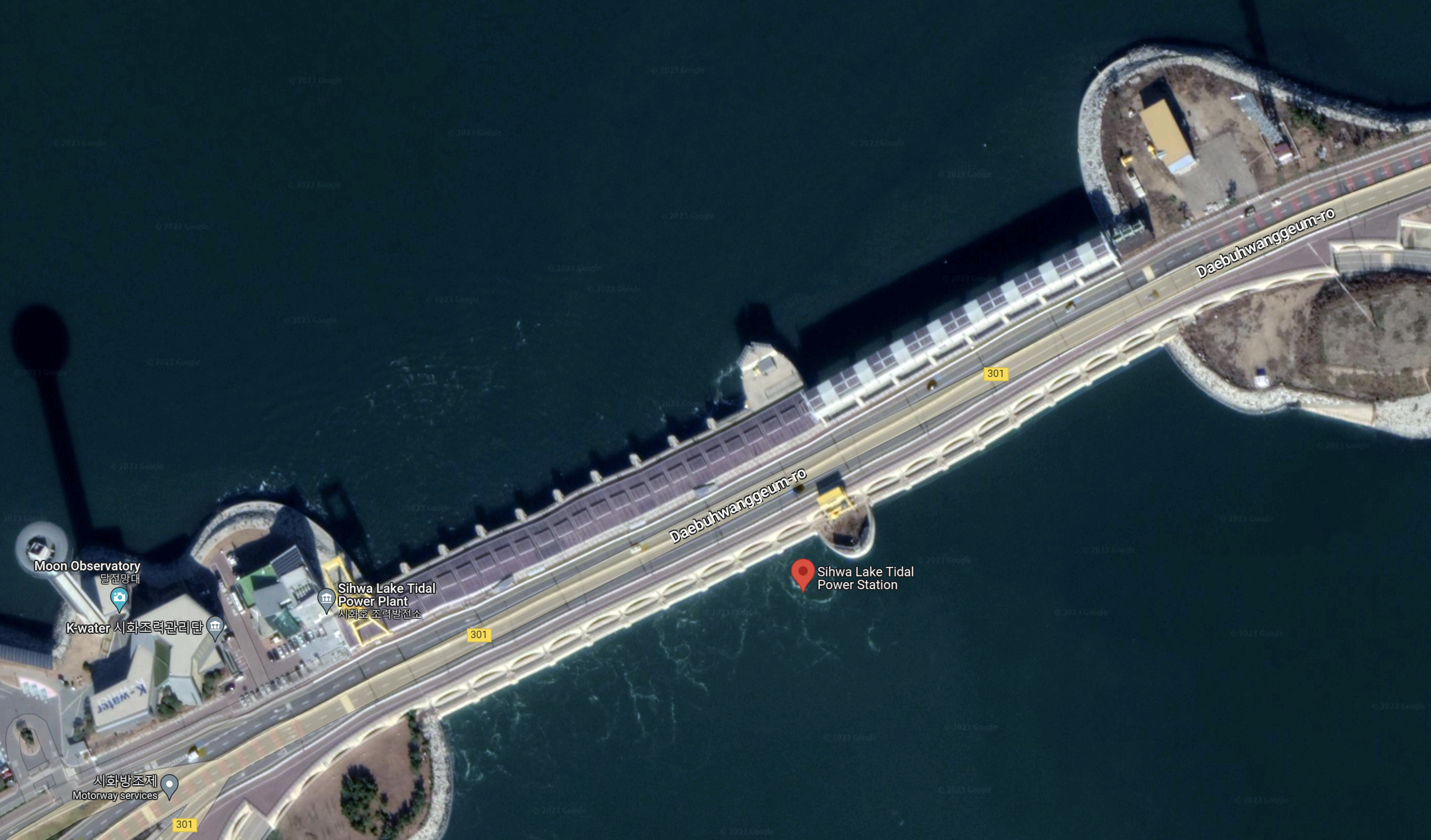
The road over the dam is clearly visible.
I took these pictures of the Mersey Estuary as I came back from Liverpool on Tuesday.





This Google Map shows the Mersey Estuary.
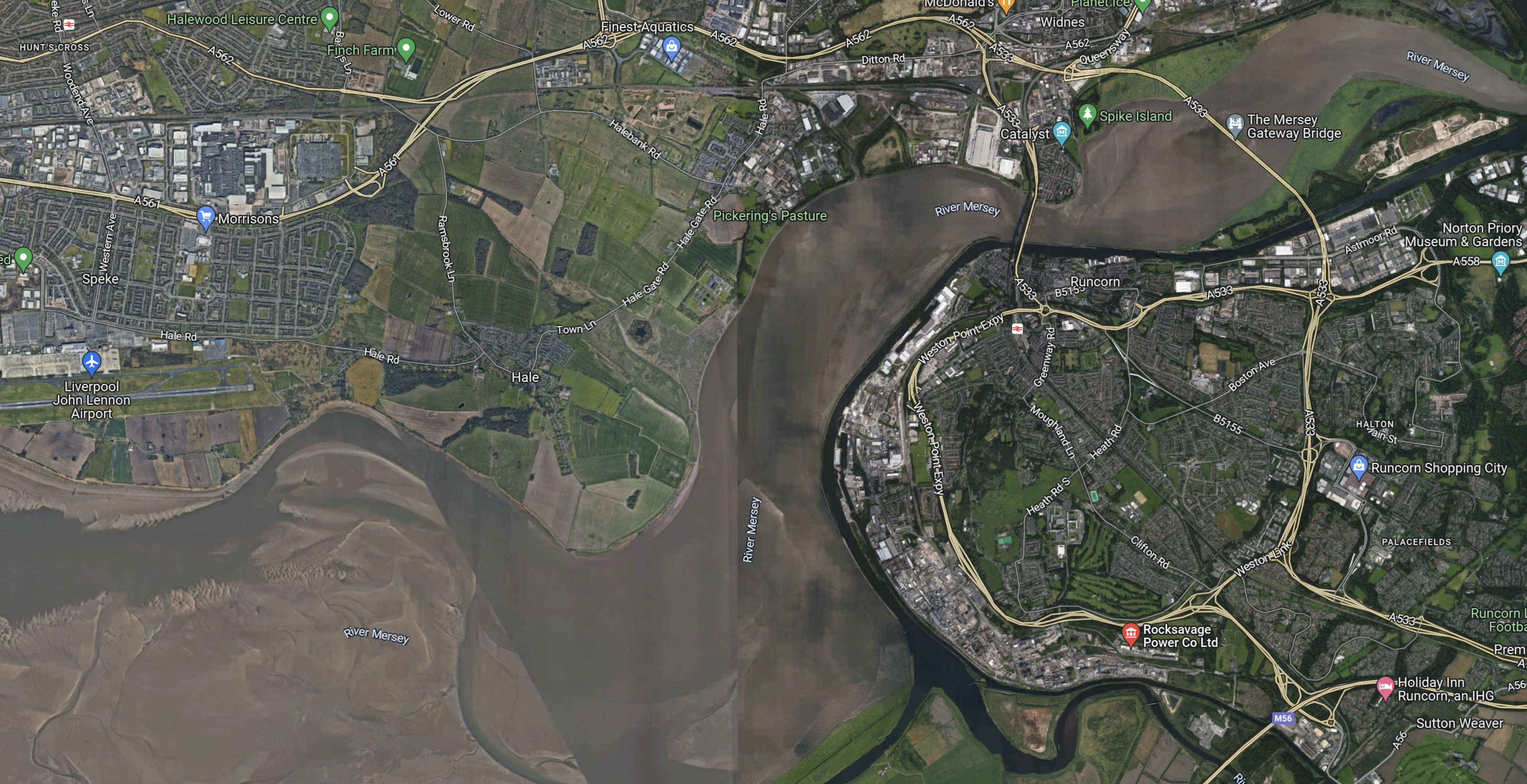
Note.
- The River Mersey flowing from the North-East corner of the map to the South-West corner.
- On the South Bank of the Mersey, there is the deep-water channel of the Manchester Ship Canal.
- The bridge in the North-East corner of the map is the Mersey Gateway Bridge.
- Then there is the pair of bridges at Runcorn; the Silver Jubilee Bridge and the Runcorn Railway Bridge.
I am fairly sure, that the Mersey Tidal Project would be built downstream of the pair of bridges at Runcorn.
This Google Map shows the Mersey Estuary from the Runcorn Bridges to the mouth of the Manchester Ship Canal.

Note.
- The Mersey Gateway Bridge and the two Runcorn bridges are in the North-East corner.
- The route of the Manchester Ship Canal is clearly visible.
- Liverpool John Lennon Airport is on the North Bank of the Mersey.
- The M56 and M53 Motorways run East-West across the map to the South of the River.
This map leads me to the conclusion, that a tidal barrage with a road on top could link Liverpool to the M56.
I have some thoughts.
Rail Access To Liverpool
There is an electrified railway between Liverpool and Ellesmere Port.
- The railway can be picked out running across the bottom of the map.
- In Liverpool’s Vision For Rail, I talked about Liverpool City Region’s plan to expand this service to Helsby, Frodsham and Runcorn East.
- Helsby and Frodsham are shown on the map.
I wouldn’t be surprised to see a new Park-and-Ride station, where the M56 and the railway cross.
Ship Access To Manchester And Other Ports
Barrages usually have to provide access for ships to pass through to any ports behind the barrage.
But the Mersey Tidal Project already has that access. – It was built in the 1893 and is called the Manchester Ship Canal.
There is probably strong protection between the Mersey and the Canal between the mouth of the Canal and Runcorn, which may impact positively on the costs of the barrage.
The Simple Barrage
Sihwa Lake Tidal power station is a simple barrage with a bridge over the power station in the middle.
This Google Map shows the location of the power station.
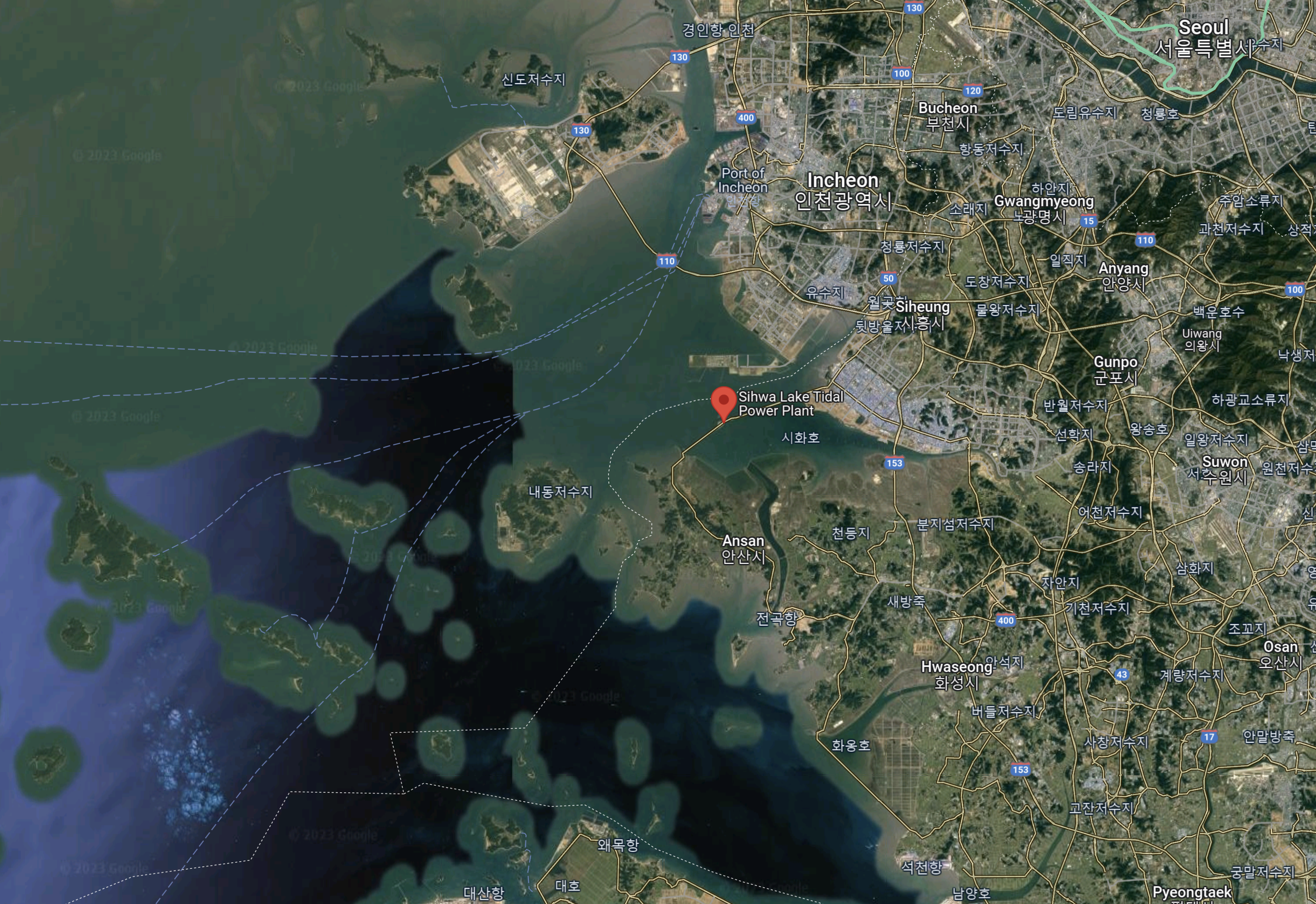
Note.
- Seoul is in the North-East corner of the map.
- The Sihwa Lake Tidal power station is marked by the red arrow.
This Google Map shows a close-up of the power station.
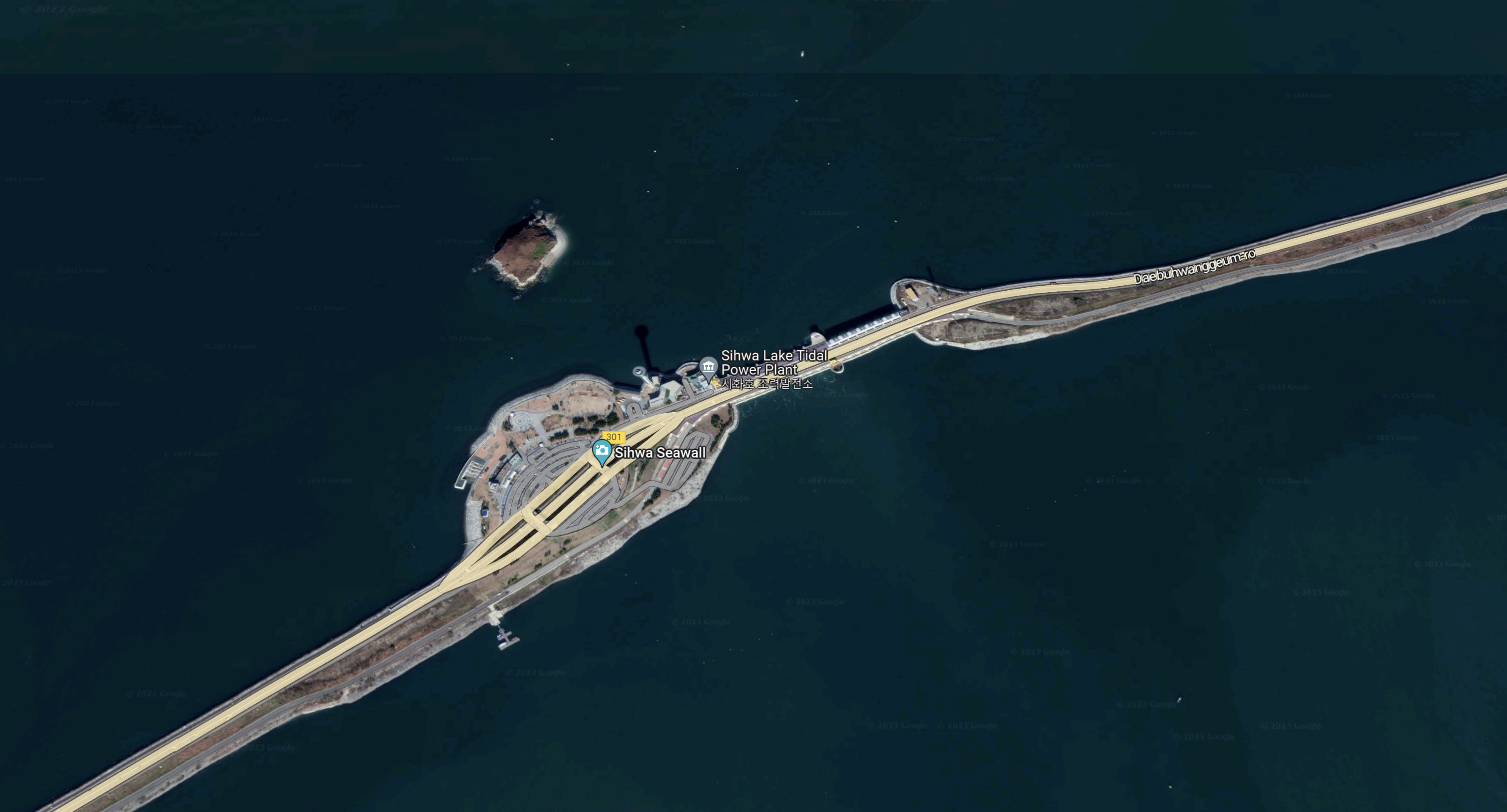
Note.
- The ten turbines appear to be in the gap.
- There appears to be a road on top of the barrage.
- The area to the West of the power station is marked as a rest area.
- A Moon Observatory is marked.
- It has bus stops, showing that it is served by the 123 and 123-1 buses.
It is an impressive structure.
I’m sure that this type of barrage would work over the Mersey.
- A road could be built on top.
- It may only be able to generate electricity,from an incoming tide, like Sihwa.
- It could incorporate a rest area.
I do suspect though Liverpudlians would add a few unique touches of their own. Perhaps some liver birds or superlambananas.
The Frederick Snow Solution
The Severn is a wide river and he proposed that there would be a dam across the river, with a spine running East along the middle of the river.
- The spine would divide the river into two lakes.
- On the incoming tide, sluices would open and allow water to flow into the Northern or high lake from the Mersey estuary.
- On the outgoing tide, sluices would open and allow water to flow out of the Southern or low lake into the Mersey estuary.
- Water would flow between the high and low lake through turbines to generate electricity.
- I have assumed that the high lake is on the North side, but if the geography is more suitable, the high and low lakes could be reversed.
In the design for the Severn Barrage, an International airport would have been built on the spine.
But Liverpool already has a nearby International airport, so perhaps it could be much better to install a large electrolyser and hydrogen storage on the spine.
BMW To Launch Small Test Fleet Of H2 Cars To Use Truck Hydrogen Fuel Stations
The title of this post, is the same as that of this article on Hydrogen Fuel News.
This is the first paragraph.
BMW is aiming to take a ride on the network of hydrogen fuel stations for trucks in order to help overcome the challenge associated with building an expensive network specifically for passenger cars.
Why not?
Honda And GM To Produce Systems For Hydrogen Fuel Cell Cars And Trucks
The title of this post, is the same as that of this article on Hydrogen Fuel News.
This is the first paragraph.
A hydrogen fuel cell system co-developed by Honda Motor and General Motors (GM) will begin production this year and will gradually increase its numbers throughout this decade.
This could be a big development.
Researchers Use Sea Water To Produce Green Hydrogen At Almost 100% Efficiency
The title of this post, is the same as that of this article on Hydrogen Fuel News.
This paragraph gives more details.
“We have split natural seawater into oxygen and hydrogen with nearly 100 percent efficiency, to produce green hydrogen by electrolysis, using a non-precious and cheap catalyst in a commercial electrolyser,” explained Professor Shi-Zhang Qiao, project leader at the School of Chemical Engineering at the University of Adelaide.
They use what is called a Lewis acid catalyst.
In the late 1960s, I worked for ICI in Runcorn.
Most of the hydrogen they needed was produced from brine by the large Castner-Kellner process, which may have been green, but was filthy, as it used a lot of mercury.
ICI also had an older and cruder process, which produced hydrogen and oxygen, by electrolysing brine, in a simple cell.
- These cells had a metal tub, with a concrete lid.
- Two electrodes passed through the lid.
- The lids quickly degraded and cells were rebuild regularly.
- But it did produce medical grade sodium hydroxide.
Legend also had it, that the salt that collected around the lid was pure enough to use in the canteen.
In Torvex Energy, I describe a company in Stockton which is also going the sea water electrolysis route.
Having seen, its Victorian ancestor in operation, I believe that sea water electrolysis has possibilities to make hydrogen efficiently.
Equinor And SSE Eye Green Hydrogen Production For 1.32 GW Dogger Bank D
The title of this post, is the same as that of this article on offshoreWIND.biz.
This is the sub-heading.
SSE Renewables and Equinor, the developers of the Dogger Bank Wind Farm in the UK, are exploring two options for Dogger Bank D, the fourth wind farm the partners are looking to build as part of the development. These include using Dogger Bank D for electricity that would feed into the UK grid and/or for green hydrogen production.
This says to me, that depending on need, electricity from the Dogger Bank Wind Farms and D in particular, can be distributed in the grid or converted into green hydrogen.
- The article says that the electrolyser could become the UK’s largest green hydrogen project
- There will be plenty of hydrogen storage in the salt caverns at Aldbrough, which can currently store the equivalent of 320 GWh of electricity, It is currently being expanded to be one of the largest hydrogen stores in the world according to this page on the SSE web site.
- There are currently two gas-fired power stations at Keadby and they will in a few years be joined by a third, that will be fitted with carbon-capture and a hydrogen-fueled power station.
The various wind farms, power stations and gas storage on Humberside are growing into a very large zero-carbon power cluster, with an output approaching six GW.
Any shortfall in wind output, could be made-up by using the Keadby 3 gas-fired power station with carbon capture or the Keadby hydrogen power station.
Conclusion
Humberside is getting a cluster of power stations and wind farms, that can produce almost twice the electricity of Hinckley Point C nuclear power station.
 The Anonymous Widower