Rolls-Royce And Hydrogen
This page on the Rolls-Royce web site given their view on hydrogen.
This is the first paragraph.
We see an important role for hydrogen in helping to lower emissions; fuelling buses and lorries as well as for energy storage and home heating. Interest in its use in aviation is growing too, especially to power smaller aircraft using fuel cells. Hydrogen has the potential to power larger aircraft as a direct gas turbine engine fuel, and is being investigated with significant technical and operational challenges needing to be overcome.
Good to see the company confirm later in the page, that hydrogen can be used as fuel in a gas-turbine.
Rolls-Royce And Porterbrook Agreement Will Drive Rail Decarbonisation
The title of this post, is the same as that of this press release from Porterbrook.
This is the important part of the press release.
Rolls-Royce is teaming up with Porterbrook to identify and develop technological innovations to reduce carbon emissions and improve air quality across the rail network. The two companies, who have signed a memorandum of understanding, will investigate the potential for the use of synthetic and net zero fuels, including hydrogen, both in fuel cells and internal combustion engines. Building on their recent success of jointly introducing hybrid battery-diesel railcars into passenger service, the two companies will also explore the potential for advanced hybridisation.
The relationship also includes considering the role of the wider rail ecosystem in decarbonisation, including fuel chain supply, infrastructure and operational models that can aid innovation and the transition to net zero.
The UK’s railway accounts for approximately 1% of all domestic greenhouse gas (GHG) emissions* and the Government’s ambition is to remove all diesel-only trains – both passenger and freight – from the network by 2040 and achieve a net zero rail network by 2050. The UK Government has identified a number of different routes to this target including alternative forms of power such as hydrogen, fuel cells, batteries, hybrid-electric and sustainable fuels.
Rolls-Royce have issued a similar press release.
I believe this agreement could result in significant benefits to the UK rail industry, in respect to reduction in diesel consumption, noise and carbon emissions.
Examples could include.
- Conversion of Bombardier Turbostars to hybrid operation. I covered this in UK’s First 100mph Battery-Diesel Hybrid Train Enters Passenger Service.
- Conversion of Class 66 locomotives to hydrogen power.
- Conversion of Class 43 power-cars to hydrogen power.
Unfortunately, I can’t add more examples as there is no Porterbrook fleet list on their web site.
New Catalyst Extracts Hydrogen From Hydrogen Storage Materials More Efficiently
The title of this post, is the same as that of this article on Tech Explorist.
These are the first two paragraphs.
Hydrogen storage is a crucial enabling technology for advancing hydrogen and fuel cell technologies. One of the ways to store hydrogen is chemically. Chemical storage allows large amounts of hydrogen stored in small volumes at ambient temperatures.
However, for the hydrogen to be useful, catalysts are needed to activate LOHCs and release the hydrogen. This process is called dehydrogenation.
LOHCs are Liquid Organic Hydrogen Carriers.
The article describes how scientists at the Ames Laboratory have developed a new catalyst that doesn’t use metals or additives, that works at mild temperatures and under normal atmospheric conditions.
It does seem to me that LOHCs have a future, but given the sparseness of the Wikipedia entry, their widespread use may be some years away.
Norfolk Vanguard Offshore Wind Farm Re-approved By Government
The title of this post, is the same as that of this article on the BBC.
These are the two introductory paragraphs.
An offshore wind farm capable of generating electricity for nearly two million homes has been re-approved by government after consent was previously overturned by a High Court judge.
Vattenfall’s 1.8-gigawatt Norfolk Vanguard project had been granted consent by the Department for Business, Energy and Industrial Strategy (BEIS).
Note.
- Norfolk Boreas and Norfolk Vanguard are a pair of 1.8 GW offshore wind farms to be developed 72 and 47 kilometres off the Norfolk coast by Swedish company; Vattenfall.
- Hinckley Point C will have a capacity of 3.25 GW.
This map shows the two fields in relation to the coast.
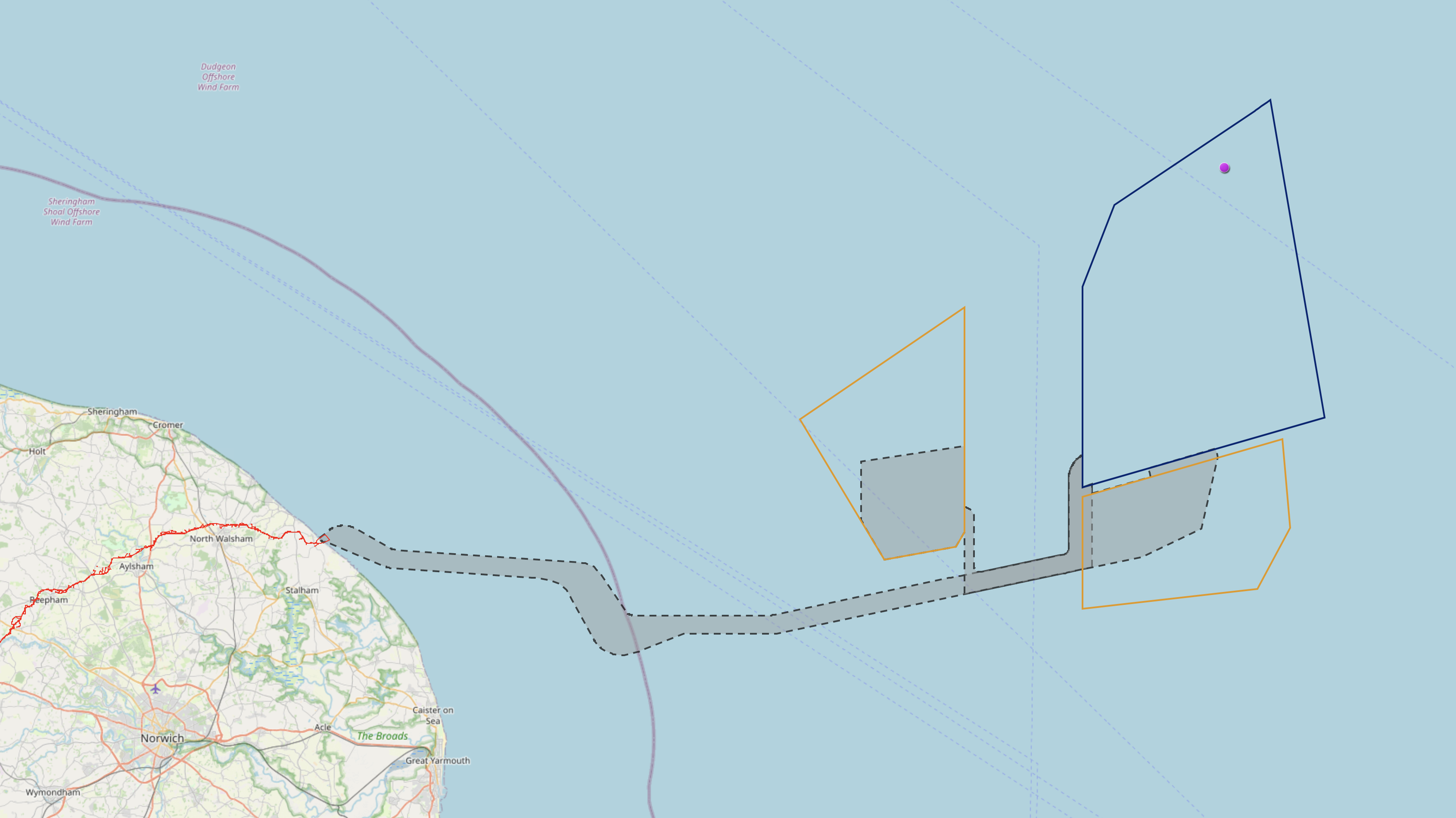
Note.
- The purple line appears to be the UK’s ten mile limit.
- Norfolk Boreas is outlined in blue.
- Norfolk Vsnguard is outlined in orange.
- Cables will be run in the grey areas.
This second map shows the onshore cable.
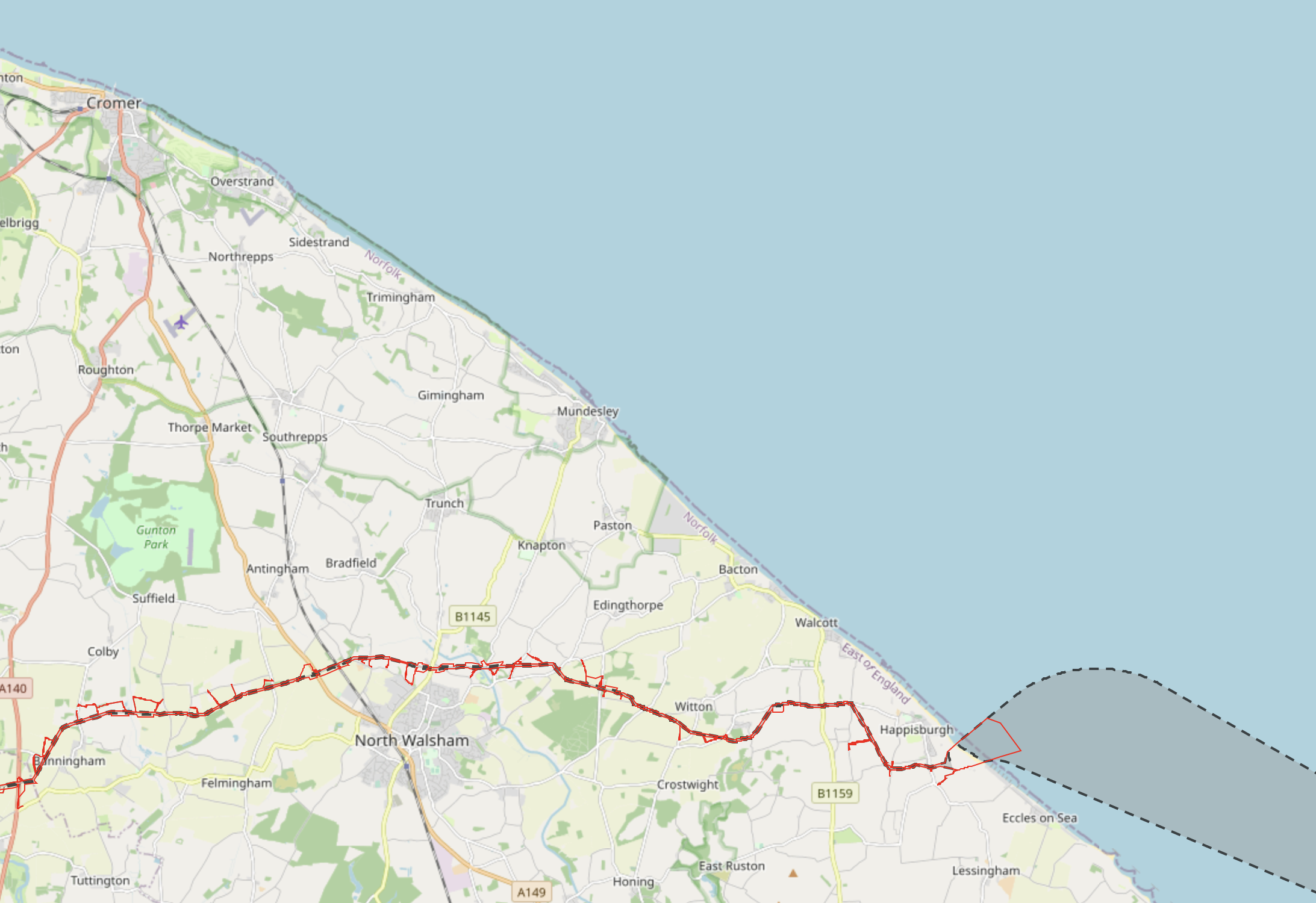
Note.
- The cables are planned to come ashore between Happisburgh and Eccles-on-Sea.
- Bacton is only a short distance up the coast.
- The onshore cable is planned to go from here across Norfolk to the Necton substation.
But the planning permission was overturned by a legal ruling.
This article on the BBC is entitled Norfolk Vanguard: Ministers Wrong Over Wind Farm Go-Ahead, Says Judge.
These are the first four paragraphs.
A High Court judge has quashed permission for one of the world’s largest offshore wind farms to be built off the east coast of England.
The Norfolk Vanguard Offshore Wind Farm was granted development consent in July by the Secretary of State for Business, Energy and Industrial Strategy (BEIS).
But Mr Justice Holgate overturned the decision following legal action from a man living near a planned cable route.
A Department for BEIS spokeswoman said it was “disappointed by the outcome”.
This is a paragraph in today’s BBC article.
Kwasi Kwarteng, Secretary of State at the Department of Business, Energy and Industrial Strategy, granted development consent for the wind farm, having re-determined the application.
So will we be back to the Law Courts?
In Is There A Need For A Norfolk-Suffolk Interconnector?, I said this.
But seriously, is it a good idea to dig an underground cable all the way across Norfolk or in these times build a massive overhead cable either?
Perhaps the solution is to connect the Norfolk Boreas And Norfolk Vanguard wind farms to a giant electrolyser at Bacton, which creates hydrogen.
- The underground electricity cable across Norfolk would not be needed.
- Bacton gas terminal is only a few miles up the coast from the cable’s landfall.
- The UK gets another supply of gas.
- The hydrogen is blended with natural gas for consumption in the UK or Europe.
- A pure hydrogen feed can be used to supply hydrogen buses, trucks and other vehicles, either by tanker or pipeline.
- Excess hydrogen could be stored in depleted gas fields.
Thye main benefit though, would be that it would transform Bacton gas terminal from a declining asset into Norfolk’s Hydrogen Powerhouse.
For more information on blending hydrogen into our natural gas supply see HyDeploy.
Offshore Service Facilities
Some years ago at a wedding in The Netherlands, I got talking to a Dutch engineer, who had a lot to do with the creation of the Delta Works.
Also in The Netherlands, I visited the Watersnoodmuseum, which describes the floods in the Netherlands, that brought about the Delta Works.
So I was not surprised to see the spectacular offshore construction ideas talked about on the Offshore Service Facilities web site.
The site talks about a project to create a four GW wind farm, eighty kilometres off the coast, all serviced from an artificial island.
This is their overview of what they call the IJVER project.
IJmuiden Ver (IJVER) is one of the designated wind farm areas under the Dutch offshore wind road map 2030. With a capacity of at least 4 GW and a distance to shore of approximately 80 km, it is currently the largest foreseen Dutch wind farm zone, and the furthest from shore. The area also includes legacy oil & gas asset, including several gas pipelines that can be retrofitted to transport other gasses such as hydrogen or for CCS-purposes.
Note.
- 80 km. is not far offshore, when you consider the UK’s Dogger Bank C wind farm is 196 km from Teesside.
- There are depleted gas fields for storage and pipelines to transport gases to and from the shore.
This page describes the concept, starting with this introductory paragraph.
A multi-purpose island provides additional benefits over fixed offshore platforms (so-called jackets). It stimulates the energy transition, drives down the costs of the renewable energy transition, creates room for nature inclusive island design, facilitates Research & Development (R&D) and innovation, creates a safe working environment, as well as additional economic opportunities.
One feature they are proposing is an interconnector to the UK.
In Is There A Need For A Norfolk-Suffolk Interconnector?, I suggested that Bacton, Sizewell and Felixstowe could be places, where wind power from the North Sea were to be landed.
Distances to the IJVER island would be as follows.
- Bacton – 85 miles
- Sizewell – 77 miles
- Felixstowe – 92 miles
These distances are feasible for an interconnector.
There is this explanatory video.
Conclusion
My experience of the Dutch, their civil and marine engineers and their creations, indicates to me, that the Dutch could build an island like this.
Once you have built the island and it can stand up to the weather, you could of course fit it out how you want. Even with a football pitch, as shown in the video.
As with many ideas, the realisation of this concept will depend on the costs involved.
It should be noted, that some UK wind farms have been built with offshore substations, but nothing appears to be as ambitious as this idea and is probably based on proven oil and gas platform technology.
The Dutch also have plans with the Germans and the Danes to create the North Sea Wind Power Hub in the middle of the North Sea.
- This would probably connect to the UK’s Dogger Bank wind farms.
- It would feed electricity as required to the countries around the North Sea.
- Hydrogen could be created on the hub.
- Over a hundred GW of electricity could be generated according to some forecasts.
I like the concept of the North Sea Wind Power Hub and suspect that the Dutch will see it built.
Talgo To Begin Fuel Cell Loco Trials
The title of this post, is the same as that of this article on Railway Gazette.
These are the first two paragraphs.
Trials are to begin shortly with the TPH2 fuel cell test locomotive developed by Talgo as part of its hydrogen traction programme. This forms part of a low-carbon research and development strategy which is being supported by a green hydrogen supply alliance and financing from the European Investment Bank.
The TPH2 loco has been produced by fitting fuel cells and traction batteries to the Travca L-9202 ‘Virgen del Buen Camino’ prototype multi-system and variable gauge locomotive which was built by Talgo in 2005.
This page on the Talgo web site describes the Travca locomotive like this.
Travca: Traction Without Borders
Travca is a locomotive that stops at nothing; not at different power supplies, track gauges nor signalling systems all of which makes Travca Talgo’s most advanced development in the field of traction.
This is the specification of the electric locomotive from the Talgo web site.
- Operating speed – Up to 250km/h (passenger version)
- Configuration – Bo-Bo
- Track gauge (mm) -1435-1668
- Length (m) – 19400
- Bodyshell width (mm) – 2950
- Unladen weight (tonnes) – 72 (passenger version)
- Number of axles – 4
- Power – 2,400 kW (25kV, 50Hz) / 2,000kW (3kV dc)
- Brakes – Regenerative, rheostatic and air brakes
Notes.
- It is a variable-gauge and variable-voltage locomotive.
- 1435 mm is standard gauge
- It is lighter and wider than a Class 90 locomotive.
It does seem to be the basis of a very useful locomotive.
This article on Railway News is entitled University Of Extremadura To Work With Talgo On Its Hydrogen Train, says this about the test train.
During the first stage of the hydrogen train project, Talgo is developing the necessary engineering for the assembly and commissioning of hydrogen traction in a test train. The train will comprise a Talgo Travca MS locomotive, which can change gauges and run under different electrification systems, and five Talgo hauled cars that will house the hydrogen fuel cell system. One of the cars will be a laboratory car.
This would appear to be an experimental train with the hydrogen power station in four of the coaches.
It also appears that Extremadura is developing a hydrogen infrastructure.
Applications In The UK
The obvious application in the UK, is as a Class 66 diesel locomotive replacement, for some of the light to medium duties.
The Class 66 locomotives have a power of 2400 kW, which could be within the range of the Talgo locomotive.
In LNER Seeks 10 More Bi-Modes, I speculated that Talgo, with all their experience of high speed trains might like to bid for the extra ten trains, that LNER requires.
They could be ideal to allow electric trains to run between London and Aberdeen and Inverness.
- The Travca locomotive running on electricity could certainly handle 140 mph between London and Edinburgh.
- The power requirements North of Edinburgh would be less, as speeds would be lower.
- Ranges on hydrogen would be under two hundred miles.
It would be a flagship service for both LNER and Talgo.
The Mathematics Of Blending Twenty Percent Of Hydrogen Into The UK Gas Grid
HyDeploy is a project, that is investigating blending hydrogen into the UK’s natural gas supply to reduce the amount of carbon dioxide produced by the burning of natural gas in power stations, industrial processes and in our homes and other buildings.
To find out more about the project, visit the HyDeploy web site.
This is a paragraph from this page on the HyDeploy web site, which describes the current progress of the project.
HyDeploy is progressing well. The HSE gave the go ahead for a live demonstration, at Keele University, of blended hydrogen and natural gas which began in Autumn 2019 and completed in Spring 2021. The HSE are satisfied that the blend of gas will be as safe as the gas we all currently use. The hydrogen content will be up to 20% and has so far reached 15%.
Note that HSE is the Health and Safety Executive, who are closely involved.
HyDeploy has now moved on to Phase 2 in the North East.
For our North East demonstration, we have contacted everyone who will be involved in that demonstration – more than 650 homes – and arranged for our engineers to carry out Gas Safe checks on their gas appliances and gather information on the range of appliances in the demonstration area. The Gas Safe checks were free of charge. Almost 90% of those homes have engaged with us.
What would be the effects of 20 % of hydrogen blended into natural gas?
Will current boilers, cookers and other gas-powered devices work on a blend of hydrogen and natural gas?
This is one for the scientists and it is one of the objectives of the HyDeploy trial to understand how every use of gas performs if instead of natural gas, the fuel is a mixture of eighty percent natural gas and twenty percent hydrogen.
I will assume that these problems are solvable.
I am not just hoping, but I can remember in the early 1970s, when our elderly gas cooker was successfully converted from town gas, which was typically a mixture of hydrogen (50%), methane (35%),carbon monoxide (10 %) and ethylene (5%), to natural gas, as North Sea gas started to flow.
This document from the UK government is entitled Fuels: Natural Gas, which contains a section entitled Material Properties Relevant To Use, where this is said.
Natural gas is a combustible gas that is a mixture of simple hydrocarbon compounds. It contains primarily methane, along with small amounts of ethane, butane, pentane, and propane. Natural gas does not contain carbon monoxide. The by-products of burning natural gas are primarily carbon dioxide and water vapour. Natural gas is colourless, tasteless and odourless. Because it is odourless, an odorant (80% tertiarybutyl mercaptan, 20% dimethyl sulphide) is added to the gas, to give the gas a distinctive smell. Other beneficial properties of natural gas are a high ignition temperature and a
narrow flammability range, meaning natural gas will ignite at temperatures above 593°degrees and burn at a mix of 4 – 15% volume in air (St. Lawrence Gas, 2015)
As ethane (C2H6), butane (C4H10), pentane (C5H12) and propane (C3H8) are all similar simple hydrocarbons to methane, which burn to produce carbon dioxide and water, I will assume in this analysis, that natural gas is all methane (CH4).
It is reasonable to assume, that currently we use a fuel which is equivalent to 100 % methane and that in the future we could use 80 % methane and 20 % hydrogen. Also in the past, we used to use a fuel, that was 50 % hydrogen and 35 % methane. The carbon monoxide is a poison, so I’ll ignore it, but ethylene (C2H4) is another of those simple hydrocarbons, which burn to release just carbon dioxide and water.
So if we were able to go from town to natural gas fifty years ago, by just adjusting gas equipment, surely we can go partly the other way in the Twenty-First Century.
I can certainly see the UK gas supply containing twenty percent hydrogen, but wouldn’t be surprised to see a higher level of hydrogen in the future.
How Much Hydrogen Needs To Be Added?
This page on worldodometer says this about UK gas consumption.
The United Kingdom consumes 2,795,569 million cubic feet (MMcf) of natural gas per year as of the year 2017.
I will now calculate the weight of hydrogen needed to be added.
- 2,795,569 million cubic feet converts to 79161.69851 million cubic metres.
- I will round that to 79161.7 million cubic metres.
- Twenty percent is 15832.34 million cubic metres.
- A cubic metre of hydrogen weighs 0.082 Kg, which gives that in a year 1,298.25188 million kilograms will need to be added to the UK gas supply.
This is 1,298,251.88 tonnes per year, 3,556.85 tonnes per day or 148.2 tonnes per hour.
How Much Electricity Is Needed To Create This Amount Of Hydrogen?
In Can The UK Have A Capacity To Create Five GW Of Green Hydrogen?, I said the following.
Ryze Hydrogen are building the Herne Bay electrolyser.
- It will consume 23 MW of solar and wind power.
- It will produce ten tonnes of hydrogen per day.
The electrolyser will consume 552 MWh to produce ten tonnes of hydrogen, so creating one tonne of hydrogen needs 55.2 MWh of electricity.
To create 148.2 tonnes per hour of hydrogen would need 8,180.64 MW of electricity or just under 8.2 GW.
How Much Carbon Dioxide Would Be Saved?
This page on the Engineering Toolbox is entitled Combustion Of Fuels – Carbon Dioxide Emission and it gives a list of how much carbon dioxide is emitted, when a fuel is burned.
For each Kg of these fuels, the following Kg of carbon dioxide will be released on combustion.
- Methane – 2.75
- Gasoline – 3.30
- Kerosene – 3.00
- Diesel – 3.15
- Bituminous coal – 2.38
- Lignite 1.10
- Wood – 1.83
Engineering Toolbox seems a very useful web site.
I will now calculate how much carbon dioxide would be saved.
- In 2017, UK methane consumption was 79161.7 million cubic metres.
- One cubic metre of methane weighs 0.554 Kg.
- The total weight of methane used is 43,855,581.8 tonnes.
- Multiplying by 2.75 shows that 120,602,849.95 tonnes of carbon dioxide will be produced.
As twenty percent will be replaced by hydrogen, carbon dioxide emission savings will be 24,120,569.99 tonnes.
That seems a good saving, from a small country like the UK.
The UK would also reduce natural gas consumption by twenty percent or 15832.34 million cubic metres per year.
How many other countries with good renewable and zero-carbon electricity resources like Australia, Chile, Denmark, France, Iceland, Ireland, Jordan, Morocco, Norway, Sweden and the United States will take this route, as it seems a good way to save large amounts of carbon?
There is also the collateral benefit, that countries with a good supply of hydrogen can use hydrogen to decarbonise the heavy transport sectors of rail, road and sea freight transport.
The big winners would appear to be those companies like ITM Power, who manufacture electrolysers and those companies like Fortescue Future Industries, who are prospecting, developing and promoting the hydrogen resources of the planet.
The losers will be countries, who are reliant on importing large amounts of gas and other fossil fuels, who don’t have access to large amounts of renewable energy like geothermal, hydro, nuclear, solar and wind.
Germany’s energy policy of no nuclear, more coal and Russian gas seems to have been a mistake.
But I’m sure, if Olaf Sholz talked nicely to Boris, there is a deal to be made.
- German utilities have already arranged to fund BP’s move into wind farms in Morecambe Bay and the North Sea.
- Norfolk’s gas terminal at Bacton is less than three hundred miles from Germany’s new hydrogen terminal at Wilhelmshaven.
The biggest loser could be Vlad the Poisoner.
Aberdeen’s Hydrogen Buses Taken Off The Road Due To Technical Issue
The title of this post, is the same as that of this article on the BBC.
This is the introductory paragraph.
Aberdeen’s fleet of hydrogen buses has been taken off the road due to a “technical issue”.
The technical issue appears not to be hydrogen-related, but with a mounting bracket.
Strange coming after CAF had bracket trouble with their trams and Hitachi had a similar problem with their trains.
Wrightbus, CAF and Hitachi haven’t been using the save dodgy Chinese supplier called El Cheapo Brackets have they?
Is There A Need For A Norfolk-Suffolk Interconnector?
The coast of East Anglia from the Wash to the Haven Ports of Felixstowe, Harwich and Ipswich is becoming the Energy Coast of England.
Starting at the Wash and going East and then South, the following energy-related sites or large energy users are passed.
Bicker Fen Substation
Bicker may only be a small hamlet in Lincolnshire, but it is becoming increasingly important in supplying energy to the UK.
Nearby is Bicker Fen substation, which connects or will connect the following to the National Grid.
- The 26 MW Bicker Fen onshore windfarm.
- The 1,400 MW interconnector from Denmark called Viking Link.
- The proposed 857 MW offshore wind farm Triton Knoll.
This Google Map shows the location of Bicker Fen with respect to The Wash.
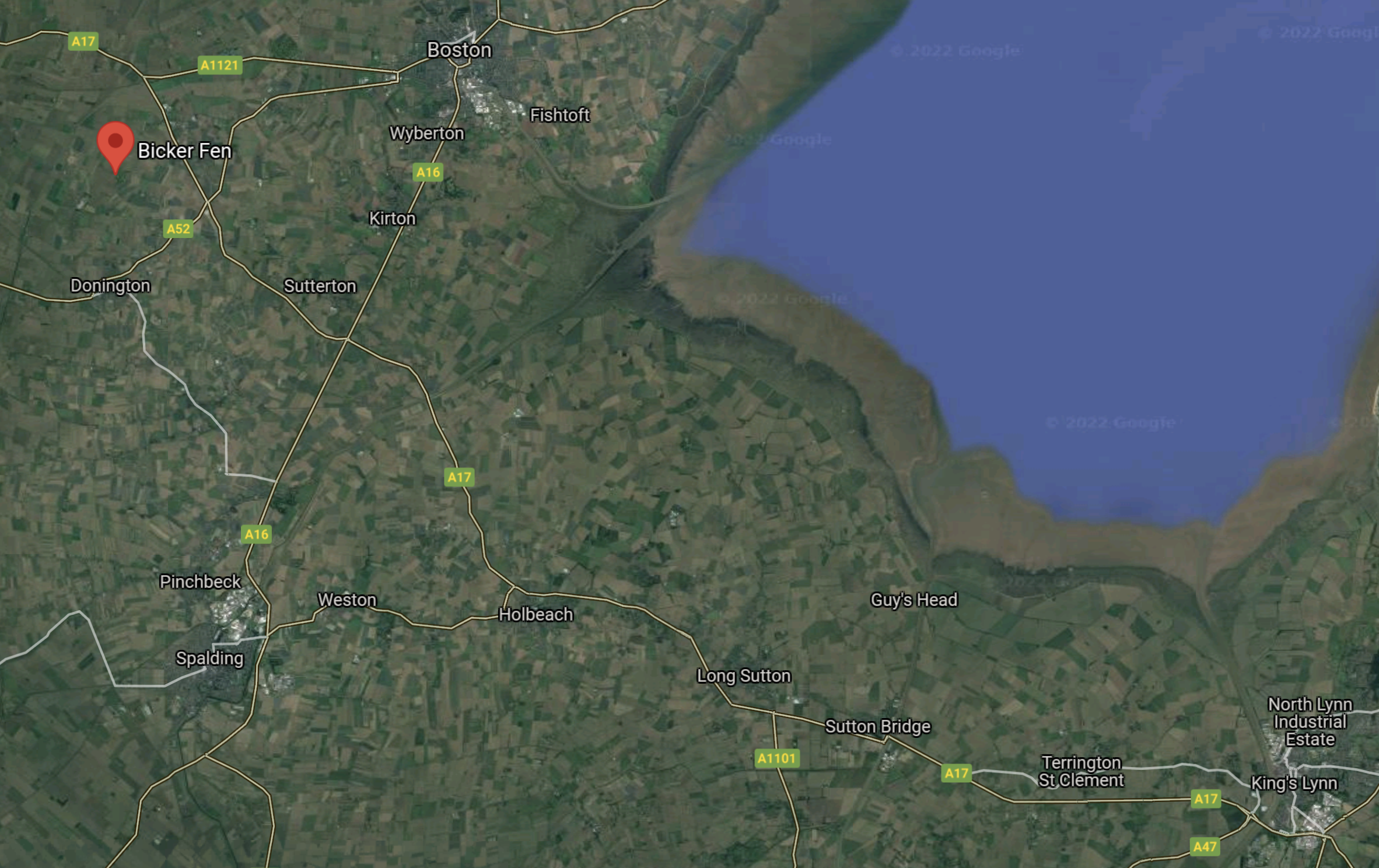
Bicker Fen is marked by the red arrow.
The Google Map shows the substation.
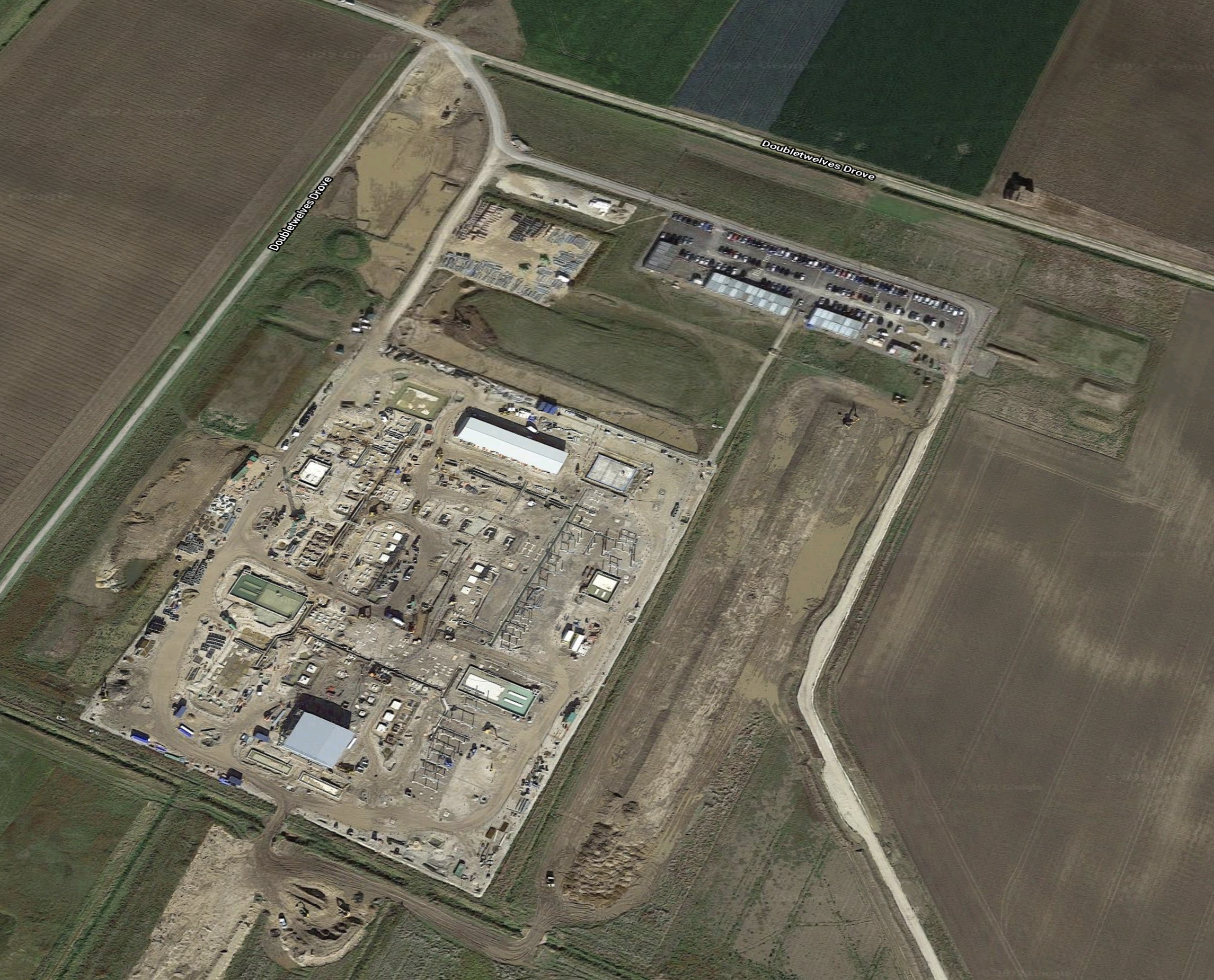
It must be sized to handle over 2 GW, but is it large enough?
Dudgeon Offshore Wind Farm
The Dudgeon offshore wind farm is a 402 MW wind farm, which is twenty miles off the North Norfolk coast.
- It has 67 turbines and an offshore substation.
- It is connected to the shore at Weybourne on the coast from where an underground cable is connected to the National Grid at Necton.
- It became operational in Oct 2017.
- Equinor and Statkraft are part owners of the windfarm and this is the home page of the wind farm’s web site.
- Equinor is the operator of the wind farm.
This Google Map shows the location of Weybourne on the coast.
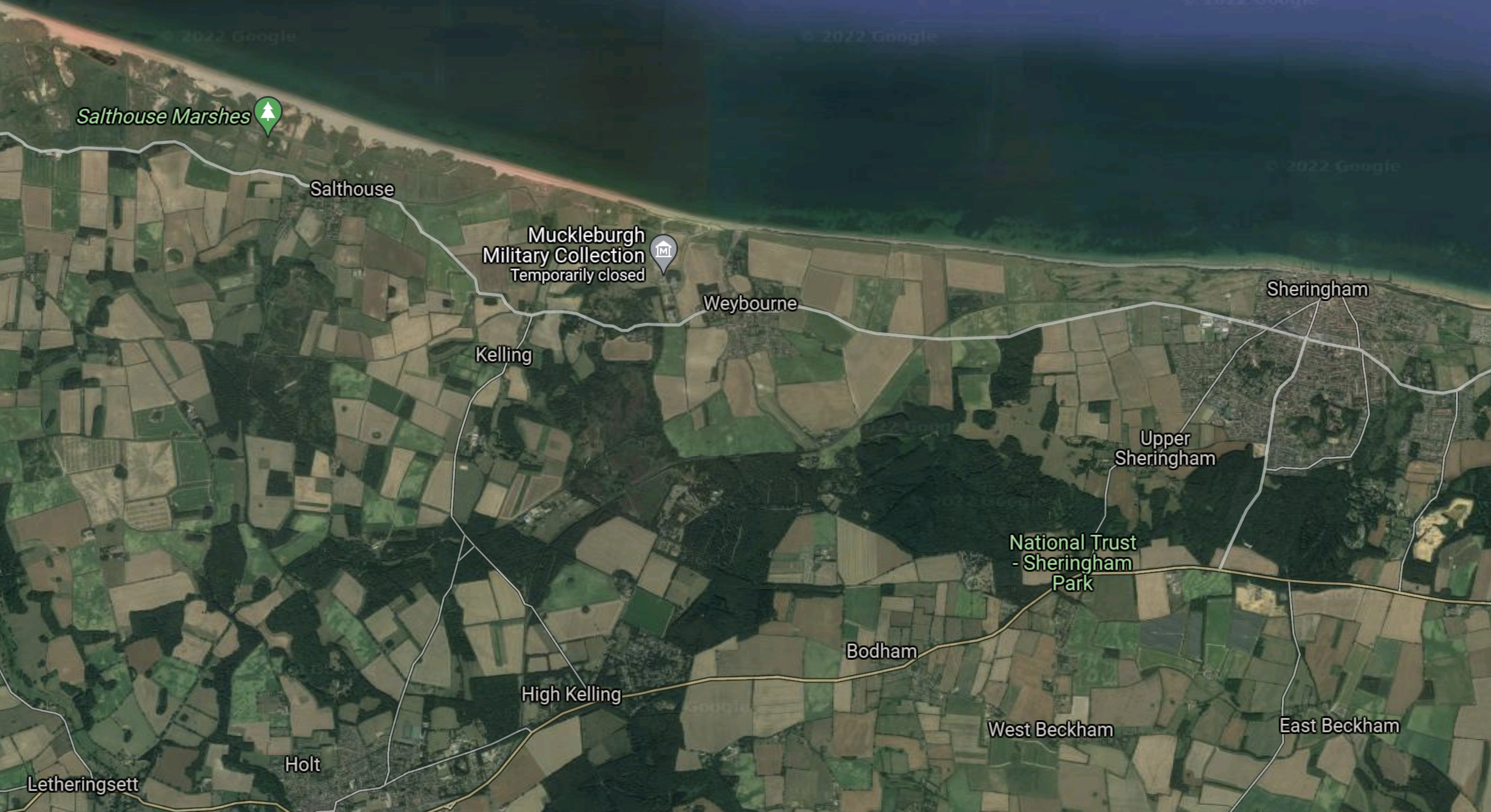
Note.
- Weybourne is in the middle on the coast.
- Sheringham is on the coast in the East.
- Holt is on the Southern edge of the map almost South of Weybourne.
This second map shows the location of the onshore substation at Necton, with respect to the coast.
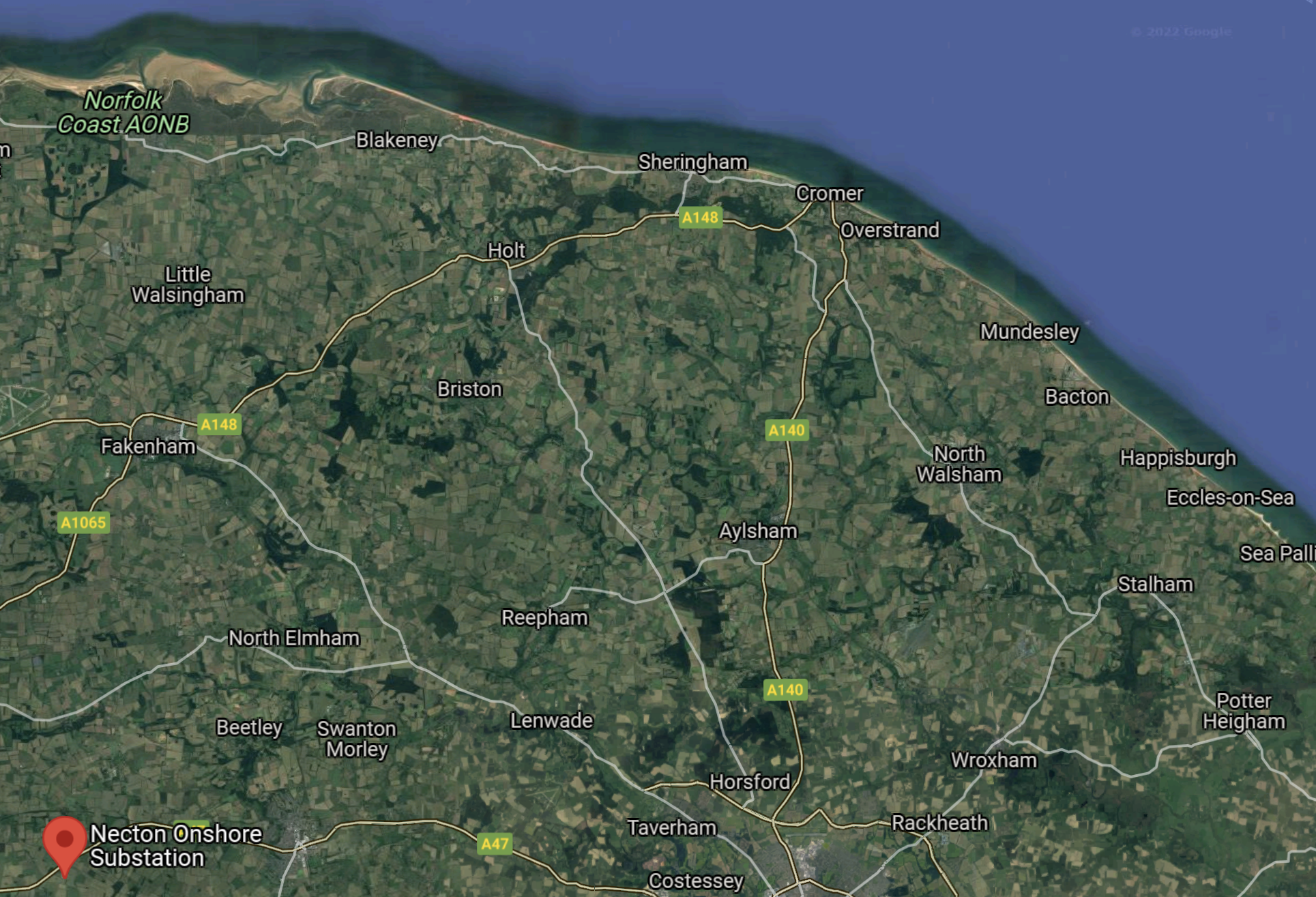
Note.
- The Necton substation is marked by a red arrow.
- Holt and Sheringham can be picked out by the coast in the middle.
- Weybourne is to the West of Sheringham.
- Necton and Weybourne are 35 miles apart.
Digging in the underground cable between Necton and Weybourne might have caused some disruption.
Looking at Weybourne in detail, I can’t find anything that looks like a substation. So is the Necton substation connected directly to Dudgeon’s offshore substation?
Sheringham Shoal Offshore Wind Farm
The Sheringham Shoal offshore wind farm is a 316.8 MW wind farm, which is eleven miles off the North Norfolk coast.
- It has 88 turbines and two offshore substations.
- As with Dudgeon, it is connected to the shore at Weybourne on the coast.
- But the underground cable is connected to an onshore substation at Salle and that is connected to the National Grid at Norwich.
- It became operational in Sept 2012.
- Equinor and Statkraft are part owners of the windfarm and this is the home page of the wind farm’s web site.
- Equinor is the operator of the wind farm.
This second map shows the location of the onshore substation at Salle, with respect to the coast.

Note.
- The Salle substation is marked by a red arrow.
- Holt, Weybourne and Sheringham can be picked out by the coast in the middle.
- Weybourne is to the West of Sheringham.
- Salle and Weybourne are 13.5 miles apart.
Could the following two statements be true?
- As the Sheringham Shoal wind farm was built first, that wind farm was able to use the shorter route.
- It wasn’t built large enough to be able to handle the Dudgeon wind farm.
The statements would certainly explain, why Dudgeon used a second cable.
Extending The Dudgeon And Sheringham Shoal Wind Farms
Both the Dudgeon And Sheringham Shoal web sites have details of the proposed join extension of both wind farms.
This is the main statement on the Overview page.
Equinor has been awarded an Agreement for Lease by the Crown Estate, the intention being to seek consents to increase the generating capacity of both the Sheringham Shoal Offshore Wind Farm and the Dudgeon Offshore Wind Farm.
They then make three points about the development.
- Equinor is proposing a joint development of the two projects with a common transmission infrastructure.
- As part of the common DCO application, the Extension Projects have a shared point of connection at the National Grid Norwich Main substation.
- These extension projects will have a combined generating capacity of 719MW which will make an important contribution to the UK’s target of 30GW of electricity generated by offshore wind by 2030.
This statement on the Offshore Location page, describes the layout of the wind farms.
The Sheringham Shoal Offshore Wind Farm extension is to the north and the east of the existing wind farm, while its Dudgeon counterpart is to the north and south east of the existing Dudgeon Offshore Wind Farm site. The proposed extension areas share the boundaries with its existing wind farm site.
They then make these two important points about the development.
- Equinor is seeking to develop the extension project with a joint transmission infrastructure. A common offshore substation infrastructure is planned to be located in the Sheringham Shoal wind farm site.
- The seabed export cable which will transmit the power generated by both wind farm extensions will make landfall at Weybourne.
There is also this map.

Note.
- The purple line appears to be the UK’s ten mile limit.
- The Sheringham Shoal Extension is outlined in red.
- The Dudgeon Extension is outlined in blue.
- The black lines appear to be the power cables.
I suspect the dotted blue lines are shipping routes sneaking their way through the turbines.
This statement on the Onshore Location page, describes the layout of the offshore and onshore cables.
A new seabed export cable will bring the electricity generated by both the Sheringham Shoal and Dudgeon Offshore Wind Farm extensions to shore at Weybourne, on the coast of Norfolk.
They then make these two important points about the development.
- From there a new underground cable will be installed to transmit that power to a new purpose built onshore substation, which will be located within a 3km radius of the existing Norwich main substation, south of Norwich. This will be the National Grid network connection point for the electricity from both wind farm extensions.
- The power will be transmitted from landfall to the substation using an HVAC system which eliminates the need for any relay stations along the onshore cable route.
There is also this map.
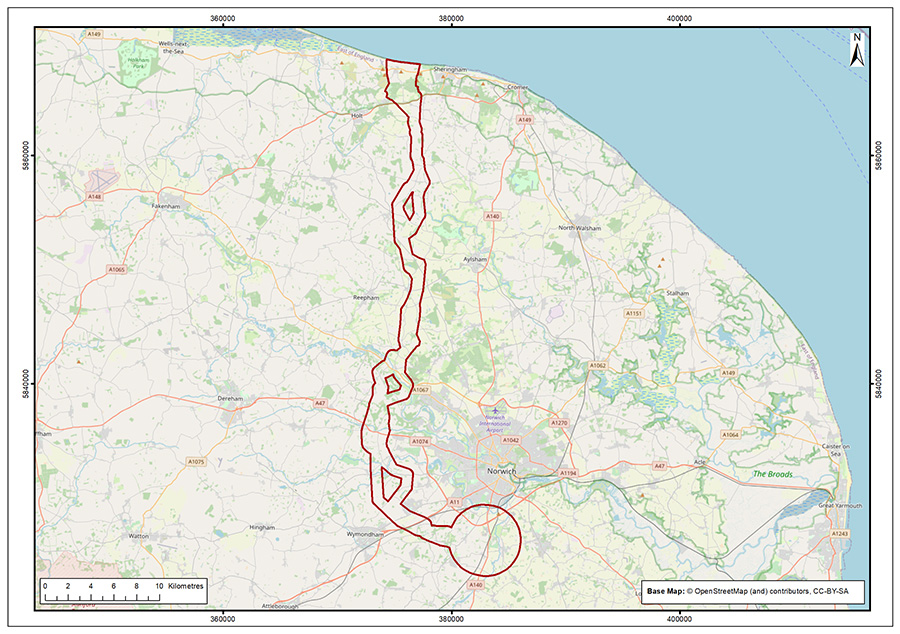
It will be a substantial undertaking to build the underground cable between Weybourne and South of Norwich.
Bacton Gas Terminal
The Bacton gas terminal is a complex of six gas terminals about ten miles East of Cromer.
- It lands and processes gas from a number of fields in the North Sea.
- It hosts the UK end of the BBL pipeline to The Netherlands.
- It hosts the UK end of the Interconnector to Zeebrugge in Belgium.
- The Baird and Deborah fields, which have been developed as gas storage, are connected to the gas terminal. They are both mothballed.
This Google Map shows the location of the terminal.
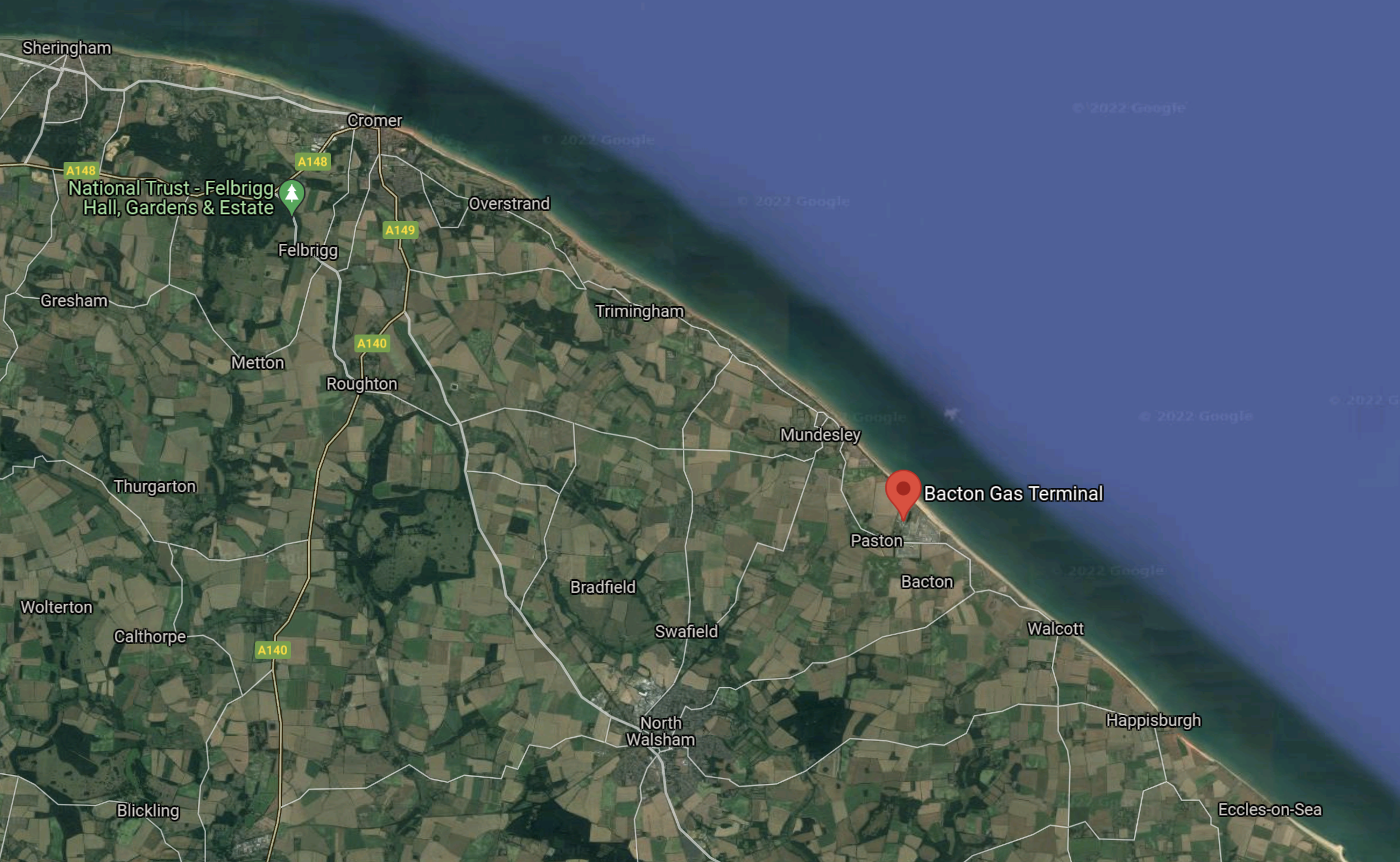
Note.
- The Bacton gas terminal is marked by a red arrow.
- Sheringham is in the North West corner of the map.
- Cromer, Overstrand, Trimingham and Mundesley are resort towns and villages along the coast North of Bacton.
This second map shows the Bacton gas terminal in more detail.
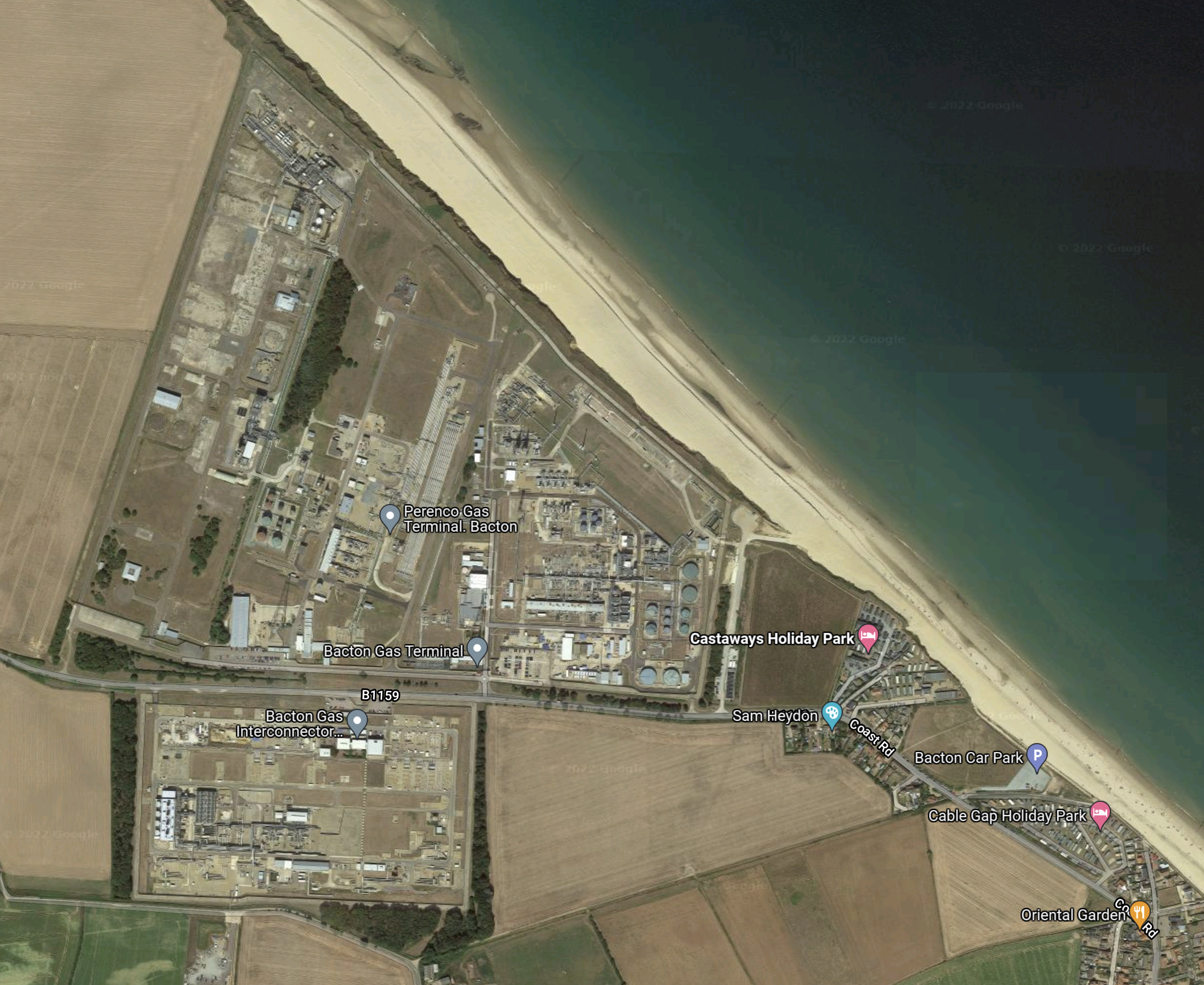
Would you want to have a seaside holiday, by a gas terminal?
Norfolk Boreas And Norfolk Vanguard
Norfolk Boreas and Norfolk Vanguard are two wind farms under development by Vattenfall.
- Norfolk Boreas is a proposed 1.8 GW wind farm, that will be 45 miles offshore.
- Norfolk Vanguard is a proposed 1.8 GW wind farm, that will be 29 miles offshore.
This map shows the two fields in relation to the coast.
Note.
- The purple line appears to be the UK’s ten mile limit.
- Norfolk Boreas is outlined in blue.
- Norfolk Vsnguard is outlined in orange.
- Cables will be run in the grey areas.
This second map shows the onshore cable.
Note.
- The cables are planned to come ashore between Happisburgh and Eccles-on-Sea.
- Bacton gas terminal is only a short distance up the coast.
- The onshore cable is planned to go from here across Norfolk to the Necton substation.
But all of this has been overturned by a legal ruling.
This article on the BBC is entitled Norfolk Vanguard: Ministers Wrong Over Wind Farm Go-Ahead, Says Judge.
These are the first four paragraphs.
A High Court judge has quashed permission for one of the world’s largest offshore wind farms to be built off the east coast of England.
The Norfolk Vanguard Offshore Wind Farm was granted development consent in July by the Secretary of State for Business, Energy and Industrial Strategy (BEIS).
But Mr Justice Holgate overturned the decision following legal action from a man living near a planned cable route.
A Department for BEIS spokeswoman said it was “disappointed by the outcome”.
I bet the spokeswoman was disappointed.
Vattenfall and the BEIS will go back to the drawing board.
But seriously, is it a good idea to dig an underground cable all the way across Norfolk or in these times build a massive overhead cable either?
Perhaps the solution is to connect the Norfolk Boreas And Norfolk Vanguard wind farms to a giant electrolyser at Bacton, which creates hydrogen.
- The underground electricity cable across Norfolk would not be needed.
- Bacton gas terminal is only a few miles up the coast from the cable’s landfall.
- The UK gets another supply of gas.
- The hydrogen is blended with natural gas for consumption in the UK or Europe.
- A pure hydrogen feed can be used to supply hydrogen buses, trucks and other vehicles, either by tanker or pipeline.
- Excess hydrogen could be stored in depleted gas fields.
The main benefit though, would be that it would transform Bacton gas terminal from a declining asset into Norfolk’s Hydrogen Powerhouse.
Great Yarmouth And Lowestoft
Great Yarmouth Outer Harbour and the Port of Lowestoft have not been the most successful of ports in recent years, but with the building of large numbers of wind farms, they are both likely to receive collateral benefits.
I wouldn’t be surprised to see the support ships for the wind farms switching to zero-carbon power, which would require good electrical connections to the ports to either charge batteries or power electrolysers to generate hydrogen.
Sizewell
Sizewell has only one nuclear power station at present; Sizewell B, but it could be joined by Sizewell C or a fleet of Small Modular Reactors (SMR).
The Sizewell Overhead Transmission Line
Sizewell also has a very high capacity overhead power line to Ipswich and the West.





I doubt, it would be possible to build an overhead transmission line like this today.
Sizewell And Hydrogen
EdF, who own the site are involved with Freeport East and may choose to build a large electrolyser in the area to create hydrogen for the Freeport.
East Anglia Array
The East Anglia Array will be an enormous wind farm., comprising up to six separate projects.
It will be thirty miles offshore.
It could generate up to 7.2 GW.
The first project East Anglia One is in operation and delivers 714 MW to a substation in the Deben Estuary, which connects to the Sizewell high-capacity overhead power line.
Most projects will be in operation by 2026.
Freeport East
As the Freeport develops, it will surely be a massive user of both electricity and hydrogen.
Problems With The Current Electricity Network
I don’t believe that the current electricity network, that serves the wind farms and the large energy users has been designed with the number of wind farms we are seeing in the North Sea in mind.
Every new windfarm seems to need a new connection across Norfolk or Suffolk and in Norfolk, where no high-capacity cables exist, this is stirring up the locals.
There is also no energy storage in the current electricity network, so at times, the network must be less than efficient and wind turbines have to be shut down.
Objections To The Current Policies
It is not difficult to find stories on the Internet about objections to the current policies of building large numbers of wind farms and the Sizewell C nuclear power station.
This article on the East Anglia Daily Times, which is entitled Campaigners Unite In Calling For A Pause Before ‘Onslaught’ Of Energy Projects ‘Devastates’ Region is typical.
This is the first paragraph.
Campaigners and politicians have called on the Government to pause the expansion of the energy industry in Suffolk, which they fear will turn the countryside into an “industrial wasteland” and hit tourism.
The group also appear to be against the construction of Sizewell C.
I feel they have a point about too much development onshore, but I feel that if the UK is to thrive in the future we need an independent zero carbon energy source.
I also believe that thousands of wind farms in the seas around the UK and Ireland are the best way to obtain that energy.
Blending Hydrogen With Natural Gas
Blending green hydrogen produced in an electrolyser with natural gas is an interesting possibility.
- HyDeploy is a project to investigate blending up to 20 % of green hydrogen in the natural gas supply to industrial and domestic users.
- Partners include Cadent, ITM Power, Keele University and the Health and Safety Executive.
- Natural gas naturally contains a small amount of hydrogen anyway.
- The hydrogen gas would be distributed to users in the existing gas delivery network.
I wrote about HyDeploy in a post called HyDeploy.
Thje only loser, if hydrogen were to be blended with natural gas would be Vlad the Poisoner, as he’d sell less of his tainted gas.
An Interconnector Between Bicker Fen And Freeport East
I believe that an electricity interconnector between at least Bicker Fen and Freeport East could solve some of the problems.
My objectives would be.
- Avoid as much disruption on the land as possible.
- Create the capacity to deliver all the energy generated to customers, either as electricity or hydrogen.
- Create an expandable framework, that would support all the wind farms that could be built in the future.
The interconnector would be a few miles offshore and run along the sea-bed.
- This method of construction is well proven.
- It was used for the Western HVDC Link between Hunterston in Scotland and Connah’s Quay in Wales.
- Most wind farms seem to have existing substations and these would be upgraded to host the interconnector.
Connections en route would include.
Dudgeon Offshore Wind Farm
The interconnector would connect to the existing offshore substation.
Sheringham Shoal Wind Farm
The interconnector would connect to the existing offshore substation.
Dudgeon and Sheringham Shoal Extension Offshore Wind Farms
These two wind farms could be connected directly to the interconnector, if as planned, they shared an offshore substation in the Sheringham Shoal Extension offshore wind farm.
Bacton Gas Terminal
I would connect to the Bacton Gas Terminal, so that a large electrolyser could be installed at the terminal.
The hydrogen produced could be.
- Stored in depleted gas fields connected to the terminal.
- Blended with natural gas.
- Exported to Europe through an interconnector.
- Supplied to local users by truck or pipeline.
After all, the terminal has been handling gas for over fifty years, so they have a lot of experience of safe gas handling.
Norfolk Boreas And Norfolk Vanguard
These two wind farms could be connected directly to the interconnector, if they shared an offshore substation.
It would also help to appease and silence the objectors, if there was no need to dig up half of Norfolk.
Great Yarmouth And Lowestoft
It might be better, if these ports were supplied from the interconnector.
- Either port could have its own electrolyser to generate hydrogen, which could be.
- Used to power ships, trucks and port equipment.
- Liquefied and exported in tankers.
- Used to supply local gas users.
- Hydrogen could be supplied to a converted Great Yarmouth power station.
Both Great Yarmouth and Lowestoft could become hydrogen hub towns.
Sizewell
This site has a high-capacity connection to the National Grid. This connection is a big eyesore, but it needs to run at full capacity to take electricity from the Energy Coast to the interior of England.
That electricity can come from Sizewell B and/or Sizewell C nuclear power stations or the offshore wind farms.
East Anglia Array
There would probably need to be a joint offshore substation to control the massive amounts of electricity generated by the array.
Currently, the only wind farm in operation of this group is East Anglia One, which uses an underground cable connection to the Sizewell high-capacity connection to the Bullen Lane substation at Bramford.
Freeport East, Ipswich And Bullen Lane Substation
This Google Map shows the area between Ipswich and the coast.
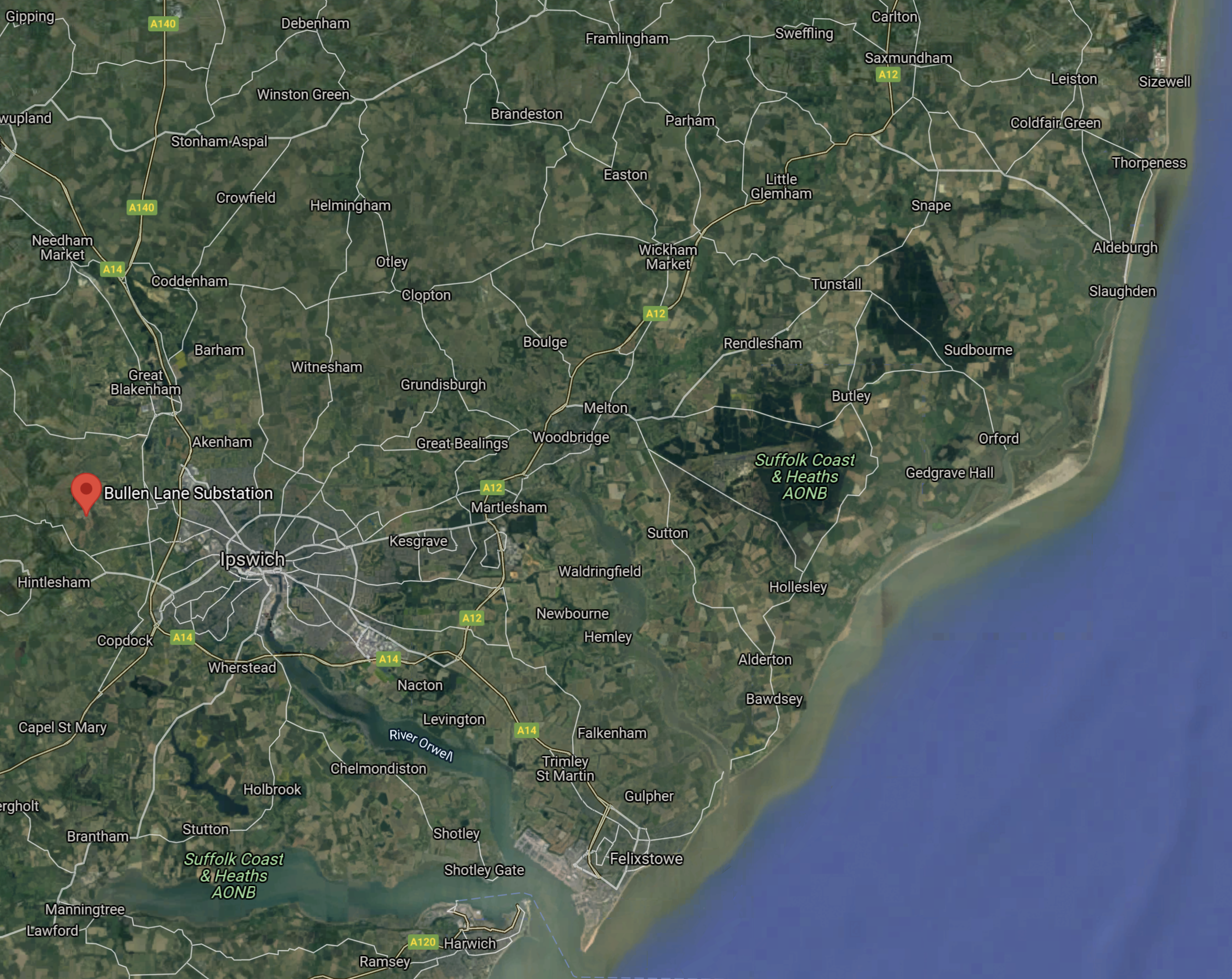
Note.
- Sizewell is in the North-East corner of the map.
- Felixstowe, Harwich and Freeport East are at the mouth of the rivers Orwell and Stour.
- The Bullen Lane substation is to the West of Ipswich and shown by the red arrow.
I would certainly investigate the possibility of running an underwater cable up the River Orwell to connect the Southern end of the interconnector Between Bicker Fen And Freeport East.
This Google Map shows the Bullen Lane Substation.
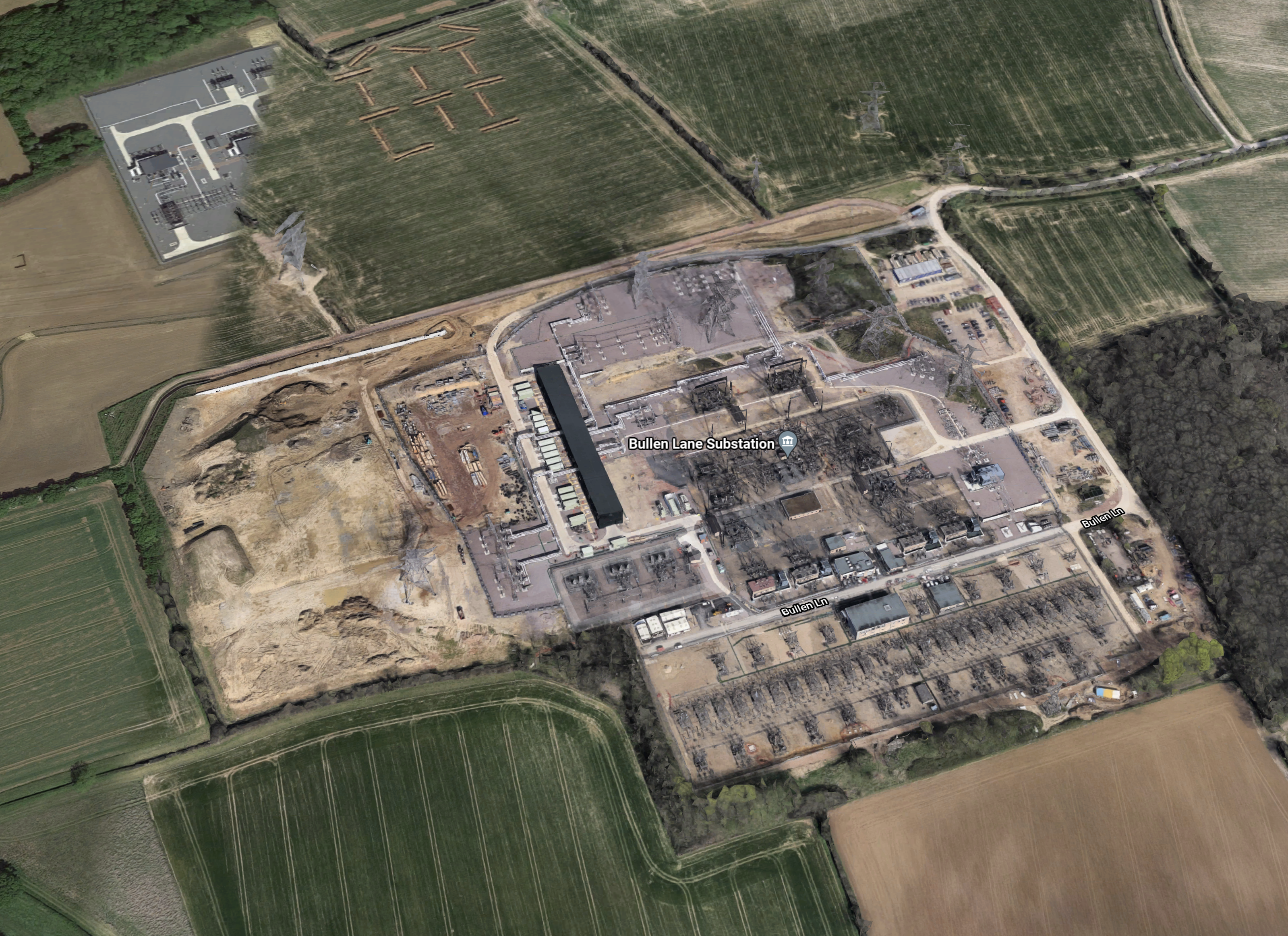
It looks impressive, but is it big enough to handle all the electricity coming ashore from the offshore wind farms to the East of Suffolk and the electricity from the power stations at Sizewell?
Conclusion
I believe there are a lot of possibilities, that would meet the threeobjectives, I stated earlier.
- Avoid as much disruption on the land as possible.
- Create the capacity to deliver all the energy generated to customers, either as electricity or hydrogen.
- Create an expandable framework, that would support all the wind farms that could be built in the future.
In addition, simple mathematics says to me, that either there will need to be extra capacity at both Bicker Fen and Bullen Lane substations and onward to the rest of the country, or a large electrolyser to convert several gigawatts of electricity into hydrogen for distribution, through the gas network.
Hydrogen Refuelling Station For Vehicles Lands At Teesside Airport
The title of this post, is the same as that of this article on the Northern Echo.
This is the introductory paragraph.
A refuelling station that will serve hydrogen-powered vehicles based in the Tees Valley is now up and running at Teesside Airport as part of a £2.5million region-wide trial.
A selection of vehicles and equipment is being trialled, including some for the emergency services.
The trial will be overseen by Teesside University.
The University also runs the Tees Valley Hydrogen Innovation Project, which is described on this page on the University web site.
 The Anonymous Widower