A Cool Move To Keep Emissions On Track
The title of this post is the same as that of this press release from Tesco.
This is the body of the release.
- Tesco and DRS partner on a new refrigerated rail freight service that will take 40 lorries off the road for every journey it makes
- Helping Tesco to deliver Christmas, the service will run seven days a week and replace 7.3 million road miles with greener distribution
- New service supports Tesco’s commitment to reach net zero emissions in its operations by 2035
Tesco and Direct Rail Services (DRS) have partnered to introduce a cool new service to Britain’s railways.
The new service will be the first time Tesco has used refrigerated rail freight in the UK, distributing chilled goods from Tilbury to Coatbridge by low CO2 rail twice a day, seven days a week. This means that rail freight will play an even bigger role in helping Tesco to deliver Christmas this year and over the next couple of weeks this new service will transport hundreds of different products, including festive favourites such as sprouts, parsnips, carrots, onions, oranges and lemons just in time for that all important Christmas dinner.
Using rail has significant environmental benefits. The 415-mile route will use DRS’s Class 88 bi-mode electric locomotives which can run on electricity and produce zero exhaust and greenhouse gas emissions. This service alone will take at least 17,000 containers off the road each year, saving Tesco 7.3 million road miles and nearly 9,000 tonnes of CO2e.
Note.
- This is Tesco’s first use of refrigerated rail freight.
- It starts from the new Tilbury 2 freight terminal.
- All services seem to be run using bi-mode Class 88 locomotives, running for most of the route using electricity.
Tesco seem to be following the rule, that every little helps when it comes to decarbonisation and climate change.
This Google Map shows Tilbury.
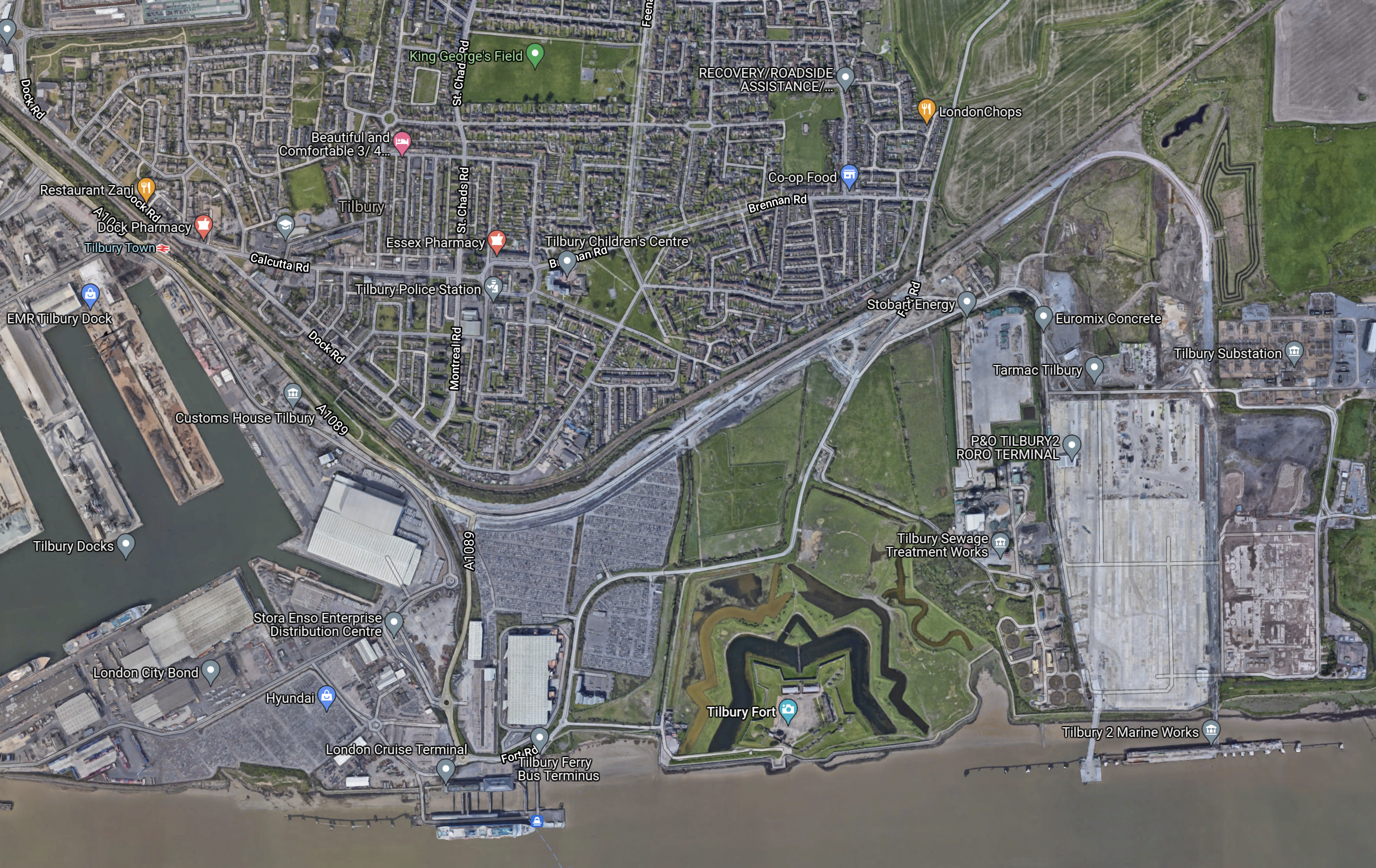
Note.
- The Port of Tilbury is in the West.
- Tilbury Town station on the Tilbury Loop Line is on the North side of the Port.
- There is a cruise ship at the London Cruise Terminal on the river.
- Next to the terminal is the Gravesend Tilbury Ferry. I can remember the car ferries on this route.
- Then there is Tilbury Fort.
- The Tilbury 2 Terminal is in the East.
I took these pictures in 2017.









I suspect it’s a bit different now!
The Mathematics Of Blending Twenty Percent Of Hydrogen Into The UK Gas Grid
HyDeploy is a project, that is investigating blending hydrogen into the UK’s natural gas supply to reduce the amount of carbon dioxide produced by the burning of natural gas in power stations, industrial processes and in our homes and other buildings.
To find out more about the project, visit the HyDeploy web site.
This is a paragraph from this page on the HyDeploy web site, which describes the current progress of the project.
HyDeploy is progressing well. The HSE gave the go ahead for a live demonstration, at Keele University, of blended hydrogen and natural gas which began in Autumn 2019 and completed in Spring 2021. The HSE are satisfied that the blend of gas will be as safe as the gas we all currently use. The hydrogen content will be up to 20% and has so far reached 15%.
Note that HSE is the Health and Safety Executive, who are closely involved.
HyDeploy has now moved on to Phase 2 in the North East.
For our North East demonstration, we have contacted everyone who will be involved in that demonstration – more than 650 homes – and arranged for our engineers to carry out Gas Safe checks on their gas appliances and gather information on the range of appliances in the demonstration area. The Gas Safe checks were free of charge. Almost 90% of those homes have engaged with us.
What would be the effects of 20 % of hydrogen blended into natural gas?
Will current boilers, cookers and other gas-powered devices work on a blend of hydrogen and natural gas?
This is one for the scientists and it is one of the objectives of the HyDeploy trial to understand how every use of gas performs if instead of natural gas, the fuel is a mixture of eighty percent natural gas and twenty percent hydrogen.
I will assume that these problems are solvable.
I am not just hoping, but I can remember in the early 1970s, when our elderly gas cooker was successfully converted from town gas, which was typically a mixture of hydrogen (50%), methane (35%),carbon monoxide (10 %) and ethylene (5%), to natural gas, as North Sea gas started to flow.
This document from the UK government is entitled Fuels: Natural Gas, which contains a section entitled Material Properties Relevant To Use, where this is said.
Natural gas is a combustible gas that is a mixture of simple hydrocarbon compounds. It contains primarily methane, along with small amounts of ethane, butane, pentane, and propane. Natural gas does not contain carbon monoxide. The by-products of burning natural gas are primarily carbon dioxide and water vapour. Natural gas is colourless, tasteless and odourless. Because it is odourless, an odorant (80% tertiarybutyl mercaptan, 20% dimethyl sulphide) is added to the gas, to give the gas a distinctive smell. Other beneficial properties of natural gas are a high ignition temperature and a
narrow flammability range, meaning natural gas will ignite at temperatures above 593°degrees and burn at a mix of 4 – 15% volume in air (St. Lawrence Gas, 2015)
As ethane (C2H6), butane (C4H10), pentane (C5H12) and propane (C3H8) are all similar simple hydrocarbons to methane, which burn to produce carbon dioxide and water, I will assume in this analysis, that natural gas is all methane (CH4).
It is reasonable to assume, that currently we use a fuel which is equivalent to 100 % methane and that in the future we could use 80 % methane and 20 % hydrogen. Also in the past, we used to use a fuel, that was 50 % hydrogen and 35 % methane. The carbon monoxide is a poison, so I’ll ignore it, but ethylene (C2H4) is another of those simple hydrocarbons, which burn to release just carbon dioxide and water.
So if we were able to go from town to natural gas fifty years ago, by just adjusting gas equipment, surely we can go partly the other way in the Twenty-First Century.
I can certainly see the UK gas supply containing twenty percent hydrogen, but wouldn’t be surprised to see a higher level of hydrogen in the future.
How Much Hydrogen Needs To Be Added?
This page on worldodometer says this about UK gas consumption.
The United Kingdom consumes 2,795,569 million cubic feet (MMcf) of natural gas per year as of the year 2017.
I will now calculate the weight of hydrogen needed to be added.
- 2,795,569 million cubic feet converts to 79161.69851 million cubic metres.
- I will round that to 79161.7 million cubic metres.
- Twenty percent is 15832.34 million cubic metres.
- A cubic metre of hydrogen weighs 0.082 Kg, which gives that in a year 1,298.25188 million kilograms will need to be added to the UK gas supply.
This is 1,298,251.88 tonnes per year, 3,556.85 tonnes per day or 148.2 tonnes per hour.
How Much Electricity Is Needed To Create This Amount Of Hydrogen?
In Can The UK Have A Capacity To Create Five GW Of Green Hydrogen?, I said the following.
Ryze Hydrogen are building the Herne Bay electrolyser.
- It will consume 23 MW of solar and wind power.
- It will produce ten tonnes of hydrogen per day.
The electrolyser will consume 552 MWh to produce ten tonnes of hydrogen, so creating one tonne of hydrogen needs 55.2 MWh of electricity.
To create 148.2 tonnes per hour of hydrogen would need 8,180.64 MW of electricity or just under 8.2 GW.
How Much Carbon Dioxide Would Be Saved?
This page on the Engineering Toolbox is entitled Combustion Of Fuels – Carbon Dioxide Emission and it gives a list of how much carbon dioxide is emitted, when a fuel is burned.
For each Kg of these fuels, the following Kg of carbon dioxide will be released on combustion.
- Methane – 2.75
- Gasoline – 3.30
- Kerosene – 3.00
- Diesel – 3.15
- Bituminous coal – 2.38
- Lignite 1.10
- Wood – 1.83
Engineering Toolbox seems a very useful web site.
I will now calculate how much carbon dioxide would be saved.
- In 2017, UK methane consumption was 79161.7 million cubic metres.
- One cubic metre of methane weighs 0.554 Kg.
- The total weight of methane used is 43,855,581.8 tonnes.
- Multiplying by 2.75 shows that 120,602,849.95 tonnes of carbon dioxide will be produced.
As twenty percent will be replaced by hydrogen, carbon dioxide emission savings will be 24,120,569.99 tonnes.
That seems a good saving, from a small country like the UK.
The UK would also reduce natural gas consumption by twenty percent or 15832.34 million cubic metres per year.
How many other countries with good renewable and zero-carbon electricity resources like Australia, Chile, Denmark, France, Iceland, Ireland, Jordan, Morocco, Norway, Sweden and the United States will take this route, as it seems a good way to save large amounts of carbon?
There is also the collateral benefit, that countries with a good supply of hydrogen can use hydrogen to decarbonise the heavy transport sectors of rail, road and sea freight transport.
The big winners would appear to be those companies like ITM Power, who manufacture electrolysers and those companies like Fortescue Future Industries, who are prospecting, developing and promoting the hydrogen resources of the planet.
The losers will be countries, who are reliant on importing large amounts of gas and other fossil fuels, who don’t have access to large amounts of renewable energy like geothermal, hydro, nuclear, solar and wind.
Germany’s energy policy of no nuclear, more coal and Russian gas seems to have been a mistake.
But I’m sure, if Olaf Sholz talked nicely to Boris, there is a deal to be made.
- German utilities have already arranged to fund BP’s move into wind farms in Morecambe Bay and the North Sea.
- Norfolk’s gas terminal at Bacton is less than three hundred miles from Germany’s new hydrogen terminal at Wilhelmshaven.
The biggest loser could be Vlad the Poisoner.
SSE Renewables Launches 1.5GW Coire Glas Construction Tender
The title of this post, is the same as that of this article on renews.biz.
These are the first two paragraphs.
Hydro construction companies have been invited to submit tenders for construction of SSE Renewables’ proposed 1500MW pumped hydro storage scheme at Coire Glas, in Scotland.
Coire Glas, on the shores of Loch Lochy near Invergarry, would be the first large-scale pumped hydro storage scheme to be built in the United Kingdom for more than 30 years.
There appears to be global interest and six shortlisted bidders.
- The ANDRITZ HYDRO and Voith Hydro partnership
- The Bechtel, Acciona Construcción and Webuild S.p.A consortium
- The BAM Nuttall, Eiffage Génie Civil and Marti Tunnel consortium
- The Dragados and BeMo Tunnelling UK consortium
- GE Hydro France
- STRABAG UK
Bidders like these probably wouldn’t bother to get involved unless they knew that funding of the project was in place and it was pretty certain that the project will be constructed.
In World’s Largest Wind Farm Attracts Huge Backing From Insurance Giant, I talk about how Aviva are funding the Hornsea wind farm.
I believe, that insurance and pension companies like abrdn, Aviva and L & G could find a way of financing a scheme like Coire Glas.
Conclusion
It looks to me, that it’s almost certain that Scotland will get a 1.5GW/30 GWh pumped-storage system at Coire Glas.
Coire Glas could supply slightly more power than Sizewell B nuclear power station for twenty hours.
Now that’s what I call backup!
Electrified Regional Air Mobility Will Be Disruptive & Mature Rapidly In Coming Years
The title of this post, is the same as that of this article on Clean Technica.
It is very much a must-read article, where the author analyses technology and how it will affect regional aviation.
He comes to the conclusion, that electric aircraft will develop much quicker than autonomous systems and full digital air traffic control.
He feels that we’ll see rapid development of electric aircraft flying traditionally with a pilot in charge, who talks to air traffic controllers.
Effectively, this is the system that was in operation, when I used to fly my Cessna 340 all round the UK and Western Europe thirty years ago.
Adding in electric aircraft to this system, is very similar to adding a car with a certified alternative power source to the traffic of the UK.
I think this means, that electric aircraft need to have a pilot on board to be certified, as any certification involving passenger will have to be as risk-free as possible.
The article mentions Electron Aviation. The author describes their operational model like this.
Electron Aviation, for example, sees that a 4-seater, one-pilot plane can become the workhorse of a regional short-haul leisure and business travel on-demand flight service in the second half of this decade, with planes coming to a small airport near customers, who are delivered by electric Ubers at either end. The economics work out with electric airplanes where they don’t with current internal combustion planes.
As Electron’s UK address is in Mildenhall in Suffolk, which is close to the UK horseracing centre of Newmarket, I know from my past experience that their model of four-seat air-taxis certainly works in the racing industry.
The specification for their aircraft looks impressive.
- Very aerodynamic with a high aspect ratio wing.
- Tricycle retractable undercarriage.
- Twin-pusher propellers.
- 186 mph cruise at 10,000 feet.
- 466 mile range.
- Low noise.
- Zero emissions.
Looking at the visualisation on the home page of their web site, I suspect that the battery is at the centre of lift in the middle of the plane to give excellent flying characteristics.
I also think, that their concept is scalable and that a larger aircraft could be built to a similar layout.
Conclusion
I am happy to agree with the author’s conclusion, that electric aircraft will revolutionise regional aviation in a short space of time.
Aberdeen’s Hydrogen Buses Taken Off The Road Due To Technical Issue
The title of this post, is the same as that of this article on the BBC.
This is the introductory paragraph.
Aberdeen’s fleet of hydrogen buses has been taken off the road due to a “technical issue”.
The technical issue appears not to be hydrogen-related, but with a mounting bracket.
Strange coming after CAF had bracket trouble with their trams and Hitachi had a similar problem with their trains.
Wrightbus, CAF and Hitachi haven’t been using the save dodgy Chinese supplier called El Cheapo Brackets have they?
Greater Manchester Clean Air Zone Plans Put On Hold
The title of this post, is the same as that of this article on the BBC.
These are the first four paragraphs.
The controversial rollout of Greater Manchester’s Clean Air Zone (CAZ) has been delayed.
The scheme, which would see some high-emission vehicles face daily charges, had been due to begin at the end of May. Private cars would be exempt.
The government said the pause would allow for consultation and a revised plan was due in July.
Regional mayor Andy Burnham had earlier asked the government to delay the scheme.
If Manchester don’t bring the pollution levels down, Client Earth are threatening legal action.
But to me, as a pedestrian, I do find Manchester City Centre a difficult place to walk, compared to say Birmingham or Liverpool, as the traffic seems to move about at a fast pace.
But then I blame Harold Wilson, who cancelled the Picc-Vic tunnel.
Liverpool and Newcastle received their beneficial cross-city tunnels, but Harold Wilson said that everyone would have their own cars, so we won’t need railways.
London To Be A Magnet For Overseas Cash, Says Knight Frank
The title of this post, is the same as that of this article in The Times.
This is the first paragraph.
Investors from around the world are expected to spend £60 billion on London offices over the next five years in a post-Brexit, post-pandemic vote of confidence in the capital.
They also feel that the Americans will lead the investors.
I was pleased to read this, as although, they are talking mainly about offices, these will inevitably lead to a greater need for quality housing.
And the more people live in the city, the more public transport will be dug through London’s obliging clay, the more places of entertainment will open and the city will become an even better place to live.
It will also mean that if people like me want to more out, we won’t have trouble selling our properties.
Work Begins On Bristol’s First Railway Station Since 1927
The title of this post, is the same as that of this article on the BBC.
These are the first two paragraphs.
Construction work has begun on Bristol’s first new railway station in 95 years.
Portway Park & Ride will open in the Summer, linking Shirehampton with the Severn Beach railway line.
It is planned to open this Summer.
I first wrote about Portway Parkway station in DfT Names Five Winners Of Fresh £16m Stations Fund in 2017, when the stations names were as follows.
- Horden Peterlee in County Durham
- Warrington West in Cheshire
- Reading Green Park
- Bow Street in Ceredigion, Wales
- Portway Parkway near Bristol
Note.
- Portway Parkway is the last station to start construction.
- Reading Green Park station is still under construction and should open this year.
- Bow Street station opened in February 2021.
- Horden station opened in June 2020. I wrote about station after a visit, in Horden Station – 28th October 2020.
- Warrington West station opened in December 2019. I wrote about the station after a visit in January 2020, in The New Warrington West Station.
Given the pandemic, the construction hasn’t gone too badly.
Bill Gates Invests In Verdox’s Carbon Capture Technology
The title of this post, is the same as that of this article on The Times.
This is the first paragraph.
Bill Gates has invested in a carbon capture start-up. His Breakthrough Energy Ventures fund has taken part in an $80 million fundraising for Verdox, a Massachusetts-based business whose technology aims to remove carbon dioxide directly from the air.
I have my doubts that this technology will ever be economic, especially as plant, trees and in particular rain forests, do a good job at using the carbon dioxide. Planting trees is also one of those feel-good community activities.
This last paragraph gives a few details of the process.
Verdox, which is a spinout from the Massachusetts Institute of Technology, claims that its system is cheaper and more efficient. It uses a special plastic, which when charged with electricity, can extract CO2 from a mixture of gases. A change in voltage releases the CO2.
It is a process with a good pedigree, but you’ve still got to find a way to store or use the carbon dioxide.
Plants worked out how to do that eons ago.
Power Storage Is The Next Big Net Zero Challenge
The title of this post, is the same as that of this Opinion from Bloomberg.
This is the sub-heading.
Britain’s pioneering plans for renewable energy show the global need could be massive. The means don’t yet exist.
The opinion is very much a well-written must-read.
One new project the article mentions is a 30 GWh pumped storage project at Coire Glas in the Scottish Highlands, that is planned by SSE.
I discuss this scheme in The Coire Glas Pumped Storage Scheme.
Bloomberg didn’t say it, but this pumped storage scheme could give the UK energy security.
 The Anonymous Widower