Diversifying A US$200 billion Market: The Alternatives To Li-ion Batteries For Grid-Scale Energy Storage
The title of this post, is the same as that of this article on Energy Storage News.
This is the introductory paragraph.
The global need for grid-scale energy storage will rise rapidly in the coming years as the transition away from fossil fuels accelerates. Energy storage can help meet the need for reliability and resilience on the grid, but lithium-ion is not the only option, writes Oliver Warren of climate and ESG-focused investment bank and advisory group DAI Magister.
Oliver starts by saying we need to ramp up capacity.
According to the International Energy Agency (IEA), to decarbonise electricity globally the world’s energy storage capacity must increase by a factor of 40x+ by 2030, reaching a total of 700 GW, or around 25% of global electricity usage (23,000TWh per annum). For comparison, this would be like swelling the size of the UK’s land to that of the USA.
Similar to how “nobody ever gets fired for buying IBM”, lithium-ion holds a similar place in grid scale electrical storage today.
And just as IBM did in the last decades of the last century, the builders of lithium-ion will fight back.
He then lists the problems of grid-scale lithium-ion batteries.
- Shortage of cobalt.
- Toxic and polluting extraction of some much needed metals and rare earths from unstable countries.
- Lack of capacity to load follow.
- Limited lifespan.
He does suggest vehicle-to-grid can provide 7TWh of storage by 2030, but it has similar problems to lithium-ion grid scale batteries.
Finally, he covers these what he considers several viable methods of energy storage in detail.
He introduces them with this paragraph.
No single killer application or technology exists to get the job done. Diversification is key with success dependent on the wide-scale adoption of multiple grid-scale energy storage solutions.
- Energy Dome – Italy – Stylish Use of CO2
- Augwind Energy – Israel – Stores Energy As Compressed Air Underground
- Cheesecake Energy – UK – Stores Energy As Heat And Compressed Air
- Highview Power – UK – Stores Energy As Liquefied Air
- Ocean Grazer – Netherlands – Ocean Battery
- RheEnergise – UK – High Density Hydro
- Lumenion – Germany/Japan – Stores Energy As Heat
- Energy Vault – Switzerland – Raising And Lowering Of Weights
Note.
- All systems are environmentally-friendly and use readily-available materials like air, water, sea-water, steel and concrete for their systems.
- The most exotic materials used are probably in the control computers.
- Some systems use readily-available proven turbo-machinery.
- Most systems appear to be scalable.
- All systems would appear to have a working life measured in decades.
- I would expect that most well-educated teenagers could understand how these systems worked.
Only Augwind Energy and Lumenion are new to me.
He finally sums up the economics and the market potential.
Our ability to expand energy storage capacity is one of the most pressing issues that will determine whether this defining ‘transitional’ decade is a success. But we’ll need to invest wisely into the right technologies that get the greatest bang for the buck (in terms of GWh capacity and return on capital) given the limited lifespan of Li-Ion and the decarbonisation of the grid.
At a current capital cost of US$2,000 per kW quoted by the US National Renewable Energy Laboratory (NREL) for 6-hour Li-ion battery storage, the 700GW of capacity needed by 2030 equates to around a US$1.5 trillion market over the coming decade, making it worth nearly US$200 billion a year.
The Energy Storage News article is a comprehensive must read for anyone, who is considering purchasing or investing in energy storage.
I have some further thoughts.
From My Experience Would I Add Any Other Systems?
I would add the following.
- Form Energy, because its iron-air battery is well-backed financially.
- Gravitricity, because it can use disused mine shafts to store energy and the world has lots of those.
- STORE Consortium, because its 3D-printed concrete hemispheres, that store energy using pressurised sea-water can be placed within a wind farm.
I also suspect that someone will come up with an energy storage system based on tidal range.
Finance
When we started Metier Management Systems, finance to breakout from the first initial sales was a problem. We solved the problem with good financial planning and an innovative bank manager who believed us all the way.
David, was a rogue, but he was a rogue on the side of the angels. Long after Metier, he even came to my fiftieth birthday party.
David would have found a way to fund any of these systems, as they tick all the boxes of demonstrated, environmentally-friendly, safe and understandable. They are also likely to be bought by companies, governments and organisations with a high net value, a very respectable reputation and/or large amounts of money.
I also think, that just as we did with the original Artemis project management system, some of these systems can be leased to the operators.
Second-Use Of Systems
Several of these systems could be moved on to a new location, if say they were supporting an industry that failed.
That would surely help the financing of systems.
An American View Of The Harrier
In The Times today there is the obituary of Ralph Hooper.
This is the sub-heading.
Aeronautical engineer who designed the revolutionary Harrier jump jet and the versatile Hawk used by the Red Arrows.
I have two tales that must be told.
An Artemis Users Conference In Denver
The project management software I wrote; Artemis, was used by both British Aerospace and McDonnell Douglas to build Harriers.
One day, soon after the end of the Falklands War, I was at an Artemis Users Conference in Denver and got chatting to three users.
- The Project Manager for the US Harrier.
- A Senior Project Manager for Long Beach Naval Shipyard.
- A banker from a famous New York Bank.
Because of the times and two project managers working on military projects, the conversation naturally turned to the recent war.
The banker, then said something like. “What you need is a big flat-top with a squadron of Tomcats, to blow the Argies out of the sky.”
Tomcats were top-of-the-range US naval fighter jets.
Whereupon, the McDonnell Douglas guy said. “We’re getting the weather reports! There’s no other aircraft, that can take-off and land in the terrible conditions!”
An A-10 Pilot’s View Of The Harrier
In the 1970s, I used to drink in the Clopton Crown pub. Sometimes, I got drinking with one of the USAF A10 Thunderbolt II pilots from Bentwaters.
As I was a pilot myself at the time, we had quite a few chats about flying.
One night he told how two A10s would fly as a pair, at a fairly low altitude.
To protect themselves from MiGs, one would break away and do a steep turn through a complete circle, scanning the horizon for any threat.
Then the other would do the movement the other way.
He felt that in hostile combat, that they would give any opposition fighter a real kicking, as the attacker would have to keep out of the way of two GAU-8 Avenger 30 mm Gatling-style autocannons, firing large numbers of heavy shells.
He also told me, that he had flown A-10s up against other aircraft on a simulator. He just said, he found AV-8As, as the US called Harriers, very difficult to beat.
East Kent Maternity Deaths: Babies Might Have Survived With Better Care
The title of this post, is the same as that of this article on the BBC.
This is the first paragraph.
Up to 45 babies might have survived if they had received better care at East Kent NHS Hospitals Trust, a damning independent review has found.
As a father of three, who has experienced the death of both his wife and youngest son, I know that this is a tragedy for too many families.
But episodes like these seem to come along regularly in the NHS. We have had two cases, where nurses were murdering babies, the notorious Harold Shipman and several abuse cases in mental health.
Is the monitoring of the outcome of patient treatment up to scratch?
In the 1970s, I was asked to do some programming for Bob, who was the Chief Management Accountant of Lloyds Bank and before that he had been Chief Accountant of Vickers. Bob had very definite ideas about how to ascertain the performance of various divisions and departments in a company or organisation.
He taught me a lot as we applied his ideas to check out the performance of various branches in the Bank. A lot of his experience was incorporated into Artemis and other programs I have written.
One of the things we did with bank branches was to plot groups of branches in simple scatter diagrams, so that those with problems stood out.
Does the government do similar things with hospitals and GP surgeries?
I even went as far as to suggest that my software Daisy could be used to find rogue practitioners like Harold Shipman. I was thanked for my submission to the report, but was not told my ideas were mentioned in the report.
Conclusion
I believe that more babies might have survived in Kent, if a statistician had been comparing results between hospital trusts and actively looking for problems.
I suspect the reason, there is no serious analysis, is that there is a belief in the NHS, that no-one ever makes mistakes or is evil.
New Proton Ceramic Reactor Stack For Highly Efficient Hydrogen Production And Carbon Capture In A Single Step
The title of this post, is the same as that of this article on Green Car Congress.
This is the opening paragraph.
A team of researchers from CoorsTek Membrane Sciences and SINTEF in Norway, and Universitat Politècnica de València in Spain, has demonstrated a 36-cell well-balanced proton ceramic reactor stack enabled by a new interconnect that achieves complete conversion of methane with more than 99% recovery to pressurized hydrogen, leaving a concentrated stream of carbon dioxide. The team has also demonstrated that the process can be scaled up for commercial application.
A paper has been published in the journal; Science.
I find this concept interesting for a number of reasons.
- I’ve believed for some time, that applications, that need a good supply of pure carbon dioxide will be developed. One obvious use is feeding it to plants in large greenhouses, so we can have our CO2 and eat it!
- 99 % is a very high efficiency.
- Ammonia, natural gas or biogas can be used as a feedstock.
Coors were an Artemis user for project management and I had an enjoyable few days Golden, Colorado and at the Coors brewery, sometime in the 1980s.
- It was then that I first heard of CoorsTek, who used to make ceramics for the US defence industry.
- In those days, the beer was made to German brewing rules and was unpasteurised.
- The beer had to be delivered to customers within a certain time, so long distance deliveries used trains.
- Coors Brewing Company has since merged with Molson, but CoorsTek appears to be still owned by the Coors family.
- I had taken a few small bottles of Adnams Broadside with me and one of their managers analysed one before drinking the rest of the bottle. He informed me that it was a felony to be in possession of such a strong beer in Colorado.
Coors were and probably still are in some ways not your average brewing company.
Coors News Item On Proton Ceramic Membranes For Hydrogen Production
This page on the CoorsTek web site, which is entitled Proton Ceramic Membranes For Hydrogen Production Published In ‘Science’, gives more details.
Conclusion
This technology could be massive.
The Channel Crossing Problem
My company provided the project management computer system; Artemis, that planned how both the tunnel and the rail link to London was built. So I heard numerous stories of inadequate infrastructure on both sides of the Channel.
I also for a time was a business partner of the man, who had been project manager on a previous attempt to build a Channel Tunnel, that was cancelled by Harold Wilson’s government in 1975, who had a lot of interesting input.
I have heard over the years of these inadequacies,
- The Dartford Crossing wouldn’t be able to handle the traffic generated at busy times.
- The Eurotunnel terminal in Folkestone wasn’t built large enough.
- The port of Dover is too small.
- The roads to the Port of Dover were inadequate.
- The rail terminal at St. Pancras doesn’t have the capacity to run services to the places that are better served by train.
The government only has one major improvement in place, which is a new Thames Crossing, but that will only make matters worse, as more traffic will be tempted to cross the Channel to get to Europe.
It is my belief, that we need more innovative services to provide more capacity.
- A German company called CargoBeamer, is developing a system, whereby unaccompanied freight trailers can be moved thousands of miles across Europe by rail. Their plans include services to Birmingham, Cardiff, Manchester and Scotland.
- I would also run a CargoBeamer service from Calais to Holyhead to create a direct freight service between Ireland and Europe.
- Ebbsfleet needs to be developed as a destination for the Elizabeth Line and an extra terminal for both daytime and sleeper trains to Europe.
- High speed freight trains, based on existing 160 mph EMUs could be used.
- Given the position of the new Thames Crossing on the Isle of Grain, perhaps a new ferry port could be built on the island to partially replace Dover.
- Could some Eurotunnel services start from Watford Gap?
We have to be bold.
Monte To Purchase 100 FC Aircraft Drives From ZeroAvia
The title of this post, is the same as that of this article on electrive.com.
This is the first paragraph.
ZeroAvia and Monte Aircraft Leasing will jointly market hydrogen-powered aircraft to regional operators. Under an agreement now signed between the companies, Monte will purchase up to 100 ZA600 hydrogen-electric powertrains from ZeroAvia to be installed on existing and new 5- to 20-seat aircraft.
Monte look to be an interesting company from their web site, which has this title.
Supporting The Transition Of The Regional Aviation Industry To Net Zero Carbon Emissions
The business model appears to be a well-proven and it is not that far removed from the one, colleagues and myself used to sell the project management system; Artemis.
In our case we took proven Hewlett-Packard computers and and other hardware, added our Artemis software and a custom-made desk and leased the systems to those who wanted to do project management, with as much support as our clients required. Customers just had to supply operators, printer paper and a thirteen amp socket.
Finance was obtained by various innovative methods, often through a bank manager, who was a bit of a rogue. But he was a rogue, who was on the side of the angels.
Later he became a firm friend of mine, before he sadly died within a few days of my wife.
Monte Aircraft Leasing’s model would appear to take a proven aircraft like a Cessna Caravan, Dornier 228 or Dash 8, replace the turboprop engines with a zero-carbon powerplant and then lease the aircraft. Often this will just be an additional lease to the existing operator.
The great advantage of this approach, is that the reengined aircraft does not need to be fully re-certified. It can fly under a Supplemental Type Certificate, which is described like this in Wikipedia.
A supplemental type certificate (STC) is a civil aviation authority-approved major modification or repair to an existing type certified aircraft, engine or propeller. As it adds to the existing type certificate, it is deemed “supplemental”. In the United States issuance of such certificates is under the purview of the Federal Aviation Administration (FAA).
Monte seem to have found a good way to make money from going net-zero.
Highview Chief Rupert Pearce On The Cold Batteries That Could Save The Planet
The title of this post, is the same as that of this article on The Sunday Times.
It is an article very much worth a read, as it talks about former Inmarsat boss; Rupert Pearce and his new position as boss at Highview Power.
I have followed Highview Power for a few years.
I first wrote about the company in British Start-Up Beats World To Holy Grail Of Cheap Energy Storage For Wind And Solar, after reading about the company in the Daily Telegraph in August 2019.
They seem to have had good press in the last three years and have generated a steady stream of orders from Spain, Chile and Scotland.
But progress seems to have been slow to get the first full-size system at Carrington completed.
It does seem , that Rupert Pearce could be the professional boss they need?
Highview Power ‘s CRYOBatteries certainly have potential.
Highview Power CRYOBatteries Compared To Lithium-Ion Batteries
Highview Power ‘s CRYOBatteries do not use any exotic metals or materials, that are not readily available, whereas lithium-ion batteries use lots of rare metals and electricity in their manufacture.
CRYOBatteries can also be expanded in capacity by just adding more liquid-air tanks.
Highview Power CRYOBatteries Typically Cost £500 Million
This figure is disclosed in the Sunday Times article.
For that you probably get a power station, with these characteristics.
- 50 MW Output.
- Five to eight hour storage.
- No emissions.
- Well-understood maintenance.
- An environmentally-friendly plant.
- Long battery life.
But my experience tells me, that like large lithium-ion batteries used for grid storage, that CRYOBatteries could be an asset that will appeal to large financial companies.
- At present, Highview Power have not run a 50 MW CRYOBattery, but once they show high reliability, I can envisage the energy storage funds taking a good look.
- At £500 million a throw, they are a good size with probably a decent return for insurance companies and pension funds.
See World’s Largest Wind Farm Attracts Huge Backing From Insurance Giant for Aviva’s view on investing in massive green infrastructure.
I very much feel, that with his City connections and experience, that Rupert Pearce might be the right person to arrange financing for CRYOBatteries.
I will add a story from the financing of Artemis, which was the project management system, that I wrote in the 1970s.
Normally we leased or rented the systems, but some companies wanted to buy them outright, so we came up with a price of something like £125,000. Our bank were happy to fund these systems, when the purchaser was someone like BP, Shell, Bechtel, Brown & Root or British Aerospace. Later on, the bank would package together several systems and get us a better deal.
Intriguingly, £125,000 in the late 1970s is about half a billion now. I suspect, I’m being naive to suggest that Highview’s problem of funding multiple sales is similar to the one we had fifty years ago.
Highview Power CRYOBatteries And Wind And Solar Farms
I discussed the use of CRYOBatteries with solar power in The Power Of Solar With A Large Battery.
As the Highview Power press release, on which I based the article has now been deleted, I would assume that that project has fallen through. But the principles still apply!
But surely, a wind farm paired with an appropriately-sized CRYOBattery would ensure a steady supply of power?
Could CRYOBatteries Be Used With Floating Offshore Wind Farms?
In ScotWind N3 Offshore Wind Farm, I described an unusual wind farm proposed by Magnora ASA.
- This page on their web site outlines their project.
- It will be technology agnostic, with 15MW turbines and a total capacity of 500MW
- It will use floating offshore wind with a concrete floater
- It is estimated, that it will have a capacity factor of 56 %.
- The water depth will be an astonishing 106-125m
- The construction and operation will use local facilities at Stornoway and Kishorn Ports.
- The floater will have local and Scottish content.
The floater will be key to the whole wind farm.
- It will certainly have an offshore substation to connect the wind turbines to the cable to the shore.
- Magnora may be proposing to add a hydrogen electrolyser.
- Tanks within the concrete floater can be used to store gases.
I wonder if CRYOBatteries could be installed on the concrete floaters, that would be used to smooth the electrical output of the wind farm?
Note that in the past, concrete semi-submersible concrete structures have been used to host all kinds of gas and oil processing equipment.
Conclusion
I feel that Highview Power have made a good choice of Chief Executive and I have high hopes he can awaken a company with masses of potential.
How Britannia With Help From Her Friends Can Rule The Waves And The Wind
The Government doesn’t seem to have published its future energy plans yet, but that hasn’t stopped the BBC speculating in this article on their web site, which is entitled Energy Strategy: UK Plans Eight New Nuclear Reactors To Boost Production.
These are the first two paragraphs.
Up to eight more nuclear reactors could be delivered on existing sites as part of the UK’s new energy strategy.
The plan, which aims to boost UK energy independence and tackle rising prices, also includes plans to increase wind, hydrogen and solar production.
Other points include.
- Up to 95% of the UK’s electricity could come from low-carbon sources by 2030.
- 50 gigawatts (GW) of energy through offshore wind farms, which would be more than enough to power every home in the UK.
- One of the big points of contention is thought to have been the construction of onshore wind turbines.
- Targets for hydrogen production are being doubled to help provide cleaner energy for industry as well as for power, transport and potentially heating.
- A new licensing round for North Sea oil and gas projects.
- A heat pump accelerator program.
In this post I shall only be looking at one technology – offshore wind and in particular offshore floating wind.
Who Are Our Friends?
I will start with explaining, who I see as our friends, in the title of this post.
The Seas Around Us
If we are talking about offshore winds around the the UK, then the seas around the UK are surely our biggest and most-needed friend.
The Island Of Ireland
The seas are shared with the island of Ireland and the UK and the Republic must work together to maximise our joint opportunities.
As some of the largest offshore wind farm proposals, between Wales and Ireland involve a Welsh company called Blue Gem Wind, who are a partnership between Irish company; Simply Blue Energy, and French company; TotalEnergies, we already seem to be working with the Irish and the French.
The City Of London
Large insurance and pension companies, based in the City of London like, abrdn, Aviva, L & G and others are always looking for investments with which to provide income to back their insurance business and our pensions.
In World’s Largest Wind Farm Attracts Huge Backing From Insurance Giant, I describe why and how, Aviva back wind farms.
Germany
Germany are certainly on our side, despite being in a mess of Mutti Merkel’s making, because she got the country too deeply dependant on Vlad the Mad’s tainted gas.
- German utilities are providing finance to build wind farms in British waters.
- German company; Siemens is manufacturing turbine blades in Hull.
- Germany wouldn’t mind buying any electricity and hydrogen we have spare. Especially, as we haven’t invaded them since 1944.
I suspect a mutually-beneficial relationship can be negotiated.
Norway
I have customised software for a number of countries, including Iran, Saudi Arabia, South Korea and the United States and despite selling large numbers of systems to Norway, the Norwegians never requested any modifications.
They are generally easy-going people and they are great friends of the UK. They were certainly a fertile country for the sale of Artemis systems.
Just as the UK worked together with the Norwegians to deliver North Sea Oil, we are now starting to work together to develop renewable energy in the North Sea.
In UK To Norway Sub-Sea Green Power Cable Operational, I describe how we have built the North Sea Link with the Norwegians, which will link the British and Norwegian energy networks to our mutual benefit.
In Is This The World’s Most Ambitious Green Energy Solution?, I describe an ambitious plan called Northern Horizons, proposed by Norwegian company; Aker Solutions to build a 10 GW floating wind farm, which will be 120 km to the North-East of the Shetlands.
Floating Wind Turbines
This is the introduction of the Wikipedia entry for floating wind turbines.
A floating wind turbine is an offshore wind turbine mounted on a floating structure that allows the turbine to generate electricity in water depths where fixed-foundation turbines are not feasible. Floating wind farms have the potential to significantly increase the sea area available for offshore wind farms, especially in countries with limited shallow waters, such as Japan, France and US West coast. Locating wind farms further offshore can also reduce visual pollution, provide better accommodation for fishing and shipping lanes, and reach stronger and more consistent winds.
At its simplest a floating wind farm consists of a semi-submersible platform, which is securely anchored to the sea-bed to provide a firm platform on which to erect a standard wind turbine.
There are currently two operational floating wind farms off the East Coast of Scotland and one in the Atlantic off the Portuguese coast.
- These wind farms are fairly small and use between three and five turbines to generate between 25-50 MW.
- The largest current floating turbines are the 9.5 MW turbines in the Kincardine Wind Farm in Scotland, but already engineers are talking of 14 MW and 20 MW floating turbines.
- Experience of the operation of floating wind turbines, indicates that they can have capacity factors in excess of 50 %.
- Floating wind turbines can be erected on their floats in the safety of a port using a dockside crane and then towed into position.
- Floating wind turbines can be towed into a suitable port for servicing and upgrading.
Many serious engineers and economists, think that floating wind farms are the future.
The Energy Density of Fixed Foundation And Floating Wind Farms
In ScotWind Offshore Wind Leasing Delivers Major Boost To Scotland’s Net Zero Aspirations, I summarised the latest round of Scotwind offshore wind leases.
- Six new fixed foundation wind farms will give a capacity of 9.7 GW in 3042 km² or about 3.2 MW per km².
- Ten new floating wind farms will give a capacity of 14.6 GW in 4193 km² or about 3.5 MW per km².
Note.
- Floating wind farms have a small advantage in terms of energy density over those with fixed foundations.
- Suppose these energy densities are achieved using 14 MW turbines.
- Engineers are talking of 20 MW turbines.
- Using large turbines could increase the energy density by 20/14 or 43 %
We could see in a few years with 20 MW turbines, fixed foundation turbines having an energy density of 4.6 MW per km², with floating turbines having 5 MW per km².
The Potential Of A Ten-Mile Square In The Seas Around Us
I will assume.
- It is at least 100 km from land.
- The water would be at least 100 metres deep.
- There are no structures in the area.
And calculate.
- The area will be a hundred square miles, which is smaller than the county of Rutland.
- This will be 259 square kilometres.
If it were to be filled with floating wind turbines at a density of 5 MW per km², the capacity would be 1300 MW or 1.3 GW.
There must be hundreds of empty ten-mile squares in the seas around us.
Offshore Hydrogen Production And Storage
I believe in the near future, that a lot of offshore wind energy will be converted to hydrogen offshore.
- Electrolysers could be combined with wind turbines.
- Larger electrolysers could be combined with sub-stations collecting the electricity.
- In Torvex Energy, I discuss a method to create hydrogen from seawater, without having to desalinate the water. Surely, this technology would be ideal for offshore electrolysis.
Hydrogen would be brought to shore using pipelines, some of which could be repurposed from existing gas pipelines, that are now redundant, as the gas-fields they served have no gas left.
I also suspect that hydrogen could be stored in a handy depleted gas field or perhaps some form of specialist storage infrastructure.
Combining Wind And Wave Power In A Single Device
Marine Power Systems are a Welsh company, that has developed a semi-submersible structure, that can support a large wind turbine and/or a wave-power generator.
This is the mission statement on their home page.
Marine Power Systems is revolutionising the way in which we harvest energy from the world’s oceans.
Our flexible technology is the only solution of its type that can be configured to harness wind and wave energy, either as a combined solution or on their own, in deep water. Built on common platform our devices deliver both cost efficiency and performance throughout the entire product lifecycle.
Our structurally efficient floating platform, PelaFlex, brings excellent stability and straightforward deployment and maintenance. The PelaGen wave energy converter represents market-leading technology and generates energy at an extremely competitive cost of energy.
Through optimised farm layout and the combination of wind and wave energy, project developers can best exploit the energy resource for any given area of seabed.
We are unlocking the power of oceans.
There is a link on the page to more pages, that explain the technology.
It looks to me, that it is well-designed technology, that has a high-chance of being successful.
It should also be noted that according to this news page on the Marine Power Systems web site, which is entitled MPS Lands £3.5M Of Funding From UK Government, the UK government feel the technology is worth backing.
I certainly believe that if Marine Power Systems are not successful, then someone else will build on their original work.
If wind and wave power can successfully be paired in a single float, then this must surely increase the energy production at each float/turbine in the floating wind farm.
Energy Storage In Wind Turbines
The output of wind farms can be very variable, as the wind huffs and puffs, but I believe we will see energy storage in wind turbines to moderate the electricity and deliver a steadier output.
Using lithium-ion or other batteries may be possible, but with floating offshore turbines, there might be scope to use the deep sea beneath the float and the turbine.
Hybrid Wind Farms
In the latest round of Scotwind offshore wind leases, one wind farm stands out as different. Magnora ASA’s ScotWind N3 Offshore Wind Farm is described as a floating offshore wind farm with a concrete floater.
I can see more wind farms built using this model, where there is another fixed or floating platform acts as control centre, sub-station, energy store or hydrogen electrolyser.
How Much Electricity Could Be Produced In UK And Irish Waters?
I will use the following assumptions.
- Much of the new capacity will be floating wind turbines in deep water.
- The floating wind turbines are at a density of around 5 MW per km²
This Google Map shows the British Isles.
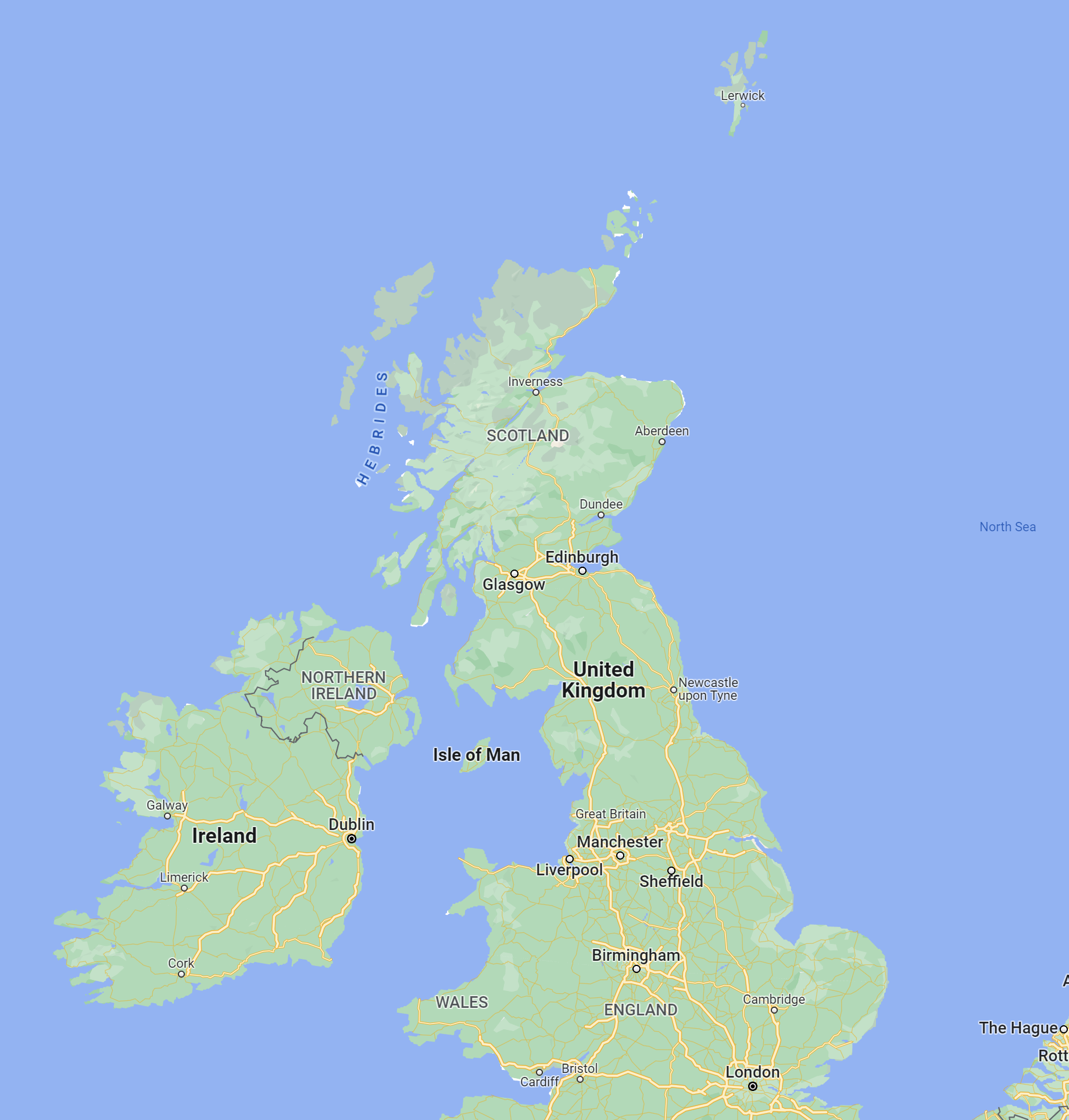
I will look at various seas.
The Celtic Sea
The Celtic Sea is to the South-West of Wales and the South of Ireland.
In Blue Gem Wind, I posted this extract from the The Our Projects page of the Blue Gem Wind web site.
Floating wind is set to become a key technology in the fight against climate change with over 80% of the worlds wind resource in water deeper than 60 metres. Independent studies have suggested there could be as much as 50GW of electricity capacity available in the Celtic Sea waters of the UK and Ireland. This renewable energy resource could play a key role in the UK meeting the 2050 Net-Zero target required to mitigate climate change. Floating wind will provide new low carbon supply chain opportunities, support coastal communities and create long-term benefits for the region.
Consider.
- The key figure would appear 50 GW of electricity capacity available in the Celtic Sea waters of the UK and Ireland.
- Earlier I said that floating turbines can have a wind turbine density of 5 MW per km².
- According to Wikipedia, the surface area of the Celtic Sea is 300,000 km².
To accommodate enough floating turbines to generate 50 GW would need 10000 km², which is a 100 km. square, or 3.33 % of the area of the Celtic Sea.
This wind generation capacity of 50 GW would appear to be feasible in the Celtic Sea and still leave plenty of space for the shipping.
The Irish Sea
According to Wikipedia, the surface area of the Irish Sea is 46,000 km².
Currently, there are ten wind farms in the Irish Sea.
- Six are in English waters, three are in Welsh and one is in Irish.
- None are more than sixteen kilometres from the coast.
The total power is 2.7 GW.
I feel that the maximum number of wind farms in the Irish Sea would not cover more than the 3.33 % proposed for the Celtic Sea.
3.33 % of the Irish Sea would be 1532 km², which could support 7.6 GW of wind-generated electricity.
I can’t leave the Irish Sea without talking about two wind farms Mona and Morgan, that are being developed by an enBW and BP joint venture, which I discussed in Mona, Morgan And Morven. This infographic from the joint venture describes Mona and Morgan.

That would appear to be a 3 GW development underway in the Irish Sea.
Off The Coast Of South-East England, East Anglia, Lincolnshire And Yorkshire
These wind farms are proposed in these areas.
- Hornsea – 6 GW
- Triton Knoll – 900 MW
- Dogger Bank – 3.6 GW
- Norfolk Boreas – 1.8 GW
- Norfolk Vanguard – 1.8 GW
- East Anglia Array – 7.2 GW
- Rampion Extension – 1.2 GW
Note.
All wind farms have comprehensive web sites or Wikipedia entries.
The total capacity of these wind farms is 22.5 GW
The North Sea
According to Wikipedia, the surface area of the North Sea is 570,000 km².
Would it is reasonable to assume, that perhaps a tenth of this area would be available for new wind farms in UK waters?
3.33 % of the available North Sea would be 1898 km², which could support 9.5 GW of wind-generated electricity.
On The East Coast Of Scotland
In Wind Farms On The East Coast Of Scotland, I summarised the wind farms off the East coast of Scotland, that are being built in a cluster in the First of Forth.
This map shows the proposed wind farms in this area.
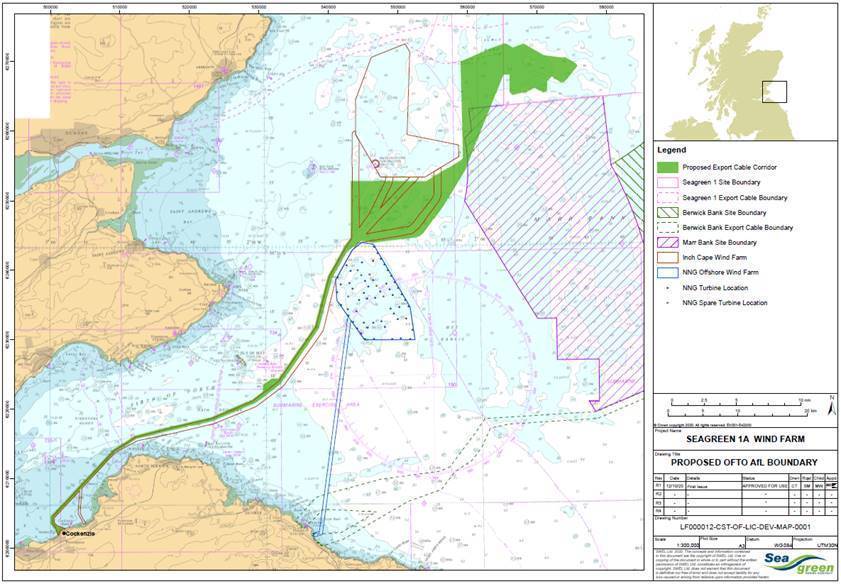
There are five wind farms in the map.
- The green area is the cable corridor for Seagreen 1a
- Inch Cape is the odd-shaped wind farm to the North and West of the green area
- Seagreen at the top of the map, to the North of Inch Cape.
- Marr Bank with the pink NE-SW hatching
- Berwick Bank with the green NW-SE hatching
- Neart Na Gaoithe is edged in blue to the South of the green area.
Berwick Bank and Marr Bank are both owned by SSE and appear to have been combined.
The capacity of the wind farms can be summarised as follows.
- Seagreen – 1075 MW
- Neart Na Gaoithe – 450 MW
- Inch Cape – 1000 MW
- Berwick Bank and Marr Bank – 4100 MW
This gives a total of 6625 MW or just over 6.6 GW.
Around The North Of Scotland
This map shows the latest successful ScotWind leases.

Note.
- Several of these proposed wind farms have detailed web sites.
These seventeen leases total up to 24.3 GW.
An Interim Total
I believe these figures are realisable.
- Celtic Sea – 50 GW
- Irish Sea – 7.6 GW – 3 GW already underway
- South East England, East Anglia, Lincolnshire And Yorkshire – 22.5 GW
- North Sea – 9.5 GW
- On The East Coast Of Scotland – 6.6 GW
- Around The North Of Scotland – 24.3 GW
Note.
- I have tried to be as pessimistic as possible.
- Irish and North Sea estimates are based on Blue Gem Wind’s professional estimate for the Celtic Sea.
- I have used published figures where possible.
My estimates total up to 120.1 GW of extra wind-power capacity. As I write this, current UK electricity production is around 33 GW.
Vikings Will Invade
This Google Map shows the Faroe Islands, the North of Scotland, Norway and Denmark.
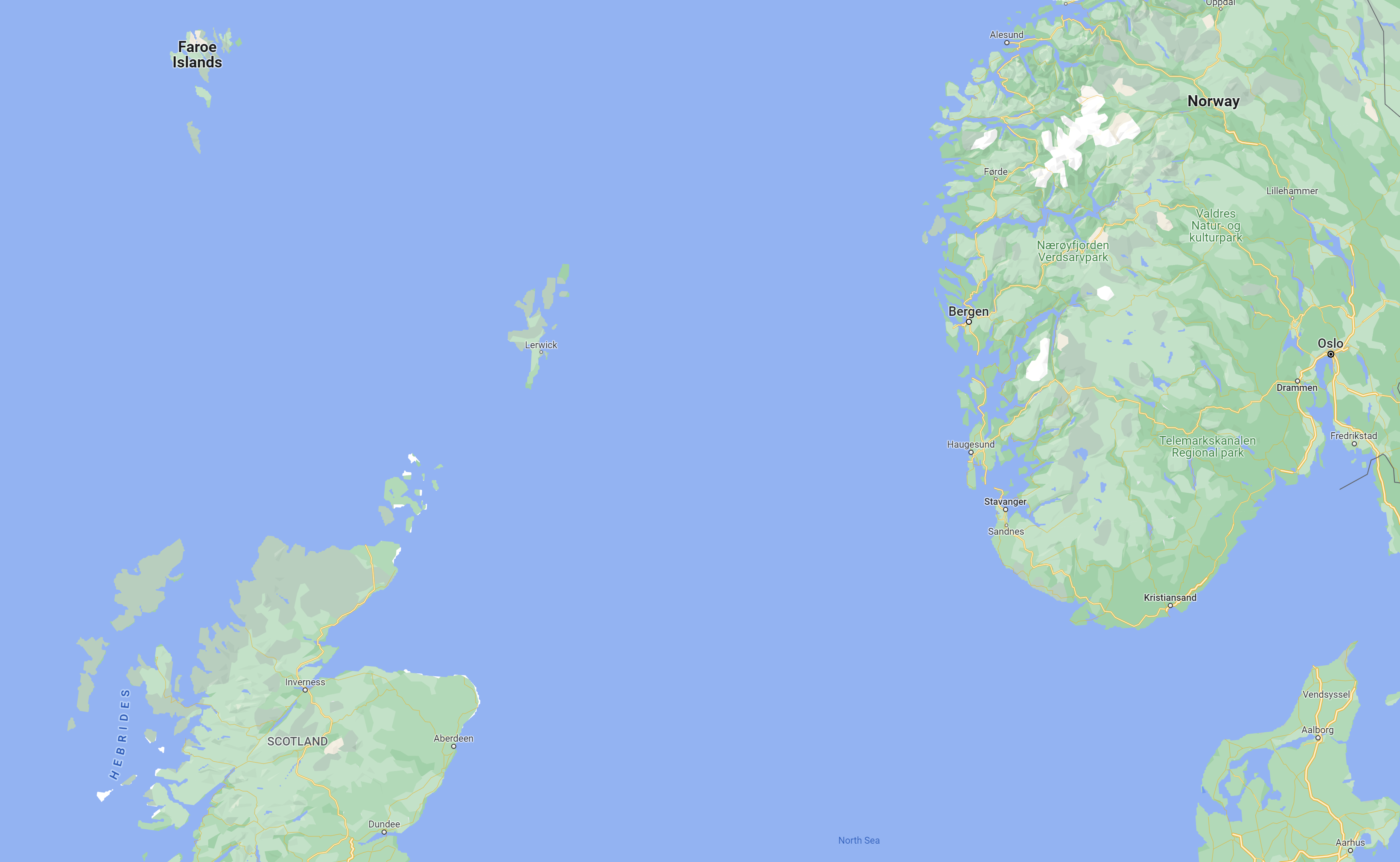
To get an idea of scale, the Shetland Isles are around 70 miles or 113 km. from North to South.
In Is This The World’s Most Ambitious Green Energy Solution?, I talked about Norwegian company; Aker Solutions’s plan for Northern Horizons.
- It would be a 10 GW offshore floating wind farm 136 km to the North-East of the Shetlands.
- This position would probably place it about halfway between the Faroes and the Norwegian coast.
- The project is best described in this article on the Engineer, which is entitled Northern Horizons Plans Clean Energy Exports For Scotland.
- In the article, there is a good graphic and a video.
This will be offshore engineering of the highest class, but then I first came across Norwegian offshore engineering like this in the 1970s, where nothing was too difficult for Norwegian engineers.
There are two major points to remember about the Norwegians.
- They have the Sovereign Wealth Fund to pay for the massive investment in Northern Horizons.
- They need to replace their oil and gas income, with a zero-carbon investment stream.
I feel that Northern Horizons will not be a one-off and the virgin sea in the map above will be liberally carpeted with more floating wind farms.
- On Shetland, electricity can be fed into the UK grid.
- On Norway, electricity can be fed into the Norwegian grid or stored in Norwegian pumped storage systems.
- On Scotland, more pumped storage systems can be built to store energy.
- Hydrogen can be piped to where it is needed to decarbonise heavy industry and transport.
- Norwegian fjords, Shetland harbours, Scottish lochs and possibly Scapa Flow would be ideal places to assemble and service the giant floating turbines and build the other needed floating infrastructure.
- I can also see Denmark getting in on the act, as they will probably want to decarbonise the Faroe Islands.
I estimate that between the Faroes, Scotland and Norway, there are 510,000 km² of virgin sea.
With a potential of 5 MW per km², that area has the potential to create an amazing amount of both electricity and hydrogen.
Exporting Power To Europe
There will need to be more interconnectors from the UK to Europe.
These are already working.
- BritNed – 1 GW – Isle of Grain and Rotterdam
- ElecLink – 1 GW – Through the Channel Tunnel
- HVDC Cross-Channel – 2 GW – England and France
- IFA-2 – 1 GW – England and France
- NemoLink – 1 GW – Kent and Belgium
- North Sea Link – 1.4 GW – Blyth and Norway
- Viking Link – 1.4 GW – Lincolnshire and Denmark
These are proposed.
- GridLink – 1.4 GW – Kent and Dunkirk
- NeuConnect – 1.4 GW – Isle of Grain and Germany
- North Connect – 1.4 GW – Scotland and Norway
There are also gas interconnectors, that could be converted to hydrogen.
This press release from National Grid, which is entitled Undersea Electricity Superhighways That Will Help Deliver Net Zero Move A Step Closer, has these bullet points.
- Positive progress on plans for £3.4bn electricity super-highway projects – Scotland to England Green Links.
- Ofgem opens consultation that recognises the “clear case” and “consumer benefit” of two subsea high voltage cables to transport clean between Scotland and England.
- The cables form part of a planned 16 project £10 billion investment from National Grid to deliver on the government’s target of 40GW of offshore wind generation by 2030.
This paragraph expands on the work by National Grid to meet the third point.
These projects are part of National Grid’s work upgrading the electricity transmission system to deliver the UK government’s target of 40GW of offshore wind generation by 2030. In addition to the Eastern Links, it is developing 14 major projects across its network to facilitate the target representing a £10 billion investment. This includes two further Scotland to England high voltage links (also in partnership with the Scottish transmission network owners) and proposals in the Humber, Lincolnshire, East Midlands, North of England, Yorkshire, North Kent, as well as four in East Anglia (one of which is a proposed offshore link between Suffolk and Kent).
I think we can assume, that National Grid will do their part to allow the UK government’s target of 40GW of offshore wind generation by 2030 to be met.
Will The UK Have 40 GW Of Offshore Wind Generation By 2030?
In the Wikipedia entry for Windpower In The UK, this is the opening sentence.
The United Kingdom is one of the best locations for wind power in the world and is considered to be the best in Europe. By the beginning of March 2022, the UK had 11,091 wind turbines with a total installed capacity of over 24.6 gigawatts (GW): 14.1 GW of onshore capacity and 10.4 GW of offshore capacity.
It would appear an extra 30 GW of wind power is needed.
In An Interim Total earlier, I gave these figures.
- Celtic Sea – 50 GW
- Irish Sea – 7.6 GW – 3 GW already underway
- South East England, East Anglia, Lincolnshire And Yorkshire – 22.5 GW
- North Sea – 9.5 GW
- On The East Coast Of Scotland – 6.6 GW
- ScotWind – 24.3 GW
The wind farms in South East England, East Anglia, Lincolnshire And Yorkshire and ScotWind and Mona and Morgan are either being planned or under construction, and in many cases leases to construct wind farms are being paid.
I would feel, that at least 30 GW of these 56.4 GW of wind farms will be completed by 2030.
Conclusion
Boris’s vision of the UK becoming a Saudi Arabia of wind is no fantasy of a man with massive dreams.
Standard floating wind turbines, with the possibility of also harvesting wave power could be assembled in ports along the coasts, towed into position and then connected up.
Several GW of wind-power capacity could probably be added each year to what would become the largest zero-carbon power station in the world.
By harvesting the power of the winds and waves in the seas around the British Isles it is an engineering and mathematical possibility, that could have been developed by any of those great visionary Victorian engineers like Armstrong, Bazalgette, Brunel and Reynolds, if they had had access to our modern technology.
Up Yours! Putin!
 The Anonymous Widower