Dore & Totley Station – 1st April 2025
It seems like only yesterday, when I visisited Dore and Totley station and wrote Dore And Totley Station – 13th July 2020, when I took these pictures.
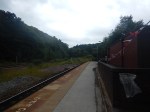
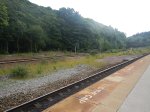


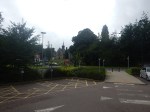
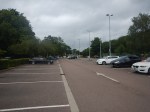

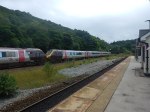
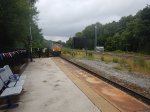


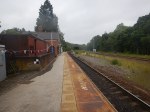

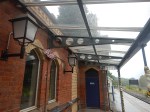
But it was yesterday, when I visited the station again and look at the station now.

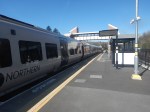
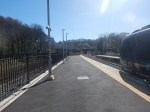
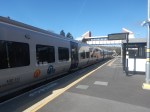
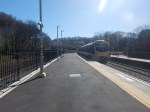
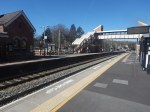
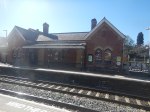
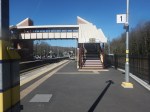
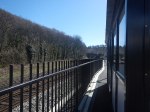

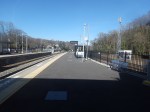
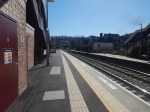

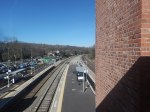
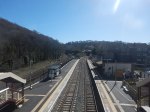
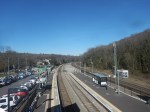



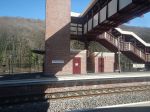
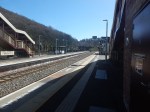
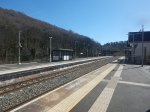
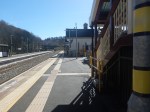
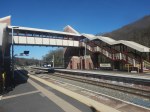
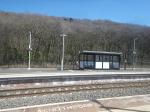


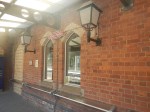
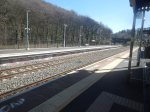
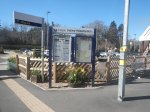
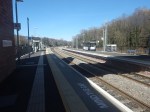
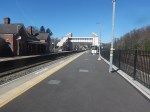
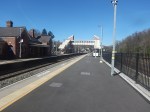
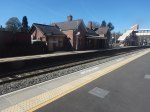
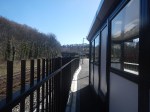
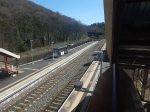
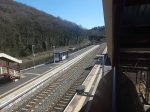
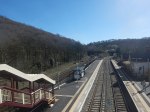
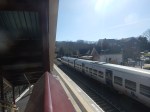
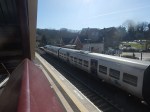
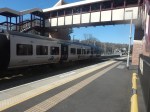
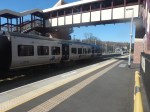
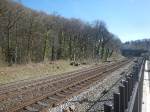
Note.
- The footbridge is in keeping with the original station building.
- The only changes to the original station building, is a small amount of tasteful restoration.
- The footbridge is high enough for future electrification.
- There are one shelter on the entry/car park and two on the far side.
- As I watched several Class 158, Class 195 and Class 222 trains pass through, it appears that the curve has been profiled for speed.
- I am pretty sure, that the station has been designed so that if required, at least one extra platform can be added to the Chesterfield Lines.
- The Rajdhani Restaurant in the original station building is rated 4.2 on Trip Advisor, which says they do gluten-free options.
- The maximum speed through the station appears to be 50 mph, with 70 mph on the Chesterfield Lines.
From my brief visit, it appears to be another station, that has been superbly updates.
Let’s bring on a few more.
Rail Minister Marks Completion Of £150m Hope Valley Railway Upgrade
The title of this post is the same as that of this article on Rail Magazine.
These first two paragraphs summarise the work.
More reliable journeys are promised on the Hope Valley line between Manchester and Sheffield after a £150 million upgrade was completed in early April.
Over the last three years, the existing platform at Dore & Totley station on the south side of Sheffield has been extended to cope with six-coach trains. Meanwhile the second platform has been rebuilt and commissioned (after it was removed in the 1980s), two mechanical signal boxes have been abolished and a new one-kilometre freight loop laid in the Peak District. At Hathersage, a pedestrian crossing has also been removed and replaced with a footbridge.
These are my thoughts.
Dore And Totley Station
The Rail Magazine article says this about the improvements at Dore and Totley station.
Replacing two tracks through Dore & Totley removes a single-track bottleneck that often saw Sheffield to Manchester express services held up by slower stopping services and cement trains destined for Earles Sidings. A nine-day shutdown of the route in March was needed to finish the work.
The new platform sits between the Midland Main Line and the Hope Valley line, so can only be reached via the new footbridge or lifts. As well as the usual ‘blister paving’ slabs marking the edge of the platform, other tactile paving has been laid to help people with visual impairments find their way around the station.
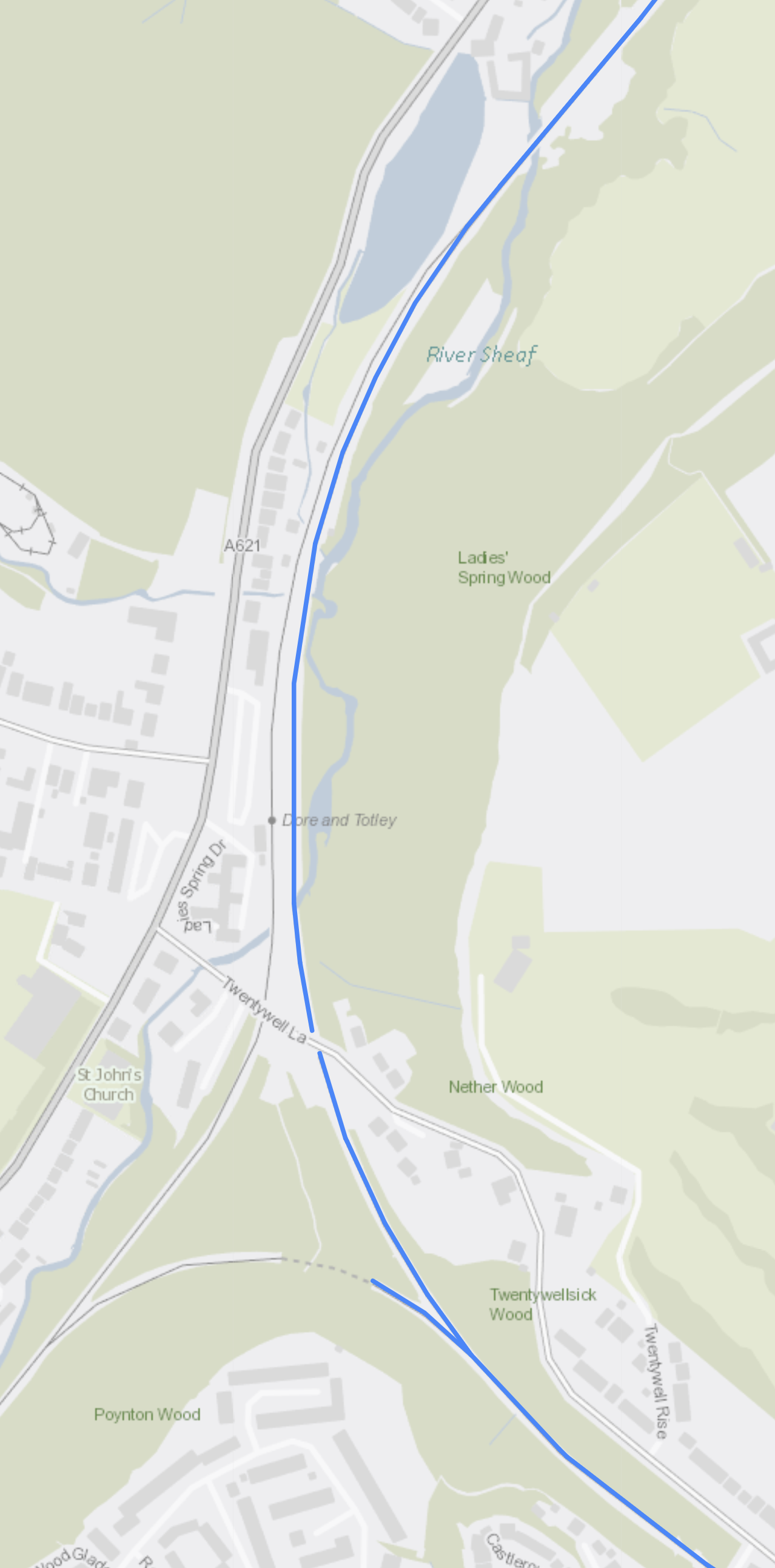
This OpenRailwayMap shows the new layout of tracks at Dore and Totley station.

Note.
- The four tracks at the North of the map go to Sheffield station.
- The Eastern pair of tracks are the Midland Main Line and they go to the South-East corner of the map for Chesterfield and the South.
- The Western pair of tracks are the Hope Valley Line and they go to the South-West corner of the map for Manchester.
- The blue lettering in the middle of the map indicates Dore and Totley station.
- There is a single track curve between the Midland Main Line and the Hope Valley Line, which is mainly used by freight trains.
This secondOpenRailwayMap shows Dore and Totley station in greater detail.

The big improvement is that the Hope Valley Line is now double instead of single track, which must eliminate a lot of delays.
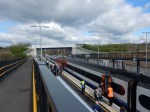
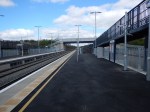
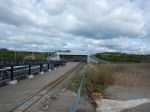
These pictures show the station in July 2020.

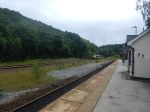
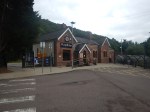
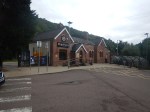
The pictures clearly show the single track and platform at Dore and Totley station.
Dore South Curve
Dore South Curve links the Southbound Midland Main Line with the Westbound Hope Valley Line.
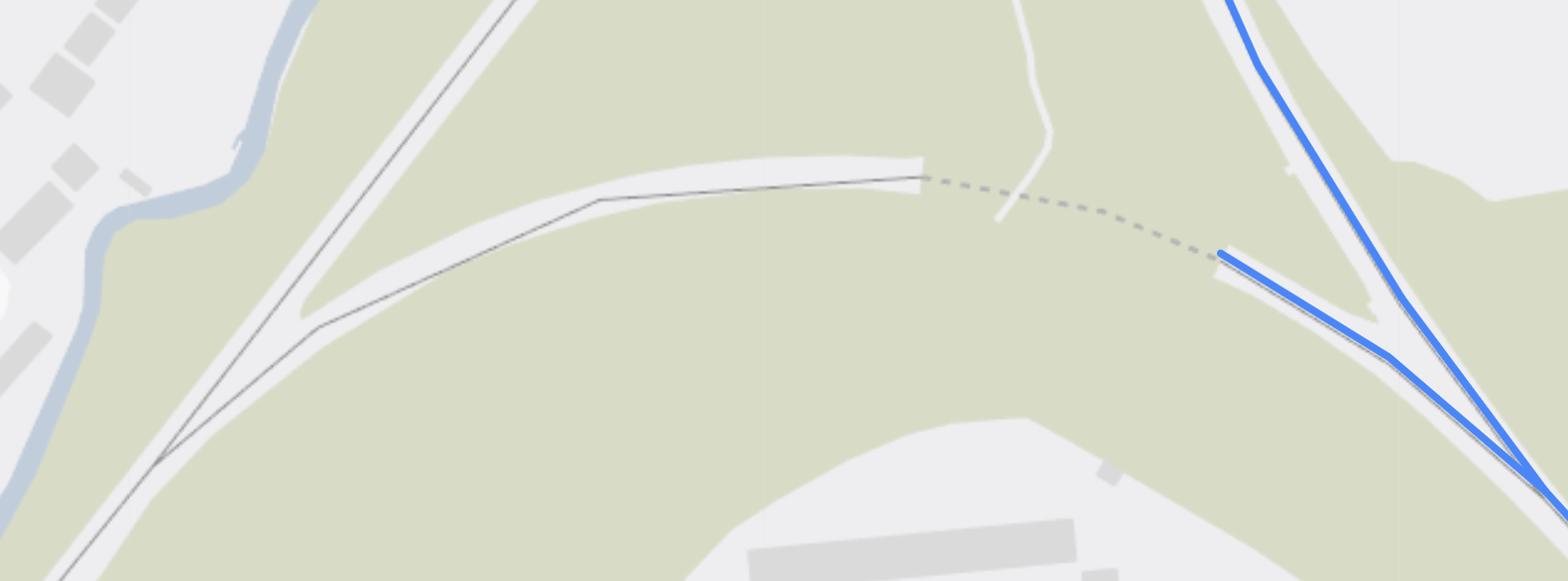
This OpenRailwayMap shows the curve.

There is a crossover in the South-West corner of the map, so with careful signalling, trains can use the Dore South Curve in both directions.
Bamford Loop
This is a freight loop between Bamford and Hathersage stations.
This OpenRailwayMap shows the loop.

Note.
- The Hope Valley Line goes diagonally across the map.
- Manchester is to the North-West.
- Sheffield is to the South-East.
- Bamford station is in the North-West corner of the map.
- Hathersage station is just off the South-East corner of the map.
- The loop is on the Northern side of the Hope Valley Line.
The loop will most likely be used by trains going to Sheffield or Chesterfield.
Hathersage Footbridge
This Google Map shows Hathersage station.

Note.
- Dore Lane and the B 6001 appear to pass under the railway.
- There appears to be what could be foundations just to the West of the platforms at Hathersage station.
- From pictures found by Google the bridge appears to be a simple steel structure.
I shall have to go and take pictures.
Fast Trains Between Manchester And Nottingham
In the Wikipedia entry for the Hope Valley Line, this is said.
Nottinghamshire County Council and the Department for Transport have investigated the possibility of adding another service that does not call at Sheffield in order to improve the journey time between Nottingham and Manchester. Stopping (and changing direction) in Sheffield, the fastest journey is 110 minutes (in 2019), but the council has estimated bypassing Sheffield would cut the time to 85 minutes. Suggested improvements on a 2+1⁄2-mile (4 km) stretch near Stockport may reduce journey times by 2–3 minutes.
Consider.
- According to Google, the driving time between the two cities is 128 minutes and the motorway route is via the M1 and M62.
- If nearly half-an-hour could be saved between Manchester and Nottingham could be a big saving in journey time.
- Manchester Piccadilly is likely to be rebuilt for High Speed Two and a fast route via Nottingham could be a viable alternative.
- Both Manchester and Nottingham have good local tram and train networks.
- As the electrification of the Midland Main Line progresses, the route will be increasingly suitable for 100 mph battery-electric trains.
A Manchester and Nottingham express service looks to be an easy service to implement after the Hope Valley Line has been improved.
Hourly Stopping Trains Between Manchester And Sheffield
The Wikipedia entry for the Hope Valley Line gives these details for the stopping service between Manchester Piccadilly and Sheffield.
- Trains are hourly.
- Trains call at Reddish North, Brinnington, Bredbury, Romiley, Marple, New Mills Central, Chinley, Edale, Hope, Bamford, Hathersage, Grindleford and Dore & Totley.
- But some services do not call at some or all of Edale, Bamford, Hathersage, Grindleford and Dore & Totley giving some 2-hour gaps between services at these stations.
Let’s hope that some of the extra capacity is used to provide a regular service at all stations on the Hope Valley Line.
As in a few years, it will have electrification at both ends, this route could be very suitable for battery-electric trains.
Completion Date
It appears that the first day, when passengers will be able to use the new upgraded tracks and stations will be Thursday, the 2nd of May.
Conclusion
The improvements, certainly seem to allow extra and improved services through on the Hope Valley Line.
I also feel that in a few years, services will be run by battery-electric trains.
Electrification Of The Hope Valley Line
This news story from the Department of Transport is entitled Yorkshire And The Humber To Benefit From £19.8 billion Transport Investment.
This is said about the Hope Valley Line.
The Hope Valley Line between Manchester and Sheffield will also be electrified and upgraded, with the aim of cutting journey times from 51 to 42 minutes and increasing the number of fast trains on the route from 2 to 3 per hour, doubling capacity.
The fast trains are currently TransPennine’s service between Liverpool Lime Street and Cleethorpes.
- Between Platform 13 at Manchester Piccadilly station and Sheffield station is 42.6 miles.
- At the Manchester end, there will be electrification between Manchester Piccadilly and Hazel Grove stations, which is 8.7 miles and takes typically 17 minutes.
- After the electrification of the Midland Main Line to Sheffield, there will be electrification between Dore & Totley and Sheffield stations, which is 4.2 miles and takes typically 8 minutes.
The gap in the electrification between Dore & Totley and Hazel Grove stations will be 29.7 miles.
But it will not be an easy route to electrify.
- At the Western end, there is the Disley Tunnel, which is 3535 metres long.
- In the middle, there is the Cowburn Tunnel which is 3385 metres long, that is also the deepest tunnel in England.
- At the Eastern end, there is the Totley Tunnel, which is 5700 metres long.
Yorkshire doesn’t have an Underground railway, but the combined length of these three tunnels is 7.84 miles, which means that over 26 % of the electrification needed between Manchester Piccadilly and Sheffield will have to be installed in tunnels.
Could The Route Be Run Using Battery-Electric Trains?
Consider.
- The gap in the electrification between Dore & Totley and Hazel Grove stations will be 29.7 miles.
- There is electrified sections at Dore & Totley and Hazel Grove stations, which will be able to charge the trains.
- Merseyrail’s Class 777 trains have demonstrated a battery range of 84 miles.
- A Stadler Akku train has demonstrated a battery range of 139 miles.
- Hitachi are developing a battery-electric version of TransPennine’s Class 802 train.
- If all trains can run on batteries or be self-powered, there would be no need to electrify the long and possibly difficult tunnels.
I believe that it would be possible to electrify all passenger services between Manchester and Sheffield using appropriate battery-electric trains.
Freight would be a problem and I suspect that hydrogen-hybrid and other self-powered locomotives could handle the route.
Could The Complete TransPennine Liverpool Lime Street and Cleethorpes Service Be Run By Battery-Electric Class 802 trains?
These are the various electrified and unelectrified sections.
- Liverpool Lime Street and Liverpool South Parkway – Electrified – 5.7 miles – 10 minutes
- Liverpool South Parkway and Trafford Park – Not Electrified – 25.2 miles – 30 minutes
- Trafford Park and Hazel Grove – Electrified – 12.6 miles – 28 minutes
- Hazel Grove and Dore & Totley – Not Electrified – 29.7 miles – 35 minutes
- Dore & Totley and Sheffield – Electrified – 4.2 miles – 6 minutes
- Sheffield and Doncaster – Not Electrified – 18.6 miles – 25 minutes
- Doncaster and Cleethorpes – Not Electrified – 52.1 miles – 78 minutes
Note.
- This is a total of 125.6 miles without electrification.
- The Manchester Piccadilly and Sheffield time is 56 minutes.
- The distance is 37.8 miles.
- That is an average speed on 40.5 mph.
- Most of the line between Manchester Piccadilly and Sheffield has an maximum speed of 70 mph, but there is a short length of track with a 50 mph speed and another longer one with 90 mph.
To achieve 40 minutes between Manchester Piccadilly and Sheffield would need an average speed of 60.7 mph. Given the improvements being carried out by Network Rail at the current time, I believe that forty minutes between Manchester Piccadilly and Sheffield should be possible.
I’ll look at a train going East.
- The train will leave Liverpool Lime Street with a reasonably full battery after charging using the current electrification in the station.
- The train will leave Liverpool South Parkway with a full battery after charging using the current electrification from Liverpool Lime Street.
- The train will arrive at Trafford Park with a battery perhaps two-thirds full, but it will be fully charged on the current electrification to Hazel Grove.
- The train will arrive at Dore & Totley with a battery perhaps two-thirds full, but it will be fully charged on the Midland Main Line electrification to Sheffield.
- The train will arrive at Doncaster with a battery perhaps two-thirds full and the train would wait until it had enough charge to reach Cleethorpes.
I’ll look at a train going West.
- The train will leave Cleethorpes with a full battery after charging using the new electrification in the station.
- The train will arrive at Doncaster with a battery perhaps two-thirds full and the train would wait until it had enough charge to reach Sheffield.
- The train will arrive at Sheffield with a battery perhaps two-thirds full, but it will be fully charged on the Midland Main Line electrification to Dore & Totley.
- The train will arrive at Hazel Grove with a battery perhaps two-thirds full, but it will be fully charged on the current electrification to Trafford Park.
- The train will arrive at Liverpool South Parkway with a battery perhaps two-thirds full, but the route is electrified to Liverpool Lime Street.
Note.
- If the battery range on a full battery was over 90 miles, the two most easterly sections could be run without any charging at Doncaster.
- If the battery range was over 125.6 miles, the journey could be done by starting with a full battery.
- If every time the train decelerated, regenerative braking would recover energy, which could be reused.
- The only new electrification needed will be a short length at Cleethorpes station, that would charge the trains.
I certainly believe that Liverpool Lime Street and Cleethorpes services could be run by battery-electric trains.
Could The Complete TransPennine Liverpool Lime Street and Cleethorpes Service Be Run By Battery-Electric Class 802 trains Without The Midland Main Line Electrification?
In this section, I’m assuming, that there is no electrification at Sheffield.
These would be the various electrified and unelectrified sections.
- Liverpool Lime Street and Liverpool South Parkway – Electrified – 5.7 miles – 10 minutes
- Liverpool South Parkway and Trafford Park – Not Electrified – 25.2 miles – 30 minutes
- Trafford Park and Hazel Grove – Electrified – 12.6 miles – 28 minutes
- Hazel Grove and Cleethorpes – Not Electrified – 104.6 miles – 143 minutes
Note.
- This is a total of 129.6 miles without electrification.
- The battery range of the train, should probably be around 120 miles to make sure the train could run between Hazel Grove and Cleethorpes.
- One diesel power-pack could be installed for emergency use.
I’ll look at a train going East.
- The train will leave Liverpool Lime Street with a reasonably full battery after charging using the current electrification in the station.
- The train will leave Liverpool South Parkway with a full battery after charging using the current electrification from Liverpool Lime Street.
- The train will arrive at Trafford Park with a battery perhaps 80 % full, but it will be fully charged on the current electrification to Hazel Grove.
- The train would then eek out what power it had left to reach Cleethorpes.
If necessary, the train could stop in the electrified Doncaster station to top up the batteries from the East Coast Main Line electrification for the run to Cleethorpes.
I’ll look at a train going West.
- The train will leave Cleethorpes with a full battery after charging using new electrification in the station.
- The train will arrive at Doncaster with a battery perhaps 57 % full and the train would wait if needed, until it had enough charge to reach Hazel Grove.
- The train will arrive at Hazel Grove with a battery perhaps one-thirds full, but it will be fully charged on the current electrification to Trafford Park.
- The train will arrive at Liverpool South Parkway with a battery perhaps one-thirds full, but the route is electrified to Liverpool Lime Street.
Note.
- If the battery range on a full battery was over 105 miles, the Eastern section could be run without any charging at Doncaster.
- If the battery range was over 129.6 miles, the journey could be done by starting with a full battery.
- If every time the train decelerated, regenerative braking would recover energy, which could be reused.
- The only new electrification needed will be a short length at Cleethorpes station, that would charge the trains.
However, it might be prudent to electrify the through platforms at Sheffield, so that they could be used for emergency charging if required.
Northern Train’s Service Between Sheffield And Manchester Piccadilly Via The Hope Valley Line
There is a one train per hour (tph) Northern service between Sheffield and Manchester Piccadilly.
- The Class 195 diesel train takes 78 minutes.
- The distance is 42 miles.
- The first mile or so at the Manchester end is electrified.
- Trains seem to take about sixteen minutes to turn round at Manchester Piccadilly.
- Trains seem to take about nine minutes to turn round at Sheffield.
- The service runs via Reddish North, Brinnington, Bredbury, Romiley, Marple, New Mills Central, Chinley, Edale, Hope, Bamford, Hathersage, Grindleford and Dore & Totley.
- The max speed is generally 60 mph to the West of New Mills Central and 70 mph to the East, with short lower speed sections.
There would appear to be two ways to run this route withy battery-electric trains.
- As Manchester Piccadilly station is fully-electrified and trains could be connected to the electrification for upwards of twenty minutes, trains will certainly be able to be fully-charged at Manchester. As the round trip is only 84 miles, could trains run the service without a charge at Sheffield.
- Alternatively, there could be a dedicated electrified platform at Sheffield. But the problem with this, is that currently this service uses a random platform at Sheffield.
It looks like, if the train has the required range, that charging at the Manchester end would be the better solution.
Liverpool And Norwich Via The Hope Valley Line
This service uses a similar route between Liverpool Lime Street and Sheffield, as the Liverpool and Hull service and then it meanders, through the East Midlands.
- Liverpool Lime Street and Liverpool South Parkway – Electrified – 5.7 miles – 11 minutes
- Liverpool South Parkway and Trafford Park – Not Electrified – 25.2 miles – 33 minutes
- Trafford Park and Hazel Grove – Electrified – 12.6 miles – 26 minutes
- Hazel Grove and Dore & Totley – Not Electrified – 29.7 miles – 28 minutes
- Dore & Totley and Sheffield – Electrified – 4.2 miles – 6 minutes
- Sheffield and Nottingham – Being Electrified – 40.6 miles – 52 minutes
- Nottingham and Grantham – Not Electrified – 22.7 miles – 30 minutes
- Grantham and Peterborough – Electrified – 29.1 miles – 29 minutes
- Peterborough And Ely – Not Electrified – 30 miles – 31 minutes
- Ely and Norwich – Not Electrified – 53.7 miles – 56 minutes
This is a total of 161.3 miles without electrification.
But as Sheffield and Nottingham and Grantham and Peterborough will be fully electrified, this route will be possible using a battery-electric train.
Electrifying Sheffield Station
I said earlier in this post, that electrifying Sheffield station would be an option for electrifying the Sheffield and Manchester Piccadilly service.
If this were to be done, it would have collateral benefits for other services that terminate at Sheffield, which could be charged whilst they turned around.
I wrote about Sheffield station as a battery-electric train hub in Could Sheffield Station Become A Battery-Electric Train Hub?
Conclusion
I believe that full electrification of the Hope Valley Line is not needed, if battery-electric trains are used.
I also believe that battery-electric trains and the current improvements being carried out on the Hope Valley Line will enable a forty minute time between Manchester Piccadilly and Sheffield.
Hydrogen Tourist Transport Network Trialled In The Peak District
The title of this post, is the same as that of this article on Fleet News.
This paragraph outlines the trial.
A trial is taking place in the Peak District National Park where hydrogen fuel cell electric vehicles (FCEVs) and electric vehicles (EVs) will run together between multiple destinations and attractions.
Note.
- Toyota will provide the buses.
- Air Products is providing hydrogen.
- The services appear to be centred on Chesterfield station.
It looks like one of the objectives is to test the two types of buses against the terrain.
I can see hydrogen-powered buses being used extensively in tourist areas all over the world.
Is A High Capacity Freight Route Being Created On The Midland Main Line?
In the January 2022 Edition of Modern Railways, there is a section, which is entitled Mixed Fortunes For Freight In IRP, where IRP is short for Integrated Rail Plan For The North And Midlands.
In the section, this is said about freight on the Midland Main Line.
Whilst HS2 does relieve the MML, electrification of the route north from Kettering via Derby to Sheffield is of relatively limited use to freight, which is generally routed via Corby and Toton to Chesterfield and Rotherham. That said, assuming electrification of the passenger route includes the slow lines from Leicester to Trent and through Chesterfield, it does provide a base on which freight electrification can be built.
This would involve wiring Corby to Syston Junction (north of Leicester), Trent Junction to Clay Cross (south of Chesterfield) and Tapton Junction (north of Chesterfield) to Rotherham Masborough and Doncaster.
As with the ECML, this ‘freight’ electrification would provide a diversionary route and thus greater resilience for East Midlands Railway services.
In addition, gauge clearance throughout from Corby as part of this package would also be highly beneficial in creating a direct route from the ‘Golden Triangle of Logistics’ in the East Midlands to the North East and Scotland for consumer goods supply chains, boosting modal shift to rail and decarbonisation.
It does seem to be a cunning plan worthy of Baldrick at his best.
So is it feasible?
Which Routes Do Freight Trains Use Now?
Christmas in a pandemic, is not a particularly good time to look at the routes freight trains take.
But by looking at Real Time Trains, I can say this.
- Many trains take the route via Corby and Syston Junction, rather than the direct route via Market Harborough and Leicester.
- Leicester is quite busy with freight as trains between Felixstowe and places on the West Coast Main Line, go through the station.
- Very few freight trains seem to take the route via Derby and the Derwent Valley Mills.
- Most freight trains between East Midlands Parkway and Chesterfield seem to take the Erewash Valley Line via Toton and Ilkeston.
I don’t think the pattern will change much, if I look at the trains around the end of January.
What Do I Mean By European-Size Freight Trains?
The Wikipedia entry for loading gauge says this about about the route through the Channel Tunnel and up the Midland Main Line.
UIC GC: Channel Tunnel and Channel Tunnel Rail Link to London; with proposals to enable GB+ northwards from London via an upgraded Midland Main Line.
Note.
- . GC is 3.15 metres wide by 4.65 metres high.
- GB+ is 3.15 metres wide by 4.32 metres high.
- GB+ is intended to be a pan-European standard, that allows piggy-back services.
- British gauging is so complicated, it isn’t specified in standard units. It must be a nightmare for rolling stock designers.
I’ll take an easy way out and assume that by European-Size Freight Trains, I mean that the route must be cleared for GB+ gauge.
Could Kettering and Syston Junction Via Corby Be Cleared For European-Size Freight Trains?
According to a Network Rail Map from February 2010, the current clearance is as follows.
- Kettering and Oakham – W7
- Oakham and Syston Junction – W8
Note.
- Oakham and Peterborough is also W8
- The main problem seems to be that between Corby and Oakham, there are five tunnels; Corby, Glaston, Manton, Seaton and Wing.
- There are also a few overbridges and several level crossings, but they don’t look too challenging.
- Between Corby and Oakham, there is the magnificent Welland viaduct, which has eighty-two arches and is Grade II Listed.
- Ideally, freight operators would like to run European gauge piggy-back services, with road trailers travelling on flat wagons, as they do in CargoBeamer services.
It would be a tough call to satisfy my last point, but if it can be done it would allow all Midland Main Line freight trains to take the Corby diversion and this would remove the problems of running European gauge trains through Leicester station.
This Google Map shows a section of the Welland viaduct.
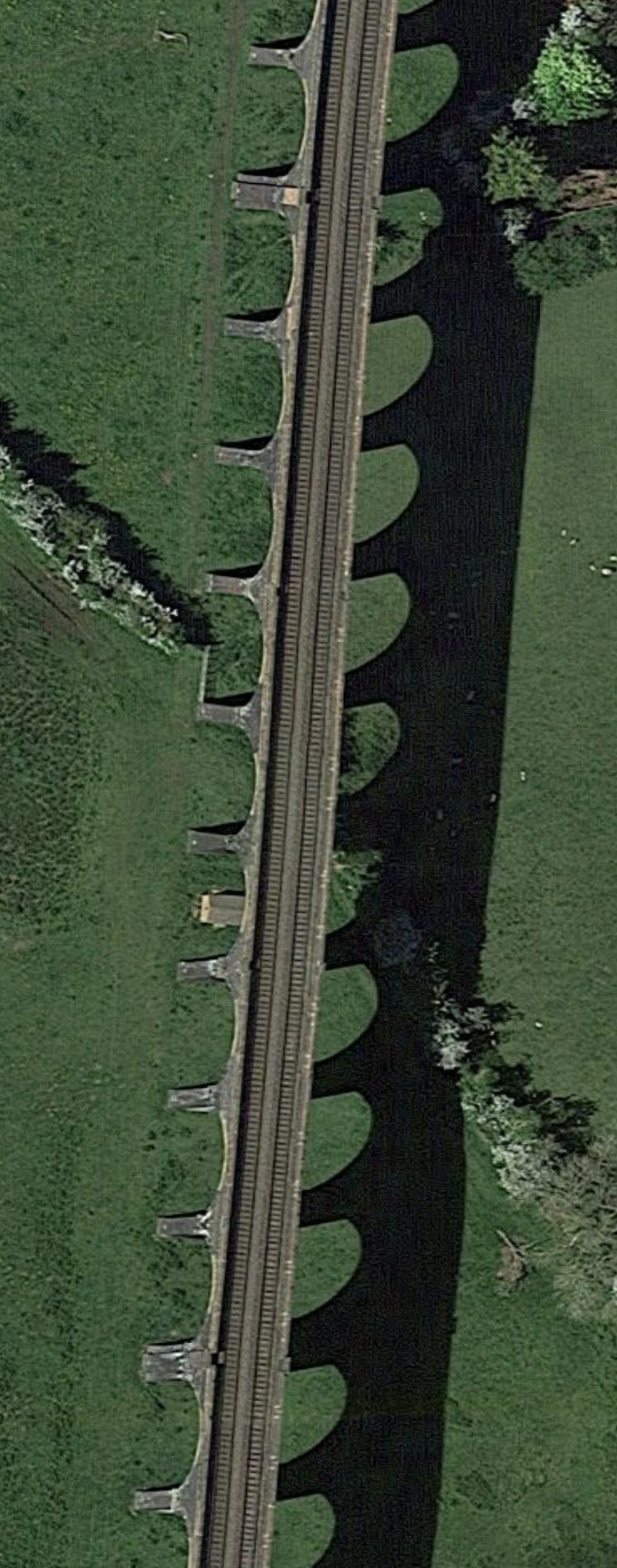
It could be key, as it is fully double-track.
But could it support two heavy freight trains at the same time?
But it would be some sight to see, long European-sized freight trains running over the viaduct.
Could The Midland Main Line Between Syston And Trent Junctions Be Cleared For European-Size Freight Trains?
The route is cleared to W7 or W8 between the two junctions and on inspection with my virtual helicopter, I suspect it wouldn’t be that challenging to upgrade.
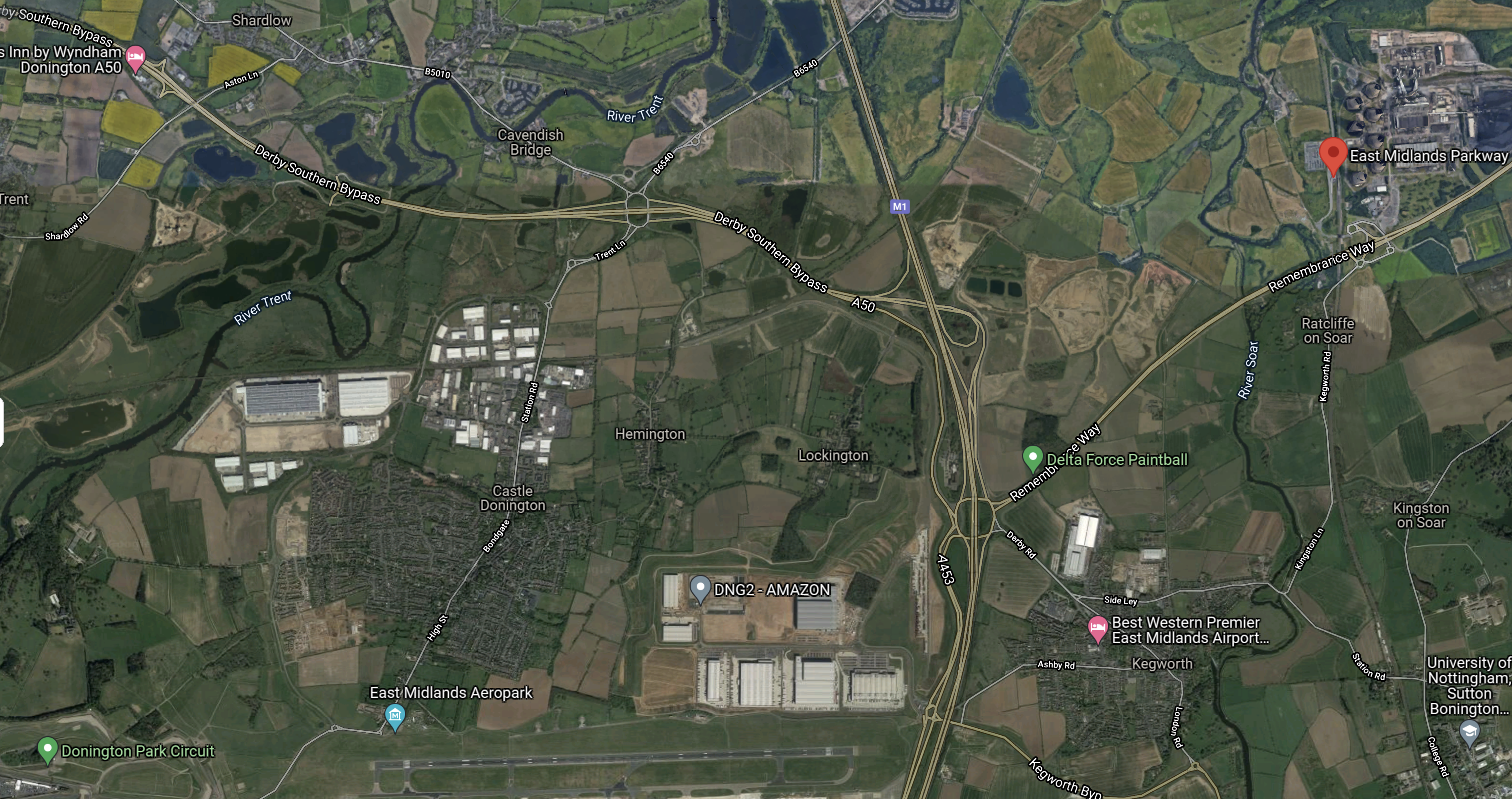
It would also be sensible to clear the Castle Donnington Line for European-size freight trains, so that they could reach the East Midlands Gateway freight terminal.
This Google Map shows the location of the East Midlands Gateway.
Note.
- East Midlands Parkway station is marked by the red arrow in the North-East corner of the map.
- Castle Donnington circuit is in the South West corner of the map.
- The long East-West runway of East Midlands Airport is clearly visible.
- East Midlands Gateway is to the North of the airport.
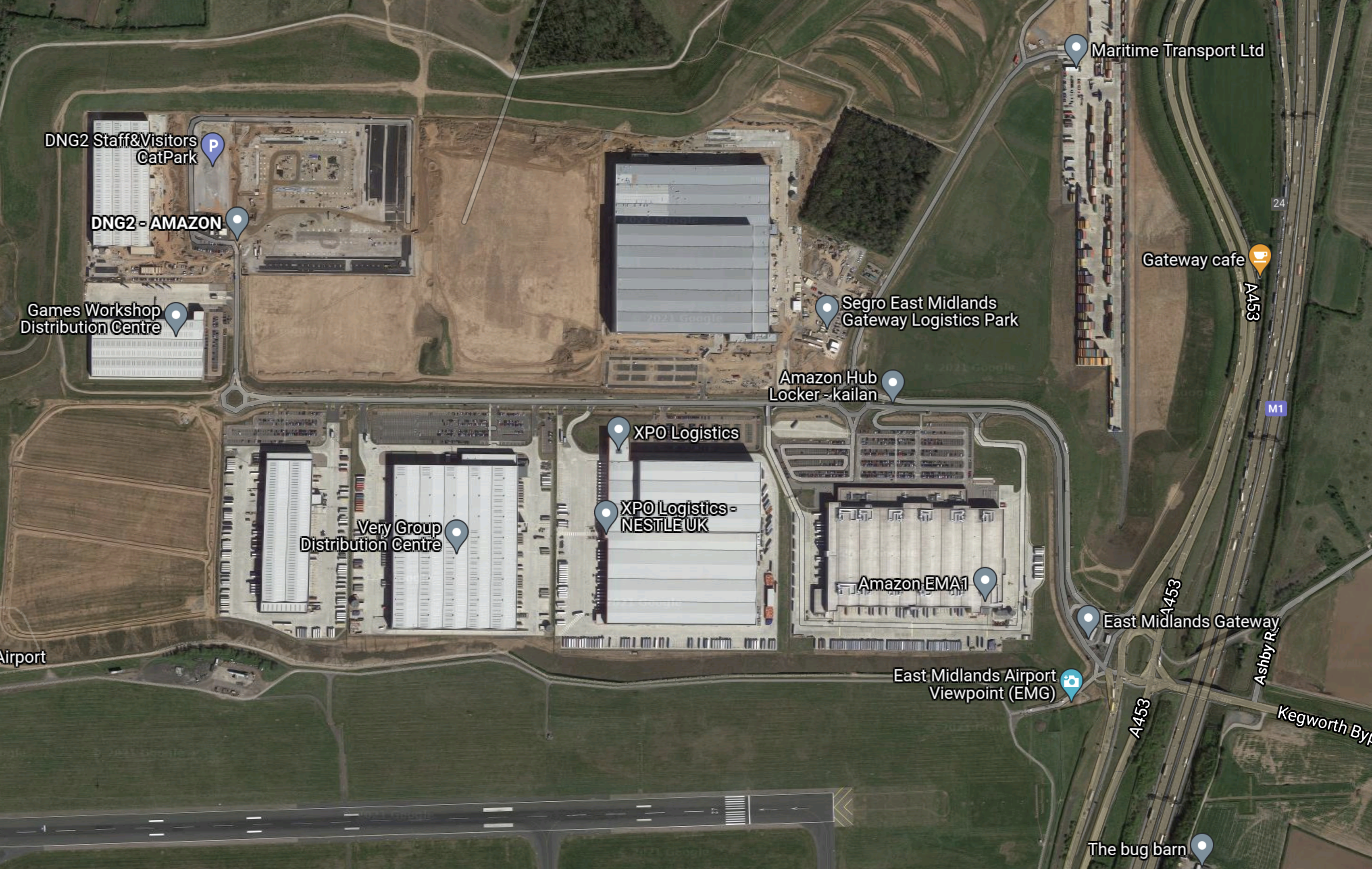
This second Google Map shows East Midlands Gateway in more detail.
Note.
- In the North-East corner is Maritime Transport’s rail freight terminal.
- The M1 runs North-South at the Eastern edge of the map.
- East Midlands Gateway Logistics Park with two Amazon sheds is in the middle.
- The runway at East Midlands Airport is clearly visible.
The Integrated Rail Plan for the North And Midlands has already announced that High Speed Two will join the Midland Main Line to the South of East Midlands Parkway station to serve Derby, Nottingham and Sheffield.
- This new line will have to go past the airport, either to the North of the Logistics Park or South of the Airport.
- Could there be a station here, both for passengers and the workers at a very busy freight airport and Logistics Park?
- Currently, trains between the rail terminal and London, London Gateway and the Port of Felixstowe have to reverse North of the rail terminal to access the terminal.
- All the rail links between the Midland Main Line and East Midlands Gateway would need to be built to accept European-size freight trains, to ensure maximum flexibility.
It strikes me, that there are a lot of extra features that could be added to the rail network between the Midland Main Line and East Midlands Gateway.
Could The Erewash Valley Line Via Ilkeston Be Cleared For European-Size Freight Trains?
Consider.
- According to a Network Rail Map from February 2010, the Erewash Valley Line is cleared to W8.
- According to Wikipedia, it is the second busiest freight route in the East Midlands.
- Network Rail have spent £250 million on the line in recent years to improve junctions and improve signalling.
- The route doesn’t have a large number of passenger services.
These pictures show Ilkeston station on the Erewash Valley Line.

Note.
- The recently rebuilt bridge and the separate avoiding line.
- The Class 158 train under the bridge is 3.81 metres high.
As the European gauge; GB+ is 4.32 metres high, I would feel that Ilkeston station can handle European-size freight trains.
I have flown my virtual helicopter all the way over the Erewash Valley Line from Toton to Clay Cross North junction.
- It looks as if most of the not many bridges are either recent or could be updated to handle the large European-sized freight trains.
- It should also be noted that in many places there is a third track or space for them.
- There are three stations and the Alfreton tunnel.
After this quick look, I feel that the Erewash Valley Line will be able to handle European-size freight trains.
Could Tapton Junction to Rotherham Masborough and Doncaster Be Cleared For European-Size Freight Trains?
This route has very few bridges and I doubt updating wouldn’t cause too many problems.
CargoBeamer
Would it be possible for one of CargoBeamer’s piggy-back trains carrying trailers to run between the Channel Tunnel and the rail terminal at East Midlands Gateway Logistics Park or perhaps another terminal further up the Midland Main Line?
If they could use the Gospel Oak and Barking Line to access the Midland Main Line, I don’t see why not!
Conclusion
It appears that it should be possible to allow European-size freight trains to run between the North of England and the Channel Tunnel.
Reopening The Don Valley Section Of The Former Woodhead Line Between Stocksbridge and Sheffield Victoria To Passenger Services
On October 27th this Beeching Reversal Project was given £50,000 to build a case for reopening.
Stocksbridge is introduced like this in its Wikipedia entry.
Stocksbridge is a town and civil parish, in the City of Sheffield, in South Yorkshire, England. Historically part of the West Riding of Yorkshire, it lies just to the east of the Peak District. The town is located in the steep-sided valley of the Little Don River, below the Underbank Reservoir. It blends into the areas of Deepcar, Bolsterstone and the eastern end of Ewden valley around Ewden village, which are also within the civil parish. The population of the civil parish as of the 2011 census was 13,455.
This Google Map shows the area.
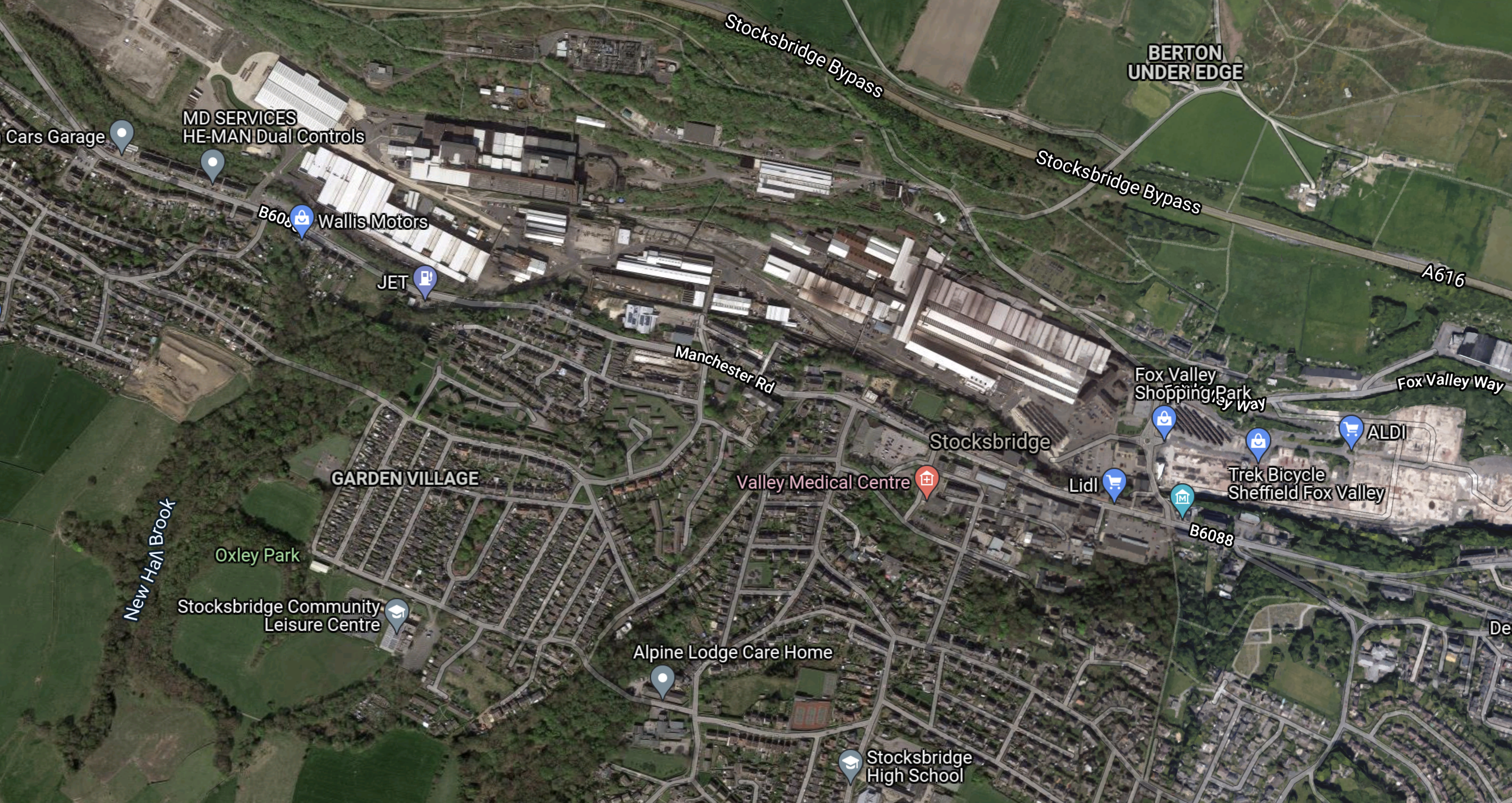
Note there are a large number of steel related industries all connected by an extensive railway system.
This Google Map shows part of the area to a more detailed scale.
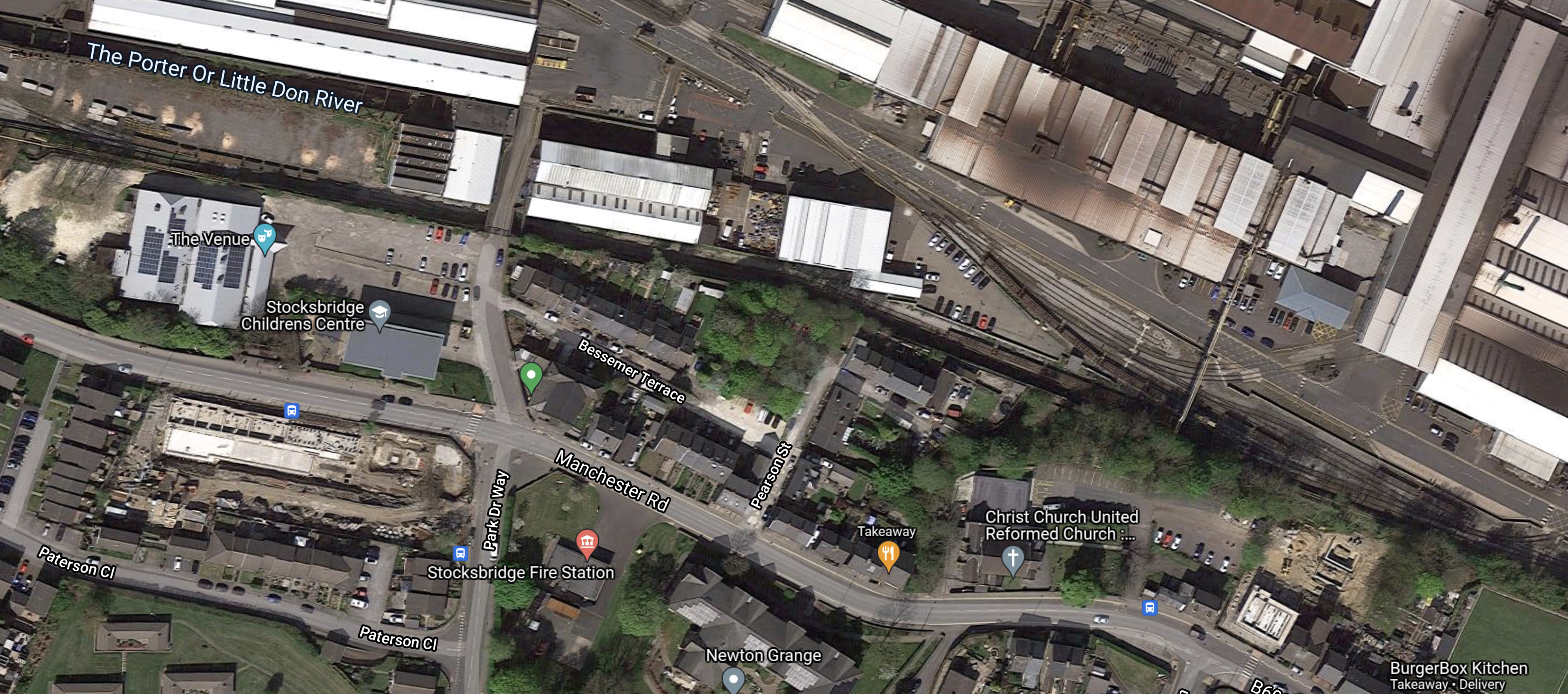
I suspect that a station could be built somewhere to the South of the works.
I have followed the Stocksbridge Railway out to the East and it takes a loop to the South to Deepcar Tram and Railway station, as is shown on this Google Map.
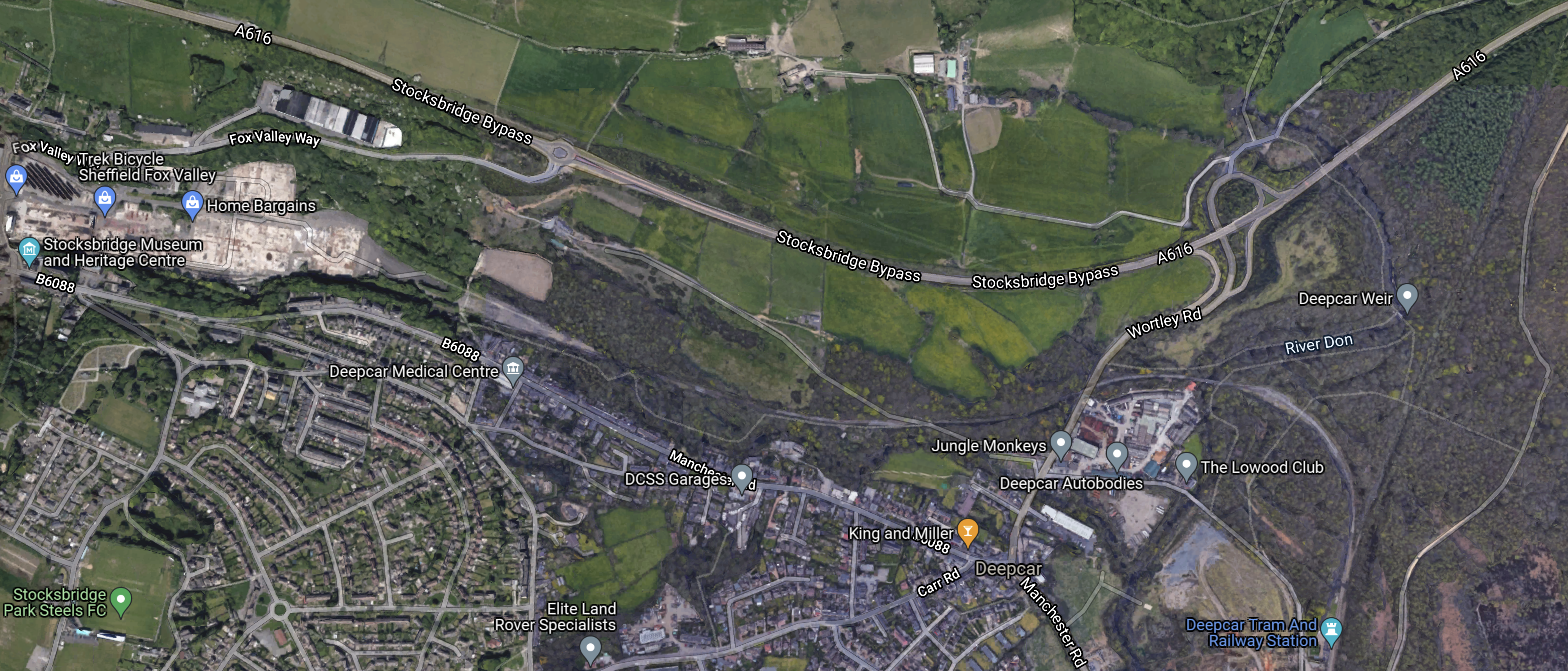
Note.
The Eastern end of the Stockbridge site is in the North-West of the map.
Deepcar station is shown by a blue dot in the South-East corner of the map.
This Google Map shows Deepcar station in greater detail.
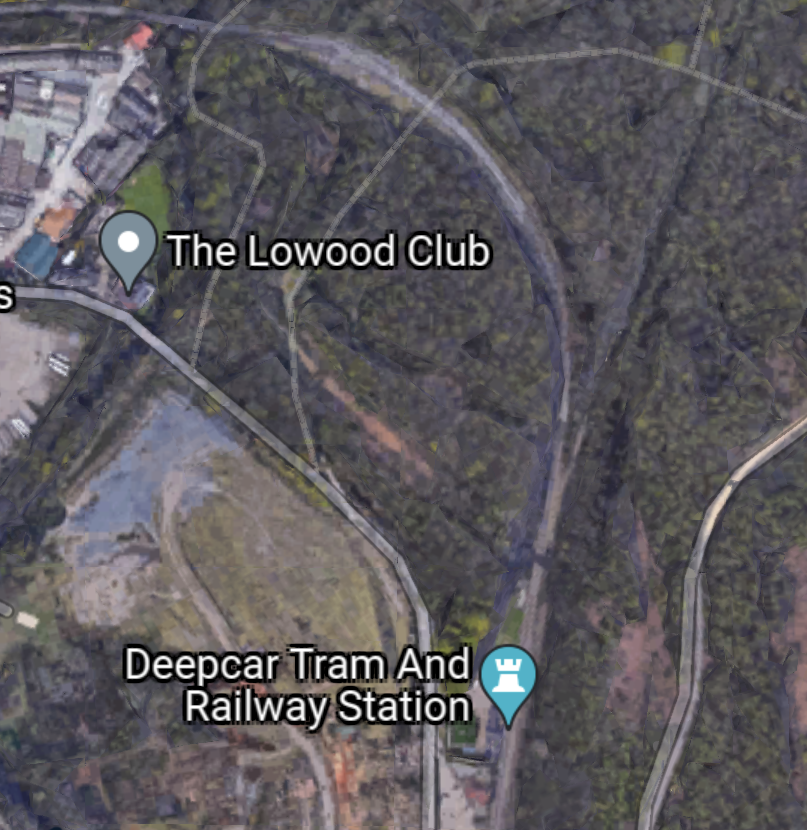
Note.
- The Stocksbridge Railway curving to the West is clearly visible.
- The other railway going North is the former Woodhead Line to Manchester.
This map clipped from Wikipedia shows the Lines through Deepcar station.
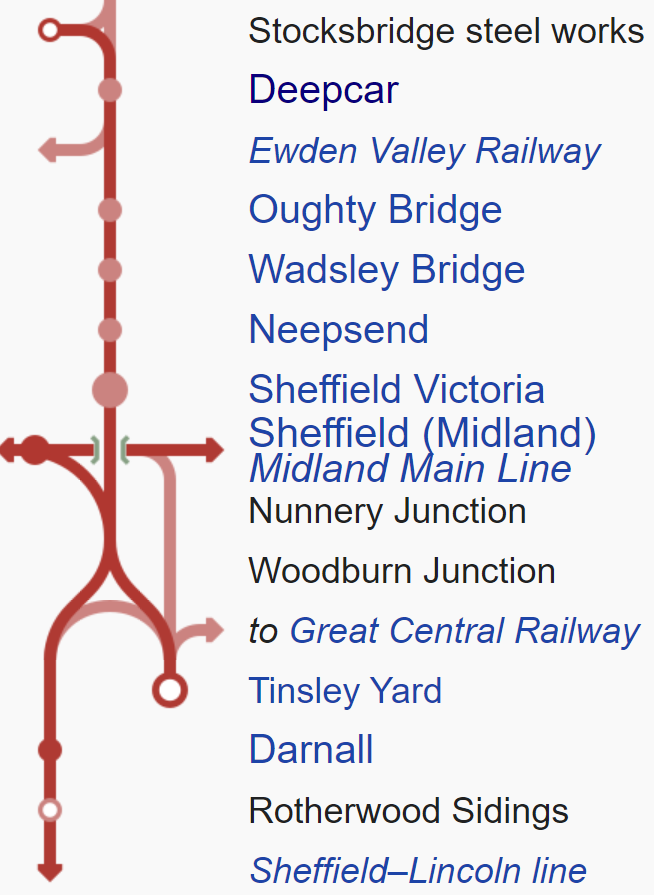
This shows the route between Stocksbridge and the former Sheffield Victoria station.
I have also found this article on the Sheffield Star, which is entitled Passenger Trains Could Return On Sheffield To Stocksbridge Don Valley Railway Line After major Funding Boost.
This is a paragraph.
The plans also involve reopening Sheffield Victoria station, which could serve a new Barrow Hill line to Chesterfield, stopping at Darnall, the Advanced Manufacturing Park, Woodhouse and other new stations, similar funding for which was granted last year.
This would seem to be a sensible plan.
These are my thoughts.
Sheffield Victoria Station
This Google Map shows the site of the Stocksbridge Line going through the centre of Sheffield.

The line starts in the North-West corner of the map and goes diagonally across.
The site of Sheffield Victoria station is at the Eastern edge of the map and is shown enlarged in this Google Map.

The street and hotel names are a giveaway.
There would appear to be space for a simple station with one or two platforms on the single-track through the area.
My preference would be for a single bi-directional platform, as has been used successfully at Galashiels station.
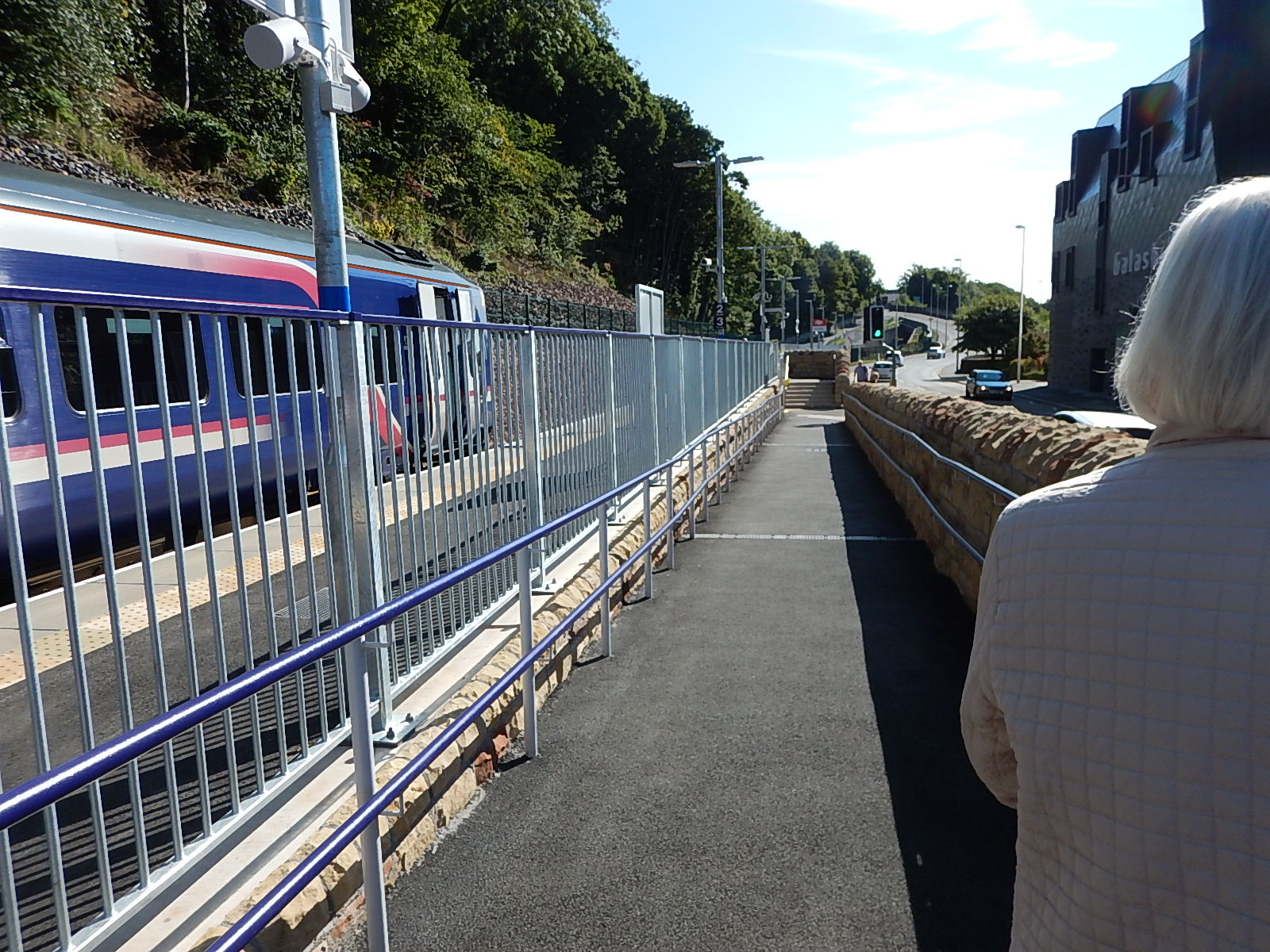
With well-placed passing loops, stations like these can handle two trains per hour (tph) and they can be step-free for all users.
Onward To Chesterfield
The plans as laid out in the paragraph in the Sheffield Star would appear to be feasible.
Darnall and Woodhouse are existing stations.
It would serve the proposed new station at Waverley, that I wrote about in Sheffield Region Transport Plan 2019 – A New Tram-Train Route To A New Station At Waverley.
Chesterfield station will be rebuilt for High Speed Two, so extra platforms could surely be added.
I wrote about plans for the Barrow Hill Line in Reinstatement Of The Barrow Hill Line Between Sheffield And Chesterfield.
It certainly looks to me, that taken together the Barrow Hill and Stocksbridge schemes could be a valuable new railway for Sheffield.
Rolling Stock
I have ridden all over Karlsruhe in Germany on their tram-trains, which are a German variant of Sheffield’s Class 399 tram-trains and I can see no reason, why the combined route couldn’t be designed and built for these trains.
- They are very good on hills.
- They can work on both 750 VDC and 25 KVAC overhead wires.
- The closely-related Class 398 tram-trains in Cardiff will have batteries.
- They are already working successfully in Sheffield.
- There must be design advantages for stations.
- Travellers in Sheffield are used to the tram-trains.
- There is maintenance and operational experience in Sheffield.
It is also my belief, that Class 399 tram-trains would make excellent replacements for Sheffield’s current trams. I wrote about this in Sheffield Region Transport Plan 2019 – Renewal Of Supertram Network.
Electrification
Looking at the Stocksbridge and Barrow Hill Lines together, I believe there is a strong case for electrification of both routes with 25 KVAC overhead wires.
This would enable the following.
- Class 399 tram-trains to work the combined route.
- East Midlands Railway’s Class 810 trains to access Sheffield station via the Barrow Hill Line on electricity.
- Electrified freight trains could use the route.
It could also be an easy route to electrify and be a good start to the electrification of Sheffield, which will happen in the future.
Electrification Between Sheffield And Clay Cross North Junction For High Speed Two
This electrification is needed for High Speed Two’s connection to Sheffield. It will also entail a lot of disruption for trains between Derby and Sheffield.
For these reasons, I believe that opening up the Barrow Hill route early between Sheffield and Chesterfield could be an excellent blockade buster.
Conclusion
There’s more to reopening the Stocksbridge Line, than as a local service in Sheffield.
Electrification Between Clay Cross North Junction And Sheffield Station
Long term readers of this blog, will have noticed that I make regular references to this proposed electrification, that is part of High Speed Two’s proposals to connect Sheffield to the new high speed railway.
So I thought I would bring all my thoughts together in this post.
Connecting Sheffield To High Speed Two
Sheffield is to be accessed from a branch off the Main High Speed Two route to Leeds.
This map clipped from High Speed Two’s interactive map, shows the route of the Sheffield Branch, from where it branches North West from the main Eastern Leg of High Speed Two.
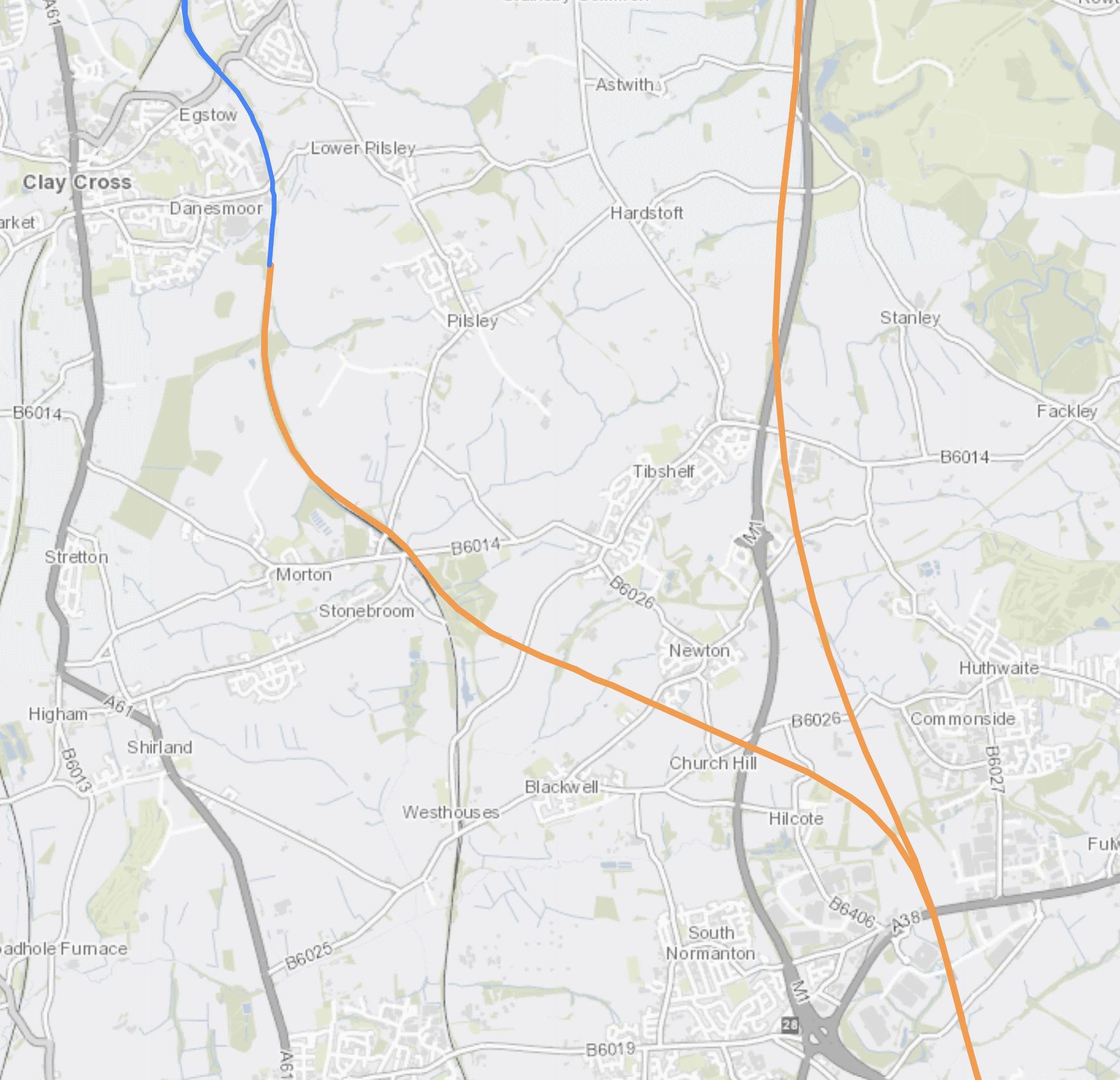
Note.
- Orange indicates new High Speed Two track.
- Blue indicates track that High Speed Two will share with other services.
- The orange route goes North to Leeds, along the M1
- The blue route goes North to Chesterfield and Sheffield, after skirting to the East of Clay Cross.
- The orange route goes South to East Midlands Hub station.
This second map, shows where the Erewash Valley Line joins the Sheffield Branch near the village of Stonebroom.
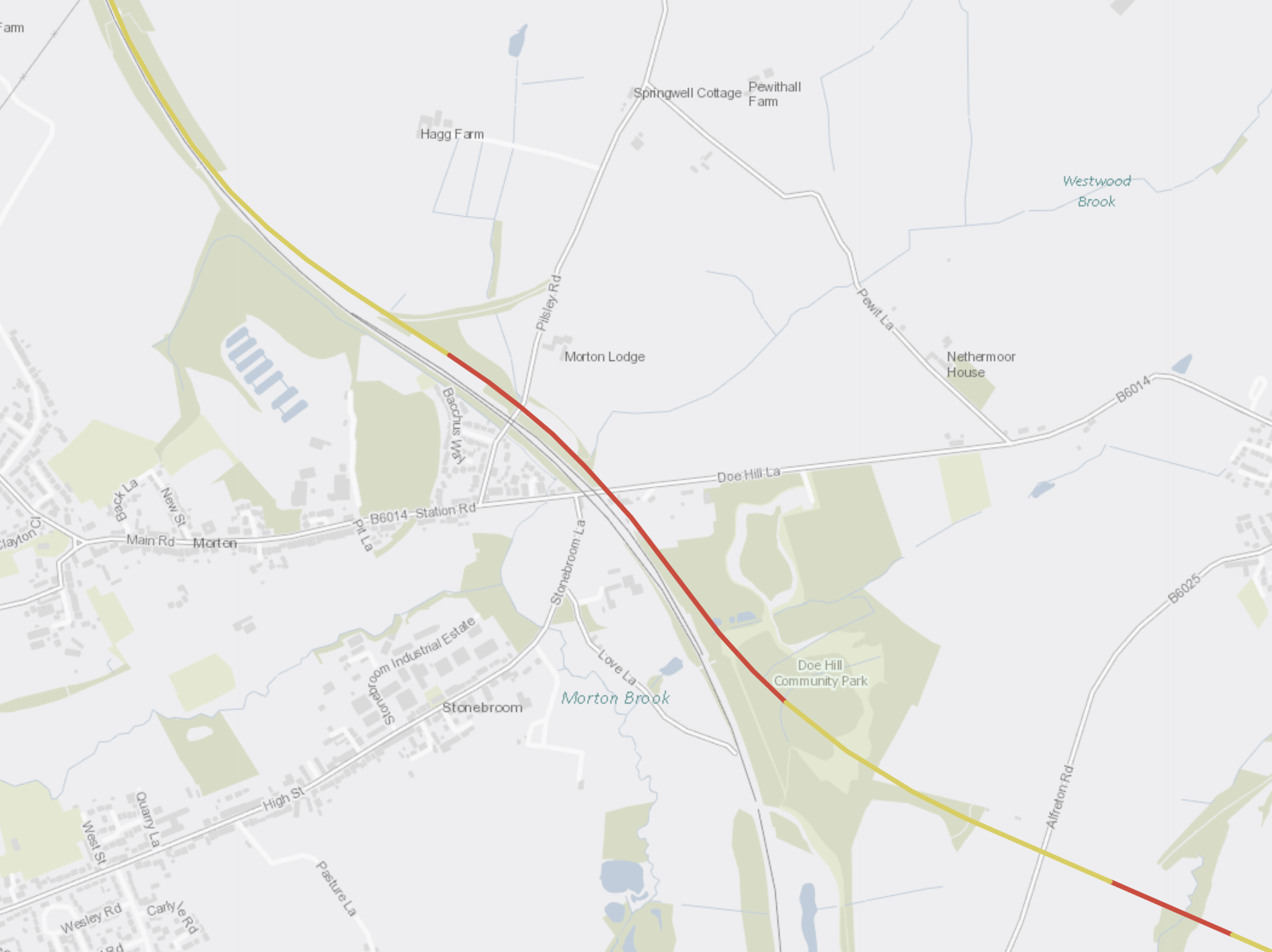
Note.
- Red is an embankment.
- Yellow is a cutting.
- The Sheffield Branch goes North-West to Clay Cross, Chesterfield and Sheffield
- The Sheffield Branch goes South-East to East Midlands Hub station.
- The Sheffield Branch goes through Doe Hill Country Park.
- The Sheffield Branch runs alongside the existing Erewash Valley Line, which goes South to Langley Mill, Ilkeston and the Derby-Nottingham area.
The Sheffield Branch and the Erewash Valley Line appear to share a route, which continues round Clay Cross and is shown in this third map.
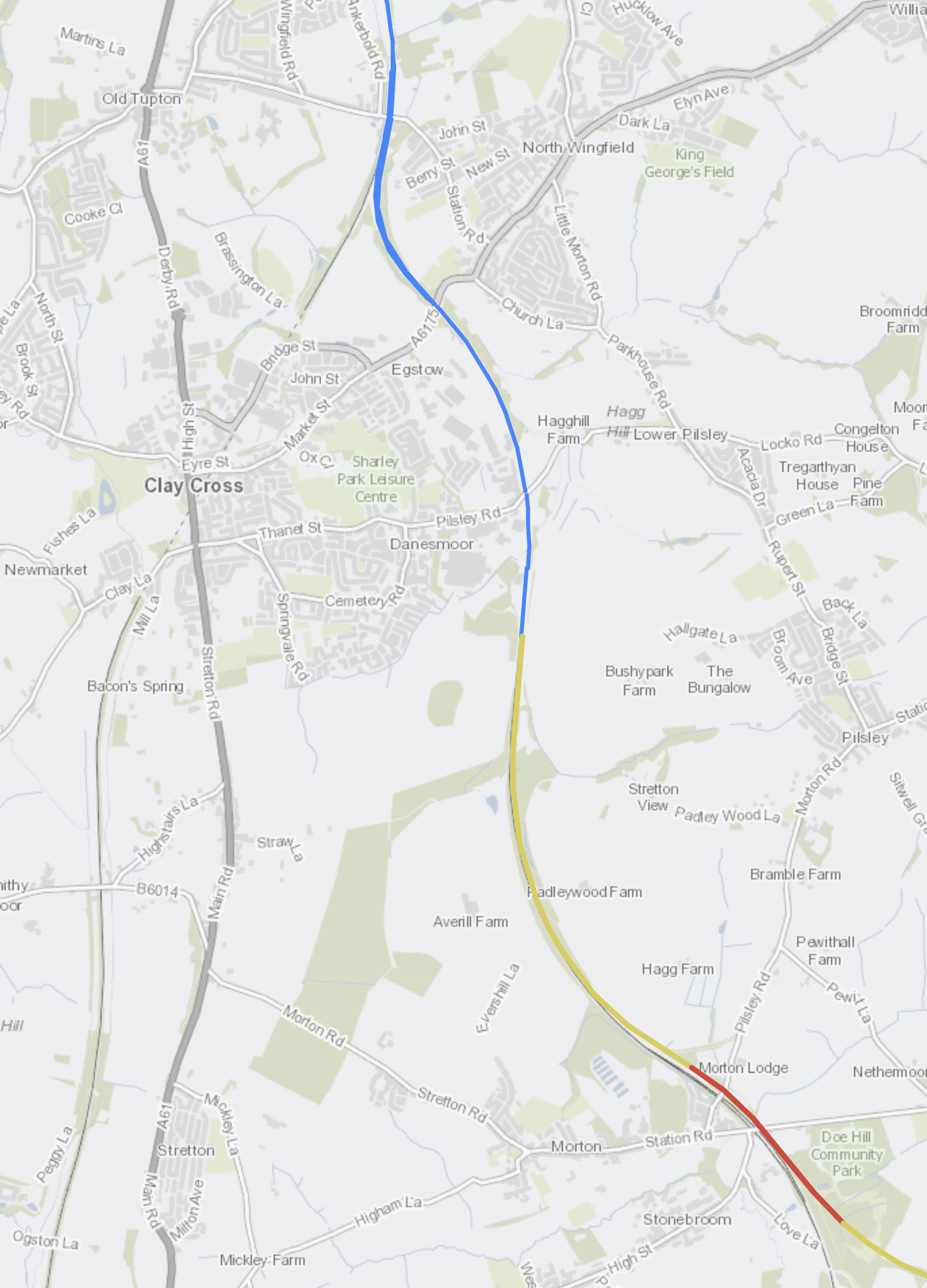
Note
- Doe Hill Country Park is in the South-East corner of the map.
- The dark line running North-South is the A61.
- Running to the West of the A61 is the Midland Main Line, which currently joins the Erewash Valley Line at Clay Cross North junction.
High Speed Two and the Midland Main Line will share a route and/or tracks from Clay Cross North junction to Sheffield.
This fourth map, shows where the combined route joins the Hope Valley Line to Manchester to the South West of Sheffield.
Note.
- Sheffield is to the North East.
- Chesterfield is to the South East,
- Totley junction is a large triangular junction, that connects to the Hope Valley Line.
These are some timings for various sections of the route.
- Clay Cross North Junction and Chesterfield (current) – 4 minutes
- Clay Cross North Junction and Sheffield (current) – 17 minutes
- Chesterfield and Sheffield (current) – 13 minutes
- Chesterfield and Sheffield (High Speed Two) – 13 minutes
- East Midlands Hub and Chesterfield (High Speed Two) – 16 minutes
- East Midlands Hub and Sheffield (High Speed Two) – 27 minutes
As Class Cross North Junction and Sheffield are 15.5 miles, this means the section is run at an average speed of 53 mph.
Can I draw any conclusions from the maps and timings?
- There would appear to be similar current and High Speed Two timings between Chesterfield and Sheffield.
- The various junctions appear to be built for speed.
The Midland Main Line will be electrified between Clay Cross North Junction and Sheffield, so that High Speed Two trains can use the route.
What will be the characteristics of the tracks between Clay Cross North Junction and Sheffield?
- Will it be just two tracks as it mainly is now or will it be a multi-track railway to separate the freight trains from the high speed trains?
- Will it have a high enough maximum speed, so that East Midland Railway’s new Class 810 trains can go at their maximum speed of 140 mph?
- Will it be capable of handling a frequency of 18 tph, which is the maximum frequency of High Speed Two?
Surely, it will be built to a full High Speed Two standard to future-proof the line.
Current Passenger Services Between Clay Cross North Junction And Sheffield Station
These trains use all or part of the route between Cross North Junction And Sheffield stations.
- CrossCountry – Plymouth and Edinburgh via Derby, Chesterfield, Sheffield and Leeds – 1 tph
- East Midlands Railway – London St. Pancras and Sheffield via Derby and Chesterfield – 2 tph
- East Midlands Railway – Liverpool Lime Street and Norwich via Stockport, The Hope Valley Line, Sheffield and Chesterfield – 1 tph
- Northern Trains – Manchester Piccadilly and Sheffield via the Hope Valley Line – 1 tph
- Northern Trains – Leeds and Nottingham via Meadowhall, Sheffield and Chesterfield – 1 tph
- TransPennine Express – Manchester Airport and Cleethorpes via Stockport, the Hope Valley Line and Sheffield – 1 tph
Note.
- tph is trains per hour.
- High Speed Two is currently planning to run two tph to Sheffield, which will run between Cross North junction and Sheffield stations.
- The services on the Hope Valley Line run on electrified tracks at the Manchester end.
These services can be aggregated to show the number of trains on each section of track.
- Hope Valley Line between Manchester and Totley junction – 3 tph
- Totley junction and Sheffield station – 7 tph
- Totley junction and Clay Cross North junction via Chesterfield – 4 tph
Adding in the High Speed Two services gives these numbers.
- Hope Valley Line between Manchester and Totley junction – 3 tph
- Totley junction and Sheffield station – 9 tph
- Totley junction and Clay Cross North junction via Chesterfield – 6 tph
This report on the Transport for the North web site, is entitled At A Glance – Northern Powerhouse Rail. It states that Transport for the North’s aspirations for Manchester and Sheffield are four tph with a journey time of forty minutes.
Adding in the extra train gives these numbers.
- Hope Valley Line between Manchester and Totley junction – 4 tph
- Totley junction and Sheffield station – 10 tph
- Totley junction and Clay Cross North junction via Chesterfield – 6 tph
This level of services can be accommodated on a twin-track railway designed to the right high speed standards.
Freight Services Between Clay Cross North Junction And Sheffield Station
The route is used by freight trains, with up to two tph on each of the three routes from Totley junction.
And these are likely to increase.
Tracks Between Clay Cross North Junction And Sheffield Station
I am absolutely certain, that two tracks between Clay Cross North junction And Sheffield station will not be enough, even if they are built to High Speed Two standards to allow at least 140 mph running under digital signalling.
Battery Electric Trains
The only battery-electric train with a partly-revealed specification is Hitachi’s Regional Battery Train, which is described in this Hitachi infographic.

Note.
- The train is a 100 mph unit.
- Ninety kilometres is fifty-six miles.
I would expect that battery-electric trains from other manufacturers like Alstom, CAF and Siemens would have similar performance on battery power.
In Thoughts On CAF’s Battery-Electric Class 331 Trains, I concluded CAF’s approach could give the following ranges.
- Three-car battery-electric train with one battery pack – 46.7 miles
- Four-car battery-electric train with one battery pack – 35 miles
- Four-car battery-electric train with two battery packs – 70 miles
I was impressed.
These are my thoughts on battery-electric trains on the routes from an electrified Sheffield.
Adwick
Sheffield and Adwick is 22.7 miles without electrification
I am sure that battery-electric trains can handle this route.
If the battery range is sufficient, there may not need to be charging at Adwick.
Bridlington
Sheffield and Bridlington is 90.5 miles without electrification, except for a short section through Doncaster, where trains could top up batteries.
I am sure that battery-electric trains can handle this route.
But there would need to be a charging system at Hull, where the trains reverse.
An alternative would be to electrify Hull and Brough, which is just 10.4 miles and takes about twelve minutes.
Derby Via The Midland Main Line
Clay Cross North junction and Derby is 20.9 miles without electrification.
I am sure that battery-electric trains can handle this route.
Gainsborough Central
Sheffield and Gainsborough Central is 33.6 miles without electrification
I am sure that battery-electric trains can handle this route.
But there will need to be a charging system at Gainsborough Central.
Huddersfield Via The Penistone Line
This is a distance of 36.4 miles with electrification at both ends, after the electrification between Huddersfield and Westtown is completed.
I am sure that battery-electric trains can handle this route.
Hull
Sheffield and Hull is 59.4 miles without electrification, except for a short section through Doncaster, where trains could top up batteries.
I am sure that battery-electric trains can handle this route.
But there will probably need to be a charging system at Hull.
An alternative would be to electrify Hull and Brough, which is just 10.4 miles and takes about twelve minutes.
Leeds Via The Hallam Or Wakefield Lines
This is a distance of 40-45 miles with electrification at both ends.
I am sure that battery-electric trains can handle this route.
Lincoln
Sheffield and Lincoln Central is 48.5 miles without electrification
I am sure that battery-electric trains can handle this route.
But there will probably need to be a charging system at Lincoln Central.
Manchester Via The Hope Valley Line
This is a distance of forty-two miles with electrification at both ends.
I am sure that battery-electric trains can handle this route.
Nottingham
Clay Cross North junction and Nottingham is 25.1 miles without electrification
I am sure that battery-electric trains can handle this route.
But there may need to be a charging system at Nottingham.
York
This is a distance of 46.4 miles with electrification at both ends.
I am sure that battery-electric trains can handle this route.
Is London St. Pancras And Sheffield Within Range Of Battery-Electric Trains?
In the previous section, I showed that it would be possible to easily reach Derby, as Clay Cross North junction and Derby is 20.9 miles without electrification.
- Current plans include electrifying the Midland Main Line as far North as Market Harborough.
- Market Harborough is 82.8 miles from London St. Pancras
- Derby is 128.3 miles from London St. Pancras
So what would be the best way to cover the 45.5 miles in the middle?
One of the best ways would surely be to electrify between Derby and East Midlands Parkway stations.
- Derby and East Midlands Parkway stations are just 10.2 miles apart.
- Current services take around twelve-fourteen minutes to travel between the two stations, so it would be more than enough time to charge a battery-electric train.
- Power for the electrification should not be a problem, as Radcliffe-on-Soar power station is by East Midlands Parkway station. Although the coal-fired power station will soon be closed, it must have a high class connection to the electricity grid.
- The East Midlands Hub station of High Speed Two will be built at Toton between Derby and Nottingham and will have connections to the Midland Main Line.
- An electrified spur could connect to Nottingham station.
I have flown my virtual helicopter along the route and found the following.
- Three overbridges that are not modern and built for large containers and electrification.
- Two level crossings.
- One short tunnel.
- Two intermediate stations.
- Perhaps half-a-dozen modern footbridges designed to clear electrification.
I’ve certainly seen routes that would be much more challenging to electrify.
I wonder if gauge clearance has already been performed on this key section of the Midland Main Line.
If this section were to be electrified, the sections of the Midland Main Line between London St. Pancras and Sheffield would be as follows.
- London St. Pancras and Market Harborough – Electrified – 82.8 miles
- Market Harborough and East Midlands Parkway – Not Electrified – 35.3 miles
- East Midlands Parkway and Derby – Electrified – 10.2 miles
- Derby and Clay Cross North junction – Not Electrified – 20.9 miles
- Clay Cross North junction and Sheffield – Electrified – 15.5 miles
Note.
- The World Heritage Site of the Derwent Valley Mills is not electrified, which could ease the planning.
- Leicester station with its low bridge, which could be difficult to electrify, has not been electrified.
- Under thirty miles of electrification will allow battery-electric trains to run between London St. Pancras and Sheffield, provided they had a range on batteries of around forty miles.
Probably, the best way to electrify between East Midlands Parkway and Derby might be to develop a joint project with High Speed Two, that combines all the power and other early works for East Midlands Hub station, with the electrification between the two stations.
Will The Class 810 Trains Be Converted To Battery-Electric Operation?
Hitachi’s Class 8xx trains tend to be different, when it comes to power. These figures relate to five-car trains.
- Class 800 train – 3 x 560 kW diesel engines
- Class 801 train – 1 x 560 kW diesel engine
- Class 802 train – 3 x 700 kW diesel engines
- Class 803 train – All electric – No diesel and an emergency battery
- Class 805 train – 3 x 700 kW diesel engines (?)
- Class 807 train – All electric – No diesel or emergency battery
- Class 810 train – 4 x 700 kW diesel engines (?)
Note.
- These figures relate to five-car trains.
- Class 807 train are seven-car trains.
- Where there is a question mark (?), the power has not been disclosed.
- Hitachi use two sizes of diesel engine; 560 kW and 700 kW.
It was generally thought with the Class 810 train to be used on the Midland Main Line, will be fitted with four engines to be able to run at 125 mph on diesel.
But are they 560 kW or 700 kW engines?
- A Class 802 train has an operating speed of 110 mph on diesel, with 2100 kW of installed power.
- To increase speed, the power will probably be related to something like the square of the speed.
So crudely the power required for 125 mph would be 2100*125*125/110/110, which works out at 2712 kW.
Could this explain why four engines are fitted? And why they are 700 kW versions?
Interestingly, I suspect, Hitachi’s five-car trains have two more or less identical driver cars, except for the passenger interiors, for the efficiency of manufacturing and servicing.
So does that mean, that a fifth engine could be fitted if required?
There probably wouldn’t be a need for five diesel engines, but as I also believe that the Hyperdrive Innovation battery packs for these trains are plug-compatible with the diesel engines, does that mean that Hitachi’s trains can be fitted with five batteries?
Suppose you wanted to run a Class 810 train at 125 mph to clear an electrification gap of forty miles would mean the following.
- It would take 0.32 hours or 19.2 minutes to cross the gap.
- In that time 2800 kW of diesel engines would generate 896 kWh.
- So to do the same on batteries would need a total battery capacity of 896 kWh.
- If all diesel engines were replaced, each battery would need to be 224 kWh
A battery of this size is not impractical and probably weighs less than the at least four tonnes of the diesel engine it replaces.
Conclusions
Electrification between Clay Cross North Junction and Sheffield station is an important project that enables the following.
- A high proportion of diesel services to and from Sheffield to be converted to battery-electric power.
- With electrification between Derby and East Midlands Parkway, it enables 125 mph battery-electric trains to run between London St. Pancras and Sheffield.
- It prepares Sheffield for High Speed Two.
It should be carried out as soon as possible.
Northern Powerhouse Rail – Connecting Sheffield To HS2 And On To Leeds
In this article on Transport for the North, which is entitled Northern Powerhouse Rail Progress As Recommendations Made To Government, one of the recommendations proposed for Northern Powerhouse Rail is connecting Sheffield to High Speed Two and on to Leeds.
Northern Powerhouse Rail’s Objective For The Sheffield and Leeds Route
Wikipedia, other sources and my calculations say this about the trains between Leeds and Sheffield.
- The distance between the two stations is 39 miles
- The current service takes around 40 minutes and has a frequency of one train per hour (tph)
- This gives an average speed of 58.5 mph for the fastest journey.
- The proposed service with Northern Powerhouse Rail will take 28 minutes and have a frequency of four tph.
- This gives an average speed of 84 mph for the journey.
This last figure of 84 mph, indicates to me that a fast route will be needed.
But given experience of 100 mph lines in other parts of the UK, 100 mph trains and infrastructure could make this demanding objective of twenty-eight minutes between Sheffield and Leeds a reality
Connecting Sheffield To High Speed Two
Sheffield is to be accessed from a branch off the Main High Speed Two route to Leeds.
This map clipped from High Speed Two’s interactive map, shows the route of the Sheffield Branch, from where it branches North West from the main Eastern Leg of High Speed Two.
Note.
- Orange indicates new High Speed Two track.
- Blue indicates track that High Speed Two will share with other services.
- The orange route goes North to Leeds, along the M1
- The blue route goes North to Chesterfield and Sheffield, after skirting to the East of Clay Cross.
- The orange route goes South to East Midlands Hub station.
This second map, shows where the Erewash Valley Line joins the Sheffield Branch near the village of Stonebroom.
Note.
- Red is an embankment.
- Yellow is a cutting.
- The Sheffield Branch goes North-West to Clay Cross, Chesterfield and Sheffield
- The Sheffield Branch goes South-East to East Midlands Hub station.
- The Sheffield Branch goes through Doe Hill Country Park.
- The Sheffield Branch runs alongside the existing Erewash Valley Line, which goes South to Langley Mill, Ilkeston and the Derby-Nottingham area.
The Sheffield Branch and the Erewash Valley Line appear to share a route, which continues round Clay Cross and is shown in this third map.
Note
- Doe Hill Country Park is in the South-East corner of the map.
- The dark line running North-South is the A61.
- Running to the West of the A61 is the Midland Main Line, which currently joins the Erewash Valley Line at Clay Cross North junction.
High Speed Two and the Midland Main Line will share a route and/or tracks from Clay Cross North junction to Sheffield.
This fourth map, shows where the combined route joins the Hope Valley Line to Manchester to the South West of Sheffield.
Note.
- Sheffield is to the North East.
- Chesterfield is to the South East,
- Totley junction is a large triangular junction, that connects to the Hope Valley Line.
These are some timings for various sections of the route.
- Clay Cross North Junction and Chesterfield (current) – 4 minutes
- Clay Cross North Junction and Sheffield (current) – 17 minutes
- Chesterfield and Sheffield (current) – 13 minutes
- Chesterfield and Sheffield (High Speed Two) – 13 minutes
- East Midlands Hub and Chesterfield (High Speed Two) – 16 minutes
- East Midlands Hub and Sheffield (High Speed Two) – 27 minutes
As Class Cross North Junction and Sheffield are 15.5 miles, this means the section is run at an average speed of 53 mph.
Can I draw any conclusions from the maps and timings?
- There would appear to be similar current and High Speed Two timings between Chesterfield and Sheffield.
- The various junctions appear to be built for speed.
The Midland Main Line will be electrified from Clay Cross North Junction to Sheffield, so that High Speed Two trains can use the route.
What will be the characteristics of the tracks between Clay Cross North Junction and Sheffield?
- Will it be just two tracks as it mainly is now or will it be a multi-track railway to separate the freight trains from the high speed trains?
- Will it have a high enough maximum speed, so that East Midland Railway’s new Class 810 trains can go at their maximum speed of 140 mph?
- Will it be capable of handling a frequency of 18 tph, which is the maximum frequency of High Speed Two?
Surely, it will be built to a full High Speed Two standard to future-proof the line.
Before finishing this section, I will answer a few questions.
Would It Be Possible For Class 810 Trains Fitted With Batteries To Run Between London St. Pancras And Sheffield?
East Midlands Railway’s new Class 810 trains could be fitted with batteries to become Regional Battery Trains with the specification, given in this Hitachi infographic.
Note.
- This would give the trains a range of 90 kilometres or 56 miles on batteries, if a number of diesel engines were exchanged for batteries.
- The trains would only be a few mph slower on batteries, than the current Hitachi trains on diesel.
- The Class 810 trains have four diesel engines. Is this to enable 125 mph running on diesel?
By perhaps replacing two diesel engines with batteries and using the remaining two diesel engines as range extenders or some other combination, I feel that Hitachi might be able to obtain a longer self-powered range for the train.
Consider.
- Between Sheffield and Clay Cross North Junction will be fully-electrified and at 15.5 miles, it will be long enough to fully-charge the batteries on the train.
- Between London St. Pancras and Market Harborough will be fully-electrified and at 83 miles, it will be long enough to fully-charge the batteries on the train.
- The section between Market Harborough and Clay Cross North Junction is not electrified and is 66 miles.
I feel that Hitachi and their partner; Hyperdrive Innovation can design a battery electric Class 810 train, that can travel between London St. Pancras and Sheffield, without using a drop of diesel.
A great advantage of this approach, is that, as more electrification is added to the Midland Main Line, as it surely will be, the trains will be able to use the wires to reduce journey times.
I believe there are two sections on the Midland Main Line. where traditional electrification is less likely.
- The bridge at the Southern end of Leicester station is low and would need to be rebuilt causing immense disruption to both road and rail in the city.
- Between Derby and Alfreton is the World Heritage Site of the Derwent Valley Mills. Will electrification be fought by the heritage lobby?
Both sections may eventually be electrified at some far off date in the future.
Why Is There A Spur Of Electrification At Totley Junction?
This map clipped from High Speed Two’s interactive map, shows the Southern Leg of Totley Junction, where the Hope Valley Line joins the Midland Main Line.
Note that a short length of electrification is shown, between the Midland Main Line and a tunnel on the Southern leg.
This Google Map shows the same area.

Note, that the line disappears into a tunnel.
- In Northern Powerhouse Rail -Significant Upgrades And Journey Time Improvements To The Hope Valley Route Between Manchester And Sheffield, I indicated, that running battery electric trains between Manchester and Sheffield would be a possibility and could be a way of meeting Northern Powerhouse Rail’s objectives for the route.
- A short length of electrification might help battery electric trains turn out to go South.
- I don’t think any passenger trains ever go that way now, but I have seen articles and heard complaints from passengers, that want a better service between Derby and/or Nottingham and Manchester.
- It might also help with the decarbonisation of freight trains to and from the quarries.
I also suspect, that if building High Speed Two in Manchester temporarily reduced the capacity of Manchester Piccadilly station, trains could use the Hope Valley Line to get to the city, as they have done previously, with Project Rio.
Accessing The Infrastructure Depot At Staveley
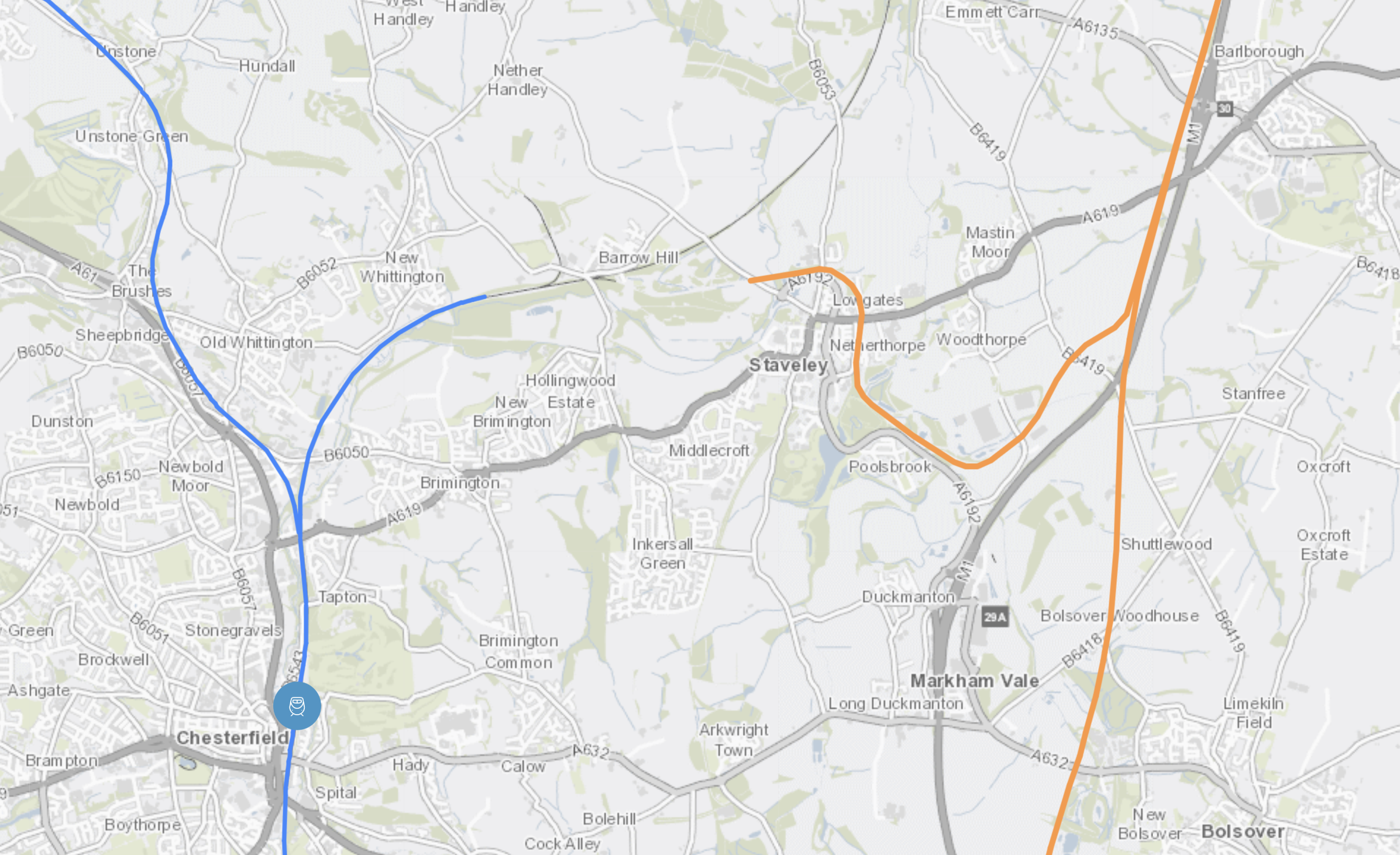
This map clipped from High Speed Two’s interactive map, shows the location of the infrastructure depot at Staveley.
Note.
- Chesterfield is shown by the large blue dot.
- High Speed Two’s Sheffield Branch runs North from Chesterfield station.
- High Speed Two’s Eastern Leg runs down the Eastern side of the map.
- Two spurs from East and West go towards each other and would meet to the North of the town of Staveley.
The infrastructure depot will be located where they meet.
The route from the Sheffield Branch uses the Barrow Hill Line, which might be reopened as another passenger route between Chesterfield and Sheffield.
I wrote about this idea in Reinstatement Of The Barrow Hill Line Between Sheffield And Chesterfield.
If the line is being upgraded and electrified as far as Barrow Hill for the Infrastructure Depot, would it be worthwhile to create a new electrified route into Sheffield?
I also wrote in Could East Midlands Railway’s Liverpool And Norwich Service Avoid A Reverse At Sheffield By Using the Barrow Hill Line?, that the Barrow Hill Line might be an alternative route for the Liverpool and Norwich service.
When the railway routes in the area of the Infrastructure Depot are developed, I wouldn’t be surprised to see some routes changed.
Between Sheffield And Meadowhall Stations
One of the original designs for High Speed Two had it calling at Meadowhall station.
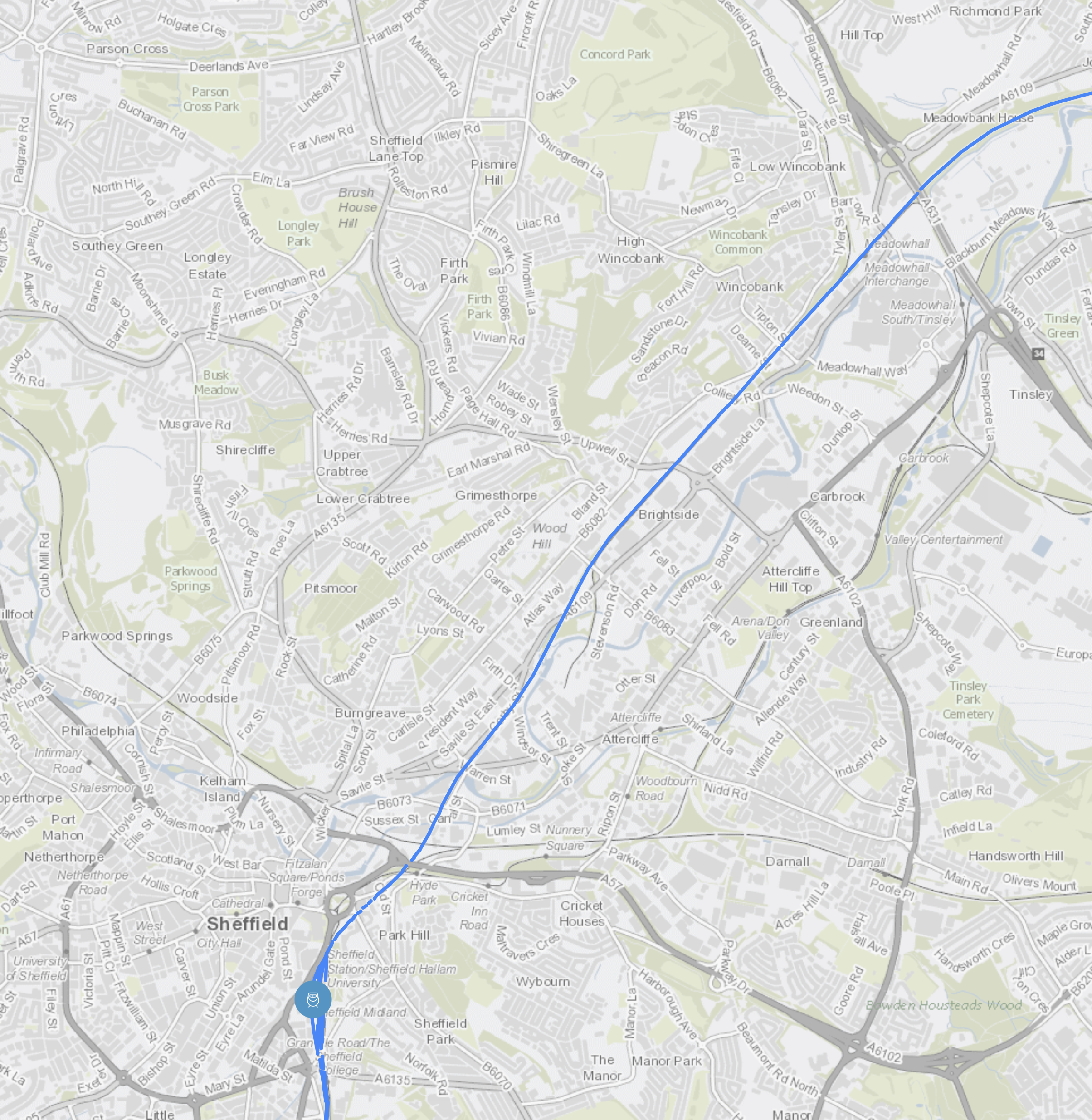
This map clipped from High Speed Two’s interactive map, clearly shows High Speed Two running across Sheffield.
Note.
- Sheffield station is the big Blue dot in the South-West corner of the map.
- The M1 runs across the North-East corner of the map.
- The railway between Sheffield and Meadowhall stations already exists.
- Sheffield and Meadowhall stations are 3.5 miles apart and trains take seven minutes.
Is there any reason, why High Speed Two trains shouldn’t serve both Sheffield and Meadowhall stations, by just taking the existing line across the city?
Taking The Wakefield Line Towards Leeds
In extending to Meadowhall, High Speed Two’s route seems to be taking the current Wakefield Line.
This map clipped from High Speed Two’s interactive map, clearly shows High Speed Two passing through Sheffield and Rotherham and then going towards Leeds.
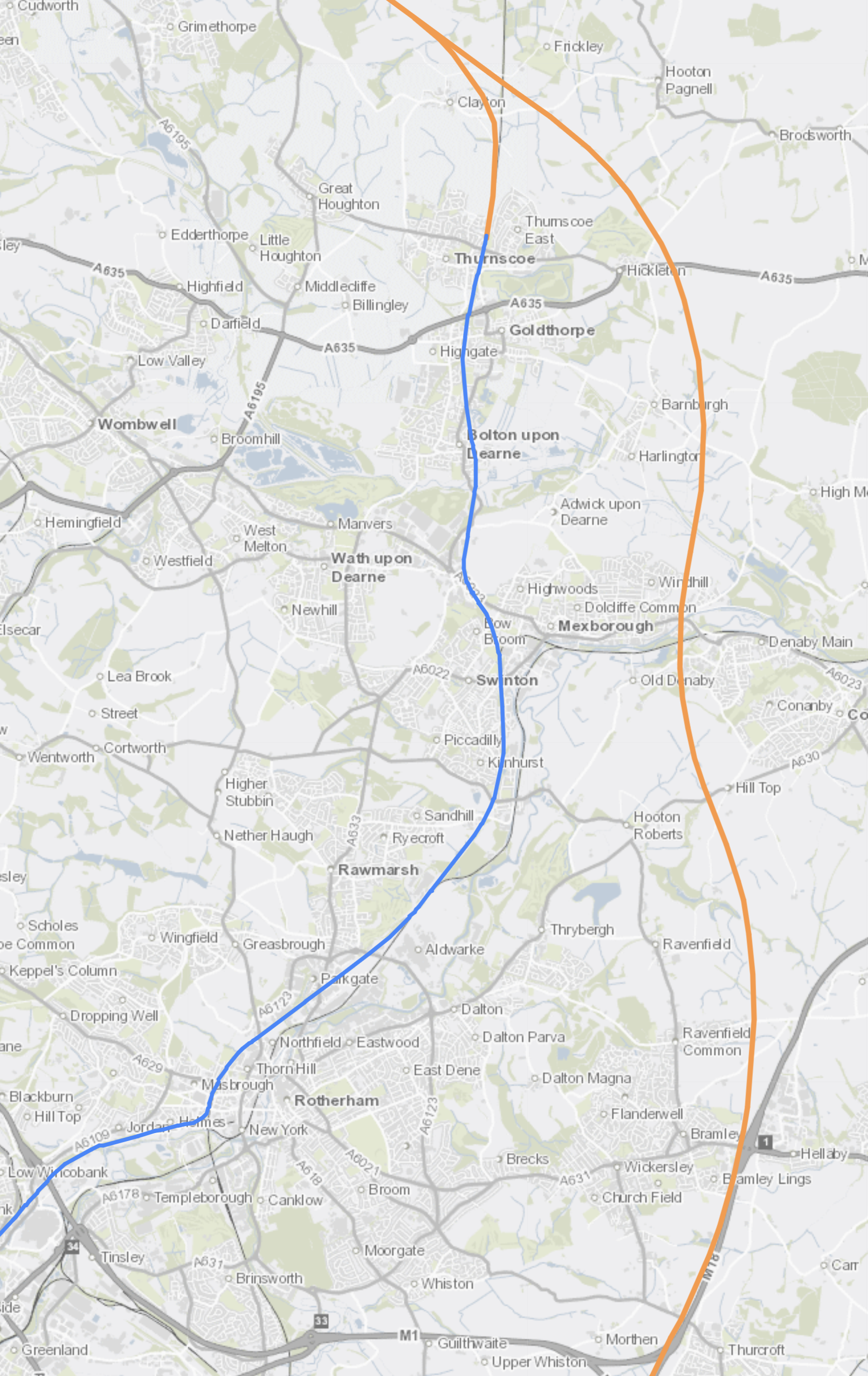
Note.
- Orange indicates new High Speed Two track.
- Blue indicates track that High Speed Two shares with other lines.
- The Wakefield Line is shown in blue and has stations at Meadowhall, Swinton, Bolton-upon-Dearne, Goldthorpe and Thurscoe.
- The main High Speed Two leg to Leeds is shown in orange.
It looks to me, that High Speed Two are aiming to provide a route, so that trains going to Sheffield can extend the journey to Leeds.
As Leeds will have three tph to and from London, why is this service being extended to Leeds?
I will explore a few reasons why in the next few sub-sections.
It’s Convenient For Running Trains
Consider.
- High Speed Two are saying London and Sheffield will be one hour and twenty-seven minutes.
- Northern Powerhouse Rail have an objective of Leeds and Sheffield in twenty-eight minutes.
- One hour and fifty-five minutes could be a convenient time for a London and Leeds service, as it could be a four hour round trip.
But High Speed Two are saying London and Leeds will be one hour and twenty-one minutes.
It looks to me, that it is a convenient way to serve Meadowhall, Rotherham, Bolton-upon-Dearne, Goldthorpe and Thurscoe stations
High Speed Two Through Rotherham
This map clipped from High Speed Two’s interactive map, clearly shows High Speed Two passing through Rotherham to the North of the Parkgate Shopping Park.
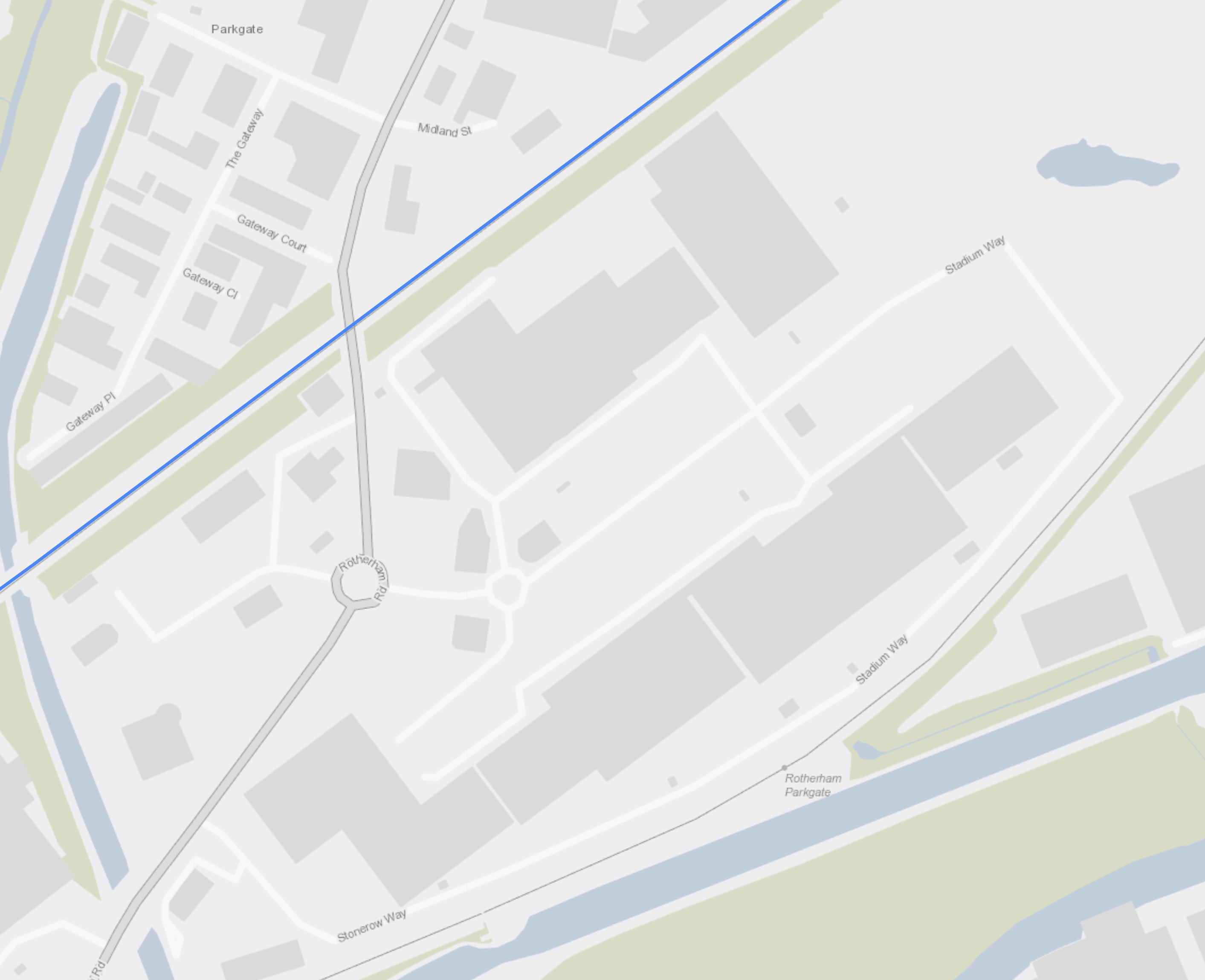
Note.
- High Speed Two is the bright blue line running North-East from the Western edge of the map.
- The grey blocks are the stores in the Shopping Park.
- The Rotherham Parkgate tram-train stop is marked.
This Google Map shows a similar area.
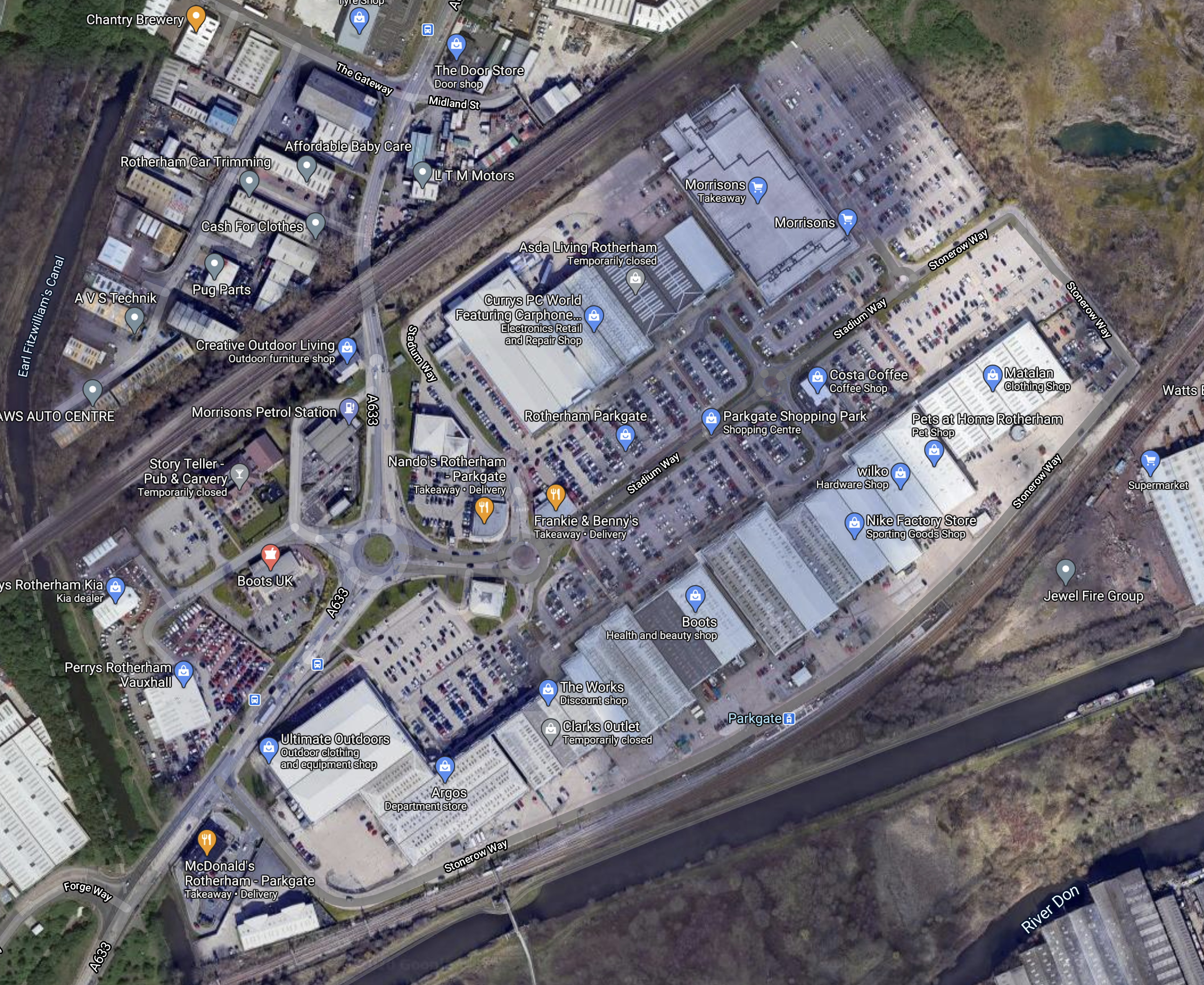
To the East of the Parkgate Shopping Park, is a large brownfield site, as this Google Map shows.

Could Rotherham have a station on the line North of this site?
- The rail line running SW-NE across this map is drawn in blue on High Speed Two’s interactive map.
- Rotherham Masborough station used to be in this area.
If High Speed Two is supposed to be a railway for all the people, or at least as many as possible, surely there should be a station in the town.
High Speed Two Through Bolton-upon-Dearne
In July 2019, I wrote a post called Sheffield Region Transport Plan 2019 – A New Station At Barnsley Dearne Valley.
So have High Speed Two taken on this feature of the Sheffield Region Transport Plan 2019, to add another station to their list of destinations?
Approach To Leeds
This map clipped from High Speed Two’s interactive map, clearly shows route High Speed Two will take to approach Leeds from the South East.
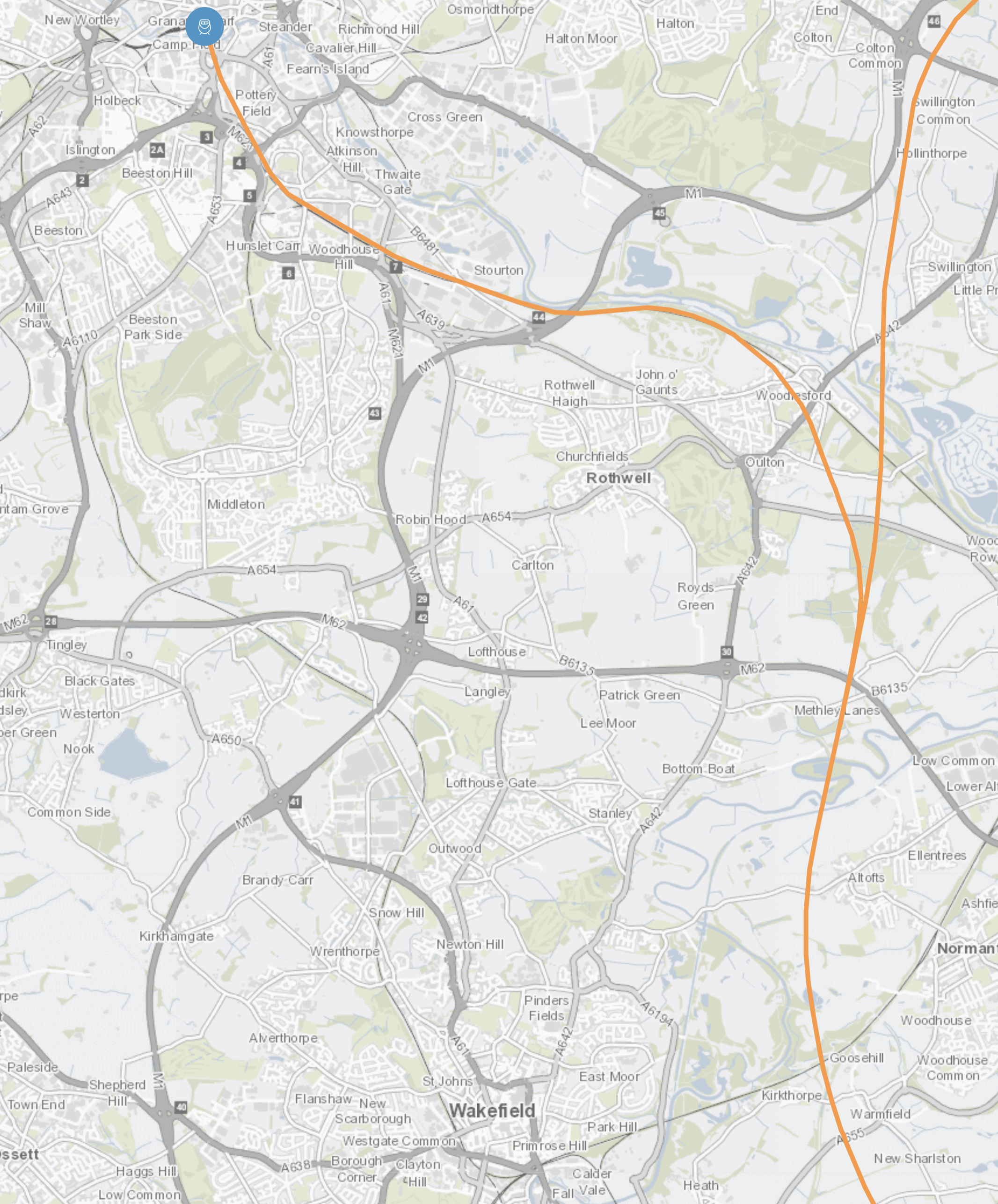
Note.
- Leeds station is the blue dot in the North West corner of the map.
- High Speed Two is shown in orange and continues North to York, where it joins the East Coast Main Line.
- Wakefield is in the middle at the bottom of the map and is on the Wakefield Line and the current route for LNER’s expresses from London.
It looks to me, that Leeds and Sheffield will eventually end up with two faster routes between the two cities.
- An upgraded Wakefield Line
- A route based on the Southern section of the Wakefield Line and the Eastern leg of High Speed Two route to Leeds.
If High Speed Two’s trains are to be able to get across Sheffield and call at Sheffield, Meadowhall, Rotherham and Barnsley Dearne Valley stations, then these conditions must be met.
- The trains must be High Speed Two’s Classic-Compatible trains or a train to a similar specification.
- Some platform lengthening might be needed to allow the two hundred metre long trains to call.
- The Wakefield Line must be electrified between Sheffield and just North of Goldthorpe station, where it will be able to join the link to the Eastern leg of High Speed Two.
It would probably be sensible to electrify the Wakefield Line all the way to Fitzwilliam station, from where the line is electrified all the way to Leeds.
This would enable the following.
- Electric trains to run between Sheffield and Leeds via Wakefield Westgate station.
- Would Northern Powerhouse Rail’s objective of a twenty-eight minute journey be achieved?
- East Midlands Railway could run their Class 810 trains between London St. Pancras and Leeds under electric power.
- High Speed Two could serve Leeds before the Northern infrastructure of the Eastern leg of High Speed Two is complete.
- High Speed Two could offer services to Wakefield, Barnsley and Rotherham via Sheffield.
I can see reasons for early upgrading of the Wakefield Line.
Conclusion
It appears that High Speed Two are planning an electrified route through Sheffield between Clay Cross North Junction on the Midland Main Line and Goldthorpe station on the Wakefield Line.
Once complete it would enable the following.
- Rotherham and Barnsley to have direct electric services to and from the capital.
- When East Midlands Railway introduce their new Class 810 trains, the electrification North of Clay Cross North Junction would mean faster services and less running on diesel power.
- I believe these Class 810 trains could run between London and Sheffield, if their four diesel engines are replaced with batteries, which would power the trains between Clay Cross North Junction and Market Harborough.
- The electrification at Sheffield would allow battery electric trains to work between Manchester and Sheffield as I outlined in Northern Powerhouse Rail -Significant Upgrades And Journey Time Improvements To The Hope Valley Route Between Manchester And Sheffield.
I think it is a good plan.
Project Management Recommendations
It is my view that the following projects should be started as soon as possible.
- Electrification between Clay Cross North Junction and Sheffield station.
- Electrification of the Wakefield Line between Sheffield and Fitzwilliam stations.
- Provision of new stations at Rotherham and Barnsley Dearne Valley on the Wakefield Line.
These projects could deliver worthwhile improvements in services in a couple of years, rather than the tens of years for High Speed Two.
Reinstatement Of The Barrow Hill Line Between Sheffield And Chesterfield
This is one of the successful bids in the First Round of the Restoring Your Railway Fund.
The Route
This Google Map shows where the Barrow Hill Line starts at Tapton Junction near Chesterfield station.
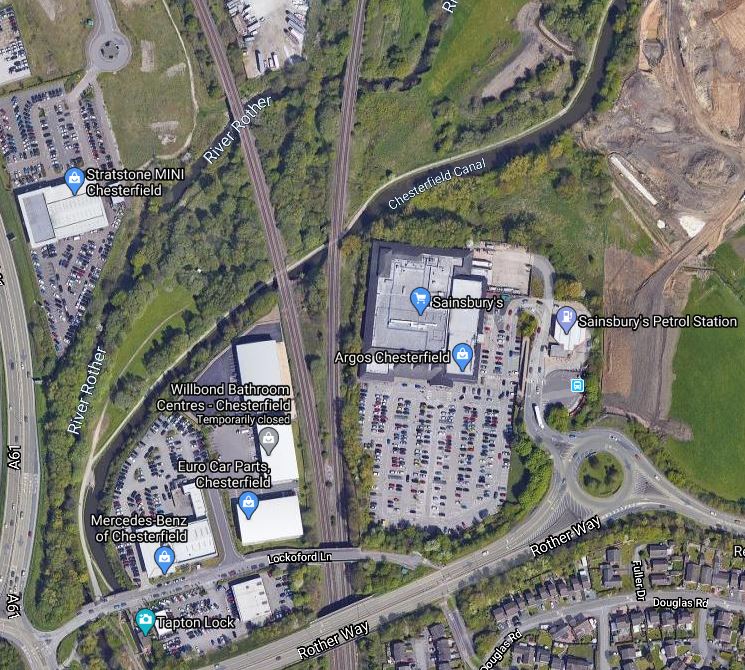
Note.
- Chesterfield station is less than a mile to the South.
- The left railway going North is the Midland Main Line to Sheffield
- The right railway going North is the Barrow Hill Line.
The Barrow Hill Line turns slightly to the East and this Google Map shows it passing through Barrow Hill, which gives the route its name.
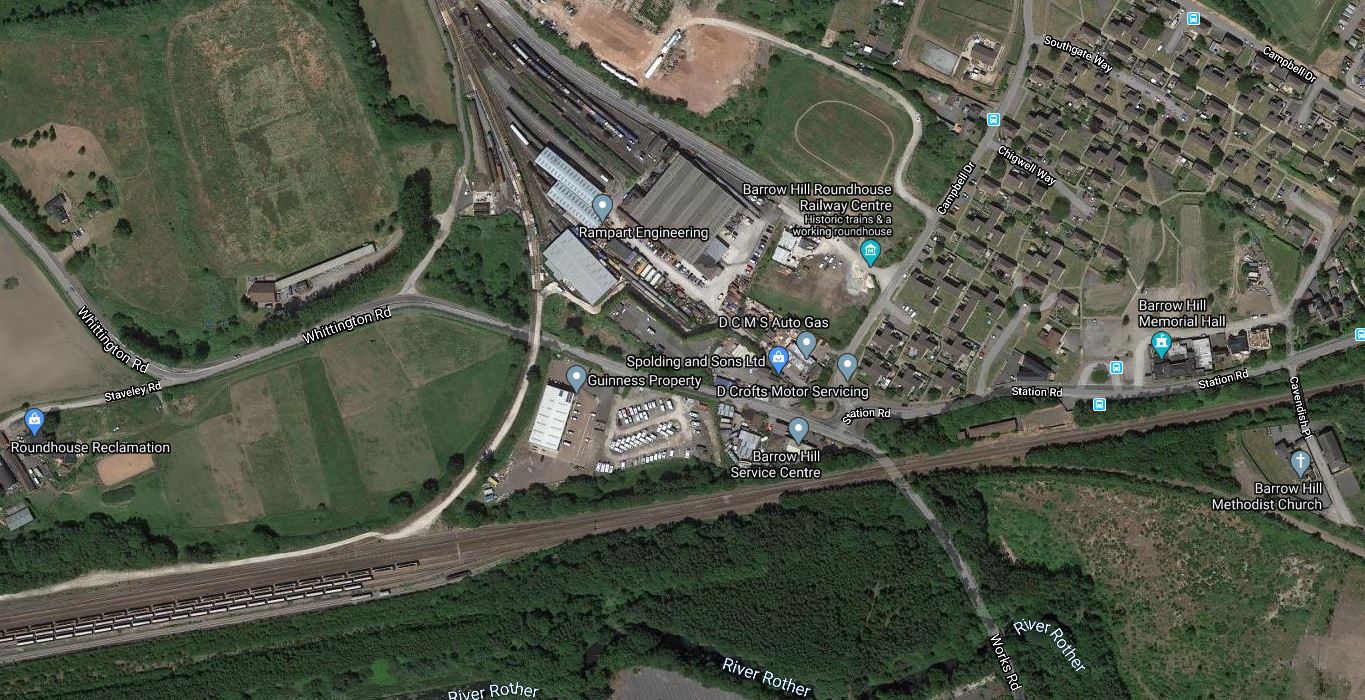
Note.
The historic Barrow Hill Roundhouse and some rail-related businesses to the North of the line.
There used to be a station here called Barrow Hill! What a surprise!
The Wikipedia entry for Barrow Hill station has a section called Modern Traffic, where this is said.
At 22 June 2013 the line is part of the Midland Main Line. It is used predominantly for freight, with a handful of passenger trains going the “long way round” from Chesterfield to Sheffield via the Old Road and Darnall largely to retain staff route knowledge in case of diversions.
The Wikipedia entry for the station also has a section called Possible Future, which is worth a read, as it lists other mothballed rail lines in the area, that could be developed.
Follow the Barrow Hill Line to the North-East and it goes through a mix of agricultural land, industrial dereliction, modern factories and nature reserves before it splits near Beighton.
This Google Map shows the area.
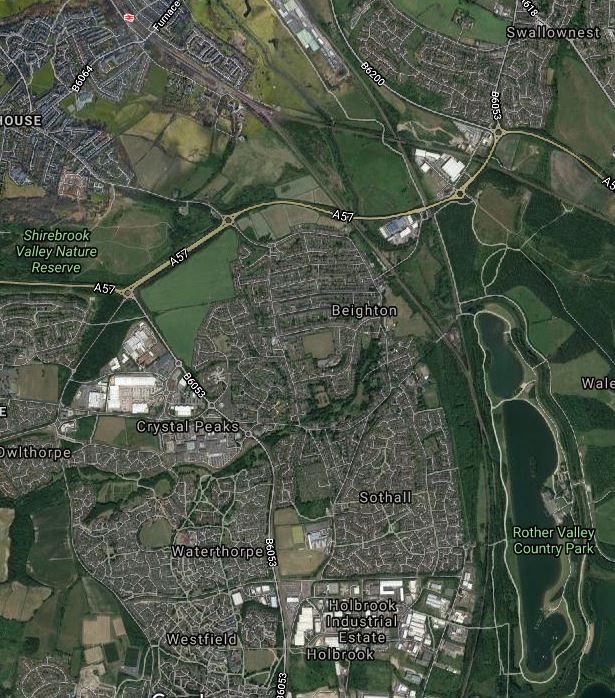
Note.
- The rail lines splitting by the Rother Valley Country Park at Beighton Junction.
- Barrow Hill is to the South.
- There used to be a station at Beighton.
- Woodhouse station is in the North West corner of the map.
- Woodhouse station is on the Sheffield-Lincoln Line, which can be seen crossing the area.
- Trains taking the left fork at Beighton Junction can go to Sheffield via Woodhouse and Darnall stations.
- Trains taking the right fork go under the Sheffield-Lincoln line and have connections to a large number of destinations for both freight and passengers.
It looks to me, that it is proposed to convert this long-way round route, into a second route between Sheffield and Chesterfield.
- Stations exist at Woodhouse and Darnall.
- Stations used to exist at Barrow Hill, Eckington & Renishaw, Killamarsh West and Beighton.
- The route would surely be very useful, when the Midland Main Line route between Sheffield and Chesterfield is updated for High Speed Two.
- The route might also be very useful for East Midlands Railway to develop services to Rotherham and other places to the East of Sheffield.
- I’ve found a train that takes this route between Chesterfield and Sheffield and with no stops it took twenty-five minutes.
- Typically, the direct route takes about eleven minutes.
I can see several possibilities for local, regional and national services using the Barrow Hill Line.
I have a few questions.
Would The Barrow Hill Line Be Electrified?
It has been stated that High Speed Two and the Midland Main Line will share an electrified corridor from Clay Cross North Junction to Sheffield via Chesterfield.
- So as both stations will be electrified, it would not be any problem to rustle up a good electricity supply to power an electrified Barrow Hill Route.
- Electrification might narrow the fourteen minute difference between the routes.
- Electrification would allow East Midlands Railway‘s new Class 810 trains to have a second electrified route into Sheffield.
- Is there a case for a service between London and the South of England and the South and East of Sheffield?
I think electrification of the Barrow Hill Line is more than a possibility.
Would Gauge-Clearance For Electrification Be Difficult?
As the route is already cleared for freight trains with the largest containers, it won’t be as difficult as some routes.
Could Tram-Trains Be Used Between Sheffield And Chesterfield On The Barrow Hill Line?
In Sheffield Region Transport Plan 2019 – A New Tram-Train Route To A New Station At Waverley, I talked about a plan by the Sheffield Region for a new tram-train route between Sheffield station and a new housing district of Waverley on the Sheffield-Lincoln Line.
- Waverley is between Darnall and Woodhouse stations.
- The new Advanced Manufacturing Park would also be served.
- Tram-trains could venture further down the Sheffield-Lincoln Line, if that was so desired.
If tram-trains were used on the Barrow Hill Line, between Sheffield and Chesterfield, both routes would share the track between Sheffield and Darnall stations.
Note that tram-trains would be able to share tracks with all electric trains used around Sheffield, including freight trains and the Class 810 trains.
Note that the stations for tram-trains can be much simpler and even share platforms with full-size trains.
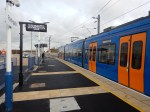
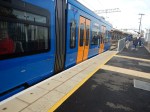
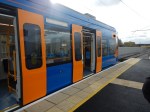
The pictures show Class 399 tram-trains at Rotherham Parkgate and Rotherham Central stations.
- I feel with innovative design, the whole route between Sheffield and Chesterfield could be run using tram-trains.
- The route could be electrified with 25 KVAC overhead wires.
- Instead of taking the Sheffield fork at Beighton Junction, the tram-trains could also take the right fork and link Chesterfield with Barnsley, Doncaster, Rotherham and Swinton.
- These tram-trains also come with batteries, if that is needed.
Barnsley, Chesterfield, Rotherham and Sheffield could be getting a lot of better connectivity and the Barrow Hill Line is key.
Conclusion
This looks to be a very sensible project.
- It could be run with either trains or tram-trams.
- It should be electrified, so it could be zero-carbon.
- Tram-trains could be used to make stations simpler.
- It could give an alternative route for electric trains to Sheffield station.
- The track is already there and regularly used.
But surely the biggest reason to built it, is that it appears to open up a lot of South and South-East Sheffield and North-East Chesterfield for development.
 The Anonymous Widower