High Speed Two To Manchester
There has been a lot of speculation about the Northern end of High Speed Two, so I might as well add sort out a few facts and add a bit of speculation of my own.
The Current Manchester Piccadilly Services
Currently, there are three trains per hour (tph) between London Euston and Manchester Piccadilly.
The services stop as follows.
- Milton Keynes Central, Rugby, Stoke-on-Trent, Macclesfield and Stockport
- Nuneaton, Stoke-on-Trent and Stockport
- Stafford, Crewe, Wilmslow and Stockport
Note.
- One service goes via Crewe.
- Two services go via Stoke-on-Trent.
- All services go via Stockport.
- A London and Manchester Piccadilly train could go via Milton Keynes Central, Nuneaton, Rugby, Stafford, Stoke-on-Trent, Macclesfield and Stockport.
- A London and Manchester Piccadilly train could go via Crewe, Wilmslow and Stockport.
The two trains detailed would mean that Manchester wouldn’t lose any connectivity.
I would expect that Manchester Piccadilly needs at least three tph to and from London.
This graphic shows High Speed Two services after Phase 2b is completed.
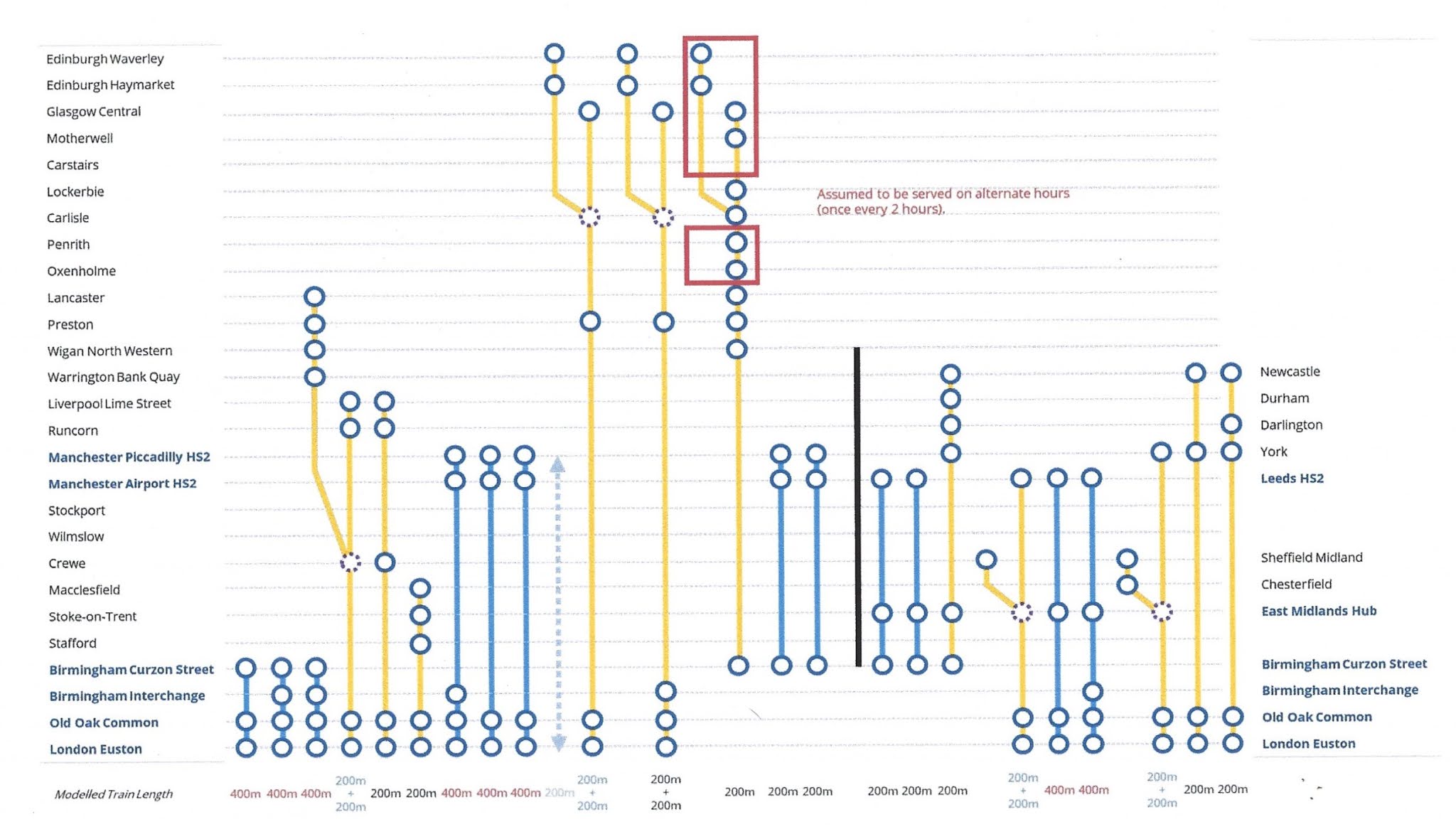
Note.
- Services shown in blue are run by High Speed Two Full Size trains.
- Services shown in yellow are run by High Speed Two Classic-Compatible trains.
- Full Size Services will only run to Manchester Airport and Manchester Piccadilly after Phase 2b is completed to Manchester Piccadilly.
- Classic-Compatible Services will be able to run to to Manchester Piccadilly after Phase 2a is completed.
- Two London and Manchester Piccadilly trains will call at just Old Oak Common and Manchester Airport.
- A third London and Manchester Piccadilly train will call at Old Oak Common, Birmingham International and Manchester Airport.
- Two Birmingham Curzon Street and Manchester Piccadilly trains will call at just Manchester Airport.
- Despite Wilmslow and Stockport being shown in the list of stations on the left hand side of the graphic, no High Speed Two services appear to call at the two stations.
The graphic of High Speed Two services also shows these Full-Size services to Manchester Piccadilly.
- Three tph to London Euston
- Two tph to Birmingham Curzon Street
Some or all of these services will surely be run by High Speed Two Classic-Compatible trains.
What services will run to Manchester between the opening of Phase 2a and the opening of Phase 2b?
I will now give some possibilities for services.
London and Manchester Piccadilly Via Crewe, Wilmslow And Stockport
I shall look at the 07:33 train to Manchester Piccadilly on the 20th September 2023.
- It was a service via Stafford, Crewe, Wilmslow and Stockport
- It was a nine-car Class 390 train or Pendolino, which left on time.
- Euston and Manchester Piccadilly are 188.9 miles apart.
- The train called at Crewe at 09:08 and left at 09:10.
- The average speed between London Euston and Crewe is 70.7 mph.
- The train arrived in Manchester Piccadilly on time at 09:44.
- The journey took two hours and 11 minutes
- The average speed was 86.5 mph.
- The Crewe and Manchester Piccadilly section is 30.9 miles and the train is scheduled to take 34 minutes.
- The average speed between Crewe and Manchester Piccadilly is 54.5 mph.
- The example train slows past Crewe because of two stops at Wilmslow and Stockport.
When Phase 2a of High Speed Two opens a replacement for this service via Crewe, could operate as follows.
- It could use High Speed Two between and Crewe.
- It could use the current route between Crewe and Manchester Piccadilly.
- It would probably use a 200 metre long High Speed Two Classic-Compatible trains.
- I wouldn’t be surprised, that the current Pendolino service between Euston and Manchester Piccadilly via Crewe, Wilmslow and Stockport was retired.
- The new High Speed Two service could take over the path currently used by the current Pendolino service, between Crewe and Manchester Piccadilly.
- The train could stop at Crewe, Wilmslow and Stockport as required.
- If it stopped at Crewe, Wilmslow and Stockport, it would restore some of the connectivity to smaller places.
According to the Wikipedia entry for High Speed Two, these will be the timings.
- London Euston and Crewe – 56 minutes
- London Euston and Manchester Piccadilly Phase 2a – One hour and 30 minutes
- London Euston and Manchester Piccadilly Phase 2b – One hour and 11 minutes
From these figures and the times of the 07:33, I can deduce these journey times for trains via Crewe, Wilmslow and Stockport.
- Currently, Crewe and Manchester Piccadilly takes 34 minutes.
- High Speed Two after Phase 2a will also take 34 minutes.
I am surprised that sectional timings on this section of the West Coast Main Line are the same as current timings. Digital signalling and the faster acceleration and deceleration of the new trains, are quite likely to decrease times.
Because they are both 34 minutes, does that mean that services will stop at Crewe, Wilmslow and Stockport?
London and Macclesfield Via Stafford And Stoke-on-Trent
This map of High Speed Two in North West England was captured from the interactive map on the High Speed Two web site.

Note.
- The map dates from around October 2020.
- The current West Coast Main Line (WCML) and Phase 2a of High Speed Two are shown in blue.
- Phase 2b of High Speed Two is shown in orange.
- The main North-South route, which is shown in blue, is the WCML passing through Crewe, Warrington Bank Quay and Wigan North Western as it goes North.
- The Western Branch, which is shown in blue, is the Liverpool Branch of the WCML, which serves Runcorn and Liverpool.
- High Speed Two, which is shown in orange, takes a faster route between Crewe and Wigan North Western.
- The Eastern Branch, which is shown in orange, is the Manchester Branch of High Speed Two, which serves Manchester Airport and Manchester Piccadilly.
- The route in the East, which is shown in blue, is the Macclesfield Branch of High Speed Two, which serves Stafford, Stoke-on-Trent and Macclesfield.
The route of Northern Powerhouse Rail between Manchester Airport and Liverpool has still to be finalised.
The London and Macclesfield service is as follows.
- There will be one tph
- There are intermediate stops at Stafford and Stoke-on-Trent.
- Macclesfield has a long electrified bay platform, which looks like it will take a 200 m High Speed Two Classic-Compatible train.
- Macclesfield Station And High Speed Two has pictures of the station.
- Four tph operate between Stoke-on-Trent and Manchester Piccadilly via Macclesfield.
- Timings from London would be 55 minutes to Stafford, 70 minutes to Stoke-on-Trent and 90 minutes to Macclesfield.
In some ways, I was surprised about this High Speed Two service.
But it does give an easy connection to Stafford and Stoke-on-Trent.
London and Manchester Piccadilly via Macclesfield, Stafford And Stoke-on-Trent
Currently, Avanti West Coast run a service between London and Manchester which runs as follows.
- It calls at Milton Keynes Central, Rugby, Stoke-on-Trent, Macclesfield and Stockport
- It also passes through Watford Junction, Nuneaton, Tamworth and Lichfield Trent Valley.
- It could pass through Stafford.
- It would mean that Stafford and Stoke-on-Trent were served by 2 tph.
- It is run by a Pendolino.
- It has a frequency of 1 tph.
- The current service takes two hours and 6 minutes.
- A few minutes would be added for each extra stop.
I believe it could be a very useful service.
I wonder if it could be run as a complimentary service to High Speed Two to serve more places on the route.
A Second High Speed Two Service Between London and Manchester Piccadilly Via Crewe, Wilmslow And Stockport
So far, I have mapped out three possible services.
- High Speed Two – London and Manchester Piccadilly Via Crewe, Wilmslow And Stockport – One hour and thirty minutes
- High Speed Two – London and Macclesfield Via Stafford and Stoke – One hour and thirty minutes
- Pendolino – London and Manchester Piccadilly Via Milton Keynes Central, Rugby, Nuneaton, Tamworth, Lichfield Trent Valley, Stafford, Stoke-on-Trent, Macclesfield and Stockport – Two hours and 6 minutes plus 4 minutes for each extra stop.
I suspect that four tph could be a good frequency.
The simplest extra service would probably be another High Speed Two London and Manchester Piccadilly Via Crewe, Wilmslow And Stockport.
But it could be another Pendolino service to serve more places.
I believe a service pattern could be arranged with these features.
- Major cities and towns between London and Manchester have at least two tph.
- A larger number of towns and cities have at least one tph.
Note that many stations on the route already have Pendolino services.
Phase 2b Would Be The Ultimate Solution
Phase 2b which will involve a tunnel via Manchester Airport to new platforms in Manchester Piccadilly could be the ultimate solution.
Phase 2b is also needed so that full-size High Speed Two trains can be run to Manchester Piccadilly.
But it will be difficult, expensive and disruptive to build.
Conclusion
I believe it could be easy to plan four services between London and Manchester Piccadilly or Macclesfield.
- High Speed Two Full-Size train – London and Manchester Piccadilly Via Crewe, Wilmslow And Stockport – One hour and eleven minutes
- High Speed Two Classic-Compatible train – London and Macclesfield Via Stafford and Stoke – One hour and thirty minutes
- High Speed Two Full-Size train – London and Manchester Piccadilly Via Crewe, Wilmslow And Stockport – One hour and eleven minutes
- Pendolino – London and Manchester Piccadilly Via Milton Keynes Central, Rugby, Nuneaton, Tamworth, Lichfield Trent Valley, Stafford, Stoke-on-Trent, Macclesfield and Stockport – Two hours and 6 minutes plus 4 minutes for each extra stop.
Note.
Services 1 and 3 are identical, but don’t need to be.
Service 4 could be run by a High Speed Two Classic-Compatible train.
See Also
Could High Speed Two Finish At Lichfield?
Could East Midland Railway’s Leicester And Lincoln Service Be Extended To Burton On Trent?
After my trip to Lincoln and Cleethorpes earlier this week, I got to thinking about how train services could be improved in the area.
Cleethorpes As A Battery-Electric Train Hub Station
In Cleethorpes Station – 28th June 2023, this was my last sentence.
Cleethorpes station could be at the centre of its own battery-electric train network, with all trains powered by just 3.3 miles of single-track electrification.
Services running to Cleethorpes station could be.
- East Midlands Railway – Barton-on-Humber and Cleethorpes via Barrow Haven, New Holland, Goxhill, Thornton Abbey, Ulceby, Habrough, Stallingborough, Healing, Great Coates, Grimsby Town, Grimsby Docks and New Clee, which currently runs two-hourly, but probably should run hourly. Barton-on-Humber and Grimsby Town is not electrified and is 19.6 miles or 39.2 miles for a round trip.
- East Midlands Railway – Leicester and Cleethorpes via Syston, Sileby, Barrow-upon-Soar, Loughborough, East Midlands Parkway, Attenborough, Beeston, Nottingham, Newark Castle, Collingham, Swinderby, Hykeham, Lincoln, Market Rasen, Barnetby, Habrough and Grimsby Town which currently runs two-hourly, but probably should run hourly. Nottingham and Grimsby Town is not planned to be electrified and is 77.8 miles.
- LNER – London King’s Cross and Cleethorpes via Stevenage, Peterborough, Grantham, Newark Northgate, Lincoln, Market Rasen, Barnetby, Habrough and Grimsby Town, which would run at least two trains per day (tpd). Newark Northgate and Grimsby Town is not electrified and is 60.6 miles.
- TransPennine Express – Liverpool Lime Street and Cleethorpes via Liverpool South Parkway, Warrington Central, Birchwood, Manchester Oxford Road, Manchester Piccadilly, Stockport, Sheffield, Meadowhall, Doncaster, Scunthorpe, Barnetby, Habrough and Grimsby Town, which runs hourly. Hazel Grove and Grimsby Town is not electrified and is 101.4 miles.
Note.
- All services to Cleethorpes could be run using a battery-electric train, with the range of a Stadler FLIRT Akku, which is 139 miles.
- Cleethorpes station will soon have four terminal platforms. Could it be one platform for each service?
- The 3.3 miles of single-track electrification would be between Cleethorpes and Grimsby stations.
- I am assuming that all services should be at least hourly, except London King’s Cross.
- If the frequency of services to London King’s Cross, were to be increased, the extra services would take-over paths of the East Midlands Railway services between Lincoln and Cleethorpes.
- I am also assuming that the Midland Main Line electrification has been completed through Leicester to Nottingham, as is currently planned.
Cleethorpes will become a very well-connected station.
Collateral Benefits Of Cleethorpes As A Fossil Fuel-Free Station
If all services to Cleethorpes are run by battery-electric trains, then there will be collateral benefits.
- All passenger train services in North-East Lincolnshire will be zero-carbon.
- TransPennine Express’s Southern route between Liverpool Lime Street and Cleethorpes via Manchester, Sheffield and Doncaster will be zero-carbon.
- LNER’s services to London King’s Cross from Lincolnshire will be zero carbon.
Manchester and Sheffield will be linked by an hourly electric service, just as it was between 1953 and 1981.
The Ivanhoe Line
I wrote about the Ivanhoe Line in Reinstatement Of The Ivanhoe Line.
- There is a proposed reinstatement of passenger services between Leicester and Burton-on-Trent stations.
- I estimate it’s a distance of around 37 miles.
- There would be some new stations on the route.
In the Wikipedia entry for the Ivanhoe Line, there is a section called Future, where this is said.
The intermediate stations are capable of taking only a two-coach train, which has led to overcrowding on some services, especially now that the service is extended to Nottingham and Lincoln. The latest Route Utilisation Strategy for the East Midlands makes recommendations for platform lengthening.
East Midlands Parkway railway station has now been built on the route. The Borough of Charnwood’s local plan of 2004 anticipates a station at Thurmaston.
In 2022 the closed section of the line was one of nine schemes chosen to undergo a feasibility scrutiny by Network Rail as part of the government’s Restoring Your Railway programme. If approved, work could start in 2024 and the line reopened in 2026
Note.
- The first paragraph refers to the existing section of the Ivanhoe Line, to the North of Leicester.
- I went to Burton once for the football and it’s a difficult place to get to from North London by train.
- Burton-on-Trent station was fully refurbished in 2011.
- Burton-on-Trent station has hourly services from CrossCountry trains.
It seems that a creditable plan is emerging.
Service Frequency Between Burton-on-Trent And Leicester
As Burton-on-Trent station has hourly services, I suspect that this will be the initial frequency between Burton-on-Trent and Leicester.
But I could see this frequency being increased, if there were long waits during interchange at Burton-on-Trent.
Average Speed Of The Service And Estimate For A Time Between Cleethorpes And Burton-on-Trent
The current Grimsby Town and Leicester service is over a route of 105.3 miles and a direct service takes two hours and thirty-seven minutes.
This is an average speed of 40.24 mph.
I can now give an estimate for a Cleethorpes and Burton-on-Trent service.
The distance will be 105.3+3.3+37, which is 145.6 miles.
An estimate of the time using a speed of 40.24 mph is three hours and thirty-seven minutes.
But seeing that a good proportion of the route has a 110 mph operating speed, I suspect that a 100 mph train could do the trip faster.
Could Cleethorpes And Burton-on-Trent Be Worked By A Battery-Electric Train?
The route could be effectively four sections.
- Cleethorpes and Grimsby Town – 3.3 miles – Electrified
- Grimsby Town and Nottingham – 77.8 miles – Not Electrified
- Nottingham and Leicester – 27.5 miles – Being Electrified
- Leicester and Burton-on-Trent – 37 miles – Not Electrified
Note.
- In a round trip, there are two sections of 77.8 miles and two consecutive sections of 37 miles.
- Battery-electric trains would be charged on the electrified section of the route.
I am sure that a battery-electric train with a range of greater than 77.8 miles would handle the service.
Thoughts About Electrification Through Devon And Cornwall
Distances
I’ll start by looking at a few distances.
- Penzance and Taunton – 162.3 miles
- Penzance and Exeter St. David’s – 131.5 miles
- Penzance and Plymouth – 79.5 miles
- Taunton and Exeter St. David’s – 30.7 miles
- Plymouth and Exeter St. David’s – 52 miles
- Taunton and Newbury – 89.6 miles
- Plymouth and Taunton – 82.8 miles
- Taunton and Paignton – 59 miles
- Taunton and Patchway – 51.7 miles
Note.
- Patchway and Newbury are already electrified to Cardiff Central and London Paddington respectively.
- Bombardier’s engineer told me eight years ago, that the battery-electric Class 379 had a range of sixty miles.
- Stadler’s FLIRT Akku has a Guinness world record of 139 miles on one battery charge. See this page on the Stadler web site.
- Even Stadler’s Class 777 trains for Merseyrail have a range of 84 miles on battery power. See New Merseyrail Train Runs 135km On Battery.
The rail distances in Devon and Cornwall are getting closer to being within the capability of trains fitted with batteries.
Station Stop Times
These are typical times that trains stop in the more important stations between Taunton and Penzance.
- Taunton – < 2 mins
- Tiverton Parkway – < 2 mins
- Exeter St. Davids – 2 mins
- Newton Abbot – < 2 mins
- Totnes – < 2 mins
- Plymouth – 11 minutes
- Devonport – < 2 mins
- Saltash – < 2 mins
- Menheniot – < 2 mins
- Liskeard – < 3 mins
- Bodmin Parkway – 2 mins
- Lostwithiel – 2 mins
- Par – 2 mins
- St. Austell – 2 mins.
- Truro – 2 mins
- Redruth – 2 mins
- Camborne – 2 mins
Note.
- The timings were for today.
- The Cardiff and Penzance services were being run by five-car Class 802 trains.
- Most station stops are around two minutes or less, but Plymouth on this train was eleven minutes.
I find it interesting that the Plymouth stop takes so much longer.
Train Stops At Plymouth
I looked at about twenty trains stopping at Plymouth, that included these services.
- London Paddington and Penzance
- Penzance and London Paddington
- Cardiff Central and Penzance
- Penzance and Cardiff Central
Note.
- I found an average time of eight minutes.
- Eleven minutes was a common stop.
- Eight minutes could be enough time for the rail equivalent of a Formula One splash and dash.
- CrossCountry services were going through the station in three minutes.
I am led to believe that the timetable used by the GWR trains would allow a quick battery charge at Plymouth station.
This OpenRailwayMap shows the platforms at Plymouth station.
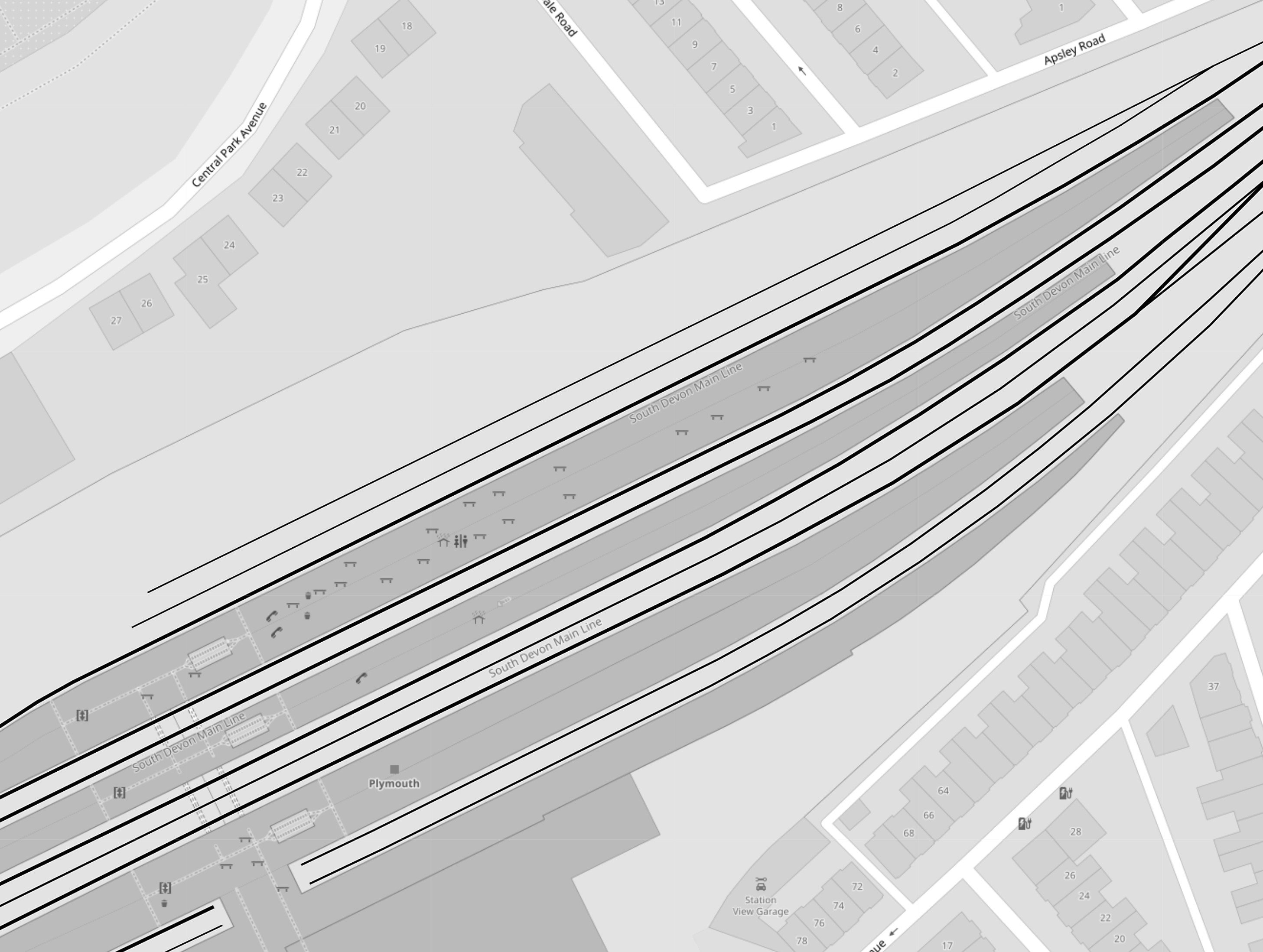
Note.
- London is to the East and Penzance is to the West.
- Platform numbers increase from South to North.
- The two East-facing bay platforms are Platforms 1 and 2.
- The West-facing bay platform in the South-West corner is Platform 3.
- Platform 4 shares the island with the bay platforms 1, 2 and 3.
- Most trains going to Penzance use Platform 4.
- Platforms 5 and 6 share the centre island platform.
- Platforms 7 and 8 share the Northernmost island platform.
- Most trains going towards London use Platform 7.
- Wikipedia indicates that the track layout is comprehensive and allows a lot of operational flexibility.
Although the station was completed around forty years ago, it could have been designed for handling modern battery-electric trains.
- There are three bay platforms numbered 1 to 3, to charge local services and send them on their way.
- Trains can arrive and depart in the five through platforms, numbered 4 to 8, from either direction.
- Two days ago, a nine-car London Paddington to Plymouth train terminated in Platform 7. After waiting an hour it returned to London. An hour would be enough time to fully-charge a train.
- As many platforms as needed could be electrified.
I am fairly sure, that most battery-electric trains could be timetabled to leave Plymouth station with full batteries.
Turnround At Penzance
I have found these turnrounds.
- 802113 arrived from Paddington at 1142 and left for London at 1215
- 802022 arrived from Paddington at 1307 and left for London at 1415
- 802103 arrived from Paddington at 1500 and left for London at 1615
This OpenRailwayMap shows the platforms at Penzance station.
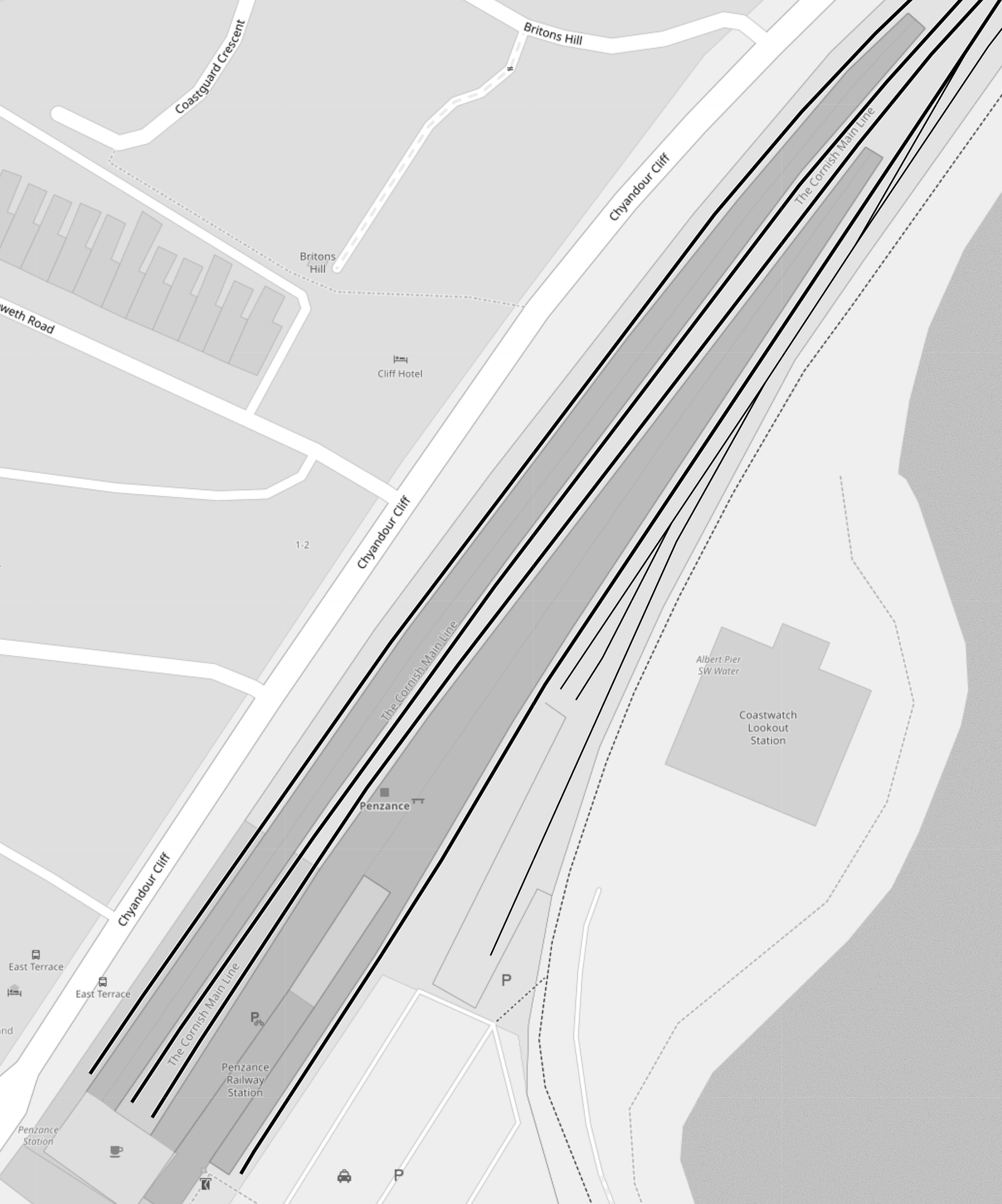
Note.
- The three example trains used Platform 1.
- Platform 1 is the long platform on the landward side of the station.
- Platforms are numbered 1 to 4 from left to right.
- An appropriate number of platforms would be electrified to charge trains terminating at Penzance.
Trains would appear to have plenty enough time to recharge, so they would start their return journey with full batteries.
Engineering Ambition
Several times in my life, I’ve got fired up about engineering or software projects and I like to think, I’ve produced the best and fastest solution.
For this reason, I believe that Hyperdrive Innovation, who are now part of Turntide Technologies, and Hitachi will set themselves three objectives with the design of the the battery packs for the Class 802 train.
- The battery-electric Class 802 will outperform the Stadler FLIRT Akku in terms of speed and distance.
- The battery packs will be plug-compatible with the diesel engines, so there will only be minor software modification to the trains.
- The train will be able to be handle all Great Western Railway’s routes without using diesel.
- I wouldn’t be surprised that on many routes the train will cruise at over 110 mph on batteries.
I also suspect they want the Akku’s Guinness world record, which will mean the range will be in excess of 139 miles.
Battery Range Needed For Routes
These are routes that need to be covered by battery-electric Class 802 trains or similar.
- Avanti West Coast – Crewe and Chester – 22.2 miles
- Avanti West Coast – Crewe and Holyhead – 105.5 miles
- Avanti West Coast – Crewe and Llandudno Junction – 65.5 miles
- Avanti West Coast – Crewe and Wrexham – 34.4 miles
- Avanti West Coast – Shrewsbury and Wolverhampton – 29.7 miles
- Great Western Railway – Penzance and Plymouth – 79.5 miles
- Great Western Railway – Plymouth and Taunton – 82.8 miles
- Great Western Railway – Taunton and Patchway – 51.7 miles
- Great Western Railway – Newbury and Taunton – 89.6 miles
- Great Western Railway – Taunton and Paignton – 59.0 miles
- Great Western Railway – Weston-super-Mare and Chippenham – 43.5 miles
- Great Western Railway – Oxford and Great Malvern – 65.6 miles
- Great Western Railway – Oxford and Hereford – 86.3 miles
- Great Western Railway – Oxford and Worcester Foregate Street – 57.6 miles
- Great Western Railway – Oxford and Worcester Shrub Hill – 57.2 miles
- Great Western Railway – Cheltenham Spa and Swindon – 43.2 miles
- Great Western Railway – Cardiff Central and Carmarthen – 77.4 miles
- Great Western Railway – Cardiff Central and Pembroke Dock – 118.9 miles
- Great Western Railway – Cardiff Central and Swansea – 45.7 miles
- Hull Trains – Beverley and Temple Hirst Junction – 44.3 miles
- Hull Trains – Hull and Temple Hirst Junction – 36.1 miles
- LNER – Hull and Temple Hirst Junction – 36.1 miles
- LNER – Middlesbrough and Longlands Junction – 22.2 miles
- LNER – Sunderland and Longlands Junction – 48.5 miles
- LNER – Lincoln Central and Newark Northgate – 16.6 miles
- LNER – Leeds and Bradford – 13 miles
- LNER – Leeds and Harrogate – 18 miles
- LNER – Leeds and Huddersfield – 17 miles
- LNER – Stirling and Inverness – 146 miles
- LNER – Edinburgh Haymarket and Aberdeen – 130 miles
- LNER – Peterborough and Doncaster via Great Northern and Great Eastern Joint Line – 93.7 miles
- South Western Railway – Basingstoke and Exeter St. David’s – 124.5 miles
- TransPennine – Hull and Micklefield – 42 miles
- TransPennine – Longlands Junction and Saltburn – 34.7 miles
- TransPennine – York and Scarborough – 42 miles
- TransPennine – Doncaster and Cleethorpes – 52.1 miles
- TransPennine – Stockport and Doncaster – 55.4 miles
- TransPennine – Stockport and Cleethorpes – 107.5 miles
Note.
- Stirling and Inverness and Edinburgh Haymarket and Aberdeen could be shortened by up to thirty miles, by planned electrification in Scotland.
- I have assumed that the TransPennine Upgrade has been completed.
- It looks like a battery-electric Class 802 train could use the Great Northern and Great Eastern Joint Line diversion via Lincoln.
- I am slightly surprised, that the longest stretch of line without electrification and with a passenger service is Basingstoke and Exeter St. David’s.
Charging will be needed at some places to charge the battery-electric trains. Stations fitted with chargers could include Aberdeen, Carmarthen, Cleethorpes, Exeter St. David’s, Hereford, Holyhead, Hull, Inverness, Paignton, Penzance, Pembroke Dock, Plymouth, Swansea, Taunton, Weston-super-Mare, Worcester.
Most chargers would be a length of electrification in the platform, where the battery-electric trains terminated or passed through.
More On LNER’s Ten New Bi-Modes
I wrote about these trains in LNER Seeks 10 More Bi-Modes.
This was my conclusion.
There is a lot of scope to develop LNER’s services.
I think it is likely that the order will go to Hitachi.
But as I indicated, I do believe that there is scope for a manufacturer to design a zero-carbon train, that was able to serve Aberdeen and Inverness.
-
- I suspect a fleet of ten trains would be sufficient.
- Trains would use the 25 KVAC overhead electrification, where it exists and hydrogen or battery power North of the wires.
The trains would also be capable of being upgraded to higher speeds, should the East Coast Main Line be turned into a High Speed Line.
I also think, that whatever trains are bought, there will be a large upgrading of the existing Hitachi fleet, which will add batteries to a lot of trains.
In the July 2023 Edition of Modern Railways, there is an article, which is entitled LNER Embraces Pioneering Spirit, which takes the form of an interview with LNER’s Managing Director; David Horne.
In a section, which is entitled ‘225’ Replacement, this is said.
Meanwhile, Mr Horne is looking to what might replace the InterCity 225 fleet, now smartly repainted in a scheme which pays homage to the original ‘Swallow’ livery. While there were fears this fleet may be withdrawn as an economy measure, the ‘225s’ are now on lease until at least next summer.
But Mr Horne says obsolescence issues are a real challenge and LNER will struggle to maintain the fleet beyond 2025, and from the May 2023 timetable change the number of daily diagrams was reduced from five to four to conserve the fleet’s mileage. Much of the heavy maintenance work had previously been carried out at Wabtec’s Doncaster site, but this facility is no longer available, and while a recent reliability improvement programme is bearing fruit, the challenges remain. The crunch point comes with the transition to ETCS at the southern end of the ECML as part of the East Coast Digital Programme – Mr Horne says LNER does not want to fit cab signalling on the ‘225s’.
The solution to this issue is to procure additional trains to run alongside the 65 Azumas, and LNER went out to tender in October 2020 for a fleet of 10 trains with self-power capability.
While a preferred bidder has been identified, the business case to proceed with the procurement is awaiting approval, but Mr Horne is still hopeful this project can be progressed.
The current plan envisages the new trains broadly replacing the ‘225s’ on Leeds and York diagrams, but a major benefit with the new fleet would be during engineering work – at present LNER has to withdraw services to places such as Harrogate and Hull to concentrate its bi-mode Azumas on services using non-electrified diversionary routes, and having more stock with self-power capability would ease the issue.
Currently, LNER has these Azumas and InterCity 225s in its fleet.
- Five-car bi-mode Class 800 trains – 10
- Nine-car bi-mode Class 800 trains – 13
- Five-car electric Class 801 trains – 12
- Nine-car electric Class 801 trains – 30
- Nine-car electric ImterCity 225 trains – 8
Note.
- There are 23 bi-mode trains and 50 electric trains.
- There are 167 bi-mode carriages and 302 electric carriages.
- Currently 31.5 % of the trains are bi-mode.
- With ten new bi-mode trains and no InterCity 225 trains, 44 % of the fleet will be bi-mode.
Is this increase in the percentage of the fleet, that are bi-mode acceptable?
I wonder, if there is a more affordable and flexible way to increase the fleet size.
In the Wikipedia entry for the Class 800 train, there is a section, which is entitled Traction And Generator Units, where this is said.
The Class 800 and Class 802 bi-mode are equipped with three GU per five-car set and five GU per nine-car set; a five-car set has a GU situated under vehicles 2/3/4 and a nine-car set has a GU situated under vehicles 2/3/5/7/8. In comparison, the electric-orientated Class 801 features a single GU for a five to nine-car set, which provides emergency power for limited traction and auxiliaries if the power supply from the overhead line fails. By adding or removing GUs, a Class 800 can be converted into a Class 801 and vice versa.
Let’s look at LNER’s needs, which are actually two separate sub-needs.
- There is a need for ten new trains to replace the InterCity 225 trains.
- There is a need to increase the size of the bi-mode fleet to be able to use the Great Northern and Great Eastern Joint Line and other non-electrified routes to by-pass engineering works.
Note.
- I suspect that as Mr Horne explained, there are only five or possibly four InterCity 225s diagrammed on a particular day, then perhaps ten five-car bi-mode Class 800 trains, might be able to cover for the retirement of the InterCity 225s.
- These trains would work as pairs to Leeds and York to replace the InterCity 225 capacity.
- If required they could split and join at Leeds and York to serve other destinations.
- The diversion route of the Great Eastern Joint Line has an unelectrified distance of 93.7 miles and the route is electrified at both ends.
- Would a battery-electric Class 800 train handle this distance? I suspect if Stadler can do it, then Hitachi and Turntide Technology will be able to do it too!
LNER will have replaced the InterCity 225s and acquired ten new five-car blockade runners.
As an order for ten new five-car battery-electric trains, is not to be sneezed at, I suspect Hitachi will make sure that their new battery-electric variants have enough range.
So this would mean that the range of a five cat battery-electric Class 800 train, should be in excess of 93.7 miles.
It should be noted that the five-car Class 800 and Class 802 trains have specific advantages when it comes to converting them to battery-electric trains.
- They are modern trains, that are still in production, every bit of information about the train is known down to the last nut, bolt and plastic clip.
- Like most modern trains, hey have a sophisticated computer system controlling the train.
- They have spaces for three, four or maybe even five diesel engines under the floor, which could be used for a battery-pack in every car designed to hold a diesel engine.
- The train has an electric bus between nose and tail.
- As is shown, when the trains change between diesel and electric, the pantograph can go up and down with all the alacrity of a whore’s drawers.
- The trains can be converted between bi-mode and electric, by adding or removing diesel packs. I doubt this feature will be removed, as batteries replace diesels.
With my Electrical and Control Engineer’s hard hat on, I doubt there is anything to stop a Class 800 or Class 802 train being fitted with three or more batteries to create a 125 mph train, with a range approaching two hundred miles on battery power.
The initial name of these Hitachi trains was the Hitachi Super Express. Is this train the Hitachi Super Battery Express?
But it would appear, that for their initial needs, LNER, just need a range to handle the near hundred miles of the Great Northern and Great Eastern Joint Line.
Inverness and Aberdeen will come later.
Hull Trains
This page on the Lumo web site is entitled Greener Travel Between Edinburgh And London.
These are the first three paragraphs.
A new, 100% electric rail service is to start running between London and Edinburgh with fares for as little as £14.90 in a bid to encourage greener and more affordable travel between the capitals.
Called Lumo, it will provide low-carbon, affordable long-distance travel for over 1 million passengers per year. Over 74,500 passengers currently fly between Edinburgh and London each month3.
And with single tickets between the capitals starting from just £14.90, Lumo will be a comfortable, convenient alternative to flying that is affordable for all. Some 60% of all single fares will be available at a cost of £30 or less.
I’m sure Hull Trains, who are owned by First Group like Lumo would like to position themselves in the 100 % electric low-carbon box too!
Currently, Hull Trains’s five-car Class 802 trains, run 88.6 and 72.2 miles using diesel on round-trips to Beverley and Hull respectively from London.
If batteries were fitted to their trains to give a battery range of around a hundred miles, Hull Trains could call themselves 100 % electric.
No new infrastructure would be required, but a short length of overhead electrification in a convenient platform at Hull station would ensure the train left for London and Beverley with a full battery.

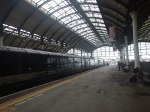



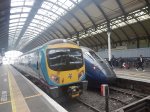
The pictures show Hull Trains’s Class 802 train in Platform 7 at Hull station.
Penzance And Taunton
This to me is the key section as if you can run a battery-electric train between these two stations it allows so many of the services to be run using zero-carbon traction.
These are distances from Taunton.
- Exeter St. David’s – 30.7 miles
- Newbury – 89.6 miles
- Okehampton – 55.3 miles
- Paignton – 59.0 miles
- Patchway – 51.7 miles
- Plymouth – 82.8 miles
Note.
- I’ve added Okehampton, as I feel that if Dawlish had another encounter with Poseidon, Okehampton with its proposed Parkway station on the A30 could be the terminus for coaches to and from Cornwall.
- All would be possible with a battery-electric train, with a hundred-mile range, leaving Taunton with a full battery.
- Charging could be needed at Okehampton and Paignton.
What is needed is some form of charging in the Taunton area.
This OpenRailwayMap shows Taunton station.

Note.
- The station has four through platforms.
- All Great Western Railway services to and from Devon and Cornwall stop in the station.
- I feel it would be possible to electrify the station, so that all stopping trains could charge the batteries.
But the problem would be, that as typically trains only stop for a couple of minutes at Taunton, there may not be enough time to take enough charge on board.
This OpenRailwayMap shows the track between Wellington and Collumpton, between Taunton and Exeter.
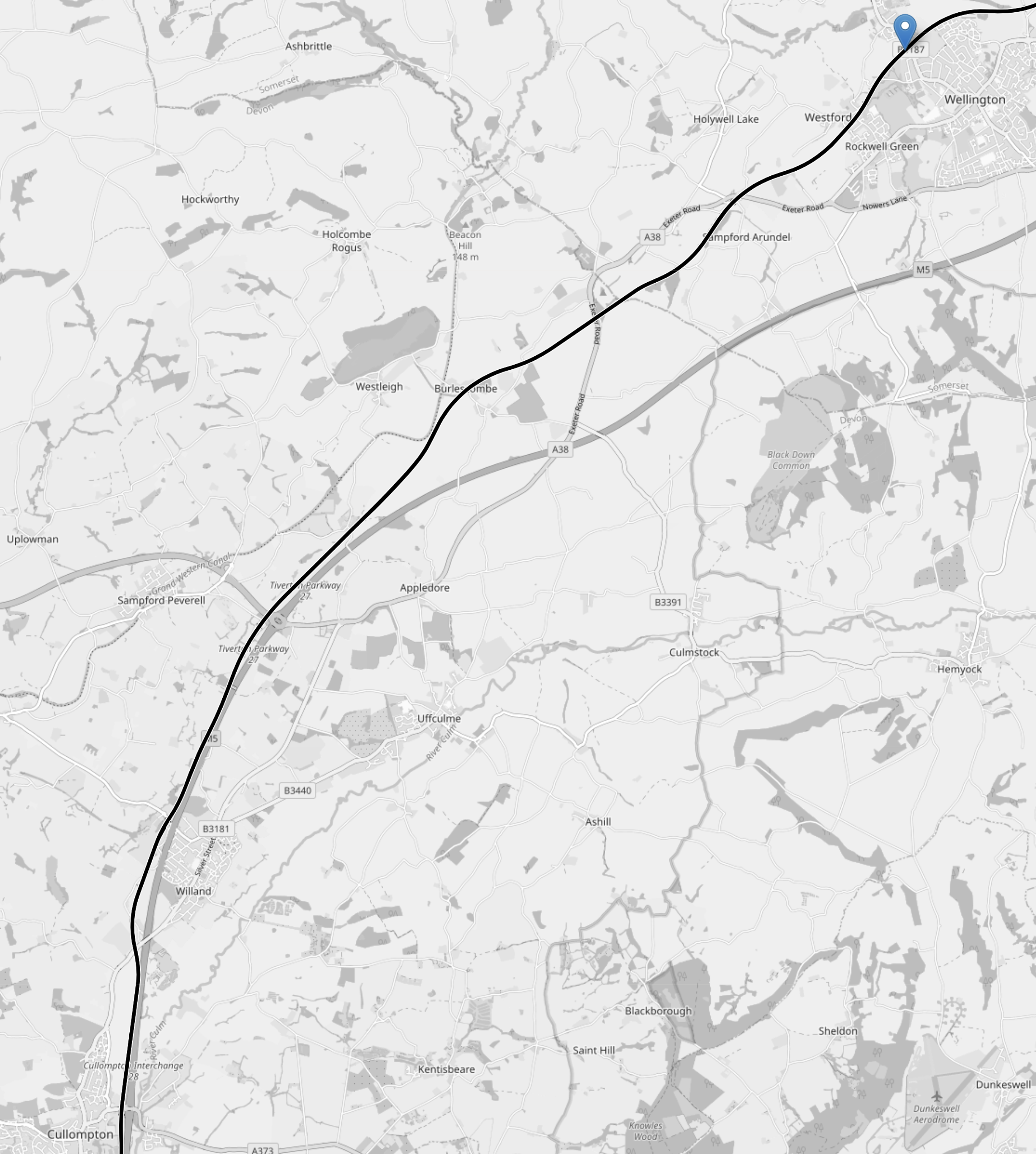
Note.
- The black line is the railway between Taunton and Exeter.
- The blue arrow in the North-East corner of the map indicates the position of the proposed Wellington station.
- Collumpton is in the South-West corner of the map and has also been put forward for a new Collumpton station.
- I talked about the reopening of these two stations in Reopening Of Wellington and Cullompton Stations.
- The M5 to the North of Collumpton runs closely alongside the railway.
- According to Real Time Trains, it takes just under ten minutes to go the thirteen miles between Wellington and Collumpton.
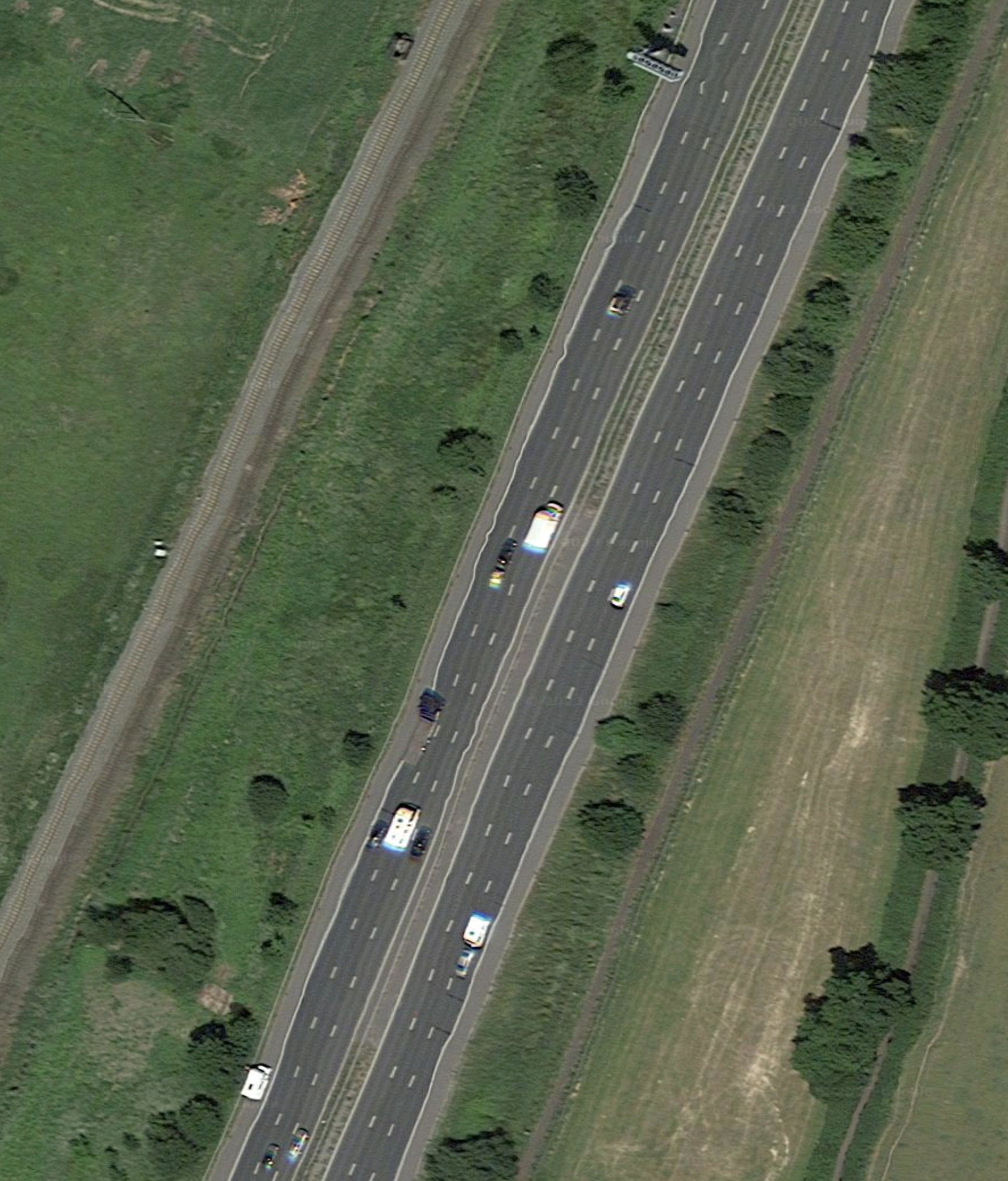
This Google Map shows a section of the M5 North of Collumpton.
And this Google Map shows Tiverton Parkway station.
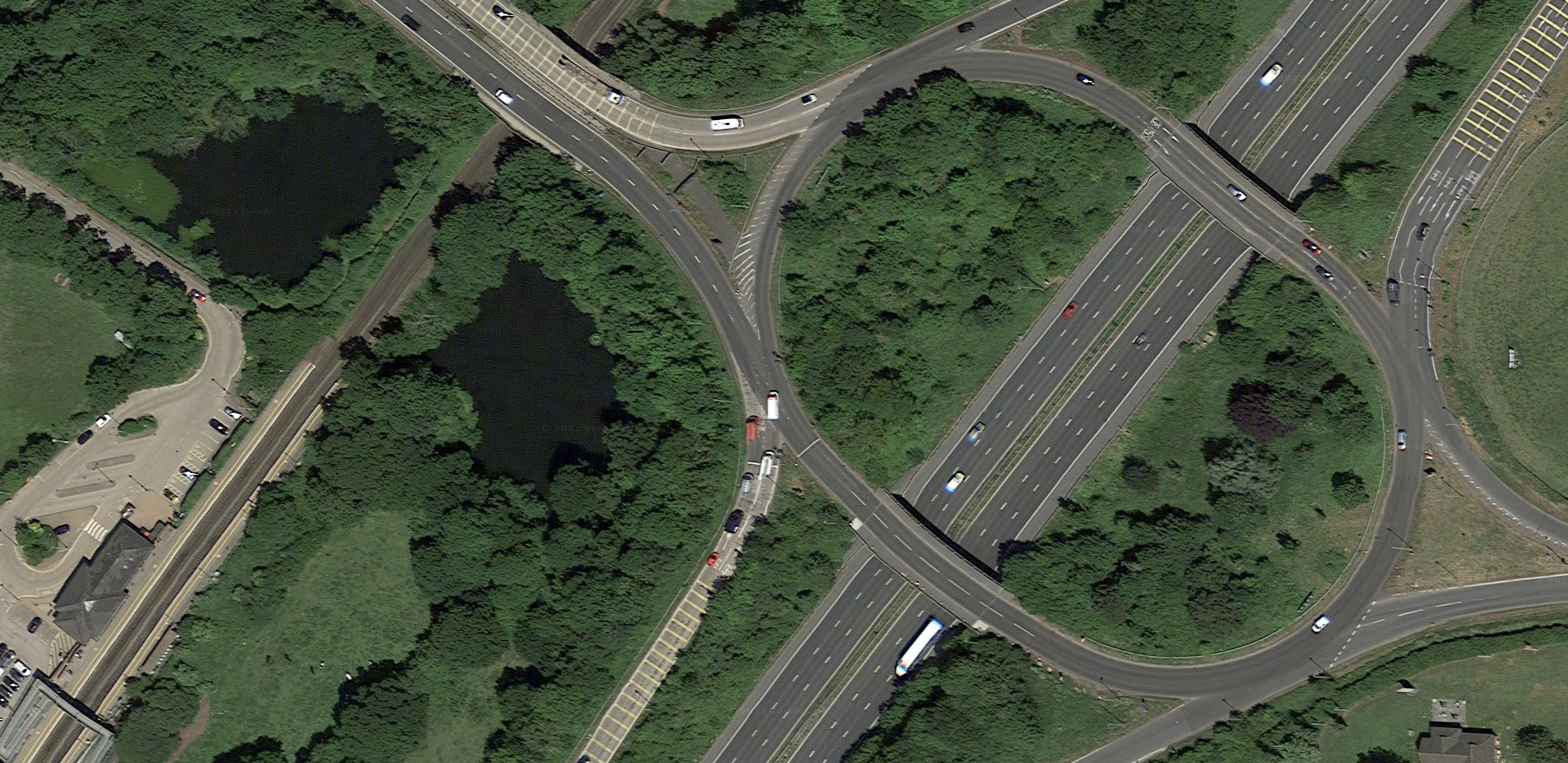
Note how the railway runs alongside the M5 to the West.
I feel that if the two new stations of Wellington and Collumpton are built between Taunton and Exeter St. David’s, then why not partially electrify the route, so that all trains would leave or pass through Taunton and Collumpton stations with full batteries.
- Going West the trains would reach Exeter St. David’s, Okehampton or Plymouth.
- Going East trains would reach Newbury for Reading and Paddington, and Patchway for Cardiff.
I believe that a battery-electric solution is possible, that would enable the decarbonisation of the Great Western Main Line all the way to Penzance.
Government Agrees To Fund £200m Cambridge South Station
The title of this post, is the same as that of this article on the BBC.
This is the sub-heading.
The government has agreed to fully fund a new £200m railway station.
These are a few points.
- Work has already started.
- The station is next to the city’s Biomedical Campus and Addenbrooke’s Hospital.
- Cambridge South station will be on the East West Railway.
It is expected to be open within two years.
I have a few thoughts.
Services At Cambridge South Station
In a typical hour, it seems the following trains go through the proposed site of Cambridge South station.
- 2 tph – Greater Anglia – Liverpool Street and Cambridge North via Tottenham Hale, Cheshunt, Broxbourne, Roydon (1tph), Harlow Town, Harlow Mill (1tph), Sawbridgeworth (1tph), Bishop’s Stortford, Stansted Mountfitchet (1tph), Elsenham (1tph), Newport (1tph), Audley End, Great Chesterford (1tph), Whittlesford Parkway, Shelford (1tph) and Cambridge.
- 1 tph – Greater Anglia -Norwich and Stansted Airport via Wymondham, Spooner Row (1tpd), Attleborough, Eccles Road (1tpd), Harling Road (1tpd), Thetford, Brandon, Shippea Hill (1tpd), Ely, Cambridge North, Cambridge, Whittlesford Parkway and Audley End
- 1 tph – Great Northern – King’s Cross and Ely via Cambridge, Cambridge North and Waterbeach.
- 1 tph – Great Northern – King’s Cross and King’s Lynn via Cambridge, Cambridge North, Waterbeach, Ely, Littleport, Downham Market and Watlington.
- 1 tph – Great Northern – King’s Cross and Cambridge via Finsbury Park, Alexandra Palace, Potters Bar, Hatfield, Welwyn Garden City, Welwyn North, Knebworth, Stevenage, Hitchin, Letchworth Garden City, Baldock, Royston, Meldreth, Shepreth and Foxton.
- 2 tph – Thameslink – Cambridge and Brighton via Royston, Ashwell & Morden, Baldock, Letchworth Garden City, Hitchin, Stevenage, Finsbury Park, St Pancras International, Farringdon, City Thameslink, London Blackfriars, London Bridge, East Croydon, Gatwick Airport, Three Bridges, Haywards Heath and Burgess Hill
- 1 tp2h – CrossCountry – Birmingham New Street and Stansted Airport via Coleshill Parkway, Nuneaton, Leicester, Melton Mowbray, Oakham, Stamford, Peterborough, March, Ely and Cambridge.
Note.
- tph is trains per hour.
- tp2h is trains per two hours.
This gives a base frequency through Cambridge South, Cambridge and Cambridge North of 8.5 tph.
Could some services be extended to Cambridge South or Stansted Airport?
- 1 tph – Greater Anglia – Ipswich and Cambridge via Needham Market, Stowmarket, Elmswell, Thurston, Bury St Edmunds, Kennett (1tp2h), Newmarket and Dullingham (1tp2h).
- 1 tp2h – CrossCountry – Birmingham New Street and Cambridge via Coleshill Parkway, Nuneaton, Leicester, Melton Mowbray, Oakham, Stamford, Peterborough, March and Ely.
These two trains would gives frequencies of.
- Cambridge South – 10 tph
- Cambridge – 10 tph
- Cambridge North – 9 tph
I have assumed these services would terminate at Cambridge South.
There could also be some new services.
1 tph – Greater Anglia – Wisbech and Cambridge via March, Ely and Waterbeach, Cambridge North and Cambridge.
1 tph – East West Railway – Oxford and Great Yarmouth via Oxford Parkway, Bicester Village, Winsford, Bletchley, Bedford, Tempsford, Cambourne, Cambridge, Cambridge North, Ely, Brandon, Thetford, Attleborough, Wymondham and Norwich.
1 tph – East West Railway – Oxford and Manningtree via Oxford Parkway, Bicester Village, Winsford, Bletchley, Bedford, Tempsford, Cambourne, Cambridge, Newmarket, Bury St. Edmunds, Stowmarket, Needham Market and Ipswich.
These three trains would gives frequencies of.
- Cambridge South – 13 tph
- Cambridge – 13 tph
- Cambridge North – 11 tph
I have assumed these services would terminate at Cambridge South.
The A14 Parkway Station
The A14 Parkway station is a proposal from the East West Railway.
- It would be just to the East of Chippenham junction and would be served by both Greater Anglia’s services between Ipswich and Cambridge and Ipswich and Peterborough.
- It would also be close to the major road junction, where the A11 and the A14 meet.
- It would be a Park-and-Ride station.
I believe it could be a major factor in cutting road mileage in East Anglia, as drivers going to Cambridge from Ipswich, Norwich, a large area of North-East East Anglia and North Essex could find that using the A14 Parkway station an easier and faster route. But the A14 Parkway would need a frequent service to the soon-to-be-three main Cambridge stations.
A Soham and Cambridge service could reverse at the A14 Parkway station or by careful timetabling, passengers would be able to change trains in a minute or two.
A Soham and Cambridge service, that terminated at Cambridge South, would give an extra train between Cambridge South and Newmarket and these frequencies at the three Cambridge stations.
- Cambridge South – 13 tph
- Cambridge – 14 tph
- Cambridge North – 12 tph
There would be a minimum interval of no more than five minutes between trains, if you wanted to hop between any of the three Cambridge stations.
Frequencies between Cambridge station and other main stations in the area would be as follows.
- A14 Parkway – 2 tph
- Attleborough – 2 tph
- Bishop’s Stortford – 2 tph
- Bletchley – 2 tph
- Bury St. Edmunds – 2 tph
- Ely – 6 tph
- Great Yarmouth – 1 tph
- Harlow Town – 2 tph
- Hitchin – 3 tph
- Ipswich – 2 tph
- King’s Lynn – 1 tph
- Letchworth Garden City – 3 tph
- Manningtree – 1 tph
- March – 1 tph
- Needham Market – 2 tph
- Newmarket – 2 tph
- Norwich – 2 tph
- Peterborough – 1 tph
- Royston – 3 tph
- Soham – 1 tph
- Stansted Airport – 2 tph
- Stevenage – 3 tph
- Stowmarket – 2 tph
- Thetford – 2 tph
- Wisbech – 1 tph
- Wymondham – 2 tph
Looking at this list, I think that the timetable needs reinforcing, to perhaps Colchester, Haverhill, March, Peterborough, Soham and Sudbury.
But these services will help.
- 1 tph – Greater Anglia – Ipswich and Peterborough via Stowmarket, Bury St Edmunds, Soham, Ely, Manea, March and Whittlesea.
- 1 tph – East Midlands Railway – Liverpool and Norwich via Liverpool South Parkway, Widnes, Warrington Central, Manchester Oxford Road, Manchester Piccadilly, Stockport, Sheffield, Chesterfield, Alfreton, Nottingham, Grantham, Peterborough, Ely and Thetford
But I can’t help feeling that the Stour Valley Railway needs to be reopened.
One Of The Worst Train Journeys I’ve Had In The UK Since The 1960s
I started out with a simple objective, in that I intended to go to Cardiff Central station and then explore the Cardiff Valley Lines to look at the progress of the electrification. I had also arranged to possibly have a drink, with an old acquaintance at Rhymney station.
For the first time, I took the Elizabeth Line from Moorgate to Paddington to catch a long distance train. It is so much easier than taking the Underground.
I bought a Super Off Peak Return ticket to Cardiff Central station for £62.15 with my Senior Railcard.
This was the journey I took today.
- I left Paddington on the 10:18 train for Cardiff Central.
- The train arrived at Bristol Parkway at 11:34½.
- Real Time Trains says this about the rest of the journey. “This service was cancelled between Bristol Parkway and Cardiff Central due to a problem with signalling equipment (J3)”
- I was advised by a member of staff, that I wouldn’t be going to Cardiff in the near future and he advised taking a CrossCountry train to Bristol Temple Meads and then going back to London using my Return ticket.
- I left Bristol Parkway at 12:12¼ and arrived in Bristol Temple Meads at 12:20½, after taking the CrossCountry train.
- At Bristol Temple Meads to salvage something of a wasted day, I took a diversion to Severn Beach for the princely sum of £1.95 with my Senior Railcard, arriving back at Bristol Temple Meads at 14:48½.
- I then caught the next train to London, which turned out to be the 16:00, as both the 15:00 and 15:30 were cancelled due to an incident at Didcot.
- The train left Bristol Temple Meads at 16:03 and arrived at London Paddington at 18:00, which was twenty minutes late.
Note.
- I never got to Cardiff.
- If I’d waited at Bristol Parkway and caught the next train, I’d have got to Cardiff at 16:15¼, which would have been four hours later, than if the first train hadn’t been cancelled and had been on time.
I’ve just tried to phone Great Western Railway, but their Contact Us page only gives details of Facebook, Twitter and What’s App. I don’t use any of those!
Conclusion – Added On 5th June 2023
I just received an e-mail saying the cheque will be the post!
Could The Bombardier Voyagers Be Converted To Hydrogen Power?
Avanti West Coast, CrossCountry and East Midlands Trains all run versions of Bombardier Voyager trains.
- There are 103 sets in service.
- Lengths are four, five and seven cars.
- They are 125 mph trains.
- They are powered by one Cummins QSK19 diesel engine in each car.
Given Cummins’s enthusiasm for hydrogen could these diesel engines be converted to hydrogen power, so the trains could run long distance routes on zero-carbon power?
If there is no need for them in the UK, there are probably lots of places in the world that would like them!
Thoughts On High Speed Two
These are a few thoughts about High Speed Two, after the reports of major changes today.
This article on the BBC is entitled HS2 Line Between Birmingham And Crewe Delayed By Two Years.
This is the sub-heading.
The Birmingham to Crewe leg of high speed railway HS2 will be delayed by two years to cut costs.
These are the three opening paragraphs.
Some of the design teams working on the Euston end of the line are also understood to be affected.
Transport secretary Mark Harper blamed soaring prices and said it was “committed” to the line linking London, the Midlands and North of England.
HS2 has been beset by delays and cost rises. In 2010, it was expected to cost £33bn but is now expected to be £71bn.
Delivering The Benefits Of High Speed Two Early
It is my belief that with a large project taking a decade or more , it is not a bad idea to deliver some worthwhile benefits early on.
The Elizabeth Line opened in stages.
- The new Class 345 trains started replacing scrapyard specials in 2017.
- The rebuilt Abbey Wood station opened in 2017.
- Paddington local services were transferred to the Elizabeth Line in 2019.
- Outer stations reopened regularly after refurbishment from 2018.
- The through line opened in May 2022.
There’s still more to come.
Some projects wait until everything is ready and everybody gets fed up and annoyed.
Are there any parts of High Speed Two, that could be completed early, so that existing services will benefit?
In 2020, the refurbishment of Liverpool Lime Street station and the tracks leading to the station was completed and I wrote about the station in It’s A Privilege To Work Here!, where this was my conclusion.
Wikipedia says this about Liverpool Lime Street station.
Opened in August 1836, it is the oldest still-operating grand terminus mainline station in the world.
I’ve used Lime Street station for fifty-five years and finally, it is the station, the city needs and deserves.
I’ve been to grand termini all over the world and Lime Street may be the oldest, but now it is one of the best.
Are there any stations, that will be served by High Speed Two, that should be upgraded as soon as possible to give early benefits to passengers, staff and operators?
Avanti West Cost have solved the problem of the short platforms at Liverpool South Parkway station, by ordering shorter Class 807 trains. Will High Speed Two lengthen the platforms at this station?
A good project manager will need to get all the smaller sub-projects in a row and work out what is the best time to do each.
Digital Signalling
I would assume, as this will be needed for High Speed Two services in the West Coast Main Line to the North of Crewe, this is surely a must for installing as early as possible.
If the existing trains could run for a hundred miles at 140 mph, rather than the current 125 mph, that would save five worthwhile minutes.
Trains could run closer together and there is the possibility of organising services in flights, where a number of trains run together a safe number of minutes apart.
Remove Bottlenecks On Classic Lines, That Could Be Used By High Speed Two
I don’t know the bottlenecks on the West Coast Main Line, but there are two on the East Coast Main Line, that I have talked about in the past.
Could ERTMS And ETCS Solve The Newark Crossing Problem?
Improving The North Throat Of York Station Including Skelton Bridge Junction
Hopefully, the digital signalling will solve them.
Any bottlenecks on lines that will be part of High Speed Two, should be upgraded as soon as possible.
Birmingham And Crewe
I will start by looking at the leg between Birmingham and Crewe.
This section of the HS2 map shows High Speed Two between Birmingham and Lichfield.
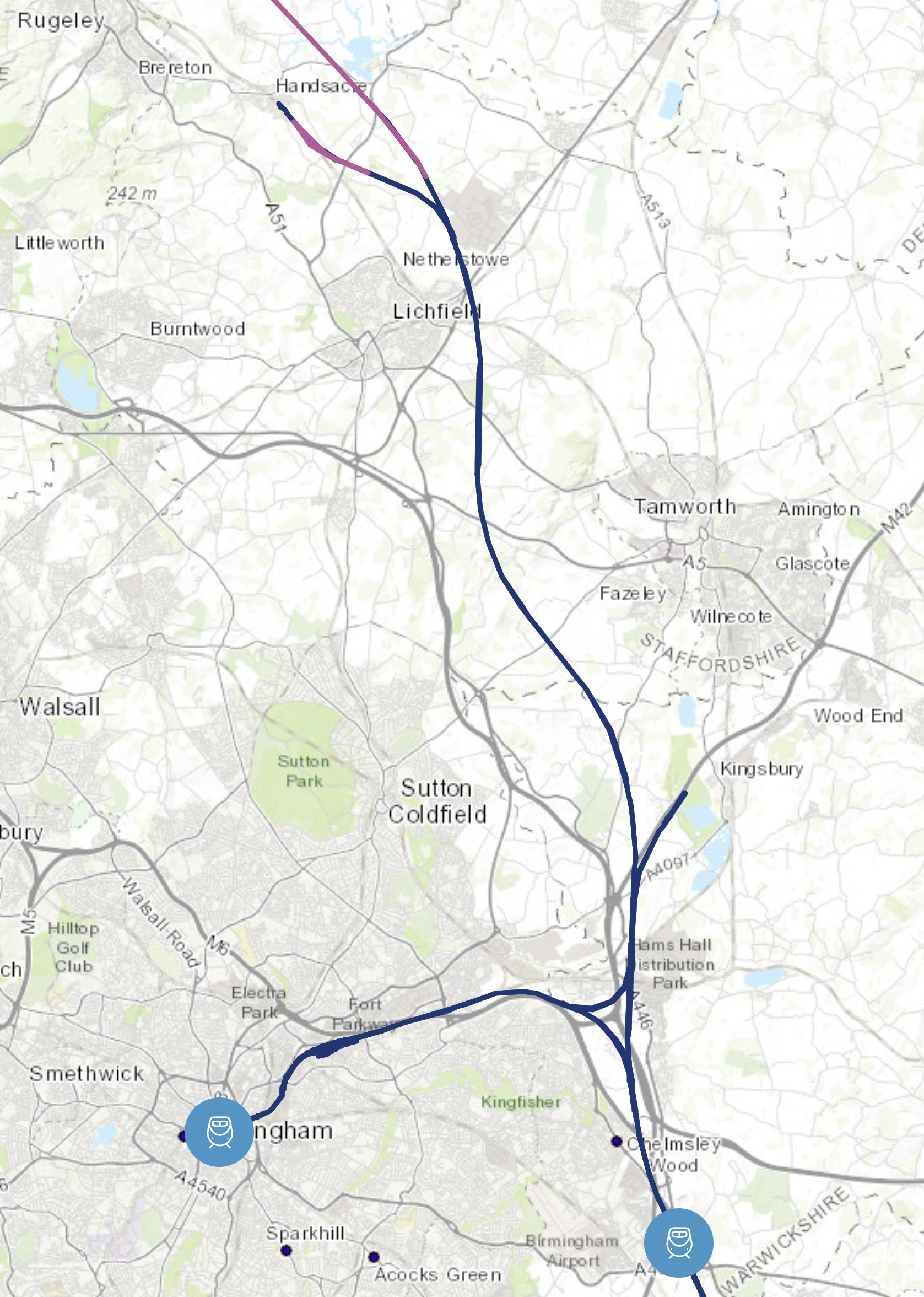
Note.
- The blue circle on the left at the bottom of the map is Birmingham Curzon Street station.
- The blue circle on the right at the bottom of the map is Birmingham Interchange station.
- The High Speed Two to and from London passes through Birmingham Interchange station.
- The branch to Birmingham Curzon Street station connects to the main High Speed Two at a triangular junction.
- North of the triangular junction, High Speed Two splits.
- The Eastern branch goes to East Midlands Parkway station.
- The Northern branch goes to Crewe, Liverpool Lime Street, Manchester Piccadilly, Preston and Scotland.
At the top of the map, the Northern branch splits and lines are shown on this map.

Note.
- The junction where the Northern and Eastern branches divide is in the South-East corner of the map.
- To the North of Lichfield, the route divides again.
- The Northern purple line is the direct line to Crewe.
- The shorter Southern branch is a spur that connects High Speed Two to the Trent Valley Line, which is the current route taken by trains between London Euston and Crewe, Liverpool Lime Street, Manchester Piccadilly, Preston and Scotland.
- Crewe station is in the North-West corner of the map.
The route between the junction to the North of Lichfield and Crewe is essentially two double-track railways.
- High Speed Two with a routine operating speed of 205 mph.
- The Trent Valley Line with a routine operating speed of 140 mph.
- High Speed Two Classic-Compatible trains can run on all tracks.
- High Speed Two Full-Size trains may be able to run on the Trent Valley Line at reduced speed.
- Eighteen trains per hour (tph) is the maximum frequency of High Speed Two.
I feel in an emergency, trains will be able to use the other route.
Will This Track Layout Allow An Innovative Build?
Suppose the link to the Trent Valley Line was built first, so that High Speed Two trains from London for Crewe, Liverpool Lime Street, Manchester Piccadilly, Preston and Scotland, could transfer to the Trent Valley Line as they do now.
- All lines used by High Speed Two services North of the junction, where High Speed Two joins the Trent Valley Line would be updated with digital signalling and 140 mph running. This will benefit current services on the line. For instance Euston and Liverpool/Manchester services could be under two hours.
- The current services would be replaced by High Speed Two services run by High Speed Two Classic-Compatible trains.
- The direct High Speed Two route between Lichfield and Crewe would now be built.
- When this section of High Speed Two is complete, High Speed Two services would use it between Lichfield and Crewe.
- As the direct route would be built later, this would delay the building of the Birmingham and Crewe high-speed route.
Currently, trains run the 41.8 miles between Lichfield and Crewe in 28 minutes, which is an average speed of 89.6 mph.
I can build a table of average speeds and times for Lichfield and Crewe.
- 100 mph – 25.1 minutes – 2.9 minutes saving
- 110 mph – 22.8 minutes – 5.2 minutes saving
- 120 mph – 20.9 minutes – 7.1 minutes saving
- 125 mph – 20.1 minutes – 7.9 minutes saving
- 130 mph – 19.3 minutes – 8.7 minutes saving
- 140 mph – 17.9 minutes – 10.1 minutes saving
- 160 mph – 15.7 minutes – 12.3 minutes saving
- 180 mph – 13.9 minutes – 14.1 minutes saving
- 200 mph – 12.5 minutes – 15.5 minutes saving
Note.
- Even a slight increase in average speed creates several minutes saving.
- Times apply for both routes.
I believe that a 125 mph average should be possible on the Trent Valley route, which may be enough for Euston and Liverpool/Manchester services to be under two hours.
Improving Classic Lines Used By High Speed Two North Of Lichfield
Real Time Trains shows these figures for a Glasgow Central to Euston service.
- Glasgow and Lichfield Trent Valley is 298.2 miles.
- Glasgow and Lichfield Trent Valley takes five hours.
This is an average speed of 59.6 mph.
Note.
- The average speed is low considering the trains are capable of cruising at 125 mph and 140 mph with digital signalling.
- High Speed Two services between Euston and Glasgow will use the classic network, to the North of Lichfield.
I can build a table of average speeds and times for Glasgow and Lichfield.
- 100 mph – 179 minutes – 121 minutes saving
- 110 mph – 163 minutes – 157 minutes saving
- 120 mph – 149 minutes – 151 minutes saving
- 125 mph – 143 minutes – 157 minutes saving
- 130 mph – 138 minutes – 162 minutes saving
- 140 mph – 128 minutes – 172 minutes saving
This table illustrates why it is important to improve all or as many as possible of classic lines used by High Speed Two to enable 140 mph running, with full digital signalling. Obviously, if 140 mph is not feasible, the speed should be increased to the highest possible.
Routes that could be updated include.
- London Euston and Glasgow Central
- London Euston and Liverpool Lime Street
- London Euston and Manchester Piccadilly (all routes)
- London Euston and Blackpool
- London Euston and Holyhead
- London Euston and Shrewsbury
Not all these routes will be served by High Speed Two, but they could be served by 140 mph trains.
What Times Would Be Possible?
The InterCity 225 was British Rail’s ultimate electric train and these two paragraphs from its Wikipedia entry, describe its performance.
The InterCity 225 was designed to achieve a peak service speed of 140 mph (225 km/h); during a test run in 1989 on Stoke Bank between Peterborough and Grantham, an InterCity 225 was recorded at a speed of 162 mph (260.7 km/h). Its high speed capabilities were again demonstrated via a 3hr 29mins non-stop run between London and Edinburgh on 26 September 1991. British regulations have since required in-cab signalling on any train running at speeds above 125 mph (201 km/h) preventing such speeds from being legally attained in regular service. Thus, except on High Speed 1, which is equipped with cab signalling, British signalling does not allow any train, including the InterCity 225, to exceed 125 mph (201 km/h) in regular service, due to the impracticality of correctly observing lineside signals at high speed.
The InterCity 225 has also operated on the West Coast Main Line (WCML). In April 1992, one trainset achieved a new speed record of two hours, eight minutes between Manchester and London Euston, shaving 11 minutes off the 1966 record. During 1993, trials were operated to Liverpool and Manchester in connection with the InterCity 250 project.
- The fastest London Euston and Manchester Piccadilly services appear to be two hours and six minutes tomorrow, with stops at Nuneaton and Stoke-on-Trent.
- The fastest London King’s Cross and Edinburgh service is four hours seventeen minutes tomorrow.
It does appear that British Rail’s 1980s-vintage InterCity 225 train did very well.
Trains that would be able to run at 140 mph with updated signalling include.
- Alstom Class 390
- Hitachi Class 800, 801, 802, 803, 805, 807 and 810
- British Rail InterCity 225
- High Speed Two Classic-Compatible.
All are electric trains.
Could High Speed Two, West Coast Main Line and East Coast Main Line Services Be Run By High Speed Two Classic-Compatible Trains?
I don’t see why not!
- They would be able to use short stretches of High Speed Line like Lichfield and Crewe.
- LNER and CrossCountry could also use the trains.
- High Speed Two is providing the framework and it’s there to be used, provided the paths are available.
This graphic shows the preliminary schedule.
It only shows ten trains going through Crewe, so there could be up to eight spare high speed paths between Birmingham and Crewe.
Could High Speed Two Classic-Compatible Trains Be Used To Advantage On The East Coast Main Line?
I published this extract from the Wikipedia entry for the InterCity 225 earlier.
The InterCity 225 was designed to achieve a peak service speed of 140 mph (225 km/h); during a test run in 1989 on Stoke Bank between Peterborough and Grantham, an InterCity 225 was recorded at a speed of 162 mph (260.7 km/h). Its high speed capabilities were again demonstrated via a 3hr 29mins non-stop run between London and Edinburgh on 26 September 1991.
The London and Edinburgh run was at an average speed of around 112 mph.
I wonder what time, one of LNER’s Class 801 trains, that are all-electric could do, once the new digital signalling has been fully installed on the route? I suspect it would be close to three hours, but it would depend on how long the trains could run at 140 mph.
It should be noted that the Selby Diversion was designed for 160 mph, when it was built by British Rail in the 1980s.
In Are Short Lengths Of High Speed Line A Good Idea?, I look at the mathematics of putting in short lengths of new railway, which have higher speeds, where this was part of my conclusion.
I very much feel there is scope to create some new high speed sections on the current UK network, with only building very little outside of the current land used by the network.
I would love to know what some of Network Rail’s track experts feel is the fastest time possible between London and Edinburgh that can be achieved, by selective upgrading of the route.
If some of the trains were High Speed Two Classic-Compatible Trains, with a top speed of 205 mph, provided the track allowed it, there could be some interesting mathematics balancing the costs of track upgrades, new trains with what passengers and operators need in terms of journey times.
Could High Speed Two Classic-Compatible Trains Be Used To Advantage On The West Coast Main Line?
Much of what I said about the East Coast Main Line would apply to the West Coast Main Line.
But in addition, the West Coast Main Line will be a superb place to test the new High Speed Two Classic-Compatible Trains.
I believe, that before High Speed Two opens, we’ll see High Speed Two Classic-Compatible Trains, carrying passengers between Euston and Avanti West Coast’s destinations.
Could High Speed Two Be Split Into Two?
Consider.
- Under earlier plans, the East Coast Main Line to the North of York, will be used by High Speed Two.
- With digital signalling the East Coast Main Line will support continuous running at 140 mph for long sections of the route.
- The East Coast Main Line has a recently-rebuilt large Southern terminal at King’s Cross with eleven platforms and good suburban services and excellent connections to the London Underground.
- The East Coast Main Line has a very large Northern terminal at Edinburgh Waverley with twenty platforms and good local train connections.
- There are large intermediate stations on the East Coast Main Line at Doncaster, Leeds, Newcastle, Peterborough and York. All these stations have good local train connections.
- The East Coast Main Line has important branches to Cambridge, Harrogate, Huddersfield, Hull King’s Lynn, Lincoln, Middlesbrough, Nottingham, Scarborough, Sheffield, Skegness and Sunderland.
We are talking about an asset, that needs improving rather than sidelining.
Could High Speed Two Be A One-Nation Project?
Over three years ago, I wrote Could High Speed Two Be A One-Nation Project? and tried to answer the question in the title.
But now the core network is better defined, perhaps it is time to look at extending the High Speed network again.
The next few sections look at possible extensions.
Serving Chester And North Wales
I looked at this in Could High Speed Two Trains Serve Chester And North Wales?, which I have updated recently.
This was my conclusion.
It looks to me, that when High Speed Two, think about adding extra destinations, Chester and Holyhead could be on the list.
I also suspect that even without electrification and High Speed Two services, but with the new Class 805 trains, the route could be a valuable one for Avanti West Coast.
These are current and promised times for the two legs to Holyhead.
- Euston and Crewe – 90 minutes – Fastest Class 390 train
- Euston and Crewe – 55 minutes – High Speed Two Classic-Compatible train from Wikipedia
- Crewe and Holyhead – 131 minutes – Fastest Class 221 train
- Crewe and Holyhead – 70 minutes – 90 mph average speed
- Crewe and Holyhead – 63 minutes – 100 mph average speed
- Crewe and Holyhead – 57 minutes – 110 mph average speed
- Crewe and Holyhead – 53 minutes – 120 mph average speed
- Crewe and Holyhead – 45 minutes – 140 mph average speed
Note.
- I have assumed that Crewe and Holyhead is 105.5 miles.
- The operating speed of the North Wales Coast Line is 90 mph.
- In the following estimates, I have assumed a change of train at Crewe, takes 6 minutes.
I think there are several options to run fast services to Chester and North Wales.
Pre-HS2 – Class 805 all the way
I believe this train will match the following.
- The fastest Class 390 train between Euston and Crewe.
- The fastest Class 221 train between Crewe and Holyhead.
This would give a time of 3 hours 41 minutes.
Pre-HS2 – Class 805 all the way, but with perhaps less stops and some track improvement
I believe this train will match the following.
- The fastest Class 390 train between Euston and Crewe.
- 110 mph train Crewe and Holyhead.
This would give a time of 2 hours 27 minutes.
Pre-HS2 – Class 805 all the way, but with perhaps less stops and Crewe and Holyhead uprated largely to 125 mph
I believe this train will match the following.
- The fastest Class 390 train between Euston and Crewe.
- 120 mph train Crewe and Holyhead.
This would give a time of 2 hours 23 minutes.
Pre-HS2 – Class 805 all the way, but with perhaps less stops and Crewe and Holyhead Crewe and Holyhead electrified and uprated to 140 mph
I believe this train will match the following.
- The fastest Class 390 train between Euston and Crewe.
- 140 mph train Crewe and Holyhead.
This would give a time of 2 hours 15 minutes.
After-HS2 – High Speed Two Classic-Compatible train to Crewe, the Class 805 train to Holyhead
I believe this train will match the following.
- The fastest High Speed Two Classic-Compatible train between Euston and Crewe.
- The fastest Class 221 train between Crewe and Holyhead.
This would give a time of 3 hours 12 minutes.
After-HS2 – High Speed Two Classic-Compatible train to Crewe, the Class 805 train to Holyhead, but with perhaps less stops and some track improvement
I believe this train will match the following.
- The fastest High Speed Two Classic-Compatible train between Euston and Crewe.
- 110 mph train Crewe and Holyhead.
This would give a time of 1 hours 58 minutes.
After-HS2 – High Speed Two Classic-Compatible train to Crewe, the Class 805 train to Holyhead, but with perhaps less stops and Crewe and Holyhead uprated largely to 125 mph
I believe this train will match the following.
- The fastest High Speed Two Classic-Compatible train between Euston and Crewe.
- 120 mph train Crewe and Holyhead.
This would give a time of 1 hours 54 minutes.
After-HS2 – High Speed Two Classic-Compatible train to Crewe, Class 805 train to Holyhead, but with perhaps less stops and Crewe and Holyhead electrified and uprated to 140 mph
I believe this train will match the following.
- The fastest High Speed Two Classic-Compatible train between Euston and Crewe.
- 140 mph train Crewe and Holyhead.
This would give a time of 1 hours 46 minutes.
After-HS2 – High Speed Two Classic-Compatible train all the way, but with perhaps less stops and Crewe and Holyhead electrified and uprated to 140 mph
I believe this train will match the following.
- The fastest High Speed Two Classic-Compatible train between Euston and Crewe.
- 140 mph train Crewe and Holyhead.
This would give a time of 1 hours 40 minutes.
From these estimates, I have come to these conclusions.
- A sub-two and a half-hour service can be attained with the new Class 805 trains and some improvements to the tracks along the North Wales Coast Line.
- A sub-two hour service can be attained with a High Speed Two Classic-Compatible train to Crewe and a Class 805 train to Hplyhead along a 140 mph electrified North Wales Coast Line.
- If the North Wales Coast Line is electrified, the journey from London Euston, Birmingham Interchange, Crewe, Chester, Liverpool and Manchester would be zero-carbon.
We should be looking to building a zero-carbon fast passenger ferry for sailing between Holyhead and Dublin.
- The current fastest ferries appear to take three hours and 15 minutes, which means that a six-hour low-carbon journey between London Euston and Dublin, should be possible with the new Class 805 trains, prior to the opening of High Speed Two.
- A five-hour journey after the opening of High Speed Two to Crewe and electrification of the North Wales Coast Line should be possible.
If the advanced zero-carbon ferry could knock an hour off the journey, four hours between London and Dublin along a spectacular coastal railway with a fast sea voyage, would be a route that would attract passengers.
- High Speed Two would need to be opened to Crewe.
- The North Wales Coast Line would need to be upgraded to a 140 mph digitally-signalled line.
- The North Wales Coast Line would need to be electrified.
- Full electrification may not be needed, as discontinuous electrification will have advanced to provide zero-carbon running, in a more affordable and less disruptive manner.
- Trains could either be High Speed Two Classic-Compatible trains all the way from London or there could be a change at Crewe to Class 805 trains.
- The ferry would use the best zero-carbon and operational technology.
The improvement and electrification of the North Wales Coast Line could be planned to take place in a relaxed manner, so that journey times continuously got quicker.
I would start the improvement of the North Wales Coast Line, as soon as possible, as all these improvement will be used to advantage by the new Class 805 trains.
Serving West And South West England And South Wales
Suppose you want to go between Glasgow and Cardiff by train, after High Speed Two has opened.
- You will take one of the half-hourly High Speed Two Classic-Compatible trains between Glasgow Central and London.
- Three and a half-hours later, you will get off the train in one of the below ground platforms at Old Oak Common station.
- A short ride in an escalator or lift and you will be in the Great Western Railway station at ground level.
- From here, fifty minutes later, you will be in Cardiff.
The journey will have taken four hours and twenty minutes.
This may seem a long time but currently Glasgow and Cardiff by train takes over seven hours by train.
- Glasgow and Bristol Temple Meads takes eight hours, but using High Speed Two and GWR will take 5 hours.
- Glasgow and Cheltenham Spa takes six hours, but using High Speed Two and GWR will take 5 hours and 30 minutes.
- Glasgow and Penzance takes twelve hours, but using High Speed Two and GWR will take 8 hours and 33 minutes.
- Glasgow and Swansea takes nearly nine hours, but using High Speed Two and GWR will take 6 hours and 9 minutes.
The High Speed Two route only has one simple change, whereas some routes now have up to four changes.
Conclusion
Could Chiltern Go Battery-Electric?
In the October 2022 Edition of Modern Railways, there is an article, which is entitled Chiltern Considers Turbo Future, with a sub-title of Battery Replacement Could Be On The Cards.
These are the first two paragraphs.
In early September Chiltern Railways was preparing to launch a market sounding exercise to consider options for the future of the Class 165 Turbo DMU fleet.
The operator has 28×2-car and 11×3-car ‘165s’. which operate alongside its more modern Class 168 DMUs and its loco-hauled sets. The market sounding exercise will consider two options for the future of the fleet – some sort of hybrid conversion, or outright replacement.
The Class 165 Trains
The Class 165 trains were built in 1990-1991.
- Maximum Speed – 75 mph
- Prime Movers – One per car, Perkins 2006-TWH
- 2-car Trains – 28
- 3-car Trains – 11
One is being converted to a diesel/battery hybrid.
The Class 168 Trains
The Class 168 trains were built in 1998-2004.
- Maximum Speed – 100 mph
- Prime Movers – One per car, MTU 6R 183TD13H
- 2-car Trains – 9
- 3-car Trains – 8
- 4-car Trains – 11
One has been converted to a diesel/battery hybrid.
Conversion To Hybrid Operation
If this proves to be feasible, it will surely be the more affordable of the two options.
But it does leave Chiltern with a mixed fleet with two types of train with different maximum speeds and these lengths.
- 2-car Trains – 37
- 3-car Trains – 19
- 4-car Trains – 11
Would a fleet of similar trains, with perhaps a maximum speed of 100 mph, be better operationally?
Battery-Electric Operation
The Modern Railways article introduces the concept of battery-electric operation with this paragraph.
If a replacement fleet is considered the best option for the Turbo units, the replacements could take the form of a straight battery EMU, taking advantage of recent advances in ‘fast charge’ technology.
The article also says this about battery technology and electrification.
There is optimism that advances in battery technology will provide a smooth pathway to decarbonise Chiltern’s operations – the company serves the only non-electrified London terminus.
In the longer-term, it is hoped electrification from Birmingham to Banbury as part of a strategy to decarbonise CrossCountry and freight services would enable Chiltern to run a battery EMU on London to Birmingham duties, running under battery power as far north as Banbury and switching to overhead wires from there, both powering the unit and enabling the batteries to be recharged.
The Modern Railways article looked at each route and I will do this in more detail.
London Marylebone And Aylesbury via High Wycombe
London Marylebone and Oxford would be under battery operation for 40 miles.
Trains would be charged at London Marylebone and Aylesbury stations.
London Marylebone And Aylesbury Vale Parkway
London Marylebone and Oxford would be under battery operation for 41 miles.
Trains would be charged at London Marylebone and Aylesbury Vale Parkway stations.
It might be better to electrify between Aylesbury and Aylesbury Vale Parkway stations.
London Marylebone And Banbury
London Marylebone and Oxford would be under battery operation for 69 miles.
Trains would be charged at London Marylebone and Banbury stations.
Leamington Spa And Birmingham Moor Street
Assuming the Birmingham and Banbury section of the route is electrified, this route will be electrified.
London Marylebone And Birmingham Moor Street Or Birmingham Snow Hill
Assuming the Birmingham and Banbury section of the route is electrified, this route can be considered to be in two sections.
- London Marylebone and Banbury – Battery operation – 69 miles
- Banbury and Birmingham – Electric operation – 42 miles
Trains would be charged at London Marylebone station and on the electrified section.
London Marylebone And Gerrards Cross
London Marylebone and Oxford would be under battery operation for 19 miles or 38 miles both ways.
Trains would be charged at London Marylebone station.
London Marylebone And High Wycombe
London Marylebone and Oxford would be under battery operation for 28 miles or 56 miles both ways.
Trains would be charged at London Marylebone station.
London Marylebone And Oxford
London Marylebone and Oxford would be under battery operation for 66.8 miles.
Trains would be charged at London Marylebone and Oxford stations.
London Marylebone And Stratford-upon-Avon
Assuming the Birmingham and Banbury section of the route is electrified, this route can be considered to be in two sections.
- London Marylebone and Banbury – Battery operation – 69 miles
- Banbury and Hatton Junction – Electric operation – 26 miles
- Hatton Junction and Stratford-upon-Avon – Battery operation – 9 miles
Trains would be charged at London Marylebone station and on the electrified section.
Chiltern’s Mainline Service
Chiltern’s Mainline service between London and Birmingham is run by either a Class 68 locomotive pulling a rake of six Mark 3 coaches and a driving van trailer or two or three Class 168 trains.
As the locomotive-hauled train is about eight coaches, it could surely be replaced by two four-car multiple units working together.
I believe that if Chiltern obtained a fleet of four-car battery electric trains, this would be the most efficient fleets for all their routes.
Charging At London Marylebone Station
I took these pictures at Marylebone station today.
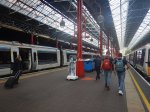
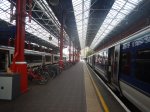
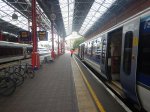
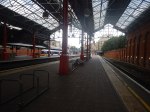

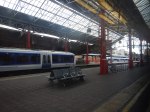
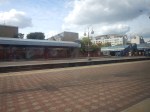


Note.
- It is a surprisingly spacious station and I feel that Furrer+Frey or some other specialist company could add some form of charging to the platforms.
- Charging would probably performed using the train’s pantograph.
It appears that the turnround time in Marylebone is typically twelve minutes or more, which should be adequate to fully charge a train.
Conclusion
Both solutions will work for Chiltern.
But I prefer the new battery-electric train, which has some crucial advantages.
- Battery-electric trains will be quieter than hybrid trains.
- Marylebone station has a noise problem and battery-electric trains are very quiet.
- Chiltern have ambitions to built new platforms at Old Oak Common and to serve Paddington. This could be easier with a battery electric train.
Rhe only disadvantage is that Banbury and Birmingham would need to be electrified.
York And Church Fenton Electrification
This news item from Network Rail is entitled Yorkshire’s First New Electric Railway In 25 Years Set To Cut Carbon And Slash Journey Times.
This section summarised the work
Work began on the York to Church Fenton electrification scheme in October 2019, and to date has delivered:
- 17 kilometres of new, more reliable track, ready to run faster trains
- An innovative 65-metre-wide under-track crossing
- 270 new steel masts, which carry the overhead electric wires
When the new wires are energised, they will allow more environmentally friendly hybrid trains to run along this section at speeds of up to 125mph – that’s 30mph faster than they currently run.
This OpenRailwayMap shows between York and Church Fenton.
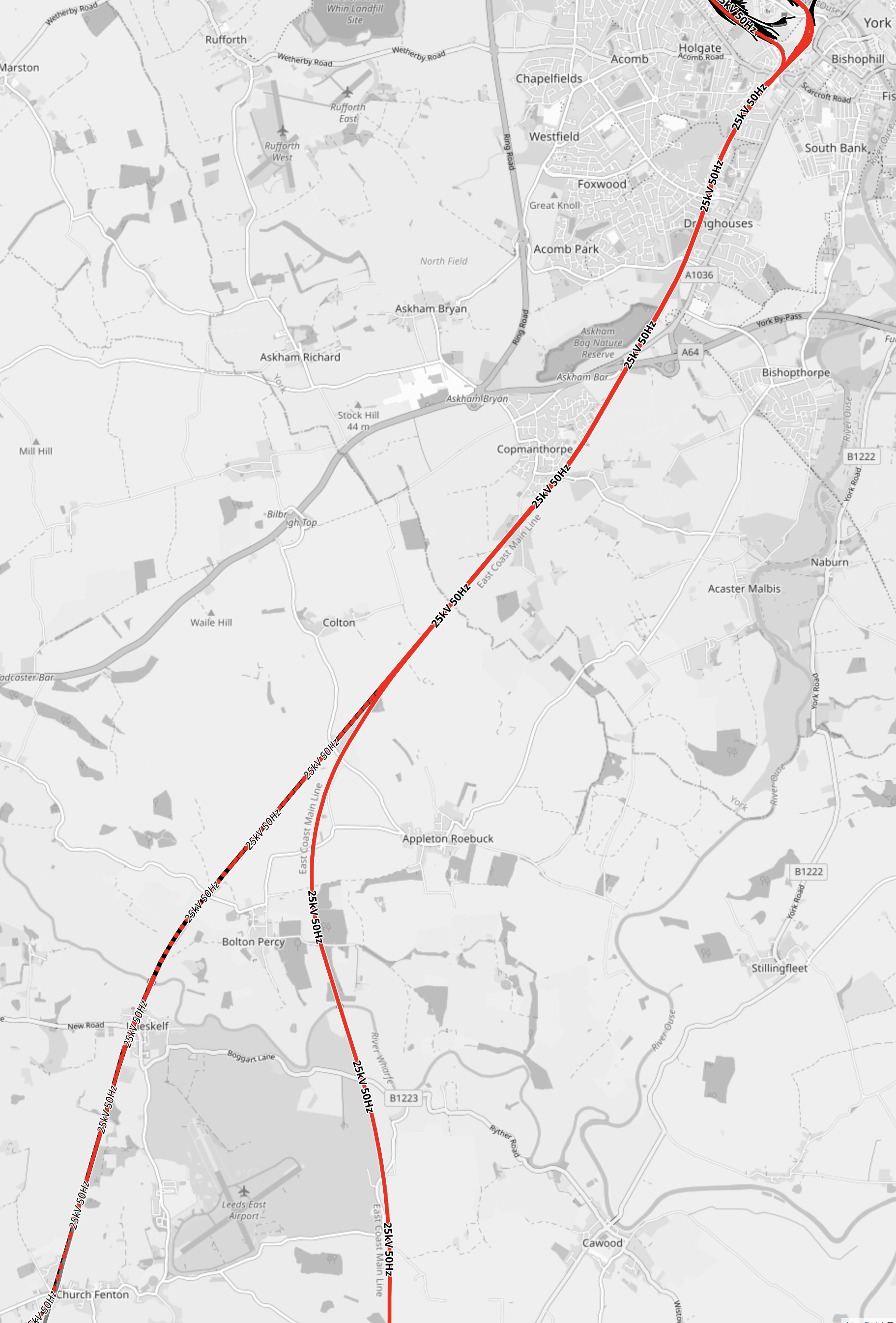
Note.
red lines indicate 25 KVAC overhead electrification.
York is in the North-East corner of the map.
Church Fenton is in the South-West corner of the map.
The track marked in red going South is the Selby Diversion, which was built in 1983 to avoid the Selby coalfield. It joins the York and Church Fenton route at Colton Junction.
The Colton Junction and Church Fenton section is marked in red and black, indicating this section is being electrified.
This second OpenRailwayMap shows between Church Fenton and Neville Hill TMD in the East of Leeds.
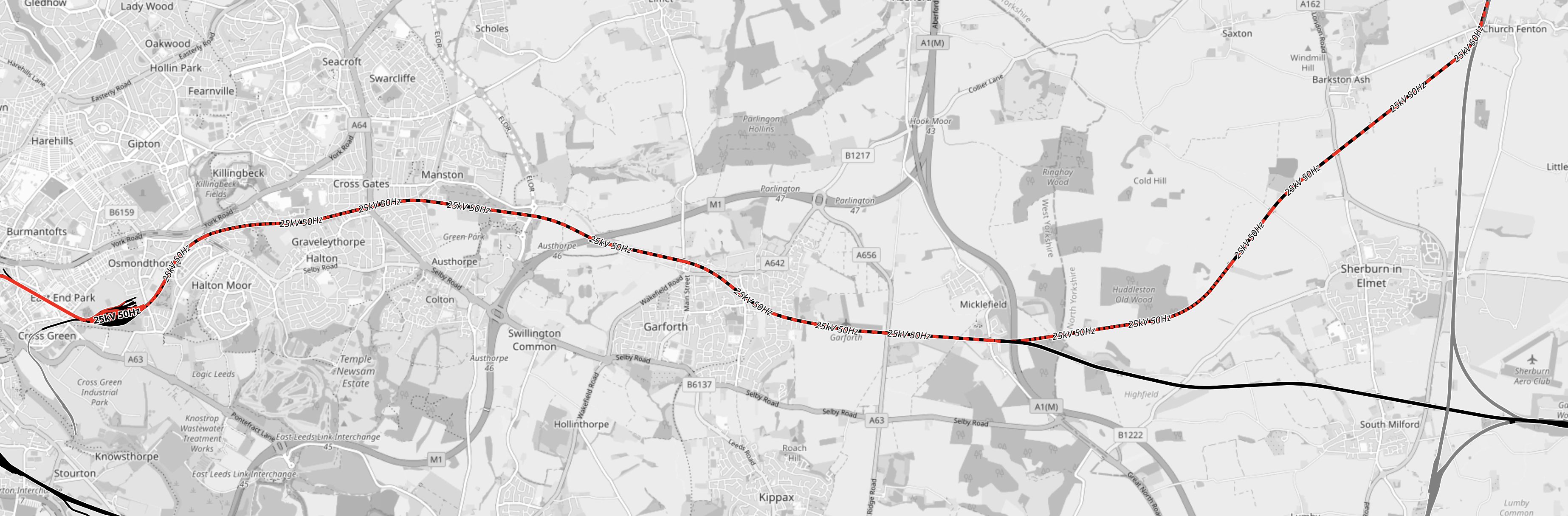
Note.
- Church Fenton is in the North-East corner of the map.
- Neville Hill TMD is the big black blob in the middle of the West edge of the map.
- The route marked in red and black will probably be the next to be electrified.
- Between Leeds and Neville Hill is electrified.
Electrification of Church Fenton and Neville Hill TMD means that the electrification between Leeds and York would be complete.
These services use this route between Leeds and York.
- TransPennine Express – 1 tph – Liverpool Lime Street and Newcastle
- TransPennine Express – 1 tph – Manchester Airport and Redcar Central
- CrossCountry – 1 tph – Plymouth and Edinburgh Waverley
In addition, the new electrified route will have other effects.
Electric trains will have direct electrified access to Neville Hill TMD from York.
Micklefield is only 42 miles from Hull and with charging at Hull, I suspect TransPennine’s Manchester Piccadilly and Hull service could go battery-electric.
 The Anonymous Widower