UK Gov’t Says Offshore Wind Backbone Of 2030 Clean Power System, Plans To Procure 12 GW More In Next Few Allocation Rounds
The title of this post, is the same as that of this article on offshoreWIND.biz.
This is the sub-heading.
Electricity generated by renewable sources and nuclear power will be the foundation of the UK’s electricity system by 2030, according to a new action plan the UK government issued in December 2024. Offshore wind, which now accounts for some 17 per cent of the country’s electricity generation, has “a particularly important role as the backbone of the clean power system”, the government said, revealing plans to make part of the path to building offshore wind farms easier as soon as before the Contract for Difference (CfD) round planned for the summer.
These two paragraphs add a few more details to the plan.
The action plan, issued by the Department for Energy Security and Net Zero (DESNZ), was presented by the UK Energy Secretary Ed Miliband on 13 December and is said to be a “major milestone to deliver on the Prime Minister’s Plan for Change which aims to drive economic growth and rebuild Britain with mission-driven government”.
Clean Power 2030 Action Plan is a roadmap to an (almost) fully clean power system in the UK by 2030, with clean sources making up 95 per cent of Great Britain’s electricity generation with gas being used for no more than 5 per cent of total generation.
This Wikipedia entry is a List of Operational Wind Farms in the UK.
Operational Offshore Wind Farms
In October 2023, there were offshore wind farms consisting of 2,695 turbines with a combined capacity of 14,703 megawatts. Strike price based on £/MWh at 2012 prices.
Wind Farms Under Construction
Offshore wind farms currently under construction (offshore), with a combined capacity in December 2024 of 7,792 MW. Strike price based on £/MWh at 2012 prices.
Pre-Construction Wind Farms
Wind farms that have started onshore construction and have been awarded contracts under the UK Government’s Contracts for Difference Round 3 (2019)/Round 4 (2022). Total capacity of 3,932 MW. Strike price based on £/MWh at 2012 prices. These projects re-bid some capacity in Round 6 (2024) with a higher strike price.
Proposed Wind Farms – Contracts For Difference Round 4
Wind farms proposed under the Round 4 (2022) CFD auction,[88] with a combined capacity of 1,428 MW . Strike price based on £/MWh at 2012 prices.
Proposed Wind Farms – Contracts For Difference Round 6
Wind farms proposed under the Round 6 (2024) CFD auction,[88] with a combined capacity of 3,763 MW . Strike price based on £/MWh at 2012 prices.
Proposed Wind Farms – Previously Awarded In The CfD Round 3
This wind farm was proposed under the UK Government’s Contracts for Difference Round 3 (2019), which it decided to withdraw from. It will likely bid in AR6 with a changed specification from the original submission
Proposed Wind Farms – Early Planning
Wind farms that are in an exploratory phase and have not yet secured a Contract for Difference at auction.
Total capacities: England: 18,423 MW – Wales: 700 MW – Scotland: 30,326 MW
Current Totals
- Operational Offshore Wind Farms – 14,703 MW
- Wind Farms Under Construction – 7,792 MW
- Pre-Construction Wind Farms – 3,932 MW
- Contracts For Difference Round 4 – 1,428 MW
- Contracts For Difference Round 6 – 3,763 MW
- Previously Awarded In The CfD Round 3 – 0 MW
- Earlp Planning – England: 18,423 MW
- Early Planning – Wales: 700 MW
- Early Planning – Scotland: 30,326 MW
Adding up these totals gives 81.067 MW
As I’m typing this, the UK is generating and importing a total of 29,330 MW of electricity.
Conclusion
Another 12 GW of new offshore wind will mean that we will have 81,067 + 12,000 – 29330 MW of electricity to put in store or sell to the Germans and other Europeans.
Perhaps we should be investing in industries, that use large quantities of electricity like hydrogen steel-making or zero-carbon cement making.
Cold Snap Leaves Britain With Less Than A Week’s Worth Of Gas
The title of this post, are the same as that of this article on The Times.
This is the sub-heading.
The closure of Russian pipelines through Ukraine and recent weather conditions have left gas stores ‘concerningly low’
These are the first two paragraphs.
Britain has less than a week of gas supplies in storage, the country’s largest supplier has warned after plunging temperatures and high demand.
Centrica, the owner of British Gas, said the UK’s gas storage was “concerningly low” after coming under pressure this winter.
The two largest gas storage facilities in this country are both in the Humberside area.
- Aldbrough is in salt caverns North of Hull and is owned by SSE.
- Rough is under the North Sea and is owned by Centrica
Both are being converted to store hydrogen.
Some might thing that is a bit stupid if we’re short of storage, but we need the hydrogen storage for four reasons.
- To store hydrogen created by electrolysers on Humberside, which will enable heavy gas users in the area to decarbonise.
- The hydrogen will also be burnt in a 1 GW hydrogen-fired power station at Keadby to back up the wind turbines, with zero-carbon electricity.
- The hydrogen will also be sold to the Germans to replace Putin’s blood-stained gas. It will be sent to Germany in a pipeline called AquaVentus, which will also deliver Scottish hydrogen across the North Sea. Hopefully, the Germans will pay a good price for the hydrogen.
- The hydrogen will be used for transport.
The mistake the Government is making is not to develop smaller gas fields, so that domestic gas users can continue to use natural gas, until the technology to replace it with zero-carbon sources is fully developed.
Building A New Concrete Revolution To Net Zero
he title of this post, is the same as that of this article on Pearls and Irritations.
The article is a good explanation of the contributions concrete makes to global warming and what we should do about it.
At least I can find entrepreneurs and scientists willing to develop concretes that will be friendlier to the planet.
- Low-Carbon Concrete: Separating Greenwash From Reality
- Earth Friendly Concrete
- Carbon-Neutral Concrete Prototype Wins €100k Architecture Prize For UK Scientists
- UK Breakthrough Could Slash Emissions From Cement
- HS2 Reveals Dramatic Carbon Saving With Ambitious Modular Design For Thame Valley Viaduct
I believe that this will be a problem that will be solved by technology.
Where Will Lumo Strike Next?
Yesterday, First Group reported that they had added more possible services to their network of open-access services.
I gave my view in FirstGroup Acquires London – South Wales Open Access Business And Plans Lumo To Devon.
Their list of possible services and destinations include.
- Hull Trains – London King’s Cross and Beverley via Stevenage, Grantham, Retford, Doncaster, Selby, Howden, Brough, Hull Paragon and Cottingham
- Hull Trains – London King’s Cross and Hull Paragon via Stevenage, Grantham, Retford, Doncaster, Selby, Howden and Brough
- Hull Trains – London King’s Cross and Sheffield via Worksop and Woodhouse
- Lumo – London Euston and Rochdale via Warrington Bank Quay, Newton-le-Willows, Eccles and Manchester Victoria
- Lumo – London King’s Cross and Edinburgh/Glasgow via Stevenage, Newcastle and Morpeth
- Lumo – London Paddington and Carmarthen via Bristol Parkway, Newport, Severn Tunnel Junction, Cardiff Central, Gowerton and Llanell
- Lumo – London Paddington and Paignton via Bath Spa, Bristol Temple Meads, Taunton, Exeter St David’s and Torquay
I believe that all services could be run by identical versions of Hitachi’s high speed Intercity Battery Electric Train, which are described in this page on the Hitachi web site.
The London Paddington and Paignton service would require the longest running without electrification at 210 km. and I don’t believe First Group would have put in a bid, unless they were certain zero-carbon trains with sufficient performance would be available.
Other possible open access services could be.
Hull And Blackpool Airport
Note.
- This could be the first half of a Green Route between the North of England and the island of Ireland, if zero-carbon aircraft can fly from Blackpool Airport.
- Trains would call at Selby, Leeds, Bradford, Huddersfield, Manchester Victoria, Blackburn and Preston.
- Blackpool Airport has good access from Squires Gate station and tram stop, which could be improved.
- Blackpool Airport could be well supplied with green electricity and hydrogen from wind power.
These are distances to possible airports.
- Belfast City – 111 nm.
- Belfast International – 114 nm.
- Cardiff – 143 nm.
- Cork – 229 nm.
- Donegal – 200 nm.
- Derry/Londonderry – 163 nm.
- Dublin – 116 nm.
- Inverness – 228 nm
- Ireland West Knock – 204 nm.
- Kerry – 253 nm.
- Ronaldsway, IOM – 59 nm.
- Shannon – 220 nm.
Note.
- The Wikipedia entry for the all-electric Eviation Alice, gives the range with reserves as 250 nm.
- The Belfast and Dublin airports could be within range of a round trip from Blackpool without refuelling.
- ,Cork, Kerry and Shannon airports may need to go by another airport, where a small battery charge is performed.
- The Isle of Man is surprisingly close.
Blackpool has reasonably good coverage for the island of Ireland.
London Euston And Holyhead
This could be the first half of a Green Route to Dublin, if the trains met a high speed hydrogen-powered catamaran to speed passengers across to Dun Laoghaire.
London King’s Cross And Aberdeen Or Inverness
Why not? But these routes would probably be best left to LNER.
London King’s Cross And Grimsby Or Cleethorpes
In Azuma Test Train Takes To The Tracks As LNER Trials Possible New Route, I talked about how LNER had run a test train to Grimsby and Cleethorpes.
The Government might prefer that an open access operator took the risk and got all the blame if the route wasn’t worth running.
Humberside is very much involved in the energy industry, with several gas-fried power-stations at Keadby.
It might be more efficient in terms of trains and infrastructure, if this service was an extension of the Lincoln service.
London King’s Cross And Scarborough Via Beverley
This would probably be one for Hull Trains, but it would also serve Bridlington and Butlin’s at Filey.
The BBC was running a story today about how holiday camps are making a comeback. Surely, one on a direct train from London wouldn’t be a bad thing. for operators, train companies or holidaymakers.
London King’s Cross And Middlesbrough, Redcar Or Saltburn
As with the Grimsby and Cleethorpes service, the government might think, that this might be a better service for an open access operator.
Teesside is heavily involved in the offshore wind industry and may add involvement in the nuclear industry.
London Paddington And Fishguard, Haverfordwest, Milford Haven Or Pembroke Dock
Note.
- This could be the first half of a Green Route to Southern Ireland, if the trains met a high speed hydrogen-powered catamaran to speed passengers across to Rosslare or an electric or hydrogen-powered aircraft from Haverfordwest Airport.
- These three ports and one airport will feature heavily in the development of offshore wind power in the Celtic Sea.
- RWE are already planning a hydrogen electrolyser in Pembrokeshire, as I wrote about in RWE Underlines Commitment To Floating Offshore Wind In The Celtic Sea Through New ‘Vision’ Document.
- According to the Wikipedia entry for Fishguard Harbour station, it was built as a station to handle ship passengers and is now owned by Stena Line, who run the ferries to Rosslare in Ireland.
- I can see a tie-up between FirstGroup and Stena Line to efficiently transfer passengers between Lumo’s planned service to Carmarthen and Stena Line’s ships to Ireland.
All four secondary destinations would be a short extension from Carmarthen.
Summing Up
Note how energy, a Green Route to Ireland and other themes keep appearing.
I do wonder if running a budget train service to an area, is an easy way of levelling up, by attracting people, commuters and industry.
Have the budget airlines improved the areas they serve?
They’ve certainly created employment in the transport, construction and hospitality industries.
Zero-Carbon Ferries And Short-Haul Aircraft
These will be essential for Anglo-Irish routes and many other routes around the world.
I will deal with the ferries first, as to create a zero-carbon ferry, only needs an appropriate power unit to be installed in a ship design that works.
But with aircraft, you have to lift the craft off the ground, which needs a lot of energy.
This article on Transport and Environment is entitled World’s First ‘Carbon Neutral’ ship Will Rely On Dead-End Fuel, with this sentence as a sub-heading.
The Danish shipping giant Maersk announced it will operate the world’s first carbon-neutral cargo vessel by 2023. The company had promised a carbon-neutral container ship by 2030 but now says it will introduce the ship seven years ahead of schedule following pressure from its customers. While welcoming Maersk’s ambition, T&E says the company is betting on the wrong horse by using methanol which may not be sustainable and available in sufficient amounts.
Note.
- I’d not heard of this ship.
- Pressure from customers brought the date forward by seven years.
- As always, it appears that the availability of enough green hydrogen and methanol is blamed.
Perhaps, Governments of the world should put more teeth in green legislation to ensure that companies and governments do what they say they are gong to do?
But worthwhile developments in the field of shipping are underway.
For instance, I estimate that this Artemis Technologies hydrofoil ferry could take passengers across the 54 nautical miles between Dun Laoghaire and Holyhead in around 90 minutes.
This ferry is being designed and built in Northern Ireland and I can’t believe, it is the only development of its type.
A Fast Green Route To Ireland
I have talked about this before in High-Speed Low-Carbon Transport Between Great Britain And Ireland and I am certain that it will happen.
- Air and sea routes between the UK and the island of Ireland carry a lot of traffic.
- Some travellers don’t like flying. Especially in Boeings, which are Ryanair’s standard issue.
- It is the sort of trip, that will appeal to a lot of travellers and most probably a lot with Irish connections.
- An electric or hydrogen-powered aircraft or a fast surface craft will be able to cross the Irish Sea in a quick time.
- High speed trains and then High Speed Two will consistently reduce the travel times on the UK side of the water.
Cross-water travel routes, be they by aircraft, ferries, bridges or tunnels are generally popular and successful.
Conclusion
Given the opportunity at Fishguard, I can see that FirstGroup next move would be to extend the Carmarthen service to Fishguard Harbour.
Thoughts On Tram-Trains In Manchester
The State Of Public Transport In the North
Over the last few years plans have been put in place to improv the state of the public transport of the major cities of the North and progress has started to happen, with new trains, trams and light rail systems being planned and in some cases coming into service.
Birmingham, Coventry And The West Midlands
A lot of investment has been made and it is continuing.
- Birmingham New Street station has been rebuilt.
- Coventry and Wolverhampton stations have been remodelled.
- Two new stations were built in Birmingham for the Commonwealth Games.
- A large number of new Class 730 local trains are being brought into service.
- Birmingham stations are being updated for High Speed Two.
- The West Midland Metro has been extended at both ends and a second line is under construction.
Transport in the wider West Midlands has been greatly improved.
Derby, Nottingham, Sheffield And The East Midlands
The major investment in this area is the electrification of the Midland Main Line and the provision of new Hitachi electric Class 810 trains.
In addition the following has been done.
- The Hope Valley line between Manchester and Sheffield has been improved.
- Derby station has been improved.
- The local trains have been refurbished.
- The power supply has been improved.
- An application for an Open Access service to Sheffield has been made.
The improvements in the East Midlands, will not be on the same scale as in the West Midlands, but they will make a difference.
Leeds, Bradford And West Yorkshire
For decades, West Yorkshire and especially Bradford has lagged behind the rest of the North.
But at least things are stirring.
- Plans have been laid to create a through station in Bradford.
- Leeds station has been refurbished.
- An extra platform is being added at Bradford Forster Square station.
- The TransPennine Upgrade is underway to electrify between Huddersfield and York.
- Hitachi have developed a battery-electric high speed train for the TransPennine route.
- Bradford is installing a hydrogen electrolyser, so that the city can have hydrogen buses to cope with the hills.
- Plans are now being developed to create a metro for Leeds and Bradford.
West Yorkshire is closing the gap to the rest of the North.
Liverpool And Merseyside
Again, a lot of investment has been made.
- The approaches to Liverpool Lime Street station have finally been sorted, with more tracks and new signalling.
- Liverpool Lime Street station has been improved and is now one of the finest stations in Europe.
- Trains are now approaching High Speed Two times between Crewe and Liverpool.
- More services between London and Liverpool can now be planned, with the arrival of new Class 807 trains.
- Some new stations have been built and more are planned.
- A large number of new Class 777 local trains are being brought into service.
Transport in the wider Merseyside has been greatly improved.
Newcastle, Tyneside And Northumberland
The area is getting investment, but not as much in proportion as others.
- The Metro trains are being replaced and the Metro itself, is getting a major update.
- The East Coast Main Line has received improvements to power supplies, signalling and some bottlenecks.
- The Northumberland Line to Ashington is being brought back into operation.
It’s a start, but if the Northumberland Line is a success, I can see a call for more line re openings.
Manchester And Greater Manchester
If you look at each of the areas, they generally have one or more large projects.
- Birmingham, Coventry And The West Midlands – Birmingham New Street station, Class 730 Trains, High Speed Two, West Midland Metro
- Derby, Nottingham, Sheffield And The East Midlands – Midland Main Line, Class 810 Trains, Hope Valley Line, Open Access To Sheffield
- Leeds, Bradford And West Yorkshire – Leeds station, Bradford improvements, TransPennine Upgrade, Battery-Ekectric Trains, Leeds Metro
- Liverpool And Merseyside – Liverpool Lime Street Improvements, Class 807 Trains, Class 777 Trains
- Newcastle, Tyneside And Northumberland – Metro upgrade with New Trains, Northumberland Line
So what improvements are in the pipeline for Greater Manchester?
This Wikipedia entry is entitled Proposed Developments Of Manchester Metrolink.
The proposed developments include in the Wikipedia order.
- New Metrolink Stop: Stop to serve new housing development proposed at Elton Reservoir on the Bury Line.
- New Metrolink Stop: Stop to serve new housing development proposed at Sandhills on the Bury Line.
- New Metrolink Stop: Stop to serve new housing development proposed at Cop Road on the Oldham and Rochdale Line.
- Airport Line extension to Terminal 2: A short extension of the Airport Line from the current Manchester Airport station to the site of the expanded Terminal 2.
- Airport Line extension to Davenport Green: An extension of the Airport Line from Roundthorn to the site of the proposed Manchester Airport High Speed station on the HS2 high speed network.
- Oldham–Heywood via Rochdale tram-train pathfinder: A tram-train service utilising the heavy rail Calder Valley line to connect Oldham to Heywood through Rochdale railway station.
- Manchester Airport–Wilmslow via Styal tram-train pathfinder: A tram-train service operating on the southern section of the heavy rail Styal Line between Manchester Airport and Wilmslow in Cheshire.
- South Manchester–Hale via Altrincham tram-train pathfinder: An extension of Metrolink’s Altrincham Line using tram-train to reach Hale on the heavy rail Mid-Cheshire line.
- Improved Metrolink frequency between Piccadilly and Victoria stations: Increasing capacity to provide a direct service from Rochdale and Oldham to Manchester Piccadilly.
- Interventions to improve Metrolink capacity and reliability: Includes improvements to turnback facilities and double-tracking currently single-track sections.
- Further interventions to improve Metrolink capacity and reliability: Includes longer vehicles, a third depot and double-tracking currently single-track sections.
- Manchester–Stalybridge extension: An extension of the East Manchester Line from Ashton-under-Lyne to Stalybridge.
- Manchester–Middleton extension: A proposed spur from the Bury Line connecting to the town of Middleton.
- Oldham–Middleton extension: A spur from Oldham to Middleton.
- MediaCityUK–Salford Crescent: A line connecting the MediaCityUK tram stop to the Salford Crescent railway station interchange. Further new Metrolink.
- Connections between Salford Crescent, Inner Salford and the City Centre: Extension of the MediaCityUK–Salford Crescent line into the regional centre.
- Completion of the Airport Line (Wythenshawe Loop): Completion of the Wythenshawe Loop by connecting the Metrolink lines between the Davenport Green and Manchester Airport Terminal 2 extensions.
- Port Salford/Salford Stadium extension: Extending the Trafford Park Line from the Trafford Centre to a proposed container terminal at Port Salford.
- Glossop tram-train: A tram-train service utilising the Glossop line between Manchester and Glossop in Derbyshire.
- Marple tram-train: A tram-train service utilising the Hope Valley line branches north of Marple towards Manchester.
- Manchester–Wigan via Atherton tram-train: A tram-train service utilising the Atherton section of the Manchester–Southport line between Manchester and Wigan.
- Manchester–Warrington tram-train: A tram-train service utilising the southern route of the Liverpool–Manchester lines between Manchester and Warrington.
- Stockport–Hazel Grove tram-train: A tram-train service between Stockport and the suburb of Hazel Grove.
- Stockport–Manchester Airport tram-train: A tram-train service between Stockport and Manchester Airport.
- Rochdale–Bury via Heywood tram-train: Extension of the Oldham–Heywood tram-train pathfinder from Heywood to Bury.
- Manchester Airport–Mid Cheshire tram-train: A tram-train service from Manchester Airport using a proposed Western Link rail line to the Mid-Cheshire line.
- Stockport–Ashton via Denton and Reddish tram-train: A tram-train service utilising the Stockport–Stalybridge line from Stockport to Ashton.
- Cornbrook–Manchester Airport via Timperley tram-train: A tram-train service from Cornbrook using the Altrincham line to Timperley, the Mid Cheshire line to Baguley, then the Wythenshawe Loop to Manchester Airport.
- Regional centre metro tunnel: Providing capacity for more services on the network.
- Oldham–Greenfield via Grotton extension: A Metrolink spur from Oldham town centre to Greenfield railway station on the Huddersfield line.
- Oldham–Royton extension: A Metrolink spur from the Oldham and Rochdale line to the town of Royton.
Note.
- The number of times that tram-trains are mentioned.
- But with its numerous rail and tram lines, Greater Manchester is ideally suited for conversion to tram-trains.
- There are three pathfinder routes for tram-trains, which will be converted first to prove the technology.
These are my detailed thoughts on tram-trains in Greater Manchester,
All Routes Could Be Run By Identical Tram-Trains
If this can be arranged, it is surely preferable from the operator, staff and passengers point-of-view.
Tram-Trains Can Run On Secondary Routes Like The Calder And Hope Valley Lines
In Manchester, this would enable some routes to be swapped from the rail to the tram network.
It would also allow trams to run between networks, so you could have a direct tram service between say Stockport and Sheffield on the Hope Valley Line.
Tram-Trains Can Be Faster
Tram-trains can be faster, when running on rail lines, so they don’t hold up expresses.
What Do Tram-Trains Look Like?
This is one of Sheffield’s Class 399 tram-trains at Rotherham Parkgate.
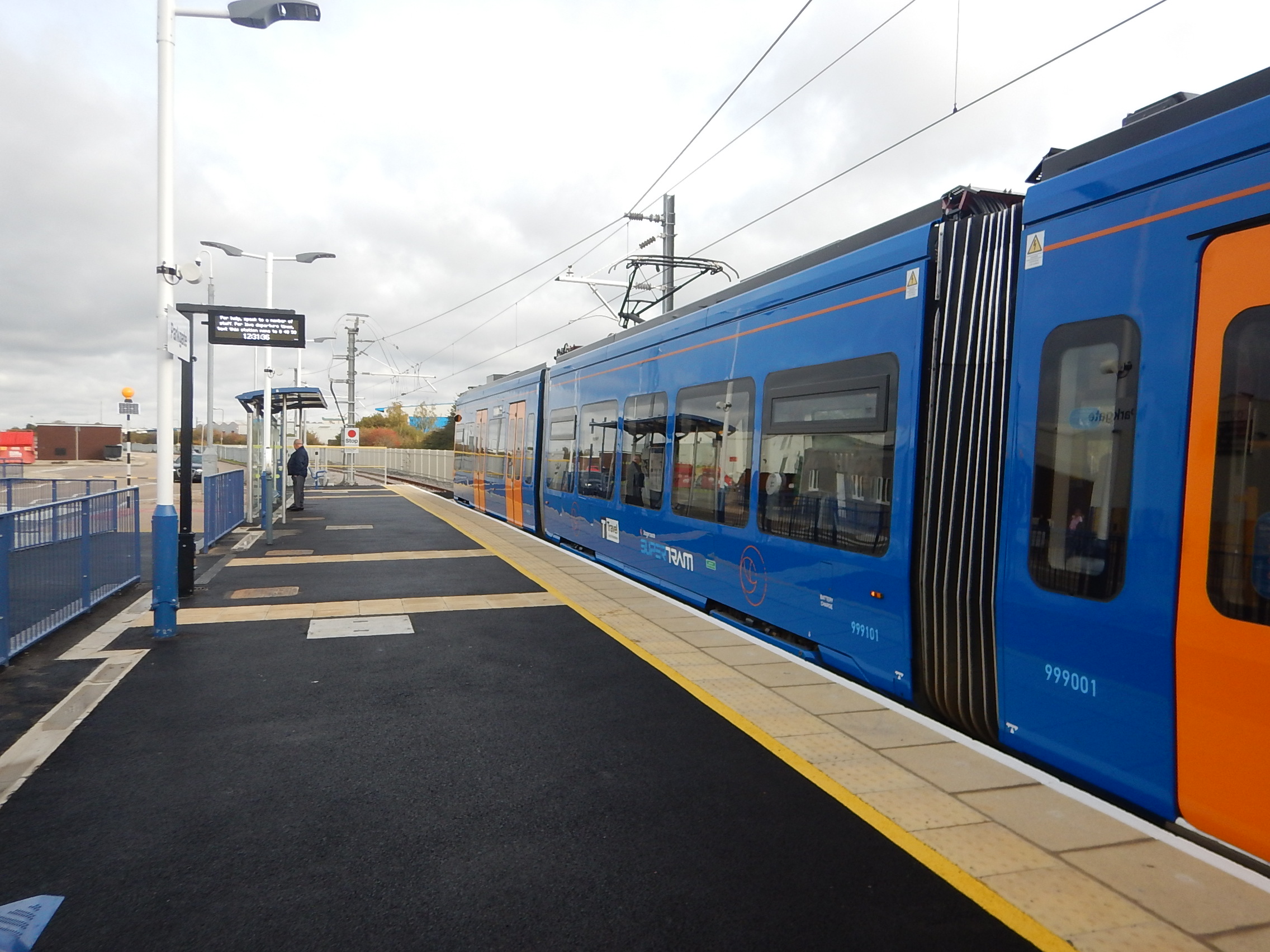
Note.
- This tram-train is a member of the Stadler Citylink family.
- this version can be powered by either 750 VDC or 25 KVAC.
- The Welsh version will also have battery-power.
- It is a three-car tram train.
- There is step-free access.
The Wikipedia entry for the Stadler Citylink has lots more details.
Stadler have just launched a new smaller one- or two-car tram-train.
This image from the press release shows the prototype hydrogen-powered one-car RS ZERO.
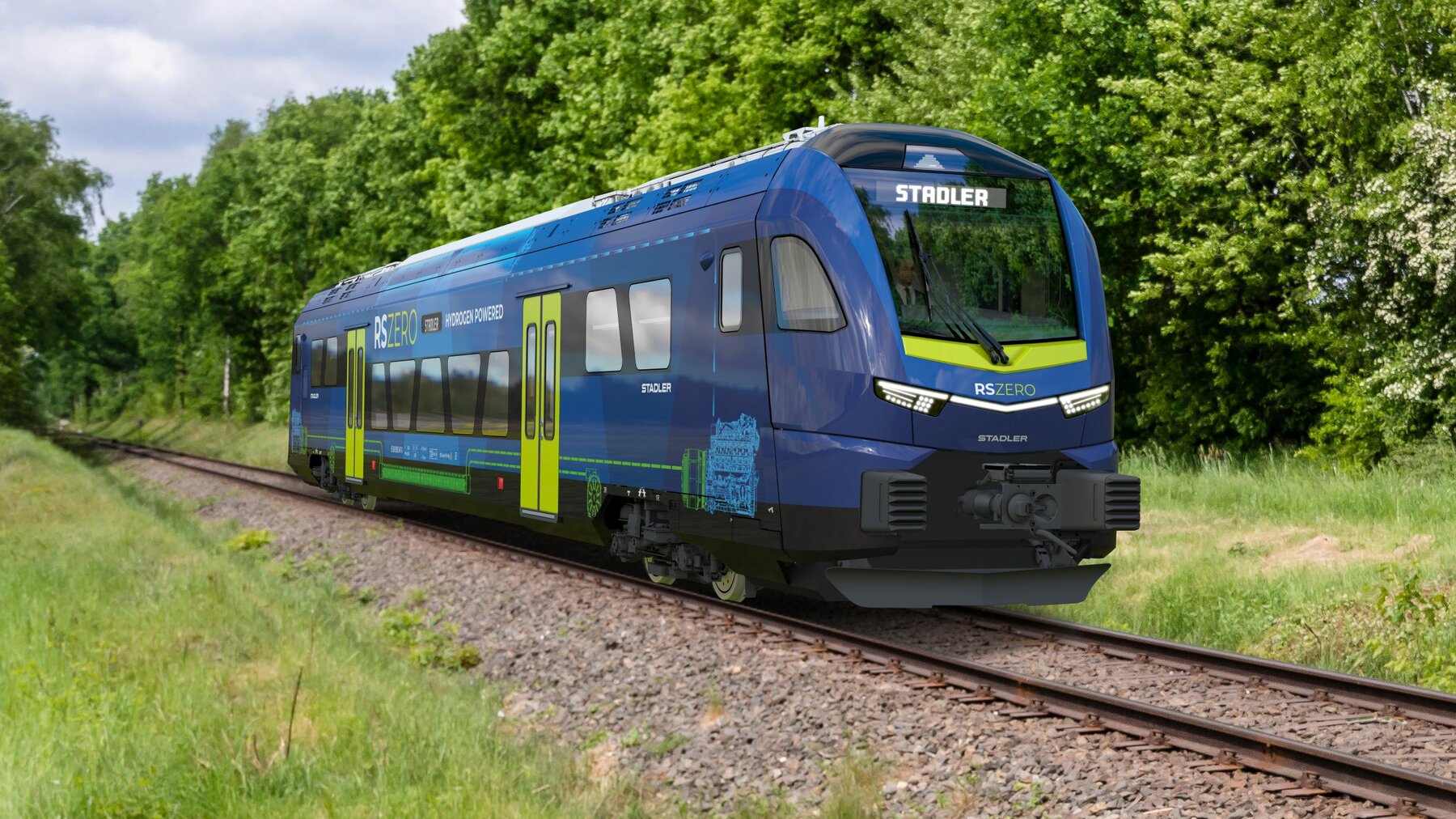
Note.
- The Regio-Shuttles can run as up to seven car trains.
- These RS ZERO are powered by overhead electrification, battery or hydrogen power.
- They can carry 170 passengers at 75 mph.
- They can run as train-trams using the Chemnitz model on compatible tram networks.
- The interiors are very flexible.
- An RS ZERO can be fitted with toilets for the posher parts of Manchester.
- Typically, a one-car RS ZERO handles a similar passenger load to a one-car Metrolink vehicle.
The more I compare the RS ZERO with the Metrolink’s trams, the more it looks like Stadler’s design has a Metrolink order firmly in its sights.
A Simple Tram-Train Example
The Altrincham Line of the Metrolink, runs between Altrincham and Deansgate-Castlefield in Central Manchester.
- Tram-trains would be capable of sharing the tracks with the current trams.
- Initially, they would run an identical service to the same destinations in the North.
- At either Navigation Road or Altrincham stations, they would switch to the heavy rail track.
- They would then travel to Hale or whatever station is determined to be the terminus.
Tram-trains would be a simple way of extending a tram service along a heavy eail line.
The Range Of The RS ZERO
This article on the Railway Gazette is entitled Prototype RS Zero Hydrogen Or Battery Railcar For Secondary Lines Unveiled At InnoTrans, has this paragraph.
The hydrogen powered RS Zero has a range of more than 700 km in the single car version, and a two-car version would offer more than 1 000 km. Battery trains will offer ranges of 80 to 110 km or 90 to 180 km. The maximum speed is 120 km/h.
As Chester and Manchester is only 45 miles or 72.4 kilometres, ways and means of running the battery versions on the route should be possible.
In fact, as Stockport and Manchester Piccadilly is already electrified at 25 KVAC and a return trip to Manchester Piccadilly from Stockport probably takes about twenty-five minutes, I would envisage that an RS ZERO would leave Stockport for Chester with a full battery. As Stockport and Chester is only 39.2 miles or 63 kilometres, the RS ZERO should do the trip if it started with a full battery and had a short length of electrification at Chester to top up the battery, if needed.
Other Possible Tram-Train Routes From Stockport
It is indicated the Metrolink would like to run other tram-train routes from Stockport.
- Ashton – Not sure of the route
- Buxton – 31.8 km
- Hazel Grove – 5 km – Electrified
- Manchester Piccadilly – 9 km – Electrified
- Manchester Airport – Not sure of the route
- Sheffield – 59 km – Will be electrified at Sheffield
Note.
- This would speed up Sheffield services.
- Buxton would be an interesting route and would probably use Newton’s friend to help on the return.
I suspect that nearly all local services from Manchester through Stockport could be run by battery-electric or hydrogen tram-trains.
The Glossop Line Could Be Converted To Tram-Train
It’s already electrified so why not?
Conclusion
It strikes me, that a lot of Manchester’s suburban rail network could be converted to RS ZERO tram-trains.
The RS ZERO tram-trains could also be used on existing tram routes to convert them to tram-train operation and extend them.
As a bonus Manchester’s trains would be substantially decarbonised.
BP’s Morven Wind Farm At Risk Of Missing Start Date
The title of this post, is the same as that as this article in The Times.
This is the sub-heading.
A lengthening queue for grid connection could scupper plans to provide energy for three million homes from a development in the North Sea by the end of the decade
These two paragraphs introduce the article.
One of the largest wind farms in the UK risks missing its 2030 target to start generating power, due to lengthy grid connection queues and supply chain shortages.
The Morven Wind Farm being developed by BP, which is to be located 38 miles off the coast of Aberdeen, will have capacity of 2.9 gigawatts, which is expected to be capable of powering three million homes in Britain.
The delays in getting a grid connection and obtaining various electrical parts could derail BP’s plans.
The Morven wind farm is one of three being developed by a partnership of BP and a German company, which is outlined in this paragraph.
Morven is one of three UK wind farms being built by BP in a joint venture with Energie Baden-Württemberg AG (EnBW), the German energy company. The other two, Mona and Morgan, are being developed in the Irish Sea and have already secured grid connections.
These are my thoughts on the problems with the Morven Wind Farm.
Everybody is assuming that there will be a large cable to bring the 2.9 GW of electricity to the Scottish coast somewhere near Aberdeen.
Cables can be a problem as the article indicates, with connection to the grid and the erection of large numbers of pylons being major ones.
But the energy from Morven doesn’t necessarily need to go to Scotland.
It can be converted into hydrogen using an offshore electrolyser and sent to where it is needed by pipeline or a tanker ship.
I have also noted that BP’s partners are German and Germany has a massive need for zero-carbon energy to replace the large amount of coal they burn.
The Germans are building a massive pipeline called AquaVentus, from their North-West coast to the Dogger Bank, to collect hydrogen created by up to 10 GW of offshore wind farms in the German Ocean or their part of the North Sea to the shore.
I introduced AquaVentus in this post called AquaVentus.
This video shows the structure of AquaVentus.
I clipped this map from the video.

Note.
- The thick white line running North-West/South-East is the spine of AquaVentus, that will deliver hydrogen to Germany.
- There is a link to Esbjerg in Denmark, that is marked DK.
- There appears to be an undeveloped link to Norway, which goes North,
- There appears to be an undeveloped link to Peterhead in Scotland, that is marked UK.
- There appears to be a link to just North of the Humber in England, that is marked UK.
- Just North of the Humber are the two massive gas storage sites of Aldbrough owned by SSE and Brough owned by Centrica.
- Aldbrough and Rough gas storage sites are being converted into two of the largest hydrogen storage sites in the world!
- There appear to be small ships sailing up and down the East Coast of the UK. Are these small coastal tankers, that are distributing the hydrogen to where it is needed?
When it is completed, AquaVentus will be a very comprehensive hydrogen network.
- Pipelines from Denmark, Norway, The Netherlands and the UK will feed directly into AquaVentus.
- Will enBW and BP build a giant offshore electrolyser at Morven and send the hydrogen to Germany via the spine of AquaVentus?
- Will AquaVentus use the vast hydrogen storage North of Hull to store excess hydrogen?
- Will connections be built between AquaVentus and the UK’s Northern gas terminals at St Fergus and Easington?
If AquaVentus works as intended, Germany’s Russian gas will be replaced by zero-carbon hydrogen, a large proportion of which will come from the UK’s waters.
Where Will We Get Our Electricity From?
If the energy from Morven is sold to the Germans as hydrogen, where will we get the energy we need?
Morven is just one of several large wind farms and being developed around the North of Scotland and we’ll probably use the energy from another wind farm.
- Wind farms that can best send their energy to the grid, will do so.
- Wind farms that can best send their energy to one or more of the large Scottish pumped storage hydro-electric power-stations, will do so.
- Wind farms that can best send their energy to Germany as hydrogen, will do so.
- Wind farms that can best send their energy to Scotland or another country as hydrogen, will do so.
The hydrogen will get distributed to those who need it and can pay the appropriate price.
Where Will The Turbines And the Electrical Gubbins Come From?
I’m sure that if Morven was sending a couple of GW of hydrogen to Germany, Siemens could build the turbines and the associated electrical gubbins needed at a favourable price, with an acceptable delivery date.
Conclusion
Germany will likely be pleased, in that they will be able to close a lot of very dirty coal-fired power stations, by replacing coal with green hydrogen.
The UK should be pleased, as the Germans will pay us for the hydrogen.
As for Putin, who knows, what the mad Russian will do?
Trump Could Be A Disaster For The Environment
This article on ITVx is entitled ‘Drill, baby, drill’: What Trump’s Re-election Could Mean For Our Climate
The article is a must-read.
It starts with a picture that has a placard that says “Trump Digs Coal”
I certainly don’t and have felt that way since probably the Aberfan disaster of 1966.
This is the first paragraph from the Wikimedia entry.
The Aberfan disaster was the catastrophic collapse of a colliery spoil tip on 21 October 1966. The tip had been created on a mountain slope above the Welsh village of Aberfan, near Merthyr Tydfil, and overlaid a natural spring. Heavy rain led to a build-up of water within the tip which caused it to suddenly slide downhill as a slurry, killing 116 children and 28 adults as it engulfed Pantglas Junior School and a row of houses.
In coal mining areas, disasters still happen.
We should all show our disgust at Trump ad the people who voted for him, by not buying any American products, unless it is absolutely necessary.
Stadler Presents A World First In Berlin
The title of this post, is the same as that of this press release from Stadler.
These are the first two paragraphs.
With the RS ZERO, the rail vehicle manufacturer is presenting the successor to the successful Regio-Shuttle RS1 model. There is a choice of two modern and environmentally friendly drive technologies: Hydrogen and battery. Both will enable CO2 emission-free operation of secondary lines in the future.
Stadler today unveiled the prototype of the new RS ZERO, the innovative successor to the successful RS1 Regio-Shuttle. The Regio-Shuttle has been one of the most popular vehicles in German regional rail transport for 28 years, with around 500 RS1 vehicles currently in operation in Germany and the Czech Republic. Stadler is building on this proven technology and integrating state-of-the-art, environmentally friendly drive systems. The RS ZERO is optionally available with a hydrogen and/or battery drive and thus not only sets new standards for environmentally friendly rail transport, but also presents a world first.
These pictures from Chemnitz Trams And The Chemnitz Model, show the Regio-Shuttle RS1.




Note.
- The Regio-Shuttles can run as up to seven car trains.
- These Regio-Shuttles are electro-diesel.
- The distinctive diagonal windows.
- They can carry 170 passengers at 75 mph.
- They can run as train-trams using the Chemnitz model on compatible tram networks.
The Regio-Shuttle Wikipedia entry gives more details.
This image from the press release shows the prototype RS ZERO.
It looks very similar to my pictures from Chemnitz.
I have a few thoughts.
Comparison To A Class 150 Train
A Class 150 train can carry up to 149 seated passengers at 75 mph, which is similar to the RS ZERO.
As Stadler have built trains for Greater Anglia, Merseyrail and the Glasgow Subway, I believe that Stadler could build an RS ZERO, that would fit the UK loading gauge.
In What Train Is This?, I show the standard of interior, that can be achieved by refurbishing a Class 150 train, but unlike the RS ZERO, the train won’t be zero-carbon.
Does The RS ZERO Have A Toilet?
This is a paragraph from the press release.
The prototype of the RS ZERO presented today in Berlin is a one-car vehicle with hydrogen drive. Stadler is demonstrating the numerous design options with a multi-purpose area equipped for carrying bicycles, pushchairs and bulky luggage, lounge and comfort zones, standard and privacy seats, a wheelchair space, WC and a train office.
The train appears to be able to have what an operator might need.
What Will Be The Range Of An RS ZERO On Hydrogen?
I suspect, Stadler will provide a train, that will handle the route.
Conclusion
This could be a very handy train to decarbonise branch and secondary lines in the UK.
Where’s The Plan, Rishi?
In RWE Goes For An Additional 10 GW Of Offshore Wind In UK Waters In 2030, I detailed how RWE intended to add an extra 10 GW of offshore wind to the seas around the UK.
As our current offshore wind capacity is around 15 GW, another 10 GW would surely be very welcome.
My post also outlined H2ercules, which is Germany’s massive project to create a hydrogen network to bring hydrogen to Southern Germany.
I also gave details of the hydrogen hub at Wilhelmshaven, which is being built by Uniper to feed H2ercules with green hydrogen from around the world.
I believe that some of this hydrogen for H2ercules will take a short trip across the North Sea from UK waters, after being created by offshore electrolysers.
Rishi Sunak’s Manifesto Speech – June 11
I also reported on Rishi Sunak’s Manifesto Speech, which he made on June 11th. This is an extract
This document on the Policy Mogul web site is entitled Rishi Sunak – Conservative Party Manifesto Speech – Jun 11.
These are three paragraphs from the speech.
We don’t just need military and border security. As Putin’s invasion of Ukraine has shown, we need energy security too. It is only by having reliable, home-grown sources of energy that we can deny dictators the ability to send our bills soaring. So, in our approach to energy policy we will put security and your family finances ahead of unaffordable eco zealotry.
Unlike Labour we don’t believe that we will achieve that energy security via a state-controlled energy company that doesn’t in fact produce any energy. That will only increase costs, and as Penny said on Friday there’s only one thing that GB in Starmer and Miliband’s GB Energy stands for, and that’s giant bills.
Our clear plan is to achieve energy security through new gas-powered stations, trebling our offshore wind capacity and by having new fleets of small modular reactors. These will make the UK a net exporter of electricity, giving us greater energy independence and security from the aggressive actions of dictators . Now let me just reiterate that, with our plan, we will produce enough electricity to both meet our domestic needs and export to our neighbours. Look at that. A clear, Conservative plan not only generating security, but also prosperity for our country.
It is now nine days since Rishi made that speech and I can’t remember any reports about an energy security policy, which he outlined in the last paragraph of my extract from his speech.
He particularly mentioned.
- New gas-powered stations
- Trebling our offshore wind capacity
- Having new fleets of small modular reactors.
He also said we would have sufficient electricity to export to our neighbours. As I said earlier some of this energy will be in the form of hydrogen, which has been created by offshore electrolysers.
If we are exporting electricity and hydrogen to Europe, this is likely to have three effects.
- An improvement in Europe’s energy security.
- H2ercules will improve and decarbonise German industry, using UK hydrogen.
- The finances of UK plc will improve.
It looks like there will be winners all round.
Rishi also said this, in his speech.
As Putin’s invasion of Ukraine has shown, we need energy security too.
The gas-powered stations, offshore wind farms and the fleets of small modular reactors, will be part of the equation.
But I believe, we need three other components to complete our energy security.
- The upgrading of the National Grid.
- The building of four x 2 GW interconnectors between Scotland and Eastern England.
- Large amounts of energy storage.
Note.
- The Great Grid Upgrade and the four x 2 GW interconnectors are being planned.
- In Huge Boost To UK Supply Chain As National Grid Launches The Great Grid Partnership With Seven New Industry Partners, All United In The Drive To Deliver The Great Grid Upgrade, I describe how National Grid has setup the Great Grid Partnership to deliver the Great Grid Upgrade.
- In UK Infrastructure Bank, Centrica & Partners Invest £300M in Highview Power Clean Energy Storage Programme To Boost UK’s Energy Security, I describe how the big boys do a deal with Highview Power to create affordable batteries for the UK and the world.
- In Grid Powers Up With One Of Europe’s Biggest Battery Storage Sites, I describe how the very large Swardeston BESS is to be built near Norwich.
- In Mercia Power Response & RheEnergise Working Together To Build Long Duration Energy Storage Projects In The UK, I describe another UK-developed long duration energy storage system, which is now being planned.
- In National Grid Shares Proposals For Green Electricity Projects In Lincolnshire And West Norfolk, Needed To Boost Home-Grown Energy Supplies And Progress Towards Net Zero, I describe National Grid’s projects in the East of England.
- In UK ESO Unveils GBP 58 Billion Grid Investment Plan To Reach 86 GW of Offshore Wind By 2035, I show how we’re not that far away from 86 GW by 2035.
- In 400k For National Grid Innovation Projects As Part Of Ofgem Fund To Help Shape Britain’s Net Zero Transition, I describe how National Grid is using innovation to help target net-zero by 2035.
- In Iberdrola Preparing Two East Anglia Offshore Wind Projects For UK’s Sixth CfD Round, I describe how Iberdrola is getting 1.7 GW ready for commissioning in 2026.
- In National Grid To Accelerate Up To 20GW Of Grid Connections Across Its Transmission And Distribution Networks, I describe how National Grid are accelerating the development of the electricity networks. 10 GW of battery storage is a collateral benefit.
These ten projects, most of which are financed and/or underway, would appear to be good foundations, on which to build the Great Grid Upgrade.
It looks to me, that National Grid, RWE, Centrica, Iberdrola and others, by just doing what comes naturally have offered the next government a road to a future.
It will be interesting, what gets said before the election.
 The Anonymous Widower