Man In Seat 61: My Nail-Biting Journey To Orkney By Train And Ferry
The title of this post is the same as that of this article in The Times.
This is the heading.
Now the Caledonian Sleeper connects the Midlands to Scotland in style. Mark Smith travels to the UK’s most northerly rail station and beyond
These are the first two paragraphs.
In January the Caledonian Sleeper added Birmingham to its route from London to Scotland — its first new stop in 30 years. With a ticket for one of the first departures and a bucket-list desire to see the historic naval anchorage that is Scapa Flow, I would ride the sleeper to Inverness, take Scotland’s scenic Far North Line to Britain’s northernmost station and then sail across the Pentland Firth to Stromness. I could leave my Buckinghamshire home in the evening and reach Orkney 24 hours later without setting foot on a plane. It sounded like a plan.
The Highland sleeper (which travels to the Highlands; there is also a Lowland sleeper that travels to Edinburgh and Glasgow) rolled into Birmingham International at 10.42pm on the dot. I was greeted at the door by a steward with a friendly Scottish accent and my room key. He jotted down my breakfast reservation and I headed for room 4 in car L. The Cal Sleeper is rightly proud of its Scottish-made mattresses and fluffy duvets and I drifted off to sleep in my cosy berth to the sound of steel wheel on steel rail.
I feel adding a Birmingham International stop is a masterstroke, as it gives so many travel options.
- You could of course still join in London.
- I might go to Birmingham on Chiltern, as I prefer the trains to Avanti West Coast.
- There are lots of shows and exhibitions in Birmingham.
- If you had a relative in Scotland and you lived in the far South-East of England and Wales, half of the journey would be in a comfortable bed.
- Birmingham International has regular connections to Aberystwyth, Bournemouth, Pwllheli, Shrewsbury and Wrexham General.
- Some journeys might be easier with a change between plane and sleeper train at Birmingham International.
The list is endless and will grow as travellers have other ideas.
More imagination needs to be added to train journeys.
My first thoughts are.
There needs to be a Lumo-style service between Birmingham and Scotland and a sleeper between Birmingham and Penzance.
MoU Signed To Develop Scottish Highlands As Offshore Wind And Renewables Hub
The title of this post, is the same as that of this article on offshoreWIND.biz.
This is the sub-heading.
The Inverness and Cromarty Firth Green Freeport (ICFGF) has signed a Memorandum of Understanding (MoU) with the UK and Scottish governments and The Highland Council, creating a formal framework for cooperation in developing the Highlands as a major international hub for the offshore wind and renewable energy sector
This is the first paragraph.
The agreement is said to unlock GBP 25 million (approximately EUR 29 million) in funding from the UK government, which ICFGF plans to use to support the delivery of significant infrastructure projects and its partner ports.
These are some points from the rest of the article.
- Inverness and Cromarty Firth Green Freeport aims to bring up to 11,300 jobs to the Highlands.
- Significant investments we’ve already include the Sumitomo subsea cable plant at Nigg and the Haventus energy transition facility at Ardersier.
- Over the next 25 years, ICFGF is expected to attract over GBP 6.5 billion of investment.
- The Green Freeport includes three tax sites: Cromarty Firth, which includes Port of Nigg, Port of Cromarty Firth, and Highland Deephaven.
- Ardersier Energy Transition Facility has secured a GBP 100 million joint credit facility to create nationally significant infrastructure for industrial-scale deployment of fixed and floating offshore wind.
- It has placed contracts with more than 110 local firms as part of the development.
These investments will setup the long-term future of Inverness and the Highlands of Scotland.
The Inverness and Cromarty Firth Green Freeport (ICFGF) has this web site, with these messages on the home page.
Europe’s strategic hub for renewable energy
Transforming the Highland economy and delivering national energy security
Conclusion
This area will become one of the most vibrant places in Europe.
Haventus, Sarens PSG Unveil ‘On-Land to Launch’ Floating Wind Solution
The title of this post, is the same as that of this article on offshoreWIND.biz.
This is the sub-heading.
UK companies Haventus and Sarens PSG have developed a low-cost solution for the integration and launch of floating offshore wind turbines.
These two introductory paragraphs add more details.
Haventus said that it is working to enable offshore wind project developers to acquire fully assembled floating bases and turbines at Ardersier, Scotland, as well as providing dry storage which does not require complex licensing.
A heavy-lift solution will enable safe on-land integration and launch to the harbour of fully integrated floating offshore wind turbines.
Note.
- Haventus introduce themselves on their web site, as an energy transition facilities provider, offering pivotal infrastructure for the offshore wind industry. The first facility, they are developing is the Port of Ardesier in the North of Scotland, to the North-East of Inverness.
- Sarens PSG introduce themselves on their web site, as specialists in turnkey heavy lifting and transportation solutions for offshore wind component load-in, marshalling, assembly, deployment, and integration.
It looks to me that the two companies are ideal partners to put together flotillas of large floating wind turbines.
These two paragraphs seem to describe the objectives of the partnership.
This should shorten supply chains through single-site sourcing of key components and remove the operational, safety, logistical, and engineering complexity that comes with storage and integration activities in the marine environment.
The companies also said that the solution can also drive down the costs and accelerate floating offshore wind deployment by simplifying transport and installation requirements and remove the obstacles of weather and design life variables that must be considered with ‘wet’ storage and integration.
I was always told as a young engineer to define your objectives first, as you might find this helps with the design and costs of the project.
I do wonder sometimes, if the objectives of High Speed Two smelt too much of a project designed by lots of parties, who all had different objectives.
The Location Of The Port Of Ardesier
This Google Map shows the location of the Port of Ardesier in relation to Inverness, the Orkneys and Shetlands, and Norway.
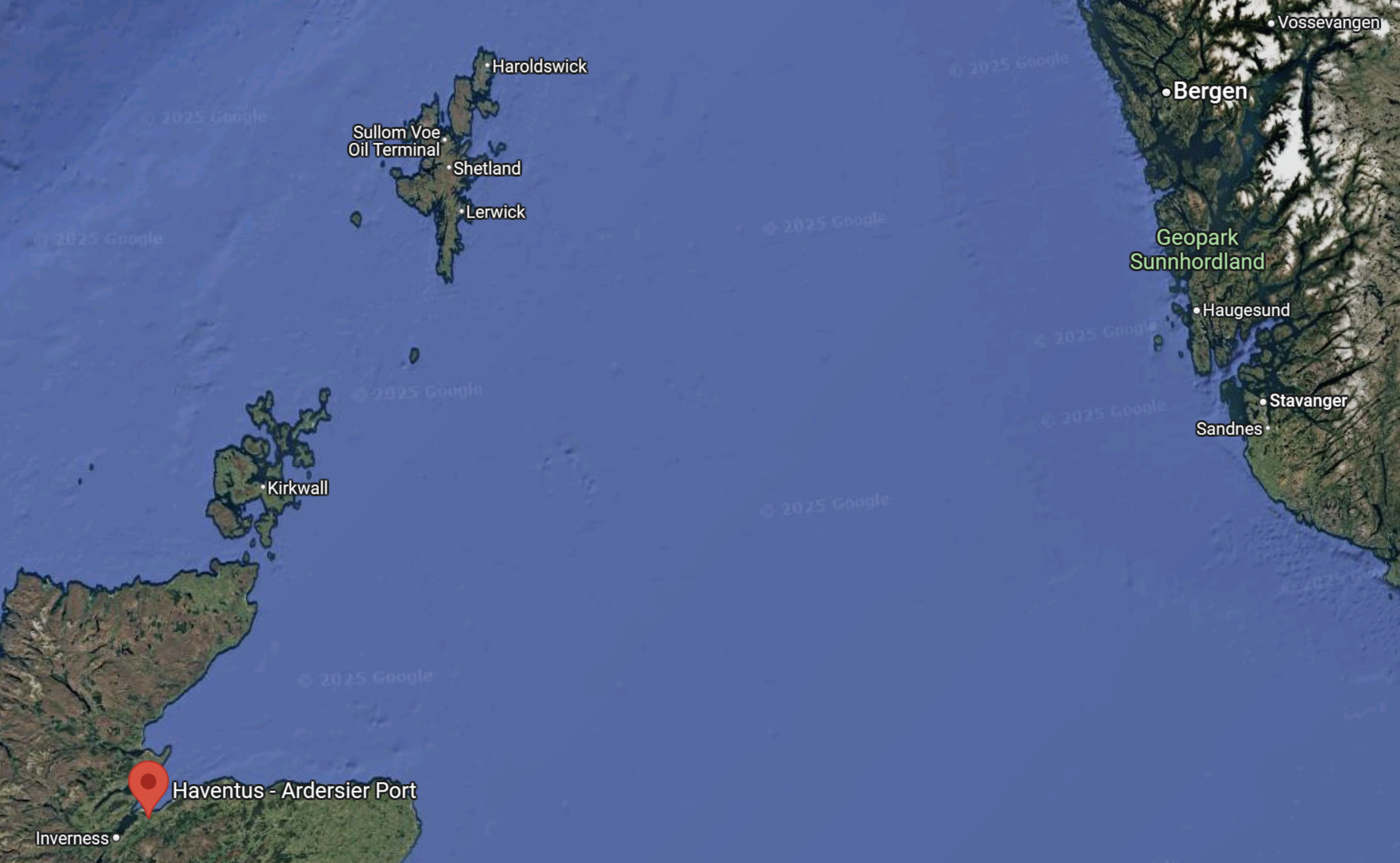
The Port of Ardesier would appear to be ideally placed to bring in business for the partnership.
SSE Announces Construction Of Aberarder Wind Farm
The title of this post, is the same as that as an advert on my online edition of The Times.
Click the advert and you get this page, with the title of this post.
This is the sub-heading.
Aberarder secured 15-year CfD in UK Allocation Round 5
These three paragraphs give more details of the wind farm.
SSE has taken a final investment decision to proceed with Aberarder Wind Farm in the Scottish Highlands, in a circa £100m investment boost for its onshore wind portfolio.
Construction of the 12 turbine, 50MW wind farm, which is wholly owned by SSE Renewables, will begin before the end of the year with completion scheduled for the end of 2026. The Aberarder project was successful in September 2023 in the UK’s fifth Contract for Difference (CfD) Allocation round, securing a 15-year contract for low-carbon power generation.
Located at Strathnairn near Inverness, on a natural plateau at an average of 700m above sea level, the Aberarder project site sits directly adjacent to the operational 94MW Dunmaglass Wind Farm, which is jointly owned by SSE Renewables and Greencoat UK Wind.
It would appear that a £100m investment in the Scottish Highlands will get you a fully-operational 50 MW wind farm.
These are my observations and thoughts.
SSE’s Project Overview Of Aberarder Wind Farm
These four paragraphs are SSE’s project overview from this page on the SSE Renewables web site.
The Aberarder Wind Farm project is located in Strathnairn near Inverness, on a natural plateau at an average of 700m above sea level. It will sit directly adjacent to the operational 94MW Dunmaglass Wind Farm, which is jointly owned by SSE Renewables and Greencoat UK Wind.
The project was developed by RES and consented by The Highland Council in April 2017. The consent allows for the construction of a 12-turbine onshore wind farm, with each turbine having a maximum tip height of up to 130m and is expected to have an export capacity of 49.9MW. SSE Renewables reached an agreement with RES to acquire Aberarder in October 2022.
In September 2023 Aberarder was successful in the UK’s fifth Contract for Difference (CfD) Allocation Round and was awarded a 15-year contract for low carbon power generation. SSE took a final investment decision to proceed with Aberarder Wind Farm, in a circa £100m investment in May 2024, construction is scheduled to begin before the end of 2024 with completion scheduled for the end of 2026.
Our focus is now on building strong and meaningful relationships with the local community surrounding the Aberarder Wind Farm. As a responsible developer and operator, we are looking forward to working closely with the community in surrounding area to fully realise the benefits of this exciting project.
Construction has now started and it would appear that in two years, the twelve-turbine wind farm will be producing power.
SSE’s Description Of Dunmaglass Wind Farm
These four paragraphs are SSE’s description from this page on the SSE Renewables web site.
Located to the south east of Inverness, on a natural plateau at an average of 700m above sea level, Dunmaglass is SSE’s highest wind farm to be constructed.
SSE acquired the project from RES in May 2013 and initial enabling works began in the summer of 2013 which included the upgrading of 11km of tracks and the construction of two timber deck bridges.
Highland contractor RJ McLeod was awarded the £16m main civil works contract in summer 2014.
Dunmaglass became fully operational in 2017.
This paragraph also illustrates the challeges of the It looks like the construction of the larger Dunmaglass wind farm.
The height at which Dunmaglass is located presented its challenges during construction and the winter months brought high winds and plenty of snow. The site was fully completed and handed to the operations team in 2017.
Surprisingly, the legendary Highland midges didn’t get a mention.
The Sale Of 49.9 % Of Dunmaglass Wind Farm To Greencoat UK Wind
This sub-heading outlines the sale.
In February 2019, SSE sold 49.9% of Dunmaglass to Greencoat UK Wind PLC as part of a deal in which Greencoat acquired a 49.9% stake in both Dunmaglass and the nearby Stronelairg wind farm.
This paragraph gives more details of the sale.
In February 2019, SSE signed agreements for the sale of 49.9% of Dunmaglass wind farm to Greencoat UK Wind Plc (“UKW”). This sale was part of a £635m deal in which Greencoat acquired a 49.9% stake in both Stronelairg and Dunmaglass wind farms. The stakes equate to 160.6MW (megawatts) of capacity, with an average valuation for the two wind farms of around £4m per MW. This valuation demonstrates SSE’s ability develop quality, low carbon assets and infrastructure vital to the GB energy market.
The interesting figure is that SSE was paid £4m per MW for the interest of 160.6 MW, that they sold.
Aberarder wind farm is a 50 MW wind farm and it appears that it will cost £100 million to build.
If after a couple of years of operation, the wind farm is worth £4 million per MW, then SSE have doubled their money.
Does this illustrate, why the professionals like SSE and Greencoat UK Wind invest in wind farms?
- SSE would have taken the risk, that they could build the wind farm.
- SSE have the engineering skillsto do an excellent job.
- Greencoat UK Wind are buying into a producing asset, with a known cash flow.
SSE also get more money to build more wind farms.
Where Are Aberarder And Dunmaglass?
This Google Map shows the site of Aberarder wind farm with respect to Inverness.
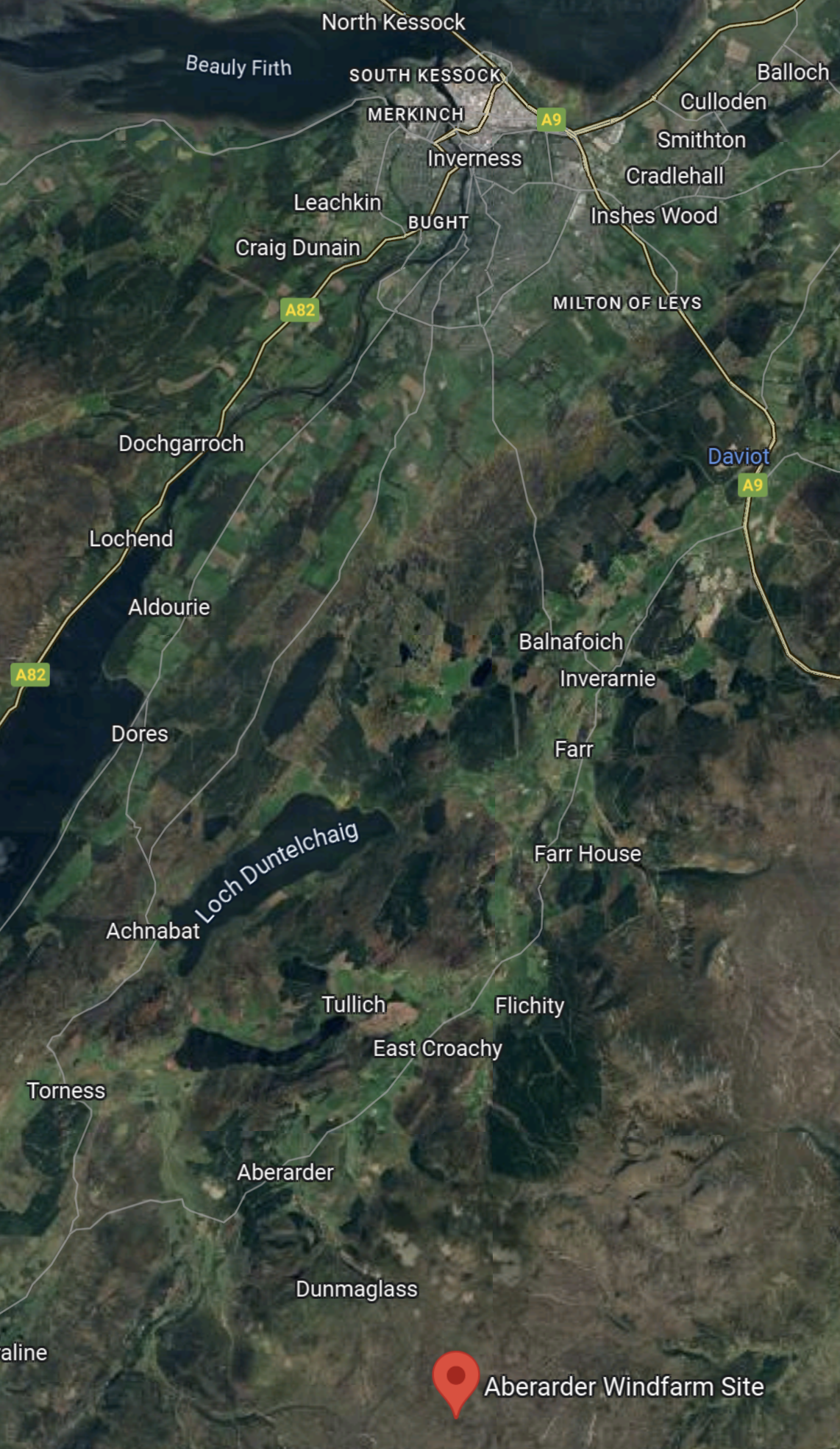
Note.
- Inverness is at the top of the map on the waters of the Solway Firth.
- Aberarder wind farm is marked by the red arrow.
- Aberarder is a hamlet to the North-West of the wind farm.
- Drumnaglass is a shooting estate to the North-West of the wind farm.
- Loch Duntelchaig is the main reservoir for Inverness.
This second Google Map shows the Drumnaglass wind farm.
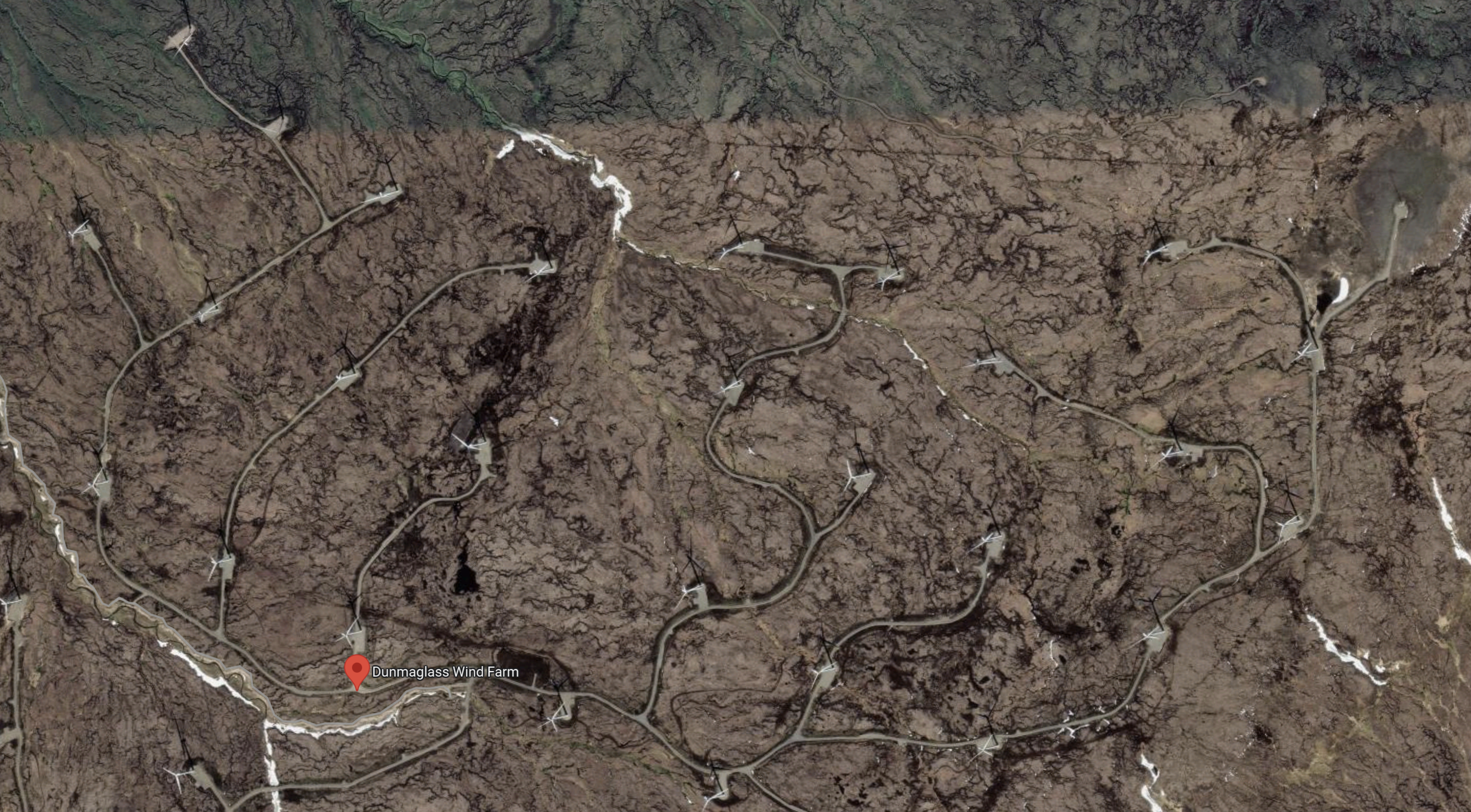
Note.
- Drumnaglass wind farm has 33 turbines and a capacity of 94.05 MW.
- There is a track network of 11 km. linking all the turbines.
- A good proportion of the turbines can be picked out on the map.
It would appear that Aberarder wind farm will lie to the South-East of this wind farm.
Aberarder Wind Farm To Fort Augustus
In Cloiche Onshore Wind Farm, I talked about the 130.5 MW Cloiche wind farm and its future construction to the East of Fort Augustus and Stronelairg wind farm.
This Google Map shows the position of Aberarder wind farm with respect to Ford Augustus.
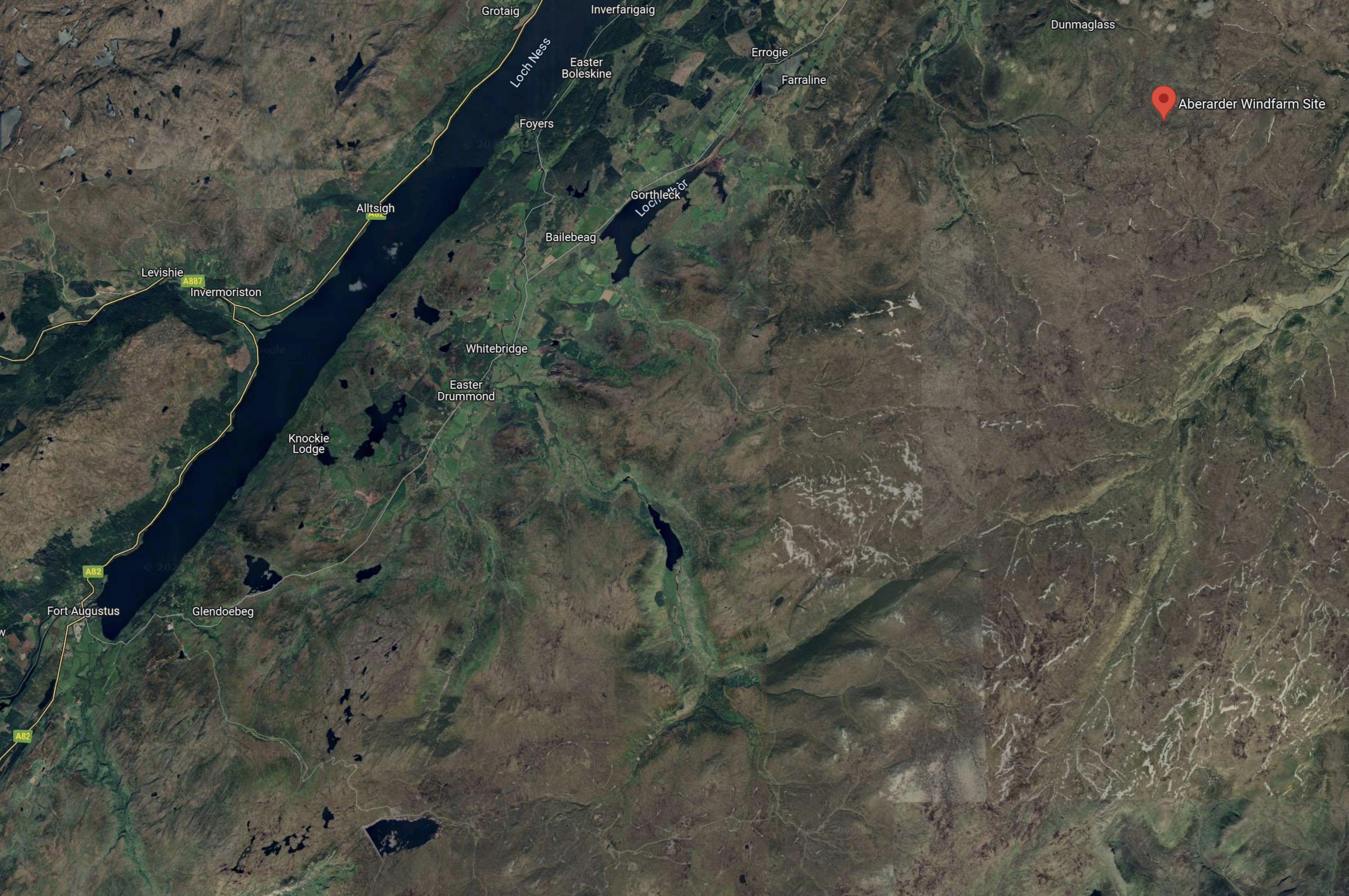
Note.
- Loch Ness runs across the North-West corner of the map.
- Fort Augustus and Stronelairg wind farm, are at the Southern end of the loch.
- The red arrow shows Aberarder wind farm.
- Foyers pumped hydro is on the Eastern bank of Loch Ness, at about the same latitude as the Aberarder wind farm.
- The lake at the bottom of the map, to the South-East of Ford Augustus, is the Glendoe Reservoir, that powers the Glendoe hydroelectric scheme.
There are certainly, a lot of SSE-owned and/or SSE-controlled assets in the area and I wouldn’t be surprised, if SSE integrated them more closely, or added a few more wind farms.
Why Are SSE Advertising The Start Of Construction?
SSE have been advertising for some time on The Times web site.
As they are not a retail energy company anymore, as they sold their retail business to OVO, the advertising, is probably about spreading a good corporate message and getting their strategy broadcast.
Redevelopment Of Scottish Port Begins As Owner Secures GBP 400 Million For Offshore Wind Upgrade
The title of this post, is the same as that of this article on offshoreWIND.biz.
This is the sub-heading.
Haventus, the owner of the Ardersier Port in the Moray Firth, Scotland, has taken a final investment decision and kicked off construction work on redeveloping the port to serve both fixed-bottom and floating offshore wind projects. The revamped port is expected to open in the second half of 2025.
These are the first two paragraphs.
This month, Haventus was granted a GBP 100 million (approximately 117 million) joint credit facility from the Scottish National Investment Bank and UK Infrastructure Bank with GBP 50 million (approx. EUR 58.5 million) investment from each.
This follows a GBP 300 million (approx. 351 million) investment commitment by the energy investment firm Quantum Capital Group in 2023 when Haventus began the redevelopment of Ardersier Port.
This page on the Haventus web site, gives more details of the Port of Ardersier.
Included are.
- Access channel width – 160 m.
- Access channel depth – 12.4 m.
- Landside area – 350 acres.
- 420m main quay.
- 80 m Ro/Ro capable berth.
- People-friendly midges
- Green Freeport tax site designation
- More space is available if required.
There is also an informative video.
Haventus say they are delivering a world-leading energy transition facility. I can go along with that!
These are my thoughts.
The Location Of The Port of Ardersier
This Google Map shows the location of the Port of Ardersier.
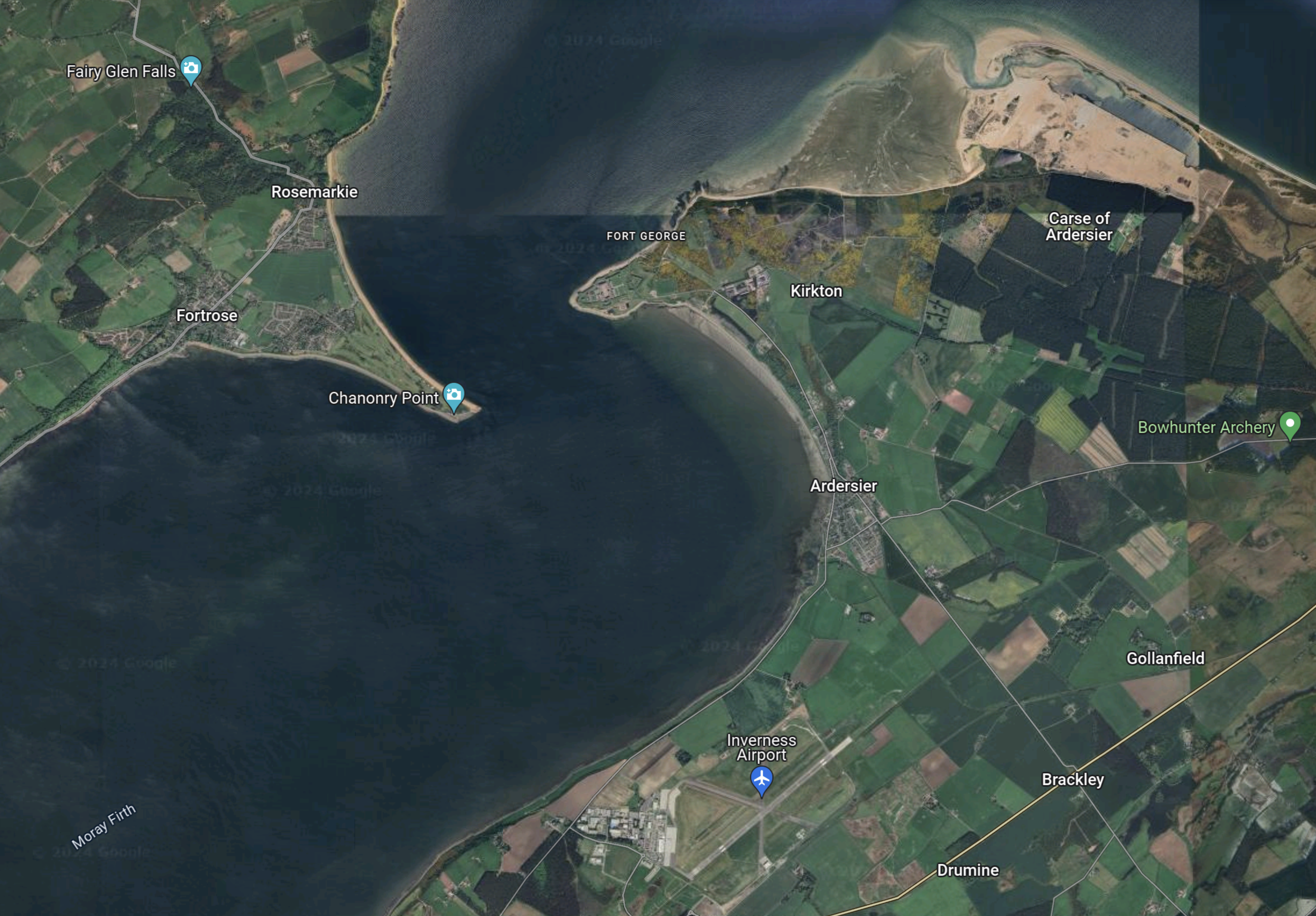
Note.
- The large expanse of water in the middle of the map is Moray Firth.
- The blue arrow at the bottom of the map indicates Inverness Airport.
- Inverness Airport, has a railway station on the Aberdeen and Inverness Line.
- The village of Ardersier is on the the Eastern bank of the Moray Firth
- The Port of Ardersier is in the North-East corner of the map.
The city of Inverness, with a population of around 48,000, is a few miles South-West of the South-West corner of the map.
Which Windfarms Will Be Built And Serviced From The Port Of Ardersier?
This map shows the various ScotWind leases, around the North of Scotland.

The numbers are Scotwind’s lease number in their documents.
These are the Scotwind wind farms to the North-East of Scotland, that could reasonably be assumed to be built and served from the Port of Ardersier.
- 7 – DEME Concessions Wind – 200 km² – 1.0 GW – Floating
- 8 – Falck Renewables Wind – 256 km² – 1.0 GW – Floating
- 9 – Ocean Winds – 429 km² – 1.0 GW – Fixed
- 10 – Falck Renewables Wind – 134 km² – 0.5 GW – Floating
- 11 – Scottish Power Renewables – 684 km² – 3.0 GW – Floating
- 12 – BayWa r.e. UK – 330 km² – 1.0 GW – Floating
These are the Scotwind wind farms to the North-West of Scotland, that could reasonably be assumed to be built and served from the Port of Ardersier.
- 13 – Offshore Wind Power – 657 km² – 2.0 GW – Fixed or Floating
- 14 – Northland Power – 390 km² – 1.5 GW – Floating
- 15 – Magnora – 103 km² – 0.5 GW – Floating
- 16 – Northland Power – 161 km² – 0.8 GW – Floating
These ten wind farms add up to 12.3 GW.
Transport
Consider.
- Obviously, heavy components will be brought in by sea, using the Ro/Ro capable berth or using a crane to unload a barge.
- Personnel will be able to fly in for the day.
- Will some visitors rom London use the Caledonian Sleeper to and from Inverness station to get a full day on site and a good night’s sleep, whilst travelling.
But I do see a problem with local traffic to and from the site.
Hydrogen Buses
This page on the Sizewell C web site, discusses how they will use hydrogen buses.
I could see the Port of Ardersier taking a leaf out of Sizewell C’s book and run hydrogen buses to Inverness, Inverness Airport and other nearby towns.
The North of Scotland certainly won’t be short of green hydrogen to power the buses.
Hydrogen
Conclusion
If you thought that the only useful wind-driven thing to come out of Scotland was bagpipes, you had better think again.
The Port of Ardersier will be the factory and operation and maintenance port for one of the largest offshore wind industries in the world.
Highland Council Forges Green Hydrogen Pact
The title of this post, is the same as that of this article on renews.biz.
These are the first two paragraphs.
Getech subsidiary H2 Green has signed a memorandum of understanding (MoU) with the Highland Council in Scotland aimed at creating a regional network of green hydrogen hubs across the Scottish Highlands.
Under the terms of the MoU, H2 Green and the Highland Council will produce a regional plan to develop a network of green hydrogen hubs at optimal locations across the region.
The first hub appears to be in Inverness, as I wrote in Hydrogen Hub Plan Will Cut Transport Sector Emissions In The Highlands.
But that is only the start.
- Green hydrogen will be used in transport in the Highlands.
- By-products like oxygen and heat will be distributed.
- Delivery of Highland decarbonisation will be planned.
- SGN Commercial Services will service large-volume customers.
- Agreements are in place for Eversholt Rail to deploy their hydrogen-powered trains on the Far North and West Highland Lines of Scotland.
This statement from Jonathan Copus of Getech, sums up the objectives of the hydrogen project.
These activities combined with the Highland Council initiative are set to establish the Highlands as the leading UK-centre for decarbonisation and innovation; they will also support job creation, deliver energy security and provide a sustainable path for the region’s net zero transition.
I believe that a similar approach could be taken in other parts of the UK. Cornwall, East Anglia, Lincolnshire, much of Wales and the Borderlands between England and Scotland come to mind.
Each region will probably, decarbonise slightly differently and each will develop more and more innovative ways to use the hydrogen.
Conclusion
Hydrogen will play a large part in the decarbonisation of the UK.
Hydrogen Hub Plan Will Cut Transport Sector Emissions In The Highlands
The total of this post, is the same as that of this article on the Ross-Shire Journal.
This is the introduction to the article.
The site of one of the Highland capital’s most distinctive industrial landmarks is set to take on new life and a new role, helping decarbonise transport in the region.
The former SGN gas holder site on Harbour Road, Inverness, has been identified by H2 Green as an ideal location for its new green hydrogen production, storage, and distribution facility.
H2 Green, which is part of the Getech Group, signed a deal with gas network operator SGN for use of the site, which lies between Inverness’s rail depot and industrial area.
This Google Map shows the centre of Inverness.
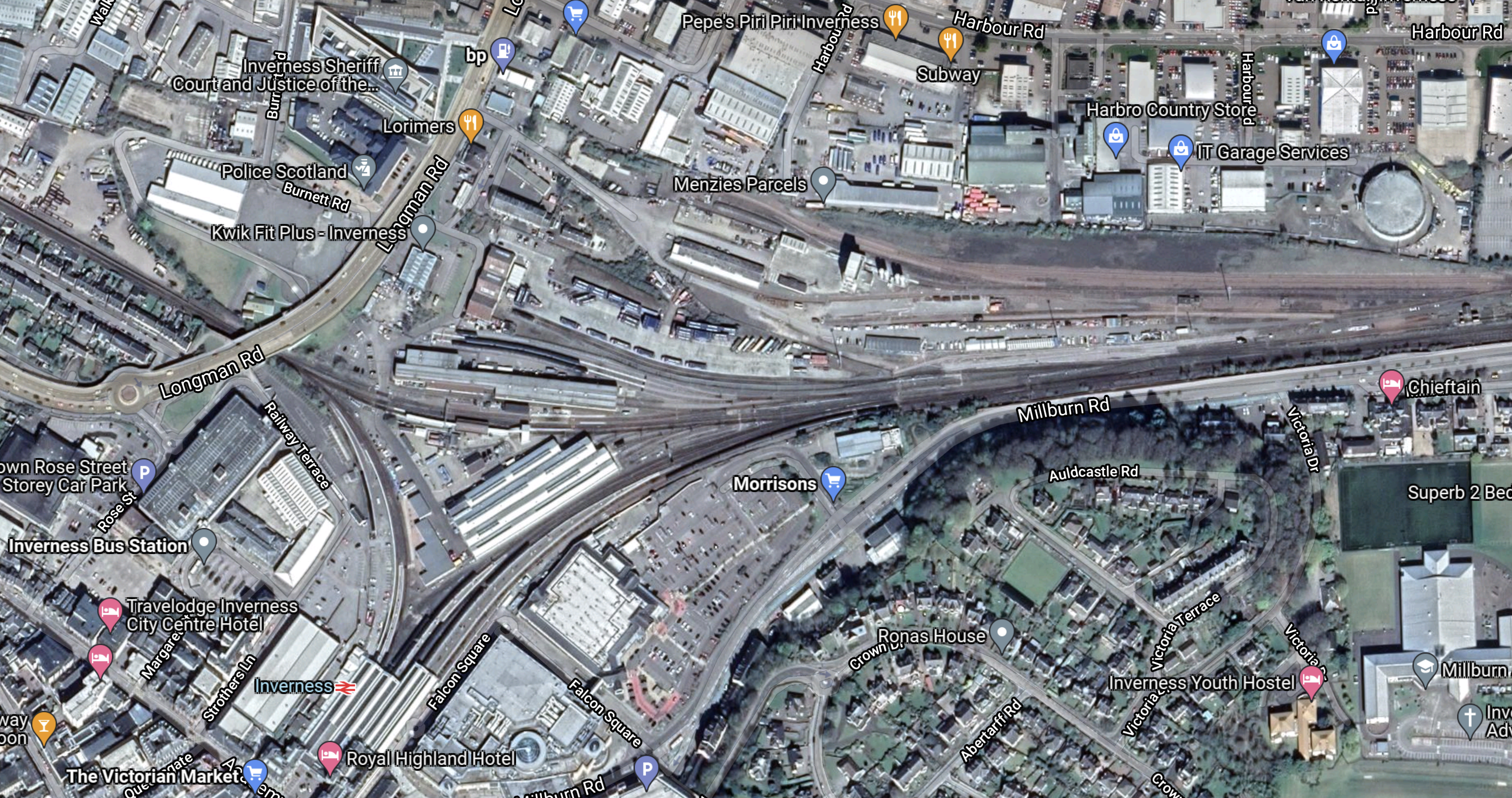
Note.
- Inverness station in the South West corner of the map.
- Inverness bus station is nearby.
- Harbour Road runs across the top of the map.
It looks to me that the round structure in the North East corner is the former SGN gas holder.
These are my thoughts.
The Size Of The Electrolyser
At eight tonnes of hydrogen per day, the proposed electrolyser would be almost as big as the Herne Bay Electrolyser, which creates ten tonnes of hydrogen per day.
Could The Gas Holder Be Used To Store Hydrogen?
As the gas holder was probably built for town gas, which contains a lot of hydrogen, I suspect it could be refurbished to hold hydrogen.
Oxygen Production
The article also says this about oxygen production.
The hub could also provide zero-carbon heat and medical-grade oxygen for hospitals, aquaculture and water treatment works in the area.
Could it be that oxygen is at a premium in the Highlands, so H2 Green are filling a need?
At the height of the pandemic, when hospitals had an oxygen shortage, I asked ITM Power, if they could produce medical grade oxygen, as a by-product of creating hydrogen. They replied in the affirmative.
Conclusion
It looks to me, that H2 Green have a well-thought out plan for hydrogen in The Highlands.
Thoughts On Batteries On A Hitachi Intercity Tri-Mode Battery Train
This Hitachi infographic describes a Hitachi Intercity Tri-Mode Battery Train.

Hitachi are creating the first of these battery trains, by replacing one of the diesel power-packs in a Class 802 train with a battery-pack from Hyperdrive Innovation of Sunderland.
This press release from Hitachi is entitled Hitachi And Eversholt Rail To Develop GWR Intercity Battery Hybrid Train – Offering Fuel Savings Of More Than 20%, gives a few more details.
The Class 802 train has the following characteristics.
- Five cars.
- Three diesel power-packs, each with a power output of 700 kW.
- 125 mph top speed on electricity.
- I believe all intermediate cars are wired for diesel power-packs, so can all intermediate cars have a battery?
In How Much Power Is Needed To Run A Train At 125 Or 100 mph?, I estimated that the trains need the following amounts of energy to keep them at a constant speed.
- Class 801 train – 125 mph 3.42 kWh per vehicle mile
- Class 801 train – 100 mph 2.19 kWh per vehicle mile
The figures are my best estimates.
The Wikipedia entry for the Class 800 train, also gives the weight of the diesel power-pack and all its related gubbins.
The axle load of the train is given as 15 tonnes, but for a car without a diesel engine it is given as 13 tonnes.
As there are four axles to a car, I can deduce that the diesel power-pack and the gubbins, weigh around eight tonnes.
How much power would a one tonne battery hold?
This page on the Clean Energy institute at the University of Washington is entitled Lithium-Ion Battery.
This is a sentence from the page.
Compared to the other high-quality rechargeable battery technologies (nickel-cadmium or nickel-metal-hydride), Li-ion batteries have a number of advantages. They have one of the highest energy densities of any battery technology today (100-265 Wh/kg or 250-670 Wh/L).
Using these figures, a one-tonne battery would be between 100 and 265 kWh in capacity, depending on the energy density.
As it is likely that if the diesel power-pack replacement would probably leave things like fuel tanks and radiators behind, so that the diesel engines could be reinstalled, I would expect that a battery of around four tonnes would be fitted.
On the basis of the University of Washington’s figures a 400 kWh battery pack would certainly be feasible.
Using. the energy use at 100 mph of 2.19 kWh per vehicle mile, I can get the following ranges for different battery sizes.
- 400 kWh battery – 36.53 miles
- 500 kWh battery – 45.67 miles
- 600 kWh battery – 54.80 miles
- 800 kWh battery – 73.06 miles
As Lincoln and Newark are just 16.6 miles apart, it looks to me that a 500 or 600 kWh battery could be a good choice for that route, as it would leave enough hotel power for the turnround.
It should also handle shorter routes like these.
- Newbury and Bedwyn – 13.3 miles.
- Didcot and Oxford – 10.3 miles
- Newark and Lincoln – 16.6 miles
- Leeds and Harrogate – 18.3 miles
- Northallerton and Middlesbrough – 20 miles
- Hull and Temple Hirst Junction and Hull – 36.1 miles
Some routes like Temple Hirst Junction and Hull would need charging at the destination.
The Range Of A Five Car Train With Three Batteries
Suppose a Hitachi Intercity Tri-Mode Battery Train had three battery-packs and no diesel engines.
- It would be based on Hitachi Intercity Tri-Mode Battery Train technology.
- It would have two driver cars without batteries.
- It would have three intermediate cars with 600 kWh batteries.
- It would have 1800 kWh in the batteries.
- The train would be optimised for 100 mph running.
- My estimate says it would need 2.19 kWh per vehicle mile to cruise at 100 mph.
It could have a range of up to 164 miles.
If the batteries were only 500 kWh, the range would be 137 miles.
The Ultimate Battery Train
I think it would be possible to put together a nine car battery-electric train with a long range.
- It would be based based on Hitachi Intercity Tri-Mode Battery Train technology, which would be applied to a Class 800 or Class 802 train.
- It would have two driver cars without batteries.
- It would have seven intermediate cars with 600 kWh batteries.
- It would have a total battery capacity of 4200 kWh.
- The train would be optimised for 100 mph running.
- My estimate in How Much Power Is Needed To Run A Train At 125 Or 100 mph?, said it would need 2.19 kWh per vehicle mile to cruise at 100 mph.
That would give a range of over 200 miles.
If the batteries were only 500 kWh, the range would be 178 miles.
Aberdeen, Inverness, Penzance and Swansea here we come.
Can Hitachi Increase The Range Further?
There are various ways that the range can be improved.
- More electrically-efficient on-board systems like air-conditioning.
- A more aerodynamic nose.
- Regenerative braking to the batteries.
- Batteries with a higher energy density.
- Better driver assistance software.
Note.
- Hitachi have already announced that the Class 810 trains for East Midlands Railway will have a new nose profile.
- Batteries are improving all the time.
I wouldn’t be surprised to see a ten percent improvement in range by 2030.
Conclusion
I was surprised at some of the results of my estimates.
But I do feel that Hitachi trains with 500-600 kWh batteries could bring a revolution to train travel in the UK.
Edinburgh And Aberdeen
Consider.
- The gap in the electrification is 130 miles between Edinburgh Haymarket and Aberdeen.
- There could be an intermediate charging station at Dundee.
- Charging would be needed at Aberdeen.
I think Hitachi could design a train for this route.
Edinburgh And Inverness
Consider.
- The gap in the electrification is 146 miles between Stirling and Inverness.
- This could be shortened by 33 miles, if there were electrification between Stirling and Perth.
- Charging would be needed at Inverness.
I think Hitachi could design a train for this route.
Roger Ford’s Cunning Plan
In the February 2020 of Modern Railways, there is an article called LNER Procurement, which has been written by Roger Ford.
It is Roger’s reply to an article in the December 2020 Edition of Modern Railways, which was entitled LNER Seeks 10 More Bi-Modes.
He starts by describing the requirement and then says this.
Would any fleet engineer in his or her right mind want to add a unique sub-fleet of 10 high speed trains to an existing successful fleet, even if they were hydrogen-electric tri-modes from the respected Kim Chong t’ae Electric Locomotive Works?
In my analysis of the December 2020 article, I wrote this post with the same name, where I said this, under a heading of More Azumas?
Surely, It would require a very innovative train at perhaps a rock-bottom price from another manufacturer, for LNER to not acquire extra Azumas.
So it would appear that Roger and myself are vaguely in agreement on the subject of more Azumas.
The last section of the article has a title of Cunning.
Roger puts forward, the view that the procurement process, as well as being compatible with EU law, could be a warning to Hitachi, to make sure that LNER get a good deal.
It certainly could be, and I remember a similar maneuver by ICI around 1970.
The company was buying a lot of expensive IBM 360 computers.
ICI needed a new computer to do scientific calculations at their Central Instrument Research Establishment (CIRL) at Pangbourne in Berkshire.
- English Electric had just released a clone of an IBM 360 and were keen to sell it to ICI.
- As it would do everything that ICI wanted, they bought one.
- It worked well and did everything that CIRL wanted at a cheaper price.
IBM’s reaction was supposedly quick and dramatic. The salesman who dealt with ICI, was immediately fired!
But as ICI had about a dozen large IBM computers, there wasn’t much they could do to one of the most important and largest UK companies.
IBM also made sure, that ICI got their next computer at a good price.
I’m with Roger that all the shenanigans are a warning to Hitachi.
Roger finishes the article with these two paragraphs.
A genuine bluff would have been to seek bids for the long-term deployment of remanufactured IC225s. Which in these straitened times could still turn out to be a more viable option.
I rather fancy the idea of a hydrogen-electric Class 91. Owner Eversholt Rail might even have played along on the understanding that it funded the inevitable hybrid Azumas.
Note that IC225s are InterCity 225 trains.
- The 31 trains, were built for British Rail in the 1980s.
- They are hauled by a 4.83 MW Class 91 locomotive, which is usually at the Northern end of the train.
- Nine Mark 4 coaches and a driving van trailer complete the train.
- As with the Hitachi Azumas (Class 800 and Class 801 trains), they are capable of operating at 140 mph on lines where digital in-cab ERTMS signalling has been installed.
I just wonder, if a Class 91 locomotive could be to the world’s first 140 mph hydrogen-electric locomotive.
Consider the following.
Dynamics
The wheels, bogies and traction system were designed by British Rail Engineering Ltd, who were the masters of dynamics. This is a sentence from the locomotive’s Wikipedia entry.
Unusually, the motors are body mounted and drive bogie-mounted gearboxes via cardan shafts. This reduces the unsprung mass and hence track wear at high speeds.
That is a rather unique layout. But it obviously works, as otherwise these locomotives would have been scrapped decades ago.
I believe the quality dynamics are because BREL owned a PACE 231R for a start, which was an analogue computer, that was good enough for NASA to use two computers like this to calculate how to put a man on the moon.

London and Edinburgh is a slightly shorter distance, run at a somewhat slower speed.
Space
This picture shows a Class 91 locomotive.
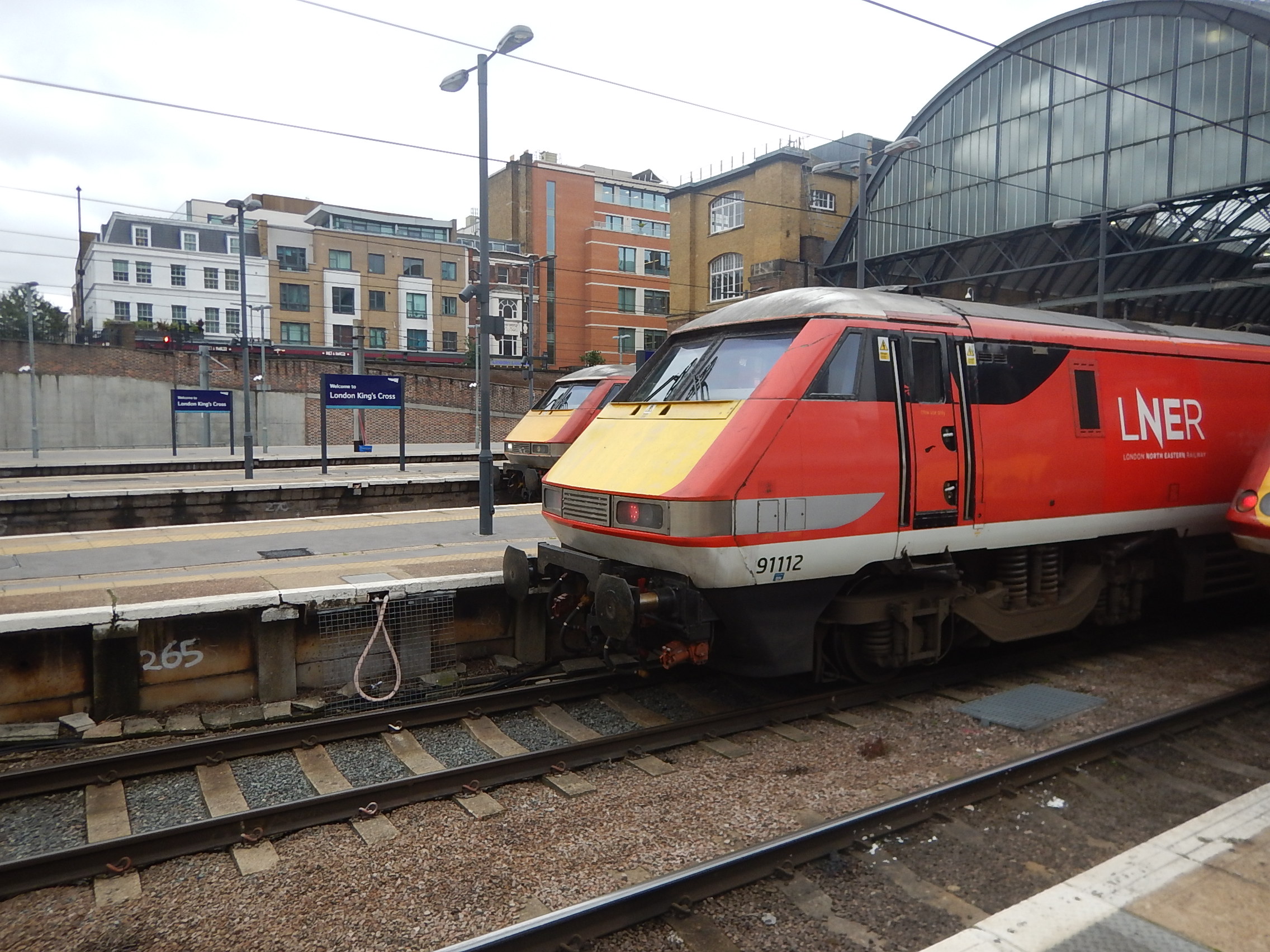
What is in the space in the rear end of the nearly twenty metre-long locomotive?
This sentence from the Wikipedia entry for the locomotive gives a clue.
The locomotive also features an underslung transformer, so that the body is relatively empty compared to contemporary electric locomotives.
It also states that much of the layout came from the APT-P, which was a version of the tilting Advanced Passenger Train.
Would the space be large enough for a tank of hydrogen and some form of generator that used the hydrogen as fuel?
It should be noted that one version of the APT used a gas-turbine engine, so was the locomotive designed for future use as a bi-mode?
Fuel Cells
I’ve ignored fuel cells, as to get the amount of power needed, the fuel cells could be too large for the locomotive.
Class 91 Locomotive Performance
The performance of a Class 91 locomotive is as follows.
- Power output – 4.83 MW
- Operating speed – 140 mph
- Record Speed – 161 mph
Not bad for a 1980s locomotive.
Required Performance Using Hydrogen Fuel
If the locomotives were only needed to use hydrogen to the North of the electrification from London, the locomotive would need to be able to haul a rake of coaches twice on the following routes.
- Aberdeen and Edinburgh Haymarket – 130 miles
- Inverness and Stirling – 146 miles
A range of three hundred miles would be sufficient.
The locomotive would need refuelling at Aberdeen and Inverness.
The operating speed of both routes is nowhere near 140 mph and I suspect that a maximum speed of 100 mph on hydrogen, pulling or pushing a full-size train, would probably be sufficient.
When you consider that a nine-car Class 800 train has five 560 kW diesel engines, that give a total power of 2.8 MW, can carry 611 passengers and an InterCity 225 can only carry 535, I don’t think that the power required under hydrogen will be as high as that needed under electricity.
Rolls-Royce
Rolls-Royce have developed a 2.5 MW generator, that is the size of a beer keg. I wrote about it in Our Sustainability Journey.
Could one of these incredibly-powerful generators provide enough power to speed an InterCity 225 train, through the Highlands of Scotland to Aberdeen and Inverness, at speeds of up to 100 mph.
I would give it a high chance of being a possible dream.
Application Of Modern Technology
I do wonder, if the locomotive’s cardan shaft drive could be improved by modern technology.
These pictures show Joseph Bazalgette’s magnificent Abbey Mills Pumping station in East London.


A few years ago, Thames Water had a problem. Under the pumping station are Victorian centrifugal pumps that pump raw sewage to Beckton works for treatment. These are connected to 1930s electric motors in Dalek-like structures on the ground floor, using heavy steel shafts. The motors are controlled from the control panel in the first image.
The shafts were showing signs of their age and needed replacement.
So Thames Water turned to the experts in high-power transmission at high speed – Formula One.
The pumps are now connected to the electric motors, using high-strength, lower-weight carbon-fibre shafts.
Could this and other modern technology be used to update the cardan shafts and other parts of these locomotives?
Could The Locomotives Use Regenerative Braking To Batteries?
I’ll start by calculating the kinetic energy of a full InterCity 225 train.
- The Class 91 locomotive weighs 81.5 tonnes
- Nine Mark 4 coaches weigh a total of 378 tonnes
- A driving van trailer weighs 43.7 tonnes.
- This gives a total weight of 503.2 tonnes.
Assuming that each of the 535 passengers, weighs 90 Kg with babies, baggage, bikes and buggies, this gives a passenger weight of 48.15 tonnes or a total train weight of 551.35 tonnes.
Using Omni’s Kinetic Energy Calculator, gives the following values at different speeds.
- 100 mph – 153 kWh
- 125 mph – 239 kWh
- 140 mph – 300 kWh
I think, that a 300 kWh battery could be fitted into the back of the locomotive, along with the generator and the fuel tank.
With new traction motors, that could handle regenerative braking, this would improve the energy efficiency of the trains.
Sustainable Aviation Fuel
Sustainable aviation fuel produced by companies like Altalto would surely be an alternative to hydrogen.
- It has been tested by many aerospace companies in large numbers of gas turbines.
- As it has similar properties to standard aviation fuel, the handling rules are well-known.
When produced from something like household waste, by Altalto, sustainable aviation fuel is carbon-neutral and landfill-negative.
ERTMS Signalling And Other Upgrades
Full ERTMS digital signalling will needed to be fitted to the trains to enable 140 mph running.
Conclusion
I believe it is possible to convert a Class 91 locomotive into a hydrogen-electric locomotive with the following specification.
- 4.83 MW power on electricity.
- 140 mph on electrification
- 2.5 MW on hydrogen power.
- 100 mph on hydrogen
- Regenerative braking to battery.
If it were easier to use sustainable aviation fuel, that may be a viable alternative to hydrogen, as it is easier to handle.
LNER Seeks 10 More Bi-Modes
The title of this post, is the same as that of an article in the December 2020 Edition of Modern Railways.
This is the opening paragraph.
LNER has launched the procurement of at least 10 new trains to supplement its Azuma fleet on East Coast Main Line services.
Some other points from the article.
- It appears that LNER would like to eliminate diesel traction if possible.
- On-board energy storage is mentioned.
- No form of power appears to be ruled out, including hydrogen.
- LNER have all 65 of their Azumas in service.
The last paragraph is very informative.
Infrastructure upgrades are due to prompt a timetable recast in May 2022 (delayed from December 2021) from which point LNER will operate 6.5 trains per hour, out of Kings Cross, compared to five today. As an interim measure, LNER is retaining seven rakes of Mk 4 coaches hauled by 12 Class 91 locomotives to supplement the Azuma fleet and support its timetable ambitions until the new trains are delivered.
These are my thoughts.
More Azumas?
Surely, It would require a very innovative train at perhaps a rock-bottom price from another manufacturer, for LNER to not acquire extra Azumas.
Classic-Compatible Trains For High Speed Two
Consider.
- Alstom, Bombardier, CAF, Hitachi, Siemens and Talgo are involved in the competition to design Classic-Compatible trains for High Speed Two.
- As the York and Edinburgh section of the East Coast Main Line will eventually be upgraded and used by High Speed Two services,
- Also in the December 2020 Edition of Modern Railways, is an article entitled 140 mph Plan For ECML North of York, which details improvements proposed by Northern Powerhouse Rail to improve services between Leeds and Edinburgh.
Would there be advantages to High Speed Two, LNER and Network Rail and Northern Powerhouse Rail, to have some commonality between the High Speed Two, LNER and Northern Powerhouse Rail fleets?
Hopefully, the various government-controlled companies are talking.
A Flagship Train For Aberdeen And Inverness
The InterCity 225s, which consist of a Class 91 locomotive and a rake of nine Mark 4 coaches, have given thirty years of top-quality service on the East Coast Main Line and appear to be being asked to handle services until the new trains are delivered.
- Full-length InterCity 225s are 245 metres long and have 406 Standard and 129 First seats or a total of 535 seats.
- Nine-car Azumas are 234 metres long and have 510 Standard and 101 First seats or a total of 611 seats.
- Two five-car Azumas working as a pair are 260 metres long and have 604 seats. They can also be handled on most platforms, that are used by LNER.
- The power of a Class 91 locomotive is 4.83 MW.
- A Class 91 locomotive is 19.4 metres long and weighs 81.5 tonnes.
- Both Azumas and InterCity 225s can maintain 125 mph with ease on the East Coast Main Line and both will be able to reach 140 mph with in-cab signalling.
There would appear to be nothing wrong with locomotive-hauled high speed services, in terms of capacity and performance.
In The Mathematics Of A Hydrogen-Powered Freight Locomotive, I laid out my thoughts on a high-powered railway locomotive fuelled by hydrogen, that used one or possibly two Rolls-Royce gas-turbine engines to generate electricity for traction.
With all the work done, by the companies bidding for Classic-Compatible trains for High Speed Two, into very high speed trains, I believe that at least one company could build a locomotive with this specification.
- 140 mph operation on 25 KVAC overhead electrification. As I said, that was done by British Rail almost forty years ago.
- Ability to use full digital in-cab signalling. This is on its way and already working in some applications.
- 110 mph operation on hydrogen. Hitachi are planning 100 mph battery trains, so it should be possible.
- 400 mile range on one filling of hydrogen. This is working in Germany.
- Ability to be upgraded to higher speeds on electric power, should the East Coast Main Line be upgraded for higher speeds in the future. The train manufacturers are probably ahead of track designers with this one.
Such a locomotive would be key to building a train with this specification.
- Sub-four hour time between London and Edinburgh.
- Sub-seven hour time between London and Aberdeen, which has 130 miles without wires.
- Sub-eight hour time between London and Inverness, which has 146 miles without wires.
- Hydrogen would be used, where there is no electrification.
- Zero-carbon at all times.
- A maximum length of 260 metres, which I estimate could give a passenger capacity of around 640 seats.
- The last coach would include a driving van trailer.
- They would not need the ability to split and join, except for the purpose of rescue, as there is no platform on the route, that could accommodate the resulting 520 metre long pair of trains.
I estimate that a fleet of around seven trains would be needed to run the current Aberdeen and Inverness services.
A few extra thoughts.
- Could they have an up-market more spacious interior, as their main competition to the North of Scotland, would be the budget airlines?
- Could they be slightly longer, with some platform work at Kings Cross and other stations?
- Add a few extra trains to the order, so that extra services between London and Edinburgh could be added to the timetable.
- Could the driving van trailer incorporate an observation car?
- Hydrogen refuelling shouldn’t be a problem in Scotland, as the country is developing a hydrogen economy.
- Hydrogen refuelling wouldn’t be needed in England, as they’d be using the electrification.
- As an alternative to hydrogen, sustainable aviation fuel could be used.
I suspect that Talgo, would be very happy to tender.
- They are developing hydrogen-powered trains as I wrote in Talgo: Our Hydrogen Train Will Be Ready In 2023.
- They are building a factory in Scotland, close to the Forth Bridge.
- Because of the factory, Talgo probably have the ear of the Scottish Government, who would probably welcome a Scottish-built train.
- A shorter version of these trains without the hydrogen, could be the design for a High Speed Two Classic-Compatible train, for which Talgo, are on the short list of suppliers.
What better way, would there be to sell your hydrogen-powered high speed trains, than to give prospective clients a ride up from London to the factory in the luxury version?
A New Elizabethan
I can remember The Elizabethan, which was a steam-hauled non-stop express between London and Edinburgh between 1953 and 1961.
I have laid out my ideas for a modern express train of the same name in A New Elizabethan.
It could be an interesting concept, to increase capacity between London and Edinburgh.
Splitting And Joining
Some of LNER’s philosophy to serve places like Harrogate, Huddersfield and Middlesbrough, depends on the ability to split and join trains.
A pair of Azumas could leave London and go to Leeds, where they would split, with one train going to Harrogate and the other going to Huddersfield.
When returning to London, the two trains would join at Leeds.
The big advantage of splitting and joining, is that it increases the capacity on the main line, as services can be arranged, so that every path always carries a full-length train. I would expect that LNER would prefer never to run a single five-car Azuma into Kings Cross.
Currently LNER have these paths to and from Kings Cross.
- 2 tph between London Kings Cross and Leeds
- 1 tph between London Kings Cross and Lincoln and East Yorkshire
- 2 tph between London Kings Cross and Edinburgh
Note.
- LNER have already started to extend services from Leeds, so will we see splitting and joining being used on one tph at Leeds to provide services to several destinations, throughout the day.
- Splitting and joining at Edinburgh is surely another possibility, to serve Stirling and Glasgow, with the same train.
- Splitting and joining at York could serve destinations like Middlesbrough, Newcastle, Redcar, Scarborough and Sunderland.
- In A Trip To Grantham Station – 4th November 2020, I advocated splitting at Grantham station to serve both Nottingham and Lincoln.
There are a lot of possibilities for splitting and joining.
As LNER has a fleet of twenty-two five-car Azumas, if the new trains are needed to split and join on certain services, this might mean more five-car Azumas are a better buy.
What Will Happen To Nine Car Azumas?
Hitachi have launched the Regional Battery Train concept, the specification of which is given in this Hitachi infographic.

The diesel engines in LNER’s Class 800 trains will be able to be replaced with batteries, making them all-electric trains.
- Destinations like Cleethorpes, Dundee, Grimsby, Harrogate, Huddersfield, Hull, Lincoln, Middlesbrough Nottingham, Perth, Redcar, Scarborough, Sheffield and Sunderland will be within range of battery electric Azumas.
- Some destinations would need the ability to charge the train before it returned, but I can see lots of places getting an appropriate service, even if it was just one or two trains per day.
- Unfortunately, Aberdeen and Inverness would be too far for battery electric Azumas, so services will still need to be run by nine-car bi-mode Azumas.
Five-car battery electric Azumas working in pairs from London could be the key to increasing LNER services.
I can see that LNER may end up with too many nine-car Azumas, if nine-car trains are replaced by pairs of five-car trains to serve two destinations by splitting and joining.
Would it be possible to shorten nine-car Azumas to five-car trains?
These are the formations of the two trains.
- nine-car: DPTS-MS-MS-TS-MS-TS-MC-MF-DPTF
- five-car: DPTS-MS-MS-MC-DPTF
It is known, that the trains have a computer, that does a quick check on start-up to determine, what cars are present and correct in the train.
- This means that if LNER needed twelve-car trains for say London and Edinburgh, they could create a sub-fleet by just buying the requisite number of extra TS (Trailer Standard) and MS (Motor Standard) cars and coupling them up.
- This feature also means that operators running fleets of five-car Hitachi trains, like TransPennine Express and Hull Trains can increase capacity by just purchasing the extra cars.
- It would also allow, cars to be shuffled to create viable trains, after say several cars were damaged by vandalism.
All trains these days seem to have this very operator-friendly feature.
With LNER’s trains, I suspect that all cars of the same type are identical.
This would mean, that a nine-car train can be converted to a five-car by removing two TS (Trailer Standard), one MS (Motor Standard) and one MF (Motor First) cars.
The four cars, that have been removed could be reconfigured to form the middle three cars of a new five-car train, which would be completed by adding new DPTS (Driver Pantograph Trailer Standard) and DPTF (Driver Pantograph Trailer First) cars.
An Increase In Paths From 5 To 6.5
This will certainly allow LNER to run more services.
The odd half path could be easy to explain.
- Hull is a city, that is on the up.
- I suspect that it could support a five-car direct service from London with a frequency of one tph.
- But Hull Trains are also running a successful service on the route.
Perhaps a fair solution, would be to allow both LNER and Hull Trains to run a one train per two hour (tp2h) service.
If LNER didn’t want to use the path to just run a five-car train to Hull, there are several possibilities for a split and join.
- With a Cleethorpes, Lincoln or Nottingham service at Grantham.
- With a Cleethorpes or Lincoln service at Newark.
- With a Cleethorpes, Middlesbrough, Sheffield or Sunderland service at Doncaster.
I can only see splitting and joining increasing, which surely means an Azuma order is more likely.
As someone, who spent a working life, writing software to schedule projects, I can’t resist speculating on what to do with the extra whole path, that LNER will be allocated, when the infrastructure allows.
- Many travellers wouldn’t mind LNER providing more seats between the English and Scottish capitals.
- Many would like an alternative to flying.
- Others would like a faster service.
- Leeds and York will soon be a route, that LNER’s Azumas will be able to use without diesel, because of extra electrification and Azumas with traction batteries.
This leads me to believe that LNER could use the extra path for a third London and Edinburgh service in every hour, that ran via Leeds.
- Additionally, it might stop at stations like Peterborough, York, Darlington or Newcastle.
- It could also provide a non-stop London and Leeds service.
- Some services could go non-stop between London and Edinburgh.
- The direct London and Edinburgh service would be under four hours.
- Going via Leeds would add under an hour.
It would be run by a nine-car all-electric Azumas, of which there will be unlikely to be a shortage.
How Many Azumas Could Be Fitted With Batteries Instead Of Diesel Engines?
The Wikipedia entry for the Class 800 train, has a section called Powertrain, where this is said.
Despite being underfloor, the generator units (GU) have diesel engines of V12 formation. The Class 801 has one GU for a five to nine-car set. These provide emergency power for limited traction and auxiliaries if the power supply from the overhead line fails. The Class 800 and Class 802 bi-mode has three GU per five-car set and five GU per nine-car set. A five-car set has a GU situated under vehicles 2/3/4 and a nine-car set has a GU situated under vehicles 2/3/5/7/8.
Consider.
- Class 807 trains for Aventi West Coast will have no batteries or diesel engines. Does this save weight?
- Class 803 trains for East Coast Trains will only have a small battery for emergency hotel power, in case of catenary failure. Does this save weight?
- Saving weight should improve acceleration and deceleration, which could reduce journey times.
- Removal of diesel engines would reduce the trains carbon footprint.
- Removal of diesel engines could reduce maintenance costs.
- Diesel engines are only needed for services that run North of Edinburgh. Other sections without electrification are probably within battery range or could be easily made so.
- It appears every Motor car (MC, MF and MS) can be fitted with a diesel engine, although in Class 801 trains, only one is fitted. Does that mean that every Motor car in the future, could have a battery?
I think this could lead to the following.
- The Class 801 trains are fitted with sufficient batteries to enable handling of expected emergencies. These could be similar to those in the Class 803 trains.
- Enough nine-car Class 800 trains would be kept with diesel engines to work the Aberdeen and Inverness services. These routes at 130 and 146 miles without wires are too long for battery trains, without a succession of chargers along the routes.
- If a third Edinburgh service were to be introduced, could some of the remainder of the nine-car Class 800 trains be converted to Class 801 trains, by removing the diesel engines?
- I would expect most of the five-car thirty-six Class 800 trains would be fitted with batteries to run services to destinations, that can be reached on battery power. In a few years time, these will probably mean splitting and joining at Edinburgh, Leeds and other places.
- Could we even see the twelve five-car Class 801 trains converted to battery electric Class 800 trains, which would surely give maximum flexibility about their use?
If the software on the trains, is as intelligent as it could be and can accept cars with diesel engines, batteries or no extra power, then LNER will have an enormous amount of flexibility, to configure the trains as they need.
I could even see a nine-car Class 800 train with a mix of batteries and diesel engines, that can be used as range extenders, reaching further towards Aberdeen and Inverness.
Consider a five-car Class 800 train with two batteries and a single diesel engine!
- If I assume that Hitachi’s specification for the Regional Battery Train, is for a five-car train with three diesel engines replaced with battery packs, then a two battery pack train could have a range of 60 km or 37 miles.
- If the route wasn’t very challenging, and the computer made judicious use of the diesel engine, could the train’s range be extended to beyond the ninety kilometres of the three-battery pack train.
- The diesel engine could also be used to charge the batteries, before returning to the electrification of the main line.
In Vivarail’s Plans For Zero-Emission Trains, I talked about Adrian Shooter and his concept of a Pop-Up Metro, run for perhaps a year, to test if a Metro service would be viable, instead of spending the money on consultants.
The two-battery pack/one diesel Class 800 train, could run a Pop-Up London Service to test the need for a London service. All it would need is a convenient platform long enough to take a 130 metre long Class 800 train.
Possible destinations to test could include Cleethorpes, Dundee, Glenrothes-with-Thornton, Grimsby, Nottingham, Norwich, Perth, Redcar, Sheffield and Sunderland
Conclusion
There is a lot of scope to develop LNER’s services.
I think it is likely that the order will go to Hitachi.
But as I indicated, I do believe that there is scope for a manufacturer to design a zero-carbon train, that was able to serve the Aberdeen and Inverness.
- I suspect a fleet of ten trains would be sufficient.
- Trains would use the 25 KVAC overhead electrification, where it exists and hydrogen or battery power North of the wires.
The trains would also be capable of being upgraded to higher speeds, should the East Coast Main Line be turned into a High Speed Line.
I also think, that whatever trains are bought, there will be a large upgrading of the existing Hitachi fleet, which will add batteries to a lot of trains.
 The Anonymous Widower