Thoughts On Alstom At Derby
In the 1970s, I worked at ICI Plastics in Welwyn Garden City in a section called Computer Techniques.
We had a unique mandate from the Divisional Board, that allowed us to stick our nose into anybody’s business.
We certainly weren’t short of computing power, as in addition to the Division’s IBM 360 and dial-up services to GEISco, we had one of the handful of PACE 231R analogue computers in the UK.

Note.
- These machines didn’t use many semiconductors.
- These beasts could solve up to a hundred simultaneous differential equations and display the answers as graphs on the printers.
- Other UK companies and institutions with a PACE 231 R, included BMC, British Rail Research and Cambridge University.
- Two were linked together and these did the calculations for the Apollo flights.
- Their finest hour would surely have been to use their flexibility and power to bring home the stricken Apollo 13.
I got an interesting introduction to the industrial world in my three years at Welwyn.
One of our problems, was recruiting enough specialist engineers and programming staff.
So in the end, at one of our Monday morning meetings, we wrote our own advert for the Sunday Times.
We got all the staff we needed, but they weren’t the sort of recruits, you’d normally expect in the 1970s. Two were Indian and two were American, but all were recent immigrants. But they were certainly good enough to solve our problems.
I don’t think the Personnel Department were amused at our independent recruitment exercise.
I sometimes wonder if Bombardier (now Alstom) in Derby has a similar recruitment problem.
I am a Control Engineer and all these hybrid systems, that will power the transport of the future, be they trains, planes or automobiles, need lots of engineers with similar skills to myself and those of computer programmers. So do local companies; Rolls-Royce, JCB and Toyota, who probably have their own skill shortages in these areas, nick the best from Alstom.
It should be noted that in the railway press, it has been said that the Aventras from Derby were late because of software problems.
Rolls-Royce Completes Next Step On Its Journey To Decarbonising Business Aviation
The title of this post, is the same as that of this press release from Rolls-Royce.
This is the sub-heading.
Rolls-Royce today announces the successful completion of a series of tests with 100% Sustainable Aviation Fuel (SAF) on its latest generation of business aviation engines, the Pearl 15 and the Pearl 10X. The Pearl 15, the first member of the Pearl engine family, powers Bombardier’s Global 5500 and 6500 aircraft, while the Pearl 10X will power Dassault’s ultra-long-range flagship aircraft, the Falcon 10X.
These are the websites for the three aircraft, with number of passengers, typical cruise speed and range.
- Bombardier Global 5500 – 16 pax – Mach 0.85 – 5900 nm
- Bombardier Global 6500 – 17 pax – Mach 0.85 – 6600 nm
- Dassault Falcon 10X – 19 pax – Mach 0.925 – 7500 nm
This screenshot from the Dassault Falcon 10X web site shows the range from London.

Note that Buenos Aires, the Falkland Islands, Seattle, Seoul and Tokyo are all within range.
I have a few thoughts and observations.
Jet A-1 And 100% SAF
This paragraph from the press release describes how Rolls-Royce are testing the compatibility of Jet A-1 and 100% SAF.
As well as proving compatibility with 100% SAF another target of the test campaign was to run a back-to-back engine test with both Jet A-1 and SAF on the same Pearl 10X engine. The aim was to confirm further improvements in the environmental footprint when switching to SAF. The results from this first back-to-back engine emission test under standard certification conditions provides important correlations for the evaluation of future SAF within our environmental strategy.
Compatibility and back-to-back running is surely very important, as it could be many years before all airports can supply 100 % SAF for visiting jet aircraft.
The Fuels Used In The Tests And The Benefits
These two paragraphs from the press release describes the fuels used and the benefits..
The HEFA (Hydro-processed Esters and Fatty Acids) SAF was produced from waste-based sustainable feedstocks such as used cooking oils and waste fat. This fuel has the potential to significantly reduce net CO2 lifecycle emissions by about 80% compared to conventional jet fuel.
The back-to-back tests conducted with conventional fossil-based fuel and subsequently SAF also confirmed a cleaner combustion of the sustainable fuel, with significantly lower levels of non-volatile particulate matter (nvPM). In combination with the low NOx combustor technology of the Pearl 10X and its additive manufactured combustor tiles a reduction of all emissions was achieved.
Note.
- An eighty percent reduction in lifecycle emissions is not to be sneezed at.
- Cleaner combustion and low NOx emissions are very much bonuses.
- Additive manufacture is better known as 3D-printing and I’m not surprised that Rolls-Royce have embraced the technology.
As an engineer and retired light aircraft pilot, I suspect the tests have met Rolls-Royce’s objectives.
Moving To 100 % SAF
This is the final paragraph of the press release.
The tests demonstrated once again that Rolls-Royce’s current engine portfolio for large civil and business jet applications can operate with 100% SAF, laying the groundwork for moving this type of fuel towards certification. At present, SAF is only certified for blends of up to 50% with conventional jet fuel. By the end of 2023 Rolls-Royce will have proven that all its in-production Trent and business aviation engines are compatible with 100% SAF.
It must be a good selling point for aircraft equipped with Rolls-Royce engines, that the buyer knows that the aircraft can run on 100% SAF.
100 % SAF As An Airline Marketing Tool
It will be interesting to see how airlines use 100% SAF to sell tickets.
As an example, I can see routes like London and Scotland becoming very competitive.
- Avanti West Coast, LNER and Lumo already run all-electric trains to Edinburgh and Glasgow.
- The technology exists to decarbonise trains to Aberdeen and Inverness..
- Other open access operators could well move in to a lucrative market.
- The only way, that the airlines will be able to compete on emissions, would be to move to 100 % SAF.
There must be hundreds of routes like London and Scotland around the world.
100 % SAF And Business Jets
In A Class 319 Train, But Not As We Know It!, I told this tale.
I am reminded of a tale, that I heard from a former GEC manager.
He was involved in selling one of GEC’s Air Traffic Control radars to a Middle Eastern country.
The only working installation of the radar was at Prestwick in Scotland, so he arranged that the dignitaries and the sales team would be flown to Prestwick in GEC’s HS 125 business jet.
As they disembarked at Prestwick and walked to the terminal, the pilot called the GEC Manager over.
The pilot told him “The Scottish Highlands at this time of the year, are one of the most beautiful places in the world! Would you and your guests like a low-level tour on the way back? I can arrange it, if you say so!”
Despite knowing GEC’s draconian attitude to cost control he said yes.
The sale was clinched!
I also remember an article in Flight International about how JCB sold diggers.
- Dealers in a country like Greece would put together a party of prospective customers.
- The customers would then be flown to East Midlands Airport in JCB’s business jet, which is close to the JCB factory at Rocester.
- After a sales demonstration and a tour of the factory they would be flown home.
I once met a lady who had been one of JCB’s cabin staff and she told me it was a very successful sales technique.
I suspect that a business jet running on 100 % SAF would be an even better sales aid.
There are also increasing protests from the greens about business jets, which are seen as producing pollution and are only the toys of the rich and powerful.
Surely, if they were running on 100 % SAF, this would make business jets more acceptable.
100 % SAF And Niche Airlines
In the web site for the Falcon 10X, there is a section called Mission Flexibility, where this is said.
As large as it is, the Falcon 10X can still access typical airports serving business aviation as well as others with challenging approaches. The Falcon 10X will be London City-capable so that it can fly you straight into the heart of global finance. When you’re ready for rest and relaxation, the 10X can whisk you to out-of-the-way corners of the world.
British Airways used to run a service between London City Airport and New York.
- The route used 32-seat Airbus A-318 airliners.
- The flight stopped at Shannon for refuelling.
- It was business class only.
I suspect someone will think about running a similar London City Airport and New York service using a Falcon 10X.
- It has nineteen seats.
- It could do it in one hop.
- It could run on 100 % SAF.
- British Airways must have all the passenger data from the discontinued service.
- A Falcon 10X flies higher than a Boeing 767, Boeing 787 or an Airbus A350.
I have a feeling that flight time would be comparable or better to a flight between Heathrow and New York.
Conclusion
Rolls-Royce would appear to have the right strategy.
If I was going to New York in business class, I’d use it.
Lord Bamford: We’re Too Mesmerised By Musk — Here’s Why I’m Building A Hydrogen JCB
The title of this post, is the same as that of this article in the Sunday Times.
This is the sub-heading.
JCB’s Lord Bamford has spent £100m on a hydrogen engine. Tesla’s tech won’t suit everyone, he tells Jim Armitage
These are my thoughts.
The Need For Zero-Carbon Construction Equipment
Construction sites can be dangerous places and in addition to the obvious dangers, there are hidden pollutants in the atmosphere on sites.
Health and Safety will surely demand an improvement in air quality on construction sites for the protection of the workforce and nearby residents.
If JCB can produce zero-carbon construction equipment, then whether it is electric or hydrogen, this will be to their advantage.
High Speed Two And Low-Carbon Construction
High Speed Two is the UK’s biggest construction project and these posts on this blog, talk about low-carbon construction.
- HS2 Reveals Dramatic Carbon Saving With Ambitious Modular Design For Thame Valley Viaduct
- HS2 Smashes Carbon Target
- HS2 To Trial New Building Method Which Could Provide Carbon-Free Energy
- New HS2 Pilot Project Swaps Steel For Retired Wind Turbine Blades To Reinforce Concrete
- World First As HS2 Trials Dual-Fuel Piling Rig On London Site
If High Speed Two are thinking this way, how many other projects will be built in a similar way?
Decarbonising Cargo Handling
It should be noted that JCB are involved in Freeport East at Felixstowe/Harwich.
Ports will be the sort of workplaces, where all vehicles should be zero-carbon, to protect the workforce. Some of the container handling machines are large and would be ideal for hydrogen.
Decarbonising Agriculture
JCB also make tractors, like the Fastrac and other equipment for agriculture. As they often work around people, hydrogen could be much better.
New Markets
Zero-carbon engines will result in new products for new markets.
Lord Bamford is on track to create valuable new markets for his diggers and other equipment.
Hydrogen-Powered Land Speed Record
JCB already hold the land speed record with the JCB Dieselmax, at over 350 mph.
This paragraph from Wikipedia describes the powerplant.
The car is powered by two specially-tuned versions of the production JCB444 powerplant, developing up to 750 brake horsepower (560 kW) each (over five times the power output of the production version with 90 psi (6 bar) of boost) and featuring four cylinders and 5 litres of displacement, accompanied by two stage turbochargers, intercooler and aftercooler.
I believe that getting that amount of power out of a production diesel engine, shows that JCB’s combustion engineers could do the same for a hydrogen-powered vehicle.
Angus Peter Campbell: I’m In Two Minds About The Renewable Energy Revolution
The title of the post, is the same as that of this article in the Aberdeen Press and Journal.
This is the sub-heading.
The debate (argument) between development and environmentalism is as old as the hills.
In the article, Campbell puts all sides of the arguments over the Coire Glas pumped storage hydro-electric scheme, and the article is very much a must read.
I feel that this 1500 MW/30 GWh scheme should be built, as like Hinckley Point C and Sizewell C, it takes a large bite out of the new energy storage capacity that is needed.
But if we do build this large project, we should think very hard about how we do it.
These are a few thoughts.
Low Carbon, Disturbance And Noise During Construction
High Speed Two are doing this and I wrote about it in HS2 Smashes Carbon Target.
I do subject though, that increasingly large construction projects can go this way.
Electric Trucks, Cranes And Other Equipment
High Speed Two and big mining companies are increasingly using electric mining trucks, cranes and other equipment.
As this sort of equipment, also provides a better environment for workers, I suspect we’ll see more electric equipment.
Hydrogen Trucks And Construction Equipment
Hydrogen could play a big part and rightly so.
It is ideal for heavier equipment and one of its biggest advocates and developers is JCB.
I wouldn’t be surprised to see a decision about an onsite electrolyser being made soon.
Low Carbon Concrete
There are various methods of making low- and zero-carbon concrete, some of which incorporate carbon dioxide into the material.
Use Of Loch Lochy And The Caledonian Canal
I wouldn’t be surprised if just as the Thames in London was used in the construction of Crossrail and the Northern Line extension, Loch Lochy and The Caledonian Canal will be used to take out construction spoil.
There’s certainly a lot of ways to be innovative in the movement of men and materials.
Conclusion
The construction of Coire Glas will make an epic documentary.
This Hydrogen Combustion Engine Is The EV Alternative We’ve Been Waiting For – HotCars
The title of this post, is the same as that of this article on Hydrogen Central.
This must-read article is a reprint of an article in hotcars and it details the technology and thinking behind JCB’s new hydrogen engine.
As someone who believes, that hydrogen is the only way to go to power zero-emission vehicles in the future, I advise all hydrogen sceptics to read this article.
These two paragraphs, explain the thinking behind why JCB turned to hydrogen.
As they say, necessity is the mother of invention. JCB was struck with the problem of going zero emissions without sacrificing power and cost of purchase. In a previous Harry’s Garage episode, Lord Bamford, Chairman of JCB, mentioned that passenger cars, on average, run about 300 hours per year. In contrast, a regular heavy-duty backhoe would have running hours close to 10 times that amount. He adds that in countries like India, machines of this scale run for at least 5000 hours per year.
So, to have electricity run an industrial equipment for eight hours at the minimum requires significantly more batteries. Not only does it skyrocket the costs involved, but it will add a ton of complexity and increase the overall weight. Therefore, engineers had to think radically.
Many believe that Hydrogen engines will pump out loads of nitrogen oxides.
These two paragraphs outline JCB’s solution.
A known disadvantage of a hydrogen ICE is the production of Nitrogen oxides or NOX. The reason is high operating temperatures. JCB engineers, however, found a clever way to circumvent this by running the engine on a lean mixture of fuel. Hydrogen for a given mass has three times the energy density of its diesel equivalent.
This allowed the team to get the same torque figures without running the engine too rich. Another way to get rid of NOX is through selective catalytic reduction, a common practice in modern diesel engines.
It is my belief, that if a company or engineer solves the problem of making a small hydrogen internal combustion engine, they will make an absolute fortune, that will make Microsoft and Bill Gates look like paupers.
Engineering is the science of the possible, whereas politics is dreams of the impossible.
No Shortcuts In Evia Aero’s Path To Being Europe’s First Green Regional Airline
The title of this post, is the same as that of this article on FutureFlight.
This is the first paragraph.
The closer you examine the task of establishing a green airline, the clearer it becomes that it does not begin and end with sourcing net zero carbon aircraft. Evia Aero is a case in point in that while the German start-up has made provisional commitments to a pair of electric aircraft developers, for now, it is more preoccupied with getting a somewhat daunting operational ecosystem in place.
The article is an interesting read and certainly follows this old joke about aviation.
If you want to make a small fortune in aviation, start with a large fortune.
The article is mainly drawn from an interview with the founder of Evia Aero; Florian Kruse and these are some of his thoughts.
On Sustainability
This paragraph talks about a truly sustainable aviation company.
First you have to be sure that you can operate as a truly sustainable aviation company,” Evia Aero founder Florian Kruse told FutureFlight. The Bremen-based venture plans to invest in photovoltaic (PV) solar energy plants at the airports it intends to serve to fulfill its commitment to being self-sufficient in green energy, which could include electricity and hydrogen fuel. The next step will be installing the required refueling and recharging facilities.
I’ll agree with that objective, but is it an affordable commitment?
On An Air Operator Certificate
This paragraph talks about an Air Operator Certificate.
Only when these tasks are well advanced, probably in 2024, will Evia Aero secure the air operator certificate it needs to launch commercial scheduled services in Europe. The company has yet to determine whether it will establish an operation from scratch or acquire an existing AOC holder.
Having seen a friend struggle to get an airline going, I wonder, if existing AOC holders will have an advantage in getting fully certified.
Why Not Start A Traditional Airline And Transition To A Green One?
This was Florian Kruse’s answer.
Some people ask us why we don’t just start operating normal [fossil-fuel-burning] aircraft today and then make a transition [to net zero],But we don’t think that works. The only way to be successful in this is to be green with everything from the start.
But by his choice of the Britten-Norman Islander, Florian is taking a conservative route with a proven small airliner, that has been flown into hundreds, if not thousands, of airfields all over Europe and the wider world.
I suspect too, that a lot of experienced Islander pilots from all over the world, will want to add these aircraft to their log book. So recruitment of top quality pilots will not be a problem!
Refuelling And Maintenance
This is said about refuelling and maintenance.
In this regard, Evia Aero’s strategy isn’t based purely on a sustainability agenda. It views the plans for refueling and maintenance as key parts of its revenue stream.
Does this mean, it will be supplying support services to other operators of zero-carbon aircraft?
It should be remembered that the business model of some companies is based heavily on a business aircraft. Will these companies change their philosophy or change the aircraft?
One company that used business jets to sell construction equipment in the past was JCB. Prospective customers would be flown to the UK for demonstrations at their test site near the factory. GEC also used to use their business jet creatively.
The Eviation Alice, which Evia Aero intend to fly, will also be available in a six-seat business configuration.
I can imagine many companies using zero-carbon business aircraft creatively and to send the right message to customers and green activists, who haven’t been friendly in the past.
Thinking about this, as I type, I think that zero-carbon business aircraft could be a significant sector of the zero-carbon aircraft market. It would also appeal to many politicians, royalty, innovative business me and women and the very rich.
In the case of King Charles, I suspect a six-seat Eviation Alice or similar based at Northolt Airport would cost less to run than the Royal Train.
Pricing
This is said on pricing.
It believes (passengers) will pay a premium to access airfields in locations across northern Europe that are not well served by road and rail links.
I’ll go with that, as many years ago, I needed to go to Stavanger for a day or so from Ipswich. So I flew Air Anglia from Norwich in a Bandeirante, rather than go from Heathrow with a change at Oslo.
Backing And Expertise
This is a paragraph from the FutureFlight article.
Evia Aero is not without expertise as it seeks to put these building blocks in place. One of its backers, Energiequelle, is involved in a business that owns and operates PV plants in Finland and Germany. Its leadership team also includes Gerd Weber, CEO of regional airline OLT, and the chair of its advisory board is Axel Trampnau, who previously ran the carrier Germania.
That seems reasonably strong.
If Energiequelle live up the mission statement on their web site, they could be particularly useful.
Hydrogen-Powered Islanders
This is said about their purchase of conversion kits for Islanders to be converted to hydrogen power.
Under current plans, the first aircraft in the Evia Aero flight will be nine-passenger Britten-Norman Islanders under a plan being advanced by Cranfield Aerospace Solutions (CAeS) to convert the piston-powered models to hydrogen propulsion. Evia Aero expects these aircraft to be ready to enter service in 2026 and has agreed to buy 15 of the conversion kits.
The Islander may have flown nearly sixty years ago, but nearly 1300 have been built and they are still being manufactured, so there should be plenty available from conversion and spare parts shouldn’t be a problem.
Cranfield Aerospace Solutions, is a spin-out of Cranfield University and the article says this about an ongoing project between CAeS and Evia Aero.
In 2022, the new airline signed a wider agreement with CAeS covering a provisional order for 10 hydrogen-powered 19-seat aircraft. The companies have not yet determined whether these would be conversions of existing aircraft or a clean-sheet design. Under the UK’s Project Fresson, CAeS is working on plans for new 19- and 75-seat zero-emissions regional airliners.
CAeS look like another serious contender in the zero-carbon airliner market.
Eviation Alice
This is said about the Eviation Alice.
Evia Aero has signed a memorandum of understanding covering provisional orders for 25 of Eviation’s nine-passenger, all-electric Alice aircraft. It expects to add the first of these to its fleet in 2028, a year after the U.S.-based manufacturer now says it aims to complete type certification, initially with the FAA.
Note.
- Alice is running two years behind the Islander.
- Certifying the Islander should be easier as it is an existing airliner.
I could see the earlier delivery and entry into service of the Islander, being used to develop the business.
Range And Routes
This is said about range and routes.
With either of these aircraft, Evia Aero will be launching its services with the equipment providing a modest payload and range. The Cranfield Islanders will be able to fly up to around 200 kilometers (109 nm), while Eviation last year reduced its range projections from 440 to 250 nm, citing the limitations of current battery technology.
Kruse accepts these limitations, while already laying plans to add subsequent 19-seat aircraft to his fleet. He showed FutureFlight route maps for both aircraft including planned destinations extending along the North Sea and Channel coasts from Denmark through Germany and the Benelux countries and into France and the UK.
- The range isn’t that long.
- It is 629 kilometres between Evia Aero’s base at Bremen and Southend.
- Schiphol is closer at 89 kilometres with Groningen at 147 kilometres.
But the interesting one is Heligoland at 139 kilometres.
Heligoland
This Google Map shows the archipelago.
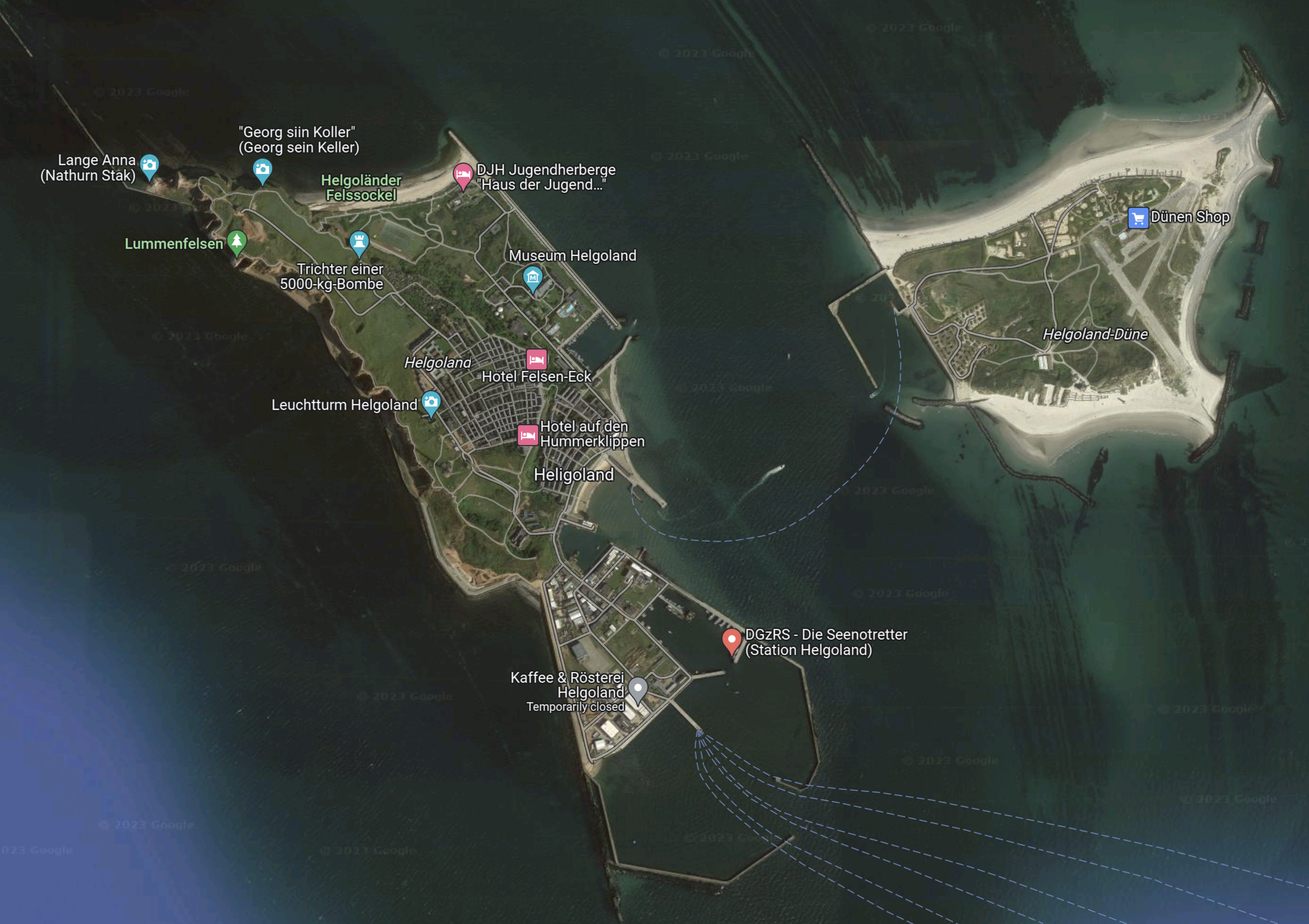
Note.
- Heligoland is the island in the West.
- Düne is the island in the East.
- You can just pick out the characteristic pattern of Heligoland Airport‘s three concrete runways.
Why would anybody want to go to a rock in the North Sea?
This article on the Guardian, which is entitled Heligoland: Germany’s Hidden Gem In The North Sea, gives lots of reasons, including.
- History.
- It is a regular day trip from the German coast by ship.
- It used to be British.
- It could be at the heart of offshore wind developments.
But for German day-trippers, it’s probably the attraction of the island being duty-free.
It could be a nice little earner for an airline based in Bremen and it would be within the range of the Islanders.
A Pattern Of German Islands
This Google Map shows the German corner of the North Sea.
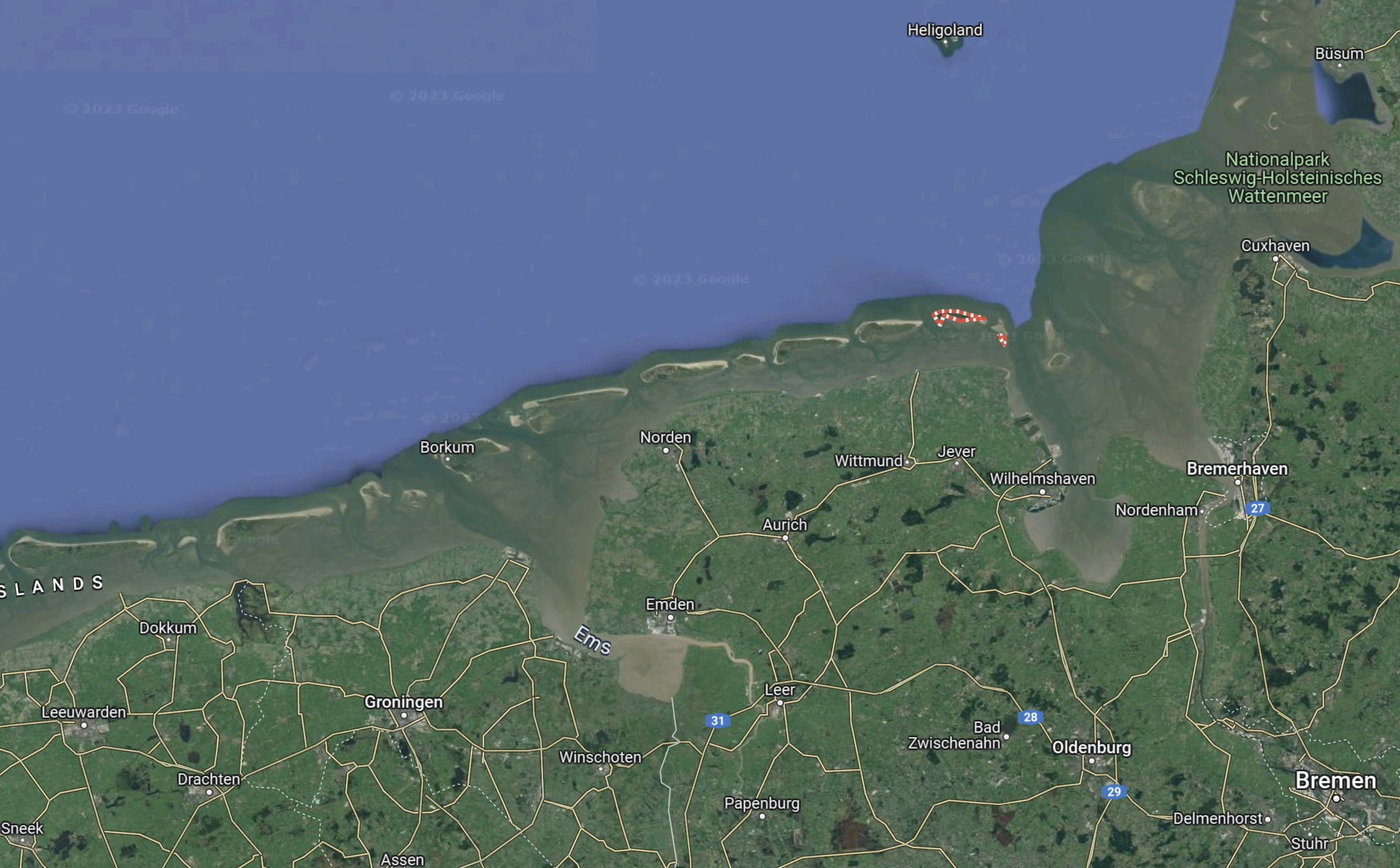
Note.
- The island of Heligoland at the top of the map.
- Bremen in the South-East corner of the map.
- The string of islands along the German and Dutch coasts.
- The red area marks out the most-Easterly island of Wangerooge.
This Google Map shows Wangerooge in detail.
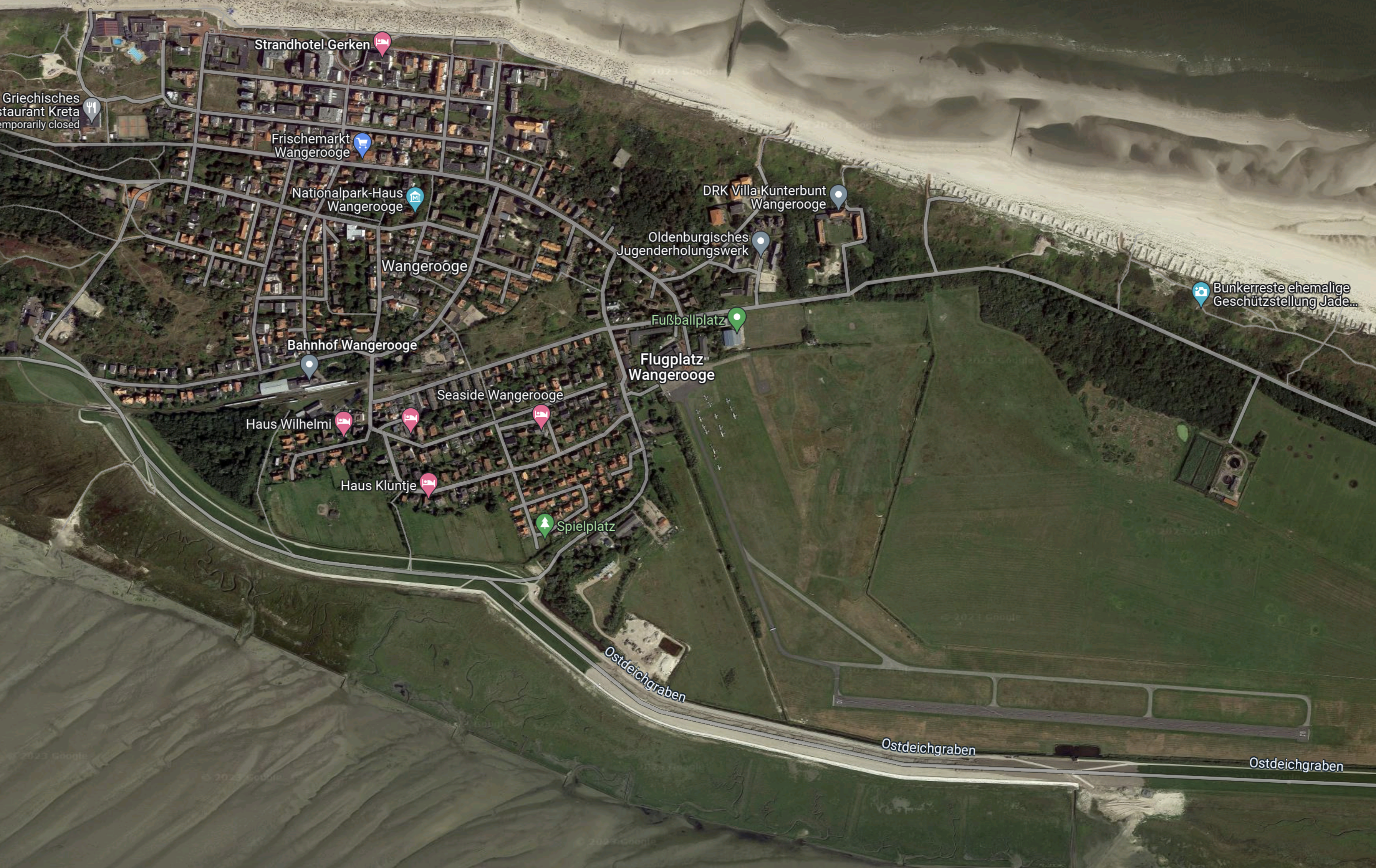
Flugplatz Wangerooge is in the South-East corner of the map.
- It has an 850 metre asphalt runway.
- The island appears to have a sizeable beach.
- The island has a population of around 1200.
The Wikipedia entry for Wangerooge says this about the character of the island.
In order to guarantee a relaxed atmosphere, cars are prohibited on the island. The island can be reached by ship from Harlesiel, or it can be reached by plane via its airfield, regular service being offered from Harlesiel, Bremen, or Hamburg. The ferries leave at different times every day according to the tide. As on most East Frisian Islands, a small narrow gauge railway line, the Wangerooge Island Railway, connects the harbor to the main village.
The Wikipedia entry, for the Wangerooge Island Railway gives a lot of detail about what looks to be a fascinating railway, including this opening paragraph.
The single track Wangerooge Island Railway (Wangerooger Inselbahn) is an unelectrified narrow gauge railway with a track gauge of 1,000 mm (3 ft 3+3⁄8 in) located on the East Frisian island of Wangerooge off the northwestern coast of Germany. It is the most important means of transport on the island and is the only narrow gauge railway operated today by the Deutsche Bahn.
I must visit next time, I go to Hamburg.
Working towards the West the next airfield, I can find is on Langeoog, which is shown in this Google Map.
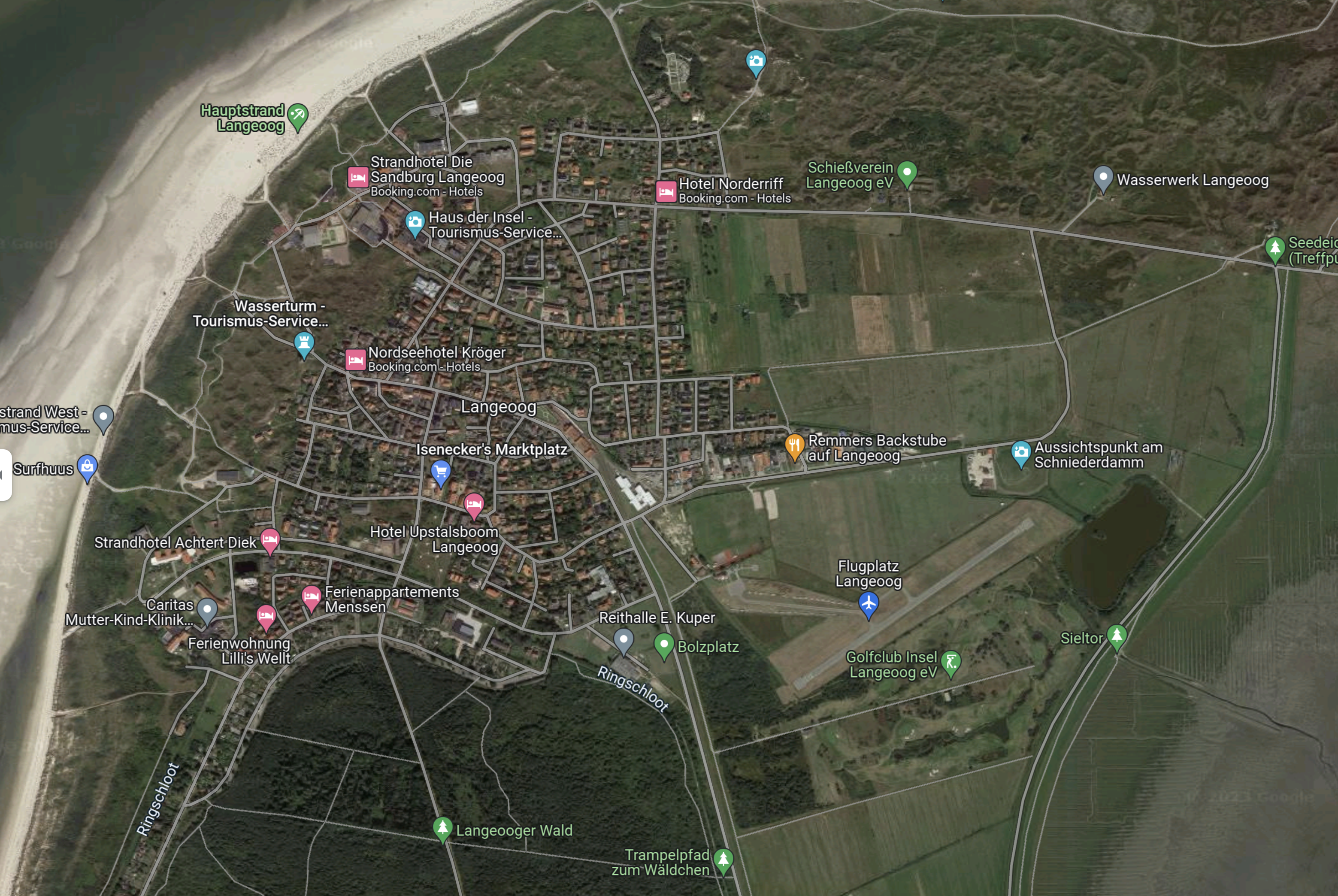
Flugplatz Langeoog is marked by the blue arrow towards the South-East corner of the map.
Working towards the West the next airfield, I can find is on Nordeney, which is shown on this Google Map.
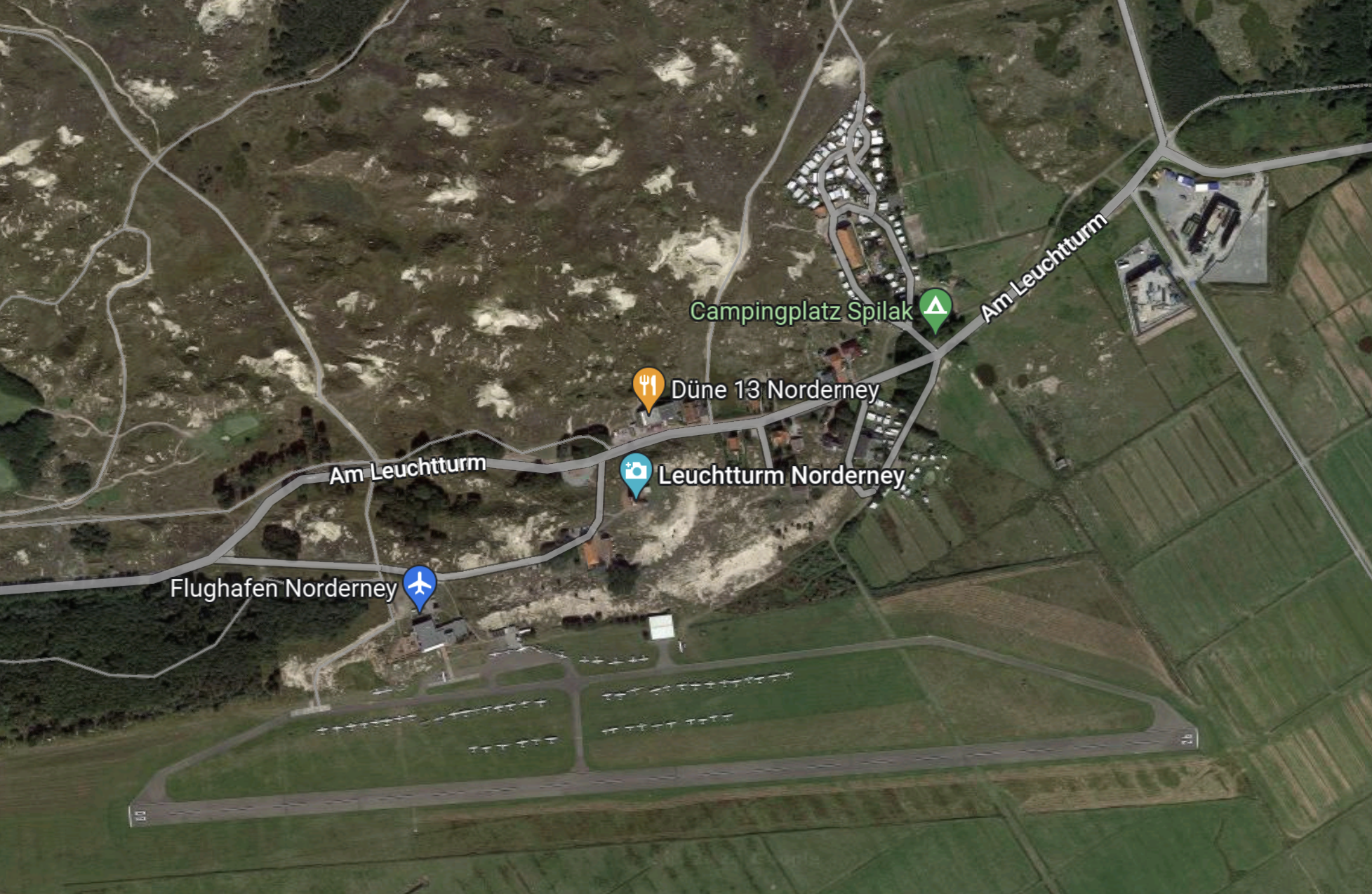
Flughaven Nordeney is at the bottom of the map.
It has a 1000 metre runway and judging by the planes on the map, it is very busy.
Continuing West brings me to the Eastern end of the island of Juist, which is shown on this Google Map.
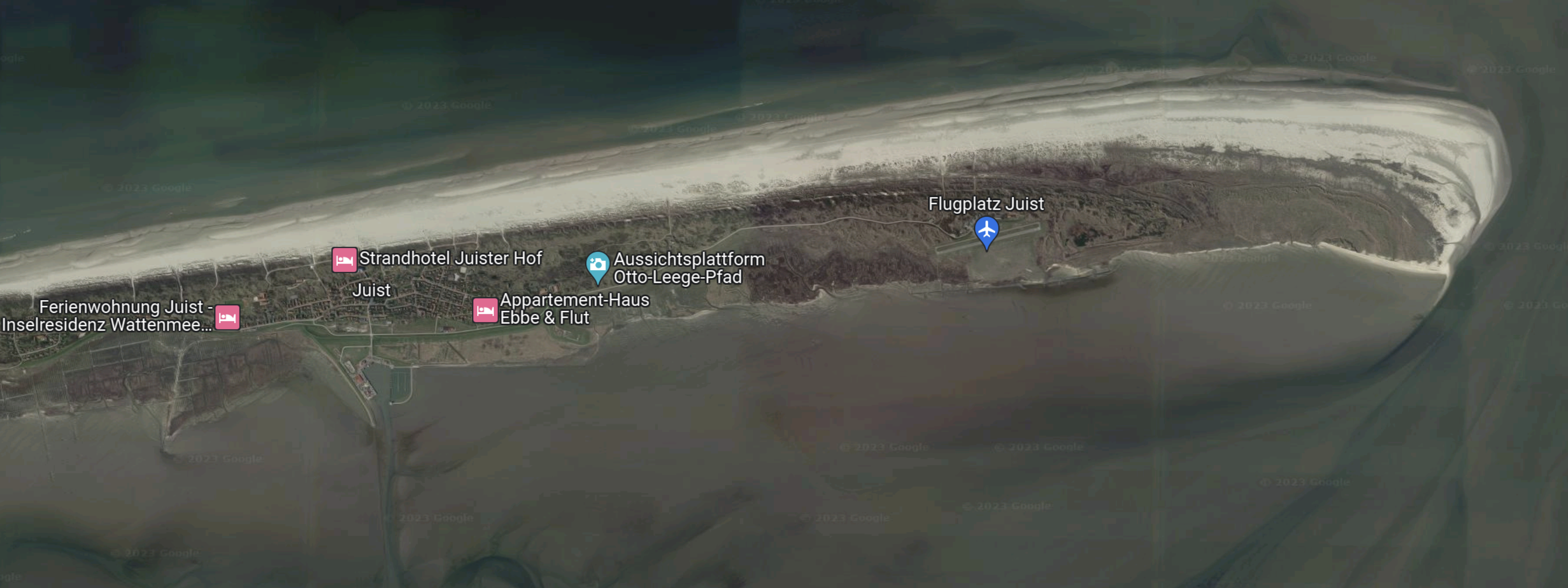
Flugplatz Juist is indicated the rightmost blue arrow. This extract from the Wikipedia entry, illustrates the importance of this airfield.
As of 2013, the airfield had up to 500 takeoffs and landings on weekends, the second most aircraft movements in the state of Lower Saxony, after Hannover Airport. The airfield is a critical piece of infrastructure for the island, due to ferry traffic being dependent on the tides.
The airfield was also the first on the East Frisian Islands to have a paved runway
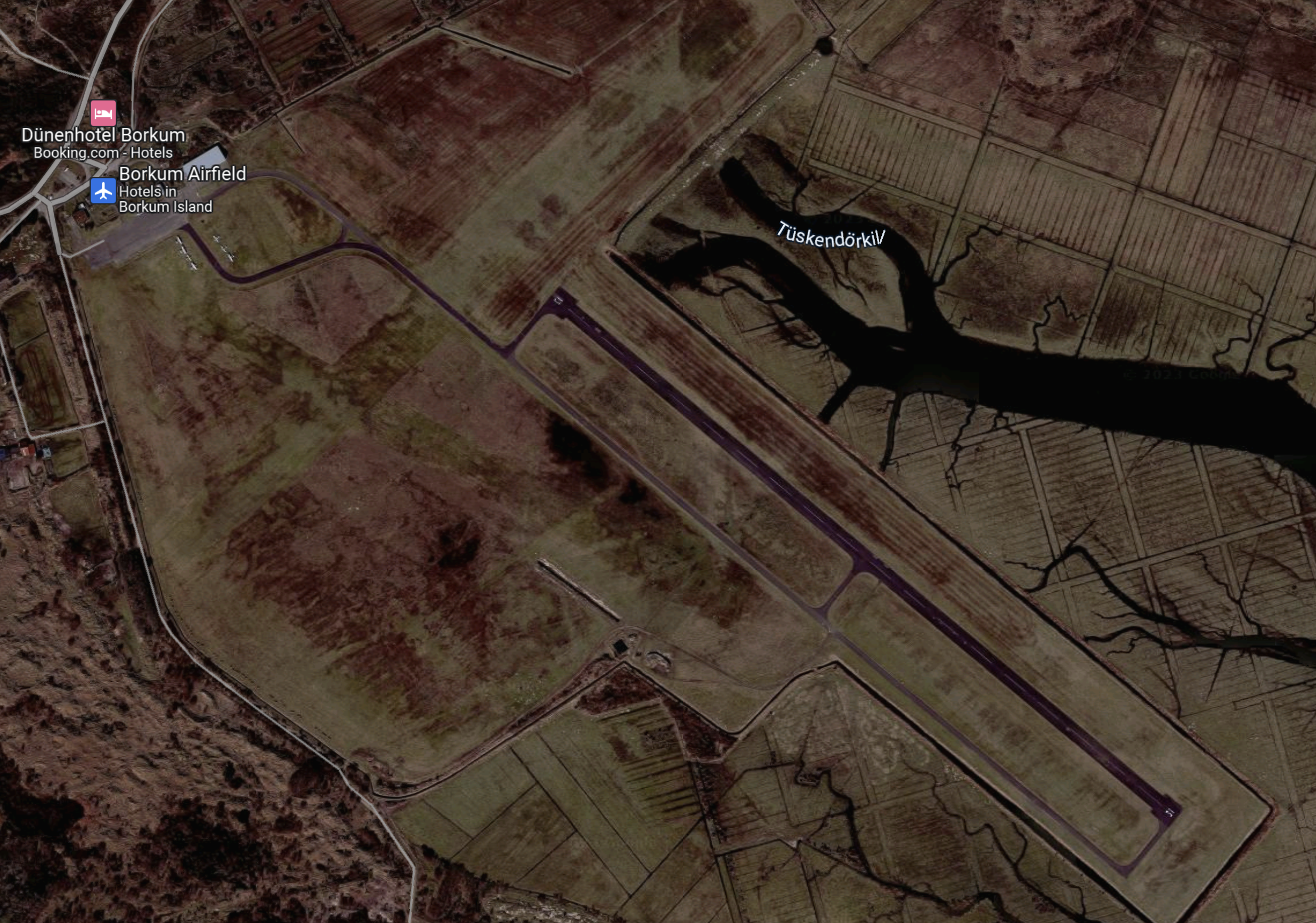
Continuing West brings me to Borkum, which is shown on this Google Map.
Note.
Borkum Airport is in the Eastern half of the map.
- It has a 1000 metre asphalt runway.
- Borkum has a population of around 5000.
On this brief exploration of the German East Frisian Islands, I have been surprised to find five airfields; Borkum, Juist, Langeoog, Nordeney and Wangerooge.
- All seem to have asphalt or concrete runways.
- Were these runways built as part of a plan to improve transport to the islands, as it appears the tides make the ferries a bit variable?
It also appears that the islands are totally or at least partially car-free.
On one island I noticed that the taxis are horse-drawn carriages.
So does this all fit well with the philosophy of Evia Aero of flying zero-carbon aircraft?
I suspect it does.
I also think, that Evia Aero’s thinking has been influenced by recent events in the area, which I talked about in From Groningen To Leer By Train.
- To put it simply, a freighter called the Emsmoon, demolished the Freisenbrücke, which carries the Groningen and Bremen railway over the River Ems.
- Zero-carbon aircraft flying between Groningen and Bremen would be a viable and quicker and more comfortable alternative to the bus I took.
I wonder if Evia Aero are planning a service between Groningen and Bremen.
- Groningen and Bremen is 147 kilometres.
- Islanders can cruise at 240 kph.
- The service could call at the five intermediate airports.
- I would reckon, that the service would take about an hour between Groningen and Bremen.
- The aircraft would be refuelled at Groningen and Bremen.
- I am fairly certain that two planes could run an hourly service.
I also suspect that the ticketing could be run by an app and if there were no passengers wanting to get on or off at an intermediate stop, then the plane would continue to the next stop, which would save fuel. If a passenger missed a plane, there would be only a wait of an hour until the next one.
Get this right and if it proves successful, then extra services could be added, to create a true Turn-Up-And-Go air service.
Landing And Take-Off Performance
This is a paragraph from the FutureFlight article.
Both the Islander and the Alice offer short takeoff and landing performance that will allow them to get in and out via limited runways in small communities. In the case of the Islander, which has been in service for several decades, it will even be able to operate from grass landing strips.
Every little helps.
Islanders can also use sand runways, as they do at Barra.
Refueling The Islanders
This image of the hydrogen-powered Islander was clipped from the Cranfield Aerospace Solutions’ home page.

Consider.
- Many years ago, I had fun with a farmer friend moving a lot of apples in boxes, that were destined for Aspall Cyder with his forklift. The machine was powered by gas in a cylinder strapped horizontally behind the driver.
- We ran out of gas halfway through and it was a simple matter of disconnecting the bottle and connecting another.
- Drop tanks have been used in military aircraft for almost a hundred years.
- Universal Hydrogen refuels its hydrogen-powered aircraft by changing a fuel capsule.
Look at the above picture and note the two green cylinders under the wings.
- Could they be two hydrogen tanks for the aircraft?
- They appear to have some aerodynamic features. Could this reduce drag, but increase lift?
- Could they be cylinders for the hydrogen fuel?
- If they are fuel cylinders, is it possible for one or two people and/or possibly a special truck to easily swap an empty one for a full one?
Fast refuelling would allow the aircraft to work hard.
Connecting To Major Hubs
My proposed East Frisian Islands service, only connects to Groningen and Bremen on the mainland.
- Schiphol and Groningen Airports are only 93 kilometres apart.
- Bremen and Hamburg Airports are only 103 kilometres apart.
After refuelling, flying on without a change of plane to a major hub would be possible.
Channel Hops
This is said about range.
With either of these aircraft, Evia Aero will be launching its services with the equipment providing a modest payload and range. The Cranfield Islanders will be able to fly up to around 200 kilometers (109 nm), while Eviation last year reduced its range projections from 440 to 250 nm, citing the limitations of current battery technology.
The only hops, I can find less than two hundred kilometres are.
- Calais and Manston – 61 kilometres
- Calais and Lydd – 71 kilometres
- Calais and Southend – 111 kilometres
- Le Touquet and Lydd – 69 kilometres
- Le Touquet and Manston – 94 kilometres
- Le Touquet and Southend – 134 kilometres
- Ostend and Manston – 107 kilometres
- Ostend and Lydd – 138 kilometres
- Ostend and Southend – 210 kilometres
- Cherbourg and Southampton – 147 kilometres
Note.
- Manston and Southend are probably the two best British airports, as they have or will have a rail connection.
- Only Le Touquet has a railway station close to the airport on the European side.
I do suspect, that Eurostar could kill channel-hopping, by adding extra services.
Possible Markets
The methodology developed at Bremen, could probably be applied to other services around Europe and the wider world.
This is a paragraph from the FutureFlight article.
Evia Aero, which Kruse said is already in talks with as many as 30 regional airports about possible air services, is also eyeing the Nordic countries, the UK’s islands, and parts of southern Germany as target markets. Norway with its mountainous coastline seems a promising early adopter for short flights in net zero aircraft, not least because the country’s government plans to ban conventional aircraft on domestic routes from 2030.
The low noise of the electric aircraft might make them acceptable, where other aircraft have been rejected in the past.
Conclusion
T think Evia Aero plans are sound, but I do wonder whether the freighter trashing the railway got Florian Kruse and his friends thinking.
Universal Hydrogen And Railway Locomotives
On the product page of the Universal Hydrogen web site, there is a section, which is entitled Other Transportation Applications, where this is said.
Our lightweight, aviation-grade modular hydrogen capsules can be used in a wide range of transportation applications where weight, safety, and speed of refueling are important. We are working with partners in automotive, heavy equipment, maritime, and railroad domains. If you have an application that can benefit from our global modular green hydrogen distribution network, please get in touch!
I believe that the railway locomotive of the future will be hydrogen-electric. And so do some of the UK’s rail freight companies, judging, by some of their press releases.
- It would have an electric transmission. like most locomotives today, such as the UK’s Class 66, Class 68, Class 70, Class 88, Class 93 and the upcoming Class 99 locomotives.
- It will be able to use 25 KVAC overhead electrification, where it exists.
- Hydrogen-power will be used, where there is no electrification.
The lowest-carbon of the locomotives, that I listed, will probably be the Class 99 locomotive.
- Thirty have been ordered by GB Railfreight, from Swiss company; Stadler.
- The locomotives will be built at Valencia in Spain.
- It will have up to 6 MW, when running using electrification.
- It will have up to 1.6 MW, when running using a Cummins diesel, with a rating of 2,150 hp.
- Because a proportion of UK freight routes are electrified, it is likely that these locomotives will substantially reduce carbon emissions for many locomotive-hauled operations.
It should be noted that Cummins are heavily into hydrogen and their philosophy seems to embrace families of engines, which are identical below the cylinder head gasket, but with appropriate cylinder heads and fuel systems, they can run on diesel, natural gas or hydrogen.
I wouldn’t be surprised to find out that the Class 99 locomotive will have a diesel engine, that has a hydrogen-powered sibling under development at Cummins.
With perhaps a power on hydrogen of about 2.5 MW, these zero-carbon locomotives would be able to handle upwards of ninety percent of all heavy freight trains in the UK.
These are further thoughts.
Alternatives To Cummins Hydrogen Internal Combustion Engines
There are two main alternatives, in addition to similar engines from companies like Caterpillar, JCB, Rolls-Royce mtu and others.
- Fuel cells
- Gas-turbine engines.
Note.
- Universal Hydrogen and others have fuel cells, that can probably deliver 2.5 MW.
- Universal Hydrogen use Plug Power fuel cells.
- Rolls-Royce have developed a 2.5 MW electrical generator, based on the engine in a Super Hercules, that is about the size of a typical beer-keg. I wrote about this generator in What Does 2.5 MW Look Like?.
Cummins may be in the pole position with Stadler, but there are interesting ideas out there!
Cummins have also indicated, they will build hydrogen internal combustion engines at Darlington in the UK.
Would One Of Universal Hydrogen’s Hydrogen Capsules Fit In A Railway Locomotive?
These are various widths.
- Class 66 locomotive – 2.63 metres.
- ATR72 airliner – 2.57 metres.
- DHC Dash-8 airliner – 2.52 metres
- Class 43 power car – 2.74 metres
I suspect that even if it was a bit smaller a hydrogen capsule could be made for a UK locomotive.
How Big Is The Market?
The UK has around five hundred diesel railway locomotives.
JCB: Building A Hydrogen Future
The title of this post, is the same as that of this page on the JCB web site.
The page contains this statement from Lord Bamford, who is JCB’s chairman.
I’m often asked, why hydrogen? Two years ago, I set the challenge that we should be making hydrogen engines for the construction industry and for agriculture. Two years later, we have hydrogen engines working in the kind of equipment that JCB makes. A solution that delivers power in the same way as conventional engines, but with none of the fossil fuels. We’re proving daily that hydrogen does work, that it’s a clean, renewable, transportable fuel.
Bold thinking, a lot of hard work, a lot of innovation – the kind of thing JCB has been delivering for over 75 years.
It is followed by a series of articles on hydrogen and JCB.
Rolls-Royce Successfully Tests mtu Engines With Pure Hydrogen
The title of this post, is the same as that of this press release from Rolls-Royce.
These are the two bullet points.
- mtu gensets and cogeneration units to be further developed for 100% hydrogen use
- First use in the new CO2-neutral container terminal in the German inland port of Duisburg
This is the first paragraph.
Rolls-Royce (LSE: RR., ADR: RYCEY) today announces that it has conducted successful tests of a 12-cylinder gas variant of the mtu Series 4000 L64 engine running on 100% hydrogen fuel. The tests, carried out by the Power Systems business unit, showed very good characteristics in terms of efficiency, performance, emissions and combustion. These tests mark another important step towards the commercial introduction of hydrogen solutions to meet the demand of customers for more sustainable energy.
Note.
- Rolls-Royce mtu have converted and tested a natural gas version of the Series 4000 L64 engine.
- The Class 43 power cars used in the iconic InterCity 125 train and powered by mtu V16 4000 R41R engines.
Are the two engines related? If so, can Rolls-Royce mtu build a hydrogen engine that could power an InterCity 125?
It was a rapid development.
Andrea Prospero, an engineer at Rolls-Royce responsible for the development of the hydrogen engine, is quoted as saying.
We are very pleased with the rapid progress. The very low engine emissions are well below the strict EU limits, no exhaust gas aftertreatment is required.
Due to the different combustion behaviour of hydrogen compared to natural gas, some engine components including fuel injection, turbocharging, piston design and control, were modified in the test engine. However, by using proven technologies within the Power Systems’ portfolio, such as mtu turbochargers, injection valves, and engine electronics and control, the development of the engine to use hydrogen was advanced quickly and efficiently.
Diesel and natural gas internal combustion engine manufacturers like Cummins, Rolls-Royce mtu and several other companies, have a long history of research, that they have the knowledge to convert diesel or natural gas engines to hydrogen.
So far only Cummins, JCB and Rolls-Royce mtu have disclosed a multi-fuel line of engines.
First Deployment For CO2-Neutral Power Supply At Duisport
There is a section in the press release called First Deployment For CO2-Neutral Power Supply At Duisport, where this is said.
Duisport, one of the world’s largest inland ports, is working with several partners to build a hydrogen-based supply network for its new terminal, ready for operation in 2024. In the future, most of the electricity required by the port itself will be generated directly on site from hydrogen in a CO2-neutral manner. This will be achieved by two combined heat and power plants with mtu Series 4000 hydrogen engines (with a total installed capacity of 2MW) as well as three mtu fuel cell systems (with a total installed capacity 1.5MW).
As part of its sustainability program, Rolls-Royce is realigning the product portfolio of Power Systems towards more sustainable fuels and new technologies that can further reduce greenhouse gas emissions.
There is also this Rolls-Royce graphic, which shows the energy sources.

It would appear batteries, combined heap and power (CHP), grid electricity, hydrogen electrolyser, hydrogen storage and renewable electricity are being brought together to create a climate-neutral energy system.
Is this a world-first, where hydrogen engines and fuel cell systems will be working together?
The Third Route To Zero-Carbon Transport
The two most common routes to zero-carbon transport are.
- Battery-electric vehicles
- Hydrogen fuel-cell vehicles
Note that most hydrogen-fuel cell vehicles also have a battery.
But I believe there’s a third route and that is the use of hydrogen in an internal combustion engine.
Earlier today, I wrote Rolls-Royce And AVK Provide Over 3.5 Gigawatts Of Emergency Power Capacity In The UK, which is based on a Rolls-Royce press release, with the same title.
This is an extract.
And this is said about the use of hydrogen.
Rolls-Royce is also currently developing its mtu gas engine portfolio for power generation so that the engines can run on hydrogen fuel in future, enabling a Net Zero energy supply. The company is also launching complete mtu hydrogen fuel cell solutions, that emit nothing but water vapor from 2025. This will enable CO2-free generation of emergency power for data centers and many other critical applications.
I certainly think, that they are going in the right direction.
Rolls-Royce mtu have a lot to lose, if their diesel engines that power trains, heavy equipment, ships and emergency power generators are replaced by other companies zero-carbon solutions.
- Large investments will need to be made in hydrogen electrolyser and fuel cell production.
- Some traditional factories making diesel engines will be closed and could this mean redundancies?
- A lot of retraining of staff at both manufacturer and customer will need to be made.
But a traditional internal combustion engine, that runs on hydrogen or even both hydrogen and diesel makes the transition to hydrogen a lot less painful.
Other companies going this route include Cummins, Deutz and JCB.
Conversion Of Existing Diesel Engines To Hydrogen
Surely, if an equivalence hydrogen engine exists for all of their diesel engines, a company like Cummins or Rolls-Royce mtu can produce a sound engineering route to decarbonise some of their existing applications.
A classic application would be converting London’s Routemaster buses to hydrogen, which I wrote about in Could London’s New Routemaster Buses Be Converted To Hydrogen Power?
This was my conclusion in that post.
I believe from my knowledge of Cummins and the way they work, that they will come up with a hydrogen-based solution, that will replace the Cummins diesel in these buses with a zero-carbon engine.
If Cummins don’t then someone else will.
Whoever solves the problem of converting London’s new Routemasters to hydrogen will have one of the best adverts for their product, there has ever been.
After converting London’s thousand Routemasters, the engineers could move on to anything powered by a Cummins engine.
As this is a world-wide problem, I believe that the manufacturers of cars, buses, trucks and many other vehicles will offer zero-carbon solutions for their products, as it will be necessary for survival.
If you have just bought a new diesel BMW and your government says that in two years time, diesel will no longer be available, you’re up the creek without a paddle. But if BMW can convert it to hydrogen for a small fraction of the cost of a new electric equivalent, you have a more available way out.
 The Anonymous Widower