Could Doncaster Sheffield Airport Become A Hydrogen Airport?
I asked Google AI, what is the current status of Doncaster Sheffield Airport and received this reply.
Doncaster Sheffield Airport (DSA) is currently in a state of active, public-funded redevelopment after closing in late 2022 due to financial issues, with plans to reopen for passenger flights by late 2027 or 2028, following significant funding (around £160m) secured by the South Yorkshire Mayoral Combined Authority (SYMCA) for the City of Doncaster Council to take over operations and rebuild commercial viability, with freight and general aviation potentially returning sooner.
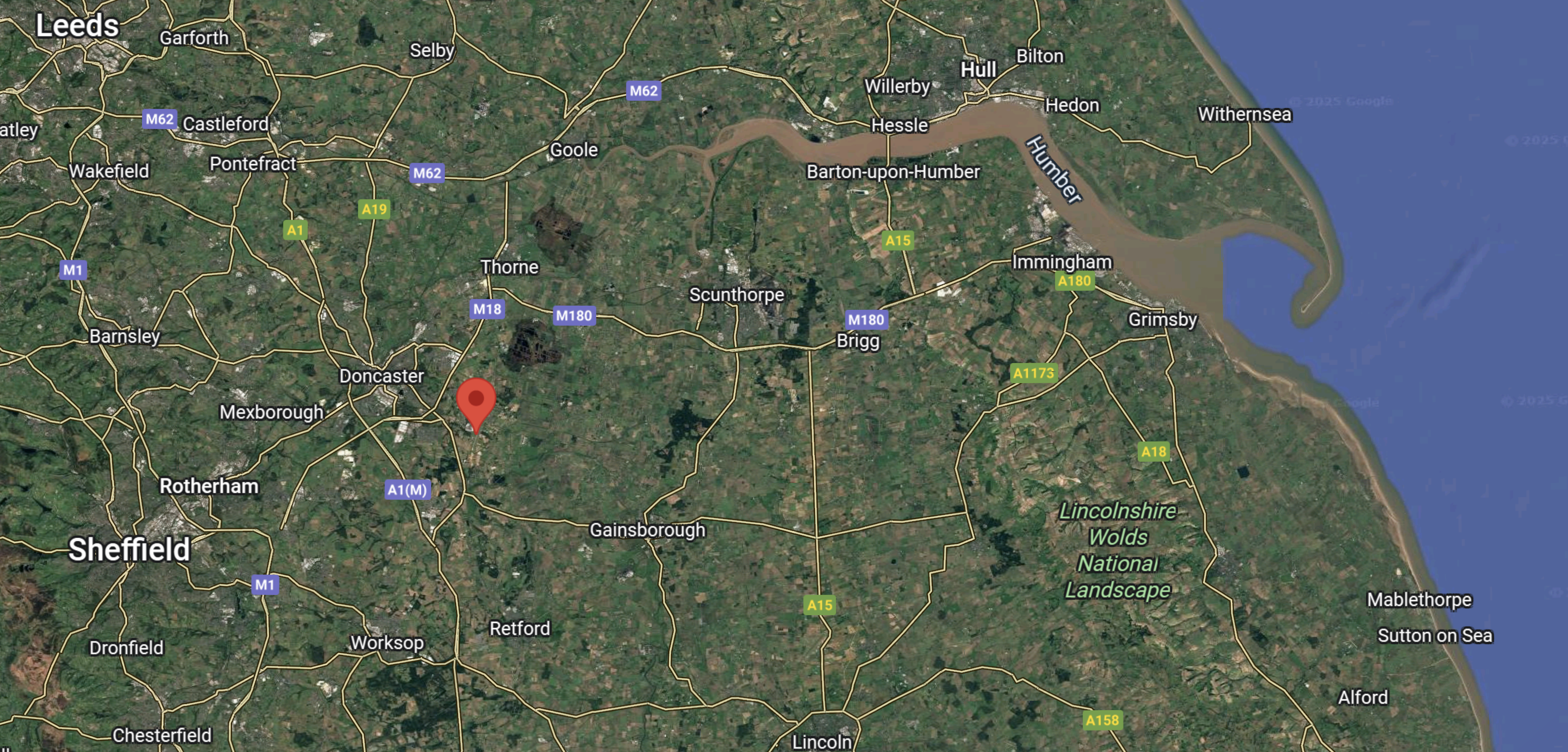
This Google Map shows the location of the airport.
Note.
- The distinctive mouth of the River Humber can be picked out towards the North-East corner of the map.
- Hull and Grimsby sit in the mouth of the Humber.
- The red arrow indicates Doncaster Sheffield Airport.
- Leeds is in the North-West corner of the map.
- The towns and city of Doncaster, Rotherham and Sheffield can be picked out to the West of the airport.
This second Google Map shows a close-up of the airport.

On my visit to NASA in the 1980s, where an Artemis system was used to project manage the turnround of the Space Shuttle, I was asked questions by one of NASA’s support people about RAF Finningley. Nothing too technical, but things like what is Doncaster like.
When I asked why, they said there’s a high chance that a Space Shuttle could land at RAF Finningley, as it has one of the best runways for a very heavy aircraft in Europe.
Looking at the runway, it is a long and wide runway that was built for heavy RAF nuclear bombers like Valiants, Victors and Vulcans.
I believe that we will eventually see hydrogen- and/or nuclear-powered airliners flying very long routes across the globe, just as a nuclear-powered example, attempted to do in the first episode of the TV series Thunderbirds, which was called Trapped in the Sky and has this Wikipedia entry.
Just as the Space Shuttle did, these airliners and their air-cargo siblings will need a large runway.
Doncaster Sheffield Airport already has such a runway.
These hydrogen- and nuclear-powered aircraft will make Airbus A 380s look small and will need runways like the one at Finningley.
But I don’t think we’ll ever see nuclear-powered aircraft in the near future, so the aircraft will likely be hydrogen.
Other things in favour of making Doncaster Sheffield Airport, an airport for long range hydrogen aircraft include.
- The airport is close to the massive hydrogen production and storage facilities being developed on Humberside at Aldbrough and Rough.
- The airport could be connected to the Sheffield Supertram.
- The airport could be connected to the trains at Doncaster station, which has 173 express trains per day to all over the country.
- The airport would fit well with my thoughts on hydrogen-powered coaches, that I wrote about inFirstGroup Adds Leeds-based J&B Travel To Growing Coach Portfolio
- The airport might even be able to accept the next generation of supersonic aircraft.
- The airport could certainly accept the largest hydrogen-powered cargo aircraft.
- The Airport isn’t far from Doncaster iPort railfreight terminal.
Did I read too much science fiction?
I have some further thoughts.
Do Electric Aircraft Have A Future?
I asked Google AI this question and received this answer.
Yes, electric aircraft absolutely have a future, especially for short-haul, regional, and urban air mobility (UAM), promising quieter, zero-emission flights, but battery limitations mean long-haul flights will rely more on hydrogen-electric or Sustainable Aviation Fuels (SAF) for the foreseeable future. Expect to see battery-electric planes for shorter trips by the late 2020s, while hybrid or hydrogen solutions tackle longer distances, with a significant shift towards alternative propulsion by 2050.
That doesn’t seem very promising, so I asked Google AI what range can be elected from electric aircraft by 2035 and received this answer.
By 2035, fully electric aircraft ranges are expected to be around 200-400 km (125-250 miles) for small commuter planes, while hybrid-electric models could reach 800-1,000 km (500-620 miles), focusing on short-haul routes due to battery limitations; larger, long-range electric flight remains decades away, with hydrogen propulsion targeting 1,000-2,000 km ranges for that timeframe.
Note.
- I doubt that many prospective passengers would want to use small commuter planes for up to 250 miles from Doncaster Sheffield airport with hundreds of express trains per day going all over the UK mainland from Doncaster station.
- But Belfast City (212 miles), Dublin (215 miles) and Ostend (227 miles), Ronaldsway on the Isle of Man (154 miles) and Rotterdam(251 miles) and Schipol 340 miles) may be another matter, as there is water to cross.
It looks like it will be after 2035 before zero-carbon aircraft will be travelling further than 620 miles.
My bets would be on these aircraft being hydrogen hybrid aircraft.
What Will The Range Of Hydrogen-Powered Aircraft In 2040?
I asked Google AI this question and received this answer.
By 2040, hydrogen-powered commercial aircraft are projected to have a range that covers short- to medium-haul flights, likely up to 7,000 kilometers (approximately 3,780 nautical miles), with some models potentially achieving longer ranges as technology and infrastructure mature.
The range of these aircraft will vary depending on the specific technology used (hydrogen fuel cells versus hydrogen combustion in modified gas turbines) and aircraft size.
It looks like we’ll be getting there.
This Wikipedia entry is a list of large aircraft and there are some very large aircraft, like the Antonov An-225, which was destroyed in the Ukraine War.
A future long-range hydrogen-powered airline must be able to match the range of current aircraft that will need to be replaced.
I asked Google AI what airliner has the longest range and received this reply.
The longest-range airliner in service is the Airbus A350-900ULR (Ultra Long Range), specifically configured for airlines like Singapore Airlines to fly extremely long distances, reaching around 9,700 nautical miles (18,000 km) for routes like Singapore to New York. While the A350-900ULR holds records for current operations, the upcoming Boeing 777-8X aims to compete, and the Boeing 777-200LR was previously known for its exceptional range.
I believe that based on the technology of current successful aircraft, that an aircraft could be built, that would be able to have the required range and payload to be economic, with the first version probably being a high-capacity cargo version.
What Would An Ultra Long Range Hydrogen-Powered Airliner Look Like?
Whatever the aircraft looks like it will need to be powered. Rolls-Royce, appear to be destining a future turbofan for aircraft called the Ultrafan, which has this Wikipedia entry.
I asked Google AI, if Rolls-Royce will produce an Ultrafan for hydrogen and received this answer.
Rolls-Royce is actively developing the UltraFan architecture to be compatible with hydrogen fuel in the future, but the current UltraFan demonstrator runs on Sustainable Aviation Fuel (SAF). The company has a research program dedicated to developing hydrogen-powered engines for future aircraft, aiming for entry into service in the mid-2030s.
I asked Google AI, if Rolls-Royce have had major difficulties converting engines to hydrogen and received this answer.
Rolls-Royce has not encountered insurmountable difficulties but faces significant engineering and logistical challenges in converting engines to run on hydrogen. The company has made substantial progress in testing both stationary and aero engines using pure hydrogen, confirming its technical feasibility.
Given the company’s success in developing engines in the past, like the R Type, Merlin, RB 211, Pegasus, Trent, mtu 4000 and others, I suspect there’s a high chance of a successful hydrogen-powered Ultrafan.
If you look at a history of large passenger and cargo aircraft over the last sixty years, there has been a lot of the following.
- Conversion of one type of aircraft to a totally different type.
- Fitting new engines to a particular type.
- Fitting new avionics to a particular type.
Examples include.
- Fitting new CFM-56 engines to DC-8s.
- The first two Nimrods were converted from unsold Comet 4Cs.
- Converting Victor bombers to RAF tanker aircraft.
- Converting BA Tristars to RAF tanker aircraft.
- Converting DC-8s to cargo aircraft.
- Airbus converted five Airbus A 300-600 into Belugas, which have this Wikipedia entry.
- Airbus converted six Airbus A 330-200F into BelugaXLs, which have this Wikipedia entry.
- Converting two Boeing-747s to carry Space Shuttles ; one from American Airlines and one from Japan Airlines, which have this Wikipedia entry.
Note.
- Most of these examples have been successful.
- The last three examples have been very successful.
- Most of these applications do not have a human cargo.
This picture shows an Emirates Air Lines’s Airbus A 380 on finals at Heathrow.

Note.
- The aircraft was landing on Runway 27 L.
- The four engines and the vertical oval cross-section of the fuselage are clearly visible.
- The Wikipedia entry for the Airbus A 380 shows two floors across the fuselage; the upper floor with eight seats in 2-4-2 and the lower floor with ten seats in 3-4-3, and a pair of LD3 cargo containers in the basement.
I’d be interested to know, how much hydrogen could be put in the basement and how far it could take the plane with a full load of passengers!
This link to the Wikipedia entry, shows the cross section in detail.
Note
I wouldn’t be surprised that the first application of large hydrogen aircraft will be for cargo and it could be an Airbus Beluga or perhaps an Airbus A 380 freighter?
Huddersfield Station – 30th September 2025
This press release on the Network Rail Media Centre is entitled Huddersfield Station Set To Reopen Next Week With New Temporary Layout.
As it is now next week, I went to have a look at the progress today.
I made a mistake and got on a Grand Central Train, which meant, I had to change at York.
Speeding past Drax power station on the Selby Diversion, I took these pictures.












We were only in a 125 mph diesel, so we couldn’t take advantage of the 160 mph running, that the East Coast Main Line’s new signalling might allow on this section. The Wikipedia entry for the Selby Diversion, says this about the possible speeds.
The line was the first purpose-built section of high-speed railway in the UK having a design speed of 125 mph; however, research by British Rail in the 1990s indicated that the route geometry would permit up to 160 mph operation, subject to the necessary overhead line equipment and signalling upgrades. The new line also avoided the speed restriction over the swing bridge at Selby. The former ECML route, the NER’s 1871 York and Doncaster branch line, was closed from Selby northwards.
As the Selby Diversion opened in 1983, I wouldn’t be surprised that the calculations were performed on British Rail Research’s Pace 231-R, which was similar to the one I used at ICI and the pair, that NASA used calculate how to land Apollo on the moon.
When I eventually got to Huddersfield, I took these pictures.











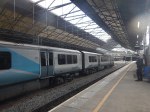
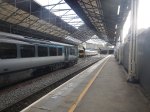



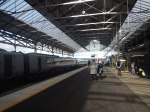







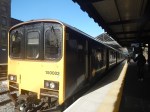
Note.
- In I’ve Just Glimpsed The Future Of Train Travel Across The North Of England And I Like It, there are pictures of Huddersfield station, that were taken on the 21st August, soon after the work started.
- In Huddersfield Station – 15th December 2023, there are pictures of Huddersfield before the work started.
- Much of the work seems to have been done at the Western end of the station to lengthen the platform on the Penistone Line to Sheffield.
- Platform 2 for the Penistone Line has also been renumbered Platform 1.
Work still to be carried out at Huddersfield station, includes refurbishing the roof, installing the electrification and adding a couple of new platforms.
These are my thoughts.
Which Platforms Will Be Electrified?
This OpenRailwayMap shows the proposed electrification in Huddersfield station.
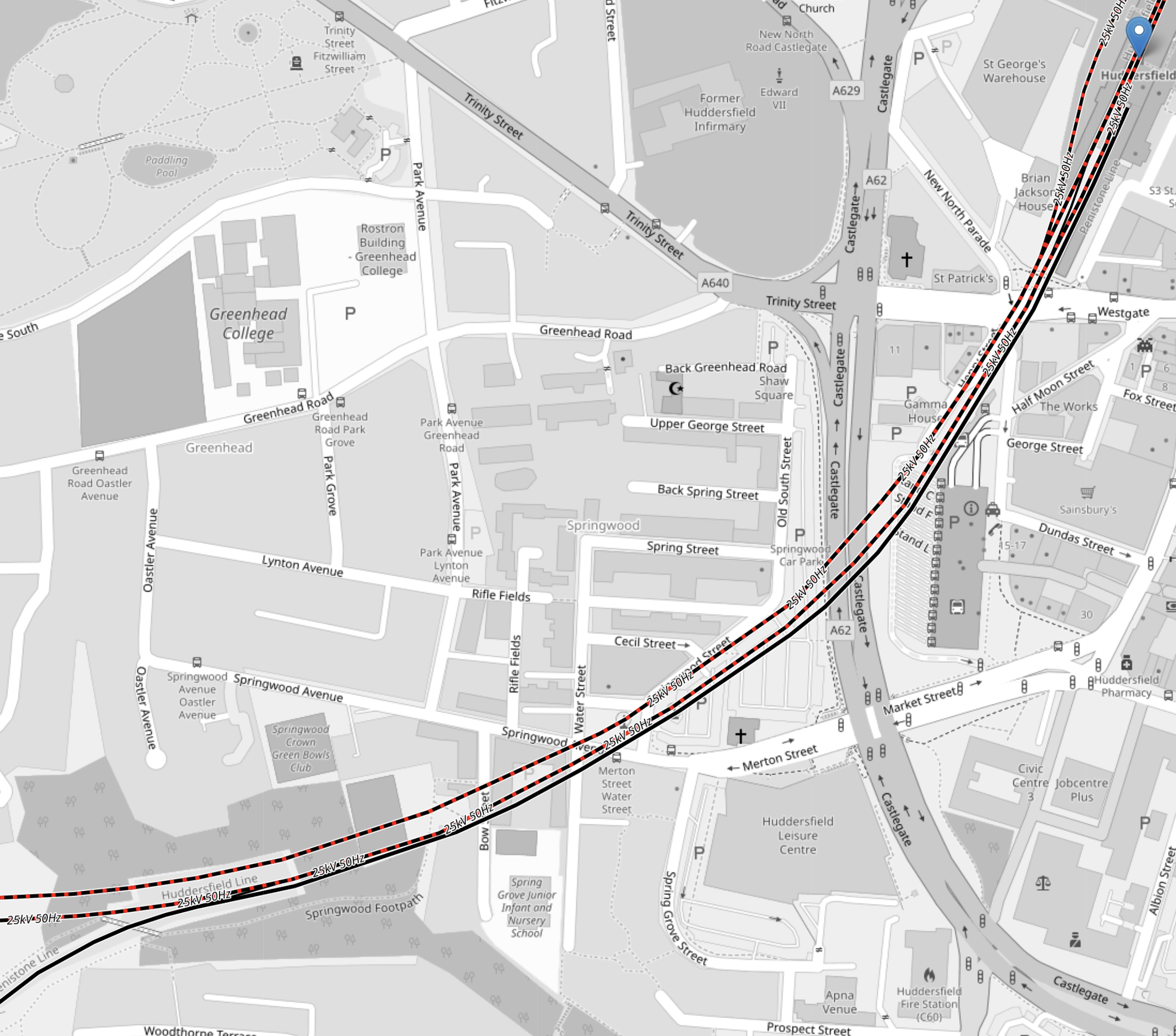
Note.
- The blue arrow in the North-East corner of the map indicates Huddersfield atation.
- The two red-and-black tracks going diagonally across the map are the Hudderfield Line.
- The red-and-black colour, indicates that the two tracks will be electrified.
- South of these two tracks, the Penistone Line sneaks into Platform 1 at Huddersfield station.
- The Penistone Line goes to Sheffield in a South-Westerly direction.
- There appears to be a crossover, so that trains from the Penistone Line can use both Platforms 1 and 2 in Huddersfield station.
- The OpenRailwayMap appears to show planned electrification between Stalybridge and Leeds stations.
- To the East of Leeds planned electrification is shown as far as Micklefield and Church Fenton stations.
Once installed, this electrification will create a complete electrified route across the Pennines from Liverpool Lime Street in the West to the East Coast Main Line in the East.
This OpenRailwayMap shows the planned electrification between Micklefield and Hull stations.

Note.
- Red tracks are electrified.
- Black tracks are not electrified.
- York is in the North-West corner of the map, with the electrified East Coast Main Line going through the station North-South.
- South of York, the East Coast Main Line now splits.
- The Western branch includes an electrified line to Micklefield station, Neville Hill depot and Leeds station.
- The Eastern Branch is the Selby Diversion, which is an electrified 160 mph line, that avoids the Selby coalfield.
- Running West-East across the map is the unlectrified Micklefield and Hull Line, which goes via Selby.
- Hull is in the South-East corner of the map.
- Hull is 42 miles from Micklefield and 36.1 miles from the Temple Hirst junction on the Selby Diversion, so it is within range of battery-electric trains, with charging at Hull station.
- Hitachi’s battery-electric Class 802 trains, used by Hull Trains and TransPennine Express, which are currently on test, should certainly be able to serve Hull.
Hull can become an electrified station, without the expense and disruption of full electrification.
How Long Is Platform 1 At Huddersfield Station?
This OpenRailwayMap shows the new Platform 1 at Huddersfield station.
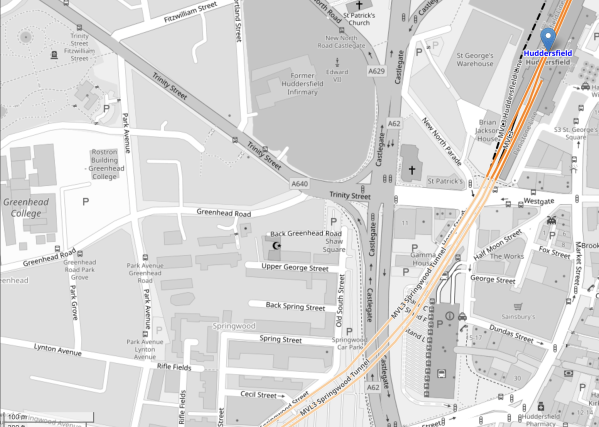
Note.
The blue arrow indicates Huddersfield station.
- The three darker orange lines indicate the two through platforms 2 and 3, and the reconfigured bay platform 1.
- There is a cross-over between platforms 1 and 2, which connects Platform 2 to the Penistone Line.
- In the South-West corner of the map is a hundred metre scale.
- Using the scale, I estimate that the length of the bay platform 1 is around 120 metres.
- In the last two rows of pictures in the gallery of this post, a three car Class 150 train is shown in Platform 1.
- A three car Class 150 train is approximately sixty metres long.
Looking at the pictures, I wouldn’t be surprised if the new platform has been designed to take two three-car Class 150 trains. It would certainly take a pair of two-car Class 150 trains.
Other trains and their lengths that might use the platform include.
- Class 170 – three-car – 70.85 metres
- Class 195 – two-car – 48.05 metres
- Class 195 – three-car – 71.40 metres
- Class 195 – 2 x two-car – 96.10 metres
- Class 810 – five-car – 120 metres
The Class 810 uses 24 metre cars, so that a pair of trains, will fit in St. Pancras. But with perhaps selective door opening could a single Class 810 train run a St. Pancras and Huddersfield service, perhaps with a split and join at Sheffield.
Electrification Across The Pennines
The TransPennine Route will be electrified between Liverpool Lime Street and Micklefield stations, once the current works between Huddersfield and Leeds are complete.
Sections without electrification include.
- Bradford Interchange and Doncaster – 52.1 miles
- Cleethorpes and Doncaster – 52.1 miles
- Harrogate and Leeds – 18.3 miles
- Hazel Grove and Doncaster – 52.6 miles
- Hull and Micklefield – 42 miles
- Hull and Temple Hirst junction – 36.1 miles
- Saltburn and Northallerton – 28.1 miles
- Sunderland and Northallerton – 46.8 miles
- Scarborough and York – 42.1 miles
I expect that Hitachi trains with batteries or CAF’s tri-mode trains will be able to handle these routes in a low-carbon manner.
Electrification Between Stalybridge And Huddersfield
This section is shown as being electrified on OpenRailwayMap.
But as it is only 18 miles and includes the Standedge Tunnels will the route use battery-electric trains?
SaxaVord ‘A Real Spaceport Now’ After First Rocket Explosion
The title of this post, is the same as that of the title of this article on The Times.
This is the sub-heading.
Despite the disappointment of last Monday’s fire engineers remain confident that the Unst site is ready for launch
These are the first two paragraphs.
Nothing could look more ominous for the European space industry than the tower of flame lighting up the skies over Shetland’s SaxaVord spaceport when a prototype engine suddenly and spectacularly caught fire on the launchpad last week.
The blaze was certainly “a nightmare” for the engineers of Rocket Factory Augsburg (RFA), the German company that hoped to conduct its first vertical rocket launch this year.
These are my thoughts and some from the article.
- I can remember a headline of Ike’s Phutnik, in a tabloid, when the United States tried to launch their first satellite.
- The safety systems seem to have worked well and no-one was hurt.
- The Chief Operating Officer of Rocket Factory Augsburg, still seems to have the ambition to make the project succeed.
- The operators are confident that SaxaVord will be ready for the next trials, whenever they are required.
- There is interest from Malaysia, to launch earth observation satellites.
- Scotland also offers other opportunities to southeast Asian tech businesses, as there are no launch sites in the region.
But most importantly, SaxaVord is generating interest from a wide range of users, as this paragraph indicates.
Others have already decided. SaxaVord has struck launch agreements with Lockheed Martin, the US aerospace giant and the German company HyImpulse as well as the UK’s Skyrora. Another four deals with international satellite companies are said to be in the offing.
If an established company were to launch a successful satellite, it could make all the difference to SaxaVord.
Conclusion
These are the last two paragraphs of the article.
Interest on this global scale enables the Scottish space pioneers to shrug off Monday’s blaze and the bad publicity it entailed. For anyone thinking the fire was bad news, emails from colleagues in the US told an altogether different story.
“You’re a real spaceport now,” read one message to a Shetland engineer. “You can’t call yourself a spaceport until you’ve had a rocket blow up!”
I have been to a party at NASA in Houston and they wouldn’t have been as successful, as they have, if they gave up on a failure. They try, try and try again.
British Gas Joins Forces With Samsung To Help Customers Power Smarter Energy Use
The title of this post, is the same as that of this press release from Centrica.
This is the sub-heading.
British Gas and Samsung have today announced the exciting first step in a long-term venture – aimed at helping customers better manage their energy use and increase the adoption of low carbon heating technologies in homes across Britain.
These are the first two paragraphs.
The collaboration will see British Gas integrate with Samsung’s SmartThings app to help customers optimise their home appliances to use energy when the cost and demand are lower. This is now possible through the integration of SmartThings Energy and British Gas’ PeakSave demand flexibility scheme informing customers (by sending notifications via their smartphone, TV or other compatible devices) of the best times to use household appliances to save money.
The PeakSave scheme includes PeakSave Sundays, running every Sunday until the end of February with half-price electricity from 11am to 4pm for British Gas customers and PeakSave Winter events which encourages customers to move their electricity use out of peak times when there is high demand on Britain’s energy grid.
As a Graduate Control Engineer, I believe that this could make optimising your energy use much easier.
- It would surely be a lot easier to check usage on your phone rather than a smart meter, when you perhaps cook a ready meal, so that you can see if your microwave or traditional cooker is cheapest.
- Suppose you and everybody, who lives with you are out for supper and British Gas want to cut off your gas for a reward, you can make an appropriate decision.
- Hopefully, if you have the right controls, you’ll be able to switch lights and appliances off and on.
The possibilities are endless.
I shall certainly be looking at the reviews of this app.
There is a section in the press release called Scaling Up Low Carbon Heating Opportunities, where this is said.
The collaboration will also help support customers in their journey to decarbonising their homes by introducing smart technologies in a way that is simple and empowering. From early 2024, British Gas will include Samsung heat pumps in its offering to British households to support the UK’s commitment to reach net zero by 2050.
The venture will see specially trained British Gas surveyors and engineers working with consumers to explain the benefits of heat pumps and then conducting the installations on-site. Samsung will be supporting workforce training as part of their efforts to upskill the heating industry to ensure there are enough installers to service the expected growing demand.
British Gas also offers customers the chance to purchase heat pumps through flexible financing methods. This, combined with the recently increased UK Government Boiler Upgrade Scheme grant of £7,500, creates an attractive package of financing options to help people make the transition more affordable.
Various plumbers, who I would trust, have given me different views about heat pumps.
I suspect the Samsung’s SmartThings app might be able to simulate your energy usage with or without the heat pump, as it would know your energy use with your current boiler.
I was doing similar calculations for chemical plants in the early 1970s at ICI, using a PACE 231-R computer.

Consider.
- It may look rather old fashioned, but it could solve a hundred simultaneous differential equations in one go.
- Two similar computers linked together were the analogue half of NASA’s moon mission simulator.
- Without these wonderful machines, NASA would not have been able to re-calculate the dynamics of Apollo 13 and the mission would be remembered as a disaster, rather than the first space rescue.
The average current smart phone has more computing power than a PACE 231-R.
What’s In It For Samsung?
I have a Samsung television, but unfortunately it has a screen fault because of age. So if I had the Samsung app and liked it, I might buy another Samsung TV.
Similarly, the app might give me a financial reason to buy a Samsung heat pump.
Samsung will sell more equipment.
What’s In It For Centrica?
Centrica would appear to be a loser, as bills will fall and they could be paying customers to not use energy.
But they are surely hoping that their market share will increase and I’m sure Samsung will give them a commission.
What’s In It For The Consumer?
Hopefully, they’ll get lower energy bills.
But also they might get a lot of convenience controlling their appliances and heating.
Conclusion
Using energy is becoming a computer game with monetary rewards.
Is the deal between Centrica/British Gas and Samsung another deal that has been brought to fruition by the Korean President’s visit to the UK?
It looks like this is the third recent deal signed between UK and Korean companies, after these two.
- South Korea, UK Strenghten Offshore Wind Ties
- UK And South Korea Help Secure Millions For World’s Largest Monopile Factory
I suspect, there might be a few more deals, if Charles and Camilla really turned on the charm.
In Mersey Tidal Project And Where It Is Up To Now, I wrote about talks between Liverpool City Council and Korea Water about a tidal barrage of the Mersey. This project must surely be a possibility!
This is said in the Wikipedia entry for Korean Air under Fleet Plans.
At the Association of Asia Pacific Airlines Assembly in 2018, Korean Air announced that it was considering a new large widebody aircraft order to replace older Airbus A330, Boeing 747-400, Boeing 777-200ER and Boeing 777-300. Types under consideration for replacement of older widebody aircraft in the fleet include the Boeing 777X and Airbus A350 XWB. At the International Air Transport Association Annual General Meeting (IATA AGM) in Seoul, Chairman Walter Cho said Korean Air’s widebody order is imminent and it is considering an extra order of Airbus A220 Family including developing version, Airbus A220-500.
Note.
- Airbus A350 XWB have Welsh wings and Rolls-Royce engines.
- Airbus A220-500 are made in Canada with wings and composite parts from Belfast. Rolls-Royce may have a suitable engine.
Could a deal have something in it for the UK?
Although Korea has its own SMR program, I wonder, if there could be a link-up between Korean industry and Rolls-Royce over SMRs?
Roger Ford’s Cunning Plan
In the February 2020 of Modern Railways, there is an article called LNER Procurement, which has been written by Roger Ford.
It is Roger’s reply to an article in the December 2020 Edition of Modern Railways, which was entitled LNER Seeks 10 More Bi-Modes.
He starts by describing the requirement and then says this.
Would any fleet engineer in his or her right mind want to add a unique sub-fleet of 10 high speed trains to an existing successful fleet, even if they were hydrogen-electric tri-modes from the respected Kim Chong t’ae Electric Locomotive Works?
In my analysis of the December 2020 article, I wrote this post with the same name, where I said this, under a heading of More Azumas?
Surely, It would require a very innovative train at perhaps a rock-bottom price from another manufacturer, for LNER to not acquire extra Azumas.
So it would appear that Roger and myself are vaguely in agreement on the subject of more Azumas.
The last section of the article has a title of Cunning.
Roger puts forward, the view that the procurement process, as well as being compatible with EU law, could be a warning to Hitachi, to make sure that LNER get a good deal.
It certainly could be, and I remember a similar maneuver by ICI around 1970.
The company was buying a lot of expensive IBM 360 computers.
ICI needed a new computer to do scientific calculations at their Central Instrument Research Establishment (CIRL) at Pangbourne in Berkshire.
- English Electric had just released a clone of an IBM 360 and were keen to sell it to ICI.
- As it would do everything that ICI wanted, they bought one.
- It worked well and did everything that CIRL wanted at a cheaper price.
IBM’s reaction was supposedly quick and dramatic. The salesman who dealt with ICI, was immediately fired!
But as ICI had about a dozen large IBM computers, there wasn’t much they could do to one of the most important and largest UK companies.
IBM also made sure, that ICI got their next computer at a good price.
I’m with Roger that all the shenanigans are a warning to Hitachi.
Roger finishes the article with these two paragraphs.
A genuine bluff would have been to seek bids for the long-term deployment of remanufactured IC225s. Which in these straitened times could still turn out to be a more viable option.
I rather fancy the idea of a hydrogen-electric Class 91. Owner Eversholt Rail might even have played along on the understanding that it funded the inevitable hybrid Azumas.
Note that IC225s are InterCity 225 trains.
- The 31 trains, were built for British Rail in the 1980s.
- They are hauled by a 4.83 MW Class 91 locomotive, which is usually at the Northern end of the train.
- Nine Mark 4 coaches and a driving van trailer complete the train.
- As with the Hitachi Azumas (Class 800 and Class 801 trains), they are capable of operating at 140 mph on lines where digital in-cab ERTMS signalling has been installed.
I just wonder, if a Class 91 locomotive could be to the world’s first 140 mph hydrogen-electric locomotive.
Consider the following.
Dynamics
The wheels, bogies and traction system were designed by British Rail Engineering Ltd, who were the masters of dynamics. This is a sentence from the locomotive’s Wikipedia entry.
Unusually, the motors are body mounted and drive bogie-mounted gearboxes via cardan shafts. This reduces the unsprung mass and hence track wear at high speeds.
That is a rather unique layout. But it obviously works, as otherwise these locomotives would have been scrapped decades ago.
I believe the quality dynamics are because BREL owned a PACE 231R for a start, which was an analogue computer, that was good enough for NASA to use two computers like this to calculate how to put a man on the moon.
London and Edinburgh is a slightly shorter distance, run at a somewhat slower speed.
Space
This picture shows a Class 91 locomotive.
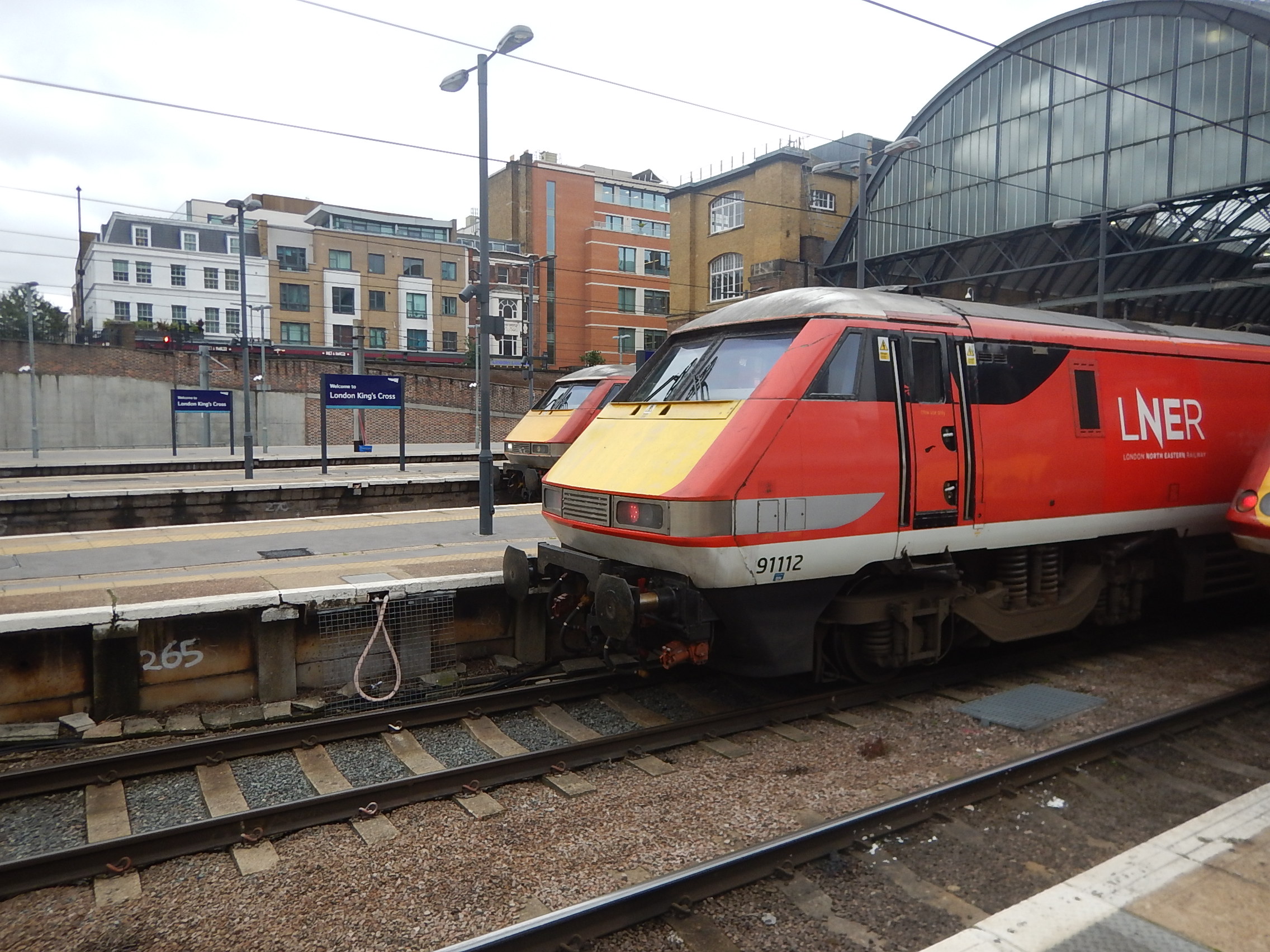
What is in the space in the rear end of the nearly twenty metre-long locomotive?
This sentence from the Wikipedia entry for the locomotive gives a clue.
The locomotive also features an underslung transformer, so that the body is relatively empty compared to contemporary electric locomotives.
It also states that much of the layout came from the APT-P, which was a version of the tilting Advanced Passenger Train.
Would the space be large enough for a tank of hydrogen and some form of generator that used the hydrogen as fuel?
It should be noted that one version of the APT used a gas-turbine engine, so was the locomotive designed for future use as a bi-mode?
Fuel Cells
I’ve ignored fuel cells, as to get the amount of power needed, the fuel cells could be too large for the locomotive.
Class 91 Locomotive Performance
The performance of a Class 91 locomotive is as follows.
- Power output – 4.83 MW
- Operating speed – 140 mph
- Record Speed – 161 mph
Not bad for a 1980s locomotive.
Required Performance Using Hydrogen Fuel
If the locomotives were only needed to use hydrogen to the North of the electrification from London, the locomotive would need to be able to haul a rake of coaches twice on the following routes.
- Aberdeen and Edinburgh Haymarket – 130 miles
- Inverness and Stirling – 146 miles
A range of three hundred miles would be sufficient.
The locomotive would need refuelling at Aberdeen and Inverness.
The operating speed of both routes is nowhere near 140 mph and I suspect that a maximum speed of 100 mph on hydrogen, pulling or pushing a full-size train, would probably be sufficient.
When you consider that a nine-car Class 800 train has five 560 kW diesel engines, that give a total power of 2.8 MW, can carry 611 passengers and an InterCity 225 can only carry 535, I don’t think that the power required under hydrogen will be as high as that needed under electricity.
Rolls-Royce
Rolls-Royce have developed a 2.5 MW generator, that is the size of a beer keg. I wrote about it in Our Sustainability Journey.
Could one of these incredibly-powerful generators provide enough power to speed an InterCity 225 train, through the Highlands of Scotland to Aberdeen and Inverness, at speeds of up to 100 mph.
I would give it a high chance of being a possible dream.
Application Of Modern Technology
I do wonder, if the locomotive’s cardan shaft drive could be improved by modern technology.
These pictures show Joseph Bazalgette’s magnificent Abbey Mills Pumping station in East London.


A few years ago, Thames Water had a problem. Under the pumping station are Victorian centrifugal pumps that pump raw sewage to Beckton works for treatment. These are connected to 1930s electric motors in Dalek-like structures on the ground floor, using heavy steel shafts. The motors are controlled from the control panel in the first image.
The shafts were showing signs of their age and needed replacement.
So Thames Water turned to the experts in high-power transmission at high speed – Formula One.
The pumps are now connected to the electric motors, using high-strength, lower-weight carbon-fibre shafts.
Could this and other modern technology be used to update the cardan shafts and other parts of these locomotives?
Could The Locomotives Use Regenerative Braking To Batteries?
I’ll start by calculating the kinetic energy of a full InterCity 225 train.
- The Class 91 locomotive weighs 81.5 tonnes
- Nine Mark 4 coaches weigh a total of 378 tonnes
- A driving van trailer weighs 43.7 tonnes.
- This gives a total weight of 503.2 tonnes.
Assuming that each of the 535 passengers, weighs 90 Kg with babies, baggage, bikes and buggies, this gives a passenger weight of 48.15 tonnes or a total train weight of 551.35 tonnes.
Using Omni’s Kinetic Energy Calculator, gives the following values at different speeds.
- 100 mph – 153 kWh
- 125 mph – 239 kWh
- 140 mph – 300 kWh
I think, that a 300 kWh battery could be fitted into the back of the locomotive, along with the generator and the fuel tank.
With new traction motors, that could handle regenerative braking, this would improve the energy efficiency of the trains.
Sustainable Aviation Fuel
Sustainable aviation fuel produced by companies like Altalto would surely be an alternative to hydrogen.
- It has been tested by many aerospace companies in large numbers of gas turbines.
- As it has similar properties to standard aviation fuel, the handling rules are well-known.
When produced from something like household waste, by Altalto, sustainable aviation fuel is carbon-neutral and landfill-negative.
ERTMS Signalling And Other Upgrades
Full ERTMS digital signalling will needed to be fitted to the trains to enable 140 mph running.
Conclusion
I believe it is possible to convert a Class 91 locomotive into a hydrogen-electric locomotive with the following specification.
- 4.83 MW power on electricity.
- 140 mph on electrification
- 2.5 MW on hydrogen power.
- 100 mph on hydrogen
- Regenerative braking to battery.
If it were easier to use sustainable aviation fuel, that may be a viable alternative to hydrogen, as it is easier to handle.
Are Extinction Rebellion Counter Productive?
I am coming to the conclusion that Extinction Rebellion are a bunch of climate-change fascists of the left, that mirror, the racist and immigration fascists on the right.
Both have unrealistic ambitions and just like Hitler and Stalin want to control out lives and give themselves and their acolytes absolute power.
In my mind, there is no difference between the extreme left and extreme right. For instance the extreme-right is generally thought to be anti-Semitic and who is being accused of that now? The once respectable Labour Party, which is now more useless than a chocolate teapot.
I am scientifically green and have been so since my I left Liverpool University round fifty years ago.
I have believed in global warming for about thirty years, ever since I was told by a guy on the NASA team, that measured the Earth’s temperature from satellites, that the world was warming up.
No matter what Bolsonaro Trump, Xi Jinping and other leaders say, global warming is a NASA fact!
But large numbers of people don’t believe in good scientific practice and behaviour.
- Some are anti-vaccination.
- Some believe in homeopathy.
- Many believe in religion, some of which are totally bonkers!
- Some think the 9/11 attacks were faked or carried out by the Israelis.
- Some believe the moon landings were faked!
- Some believe in log fires.
- They drive hundreds of miles to work every year.
- They drive their children everywhere.
- They never talk to anybody of a different race or religion.
- Some have a holiday home in Cornwall, North Norfolk, France or Spain.
There is only one way to convince morons like these to change to a more scientifically-green lifestyle.
By nudging them to it, by showing them it can be better and more affordable.
Extinction Rebellion and their ilk just alienate Middle England and they push green issues under the carpet for another day.
Incidentally, we need politicians at both a National and local level to stop playing stupid games about Brexit and get on with the job of improving the lives of all of the residents of the UK.
The Britons Who Played For The Moon
The title of this post, is the same as that of an article on page 15 of today’s copy of The Times.
This is two paragraphs – – .
The team was organised by John Hodge, who was born in Leigh-on-Sea, Essex and who had previously worked for Vickers Armstrong, which during the Second World War built the Supermarine Spitfire.
Mr. Hodge, now 90, would become a flight director at mission control – the one time that ‘Houston’ spoke with a British accent.
I’ve heard of John before.
Like me, John Hodge went to Minchenden Grammar School and one of our maths’ teachers; George Bullen,when I was doing Further Maths in the Sixth Form, told us the full story of one of his brightest students.
If John had a problem, it was that he couldn’t get a language O-level, which was needed to get to University in the late 1940s.
So he went to Northampton Engineering College, which is now the City University, where the qualification wasn’t needed.
I think George Bullen, with his John Arlott Hampshire accent, probably told us the story of John Hodge for motivation.
This is another paragraph in the article.
Peter Armitage, 90, who grew up in Hable-le-Rice, Hampshire, was also in the Avro group. In 1969 he oversaw the simulator that Neil Armstrong used to learn how to touch down on the moon.
As I remember it, the simulator was a hybrid digital-analogue computer using two PACE 231-R computers as the analogue half.
This picture shows the similar computer, that I worked on at ICI in Welwyn Garden City.
These machines could each solve up to a hundred simultaneous differential equations, in real time, so were ideal for calculating the dynamics of complex systems.
They were some beasts!
From what I read at the time, they were key in bringing the Apollo 13 astronauts home, as they could be quickly reprogrammed, if you were familiar with the dynamic model., as undoubtedly NASA’s engineers were.
 The Anonymous Widower
