Coach Chaos At The Finchley Road Coach Stop On A Sunday Lunchtime
I went to Finchley Road coach stop at lunchtime today and took these pictures.




















































Note.
- Finchley Road coach stop is on the Finchley Road, just to the North of Finchley Road tube station.
- The Finchley Road coach stop is lavelled CL.
- Not all coaches stopped at the Finchley Road coach stop.
- I did see a double-deck coach taking visitors to the Harry Potter Attraction pass through ar Victoria Coach station and the Finchley Road.
- There is a pedestrian subway under Finchley Road.
- There is a second stop for Southbound coaches on the other side of the Finchley Road.
- There are a few tatty shops along the pavement selling snacks, coffee, tea and other travellers needs.
- In the early pictures note, the large number of travellers queuing along the pavement in front of those shops.
- It looks like a lot of those travellers, were waiting for the Flixbus.
- The Flixbus stayed parked for several minutes.
- Finchley Road tube station is not step-free.
- Finchley Road tube station is served by the Metropolitan and Jubilee Lines.
I took most of the pictures from the opposite site to the Northbound coach stop, as the pavement was rather crowded.
This Google Map shows Finchley Road, the tube station and the coach stop.
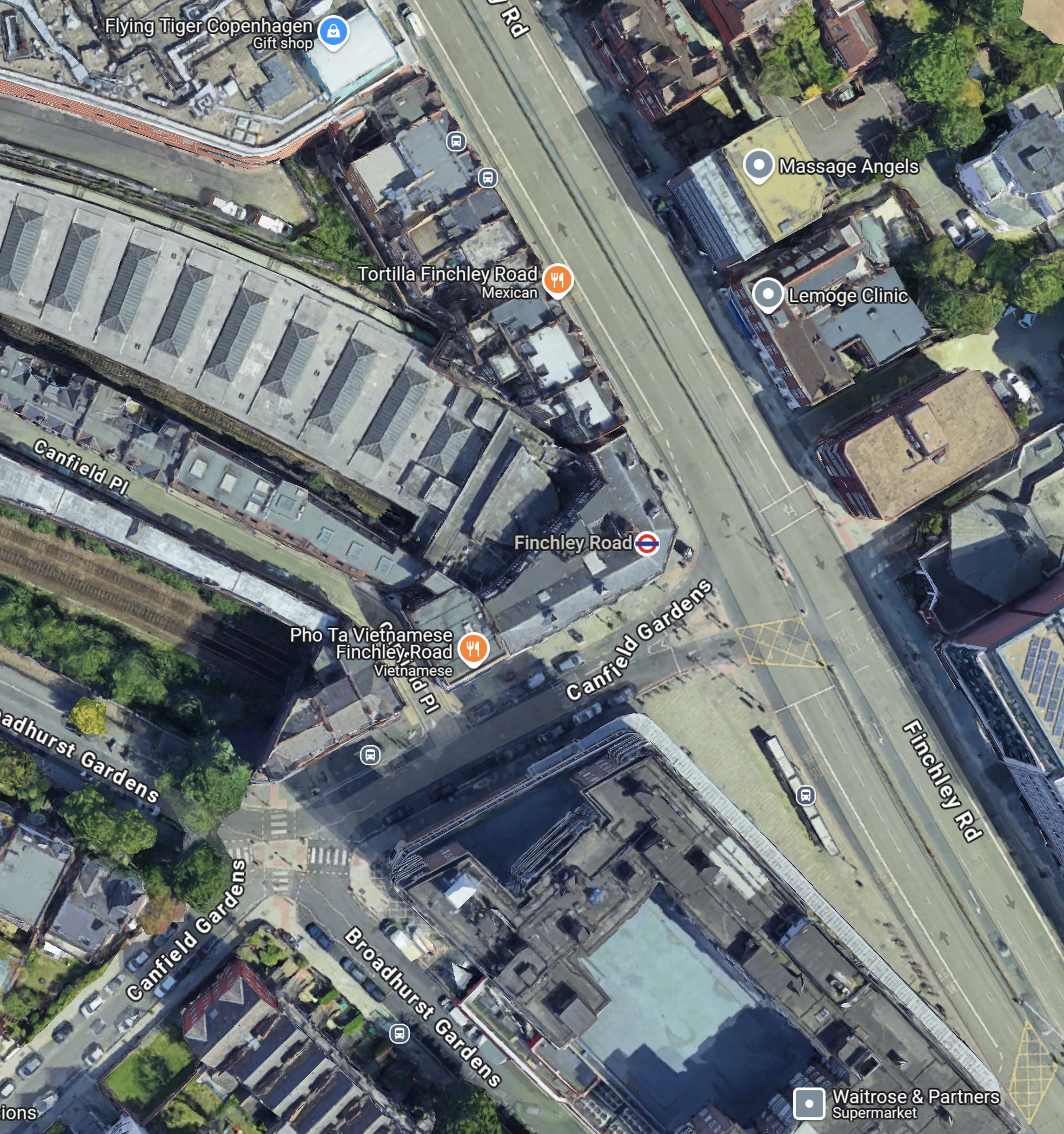
Note.
- The Finchley Road is the dual-carriageway road.
- The two grey dots at the Northend end of the Finchley Road, indicate the Coach stop and to its North a bus stop.
- The larger orange dot indicates the Tortilla restaurant, which is visible in several of the pictures.
- The London Underground roundel indicates Finchley Road tube station.
- The building curving away to the North-West is the train shed for the four platforms of Finchley Road tube station.
South of Finchley Road tube station, is a large Waitrose in the old John Barnes building.
This pictures show some of the Train to Street access at Finchley Road station.
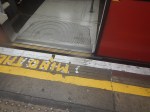


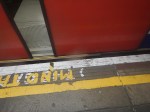




Note.
- There is a high step out of the Jubilee Line trains.
- The steps from platform to the street are steep with a heavy case or a baby in a buggy.
But it’s a long time, since I’ve done any travelling with a baby.
I have some further thoughts.
Travelling With Heavy Luggage, In A Wheelchair Or A Baby Buggy
It might be better to take a 13 or 113 bus to Finchley Road tube station, as the stop is just South of the station and no more than fifty metres from the Finchley Road coach stop.
You could even get the bus from Swiss Cottage station, which is the next station South from Finchley Road and has a complete set of traditional escalators with uplighters.







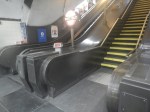
Note.
Start-Up’s Plan To Convert Food Waste Into Green Fuel
The title of this post, is the same as that, of this article in The Times.
This is the sub-heading.
Dark Green wants to build biogas production plants to supply local authorities and businesses
These three paragraphs give some detail to the plans.
A Nottingham-based start-up wants to become the first company to build a fleet of plants that would convert food waste into green energy in urban centres across Britain, producing an alternative fuel for businesses and local authorities attempting to shrink their carbon footprints.
Dark Green expects to submit planning applications for six biogas production plants, including one each in Birmingham and Huddersfield, with a further six in the pipeline.
The facilities, which are more usually sited on farms, will be capable of handling 60,000 tonnes of organic waste a year, saving the same amount of carbon dioxide as taking 65,000 cars off the road, the company estimates, and will produce seven megawatts of energy, capable of powering around 6,000 homes.
I have a feeling that Dark Green fit a theme, that this blog has been following for a couple of years now.
I have been commenting on a company called HiiROC.
- I first became aware of HiiROC and their new method of generating hydrogen in this news item from Centrica, which is entitled Centrica And HiiROC To Inject Hydrogen At Brigg Gas-Fired Power Station In UK First Project.
- HiiROC is a Hull-based startup-up, that is backed by Cemex, Centrica, Hyundai, Kia, Siemens and other big names.
- HiiROC can take any hydrocarbon gas from something like chemical plant off-gas, through biomethane to natural gas and split it into hydrogen and carbon black.
- HiiROC call their process thermal plasma electrolysis.
- The carbon black has uses in the manufacture of tyres and rubber products, anodes for lithium-ion batteries and other materials and in agriculture, it can be used to improve soils.
HiiROC claim that their method uses a fifth of the energy to create hydrogen, than electrolysis.
It looks to me that if you pipe Dark Green’s methane-rich gas into one of HiiROC’s thermal plasma electrolysers, you’ll get two valuable products; hydrogen and carbon black.
Centrica have also been active with an energy storage company called Highview Power recently, in the company of Goldman Sachs and Rio Tinto.
Centrica seem to have a cunning plan!
Is Dark Green going to be part of it?
Agrivoltaics Deal To Bring 9,000 Sheep To 1GW Solar Park
The title of this post, is the same as that of this article on Solar Power Portal.
When I saw the title, I felt I just had to call it out.
A 1GW Solar Park
Normally, a 50-100 MW solar farm is considered large for the UK, so a 1 GW solar farm must be truly enormous, by any standards.
According to the heading of the Great North Road Solar and Biodiversity Park web site, which says this.
Elements Green is developing proposals for a new solar and energy storage park located to the northwest of Newark-on-Trent, Nottinghamshire.
With a potential generation capacity of around 800 megawatts (MW) AC of solar energy, the scheme has the potential to provide enough clean, affordable energy to meet the power needs of approximately 400,000 homes while avoiding more than 250,000 tonnes of CO₂ emissions every year.
The size appears to be around 800 MW.
But that is still large!
The Project Area
This article on the BBC is entitled Survey Suggests Opposition To Major Solar Farm, has this as a caption to the first picture.
The solar project is made up of around 1.5 million panels covering 7,000 acres.
That is around eleven square miles or a 3.3 mile square.
A Map Of The Project
This map of the project was clipped from the Elements Green web site.
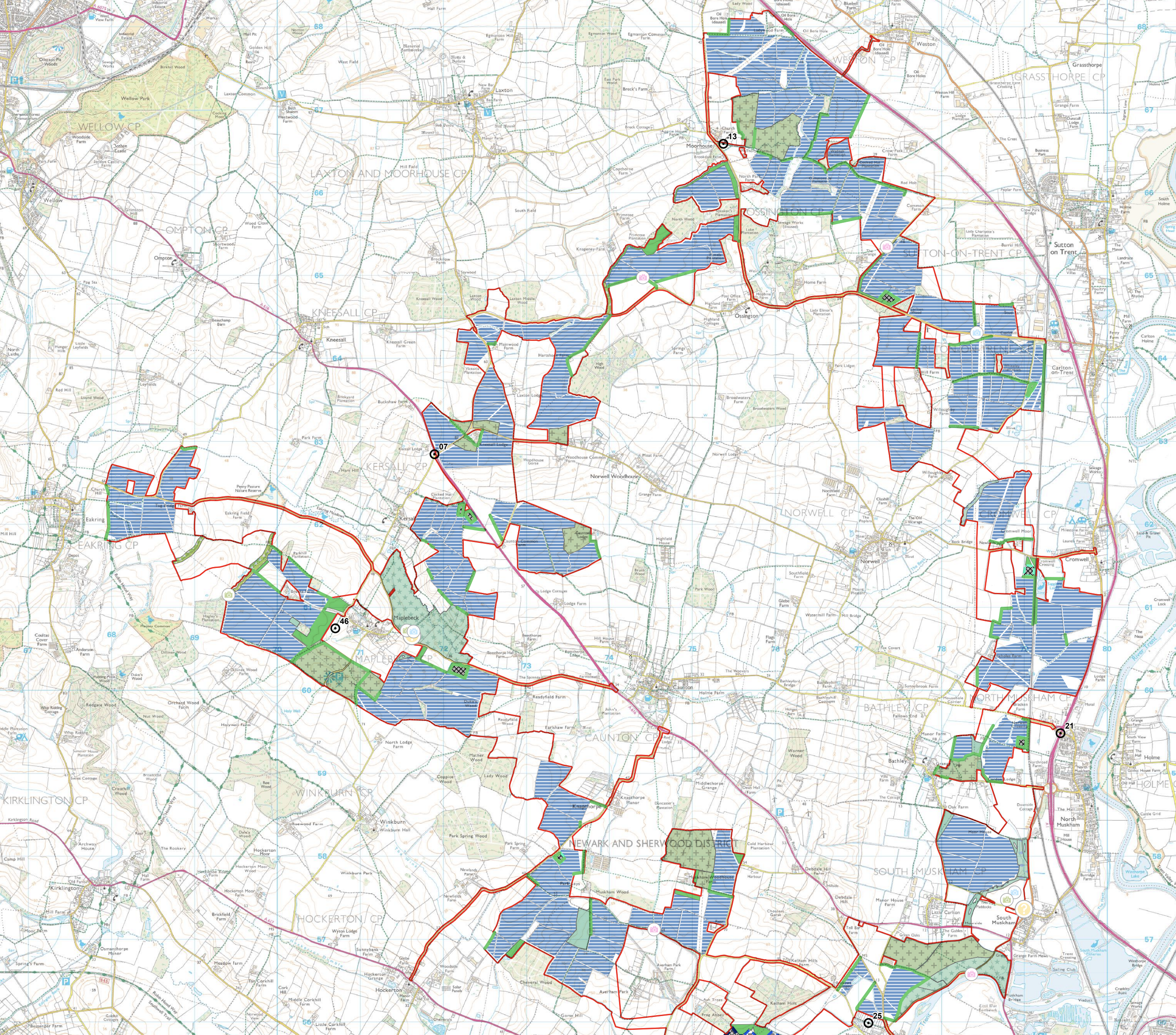
Note.
- The blue areas are solar panels.
- The red line at the right hand side is the A1 Great North Road.
- There is a lot of space for more solar panels.
It could be even bigger than 1 GW.
There Is Opposition To The Wind Farm
This article on the BBC is entitled Survey Suggests Opposition To Major Solar Farm.
This is the sub-heading,
A consultation about a major solar farm in Nottinghamshire has shown the scale of the opposition it faces to being built.
These two paragraphs detail the scale of the opposition.
The consultation, held in January and February, found 54% of respondents opposed the scheme, with 16% supporting the current plan.
Among the main reasons people gave for opposing the scheme were its visual and ecological impact.
The reasons for opposition are typical.
These two paragraphs describe the actions of the developer.
Having received the backing in principle of several key nature charities and trusts, the Great North Road Solar Park project will be renamed ‘Great North Road Solar and Biodiversity Park’, with a new logo to reflect this.
Communities who were consulted on the original proposals in early 2024 expressed a strong desire to protect and enhance their natural environment. Acting upon this feedback, developer Elements Green has formed partnerships with the RSPB, Sherwood Forest Trust, Nottinghamshire Wildlife Trust, and The Trent Rivers Trust, to ensure that nature benefits from their ambitious project.
I suspect that some of the opposition groups have labelled the last paragraph as green-washing.
Nine Thousand Sheep!
Usually, when large numbers of sheep are mentioned on the Internet, it’s usually something a bit coarse.
But in this project, it’s only letting sheep, do what they do well ; act as green lawnmowers, have lambs and provide meat and wool to increase the bottom line.
Where Is The Connection To The Grid?
The FAQs section of the Great North Road Solar and Biodiversity Park web site has this question.
Why has Elements Green chosen this location for the solar park?
This answer is given.
A key factor influencing the location of GNR Solar and Biodiversity Park is the availability of a connection at National Grid’s Staythorpe substation. The closure of fossil fuel power stations has created capacity on the grid. This would enable GNR Solar and Biodiversity Park to continue the tradition of power generation in the area using a clean, renewable resource.
In addition, a range of planning and environmental factors such as the existing land use, quality of land, as well as designations and planning and technical constraints have also informed our choice of location for the scheme.
So if you’re near the site of a disused coal- or gas-fired power station, don’t expect it to be developed as agricultural land, woodland or housing.
The Wikipedia entry for Staythorpe power station, reveals there is a 1,850 MW gas-fired power station on the site.
The Great North Road Solar and Biodiversity Park would appear to have a very able gas-fired back-up,
No Battery Or Energy Storage Is Mentioned
In an idealised day, there is a period of light and a period of darkness.
A battery would allow any excess electricity generated in the day to be used at night.
Google searches reveal energy storage could be fitted.
One of Highview Power’s environmentally-friendly 200 MW/3.25 GWh liquid-air batteries could be a starting point for a one GW solar or wind farm.
Could A Wind Farm Be Added To The Solar Farm?
In An Excursion To Retford And Worksop, I noticed a large hybrid solar and wind farm alongside the railway.






As the Great North Road Solar and Biodiversity Park uses a lot of land, would some be available for a sprinkling of wind turbines?
Conclusion
Looking at the map, you can understand some peoples’s enthusiasm for large solar farms and large onshore wind farms, as they can be so easily connected to the infrastructure of a decommissioned coal- or gas-fired power station.
Energy In – Hydrogen And Carbon Dioxide Out
This article was inspired by this article in the Sunday Times, which is entitled ‘It’s A Slog’: Life Inside Britain’s Last Coal Power Station.
The article is about Ratcliffe-on-Soar power station, which is next to East Midlands Parkway station.
This is the first paragraph of the station’s Wikipedia entry.
Ratcliffe-on-Soar Power Station is a coal-fired power station owned and operated by Uniper at Ratcliffe-on-Soar in Nottinghamshire, England. Commissioned in 1968 by the Central Electricity Generating Board, the station has a capacity of 2,000 MW. It is the last remaining operational coal-fired power station in the UK, and is scheduled to close in September 2024.
I took these pictures of the power station in 2019.
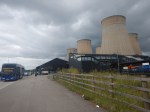
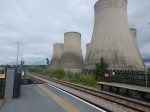
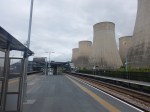
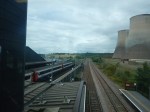
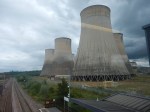
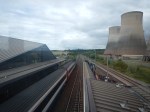
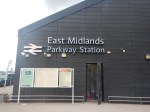
Ratcliffe-on-Soar is the last of a number of large coal-fired power stations, that were built in the area, mainly along the River Trent.
- Rugeley – 600 MW – 1961
- Drakelow – 1630 MW – 1964
- Willington – 800 MW – 1962
- Castle Donington – 600 MW – 1958
- Ratcliffe-on-Soar – 2000 MW – 1968
- High Marnham – 1000 MW – 1959
- Cottam – 2000 MW – 1968
- West Burton – 2000 MW – 1968
Note.
- The date is the commissioning date.
- That is 10,630 MW of electricity.
- There are also a few large gas-fired power stations along the river, that are still operating.
- Both coal and gas-fired stations use the water from the River Trent for cooling.
At the mouth of the river, there is the Keadby cluster of gas-fired power stations.
- Keadby 1 – 734 MW – 1996
- Keadby 2 – 849 MW – 2023
- Keadby 3 – 910 MW – 2027
- Keadby Hydrogen – 900 MW – 2030
Note.
- The date is the commissioning date.
- That is 3,393 MW of electricity.
- Keadby 2 is the most efficient CCGT in the world.
- Keadby 3 will be fitted with carbon capture.
- Keadby 2 has been designed to be retrofitted with carbon capture.
- Keadby Hydrogen will be fuelled by zero-carbon hydrogen.
As the years progress, I can see the Keadby cluster of power stations becoming a large zero-carbon power station to back-up wind farms in the North Sea.
- Hydrogen power stations will emit no carbon dioxide.
- Carbon dioxide from all gas-fired stations will be captured.
- Some carbon dioxide will be sold on, to companies who can use it, in industries like construction, agriculture and chemical manufacture.
- The remaining carbon dioxide will be stored in depleted gas fields.
As technology improves, more carbon dioxide will be used rather than stored.
Other Power Sources In The Humberside Area
In the next few sub-sections, I will list the other major power sources in the Humberside area.
Drax Power Station
Drax power station is a shadow of its former self, when it was one of the power stations fed by the newly discovered Selby coalfield.
These days it is a 2,595 MW biomass-fired power station.
Eastern Green Link 2
Eastern Green Link 2 will be a 2 GW interconnector between Peterhead in Scotland and Drax.
It is shown in this map.

Note.
- Most of the route is underwater.
- It is funded by National Grid.
- Contracts have been signed, as I talk about in Contracts Signed For Eastern Green Link 2 Cable And Converter Stations.
- It is scheduled to be completed by 2029.
This interconnector will bring up to 2 GW of Scottish wind-generated electricity to Drax and Humberside.
Drax has the substations and other electrical gubbins to distribute the electricity efficiently to where it is needed.
2 GW could also reduce the amount of biomass used at Drax.
In the long term, if the concept of the four Eastern Green Links is successful, I could see another Eastern Green Link to Drax to replace imported biomass at Drax.
I also, don’t see why a smaller Drax can’t be run on locally-sourced biomass.
Solar Farms And Batteries Along The River Trent
As the coal-fired power stations along the River Trent are demolished, solar farm developers have moved in to develop large solar farms.
Salt End Power Station And Chemical Works
These two paragraphs from the Wikipedia entry for Salt End describes the hamlet and its power station and chemical works.
Salt End or Saltend is a hamlet in the East Riding of Yorkshire, England, in an area known as Holderness. It is situated on the north bank of the Humber Estuary just outside the Hull eastern boundary on the A1033 road. It forms part of the civil parish of Preston.
Salt End is dominated by a chemical park owned by PX group, and a gas-fired power station owned by Triton Power. Chemicals produced at Salt End include acetic acid, acetic anhydride, ammonia, bio-butanol, bio-ethanol, ethyl acetate (ETAC) and ethylene-vinyl alcohol copolymer (EVOH) with animal feed also being produced on site.
I wonder, if running the complex on hydrogen would give cost and marketing advantages.
Aldbrough Hydrogen Storage Facility
This page on the SSE Thermal web site is entitled Plans For World-Leading Hydrogen Storage Facility At Aldbrough.
This is the most significant paragraph of the page, that is definitely a must-read.
With an initial expected capacity of at least 320GWh, Aldbrough Hydrogen Storage would be significantly larger than any hydrogen storage facility in operation in the world today. The Aldbrough site is ideally located to store the low-carbon hydrogen set to be produced and used in the Humber region.
This is a hydrogen storage facility for a much wider area than Humberside.
Rough Gas Storage Facility
This is the first paragraph of the Wikipedia entry for the Rough Gas Storage Facility.
Rough is a natural gas storage facility under the North Sea off the east coast of England. It is capable of storing 100 billion cubic feet of gas, nearly double the storage capacities in operation in Great Britain in 2021.
In Wood To Optimise Hydrogen Storage For Centrica’s Rough Field, I describe Centrica’s plans to convert the Rough gas storage into a massive hydrogen storage.
The Location Of Aldbrough Gas Storage, Rough Gas Storage, Salt End And Easington Gas Terminal
This Google Map shows between Salt End and the coast.
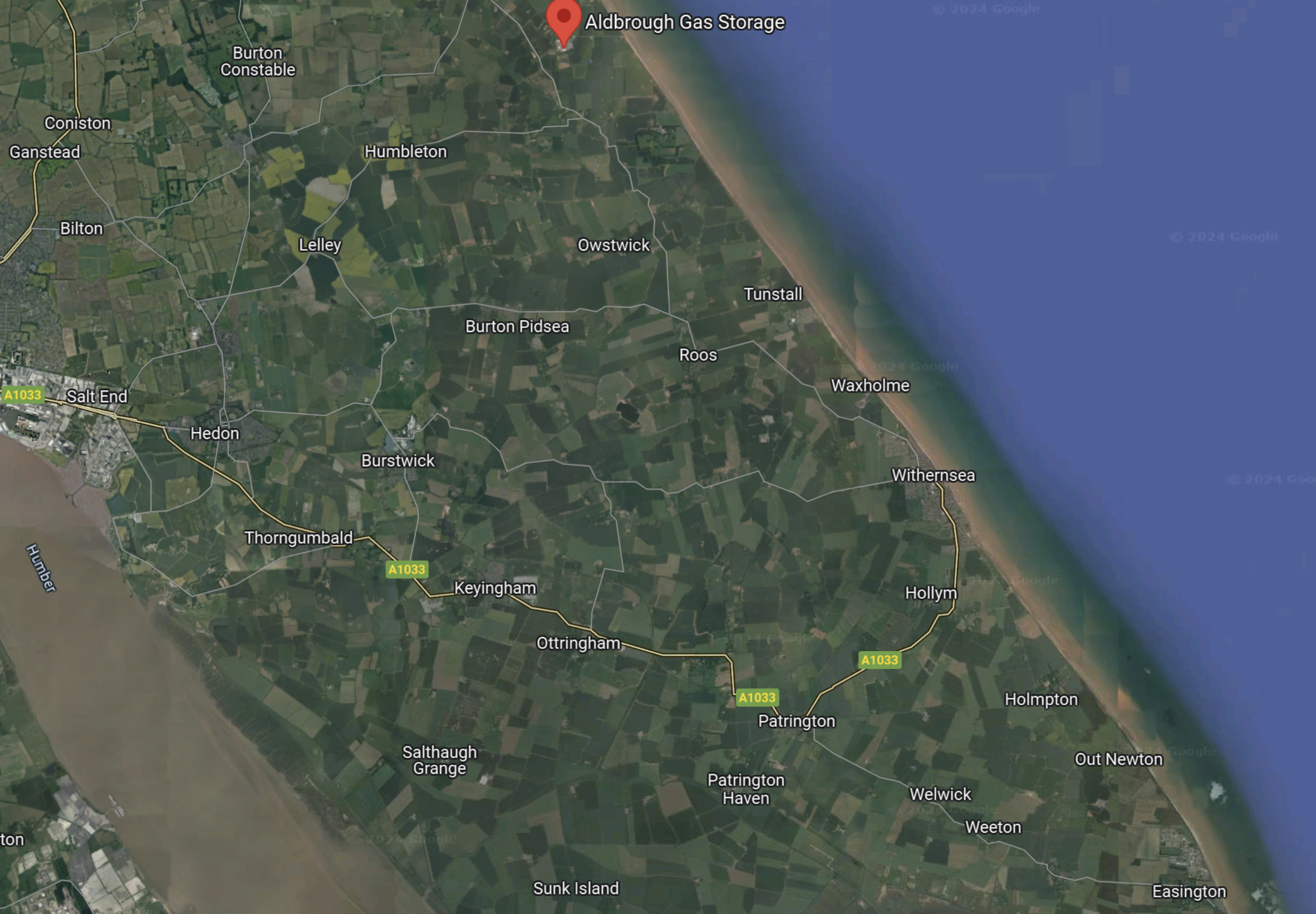
Note.
- The river crossing the South-West corner of the map is the Humber.
- Salt End with its power station and chemical works is on the North Bank of the Humber, where the river leaves the map.
- Aldbrough Gas Storage is marked by the red arrow at the top of the map.
- Easington Gas Terminal is in the South-East corner of the map.
- According to Wikipedia, gas flows into and out of the Rough Gas Storage are managed from Easington.
Looking at the map, I feel that the following should be possible.
- The two gas storage sites could be run together.
- Salt End power station and the related chemical works could run on hydrogen.
- Salt End will always have a reliable source of hydrogen.
- This hydrogen could be green if required.
All the chemical works at Salt End, could be run on a zero-carbon basis. Would this mean premium product prices? Just like organic does?
Enter The Germans
The Germans have a huge decarbonisation problem, with all their coal-fired power stations and other industry.
Three massive projects will convert much of the country and industry to hydrogen.
- H2ercules, which is a project of OGE and RWE, will create a hydrogen network to bring hydrogen, to where it is needed.
- In Uniper To Make Wilhelmshaven German Hub For Green Hydrogen; Green Ammonia Import Terminal, I describe how Uniper are going to build a hydrogen import terminal at Wilhelmshaven.
- AquaVentus is an RWE project that will use 10.3 GW of offshore wind power in German territorial waters to create a million tonnes per year of green hydrogen.
These would appear to be three of Europe’s largest hydrogen projects, that few have ever heard of.
AquaVentus And The UK
This video shows the structure of AquaVentus.
I clipped this map from the video.

Note.
- The thick white line running North-West/South-East is the spine of AquaVentus, that delivers hydrogen to Germany.
- There is a link to Denmark.
- There appears to be an undeveloped link to Norway.
- There appears to be an undeveloped link to Peterhead in Scotland.
- There appears to be a link to just North of the Humber in England.
- Just North of the Humber are the two massive gas storage sites of Aldbrough owned by SSE and Brough owned by Centrica.
- There appear to be small ships sailing up and down the East Coast of the UK. Are these small coastal tankers, that are distributing the hydrogen to where it is needed?
In the last century, the oil industry, built a substantial oil and gas network in the North Sea.
It appears now the Germans are leading the building of a substantial hydrogen network in the North Sea.
These are my thoughts about development of the AquaVentus network.
Hydrogen Production And AquaVentus
This RWE graphic shows the layout of the wind farms feeding AquaVentus.
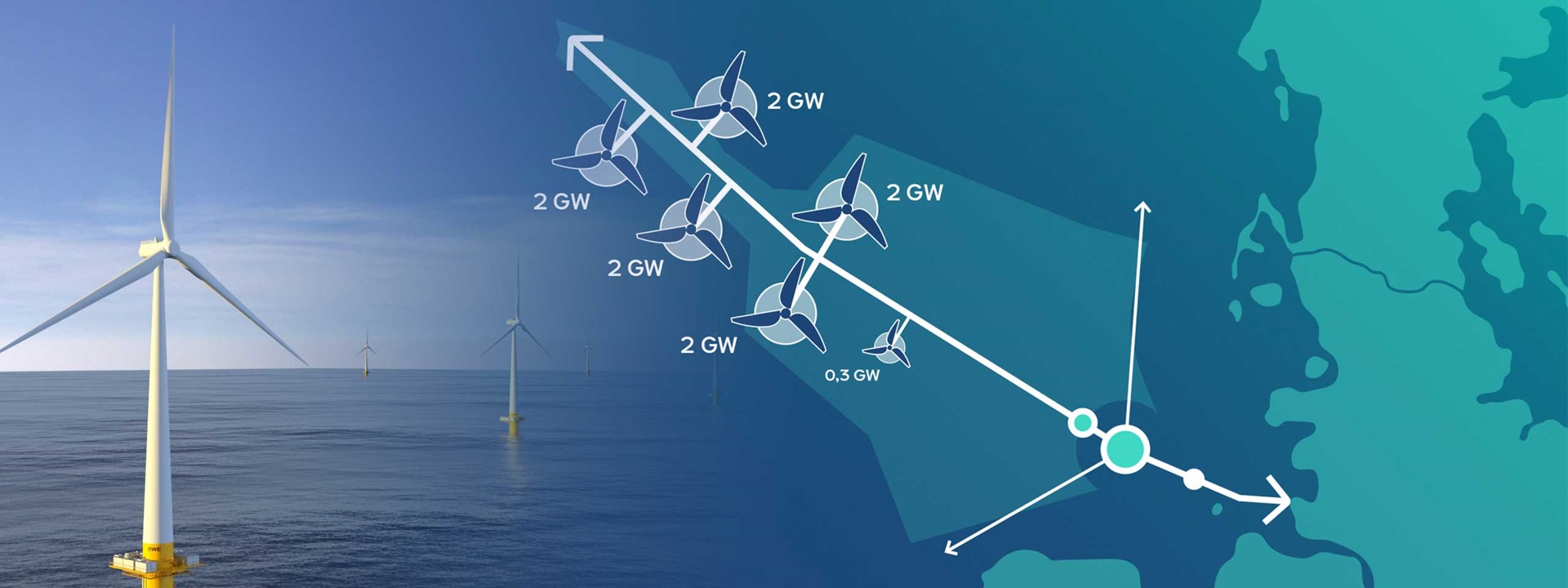
Note.
- There is a total of 10.3 GW.
- Is one of the 2 GW web sites on the UK-side of AquaVentus, the 3 GW Dogger Bank South wind farm, which is being developed by RWE?
- Is the 0.3 GW wind farm, RWE’s Norfolk wind farm cluster, which is also being developed by RWE?
Connecting wind farms using hydrogen pipelines to Europe, must surely mitigate the pylon opposition problem from Nimbys in the East of England.
As the AquaVentus spine pipeline could eventually connect to Peterhead, there will be other opportunities to add more hydrogen to AquaVentus.
Hydrogen Storage And AquaVentus
For AquaVentus to work efficiently and supply a large continuous flow of hydrogen to all users, there would need to be storage built into the system.
As AquaVentus is around 200 kilometres in length and natural gas pipelines can be up to 150 centimetres in diameter, don’t underestimate how much hydrogen can be stored in the pipeline system itself.
This page on the Uniper web site is entitled Green Wilhelmshaven: To New Horizons.
This is a sentence on the page.
Access to local hydrogen underground storage at the Etzel salt cavern site.
An Internet search gives the information, that Etzel gas storage could be developed to hold 1 TWh of hydrogen.
That would be enough hydrogen to supply 10 GW for a hundred hours.
Note that the UK branch of AquaVentus reaches the UK, just to the South of the massive hydrogen storage facilities at Aldbrough and Rough.
It would appear that both Germany and the UK are connected to AquaVentus through substantial storage.
I am certain, that all country connections to AquaVentus will have substantial storage at the country’s hydrogen terminal.
AquaDuctus
This would appear to be the first part of the AquaVentus network and has its own web site.
The web site is entitled Nucleus Of A Offshore Hydrogen Backbone.
These are the first two paragraphs.
The project partners are focusing on a scalable, demand-driven infrastructure: By 2030, AquaDuctus will connect the first large hydrogen wind farm site, SEN-1, with a generation capacity of approximately one gigawatt. SEN-1 is located in the German EEZ in the northwest of Helgoland. The pipeline will transport at a length of approx. 200 km green hydrogen produced from offshore wind to the German mainland and from there to European consumers via the onshore hydrogen infrastructure.
In the next project stage, AquaDuctus will be extended to the remote areas of the German exclusive economic zone towards the tip of the so-called duck’s bill. By that, additional future hydrogen wind farm sites will be connected. Along its way AquaDuctus will provide interconnection points with the opportunity for linking of adjacent national offshore hydrogen infrastructures originating from Denmark, Norway, the Netherlands, Belgium and United Kingdom which opens the door for Europe-wide offshore hydrogen transport by pipeline.
There is also an interactive map, that gives more details.
This paragraph explains, why the Germans have chosen to bring the energy ashore using hydrogen, rather than traditional cables.
Recent studies show that offshore hydrogen production and transport via pipelines is faster, cheaper, and more environmentally friendly than onshore electrolysis with a corresponding connection of offshore wind turbines via power cables. The German federal government has also recognized this advantage and has clearly expressed its intention to promote offshore hydrogen production in the North Sea.
I suspect, that some UK offshore wind farms will use the same techniques.
Hydrogen Production For The UK
Electrolysers will probably be built along the East Coast between Peterhead and Humberside and these will feed hydrogen into the network.
- Some electrolysers will be offshore and others onshore.
- Turning off windfarms will become a thing of the past, as all surplus electricity will be used to make hydrogen for the UK or export to Europe.
- Until needed the hydrogen will be stored in Albrough and Rough.
Backup for wind farms, will be provided using hydrogen-fired power stations like Keadby Hydrogen power station.
Financial Implications
I reported on Rishi Sunak’s Manifesto Speech, which he made on June 11th. This is an extract
This document on the Policy Mogul web site is entitled Rishi Sunak – Conservative Party Manifesto Speech – Jun 11.
These are three paragraphs from the speech.
We don’t just need military and border security. As Putin’s invasion of Ukraine has shown, we need energy security too. It is only by having reliable, home-grown sources of energy that we can deny dictators the ability to send our bills soaring. So, in our approach to energy policy we will put security and your family finances ahead of unaffordable eco zealotry.
Unlike Labour we don’t believe that we will achieve that energy security via a state-controlled energy company that doesn’t in fact produce any energy. That will only increase costs, and as Penny said on Friday there’s only one thing that GB in Starmer and Miliband’s GB Energy stands for, and that’s giant bills.
Our clear plan is to achieve energy security through new gas-powered stations, trebling our offshore wind capacity and by having new fleets of small modular reactors. These will make the UK a net exporter of electricity, giving us greater energy independence and security from the aggressive actions of dictators . Now let me just reiterate that, with our plan, we will produce enough electricity to both meet our domestic needs and export to our neighbours. Look at that. A clear, Conservative plan not only generating security, but also prosperity for our country.
I can’t remember any reports about an energy security policy, which he outlined in the last paragraph of my extract from his speech.
He also said we would have sufficient electricity to export to our neighbours. As I said earlier some of this energy will be in the form of hydrogen, which has been created by offshore electrolysers.
If we are exporting electricity and hydrogen to Europe, this is likely to have three effects.
- An improvement in Europe’s energy security.
- H2ercules will improve and decarbonise German industry, using UK hydrogen.
- The finances of UK plc will improve.
It looks like there would be winners all round.
Rishi Sunak had the cards and he played them very badly.
It is now up to Keir Starmer, Great British Energy and Jürgen Maier to play those cards to link the energy systems of the UK and Germany to ensure security and prosperity for Europe.
East Midlands Commuter Programme
The East Midlands Commuter Programme has been launched.
It has its own web site, with this mission statement.
Working Towards A Sustainable/Healthy/Prosperous East Midlands By Investing In Rail
And this more expansive statement.
East Midlands Commuter Programme is a scheme to introduce a high-frequency and high-quality rail service across the East Midlands with as little new infrastructure as possible, as well as lobbying for the extension of NET trams into Derby, East Midlands Airport and more.
So what is the flesh on the bones?
Four Stages
These are.
- Stage One – Building the Core
- Stage Two – Trams and Stations
- Stage Three – A Vital Stage For Heavy Rail
- Stage Four – Achieving Twenty trams per hour Through Toton
It looks to me, that there is the start of good things there, but full information is not on the web site yet.
Every plan put forward must be capable of being built.
I shall not comment further until the plan has been completed, published and handed to the Government.
Liverpool’s Vision For Rail was published by the region in July 2021 and it is a complete and well-thought out plan.
In October 2021, I was able to write Chancellor To Fund £710m Merseyrail Expansion.
Work has already started on the first extension to Headbolt Lane station.
At a very much smaller level, look what happened in Devon with the Dartmoor Line, where a small scheme was delivered quickly.
We now also have two further smaller well-planned schemes underway; the Northumberland Line and the Levenmouth Rail Link in Scotland.
Conclusion
I would suspect, that if the East Midlands can write a plan that is complete, fully-costed and deliverable, then they will get the same result as the Liverpool City Region.
Plans For £100m Coventry To Nottingham Rail Link Announced
The title of this post, is the same as that of this article on the BBC.
This is the first two paragraphs.
A £100m scheme to reconnect three Midlands cities by rail could be running by 2025, subject to funding, according to a regional transport group.
Midlands Connect said it had completed a strategic business case for a direct link between Coventry, Leicester and Nottingham.
The article also says this about the route.
The group said there was a “strong case” for the project and it had narrowed it down to two – one which called at the Warwickshire town of Nuneaton and one which ran direct between the three cities.
In A Potential Leicester To Coventry Rail Link, which I wrote in February 2019, I talked about this link and came to the conclusion it was feasible.
But things have moved on in those two years and these are my updated thoughts.
Via Nuneaton Or Direct
This Google Map shows the rail layout to the South of Nuneaton station.
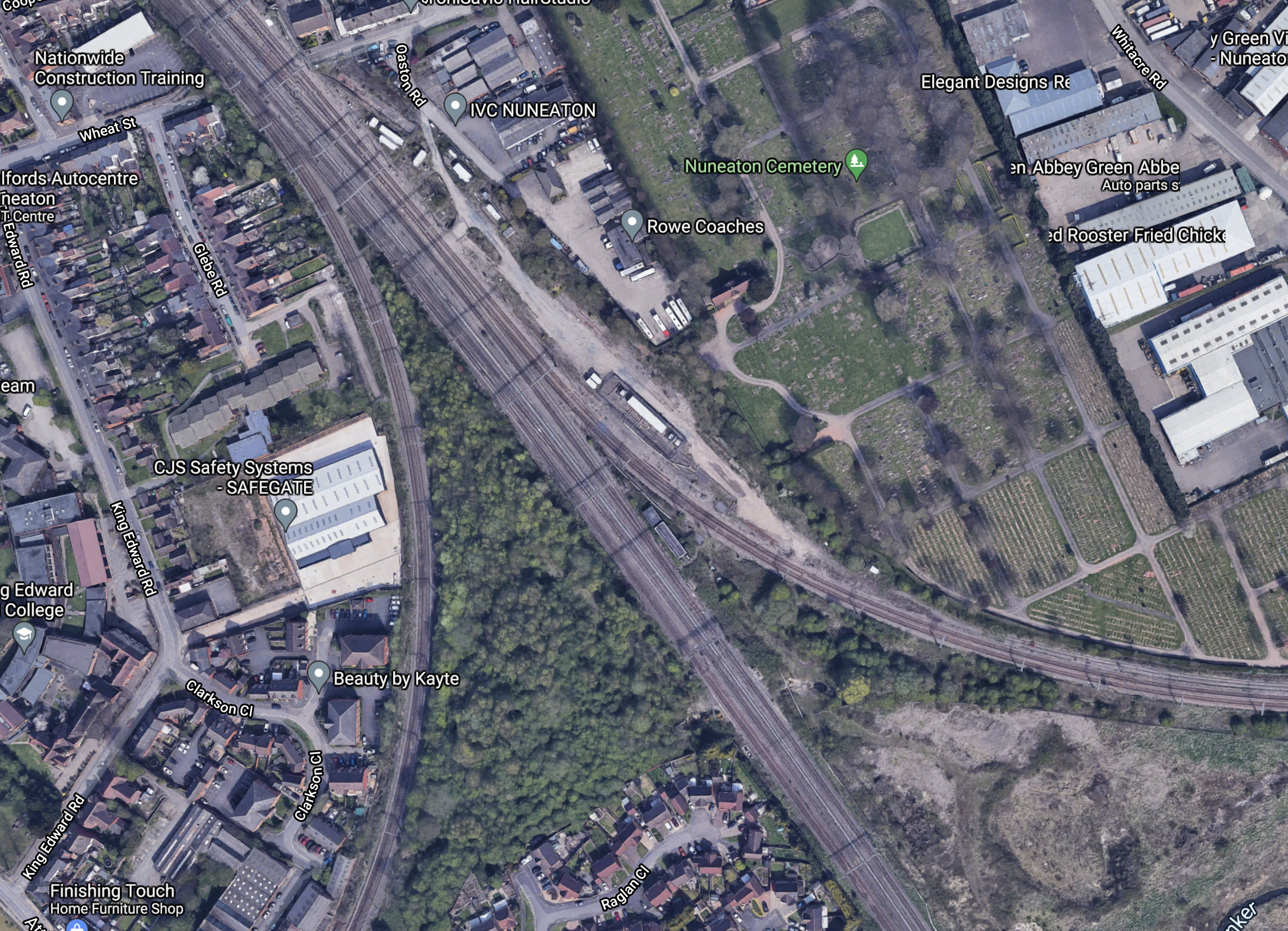
Note.
- The multi-track electrified railway running North-West and South-East is the Trent Valley section of the West Coast Main Line.
- Branching off to the South-West is the Coventry and Nuneaton Line.
- Branching off to the South-East is the line to Leicester.
Nuneaton station is off the map to the North on the West Coast Main Line.
Unfortunately, services to Coventry and Leamington Spa call in Platform 1 on the Western side of the station and services between Leicester and Birmingham call in platforms 6 and 7 on the Eastern side.
This probably rules out a clever solution, where perhaps an island platform, has Birmingham and Leicester services on one side and Coventry and Leicester services on the other.
This Google Map shows Nuneaton station.
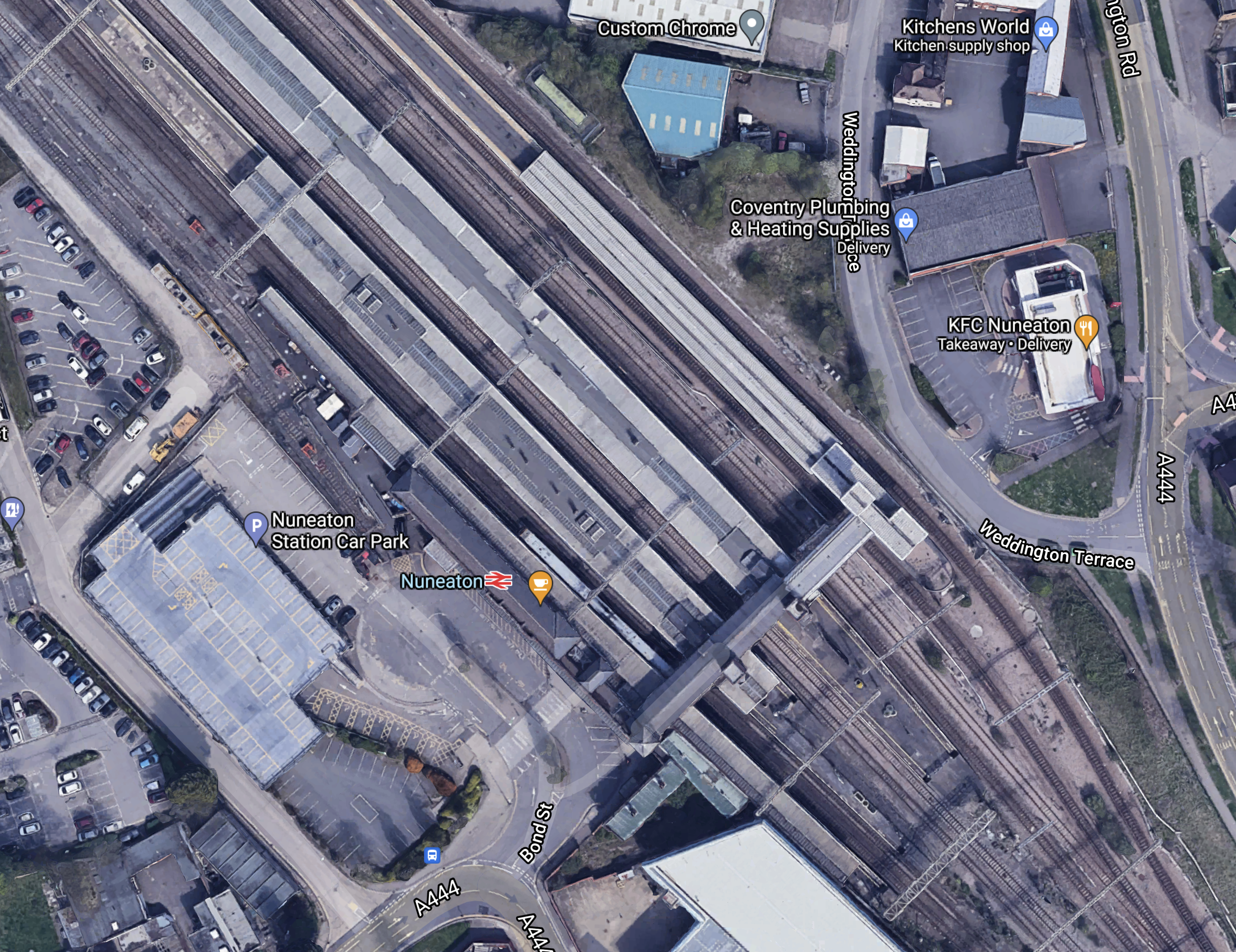
Note.
- Platform 6 and 7 form the island platform on the North-East side of the station.
- Birmingham trains call in Platform 6.
- Leicester trains call in Platform 7.
The track layout for Platforms 6 and 7 appears comprehensive with crossovers allowing both platforms to be used for services to both cities.
This Google Map shows the crowded track layout to the South of the station.
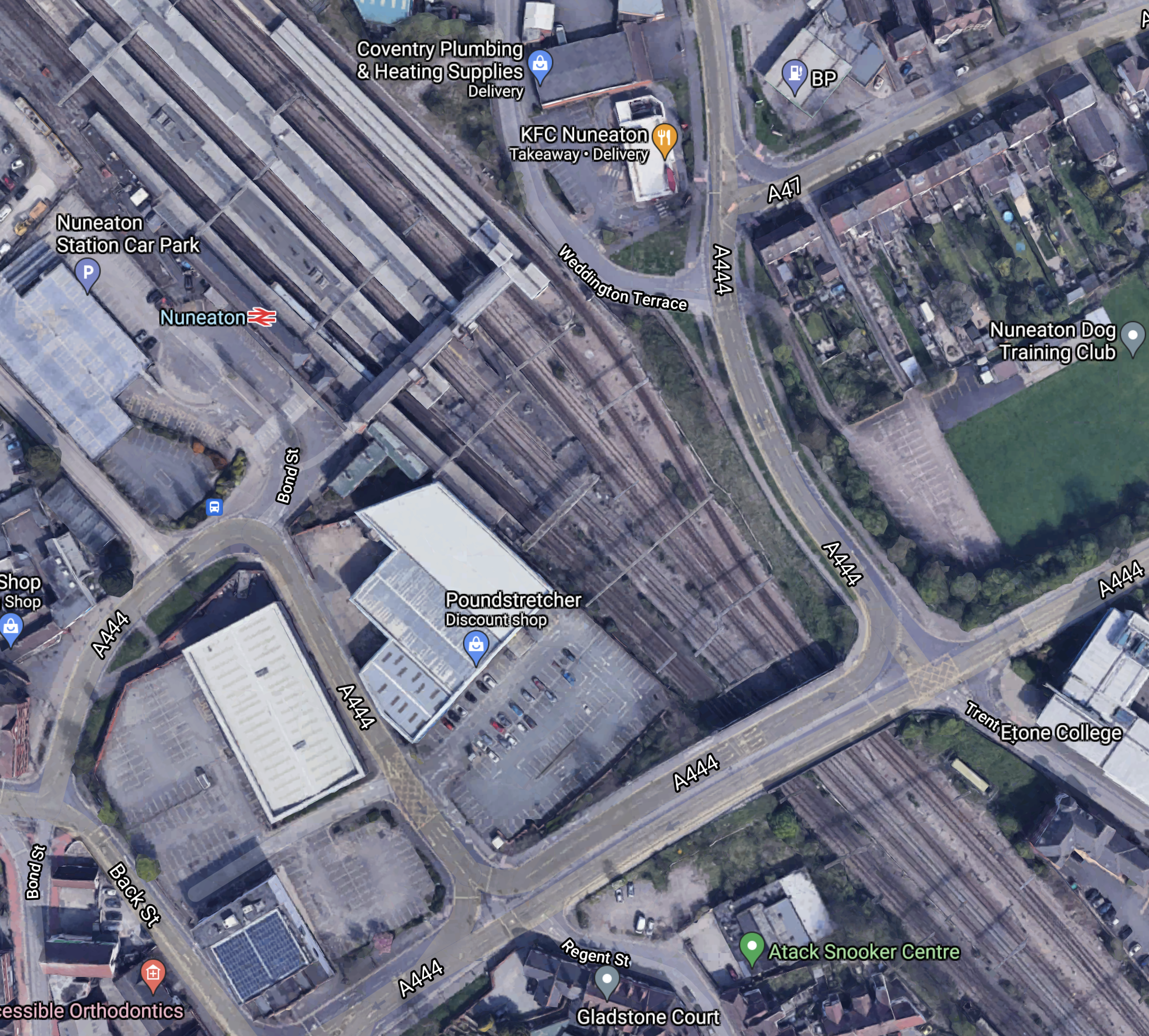
The only possibility would appear to be a single track dive-under that connected Platform 6 and/or 7 to the Coventry and Nuneaton Line on the other side of the West Coast Main Line.
I feel that costs would rule it out.
I suspect that a direct solution cutting out Nuneaton might be possible.
This Google Map shows the three routes diverging to the South of Nuneaton station.
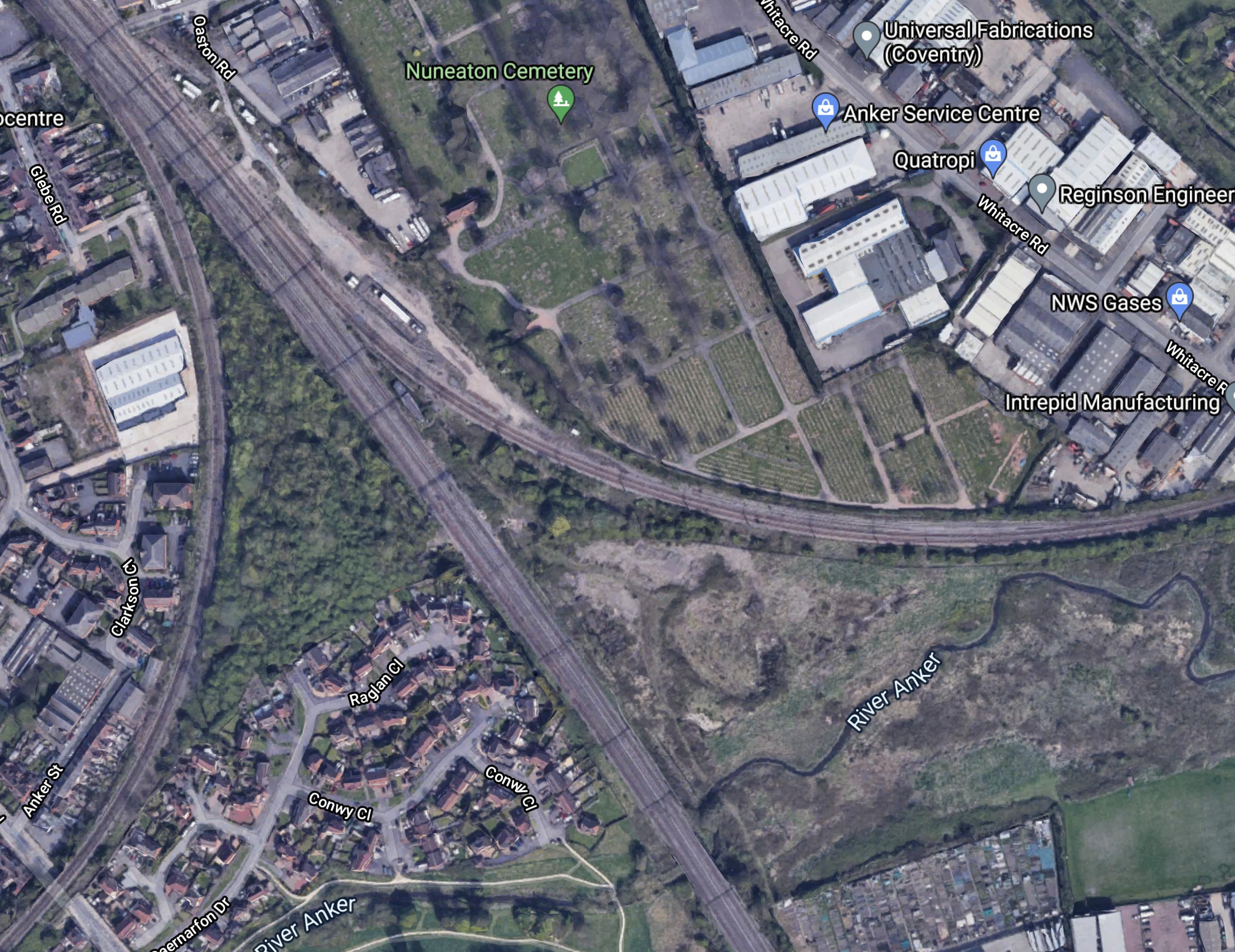
It might be possible to connect the Coventry and Leicester Lines, but the curve might be too tight.
The alternative could be to build a dive-under that would connect Platform 1 to the Leicester Line.
- It would appear that it could be the easiest and most affordable option.
- Trains would reverse in Nuneaton station.
It is certainly a tricky problem, but I do believe there is a simple cost-effective solution in there somewhere.
Nuneaton Parkway Station
This page on Coventry Live gives some information about the proposed Nuneaton Parkway station.
There is also a proposed station, to be called Nuneaton Parkway, situated off the A5 between Hinckley and Nuneaton.
This Google Map shows the area where the A5 crosses the Birmingham-Peterborough Line, that runs between Hinckley and Nuneaton..
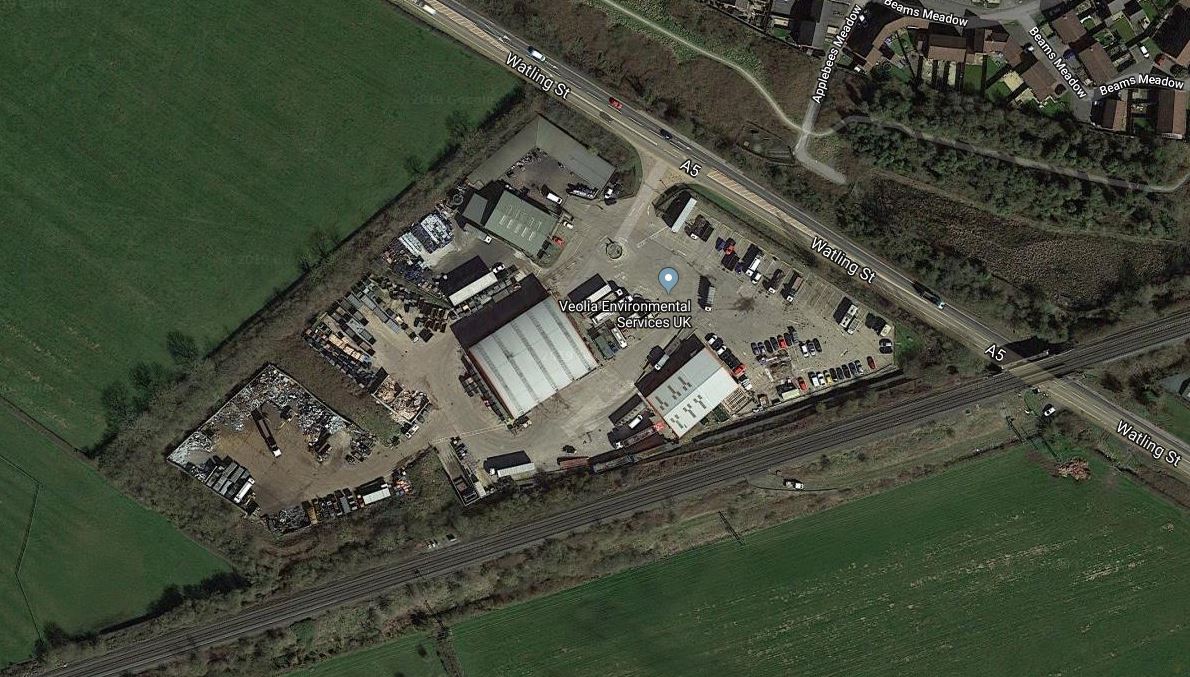
This must surely be one of the best sites to build a new Parkway station in the UK.
- The triangular site is a waste transfer station operated by Veolia Environmental Services UK.
- It has a direct connection to the A5, which could be easily improved, with perhaps a roundabout.
- Doing a crude estimate from the Google Map, I calculate that the site is about sixteen hectares, which is surely a good size for a Parkway station.
- There’s even quite a lot of new housing within walking and cycling distance.
It would also appear that the station could be built on this site without major disruption to either road or rail traffic.
The Stations And Timing
This document on the Midlands Connect web site, gives their aims for the service.
- Coventry and Leicester – 38 minutes from 54 minutes with one change.
- Coventry and Loughborough – 50 minutes from 88 minutes with otwo changes.
- Coventry and East Midlands Parkway – 56 minutes from 104 minutes with otwo changes.
- Coventry and Nottingham – 70 minutes from 108 minutes with otwo changes.
The service would have a frequency of two trains per hour (tph).
If the train did the same station stops as the current services between Coventry and Leicester, it could stop at all or a selection of the following intermediate stations.
- South Wigston
- Narborough
- Hinckley
- Nuneaton
- Bermuda Park
- Bedworth
- Coventry Arena
The total time would appear to be around fifty minutes, with 28 minutes for Leicester to Nuneaton and 22 minutes from Nuneaton to Coventry. Although the BBC article says that Coventry and Leicester would drop from the current 54 minutes to 38 minutes.
Currently services between Leicester and Birmingham New Street stations are run by CrossCountry.
- One tph – Birmingham New Street and Cambridge or Stansted Airport
- One tph – Birmingham New Street and Leicester
Note that not all intermediate stations receive a two tph service.
Would a two tph service between Leicester and Coventry enable all the stations on the route to have a two tph service?
The Current Leicester And Nottingham Service
Currently the following services run between Leicester and Nottingham.
- 1 tph – EMR InterCity – Direct
- 1 tph – EMR InterCity – Via Loughborough, East Midlands Parkway and Beeston
- 1 tph – EMR Regional – Via Syston, Sileby, Barrow-upon-Soar, Loughborough, East Midlands Parkway, Attenborough and Beeston
Note.
- Timings vary between 23 and 49 minutes.
- Four tph between Leicester and Nottingham would be a Turn-Up-and-Go service that would attract passengers.
- The BBC article is indicating a Coventry and Nottingham time of 70 minutes, which would indicate a Leicester and Nottingham time of 32 minutes, which would appear to be in-line with the EMR Intercity service that stops at Loughborough, East Midlands Parkway and Beeston.
It looks to me that a fourth semi-fast service between Leicester and Nottingham would not be a bad idea.
But Midlands Connect are proposing two extra tph between Coventry and Nottingham.
A Coventry And Nottingham Service
Consider.
- An two tph service would fit in well and give a Turn-Up-and-Go service between Leicester and Nottingham.
- The Coventry and Nottingham time of 70 minutes indicates that the train would need to be to EMR InterCity standard.
- If there is an allowance of twenty minutes at either end of the route, this would indicate a round trip of three hours.
This standard of service would need an operational fleet of six five-car Class 810 trains or similar for a frequency of two tph.
I very much feel that there should be electrification of the Midland Main Line between Leicester and either East Midlands Parkway or Derby.
This would mean that the Coventry and Nottingham route would break down as follows.
- Coventry and Nuneaton – 19,2 miles – No electrification
- Nuneaton and Leicester – 18.8 miles – No electrification
- Leicester and East Midlands Parkway – 19.1 miles – Possible electrification
- East Midlands Parkway and Nottingham – 8.4 miles – No electrification
Note that electrification is already available at Coventry and Nuneaton.
The Coventry and Nottingham route would appear to be possible with battery-electric trains, after the route between Leicester and East Midlands Parkway is electrified.
An Improved Birmingham And Cambridge Service
If Nottingham and Coventry needs a fast two tph service stopping at the major towns and cities in between, surely Birmingham and Cambridge need a similar service.
- It could call at Nuneaton, Leicester, Melton Mowbray, Oakham, Stamford, Peterborough, Ely and Cambridge North.
- Some services could be extended to Stansted Airport.
- It would have a frequency of two tph.
The Birmingham and Cambridge route would break down as follows.
- Birmingham and Nuneaton – 21 miles – No electrification
- Nuneaton and Leicester – 18.8 miles – No electrification
- Leicester and Peterborough – 40 miles – No electrification
- Peterborough and Ely – 30.5 miles – No electrification
- Ely and Cambridge – 14.7 miles – Electrified.
Note that electrification is already available at Birmingham, Nuneaton and Peterborough.
The Birmingham and Cambridge route would appear to be possible with battery-electric trains, if Leicester station were to be electrified.
Midland Connect’s Proposed Leeds and Bedford Service
I wrote about this service in Classic-Compatible High Speed Two Trains At East Midlands Hub Station.
It would run between Leeds and Bedford stations.
It would use the Midland Main Line between Bedford and East Midlands Hub stations.
It would use High Speed Two between East Midlands Hub and Leeds stations.
It would stop at Wellingborough, Kettering, Market Harborough, Leicester, Loughborough and East Midlands Hub stations.
- The service frequency could be hourly, but two trains per hour (tph) would be better.
- Leicester and Leeds would take 46 minutes.
Obviously, it wouldn’t run until the Eastern Leg of High Speed Two opens, but it could open up the possibility of Coventry and Leeds in under ninety minutes.
Driving takes over two hours via the M1.
Conclusion
This looks to be a very feasible and fast service.
It also illustrates how extending the electrification on the Midland Main Line can enable battery-electric trains to provide connecting services.
Enough electrification at Leicester and a few miles North of the station to fully charge passing trains would probably be all that is needed.
£2.7bn East Midlands Plan Unveiled For HS2 Links
The title of this post, is the same as that of this article on Rail News.
This is the first two paragraphs.
A bold plan costed at £2.7 billion for the area around the HS2 hub in the East Midlands has been published by a group of councils, transport bodies and East Midlands Airport.
The core of the scheme is the future East Midlands Hub at Toton, and the plan proposes direct access to the Hub from more than 20 cities, towns and villages in the East Midlands.
If you want to read the original report by Midlands Connect, there’s a download link on this page of their web site.
The project is in three phases.
Phase One
Phase One is to be operational within ten years.
- Scheme 1 – The extension of the Nottingham tram system (Nottingham Express Transit or NET light rail system) from the Toton Lane Park and Ride site to Long Eaton via two new stops at the planned Innovation Campus development and HS2 East Midlands Hub station.
- Scheme 2 – New bus services between the HS2 East Midlands Hub and Amber Valley, West Bridgford and Clifton.
- Scheme 3 – Bus Rapid Transit between the HS2 East Midlands Hub and Derby city centre via Pride Park and Derby railway station.
- Scheme 4 – Extension of the HS2 East Midlands Hub A52 highway access route to the A6005 Derby Road in Long Eaton.
- Scheme 5 – Capacity enhancements to M1 Junction 25, increasing road capacity and improving access to the HS2 East Midlands Hub station and Innovation Campus site.
- Scheme 6 – The implementation of a minimum of four direct rail services per hour linking the HS2 East Midlands Hub station to Derby, Nottingham and Leicester stations, as well as Loughborough, Matlock, Mansfield, Newark, Alfreton and Grantham, made possible by the building of a new piece of infrastructure, the Trowell Curve, which will link to the Midland Mainline.
- Scheme 7 – New rail service between Mansfield, Derby and Leicester with stops at Ilkeston, Langley Mill, Kirkby in Ashfield, Sutton Parkway and HS2 East Midlands Hub via the Kirkby Freight Line (Maid Marian line).
Note.
- These schemes will be built before the HS2 East Midlands Hub station opens.
- I discussed Scheme 7 – The Maid Marian Line in After The Robin Hood Line Will Nottingham See The Maid Marian Line?.
The most important part of Phase One is that all these seven schemes will be built before High Speed Two reaches the East Midlands. So hopefully, there will be a continuous stream of improvements in the East Midlands.
Phase Two
Phase Two will be operational within twenty years.
- Scheme 8 – Extension of the NET light rail system or enhanced Bus Rapid Transit from the HS2 East Midlands Hub station to Derby.
- Scheme 9 – The construction of a railway station at East Midlands Airport, connected to the Midland Mainline via a spur to the south of Kegworth village, allowing new direct rail services to the airport from Derby, Nottingham, Leicester and Mansfield as well as some intermediate stations including HS2 East Midlands Hub and East Midlands Parkway. This intervention will vastly improve public transport access to East Midlands Airport for passengers and staff.
Phase Three
Phase Three will be operational within twenty-five years.
- Scheme 10 – A new rail line between East Midlands Airport (opened during Phase 2) and Derby via the South Derby Growth Zone residential and employment developments and the Rolls Royce site, designed to support local housing and employment growth.
- Scheme 11 – A tram-train service connecting into the NET light rail network (Phase 1) to a proposed development site (11,000 houses and other associated development) to the west of East Midlands Airport. This scheme would also serve stops within the Ratcliffeon-Soar power station development site and could also serve Kegworth village and the East Midlands Gateway Logistics Park.
It is comprehensive project and I will discuss the various schemes in separate posts.
Northern Cities And COVID-19
If you look at the official Government statistics for the total number of cases of COVID-19, as of May 3rd, the number of cases in the two major cities in the North West as follows.
- Leeds – 1463 out of a city population of 789,194 (0.18%) and a metro population of 2,638,127 (0.05%)
- Liverpool – 1454 out of a city population of 494,814 (0.29%) and a metro population of 2,241,000 (0.06%)
- Manchester – 1154 out of a city population of 547,627 (0.21%) and a metro population of 3,748,274 (0.03%)
- Newcastle – 939 out of a city population of 300,196 (0.31%) and a metro population of 1,650,000 (0.06%)
- Nottingham – 537 out of a city population of 321,500 (0.17%) and a metro population of 1,610,000 (0.03%)
- Sheffield – 2191 out of a city population of 582,506 (0.38%) and a metro population of 1,569,000 (0.14%)
Note.
- All populations come from Wikipedia.
- Why is Liverpool 40% worse than Manchester?
- Why is Sheffield the worst?
I will add a few smaller towns andcities.
- Blackpool – 465 out of an urban population of 139,720 (0.33%)
- Caldervale – 252 out of an urban population of 200,100 (0.13%)
- Hull – 469 out of a city population of 260,645 (0.18%)
- Middlesbrough – 566 out of an urban population of 174,700 (0.32%)
- Stoke-on-Trent – 509 out of a city population of 255,833 (0.20%)
- York – 315 out of a city population of 209,893 (0.15%)
I’d like to see full statistics plotted on a map or a scatter diagram.
The latter is a very powerful way to plot data and often they highlight data points that lie outside the underlying pattern of the data.
Fresh Calls For ‘Missing Link’ Buxton To Matlock Railway Line To Be Reopened
The title of this post is the same as that of an article in the Buxton Advertiser.
I wrote in full about this route in Connecting The Powerhouses, after an article was published in the June 2017 Edition of Modern Railways.
This was my conclusion.
It’s very difficult to find a reason not to reopen the Peak Main Line.
I think in the last two years the case for reopening the Peak Main Line between Buxton and Matlock may have become even stronger.
MEMRAP
A group called the Manchester and East Midlands Rail Action Partnership or MEMRAP has been setup to promote the case for reopening.
A web site has been created.
New Lower-Carbon And Quieter Passenger Trains
Rolling stock has improved and trains like tri-mode Class 755 trains and possible battery electric trains, should be able to handle the route in a more environmentally-friendly way.
Transport Of Building Materials
This is a paragraph from the Buxton Advertiser article.
Funding for the project, according to Mr Greenwood, would come from working in partnership with local quarries which are supplying materials for the new Heathrow Airport runway and are involved with the HS2 project.
Network Rail has already have spent a lot of money to improve freight access to the quarries, as I reported in £14m Peak District Rail Freight Extension Unveiled. So the demand for building materials must be there and going via Matlock would remove some heavy freight trains from the Hope Valley Line.
Heavy freight trains might not be welcomed by all stakeholders.
Possible High Speed Two Cutbacks
As I wrote in Rumours Grow Over Future Of HS2, The Eastern leg of High Speed Two might be axed.
This may or may not change the case for reopening the Peak Main Line.
There Will Be Opposition
This is two paragraphs from the Buxton Advertiser article.
Peak Rail has long campaigned to re-open the line for heritage trains to run between Buxton and Matlock. However, director Paul Tomlinson said he was not in favour of the new plans.
He said: “I’m all in favour raising the profile of the line to get it re-opened but we can’t support this new idea.
Others will also object.
Conclusion
There will be various opposing pressures on both sides of reopening the Peak MNain Line.
In favour will be.
- The quarries.
- Cities like Derby and Nottingham and passengers wanting better links to and from Manchester and its Airport.
- Transport for the North, as opening could increase capacity on the Hope Valley Line between Manchester and Sheffield.
Local interests will want to maintain the status quo.
How Will Abellio East Midlands Railway Maximise Capacity On The Midland Main Line?
In this post, I will try and get a feel to how Abellio East Midlands Railway, will maximise capacity on the Midland Main Line.
The Current Service
There are currently two trains per hour (tph) to both Nottingham and Sheffield and one tph to Corby from London.
Ignoring the Corby service, which will be using electric trains, intermediate calls have these frequencies, from South to North.
- Bedford – One tph
- Wellingborough – One tph
- Kettering – One tph
- Market Harborough – Two tph
- Leicester – Four tph
- Loughborough – Two tph
- East Midlands Parkway – Two tph
- Long Eaton – One tph
- Beeston – One tph
- Derby – Two tph
- Chesterfield – Two tph
As the new bi-mode trains will be more modern, with probably shorter dwell times at each station, I suspect that when Abellio East Midlands Railway implement their ultimate timetable, there will be more stops, without degrading journey times.
These are fastest times.
- London and Nottingham is one hour forty minutes
- London and Sheffield is two hours
I feel that round trips to both destinations will be four hours with some speed increases and shorter station dwell times.
- The current two tph to Nottingham and Sheffield needs eight trains to each destination.
- This is a total of sixteen trains.
As each train could be two five-car trains working as a ten-car train, train numbers for the current service could be as high as thirty-two trains.
A first look seems to indicate that there .will be no overall increase in train frequency, although, as I said earlier, the performance of the new trains should allow extra station stops.
It also indicates to me, that any increases in frequency between London and Nottingham/Sheffield will need extra trains.
The Electrified High Speed Line South Of Kettering
Midland Main Line services South of Kettering are as follows.
- Two tph to London and Nottingham
- Two tph between London and Sheffield
- One tph between London and Corby.
From December 2021, there will be two tph between London and Corby.
The maximum number of services between London and Kettering on the electrified section currently envisaged is only six tph or one train every ten minutes.
As the Class 700 trains on Thameslink are capable of using digital signalling and all the new trains will also be similarly equipped, I wouldn’t be surprised that the theoretical capacity of the electrified fast lines could be higher than the proposed six tph. |Especially, when digital signalling is installed.
The number of trains in the fleet, is much more of a limit on services, than the capacity of the Midland Main Line.
If all trains were ten cars, the following numbers of trains would be needed.
- Current two tph – 32 trains
- Increase to three tph – 48 trains
- Increase to three tph – 64 trains
Are there enough passengers to fill all these trains?
Does St. Pancras Have Enough Capacity?
St. Pancras station has four platforms for Midland Main Line services.
- The platforms are long enough to take two five-car Class 222 trains,.
- They would surely accommodate a ten-car formation of the new Hitachi trains.
- Each platform can probably handle three or four tph, giving a total capacity of 12-16 tph.
As four tph to Nottingham and Sheffield and two tph to Corby is only a total of ten tph, there is enough platform capacity for several years to come.
If there is a problem, it is that the large numbers of passengers would overwhelm the stairs and escalators between the ground level of the station and the platforms.
I am certain, that just like the Eurostar platforms at St. Pancras, the Midland Main Line platforms will need better passenger access and facilities.
Will it even be enough, when up to six tph, all of which could be 240 metres long, start to arrive in December 2021?
What could be done to help solve the capacity problem at St. Pancras station in the future?
Better Access To The Midland Main Line Platforms
Consider.
- Space is limited to add extra escalators, lifts and places to wait
- St. Pancras is a Grade I Listed Building.
- As I don’t travel through the station in the Peak, the escalators seem to always be going the wrong way.
Improving the current access will be very difficult.
This Google Map shows the Northern End of the station.
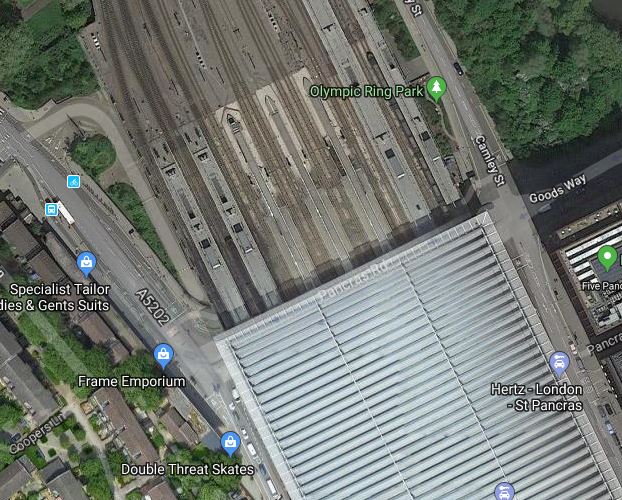
Note.
- The Midland Main Line platforms are the two island platforms on the left.
- The Southeastern HighSpeed platforms are the two island platforms on the right.
- The Eurostar platforms are the three island platforms in the middle.
Could a second entrance to some of the platforms be built here?
It would be very difficult, unless the extension was future-proofed when it was built.
Underground Improvements
Getting between the Midland Main Line platforms and the Underground is an obstable course.
As a Londoner, who’s had the operation to have the Underground Map implanted in my brain, I generally go to the Midland Main Line platforms at St. Pancras by taking one of the following.
A bus from close to my house to outside the station.
- A Metropolitan Line train from Moorgate
- A Northern Line train from Angel.
- A Piccadilly Line train from Manor House
- A Victoria Line train from Highbury & Islington
The last four need a bus to get to the Underground.
I usually come back home, by spending just over a tenner on a black cab!
Crossrail 2
Crossrail 2 should improve matters, but will it ever be built?
Will The New Brent Cross Thameslink Station Allow Cross Platform Interchange Between Midland Main Line and Thameslink Services?
Consider.
- The proposed Brent Cross Thameslink will be just North of Cricklewood station.
- Midland Main Line services through the station would be six tph.
- Thameslink services through the station would be fourteen tph
- The West London Orbital Railway could be built to connect the station to High Speed Two and Heathrow
Would it take the pressure off St. Pancras?
It might do, if a cross-platform interchange could be arranged.
Could Some Midland Main Line Services Use Thameslink?
Consider.
- The obvious service to go through Thameslink would be the two tph service between Corby and St. Pancras.
- Thameslink is currently setup to handle 24 tph, but it has been designed for 30 tph.
- The Corby service will stop at Kettering, Luton and Luton Airport Parkway, to the North of London.
- It could perhaps terminate at the soon-to-be-rebuilt Gatwick Airport station in the South.
It might work!
Especially, if Kettering station were to be rebuilt to have cross-platform interchange between Corby sewrvices and the bi-mode ones going further North.
Splitting And Joining Trains
In Rock Rail Wins Again!, I gave this simple example of how the splitting and joining capability of Hitachi AT-300 trains can be used.
A ten-car train might leave St. Pancras as two five-car units running as a pair. It could split at East Midlands Parkway station and one train could go to Nottingham and the other to Derby. Coming South the two trains would join at East Midlands Parkway.
I feel that Derby, East Midlands Parkway and Leicester are ideal stations on the Midland Main Line, where services could be split and joined.
- They have at least four platforms.
- The platforms are long and straight.
The two terminals at Nottingham and Sheffield could also probably be used to enable services to serve more destinations.
Shorter trains must have advantages on some routes.
- Capacity is better matched to demand.
- Platforms may not need to be extended.
- Services can be run by a driver and a conductor.
Will Abellio East Midlands Railway use splitting and joining to increase the coverage of their services?
Great Western Railway’s Class 800, 801 and 802 trains have the capability to split and join and the operator doesn’t seem to use it. Although, they do split and join Class 387 trains.
Extended Services To And From The North And East
The ability to split and join, that could be used to extend services to the North And East.
Serving Barnsley, South Yorkshire And Leeds
Consider.
- In Sheffield Region Transport Plan 2019 – A New Station At Barnsley Dearne Valley, I talked about a proposed new station at Barnsley Dearne Valley on the route between Sheffield and Leeds.
- The Sheffield Region Transport Plan 2019, also envisages a new Midland Main Line station at Rotherham.
- This report on the Transport for the North web site, is entitled At A Glance – Northern Powerhouse Rail.
- The report states that there will be a fast Sheffield and Leeds service at a frequency of four tph, that taqkes twenty-eight minutes.
- Currently, East Midlands services on this route take just over half-an-hour with only a stop at Wakefield Westgate.
I wonder if there are paths and need for a London and Sheffield service to split at Sheffield with, the two five-car trains going to different destinations.
- Leeds via Rotherham, Barnsley Dearne Valley and Wakefield Westgate, is one possibility.
- Could a service go to Huddersfield?
- Hull is probably too far.
One tph could terminate at Sheffield and one splitting and one tph could split and serve other destinations.
Advantages could include.
- Barnsley and Rotherham get a direct hourly service to London.
- South Yorkshire and Leeds have a direct hourly service to the East Midlands.
- Sheffield and Leeds have an hourly fast service.
I’m sure Abellio have a very workable plan to improve services North of Sheffield.
Serving Lincolnshire And Nottinghamshire
Consider.
- Splitting and joining at Nottingham may allow an increase in direct services to and from Lincoln.
- Perhaps parts of North Lincolnshire could be well-served by a fast train from Nottingham.
- Would Mansfield and Worksop benefit from a direct service from London on the Robin Hood Line, after a reverse at Nottingham.
The five-car trains give the flexibility to do the previously unthinkable.
Conclusion
There is a lot of developments that can or will happen with Midland Main Line services.
 The Anonymous Widower